VitalXPress - Saucepan BEEM - Free user manual and instructions
Find the device manual for free VitalXPress BEEM in PDF.



| Product type | Pressure cooker |
| Brand | BEEM |
| Model | VitalXPress |
| Nominal capacity | 3.0 L / 4.0 L / 6.0 L depending on version |
| Max. usable volume | 2.0 L / 2.67 L / 4.0 L (depending on version) |
| Max. operating overpressure level I | 60 kPa |
| Max. operating overpressure level II | 100 kPa |
| Base diameter | 19 cm (for all versions) |
| Dimensions (H x W x D) | 150 x 455 x 250 mm (3L) / 175 x 455 x 250 mm (4L) / 235 x 455 x 250 mm (6L) |
| Weight | Approx. 2.67 kg (3L) / 2.76 kg (4L) / 4.08 kg (6L) |
| Body material | Stainless steel with encapsulated sandwich base |
| Compatible hob types | Electric, gas, induction |
| Main functions | Pressure cooking (levels I and II), steaming (with steamer basket), use as conventional pot (with optional glass lid) |
| Safety | Safety valve, 3-position regulating valve, red pressure indicator, unlocking button, replaceable sealing ring |
| Care and cleaning | Hand wash with mild detergent; do not use abrasive cleaners or dishwasher for the gasket; clean valves under running water |
| Available spare parts | Sealing ring (ref. 900 216 011), complete lid (ref. 900 216 016), glass lid (ref. 900 216 091) |
| Warranty | Legal warranty + extended manufacturer warranty on certain products (see packaging or BEEM website) |
| Included accessories | Steamer basket, metal support for steamer basket, user manual |
Frequently Asked Questions - VitalXPress BEEM
User questions about VitalXPress BEEM
0 question about this device. Answer the ones you know or ask your own.
Ask a new question about this device
Download the instructions for your Saucepan in PDF format for free! Find your manual VitalXPress - BEEM and take your electronic device back in hand. On this page are published all the documents necessary for the use of your device. VitalXPress by BEEM.
USER MANUAL VitalXPress BEEM
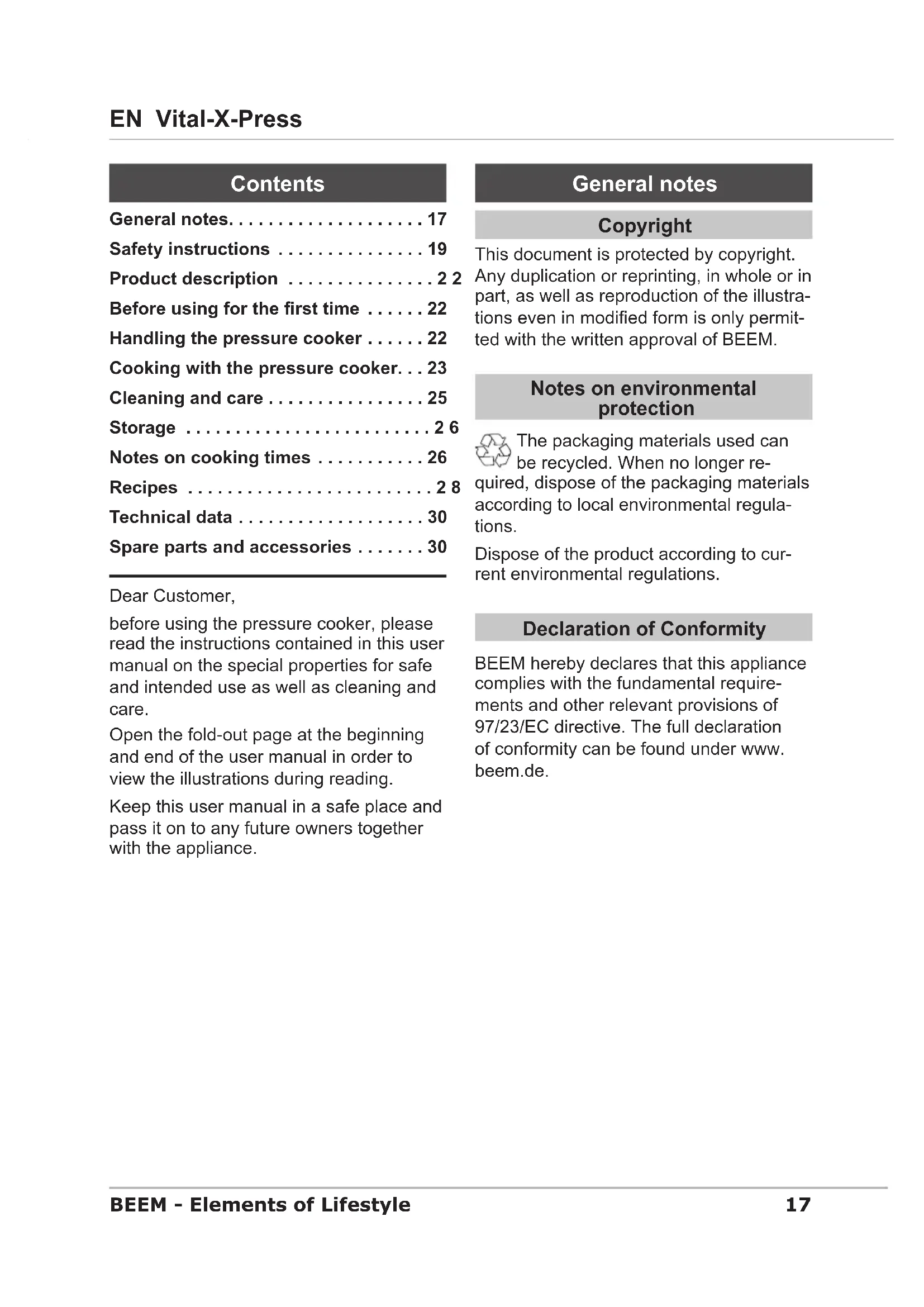
Open the fold-out page at the beginning and end of the user manual in order to view the illustrations during reading.
Safety instructions 19
Product description 22
Before using for the first time 22
Handling the pressure cooker 22
Cooking with the pressure cooker. . . 23
Cleaning and care 25
Storage 26
Notes on cooking times 26
Recipes 28
Technical data 30
Spare parts and accessories 30
Dear Customer,
before using the pressure cooker, please read the instructions contained in this user manual on the special properties for safe and intended use as well as cleaning and care.
Open the fold-out page at the beginning and end of the user manual in order to view the illustrations during reading.
Keep this user manual in a safe place and pass it on to any future owners together with the appliance.
General notes
Copyright
This document is protected by copyright. Any duplication or reprinting, in whole or in part, as well as reproduction of the illustrations even in modified form is only permitted with the written approval of BEEM.
Notes on environmental protection
The packaging materials used can be recycled. When no longer required, dispose of the packaging materials according to local environmental regulations.
Dispose of the product according to current environmental regulations.
Declaration of Conformity
BEEM hereby declares that this appliance complies with the fundamental requirements and other relevant provisions of 97/23/EC directive. The full declaration of conformity can be found under www.beem.de.
Warranty/Guarantee
In addition to the statutory warranty obligation, BEEM also grants an extended manufacturer's guarantee for some products. Provided this is granted, the corresponding details for each product can be found either on the product-specific packaging, advertising material or on the BEEM website.
Please visit our website to obtain more information on comprehensive guarantee conditions, available accessories and spare parts as well as user manuals in various languages.
Symbols used
DANGER
This indicates a possible hazardous situation, which could lead to severe physical injury or death.
Follow these instructions to avoid danger.
WARNING
This is used for a possible hazardous situation that could lead to injury.
Follow these instructions to avoid danger.
CAUTION
This is used for a possible hazardous situation that could lead to damage.
Follow these instructions to avoid danger.
NOTE
A note contains additional information to simplify the use of the appliance.
Intended use
This product is intended for non-commercial preparation of food on electric, gas and induction cookers
Any use other than previously stated is considered as improper use.
WARNING
If not used for its intended purpose and/or used in any other way, the appliance may be or become a source of danger.
Use the appliance only for its intended purpose.
Observe the procedures described in this user manual.
No claims of any kind will be accepted for damage resulting from use of the appliance for other than its intended purpose.
The risk must be borne solely by the user of the appliance.
Limitation of liability
We assume no reliability for damage or follow-up damage in the case of:
failure to observe the instructions in the user manual,
use for other than the intended purpose,
improper or unsuitable handling,
incorrectly performed repairs,
unauthorised modifications,
use of non-approved parts or spare parts,
use of unsuitable supplementary or accessory parts.
Safety instructions
General safety instructions
Read the instructions contained in this user manual completely before you work with the pressure cooker. Improper use can lead to considerable damage.
Do not allow anyone to use the pressure cooker before they have made themselves completely familiar with the user manual.
Only pass on the pressure cooker to a third party together with the user manual.
DANGER
Risk of suffocation from the packing material!
Never play with packaging material. Risk of suffocation.
Supervision
Do not leave the pressure cooker unattended during use.
Do not use the pressure cooker in the vicinity of children.
This pressure cooker is not intended for use by persons (including children) with restricted physical, sensory or mental capabilities or with insufficient experience and/or knowledge unless they are supervised by a person responsibly for their safety or have received instructions on the use of the appliance from such a person.
Safe use
WARNING
Observe the following notes to avoid injury:
The pressure cooker cooks under pressure. Before heating, check that the lid is seated properly as described in the section Closing the lid (page 23). Never use the pressure cooker with a loosely fitting lid.
Check that the safety valve and the regulating valve are clean and functional before using each time (see the section Check the safety valve (page 23) and inspect the pressure cooker for external damage before using. Doe not use a damaged pressure cooker.
WARNING
Observe the following notes to avoid injury:
Always fry in the pressure cooker without the lid in order to prevent the fat from frothing. Do not fill the pressure cooker more than a half with fat. Never fry under pressure.
WARNING
Observe the following instructions to avoid burning/scalding:
Only hold the pressure cooker with the handle and operating elements. If necessary, use gloves or pot holders.
Move the pressure cooker carefully when it is under pressure.
Hot steam can escape from the safety valve and regulating valve. Keep a safe distance from the appliance.
When using as pressure cooker, pay attention to the "max." mark.
In the case of foodstuffs that froth or expand during cooking such as rice, beans and peas, broth or dried vegetables, do not fill the pressure cooking beyond half of its filling capacity.
When using as conventional pot, it is not necessary to pay attention to the "max." mark.
Do not prepare apple puree and compotes in the pressure cooker as this can lead to steam bubbles that could cause scalding when the pot is opened.
WARNING
Observe the following instructions to avoid burning/scalding:
When cooking meat with skin, do not prick into the skin of the meat as long as the skin is swollen. Squirting broth could lead to burns.
CAUTION
Observe the following instructions to avoid damage to the pressure cooker or hot plate:
Never heat the pressure cooker without liquid otherwise the pot can be damaged by overheating. Fill the pressure cooker with liquid up to at least the "min." mark.
Never use the product in the oven. Handles, valves, seals and safety equipment will be damaged by high temperatures.
Safe opening of the pressure cooker
WARNING
Observe the following notes to avoid injury:
Never use force to open the pressure cooker. Do not open it before the pressure has been completely released as described in the section Opening the pressure cooker (page 25).
Shake the pressure cooker thor- roughly before opening each time so that steam bubbles cannot squirt and scald you. This is particularly important when cooling down quickly or after cooling under running water.
Always keep hands, head and body away from the danger zone. You could be injured by escaping steam. Pay particular attention when releasing pressure quickly with the regulating valve at position
Safety during cleaning
WARNING
Danger of burns!
Always allow the pressure cooker to cool down before cleaning.
CAUTION
Do not use sharp objects or abrasive cleaning agents to clean the pressure cooker.
Safety during repairs and maintenance
WARNING
Observe the following notes to avoid injury:
Do not modify the pressure cooker. In particular, do not interfere with the safety equipment other than the cleaning measures listed in these operating instructions. Do not oil the valves!
Replace the sealing ring with an original spare part regularly after using approx. 400 times or at least after 2 years.
Expendable parts that exhibit visible damage (e.g., cracks, discoloring or deformation) or that are not correctly seated, must be replaced immediately. Failure to observe this will impair the function and safety of your pressure cooker.
Repairs to the product must only be carried out by an authorised specialist or by the works customer service. Unqualified repairs can lead to considerable danger for the user. They will also invalidate the warranty/ guarantee.
Defective parts may only be replaced with original spare parts. Only original spare parts guarantee that the safety requirements are met.
Product description
The Vital-X-Press pressure cooker is suitable for preparing soups, stews, vegetables and meat. The glass lid also allows the pressure cooker to be used as a conventional pot. The 6 I pot without lid is suitable for frying. The Vital-X-Press pressure cooker is suitable for all types of cookers.
Product overview
(See illustration on the left fold-out page)
Lid handle, short1
Safety valve2
Lid3
Regulating valve4
Release button5
Lid handle, long6
Pot handle, short7
Pot body8
Sandwiched capsule base9
Pot handle, long10
Sealing ring11
Glass lid button12
Glass lid (available as accessory for 13
single pots)
Wire stand for steam insert14
15 Steam insert
16 Marks on the inside of the pot body
17 User manual (not illustrated)
Before using for the first time
Check the delivery contents
Check for visible signs of damage or missing items.
Report incomplete or damaged contents to your supplier immediately.
Before using for the first time
Clean all parts in warm dishwater to remove possible production residues.
Clean the sealing ring and dry it properly.
Insert the sealing ring into the lid as described in the section Inserting the sealing ring (page 23).
Handling the pressure cooker
Opening the lid
(See illustrations A1, A2)
Hold both handles tightly and press the release button on the lid handle.
Press and hold down the release button and turn the lid anticlockwise.
Lift the lid upward
NOTE
Pressing the release button lifts the regulating valve to release any pressure (see fig. A3 and A4). Wait until the pressure has been fully released before opening the lid.
Closing the lid
(See illustrations B1-B2)
Put the lid with the inserted sealing ring onto the pot so that the arrow on the lid corresponds to the punctiform marking on the pot handle. Make sure that the lid fits properly.
Hold the lid tight and turn it clockwise until the handle snaps in with an audible "click" and cannot be moved any further. Your pressure cooker is now ready for use.
Insert the sealing ring
(see illustration C1-C3)
Insert the sealing ring into the lid without twisting it and or leaving gaps, the sealing ring must lie flat underneath the inwardly bent edge segments of the stainless steel lid.
Check the safety valve
The safety valve indicates the pressure in the pressure cooker by its red cap:
Red cap is down (fig. F1): pressure cooker is not under pressure and can be opened.
Red cap is up (fig. F2): the pressure cooked is under pressure and CANNOT be opened.
NOTE
Before using each time, check that the safety valve can move lightly by pressing against it from beneath. It must be able to move up and down freely (see fig. G1 and G2).
Cooking with the pressure cooker
Preparations
Put the ingredients into the pressure cooker. Pay attention to the minimum and maximum filling quantities.
Check for correct seating of the seal- ing ring as described in the section Inserting the sealing ring (page 23).
Close the lid of the pressure cooker as described in the section Closing the lid (page 23).
Put the pressure cooker onto the cooker and switch the cooker on to maximum heat.
Pay attention to the filling quantity
(See illustration D)
You will find a marking (16) on the inside of the pressure cooker which indicates the filling quantities in litres. The minimum and maximum filling levels are also marked.
"min.": this minimum amount of water is necessary for generating steam irrespective of whether you cook with or without the steam insert. The minimum filling quantity is 1 litre.
max.": the pressure cooker may only be filled to a maximum of 2/3 of its entire filling capacity. In the case of the 4 I pot, this would be roughly 2.6 litres. When using as conventional pot, it is not necessary to pay attention to the "max." mark.
NOTE
When you cook food that foams or expands during cooking (e.g., rice, peas and beans), the pressure cooker may only be filled up to half of its filling capacity. In the case of the 4 l pot, this would be 2 litres.
Setting the regulating valve
(See illustrations E1-E3)
The regulating valve has 3 setting options:
Level Use
| Ⅰ | For slow cooking, e.g. fish or vegetables. |
| Ⅱ | For fast cooking, e.g. meat dishes and stews. |
| For releasing steam so that the lid can be opened. |
NOTE
Before each use, check the function of the regulating valve. Move the rotary knob to each position and back for this purpose.
Tips for energy-saving cooking
Cook vegetables and potatoes with the minimum amount of water. This enables you save up to 10 percent energy.
Match the pot size to the size of the hotplate. The pressure cooker should not be smaller than the hotplate, otherwise 10 to 15 percent more energy will be consumed than necessary.
Switch to a lower heat setting as soon as cooking begins.
Make use of the residual heat of the hotplate for simmering and switch off the hotplate a few minutes before the end of the cooking time.
Using the steam insert
The steam insert can be used to steam delicate foods such as fish or vegetables. The food is then not immersed in the water and is gently cooked by the rising steam.
Fill with water up to the "min" marking in the pot and insert the wire stand supplied into the pot.
Put the steam insert with the food onto the wire stand.
Heating up
At the beginning of the cooking process, steam will escape from the safety valve. This is normal since the pressures is not yet high enough to close the safety valve. As soon as this pressure has been reached, the red cap of the safety valve rises - clearly visible in the inspection window of the safety valve.
Set the regulating valve to the desired cooking level. Pay attention to our recommendations in the section Notes on cooking times (page 26).
As soon as steam escapes from the regulating valve, gradually decrease the heat from the cooker until no more steam escapes. At this point, the values listed in the section Notes on cooking times (page 26) apply.
When no more steam escapes from the regulating valve, gradually increase the heat from the cooker. When steam appears again, leave the heat at that level.
Opening the pressure cooker
After the cooking time has elapsed, the pressure in the pressure cooker must be released before you can open it.
NOTE
The pressure cooker can only be opened when the pressure has been completely released. You can recognise this when the red cap of the safety valve is at the bottom (see fig. F1).
Slower method:
As soon as cooking has finished, remove from the heat and allow the pot to cool down. The red cap of the safety valve sinks - clearly visible in the inspection window of the safety valve.
NOTE
Be aware that the cool-down time is part of the cooking time.
Faster method:
To achieve faster cooling down and release of pressure in the pressure cooker, move the regulating valve to the fast steam position or hold the closed pressure cooker under cold water so that the steam can escape and the pressure can be released.
Cleaning and care
Before beginning any work, pay attention to the safety instructions in the section Safety instructions (page 19)!
Before cleaning, allow the pressure cooker to cool down to avoid burning!
NOTE
Clean the pressure cooker after each use.
Pressure cooker
For cleaning, use a commercially avail- able washing up liquid and dry the pressure cooker thoroughly.
Do not use abrasive cleaners or hard sponges for cleaning as they may scratch the stainless steel.
In the event of calcium deposits, you can boil diluted vinegar in the pressure cooker.
Sealing ring
Remove all soiling thoroughly and dry the sealing ring.
Insert the sealing ring into the lid again as described in the section Inserting the sealing ring (page 23).
NOTE
Do not put the sealing ring into the dishwasher. The material will become brittle.
Replace the sealing ring regularly with a new one (every one to two years depending in the frequency of use or a soon as wear becomes apparent) to ensure perfect operation of the pressure cooker. Pay particular attention to brittle material, cracks, discolouring, deformations and hardening.
Regulating valve and safety valve
The regulating valve and the safety valve must be cleaned thoroughly after each use.
To do this, hold the the valves under running water. Make sure that the holes in the nut of the regulating valve are always clean and exposed. Also check that the safety valve can be moved lightly and is clean as described in the section Check the safety valve (page 23). Remove crusted food residue with a small needle.
NOTE
If soiling of the safety valve or the regulating valve cannot be eliminated, please contact qualified service staff or the manufacturer directly.
Storage
If you do not need to use the appliance for a longer period of time, lay the lid upside down on the pressure cooler to care for the sealing ring.
Notes on cooking times
Cooking begins when steam escapes evenly from the regulating valve.
The general rules are:
Cooking times are shortened by half when compared to conventional pots. Example: potatoes require 30 minutes to cook in a normal pot and only around 15 minutes in the pressure cooker.
The smaller size of the food to be cooked, the shorter the cooking time. Example: potatoes cut into smaller chunks cook more quickly than whole potatoes.
The less is in the pressure cooker, the shorter the cooking time. Example: 2 potatoes require less time to cook than 1kg of potatoes.
The following listed cooking times are intended only as a guide. Please adjust the cooking times to your personal taste.
| Food Cooking level | Cooking time in minutes | ||
| Meat, poultry, fish | Roast pork II 25-30 | ||
| Pork goulash | II 15-20 | ||
| Roast veal II 15-20 | |||
| Beef goulash II 15-20 | |||
| Beef stew (leg slices) II 20-25 | |||
| Roast beef II 30-40 | |||
| Soup poultry | II 25-35 | ||
| Chicken breast II 10-15 | |||
| Fish filet I 5-8 | |||
| Crustaceans, mussels, shrimps I 3-6 | |||
| Vegetables in the steamer | Cauliflower in florets I 2-3 | ||
| Green beans, fresh I 4-7 | |||
| Turnip cabbage in pieces I 4-8 | |||
| White cabbage, red cabbage, savoy cabbage, chopped | I | 7-10 | |
| Potatoes, quartered | I | 8-10 | |
| Potatoes, whole | I | 12-15 | |
| Peas and beans | Lentils | II 10-15 | |
| Peas | II 12-16 | ||
| White beans | II 12-16 | ||
| Rice | II | 6-10 | |
| Buckwheat | II | 5-8 |
Recipes
Goulash
Ingredients for 3-4 people:
500 g pork and beef
250 g onions
1 garlic clove
2 teaspoons of oil
1 small tin of tomatoes, diced
1 tablespoon of starch
350 ml vegetable broth
Spices: salt, pepper, ground red pep-
per, a little thyme
12 cup of sour cream
Some white wine
Clean the meat and cut into small chunks. Add oil to the pressure cooker and lightly fry the small chopped onions and the crushed garlic. Then add the meat and steam well. Add the spices and tomatoes and pour in the vegetable broth. Close the pot, the cooking time is roughly 15-20 minutes at level II. When cooking has finished, use the fast cooling method and open the pressure cooker. Bind the goulash with the sour cream and the starch and and a little white wine to taste.
Roast pork
Ingredients for 4-5 people:
2 teaspoons of olive oil
1 kg roast pork
1 I vegetable broth
1 green pepper
-1 red pepper
zucchini
6 small carrots
Salt, pepper
1 cup of sour cream
Brown the roast pork on all sides in hot oil. Deglaze with the vegetable broth and season with salt and pepper. Close the pressure cooker and allow the roast to cook at level II for 30 minutes. Cool down with the fast cooling method, open the pressure cooker and add the washed, peeled and finely chopped vegetables. Close the lid again and allow the roast to cook for a further 10 minutes (level I). When finished, add sauce to taste and then the sour cream.
Barley soup
Ingredients for 4 people:
250 g ham
2 teaspoons of olive oil
1 1 / 2 I vegetable broth
500 g leeks
12 packet of pearl barley, medium grain
1 kg potatoes
4 sausages
Cut the ham into chunks, fry lightly in oil and subsequently deglaze with the vegetable broth. Add the washed chopped leeks and sprinkle the pearly barley into the pot. Close the pressure cooker and allow the soup to cook at level II for 30 minutes. Cool down with the fast cooling method, open the pressure cooker and add the peeled and diced potatoes to the soup. Close the pressure cooker again and allow soup to cook at level II again for a further 10 minutes. When finished, open the lid (fast method), taste the soup and warm up the sausages in the hot soup.
Shrimp risotto
Ingredients for 3-4 people:
3 teaspoons of oil
1 onion
2 cloves of garlic
400 g rice for risotto
800 ml vegetable broth
200 ml white wine
3 portions of prawns
A little parsley and rosemary, chopped
Salt and pepper
Add olive oil to the pressure cooker and steam the finely chopped onions and the pressed garlic until transparent. Mix in the rice, add a little salt and the vegetable broth as well as the white wine. Close the pot; the cooking time is 10 minutes at level II. Open the pot (fast method), add the prawns and the chopped herbs. Allow the risotto to cook while stirring continually. Add a little salt and pepper to taste.
Lentil soup
Ingredients for 4 people:
2 teaspoons of oil
1 onion
1 leek
3 carrots
1 / 4 celery stalks
250 g lentils
5 potatoes
Salt, pepper, thyme
1 I vegetable broth
1 tablespoon of vinegar
Peel and dice the onion, clean the vegetables and cut into pieces. Peel the potatoes and cut into larger pieces. Add oil to the pressure cooker and lightly fry the onions. Add potatoes, vegetables and the lentils and pour in the vegetable broth. Add spices and herbs to taste. Close the pot. The cooking time is approximately 10 minutes at level II. Open the pot and subsequently add the vinegar to the lentils.
Technical data
| Model Vital-X-Press pressure cooker | |||
| Nominal contents | 3.0 litre 4.0 litre | 6.0 litre | |
| Max. net capacity | 2.0 litre 2.67 litre | 4.0 litre | |
| Max. operating pressure | |||
| Cooking level I | 60 kPa 60 kPa | 60 kPa | |
| Cooking level II | 100 kPa 100 kPa | 100 kPa | |
| Pot base diameter | 19 cm 19 cm | 19 cm | |
| Dimensions (H x W x D) | 150 x 455 x 250 mm | 175 x 455 x 250 mm | 235 x 455 x 250 mm |
| Approximate weight | 2.67 kg | 4.08 kg | |
Spare parts and accessories
| Item* Article No. Designation | |
| 11 900 216 011 Sealing ring | |
| 3 + 11 900 216 016 Lid complete with sealing ring | |
| 13 900 216 091 Glass lid |
- numbering according to the description of the appliance
Table des matieres
Indications generales 31
modifications non-authorises
(cf. illustrations A1, A2)
(cf. illustrations B1-B2)
(cf. illustrations C1-C3)
(cf. illustration D)
(cf. illustrations E1-E3)
Sandwich-capsulebodem9
Handgreep pan, lang10
Afdichtring11
Dekselknop glazen deksel12
Elements of Lifestyle
BEEM
Subject to printing error.
For service in other countries contact your local dealer.