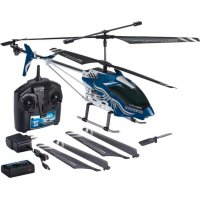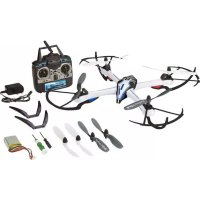
FORMULA Q - Remote control toy Revell - Free user manual and instructions
Find the device manual for free FORMULA Q Revell in PDF.



| Product type | Radio-controlled toy (quadcopter) |
| Brand | Revell |
| Model | FORMULA Q |
| Category | Radio-controlled toy |
| Recommended age | From 14 years |
| Model power supply | Rechargeable Li-Po battery 7.4V 1200mAh (included) |
| Remote control power supply | 6 AA 1.5V batteries (not included) |
| Charger | Input 110-240V AC, output 1.5V DC 800mA |
| Charging time | Approximately 140 minutes |
| Flight time | 8 to 10 minutes |
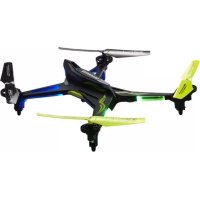
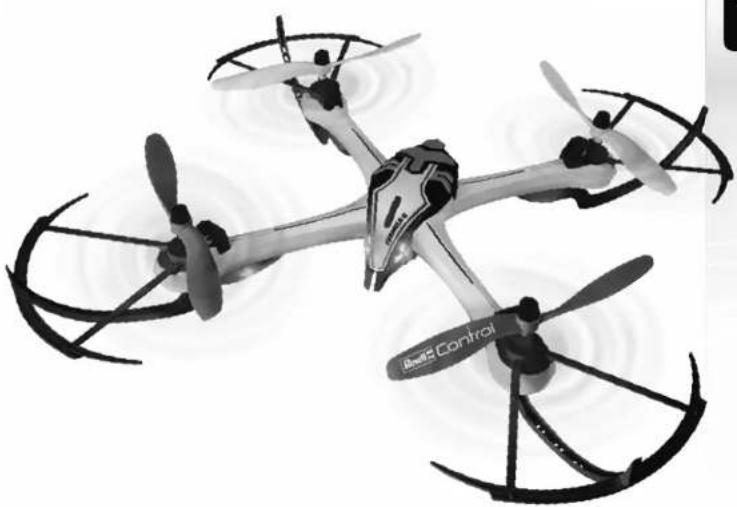
| Functions | Three speed levels, flip function, headless mode, LED lighting |
| Protection | Protection guards |
| Propellers | Rotors with clockwise (A) and counterclockwise (B) blades |
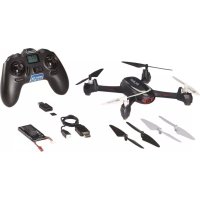
| Included accessories | 1 model, 1 remote control, 1 charger, 4 spare propellers, 2 landing skids, instruction manual |
| Maintenance | Clean with a clean, damp cloth; avoid any contact of the remote control and charger with water |
| Safety | Adult supervision required; do not use near people, animals, bodies of water, or power lines |
| Material | Plastic |
| Spare parts | Available at www.revell-control.de |
| Repairability | Repairs with original parts only |
| General information | Compliant with directive 1999/5/EC; declaration of conformity at www.revell-control.de |
Frequently Asked Questions - FORMULA Q Revell
User questions about FORMULA Q Revell
0 question about this device. Answer the ones you know or ask your own.
Ask a new question about this device
Download the instructions for your Remote control toy in PDF format for free! Find your manual FORMULA Q - Revell and take your electronic device back in hand. On this page are published all the documents necessary for the use of your device. FORMULA Q by Revell.
USER MANUAL FORMULA Q Revell
- Eigenkapital in Mio. (2014) Aktien 31.05.2014
- Eigenkapital in Mio. (2015) Aktien 31.05.2015
- Eigenkapital in Mio. (2016) Aktien 31.05.2016
Sellee a sone of the great
Warden's and J. Pundicello's
Benedict's and D. R. Hare's
Benedict's and S. Gagnon's
Benedict's and A. M. Weyl's
Benedict's and C. L. Oakesley's
Benedict's and D. M. Weyl's
Benedict's and A. M. Weyl's
Benedict's and C. L. Oakesley's
Benedict's and A. M. Weyl's
Benedict's and C. L. Oakesley's
Benedict's and A. M. Weyl's
Benedict's and C. L. Oakesley's
Benedict's and A. M. Weyl's
Benedict's and C. L. Oakesley's
Benedict's and A. M. Weyl's
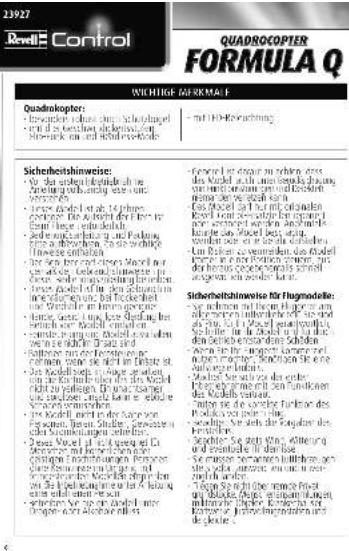
- Never disassemble or alter the battery contacts. Do not damage or puncture the battery cells. There is a risk of explosion!
The LiPo battery must be kept out of reach of children. - When disposing of batteries, they must be discharged or their capacity must be fully depleted. Cover exposed terminals with adhesive tape in order to prevent short-circuiting!
Maintenance and care:
- Please only use a clean, damp cloth to wipe off the model.
- Protect the model and batteries from direct sunlight and/or direct heat.
- Never allow the remote control and charging unit to come into contact with water, because the electronics will be damaged as a result.
Technical changes and differences in color reserved!
Required batteries for the model: Best or supply
Power supply Rated output
Rated output: 1xD67.40(8.0W)
1×DC/4√78.9W
rechargeable.
LiPo battery (included)
Capacity: 1200 mAh
Battery requirement for the
remoteccontrol:
Power supply:
DC9V
Batteries:
6x15V"AA
(1)A (2)A (3)A (4)A (5)A (6)A (7)A (8)A (9)A (10)

Charger:
Power supply:
110-240VAC-50-60Hz
Rated output
7.4VDC:800mA
1 MODEL
1A Status LED
1B Rotors
1C Protective guard
10 Battery compartment cover
1E Battery compartment securing screw
1E ON/OFF switch
16 No function
2 REMOTE CONTROL
2A Control for thrust and rotation
2B Control for forward/backward
andsideways
2C Trim for rotation
2D Trim for forwards/backwards
2E Trim for sideways
2F ON/OFF switch
26 No function
2H Headless mode
21 Power LED
21 Antenna
2K Turbo switch
21. Flip button
2M Battery compartment cover
2N Battery compartment securing screw
20 Battery compartment opening tab
3 INSERTING BATTERIES (REMOTE CONTROL)
3ATo open the battery
compartment, unscrew
the locking screw (2N)
counter-clockwise and
open the battery
compartment cover (2M)
to the top by pressing
down the opening levels.
(20).
Attention: The battery and motor must cool down for 15 to 30 minutes before charging and after every flight. Otherwise they can be damaged. The charging process must be constantly monitored. Always ensure that the charging process takes place on a waterproof surface in a life-threatening environment.
-
Open the battery compartment cover (1D) by unscrewing the battery compartment securing screw (1E) in anti-clockwise motion (4A). Unplug the battery from the model (4B) and switch off the remote control (4C). Remove the battery from the model. Plug the charger into an unoccupied socket (4D). The status LFD on the charger begins to illuminate.
-
Plug the white balancer plug into the charging socket of the charger and ensure the correct polarity (4E). The battery must be gently inserted into the charging socket - DO NOT USE FORCE. If the battery is not correctly inserted into the charging socket, the battery may become damaged and, under certain circumstances, cause injury.
- The status LED on the charger will light up red when charging begins.
The charging process lasts approx. 140 minutes and must be continuously monitored. The colour of the LED on the charger changes from red to green when the charging process is finished. - Disconnect the battery from the charger and disconnect the charger from the outlet after the charging is completed.
The model can fly for approx. 8-10 minutes after a charge time of approx. 140 minutes.
Warning notice: The battery does not normally heat up while charging. If it should become warm or even hot and/or changes to the surface begin to appear, immediately discontinue the charging process!
5 START PREPARATION
The model must be switched on first in order to connect it to the remote control. Open the battery cover (1D), insert the battery into the battery compartment of the model, plug the battery plug into the socket in the model, and close the battery compartment. Do not use force and ensure the correct polarity (SA). Then set the ON/OFF switch on the model (1F) to the "ON" position.
Before switching on the remote control, the control for thrust and rotation (2A) must point down (5B). To switch on the remote control, move the ON/OFF switch (2F) to the ON position and briefly push the control for thrust and rotation upwards. After approx. 3 seconds, the model activates and is ready for use.
Once you have finished flying, switch the model off and then the remote control. Unplug the battery from the model and remove the battery from the model.
6 TRIM ADJUSTMENT OF THE CONTROL
The model must be switched on first in order to connect it to the remote control. Its adjustment is simple, but it requires some patience and a feel for it. Please observe the following instructions precisely: Carefully move the thrust control up and raise the helicopter approximately 0.5 to 1 metre in altitude.
6A If the model automatically moves slowly or quickly to the left or right ... gradually press the trim for sideways flight (2E) in the opposite direction.
6B If the model moves by itself slowly or quickly around its own axis .. press the trim adjustment for rotation (2C) incrementally in the opposite direction.
6C If the model automatically moves slowly or quickly forwards or backwards .. gradually press the forwards/backwards trim (2D) in the opposite direction.
7 FLIGHT CONTROL
Note: Only minimal corrections of the controls are necessary for a smooth flying behavior of the model. The direction indication applies when the model is viewed from behind. If the model is flying forwards towards the pilot, it must be moved in the opposite direction.
7A Take off or increase altitude by carefully moving the control for thrust and rotation (2A) forward.
7B Land or decrease altitude by moving the control for thrust and rotation (2A) backward.
7C Fly forward by moving the controller for forward/backward and sideways flight (2B) carefully forward.
7D Fly backward by moving the controller for forward/backward and sideways flight (2B) carefully backward.
7E Fly to the left by moving the controller for forward/backward and sideways flight (2B) carefully to the left.
7F Fly to the right by moving the controller for forward/backward and sideways flight (2B) carefully to the right.
76 Turn the model around to the left by moving the control for thrust and rotation (2A) to the left.
7H Turn model around to the right by moving the control for thrust and rotation (2A) to the right.
2K Turbo switch: Move the turbo switch to 60% in order to fly faster. At the 90% position the model performs a flip after a full throw of the the control for forward/backward and sideways (2B). Only activate this mode when there is adequate space and the model is flying at a height of at least 2 metres.
2L Flip button: The model performs a flip each time the flip button is pressed. Only activate this function if there is enough space available and the model is lying at a height of at least 2 meters.
2H Button for Headless Mode: Headless mode supports beginners in the initial stages. Regardless of where the quadrotocopter turns, the direction of flight always corresponds exactly to the direction specified with the control for forwards/backwards and sideways movement (2B). An example: if the model were to be turned 180^ and flown towards the operator, the operator would have to convert' the forwards/ backwards and sideways movement accordingly. This is no longer necessary if headless mode is activated, as the internal processor always converts the control directions automatically. Pressing the 2H button again deactivates the mode
Attention: The model, notes" the forwards direction during each switch-on. This means that the operator must not turn when controlling the model, as this would change the concept of "forwards" and right/left in relation to the model. If the operator changes position and wants to use headless mode or if the control direction is no longer correct due to a collision, the model must be restarted.
BATTERY STATUS:
The battery is empty if the model begins to lose thrust. Land in order to avoid crashing.
8LANDING SKID
A pair of landing skids is included with the mode. This is placed in the groove on the underside of the model (8A). Then carefully screw in two securing screws in each skid (8B).
INSTRUCTIONS FOR SAFE FLYING
GENERAL FLYING TIPS:
- Always place the model on a level surface. An inclined surface can, under certain circumstances, have a negative impact on the starting behavior of the model.
Always operate the controls slowly and with a gentle touch.
Always maintain visual contact with the model and do not look at the remote control! - Move the thrust control down again somewhat as soon as the model lifts off from the ground. Maintain lying altitude by adjusting the thrust controller.
- if the model lowers, move the thrust control slightly upward again.
- If the model climbs, move the thrust control down slightly.
- To fly along a curve, tapping the directional controller very slightly in the respective direction often suffices. There is a general tendency during preliminary attempts at flight to operate the model's controls too aggressively. Always operate the controls slowly and carefully. Never fast and litfully.
- Beginners should first master trimming before attempting to master the thrust controller. The model does not necessarily have to fly straight at the beginning - initially, it is more important to maintain a constant height of approximately one meter above the ground by repeatedly tapping the thrust control. Only then should the pilot practice steering the model left and right.
9 CHANGING THE PROPELLERS
If the rotor blades on the model are damaged, they must be replaced. To do so, proceed as follows:
9A Unscrew the screw of the rotor blade anti-clockwise. Hold the faulty rotor blade with two fingers and pull it off carefully to the top.
98 Place the new rotor blade on the shaft and screw in the fixing screw carefully in clockwise direction. Caution: Do not tighten the screw too tightly, as this could damage the thread.
9C When mounting the rotor blade, please note that there are right turning (A) and left-turning (B) rotor blades.
TROUBLESHOOTING
Problem: The propellers do not move.
Cause: No connection has been established.
The battery is too weak or depleted.
Remedy: - Switch everything off and switch on again in the correct sequence.
- Charge the battery.
Problem: The model stops and descends during flight for no apparent reason.
Cause: The battery is too weak.
Remedy: Charge the battery.
Problem: The model cannot be controlled with the remote control.
Cause: The ON/OFF switch is in the OFF" position.
The batteries were not inserted correctly.
- the batteries do not have enough power.
Remedy: Set the ON/OFF switch to the ON" position.
-
Check whether the batteries are inserted correctly.
-
Insert new batteries
Problem: The model only turns on its vertical axis or rolls over when started.
Cause: Incorrect arrangement of the propellers.
Remedy: Install the propellers and arms as outlined in the manual.
Problem: The model will no longer fly loops.
Cause: Battery too weak.
Remedy: Charge the battery.
Additional tips and tricks can be found online at www_REVell-control.de.
SERVICE NOTES
Go to www_REVell-control.de for ordering information and tips on replacing spare parts, plus other useful information on all Revell Control models.

23927
Revie
Control
QUADROCEPTOR
FORMULA Q
CHARACTERISTIQUES PRINCIPALES
Quadricoptère:
INDICATIONS DE SERVICE
De accu is te zwak of leeq.
Iadattaya LiPo -akku (sisalyy
[paakkaikseen] 1360
1200 mAn
Electrical and electronic waste ordinance: After the end of use, remove all batteries and separately dispose of all electrically operated devices at the communal collection centres for electrical and electronic waste. Dispose of the remaining p with household waste. Thank you your cooperation!
Attention: Risk from heat development and rotating parts during operation Adult supervision is required!
Revell GmbH hereby declares that this product conforms with the basic requirements and the additional applicable provisions of Directive 1999/5/EC. The declaration of Conformity can be found at www.revell-control.de