HZV 9 - Range hood Ariston Thermo - Free user manual and instructions
Find the device manual for free HZV 9 Ariston Thermo in PDF.



| Product type | Range hood |
| Brand | Ariston Thermo |
| Model | HZV 9 |
| Power supply | 220-240 V / 50 Hz |
| Number of speeds | 4 (including temporary intensive 5 min) |
| Lighting | Halogen or incandescent bulbs (max 40 W) with variable intensity |
| Grease filters | Washable metal (dishwasher or hand wash) |
| Charcoal filter | Active (optional, washable with water or dishwasher at 65°C) |
| Minimum distance from hob | 50 cm for electric hobs, 65 cm for gas or mixed |
| Exhaust duct diameter | 150 mm |
| Special functions | Grease filter indicator (40 h) and charcoal filter indicator (160 h), variable light intensity |
| Material | Stainless steel (estimated) |
| Dimensions (W x D) | 90 cm x 50 cm (estimated) |
| Weight | Approximately 12 kg (estimated) |
Frequently Asked Questions - HZV 9 Ariston Thermo
User questions about HZV 9 Ariston Thermo
0 question about this device. Answer the ones you know or ask your own.
Ask a new question about this device
Download the instructions for your Range hood in PDF format for free! Find your manual HZV 9 - Ariston Thermo and take your electronic device back in hand. On this page are published all the documents necessary for the use of your device. HZV 9 by Ariston Thermo.
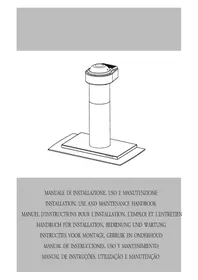
USER MANUAL HZV 9 Ariston Thermo
Instructions for installation and use
FR Hotte aspirante
Filtro carbone
natural_image
Illustration of a hand holding three circular objects with a tool above them (no text or symbols)Instruction on mounting and use
Cooker Hood

Italiano

English

Français

Español

Português
HZV
Contents
Installation, 10
Installation, 10
Description of the appliance, 12
Control panel, 12
Operation, 13
Maintenance, 14
Cleaning the hood, 14
Cleaning the grease filters, 14
Cleaning the carbon filter, 14
Mounting and changing the filter, 14
Replacing lamps, 15
Caution, 16
General safety, 16
Disposal, 16
Installation
UK
! It is important to conserve this booklet for consultation at any moment. In the case of sale, cession or move, make sure it is together with the product.
! Read the instructions carefully: there is important information about installation, use and safety.
! Do not carry out electrical or mechanical variations on the product or on the discharge conduits.
Installation
Electric connection
! The power tension must correspond with the tension shown on the characteristics label situated inside the hood. If provided with a plug, attach the hood to a socket conforming to the regulations in force and placed in an accessible zone. If without a plug, (connected directly to the power supply), use a regulation bipolar switch with a distance of the contacts on opening not less than 3mm (accessible).
! If necessary, the situating of the supply cable must be carried out by the technical assistance service or a qualified person.
! An authorized installer must carry out the electrical connection of the hood.
! The company declines any responsibility whenever these regulations are not respected.
Preliminary information for installation of the hood:
Disconnect the hood during electrical connection, by turning the home mains switch off.
Expansion wall plugs are provided to secure the hood to most types of walls/ceilings. However, a qualified technician must verify suitability of the materials in accordance with the type of wall/ceiling. The wall/ceiling must be strong enough to take the weight of the hood.
Do not tile, grout or silicone this appliance to the wall. Surface mounting only.
Do not fix chimney flue to furniture or fly over shelves unless the chimney flue can be easily removed, in case maintenance is ever required.
Where foreseen remove the grease collecting panels. Remove the grease filter/s
Do not tile, grout or silicone this appliance to the wall. Surface mounting only.
Do not fix chimney flue to furniture or fly over shelves unless the chimney flue can be easily removed, in case maintenance is ever required.
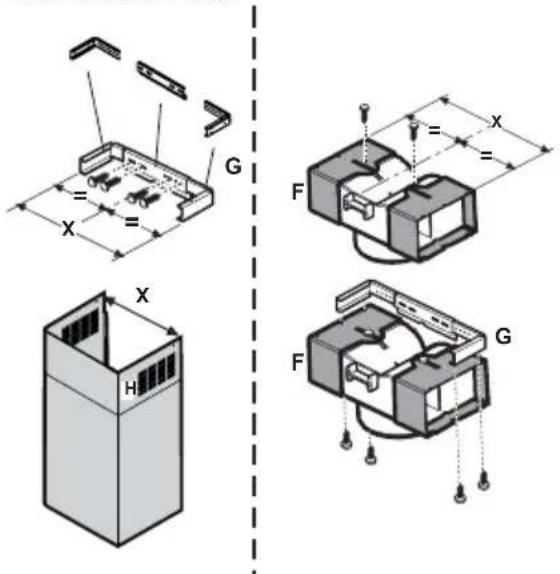
Assembling the chimney flue support/bracket (3 parts): The three parts should be fixed with 4 screws, the support extension is adjustable and should correspond to the internal width of the telescopic chimney flue.
Assembling the deflector (only when a deflector composed of 3 parts is supplied – the deflector should be only for the filter version):
The three parts should be fixed with 2 screws, the deflector extension is adjustable and should correspond to the width of the chimney flue support, to which it is then fixed.
The minimum distance between the supporting surface for the cooking vessels on the hob and the lowest part of the range hood must be not less than 50cm from electric cookers and 65 cm from gas or mixed cookers. If the instructions for installation for the gas hob specify a greater distance, this must be adhered to.
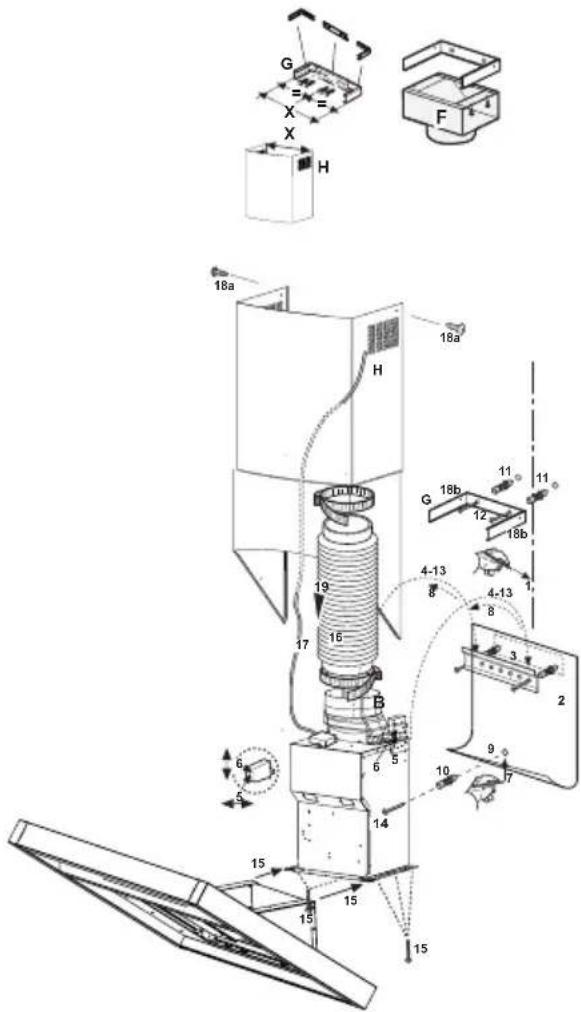
1.Draw a line corresponding to the centre line on the
wall to the ceiling with a pencil. It will help the installation operations.
-
Apply the perforation diagram to the wall: The centre vertical line printed on the perforation diagram must correspond to the centre line drawn on the wall. In addition, the lower edge of the perforation diagram must correspond to the lower edge of the hood: keeping mind that the lower part of the hood, once installation is completed, must distance at least 50 cm from the cooking surface in case of electric plates and 65 cm in case of gas rings or mixed tops.
-
Place the support bracket on the perforation diagram making it coincide with the rectangle marked out. Mark the two external holes and make the holes. Remove the peroration diagram, insert two wall dowels and fix the support bracket of the hood with two 5x45mm screws.
4.Hang up the suction unit.
- Adjust the distance of the suction unit from the wall.
6.Adjust the horizontal setting of the suction unit.
- Mark the hole for definitively fixing the suction unit from inside the suction unit with a pencil.
8.Remove the suction unit from the bracket.
-
Make a hole at the marked point (∅8mm - see operation 7).
-
Insert 1 wall dowel.
-
Apply flue support bracket „G“ to the ceiling, using the support bracket as a perforation diagram (the small slot on the support must coincide with the line previously traced on the wall – operation 1) and mark 2 holes with the pencil. Make the holes (∅8mm) and insert 2 dowels.
12.Fix the flue support bracket to the wall with two 5x45mm screws.
-
Connect the suction group to the lower bracket.
-
Definitively fix the suction unit to the wall (COMPULSORY!!).
-
Position the hood on the suction unit (insert it partially), connect the electricity, fix the hood to the suction unit (from inside with 3 screws at the sides and 2 in front) after having completely inserted it into its housing.
-
Connect the tube (tube and band for fixing not supplied and must be purchased) for discharging the fumes at the connection ring placed over the suction motor unit.
The other end of the tube must be connected to a fumes expulsion device towards the outside in the case of using a suction version hood. If you want to use a filtering hood, fix baffle F to flue support staff G and connect the other end of the tube to the connection ring placed on baffle F.
-
Connect the electricity.
-
Apply the flues and fix them with 2 screws (18a) to flues support „G“ (18b).
-
Let the lower part of the flue slide to completely cover the suction unit until it is inserted into the apposite housing over the hood.
Mount the fats filter/s (and where envisaged, the fat
collecting panels) and check the perfect functioning of the hood.
Description of the appliance
UK
Control panel





Calibrating the control panel
When the plug is inserted (or after a blackout) the system calibrates the keys; during calibration the display point flashes. Calibration lasts 15". The point stops flashing at the end of calibration.

Off/Stand by: the On condition is obtained by

for 3 seconds; in this case keys


are enabled, the display point and the blue led the relative keys light up. The Off condition is
obtained by pressing

again for 3 seconds.

On/Off lights: press 📋 to switch on the lights, turn amber. Contemporaneously the symbols at
the sides and turn blue: the intensity of the light can be increased and diminished with these.
Once the luminosity has been set, pressing rapidly again memorises it (the symbol turns blue) and the light switches off.

On/Off motor: press

It turns amber. Contemporaneously the symbols at the
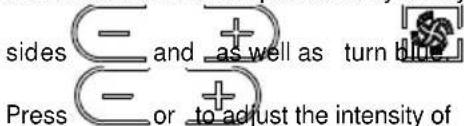
suction. Pressing 📄 again switches the motor off and the last speed set is memorised.

Intensive timing: by pressing this key the suction hood becomes intensive for a maximum time of 5 es. At the end the hood returns to the speed busly set. To exit from the function earlier press

or one of the following keys:


Fats filter signal: this symbol (red led) lights up
after 40 hours. Reset the signal by pressing 📄 for a long time (at least 3 seconds) until the beep confirms it.

Carbon filter signal action.
This signal is shown only if it has been previously set.
Proceed as follows: press with the hood in Off:
first turns red, after about 1 second turns red. If you want to eliminate the carbon f
signal previously set, press with the hood in Off. Reset the carbon filter signal (after 160 hours) by
pressing 📄 for a long time (about 3 seconds, until the beep).
! We advise switching the hood on, at minimum power, before beginning to cook to favour the optimal expulsion of odours. In addition we advise turning it off every time 10/15 minutes after finishing cooking.
! We advise frying under the hood only under constant supervision.
! It is forbidden to cook flambé under the hood because there is the risk of causing a fire.
The best performance of the apparatus is obtained with external expulsion: we advise using the hood in this version if possible.
External exhausting version
In this case the fumes are conveyed outside by means of a special pipe connected with the connection ring located on top of the hood. Diameter of the exhausting pipe must be equal to that of the connection ring = 150mm.
In the horizontal runs the exhausting pipe must be slightly slanted (about 10°) and directed upwards to vent the air easily from the room to the outside.
Attention! If the hood is supplied with active charcoal filter, then it must be removed.
Filtering version
One active charcoal filter is needed for this and can be obtained from your usual retailer.
The filter removes the grease and smells from the extracted air before sending it back into the room through the upper outlet grid.
Maintenance
UK
! It is always necessary to isolate the hood from the power supply during cleaning and maintenance.
Therefore remove the plug. We recommend carrying our maintenance regularly (about every 10 days) to ensure efficacious and constant performance of the hood.
Cleaning the hood
The hood should be cleaned frequently, both internally and externally. Use a cloth damped in neutral detergent liquids.
Avoid the use of products containing abrasives.
Attention: failure to observe the cleaning regulations of the hood and the substitution and cleaning of the filters leads to the risk of fire. We therefore recommend keeping to the suggested instructions.
Cleaning the grease filters
The fats filter serves to capture the particles of fat in suspension that come from the cooking.
It must be cleaned once a month with non-aggressive detergents manually or in a dishwasher at low temperature and short cycle.
If washed in a dishwasher it can become opaque over time but its filtering ability is not lessened in any way. Dismantle it using the corresponding handles, pushing them backward first and then pulling them down.
After having washed it, dry it carefully and assemble it again in its seat, reversing the procedure.
Clean the perimeter suction panel (when envisaged) with the same frequency as the anti-fat filter. Use a cloth and a not too concentrated liquid detergent.
Never use abrasive substances.
Cleaning the carbon filter
The charcoal filter can be washed once every two months using hot water and a suitable detergent, or in a dish-washer at 65°C (if the dish-washer is used, select the full cycle function and leave dishes out).
Eliminate excess water without damaging the filter, then remove the mattress located inside the plastic frame and put it in the oven for 10 minutes at 100^ C to dry completely. Replace the mattress every 3 years and when the cloth is damaged.
Mounting and changing the filter
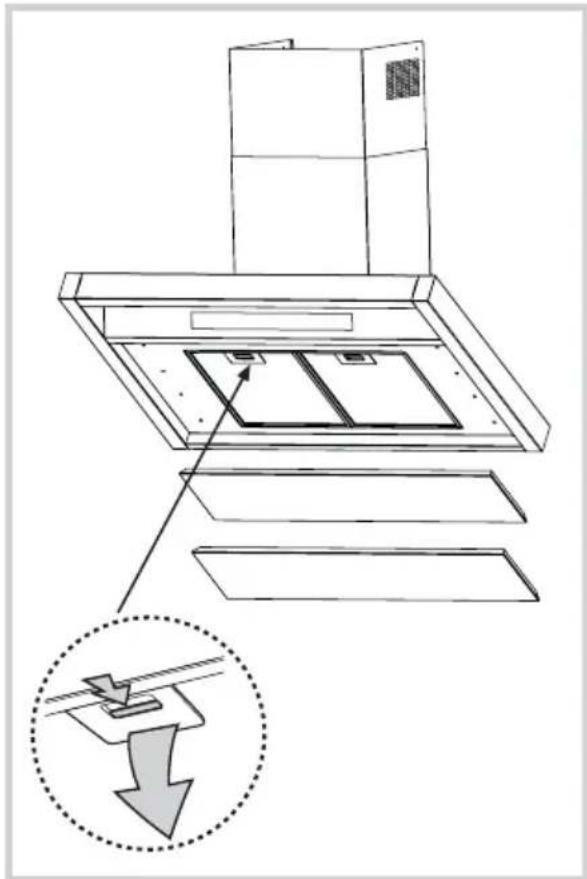
To remove the panels pull them back (the support pins will disconnect from the housing).
Pull the spring disconnection handle to dismantle the fats filter.
Carbon filter
Remove the filter holder frame by turning the knobs (g) 90° that affix the chimney to the cooker hood.
Insert the pad (i) of activated carbon into the frame (h) and fit the whole back into its housing (j).

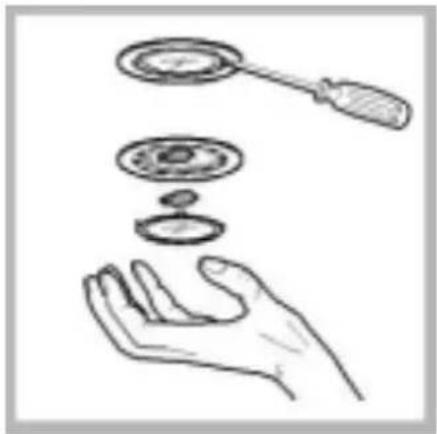
Replacing lamps
natural_image
Illustration of a hand holding a circular object with a tool above it, no text or symbols presentRemove the plug!
Bulb/s:
Remove the overhead light
and remove
the bulb to change. Only
use 40W
lamps.
Make sure the
bulbs are cold
before
touching
them.
Halogen bulbs:
Use a small screwdriver or other tool suitable for prising.
Substitute the halogen bulb with another of equal value. Close with the trigger fixing.
UK
General safety
! The hood has been designed and constructed in conformity with international safety regulations. These warnings are provided for safety reasons and must be carefully read.
- This apparatus has been designed for use by adults.
- Children and invalids are not allowed to use this apparatus without supervision. Check that children do not play with the apparatus.
- The premises must have sufficient ventilation when the hood is being used at the same time as other apparatuses that use gas and other fuels. If the hood must be installed in a kitchen where there is a water-heater or a gas heating system we recommend, for safety reasons, not using the suction version. It is therefore necessary to equip the apparatus with an active carbon filter, in this way allowing recycling use.
- For safe performance, low pressure should not exceed 0.04 mbar: in this way re-suction of the expulsion gas will be avoided. This can be obtained ensuring entry of air into the room through openings that cannot be closed.
- The sucked air must not be conveyed in a conduit used for the discharge of fumes from apparatuses supplied with energy other than electricity.
- It is severely forbidden to cook food on the flame under the hood.
- The use of naked flame damages the filters and can cause fires. It must therefore be avoided in any case.
- Frying must be carried out under control to avoid the overheated oil catching fire.
- As far as the technical and safety measures to adopt for the discharge of fumes are concerned, keep strictly to what is envisaged by the regulations of the competent authorities.
- For any problem regarding the expulsion of fumes, keep to the instructions of the competent authority. The company declines any responsibility in the case of damage or fire caused by apparatus resulting from failure to observe the above-mentioned instructions.
Disposal
- Disposing of the packaging material: keep to the local regulations so that the packaging can be re-used.
-
European directive 2002/96/CE on electric and electronic apparatus waste provides that domestic appliance should not be disposed of in the normal flow of solid urban waste. The disused apparatuses must be collected separately to make the rate of recovering and recycling of the materials they consist of and prevent potential damage to health and the environment. The symbol of the barred basket is shown on all the products to remind users of the need for separate collection.
-
Disused domestic appliances can be delivered to the public collecting service, taken to suitable local authority areas or, if envisaged by national laws on the matter, resold to dealers at the same time as purchasing new, equivalent, types of product.
- All the main producers of domestic appliances are active in the creation and management of collecting systems of disused apparatuses.
! In case of anomalies apply to the authorized technical assistance service and require original spare parts.
! The information and technical data are subject to change and the producer, in line with technical progress, maintains the right to make modifications that he considers necessary without prior notice.
This appliance is marked according to the European directive 2002/96/EC on Waste Electrical and Electronic Equipment (WEEE). By ensuring this product is disposed of correctly, you will help prevent potential negative consequences for the environment and human health, which could otherwise be caused by inappropriate waste handling of this product.

The symbol ■ on the product, or on the documents accompanying the product, indicates that this appliance may not be treated as household waste. Instead it shall be handed over to the applicable collection point for the recycling of electrical and electronic equipment. Disposal must be carried out in accordance with local environmental regulations for waste disposal.
For more detailed information about treatment, recovery and recycling of this product, please contact your local city office, your household waste disposal service or the shop where you purchased the product.
Assembler le support cheminée (3 parties):
Filtre à charbon
natural_image
Illustration of a hand holding a small bowl with a magnifying glass above it, no text or symbols present.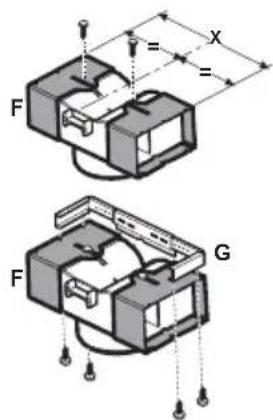
Filtro de carbón
natural_image
Illustration of a hand holding a circular object with a tool above it, no text or symbols present.natural_image
Row of eight gray square icons with varying internal symbols (no text or labels)Filtro de carvão
Remover o chassis de suporte do filtro girando as manoplas (g) que o fixam à coifa de 90°.
natural_image
Illustration of a hand holding three circular objects with a tool above them (no text or symbols)Antes de tocar as lâmpadas certificar-se


- FR Hotte aspirante
- Filtro carbone
- Instruction on mounting and use
- Contents
- Installation
- UK
- Electric connection
- Description of the appliance
- Control panel
- External exhausting version
- Filtering version
- Maintenance
- Cleaning the hood
- Cleaning the grease filters
- Cleaning the carbon filter
- Mounting and changing the filter
- Carbon filter
- Replacing lamps
- General safety
- Disposal
- Filtre à charbon
- Filtro de carbón
- Filtro de carvão
Brand : Ariston Thermo
Model : HZV 9
Category : Range hood