RT02 - Audio Receiver ROTEL - Free user manual and instructions
Find the device manual for free RT02 ROTEL in PDF.

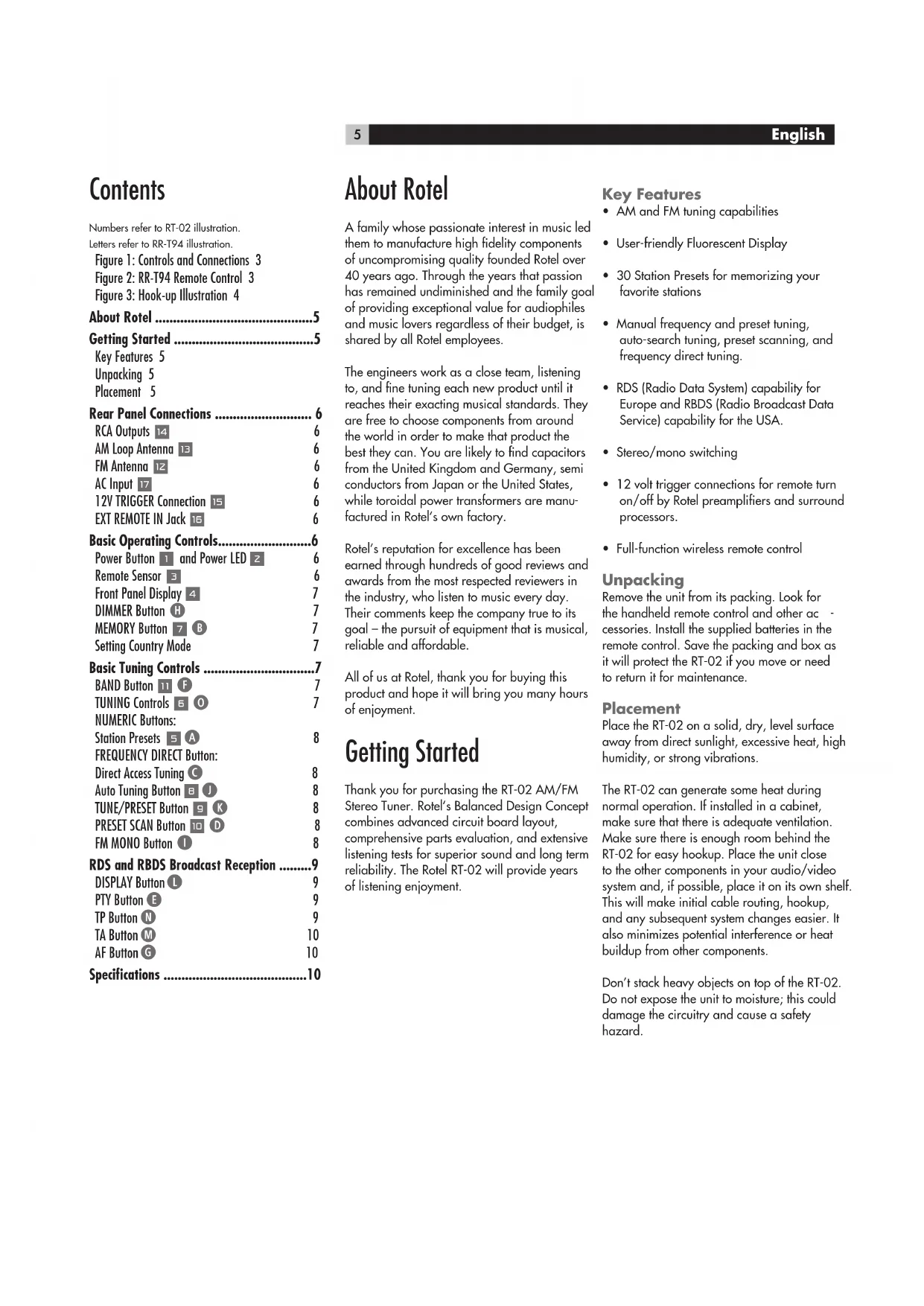


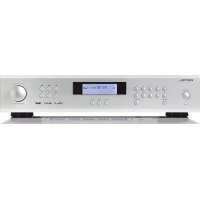
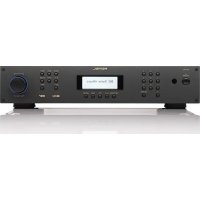
| Product Type | AM/FM Audio Receiver (Stereo Tuner) |
| Brand | Rotel |
| Model | RT02 |
| Dimensions (W x H x D) | 435 x 72 x 319 mm |
| Front panel height (for rack) | 60 mm |
| Weight | 3.9 kg |
| Power supply | 230 V, 50 Hz (Europe) / 115 V, 60 Hz (USA) |
| Wavebands | AM (MW) and FM (VHF) |
| Number of presets | 30 stations |
| RDS functions | Display station name, program type, time, radio text, PTY/TP/TA/AF search |
| Tuning modes | Manual, automatic, direct frequency, preset, scan |
| Audio output | 1 pair RCA line level (left/right) |
| FM output level | 1 V |
| FM antenna input | 75 ohms unbalanced (F connector) |
| AM antenna input | Screw terminals for loop or outdoor antenna |
| Remote control | Yes, model RR-T94 with included batteries |
| Special features | 12V trigger switching, external IR remote input, display dimming |
| FM sensitivity | 14.2 dBf (usable) |
| FM signal-to-noise ratio (stereo) | 70 dB at 65 dBf |
| FM harmonic distortion (stereo) | 0.3% at 65 dBf |
| Maintenance and cleaning | Clean only as per manufacturer's recommendations, avoid objects/liquids in openings |
| Safety | Do not remove the cover; do not expose to moisture; unplug if not used for extended periods |
| Spare parts and repairability | No user-serviceable parts; contact a Rotel authorized repairer |
| Supplied accessories | Power cord, AM loop antenna, FM T-type indoor antenna, remote control, batteries |
Frequently Asked Questions - RT02 ROTEL
User questions about RT02 ROTEL
0 question about this device. Answer the ones you know or ask your own.
Ask a new question about this device
Download the instructions for your Audio Receiver in PDF format for free! Find your manual RT02 - ROTEL and take your electronic device back in hand. On this page are published all the documents necessary for the use of your device. RT02 by ROTEL.
USER MANUAL RT02 ROTEL
This symbol is to alert the user to the presence of uninsulated dangerous voltages inside the product's enclosure that may constitute a risk of electric shock.

This symbol is to alert the user to important operating and maintenance (service) instructions in this manual and literature accompanying the product.
C E

Important Safety Instructions
WARNING: There are no user serviceable parts inside. Refer all servicing to qualified service personnel.
WARNING: To reduce the risk of fire or electric shock, do not expose the unit to moisture or water. Do not allow foreign objects to get into the enclosure. If the unit is exposed to moisture, or a foreign object gets into the enclosure, immediately disconnect the power cord from the wall. Take the unit to a qualified service person for inspection and necessary repairs.
Read all the instructions before connecting or operating the component. Keep this manual so you can refer to these safety instructions.
Heed all warnings and safety information in these instructions and on the product itself. Follow all operating instructions.
Clean the enclosure only with a dry cloth or a vacuum cleaner.
You must allow 10 cm or 4 inches of unobstructed clearance around the unit. Do not place the unit on a bed, sofa, rug, or similar surface that could block the ventilation slots. If the component is placed in a bookcase or cabinet, there must be ventilation of the cabinet to allow proper cooling.
Keep the component away from radiators, heat registers, stoves, or any other appliance that produces heat.
The unit must be connected to a power supply only of the type and voltage specified on the rear panel of the unit.
Connect the component to the power outlet only with the supplied power supply cable or an exact equivalent. Do not modify the supplied cable in any way. Do not attempt to defeat grounding and/or polarization provisions. Do not use extension cords.
Do not route the power cord where it will be crushed, pinched, bent at severe angles, exposed to heat, or damaged in any way. The power cord should be unplugged from the wall outlet if the unit is to be left unused for a long period of time.
Immediately stop using the component and have it inspected and/or serviced by a qualified service agency if:
The power supply cord or plug has been damaged.
- Objects have fallen or liquid has been spilled into the unit.
The unit has been exposed to rain.
The unit shows signs of improper operation
The unit has been dropped or damaged in any way
Place the unit on a fixed, level surface strong enough to support its weight. Do not place it on a moveable cart that could tip over.
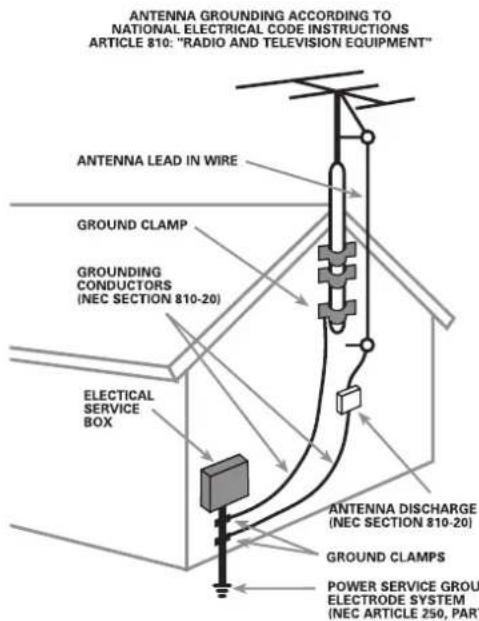
NOTE TO CATV SYSTEM INSTALLER: Call the CATV system or antenna installer's attention to Article 820-40 of the NEC. This provides guidelines for proper grounding and, in particular, specifies that the cable ground shall be connected to the grounding system of the building, as close to the point of cable entry as practical. See installation diagram.
NOTE: This equipment has been tested and found to comply with the limits for a Class B digital device, pursuant to Part 15 of the FCC Rules. These limits are designed to provide reasonable protection against interference in a residential installation. This equipment generates and can radiate radio frequency energy and, if not installed and used in accordance with the instructions, may cause interference to radio or TV communications. There is no guarantee that interference will not occur in a particular installation. If this equipment does cause interference to radio or television reception, which can determined by turning the equipment off and on, try to correct the interference by one or more of the following measures:
- Reorient or relocate the receiving antenna.
- Increase the separation between the unit and the television tuner.
- Connect the unit to an AC power outlet on a different electrical circuit.
- Consult your authorized Rotel retailer for assistance.
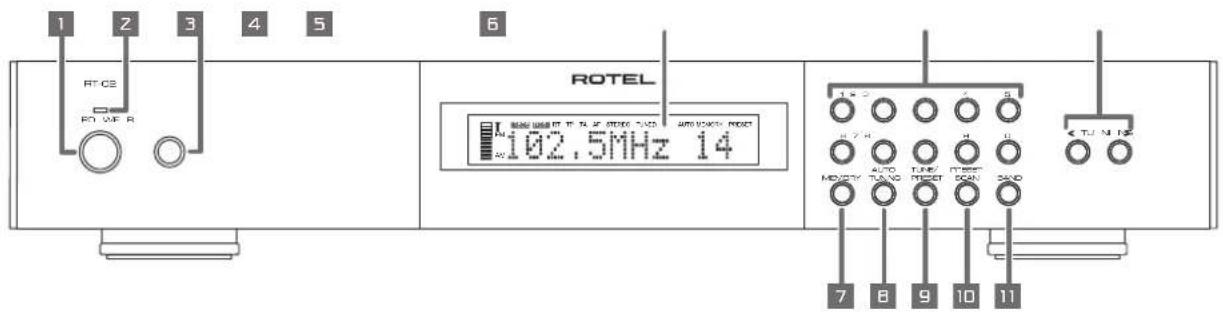
Figure 1: Controls and Connections
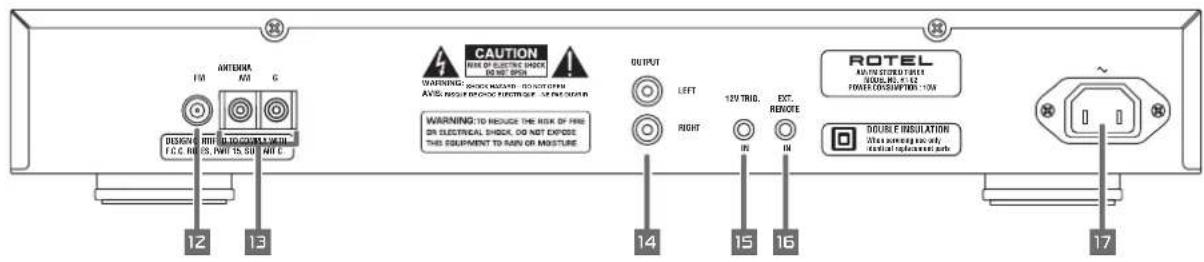
Figure 2: RR-T94 Remote Control
Telecommande RR-T94
Controllo a distance RR-T94
Mando a Distancia RR-T94
De RR-T94 Afstandsbediening
RR-T94 Fjärrkontroll
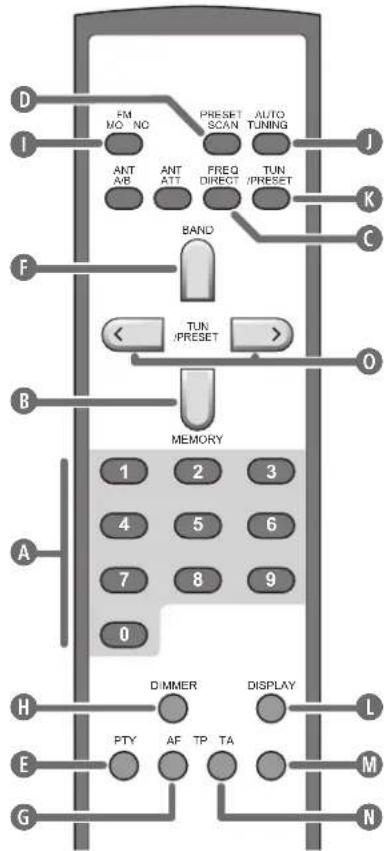
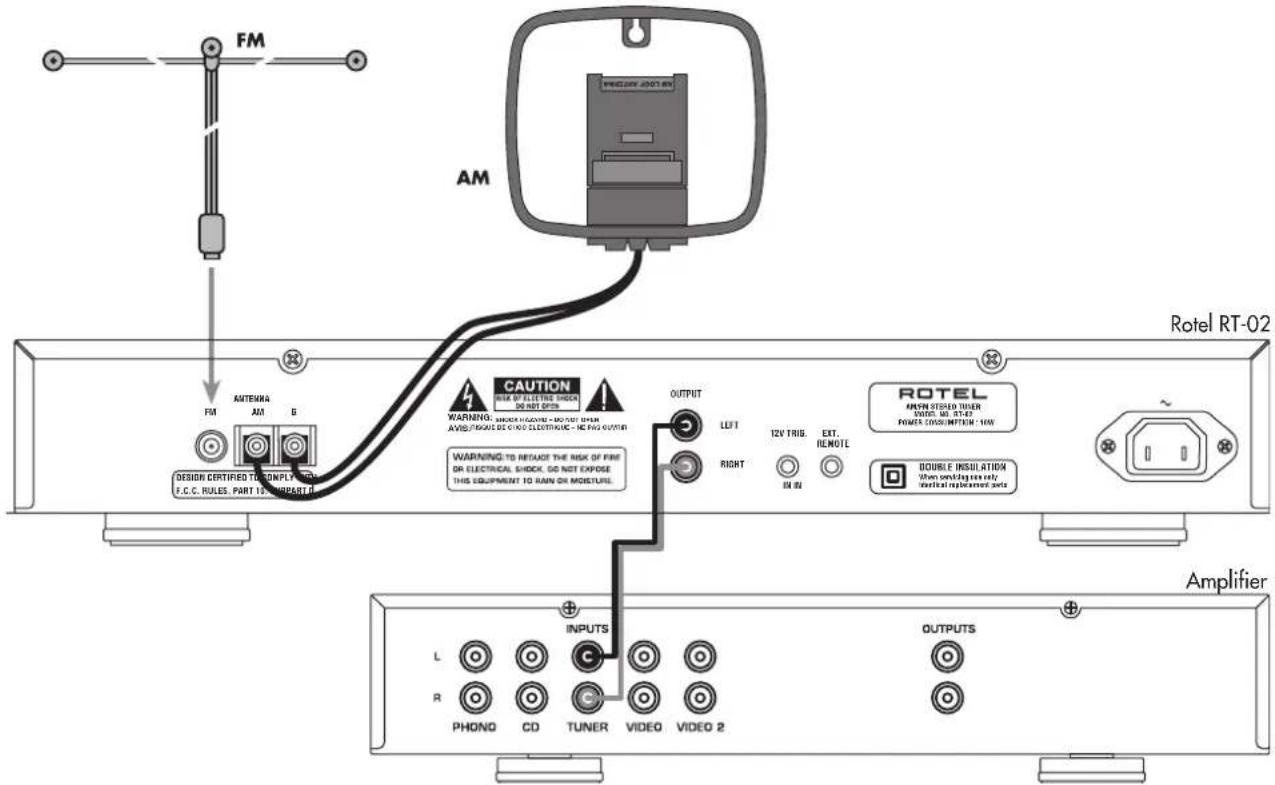
Figure 3: Hook-up Illustration
Schemade branchement type
Anschluβdiagramm
Schema di collegamento
Ejempo de Conexionado
Het aansluitingsschema
Anslutningsbeskrivning
Contents
Numbers refer to RT-02 illustration.
Letters refer to RR-T94 illustration.
Figure 1: Controls and Connections 3
Figure 2: RR-T94 Remote Control 3
Figure 3: Hook-up Illustration 4
About Rotel 5
Getting Started 5
Key Features 5
Unpacking 5
Placement 5
Rear Panel Connections 6
RCA Outputs 14
AM Loop Antenna 13 6
FM Antenna 12 6
AC Input 6
12V TRIGGER Connection 15 6
EXT REMOTE IN Jack 6
Basic Operating Controls.. 6
Power Button 1 and Power LED 2 6
Remote Sensor 6
Front Panel Display 4 7
DIMMER Button H 7
7
Setting Country Mode 7
Basic Tuning Controls 7
BAND Button F 7
TUNING Controls 7
NUMERIC Buttons:
Station Presets 8
FREQUENCY DIRECT Button:
Direct Access Tuning 8
Auto Tuning Button 8
TUNE/PRESET Button 8
PRESET SCAN Button D 8
FM MONO Button 8
RDS and RBDS Broadcast Reception .9
DISPLAY Button 9
PTY Button E 9
TP Button 9
TA Button 10
AF Button 10
Specifications 10
About Rotel
A family whose passionate interest in music led them to manufacture high fidelity components of uncompromising quality founded Rotel over 40 years ago. Through the years that passion has remained undiminished and the family goal of providing exceptional value for audiophiles and music lovers regardless of their budget, is shared by all Rotel employees.
The engineers work as a close team, listening to, and fine tuning each new product until it reaches their exacting musical standards. They are free to choose components from around the world in order to make that product the best they can. You are likely to find capacitors from the United Kingdom and Germany, semi conductors from Japan or the United States, while toroidal power transformers are manufactured in Rotel's own factory.
Rotel's reputation for excellence has been earned through hundreds of good reviews and awards from the most respected reviewers in the industry, who listen to music every day. Their comments keep the company true to its goal - the pursuit of equipment that is musical, reliable and affordable.
All of us at Rotel, thank you for buying this product and hope it will bring you many hours of enjoyment.
Getting Started
Thank you for purchasing the RT-02 AM/FM Stereo Tuner. Rotel's Balanced Design Concept combines advanced circuit board layout, comprehensive parts evaluation, and extensive listening tests for superior sound and long term reliability. The Rotel RT-02 will provide years of listening enjoyment.
Key Features
- AM and FM tuning capabilities
- User-friendly Fluorescent Display
30 Station Presets for memorizing your favorite stations - Manual frequency and preset tuning, auto-search tuning, preset scanning, and frequency direct tuning.
RDS (Radio Data System) capability for Europe and RBDS (Radio Broadcast Data Service) capability for the USA. - Stereo/mono switching
12 volt trigger connections for remote turn on/off by Rotel preamplifiers and surround processors.
Full-function wireless remote control
Unpacking
Remove the unit from its packing. Look for the handheld remote control and other accessories. Install the supplied batteries in the remote control. Save the packing and box as it will protect the RT-02 if you move or need to return it for maintenance.
Placement
Place the RT-02 on a solid, dry, level surface away from direct sunlight, excessive heat, high humidity, or strong vibrations.
The RT-02 can generate some heat during normal operation. If installed in a cabinet, make sure that there is adequate ventilation. Make sure there is enough room behind the RT-02 for easy hookup. Place the unit close to the other components in your audio/video system and, if possible, place it on its own shelf. This will make initial cable routing, hookup, and any subsequent system changes easier. It also minimizes potential interference or heat buildup from other components.
Don't stack heavy objects on top of the RT-02. Do not expose the unit to moisture; this could damage the circuitry and cause a safety hazard.
Rear Panel Connections
The RT-02 provides rear panel connections for audio line level output, an FM antenna, an AM antenna, a 12V Trigger, a remote IR sensor, and AC power input.
NOTE: Do not plug any system component into an AC source until system hookup is complete and you are confident that all component-to-component connections have been properly made.
RCA Outputs 14
Line level RCA audio outputs send a fixed-level stereo signal from the RT-02 to your preamplifier, system controller, or integrated amplifier. Use a standard RCA audio cable to connect the LEFT OUTPUT jack to the left channel tuner input on your system controller and the RIGHT OUTPUT jack to the right channel tuner input on your system controller.
AM Loop Antenna
The RT-02 includes a loop antenna to receive AM radio signals. Remove this antenna from the box and locate it near the RT-02.
Connect the 300 ohm twin-conductor wire from the loop antenna to the pair of screw terminals labeled AM LOOP, attaching one wire to each terminal. It does not matter which wire attaches to which terminal, but make sure that the connections are solid and that the two wires do not touch.
You may need to rotate or otherwise reorient the antenna to find the best position.
NOTE: To use an outdoor antenna, connect its 300 ohm twin-conductor wire to the G and AM terminals in place of the loop antenna, only after a professional contractor has installed the antenna system in accordance with local electrical codes.
FM Antenna 12
The RT-02 is supplied with a T-shaped indoor FM antenna. Remove this antenna from the box and connect its attached coax F-type plug to the FM antenna connector on the RT-02. For best reception, unfold the T-shaped antenna. Eyelets at both ends of the T allow tacking the antenna to a wall, if desired. Experiment with positioning for best reception.
NOTE: To use an outdoor antenna, connect its 75 ohm coax lead wire to the FM connector in place of the indoor wire antenna, only after a professional contractor has installed the antenna system in accordance with local electrical codes. In the USA, you will need to use the supplied F-type converter to connect the 75 ohm coax cable to the antenna input.
AC Input
Your RT-02 is configured at the factory for the proper AC line voltage in the country where you purchased it (115 volts AC at 60Hz in the USA and 230 volts AC at 50Hz in Europe). The AC line configuration is noted on a decimal on the back of your unit. Make sure that your unit is configured properly for your AC line voltage.
Plug the supplied cord into the AC INPUT receptacle on the back of the unit. Once all other rear panel connections are completed, plug the power cord into an AC wall outlet or switched AC outlet on another system component.
12V TRIGGER Connection 15
The RT-02 can be activated by a 12 volt trigger signal from a Rotel preamplifier.
The trigger input accepts any control signal (AC or DC) ranging from 3 volts to 30 volts. When a cable is connected to the input and a trigger signal is present, the tuner is activated. When the trigger signal is interrupted, the tuner goes into standby mode. The front panel indicator light remains lit, but the display goes dark and the unit will not operate.
NOTE: When using the 12V Trigger feature, leave the POWER button in the ON position.
EXT REMOTE IN Jack 16
This 3.5mm mini-jack receives command codes from industry-standard infrared receivers (Xantech, etc.) via hard-wired connections.
This feature could prove useful when the unit is installed in a cabinet and the front-panel sensor is blocked. Consult your authorized Rotel dealer for information on these external repeaters and the proper wiring of a jack to fit the mini-jack receptacle.
Basic Operating Controls
The following explanations will help you get familiar with the features and controls. When a function is available on both the front panel and the remote, a number (see front panel illustration) and a letter (see remote control illustration) are shown in the instructions. For example, to change from the AM to FM band, you can either press the front panel button or use the button on the remote. When only one identifier appears, that control is available only on the front panel or the remote, but not both.
NOTE: Controls used for tuning the AM/ FM receiver are described in the next sections of this manual.
Power Button 1 and Power LED 2
The POWER button is located on the front panel of the RT-02 and is not duplicated on the remote control. Push the button IN to turn the unit on. The LED above the switch and the front panel display will light up. Push the but ton again (returning it to the OUT position), to turn the unit off.
NOTE: If you are using a switched outlet on another component to power the RT-02 or if you are using the 12 volt trigger feature, leave the POWER switch in the ON position.
Remote Sensor
This front panel sensor receives infrared signals from the remote control. Make sure you do not accidentally block this sensor with cables or accessories.
Front Panel Display
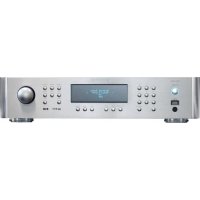
The large fluorescent display in the center portion of the RT-02 provides status information used in operating the AM/FM receiver (such as station frequency display, band, preset memory, RDS information, etc.).
DIMMER Button
Available only on the remote control, this button selects three display brightness settings: NORMAL, DIM, or OFF. When the display is OFF, pressing any button or control will return it to the NORMAL mode. Press the button to cycle through the three settings.
NOTE: When the tuner is turned off and back on, the display reverts to its normal setting.
MEMORY Button 76
The MEMORY button is used to confirm and memorize various settings in the setup and operation of the RT-02, including tuner station presets. Its use is described in detail in the relevant sections below.
Setting Country Mode
The RT-02 has two default modes, one for the USA and one for Europe. These configure the unit for differences in local markets, including FM tuning intervals, AM tuning intervals, and differences in the European RDS and United States RBDS standards. Your unit has been factory configured to the correct default mode for the country in which it was purchased.
To switch to the USA default mode, press and hold the POWER, MEMORY, and 9 buttons for 5 seconds. The word LOADING will appear in the DISPLAY and the unit will power up in the USA configuration.
To switch to the European default
mode, press and hold the POWER, MEMORY, and 0 buttons for more than 5 seconds. The word LOADING will appear in the DISPLAY and the unit will power up in the European configuration.
Basic Tuning Controls
The RT-02 features a digital synthesized AM/ FM tuner with RDS or RBDS capability and 30 station presets. The unit offers a wide range of tuning options. Here is an overview of the tuning options (more detailed information is provided in subsequent sections of this manual):
- Manual frequency tuning lets you tune up or down to the next station frequency. Set the TUNE/PRESET mode to TUNE. Turn off AUTO TUNING. Use the TUNING controls to tune up or down.
- Direct frequency tuning lets you enter the desired station frequency digits. Press the FREQUENCY DIRECT button on the remote and enter the digits using the NUMERIC buttons.
Automatic frequency search tuning lets you search up or down to find the next receivable broadcast signal. Set the TUNE/ PRESET mode to TUNE. Turn on AUTO TUNING. Use the TUNING controls to search up or down. - Memory station preset tuning lets you directly enter the number of a memorized station preset number. Enter the number of the memorized preset using the NUMERIC buttons.
- Preset scan tuning lets you scan up/down through the memorized station presets. Press the PRESET SCAN button to begin scanning.
- RDS (Europe) or RBDS (USA) tuning provides a range of special tuning and search features based on data codes encoded with the broadcast signal. See the RDS section of this manual for detailed information.
NOTE: Three buttons on the remote (ANT A/B, FM IF NARROW, and ANN ATT) are not used with the RT-02 tuner.
BAND Button
The BAND button selects whether the tuner will receive AM or FM broadcast signals. Press the button to toggle back and forth between AM and FM. A corresponding indicator will light at the left portion of the front panel DISPLAY to confirm your choice. The currently tuned station frequency will be shown.
TUNING Controls E0
A pair of buttons, labeled < TUNING on the front panel and < TUN/PRESET > on the remote, serve as the main tuning controls for the RT-02. You can use either the front panel or remote buttons; their function is identical.
These controls provide different tuning functions, depending on the mode of operation:
In the FREQUENCY TUNING mode with AUTO TUNING off, press a TUNING button to manually jump to the next frequency, regard less of whether or not a station is broad-casting on that frequency. [See the TUNE/PRE-SET button and AUTO TUNING button sections for details on changing the tuning modes.]
In the FREQUENCY TUNING mode with AUTO TUNING on, press a TUNING button to start auto tuning. The tuner begins automatically scanning up or down through the frequencies until the next receivable signal is detected. If this is not the desired station, repeat the automatic tuning procedure to find the next station. Weak stations will be skipped during auto tuning. If no receivable signal is detected, the tuner will revert to the last previously tuned station. [See the TUNE/PRESET button and AUTO TUNING button sections for details on changing the tuning modes.]
In the PRESET TUNING mode, press a TUNING button to advance to the next memorized station preset. [See the TUNE/PRESET button section for details on changing the tuning modes.]
In the RDS PTY search mode, press a TUNING button to select the desired program type from the scrolling list in the display. See the section on RDS tuning for more details. [See the RDS PTY button section for details.]
NOTE: Several indicators in the front panel display assist tuning. A large display shows the tuned frequency and increases or decreases during tuning. A signal strength indicator shows the strength of the incoming signal. A TUNED indicator lights when a suf-ficiently strong signal is received. A ST indicator lights when a stereo FM signal is received. In addition, indicators show the currently selected tuning mode.
NUMERIC Buttons: Station Presets A
The RT-02 can store up to 30 station presets for recall at any time using the NUMERIC keypad. These station presets can be used for any combination of AM stations and FM stations.
- Enter the first digit of the station frequency using the NUMERIC buttons. The digit will appear in the frequency display and the next bar will flash. Enter the remaining digits of the frequency. When all of the digits have been entered, the tuner will automatically tune to the displayed station frequency.
The RT-02 is delivered from the factory with a of generic station presets that may or may not match any available stations in your area.
To memorize a new station preset:
- Tune to the desired station, AM or FM.
- Press the MEMORY button on the front panel. A MEMORY indicator will flash in the front panel display.
- While the MEMORY indicator is flashing, press the number of the preset where you wish to store the station frequency. For example, to memorize the station as preset 3, press the 3 button. To memorize preset 15, press the 1 button followed by the 5 button.
- A previously stored frequency is erased from memory when a new frequency is memorized for the same preset number.
To tune to a previously memorized station preset, press the preset number using the NUMERIC buttons. For example, to tune to preset 3, press the 3 button. To tune to preset 30, press the 3 button and then press the 0 button within 5 seconds.
NOTE: The NUMERIC buttons can also be used for FREQUENCY DIRECT tuning.
FREQUENCY DIRECT Button: Direct Access Tuning Remote Only
If you know the exact frequency of the desired station, you may tune it directly using the FREQUENCY DIRECT button (remote only) and the NUMERIC buttons.
- Press the FREQUENCY DIRECT button to change the NUMERIC buttons from station preset to direct access mode. The station frequency in the front panel display will change to a series of bars, representing the digits of a station frequency, with the first bar blinking.
NOTE: On the USA version only, pressing 1 in the FM mode will enter 10 as the digit in the frequency display. On the European version, it is necessary to press 1 and then 0 to enter 10. For US FM stations, press only one digit following the decimal point as shown in the first example following. For European FM stations, press two digits after the decimal point as shown in the second example.
EXAMPLES:
(USA FM) 87.50MHz Press 8 > 7 > 5
(Europe FM) 87.50MHz Press 8 > 7 > 5 > 0
(USA AM) 1610kHz Press 1 > 6 > 1
(Europe AM) 1611kHz Press 1 > 6 > 1 > 1
If no frequency is entered within 5 seconds, the tuner will cancel FREQUENCY DIRECT tuning mode and revert to the last previously tuned station.
Auto Tuning Button
The AUTO TUNING button toggles between the frequency search tuning feature and manual frequency tuning. When using the TUNING controls on the front panel or remote in AUTO TUNING mode, the tuner will begin automatically scanning up or down through the frequencies until the next receivable broadcast signal is detected. If this is not the desired station, use the TUNING controls again to find the next station. Weak stations will be skipped during auto tuning. If no receivable signal is detected, the tuner will revert to the previously tuned station.
To toggle between FREQUENCY TUNING mode and AUTO TUNING mode, press the AUTO TUNING button. An AUTO indicator will appear in the display.
NOTE: AUTO TUNING mode is disengaged when the TUNE/PRESET button is set to PRESET tuning mode. See the following section.
TUNE/PRESET Button K
The TUNE/PRESET button toggles between FREQUENCY TUNING mode (the TUNING controls advance to the next station frequency) and PRESET TUNING mode (the TUNING controls advance to the next memorized station preset). To toggle between the two modes, press the TUNE/PRESET button. A PRESET indicator in the front panel DISPLAY will light when the PRESET mode is active.
NOTE: AUTO TUNING mode is disengaged when the TUNE/PRESET button is set to PRESET tuning mode.
PRESET SCAN Button D
This button activates a preset scanning feature. When you press the button, the tuner will automatically scan through all memorized station presets, playing each for five seconds before moving to the next. To stop the station scanning on the desired station preset, press the button again.
NOTE: If a PRESET station is currently tuned when the PRESET SCAN button is pressed, scanning will start with the next higher preset number and continue through all preset stations, stopping on the initial preset. If a PRESET station is not currently tuned when the button is pressed, scanning will start from PRESET 1 and continue to PRESET 30.
FM MONO Button ① Remote Only
The FM MONO button changes the FM mode from stereo reception to mono reception. In stereo mode, a stereo signal will be heard if the station is broadcasting a stereo signal and there is sufficient signal strength. A stereo indicator will light in the front panel display. In mono mode, a mono signal will be heard even if the station is broadcasting a stereo signal.
NOTE: Switching to mono mode can be a useful way to improve the reception of weak or distant FM signals. Less signal strength is required for clean mono reception than for stereo reception.
RDS and RBDS Broadcast Reception
The Rotel RT-02 is equipped with RDS (Radio Data Systems) reception capabilities for Europe and RBDS (Radio Broadcast Data Service) capabilities for the United States. These broadcast systems provide additional functionality to FM radio reception by transmitting encoded information along with the radio signal. This signal is decoded by an RDS or RBDS receiver and can provide a range of informational features including:
- a display of the station's identifying name (e.g. BBC1)
- a display of the station's program content (e.g. ROCK or NEWS)
- traffic information broadcasts
- a scrolling text display for announcements or information
In addition, RDS provides several advanced search features including:
- the ability to search for a station with the desired program content (PTY)
- the ability to search for traffic information (TP)
- the ability to automatically search stations broadcasting special traffic announcements (TA).
RDS broadcasting has been widely available in many European markets for years. There are a large number of RDS stations and most users will be familiar with the features and operation. In the USA, implementation of the RBDS system is more recent. Fewer stations are currently broadcasting RBDS signals and the features may be less familiar to many users. Consult your authorized Rotel dealer for more information on RDS or RBDS broadcasting in your market.
NOTE: The RDS and RBDS features are entirely dependent on the broadcaster sending properly encoded signals. Thus, they will only be available in markets where RDS or RBDS is currently implemented and where stations are broadcasting these data signals. If there are no RDS or RBDS stations, the RT-02 will function as a standard radio receiver.
NOTE: RDS and RBDS services are only available on FM broadcasts. The features and buttons described below are only operational in FM mode.
DISPLAY Button ① Remote Only
There are five display options when the currently tuned station is broadcasting RDS information and the RDS indicator in the front panel display is lit. Press the DISPLAY button to step sequentially through the five available display options:
- Standard FREQUENCY display.
- PROGRAM SERVICE name. This is typically the station's call letters, such as BBC1). If the current station is not broadcasting an RDS signal, the display will show a blinking PS indication.
- PROGRAM TYPE. This is a description of the station's content from a standardized list of program types in each market (for example: NEWS, CURRENT AFFAIRS, INFO, SPORT, EDUCATION, DRAMA, CULTURE, SCIENCE, VARIORED, POP, ROCK, EASY LISTENING, LIGHT CLASSICAL, SERIOUS CLASSICAL, OTHER MUSIC, WEATHER, FINANCE, CHILDREN, SOCIAL AFFAIRS, RELIGION, PHONE IN, TRAVEL, LEISURE, JAZZ, COUNTRY, NATIONAL MUSIC, OLDIES, FOLK, and DOCUMENTARY). If the current station is not broadcasting an RDS signal, the display will show a blinking PT indication.
- CLOCK TIME. A time and date display broadcast by the station. If the current station is not broadcasting an RDS signal, the display will show a blinking CT indication.
- RADIO TEXT. Additional scrolling text messages broadcast by the station. If the current station is not broadcasting an RDS signal, the display will show a blinking RT indication.
PTY Button Remote Only
The PTY search function permits you to scan available signals for RDS stations broadcasting a particular type of program content.
- Press the PTY button. The current RDS program content type will appear in the display.
- If desired, change to a different PROGRAM TYPE using the TUNING controls to scroll through the list.
- Press the PTY button a second time within 5 seconds. The tuner will attempt to find an RDS station broadcasting the selected type of program. If the button is not pressed within 5 seconds after selecting a program type, the PTY function will be cancelled.
- If no station is located for the desired content type, the tuner will return to the last previously tuned station.
- Cancel the PTY function by pressing any button (except DIMMER or FM MONO).
TP Button Remote Only
Searches for an RDS station broadcasting traffic information programming:
- Press the TP button. The tuner will attempt to find an RDS station broadcasting the traffic programming.
- If no station is located, the tuner will return to the last previously tuned station.
- Cancel the TP function by pressing any button (except DIMMER or FM MONO).
TA Button Remote Only
Searches for an RDS station broadcasting special traffic announcements:
- Press the TA button. The tuner will attempt to find an RDS station broadcasting traffic announcements.
- If no station is located, the tuner will return to the last previously tuned station.
- Cancel the TA function by pressing any button (except DIMMER or FM MONO).
AF Button ⑥
Remote Only
In some cases, an RDS station is part of a network of stations broadcasting the same programming (for example, BBC1 programming in the UK may be available at several different frequencies). Stations broadcasting this programming may transmit an RDS data signal providing the tuner with a list of alternate frequencies where this programming is available. If this data list is transmitted, an AF indicator will appear in the DISPLAY.
The AF button is used to scan the alternate frequencies to find a stronger signal. The button is only functional when the AF indicator is lit.
- Press the AF button. The tuner will scan each of the alternate frequencies for the same programming in the stored list and tune to the strongest signal.
- If no station is located, the tuner will return to the last previously tuned station.
- If the signal strength of the new station is weaker, the tuner will revert to the previously tuned station.
- Cancel the AF function by pressing any button (except DIMMER or FM MONO).
Specifications
FM Tuner
Usable Sensitivity: 14.2 dBf
50dB Quieting Sensitivity: 20.2 dBf (mono) 45.3 dBf (stereo)
Signal to Noise Ratio (at 65 dBf): 73 dBf (mono) 70 dBf (stereo)
Harmonic Distortion (at 65 dBf): 0.2% (mono) 0.3% (stereo)
Frequency Response: 10Hz - 15kHz, ± 3dB Capture Ratio: 2.0 dB
Alternate Channel Selectivity: 47 dB (±400 kHz)
Spurious Response Ratio: 90 dB
Image Rejection Ratio: 80 dB
IF Rejection Ratio: 80 dB
AM Suppression Ratio: 55 dB
Stereo Separation (100Hz/1 kHz/10 kHz): 40 dB/45 dB/35 dB
Output level: 1V
Antenna Input: 75 ohms unbalanced
AM Tuner
Useable Sensitivity: 500 V / m
Selectivity: 25 dB
Harmonic Distortion: 0.5%
Image Rejection Ratio: 45 dB
Signal to Noise Ratio: 40 dB
Output level: 500mV
Antenna Input: Loop Antenna
General
Power Consumption: 10 watts
Power Requirements (AC): 115 volts, 60 Hz (USA version)
230 volts, 50 Hz (European version)
Weight: 3.9Kg / 8.6lb
Dimensions (W× H× D) 435× 72× 319mm 171 / 8^ × 27 / 8^ × 109 / 16^
Panel Height 60 mm / 23/8"
All specifications are accurate at the time of printing.
Rotel reserves the right to make improvements without notice.
Rotel and the Rotel HiFi logo are registered trademarks of The Rotel Co, Ltd., Tokyo, Japan.
Commanded'accord TUNING 14
Clavier numérique:
Commanded accord TUNING 0
(Europe, AM) 1611 kHz:
Réjection image: 80 dB
Réjection FI: 80 dB
Réjection AM: 55 dB
Séparation des canaux (100 Hz/1 kHz/10 kHz): 40/45/35 dB
Réjection image: 45 dB
Rapport signal/bruit: 40 dB
Niveau desorting: 500mV
Entree antenne: Antenne cadre
Divers
Consummation electrique: 10 watts
Distorsione armonica (a 65 dBf): 0.2% (mono)
0.3% (stereo)
Rispostain frequency: 10Hz - 15kHz,± 3 dB
Rapportodi cattura:2.0 dB
(per montaggio a rack) 60mm
Lamerican's program is a good example of the way that you can use a computer to find information. It is a simple way of finding information in a database, and it is also a way of finding information in a database.
EEN LAATSTE WAARSCHUWING:
Stationsforval 5 A 50
FREQUENCY DIRECT-knapp:
Image Rejection Ratio 80dB
IF Rejection Ratio 80dB
AM Suppression Ratio 55dB
Stereo-separation (100Hz/1 kHz/10kHz) 40dB/45 dB/35dB
Utgangsniva 1V
Antenningang 75 ohm obalanserad
AM Tuner
Kanslicht 500 V / m
Selectivity
25 dB
Harmonisk Distortion
0.5%
Image Rejection Ratio 45 dB
Signal/Brus forhallande
40 dBf
Utgangsniva 500mV
Antenningang Ramantenn
Övrigt
Strömforbrukning
10 watt
Stromforsorjning
North Reading, MA 01864-2699
USA
Phone: +1 978-664-3820
Fax: +1 978-664-4109
Rotel Europe
ale Road
Worthing, West Sussex BN11 2BH
England
Phone: +44 (0)1903 221 600
Fax: +44 (0)1903 221 525
Rotel Deutschland
Kleine Heide 12

- Important Safety Instructions
- Contents
- About Rotel
- Getting Started
- Key Features
- Unpacking
- Placement
- Rear Panel Connections
- RCA Outputs 14
- AM Loop Antenna
- FM Antenna 12
- AC Input
- 12V TRIGGER Connection 15
- EXT REMOTE IN Jack 16
- Basic Operating Controls
- Power Button 1 and Power LED 2
- Remote Sensor
- Front Panel Display
- DIMMER Button
- MEMORY Button 76
- Setting Country Mode
- To switch to the European default
- Basic Tuning Controls
- BAND Button
- TUNING Controls E0
- NUMERIC Buttons: Station Presets A
- FREQUENCY DIRECT Button: Direct Access Tuning G Remote Only
- EXAMPLES:
- Auto Tuning Button
- TUNE/PRESET Button K
- PRESET SCAN Button D
- FM MONO Button ① Remote Only
- RDS and RBDS Broadcast Reception
- DISPLAY Button ① Remote Only
- PTY Button Remote Only
- TP Button Remote Only
- TA Button Remote Only
- AF Button ⑥
- Remote Only
- Specifications
- FM Tuner
- AM Tuner
- General
- Commanded accord TUNING 0
- Divers
- EEN LAATSTE WAARSCHUWING:
- Övrigt
Brand : ROTEL
Model : RT02
Category : Audio Receiver