ManualGo.com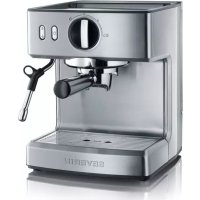
KA 5990 - Coffee machine SEVERIN - Free user manual and instructions
Find the device manual for free KA 5990 SEVERIN in PDF.



Download the instructions for your Coffee machine in PDF format for free! Find your manual KA 5990 - SEVERIN and take your electronic device back in hand. On this page are published all the documents necessary for the use of your device. KA 5990 by SEVERIN.
USER MANUAL KA 5990 SEVERIN
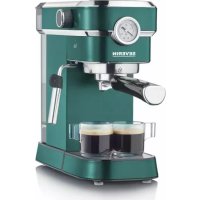
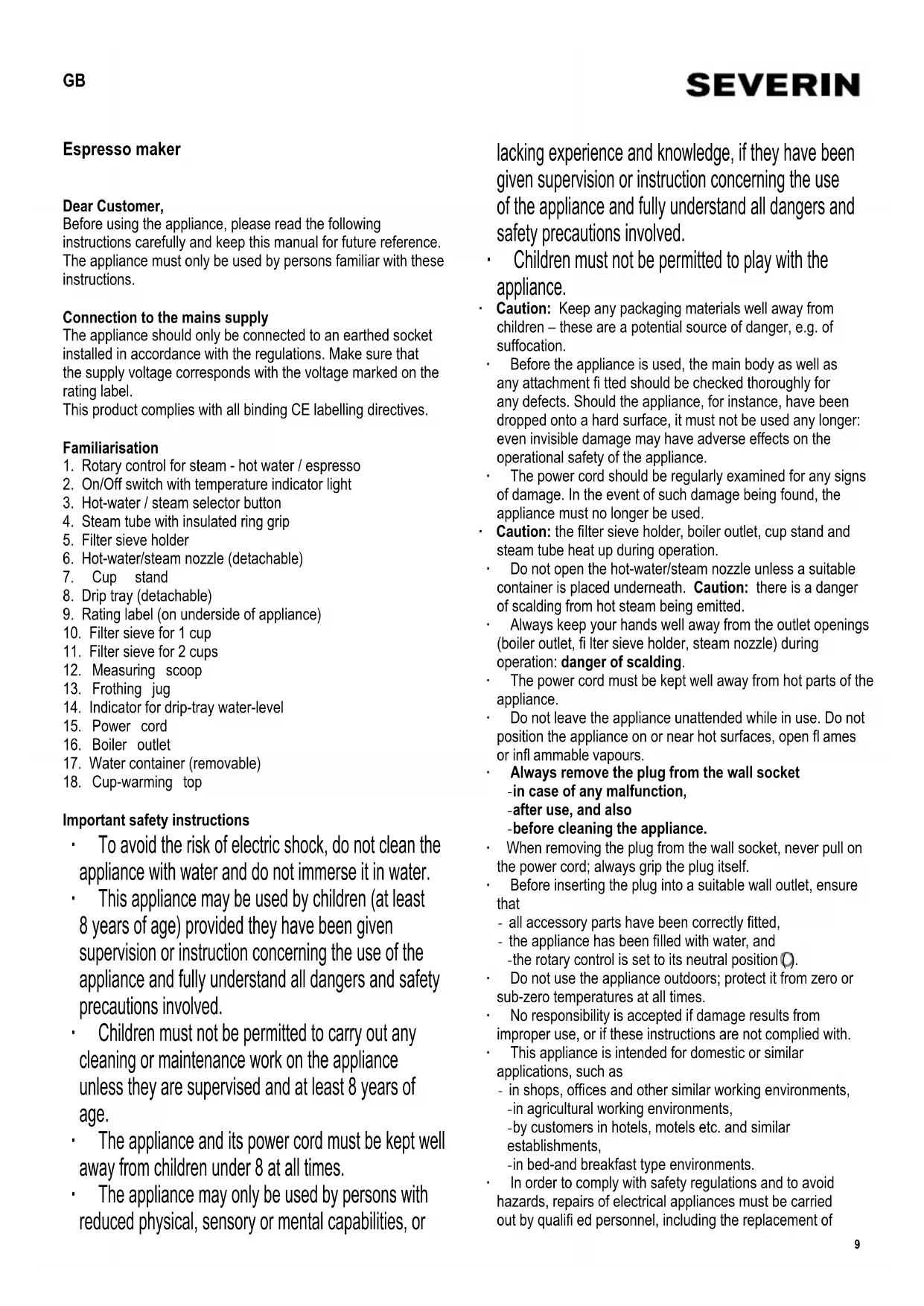
1. Rotary control for steam - hot water / espresso
2. On/Off switch with temperature indicator light
3. Hot-water / steam selector button
4. Steam tube with insulated ring grip
9. Rating label (on underside of appliance)
14. Indicator for drip-tray water-level
Important safety instructions ∙ To avoid the risk of electric shock, do not clean the appliance with water and do not immerse it in water. ∙ This appliance may be used by children (at least 8 years of age) provided they have been given supervision or instruction concerning the use of the appliance and fully understand all dangers and safety precautions involved. ∙ Children must not be permitted to carry out any cleaning or maintenance work on the appliance unless they are supervised and at least 8 years of age. ∙ The appliance and its power cord must be kept well away from children under 8 at all times. ∙ The appliance may only be used by persons with reduced physical, sensory or mental capabilities, or lacking experience and knowledge, if they have been given supervision or instruction concerning the use of the appliance and fully understand all dangers and safety precautions involved. ∙ Children must not be permitted to play with the appliance. ∙ Caution: Keep any packaging materials well away from children – these are a potential source of danger, e.g. of suffocation. ∙ Before the appliance is used, the main body as well as any attachment fi tted should be checked thoroughly for any defects. Should the appliance, for instance, have been dropped onto a hard surface, it must not be used any longer: even invisible damage may have adverse effects on the operational safety of the appliance. ∙ The power cord should be regularly examined for any signs of damage. In the event of such damage being found, the appliance must no longer be used. ∙ Caution: the fi lter sieve holder, boiler outlet, cup stand and steam tube heat up during operation. ∙ Do not open the hot-water/steam nozzle unless a suitable container is placed underneath. Caution: there is a danger of scalding from hot steam being emitted. ∙ Always keep your hands well away from the outlet openings (boiler outlet, fi lter sieve holder, steam nozzle) during operation: danger of scalding. ∙ The power cord must be kept well away from hot parts of the appliance. ∙ Do not leave the appliance unattended while in use. Do not position the appliance on or near hot surfaces, open fl ames or infl ammable vapours. ∙ Always remove the plug from the wall socket - in case of any malfunction, - after use, and also - before cleaning the appliance. ∙ When removing the plug from the wall socket, never pull on the power cord; always grip the plug itself. ∙ Before inserting the plug into a suitable wall outlet, ensure that - all accessory parts have been correctly fi tted, - the appliance has been fi lled with water, and - the rotary control is set to its neutral position ( ). ∙ Do not use the appliance outdoors; protect it from zero or sub-zero temperatures at all times. ∙ No responsibility is accepted if damage results from improper use, or if these instructions are not complied with. ∙ This appliance is intended for domestic or similar applications, such as - in shops, offi ces and other similar working environments, - in agricultural working environments, - by customers in hotels, motels etc. and similar establishments, - in bed-and breakfast type environments. ∙ In order to comply with safety regulations and to avoid hazards, repairs of electrical appliances must be carried out by qualifi ed personnel, including the replacement of GB10 the power cord. If repairs are needed, please send the appliance to one of our customer service departments. The addresses can be found in the appendix to this manual. On/Off switch with temperature indicator light The red temperature indicator light remains lit while the appliance is switched on. It fl ashes while the unit is pre-heating. Rotary control The rotary control has four settings: Dispensing steam/hot water via the steam tube Heating up for hot-water/steam Neutral position / unit in standby-mode Drawing espresso Caution: As soon as the rotary control is turned to the steam or espresso symbol, steam or hot water will be emitted. Hot-water/steam selector button With the rotary control in the ‘Heating-up’ ( ) position, the selector button can be used to select either hot water or steam. Hot water or steam may then be drawn from the hot-water/ steam nozzle. ∙ When drawing hot water, the symbol is lit (default setting). ∙ When dispensing steam, the symbol lights up. Inserting/removing the fi lter sieve holder: ∙ The fi lter sieve holder is fi tted to the appliance by means of a bayonet-type locking socket. When attaching it, the handle must be facing to the left of the boiler outlet (picture I). To lock, turn the holder fi rmly as far as possible to the right (picture II). ∙ To unlock and remove the holder, turn it to the left. ∙ Caution: Do not remove the sieve holder while the appliance is in use, since the holder is under pressure. Once the brewing cycle is complete, wait around 30 seconds before removing the sieve holder. Filling with water: ∙ Fill only with fresh water, on a daily basis; make sure that the water container is cleaned at regular intervals. Residual water should be poured out daily. Do not switch the appliance on unless the water container is fi lled. ∙ Lift out the water container before it is fi lled. ∙ Fill the container with (non-carbonated) cold water while observing the ‘Max’ marking on the water container. ∙ Once fi lled, replace the container in the appliance and push it down. ∙ Close the lid on the water container. ∙ The water level must be monitored and, if necessary, the container refi lled in good time. Please note: Should the pump have started sucking in air from the empty water container, fi ll the water container fi rst with the indicated maximum amount of water. When ‘bleeding’ the system afterwards, it may take a few moments before water is emitted again. ∙ Deposits of dirt and lime may cause the seals in the outlet at the bottom of the water container and those around the valves to leak. Check the seals carefully each time the water container is inserted and, if necessary, carefully remove any existing deposits. Automatic switch-off If the unit is not used for a period of 90 minutes, it will switch off automatically to save power. Before using for the fi rst time ∙ Before the appliance is used for the fi rst time, all detachable parts must be thoroughly cleaned as described in the section General Care and Cleaning. Refi t all parts afterwards. ∙ Clean the system by fl ushing with water as follows: ∙ Fill the container with water up to its ‘Max’ mark. ∙ Insert the sieve holder with either sieve in place, but without any ground coffee. ∙ Place a suitable container, with a capacity of about 1000 ml, underneath the outlet openings. ∙ Insert the plug into a wall outlet. ∙ Use the On/Off switch to turn the appliance on. The unit heats up. Once the temperature indicator light shows steady, turn the rotary control to position . Hot water is now emitted from the sieve holder outlets. ∙ Stop the process once the water container is about half full. Always empty the receptacle under the outlets in good time. ∙ Empty the receptacle. Use the insulated ring grip to pull the steam tube forward. Place the receptacle under the steam tube. ∙ Turn the rotary control to the ‘Heating up’ position ( ). ∙ The hot-water indicator on the selector button ( ) lights up. ∙ Turn the rotary control to the ‘Water/Steam’ position ( ). ∙ Water is now emitted through the hot-water/steam nozzle. ∙ Stop the process by turning the rotary control to position ( ) before the container is completely empty. Please note: This cleaning procedure should also be followed if the appliance has not been used for an extended period of time. General operation Good espresso is characterised by its hazelnut-brown, thick crema. It is made from dark-roasted, especially fi ne-ground coffee beans. A quantity of 20-35 ml per cup should not be exceeded. You are recommended to use thick-walled and preheated cups for espresso.11 Pre-heating the cups and the fi lter sieve holder: The cup-warming top facilitates pre-heating the cups. For a perfect coffee result, we recommend pre-heating the cups and the sieve holder. ∙ Insert the appropriate fi lter sieve into the sieve holder. ∙ Fit the sieve holder on to the appliance and place one or two cups underneath the holder. ∙ As soon as the operating temperature has been reached, the temperature indicator light shows steady. ∙ Turn the rotary control to the symbol. ∙ Let the cup(s) fi ll up to the desired level, and then turn the rotary control back to its neutral position ( ). ∙ Put the cup(s) aside to warm up and pour out the water just prior to preparing the beverage of your choice. Filling the fi lter sieve with ground espresso coffee / removing the espresso grounds ∙ Filling with ground espresso coffee: ∙ Remove the pre-heated sieve holder and sieve. (Caution: very hot). Pour out any residual water. ∙ Fill with fi nely ground espresso coffee: ∙ 1 cup = around 1 measuring scoop ∙ 2 cups = around 2 measuring scoops ∙ Fill the selected fi lter sieve up to its rim with ground espresso and use the underside of the scoop to press it down lightly. ∙ Any excess coffee powder on the rim must be removed. ∙ Removing the used grounds: ∙ After the brewing cycle is complete, wait approximately 30 seconds until the operating pressure has been suffi ciently reduced. ∙ Exercise caution when removing the sieve holder: it may still contain some hot water. Pour out the water carefully. ∙ Allow the sieve holder to cool down suffi ciently before tapping its side against a vertical surface to loosen the grounds before emptying it. ∙ To clean the sieve after use, hold the sieve with your fi ngers inside the cut-outs on the sieve holder and pull it out from above. Clean the sieve holder and sieve thoroughly. Drip tray During operation, any excess water or steam is collected in the drip tray. The tray must therefore be fi tted whenever the espresso maker is switched on. Caution: the cup stand may become very hot during use. As the water level in the drip tray rises, the fl oating red indicator becomes visible and the tray must be emptied. Do not remove the tray unless the rotary control is in its neutral position. Caution: The water in the tray may be very hot. To remove the tray, lift it up and pull it away from the appliance. Should the covering panel at the rear of the drip tray become detached from the tray during cleaning, it can be refi tted from above at a slight angle. Preparation Espresso ∙ Fill the container with water. ∙ Insert the plug into a suitable wall outlet and use the On/ Off switch to turn the appliance on. The red temperature indicator light fl ashes during the pre-heating phase. ∙ Preheat the sieve holder and the cup(s). ∙ Remove the sieve holder, fi ll with ground espresso coffee, pressing it down lightly. Re-attach the holder. ∙ Place the cup(s) underneath the sieve holder outlets. ∙ When the temperature indicator light shows steady, turn the rotary control to position . The espresso is now delivered straight into the cup(s). ∙ Once the required amount has been drawn off, turn the rotary control to its neutral position ( ) to stop the process. ∙ Wait for approximately 30 seconds before detaching the sieve holder and removing the espresso grounds. ∙ The espresso maker is now ready for another brewing cycle. ∙ Rinse the sieve holder under running water after use and replace it on the unit. ∙ Turn the rotary control to the position, holding it there for several seconds to fl ush the boiler outlet. Dispensing hot water ∙ Use the insulated ring grip to pull the steam tube forward. Place a cup under the steam tube. ∙ To dispense hot water, the sieve holder (with a sieve fi tted) must be in place. ∙ Turn the rotary control to the ‘Heating up’ position ( ). ∙ The hot-water indicator on the selector button lights up. ∙ When the temperature indicator light shows steady, turn the rotary control to position . ∙ Let the water go straight into a suitable cup. Caution: beware of hot steam. ∙ Once the required amount of hot water has been drawn off, turn the rotary control back to its neutral position ( ) to stop the process. Dispensing steam for heating beverages For heating up milk or other beverages, steam can be drawn from the hot-water/steam nozzle. ∙ Use the insulated ring grip to pull the steam tube forward. Place the cup containing the beverage to be heated under the hot-water/steam nozzle. ∙ To dispense steam, the sieve holder (with a sieve fi tted) must be in place. ∙ Turn the rotary control to the ‘Heating up’ position ( ). ∙ Set the selector button to the ‘Steam’ position ( ).The temperature indicator light starts fl ashing. ∙ Once the temperature indicator light shows steady, insert the hot-water/steam nozzle into the beverage and turn the rotary control to the position . Steam is now emitted through the nozzle. ∙ Once the beverage has reached the desired temperature, turn the rotary control back to its neutral position to stop the process. ∙ Any excess steam is collected in the drip tray. ∙ The hot-water/steam nozzle should be cleaned with a damp cloth immediately after use. Dispensing steam for frothing milk ∙ To dispense steam, the sieve holder (with a sieve fi tted) must12 be in place. ∙ Turn the rotary control to the ‘Heating up’ position ( ). ∙ Set the selector button to the ‘Steam’ position ( ). ∙ The temperature indicator light starts fl ashing. ∙ When the light shows steady, use the insulated ring grip to pull the steam tube forward and place a heat-resistant jug under the nozzle. Turn the rotary control to the ( ) position. Initially, some excess condensation may be emitted. As soon as only steam comes out, turn the rotary control to the ‘Heating up’ position ( ). ∙ The appliance is now ready to froth milk. ∙ Fill the frothing jug with around 50 ml of cold milk. ∙ Use the insulated ring grip to direct the steam tube into the jug. The hot-water/steam nozzle must be completely submerged in the milk. ∙ Turn the rotary control to the ‘Water/Steam’ position ( ). Steam is now emitted through the nozzle. ∙ Move the jug round with a circular motion, making sure that the nozzle remains submerged while frothing is in progress. ∙ As soon as the milk appears to be suffi ciently frothy, turn the rotary control to its neutral position ( ). ∙ Any excess steam is collected in the drip tray. ∙ The hot-water/steam nozzle should be cleaned immediately after frothing. Tips for the perfect milk froth ∙ Do not fi ll the frothing jug more than half-full. ∙ The milk should be cold, as this will extend the frothing time. ∙ Place your hand underneath the container, in such a way that you have good control over the temperature, which should not exceed 60 °C. As a general rule, milk should not be heated over 68 °C, to prevent the proteins from coagulating, making frothing impossible. ∙ The barista favours a creamy milk froth. ∙ Creamy milk froth tastes signifi cantly better in a cappuccino, which is traditionally made without cocoa powder. Coffee specifi cations Ristretto ∙ 6-8 g ground coffee ∙ 20 ml water Espresso ∙ 6-8 g ground coffee ∙ 20-35 ml water Coffee ∙ 6-8 g ground coffee ∙ 100-125 ml water Cappuccino ∙ 6-8 g ground coffee ∙ 20-35 ml water Fill a cappuccino cup with milk froth until it is covered by a little ‘bonnet’. Latte macchiato ∙ 6-8 g ground coffee ∙ 20-35 ml water Fill a tall glass a third full with hot milk. Then fi ll it up with hot milk froth to 2 cm below the rim, wait for about 15 seconds and then pour in the espresso; in that way, you will achieve the classic three-layer formation. General Care and Cleaning ∙ Before cleaning the espresso maker, ensure it is disconnected from the power supply and has cooled down completely. ∙ To avoid the risk of electric shock, do not clean the appliance with water and do not immerse it in water. ∙ Do not use abrasives or harsh cleaning solutions. ∙ All removable parts may be cleaned with warm, soapy water. ∙ The sieve holder and fi lter sieves should be rinsed under fresh tap water after each cycle of use, and also regularly in hot soapy water. ∙ Empty the drip tray daily, and clean the drip tray and cup stand with warm, soapy water. ∙ The exterior housing may be wiped with a dry or slightly damp, lint-free cloth.
The boiler outlet may be wiped with a moist cloth. ∙ The gasket area around the boiler outlet (at the bayonet locking socket) should be cleaned using a brush. A hard brush is recommended. ∙ Empty out any residual water from the container daily and clean it in hot soapy water at regular intervals. ∙ Under the water container (which must be lifted out) there is a cleaning tool with 2 wires (one thick, one thin). The thick wire (STEAM) may be used in the case of a blocked hot-water/steam nozzle; the thin wire (FILTER) is helpful to unblock a fi lter sieve. For safe storage, always replace the cleaning tool under the water container. ∙ The hot-water/steam nozzle should be cleaned immediately after the frothing process. Wiping the nozzle with a wet cloth should suffi ce. ∙ If the hot-water/steam nozzle becomes blocked, proceed as follows: ∙ Unscrew the hot-water/steam nozzle from the steam tube. ∙ Take out the cleaning tool from under the water container. Push the thicker wire through the nozzle opening. Rinse the nozzle under running water afterwards. ∙ Replace the nozzle. ∙ If the sieves are still blocked after cleaning them in hot soapy water, proceed as follows: ∙ Take out the cleaning tool from under the water container. Push the thinner wire through the opening in the base of the fi lter sieve. Rinse the sieve under running water afterwards. Descaling Depending on the water quality (its lime content) in your area as well as frequency of use, the appliance should be regularly descaled at 2 to 3 month intervals. Any warranty claim will be null and void if the appliance13 malfunctions because of insuffi cient descaling. Any commercially available fi lter sieve (portafi lter) descaling agent may be used. Caution: Do not pour descalers down enamelled sinks. ∙ Prepare two litres of descaling solution according to the manufacturer’s specifi cations and pour it into the water container. ∙ Replace the container in the unit. ∙ Fit the sieve holder. ∙ Place a suffi ciently large receptacle under the sieve holder outlets. ∙ Connect the unit to the mains. ∙ Use the On/Off switch to turn the appliance on. The heating process starts. Once the temperature indicator light shows steady, turn the rotary control to position
∙ The descaling solution now passes through the system into the receptacle, which should be emptied in good time. ∙ Stop the process once the water container is about 2/3 empty. ∙ Empty the receptacle. Use the insulated ring grip to pull the steam tube forward. Place the receptacle under the steam tube. ∙ Turn the rotary control to the ‘Heating up’ position ( ). ∙ The hot-water indicator on the selector button ( ) lights up. ∙ Turn the rotary control to the ‘Water/Steam’ position ( ). ∙ Water is now emitted through the hot-water/steam nozzle. ∙ Let the water pass through the nozzle until the level in the container has reached the ‘Min’ mark. Turn the rotary control back to the neutral position ( ) and pour out any remaining descaling solution left in the container. ∙ To clean the appliance after descaling, fi ll the container with clean water and let it pass through the sieve holder (position
∙ Fill the container to 1/3 with clean water and let it pass through the steam tube, until the level in the container has reached the ‘Min’ mark. Problems and their possible causes Taste Bitter taste The ground coffee is too fi ne, or has been pressed down in the sieve too hard. Sour taste The water is too sour or too soft. The ground coffee is too coarse, or the wrong type of coffee has been used (fi lter coffee roast instead of espresso roast). Other strange taste The chlorine content in the water is too high. The beans are too old, or the wrong type of coffee has been used (fi lter coffee roast instead of espresso roast). Crema Too little crema The ground coffee is too coarse, or the beans are too old. The ground coffee has not been pressed down in the sieve hard enough. The cup or the system need cleaning. Crema too dark The ground coffee is too fi ne, or the beans are too strongly roasted. Crema too light The ground coffee is too coarse, or the ground coffee has not been pressed down in the sieve hard enough. Crema does not last The cup is too cold or too hot. Disposal Devices marked with this symbol must be disposed of separately from your household waste, as they contain valuable materials which can be recycled. Proper disposal protects the environment and human health. Your local authority or retailer can provide information on the matter. Guarantee This product is guaranteed against defects in materials and workmanship for a period of two years from the date of purchase. Under this guarantee the manufacturer undertakes to repair or replace any parts found to be defective, providing the product is returned to one of our authorised service centres. This guarantee is only valid if the appliance has been used in accordance with the instructions, and provided that it has not been modifi ed, repaired or interfered with by any unauthorised person, or damaged through misuse. This guarantee naturally does not cover wear and tear, nor breakables such as glass and ceramic items, bulbs etc. This guarantee does not affect your statutory rights, nor any legal rights you may have as a consumer under applicable national legislation governing the purchase of goods. If the product fails to operate and needs to be returned, pack it carefully, enclosing your name and address and the reason for return. If within the guarantee period, please also provide the guarantee card and proof of purchase.14 Cafetière expresso Chère cliente, Cher client, Avant d’utiliser cet appareil, veuillez lire soigneusement les instructions suivantes et conserver ce manuel pour future référence. L’appareil doit être utilisé exclusivement par des personnes familiarisées avec les présentes instructions. Branchement au secteur Cet appareil ne doit être branché que sur une prise de courant avec terre, installée selon les normes en vigueur. Assurez-vous que la tension d’alimentation correspond à la tension indiquée sur la plaque signalétique. Ce produit est conforme à toutes les directives relatives au marquage “CE”. Familiarisez-vous avec votre appareil