Compact Cooker 68855 - Cooker UNOLD - Free user manual and instructions
Find the device manual for free Compact Cooker 68855 UNOLD in PDF.



User questions about Compact Cooker 68855 UNOLD
0 question about this device. Answer the ones you know or ask your own.
Ask a new question about this device
Download the instructions for your Cooker in PDF format for free! Find your manual Compact Cooker 68855 - UNOLD and take your electronic device back in hand. On this page are published all the documents necessary for the use of your device. Compact Cooker 68855 by UNOLD.
USER MANUAL Compact Cooker 68855 UNOLD
natural_image
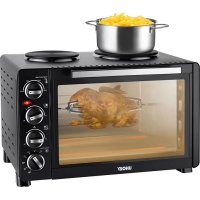
Black UNOLD portable stove with a cooking pan and pot on top (no visible text or symbols)Bedienungsanleitung
Modell 68855
Instructions for use Model 68855
Technical Data 24
For your safety 24
General information 25
Your new compact cooker ....27
Before using the appliance the first time .....27
Cleaning and Care 28
Cooking times 29
Cooking on the burners 30
Thawing 30
Warming/crisping 30
Browning 30
Grilling with the rotary spit 32
Roasting and cooking 33
Baking 36
Guarantee Conditions 126
Waste Disposal /
Environmental Protection ....130
Power: Max. 3,100 Watts, 220-240 V\~, 50 Hz, oven 1,400 W (top heat 700 W, bottom heat 700 W), burners 1,700 W (large burner 1,000 W, small burner 700 W)
Housing: Metal, enamel finish, black
Door: Heatproof glass
Dimensions: Approx. 54,5 x 36,5 x 33,0 (L/W/H)
Capacity: Baking area 28 liters, W/D: approx. 38.5 x 29.0 cm, useable height ca. 20cm
Weight: Approx. 11.95 kg (including accessories)
Power cord length: Approx. 80 cm, permanently attached
Features: Burners separately controlled from 1 - 5, large burner diameter 19.0 cm, small burner diameter 15.0 cm, oven max. 250°C, max. power output 3,100 Watts (oven 1,400 Watts, burners 1,700 Watts), interior with non-stick coating, rotary spit, circulating air function
Accessories: Operating instructions, 1 rotary spit with holding clips, 1 baking sheet, 1 grill grate, 1 grill grate lifter, 1 rotary spit lifter


Equipment features, technology, colours and design are subject to change without notice. Errors and omissions excepted
FOR YOUR SAFETY
- Please read the operating instructions carefully before using your appliance and keep them for future reference.
- This appliance is not intended for use by persons (including children) with limited physical, sensory or mental abilities or with lack of experience or limited knowledge, unless they are supervised by a person who is responsible for their safety or have been instructed on how to use the appliance.
- Children should be supervised to ensure that they do not play with the appliance.
-
Connect appliance only to an AC power supply to the voltage on the rating plate.
-
The appliance is to be connected to a socket-outlet having an earthing contact.
- Do not operate this appliance with an external timer or remote control system.
- Do not operate the appliance on or in the vicinity of hot surfaces.
- The appliance is intended for indoor use only. Place the appliance on a dry, level and sturdy surface.
-
Leave sufficient space between the appliance and walls, furniture and flammable objects such as curtains. There should be at least 10 cm of space on the sides and at least 30 cm above the appliance.
-
Place the appliance with its back against the wall.
- Never leave the appliance unattended while it is in operation.
- Always maintain a distance of at least 2 cm between the food being cooked in the oven and the top and bottom heating elements to prevent the food from catching fire - fire hazard!
- Use only suitable cookware for baking and cooking in the oven.
- Use only accessories recommended by the manufacturer. The use of other accessories can result in hazards and can also damage the appliance.
- The appliance is intended for household use only, or for similar areas of use, such as:
■ kitchenettes in businesses, offices or other workplaces,
■ agricultural enterprises,
■ for use by guests in hotels, motels or other lodgings,
■ in private guesthouses or holiday homes.
-
Do not pull on the power cord. Do not hang the power cord over the edge of a countertop. Do not wrap the power cord around the appliance and avoid kinking of the power cord.
-
Make sure that the power cord does not come into contact with the hot parts of the appliance. Do not touch hot parts. Always use pot holders.
-
The appliance becomes hot during operation. Please use pot holders. Never cover the appliance during operation.
-
Provide for adequate ventilation when the appliance is in operation.
-
Use the appliance only indoors.
-
The appliance does not shut off automatically. Therefore, set the temperature selector switch to 0 and unplug the appliance after use.
-
Do not immerse the appliance in water or other liquids.
-
All parts must be completely dry before being assembled.
-
Please allow the appliance to cool completely before moving, cleaning or storing it. Before handling the appliance, always unplug it from the electrical outlet.
-
Check the plug and the power leads cord regularly for wear or damage. In case of damage to the power cord or other parts, please send the appliance for inspection and/or repair to our after sales service (for address, see warranty terms). Unauthorized repairs can result in serious risks to the user and will void the warranty.

Caution! During and after operation, the appliance is very hot! The temperature of the door or accessible surfaces may be high when the appliance is working.
The manufacturer does not assume any warranty in case of incorrect assembly or of improper or incorrect use or after repair by unauthorized third parties.
GENERAL INFORMATION
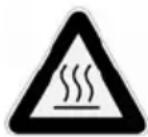
CAUTION!
The appliance becomes very hot during operation, also on the outer surfaces. Therefore, be sure to maintain sufficient clearance between the appliance and all flammable objects; also, provide for sufficient ventilation.
Always use pot holders whenever the appliance is in operation or as long as it is still hot.
- Your oven is ideal for daily use in preparing a wide variety of foods. Since cooking times can vary, we recommend that you keep an eye on the cooking process and check the food regularly for doneness.
- For some recipes we recommend pre-heating the appliance. For these recipes, switch on the appliance 5 to 10 minutes ahead of time and select the temperature specified in the recipe.
- For cooking with bottom heat we recommend using the bottom level and for top heat the top level.
- Do not use metal objects for cleaning the housing or baking sheet. The baking sheet is not suitable for cutting. Never cut cake or pizza on the baking sheet.
- The appliance becomes hot during operation; therefore, always use pot holders.
- Do not use the glass door for setting down pots or other objects when it is open; otherwise, the glass could become damaged.
- Always open the glass door carefully; escaping hot air could result in burns.
-
We recommend using the oven to keep food that has finished cooking warm only for a short time, since otherwise it can dry out.
-
As soon as the desired temperature is reached, the indicator lamps for the temperature and function go out. As soon as the appliance begins heating again, the indicator lamps light up again.
- After use, make sure to set all switches to 0 and to switch off the function switches.
- When not in use, always unplug the appliance from the power supply.
- When using the grill function, use top heat only! Otherwise, grease could drip onto the bottom heating element, causing smoke and unpleasant odors.
- The rotary function for grilling with the rotary spit can be switched on with switch 13.
- Switch on the burners only if a cooking pot with content is on the respective burner. Preferably you should use only pots which have a flat bottom and a diameter corresponding to that of the respective burner.
- You can use both burners while the oven is in use. However, we recommend using only one burner when the oven is in use, to prevent overloading the main fuse.
YOUR NEW COMPACT COOKER
text_image
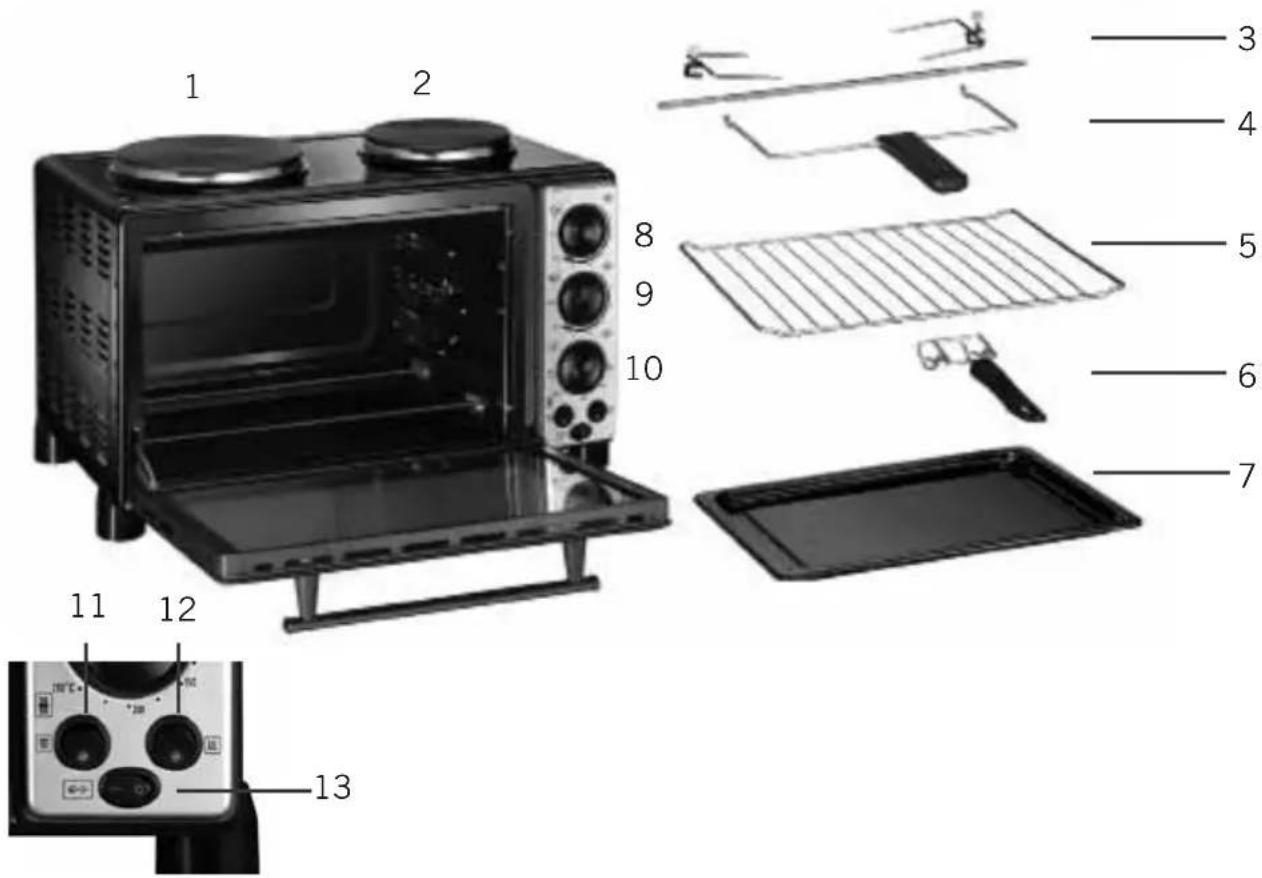
Exploded view diagram of a microwave oven with numbered parts for identification1 Large burner 1,000 W
2 Small burner 700
3 Rotary spit with holding clips
4 Lifter for rotary spit
5 Grill grate
6 Lifter for grate and baking sheet
7 Baking sheet
8 Temperature control for large burner with indicator lamp
9 Temperature control for small burner with indicator lamp
10 Temperature control for oven with indicator lamp
11 Function switch for top heat
12 Function switch for bottom heat
13 Function switch for rotary spit
BEFORE USING THE APPLIANCE THE FIRST TIME
- Remove all packaging materials from the appliance and ensure that all parts are complete and undamaged.
-
Wash the removable parts in warm water with mild dishwashing detergent. Do not use abrasive cleaners or steel wool. Then rinse the parts with clear water. Dry all parts thoroughly.
-
Wipe off the housing with a damp cloth.
- If the heating elements need to be cleaned, wipe them off a well wrung-out damp cloth. Make sure that no water enters the housing.
- Do not immerse the appliance in water or other liquids.
- The first time you use the appli- ance, it is possible that there will
be some smoke. This smoke is normal and does not represent a hazard. However, we recommend pre-heating the appliance before the first use to eliminate any residue.
- Place the appliance on a heat-proof, sturdy and level surface.
- Leave sufficient space between the appliance and walls and other flammable objects such as curtains.
- Make sure that all switches are set to the 0 position.
- Plug the power cord of the appliance into an electrical outlet (220-240 V \~ AC).
- Set the temperature selector switch to 250^ C and switch on the top and bottom heat by pressing the corresponding switches. The indicator lamps on the switches light up.
- As soon as the desired temperature is reached, the indicator
lamps for the temperature and function go out. As soon as the appliance begins heating again, the indicator lamps light up again.
- Before the first use, we recommend heating the appliance to the maximum temperature for about 10 minutes until no more smoke escapes from the appliance.
- Open the windows during this pre-heating time. After pre-heating the appliance there may already be visible signs of use; however, these do no affect the function of the appliance and do not constitute grounds for a complaint.
- Switch the appliance off by setting the temperature and time switches to 0 and allow the appliance to cool completely.
- Now your appliance is ready for use.
CLEANING AND CARE
- Before cleaning, switch off the appliance (set all switches to 0) and unplug the power cord from the power supply.
- Allow the appliance to cool completely.
- Do not immerse the appliance in water or other liquids in order to clean it.
- All removable parts, such as the baking sheet, grill spit and grate, etc. can be washed in warm water with mild dishwashing detergent. After washing, rinse the parts with clear water and dry them thoroughly. The removable parts can also be washed in the dishwasher.
-
In case food ever burns on, you can briefly soak the part in hot water with mild dishwashing detergent to remove all residue.
-
If the heating elements need to be cleaned, wipe them off a well wrung-out damp cloth. Make sure that no water enters the housing.
- To clean the housing, wipe it inside and outside with a damp cloth. Make sure that no water enters the appliance.
- The interior surfaces of the oven are equipped with an easy-to-clean surface and can be cleaned with a damp cloth. Wipe off splashes immediately with a damp cloth.
- Wipe off the burners using a damp cloth with mild dishwashing detergent. If food ever cooks over and burns on, you can use a pot scrubber to clean the burners.
- Never use caustic or abrasive cleaners or steel wool, etc.
COOKING TIMES
- The following cooking times are approximate times which can vary depending on the quality and quantity of the ingredients, the selected temperature setting and your personal taste.
- If you prepare meat with paprika or other spices which are sensitive to heat, please reduce the temperature somewhat and increase the cooking time accordingly.
- When using the grill grate or the rotary spit, you should always
insert the drip pan at the bottom level.
- When grilling on the grill grate you should turn the food being grilled several times so that it browns evenly.
- For cakes and casseroles, please follow the times stated in the recipes.
- The following pages provide information on use of the different functions, in addition to recipe suggestions for each type of use.
| Food to be grilled Accessory to use | Level (from below) | Temp. °C Preheat to 250 °C | heat to 250 °C | Cooking time, approx. |
| Pork steak | Grill grate | 3 | 250 °C | 10 min. about 10 min. on each side |
| Chicken, whole | Rotary spit | 250 °C | ||
| Chicken wings | Grill grate | 3 | 250 °C | |
| Chicken legs | Grill grate | 3 | 250 °C | |
| Pork medaillons | Grill grate | 3 | 250 °C | 10 min. about 35 min. |
| Duck, 1.8 kg | Rotary spit | 250 °C | ||
| Rolled roast of turkey 700 g | Rotary spit | 250 °C | ||
| Pheasant | Rotary spit | 250 °C | ||
| Partridge | Rotary spit | 250 °C | ||
| Meat loaf | Grill grate | 2 | 160-180 °C | |
| Trout in foil | Grill grate | 2 | 180 °C | |
| Smoked pork loin in dough | Grill grate | 2 | 180 °C | |
| Pork shoulder | Grill grate | 2 | 200 °C | |
| Leg of lamb | Grill grate | 2 | 180 °C | |
| French fries/croquettes | Baking sheet | 250 °C | 10 min. about 15-20 min. | |
| Mackerel, grilled | Grill grate | 250 °C | ||
| Baked potatoes in foil | Baking sheet | 2 | 180 °C |
- You can use the burners just as you would use a conventional stove or hotplate for cooking and frying in pots and pans.
- You can use either of the burners or both at the same time.
- Switch on the burner you wish to use by setting the corresponding selector switch to the desired setting between 1 and MAX.
- Always use pots with a flat bottom to ensure good contact with the surface of the burner. Preferably, the bottom of the pot should have the same diameter as the burner.
- After use, immediately set the temperature control to 0.
- Unplug the appliance from the power supply.
- After being switched off, the burner will remain hot for some time. The residual heat can be used to keep food warm, for example.
- You can use both burners while the oven is in use. However, we recommend using only one burner when the oven is in use, to prevent overloading the main fuse.
THAWING
- You can use the compact cooker for thawing out meat, poultry, bread and rolls.
- Insert the baking sheet/drip pan at the bottom level.
- Insert the grill grate at the second level from the bottom.
- Place the frozen food either on the grill grate or in a heat-proof dish and place the dish on the grill grate.
- For thawing, we recommend the lowest temperature setting (about 100 °C) to prevent the food from drying out.
- Switch on top and bottom heat. As soon as the desired temperature is reached, the indicator lamps for the temperature and function go out. As soon as the appliance begins heating again, the indicator lamps light up again.
WARMING/CRISPING
- The compact cooker is ideal for warming/crisping bread and rolls (also frozen).
- Pre-heat the appliance about 5 minutes with top and bottom heat at 200 °C .
- Insert the baking sheet or the grill grate at the top level.
- Place the baked goods on the baking sheet or grill grate and warm/crisp as desired.
BROWNING
- Insert the baking sheet or the grill grate with the food to be browned at the third level from the bottom.
- Set the desired temperature. For fast browning we recommend 250 °C .
- Switch on top and bottom heat.
- When browning you should check the food at short intervals to prevent it from burning.
Hawaii toast
Ingredients:
4 slices bread for toasting, 4 slices cooked ham,
4 slices pineapple, 4 slices Edam cheese
Preparation:
Place the bread slices on the grate, insert the grate at the third level from the bottom and toast the bread briefly at 250 °C top and bottom heat until the top side is slightly brown; then turn and toast the other side.
Place one slice of cooked ham, one slice of pineapple and one slice of cheese on each slice of bread.
Place the prepared bread slices on the greased baking sheet, insert in the oven at the third level from the bottom and brown at 250 °C for about 5 minutes.
Mozzarella toast
Ingredients:
4 slices bread for toasting, 1 tomato, several basil leaves, 2 balls of mozzarella, freshly ground black pepper
Preparation:
Place the bread slices on the grate, insert the grate at the third level from the bottom and toast the bread briefly at 250 °C top and bottom heat until the top side is slightly brown; then turn and toast the other side.
Slice the tomatoes and place on the bread slices. Sprinkle several basil leaves on top.
Slice the mozzarella and place on the bread slices; season with pepper.
Place the bread slices on the greased baking sheet, insert in the oven at the third level from the bottom and brown at 250 °C with top and bottom heat for about 5 minutes.
Pizza toast
Ingredients:
4 slices bread for toasting, 2 slices cervelat salami, 1 slice cooked ham, 1 small tomato, 1 TBSP sliced mushrooms, 2 slices Edam cheese, 2 TBSP sour cream, 12 tsp oregano, salt and pepper
Preparation:
Place the bread slices on the grate, insert the grate at the third level from the bottom and toast the bread briefly at 250 °C top and bottom heat until the top side is slightly brown; then turn and toast the other side.
Dice all ingredients except the sour cream and spices, mix with the sour cream and spices and spread mixture on the toasted bread slices.
Place the bread slices on the greased baking sheet, insert in the oven at the third level from the bottom and brown at 250 °C with top and bottom heat for about 5 minutes.
Curry toast
Ingredients:
4 slices bread for toasting, 100 g cooked chicken (e.g. breast or grilled leftover chicken) or pork roast, 2 TBSP barbecue sauce (curry flavor), 2 slices pineapple, 1 tsp coconut flakes, 4 slices Edam cheese, curry powder Preparation:
Place the bread slices on the grate, insert the grate at the third level from the bottom and toast the bread briefly at 250 °C top and bottom heat until the top side is slightly brown; then turn and toast the other side.
Dice meat and pineapple, mix with curry sauce and coconut flakes and spread on toasted bread slices. Top each with a slice of cheese.
Place the bread slices on the greased baking sheet, insert in the oven at the third level from the bottom and brown at 250 °C with top and bottom heat for about 5 minutes.
Sprinkle with curry powder before serving.
Franconian bratwurst toast
Ingredients:
4 slices brown bread, 16 Nuremberg bratwurst sausages (fry in pan first), 100 g cooked sauer- kraut, 1 tsp caraway seed, 30 g grated Gouda cheese, 3 TBSP sour cream, 1 TBSP fried oni- ons
Preparation:
Place the brown bread on the grate, insert the grate at the third level from the bottom and toast the bread briefly at 250 °C top and bottom heat until the top side is slightly brown; then turn and toast the other side.
Place 4 bratwurst sausages on each slice of bread and top with sauerkraut.
Mix the Gouda with the caraway seed and sour cream and spread on the bread slices.
Place the bread slices on the greased baking sheet, insert in the oven at the third level from the bottom and brown at 250 °C with top and bottom heat for about 5 minutes.
Noodle casserole
Preparation time: 60 minutes Ingredients:
250 g macaroni noodles, 400 g pork cutlet, 1 onion, 1 clove garlic, 3 TBSP oil, 1/4 l hot meat broth, 1 TBSP chopped parsley, 4 tomatoes, 1 tsp salt, 250 g zucchini, 1 pinch dried thyme, 100 g grated Swiss cheese
Preparation:
Cook noodles following instructions on package until al dente. Heat 2 TBSP oil in a pan on the stove and sauté the diced onions and chopped garlic until clear.
Add the thinly sliced meat and brown. Pour in the meat broth and braise for 8 minutes.
Slice the zucchini, brown on both sides in the remaining oil, season with salt and thyme. Peel and dice the tomatoes.
Use the oil from the pan with the zucchini to grease the casserole form. Put half the noodles in the form and layer the diced tomatoes, zucchini slices and top with the remaining noodles.
Sprinkle the cheese over the casserole and place in the oven on the grate at the second level from the bottom; bake at 230 °C with top and bottom heat for about 20 minutes.
Asparagus casserole
Preparation time: 50 minutes
Ingredients:
500 g canned asparagus, 300 g lean cooked ham, 2 TBSP butter, 2 TBSP flour, 1/4 l milk, 1/8 l dry white wine, 150 g soft cheese, 2 egg yolks, 1 TBSP chopped parsley, butter for the form
Preparation:
Cut the asparagus into 5 cm pieces. Cut ham in fine strips. Place these two ingredients in the greased casserole form.
Melt the butter in a pot on the stove and fry the flour until golden (light roux). Add the milk and the wine to the roux.
Cook the sauce 5 minutes, stirring constantly, then melt the cheese in the sauce.
Remove the sauce from the stove and fold in the egg yolk.
Pour the sauce over the asparagus in the casse-role form. Place the casserole in the oven on the grate at the second level from the bottom; bake at 190 °C with top and bottom heat for about 20 minutes. Serve right away.
TIP:
Serve asparagus casserole with princess potatoes and a green salad.
GRILLING WITH THE ROTARY SPIT
- Always insert the grease drip pan at the bottom level to catch dripping grease so that it does not drip onto the heating elements, in which case it would burn.
- The grill spit is ideal for grilling poultry up to about 2 kg or rolled roasts up to about 1 kg.
- Push one of the holding clips onto the grill spit so that the tips point toward the center.
- Then push the spit through the center of the prepared and spiced chicken or roast.
- Put the second holding clip on the spit with the tips pointing toward the middle.
- Now push both clips toward the chicken or roast so that it is held tight in the center of the spit. It is important that the spit is inserted through the center of the chicken or roast so that it is turned and browned evenly. Any parts of the chicken which stick out should be tied with kitchen string.
- Fasten the holding clips by tightening the set screws. Please be careful not to fasten the set screws behind the two dots 1 + 2 .
- Now insert the spit with the pointed end first into the corresponding recess on the left side inside the oven.
- Hang the other end of the grill spit in the holder on the right side.
- Now set the temperature to 250^ C by means of the oven temperature selector switch. Set the function selector switch to top and bottom heat. As soon as the desired temperature is reached, the indicator lamps for the temperature and function go out. As soon as the appliance begins heating again, the indicator lamps light up again.
- We recommend brushing oil or a marinade on the chicken or roast occasionally while it is cooking to prevent it from drying out and also for a crispier crust.
Crispy grilled chicken
Preparation time: about 70 minutes Ingredients:
1 chicken (about 1 kg), 1 tsp salt, 1 tsp paprika, 2 TBSP oil
Make a marinade from the salt, paprika and oil and brush the marinade on the chicken.
Insert the rotary spit through the chicken and fasten the two clips. Tie any parts which stick out, such as wings, etc., with kitchen string.
Hang the rotary spit in the appliance.
Grill the chicken about 60 minutes at 250 °C with top and bottom heat.
Partridge
Preparation time: 45 minutes
Ingredients:
2 partridges (500 g each), 400 g sausage meat, 100 g lean smoked bacon, 1/4 l meat broth, 1/8 l dark beer, 2 TBSP dark sauce thickener Preparation:
Fill the partridges with the sausage meat and sew up. Tie the wings and legs together with the bacon to the body.
Insert the rotary spit through the chicken and fasten the two clips. Tie any parts which stick out, such as wings, etc., with kitchen string.
Hang the rotary spit in the appliance.
Grill the chicken about 45 minutes at 250 °C with top and bottom heat.
Mix the pan juices with the sauce thickener in a pot on the oven and bring to a boil. Stir in the beer and remove from heat.
Roast pheasant
Ingredients:
1 pheasant, about 1 kg, 100 g canned chanterelles, 1 onion sliced thin, 100 g lean smoked bacon, 1 day-old roll, 100 g fatty bacon, 3 TBSP parsley chopped fine, 1 egg, 1/4 tsp salt, 1 pinch nutmeg, 1 pinch pepper, 1/8 l meat broth, 1/8 l red wine, 1 cup (about 200 ml) sour cream
Preparation:
Soak the roll in warm water. Sauté the fat bacon, diced, together with the onions in a pan on the stove until golden. Squeeze out the roll and cut into small pieces and add to the pan together with the chanterelles, parsley, egg and spices and mix well.
Fill the pheasant with this mixture and sew up.
Wrap the pheasant in the smoked bacon and then wrap with kitchen string so that the legs and wings are not sticking out.
Insert the rotary spit through the chicken and fasten the two clips. Tie any parts which stick out, such as wings, etc., with kitchen string.
Hang the rotary spit in the appliance.
Grill the chicken about 80 minutes at 250 °C with top and bottom heat.
15 minutes before it is done cooking, remove the string and the bacon so the pheasant can brown.
With the meat broth, loosen the pan juices in the drip pan, put in a pot and heat together with the red wine. Stir in the sour cream.
Rolled roast of turkey
Preparation time: about 70 minutes
Ingredients:
700 g rolled turkey roast, 1 tsp salt, 1 crushed garlic clove, 1 tsp vinegar, 1 TBSP oil, 1/4 tsp pepper, 150 g smoked bacon, sliced, 1/8 l dry red wine, 1/4 l hot water, 100 g sour cream Preparation:
Mix the salt, garlic, vinegar and pepper with the oil and brush on the roast.
Wrap the smoked bacon slices around the roast and tie with kitchen string.
Insert the rotary spit through the chicken and fasten the two clips.
Hang the rotary spit in the appliance.
Grill about 60 minutes at 250 °C with top and bottom heat. During this time, juices from the roast will collect in the drip pan.
When the roast has finished cooking pull out the drip pan and pour the pan juices into a pot.
Then reinsert the drip pan.
Heat the pan juices on the stove (do not boil), then stir in the wine and sour cream. Remove the string and bacon from the roast, slice and serve with the gravy.
Roast duck
Preparation time: 3 hours
Ingredients for 8 servings:
1 duck (about 1.8 kg), salt, 1 tsp pepper, 1/8 l dark beer, 1/8 l red wine, 1 tsp corn starch, dissolved in a little water
Preparation:
Wash the duck and trim any excess fat. Stuff the duck as desired and sew up. Tie the wings to the body with kitchen string.
Mix the salt and pepper with the beer and brush on the duck. If the duck is not stuffed, season inside as well. Pierce the fatty skin several times with a fork.
Fasten the duck on the rotary spit and hang in the oven.
Grill about 2.5 hours at 250^ C with top and bottom heat.
When it is finished cooking, switch off the oven but leave the duck in the oven to keep it warm.
Remove the pan juices from the drip pan and bring to a boil with the wine. Blend the corn starch with the water and stir in to thicken the gravy. Season to taste.
Remove the duck from the spit, carve and serve with the gravy.
TIP:
Serve this festive roast with red cabbage with apples and potato dumplings or bread dumplings.
If you prefer a lean roast, substitute a young turkey for the duck.
ROASTING AND COOKING
- The compact cooker is ideal for preparing casseroles, roasts and other dishes.
- For casseroles, etc. place the casserole form or ovenproof dish on the grill grate; some dishes can also be cooked directly on the baking sheet.
- Set the temperature selector switch to the desired temperature and use the function selector switch to select top and bottom heat or only bottom heat, depending on the recipe. As soon as the desired temperature is reached, the indicator lamps for the temperature and function go out. As soon as the appliance begins heating again, the indicator lamps light up again.
Meat loaf
Preparation time: 75 minutes
Ingredients:
500 g ground beef and pork, 150 g chopped pork liver, 1 day-old roll, 1 onion, 2 cloves garlic, 1 egg, 1 tsp salt, 3 pinches nutmeg, 3 pinches pepper, 150 g lean bacon, thinly sliced, 1 tsp paprika powder, 1 tsp mustard, 1 TBSP fine bread crumbs
Preparation:
Soak the roll in water. Peel the onions and garlic and chop very fine.
Knead together the squeezed out roll, the onions, ground meat, chopped liver, egg, salt, mustard and spices with the bread crumbs.
Form the mass into a long loaf and place in an ovenproof dish and cover with the sliced bacon. Place the dish with the meat loaf on the grate at the second level from the bottom and bake at 180^ C with top and bottom heat for about 50 minutes; it may be necessary to reduce the heat to 160^ C after about 30 minutes.
Leg of lamb
Marinating time: 6 hours
Preparation time: 60-80 minutes
Ingredients:
1.5 kg leg of lamb with bones, 3 cloves garlic, 3 onions, 1/4 l hot meat broth, 1/8 l dry white wine, 1 tsp corn starch
For the marinade:
70 g tomato paste, 1 TBSP flour, 1 tsp salt, 2 TBSP lemon juice, 1 tsp dried rosemary, 14 tsp caraway seed, 14 tsp pepper
Preparation:
Cut a shallow cross shape into the leg of lamb and use a sharp knife to make small incisions for spiking with the peeled and sliced garlic.
Combine the tomato paste with the flour, salt, lemon juice, rosemary, caraway seed and pepper. Spread this mixture on the leg of lamb and marinate in the refrigerator for 6 hours.
Place the leg of lamb in an ovenproof dish at the bottom level in the oven. Cover the roast with onion rings. Roast about 150-180 minutes at 180^ C with top and bottom heat.
When the onions are brown, move them to the bottom of the pan and add some meat broth. Gradually pour the remaining meat broth and the wine over the leg of lamb and turn it after about 2/3 of the cooking time. When it has finished cooking, switch off the oven and leave the leg of lamb in the oven for about 10 minutes. Loosen the pan juices with a little water, thicken with corn starch and season to taste.
Leg of lamb is complemented very well by green beans and au gratin potatoes.
Pork steaks
Ingredients:
4 pork steaks (200 g each), 1 tsp salt, a few da-shes of Tabasco, 2 tsp paprika, 3 TBSP oil Preparation:
Prepare a marinade from the Tabasco, paprika and oil and marinated the steaks about 2 hours. Place the seasoned steaks on the grate, insert in oven at third level from the bottom and grill the steaks at 250^ C with top and bottom heat about 10 minutes on each side.
TIP:
To save time you can use ready-to-grill steaks.
Smoked pork loin in dough
Preparation time: 45 minutes
Ingredients:
300 g puff pastry dough, frozen, 1 kg cooked lean smoked pork loin, 1 egg, separated
Preparation:
Thaw out the puff pastry dough. Brush egg yolk on the edges of the thawed dough and paste them together to form a large rectangle.
Place the dough over the pork loin so that the bottom is not covered. Cut off the overhanging edges.
Cut leaves and flowers from the remaining dough for decoration.
Mix the egg yolk with the remaining egg white and brush the mixture on the dough.
Place the pork loin on the baking sheet and insert at the second level from the bottom; bake at 180^ C with top and bottom heat for about 30 minutes.
TIP: This dish goes very well with a hearty potato salad.
Pork shoulder
Preparation time: 100 minutes
Ingredients:
1 kg pork shoulder with rind cut in crisscross pattern (from butcher), 1 tsp salt, 14 tsp pepper, 14 tsp caraway seed, 1 onion, 2 cloves, 2 TBSP oil, 14 l hot water, 1/8 l sweet cream, 10 prunes without pits
Preparation:
Soak the prunes in 1/8 l hot water.
Season the meat with pepper, caraway seed and salt and place in a roasting pan with the rind facing downward.
Place the roasting pan on the grate at the bottom level in the oven.
Slice the onion and place on top of the meat.
Roast at 200^ C with top and bottom heat about 120 minutes.
When onions are brown, turn the meat and pour 1/8 l hot water together with the cloves into the roasting pan. Finish roasting the meat.
After is has finished roasting, leave the crispy pork shoulder in the over for about 10 minutes. Pour the pan juices from the drip pan into a pot, add the prunes (cut in thin strips) and let simmer on the stove for a while. Add the cream before serving.
Lasagna
Preparation time: 90 minutes
Ingredients:
250 g lasagna noodles, 500 g ground beef and port, 2 TBSP oil, 2 onions, 12 tsp oregano, 1 tsp paprika powder, 1 tsp salt, 70 g, tomato paste, 2 TBSP butter, 2 TBSP flour, 12 l milk, 14 l dry white wine, 12 tsp salt, 2 pinches pepper, 100 g grated Swiss cheese, 50 g grated Parmesan cheese, 3 TBSP sweet cream, butter for the pan Preparation:
Cook the noodles according to the instructions on the package and then place in cold water.
Chop the onions and brown in the oil in a pan on the stove. Add the ground meat and fry, stirring occasionally. Add oregano, paprika and 1/2 tsp salt and set the mixture aside.
In a pot, prepare a roux from the butter and flour, and then add the milk and wine. Cook 5 minutes, stirring constantly, then season with salt and pepper.
Grease a casserole form and cover the bottom with lasagna noodles. In layers, add some the meat mixture and then sauce. Repeat in thin layers; the top layer should be lasagna noodles. Pour the rest of the sauce over the lasagna and top with cheese and cream.
Cover the form with aluminum foil and place on the grate at the bottom level of the oven; bake at 200^ C with top and bottom heat for about 45 minutes. After 2/3 of the baking time remove the foil.
Preparation time: 80 minutes Ingredients:
800 g sauerkraut, 1/8 l meat broth, 1/8 l apple juice, 1 bay leaf, 2 juniper berries, 1 large red bell pepper, 100 g lean bacon, 500 g cooked potatoes, 2 TBSP white wine, 2 TBSP sour cream, 1 TBSP butter, butter for the form Preparation:
Steam the sauerkraut in a pot on the stove together with the meat broth, apple juice and spices for about 35 minutes.
Prepare and wash the bell pepper and cut into strips.
Dice the bacon and fry in a pan until crispy. Add the bell pepper and sauté briefly.
Peel the potatoes and slice into thin rounds. Mix the sauerkraut with the bacon, bell pepper and wine, put in the casserole form and cover with the sliced potatoes.
Mix the parsley with the sour cream and spread this mixture over the potatoes. Add the butter in flakes.
Bake the casserole at the second level from the bottom at 200 °C with top and bottom heat for about 25 minutes.
Steamed trout
Preparation time: 30 minutes Ingredients:
4 trout (200 g each), 4 stalks parsley, juice of 1 lemon, salt and pepper, 4 pieces of aluminum foil
Preparation:
Pre-heat the compact cooker for 5 minutes at 250 °C top and bottom heat.
Season the trout and rub with lemon juice.
Wrap each trout in a piece of aluminum foil which has been greased with butter so the skin does not stick to the foil.
Place the wrapped trout in the oven on the baking sheet at the second level from the bottom and steam at 180^ C with top and bottom heat for about 20 minutes.
TIP:
Serve this traditional dish with boiled potatoes, melted butter and lemon slices. Trout is also very tasty with horseradish cream.
Mixed vegetables
Ingredients:
1000 g seasonal mixed vegetables, prepared, 1-2 TBSP mixed herbs, 1 tsp spices for vegetables
Preparation:
Cut larger vegetables into fine strips.
Mix the vegetables with the spices and distribute on 10 pieces of aluminum foil. Add butter in flakes, if desired.
Take the foil by the corners and twist together to form small packages.
Place the wrapped vegetables on the baking sheet and cook in the oven at 180 °C with top and bottom heat for about 30 minutes. The cooking time can vary depending on the type of vegetables.
After cooking, sprinkle the vegetables with fresh chopped herbs.
Bacon potatoes
Preparation time: 50 minutes
Ingredients:
4 potatoes (about 500 g), 150 g lean bacon,
1 tsp oil, 1 TBSP chopped parsley
Preparation:
Peel the potatoes and slice in thin rounds in the form of a fan. This can be done easily by placing the potato on a tablespoon before cutting.
Chop the bacon and distribute between the potato slices.
Oil four pieces of aluminum foil and wrap each potato fan in the foil. Place the wrapped potatoes on the baking sheet.
Bake at the second level from the bottom at 180 °C with top and bottom heat for about 40-60 minutes.
During the last 10 minutes, open the foil and finish baking the potatoes.
Sprinkle the hot potatoes with the chopped parsley and serve in the foil.
TIP:
You can also fill the potatoes with onion rings and a little garlic. Also, try sprinkling some caraway seed between the slices.
Baked potatoes in foil
Preparation time: 50 minutes
Ingredients:
4 potatoes (500 g), 1 tsp oil
Preparation:
Wash the potatoes and clean thoroughly with a vegetable brush. Poke several holes in the potatoes with a fork or cut a cross in the skins.
Wrap each potato in a piece of the aluminum foil. Place the wrapped potatoes on the baking sheet.
Bake at the second level from the bottom at 180 °C with top and bottom heat for about 40-60 minutes.
After baking, open the foil at the top, lift the skin where it was cut and top the potatoes with dressing, made for example from curd cheese or yogurt, sour cream and herbs.
TIP:
Baked potatoes are an ideal accompaniment to steaks and perfect for a barbecue or garden party.
They can be eaten with salt only, or with herb or garlic butter.
Apple rice casserole
Preparation time: 60 minutes
Ingredients:
^3/4 I milk, 1 pinch salt, 175 g round grain rice, 1 envelope vanilla sugar, 2 eggs, 2 TBSP sugar, 500 g apples, 1 TBSP lemon juice, 3 TBSP powdered sugar, butter for the form
Preparation:
Parboil the rice with the salt and milk in a pot on the stove and simmer about 30 minutes until the liquid has been absorbed.
Whisk the eggs with the sugar and vanilla sugar and mix in with the rice.
Peel the apples, core and slice thin.
Put the rice and the apples in the buttered casserole form in layers so that the top layer is apples. Drip lemon juice on the top layer of apples and sprinkle with powdered sugar.
Place the casserole form in the oven on the grate at the second level from the bottom; bake at 180^ C with top and bottom heat for about 20 minutes.
TIP:
For a fluffier casserole, separate the eggs, beat the whites until stiff and fold into the rice.
Curd cheese pudding
Preparation time: 70 minutes
Ingredients:
500 g canned apricots (or other fruit), 500 g low fat curd cheese, 14 I sweet cream, 2 eggs, 3 TBSP sugar, 1 envelope vanilla sugar, 1 envelope vanilla pudding, butter for the form
Preparation:
If available, use an oval casserole form with a maximum length of 26 cm.
Butter the form and cover the bottom with the apricots.
Whisk the curd cheese, cream and eggs, for example using an ESGE hand blender. Gradually add the sugar, vanilla sugar and pudding powder and make sure to mix everything well. Spread the cream mixture over the fruit.
Place the casserole form in the oven on the grate at the second level from the bottom; bake at 160^ C with top and bottom heat for about 50 minutes.
A fruit sauce is the perfect accompaniment to this casserole.
BAKING
- You can use standard baking pans with a maximum diameter of 26^ cm or the baking sheet included with the compact cooker.
-
For baking you should always use top and bottom heat.
-
When using baking pans, please insert the grate at the bottom level and place the pan on the grate.
- For flat baked goods or cookies, use the baking sheet at the second level from the bottom.
- Set the function selector switch to top and bottom heat and the oven switch to the desired temperature. As soon as the desired temperature is reached, the indicator lamps for the temperature and function go out. As soon as the appliance begins heating again, the indicator lamps light up again.
- After baking, use a wooden skewer to check if the cake is done. If the skewer comes out clean, then the cake is done and can be taken out of the oven.
- If batter sticks to the skewer, let the cake bake a few minutes longer, keeping the same settings, then check it again.
Spicy crown cake
Ingredients for a ring mould with a diameter of 26 cm:
5 eggs, 200 g sugar, 12 jar cherry jam, 12 tsp cinnamon, 1 heaped TBSP cocoa, 100 g ground nuts, 350 g flour, 1 envelope baking powder, milk
Preparation:
Beat eggs, butter, sugar, jam and cinnamon until foamy.
Combine cocoa, nuts, flour and baking powder and stir in. The batter must be thick. Add a little milk if necessary.
Fill the batter into a greased ring mould. Place the pan on the grate at the bottom level in the oven.
Bake about 50 minutes at 180 °C with top and bottom heat.
Cheesecake
Ingredients for the crust:
65 g butter, 75 g sugar, 1 egg, 200 g flour,
12 envelope baking powder
Ingredients for the filling:
500 g low-fat curd cheese, 150 g sugar, 1 envelope vanilla sugar, 1 envelope vanilla pudding powder, 3 eggs, 375 ml milk, 50 g melted butter Preparation:
Make a kneaded dough from the butter, sugar, egg, flour and baking powder.
Roll out the dough and cover the bottom and edge of a springform pan (26 cm diameter) greased only on the bottom, pushing the dough up on the edge about 3 cm.
Mix the ingredients for the filling and pour onto the dough.
CAUTION: Make sure to use a pan which will not leak, since the filling is runny at first.
Place the pan on the grate and insert into the oven at the bottom level.
Bake about 80-90 minutes at 180 °C with top and bottom heat.
Marble cake
Ingredients for a ring mould with a diameter of 26 cm:
250 g butter, 250 g sugar, 2 envelopes vanilla sugar, 5 eggs, 450 g flour, 1 envelope baking powder, 2 TBSP cocoa powder, 1 TBSP milk Preparation:
Beat the butter with the sugar, vanilla sugar and the eggs until foamy.
Combine the flour with the baking powder and fold into the egg mass.
Fill half the batter in the buttered and floured ring mould.
Stir the cocoa powder and milk into the remaining batter.
Spoon the dark batter on top of the light batter in the cake pan and swirl the batter with a fork to create the marble effect.
Insert the grate at the bottom level in the oven and place the cake pan on the grate.
Preheat the oven to 170^ C and bake about 50 minutes with top and bottom heat.
Fruit crumb cake
Ingredients for the crust:
100 g curd cheese, 1 egg, 1 TBSP milk, 60 ml oil, 50 g sugar, 1 pinch salt, 200 g flour, 1 envelope baking powder
Ingredients for the filling:
500 g seasonal fruit, e.g. apples, apricots, cherries
Ingredients for the crumbs:
100 g flour, 50 g sugar, 2 pinches cinnamon, 50 g butter
Preparation:
Mix curd cheese, egg, milk, oil, sugar and salt until well blended.
Combine flour and baking powder and stir into the cheese mass and knead by hand.
Roll out the dough and place on the greased baking sheet.
Prepare fruit as necessary (peel, core and cut) and distribute on the dough.
Knead flour, sugar, cinnamon and butter (at room temperature) to make the crumbs and spread them on top of the fruit.
Insert the baking sheet at the second level from the bottom and bake the cake at 180^ C with top and bottom heat for about 30 minutes.
Basic dough for yeast-risen cake
Preparation time: 120 minutes, 25 cm loaf pan Basic dough:
500 g flour, 75 g sugar, 80 g soft butter, 330 ml lukewarm milk, 12 tsp salt, 1 cake yeast
For spreading on top: 1 egg yolk, 1 TBSP cream Preparation:
Knead the ingredients for the basic dough until the dough forms a ball which pulls away from the bottom of the bowl.
Let the dough rise in a warm place until it doubles in volume.
Punch down the dough and knead thoroughly, then put the dough in a greased loaf pan.
Mix the egg yolk with the cream and brush over the dough; use a sharp knife to slice the dough lengthways.
Let the dough rise again for 30 minutes.
Place the loaf pan on the grate at the bottom level in the oven and bake at 180 °C with top and bottom heat for about 45 minutes.
You can also prepare yeast dough in a UNOLD ^®
Backmeister breadmaker.
Braided yeast bread
Ingredients:
Basic dough as above, plus 1 egg
Preparation:
Make a basic dough as described above, but with one additional egg.
After the dough has been kneaded again, divide into three parts, roll into long strips and braid to form a loaf.
Cover the baking sheet with baking paper, place the braided dough on baking sheet, brush on the egg and let rise again.
Bake the braided bread at the second level from the bottom at 180 °C with top and bottom heat for about 45 minutes.
Black Forest cherry crown cake
Ingredients for a ring mould with a diameter of 26 cm:
Ingredients for the crust:
6 eggs, 4 TBSP warm water, 200 g sugar, 1 envelope vanilla sugar, 2 pinches cinnamon, 200 g flour, 1 TBSP cocoa powder, 1 TBSP corn starch, 1 tsp baking powder
For the filling:
1 jar pitted sour cherries, 1/8 l kirsch, 1/8 l cherry juice, 1 TBSP sugar, 1 envelope red cake glaze, 1/4 l sweet cream, 1 envelope vanilla sugar, 1 TBSP powdered sugar, 2 TBSP cocoa powder
Preparation:
Separate the eggs and beat the egg yolk with the water, sugar and vanilla sugar with an ESGE hand blender or a mixer until very foamy.
Beat the egg white until stiff and put on top of the egg mass.
Combine the flour, cocoa powder, corn starch and baking powder and sift over the egg mass.
Fold in carefully using a spatula.
Butter and flour a ring mould or a springform pan with a „gugelhupf“ insert.
Insert the grate at the bottom level in the oven and place the cake pan on the grate.
Preheat the oven to 170^ C and bake about 45 minutes with top and bottom heat.
Insert the grate at the bottom level in the oven.
Place the cake pan on the grate and bake the sponge about 45 minutes.
Then remove the sponge from the pan and let cool (over night).
Mix the cherry juice, sugar and kirsch and keep 2 TBSP of this mixture for dissolving the cake glaze powder. Heat the juice on the stove, add the dissolved cake glaze and bring to a boil.
Remove the glaze from the heat and stir in the cherries, keeping 16 for decoration. Allow the filling to cool.
Slice the cake horizontally into three slices.
Whip the cream with the powdered sugar and vanilla sugar until very stiff (use whip cream stabilizer, if necessary).
Spread half of the cherry filling on the bottom ring and top with 1/3 of the cream.
Place the middle ring on top of the first and spread on the remaining cherries and 1/3 of the cream.
Place the top ring on top and spread the entire cake with cream.
Dust the crown cake with the cocoa and decorate with the 16 cherries. Decorate with the remaining cream and chill.
Chocolate mocha cake
Ingredients for a springform pan with a diameter of 18 cm (single form)
Ingredients for the crust:
3 eggs, 100 g sugar, 1 envelope vanilla sugar, 1 tsp baking powder, 125 g flour, 25 g (1 TBSP) corn starch
For the crème:
3 TBSP ground coffee, 14 I boiling water, 200 g sweet cream, 8 TBSP sugar, 3 TBSP corn starch, 350 g soft butter, 100 g grated semi-sweet chocolate, chocolate leaves and flakes
Preparation:
Separate the eggs and beat the egg yolk with the sugar and vanilla sugar until very foamy.
Beat the egg white until stiff and put on top of the egg mass. Combine the flour with the baking powder and sift with the corn starch over the batter. Fold in carefully.
Spoon the batter into the buttered and floured cake pan.
Insert the grate at the bottom level in the oven and place the cake pan on the grate.
Preheat the oven to 170^ C and bake about 35 minutes with top and bottom heat.
Allow the base to cool thoroughly (over night if necessary) and slice horizontally into three slices.
Pour boiling water over the coffee, steep and strain. Mix the corn starch with a little water.
Bring the coffee to a boil, add the grated chocolate and stir in the corn starch. Whip with a wire whisk until the mass thickens.
Remove the pot from the stove, let the coffee crème cool somewhat and fold in the egg yolk.
Allow the crème to cool.
Beat the butter until foamy and mix in the coffee crème one spoon at a time.
Spread 3/4 of the coffee crème on the bottom and middle cake layer. Place one layer on top of the other, spread the remaining crème on the top layer and decorate. Decorate the cake with chocolate leaves and flakes and chill before serving.
TIP:
If you prefer a sweeter cake, use milk chocolate instead of semi-sweet chocolate.
If the mocha butter crème curdles, put the bowl with the crème in warm water and mix with a wire whisk until smooth.
Savarin with strawberries
Ingredients for a ring mould with a diameter of 22 cm
2 eggs, 2 TBSP hot water, 100 g sugar, 1 envelope vanilla sugar, 125 g flour, 30 g corn starch,
12 tsp baking powder, butter for the pan Ingredients for dousing:
1/8 l water, 100 g sugar, 1 envelope vanilla sugar
Ingredients for the glaze:
250 g strawberries, 1 envelope red cake glaze, 1 TBSP sugar
Ingredients for the filling:
500 g strawberries, 1/8 l whipped cream
Preparation:
Beat eggs, water, sugar and vanilla sugar using an ESGE hand blender until foamy.
Sift the flour, corn starch and baking powder over the egg mass and fold in.
Grease and flour the cake pan. Spoon in the batter and bake on the grate at the second level from the bottom at 170^ C with top and bottom heat for about 35 minutes. Let cool.
About 3 hours before serving, douse the cake as follows: bring the water, sugar and vanilla sugar to a boil, add the wine and pour 1/3 of this liquid mixture into the ring mould.
Carefully place the cake in the pan, pour the remaining liquid over the cake and chill the savarin for about 2 hours until it is thoroughly steeped.
Then wash and prepare 250 g strawberries and puree them in a measuring jug with an ESGE hand blender. Fill with water to make 14^ liter and bring to a boil with the sugar and cake mix, following the instructions on the package.
Remove the cake to a platter and pour the glaze over the cake in an irregular pattern.
Wash and prepare 500^ g strawberries and put them in the middle of the cake.
Whip the cream until stiff, put it in a decorating bag and decorate the savarin.
Serve the savarin, which can also be prepared with other fruits, well cooled.
Mandarin orange cake
Ingredients for a ribbed loaf pan with a length of 25 cm
150 g margarine, 150 g sugar, 2 eggs, 1 envelope vanilla sugar, 4 TBSP lemon juice, 40 g ground hazelnuts, 200 g flour
1 tsp baking powder, 1 small can mandarin oranges, 100 g powdered sugar, 1 TBSP lemon juice
Preparation:
Beat the margarine with the sugar, vanilla sugar and 4 TBSP lemon juice until foamy.
Stir the hazelnuts and the flour with the baking powder into the batter.
Drain the mandarin oranges and fold carefully into the batter.
Fill the batter into the greased cake pan.
Insert the grate at the bottom level in the oven and place the cake pan on the grate.
Preheat the oven to 170°C and bake about 30 minutes with top and bottom heat.
Remove the cake from the pan and let cool.
Mixed the powdered sugar and lemon juice and spread this frosting on the cake.
Pear pastries
Ingredients:
4 sheets frozen puff pastry dough, 8 pear halves (canned), 4 tsp pear brandy, 1/4 l sweet cream, 1 envelope vanilla sugar, 1/2 TBSP sugar, 75 g powdered sugar
Preparation:
Thaw the pastry dough for 10 minutes and cut each one into 4 triangles.
Cover the baking sheet with baking paper, place the triangles on the baking sheet and bake in the pre-heated oven at 230 °C with top and bottom heat.
Cut into the pears to form a fan pattern and place one each on 8 of the cooled pastry triangles. Drip pear brandy over the pears.
Whip the cream and sweeten with the sugar and vanilla sugar. Spoon onto the pears.
Place the remaining pastry triangles on top of the whipped cream.
Mix the sifted powdered sugar with the remaining pear brandy until smooth and spread this frosting on the pastries.
TIP:
You can substitute pear juice or lemon juice for the pear brandy.
The pastries can be filled with other fruit, as well.
Baked apples in puff pastry
Ingredients:
4 small apples, 1 TBSP raisins, 1 TBSP slivered almonds, 1 pinch cinnamon, 1 TBSP rum, 8 sheets frozen puff pastry dough, 1 egg Preparation:
Thaw out the puff pastry dough. Mix the raisins, cinnamon and almonds with the rum and set aside.
Peel and core the apples.
Fill with the raisin mixture.
Separate the egg.
Place the thawed pastry dough sheets next to each other (4+4). Brush the edges with egg white, overlap the sheets somewhat and press together. Cut this large sheet of dough into 4 equal pieces.
Wrap each apple in a piece of the dough and cut off the edges. Cut leaves and flowers from the remaining dough for decoration.
Brush the dough with egg yolk, place on baking paper on the baking sheet and bake at 180 °C with top and bottom heat for about 35 minutes.
Cream puffs and éclairs
Ingredients for the choux pastry:
1/8 l water, 75 g flour, 1 pinch salt, 25 g butter, 2 eggs, baking paper
Suggestions for fillings:
Filling 1:
1/4 l milk, 1/2 envelope chocolate powder, 1 heaped tsp instant coffee, 2 TBSP sugar, 1 tsp gelatin, 1/8 l whipped cream
Filling 2:
1 jar sour cherries, 1 envelope red cake glaze,
2 TBSP sugar, 1/8 l whipped cream
Preparation:
Bring the water and salt to a boil in a saucepan.
Stir in the flour with a cooking spoon.
Continue stirring at low heat until a ball of dough forms which no longer sticks to the bottom of the pan.
Let cool 5 minutes and put in a high-walled container.
Whisk the eggs and mix into the dough ball. This is easiest to do with the multi-blade of an ESGE hand blender. You may not need all of the egg.
The choux pastry dough is done when it is very satiny and can easily be pulled from the blender or spoon.
Cover the baking sheet with baking paper.
Preheat the oven to 230 °C (top and bottom heat) for about 5 minutes.
Fill the dough into a decorating bag. For cream puffs, make rosettes with a diameter of 4 cm.
For éclairs, make three strips of 4 cm each, two next to each other and one on top.
Insert the baking sheet at the second level from the bottom and bake the cream puffs or éclairs at 180°C with top and bottom heat for about 15-20 minutes. Cut the cream puffs or éclairs in half while still hot.
For the 1st filling: Bring the milk with the in-stant coffee and sugar to a boil and add the gelatin dissolved in water. After cooling, fold in the whipped cream and fill the éclairs with the crème, then decorate with powdered sugar or chocolate glaze.
For the 2nd filling, which is ideal for cream puffs, first drain and save the liquid from the sour cherries. Measure the juice, heat with the sugar and thicken with the cake glaze. Add the cherries to the glaze. After cooling, fill the cream puffs and decorate with whipped cream.
The authors have thoroughly considered and tested the recipes included in these operating instructions. Nevertheless, a guarantee cannot be accepted. The authors, respectively UNOLD AG and their assignees shall not be liable for personal injuries, material damages and financial loss.
text_image
Exploded view diagram of a microwave oven with numbered parts for identificationGebakken kwarkpudding
text_image
Labeled diagram of a microwave oven with numbered parts for identificationtext_image
Labeled diagram of a microwave oven with numbered parts for identificationtext_image
Labeled diagram of a microwave oven with numbered parts for identificationWe grant a 24 months guarantee, and in case of commercial use a 12 months guarantee, starting from the date of purchase for any damage demonstrably due to manufacturing defects and when the appliance has been used according to its intended use. Within the warranty period we will remedy defective materials or workmanship through repair or replacement, at our option.
Our warranty terms apply only to appliances sold in Germany and Austria. For other countries, please contact the responsible importer. In the event of a claim for remedy of defects, please send the appliance to our after sales service, properly packaged and postage paid, together with a copy of the automatically generated sales receipt, which must show the date of purchase, and a description of the defect. If the defect is covered by the warranty, the customer will be reimbursed for the shipping costs. The warranty does not cover damage from normal wear, improper handling and failure to comply with the maintenance and care instructions. The warranty is void if repairs or modifications are made to the appliance by third parties.
Any claims of the end consumer vis-à-vis the retailer are not limited by this warranty.
CONDITIONS DE GARANTIE
E-Mail office@esc-service.at
MENAGROS SA
Route der Servion
CH - 1083 Mezières
Telefon +41 (0) 21 9 03 01-15
Telefax +41 (0) 21 9 03 01-11
E-Mail info@menagros.ch
Internet www.menagros.ch
POLEN TSCHECHIEN
„Quadra-net“ Sp. z o.o.
Skadowa 5
61-888 Poznan Skadowa 5
Internet www.quadra-net.pl
befree.cz s.r.o.
Škroupova 150
537 01 Chrudim
Telefon +42 0 46 46 01 881
natural_image
Symbol of a trash bin with crossed lines indicating no waste or restriction, and a solid rectangle below (no text or labels)Our appliances are produced on a high quality level for a long lifetime. Regular maintenance and expert repairs by our after-sales service can extend the useful life of the appliance. If an appliance is defective and repair is not possible we ask you to follow the following instructions for disposal.
Do not dispose this appliance together with your standard household waste. Please bring this product to an approved collection point for recycling of electric and electronic products.
By separate collection and disposal of waste products you help to protect natural resources and ensure, that the product is disposed in an adequate way to protect health and environment.