R291BKWE - Microwaves SHARP - Free user manual and instructions
Find the device manual for free R291BKWE SHARP in PDF.



User questions about R291BKWE SHARP
0 question about this device. Answer the ones you know or ask your own.
Ask a new question about this device
Download the instructions for your Microwaves in PDF format for free! Find your manual R291BKWE - SHARP and take your electronic device back in hand. On this page are published all the documents necessary for the use of your device. R291BKWE by SHARP.
USER MANUAL R291BKWE SHARP
This operation manual contains important information which you should read carefully before using your microwave oven.
Important: There may be a serious risk to health if this operation manual is not followed or if the oven is modified so that it operates with the door open.
SE
Denna brukarsinig innehaller viktig informotion som du bor lsa noggrant innan du anvander mikrovagsugnen.
F Chere cliente, cher client,
Congratulations on purchasing your new microwave oven, which from now on will make your kitchen chores considerably easier.
You will be pleasantly surprised by the versatility your microwave will offer you. Not only can you use it for rapid defrosting or heating up of food, you can also prepare whole meals.
In our test kitchen our microwave team has gathered together a selection of the most delicious international recipes which are quick and simple to prepare.
Be inspired by the recipes we have included and prepare your own favourite dishes in your microwave oven. There are so many advantages to using a microwave oven which we are sure you will find exciting:
Food can be prepared directly in the serving dishes, leaving less to wash up.
- Shorter cooking times and the use of little water and fat ensure that many vitamins, minerals and characteristic flavours are preserved.
We advise you to read the cookery book guide and operating instructions carefully.
You will then fully understand how to use your oven.
Enjoy using your microwave oven and trying out the delicious recipes.
SE
Bästekund,
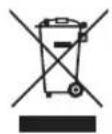
Your product is marked with this symbol. It means that used electrical and electronic products should not be mixed with general household waste. There is a separate collection system for these products.
A. Information on Disposal for Users (private households)
1. In the European Union
Attention: If you want to dispose of this equipment, please do not use the ordinary dust bin!
Used electrical and electronic equipment must be treated separately and in accordance with legislation that requires proper treatment, recovery and recycling of used electrical and electronic equipment.
Following the implementation by member states, private households within the EU states may return their used electrical and electronic equipment to designated collection facilities free of charge*.
In some countries* your local retailer may also take back your old product free of charge if you purchase a similar new one.
*) Please contact your local authority for further details.
If your used electrical or electronic equipment has batteries or accumulators, please dispose of these separately beforehand according to local requirements.
By disposing of this product correctly you will help ensure that the waste undergoes the necessary treatment, recovery and recycling and thus prevent potential negative effects on the environment and human health which could otherwise arise due to inappropriate waste handling.
2. In other Countries outside the EU
If you wish to discard this product, please contact your local authorities and ask for the correct method of disposal.
For Switzerland: Used electrical or electronic equipment can be returned free of charge to the dealer, even if you don't purchase a new product. Further collection facilities are listed on the homepage of www.swico.ch or www.sens.ch.
B. Information on Disposal for Business Users
1. In the European Union
If the product is used for business purposes and you want to discard it: Please contact your SHARP dealer who will inform you about the takeback of the product. You might be charged for the costs arising from take-back and recycling. Small products (and small amounts) might be taken back by your local collection facilities.
For Spain: Please contact the established collection system or your local authority for take-back of your used products.
2. In other Countries outside the EU
If you wish to discard of this product, please contact your local authorities and ask for the correct method of disposal.
SE
OBS!
INFORMATIONS SUR LA MISE AU REBUT
APPROPRIEE 5
FOUR 16
ACCESSIONS 18
PANNEAU DE COMMANDE 20
INSTRUCTIONS IMPORTANTES DE SECURITE ....F-1-4
INSTALLATION F-5
AVANT MISE EN SERVICE F-6
NIVEAU DE PUISSANCE DU MICRO-ONDES F-7
FONCTIONNEMENT MANUEL F-7
AUTRES FONCTIONS PRATIQUES F-8
FONCTIONNEMENT AUTOMATIQUE F-9
RECHAUFFAGE EN UN TOUCHER F-9
GUIDE DU MENU RECHAUFFAGE F-10
BOISSONS F-11
DECONGÉLATION (VIANDE ET POISSON) .... F-12
ENTRETIEN ET NETTOYAGE F-13
AVANT D'APPELER LE DEPANNEUR F-13
Livre de recette
QUE SONT LES MICRO-ONDES? F-14
BIEN CHOISIR LA VAISSELLE F-14
CONSEILS ET TECHNIQUES F-15-17
TABLEAUX ET RECETTES F-18-20
CARE AND CLEANING GB-13
SERVICE CALL CHECK GB-13
Cookbook
WHAT ARE MICROWAVES? GB-14
SUITABLE OVENWARE GB-14
TIPS AND ADVICE . .GB-15-17
TABLES .GB-18-20
SERVICE ADDRESSES 203
SPECIFICATIONS 206
SE INNEHALL
Bruksanvisning
BASTAKUND 2
INFORMATION OM RATT ATERVINNING 9
UGN 16
TILLBEHOR 18
KONTROLLPANEL 21
VIKTIGASAKERHETSANVISNINGAR..SE-1-4
INSTALLATION SE-5
FORE ANVANDNING.. SE-6
MIKROVAGSEFFEKTNIVA SE-7
MANUELL DRIFT SE-7
ANDRA PRACTISKA FUNKTIONER SE-8
AUTOMATISK DRIFT . . . . . . . . . . . . . . . . . . . . . . . . . . . . . . . . . . . . . . . . . . . . SE-9
UPPVARMINING MED EN KNAPTRYCKNING... SE-9
UPPVÄRMNINGSMENYGUIDE.. SE-10
DRYCKER.. .SE-11
FUNKTIONEN UPPTINING SE-12
SKOTSEL OCH RENGORING SE-13
KONTROLLER INNAN DU BEGÄR SERVICE SE-13
Kokbok
VAD AR MIKROVAGOR? SE-14
LAMPLIGA UGNSHUSGERAD SE-14
TIPS OCH RAD .SE-15-17
TABELLOR OCH RECEPT .SE-18-20
SERVICEADRESSER 203
SPECIFICATIONER 206
NO
INNNHOLD
Brukerhandbok
KJARE KUNDE 3
INFORMASION OM KORREKT AVHENDING AV OVNEN 10
OVNEN 16
TILBEHOR 19
KONTROLLPANEL 22
VIKTIGE SIKKERHETSINSTRUKSJONER .NO-14 INSTALLASJON .NO-5
FØR BRUK . NO-6
MIKROBOLGEEFFEKTNIVA NO-7
MANUELL BRUK NO-7
ANDRE PRAKTISKE FUNKSJONER .NO-8
AUTOMATISK BRUK . NO-9
OPPVARMING MED EN BERORING .NO-9
VEILEDNING TIL OPPVARMINGSMENY. NO-10
DRIKKE. NO-11 OPPTINING (KJOTT OG FISK) NO-12
STELLOGRENGJORING NO-13
KONTROLLER FØR DU TILKALLER SERVICE ....... NO-13
Kokebok
HVA ER MIKROBOLGER? .NO-14
PASSENDE Kokekar . NO-14
TIPS OG RAD .NO-15-17
TABLELER OG OPPSKRIFTER .NO-18-20
SERVICEADRESSER 203
SPESIFIKASJONER 207
F1
SISALTO
Käytöopas
ARVOISA ASIAKAS 3
ASIALLISTA HAVITAMISTA KOSKEVAT TIEDOT 11
UUNI 17
LISAVARUSTEET 19
SAATOPANEELI 22
TARKEITA TURVALLISUUSOHJEITA FI-1-4
ASENNUS FI-5
ENNNEN KAYTTOA FI-6
MIKROAALTOJEN TEHOTASO. FI-7
MANUAALINEN KAYTTO FI-7
MUUT HELPOT TOIMINNOT FI-8
AUTOMAATTINEN KAYTTO FI-9
ONE TOUCH LAMMITYS FI-9
LAMMITYSVALIKON OHJE FI-10
JUOMAT. FI-11
SULATUS (LIHA JA KALA) FI-12
HOITO JA PUHDISTUS FI-13
ENNEN KUIN OTAT YHTEYTTA HUOLTOON ....... FI-13
Keitokirja
MITÄ MIKROALLOT OVAT? FI-14
SOVELTUVAT KEITTOASTIAT F1-14
VIHJEET JA NEUVOT .F1-15-17
TAULUKOT JA RESEPTIT FI-18-20
HUOLTO-OSOITTEITA 203
TEKNISET TIEDOT 207
DK
INDHOLD
Brugsanvisning
KAERE KUNDE 3
OPLYSNINGER OM KORREKT BORTSKAFFELSE .... 12
OVN 17
TILBEHOR 19
BETJENINGSPANEL 22
VIGTIGSESIKKERHEDSANVISNINGER DK-1-4
INSTALLATION .DK-5
FOR IBRUGTAGNING .DK-6
MIKROBOLGEEFEKTER DK-7
MANUEL BETJENING DK-7
ANDRE NYTTIGE FUNKTIONER .DK-8
AUTOMATISK BETJENING .DK-9
GENOPVARMING MED EN BERØRING .DK-9
GENOPVARMNINGSMENUVEJLEDNING .DK-10
DRIKKEVARER. DK-11
OPTONINGSFUNKTION... DK-12
PLEJE OG RENGORING DK-13
KONTROLLER INDEN DU TILKALDER SERVICE ....DK-13
Kogebog
HVADERMIKROBOLGER? .DK-14
OVNFAST PORCELANOGEGNEDE BEHOLDERE....DK-14
TIPS OG GODE RAD DK-15-17
TABLELER OG OPSKRIFTER DK-18-20
SERVICEADRESSER 203
SPECIFICATIONER 208

GERÄT/FOUR/OVEN/HORNO/OVEN/UGN

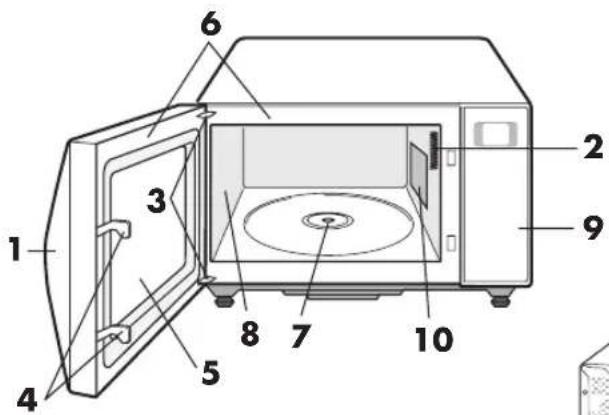
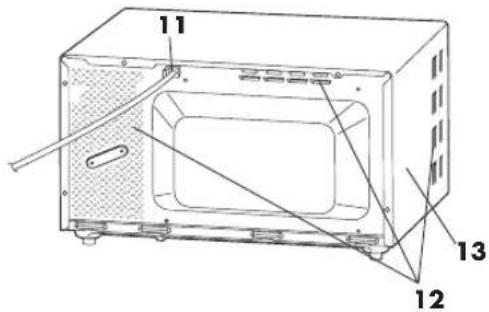
D
1 Door opening handle
2 Oven lamp
3 Door hinges
4 Door safety latches
5 Door
6 Door seals and sealing surfaces
7 Coupling
8 Oven cavity
9 Control panel
10 Waveguide cover
11 Power supply cord
12 Ventilation openings
13 Outer cabinet
SE
ZUBEHÖR/ACCESSOIRES/TOEBEHOREN ACCESSORIOS/ACCESSORIES/TILLBEHÖR

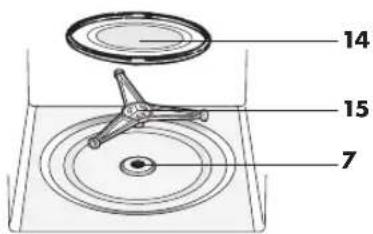
ZUBEHÖR
Check to make sure the following accessories are provided:
(14)Turntable (15) Roller stay
- Place the roller stay in the coupling (7) on the floor of the cavity.
- Then place the turntable on the roller stay.
- To avoid turntable damage, ensure dishes or containers are lifted clear of the turntable rim when removing them from the oven.
Note: When you order accessories, please mention two items: part name and model name to your dealer or SHARP authorised service agent.
SE TILLBEHÖR
For customers with impaired vision:
The audible alerts of the start and stop key are different from other audible alerts on this microwave.
There are three (3) raised dots on the start key and one (1) raised dot on the stop key.

BEDIENINGSPANEEL/PANEL DE CONTROL CONTROL PANEL/KONTROLLPANEL
NL
BEDIENINGSPANEEL
1 Digitale display
2 Indikators
The appropriate indicator will flash or illuminate, just above each symbol according to the instruction. When an indicator is flashing, press the key (which has the matching symbol) or perform the required function as required.
Beverages function
* Defrost function
Less/More function
W Microwave Power level
M Minute for less than 10 minutes
MIN Minute for more than 10 minutes
Second
Quantity (cup) for beverages
Quantity (gram) for defrost function
3 START / Sensor Reheat key
Press to start oven after setting programmes.
Press to start Sensor Reheat operation.
4 Defrost key
Press to select the Defrost menu.
5 Beverages key
Press to select the Beverages menu.
6 Power Level key
7 Stop key
8 Less / More keys
9 Time keys
SE
KONTROLLPANEL
1 Digital display
2 Indikatorer
Lamplig indicator blinkar aller lyser, strax ovanfor varje symbol enigt instruktionen. Nar en indicator blinkar, tryck pa lamplig knapp (med somma symbol) ell er vidta den nodvandiga atgarden.
Dryckfunktion
Upptiningsfunktion
MV Mindre/Mer-funktion
W Mikrovagseffektniva
M Minut under minred an 10 minuter
MN Minut under mer an 10 minuter
SFC Sekund
Mängd (kopp) for drycker
a Mangd (gram) for upptiningsfunktion
3 START / Sensoruppärming knapp
Tryck for att starta ugnen after installing n program.
FONCTIONNEMENT MANUEL
- 1 tasse
- 2 tasses
- 3 lasses
- 4 tasses
COMMENT DISPOSER LES METS ?
Installing Less/More
IMPORTANT SAFETY INSTRUCTIONS
IMPORTANT SAFETY INSTRUCTIONS: READ CAREFULLY AND KEEP FOR FUTURE REFERENCE
- This oven is designed to be used on a countertop only.
It is not designed to be built into a kitchen unit. Do not place the oven in a cabinet.
Place or mount the oven so that the bottom of the oven is 85~cm or more above the floor.
-
The oven rear surface should be placed against the wall.
-
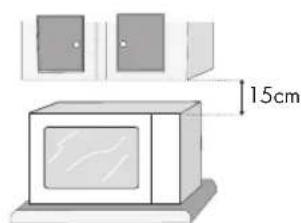
Ensure there is a minimum of free space above the oven of 15cm
-
This appliance is intended to be used in household and similar applications such as:
-
staff kitchen areas in shops, offices and other working environments;
-
farm houses;
-
by clients in hotels, motels, B&B's and other residential environments;
-
The microwave oven intended for heating food and beverages. Drying of food or clothing and heating of warming pads, slippers, sponges, damp cloth and similar may lead to risk of injury, ignition or fire.
-
This appliance can be used by children aged from 8 years and above and persons with reduced physical, sensory or mental capabilities or lack of experience and knowledge
if they have been given supervision or instruction concerning use of the appliance in a safe way and understand the hazards involved. Children shall not play with the appliance. Cleaning and user maintenance shall not be made by children without supervision.
-
WARNING: If the door or door seals are damaged, the oven must not be operated until it has been repaired by a competent person.
-
WARNING: It is hazardous for anyone other than a competent person to carry out any service or repair operation which involves the removal of a cover which gives protection against exposure to microwave energy. Never adjust, repair or modify the oven yourself.
i8. If the power supply cord of this appliance is damaged, it must be replaced by an authorised SHARP service agent in order to avoid a hazard.
- WARNING: Liquids and other foods must not be heated in sealed containers since they are liable to explode.
103/GB-1
IMPORTANT SAFETY INSTRUCTIONS

- Microwave heating of beverages can result in delayed eruptive boiling, therefore care must be taken when handling the container.
- Eggs in their shell, and whole hard-boiled eggs should not be heated in microwave ovens since they may explode, even after microwave heating has ended. To cook or reheat eggs which have not been scrambled or mixed, pierce the yolks and the whites, or the eggs may explode. Shell and slice hard-boiled eggs before reheating them in the microwave oven.
- Utensils should be checked to ensure that they are suitable for use in the oven. See Page GB-14. Use only microwave safe containers and utensils on microwave modes.
-
The contents of feeding bottles and baby food jars shall be stirred or shaken and the temperature checked before consumption, in order to avoid burns.
-
When heating food in plastic or paper containers, keep an eye on the oven due to the possibility of ignition.
- If smoke is emitted, switch off or unplug the appliance and keep the door closed in order to stifle any flames.
- The oven should be cleaned regularly and any food deposits removed.
- Failure to maintain the oven in a clean condition could lead to deterioration of the surface that could adversely affect the life of the appliance and possibly result in a hazardous situation.
- See instructions for cleaning door seals, cavities and adjacent parts on page GB-13.
104/GB-2


IMPORTANT SAFETY INSTRUCTIONS
To avoid the danger of fire.
The microwave oven should not be left unattended during operation. Power levels that are too high, or cooking times that are too long, may overheat foods resulting in a fire.
The electrical outlet must be readily accessible so that the unit can be unplugged easily in an emergency.
The AC power supply must be 230V 50Hz with a minimum 10A distribution line fuse, or a minimum 10A distribution circuit breaker.
A separate circuit serving only this appliance should be provided.
Do not place the oven in areas where heat is generated. For example, close to a conventional oven.
Do not install the oven in an area of high humidity or where moisture may collect.
Do not store or use the oven outdoors.
Clean the waveguide cover, the oven cavity, the turntable and roller stay after use. These must be dry and free from grease. Built-up grease may overheat and begin to smoke or catch fire.
Do not place flammable materials near the oven or ventilation openings.
Do not block the ventilation openings.
Remove all metallic seals, wire twists, etc., from food and food packages. Arcing on metallic surfaces may cause a fire.
Do not use the microwave oven to heat oil for deep frying. The temperature cannot be controlled and the oil may catch fire.
To make popcorn, use only special microwave popcorn makers.
Do not store food or any other items inside the oven.
Check the settings after you start the oven to ensure the oven is operating as desired.
To avoid overheating and fire, special care must be taken when cooking or reheating foods with a high sugar or fat content, for example, sausage rolls, pies or Christmas pudding.
See the corresponding hints in operation manual and the cookery book section.
To avoid the possibility of injury
WARNING:
Do not operate the oven if it is damaged or malfunctioning. Check the following before use:
a) The door; make sure the door closes properly and ensure it is not misaligned or warped.
b) The hinges and safety door latches; check to make sure they are not broken or loose.
c) The door seals and sealing surfaces; ensure that they have not been damaged.
d) Inside the oven cavity or on the door; make sure there are no dents.
e) The power supply cord and plug; ensure that they are not damaged.
Do not operate the oven with the door open or alter the door safety latches in any way.
Do not operate the oven if there is an object between the door seals and sealing surfaces.
Do not allow grease or dirt to build up on the door seals and adjacent parts. Clean the oven at regular intervals and remove any food deposits. Follow the instructions for "Care and Cleaning" on page GB-13.
Individuals with PACEMAKERS should check with their doctor or the manufacturer of the pacemaker for precautions regarding microwave ovens.
To avoid the possibility of electric shock
Under no circumstances should you remove the outer cabinet.
Never spill or insert any objects into the door lock openings or ventilation openings. In the event of a spill, turn off and unplug the oven immediately, and call an authorised SHARP service agent.
Do not immerse the power supply cord or plug in water or any other liquid.
Do not let the power supply cord hang over the edge of a table or work surface.
Keep the power supply cord away from heated surfaces, including the rear of the oven.
Do not attempt to replace the oven lamp yourself or allow anyone who is not an electrician authorised by SHARP to do so. If the oven lamp fails, please consult your dealer or an authorised SHARP service agent.
To avoid the possibility of explosion and sudden boiling:
Never use sealed containers. Remove seals and lids before use. Sealed containers can explode due to a build up of pressure even after the oven has been turned off.
Take care when microwaving liquids. Use a wide-mouthed container to allow bubbles to escape.
Never heat liquids in narrow necked containers such as baby bottles, as this may result in the contents erupting from the container when heated and cause burns.
To prevent sudden eruption of boiling liquid and possible scalding:
- Do not use excessive amount of time (See page GB-18).
- Stir liquid prior to heating/reheating.
- It is advisable to insert a glass rod or similar utensil (not metal) into the liquid whilst reheating.
- Let liquid stand for at least 20 seconds in the oven at the end of cooking time to prevent delayed eruptive boiling.
Pierce the skin of such foods as potatoes, sausages and fruit before cooking, or they may explode.
IMPORTANT SAFETY INSTRUCTIONS

To avoid the possibility of burns
Use pot holders or oven gloves when removing food from the oven to prevent burns.
Always open containers, popcorn makers, oven cooking bags, etc., away from the face and hands to avoid steam burns and eruption of boiling.
To avoid burns, always test food temperature and stir before serving and pay special attention to the temperature of food and drink given to babies, children or the elderly.
Temperature of the container is not a true indication of the temperature of the food or drink; always check the food temperature.
Always stand back from the oven door when opening it to avoid burns from escaping steam and heat.
Slice stuffed baked foods after heating to release steam and avoid burns.
To avoid misuse by children
Do not lean or swing on the oven door.
Children should be taught all important safety instructions: use of pot holders, careful removal of food coverings; paying special attention to packaging (e.g. self-heating materials) designed to make food crisp, as they may be extra hot.
Other warnings
Never modify the oven in any way.
Do not move the oven while it is in operation.
This oven is for home food preparation only and may only be used for cooking food. It is not suitable for commercial or laboratory use.
To promote trouble-free use of your oven and avoid damage.
Never operate the oven when it is empty.
When using a browning dish or self-heating material, always place a heat-resistant insulator such as a porcelain plate under it to prevent damage to the turntable and roller stay due to heat stress. The preheating time specified in the dish's instructions must not be exceeded.
Do not use metal utensils, which reflect microwaves and may cause electrical arcing. Do not put cans in the oven.
Use only the turntable and the roller stay designed for this oven. Do not operate the oven without the turntable.
To prevent the turntable from breaking:
(a) Before cleaning the turntable with water, leave the turntable to cool.
(b) Do not put hot foods or hot utensils on a cold, turntable.
(c) Do not put cold foods or cold utensils on a hot turntable.
Do not place anything on the outer cabinet during operation.
NOTE:
If you are unsure how to connect your oven, please consult an authorised, qualified electrician.
Neither the manufacturer nor the dealer can accept any liability for damage to the oven or personal injury resulting from failure to observe the correct electrical connection procedure.
Water vapour or drops may occasionally form on the oven walls or around the door seals and sealing surfaces. This is a normal occurrence and is not an indication of microwave leakage or a malfunction.

INSTALLATION
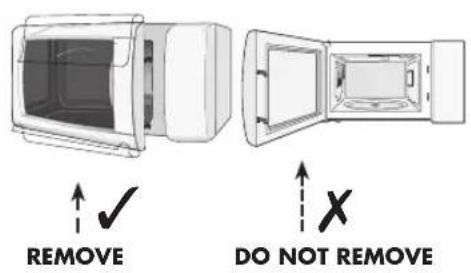
- Remove all packing materials from the inside of the oven cavity. Discard the loose polythene sheet from between the door and cavity. Remove the feature sticker, if attached, from the outside of the door.
Do not remove the protective film attached to the inside of the door.
- Check the oven carefully for any signs of damage.
- Place the oven on a flat, level surface strong enough to support the oven's weight plus the heaviest item likely to be cooked. Do not place the oven in a cabinet.
- Ensure there is a minimum free space above the oven of 15cm:
- Securely connect the plug of the oven to a standard earthed (grounded) household electrical outlet.
107/GB-5
BEFORE OPERATION

Your oven comes pre-set for Energy Save Mode. This feature saves electricity when the oven is not in use. When you first plug it in nothing will appear in the digital display.
To operate the oven in Energy Save Mode:
- Plug in the oven. Nothing will appear in the display at this time.
- Open and close the door. The oven display will show "0".
The oven lamp will illuminate while the door is open.
Using the STOP key
Use the STOP key to:
- Erase a mistake during programming.
- Stop the oven during cooking.
In Energy Save Mode, if you do not operate the oven for 3 minutes or more (e.g. closing the door, pressing the STOP key, or at the end of cooking), you will not be able to operate the oven until you open and close the oven door.
108/GB-6

Your oven has 4 power levels. To choose the correct power level for cooking, follow the advice given in the recipe section. Generally the following recommendations apply:
800w used for fast cooking or reheating e.g. soup, casseroles, canned food, hot beverages, vegetables, fish, etc.
700W/500W use for delicate food such as eggs or seafood
200W to defrost, select this power setting, to ensure that the dish defrosts evenly. This setting is also ideal for simmering rice, pasta, dumplings and cooking egg custard.
To set the power, press the POWER LEVEL key until the desired level is displayed. If POWER LEVEL key is pressed once, will be displayed. If you miss your desired level, continue pressing the POWER LEVEL key until you reach the level again.

MANUAL OPERATION
When cook under microwave manually, first enter the power level, then the cooking time. You can programme up to 20 minutes at power level 200W and 500W. You can programme up to 15 minutes at power level 700W and 800W.
Example:
To reheat soup for 2 minutes and 30 seconds on 500W microwave power.
-
Choose desired power by pressing the POWER LEVEL key three times for 500W.
-
Enter the desired cooking time by pressing the TIME keys.
-
Press the START key to begin cooking.
x3

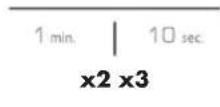

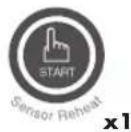

Check the display.


NOTE:
- When the door is opened during the cooking process, the cooking time on the digital display will stop automatically. The cooking time will begin to count down again when the door is closed and the START key is pressed.
- If you wish to know the power level during cooking, press the POWER LEVEL key and the power level will be displayed.
109/GB-7
OTHER CONVENIENT FUNCTIONS

Less/More Setting
The cooking times programmed into the automatic menus are tailored to the most popular tastes. To adjust the cooking time to your individual preference use the "more" or "less" feature to either add (more) or reduce (less) cooking time.
The Less/More can be used to adjust the cooking time of the following features
- ONE TOUCH REHEATING
DEFROST
BEVERAGES (Less setting only)
(1) ONE TOUCH REHEATING
-
To reheat 1 cup of soup for more time than the standard setting.
-
Press the START (Sensor Reheat) key once.
-
Press the MORE key once.
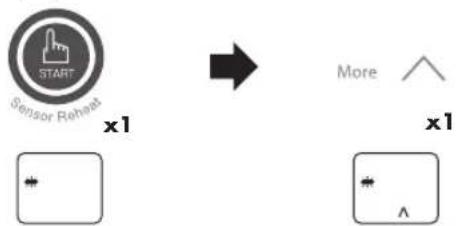
The reheating with sensor will begin operation.
The reheating with sensor continues operation with more setting. When vapour is detected, the oven will stop and the display will be "0".
(2)DEFROST
-
To defrost 400g of fish for less time than the standard setting
-
Press the DEFROST key four 2. Press the START key once. times for defrost 400g.
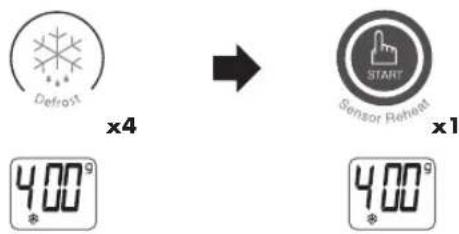
- Press the Less key once. Within 30 sec. press start key.

Less
x1

Less indicator will appear.

After 30 sec.

The defrosting time will begin counting down.
When it reaches zero, the microwave will "beep".
110/GB-8

AUTOMATIC OPERATION
- When using the automatic features, carefully follow the details provided in each MENU GUIDE to achieve the best result. If the details are not followed carefully, the food may be overcooked or undercooked.
- Food weighing more or less than the quantity or weight listed in each MENU GUIDE, cook manually.
- To change the final cooking or defrosting result from the standard setting, press the Less or More key. Refer to page GB-8.
- The final cooking result will vary according to the food condition (e.g. initial temperature, shape, quality). Check the food after cooking and if necessary continue cooking manually.
- To defrost foods above or below the weights allowed on the DEFROST MENU GUIDE, use defrost manually.
ONE TOUCH REHEATING
For your convenience One touch reheating allows you to easily reheat food by automatic sensor function. Do not cook small quantities of food or foods which do not have high water values such as bread or grilled food, with this function.
This prevent "smoke and ignition".
Do not use Sensor Reheat key to reheat a drink, we recommend using the Beverages key instead.
To reheat a dinner plate.
- Press the START (Sensor Reheat key once).



The cooking will begin start display will show sensor cooking bar, When reheating is completed the oven will stop display will be "0".
Cautions:
Take out a wrap or a cover to avoid changing a shape or melt.
- Container that have a risk of damage, explosion or ignition during heat should be taken out. (Container or bag of sauce, boiled egg, aluminium case)
- Do not use a aluminum container or a aluminium foil. (There is a risk of sparks when heating and able to cause break down).
Cool down a oven or tray if they are hot.
111/GB-9
REHEAT MENU GUIDE

-
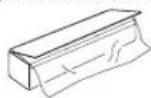
Wrapped foods : Food which want to retain moisture inside foods such as frozen rice, steamed food.
-
Unwrapped foods: Rice (room temp./frozen), foods that want to evaporate the water inside out such as deep fried dishes, stir-fried dishes.
: in the table means need wrapped
| Menu Weight Status Wrap Less/More key Techniques | ||||
| Ready meal (Spaghetti, pie) | 100-350g Room temp/chilled | - | - | |
| Dinner plate | Approx. 600g | Room temp/chilled | - | - |
| Rice | 1-4 cups (1 cup 150g) | Room temp/chilled | - | - When rice is hard, spray water into it. |
| Frozen rice | 1-2 cups (1 piece 150g) | Frozen | ○ | - Thickness should be less than 3 cm. Make a flat frozen rice then put it on a dish |
| Steam dishes (Steamed dumpling) | 5-12 pcs (160g) | Room temp/chilled | ○ | - Sprinkle water over both sides |
| Frozen | ○ | - | ||
| Grilled dishes (Hamburger) | 1-4 Cups (1 piece 80g) | Room temp/chilled | - | Apply vegetable oil if it is dry |
| Frozen | ○ | After heating, steam it for 2-3 mins with wrapped condition | ||
| Curry-Stew | 200-400g Room temp/chilled | ○ | - | Freeze with a shallow container. Take out when a remain time is displayed, stir it then return to the original position, then press START key, heat it and stir again when finish. |
| 100-400g | Frozen | ○ | More | |
| Boiled dishes | 100-400g Room temp/chilled | - | - | Wrap dishes that may burst such as boiled fish. |
| Deep fried dishes (tempura) | 100-400g Room temp/chilled | - | - | Place a kitchen or tempura paper on a dish then arrange foods (do not stack up). As squid is easy to spoil then use manual operation micro 200W. |
| Soup 1-2 Cup (1 Cup 150 ml) | - | More | ||
| Fried rice | 100-400g Room temp/chilled | - | - | Stir after heating |
| 100-300g | Frozen | ○ | Unbind before heating | |
| Fried noodle | 100-200g Room temp/chilled | - | - | Stir after heating |
| Mixed vegetables | 100-300g | Frozen | ○ | caution; when heating a small weight, it may cause smoke, ignition or arcing |
112/GB-10

BEVERAGES
Beverages key automatically calculates the microwave power to reheat popular menus. (coffee, tea and water.) Each time the Beverage key is pressed this will change number of cup. 1 cup 2 cup 3 cup 4 cup 1 cup
- 1 Cup
2.2 Cups - 3 Cups
- 4 Cups
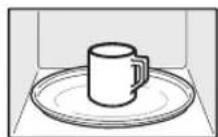
Preparation: Place onto the centre of the turntable (for 1 cup)
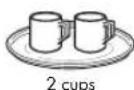
For two or more cups, place on the same circumference.
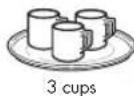
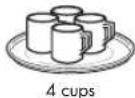
- Place beverage into standard cups.
milk: 200 ml, coffee: 150 ml (ml=cc) - Never fill the cup to the brim. As this may cause the beverage to boil over.
- Stir before and after reheating
To reheat 2 cups of tea.
- Press the Beverages key twice. 2. Press the START key once.
x2


After 30 sec.
The cooking time will begin counting down. When it reaches zero, the microwave will "beep".
Wait 1-2 mins after heating before taking out cups.
Cautions:
- Transfer all beverages from bottles before reheating.
- When a actual weight is less than a standard weight use manual reheating micro 800W. Closely monitor while reheating. Use Sensor Reheat may cause sudden boiling.
113/GB-11
DEFROST Function

The DEFROST function will automatically calculates the microwave power and defrosting time. Each time the Defrost key, is pressed, this will change the weight of defrost 100g 200g 300g 400g 500g
- 100g
- 200g
- 300g
- 400g
- 500g
Preparation: Place a wrap onto the centre of the turntable (do not use a container)
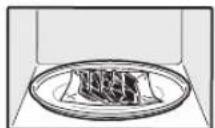
Able to defrost 100g~500g in each time.
Defrost foods that just before take out from a freezer.
If foods are already partially defrosted, use manual reheating micro 200W with attention.
Prevent discolor or be boiled by cover the thin area of foods with aluminium foil.
Be careful not to allow the foil to touch the inside wall of the cavity the cabinet or a door, to prevent arcing.
To defrost 400g of meat.
-
Press the DEFROST key four times.
-
Press the START key once.
x4


After 30 sec.

The defrosting time will begin counting down.
When it reaches zero, the microwave will "beep".
| Food Types Less/More | key Techniques | ||
| Meat | Minced meat -slice meat Chicken | More | Use aluminium foil cover thin areas of chicken's legs. |
| Fish | Tuna -shrimp Fish | Less | Use aluminium foil cover a thin areas of fish's tail. |
NOTE: Protect thin end of chops or steaks with foil.
When freezing minced meat, shape it into flat even sizes.
For chicken pieces, steaks and chops, freeze separately in single flat layers and if necessary interleave with freezer plastic to separate layers. This will ensure even defrosting.
It is also a good idea to label the packs with the correct weights.
114/GB-12

CARE AND CLEANING
CAUTION: DO NOT USE COMMERCIAL OVEN CLEANERS, STEAM CLEANERS, ABRASIVE, HARSH CLEANERS, OR ANY THAT CONTAIN SODIUM HYDROXIDE OR SCOURING PADS ON ANY PART OF YOUR MICROWAVE OVEN.
CLEAN THE OVEN AT REGULAR INTERVALS AND REMOVE ANY FOOD DEPOSITS - Keep the oven clean, or the oven could lead to a deterioration in the performance of the microwave. This could adversely affect the life of the appliance.
Oven exterior
The outside of your oven can be cleaned easily with mild soap and water. Make sure the soap is wiped off with a moist cloth, and dry the exterior with a soft towel.
Oven controls
Open the door before cleaning to de-activate the oven controls. Care should be taken when cleaning the oven control. Using a cloth dampened with water only, gently wipe the panel until it becomes clean. Avoid using excessive amounts of water. Do not use any sort of chemical or abrasive cleaner.
Oven Interior
- For cleaning, wipe any splatters or spills with a soft damp cloth or sponge after each use while the oven is still warm. For heavier spills, use a mild soap and wipe several times with a damp cloth until all residues are removed. Do not remove the waveguide cover.
- Make sure that mild soap or water does not penetrate the small vents in the walls which may cause damage to the oven.
- Do not use spray type cleaners on the oven interior.
Turntable and Roller stay
Remove the turntable and roller stay from the oven. Wash the turntable and roller stay in mild soapy water. Dry with a soft cloth. Both the turntable and the roller stay are dishwasher safe.
Door
To remove all traces of dirt, regularly clean both sides of the door, the door seals and adjacent parts with a soft, damp cloth. Do not use abrasive cleaner.
NOTE: A steam cleaner should not be used.

SERVICECALLCHECK
Please check the following before calling for service.
- Power Supply
Check the power plug is properly connected to a suitable wall outlet.
Check the line fuse/circuit breaker is functioning properly.
-
When the door is opened, does the oven lamp light? YES NO
-
Place a cup of water (approx. 150 ml) in the oven and close the door securely.
Programme the oven for one minute on 800W power and start the oven.
YES NO
YES NO
NOTE: The turntable turns in either direction.
Does the ventilation work?
(Place your hand over the ventilation openings and check for air flow.) YES NO
After 1 minute does the signal sound? YES NO
Does cooking in progress indicator go off? YES NO Is the cup with water warm after the above operation? YES NO
If you answer "No" to any of the above questions, call a Service Technician appointed by SHARP and report the results of your check. See inside back cover for details of address.
IMPORTANT: If the display shows nothing even if the power supply plug is properly connected, the energy save mode may be in operation. Open and close the oven door to operate the oven. See GB-6.
WHAT ARE MICROWAVES?

Microwaves are generated in the microwave oven by a magnetron this causes the water molecules in the food to oscillate.
Heat is generated by the friction which is created, the result is that the food is defrosted, heated or cooked.
SUITABLE OVENWARE

GLASS AND CERAMIC GLASS
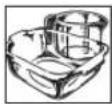
Heat-resistant glass utensils are very suitable. The cooking process can be observed from all sides. They must not, however, contain any metal (e.g. lead crystal), nor have a metallic overlay
(e.g. gold edge, cobalt blue finish).
CERAMICS
Generally very suitable. Ceramics must be glazed, as with unglazed ceramics moisture can get into the ceramic. Moisture causes the material to heat up and may cause it to shatter. If you are not certain whether your utensil is suitable for the microwave, carry out the utensil suitability test.
PORCELAIN
Very suitable. Ensure that the porcelain does not have a gold or silver overlay and that it does not contain any metal.
PLASTIC AND PAPER UTENSILS
Heat resistant plastic utensils which are suitable for use in the microwave can be used to defrost, heat and cook food. Follow the manufacturer's recommendations.
Heat-resistant paper made for use in a microwave oven is also suitable. Follow the manufacturer's recommendations.
MICROWAVE FOIL
This, or heat-resistant foil, is very suitable for covering or wrapping. Please follow the manufacturer's recommendations.
ROASTING BAGS
Can be used in a microwave oven. Metal clips are not suitable for fastening them since the roasting bag foil might melt. Fasten the roasting bag with string and pierce it several times with a fork. Non heat-resistant food wraps are not recommended for use in a microwave oven.
BROWNING DISH
A special microwave dish made from ceramic glass with a metal alloy base, which allows food to be browned.
When using the browning dish also use a suitable insulator, e.g. a porcelain plate, must be placed between the turntable and the browning dish. Be careful to adhere exactly to the pre-heating time given in the manufacturer's instructions. Excessive pre-heating can damage the
turntable and the turntable stand or can trigger the safety-device which will switch off the oven.
METAL
Generally speaking, metal should not be used, since microwaves do not pass through metal and therefore cannot reach the food. There are, however, exceptions: small strips of aluminium foil may be used to cover certain parts of the food, so that these do not defrost too quickly or begin to cook (e.g. chicken wings). Small metal skewers and aluminium containers (e.g. of ready-cooked meals) can be used. They must, however, be small in relation to the food, e.g. aluminium containers must be at least 2/3 to 3/4 filled with food. It is recommended that you transfer the food into a dish suitable for use in the microwave. When using aluminium containers or other metal utensils there must be a gap of approx. 2cm between them and the internal walls of the microwave, otherwise the walls could be damaged by possible arcing.
NO UTENSIL SHOULD HAVE A METAL OVERLAY - parts such as screws, bands or handles.
UTENSIL SUITABILITY TEST
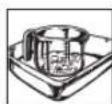
If you are not sure whether your utensil is suitable for use in your microwave oven, carry out the following test: Place the utensil into the oven. Place a glass container filled with 150ml of water on or
next to the utensil. Switch on the oven at 800W power for 1 to 2 minutes. If the utensil stays cool or just warm to the touch, it is suitable. Do not use this test on a plastic utensil, as it could melt.
TIPS AND ADVICE
TIME SETTINGS
In general the defrosting, heating and cooking times are significantly shorter than when using a conventional cooker or oven. For this reason you should adhere to the recommended times given in this operation manual. It is better to set the times too short, rather than too long. Test the food after it has been cooked. It is better to have to cook something for a little longer than to overcook it.
INITIAL TEMPERATURES
Defrosting, heating and cooking times are dependent upon the initial temperature of the food. Frozen food and food stored in a refrigerator, for example, requires longer than food which has been stored at room temperature. For heating and cooking, normal storage temperatures are assumed (refrigerator temperature approx. 5^ , room temperature approx. 20^ ). For defrosting the temperature of the freezer is assumed to be -18^ .
COOKING TIMES
All the times given in this cookery book are guidelines, which can be varied according to the initial temperature, weight and condition of the food (water or fat content etc.).
SALT, SPICES AND HERBS
Food cooked in your microwave retains its individual flavour better than it does when conventional preparation methods are used. For this reason you should use salt very sparingly and normally add it only after cooking. Salt absorbs liquid and dries out the outer layer of the food. Herbs and spices can be used as normal.
ADDITION OF WATER
Vegetables and other foods with a high water content can be cooked in their own juice or with the addition of a little water. This ensures that the majority of the vitamins and minerals are preserved.
FOOD IN SKINS OR SHELLS
Food such as sausages, chickens, chicken legs, baked potatoes, tomatoes, apples, egg yolks or such like should be pricked or pierced with a fork or small wooden skewer. This will enable the steam which forms to dissipate without splitting the skin or shell.
LARGE AND SMALL QUANTITIES
Microwave times are directly dependent upon the amount of food which you would like to defrost, heat or cook. This means that small portions cook more quickly than larger ones.
As a rule of thumb:
TWICE THE AMOUNT = ALMOST TWICE THE TIME
HALF THE AMOUNT = HALF THE TIME
DEEP AND SHALLOW CONTAINERS
Both containers have the same capacity, but the cooking time is longer for the deeper one. You should therefore choose as flat a container as possible with a large surface area. Only use deep containers for dishes where there is a danger of overcooking, e.g. for noodles, rice, milk etc..
ROUND AND OVAL CONTAINERS
Food cooks more evenly in round or oval containers than in containers with corners, since the microwave energy concentrates in the corners and the food in these areas could become overcooked.
COVERING
Covering the food retains the moisture within it and shortens the cooking time. Use a lid, microwave foil or a cover. Foods which are to be crispy, e.g. roasts or chickens, should not be covered.
As a general rule, whatever would be covered in a conventional oven should also be covered in a microwave oven. Whatever would be uncovered in an conventional oven can also be left uncovered in a microwave oven.
TURNING
Medium-sized items, such as hamburgers and steaks, should be turned over once during cooking, in order to shorten the cooking process. Large items, such as roasts and chickens, must be frequently turned, as it could dry out if not turned.
STANDING TIME
Keeping to the standing time is one of the most important rules with microwaves. Almost all foods, which are defrosted, heated or cooked in the microwave, require a certain amount of time to stand, during which temperature equalisation takes place and the moisture in the food is evenly distributed.
TIPS AND ADVICE

BROWNING AGENTS
After approx. 15 minutes of cooking food acquires a brownness, although this is not comparable to the deep brownness and crispness obtained through conventional cooking. In order to obtain an appetising brown colour you can use browning agents. For the most part they simultaneously act as seasoning agents.
In the following table you will find some suggestions for substances you might use for browning and some of the uses to which you might put them.
BROWNING AGENT DISH METHOD
| Melted butter and dried paprika Poultry Coat | coat the poultry with the butter/ | paprika mixture |
| Dried paprika Oven baked dishes "Cheese toasts" | Dust with paprika | |
| Soya sauce Meat and poultry Coat with the sauce | ||
| Barbecue and Worcester sauce, Gravy Roasts, Rissoles, small roasted items | Coat with the sauce | |
| Rendered down bacon fat or dried onions | Oven baked dishes, toasted items, soups, stews | Sprinkle pieces of bacon or dried onions on top |
| Cocoa, chocolate flakes, brown icing, honey and marmalade | Cakes and desserts | Sprinkle pieces on top of cakes and desserts or use to glaze |
HEATING
Ready-prepared meals in aluminium containers should be removed from the aluminium container and heated on a plate or in a dish.
- Remove the lids from firmly closed containers.
- Food should be covered with microwave foil, a plate or cover (obtainable from stores), so that the surface does not dry out. Drinks need not be covered.
- When boiling liquids such as water, coffee, tea or milk, place a glass stirrer in the container.
If possible, stir large quantities from time to time, to ensure that the temperature is evenly distributed.
The times are for food at a room temperature of 20^ The heating time for food stored in a refrigerator should be increased slightly.
After heating allow the food to stand for 1-2 minutes, so that the temperature inside the food can be evenly distributed (standing time).
The times given are guidelines, which can be varied according to the initial temperature, weight, water content, fat content or the result which you wish to achieve.
DEFROSTING
Your microwave is ideal for defrosting. The times are usually considerably shorter than in traditional methods of defrosting.
Here are a few tips. Take the frozen item out of its packaging and place on a plate for defrosting.
CONTAINERS
Containers suitable for microwaves are particularly good for defrosting and heating food, since they can withstand temperatures in a freezer (down to approx. -40^) as well as being heat-resistant (up to approx. 220^) . You can therefore use the same container to defrost, heat and even cook the food, without having to transfer it.
COVERING
Cover thin parts with small strips of aluminium foil before defrosting. Fully defrosted or warm parts should likewise be covered with aluminium strips during defrosting. This stops the thin parts becoming too hot while thicker parts are still frozen.
CORRECT SETTING
It is better to choose a setting which is too low rather than one which is too high. By so doing you will ensure that the food defrost evenly.
If the microwave setting is too high, the surface of the food will already have begun to cook while the inside is still frozen.
TIPS AND ADVICE
TURNING/STIRRING
Almost all foods have to be turned or stirred from time to time, during cooking. As early as possible, separate parts which are stuck together and rearrange them.
SMALL AMOUNTS
Defrost more quickly and evenly than larger ones. We recommend that you freeze portions which are of equal size. By doing so you will be able to prepare whole menus quickly and easily.
FOODS REQUIRING CAREFUL HANDLING
Foods such as gateaux, cream, cheese and bread should only be partially defrosted and then left to defrost completely at room temperature. By so doing you will avoid the outer areas becoming too hot while the inside is still frozen.
STANDING TIME
This is particularly important after defrosting food, as the defrosting process continues during this period. In the defrosting table you will find the standing times for various foods. Thick, dense foods require a longer standing time than thinner foods or food of a porous nature. If the food has not defrosted sufficiently, you may continue defrosting it in the microwave oven or lengthen the standing time accordingly. At the end of the standing time you should process the food as soon as possible and not re-freeze it.
COOKING FRESH VEGETABLES
- When buying vegetables try to ensure that, as far as possible, they are of similar size. This is particularly important when you want to cook the vegetables whole (e.g. boiled potatoes).
- Wash the vegetables before preparing them, clean them and only then weigh the required quantity for the recipe and chop them up.
- Season them as you would normally, but as a rule only add salt after cooking.
- Add about 5 lbsps of water for 500g of vegetables. Vegetables which are high in fibre require a little more water. You will find information about this in the table.
Vegetables are usually cooked in a dish with a lid. Those with a high moisture content, e.g. onions or boiled potatoes, can be cooked in microwave foil without adding water.
After half the cooking time has elapsed vegetables should be stirred or turned over.
After cooking allow the vegetables to stand for approx. 2 minutes, so that the temperature dispenses evenly (standing time).
The cooking times given are guidelines and depend upon the weight, initial temperature and condition of the type of vegetable in question. The fresher the vegetables, the shorter the cooking times.
COOKING MEAT, FISH AND POULTRY
- When buying food items, try to ensure that, as far as possible, they are of similar size. This will ensure that they are cooked properly.
Before preparation wash meat, fish and poultry thoroughly under cold running water and pat them dry with kitchen paper. Then continue as normal.
Beef should be well hung and have little gristle.
Even though the pieces may be of a similar size, cooking results may vary. This is due, amongst other things, to the kind of food, variations in the fat and moisture content as well as the temperature before cooking.
After the food has been cooking for 15 minutes it acquires a natural brownness, which may be enhanced by the use of a browning agent. If, in addition, you would like the surface to be crisp you should either use the browning dish or sear the food on your cooker and finish cooking it in your microwave. By doing this you will simultaneously obtain a brown base for making a sauce.
Turn large pieces of meat, fish or poultry half way through the cooking time, so that they are cooked evenly from all sides.
After cooking cover roasts with aluminium foil and allow them to stand for approx. 10 minutes (standing time). During this period the roast carries on cooking and the liquid is evenly distributed, so that when it is carved a minimum amount of juice is lost.
DEFROSTING AND COOKING
Frozen dishes can be defrosted and cooked at the same time in one process in your microwave. You will find some examples in the table. Do take note, however, of the general advice given on "heating" and "defrosting" food. Please refer to the manufacturer's instructions on the packaging when preparing frozen dishes. These usually contain precise cooking times and offer advice on preparation.
TABLES

ABBREVIATIONS USED
tbsp = tablespoons KG = kilogram ml = millilitre
tsp = teaspoon g = gram min = minutes
Cup = cupful | = litre sec = seconds
Food/Drink
TABLE:HEATING FOOD AND DRINK
Qty Power g/ml- Setting
Time
-Min-
Hints
| Coffee | 1 cup | 150 | 800W approx. | 1 do not cover | ||
| Milk | 1 cup | 150 | 800W | 1 | 1/2-2 | do not cover, bring to the boil |
| 6 cups | 900 | 800W | 10-12 do not cover, bring to the boil | |||
| 1 bowl | 1000 | 800W | 10-12 do not cover, bring to the boil | |||
| Platters(Vegetables, meat and trimmings) | 400 | 800W approx. | 4 sprinkle some water onto the sauce, cover | |||
| tir half way through the heating time | ||||||
| Stew | 200 | 800W 2-3 | cover, stir after heating | |||
| Clear soup | 200 | 800W approx. | 2 cover, stir after heating | |||
| Cream soup | 200 | 800W approx. | 2 cover, stir after heating | |||
| Vegetables | 200 | 800W | 2-3 if necessary add some water, cover | |||
| 500 | 800W | 4-5 stir half way through the heating time | ||||
| Garnishes | 200 | 800W | 1-2 sprinkle with water, cover and stir from time to | |||
| 500 | 800W | 4-5 time. | ||||
| Meat, | 1 slice* | 200 | 800W | 3-4 thinly spread sauce over the top, cover | ||
| Fish fillet* | 200 | 800W 2-3 | cover | |||
| Melting butter or margarine* | 50 | 800W approx. | 1/2 cover | |||
- Refrigerator temperature
TABLE: COOKING MEAT, FISH AND POULTRY
| Food | Qty -g- | Power -Setting- | Time -Min- | Hints | Standing time -Min- |
| Minced meat | 1000 | 800W | 16-18 | prepare the minced meat mixture (half pork/ half beef) place in a shallow casserole dish | 10 |
| Fish fillet | 200 | 800W | 3-4 | season to taste, place on a plate, cover | 3 |
| Chicken | 1200 | 800W | 22-25* | season to taste, place in a casserole dish, turn half way through cooking time* | 3 |
| Chicken legs | 200 | 800W | 3-4 | season to taste, place on a plate, cover | 3 |
- When turning over remove the juices from the dish.
120/GB-18
TABLE:DEFROSTING
| Food Qty | Power Defrosting time | Hints | Standing time | ||
| -g- | -Setting- | -Min- | -Min- | ||
| Roast meat (e.g. pork, beef, lamb, veal) | 1500 | 80W | 58-64 | place on an upturned plate, turn half way through defrosting time | 30-90 |
| 1000 | 80W | 42-48 | 30-90 | ||
| 500 | 80W | 18-20 | 30-90 | ||
| Steaks, escalopes, cutlets, liver 200 80W 7-8 turn half way through defrosting time 30 | |||||
| Duck, turkey 1500 80W 48-52 place upon an upturned plate, turn half way through defrosting time | 30-90 | ||||
| Chicken 1200 80W 39-43 place upon an upturned plate, turn half way through defrosting time | 30-90 | ||||
| 1000 80W 33-37 place upon an upturned plate, turn half way through defrosting time | 30-90 | ||||
| Cakes, per slice 100-150 80W 2-5 place on a cake stand 5 | |||||
| Cream cake, per slice 150 80W 3-4 place on a cake stand 10 | |||||
| Whole gateaux, Ø 25cm 80W 20-24 place on a cake stand 30-60 | |||||
TABLE:DEFROSTING AND COOKING
| Food | Qty -g- | Power -Setting- | Cooking time -Min- | Added water -tbsps/ml- | Hints | Standing time -Min- |
| Fish fillet | 300 | 800W | 10-11 | - | cover | 1-2 |
| Trout, 1 fish | 250 | 800W | 7-9 | - | cover | - |
| Platter | 400 | 800W | 8-9 | - | cover, stir half way through cooking time | - |
| Leaf spinach | 300 | 800W | 7-9 | - | cover, stir once or twice during cooking | 2 |
| Broccoli | 300 | 800W | 7-9 | 3-5tbsps | cover, stir half way through cooking time | 2 |
| Peas | 300 | 800W | 7-9 | 3-5tbsps | cover, stir half way through cooking time | 2 |
| Kohlrabi | 300 | 800W | 7-9 | 3-5tbsps | cover, stir half way through cooking time | 2 |
| Mixed vegetables | 500 | 800W | 12-14 | 3-5tbsps | cover, stir half way through cooking time | 2 |
| Brussels sprouts | 300 | 800W | 7-9 | 3-5tbsps | cover, stir half way through cooking time | 2 |
| Red cabbage | 450 | 800W | 11-13 | 3-5tbsps | cover, stir half way through cooking time | 2 |
TABLES

TABLE: COOKING FRESH
| Vegetable Qty | -g- | Power -Setting- | Time -Min- | Hints | Added Water -tbsps/ml- |
| Leaf spinach 300 800W 5-7 | wash dry well, cover, stir once or twice during cooking | - | |||
| Cauliflower 800 | 500 | 800W | 15-17 | 1 whole head, cover, divide into florets, stir during cooking | 5-6tbsps |
| 800W | 10-12 | 4-5tbsps | |||
| Broccoli 500 800W 10-12 | divide into florets, cover, stir occasionally during cooking | 4-5tbsps | |||
| Mushrooms 500 800W 8-10 | whole heads, cover, stir occasionally during cooking | - | |||
| Chinese leaves | 300 | 800W | 9-11 | cut into strips, cover, stir occasionally during cooking | 4-5tbsps |
| Peas | 500 | 800W | 9-11 cover, stir occasionally during cooking | 4-5tbsps | |
| Fennel | 500 | 800W | 9-11 | cut into quarters, cover, stir occasionally during cooking | 4-5tbsps |
| Onions | 250 | 800W | 5-7 | whole, cook in microwave foil | - |
| Kohlrabi | 500 | 800W | 10-12 | dice, cover, stir occasionally during cooking | 50ml |
| Carrots | 500 | 800W | 10-12 | cut into rings, cover, stir occasionally during cooking | 4-5tbsps |
| 300 | 800W | 9-12 | |||
| Green peppers | 500 | 800W | 7-9 | cut into strips, stir once or twice during cooking | 4-5tbsps |
| Boiled potatoes (skins on) | 500 | 800W | 9-11 | cover, stir occasionally during cooking | 4-5tbsps |
| Leeks | 500 | 800W | 9-11 | cut into rings, cover, stir occasionally during cooking | 4-5tbsps |
| Red cabbage | 500 | 800W | 10-12 | cut into strips, stir once or twice during cooking | 50ml |
| Brussels sprouts | 500 | 800W | 9-11 | whole sprouts, cover, stir occasionally during cooking | 50ml |
| Boiled Potatoes (salted) | 500 | 800W | 9-11 | cut into large pieces of a similar size, add a little salt, cover, stir occasionally during cooking | 150ml |
| Celery | 500 | 800W | 9-11 | dice finely, cover, stir occasionally during cooking | 50ml |
| White cabbage | 500 | 800W | 10-12 | cut into strips, cover, stir occasionally during cooking | 50ml |
| Courgettes | 500 | 800W | 9-11 | slice, cover, stir occasionally during cooking | 4-5tbsps |
122/GB-20

VIKTIGA SÄKERHETSINSTRUKTIONER: LÄS NOGGRANT OCH BEHÄLL FÖR FRAMTIDA BRUK
msk = matsked KG = kilogram ml = milliliter
tsk = tesked g = gram min = minute
kopp = en kopp full l = liter sek = sekunder
Mat / Dryck
TABLEL: UPPVÄRMNING AV MAT OCH DRYCK
Mindre/Mer-innstilling
- Trykk Beverages-fasten to ganger.
x2

- Trykk START-fasten en gang.


Etter 30 sek.
Tilberedningstiden vil begynne a telles ned.
Nar den nar null, vil mikrobolgeovnen "bipe".
Vent 1-2 minutefter oppvarming fullfores for du tar ut koppene.
Advarsler:
MUUT KÄYTÄNNÖLLISET TOIMINNOT

(1) ONE TOUCH-LAMMITYS
TAULUKKO: SULATUS JA KYPSENNYS
TAULUKKO: KYPSENNYS TUOREENA
For at undgå risiko for brand.
Indstilling of Mindre/Mere
DYBE HHV. FLADE BEHOLDERE
Hvis begge beholdere har somme volumen, sa er madtilberedningstiden for den dybe beholder laengere. Anvend derfor helst flade beholderede med stor overflade. Anvend kun dybe beholdereteil retter, der let kan koge over, f.eks.nudler, ris, maelk o.lign.
RUNDE HHV. OVALE BEHOLDERE
OPTØNING OG TILBEREDNING
spsk = spiseskefuld KG = kilogram ml = milliliter
tsk = teskefuld g = gram min = minutter
Kop = kopfuld | = liter sec = sekunder
TABLE: OPVARMNING AF FØDEVARE OG DRIKKEVARE
| GB | GB | SPECIFICATIONS |
| AC Line Voltage | :230 V, 50 Hz, single phase | |
| Distribution line fuse/circuit breaker | :Minimum 10 A | |
| AC Power required: Microwave | :1.25 kW | |
| Off Mode (Energy Save Mode) | :less than 0.5 W | |
| Output power: Microwave | :800 W (IEC 60705) | |
| Microwave Frequency | :2450 MHz (Group 2/Class B)* | |
| Outside Dimensions | :460 mm(W) x 275 mm(H) x 368 mm(D) | |
| Cavity Dimensions | :319 mm(W) x 211 mm(H) x 336 mm(D)** | |
| Oven Capacity | :22 litres** | |
| Turntable | :ø 272 mm | |
| Weight | :approx. 12 kg | |
| Oven lamp | :25 W/240-250 V | |
- This product fulfils the requirement of the European standard EN55011.
In conformity with this standard, this product is classified as group 2 class B equipment.
Group 2 means that the equipment intentionally generates radio-frequency energy in the form of electromagnetic radiation for the heat treatment of food.
Class B equipment means that the equipment is suitable to be used in domestic establishments.
**Internal capacity is calculated by measuring maximum width, depth and height. Actual capacity for holding food is less.
AS PART OF A POLICY OF CONTINUOUS IMPROVEMENT, WE RESERVE THE RIGHT TO ALTER DESIGN AND SPECIFICATIONS WITHOUT NOTICE.
| SE SE | SPECIFICATIONER |
Natspanning
Distributionsnatssakring/kretskydd
Nödvändig effekt:
Av-lage (Energisparlauge)
Uteffekt:
Mikrovágsfreakvens
Utvändigo mtt
Ugnens invandiga matt
Ugnsvolym
Roterande tallrik
Vikt
Ungslampa
Mikrovågsugn
Mikrovágsugn
:230V,50Hz,enfas
:Minst 10 A
1,25 kW
: mindre an 0,5 W
:800W(IEC60705)
: 2450 MHz (grupp 2/klass B)*
:460mm(B)×275mm(H)×380mm(D)
:319 mm(B)×211 mm(H)×336 mm(D)**
:22 liter**
: 272 mm
: cirka 12 kg
:25W/240-250V
- Denna produkt uppyller kraven i den europeiska standarden EN55011.
I overensstammelse medenna standard, ar dennaproduct klassificerad som grupp 2 klass B utrustning.