 ManualGo.com
 R231(W)W - Four à micro-ondes SHARP - Free user manual and instructions
Find the device manual for free R231(W)W SHARP in PDF.


Download the instructions for your Four à micro-ondes in PDF format for free! Find your manual R231(W)W - SHARP and take your electronic device back in hand. On this page are published all the documents necessary for the use of your device. R231(W)W by SHARP.
USER MANUAL R231(W)W SHARP
NL R-231(IN)W [00 Cover-IntroductioSec1:1 Sec1:1R-231(IN)W [00 Cover-IntroductioSec1:1 Sec1:1 8/13/2013 2:55:04 PM8/13/2013 2:55:04 PM2
Congratulations on acquiring your new microwave oven, which from now on will make your kitchen chores
considerably easier.
You will be pleasantly surprised by the kinds of things you can do with a microwave. Not only can you use it for
rapid defrosting or heating up of food, you can also prepare whole meals.
In our test kitchen our microwave team has gathered together a selection of the most delicious international
recipes which are quick and simple to prepare.
Be inspired by the recipes we have included and prepare your own favourite dishes in your microwave oven.
There are so many advantages to having a microwave oven which we are sure you will find exciting:
● Food can be prepared directly in the serving dishes, leaving less to wash up.
● Shorter cooking times and the use of little water and fat ensure that many vitamins, minerals and
characteristic flavours are preserved.
We advise you to read the cookery book guide and operating instructions carefully.
You will then easily understand how to use your oven.
Enjoy using your microwave oven and trying out the delicious recipes.
R-231(IN)W [00 Cover-IntroductioSec1:7 Sec1:7R-231(IN)W [00 Cover-IntroductioSec1:7 Sec1:7 8/13/2013 2:55:04 PM8/13/2013 2:55:04 PM8
A. Information on Disposal for Users
(private households)
1. In the European Union
Attention: If you want to dispose of this equipment, please do not use the
Used electrical and electronic equipment must be treated separately and
in accordance with legislation that requires proper treatment, recovery
and recycling of used electrical and electronic equipment.
Following the implementation by member states, private households
within the EU states may return their used electrical and electronic
equipment to designated collection facilities free of charge*.
In some countries* your local retailer may also take back your old
product free of charge if you purchase a similar new one.
*) Please contact your local authority for further details.
If your used electrical or electronic equipment has batteries or
accumulators, please dispose of these separately beforehand according
to local requirements.
By disposing of this product correctly you will help ensure that the waste
undergoes the necessary treatment, recovery and recycling and thus
prevent potential negative effects on the environment and human health
which could otherwise arise due to inappropriate waste handling.
2. In other Countries outside the EU If you wish to discard this product, please contact your local authorities
and ask for the correct method of disposal.
For Switzerland: Used electrical or electronic equipment can be returned
free of charge to the dealer, even if you don’t purchase a new product.
Further collection facilities are listed on the homepage of www.swico.ch
B. Information on Disposal for Business Users
1. In the European Union
If the product is used for business purposes and you want to discard it:
Please contact your SHARP dealer who will inform you about the take-back
of the product. You might be charged for the costs arising from take-back
and recycling. Small products (and small amounts) might be taken back
by your local collection facilities.
For Spain: Please contact the established collection system or your local
authority for take-back of your used products.
2. In other Countries outside the EU If you wish to discard of this product, please contact your local authorities
and ask for the correct method of disposal.
FONCTIONNEMENT MANUEL F-7
CARE AND CLEANING GB-14
1 Door opening handle
4 Door safety latches
6 Door seals and sealing surfaces
11 Power supply cord
ACCESSORIES Check to make sure the following accessories are
(14) Turntable (15) Roller stay
• Place the roller stay in the coupling (7) on the floor
• Then place the turntable on the roller stay.
• To avoid turntable damage, ensure dishes or
containers are lifted clear of the turntable rim when
removing them from the oven.
Note: When you order accessories, please mention two
items: part name and model name to your
dealer or SHARP authorised service agent.
7 ZEITSCHALTUHR/GEWICHTS-Knopf
D BEDIENFELD For use by vulnerable consumers:
Response sounds of the start key and the stop key are different from the others.
Three raised dots are on the start key and a raised dot is on the stop key.
R-231(IN)W [00 Cover-Introductio13 13R-231(IN)W [00 Cover-Introductio13 13 8/13/2013 2:55:05 PM8/13/2013 2:55:05 PM14
The appropriate indicator will flash or light up, just
above each symbol according to the instruction.
When an indicator is flashing, do the necessary
Microwave power level
3 EXPRESS COOK & DEFROST button
Press to select one of the 12 automatic programmes.
Oberfläche führen, was
TL = Teelöffel g = Gramm Msp = Messerspitze
Pr = Prise l = Liter Pck = Päckchen
Ta = Tasse ml = Milliliter MW = Mikrowellen
Min = Minuten cm = Zentimeter Sec = Sekunden
EL Butter/Margarine (25 g)
excessive (voir page
reposer approximativement 2 minutes.
KEUKENGERE I METHODE
PICCOLE E GROSSE QUANTITÀ
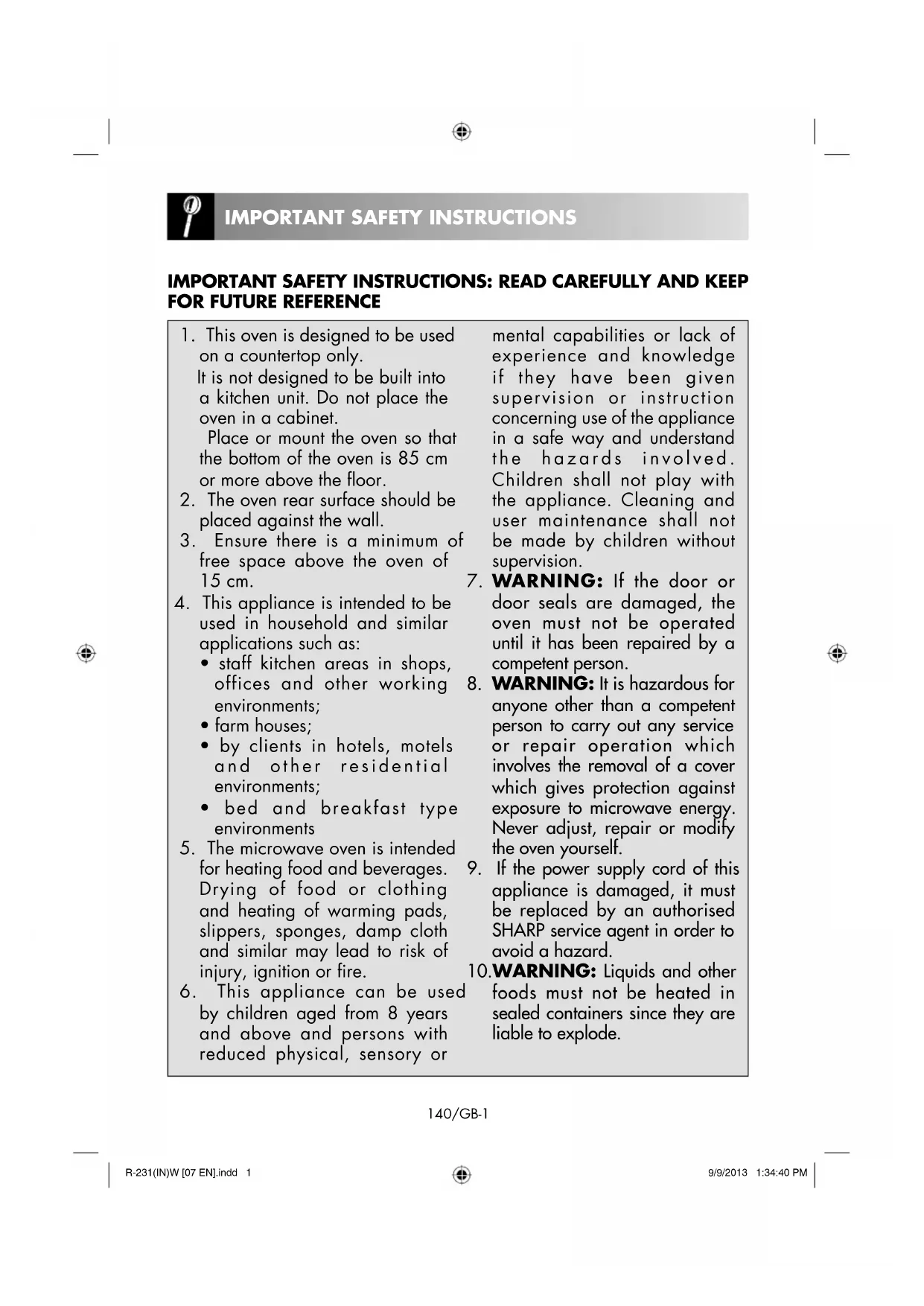
R-231(IN)W [05 ES].indd 25R-231(IN)W [05 ES].indd 25 9/9/2013 1:34:04 PM9/9/2013 1:34:04 PMIMPORTANT SAFETY INSTRUCTIONS: READ CAREFULLY AND KEEP FOR FUTURE REFERENCE
1. This oven is designed to be used
on a countertop only.
It is not designed to be built into
a kitchen unit. Do not place the
Place or mount the oven so that
the bottom of the oven is 85 cm
or more above the floor.
2. The oven rear surface should be
placed against the wall.
3. Ensure there is a minimum of
free space above the oven of
4. This appliance is intended to be
used in household and similar
applications such as:
• staff kitchen areas in shops,
offices and other working
• by clients in hotels, motels
and other residential
• bed and breakfast type
5. The microwave oven is intended
for heating food and beverages.
Drying of food or clothing
and heating of warming pads,
slippers, sponges, damp cloth
and similar may lead to risk of
injury, ignition or fire.
6. This appliance can be used
by children aged from 8 years
and above and persons with
reduced physical, sensory or
mental capabilities or lack of
experience and knowledge
if they have been given
supervision or instruction
concerning use of the appliance
in a safe way and understand
the hazards involved.
Children shall not play with
the appliance. Cleaning and
user maintenance shall not
be made by children without
7. WARNING: If the door or
door seals are damaged, the
oven must not be operated
until it has been repaired by a
8. WARNING: It is hazardous for
anyone other than a competent
person to carry out any service
or repair operation which
involves the removal of a cover
which gives protection against
exposure to microwave energy.
Never adjust, repair or modify
9. If the power supply cord of this
appliance is damaged, it must
be replaced by an authorised
SHARP service agent in order to
10.WARNING: Liquids and other
foods must not be heated in
sealed containers since they are
R-231(IN)W [07 EN].indd 1R-231(IN)W [07 EN].indd 1 9/9/2013 1:34:40 PM9/9/2013 1:34:40 PMENGLISH
11. Microwave heating of
beverages can result in
delayed eruptive boiling,
therefore care must be taken
when handling the container.
12. Eggs in their shell, and whole
hard-boiled eggs should not
be heated in microwave ovens
since they may explode, even
after microwave heating has
ended. To cook or reheat
eggs which have not been
scrambled or mixed, pierce
the yolks and the whites, or
the eggs may explode. Shell
and slice hard-boiled eggs
before reheating them in the
13. Utensils should be checked to
ensure that they are suitable
for use in the oven. See Page
GB-15. Use only microwave
safe containers and utensils
14. The contents of feeding bottles
and baby food jars shall be
stirred or shaken and the
temperature checked before
consumption, in order to avoid
15. When heating food in plastic
or paper containers, keep an
eye on the oven due to the
possibility of ignition.
16. If smoke is emitted, switch off
or unplug the appliance and
keep the door closed in order
to stifle any flames.
17. The oven should be cleaned
regularly and any food
18. Failure to maintain the oven in
a clean condition could lead to
deterioration of the surface that
could adversely affect the life
of the appliance and possibly
result in a hazardous situation.
19. See instructions for cleaning
door seals, cavities and
adjacent parts on page GB-14.
IMPORTANT SAFETY INSTRUCTIONS
R-231(IN)W [07 EN].indd 2R-231(IN)W [07 EN].indd 2 9/9/2013 1:34:40 PM9/9/2013 1:34:40 PMIMPORTANT SAFETY INSTRUCTIONS Do not operate the oven with the door open or alter the
door safety latches in any way.
Do not operate the oven if there is an object between
the door seals and sealing surfaces.
Do not allow grease or dirt to build up on the
door seals and adjacent parts. Clean the oven
at regular intervals and remove any food
deposits. Follow the instructions for “Care
and Cleaning” on page GB-14.
Individuals with PACEMAKERS should check with
their doctor or the manufacturer of the pacemaker for
precautions regarding microwave ovens.
To avoid the possibility of electric shock
Under no circumstances should you remove the outer
Never spill or insert any objects into the door lock
openings or ventilation openings. In the event of a spill,
turn off and unplug the oven immediately, and call an
authorised SHARP service agent.
Do not immerse the power supply cord or plug in water
or any other liquid.
Do not let the power supply cord hang over the edge of
a table or work surface.
Keep the power supply cord away from heated
surfaces, including the rear of the oven.
Do not attempt to replace the oven lamp yourself or
allow anyone who is not an electrician authorised by
SHARP to do so. If the oven lamp fails, please consult
your dealer or an authorised SHARP service agent.
To avoid the possibility of explosion and
Never use sealed containers. Remove seals and lids
before use. Sealed containers can explode due to
a build up of pressure even after the oven has been
Take care when microwaving liquids. Use a wide-
mouthed container to allow bubbles to escape.
Never heat liquids in narrow necked containers
such as baby bottles, as this may result in the
contents erupting from the container when
heated and cause burns.
To prevent sudden eruption of boiling liquid and
Do not use excessive amount of time (See page GB-19).
2. Stir liquid prior to heating/reheating.
3. It is advisable to insert a glass rod or similar utensil
(not metal) into the liquid whilst reheating.
4. Let liquid stand for at least 20 seconds in the oven
at the end of cooking time to prevent delayed
Pierce the skin of such foods as potatoes, sausages and
fruit before cooking, or they may explode.
To avoid the danger of fire.
The microwave oven should not be left
unattended during operation. Power levels
that are too high, or cooking times that are too
long, may overheat foods resulting in a fire.
The electrical outlet must be readily accessible so that
the unit can be unplugged easily in an emergency.
The AC power supply must be 230V, 50Hz, with a
minimum 10A distribution line fuse, or a minimum 10A
distribution circuit breaker.
A separate circuit serving only this appliance should be
Do not place the oven in areas where heat is
generated. For example, close to a conventional oven.
Do not install the oven in an area of high humidity or
where moisture may collect.
Do not store or use the oven outdoors.
Clean the waveguide cover, the oven cavity,
the turntable and roller stay after use. These
must be dry and free from grease. Built-up
grease may overheat and begin to smoke or
Do not place flammable materials near the oven or
ventilation openings.
Do not block the ventilation openings.
Remove all metallic seals, wire twists, etc., from food
and food packages. Arcing on metallic surfaces may
Do not use the microwave oven to heat oil for deep
frying. The temperature cannot be controlled and the
To make popcorn, use only special microwave popcorn
Do not store food or any other items inside the oven.
Check the settings after you start the oven to ensure the
oven is operating as desired.
To avoid overheating and fire, special care must be
taken when cooking or reheating foods with a high
sugar or fat content, for example, Sausage rolls, Pies or
See the corresponding hints in operation manual and
the cookery book section.
To avoid the possibility of injury
Do not operate the oven if it is damaged or malfunctioning.
Check the following before use:
a) The door; make sure the door closes properly and
ensure it is not misaligned or warped.
b) The hinges and safety door latches; check to make
sure they are not broken or loose.
c) The door seals and sealing surfaces; ensure that
they have not been damaged.
d) Inside the oven cavity or on the door; make sure
e) The power supply cord and plug; ensure that they
and may cause electrical arcing. Do not put cans in the
Use only the turntable and the roller stay designed
for this oven. Do not operate the oven without the
To prevent the turntable from breaking:
(a) Before cleaning the turntable with water, leave the
(b) Do not put hot foods or hot utensils on a cold
(c) Do not put cold foods or cold utensils on a hot
Do not place anything on the outer cabinet during
If you are unsure how to connect your oven, please
consult an authorised, qualified electrician.
Neither the manufacturer nor the dealer can accept
any liability for damage to the oven or personal injury
resulting from failure to observe the correct electrical
connection procedure.
Water vapour or drops may occasionally form on
the oven walls or around the door seals and sealing
surfaces. This is a normal occurrence and is not an
indication of microwave leakage or a malfunction.
To avoid the possibility of burns
Use pot holders or oven gloves when removing food
from the oven to prevent burns.
Always open containers, popcorn makers, oven
cooking bags, etc., away from the face and hands to
avoid steam burns and eruption of boiling.
To avoid burns, always test food temperature
and stir before serving and pay special
attention to the temperature of food and
drink given to babies, children or the elderly.
Temperature of the container is not a true indication of
the temperature of the food or drink; always check the
Always stand back from the oven door when opening it
to avoid burns from escaping steam and heat.
Slice stuffed baked foods after heating to release steam
To avoid misuse by children
Do not lean or swing on the oven door.
Children should be taught all important safety
instructions: use of pot holders, careful removal of food
coverings; paying special attention to packaging (e.g.
self-heating materials) designed to make food crisp, as
they may be extra hot.
Never modify the oven in any way.
Do not move the oven while it is in operation.
This oven is for home food preparation only and may
only be used for cooking food. It is not suitable for
commercial or laboratory use.
To promote trouble-free use of your oven
Never operate the oven when it is empty.
When using a browning dish or self-heating material,
always place a heat-resistant insulator such as a
porcelain plate under it to prevent damage to the
turntable and roller stay due to heat stress. The
preheating time specified in the dishes instructions must
R-231(IN)W [07 EN].indd 4R-231(IN)W [07 EN].indd 4 9/9/2013 1:34:41 PM9/9/2013 1:34:41 PM2. Check the oven carefully for any signs of damage.
3. Place the oven on a flat, level surface strong enough
to support the oven’s weight plus the heaviest item
likely to be cooked. Do not place the oven in a
4. Ensure there is a minimum free space above the
5. Securely connect the plug of the oven to a standard
earthed (grounded) household electrical outlet.
1. Remove all packing materials from the inside of the
oven cavity. Discard the loose polythene sheet from
between the door and cavity. Remove the feature
sticker, if attached, from the outside of the door.
Do not remove the protective film attached to the
R-231(IN)W [07 EN].indd 5R-231(IN)W [07 EN].indd 5 9/9/2013 1:34:41 PM9/9/2013 1:34:41 PMENGLISH BEFORE OPERATION Your oven comes pre-set for Energy Save Mode.
This facility saves electricity when the oven is not in use.
When you first plug it in nothing will appear in the
To operate the oven in Energy Save Mode:
1. Plug in the oven. Nothing will appear in the display
2. Open and close the door. The oven display will show
“. 0” . The oven lamp will light while the door is
Using the STOP button
Use the STOP button to:
1. Erase a mistake during programming.
2. Stop the oven temporarily during cooking.
3. Cancel a programme during cooking, touch twice.
In Energy Save Mode, if you do not operate the oven for 3 minutes or more (e.g. closing the door, pressing the
STOP key, or at the end of cooking), you will not be able to operate the oven until you open and close the oven
R-231(IN)W [07 EN].indd 6R-231(IN)W [07 EN].indd 6 9/9/2013 1:34:41 PM9/9/2013 1:34:41 PMMANUAL OPERATION MICROWAVE POWER LEVEL Your oven has 6 power levels. To choose the power
level for cooking, follow the advice given in the recipe
section. Generally the following recommendations
100 P (800 W) used for fast cooking or reheating
e.g. soup, casseroles, canned food, hot beverages,
vegetables, fish, etc.
70 P (560 W) used for longer cooking of dense foods
such as roast joints, meat loaf and plated meals, also
for sensitive dishes such as cheese sauce and sponge
cakes. At this reduced setting, the sauce will not boil
over and food will cook evenly without over cooking
50 P (400 W) for dense foods which require a long
cooking time when cooked conventionally, eg. beef
dishes, it is advisable to use this power setting to
ensure the meat will be tender.
30 P (240 W) to defrost, select this power setting,
to ensure that the dish defrosts evenly. This setting is
also ideal for simmering rice, pasta, dumplings and
cooking egg custard.
10 P (80 W) For gentle defrosting, eg. cream gateaux
To set the power, touch the MICROWAVE POWER LEVEL button until the desired level is displayed.
If MICROWAVE POWER LEVEL button is touched once,
will be displayed. If you miss your desired level,
continue touching the MICROWAVE POWER LEVEL button until you reach the level again. If the level is not
selected, the level 100 P is automatically set.
1. When the door is opened during the cooking process, the cooking time on the digital display stops
automatically. The cooking time starts to count down again when the door is closed and the START/+1min
2. If you wish to know the power level during cooking, press the MICROWAVE POWER LEVEL button.
As long as your finger is touching the MICROWAVE POWER LEVEL button, the power level will be
3. You can rotate the TIMER/WEIGHT knob clockwise or counterclockwise. If you rotate the knob
counterclockwise, the cooking time will decrease from 90 minutes by degrees.
Suppose you want to heat soup for 2 minutes and 30 seconds on 70 P microwave power.
1. Enter the desired cooking
time by rotating the TIMER/
WEIGHT knob clockwise.
2. Choose desired power by
pressing the MICROWAVE POWER LEVEL button twice.
3. Press the START / +1min
button to begin cooking.
Your oven can be programmed for up to 90 minutes.
(90.00) The input unit of cooking (defrosting) time
varies from 10 seconds to five minutes. It depends
on the total length of the cooking (defrosting) time as
Cooking time Increasing unit
1. MULTIPLE SEQUENCE COOKING A maximum of 3 sequences can be input, consisting of manual cooking time and mode.
To cook: 5 minutes on 100 P power (Stage 1)
16 minutes on 30 P power (Stage 2)
1. Enter the desired cooking time
by rotating TIMER/WEIGHT
by pressing the MICROWAVE POWER LEVEL button once.
3. Enter desired time by rotating
by pressing the MICROWAVE POWER LEVEL button four times.
5. Press the START/+1min
button once to begin
(The oven will begin to cook for 5 minutes on 100 P, and then for 16 minutes on 30 P).
If 100P is required on the final stage, it is not necessary to enter the power level.
2. MINUTE PLUS FUNCTION The START/+1min button allows you to operate the two following functions:
You can directly start cooking on 100 P microwave power level for 1 minute by pressing the START/+1min
To avoid the misuse by children the START/+1min button can be used only within 3 minutes after preceding
operation, e.g., closing the door, pressing the STOP button or cooking completion.
b. Extend the cooking time
You can extend the cooking time during manual cooking for multiples of 1 minute if the button is pressed while
the oven is in operation.
3. TO CHECK THE POWER LEVEL To check the microwave power level during cooking press the MICROWAVE POWER LEVEL button.
As long as your finger is touching the MICROWAVE POWER LEVEL button the power level will be displayed.
The oven continues to count down although the display shows the power level.
R-231(IN)W [07 EN].indd 9R-231(IN)W [07 EN].indd 9 9/9/2013 1:34:41 PM9/9/2013 1:34:41 PMENGLISH EXPRESS COOK & DEFROST OPERATION EXPRESS COOK & DEFROST automatically works
out the correct cooking mode and cooking time. You
can choose from 7 EXPRESS COOK menus and 5
EXPRESS DEFROST menus. What you need to know
when using this automatic function:
1. Press the EXPRESS COOK & DEFROST button
once, the display will appear as shown.
The menu can be chosen by pressing the EXPRESS COOK & DEFROST button until the desired
menu number is displayed. See pages GB-11-12
“EXPRESS COOK & DEFROST charts”.
in the display. The menu will be changed
automatically by holding down the EXPRESS COOK & DEFROST button.
2. The weight of the food can be input by rotating the
TIMER/WEIGHT knob until the desired weight is
• Enter the weight of the food only. Do not include
the weight of the container.
• For food weighing more or less than weights given
in the cooking chart, use manual programmes.
For best results, follow the cooking charts in the
3. To start cooking press START/+1min button.
When action is required (e.g. to turn food over), the
oven stops and the audible signals sound, remaining
cooking time and any indicator will flash
on the display. To continue cooking, press the
The final temperature will vary according to the initial
food temperature. Check food is piping hot after
cooking. If necessary, you can extend the cooking time
and change the power level.
To cook gratin weighing 1,0 kg using Express Cook EC-7.
2. Enter the weight by rotating
the TIMER/WEIGHT knob
1. Select the menu required by
pressing the EXPRESS COOK &
DEFROST button seven times.
Add 1 tbsp water per 100 g and salt as desired.
(For mushrooms no additional water is
When audible signal sounds, stir and re-cover.
After cooking, let stand for approx. 2 minutes.
NOTE: If frozen vegetables are compacted
together, cook manually.
Cut into small pieces, eg. strips, cubes or slices.
• Add 1 tbsp water per 100 g and salt as desired.
(For mushrooms no additional water is necessary).
When audible signal sounds, stir and re-cover.
• After cooking, let the food stand for approx
instructs to add water,
amount for the program
with additional liquid.
Transfer meal to suitable microwave-proof dish.
• Add some liquid if recommended by the
• Cook without cover if the manufacturer
When audible signal sounds, stir and re-cover.
• After cooking, stir and let stand for approx.
(initial temp -18°C)
Shallow, oval gratin
dish and microwave foil
or original container
• Remove the frozen gratin from the package.
If the container is not suitable for microwave
ovens, transfer gratin to a suitable
microwave proof dish.
• Cover with microwave foil.
• If the container is suitable for microwave
ovens, remove original paper cover and
cover with microwave foil.
After cooking, let stand for approx. 5 minutes.
• Add cold water as follows.
When audible signal sounds, stir and re-cover.
• After cooking, stir and let stand for approx.
(initial temp fish 5°C,
• See recipes for Fish Fillet with Sauce on
* Total weight of all ingredients.
• See recipes for Gratin on page GB-13.
* Total weight of all ingredients.
• Place the food in a flan dish in the centre
• When the audible signal sounds, turn
the food over, rearrange and separate.
Shield thin parts and warm spots with
small pieces of aluminium foil.
• After defrosting, wrap in aluminium foil
for 10 - 15 minutes, until thoroughly
• Place the block of minced meat in a
flan dish in the centre of the turntable.
• When the audible signal sounds, turn the
food over. Remove the defrosted parts
• After defrosting cover with aluminium foil,
stand for 5 - 10 minutes, until thoroughly
• Place the poultry in a flan dish in the
centre of the turntable.
• When the audible signal sounds, turn
over and shield thin parts and warm
spots with small pieces of aluminium
• After defrosting, rinse with cold water,
cover with aluminium foil and stand
for 15 - 30 minutes until thoroughly
• Finally clean the poultry under running
• Remove all packaging from the cake.
• Place on a plate in the middle of the
• After defrosting, cut the cake into
similar sized pieces keeping space
between each piece and let stand for
10 - 60 minutes until evenly defrosted.
(Only sliced bread is
recommended for this
• Distribute in a flan dish in the centre
of the turntable. For 1,0 kg distribute
directly on the turntable.
• When the audible signal sounds, turn
over, re-arrange and remove defrosted
• After defrosting cover in aluminum
foil and stand for 5 - 15 minutes, until
thoroughly defrosted.
NOTE: Express Defrost
1 Steaks and Chops should be frozen in one layer.
2 Minced meat should be frozen in a thin shape.
3 After turning over, shield the defrosted portions with small, flat pieces of aluminium foil.
4 The poultry should be processed immediately after defrosting.
gratin dish with the thin ends toward the centre and
3. Mix a sauce from tomatoes, corn, chilli sause,
onion, vinegar and spices and spread the sauce on
4. Cover with microwave foil and cook on EXPRESS COOK EC-6, “Fish Fillet with Sauce”.
5. After cooking, let stand for approx. 2 minutes.
FISH FILLET WITH SAUCE (EC-6)
Fish fillet with piquant sauce
0,4 kg 0,8 kg 1,2 kg
140 g 280 g 420 g canned tomatoes (drained)
4 g 8 g 12 g chilli sauce
1 tsp 1-2 tsp 2 tsp red wine vinegar mustard,
1. Place the fish fillet in a round gratin dish with the
thin ends toward the centre and sprinkle with salt.
2. Spread the banana and the ready-made curry
sauce on the fish fillet.
3. Cover with microwave foil and cook on EXPRESS COOK EC-6, “Fish Fillet with Sauce”.
4. After cooking, let stand for approx. 2 minutes.
FISH FILLET WITH SAUCE (EC-6)
Fish fillet with curry sauce
1. Mix together the drained leaf spinach with the
onion and season with salt, pepper and nutmeg.
2. Grease the gratin dish.
3. Place alternate layers of potato slices, diced ham
and spinach in the dish. The top layer should be
4. Mix the eggs with créme fraîche, add salt and
pepper and pour over the vegetables.
5. Cover the gratin with the grated cheese, sprinkle
with paprika powder and cook on EXPRESS COOK EC-7, “Gratin”.
6. After cooking, let stand for 5 minutes.
5 g 10 g butter or margarine (to grease the
salt, pepper, nutmeg
150 g 300 g boiled potatoes (sliced)
35 g 75 g cooked ham (diced)
50 g 100 g créme fraîche
40 g 75 g grated cheese
1. Grease the gratin dish and place alternate layers
of potato slices and courgette in the dish.
2. Mix the eggs with crème fraîche, season with salt,
pepper and garlic and pour over the vegetables.
3. Crumble the feta cheese and sprinkle over the
4. Finally sprinkle the gratin with sunflower kernel and
paprika powder and cook on EXPRESS COOK EC-7, “Gratin”.
5. After cooking, let stand for 5 minutes.
5 g 10 g butter or margarine (to grease the
200 g 400 g potatoes (sliced) (fresh or boiled)
/2 1 clove of garlic (crushed)
40 g 80 g feta cheese (diced)
HARSH CLEANERS, ANY THAT CONTAIN SODIUM HYDROXIDE OR SCOURING PADS ON ANY PART OF YOUR MICROWAVE OVEN.
CLEAN THE OVEN AT REGULAR INTERVALS AND REMOVE ANY FOOD DEPOSITS - Keep
the oven clean, or the oven could lead to
a deterioration of the surface. This could
adversely affect the life of the appliance and
possibly result in a hazardous situation.
The outside of your oven can be cleaned easily with
mild soap and water. Make sure the soap is wiped
off with a moist cloth, and dry the exterior with a soft
Open the door before cleaning to de-activate the oven
controls. Care should be taken when cleaning the
oven control. Using a cloth dampened with water only,
gently wipe the panel until it becomes clean. Avoid
using excessive amounts of water. Do not use any sort
of chemical or abrasive cleaner.
1. For cleaning, wipe any splatters or spills with a
soft damp cloth or sponge after each use while the
oven is still warm. For heavier spills, use a mild
soap and wipe several times with a damp cloth
until all residues are removed. Do not remove the
2. Make sure that mild soap or water does not
penetrate the small vents in the walls which may
cause damage to the oven.
3. Do not use spray type cleaners on the oven interior.
Turntable and Roller stay
Remove the turntable and roller stay from the oven.
Wash the turntable and roller stay in mild soapy water.
Dry with a soft cloth. Both the turntable and the roller
stay are dishwasher safe.
To remove all trace of dirt, regularly clean both sides of
the door, the door seals and adjacent parts with a soft,
damp cloth. Do not use abrasive cleaner.
NOTE: A steam cleaner should not be used.
SERVICE CALL CHECK Please check the following before calling for service.
Check the power plug is properly connected to a suitable wall outlet.
Check the line fuse/circuit breaker is functioning properly.
2. When the door is opened, does the oven lamp light? YES ________ NO _________
3. Place a cup of water (approx. 150 ml) in the oven and close the door securely.
Programme the oven for one minute on 100 P power and start the oven.
Does the oven lamp come on? YES ________ NO _________
Does the turntable rotate? YES ________ NO _________
NOTE: The turntable turns in either direction.
Does the ventilation work?
(Place your hand over the ventilation openings and check for air flow.) YES ________ NO _________
After 1 minute does the signal sound? YES ________ NO _________
Does cooking in progress indicator go off? YES ________ NO _________
Is the cup with water warm after the above operation? YES ________ NO _________
If you answer “No” to any of the above questions, call a Service Technician appointed by SHARP and report the
results of your check. See inside back cover for details of address.
IMPORTANT: If the display shows nothing even if the power supply plug is properly connected, the energy save
mode may be in operation. Open and close the oven door to operate the oven. See GB-6.
NOTE: If you cook the food over the standard time with only 100 P (800 W), the power of the oven will lower
automatically to avoid overheating. (The microwave power level will be reduced).
Cooking Mode Standard time
Microwave 100 P 20 minutes
R-231(IN)W [07 EN].indd 14R-231(IN)W [07 EN].indd 14 9/9/2013 1:34:42 PM9/9/2013 1:34:42 PMSUITABLE OVENWARE WHAT ARE MICROWAVES?
Microwaves are generated in the microwave oven by
a magnetron and cause the water molecules in the
Heat is generated by the friction which is caused, with
the result that the food is thawed, heated or cooked.
and the browning dish. Be careful to adhere exactly to the
pre-heating time given in the manufacturer’s instructions.
Excessive pre-heating can damage the turntable and the
turntable stand or can trigger the safety-device which will
switch off the oven.
METAL Generally speaking, metal should not be used, since
microwaves do not pass through metal and therefore
cannot reach the food. There are, however, exceptions:
small strips of aluminium foil may be used to cover certain
parts of the food, so that these do not thaw too quickly or
begin to cook (e.g. chicken wings).Small metal skewers
and aluminium containers (e.g. of ready- cooked meals)
can be used. They must, however, be small in relation to
the food, e.g. aluminium containers must be at least
/4 filled with food. It is recommended that you transfer
the food into a dish suitable for use in the microwave.
When using aluminium containers or other metal utensils
there must be a gap of approx. 2 cms between them and
the walls of the cooking area, otherwise the walls could
be damaged by possible arcing.
NO UTENSIL SHOULD HAVE A METAL OVERLAY -
parts such as screws, bands or
UTENSIL SUITABILITY TEST If you are not sure whether your utensil is
suitable for use in your microwave oven,
carry out the following test: Place the
utensil into the oven. Place a glass container
filled with 150 ml of water on or next to the utensil.
Switch on the oven at 800 W power for 1 to 2 minutes.
If the utensil stays cool or just warm to the touch, it is
suitable. Do not use this test on a plastic utensil. It could
TIME SETTINGS In general the thawing, heating and cooking times are
significantly shorter than when using a conventional
cooker or oven. For this reason you should adhere to
the recommended times given in this cookery book.
It is better to set the times too short, rather than too
long. Test the food after it has been cooked. It is better
to have to cook something for a little longer than to
GLASS AND CERAMIC GLASS Heat-resistant glass utensils are very
suitable. The cooking process can be
observed from all sides. They must not,
however, contain any metal (e.g. lead
crystal), nor have a metallic overlay (e.g.
gold edge, cobalt blue finish).
CERAMICS Generally very suitable. Ceramics must be glazed,
since with unglazed ceramics moisture can get into the
ceramic. Moisture causes the material to heat up and
may make it shatter. If you are not certain whether your
utensil is suitable for the microwave, carry out the utensil
PORCELAIN Very suitable. Ensure that the porcelain does not have a
gold or silver overlay and that it does not contain any
PLASTIC AND PAPER UTENSILS Heat resistant plastic utensils which are suitable for use in
the microwave can be used to thaw, heat and cook food.
Follow the manufacturer’s recommendations.
Heat-resistant paper made for use in a microwave
oven is also suitable. Follow the manufacturer’s
MICROWAVE FOIL This, or heat-resistant foil, is very suitable for covering
or wrapping. Please follow the manufacturer’s
ROASTING BAGS Can be used in a microwave oven. Metal clips are not
suitable for fastening them since the roasting bag foil
might melt. Fasten the roasting bag with string and pierce
it several times with a fork. Non heat-resistant food wraps
are not recommended for use in a microwave oven.
BROWNING DISH A special microwave dish made from ceramic glass with
metal alloy base, which allows food to be browned.
When using the browning dish a suitable insulator, e.g.
a porcelain plate, must be placed between the turntable
R-231(IN)W [07 EN].indd 15R-231(IN)W [07 EN].indd 15 9/9/2013 1:34:42 PM9/9/2013 1:34:42 PMENGLISH TIPS AND ADVICE INITIAL TEMPERATURES Thawing, heating and cooking times are dependent
upon the initial temperature of the food. Deep-frozen
food and food stored in a refrigerator, for example,
requires longer than food which has been stored at
For heating and cooking, normal storage temperatures
are assumed (refrigerator temperature approx. 5°C,
room temperature approx. 20°C). For thawing the
temperature of the deep freeze is assumed to be
COOKING TIMES All the times given in this cookery book are guidelines,
which can be varied according to the initial temperature,
weight and condition of the food (water or fat content
SALT, SPICES AND HERBS Food cooked in your microwave retains its individual
flavour better than it does when conventional
preparation methods are used. For this reason you
should use salt very sparingly and
normally add it only after cooking. Salt absorbs liquid
and dries out the outer layer of the food. Herbs and
spices can be used as normal.
ADDITION OF WATER Vegetables and other foods with a high water content
can be cooked in their own juice or with the addition
of a little water. This ensures that many vitamins and
minerals are preserved.
FOOD IN SKINS OR SHELLS Food such as sausages, chickens, chicken legs, baked
potatoes, tomatoes, apples, egg yolks or such like
should be pricked or pierced with a fork or small
wooden skewer. This will enable the steam which forms
to dissipate without splitting the skin or shell.
LARGE AND SMALL QUANTITIES Microwave times are directly dependent upon the
amount of food which you would like to thaw, heat or
cook. This means that small portions cook more quickly
TWICE THE AMOUNT = ALMOST TWICE THE TIME HALF THE AMOUNT = HALF THE TIME DEEP AND SHALLOW CONTAINERS Both containers have the same capacity, but the
cooking time is longer for the deeper one. You should
therefore choose as flat a container as possible with
a large surface area. Only use deep containers for
dishes where there is a danger of
overcooking, e.g. for noodles, rice, milk etc.
ROUND AND OVAL CONTAINERS Food cooks more evenly in round or oval containers
than in containers with corners, since the microwave
energy concentrates in the corners and the food in
these areas could become overcooked.
COVERING Covering the food retains the moisture within it and
shortens the cooking time. Use a lid, microwave foil or
a cover. Foods which are to be crispy, e.g. roasts or
chickens, should not be covered.
As a general rule, whatever would be covered in
a conventional oven should also be covered in a
microwave oven. Whatever would be uncovered in an
ordinary oven can also be left uncovered in
TURNING Medium-sized items, such as hamburgers and steaks,
should be turned over once during cooking, in order
to shorten the cooking process. Large items, such as
roasts and chickens, must be turned, since the upper
side receives more microwave energy and could dry
STANDING TIME Keeping to the standing time is one of the most
important rules with microwaves. Almost all foods,
which are thawed, heated or cooked in the microwave,
require a certain amount of time to stand, during which
temperature equalisation takes place and the moisture
in the food is evenly distributed.
R-231(IN)W [07 EN].indd 16R-231(IN)W [07 EN].indd 16 9/9/2013 1:34:42 PM9/9/2013 1:34:42 PMTIPS AND ADVICE BROWNING AGENTS After more than 15 minutes cooking time food acquires
a brownness, although this is not comparable to the
deep brownness and crispness obtained through
conventional cooking. In order to obtain an appetising
brown colour you can use browning agents. For the
most part they simultaneously act as seasoning agents.
● Ready-prepared meals in aluminium containers
should be removed from the aluminium container
and heated on a plate or in a dish.
● Remove the lids from firmly closed containers.
● Food should be covered with microwave foil, a plate
or cover (obtainable from stores), so that the surface
does not dry out. Drinks need not be covered.
● When boiling liquids such as water, coffee, tea or
milk, place a glass stirrer in the container.
● If possible, stir large quantities from time to time, to
ensure that the temperature is evenly distributed.
● The times are for food at a room temperature of
20°C. The heating time for food stored in a
refrigerator should be increased slightly.
● After heating allow the food to stand for 1-2 minutes,
so that the temperature inside the food can be
evenly distributed (standing time).
● The times given are guidelines, which can be varied
according to the initial temperature, weight, water
content, fat content or the result which you wish to
THAWING Your microwave is ideal for thawing. Thawing times
are usually considerably shorter than in traditional
Here are a few tips. Take the frozen item out of its
packaging and place on a plate for thawing.
BOXES AND CONTAINERS Boxes and containers suitable for microwaves are
particularly good for thawing and heating food, since
they can withstand temperatures in a deep freeze
(down to approx. –40°C) as well as being heat-resistant
(up to approx. 220°C). You can therefore use the
same container to thaw, heat and even cook the food,
without having to transfer it.
COVERING Cover thin parts with small strips of aluminium foil
before thawing. Thawed or warm parts should likewise
be covered with aluminium strips during thawing.
This stops the thin parts becoming too hot while thicker
parts are still frozen.
CORRECT SETTING It is better to choose a setting which is too low rather
than one which is too high. By so doing you will ensure
that the food thaws evenly.
If the microwave setting is too high, the surface of the
food will already have begun to cook while the inside
In the following table you will find some suggestions for
substances you might use for browning and some of the
uses to which you might put them.
BROWNING AGENT DISH METHOD Melted butter and dried paprika Poultry Coat the poultry with the butter/
Dried paprika Oven baked dishes”Cheese
Soya sauce Meat and poultry Coat with the sauce
Barbecue and Worcestershire sauce, Gravy
Roasts, Rissoles, Small roasted
Rendered down bacon fat or dried onions Oven baked dishes, toasted
Sprinkle pieces of bacon or dried
Cocoa, chocolate flakes, brown icing,
Cakes and desserts Sprinkle pieces on top of cakes
and desserts or use to glaze
R-231(IN)W [07 EN].indd 17R-231(IN)W [07 EN].indd 17 9/9/2013 1:34:43 PM9/9/2013 1:34:43 PMENGLISH TIPS AND ADVICE TURNING/STIRRING Almost all foods have to be turned or stirred from time
to time. As early as possible, separate parts which are
stuck together and rearrange them.
SMALL AMOUNTS Thaw more quickly and evenly than larger ones. We
recommend that you freeze portions which are as small
as possible. By so doing you will be able to prepare
whole menus quickly and easily.
FOODS REQUIRING CAREFUL HANDLING Foods such as gateaux, cream, cheese and bread
should only be partially thawed and then left to thaw
completely at room temperature. By so doing you
will avoid the outer areas becoming too hot while the
inside is still frozen.
STANDING TIME This is particularly important after thawing food, as
the thawing process continues during this period. In
the thawing table you will find the standing times for
various foods. Thick, dense foods require a longer
standing time than thinner foods or food of a porous
nature. If the food has not thawed sufficiently, you
may continue thawing it in the microwave oven or
lengthen the standing time accordingly. At the end of
the standing time you should process the food as soon
as possible and not re-freeze it.
COOKING FRESH VEGETABLES ● When buying vegetables try to ensure that, as far as possible, they are of similar size. This is
particularly important when you want to cook the
vegetables whole (e.g. boiled potatoes). ● Wash the vegetables before preparing them, clean them and only then weigh the required quantity for
the recipe and chop them up. ● Season them as you would normally, but as a rule only add salt after cooking.
● Add about 5 tbsps of water for 500 g of vegetables.
Vegetables which are high in fibre require a little
more water. You will find information about this in
the table. ● Vegetables are usually cooked in a dish with a lid. Those with a high moisture content, e.g. onions or
boiled potatoes, can be cooked in microwave foil
without adding water. ● After half the cooking time has elapsed vegetables should be stirred or turned over. ● After cooking allow the vegetables to stand for approx. 2 minutes, so that the temperature disperses
evenly (standing time). ● The cooking times given are guidelines and depend upon the weight, initial temperature and condition
of the type of vegetable in question. The fresher the
vegetables, the shorter the cooking times.
COOKING MEAT, FISH AND POULTRY ● When buying food items, try to ensure that, as far as possible, they are of similar size. This will ensure
that they are cooked properly. ● Before preparation wash meat, fish and poultry thoroughly under cold running water and pat them
dry with kitchen paper. Then continue as normal. ● Beef should be well hung and have little gristle.● Even though the pieces may be of a similar size, cooking results may vary. This is due, amongst other
things, to the kind of food, variations in the fat and
moisture content as well as the temperature before
cooking. ● After the food has been cooking for 15 minutes it acquires a natural brownness, which may be
enhanced by the use of a browning agent. If, in
addition, you would like the surface to be crisp
you should either use the browning dish or sear the
food on your cooker and finish cooking it in your
microwave. By doing this you will simultaneously
obtain a brown base for making a sauce. ● Turn large pieces of meat, fish or poultry half way through the cooking time, so that they are cooked
evenly from all sides. ● After cooking cover roasts with aluminium foil and allow them to stand for approx. 10 minutes
(standing time). During this period the roast carries
on cooking and the liquid is evenly distributed, so
that when it is carved a minimum amount of juice is
THAWING AND COOKING Deep-frozen dishes can be thawed and cooked at
the same time in one process in your microwave. You
will find some examples in the table. Do take note,
however, of the general advice given on “heating”
and “thawing” food. Please refer to the manufacturer’s
instructions on the packaging when preparing deep-
frozen dishes. These usually contain precise cooking
times and offer advice on preparation.
R-231(IN)W [07 EN].indd 18R-231(IN)W [07 EN].indd 18 9/9/2013 1:34:43 PM9/9/2013 1:34:43 PMTABLES ABBREVIATIONS USED
tbsp = tablespoon KG = kilogram DF = deep frozen
tsp = teaspoon g = gram MW = microwave
l.p. = large pinch l = litre MWO = microwave oven
s.p. = small pinch ml = millilitre min = minutes
Cup = cupful cm = centimetre sec = seconds
Sach. = sachet DFC = dry fat content dm = diameter
TABLE: HEATING FOOD AND DRINK Food / Drink
Coffee, 1 cup 150 800W approx.1 do not cover
Milk, 1 cup 150 800W approx.1 do not cover
Water, 1 cup 150 800W 1
-2 do not cover, bring to the boil
6 cups 900 800W 10-12 do not cover, bring to the boil
1 bowl 1000 800W 10-12 do not cover, bring to the boil
(Vegetables, meat and trimmings)
400 800W approx.4 sprinkle some water onto the sauce, cover
stir half way through the heating time
Stew 200 800W 2-3 cover, stir after heating
Clear soup 200 800W approx.2 cover, stir after heating
Cream soup 200 800W approx.2 cover, stir after heating
if necessary add some water, cover
stir half way through the heating time
sprinkle with water, cover and stir from time
Meat, 1 slice* 200 800W 3-4 thinly spread sauce over the top, cover
Fish fillet* 200 800W 2-3 cover
Sausages 2 180 560W approx.2 pierce the skin several times
place on a cake stand
Baby food, 1 glass 190 400W approx.1 remove the lid, after heating stir well and test
Melting chocolate 100 400W 2-3 stir from time to time
Dissolving six sheets of gelatine 10 400W
dip into water, squeeze thoroughly and place in
a soup bowl, stir from time to time
Glazing for a tart for
10 400W 5-6 mix the sugar in 250 ml of liquid, cover, stir well
during and after heating
* Refrigerator temperature
season to taste, place in a shallow flan dish
season to taste, place in a quiche dish,
Minced meat 1000 800W 16-18 prepare the minced meat mixture (half pork/
half beef) place in a shallow casserole dish
Fish fillet 200 800W 3-4 season to taste, place on a plate, cover 3
Chicken 1200 800W 22-25* season to taste, place in a casserole dish,
turn half way through cooking time *
Chicken legs 200 800W 3-4 season to taste, place on a plate, cover 3
* When turning over remove the juices from the dish.
Roast meat (e.g. pork, beef,
place on an upturned plate, turn
half way through thawing time
Steaks, escalopes, cutlets, liver 200 80W 7-8 turn half way through thawing time 30
Goulash 500 240W 8-12
separate and stir half way through thawing time
Sausages, 8 600 240W 6-9 place next to each other, 5-10
4 300 240W 4-5 turn half way through thawing time 5-10
Duck, turkey 1500 80W 48-52 place upon an upturned plate,
turn half way through thawing time
Chicken 1200 80W 39-43 place upon an upturned plate,
turn half way through thawing time
1000 80W 33-37 place upon an upturned plate,
turn half way through thawing time
Chicken legs 200 240W 4-5 turn half way through thawing time 10-15
Whole fish 800 240W 9-12 turn half way through thawing time 10-15
Fish fillet 400 240W 7-10 turn half way through thawing time 5-10
Crabs 300 240W 6-8 turn half way through thawing time 30
Rolls, 2 80 240W app.1 only partially thaw -
Sliced bread for toasting 250 240W 2-4 remove outer slices after each minute has
White loaf, whole 750 240W 7-10 turn half way through thawing time
(centre still frozen)
Cakes, per piece 100-150 80W 2-5 place on a cake stand 5
Cream cake, per piece 150 80W 3-4 place on a cake stand 10
Whole gateau, Ø 25cm 80W 20-24 place on a cake stand 30-60
Butter 250 240W 2-4 only partially thaw 15
Fruit such as strawberries
raspberries, cherries, plums
250 240W 4-5 spread them out evenly
turn half way through thawing time
TABLE: THAWING AND COOKING Food
-Setting- Cooking time -Min-
Fish fillet 300 800W 10-11 - cover 1-2
Trout, 1 fish 250 800W 7-9 - cover -
Platter 400 800W 8-9 - cover, stir half way through cooking time -
Leaf spinach 300 800W 7-9 - cover, stir once or twice during cooking 2
Broccoli 300 800W 7-9 3-5tbsps cover, stir half way through cooking time 2
Peas 300 800W 7-9 3-5tbsps cover, stir half way through cooking time 2
Kohlrabi 300 800W 7-9 3-5tbsps cover, stir half way through cooking time 2
Mixed vegetables 500 800W 12-14 3-5tbsps cover, stir half way through cooking time 2
Brussels sprouts 300 800W 7-9 3-5tbsps cover, stir half way through cooking time 2
Red cabbage 450 800W 11-13 3-5tbsps cover, stir half way through cooking time 2
R-231(IN)W [07 EN].indd 20R-231(IN)W [07 EN].indd 20 9/9/2013 1:34:43 PM9/9/2013 1:34:43 PMRECIPES TABLES ADAPTING RECIPES FOR THE MICROWAVE OVEN If you would like to adapt your favourite recipes for the
microwave, you should take note of the following:
Shorten cooking times by a third to a half. Follow the
example of the recipes in this cookery book.
Foods which have a high moisture content such as
meat, fish, poultry, vegetables, fruit, stews and soups
can be prepared in your microwave without any
difficulty. Foods which have little moisture, such as
platters of food, should have the surface moistened
prior to heating or cooking.
The amount of liquid to be added to raw foods, which
are to be braised, should be reduced to about two
thirds of the quantity in the original recipe. If necessary,
add more liquid during cooking.
The amount of fat to be added can be reduced
considerably. A small amount of butter, margarine or
oil is sufficient to flavour food. For this reason your
microwave is excellent for preparing low-fat foods as
● All the recipes in this cookery book are calculated
on the basis of 4 servings - unless otherwise stated.
● Recommendations relating to suitable utensils and
the total cooking times are given at the beginning of
● As a rule the quantities shown are assumed to be
wholly consumable, unless specifically indicated
● When eggs are given in the recipes they are assumed
to have weight of approx. 55 g (grade M).
TABLE: COOKING FRESH Vegetable Quantity
wash dry well, cover, stir once or twice during cooking
1 whole head, cover, divide into florets, stir
divide into florets, cover, stir occasionally during cooking
whole heads, cover, stir occasionally during cooking
Chinese leaves 300 800W 9-11 cut into strips, cover, stir occasionally during cooking 4-5
Peas 500 800W 9-11 cover, stir occasionally during cooking 4-5
Fennel 500 800W 9-11
cut into quarters, cover, stir occasionally during cooking
Onions 250 800W 5-7 whole, cook in microwave foil -
Kohlrabi 500 800W 10-12 dice, cover, stir occasionally during cooking 50ml
cut into rings, cover, stir occasionally during cooking
Green peppers 500 800W 7-9 cut into strips, stir once or twice during cooking 4-5
Boiled potatoes (skins on) 500 800W 9-11 cover, stir occasionally during cooking 4-5
cut into rings, cover, stir occasionally during cooking
Red cabbage 500 800W 10-12 cut into strips, stir once or twice during cooking 50ml
Brussels sprouts 500 800W 9-11
whole sprouts, cover, stir occasionally during cooking
Boiled Potatoes (salted) 500 800W 9-11
cut into large pieces of a similar size, add a little salt,
cover, stir occasionally during cooking
Celery 500 800W 9-11 dice finely, cover, stir occasionally during cooking 50ml
White cabbage 500 800W 10-12
cut into strips, cover, stir occasionally during cooking
Courgettes 500 800W 9-11 slice, cover, stir occasionally during cooking 4-5
CAMEMBERT TOAST Total cooking time: approx. 1-2
4 slices of bread for toasting
1. Toast the bread and spread with butter.
2. Cut the Camembert into slices and arrange on
top of the toast. Put the cranberry jelly in the
middle of the cheese and sprinkle with cayenne
3. Place the toast on a plate and heat for
Mins. 800 W Tip: You can vary this recipe according to your taste.
For example, you can use fresh mushrooms and
grated cheese or cooked ham, asparagus and
MUSHROOM SOUP Champignonsoep
Total cooking time: approx. 13-17 Minutes
Utensil: Bowl with Lid (2 l Capacity)
200 g mushrooms, sliced
1. Place the vegetables and the stock in the bowl,
2. Blend all the ingredients in the mixer.
3. Mix the flour and butter to a dough and smooth
into the soup. Season with salt and pepper, cover
and cook. Stir after cooking.
4. Mix the egg yolk with the cream, gradually stir into
the soup. Heat for a short time, but do not let it
1-2 Mins. 800 W Allow the soup to stand for about 5 minutes after
R-231(IN)W [07 EN].indd 22R-231(IN)W [07 EN].indd 22 9/9/2013 1:34:43 PM9/9/2013 1:34:43 PMRECIPES Switzerland
ZÜRICH VEAL IN CREAM Total cooking time: approx. 12-16 minutes
Utensil: dish with lid (2 l capacity)
Seasoned gravy browning, for approx.
1 tbsp parsley, chopped
1. Cut the fillet into finger-width strips.
2. Grease the dish all over with the butter. Put the
onion and the meat into the dish, cover and cook.
Stir once during cooking.
3. Add the white wine, gravy browning and cream,
stir, cover and continue cooking. Stir occasionally.
4. Test the veal, stir the mixture once more and allow to
stand for approx. 5 minutes. Serve garnished with
BRAISED LAMB WITH GREEN BEANS Total cooking time: approx. 20-24 minutes
1 tsp butter or margarine for greasing the bowl
1 onion (50 g), finely chopped
1 clove garlic, crushed
1. Skin and remove the stalks of the tomatoes, then
purée in a blender or food processor.
2. Cut the lamb into large chunks. Grease the bowl with
butter. Add meat, onions and garlic, season, cover
3. Add beans and puréed tomatoes to the meat, cover
and continue cooking.
11-13 Mins. 560 W After cooking, leave the lamb to stand for approximately
Tip: If you prefer to use fresh beans, these should be
SOLE FILLETS Total cooking time: approx. 11-14 minutes
Utensil: shallow,oval oven dish with microwave foil
(approx. 26 cm long)
1 tsp butter or margarine for greasing
1 tbsp vegetable oil
1 tbsp parsley, chopped
4 tbsps white wine (30 ml)
2 tbsps butter or margarine (20 g)
1. Wash the sole fillets and pat them dry. Remove any
2. Cut the lemon and the tomatoes into thin slices.
3. Grease the oven dish with butter. Place the fish fillets
inside and drizzle the vegetable oil over them.
4. Sprinkle parsley over the fish, place the tomato slices
on top and season. Place the lemon slices on top
of the tomatoes and pour the white wine over them.
5. Place small pats of butter on top of the lemon, cover
10-12 Mins. 800 W After cooking allow the fish fillets to stand for
Tip: This recipe can also be used for Haddock, Halibut,
Utensils: Bowl with lid (2 l capacity)
1 clove of garlic, crushed
50 g grated Parmesan cheese
1 tsp mixed chopped herbs
1 tsp vegetable oil to grease the mould
1 tbsp grated Parmesan cheese
1 tbsp butter or margarine
1. Cut the tomatoes into slices, mix with the ham and
onion, garlic, minced meat and mashed tomato.
Season and cook with the lid on. Stir during
2. Mix the cream with the milk, Parmesan cheese,
herbs, oil, and spices.
3. Grease the soufflé mould and cover the bottom of
the mould with about
/3 of the pasta. Put half of
the minced meat mixture on the pasta and pour
on some sauce. Put an additional
on top followed by another layer of the minced
meat mixture and some sauce, finishing with the
remaining pasta on top. Finally, cover the pasta with
lots of sauce and sprinkle with Parmesan cheese.
Place butter flakes on top and cook with the lid on.
15-16 Mins. 560 W After cooking, let the lasagne stand for approximately
Utensils: Bowl with lid (2 l capacity)
5 tbsp olive oil (50 ml)
1 clove garlic, crushed
1 onion (50 g), sliced
1 small aubergine (250 g), cut into cubes
1 courgette (200 g), into cubes
1 pepper (200 g), cut into large cubes
1 Small fennel (75 g) cut into large cubes
200 g tinned artichoke hearts, cut into quarters
1. Place the olive oil and garlic clove in the bowl.
Add the prepared vegetables, except the artichoke
hearts, and season with pepper. Add the bouquet
garni, cover and cook, stirring once.
18-20 Mins. 800 W For the last 5 minutes, add the artichoke hearts and
2. Season the ratatouille to taste with salt and pepper.
Remove the bouquet garni before serving. After
cooking, leave the ratatouille to stand for around
Tip: Ratatouille can be served hot with meat dishes.
Served cold, it also makes an excellent starter.
A bouquet garni consists of: one stalk of parsley,
a bunch of herbs suitable for seasoning soup, one
stalk of lovage, one stalk of thyme, several bay
Utensils: Bowl with lid (2 l capacity)
4 medium sized potatoes (400 g)
60 g ham, cut into fine cubes
/2 onion (25 g) finely cubed
2 tbsp grated Parmesan cheese (20 g)
2 tbsp grated Emmental cheese
1. Place the potatoes in a dish, add the water, cover
and cook. Rearrange halfway through cooking.
8-9 Mins. 800 W Leave to cool.
2. Cut the potatoes lengthwise and carefully remove
the potato from the skin. Mix the potato with the
ham, onion, milk and Parmesan cheese to an even
consistency. Season with salt and pepper.
3. Fill the potato skins with potato mixture and sprinkle
with Emmental cheese. Place potatoes on a plate
4-6 Mins. 800 W After cooking, leave to stand for approximately
Utensils: Dish with lid (2 l capacity)
150 g redcurrants, washed and stalks removed
150 g strawberries, washed and haulms removed
150 g raspberries, washed and haulms removed
1. Put some of the fruit to one side for decoration.
Purée the rest of the fruit with the white wine, put it
into a dish, cover and heat.
7-9 Min. 800 W Fold in the sugar and the lemon juice.
2. Soak the gelatin in cold water for approx. 10 minutes,
then take it out and squeeze dry. Stir the gelatin in
with the hot purée until it has dissolved. Place the
jelly in the refrigerator and leave to set.
3. To make the vanilla sauce; put the milk into the
other dish. Slit the vanilla pod and remove the
inside. Stir this in with the milk, together with the
sugar and the food thickener, cover and cook,
stirring during cooking and again at the end.
4. Turn out the jelly onto a plate and decorate with the
whole fruit. Add the vanilla sauce.
Tip:You can also use defrosted frozen fruits.
Centralized hotline is 800.826.111
AC Power required: Microwave
Off Mode (Energy Save Mode)
Output power: Microwave
: 25 W/240-250 V GB GB
* This Product fulfils the requirement of the European standard EN55011.
In conformity with this standard, this product is classified as group 2 class B equipment.
Group 2 means that the equipment intentionally generates radio-frequency energy in the form of electromagnetic
radiation for the heat treatment of food.
Class B equipment means that the equipment is suitable to be used in domestic establishments.
** Internal capacity is calculated by measuring maximum width, depth and height. Actual capacity for holding