USER MANUAL WX531 WX531.X WORX

WARNING: Read all safety warnings, instructions, illustrations and specifications provided with this power tool. Failure to follow all instructions listed below may result in electric shock, fire and/or serious injury.
Save all warnings and instructions for future reference.
The term “power tool” in the warnings refers to your mains-operated (corded) power tool or battery-operated (cordless) power tool.
1) Work area safety
a) Keep work area clean and well lit. Cluttered or dark areas invite accidents.
b) Do not operate power tools in explosive atmospheres, such as in the presence of flammable liquids, gases or dust. Power tools create sparks which may ignite the dust or fumes.
c) Keep children and bystanders away while operating a power tool. Distractions can cause you to lose control.
2) Electrical safety
a) Power tool plugs must match the outlet. Never modify the plug in any way. Do not use any adapter plugs with earthed (grounded) power tools. Unmodified plugs and matching outlets will reduce risk of electric shock.
b) Avoid body contact with earthed or grounded surfaces, such as pipes, radiators, ranges and refrigerators. There is an increased risk of electric shock if your body is earthed or grounded.
c) Do not expose power tools to rain or wet conditions. Water entering a power tool will increase the risk of electric shock.
d) Do not abuse the cord. Never use the cord for carrying, pulling or unplugging the power tool. Keep cord away from heat, oil, sharp edges or moving parts. Damaged or entangled cords increase the risk of electric shock.
e) When operating a power tool outdoors, use an extension cord suitable for outdoor use. Use of a cord suitable for outdoor use reduces the risk of electric shock.
f) If operating a power tool in a damp location is unavoidable, use a residual current device (RCD) protected supply. Use of an RCD reduces the risk of electric shock.
3) Personal safety
a) Stay alert, watch what you are doing and use common sense when operating a power tool. Do not use a power tool while you are tired or under the influence of
drugs, alcohol or medication. A moment of inattention while operating power tools may result in serious personal injury.
b) Use personal protective equipment. Always wear eye protection. Protective equipment such as dust mask, non-skid safety shoes, hard hat, or hearing protection used for appropriate conditions will reduce personal injuries.
c) Prevent unintentional starting. Ensure the switch is in the off-position before connecting to power source and/or battery pack, picking up or carrying the tool. Carrying power tools with your finger on the switch or energising power tools that have the switch on invites accidents.
d) Remove any adjusting key or wrench before turning the power tool on. A wrench or a key left attached to a rotating part of the power tool may result in personal injury.
e) Do not overreach. Keep proper footing and balance at all times. This enables better control of the power tool in unexpected situations.
f) Dress properly. Do not wear loose clothing or jewellery. Keep your hair and clothing away from moving parts. Loose clothes, jewellery or long hair can be caught in moving parts.
g) If devices are provided for the connection of dust extraction and collection facilities, ensure these are connected and properly used. Use of dust collection can reduce dust-related hazards.
h) Do not let familiarity gained from frequent use of tools allow you to become complacent and ignore tool safety principles. A careless action can cause severe injury within a fraction of a second.
4) Power tool use and care
a) Do not force the power tool. Use the correct power tool for your application.
The correct power tool will do the job better and safer at the rate for which it was designed.
b) Do not use the power tool if the switch does not turn it on and off. Any power tool that cannot be controlled with the switch is dangerous and must be repaired.
c) Disconnect the plug from the power source and/or remove the battery pack, if detachable, from the power tool before making any adjustments, changing accessories, or storing power tools. Such preventive safety measures reduce the risk of starting the power tool accidentally.
d) Store idle power tools out of the reach of children and do not allow persons unfamiliar with the power tool or these instructions to operate the power tool. Power tools are dangerous in the hands of untrained users.
e) Maintain power tools and accessories.
Check for misalignment or binding of moving parts, breakage of parts and any other condition that may affect the power tool's operation. If damaged, have the power tool repaired before use. Many accidents are caused by poorly maintained power tools.
f) Keep cutting tools sharp and clean.
Properly maintained cutting tools with sharp cutting edges are less likely to bind and are easier to control.
g) Use the power tool, accessories and tool bits etc. in accordance with these instructions, taking into account the working conditions and the work to be performed. Use of the power tool for operations different from those intended could result in a hazardous situation.
h) Keep handles and grasping surfaces dry, clean and free from oil and grease.
Slippery handles and grasping surfaces do not allow for safe handling and control of the tool in unexpected situations.
5) Battery tool use and care
a) Recharge only with the charger specified by the manufacturer. A charger that is suitable for one type of battery pack may create a risk of fire when used with another battery pack.
b) Use power tools only with specifically designated battery packs. Use of any other battery packs may create a risk of injury and fire.
c) When battery pack is not in use, keep it away from other metal objects, like paper clips, coins, keys, nails, screws or other small metal objects, that can make a connection from one terminal to another. Shorting the battery terminals together may cause burns or a fire.
d) Under abusive conditions, liquid may be ejected from the battery; avoid contact. If contact accidentally occurs, flush with water. If liquid contacts eyes, additionally seek medical help. Liquid ejected from the battery may cause irritation or burns.
e) Do not use a battery pack or tool that is damaged or modified. Damaged or modified batteries may exhibit unpredictable behaviour resulting in fire, explosion or risk of injury.
f) Do not expose a battery pack or tool to fire or excessive temperature. Exposure to fire or temperature above 130 °C may cause explosion.
g) Follow all charging instructions and do not charge the battery pack or tool outside the temperature range specified in the instructions. Charging improperly or at temperatures outside the specified range may damage the battery and increase the risk of fire.
6) Service
a) Have your power tool serviced by a qualified repair person using only identical replacement parts. This will ensure that the safety of the power tool is maintained.
b) Never service damaged battery packs.
Service of battery packs should only be performed by the manufacturer or authorized service providers.
SAFETY INSTRUCTIONS FOR ALL SAWS
CUTTING PROCEDURES
a) DANGER: Keep hands away from cutting area and the blade. If both hands are holding the saw, they cannot be cut by the blade.
b) Do not reach underneath the workpiece. The guard cannot protect you from the blade below the workpiece.
c) Adjust the cutting depth to the thickness of the workpiece. Less than a full tooth of the blade teeth should be visible below the workpiece.
d) Never hold the workpiece in your hands or across your leg while cutting. Secure the workpiece to a stable platform. It is important to support the work properly to minimise body exposure, blade binding, or loss of control.
e) Hold the power tool by insulated gripping surfaces, when performing an operation where the cutting tool may contact hidden wiring. Contact with a "live" wire will also make exposed metal parts of the power tool "live" and could give the operator an electric shock.
f) When ripping, always use a rip fence or straight edge guide. This improves the accuracy of cut and reduces the chance of blade binding.
g) Always use blades with correct size and shape (diamond versus round) of arbour holes. Blades that do not match the mounting hardware of the saw will run off-centre, causing loss of control.
h) Never use damaged or incorrect blade washers or bolt. The blade washers and bolt were specially designed for your saw, for optimum performance and safety of operation.
FURTHER SAFETY INSTRUCTIONS FOR ALL SAWS
Kickback causes and related warnings
— kickback is a sudden reaction to a pinched, jammed or misaligned saw blade, causing an uncontrolled saw to lift up and out of the workpiece toward the operator;
—when the blade is pinched or jammed tightly by the kerf closing down, the blade stalls and the motor reaction drives the unit rapidly back toward the operator;
— if the blade becomes twisted or misaligned in the cut, the teeth at the back edge of the blade can dig into the top surface of the wood causing the blade to climb out of the kerf and jump back toward the operator.
Kickback is the result of saw misuse and/or incorrect operating procedures or conditions and can be avoided by taking proper precautions as given below.
a) Maintain a firm grip on the saw and position your arms to resist kickback forces. Position your body to either side of the blade, but not in line with the blade. Kickback could cause the saw to jump backwards, but kickback forces can be controlled by the operator, if proper precautions are taken.
b) When blade is binding, or when interrupting a cut for any reason, release the trigger and hold the saw motionless in the material until the blade comes to a complete stop. Never attempt to remove the saw from the work or pull the saw backward while the blade is in motion or kickback may occur. Investigate and take corrective actions to eliminate the cause of blade binding.
c) When restarting a saw in the workpiece, centre the saw blade in the kerf so that the saw teeth are not engaged into the material. If a saw blade binds, it may walk up or kickback from the workpiece as the saw is restarted.
d) Support large panels to minimise the risk of blade pinching and kickback. Large panels tend to sag under their own weight. Supports must be placed under the panel on both sides, near the line of cut and near the edge of the panel.
e) Do not use dull or damaged blades.
Unsharpened or improperly set blades produce narrow kerf causing excessive friction, blade binding and kickback.
f) Blade depth and bevel adjusting locking levers must be tight and secure before making the cut. If blade adjustment shifts while cutting, it may cause binding and kickback.
g) Use extra caution when sawing into existing walls or other blind areas. The protruding blade may cut objects that can cause kickback.
SAFETY INSTRUCTIONS FOR CIRCULAR SAW WITH INNER PENDULUM GUARD
Lower guard function
a) Check the lower guard for proper closing before each use. Do not operate the saw if the lower guard does not move freely and close instantly. Never clamp or tie the lower guard into the open position.
If the saw is accidentally dropped, the lower guard may be bent. Raise the lower guard with the retracting handle and make sure it moves freely and does not touch the blade or any other part, in all angles and depths of cut.
b) Check the operation of the lower guard spring. If the guard and the spring are not operating properly, they must be serviced before use. Lower guard may operate sluggishly due to damaged parts, gummy deposits, or a build-up of debris.
c) The lower guard may be retracted manually only for special cuts such as "plunge cuts" and "compound cuts." Raise the lower guard by retracting handle and as soon as the blade enters the material, the lower guard must be released. For all other sawing, the lower guard should operate automatically.
d) Always observe that the lower guard is covering the blade before placing the saw down on bench or floor. An unprotected, coasting blade will cause the saw to walk backwards, cutting whatever is in its path. Be aware of the time it takes for the blade to stop after switch is released.
ADDITIONAL SAFETY RULES FOR YOUR CIRCULAR SAW
- Use only saw blades recommended by the manufacturer, which conform to EN 847-1, if intended for wood and analogous materials.
- Do not use any abrasive wheels.
- Use only blade diameter(s) in accordance with the markings.
- Identify the correct saw blade to be used for the material to be cut.
- Use only saw blades that are marked with a speed equal or higher than the speed marked on the tool.
CUT-OFF MACHINE SAFETY WARNINGS
a) The guard provided with the tool must be securely attached to the power tool and positioned for maximum safety, so
the least amount of wheel is exposed towards the operator. Position yourself and bystanders away from the plane of the rotating wheel. The guard helps to protect operator from broken wheel fragments and accidental contact with wheel.
b) Use only bonded reinforced or diamond cut-off wheels for your power tool. Just because an accessory can be attached to your power tool, it does not assure safe operation.
c) The rated speed of the accessory must be at least equal to the maximum speed marked on the power tool. Accessories running faster than their rated speed can break and fly apart.
d) Wheels must be used only for recommended applications. For example: do not grind with the side of cut-off wheel. Abrasive cut-off wheels are intended for peripheral grinding, side forces applied to these wheels may cause them to shatter.
e) Always use undamaged wheel flanges that are of correct diameter for your selected wheel. Proper wheel flanges support the wheel thus reducing the possibility of wheel breakage.
f) Do not use worn down reinforced wheels from larger power tools. Wheels intended for a larger power tool are not suitable for the higher speed of a smaller tool and may burst.
g) The outside diameter and the thickness of your accessory must be within the capacity rating of your power tool. Incorrectly sized accessories cannot be adequately guarded or controlled.
h) The arbour size of wheels and flanges must properly fit the spindle of the power tool. Wheels and flanges with arbour holes that do not match the mounting hardware of the power tool will run out of balance, vibrate excessively and may cause loss of control.
i) Do not use damaged wheels. Before each use, inspect the wheels for chips and cracks. If power tool or wheel is dropped, inspect for damage or install an undamaged wheel. After inspecting and installing the wheel, position yourself and bystanders away from the plane of the rotating wheel and run the power tool at maximum no load speed for one minute. Damaged wheels will normally break apart during this test time.
j) Wear personal protective equipment. Depending on application, use face shield, safety goggles or safety glasses. As appropriate, wear dust mask, hearing protectors, gloves and shop apron capable of stopping small abrasive or workpiece fragments. The eye protection must be capable of stopping flying debris generated by various operations. The dust mask or respirator must be capable of filtrating particles generated by your operation. Prolonged exposure to high intensity noise may cause hearing loss.
k) Keep bystanders a safe distance away from work area. Anyone entering the work area must wear personal protective equipment. Fragments of workpiece or of a broken wheel may fly away and cause injury beyond immediate area of operation.
I) Hold the power tool by insulated gripping surfaces only, when performing an operation where the cutting accessory may contact hidden wiring. Cutting accessory contacting a "live" wire may make exposed metal parts of the power tool "live" and could give the operator an electric shock.
m) Never lay the power tool down until the accessory has come to a complete stop. The spinning wheel may grab the surface and pull the power tool out of your control.
n) Do not run the power tool while carrying it at your side. Accidental contact with the spinning accessory could snag your clothing, pulling the accessory into your body.
o) Regularly clean the power tool's air vents. The motor's fan will draw the dust inside the housing and excessive accumulation of powdered metal may cause electrical hazards.
p) Do not operate the power tool near flammable materials. Sparks could ignite these materials.
Kickback is a sudden reaction to a pinched or snagged rotating wheel. Pinching or snagging causes rapid stalling of the rotating wheel which in turn causes the uncontrolled power tool to be forced in the direction opposite of the wheel's rotation at the point of the binding.
For example, if an abrasive wheel is snagged or pinched by the workpiece, the edge of the wheel that is entering into the pinch point can dig into the surface of the material causing the wheel to climb out or kick out. The wheel may either jump toward or away from the operator, depending on direction of the wheel's movement at the point of pinching. Abrasive wheels may also break under these conditions.
Kickback is the result of power tool misuse and/or incorrect operating procedures or conditions and can be avoided by taking proper precautions as given below.
a) Maintain a firm grip on the power tool and position your body and arm to allow you to resist kickback forces. Always use auxiliary handle, if provided, for maximum control over kickback or torque reaction during start-up. The operator can control torque reactions or kickback forces, if proper precautions are taken.
b) Never place your hand near the rotating accessory. Accessory may kickback over your hand.
c) Do not position your body in line with the rotating wheel. Kickback will propel the tool in direction opposite to the wheel's movement at the point of snagging.
d) Use special care when working corners, sharp edges etc. Avoid bouncing and snagging the accessory. Corners, sharp edges or bouncing have a tendency to snag the rotating accessory and cause loss of control or kickback.
e) Do not attach a saw chain, woodcarving blade, segmented diamond wheel with a peripheral gap greater than 10 mm or toothed saw blade. Such blades create frequent kickback and loss of control.
f) Do not "jam" the wheel or apply excessive pressure. Do not attempt to make an excessive depth of cut.
Overstressing the wheel increases the loading and susceptibility to twisting or binding of the wheel in the cut and the possibility of kickback or wheel breakage.
g) When wheel is binding or when interrupting a cut for any reason, switch off the power tool and hold the power tool motionless until the wheel comes to a complete stop. Never attempt to remove the wheel from the cut while the wheel is in motion otherwise kickback may occur. Investigate and take corrective action to eliminate the cause of wheel binding.
h) Do not restart the cutting operation in the workpiece. Let the wheel reach full speed and carefully re-enter the cut. The wheel may bind, walk up or kickback if the power tool is restarted in the workpiece.
i) Support panels or any oversized workpiece to minimize the risk of wheel pinching and kickback. Large workpieces tend to sag under their own weight. Supports must be placed under the workpiece near the line of cut and near the edge of the workpiece on both sides of the wheel.
j) Use extra caution when making a "pocket cut" into existing walls or other blind areas. The protruding wheel may cut gas or water pipes, electrical wiring or objects that can cause kickback.
ADDITIONAL SAFETY RULES:
- Always wear a dust mask.
SAFETY WARNINGS FOR BATTERY PACK
a) Do not dismantle, open or shred cells or battery pack.
b) Do not short-circuit a battery pack. Do not store battery packs haphazardly in
a box or drawer where they may short-circuit each other or be short-circuited by conductive materials. When battery pack is not in use, keep it away from other metal objects, like paper clips, coins, keys, nails, screws or other small metal objects, that can make a connection from one terminal to another. Shorting the battery terminals together may cause burns or a fire.
c) Do not expose battery pack to heat or fire. Avoid storage in direct sunlight.
d) Do not subject battery pack to mechanical shock.
e) In the event of battery leaking, do not allow the liquid to come into contact with the skin or eyes. If contact has been made, wash the affected area with copious amounts of water and seek medical advice.
f) Seek medical advice immediately if a cell or battery pack has been swallowed.
g) Keep battery pack clean and dry.
h) Wipe the battery pack terminals with a clean dry cloth if they become dirty.
i) Battery pack needs to be charged before use. Always refer to this instruction and use the correct charging procedure.
j) Do not maintain battery pack on charge when not in use.
k) After extended periods of storage, it may be necessary to charge and discharge the battery pack several times to obtain maximum performance.
I) Battery pack gives its best performance when it is operated at normal room temperature (20 °C ± 5 °C).
m) When disposing of battery packs, keep battery packs of different electrochemical systems separate from each other.
n) Recharge only with the charger specified by WORX. Do not use any charger other than that specifically provided for use with the equipment. A charger that is suitable for one type of battery pack may create a risk of fire when used with another battery pack.
o) Do not use any battery pack which is not designed for use with the equipment.
p) Keep battery pack out of the reach of children.
q) Retain the original product literature for future reference.
r) Remove the battery from the equipment when not in use.
s) Dispose of properly.
t) Do not mix cells of different manufacture, capacity, size or type within a device.
u) Do not remove battery pack from its original packaging until required for use.
v) Observe the plus (+) and minus (-) marks on the battery and ensure correct use.
SYMBOLS
 | To reduce the risk of injury, user must read instruction manual |
 | Warning |
 | Wear ear protection |
 | Wear eye protection |
 | Wear dust mask |
 | Batteries may enter water cycle if disposed improperly, which can be hazardous for ecosystem. Do not dispose of waste batteries as unsorted municipal waste. |
 | Do not burn |
 | Make sure the battery is removed prior to changing accessories. |
 | Wear protective gloves |
 Li-Ion Li-Ion | Li-Ion battery This product has been marked with a symbol relating to ‘separate collection’ for all battery packs and battery pack. It will then be recycled or dismantled in order to reduce the impact on the environment. Battery packs can be hazardous for the environment and for human health since they contain hazardous substances. |
 | TCT blade |
 | Wood |
 | Metal |
 | Aluminium |
 | Plastic |
 | Abrasive cutting disc |
 | HCS blade |
 | Tile |
 | Incorrect |
 | Correct |
 | Lock |
 | Unlock |
 | Waste electrical products must not be disposed of with household waste. Please recycle where facilities exist. Check with your local authorities or retailer for recycling advice. |
COMPONENT LIST
| 1. | SAFETY SWITCH |
| 2. | ON/OFF TRIGGER |
| 3. | SOFT GRIP HANDLE |
| 4. | HEX KEY |
| 5. | BLADE GUARD LEVER |
| 6. | BLADE GUARD |
| 7. | BASE PLATE |
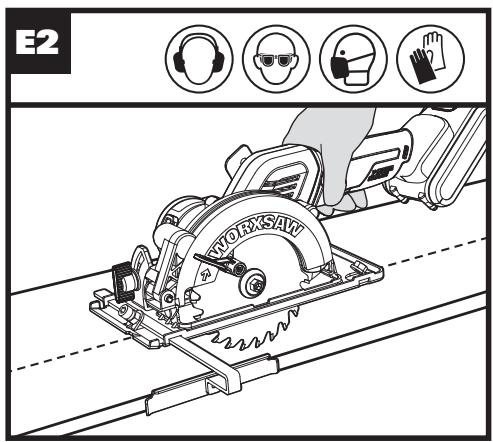
| 8. | PARALLEL GUIDE |
| 9. | CUTTING MARK, 0° |
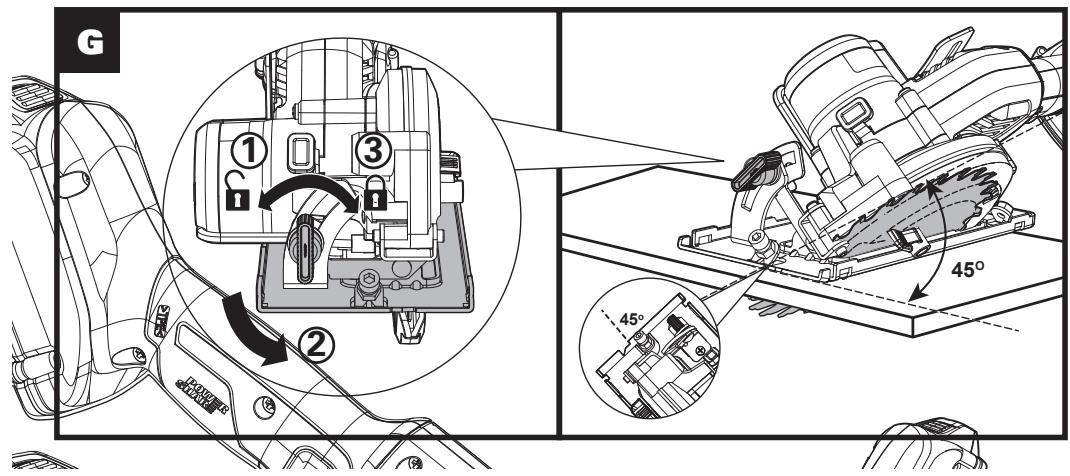
| 10. | CUTTING MARK, 45° |
| 11. | PARALLEL GUIDE CLAMPING FIXTURE |
| 12. | BEVEL ADJUSTMENT LEVER |
| 13. | DUST EXTRACTION OUTLET |
| 14. | VACUUM ADAPTER |
| 15. | FIXED UPPER BLADE GUARD |
| 16. | SPINDLE LOCK BUTTON |
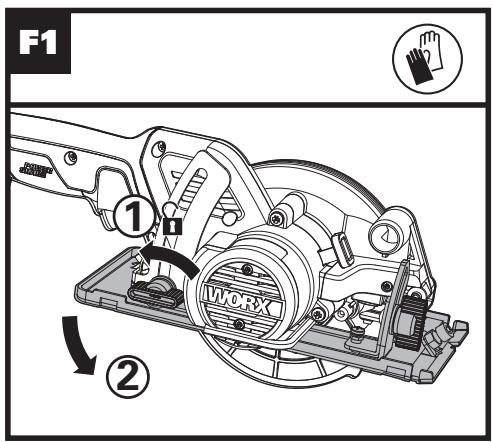
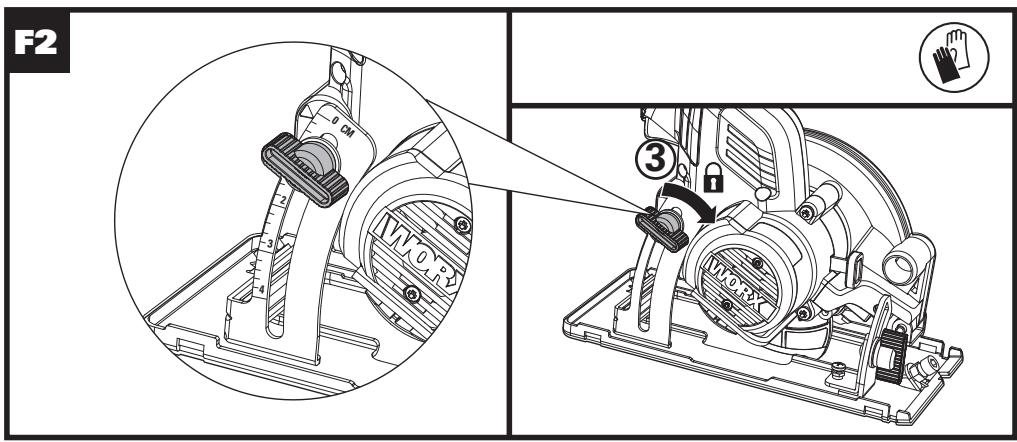
| 17. | DEPTH ADJUSTMENT LEVER |
| 18. | BLADE BOLT |
| 19. | OUTER FLANGE |
| 20. | SAW BLADE* |
| 21. | INNER FLANGE |
| 22. | BATTERY PACK* |
*Not all the accessories illustrated or described are included in standard delivery.
TECHNICAL DATA
Type WX531 WX531.X (5- designation of machinery, representative of Saw)
| WX531 WX531.X** |
| Voltage | 20V = Max*** |
| Rated speed | 6900/min |
| No load speed | 6900/min |
| Blade size | 24TTCT Blade(WA5100) | 115mm x 1.5mmx 9.5mmx 24T |
| 60T HCS Blade(WA8302) | 115mm x 1.2mm x 9.5mm x60T |
| Abrasive cutting disc (WA5048) | 115mm x 1.6mm x 9.5mm x60 G |
| Cutting capacity | Cutting Depth at 90° | 41mm |
| Cutting Depth at 45° | 29.5mm |
| Bevel capacity | 0-46° |
| Machine weight (Bare tool) | 1.71kg |
** X=1-999, A-Z, M1-M9 there are only used for different customers, there are no safe relevant changes between these models
***Voltage measured without workload. Initial battery voltage reaches maximum of 20 volts.
Nominal voltage is 18 volts
| Category | Type | Capacity |
| 20V Battery | WA3550 | 1.5Ah |
| WA3550.1 | 1.5Ah |
| WA3551 | 2.0Ah |
| WA3551.1 | 2.0Ah |
| WA3553 | 4.0Ah |
| 20V Charger | WA3880 | 2.0A |
| WA3760 | 0.4A |
| WA3869 | 2.0A |
We recommend that you purchase your accessories from the same store that sold you the tool. Refer to the accessory packaging for further details. Store personnel can assist you and offer advice.
| A weighted sound pressure | L_pA = 81.2dB(A) |
| A weighted sound power | L_wA = 92.2dB(A) |
| K_pA \& K_wA | 3dB(A) |
Wear ear protection
| A weighted sound pressure | L_pA = 88.5dB(A) |
| A weighted sound power | L_wA = 99.5dB(A) |
| K_pA & K_wA | 3dB(A) |
Wear ear protection
Vibration total values (triax vector sum) determined according to EN 62841:
| Vibration emission value: | Cutting wood: a_h,w = 0.469m/s^2 |
| Uncertainty K = 1.5m/s^2 |
| Cutting metal: a_h,M = 0.455m/s^2 |
| Uncertainty K = 1.5m/s^2 |
The declared vibration total value and the declared noise emission value have been measured in accordance with a standard test method and may be used for comparing one tool with another.
The declared vibration total value and the declared noise emission value may also be used in a preliminary assessment of exposure.
WARNING: The vibration and noise emissions during actual use of the power tool can differ from the declared value depending on the ways in which the tool is used especially what kind of workpiece is processed dependant on the following examples and other variations on how the tool is used:
How the tool is used and the materials being cut or drilled.
The tool being in good condition and well maintained.
The use of the correct accessory for the tool and ensuring it is sharp and in good condition. The tightness of the grip on the handles and if any anti vibration and noise accessories are used. And the tool is being used as intended by its design and these instructions.
WARNING: To be accurate, an estimation of exposure level in the actual conditions of use should also take account of all parts of the operating cycle such as the times when the tool is switched off and when it is running idle but not actually doing the job. This may significantly reduce the exposure level over the total working period.
Helping to minimise your vibration and noise exposure risk.
Always use sharp chisels, drills and blades.
Maintain this tool in accordance with these instructions and keep well lubricated (where appropriate).
If the tool is to be used regularly then invest in anti vibration and noise accessories.
Plan your work schedule to spread any high vibration tool use across a number of days.
Vibration total values (triax vector sum) determined according to EN 60745:
| Vibration emission value: | Cutting tile: a_h=0.466m/s^2 |
| Uncertainty K = 1.5m/s2 |
The declared vibration total value may be used for comparing one tool with another, and may also be used in a preliminary assessment of exposure.
WARNING: The vibration emission value during actual use of the power tool can differ from the declared value depending on the ways in which the tool is used dependant on the following examples and other variations on how the tool is used:
How the tool is used and the materials being cut or drilled.
The tool being in good condition and well maintained
Using the correct accessory for the tool and ensuring it is sharp and in good condition.
The tightness of the grip on the handles and if any anti vibration accessories are used.
And the tool is being used as intended by its design and these instructions.
This tool may cause hand-arm vibration syndrome if its use is not adequately managed
WARNING: To be accurate, an estimation of exposure level in the actual conditions of use should also take account of all parts of the operating cycle such as the times when the tool is switched off and when it is running idle but not actually doing the job. This may significantly reduce the exposure level over the total working period.
Helping to minimise your vibration exposure risk.
ALWAYS use sharp chisels, drills and blades
Maintain this tool in accordance with these instructions and keep well lubricated (where appropriate)
If the tool is to be used regularly then invest in anti vibration accessories.
Plan your work schedule to spread any high vibration tool use across a number of days.
OPERATING INSTRUCTIONS

NOTE: Before using the tool, read the instruction book carefully.
WARNING: Do not release the handle until the saw blade come to complete stop and do not touch saw blade while the saw blade is running.
Intended use: The tool is intended for ripping and cross-cutting wood and other materials in straight cutting lines, while resting firmly on the work piece.
ASSEMBLY AND OPERATION
| ACTION | FIGURE |
| BEFORE OPERATION | |
| Removing the battery pack | See Fig. A1 |
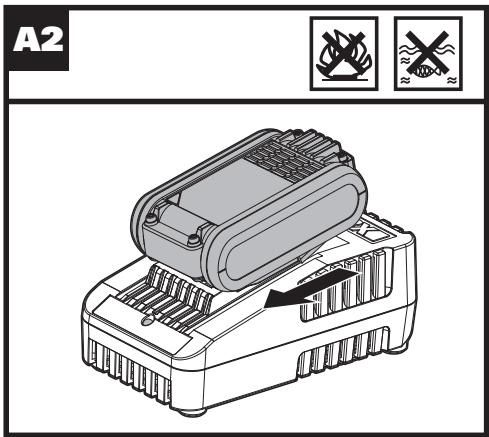
| Charging the battery | See Fig. A2 |
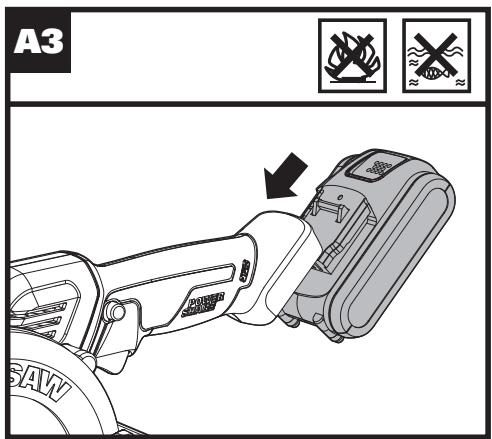
| Installing the battery pack | See Fig. A3 |
| ASSEMBLY | |
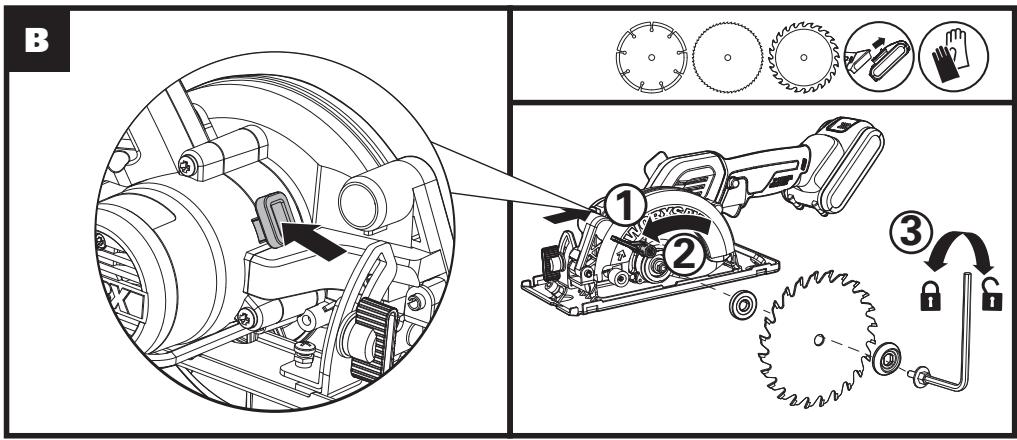
| Mounting and Removing the BladeNOTE: Lock or loose the blade bolt, the spindle lock button should be pressed.WARNING: Always remove the battery before changing the blade! | See Fig. B |
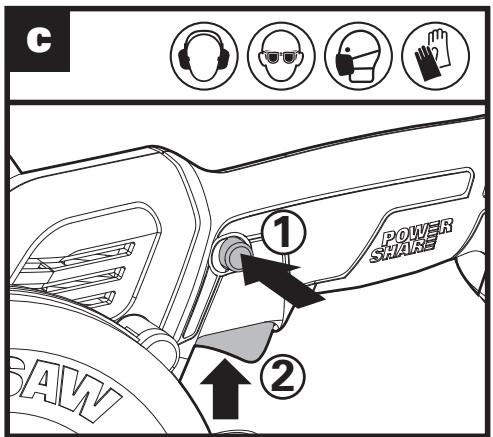
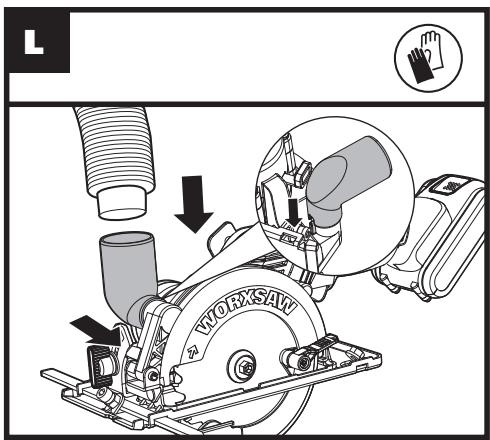
| Safety switch and On/Off triggerWARNING: To avoid cutting injury from the sharp blade, please don’t put your hands around the Base Plate.NOTE: Keep the dust adapter connected to dust collecting device when using the tool. | See Fig. C |
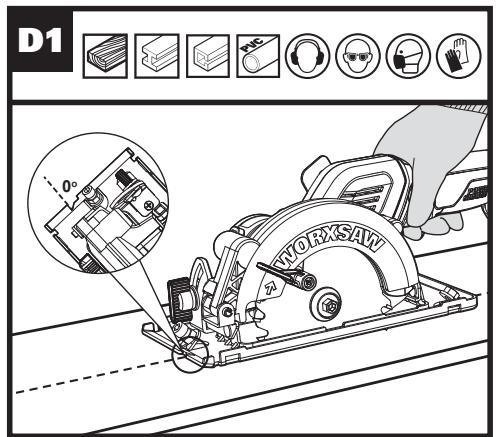
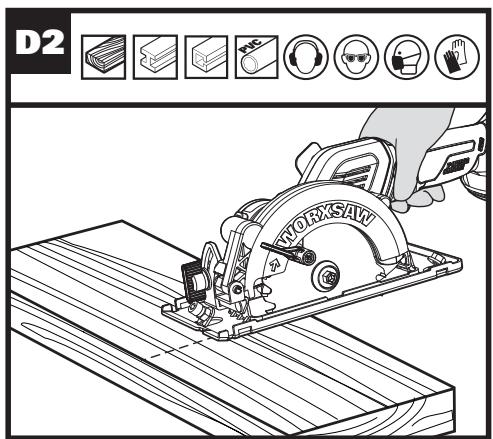
| Rip and Cross CuttingNOTE: The cutting line of saw blade is aligned with the cutting mark 0°. | See Fig. D1, D2 |
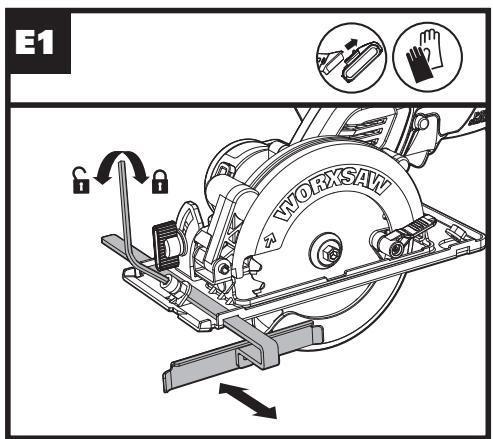
| Parallel Guide | See Fig. E1, E2 |
| Adjusting the Cutting Depth | See Fig. F1, F2 |
| Adjusting the Cutting AngleNOTE: The cutting line of saw blade is aligned with the cutting mark 45°. | See Fig. G |
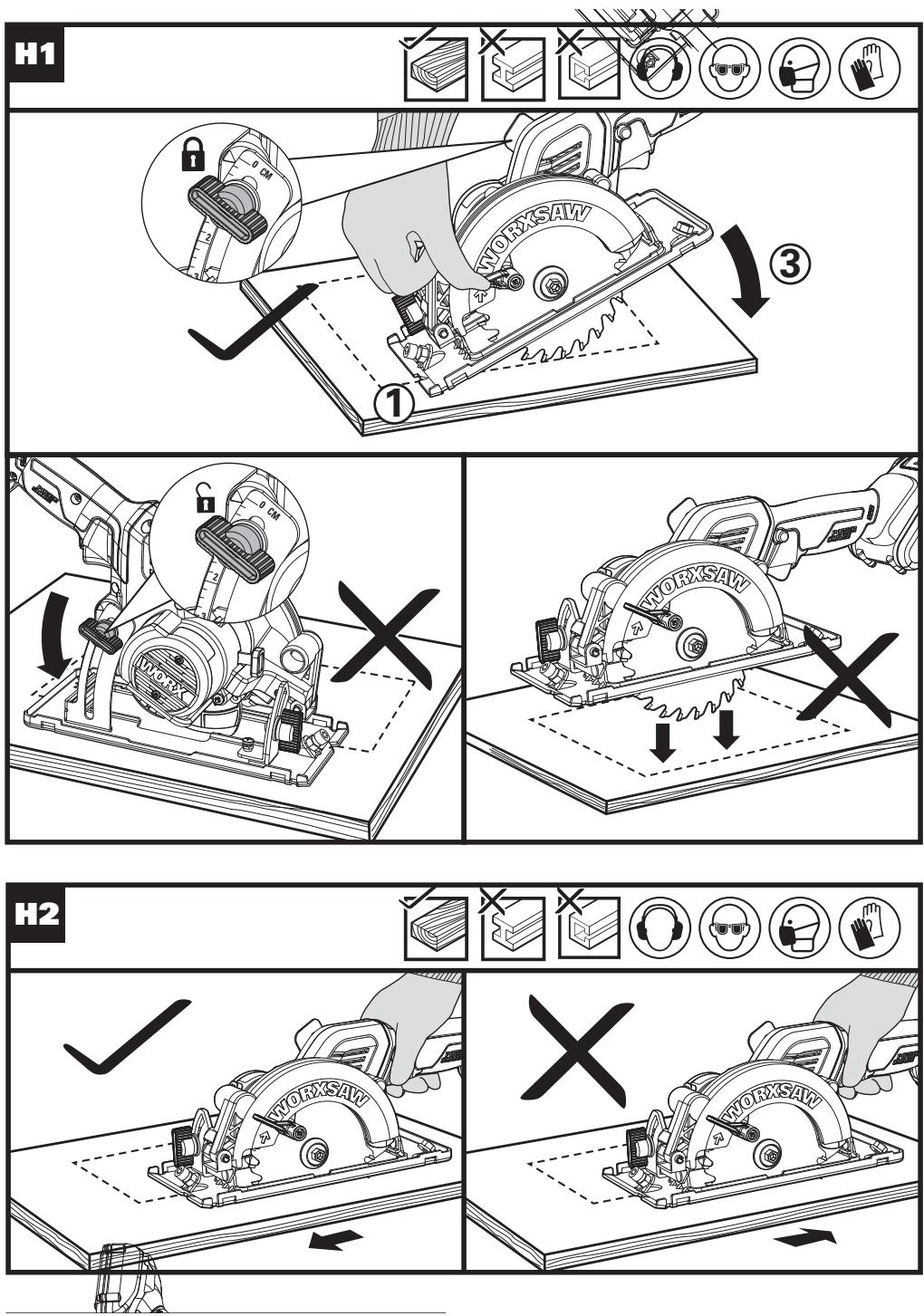
| Pocket /Plunge | See Fig. H1, H2 |
| Sawdust Removal | See Fig. I |
If your power tool becomes too hot, please run your circular saw no load for 2-3 minutes to cool the motor. Avoid prolonged usage at very low speeds. Protect saw blades against impact and shock. Cutting with extreme force can significantly reduce the performance capability of the tool and reduces the service life of the saw blade. Sawing performance and cutting quality depend essentially on the condition and the tooth count of the saw blade. Therefore, use only sharp saw blades that are suited for the material being cut.
Choice of blades: 24 teeth for general work, approx. 40 teeth for finer cuts, more than 40 teeth for very fine cuts into delicate surfaces, diamond for tile, cement board, etc.
Only use saw blades recommended.
MAINTAIN TOOLS WITH CARE
Remove the battery before carrying out any adjustment, servicing or maintenance.
Keep tools sharp and clean for better and safer performance. Follow instructions for lubricating and changing accessories. Inspect tool cords periodically and if damaged, have repaired by authorized service facility. Your power tool requires no additional lubrication or maintenance. There are no user
serviceable parts in your power tool. Never use water or chemical cleaners to clean your power tool. Wipe clean with a dry cloth. Always store your power tool in a dry place. Keep the motor ventilation slots clean. Keep all working controls free of dust.
Periodically clear dust and chips from guard and base to ensure proper performance.
TROUBLE SHOOTING
| Symptom | Possible Causes | Possible Solution |
| Tool will not start when operating the on/off trigger. | Battery park not plugged in.Battery park is powered off.Carbon brush has worn down | Check to make sure battery park is connected well into a working outlet.Charging the battery.Replace the carbon brush using a qualified maintenance person. |
| Cutting depth is less than that is set. | Sawdust accumulated at the rear of the base. | Shake out sawdust. Consider connecting a vacuum for dust collection. |
| Blade spins or slips | Blade is not tightly engaged with the spindle. | Remove the blade and reassemble it as described inMounting andRemoving the Bladesection. |
| Blade will not cut a straight line. | Blade is dull.Blade is not mounted properly.Saw is not being guided properly. | Mount a new, sharp blade on the saw.Check that blade is properly mounted.Use a parallel guide. |
| Blade kicks back when beginning a cut | Saw blade teeth may be engaged in the material when starting.Blade is not spinning fast enough | Before restarting a saw in the workpiece, center the saw blade in the kerf and check that the saw teeth are not engaged into the material.Allow the saw blade to reach full speed prior to beginning a cut in the material. |
The ambient temperature range for the use and storage of tool and battery is 0^ C- 45^ C.
The recommended ambient temperature range for the charging system during charging is 0^ C- 40^ C.
ENVIRONMENTAL PROTECTION

Waste electrical products must not be disposed of with household waste. Please recycle where facilities exist. Check with your local authorities or retailer for recycling advice.
We,
POSITEC Germany GmbH
Grüner Weg 10, 50825 Cologne, Germany
Declare that the product, Description Battery-powered circular saw Type WX531 WX531.X (5- designation of machinery, representative of Saw) Function Cutting various materials with a rotating toothed blade
Complies with the following directives,
2006/42/EC
2014/30/EU
2011/65/EU&(EU)2015/863
Standards conform to
EN 62841-1
EN 62841-2-5
EN 55014-1
EN 55014-2
EN 60745-1
EN 60745-2-22
EN 61000-3-2
EN 61000-3-3
The person authorized to compile the technical file,
Name Marcel Filz
Address Positec Germany GmbH
Grüner Weg 10, 50825 Cologne, Germany
CE
2019/11/26
Allen Ding
Deputy Chief Engineer, Testing & Certification
Positec Technology (China) Co., Ltd
18, Dongwang Road, Suzhou Industrial Park, Jiangsu 215123, P. R. China
Type WX531 WX531.X (5- designation of machinery, representative of Saw)
18, Dongwang Road, Suzhou Industrial
Park, Jiangsu 215123, P. R. China
SÉCURITÉ DU PRODUIT AVERTISSEMENTS DE SECURITE GENERAUX POUR L'OUTIL

Nous,
Positec Germany GmbH
Grüner Weg 10, 50825 Cologne, Germany
18, Dongwang Road, Suzhou Industrial
Park, Jiangsu 215123, P. R. China
PRODUCTVEILIGHEID ALGEMENE VEILIGHEIDSW- AARSCHUWINGEN VOOR VERMOGENSMACHINE

WAARSCHUWING Lees alle
TIPS VOOR HET WERKEN MET UW APPARAAT
18, Dongwang Road, Suzhou Industrial
Park, Jiangsu 215123, P. R. China
BEZPIECZEŃSTWO PRODUKTU OGÓLNE OSTRZEŻENIA DOTYCZĄCE BEZPIECZEŃSTWA PODCZAS PRACY Z ELEKTRONARZĘDZIAMI

18, Dongwang Road, Suzhou Industrial
Park, Jiangsu 215123, P. R. China
TERMÉKBIZTONSÁG ELEKTROMOS KÉZISZERSZÁMOK BIZTONSÁGOS HASZNÁLATÁVAL KAPCSOLATOS ÁLTALÁNOS FIGYELMEZTETÉSEK
18, Dongwang Road, Suzhou Industrial
Park, Jiangsu 215123, P. R. China
SECURITATEA PRODUSULUI AVERTISMENTE GENERALE DE SIGURANTĂ PENTRU UNELTE ELECTRICE

Park, Jiangsu 215123, P. R. China
Subsemnații,
Positec Germany GmbH
Grüner Weg 10, 50825 Cologne, Germany
18, Dongwang Road, Suzhou Industrial
BEZPEČNOST VÝROBKU OBECNÁ BEZPEČNOSTNÍ UPOZORNĚNÍ PRO ELEKTRICKÉ NÁSTROJE
18, Dongwang Road, Suzhou Industrial
Park, Jiangsu 215123, P. R. China
BEZPEČNOST VÝROBKU VŠEOBECNÉ BEZPEČNOSTNÉ UPOZORNENIA
TECHNICKÉ ÚDAJE
Typ WX531 WX531.X (5- designation of machinery, representative of Saw)
18, Dongwang Road, Suzhou Industrial
Park, Jiangsu 215123, P. R. China
SEGURANÇA DO PRODUTO AVISOS GERAIS DE SEGURANÇA DE FERRAMENTAS ELÉCTRICAS

Nós,
Positec Germany GmbH
Grüner Weg 10, 50825 Cologne, Germany
2019/11/26
Allen Ding
Engenheiro-chefe adjunto,
Teste e Certificação
Positec Technology (China) Co., Ltd
18, Dongwang Road, Suzhou Industrial Park, Jiangsu 215123, P. R. China
PRODUKTSÄKERHET GENERELLA SÄKERHETSVARNINGAR FÖR ELVERKTYG

18, Dongwang Road, Suzhou Industrial
Park, Jiangsu 215123, P. R. China
VARNOST IZDELKA SPLOŠNA VARNOSTNA OPOZORILA

18, Dongwang Road, Suzhou Industrial
Park, Jiangsu 215123, P. R. China
WORX
you've got the power
www.worx.com
Copyright © 2019, Positec. All Rights Reserved.
AR01480300