CV-315 - Exercise bike CARE FITNESS - Free user manual and instructions
Find the device manual for free CV-315 CARE FITNESS in PDF.


| Product type | Exercise bike |
| Brand | CARE FITNESS |
| Model | CV-315 |
| Estimated dimensions (L x W x H) | 100 x 50 x 120 cm |
| Estimated weight | 25 kg |
| Power supply | 2 AA 1.5 V batteries |
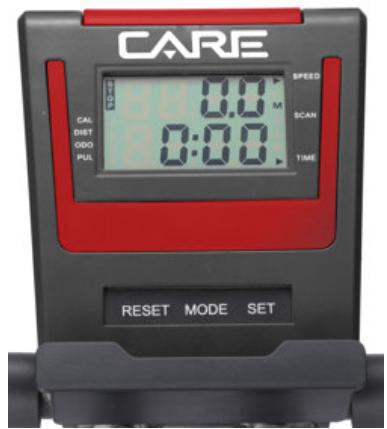
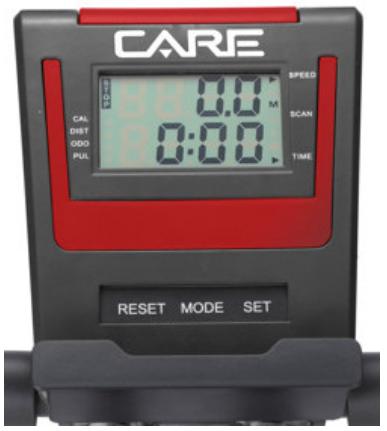
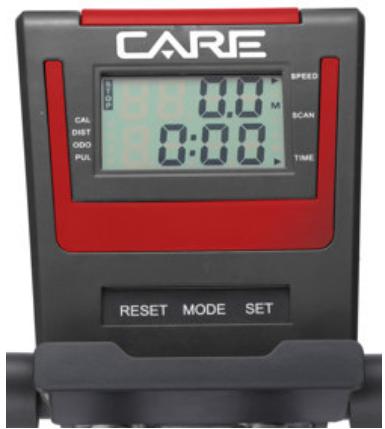
| Display | Digital screen with functions SCAN, TIME, SPEED, DISTANCE, ODO, PULSE, CALORIES |
| Time range | 0:00 to 99:59 minutes |
| Heart rate sensor | Hand grip pulse sensors |
| Auto power-off | After approx. 4 minutes of inactivity |
| Reset | Press RESET for 3 seconds or remove batteries |
| Maintenance and cleaning | Clean with a soft dry cloth. Lubricate moving parts periodically. |
| Intended use | Cardio training, weight loss, endurance |
| Spare parts | Available via after-sales service with product reference and manufacturing number |
| After-sales service | Contact Monday to Friday 10am-12pm and 2pm-5pm |
| Warranty | Legal warranty of conformity (not specified in the manual) |
Frequently Asked Questions - CV-315 CARE FITNESS
User questions about CV-315 CARE FITNESS
0 question about this device. Answer the ones you know or ask your own.
Ask a new question about this device
Download the instructions for your Exercise bike in PDF format for free! Find your manual CV-315 - CARE FITNESS and take your electronic device back in hand. On this page are published all the documents necessary for the use of your device. CV-315 by CARE FITNESS.
USER MANUAL CV-315 CARE FITNESS
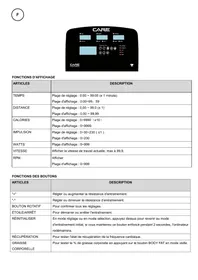
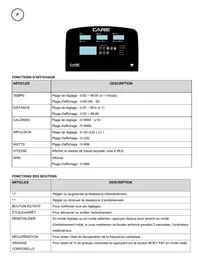
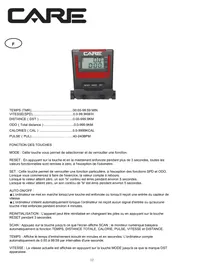
TEMPS (TMR). 00:00-99:59 MIN
VITESSE(SPD). 0.0-99.9KM/H
DISTANCE (DST) . 0.00-999.9KM
ODO (Total distance) . 0.0-999.9KM
CALORIES (CAL) . 0.0-9999KCAL
PULSE (PUL) . 40-240BPM
https://www.carefitness.com/sav
TIME(TMR) 00:00-99:59 MIN
SPEED(SPD). 0.0-99.9KM/H
DISTANCE (DST) .00-999.9KM
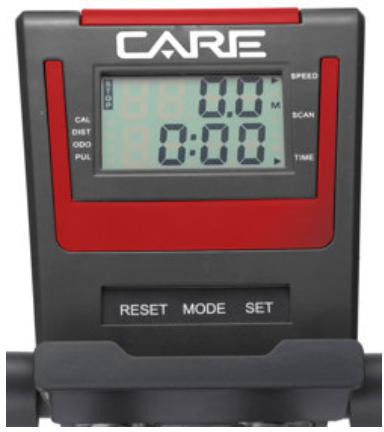
MODE: This key allows you to select and lock a function.
RESET: Pressing and holding for more than 3 seconds resets all functional values except the odometer.
SET: This key is used to lock a particular function, with the exception of the SPD and ODO functions.
When you start exercising, the value counts down.
When the value reaches zero, a continuous 'bi' sound is emitted for about 5 seconds.
When the value reaches zero, a continuous 'bi' sound is emitted for about 5 seconds.
AUTO ON/OFF:
The computer switches on when a key is pressed or when it receives an input from the speed sensor.
The computer will automatically turn off when no input is received or when no key is pressed for approximately 4 minutes.
RESET: The device can be reset by changing the batteries or by pressing the RESET key for 3 seconds.
SCAN: Press the button until the display shows SCAN; the digital monitor will automatically scan the TIME, TOTAL DISTANCE, CALORIE, PULSE, SPEED and DISTANCE functions.
TIME: Displays the elapsed training time in minutes and seconds. The computer automatically counts down from 0:00 to 99:59 in one-second intervals.
SPEED: The current speed is displayed by pressing the MODE button until the DST mark appears.
DISTANCE: Displays the cumulative distance covered during each training session.
ODO: Displays the total cumulative distance covered during each training session. The TOTAL DISTANCE data values cannot be reset by pressing and holding the button for more than 2~3 seconds. If the user removes the batteries from the computer, the TOTAL DISTANCE data will be reset to zero.
PULSE: Displays your pulse in beats per minute after holding both hands on the handlebar grip sensors during exercise. For a more accurate pulse display, always hold the handlebar grip sensors with both hands instead of one.
CALORIES: The computer measures the cumulative calories burned at any point during the workout.
Heart rate
The heart rate function is provided by the heart rate sensors on the handlebars.
To obtain the pulse function, you must place both hands on the heart rate sensors on the handlebars. It is also essential to connect the Hand Grip Puls plug to the underside of the computer.
The heart rate values recorded by the handlebar sensors may vary considerably from one person to another due to the shape of the hands and the pressure exerted by them on the sensors. Heart rate readings must not be used for therapeutic purposes.
BATTERIES 2 PCS 1.5V
Cardio - Training:
Before programming your training, it is essential to take account of your age, particularly for people of more than 35 years of age, as well as your physical condition. If you have a sedentary lifestyle without regular physical activity, it is vital that you consult your doctor to determine the level of intensity of your training. Once determined, do not attempt to achieve your maximum during the first training sessions. Be patient; your performance will quickly improve.
Cardio - Training:
This enables you to develop your cardiovascular system (fitness of the heart / blood vessels). During Cardio-Training, the muscles need a supply of oxygen and nutritive substances. They also need to eliminate waste. Our heart increases its rhythm and sends a larger amount of oxygen to the body by means of the cardiovascular system. The more often you exercise regularly and repetitively, the more your heart will develop, just like any other muscle. In daily life, this translates into the ability to bear greater physical effort and improve your intellectual faculties.
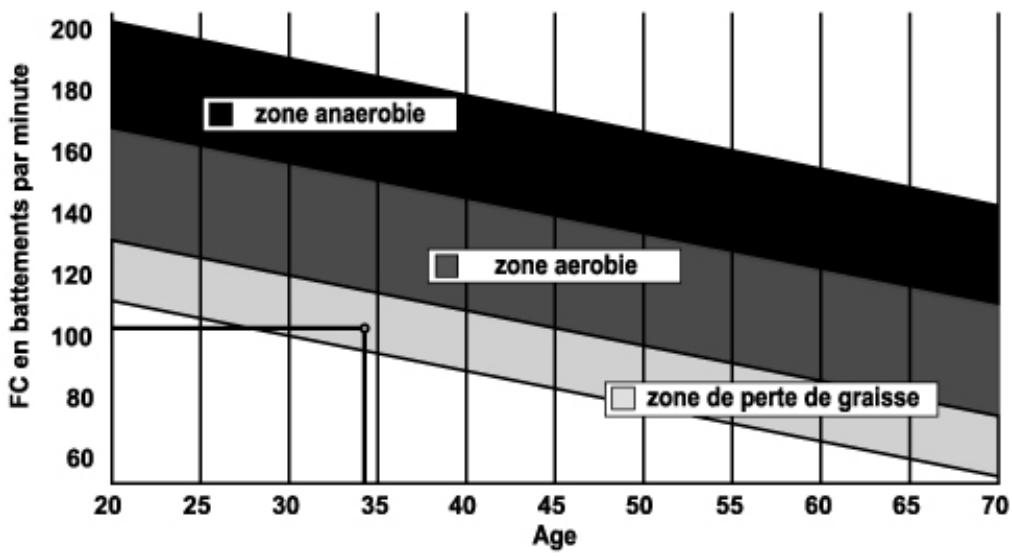
Definition of your work Zone:
The Maximum Heart Rate (MHR) = 220 - age (180 - age for sedentary people).
The Warming Up Zone and Cooling Down Zone are equal to 55% of your MHR.
The Fat Loss Zone is between 55 / 65% of your MHR.
The Aerobic Zone is between 65 / 85% of your MHR.
The Anaerobic Zone is between 85% of your MHR and your MHR.
Make a diagram of the target zones
The progressive training stages:
1) A warming up phase:
Start each training session by warming up progressively (10-20 min, more if you are over 50) which will put your muscles on standby and gently increase your heart rate. Gently increase your pulse to 55% of your MHR (Maximum Heart Rate).
Keep your Heart Rate at this level for the duration of the warming up time. If you begin your training too quickly, you are in danger of increasing the risk of tendon or muscle injury.
2) A work phase:
This is the main part of the training session. Depending on your specific goals and your initial physical condition, weight loss, improvement of cardiovascular resistance (aerobic work), development of stamina (anaerobic work), it is possible to choose the appropriate target zone.
The Fat Loss Zone, 55 - 65%
The heart rate must be low and the duration of the exercise quite long. This zone is advised for people resuming physical activity after a long period of idleness, who are trying to eliminate excess weight or are susceptible to cardiac problems. Do not forget that for this type of training the duration of the exercise must be at least 30 minutes and the Heart Rate (HR) between 55 and 65% of the MHR.
Gradually increase from 30 to 60 minutes per session.
Exercise 3 or 4 times a week.
The Aerobic Zone, 65-85%
This zone is recommended for those who are in good physical condition who train regularly. By training in this zone, you will improve your physical condition but avoid overworking.
Duration: 20 to 30 minutes per session.
- Frequency: At least 3 or 4 times a week.
The Anaerobic Zone, 85% - MHR
This zone is exclusively for experienced athletes and is never recommended without medical approval and supervision. This zone is designed only for very fit people. It is used for interval training (or for short sprints) to help you to improve or measure your level of stamina. The time spent in this zone must be brief to avoid the risk of accident.
3) A cooling down phase:
This entails a reduction of exertion (10 to 20 min). It enables you to return your cardiovascular system to normal (55% of your MHR) and prevent or reduce muscular pain such as cramp and stiffness. You must follow the training with a session of stretching exercises while your joints are still warm. This relaxes the muscles and
helps to prevent stiffness. Stretch slowly and gently. You must never stretch until you reach the pain threshold. Hold each stretch for 30 to 60 seconds while breathing out.
Check your progress
As it improves, your cardiovascular system will have an HR which will be lower when at rest. You will take longer to reach your target zone and it will be easier for you to maintain it. Sessions will seem easier and easier and you will have more stamina in your daily life.
If, on the other hand, your HR is higher than usual when at rest, you will have to rest or reduce the intensity of your training.
Do not be discouraged by the initial sessions. Motivate yourself by scheduling specific training times. Work hard!
All defective materials or parts can only be exchanged once we have received them. Shipping is at the sender's expense. No returns of goods will be accepted without our prior approval.
To order spare parts
To guarantee an efficient service, make sure you have the following items before you contact our After Sales Service:
The name or reference of the product.
The manufacturing number shown on the main chassis and on the packing box.
The number of the missing or faulty part shown on the exploded view of the product described in this manual.
After Sales Service Email: service-uk@carefitness.com
ODO(Total distance) .0.0-999.9KM
CALORIES (CAL) .0.0-9999KCAL
PULSE (PUL). 40-240BPM
FUNKTION DER TASTEN :
E mail : service-de@carefitness.com
TIEMPO(TMR). 00:00-99:59 MIN
VELOCIDAD(SPD). 0.0-99.9KM/H
E-mail: service-it@carefitness.com
NL
TIJD(TMR). 00:00-99:59 MIN
SNELHEID(SPD). 0.0-99.9KM/H
AFSTAND) .00-999.9KM
De harttraining (cardiotraining):
Dagelijke training = circa 10 minutes per keer.
2 tot 3 trainingen per week = circa 30 minutes per keer.
1 tot 2 trainingen per week = circa 50 minutes per keer.
E-mail: service-nl@carefitness.com