
PT 40 - Wireless Microphone System AKG - Free user manual and instructions
Find the device manual for free PT 40 AKG in PDF.


| Product Type | Wireless Microphone System (Bodypack Transmitter) |
| Brand | AKG |
| Model | PT 40 |
| Dimensions (l x w x h) | 64 x 22 x 96 mm |
| Net Weight | 76 g |
| Power Supply | 2 AA 1.5 V batteries |
| Typical Battery Life | > 30 hours |
| Carrier Frequency Range | 710 - 865 MHz (UHF) |
| Modulation | FM |
| Audio Bandwidth | 40 - 20,000 Hz |
| RF Output Power | 5 mW |
| Signal-to-Noise Ratio | 103 dB (A) |
| Typical Distortion | 0.8% (1 kHz) |
| Audio Input | 3-pin miniature XLR (mic or line) |
| MIC/LINE Switch | Yes, slider on back |
| GAIN Adjustment | Yes, accessible trimmer |
| On/Off Switch | 3 positions: ON, MUTE, OFF |
| Battery Indicator | LED: short flash = good, steady = 50 min remaining |
| Antenna | Built-in flexible antenna |
| Belt Clip | Yes, on back |
| Included Accessories | 1 PT 40 transmitter, 2 AA batteries |
| Optional Accessories | CB 40 pouch, MKG/L guitar cable |
| Compatible Microphones | AKG MicroMic series (C 417 L, etc.) and others with adapter |
| Cleaning | With a cloth dampened with water |
| Safety | Avoid sun, dust, humidity, vibrations; recycle batteries |
| Compliance | EN60065, EN301 489-9, EN300 422-2 |
Frequently Asked Questions - PT 40 AKG
User questions about PT 40 AKG
0 question about this device. Answer the ones you know or ask your own.
Ask a new question about this device
Download the instructions for your Wireless Microphone System in PDF format for free! Find your manual PT 40 - AKG and take your electronic device back in hand. On this page are published all the documents necessary for the use of your device. PT 40 by AKG.
USER MANUAL PT 40 AKG
wireless microphone system
bodypack transmitter
User Instructions. p. 10
Please read the manual before using the equipment!
This equipment has been tested and found to comply with the limits for a Class B digital device, pursuant to Parts 74, 15, and 90 of the FCC Rules. These limits are designed to provide reasonable protection against harmful interference in a residential installation. This equipment generates, uses, and can radiate radio frequency energy and, if not installed and used in accordance with the instructions, may cause harmful interference to radio communications. However, there is no guarantee that interference will not occur in a particular installation. If this equipment does cause harmful interference to radio or television reception, which can be determined by turning the equipment off and on, the user is encouraged to try to correct the interference by one or more of the following measures:
Reorient or relocate the receiving antenna.
- Increase the separation between the equipment and the receiver.
- Connect the equipment into an outlet on a circuit different from that to which the receiver is connected.
- Consult the dealer or an experienced radio/TV technician for help.
Shielded cables and I/O cords must be used for this equipment to comply with the relevant FCC regulations.
Changes or modifications not expressly approved in writing by AKG Acoustics may void the user's authority to operate this equipment.
This device complies with Part 15 of the FCC Rules. Operation is subject to the following two conditions: (1) this device may not cause harmful interference, and (2) this device must accept any interference received, including interference that may cause undesired operation.

1 Safety and Environment
1.1 Safety
- Do not expose the equipment to direct sunlight, excessive dust, moisture, rain, mechanical vibrations, or shock.
1.2 Environment
- Be sure to dispose of used batteries as required by local waste disposal rules. Never throw batteries into a fire (risk of explosion) or garbage bin.
- When scrapping the equipment, remove the batteries, separate the case, circuit boards, and cables, and dispose of all components in accordance with local waste disposal rules.

2 Description
2.1 Introduction
Dear Customer:
Thank you for purchasing an AKG product. Please take a few minutes to read the instructions below carefully before operating the equipment. Please keep the Manual for future reference. Have fun and impress your audience!
2.2 Unpacking
| 1 PT 40 bodypack transmitter | 2 AA size dry batteries |
Check that the package contains all the parts listed above. If anything is missing, please contact your AKG dealer.
2.3 Optional Accessories
CB 40 bag
2.4 Description
You can use the PT 40 bodypack transmitter with both dynamic microphones and condenser microphones operating on a supply voltage of approx. 3.8V . You may also connect an electric guitar, electric bass, or remote keyboard.
The PT 40 operates on one fixed, quartz stabilized frequency in the 710 MHz to 865 MHz UHF carrier frequency range.
2.5 Top Panel Controls (Refer to fig. 1)
1 On/Off Switch: This slide switch provides three positions labeled as follows:
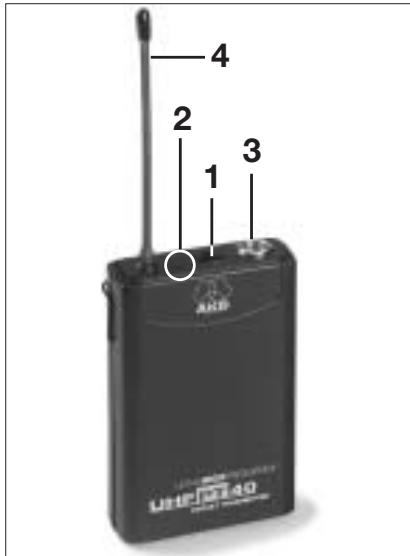
Fig. 1: Top panel controls
ON: Power to the transmitter is on. MUTE: The signal delivered by the microphone or instrument is muted while power and the RF carrier frequency remain on. This prevents the receiver from responding to interference from other transmitters.
OFF: Power to the transmitter is off.
2 Status LED: Indicates battery status. LED flashes momentarily upon switching ON and extinguishes: batteries are OK. LED lights constantly: batteries will be dead in about 50 minutes.
3 Audio input: 3-pin mini XLR connector with both mic and line level pins that automatically match the connector pinout of the recommended AKG microphones or optional MKG/L guitar cable.
4 Antenna: Permanently connected, flexible antenna.
2.6 Rear Panel Controls (Refer to fig. 2)
5 Belt Clip for fixing the transmitter to your belt.
6 Battery Compartment Lid: Refer to section 3.2 Inserting Batteries.
7 MIC/LINE: This slide switch sets the audio input either to microphone level ("MIC" position) or line level ("LINE" position).
8 GAIN: This rotary pot matches the sensitivity of the transmitter's audio section to the level of the connected microphone or instrument.
9 Carrier Frequency Label: The label on the transmitter rear panel indicates the carrier frequency, color code (receivers with the same carrier frequency are marked with the same color), and approval marks of your transmitter.
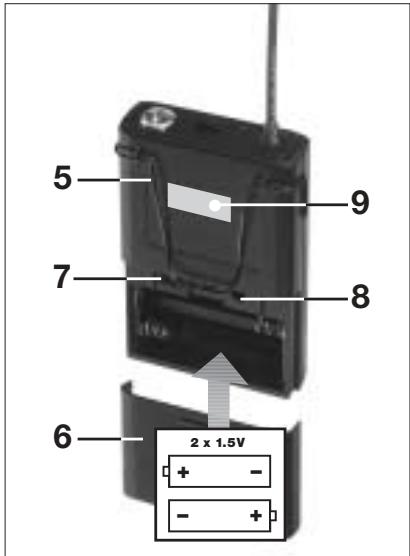
Fig. 2: Rear panel controls
2.7 Microphones, Guitar Cable
(optional)
You can connect the following microphones to the audio input of the PT 40:
| C 417 L | C 419 L | C 411 L |
| C 420 L | D 409 L | C 418 L |
| C 444 L | CK 55 L | LM 3 L |
The MKG/L guitar cable from AKG lets you connect an electric guitar, electric bass, or remote keyboard to the body-pack transmitter.
2.7 Color Code Table
| Frequency | Color | |
| US54: | 710.400 MHz | reddish brown |
| US58: | 734.600 MHz | purple |
| KR3: | 745.650 MHz | mint green |
| KR4: | 750.900 MHz | dark gray |
| EU62: | 802.525 MHz | Bordeaux red |
| EU63: | 812.800 MHz | yellow |
| UK69A: | 854.900 MHz | violet |
| Frequency | Color | |
| UK69B: | 858.200 MHz | green |
| ISM1: | 863.100 MHz | melon yellow |
| ISM2: | 864.375 MHz | gray |

3 Setting Up
Important: Prior to setting up your WMS 40, check that the transmitter and receiver are tuned to the same frequency. The easiest way to do this is to compare the color codes on the transmitter and receiver.
3.1 Placing the Receiver
Reflections off metal parts, walls, ceilings, etc. or the shadow effects of musicians and other people may weaken or cancel the direct transmitter signal.
For best results, place the receiver as follows:
- Place the receiver near the performance area (stage). Make sure, though, that the transmitter will never get any closer to the receiver than 10 ft (3 m). Optimum separation is 16 ft. (5 m).
- Check that you can see the receiver from where you will be using the transmitter.
- Place the receiver at least 5 ft. (1.5 m) away from any big metal objects, walls, scaffolding, ceilings, etc.
3.2 Inserting and Testing Batteries (Refer to figs. 1 to 3)
Important: The foam pads on the inside of the battery compartment lid holds the batteries in place. Do not remove the foam pad. If you do, the batteries will not be held in place properly and may cause a rattling noise.
- Depress the snap hook on the battery compartment lid (6).
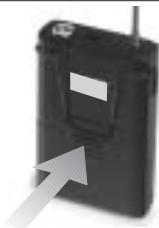
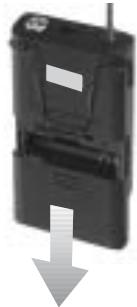
Fig. 3: Inserting batteries
- Pull the battery compartment lid (6) down to remove it from the transmitter.
- Insert the supplied batteries into the battery compartment conforming to the polarity marks.
The transmitter will not function with incorrectly inserted batteries.
- Set the on/off switch (1) to "ON" to switch the power to the transmitter on. The status LED (2) will flash momentarily. If the batteries are in good condition, the status LED (2) will extinguish.
If the status LED (2) illuminates the batteries will be dead within about 50 minutes. Replace the batteries with new ones as soon as possible.
If the status LED (2) fails to flash momentarily the batteries are dead. Insert new batteries.
- To close the battery compartment, slide the battery compartment
lid (6) onto the battery compartment from below to the point that it will click shut.
3.3 Setting Up the Transmitter
3.3.1 Connecting a Microphone
The PT 40 bodypack transmitter has been designed primarily for use with "L" type MicroMic Series microphones from AKG (see section 2.7). If you wish to connect other microphones from AKG or other manufacturers to the PT 40, please note that you may have to rewire the existing connector of your microphone or replace it with a 3-pin mini XLR connector.
Audio input pinout:
Pin 1: shield
Pin 2:audio (inphase)
Pin 3: supply voltage
A positive supply voltage of 3.8V for condenser microphones is available on pin 3.
Important: Please note that AKG cannot guarantee that the PT 40 bodypack transmitter will work perfectly with products from other manufacturers and any damage that may result from such use is not covered by the AKG warranty scheme.
- Remove the battery compartment lid.
- Set the MIC/LINE switch (7) to "MIC" and use a small screwdriver to set the GAIN control (8) to a position halfway between full CCW and full CW.
- Plug the mini XLR connector on the cable of your microphone into the audio input connector (3) on the bodypack transmitter.
-
Set the on/off switch (1) to "ON" to switch power to the transmitter on.
-
Switch power to the receiver and your sound system or amplifier on. Check the setting of the VOLUME control on the receiver:
Fully CCW if you connected the receiver to a microphone input.
Fully CW if you connected the receiver to a line input.
- Talk or sing into the microphone and set the levels on your mixer or amplifier referring to the appropriate instruction manual or by ear.
3.3.2 Connecting an Instrument (fig. 4)
- Remove the battery compartment lid.
- Set the MIC/LINE switch (7) to "LINE" and use a small screwdriver to set the GAIN control (8) to a position halfway between full CCW and full CW.
- Plug the 1/4" jack plug on the optional MKG/L guitar cable to the output jack on your instrument and the mini XLR connector on the guitar cable
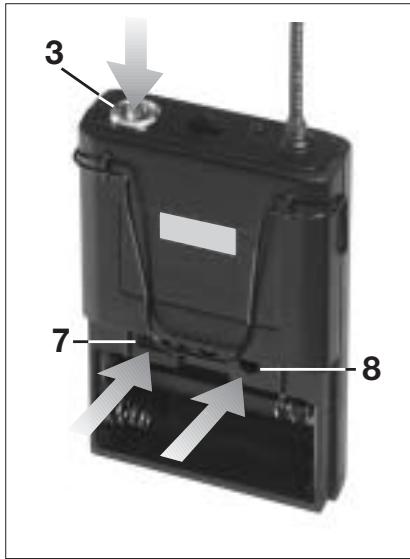
Fig. 4: Connecting an instrument
into the audio input connector (3) on the bodypack transmitter.
- Set the on/off switch (1) to "ON" to switch power to the transmitter on.
- Switch power to the receiver and your sound system or amplifier on. Check the setting of the VOLUME control on the receiver:
Fully CCW if you connected the receiver to a microphone input.
Fully CW if you connected the receiver to a line input.
- Play your instrument and set the levels on your mixer or amplifier referring to the appropriate instruction manual or by ear.
3.4 Before the Soundcheck
- Move the transmitter around the area where you will use the system to check the area for "dead spots", i.e., places where the field strength seems to drop and reception deteriorates.
If you find any dead spots, try to eliminate them by repositioning the receiver. If this does not help, avoid the dead spots.
- The RF LED on the receiver going out means no signal is being received on the squelch is active.
Switch power to the transmitter ON and/or move closer to the receiver, to the point that the RF LED on the receiver will come back on.

4 Microphone Technique
4.1 C 417 L, CK 55 L
Lavalier Microphones
- Fix the microphone to the H 40/1 lavaliier clip or H 41/1 tie pin referring to the microphone's instruction manual.
- Clamp the microphone on your clothing as close as possible to your mouth.
Remember that gain-before-feedback will be the higher the smaller the distance between the microphone and the mouth!
- Make sure to aim the microphone at your mouth.
4.2 C 420 L, C 444 L Head-worn Microphones
Refer to the user's manual of the respective microphone for instructions on how to use head-worn microphones.
4.3 Troubleshooting
For troubleshooting hints, refer to the instruction manual of your receiver.

5 Cleaning
To clean the transmitter case, use a soft cloth moistened with water.
6 Specifications
Carrier frequency range 710 to 865 MHz
Modulation FM
Audio bandwidth 40 to 20,000 Hz
Frequency stability (-10^ to +50^) ±15 kHz
Rated deviation 15 kHz (SP1, SP2: 13.5 kHz)
T.H.D. at 1 kHz 0.8% typ.
Compander integrated
Signal/noise ratio 103 dB(A) typ.
RF output 10 mW
Current consumption 70 mA typ.
Power requirement two 1.5-V AA size batteries
Battery life 30 hours typ.
Audio input level for rated deviation 300 mV (MIC); 110 mV (LINE)
Input impedance typ. 140k / / 450 pF (LINE)
Condenser mic power supply 3.8 V/4.7 kΩ (pin 3)
Size (WxDxH) 64 × 22 × 96 ~mm / (2.5 × 0.9 × 3.8 in)
Net weight 76 g (2.7 oz.)
This product complies with the following standards:
Los siguientes micrófonos de AKG seSEOSEOSEOSEOSEOSEOSEOSEOSEOSEOSEOSEOSEOSEOSEOSEOSEOSEOSEOSEOSEOSEOSEOSEOSEOSEOSEOSEOSEOSEOSEOSEOSEOSEOSEOSEOSEOSEOSEOSEOSEOSEOSEOSEOSEOSEOSEOSEOSEOSEOSEOSEOSEOSEOSEOSEOSEOSEOSEOSEOSEOSEOSEOSEOSEOSEOSEOSEOSEOSEOSEOSEOSEOSEOSEOSEOSEOSEOSEOSEOSEOSEOSEOSEOSEOSEOSEOSEOSEOSEOSEOSEOSEOSEOSEOSEOSEOSEOSEOSEO SEOEO SEOEO SEOEO SEOEO SEOEO SEOEO SEOEO SEOEO SEOEO SEOEO SEOEO SEOEO SEOEO SEOEO SEOEO SEOEO SEOEO SEOEO SEOEO SEOEO SEOEO SEOEO SEOEO SEOEO SEOEO SEOEO SEOEO SEOEO SEOEO SEOEO SEOEO SEOEO SEOEO SEOEO SEOEO SEOEO SEOEO SEOEO SEOEO SEOEO SEOEO SEOEO SEOEO SEOEO SEOEO SEOEO SEOEO SEOEO SEOEO SEOEO SEOEQ
| C 417 L | C 419 L | C 411 L |
| C 420 L | D 409 L | C 418 L |
| C 444 L | CK 55 L | LM 3 L |
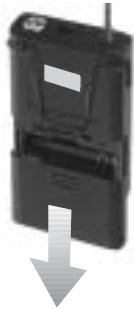
Fig. 3: Colocar as pilhas
4.3 Resolver problemas
Os avisos para resolver problemas encontrará no manual do usuario de seu receptor.

5 Limpeza
| R&TTEd Countries | ||||||||||||||||||||
| Set | MHz | AT | BE | CH | DE | DK | ES | FR | GB | GR | IE | IS | IT | LI | LU | NO | NL | PT | SE | FI |
| US54 | 710.4 | ✓ | ✓ | ✓ | ✓ | - | - | ✓ | - | - | ✓ | ✓ | ✓ | ✓ | ✓ | - | ✓ | ✓ | ✓ | - |
| US58 | 734.6 | ✓ | ✓ | ✓ | ✓ | - | - | ✓ | - | - | ✓ | ✓ | ✓ | ✓ | ✓ | - | ✓ | ✓ | ✓ | - |
| KR3 | 745.650 | - | - | ✓ | - | - | - | ✓ | - | - | - | - | - | ✓ | ✓ | - | ✓ | ✓ | ✓ | - |
| KR4 | 750.900 | - | - | ✓ | - | - | - | ✓ | - | - | - | - | - | ✓ | ✓ | - | ✓ | ✓ | ✓ | - |
| EU62 | 802.525 | - | - | ✓ | ✓ | ✓ | - | ✓ | - | - | ✓ | ✓ | ✓ | ✓ | ✓ | ✓ | - | ✓ | ✓ | ✓ |
| EU63 | 812.8 | - | - | ✓ | ✓ | ✓ | - | ✓ | - | - | ✓ | ✓ | ✓ | ✓ | ✓ | ✓ | ✓ | ✓ | ✓ | ✓ |
| UK69A | 854.9 | - | ✓ | ✓ | ✓ | - | - | - | ✓ | - | ✓ | ✓ | - | ✓ | ✓ | - | - | ✓ | ✓ | - |
| UK69B | 858.2 | - | ✓ | ✓ | ✓ | - | - | - | ✓ | - | ✓ | ✓ | - | ✓ | ✓ | - | - | ✓ | ✓ | - |
| ISM1 | 863.1 | ✓ | ✓ | ✓ | ✓ | ✓ | ✓ | ✓ | ✓ | - | ✓ | ✓ | ✓ | ✓ | ✓ | ✓ | ✓ | - | ✓ | ✓ |
| ISM2 | 864.375 | ✓ | ✓ | ✓ | ✓ | ✓ | - | ✓ | ✓ | - | ✓ | ✓ | ✓ | ✓ | ✓ | ✓ | ✓ | - | ✓ | ✓ |
AKG Acoustics GmbH hereby declares that the product WMS 40 complies with the essential requirements and other relevant provisions of Directive 1999/5/EC.
DECLARATION OF CONFORMITY
Document No.289/02-2002
replaces No. 178 / 06 - 2000
Type of Product: Wireless Microphone System, Pocket Transmitter
Brand, Model No.: PT 40
Drawing-No.: 7600 X ....
Manufacturer: AKG Acoustics GmbH A-1230 Wien, Lemböckgasse 21 - 25 AUSTRIA
We declare that the above mentioned product is in conformity with the following European Directive:
No. 99/5 EC;
Radio Equipment and
Telecommunications Terminal Equipment
The conformity is achieved by fulfilling the following European Standard(s):
EN 301489-9 v.1.1.1 (09-2000); I-ETS 300422:1995; IEC 60065:1998
Product examination was carried out by:
TÜV Product Service GmbH
Notified Body 0123
Ridlerstr. 31, 80339 München, Germany
Manufacturer's Signature:

Managing Director
Dr. Hugo Lenhard-Backhaus
This declaration certifies the accordance with the above mentioned EC-Directive but does not assure certain attributes of the product.
issued:

Mikrofone · Kopfhörer · Drahtlosmikrofone · Drahtloskopfhörer · Kopfsprechgarnituren · Akustische KomponentenMicrophones · Headphones · Wireless Microphones · Wireless Headphones · Headsets · Electroacoustical ComponentsMicrophones · Casques HiFi · Microphones sans fil · Casques sans fil · Micros-casques · Composants acoustiquesMicrofoni · Cuffie HiFi · Microfoni besoin filo · Cuffie besoin filo · Cuffie-microfono · Componenti acusticiMicrofonos · Auriculas · Micrófonos inalábricos · Auriculas inalábricos · Auriculas con micrófono · Componentes acústicosMicrofones · Fones de ouvido · Microfones s/fios · Fones de ouvido s/fios · Microfones de cabeza · Componentes acústicos
H A Harman International Company
AKG Acoustics GmbH
BodenseestraBe 228, D-81243 Munchen/GERMANY, Tel: (+49 89) 87 16-0, Fax: (+49 89) 87 16-200, www.akg-acoustics.de, e-mail: info@akg-acoustics.de
AKG ACOUSTICS, U.S.
914 Airpark Center Drive, Nashville, TN 37217, U.S.A., Tel: (+1 615) 620-3800, Fax: (+1 615) 620-3875, www.akgusa.com, e-mail: akgusa@harman.com
For other products and distributors worldwide see our website: www.akg.com
- Safety and Environment
- Safety
- Environment
- Description
- Introduction
- Optional Accessories
- Description
- Top Panel Controls (Refer to fig. 1)
- Microphones, Guitar Cable
- Color Code Table
- Setting Up
- Placing the Receiver
- Inserting and Testing Batteries (Refer to figs. 1 to 3)
- Setting Up the Transmitter
- Connecting a Microphone
- Connecting an Instrument (fig. 4)
- Before the Soundcheck
- Microphone Technique
- C 420 L, C 444 L Head-worn Microphones
- Troubleshooting
- Cleaning
- Specifications
- Resolver problemas
- Limpeza
- DECLARATION OF CONFORMITY
Brand : AKG
Model : PT 40
Category : Wireless Microphone System