
CS 1800G - Power amplifier PEAVEY - Free user manual and instructions
Find the device manual for free CS 1800G PEAVEY in PDF.


| Product Type | Power Amplifier |
| Brand | Peavey |
| Model | CS 1800G |
| Operating Class | Class BG (Dynamic Logic) |
| Power per Channel (4 ohms) | 600 W RMS |
| Power per Channel (2 ohms) | 900 W RMS |
| Bridge Power (8 ohms) | 1200 W RMS |
| Bridge Power (4 ohms) | 1800 W RMS |
| Frequency Response | 20 Hz - 20 kHz, ±0.2 dB |
| Total Harmonic Distortion | <0.04% at full power |
| Signal-to-Noise Ratio | 100 dB below full power |
| Slew Rate | 40 V/µs (stereo, per channel) |
| Minimum Load Impedance | 2 ohms per channel, 4 ohms bridged |
| Cooling | Dual-speed, automatic fan |
| Protections | Per-channel circuit breakers, thermal protection, DDT™ compression |
| Input Connectors | Female XLR and 6.35mm (1/4") jack per channel |
| Output Connectors | 6.35mm jack and 5-way binding posts per channel |
| Operating Modes | Stereo, Bridge |
| DDT™ Compressor | Built-in, enable/disable |
| Ground Lift | Rear panel switch (Lift/Ground) |
| Rack Mounting | 19 inches, 2U height (88.9 mm) |
| Power Supply | Mains, 14 AWG cord, requires 15 A minimum |
| Optional Input Transformer | PL-2 for transformer-balanced XLR input |
| Maintenance | Clean with a dry cloth; no user-serviceable parts |
Frequently Asked Questions - CS 1800G PEAVEY
User questions about CS 1800G PEAVEY
0 question about this device. Answer the ones you know or ask your own.
Ask a new question about this device
Download the instructions for your Power amplifier in PDF format for free! Find your manual CS 1800G - PEAVEY and take your electronic device back in hand. On this page are published all the documents necessary for the use of your device. CS 1800G by PEAVEY.
USER MANUAL CS 1800G PEAVEY
| A Intended to alert the user to the presence of uninsulated “dangerous voltage” within the product’s enclosure that may be of sufficient magnitude to constitute a risk of electric shock to persons. A Intended to alert the user of the presence of important operating and maintenance (servicing) instructions in the literature accompanying the product. CAUTION: Risk of electrical shock – DO NOT OPEN! CAUTION: To reduce the risk of electric shock, do not remove cover. No user serviceable parts inside. Refer servicing to qualified service personnel. |
| WARNING: To prevent electrical shock or fire hazard, do not expose this appliance to rain or moisture. Before using this appliance, read the operating guide for further warnings. |
19" rack-mountable design requiring two rack spaces
Automatic two-speed dual fan cooling system
- Separate power transformers/circuit breakers for each channel
- Independent channel thermal/fault protection
- DDT™ activation LED and power LED, each channel
- Calibrated/detented input attenuator controls, each channel
- Two recessed balanced input transformer sockets for PL-2's
- Single XLR and dual phone plug inputs, each channel
- XLR input can be transformer balanced
- Dual phone plug and 5-way binding post outputs, each channel
- Rear panel DDT™ defeat, mode select, and ground lift switches
Peavey Electronics is proud to announce the introduction of a new line of exciting Professional Power Amplifiers. The new CS-G series is the result of years of research & development into a smaller, lighter, compact and more powerful amplifier. These units operate much more efficiently than contemporary power amp designs, requiring less current from the mains power plug, producing far less heating. This new technology allows the CSTM1800G to reliably produce more than 1800 W RMS into 4 ohms (Bridge Mode) in a two rack space unit, at extremely low distortion levels.
These new designs use a new class of operation called "Class BG". This class uses two levels of power supply "rails," but switches between the rails faster and at lower distortion levels than does a typical Class G design. This unit then combines higher efficiency and lower distortion, and together with our all new Non-saturating Series Single Emitter Resistor topology (NSSER), provides awesome performance levels with full power 20kHz distortion below 0.04% , and with slew rates greater than 40V / Sec . This technology is called "Dynamic Logic" and is covered by a U.S. Patent (Pending).
The following is the new CS 1800G specs:
600 W RMS into 4 ohms; 900 W RMS into 2 ohms, per channel
1200 W RMS into 8 ohms; 1800 W RMS into 4 ohms (Bridge mode)
Slew Rate: 40 V/microsecond, stereo mode, each channel
Frequency Response: 20Hz to 20kHz , f0.2 dB, at rated power
Total Harmonic Distortion: Less than 0.04% , at rated power
Hum and Noise: 100 dB below rated power, unweighted
The unit is attractively packaged in a rugged, rack-mountable configuration requiring only two rack spaces. Naturally it has Peavey's patented DDT™ Compression Circuitry, and has a very flexible back panel. The design uses dual two speed fan cooling to provide all the cooling necessary for the two ohm load conditions.
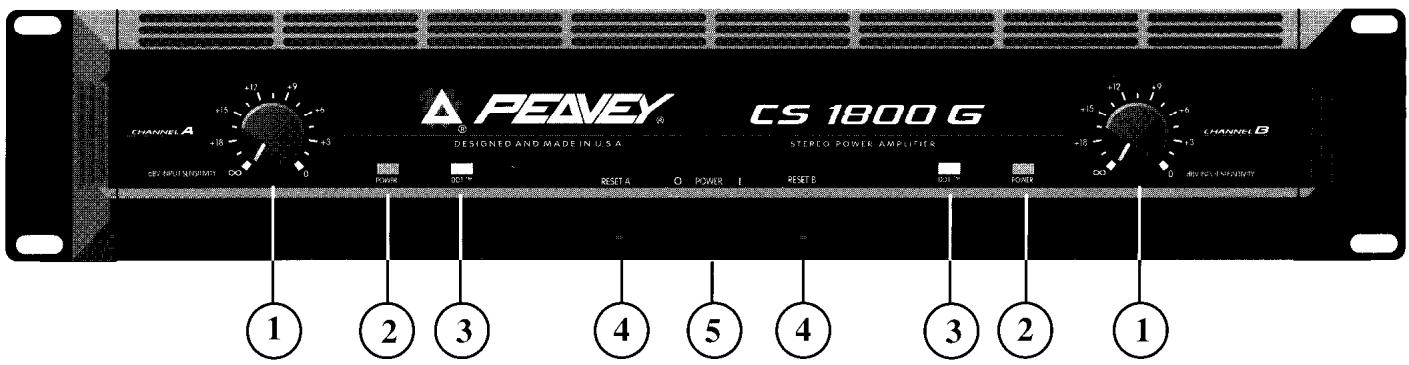
FRONT PANEL FEATURES:
CHANNELS A & B
INPUT SENSITIVITY (1)
The maximum input gain (minimum sensitivity rating) is achieved at the full clockwise setting, which yields the maximum mixer/system headroom. A setting of less than full clockwise will yield lower system noise at the expense of mixer/system headroom. Calibration indicates sensitivity in dBV necessary to attain the full available rated output power.
POWER LED (2)
Illuminates when AC power is being supplied to the amp, and the associated channel is operational. If either channel were to experience fault conditions or to exceed the safe operating temperature limits, then that channel would shut down, and the associated power LED would cease to illuminate, indicating such conditions exist. Also, whenever the Bridge mode is selected, the power LED of channel B is defeated (off), just as if there were a fault condition on channel B. This provides a positive indication that the CS 1800G is configured for bridge mode.
DDTT^TM ACTIVE LED (3)
Illuminates when DDT Compression is taking place in that channel. With the ENABLE/DEFEAT switch in the DEFEAT position, this LED indicates when clipping distortion is occurring in that channel.
CIRCUIT BREAKERS (4)
The CS 1800G uses circuit breakers in place of main fuses. These breakers are provided to limit the current to the associated power transformer for each channel, and thereby offer protection from overheating and possible destruction due to fault conditions in the amplifier. The breaker trip current value has been carefully chosen to allow continuous power output performance, yet still provide adequate protection for the power transformer. Normally, these breakers should not trip unless there is a fault in the amp circuitry that draws excessive mains current. However, abnormal conditions, such as a short circuit on either or both channels or continuous operation at overload or clipping, especially into 2 ohm load, will cause the breaker to trip. If this occurs, turn the power switch off, then simply reset the breaker and correct the cause of the overload.

When tripped, the button on the breaker will be outward nearly 1/2 and can be reset by pushing inward. A normal reset button length is about 1/4 . If this "thermal" type breaker does trip, simply pushing the button back in will reset it, after waiting a brief period of time to allow it to cool down. REMEMBER, ALWAYS TURNS THE POWER OFF BEFORE RESETTING THE BREAKER. If the breaker trips instantly each time you attempt to reset it, the unit should be taken to a qualified service center for repair.
POWER SWITCH (5)
Depress to "l" position to turn on.
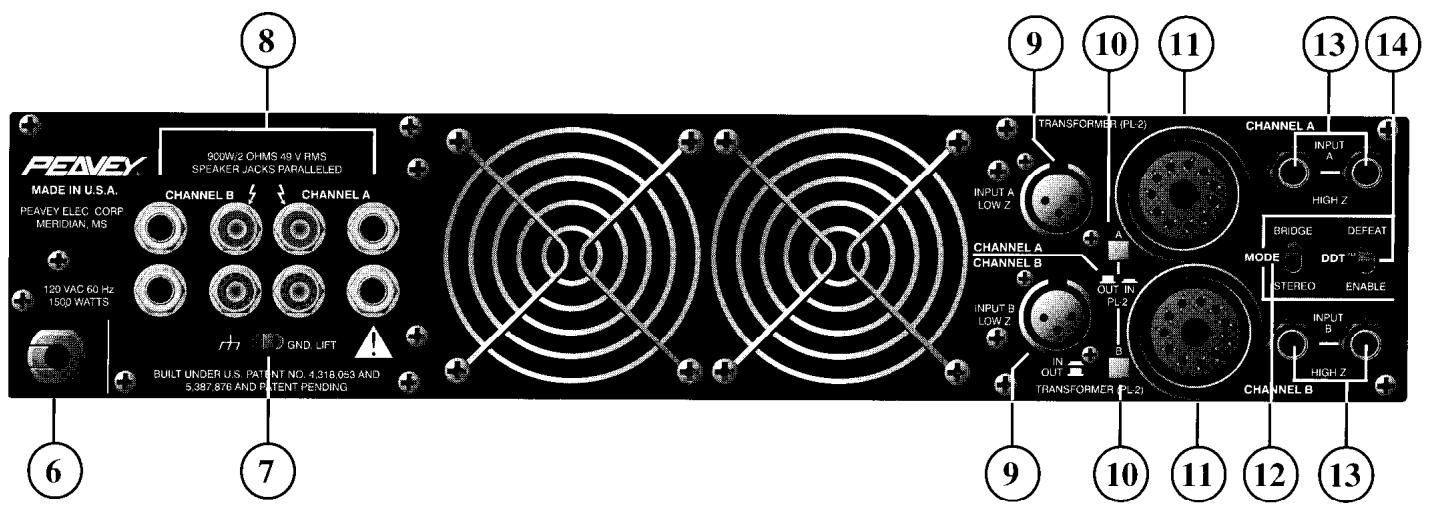
BACK PANEL FEATURES:

MAINS POWER SOURCE (6) 120 V products only
The CS 1800G is fitted with a single heavy-duty #14 AWG 3-conductor line cord and a conventional AC plug with a large ground pin. It should be connected to an independent mains circuit capable of supporting at least I.5 amps continuously or greater. This is particularly critical for sustained high power operation. If the socket used does not have a ground pin, a suitable ground lift adaptor should be used and the third wire grounded properly. Never break off the ground pin on the CS 1800G power amplifier. The use of extension cords should be avoided, but if necessary, always use a three-wire type with at least a #14 AWG wire size. The use of lighter wire will severely limit the power capability of this amplifier. Always use a qualified electrician to install any necessary electrical equipment. To prevent the risk of shock or fire hazard, always be sure that the amp is properly grounded.
GROUND LIFT SWITCH (7)
This switch is used to disconnect the CS 1800G's "signal ground" (both input and output) from the "chassis ground." Chassis ground is the chassis itself, which is electrically grounded through the rack mounting screws to the external rack system and through the mains line cord via the large ground pin to the mains ground. It is often advantageous to "lift" the signal ground from chassis ground to eliminate a "ground loop" which has caused unwanted ground current in the signal cables between the external preamp and this power amplifier. Such conditions can create excessive hum levels in the power amplifier output and render the system useless in low level applications. In this case, "lifting" the ground should solve this hum problem. Ground lift is selected when the switch is in the right or "LIFT" position. If lifting the ground does not eliminate a particular hum problem, then we recommend you defeat the ground lift feature.
NOTE: Using this ground lift feature still leaves the chassis itself grounded electrically through the mains line cord. Having the chassis grounded avoids any possibility of an electrical shock or a fire hazard. This ground lift feature should never be confused with the practice of "floating" the large ground pin at the AC mains receptacle to eliminate a ground loop. Floating the ground pin on any electrical equipment is just asking for trouble! !!
SPEAKER OUTPUTS (8)

Two each 1/4'' jacks and 5-way binding post speaker output terminals are provided. All these outputs are in parallel, hence the speaker connection cables can be terminated with 1/4'' phone plugs, banana plugs, or stripped wires for use in the binding post terminals. For sustained high power applications, the use of the binding post terminals are recommended; however, care must be exercised to assure correct speaker phasing. Regardless of what connections are used, the typical parallel speaker load should always be limited to 2 ohms per channel or 4 ohms Bridge mode for any application.
Operation at loads of 4 ohms per channel or 8 ohms Bridge mode is more desirable for sustained operation applications due to the fact that the amplifier will run much cooler at this load. Operation above 4 ohms per channel, and even open circuit conditions can always be considered safe; however, any sustained operation at loads below 2 ohms could result in temporary channel shut down due to the thermal limits and/or the amp fault circuits.
LOW-Z INPUT (9)
A conventional 3-pin, female XLR input jack is provided and may be used as the channel input. When the (PL-2) line balancing transformer is not used, this XLR input becomes Quasi-Balanced with pin #3 as the positive input (connecting to the tip of the 1/4'' input jacks above), pin #2 as the negative input (connecting to the floating sleeve of the 1/4'' input jacks above), and pin #1 going to the internal power amplifier ground. When the (PL-2) line balancing transformer is used, this XLR input becomes fully Transformer-Balanced (Pin #3 positive, pin #2 negative, pin #I ground). (See the PL-2 SELECTOR SWITCH section (next) for details on related settings.)
PL-2 SELECTOR SWITCH (10)
This switch is used in conjunction with the PL-2 transformer to allow the LOW-Z INPUT to function with or without a PL-2 module being inserted in the receptacle. The "out" position of this switch selects the Quasi-Balanced mode of operation for the LOW-Z INPUT (XLR jack), and routes the input signal directly to the HI-Z INPUT jacks. In this position the HI-Z INPUT jacks may be used as outputs after the LOW-Z INPUT to allow patching this signal to another input on this amp. Normally, in this switch position, a (PL-2) transformer is not present ("out") in the transformer receptacle; however, if one were "in" the receptacle, the LOW-Z INPUT would still be Quasi-Balanced. It becomes fully Transformer-Balanced only when the "in" switch position is selected. Notice this is a very effective means to "test" for the necessity of a line-balancing transformer. The "in" position of the switch routes the signals from the XLR jack through the (PL-2) line-balancing transformer, thereby selecting the Transformer-Balanced mode of operation for the LOW-Z INPUT. In this position the HI-Z INPUT jacks may be used as outputs after the line balancing transformer to patch the signal to another input jack on this amplifier or other amps/equipment. If the "in" position is selected without a (PL-2) line-balancing transformer "in" the receptacle, the LOW-Z INPUT will be rendered inoperable.
TRANSFORMER RECEPTACLE (11)
This receptacle only receives the optional (PL-2) line-balancing transformer. When conditions exist that demand the usage of a Transformer-Balanced XLR Input for either or both channels, then the (PL-2) transformer must be put here, and the selector switch must be in the "in" position.
MODE SWITCH (12)
This switch is used to select either Stereo or Bridge mode operation. When BRIDGE mode is selected, the channel B LED power indicator will go out indicating Bridge mode has been selected. Accidental selection of this mode could damage loudspeakers. Bridge mode will be covered in more detail later in this manual.
HIGH-Z INPUT JACKS (13)
Two parallel (bridged) input jacks are provided for each channel. This allows for one to be used as a conventional input, and at the same time the other to be used as a "line out" (Y-cord) to connect to another input jack on this amplifier or other amps/equipment. These 1/4 's Jacks are not "chassis grounded" and when used will provide a Quasi-Balanced input capability due to a unique "ground loop" elimination circuitry associated with the inputs. This feature will normally allow "hum free" operation when relatively short 1/4 cable patches are made between the various jacks on this amp and other jacks on various other equipment that share the same rack with this amplifier. This Quasi-Balanced capability is automatic and cannot be removed from the system's circuitry.
DDT^TM COMPRESSION SWITCH (14)
This switch is used to either ENABLE or DEFEAT the DDT compressor. The DDT function will be covered in more detail later in this manual.
INSTALLATION AND CONNECTION
The Peavey CS 1800G commercial series power amplifier is designed for durability in commercial installations and the quality of performance required in studio and home applications. The unit is a standard rack-mount configuration, 3 - 1 / 2'' high and is cooled by automatic two-speed internal fans. All of the input and output connections are on the back panel. The front panel contains LED indicators for power and DDT activation, detented/calibrated sensitivity controls, and a mains power switch.
INDUSTRIAL AND COMMERCIAL INSTALLATIONS
For commercial and other installations, where sustained high power operation is required, the CS 1 800G should be mounted in a standard 19" rack. It is not necessary to leave rack space between each amplifier in the stack, since the fan pulls air in from the rear and exhausts the hot air out of the front. However, an adequate COOL air supply must be provided for the amplifier when rack-mounted. The internal fan must have a source of air that is not preheated by other equipment. The amplifier will start up in "Low Speed" fan operation, and will normally stay at low speed operation unless sustained high power operating levels occur. Then as the amplifier's "Heat Sinks" heat up, the automatic thermal sensing circuitry will cause high speed operation to occur. Depending on signal conditions and amp loading, high speed fan operation may continue or it may cycle continuously between high and low. This situation is quite normal.
If cooling is inadequate due to preheated air, or a reduction of air flow occurs due to blockage of the amplifier inlet/outlet ports, or if the amplifier is severely overloaded or short circuited, then the amplifier thermal sensing system may cause temporary shutdown of that particular channel. This is indicated by the channel power LED on the front panel ceasing to illuminate. Depending on available cooling air, operation should be restored in that channel relatively quickly, and the power LED will be illuminated. In any event, corrective action should be taken to determine the cause of the thermal shutdown. If the amplifier is not severely overloaded or shorted, and air flow is normal in and out of the unit, then steps should be taken to provide a cooler environment for all the amplifiers. As a general rule, the cooler electronic equipment is operated, the longer its useful service life.
BRIDGE MODE

The bridge mode on stereo amplifiers is often misunderstood as to the actual operation and usage. In basic terms, when a two channel amplifier is operated in the Bridge mode, it is converted into a single channel unit with a Power Rating equal to the sum of both channel's power ratings, and at a Load Rating of twice that of the single channel rating. In this case, the CS 1800G is rated at 900 W RMS per channel into 2 ohms. Thus, the Bridge Rating is 1800 W RMS into 4 ohms (minimum load). Bridge mode operation is accomplished by placing the mode switch in the "BRIDGE"
position, connecting the load between the RED binding posts of each channel, and using channel A as the input channel. All the channel B functions as an input are defeated and they serve no purpose in Bridge mode.
A popular application for Bridge mode operation is to drive sound distribution systems in large public address applications. In this mode, the CS 1800G power amplifier can actually drive 70 volt systems directly without using expensive matching transformers. The real advantage of such an approach is primarily cost.
70 volt distribution systems are very common in applications where rather large numbers of relatively small loudspeakers are used for background music and paging. Such systems require the use of 70 volt transformers at each loudspeaker. Another common use for the Bridge mode is in subwoofer applications where very high power levels are required to adequately reproduce the extreme low frequencies. Such enclosures usually contain 2 or 4 loudspeakers to handle the power levels involved. For Bridge mode usage, the enclosure impedance must be 4 or 8 ohms; never below 4 ohms! Also make sure that the enclosure can handle 1800 watts reliably.
DDT^TM COMPRESSION
Peavey's patented DDT™ compression system enables the sound man to maximize the performance of the amplifier/ speaker combination by preventing the power amp from running out of headroom (clipping). This compression system is activated by a very unique circuit that senses signal conditions that might overload the amplifier and activates compression (reduces the amp gain) when clipping is imminent. Threshold of compression, then, is clipping itself and no specific threshold control is used. This technique effectively utilizes every precious watt available for the power amplifier to reproduce the signal while at the same time minimizes clipping and distortion, and thus significantly reduces the potential of loudspeaker degradation and damage. The DDT system is an automatic, hands-off approach to the problem of power amplifier clipping. Since the CS 1800G power amplifier uses circuit breakers for the over-current protection, the DDT compression system plays even a more important role in continuous performance by preventing each channel from clipping and overloading. Continuous operation at clipping can cause the circuit breaker to trip, but with the DDT activated, this problem is minimized. For this reason you should always have the DDT compression system enabled.
SPECIFICATIONS
Output Power: (typical value)
(@ 120 VAC, 60 Hz)
Stereo mode, both channels driven:
2 ohms, 1kHz 1% THD: 900 W RMS per channel
4 ohms, 1kHz, 1% THD: 600 W RMS per channel
8 ohms, 1kHz, 1% THD: 350 W RMS per channel
Bridge mode. mono:
4 ohms, 1 kHz, 1% THD: 1800 W RMS
8 ohms, 1 kHz, 1% THD: 1200 W RMS
Rated Output Power:
(@ 120 VAC, 60 Hz)
Stereo mode, both channels driven:
4 ohms, 20Hz to 20kHz , 0.04% THD: 550 W RMS per channel
8 ohms, 20Hz to 20kHz , 0.04% THD: 300 W RMS per channel
Power Bandwidth: (typical value)
Stereo mode, both channels driven
@ rated power, 4 ohms, <0.1% THD: 10Hz to 40kHz
Slew Rate: (typical value)
Stereo mode, each channel: 40 volts per Sec
Bridge mode, mono: 80 volts per Sec
Total Harmonic Distortion: (typical)
Stereo mode, both channels driven:
20 Hz to 20 kHz, 4 ohm rated load: Less than 0.04%
Input Sensitivity & Impedance:
Input attenuator set @ FCW:
@ rated output power, 4 ohms: 1.0V RMS (0 dBV), 20k ohms (+33dB)
Frequency Response: (typical value)
Stereo mode, both channels driven:
+0,-1dB,1 W RMS, 4 ohms: 10Hz to 40kHz +0,-0.2 dB@ rated output, 4 ohms: 20Hz to 20kHz
Damping Factor: (typical value)
Stereo mode, 8 ohms, I kHz: Greater than 300
Hum & Noise:
Stereo mode, below rated power, 4 ohms: 100dB , unweighted
Power Consumption:
Stereo mode, both channels driven:
@ rated output power, 4 ohms: 13 A @ 120 V AC, 6.8 A @ 230 V AC
Cooling System:
Dual 2 speed fans
DDT^TM Compression System:
Switchable with LED
Dimensions & Weight:
Height: 3.50^ (8.9 cm)
Width: 19'' (48.3 cm)
Depth 17" (43.2 cm)
Weight 35 lbs. (15.9kg)
Two Rack Space, Class BG, Dual Rail Design With
NSSER Topology
(NSSER: non-saturating series single emitter resistor)
Patent Pending.

C^TM 1800G Flow Diagram
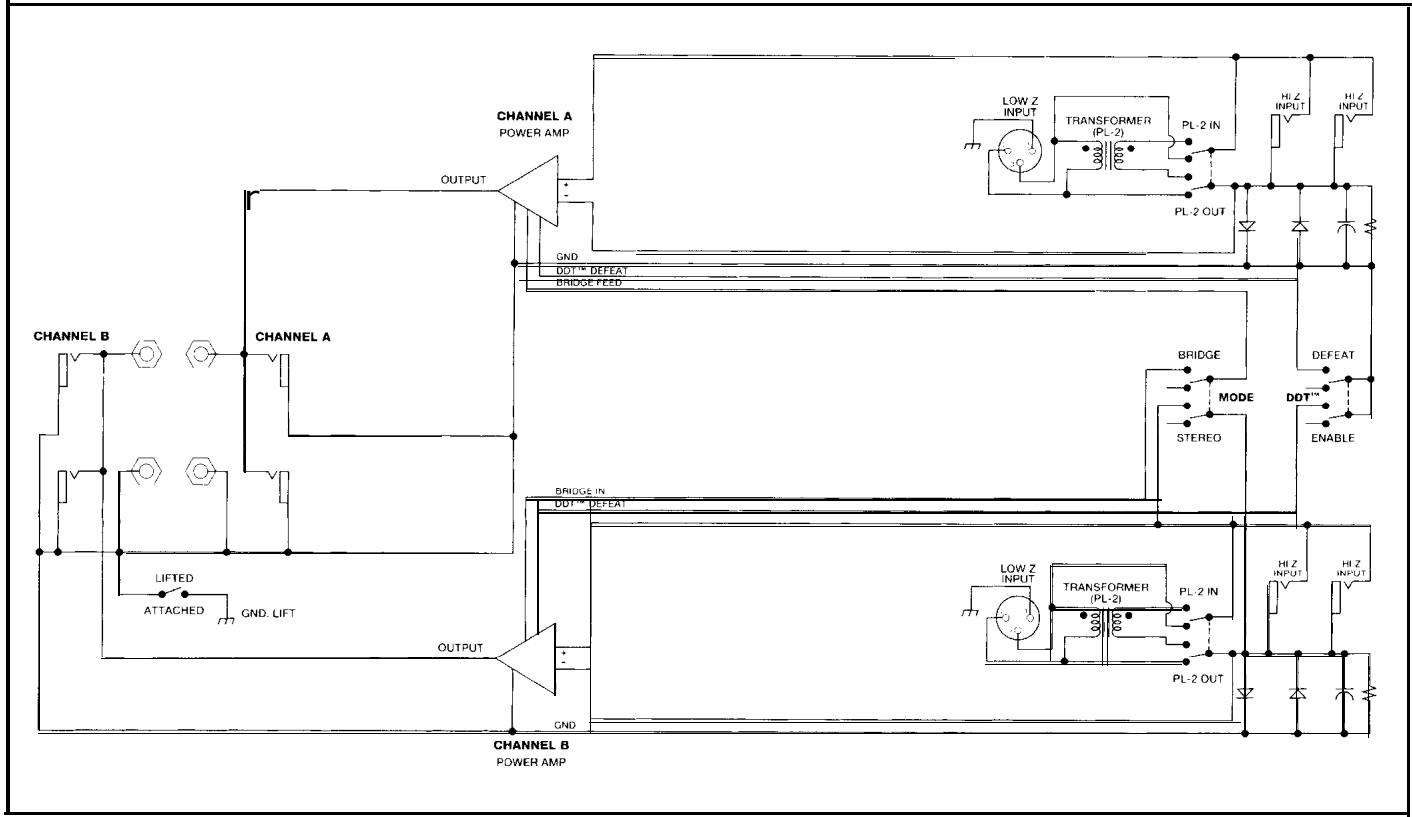
Wiring Diagrams
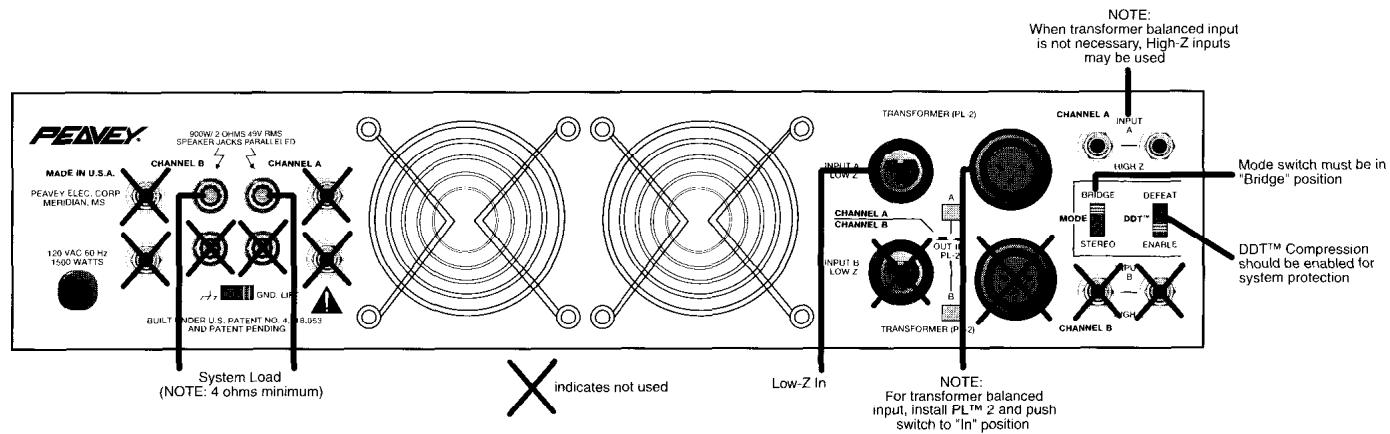
BRIDGE MODE
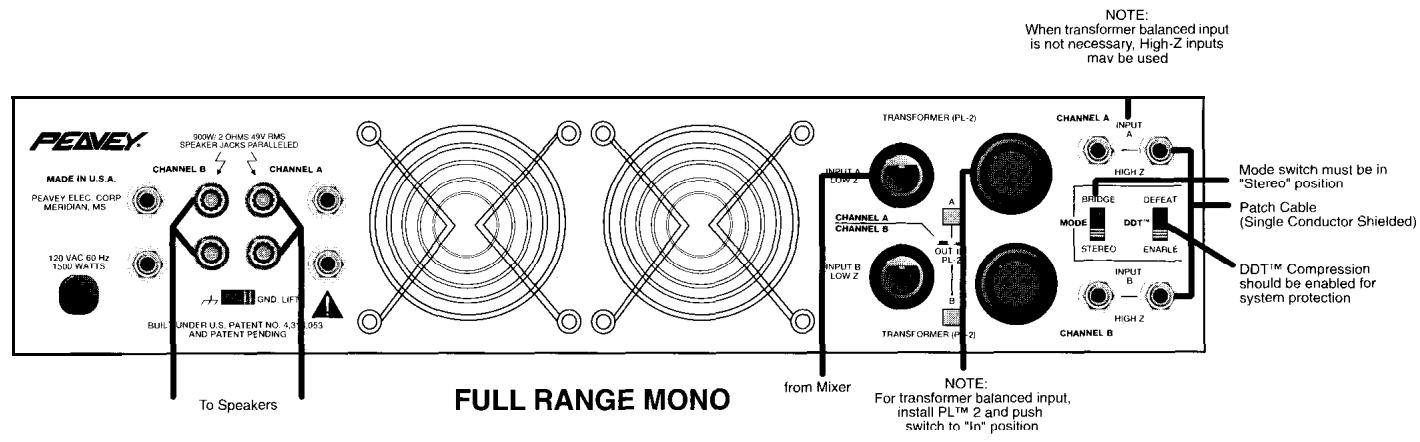
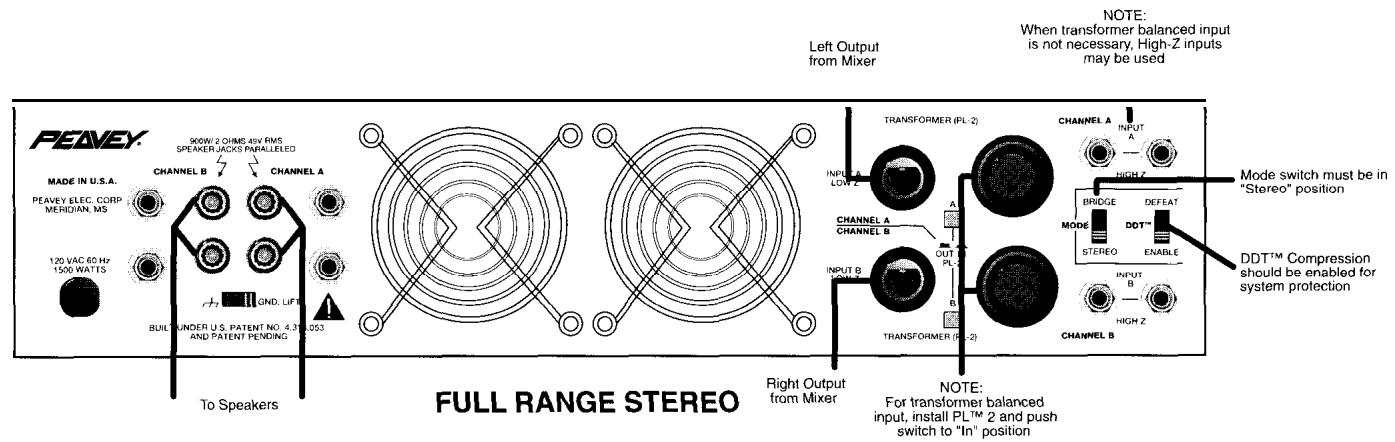
ESPAÑOL
PEAVEY ELECTRONICS CORPORATION ("PEAVEY") warrants this product, EXCEPT for covers, footswitches, patchcords, tubes and meters, to be free from defects in material and workmanship for a period of one (1) year from date of purchase, PROVIDED, however, that this limited warranty is extended only to the original retail purchaser and is subject to the conditions, exclusions, and limitations hereinafter set forth:
PEAVEY 90-DAY LIMITED WARRANTY ON TUBES AND METERS
If this product contains tubes or meters, Peavey warrants the tubes or meters contained in the product to be free from defects in material and workmanship for a period of ninety (90) days from date of purchase; PROVDED, however, that this limited warranty is extended only to the original retail purchaser and is also subject to the conditions, exclusions, and limitations hereinafter set forth.
CONDITIONS, EXCLUSIONS, AND LIMITATIONS OF LIMITED WARRANTYES
These limited warranties shall be void and of no effect, if:
a. The first purchase of the product is for the purpose of resale; or
b. The original retail purchase is not made from an AUTHORIZED PEAVEY DEALER; or
c. The product has been damaged by accident or unreasonable use, neglect, improper service or maintenance, or other causes not arising out of defects in material or workmanship; or
d. The serial number affixed to the product is altered, defaced, or removed.
In the event of a defect in material and/or workmanship covered by this limited warranty, Peavey will:
a. In the case of tubes or meters, replace the defective component without charge.
b.
THE WARRANTY REGISTRATION CARD SHOULD BE ACCURATELY COMPLETED AND MAILED TO AND RECEIVED BY PEAVEY WITHIN FOURTEEN (14) DAYS FROM THE DATE OF YOUR PURCHASE.
In order to obtain service under these warranties, you must:
a. Bring the defective item to any PEAVEY AUTHORIZATION DEALER or AUTHORIZATION PEAVEY SERVICE CENTER and present therewith the ORIGINAL PROOF OF PURCHASE supplied to you by the AUTHORIZATION PEAVEY DEALER in connection with your purchase from him of this product, If the DEALER or SERVICE CENTER is unable to provide the necessary warranty service you will be directed to the nearest other PEAVEY AUTHORIZATION DEALER or AUTHORIZATION PEAVEY SERVICE CENTER which can provide such service.
OR
b. Ship the defective item, prepaid, to:
PEAVEY ELECTRONICS CORPORATION
International Service Center
326 Hwy. 11& 80 East
Meridian, MS 39301
including therewith a complete, detailed description of the problem, together with a legible copy of the original PROOF OF PURCHASE and a complete return address. Upon Peavey's receipt of these items: If the defect is remedial under these limited warranties and the other terms and conditions expressed herein have been complied with, Peavey will provide the necessary warranty service to repair or replace the product and will return it, FREIGHT COLLECT, to you, the purchaser.
Peavey's liability to the purchaser for damages from any cause whatsoever and regardless of the form of action, including negligence, is limited to the actual damages up to the greater of $500.00 or an amount equal to the purchase price of the product that caused the damage or that is the subject of or is directly related to the cause of action. Such purchase price will be that in effect for the specific product when the cause of action arose. This limitation of liability will not apply to claims for personal injury or damage to real property or tangible personal property allegedly caused by Peavey's negligence. Peavey does not assume liability for personal injury or property damage arising out of or caused by a non-Peavey alteration or attachment, nor does Peavey assume any responsibility for damage to interconnected non-Peavey equipment that may result from the normal functioning and maintenance of the Peavey equipment.
UNDER NO CIRCUMSTANCES WILL PEAVEY BE LIABLE FOR ANY LOST PROFITS. LOST SAVINGS. ANY INCIDENTAL DAMAGES, OR ANY CONSEQUENTIAL DAMAGES ASING OUT OF THE USE OR INABILITY TO USE THE PRODUCT, EVEN IF PEAVEY HAS BEEN ADVISED OF THE POSSIBILITY OF SUCH DAMAGES.
THESE LIMITED WARRANTY ARE IN LIEU OF ANY AND ALL WARRANTYES, EXPRESSED OR IMPLIED, INCLUDING, BUT NOT LIMITED TO, THE IMPLIED WARRANTY OF MERCHANTABILITY AND FITNESS FOR A PARTICULAR USE; PROVIDED, HOWEVER, THAT IF THE OTHER TERMS AND CONDITIONS NECESSARY TO THE EXISTENCE OF THE EXPRESSED, LIMITED WARRANTY, AS HEREINABOVE STATED, HAVE BEEN COMPLIED WITH, IMPLIED WARRANTY ARE NOT DISCLAIMED DURING THE APPLICABLE ONE-YEAR OR NINETY-DAY PERIOD FROM DATE OF PURCHASE OF THIS PRODUCT.
SOME STATES DO NOT ALLOW LIMITATION ON HOW LONG AN IMPLIED WARRANTY LASTS, OR THE EXCLUSION OR LIMITATION OF INCIDENTAL OR CONSEQUENTIAL DAMAGES, SO THE ABOVE LIMITATIONS OR EXCLUSIONS MAY NOT APPLY TO YOU. THESE LIMITED WARRANTYES GIVE YOU SPECIFIC LEGAL RIGHTS, AND YOU MAY ALSO HAVE OTHER RIGHTS WHICH MAY VARY FROM STATE TO STATE.
THESE LIMITED WARRANTY ARE THE ONLY EXPRESSED WARRANTYES ON THIS PRODUCT, AND NO OTHER STATEMENT, REPRESENTATION, WARRANTY, OR AGREEMENT BY ANY PERSON SHALL BE VALID OR BINDING UPON PEAVEY.
In the event of any modification or disclaimer of expressed or implied warranties, or any limitation of remedies, contained herein conflicts with applicable law, then such modification, disclaimer or limitation, as the case may be, shall be deemed to be modified to the extent necessary to comply with such law.
Your remedies for breach of these warranties are limited to those remedies provided herein and Peavey Electronics Corporation gives this limited warranty only with respect to equipment purchased in the United States of America.
INSTRUCTIONS — WARRANTY REGISTRATION CARD
- Mail the completed WARRANTY REGISTRATION CARD to:
PEAVEY ELECTRONICS CORPORATION
P.O. BOX 2898
Meridian, MS 39302-2898
a. Keep the PROOF OF PURCHASE. In the event warranty service is required during the warranty period, you will need this document. There will be no identification card issued by Peavey Electronics Corporation.
- IMPORTANCE OF WARRANTY REGISTRATION CARDS AND NOTIFICATION OF CHANGES OF ADDRESSES:
a. Completion and mailing of WARRANTY REGISTRATION CARDS-Should notification become necessary for any condition that may require correction, the REGISTRATION CARD will help ensure that you are contacted and properly notified.
b. Notice of address changes - If you move from the address shown on the WARRANTY REGISTRATION CARD, you should notify Peavey of the change of address so as to facilitate your receipt of any bulletins or other forms of notification which may become necessary in connection with any condition that may require dissemination of information or correction.
- You may contact Peavey directly by telephoning (601) 483-5365.
IMPORTANT SAFETY INSTRUCTIONS
WARNING: When using electric products, basic cautions should always be followed, including the following.
- Read all safety and operating instructions before using this product.
- All safety and operating instructions should be retained for future reference.
- Obey all cautions in the operating instructions and on the back of the unit.
- All operating instructions should be followed.
- This product should not be used near water, i.e., a bathtub, sink, swimming pool, wet basement, etc.
- This product should be located so that its position does not interfere with its proper ventilation. It should not be placed flat against a wall or placed in a built-in enclosure that will impede the flow of cooling air.
- This product should not be placed near a source of heat such as a stove, radiator, or another heat producing amplifier.
- Connect only to a power supply of the type marked on the unit adjacent to the power supply cord.
- Never break off the ground pin on the power supply cord. For more information on grounding, write for our free booklet "Shock Hazard and Grounding."
- Power supply cords should always be handled carefully. Never walk or place equipment on power supply cords. Periodically check cords for cuts or signs of stress, especially at the plug and the point where the cord exits the unit.
- The power supply cord should be unplugged when the unit is to be unused for long periods of time.
- If this product is to be mounted in an equipment rack, rear support should be provided.
- Metal parts can be cleaned with a damp rag. The vinyl covering used on some units can be cleaned with a damp rag or an ammonia-based household cleaner if necessary. Disconnect unit from power supply before cleaning.
- Care should be taken so that objects do not fall and liquids are not spilled into the unit through the ventilation holes or any other openings.
- This unit should be checked by a qualified service technician if:
a. The power supply cord or plug has been damaged.
b. Anything has fallen or been spilled into the unit.
c. The unit does not operate correctly.
d. The unit has been dropped or the enclosure damaged.
- The user should not attempt to service this equipment. All service work should be done by a qualified service technician.
- This product should be used only with a cart or stand that is recommended by Peavey Electronics.
- Exposure to extremely high noise levels may cause a permanent hearing loss. Individuals vary considerably in susceptibility to noise induced hearing loss, but nearly everyone will lose some hearing if exposed to sufficiently intense noise for a sufficient time. The U.S. Government's Occupational Safety and Health Administration (OSHA) has specified the following permissible noise level exposures.
| Duration Per Day In Hours |
| 8 |
| 6 |
| 4 |
| 2 |
| 1 1/2 |
| 1 |
| 1/2 |
| 1/4 or less |
| Sound Level dBA, Slow Response |
| 90 |
| 92 |
| 95 |
| 97 |
| 100 |
| 102 |
| 105 |
| 110 |
| 115 |
According to OSHA, any exposure in excess of the above permissible limits could result in some hearing loss. Ear plugs or protectors in the ear canals or over the ears must be worn when operating this amplification system in order to prevent a permanent hearing loss if exposure is in excess of the limits as set forth above. To ensure against potentially dangerous exposure to high sound pressure levels, it is recommended that all persons exposed to equipment capable of producing high sound pressure levels such as this amplification system be protected by hearing protectors while this unit is in operation.
SAVE THESE INSTRUCTIONS!


Features and specifications subject to change without notice.