Longflex 4000 Shockabsorber Liberty - Washing machine CECOTEC - Free user manual and instructions
Find the device manual for free Longflex 4000 Shockabsorber Liberty CECOTEC in PDF.


User questions about Longflex 4000 Shockabsorber Liberty CECOTEC
0 question about this device. Answer the ones you know or ask your own.
Ask a new question about this device
Download the instructions for your Washing machine in PDF format for free! Find your manual Longflex 4000 Shockabsorber Liberty - CECOTEC and take your electronic device back in hand. On this page are published all the documents necessary for the use of your device. Longflex 4000 Shockabsorber Liberty by CECOTEC.
USER MANUAL Longflex 4000 Shockabsorber Liberty CECOTEC
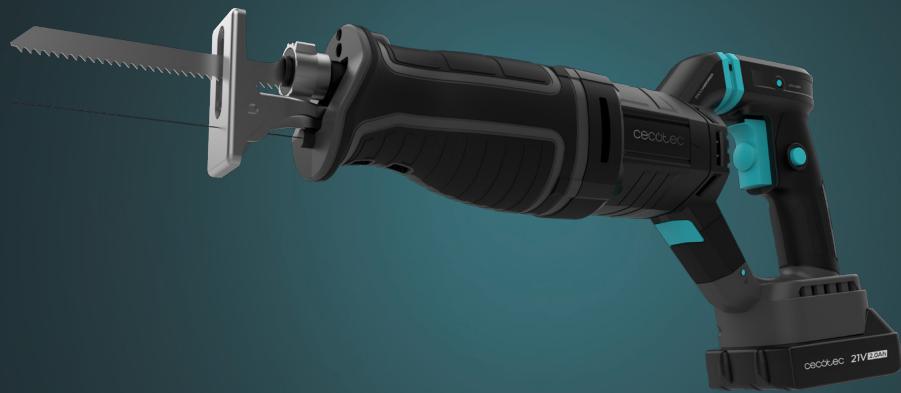
Sierra de sable / Reciprocating saw
Safety instructions 12
-
Parts and components 107
-
Before use 107
-
Operation 108
-
Troubleshooting 109
-
Cleaning and maintenance 109
-
Disposal of old electrical and electronic appliances 110
-
Copyright 110
SOMMAIRE
EN • The coding in this manual is generic and applies to all code variants of the appliance.
General power tool safety instructions
WARNING: Read all hazard warnings, instructions, figures and technical specifications supplied with the power tool. Failure to follow all instructions listed below may result in electric shock, fire and/or serious injury.
Keep all safety warnings and instructions for future reference. The term “power tool” in the warnings refers to your mains-operated (corded) power tool or battery-operated (cordless) power tool.
Work area safety
a. Keep the work area clean and well lit. Cluttered or dark areas may cause accidents.
b. Do not operate power tools in explosive atmospheres, such as in the presence of flammable liquids, gases or dust. Power tools can produce sparks that ignite dust or fumes.
c. Keep children and bystanders away while operating a power tool. Distractions can cause you to lose control.
Electrical safety
a. Power tool plugs must match the outlet. Never modify the plug in any way. Do not use adapters on grounded power tools. Unmodified plugs and matching sockets will reduce the risk of electric shock.
b. Avoid body contact with grounded surfaces, like pipes, radiators, stoves and refrigerators. There is an increased risk of electric shock if your body is earthed or grounded.
c. Do not expose power tools to rain or wet conditions. Water entering a power tool will increase the risk of electric shock.
d. Do not misuse the cord. Never use the cord for carrying, pulling or unplugging the power tool. Keep cord away from heat, oil, sharp edges or moving parts. Damaged or entangled cords increase the risk of electric shock.
e. When operating a power tool outdoors, use an extension cord suitable for outdoor use. Use of a cord suitable for outdoor use reduces the risk of electric shock.
f. If operating a power tool in a damp location is unavoidable, use a residual current device (RCD) protected supply. The use of a differential fuse reduces the risk of exposure to electric shock.
Personal safety
a. Stay alert, watch what you are doing and use commonsense when operating a power tool. Do not use a power tool while you are tired or under the influence of drugs, alcohol or medication. Failure to exercise caution when operating the power tool may result in serious injury.
b. Use personal protective equipment. Always wear eye protection. Protective equipment such as dust mask, non-skid safety footwear, helmet or hearing protection, used under appropriate conditions, will reduce personal injuries.
c. Avoid unintentional start-up. Ensure the power tool is switched off before connecting to the power supply and/or battery pack, picking up or carrying the tool. If you carry the power tool by holding it by the on/off switch, or if you power the power tool while it is switched on, this may result in an accident. Remove adjustment tools or spanners before connecting the power tool. An adjustment tool or spanner left on a rotating part may cause injury when the power tool is started.
d. Avoid awkward postures. Keep proper footing and balance at all times. This will enable you to control the power tool better should an unexpected situation arise.
e. Wear appropriate work clothing. Do not wear loose clothing or jewellery. Keep your hair and clothing away from moving parts. Loose clothing, long hair and jewellery can become caught in moving parts.
f. If devices are provided for the connection of dust extraction and collection facilities, ensure these are connected and properly used. The use of this equipment reduces dust-related risks.
g. Do not let familiarity gained from frequent use of tools allow
you to become complacent and ignore tool safety principles. A careless action can cause serious injury within a fraction of a second.
Power tool use and maintenance
a. Do not overload the power tool. Use the correct power tool for your application. With the appropriate power tool, you will work better and more safely within the specified power range.
b. Do not use the power tool if the switch is faulty. Power tools that cannot be switched on or off are dangerous and must be repaired.
c. Remove the plug from the mains and/or remove the detachable battery from the power tool before making any adjustment, changing accessories or storing the power tool. Such preventive safety measures reduce the risk of the power tool starting up accidentally.
d. Store power tools out of the reach of children. Do not allow persons unfamiliar with the power tool or who have not read these instructions to operate the power tool. Power tools used by inexperienced persons are dangerous.
e. Check the power tool and its accessories. Check if the moving parts are misaligned or stuck, if there are broken pieces or any other condition that may affect the power tool's operation. In case of damage, the power tool must be repaired before use. Many accidents are due to poorly maintained power tools.
f. Keep tools clean and sharp. Properly maintained tools are better guided and controlled.
g. Use the power tool, accessories, etc. according to these instructions, taking into account the working conditions and the work to be carried out. The use of power tools for work other than that for which they are intended can be dangerous.
h. Keep handles and gripping surfaces dry, clean and free of oil and grease. Slippery handles and grasping surfaces do not allow safe handling and control of the tool in unexpected situations.
Service
a. Only have your power tool repaired by a qualified expert, using only original spare parts. This is the only way to maintain the safety of the power tool.
b. Do not perform any maintenance on defective batteries. Only the manufacturer or the authorized technical assistance service can perform maintenance on the batteries.
Cordless tool use and handling
a. Only charge the battery with the recommended chargers. The use of a charger with a battery that does not correspond to it entails danger of fire.
b. Use only the batteries indicated for the power tools. Use of other batteries may cause injury and fire hazard.
c. Keep unused batteries away from staples, coins, keys, nails, screws or other small metal objects that can cause bridging of the contacts. A short circuit between the battery terminals can cause burns or fire.
d. Incorrect use may result in leakage of battery fluids. Avoid contact with such liquids. In case of accidental contact, rinse the affected part with water. If the liquid comes into contact with eyes, seek medical assistance immediately. Liquid leaking from the battery may cause skin irritation or burns.
e. Do not use a damaged or modified battery. Damaged or modified batteries may operate unexpectedly and cause fire, explosion or danger of injury.
f. Do not expose the battery to fire or high temperatures. Fire or temperatures above 130\ °C ( 265\ °F ) can cause explosions.
g. Follow all charging instructions and do not charge the battery or the tool outside the temperature range specified in the instructions. Improper charging or charging at temperatures outside the specified range may damage the battery and increase the risk of fire.
CAUTION! RISK OF EXPLOSION! Never recharge non-rechargeable batteries.
Protect the battery against heat, e.g. also against strong sunlight, fire, water and moisture. Danger of explosion.
Safety instructions for reciprocating saws
a. Hold the power tool by insulated gripping surfaces when performing an operation where the cutting accessory may contact hidden cables or its own cable. Contact of the cutting accessory with a “live” wire may cause exposed metal parts of the power tool to become “live” and could give the operator an electric shock.
b. Use clamps or other practical means to secure and support the workpiece on a stable platform.
c. Holding the workpiece with the hands or against the body makes it unstable and can lead to loss of control.
d. Keep hands away from the cutting area. Do not reach under the workpiece. You could be injured by touching the saw blade.
e. While working, hold the power tool firmly with both hands and take care of a safe position. By using both hands the power tool is guided more safely.
f. Only bring the power tool in operation close to the workpiece. Otherwise, the tool may suddenly move backwards when the tool gets caught in the workpiece.
g. Make sure that the base plate is always applied to the workpiece during sawing. The saw blade can snag and lead to loss of control over the power tool.
h. At the end of the work process, switch off the power tool and wait until it has come to a complete stop before removing the saw blade from the cutting groove. This allows you to safely deposit the power tool without the risk of the power tool kicking back abruptly.
i. Wait until the power tool has stopped before putting it down. The saw may snag and cause you to lose control of the power tool.
j. Only use undamaged saw blades in perfect condition. Deformed or dented saw blades may break, impair the quality of the cut, or cause the unit to kick back.
k. After switching off the unit, do not try to brake the saw blade by pushing it sideways. The saw blade could be damaged, break or cause the unit to recoil abruptly.
l. Firmly fix the material. Do not support the workpiece with your hand or foot. Do not touch any objects or the floor with the saw in operation. There is a danger of counter-attack.
m. Use suitable scanning devices to detect hidden conductors or pipes or consult your utility companies. Contact with electrical conductors can cause fire or electrocution. Damaging a gas pipe can cause an explosion. Drilling into a water pipe may result in property damage or electric shock hazard.
INSTRUCTIONS DE SÉCURITÉ
- Quick-release chuck
- Adjustable shoe
- Lock-on button
- Trigger switch
- LED light/laser button
- Battery release button
- Removable battery
- Speed control button
Note:
The graphics in this manual are schematic representations and may not exactly match the product.
2. BEFORE USE
- This tool comes in a packaging designed to protect it during transport. Remove the tool from its box. You can keep the original box and other packaging elements in a safe place to prevent damage to the tool if you need to transport it in the future. If you wish to dispose of the original packaging, make sure all items are recycled properly.
- Check that all parts and components are included and in good condition. If any of them are missing or damaged, please contact Cecotec's Official Technical Support Service immediately.
Box content:
- Reciprocating saw
- Nexus 21 V battery
- 6 blades (2 for wood, 2 extra-long for wood, 2 for metal)
- Carrying case
- Instruction manual
- Do not remove the product's serial number in order to keep proper traceability if technical assistance is required.
ENGLISH
3. OPERATION
Switching on and off
- To start: Press the trigger switch to activate the reciprocating saw. The tool will begin operating when the trigger is pressed.
- To stop: Release the trigger switch to stop the saw.
Speed setting
Speed control button: Press this button to select the desired speed. The tool has three speed levels, allowing it to adapt to different materials and types of cutting.
Trigger lock
Lock-on button: For extended use without holding the trigger, use the lock-on button. With the saw running, press the lock-on button to maintain operation without holding the trigger. To disengage the lock, simply press the trigger again.
Shoe adjustment
Quick-release lever: Use a quick-release lever or Allen key to adjust the shoe length as required.
Light and laser
Light and laser button: The reciprocating saw is equipped with a light and laser guide for improved cutting accuracy. Press the corresponding button to toggle these features on or off as needed.
Usage tips
Workpiece securing: Make sure the workpiece is firmly secured using a vice or other clamping device. Keeping the tool close to the workpiece while cutting will help achieve a more stable cut.
Using the battery
- When the battery is fully charged, unplug it.
- The battery has temperature protection, low voltage protection and overcurrent protection. If abnormal power supply is detected during use, please check if the temperature is too high due to improper use, and it is necessary to let it cool down before further use. If the voltage is too low, it must be charged. If the operating current is too high, the protection will be activated.
- During operation, if you notice sparks, smoke or odour from the battery, stop using it immediately and contact Cecotec's Official Technical Support Service.
Using the charger
- Battery charge indicator: While the battery is charging, the indicator light illuminates red. When the battery is fully charged, the indicator light changes to green.
- Insert the charging connector into the battery, ensuring good contact.
- Use the charger at temperatures from 0 to 40 degrees. Please load indoors.
4. TROUBLESHOOTING
The saw does not start:
- Battery check: Ensure the battery is charged and correctly installed.
- Connections: Check for dirt or corrosion on the battery contacts.
Poor cutting performance:
- Blade condition: Verify that the blade is sharp and properly installed. A dull or incorrectly installed blade can affect performance.
- Type of blade: Be sure to use the proper blade for the material to be cut.
Abnormal noise or vibration:
- Blade check: Check that the blade is undamaged and tight.
- Loose components: Inspect and tighten all screws and connections.
5. CLEANING AND MAINTENANCE
Cleaning:
- Battery disconnection: Before cleaning, make sure that the battery is removed to avoid accidents.
- Cleaning the exterior: Use a soft, dry cloth to clean the saw's exterior, removing dust and debris.
- Cutting mechanism maintenance: Carefully remove any wood chips or dust from the cutting mechanism to ensure smooth operation.
Regular maintenance:
Checking the battery: Periodically check the battery for damage to ensure proper operation.
Storage:
- Storage conditions: Store the saw in a dry, secure location, away from moisture and dust, to extend its service life.
- Battery safety: Ensure that the battery is removed and stored in a safe area where it cannot be accidentally activated.
ENGLISH
6. DISPOSAL OF OLD ELECTRICAL AND ELECTRONIC APPLIANCES

This symbol indicates that, according to the applicable regulations, the product and/or battery must be disposed of separately from household waste. When this product reaches the end of its shelf life, you should dispose of the batteries/accumulators and take them to a collection point designated by the local authorities. For detailed information on how to properly dispose of electrical and electronic equipment and/or the corresponding batteries, consumers should contact their local authorities.
Compliance with the above guidelines will help protecting the environment.
7. COPYRIGHT
The intellectual property rights over the texts in this manual belong to CECOTEC INNOVACIONES, S.L. All rights reserved. The content of this publication may not, either in part or in its entirety, be reproduced, stored in a retrieval system, transmitted or distributed by any means (electronic, mechanical, photocopying, recording or similar) without prior authorisation from CECOTEC INNOVACIONES, S.L.
1. PIÈCES ET COMPOSANTS
Img. 1
4. PROBLEEMOPLOSSING
De zaag start niet:
Fig./Img./Abb./Afb./Rys.1
www.cecotec.es
- SOMMAIRE
- GENERAL POWER TOOL SAFETY INSTRUCTIONS
- WORK AREA SAFETY
- ELECTRICAL SAFETY
- PERSONAL SAFETY
- POWER TOOL USE AND MAINTENANCE
- SERVICE
- CORDLESS TOOL USE AND HANDLING
- SAFETY INSTRUCTIONS FOR RECIPROCATING SAWS
- INSTRUCTIONS DE SÉCURITÉ
- NOTE
- BEFORE USE
- BOX CONTENT
- ENGLISH
- OPERATION
- SWITCHING ON AND OFF
- SPEED SETTING
- TRIGGER LOCK
- SHOE ADJUSTMENT
- LIGHT AND LASER
- USAGE TIPS
- USING THE BATTERY
- USING THE CHARGER
- TROUBLESHOOTING
- CLEANING AND MAINTENANCE
- CLEANING
- REGULAR MAINTENANCE
- STORAGE
- DISPOSAL OF OLD ELECTRICAL AND ELECTRONIC APPLIANCES
- COPYRIGHT
- PIÈCES ET COMPOSANTS
- IMG. 1
- PROBLEEMOPLOSSING
- DE ZAAG START NIET
Brand : CECOTEC
Model : Longflex 4000 Shockabsorber Liberty
Category : Washing machine