DW704 - Miter saw DEWALT - Free user manual and instructions
Find the device manual for free DW704 DEWALT in PDF.


User questions about DW704 DEWALT
0 question about this device. Answer the ones you know or ask your own.
Ask a new question about this device
Download the instructions for your Miter saw in PDF format for free! Find your manual DW704 - DEWALT and take your electronic device back in hand. On this page are published all the documents necessary for the use of your device. DW704 by DEWALT.
USER MANUAL DW704 DEWALT
You have chosen a DEWALT Power Tool. Years of experience, thorough product development and innovation make DEWALT one of the most reliable partners for professional Power Tool users.
Table of contents
| Technical data | en - 1 |
| EC-Declaration of conformity | en - 1 |
| Safety instructions | en - 2 |
| Electrical safety | en - 2 |
| Mains plug replacement (U.K. & Ireland only) | en - 3 |
| Using an extension cable | en - 3 |
| Unpacking | en - 3 |
| Description | en - 3 |
| Assembly | en - 3 |
| Adjustment | en - 4 |
| Instructions for use | en - 5 |
| Transport | en - 8 |
| Maintenance | en - 8 |
| Guarantee | en - 8 |
Technical data
| DW704 | DW705 | ||
| Voltage | V | 230 | 230 |
| (U.K. & Ireland only) | V | 115 | 115 |
| Power input | W | 1,500 | 1,500 |
| Blade diameter | mm | 305 | 305 |
| Blade bore Ø | mm | 30 | 30 |
| Max. blade speed | min | 3,800 | 3,800 |
| Max. cross-cut capacity 90° | mm | 200 | 200 |
| Max. litre capacity 45° | mm | 140 | 140 |
| Max. depth of cut 90° | mm | 90 | 90 |
| Max. depth of bevel cross-cut 45° | mm | - | 58 |
| Mitre (max. positions) | left | 48° | 48° |
| right | 48° | 48° | |
| Bevel (max. positions) | left | - | 48° |
| right | - | 3° | |
| 0° litre | |||
| Resulting width at max. height 90 mm | mm | 150 | 150 |
| Resulting height at max. width 200 mm | mm | 58 | 58 |
| 45° litre | |||
| Resulting width at max. height 90 mm | mm | 105 | 105 |
| Resulting height at max. width 140 mm | mm | 58 | 58 |
| 45° bevel | |||
| Resulting width at max. height 58 mm | mm | - | 150 |
| Resulting height at max. width 200 mm | mm | - | 43 |
| Automatic electronic blade brake time | s | < 10.0 | < 10.0 |
| Weight | kg | 16.3 | 17.2 |
| Fuses: | |||
| Europe | 230 V tools | 10 Amperes, mains | |
| U.K. & Ireland | 230 V tools | 13 Amperes, in plugs | |
| 115 V tools (< 1500 W) | 15 Amperes, mains | ||
The following symbols are used throughout this manual:

Denotes risk of personal injury, loss of life or damage to the tool in case of non-observation of the instructions in this manual.

Denotes risk of electric shock.
EC-Declaration of conformity

DW704/DW705
DeWALT declares that these Power Tools have been designed in compliance with: 89/392/EEC, 89/336/EEC, 73/23/EEC, EN 50144, EN 55104, EN 55014, EN 61000-3-2 & EN 61000-3-3.
For more information, please contact DeWALT at the address below or refer to the back of the manual.
Level of sound pressure according to 86/188/EEC & 89/392/EEC, measured according to EN 50144:
| DW704 | DW705 | ||
| LpA (sound pressure) | dB(A)* | 88,4 | 89,3 |
| LwA (acoustic power) | dB(A) | 101,4 | 97,3 |
- at the operator's ear

Take appropriate measures for the protection of hearing if the sound pressure of 85 dB(A) is exceeded.
Weighted root mean square acceleration value according to EN 50144:
| DW704 | DW705 | |
| < 2.5 m/s2 | < 2.5 m/s2 |
TÜV Rheinland
Director Engineering & Product Development Horst Großmann
X. fOpsma
DeWALT, Richard-Klinger-StraBe 40
D-65510, Idstein, Germany
Safety instructions
When using Power Tools, always observe the safety regulations applicable in your country to reduce the risk of fire, electric shock and personal injury. Read the following safety instructions before attempting to operate this product.
Keep these instructions in a safe place!
General
1 Keep work area clean
Cluttered areas and benches can cause accidents.
2 Consider work area environment
- Do not expose Power Tools to humidity. Keep work area well lit.
- Do not use Power Tools in the presence of inflammable liquids or gases.
3 Guard against electric shock
Prevent body contact with earthed surfaces (e.g. pipes, radiators, cookers and refrigerators). For use under extreme conditions (e.g. high humidity, when metal swarf is being produced, etc.) electric safety can be improved by inserting an isolating transformer or a (Fl) earth-leakage circuit-breaker.
4 Keep children away
Do not let children come into contact with the tool or extension cord. Supervision is required for those under 16 years of age.
5 Extension cords for outdoor use
When the tool is used outdoors, always use extension cords intended for outdoor use and marked accordingly.
6 Store idle tools
When not in use, Power Tools must be stored in a dry place and locked up securely, out of reach of children.
7 Dress properly
Do not wear loose clothing or jewellery. They can be caught in moving parts. Preferably wear non-slip footwear when working outdoors.
Wear protective hair covering to keep long hair out of the way.
8 Wear safety goggles
Also use a face or dust mask in case the operations produce dust or flying particles.
9 Beware of maximum sound pressure
Take appropriate measures for the protection of hearing if the sound pressure of 85 dB(A) is exceeded.
10 Secure workpiece
Use clamps or a vice to hold the workpiece. It is safer and it frees both hands to operate the tool.
11 Do not overreach
Keep proper footing and balance at all times.
12 Avoid unintentional starting
Do not carry the plugged-in tool with a finger on the switch.
Be sure that the switch is released when plugging in.
13 Stay alert
Watch what you are doing. Use common sense. Do not operate the tool when you are tired.
14 Disconnect tool
Shut off power and wait for the tool to come to a complete standstill before leaving it unattended. Unplug the tool when not in use, before servicing or changing accessories.
15 Remove adjusting keys and wrenches
Always check that adjusting keys and wrenches are removed from the tool before operating the tool.
16 Use appropriate tool
The intended use is laid down in this instruction manual. Do not force small tools or attachments to do the job of a heavy-duty tool.
The tool will do the job better and safer at the rate for which it was intended.
Warning! The use of any accessory or attachment or performance of any operation with this tool, other than those recommended in this instruction manual may present a risk of personal injury.
17 Do not abuse cord
Never carry the tool by its cord or pull it to disconnect from the socket.
Keep the cord away from heat, oil and sharp edges.
18 Maintain tools with care
Keep the tools in good condition and clean for better and safer performance. Follow the instructions for maintenance and changing accessories. Inspect the tool cords at regular intervals and, if damaged, have them repaired by an authorized DEWALT repair agent. Inspect the extension cords periodically and replace them if damaged. Keep all controls dry, clean and free from oil and grease.
19 Check for damaged parts
Before using the tool, carefully check it for damage to ensure that it will operate properly and perform its intended function.
Check for misalignment and seizure of moving parts, breakage of parts and any other conditions that may affect its operation. Have damaged guards or other defective parts repaired or replaced as instructed. Do not use the tool if the switch is defective. Have the switch replaced by an authorized DEWALT repair agent.
20 Have your tool repaired by an authorized DeWALT repair agent
This Power Tool is in accordance with the relevant safety regulations. To avoid danger, electric appliances must only be repaired by qualified technicians.
Additional Safety Rules for Mitre Saws
21 Guard actuation
The blade guard on your saw will automatically raise when the arm is brought down; it will lower over the blade when the arm is raised.
The guard can be raised by hand when installing or removing saw blades or for inspection of the saw. Never raise the blade guard manually unless the saw is turned OFF.
22 Flying debris
The front section of the guard is louvred for visibility while cutting. Although the louvres dramatically reduce flying debris, there are openings in the guard and safety glasses should be worn at all times when viewing through the louvres.
23 Saw blades
Make sure that the blade rotates in the correct direction. Keep the blade sharp. Do not use blades of larger or smaller diameter than recommended. For the proper blade rating refer to the technical data.
24 Blade guards
Never operate the saw without the guards in place.
25 Mind your hands
Keep your hands out of the path of the saw blade. Never place them in the blade area when the saw is connected to the electrical power source.
26 Stopping the motor
Raise the blade from the kerf in the workpiece prior to releasing the switch. Never attempt to stop the machine in motion by jamming a tool or similar against the blade. Do not wedge anything against the fan to hold the motor shaft.
27 Maintenance of the blade and the arbor collars
Make sure that the blade and the arbor collars are clean on the surfaces of contact and use both wrenches to tighten.
Electrical safety
The electric motor has been designed for one voltage only. Always check that the power supply corresponds to the voltage on the rating plate.

Your DEWALT tool is double insulated in accordance with EN 50144; therefore no earth wire is required.
Mains plug replacement (U.K. & Ireland only)
-
Should your mains plug need replacing and you are competent to do this, proceed as instructed below. If you are in doubt, contact an authorized DeWALT repair agent or a qualified electrician.
-
Disconnect the plug from the supply.
-
Cut off the plug and dispose of it safely; a plug with bared copper conductors is dangerous if engaged in a live socket outlet.
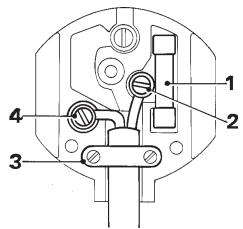
- Only fit 13 Amperes BS1363A approved plugs fitted with the correctly rated fuse (1).
- The cable wire colours, or a letter, will be marked at the connection points of most good quality plugs. Attach the wires to their respective points in the plug (see below). Brown is for Live (L) (2) and Blue is for Neutral (N) (4).
- Before replacing the top cover of the mains plug ensure that the cable restraint (3) is holding the outer sheath of the cable firmly and that the two leads are correctly fixed at the terminal screws.

Never use a light socket.
Never connect the live (L) or neutral (N) wires to the earth pin marked E or 1± .
For 115V tools, use plugs to BS4343 standard.
Using an extension cable
If an extension cable is required, use an approved triple-core extension cable suitable for the power input of this tool (see technical data).
The minimum conductor size is 1.5mm^2
When using a cable reel, always unwind the cable completely.
Also refer to the table below.
| Conductor size (mm2) | Cable rating (Amperes) |
| 0.75 | 6 |
| 1.00 | 10 |
| 1.50 | 15 |
| 2.50 | 20 |
| 4.00 | 25 |
| Voltage | Cable length (m) | ||||||
| 7.5 | 15 | 25 | 30 | 45 | |||
| Amperes | Cable rating (Amperes) | ||||||
| 115 | 0 - 2.0 | 6 | 6 | 6 | 6 | 6 | 10 |
| 2.1 - 3.4 | 6 | 6 | 6 | 6 | 15 | 15 | |
| 3.5 - 5.0 | 6 | 6 | 10 | 15 | 20 | 20 | |
| 5.1 - 7.0 | 10 | 10 | 15 | 20 | 20 | 25 | |
| 7.1 - 12.0 | 15 | 15 | 20 | 25 | 25 | - | |
| 12.1 - 20.0 | 20 | 20 | 25 | - | - | - | |
| 230 | 0 - 2.0 | 6 | 6 | 6 | 6 | 6 | 6 |
| 2.1 - 3.4 | 6 | 6 | 6 | 6 | 6 | 6 | |
| 3.5 - 5.0 | 6 | 6 | 6 | 6 | 10 | 15 | |
| 5.1 - 7.0 | 10 | 10 | 10 | 10 | 15 | 15 | |
| 7.1 - 12.0 | 15 | 15 | 15 | 15 | 20 | 20 | |
| 12.1 - 20.0 | 20 | 20 | 20 | 20 | 25 | - | |
Unpacking (fig. A1 & A2)
Remove the saw from the packing material carefully using the carrying handle (9).
The package contains:
1 Assembled Mitre Saw
1 Blade spanner
1 305 mm TCT saw blade
2 Clamps (DW704 only)
1 Instruction manual
1 Exploded drawing
- Press down the operating handle (1) and pull out the lock down pin (28), as shown in fig. A2.
- Gently release the downward pressure and allow the arm to rise to its full height.
Description (fig. B1 - B3)
B1
1 Operating handle
2 Moveable lower guard
3 Fence right-hand side
4 Mitre clamp knob
5 Mitre latch
6 Mitre scale
7 Fence left-hand side
8 Bench mounting holes
9 Carrying handle
10 Head lock up release lever
11 Rear lower guard
12 Bevel scale (DW705 only)
13 Padlock hole
14 Motor housing
15 Spindle lock button
16 Brush inspection cap
17 Trigger switch
B2
18 Blade spanner
19 Angle position stop (DW705 only)
20 Dust spout
21 Bevel clamp handle (DW705 only)
22 Hand indentation
23 Upper fence left-hand side clamping knobs (DW705 only)
24 Upper guard
25 Vertical position adjustment stop (DW705 only)
26 Bevel position adjustment stop (DW705 only)
27 Kerf plate
28 Head lock down pin
B3
29 Work support extension
30 Adjustable length stop
31 Work piece clamp
32 Dustbag
Assembly

Prior to assembly always unplug the tool.
The motor and guards are already assembled onto the base.
Bench Mounting (fig. C1 & C2)
- Holes (8) are provided in all four feet to facilitate bench mounting.
Two different sized holes are provided to accommodate different sizes of bolts (33). Use either hole; it is not necessary to use both.
Always mount your saw firmly to prevent movement. To enhance the portability, the tool can be mounted to a piece of 12.5mm or thicker plywood which can then be clamped to your work support or moved to other job sites and reclamped.
- When mounting your saw to a piece of plywood, make sure that the mounting screws do not protrude from the bottom of the wood.
The plywood must sit flush on the work support. When clamping the saw to any work surface, clamp only on the clamping bosses where the mounting screw holes are located. Clamping at any other point will interfere with the proper operation of the saw.
- To prevent binding and inaccuracy, be sure the mounting surface is not warped or otherwise uneven. If the saw rocks on the surface, place a thin piece of material under one saw foot until the saw is firm on the mounting surface.
Mounting the saw blade (fig. D1 - D7)
- Depress the head lock up release lever (10) to release the lower guard (2), then raise the lower guard as far as possible.
- Loosen the guard bracket screw (35) sufficiently to allow the angled corner piece (36) to pass between the head of the screw (38) and the guard. This will allow the guard bracket (37) to be raised enough to permit access to the blade locking screw (39).
- Hold the lower guard up and depress the spindle lock button (15) with one hand, then use the supplied blade spanner (18) in the other hand to loosen the left-hand threaded blade screw (39) by turning clockwise.

To use the spindle lock, depress the button as shown and rotate the spindle by hand until you feel the lock engage. Continue to hold the lock button in to keep the spindle from turning.
- Remove the blade locking screw (39) and the outside arbor collar (40).
- Install the saw blade (41) onto the shoulder (42) provided on the inside arbor collar (43), making sure that the teeth at the bottom edge of the blade are pointing toward the back of the saw (away from the operator).
- Replace the outer arbor collar (40).
- Tighten the blade locking screw (39) by turning counter-clockwise while holding the lower guard up and the spindle lock engaged with your other hand.
- Move the guard bracket (37) down until the angled corner piece (36) is below the head of the guard bracket screw (35).
- Tighten the guard bracket screw.

Never depress the spindle lock pin while the blade is rotating. Be sure to hold the guard bracket down and firmly tighten the guard bracket screw after installing the blade.
Adjustment

Prior to adjustment always unplug the tool.
Your Mitre Saw was accurately adjusted at the factory. If readjustment due to shipping and handling or any other reason is required, follow the steps below to adjust your saw. Once made, these adjustments should remain accurate.
Adjusting the rear lower guard (fig. E1 - E3)
- Check the rear lower guard (11) to ensure that it is located in such a position that the blade (41) is in the centre and equidistant from each side.
- Adjust as necessary by loosening the two screws (44) and moving the guard (fig. E2).
- Firmly tighten both screws.

Never remove the guard.
Cutting the kerf (fig. B2, F1 - F4)
In order to adjust and use your Mitre Saw, you must cut a slot (45) through the kerf plate (27) to allow for blade clearance.
- Set the saw at 0^ litre.
- Place a piece of scrap wood on the saw; the size should be at least 25mm × 152mm × 305mm (46).
- Depress the head lock up release lever (10) to release the head.
-
Turn the saw ON and allow the blade to reach full speed.
-
Pull the saw arm down as far as it will go and cut slowly through the scrap wood and the kerf plate.
- Turn the saw OFF and allow the blade to stop before raising the saw arm.
DW705 - Widening the kerf for 45^ bevel cuts
- Loosen the clamping knobs (23) and move the upper left side of the fence (7) as far as it will go to the left.
- Loosen the bevel clamp handle (21). Now adjust the bevel angle to 45^ and lock the bevel clamp handle (21).
- Turn the saw ON and allow the blade to reach full speed.
- Pull the arm down and cut slowly through the wood and kerf plate.
- Be sure to adjust the left side of the fence (7) (see "Adjusting the fence") so that it is as close to the saw blade as possible without interfering with the up and down movement of the arm.
- Tighten the fence in position using both knobs (23).
Checking and adjusting the blade to the fence (fig. G1 - G4)
- Loosen the litre clamp knob (4) and squeeze the litre latch (5) upwards to release the litre arm (47).
- Swing the litre arm until the latch locates it at the 0^ litre position. Do not tighten the clamp knob.
- Pull down the head until the blade just enters the saw kerf (45).
- Place a square (48) against the left side (7) of the fence and blade (41) (fig. G3).

Do not touch the tips of the blade teeth with the square.
If the saw blade is not exactly at 90^ to the fence:
- Loosen the three screws (49) and move the scale/mitre arm assembly left or right until the blade is at 90^ to the fence as measured with the square.
- Retighten the three screws (49). Pay no attention to the reading of the metre pointer at this point.
Adjusting the litre pointer (fig. G1 - G3, H1 & H2)
- Loosen the litre clamp knob (4) and squeeze the litre latch (5) to release the litre arm (47).
- Move the saw arm to set the metre pointer (51) to the zero position, as shown in fig. H1.
- With the litre clamp knob loose, allow the litre latch to snap into place as you rotate the litre arm past zero.
- Observe the pointer (51) and litre scale (6) through the viewing opening (52) (fig. H2). If the pointer does not indicate exactly zero, gently pry it left or right using a flat bladed screwdriver at either end of the plastic moulding (53).
Checking and adjusting the blade to the table

Do not touch the tip of any blade teeth with the square.
DW704 - This machine has been factory set and should not require adjusting
DW705 - Bevel stop adjustment (fig. J1 - J8)
- Loosen the bevel clamp handle (21).
- Press the metre arm to the right to ensure the angle position stop (19) is located against the vertical position stop adjustment (25).
- Loosen the right hand lock nut (54) and screw in the stop (25).
- Align the notches (61) in the bevel housing and table as shown.
- Place the smooth end of a 6.35 ~mm drill bit into the notches to align the two housings together.
- While the drill bit is in the notches (61), turn the right bevel stop screw (25) counterclockwise until it is firmly in contact with the angle position stop (19).
-
Tighten the bevel clamp handle (21) and remove the drill bit.
-
Hold the stop screw (25) in place and re-tighten the lock nut (54).
- If the bevel pointer (55) does not indicate zero on the bevel scale (12), loosen the screw (56) that secures the pointer (55) and move the pointer as necessary.
- Lower the arm so that the blade (41) protrudes slightly through the kerf plate (27).
- Place a set square (48) on the table and up against the blade (41).

Do not touch the teeth with the square to avoid inaccurate measurements.
-
If the blade is not at right angles with the table, adjust the blade as follows:
-
To move the blade to the right
- Loosen the bottom screw (63) to align the blade to the square.
-
Tighten the top screw (62).
-
To move the blade to the left
-
Loosen the top screw (62).
- Tighten the bottom screw (63) align the blade to the square.
- Tighten the top screw (62).
For either adjustment be sure both screws are fully tightened to secure the adjustment against movement.
DW705 - Adjusting the fence (fig. K)
The upper part of the left side of the fence (7) can be adjusted to the left to provide clearance, allowing the saw to bevel to a full 48^ left.
To adjust the fence:
- Loosen the two plastic knobs (23) and slide the fence to the left.
- Make a dry run with the saw turned OFF and check for clearance. Adjust the fence to be as close to the blade as practical to provide maximum workpiece support, without interfering with the up and down movement of the arm.
- Tighten both knobs securely.
- Move the fence back to the right after the cut has been accomplished.

The guide groove (58), fig. K, on the left side fence can become clogged with sawdust. Use a stick or some low pressure air to clear the guide groove.
DW705 - Checking and adjusting the bevel angle (fig. K, L1 - L4)
- Loosen the left side fence clamping knobs (23) and slide the upper part of the left side fence to the left as far as it will go.
- Loosen the bevel clamp handle (21) and move the saw arm to the left until the angle position stop (19) rests on the bevel position adjustment stop (26). This is the 45^ bevel position.
- If the bevel pointer (55) does not indicate exactly 45^ , the saw arm is out of adjustment.
- To adjust the arm, loosen the lock nut (59) on the bevel position adjustment stop (26) in fig. L2.
- Adjust the stop screw up or down as necessary until the pointer indicates 45^ with the angle position stop (19) resting against the bevel position adjustment stop (26).
- Hold the screw stationary while you firmly tighten the lock nut (59).
Do not adjust the bevel pointer. - To achieve a 3^ right bevel or a 48^ left bevel, the two adjustment stopscrews must be adjusted to allow the saw arm to move as necessary. Re-adjust the stops when the cuts are finished.
Instructions for use

Always observe the safety instructions and applicable regulations. The attention of UK users is drawn to the "woodworking machines regulations 1974" and any subsequent amendments.
Prior to operation:
- Install the appropriate saw blade. Do not use excessively worn blades. The maximum rotation speed of the tool must not exceed that of the saw blade.
- Secure the workpiece.
- Although this saw will cut wood and many nonferrous materials, these operating instructions refer to the cutting of wood only. The same guide-lines apply to the other materials. Do not cut ferrous (iron and steel) materials or masonry with this saw! Do not use any abrasive discs!
- Do not attempt to cut excessively small pieces.
- Allow the blade to cut freely. Do not force.
- Allow the motor to reach full speed before cutting.
- Make sure all locking knobs and clamp handles are tight.
- Make sure to use the kerf plate. Do not operate the machine if the kerf slot is wider than 9mm .
Switching ON and OFF (fig. M1 & M2)
- To turn the saw ON, depress the trigger switch (17) as shown in fig. M1.
- To turn the tool OFF, release the switch.
- There is no provision for locking the switch ON, but a hole (13) is provided in the trigger for insertion of a padlock to lock the saw OFF.
Vertical straight cross-cut (fig. B1, B2 & N)
- Loosen the litre clamp knob (4) and squeeze the litre latch (5) upwards.
- Engage the litre latch at the 0^ position and tighten the litre clamp knob.
- Place the wood to be cut against the fence (3 & 7).
- Take hold of the operating handle (1) and depress the head lock up release lever (10) to release the head. Press the trigger switch (17) to start the motor.
- Depress the head to allow the blade to cut through the timber and enter the plastic kerf plate (27).
- After completing the cut, release the switch (17) and return the head to its upper rest position.
Vertical litre cross-cut (fig. G1 & G2, O)
- Loosen the litre clamp knob and squeeze the litre latch upwards. Move the head left or right to the required angle.
- The litre latch will automatically locate at 15^ , 22.5^ , 30^ and 45^ . If any intermediate angle or 48^ is required hold the head firmly and lock by tightening the litre clamp knob.
- Always ensure that the litre clamp knob is locked tightly before cutting.
- Proceed as for a straight cross-cut.

When mitring the end of a piece of wood with a small off-cut, position the wood to ensure that the off-cut is to the side of the blade with the greater angle to the fence; i.e. left metre, off-cut to the right - right metre, off-cut to the left.
DW705 - Bevel cross-cut (fig. B2 & P)
- Loosen the left side fence clamping knobs (23) and slide the upper part of the left side fence to the left as far as it will go. Loosen the bevel clamp handle (21) and set the bevel as desired.
- Tighten the bevel clamp handle (21) firmly.
- Bevel angles can be set from 3^ right to 48^ left and can be cut with the litre arm set between zero and a maximum of 45^ litre position right or left.
- Proceed as for "Vertical straight cross-cut".
Quality of cut
The smoothness of any cut depends on a number of variables, e.g. the material being cut. When smoothest cuts are desired for moulding and other precision work, a sharp (60 tooth carbide) blade and a slower, even cutting rate will produce the desired results.

Ensure that the material does not creep while cutting; clamp it securely in place. Always let the blade come to a full stop before raising the arm. If small fibres of wood still split out at the rear of the workpiece, stick a piece of masking tape on the wood where the cut will be made. Saw through the tape and carefully remove tape when finished.
Body and hand position (fig. Q1 - Q4)
Proper positioning of your body and hands when operating the Mitre Saw will make cutting easier, more accurate and safer.
- Never place your hands near the cutting area.
- Place your hands no closer than 150mm from the blade.
- Hold the workpiece tightly to the table and the fence when cutting. Keep your hands in position until the trigger has been released and the blade has completely stopped.
- Always make dry runs (without power) before finish cuts so that you can check the path of the blade.
- Do not cross your hands as shown (fig. Q4).
- Keep both feet firmly on the floor and maintain proper balance.
- As you move the saw arm left and right, follow it and stand slightly to the side of the saw blade.
- Sight through the guard louvres (60) when following a pencil line.
Clamping the workpiece (fig. V1 - V4)
Always use a material clamp when cutting non-ferrous metals.
- Whenever possible, clamp the wood to the saw.
- For best results use the clamp (31) made for use with your saw (available from your dealer as an option). Clamp the workpiece to the fence whenever possible. You can clamp to either side of the saw blade; remember to position your clamp against a solid, flat surface of fence.
Support for long pieces (fig. B3)
Always support long pieces.
- For best results, use the extension work support (29) to extend the table width of your saw (available from your dealer as an option). Support long workpieces using any convenient means such as saw-horses or similar devices to keep the ends from dropping.
Cutting picture frames, shadow boxes & other four sided projects (fig. R1 & R2)
Trim moulding and other frames
Try a few simple projects using scrap wood until you develop a "feel" for your saw. Your saw is the perfect tool for mitring corners like the one shown in fig. R1. The joint shown can be made using either bevel (DW705) or mitre adjustment.
DW705 - Using bevel adjustment
The bevel for the two boards is adjusted to 45^ each, producing a 90^ corner. The mitre arm is locked in the zero position. The wood is positioned with the broad flat side against the table and the narrow edge against the fence.
Using litre adjustment
The same cut can be made by mitring right and left with the broad surface against the fence (fig. R2).
The two sketches (fig. R1 & R2) are for four side objects only. As the number of sides changes, so do the litre and bevel angles. The chart below gives the proper angles for a variety of shapes, assuming that all sides are of equal length. For a shape that is not shown in the chart, divide 180^ by the number of sides to determine the litre or bevel angle.
| No. of sides | Angle metre or bevel |
| 4 | 45° |
| 5 | 36° |
| 6 | 30° |
| 7 | 25.7° |
| 8 | 22.5° |
| 9 | 20° |
| 10 | 18° |
DW705 - Cutting Compound Mitres (fig. S1 & S2)
A compound litre is a cut made using a litre angle (fig. R2) and a bevel angle (fig. R1) at the same time. This is the type of cut used to make frames or boxes with slanting sides like the one shown in fig. S1.

If the cutting angle varies from cut to cut, check that the bevel clamp knob and the mitre lock knob are securely tightened. These knobs must be tightened after making any changes in bevel or mitre.
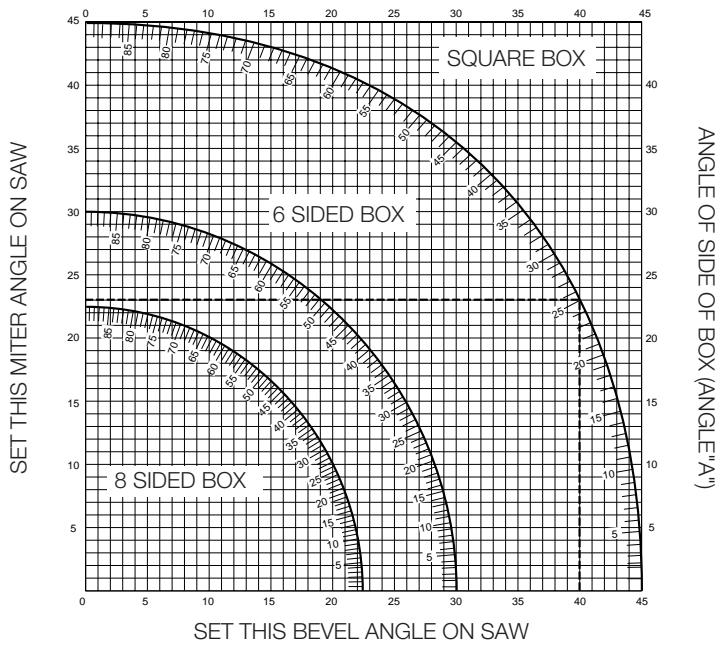
- The chart shown below will assist you in selecting the proper bevel and litre settings for common compound litre cuts. To use the chart, select the desired angle "A" (fig. S2) of your project and locate that angle on the appropriate arc in the chart. From that point follow the chart straight down to find the correct bevel angle and straight across to find the correct litre angle.
- Set your saw to the prescribed angles and make a few trial cuts.
- Practice fitting the cut pieces together.
Example: To make a 4 sided box with 30 exterior angles (angle “A”, fig. S2), use the upper right arc. Find 30 on the arc scale. Follow the horizontal intersecting line to either side to get the metre angle setting on the saw (23). Likewise follow the vertical intersecting line to the top or bottom to get the bevel angle setting on the saw. Always try cuts on a few scrap pieces of wood to verify the settings on the saw.
Dual range litre scale (fig. T1 & T2)
The litre scale has two ranges of numbers for convenience, as shown in fig. T1 & T2. One scale indicates 0^ when the blade is square to the fence. At this position the other scale reads 90^ . The 0^ scale (larger numbers closer to the front edge) is used when calculating angles. To calculate the proper litre angle, divide 180^ by the number of sides of the box or frame. Refer to the previous chart for some examples. The 90^ scale (smaller numbers behind the 0^ scale) is used when a corner of your box or frame is measured with a protractor.
For example, if you measure the corner of an 8 sided box, the protractor will read 135^ . To determine the proper litre setting, divide the measured angle by two. The proper litre setting in this example is 67^1/2 .
Set this angle on the 90^ scale.
Vernier scale (fig. U1 - U3)
Your saw is equipped with a vernier scale for added precision.
For settings that require partial degrees (^1 / 4^,^1 / 2^,^3 / 4^) , the vernier scale allows you to accurately set metre angles to the nearest ^1 / 4^ (15 minutes).
To use the vernier scale follow the steps listed below.
- Align the desired vernier mark with the closest degree mark on the metre scale, as described below. The plastic vernier plate is inscribed with marks for 1/4^ , 1/2^ , 3/4^ and 1^ . Only the 1/2^ and the 1^ are numerically labelled.
As an example, assume that the angle you want tomitre is 24^1 / 4^ right.
- Turn OFF the Mitre Saw.
- Set the litre angle to the nearest whole degree desired by aligning the centre mark in the vernier scale, shown in fig. U1, with the whole degree number etched in the litre scale. Examine fig. U2 closely; the setting shown is 24^ right litre. To set the additional 1/4^ , squeeze the litre arm lock and carefully move the arm to the right until the 1/4^ vernier mark aligns with the closest degree mark on the litre scale. In this example, the closest degree mark on the litre scale happens to be 25^ . Fig. U3 shows a setting of 24^1/4^ right litre.
When mitring to the right:
- increase the litre angle by moving the arm to align the appropriate vernier mark with the closest mark on the litre scale to the right.
- decrease the litre angle by moving the arm to align the appropriate vernier mark with the closest mark on the litre scale to the left.
When mitring to the left:
- increase the litre angle by moving the arm to align the appropriate vernier mark with the closest mark on the litre scale to the left.
- decrease the litre angle by moving the arm to align the appropriate vernier mark with the closest mark on the litre scale to the right.
Cutting Base Mouldings (fig. V1 - V4)
Vertical position
- Always make a dry run without power before making any cuts.
Straight 90^ cuts (fig. V1)
- Position the wood against the fence and clamp it in place as shown in fig. V1.
- Turn the saw ON, allow the blade to reach full speed and lower the arm smoothly through the cut.
45^ litre cuts (fig.V2)
- Position the moulding as shown in fig. V2.
- All cuts are made with the back of the moulding against the fence and the bottom of the moulding against the base.
Inside corner
-
Left side
-
Mitre left 45^ .
- Save the left side of the cut.
-Right side
- Mitre right 45^ .
- Save the right side of the cut.
Outside corner
Left side
- Mitre right 45^ .
- Save the left side of the cut.
-Right side
- Mitre left 45^ .
- Save the right side of the cut.
DW705 - Horizontal position using bevel (fig. V3 & V4)
Another method of making the cut is to make a 0^ litre, 45^ bevel cut. Your saw can cut a bevel 200mm wide. All cuts are made with 45^ bevel and 0^ litre. All cuts are made with the back of the moulding laying flat on the saw as shown in fig. V3 and V4.
Inside corner
-
Left side
-
Position the moulding with top of the moulding against the fence.
- Save the left side of the cut.
-Right side
- Position the moulding with the bottom of the moulding against the fence.
- Save the left side of the cut.
Outside corner
-
Left side
-
Position the moulding with the bottom of the moulding against the fence.
- Save the right side of the cut.
-Rightside
- Position the moulding with top of the moulding against the fence.
- Save the right side of the cut.
Saw Blades
To obtain the stated cutting capacities, always use 305 mm saw blades with 30 mm arbor holes.
Cutting non-ferrous metals
When cutting non-ferrous metals, the machine is only to be used to perform vertical straight and metre cross-cuts in the metre saw mode.
We recommend that bevel and compound litre cuts should not be performed in non-ferrous metals. The machine is not to be used for cutting ferrous metals.
- Always use a material clamp when cutting non-ferrous metals.
Make sure that the workpiece is clamped securely. - Only apply saw blades that are qualified for cutting non-ferrous metals.
- When using lubricants, only apply wax or separation spray. Do not use emulsions or similar fluids.
- Connect an FI or DI switch between machine and mains to avoid residual risks caused by metal swarf.
The FI switch should comply with the following specifications:
| rated voltage | 230 V |
| rated current | 16 A |
| reaction time | < 15 ms |
| fusing current | 30 mA |
The DI switch should comply with the following specifications:
| DIN VDE 0661 | |
| rated voltage | 230 V |
| rated current | 16 A |
| fusing current | 30 mA |
| all-pole cutoff | L+N+PE |
| PE monitoring | |
| low-voltage release | |
Consult your dealer for further information on the appropriate accessories.
Transport (fig. A2 & B1)
In order to conveniently carry the Mitre Saw, a carrying handle (9) has been included on the top of the saw arm (fig. B1).
- To transport the saw, lower the arm and depress the lock down pin (28) (fig. A2).
- Always use the carrying handle (9) or the hand indentations (22) shown in fig. B2 to transport the saw.

The saw arm cannot be fully lowered with a blade mounted, unless the kerf plate has been cut. If you wish to transport the saw before cutting the kerf plate, remove the saw blade.
Maintenance
Your DEWALT Power Tool has been designed to operate over a long period of time with a minimum of maintenance. Continuous satisfactory operation depends upon proper tool care and regular cleaning.

Lubrication
Your Power Tool requires no additional lubrication.

Cleaning
Keep the ventilation slots clear and regularly clean the housing with a soft cloth.

Unwanted tools and the environment
Take your tool to an authorised DeWALT repair agent where it will be disposed of in an environmentally safe way.
GUARANTEE
30 DAY NO RISK SATISFACTION GUARANTEE
If you are not completely satisfied with the performance of your DeWALT machine, simply return it within 30 days, complete as purchased, to a participating Dealer, or an authorized DeWALT repair agent, for a full refund or exchange. Proof of purchase must be produced.
- ONE YEAR FREE SERVICE CONTRACT
If you need maintenance or service for your DeWALT machine, in the 12 months following purchase, it will be undertaken free of charge at an authorized DeWALT repair agent. Proof of purchase must be produced. Includes labour and spare parts for Power Tools. Excludes accessories.
- ONE YEAR WARRANTY
If your DEWALT product becomes defective due to faulty materials or workmanship within 12 months from the date of purchase, we guarantee to replace all defective parts free of charge or, at our discretion, replace the unit free of charge provided that:
The product has not been misused.
- Repairs have not been attempted by unauthorized persons.
Proof of purchase date is produced.
This guarantee is offered as an extra benefit and is additional to consumers statutory rights.
For the location of your nearest authorized DeWALT repair agent, please use the appropriate telephone number on the back of this manual.
Director Engineering & Product Development
Horst Großmann
X. fOpsma
L'emballage contient:
Director Engineering & Product Development Horst Großmann
X. fiojma
DeWALT, Richard-Klinger-Straße 40, D-65510, Idstein, Duitsland
Director Engineering & Product Development Horst Großmann
X. fOpsmaa
DeWALT, Richard-Klinger-StraBe 40,
D-65510, Ildstein, Tyskland
Sikkerhetsforskrifter
- 1 ARS FRI VEDLIKEHOLDSERVICE
Director Engineering & Product Development
Horst Großmann
X. fOpsman
DeWALT, Richard-Klinger-StraBe 40
15 Tire as chaves de ajuste
Director Engineering & Product Development
Horst GroBmann
X. fiojma
DeWALT, Richard-Klinger-StraBe 40
D-65510, Idstein, Saksa
Turvallisuusohjeet
Director Engineering & Product Development Horst Großmann
X. fOpsma
DeWALT, Richard-Klinger-StraBe 40, D-65510, Idstein, Tyskland
Sakerhetsinstruktioner
Verniyer (§ekil U1 - U3)
Xpnon kalwdiou eNtKaonS
Eav xpeiaZeta kalwio eNektaoNG, xnoiopoioNTe EYKepievo Tpioliko kalwio eNektaoNG katalnnlo yia mV anoppoouevn Nktpikn ioxu auto tou epyaieou (delta ta texvika oToixia). H elaxiot diatoum tou aywyou ivai 1,5 mm. Otav xnoiopoioite Kapouli kalwioiu, navta eTuuliyTe TLewc to kalwio.