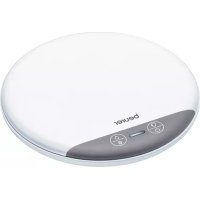
BG 19 - Kitchen scale BEURER - Free user manual and instructions
Find the device manual for free BG 19 BEURER in PDF.


| Brand | Beurer |
| Model | BG 19 |
| Product type | Kitchen impedance scale |
| Maximum capacity | 150 kg (330 lb / 24 st) |
| Graduation | 100 g (0.2 lb / 1/4 st) |
| Units of measurement | kg, lb, st (switchable) |
| Main functions | Weighing, body fat measurement, hydration and muscle mass |
| Technology | Bioelectrical impedance analysis (BIA) |
| Number of user memories | 10 |
| Age range | 10 to 100 years |
| Height range | 100 to 220 cm |
| Display | LCD digital |
| Power supply | 1 CR2032 3 V lithium battery |
| Low battery indicator | "Lo" display |
| Cleaning | Damp cloth, no harsh cleaners |
| Usage precautions | Do not use with pacemaker, during pregnancy, wet feet |
| Auto-off | Yes |
| Conformity | EMC Directive 2004/108/EC |
| Disposal | WEEE 2002/96/EC |
Frequently Asked Questions - BG 19 BEURER
User questions about BG 19 BEURER
0 question about this device. Answer the ones you know or ask your own.
Ask a new question about this device
Download the instructions for your Kitchen scale in PDF format for free! Find your manual BG 19 - BEURER and take your electronic device back in hand. On this page are published all the documents necessary for the use of your device. BG 19 by BEURER.
USER MANUAL BG 19 BEURER
Thank you for choosing one of our products. Our name stands for high-quality, thoroughly tested products for the applications in the areas of heat, weight, blood pressure, body temperature, pulse, gentle therapy, massage and air.
Please read these instructions for use carefully and keep them for later use, be sure to make them accessible to other users and observe the information they contain.
Best regards,
Your Beurer Team
1. Interesting facts

The measuring principle of the diagnostic scale
This scale determines the body weight, body water and the percentage of muscle according to the principle of Bioelectric Impedance Analysis (BIA). With this process, an imperceptible, completely safe and harmless current enables the determination of body tissue proportions within seconds. This measurement of electrical resistance (impedance) and the inclusion of constants and/or individual values (age, height, sex, activity levels) can be used to determine the percentage of fat, water and muscle in the body. Muscle tissue and water have good electrical conductivity, and therefore a lower resistance. On the other hand, fatty tissue has a low conductivity, as the fat cells hardly conduct the current due to their very high resistance.
Weighing correctly
If possible, always weigh yourself at the same time of day (ideally in the morning), after going to the toilet, on an empty stomach and without clothes to achieve comparable results.
Only the long-term trend counts.
Short-term weight fluctuations within a few days are usually only due to a loss of liquid. However, body water plays an important role in your well-being. The interpretation of the results depends on the changes in the:
- total weight
- percentage of fat
- percentage of water
- percentage of muscle
and on the length of time during which these changes take place. Rapid changes over several days should be distinguished from mid-term changes (over several weeks) and long-term changes (months). As a basic rule, SHORT-TERM weight changes almost exclusively represent changes in water content, while mid-term and long-term changes can ALSO concern the percentage of fat and muscle.
- If you experience a short-term drop in weight, however the percentage of body fat increases or remains the same, you have only lost water, e.g. after a training session, going to the sauna or following a diet limited to rapid weight loss.
- If you experience a mid-term weight increase, while the percentage of body fat drops or remains the same, you might have built up your muscle mass or your body may have retained more water (e.g. as the result of taking medication or a weaker cardiac function in elderly people).
- If your weight and percentage of body fat drop simultaneously, your diet is working and you are losing fat mass. Ideally, you can support your diet with physical exercise, fitness or power training. This can result in a mid-term increase in the percentage of muscle in your body.
And remember: Physical exercise is the basis for a healthy body.

2. Important notes - keep for later use!
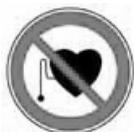
Caution: The scale may not be used by persons with medical implants (e.g. pacemakers). Otherwise their function may be impaired.
Caution - For your safety
- Do not use during pregnancy. Inaccurate measurements may be caused by the amnio-tic fluid.
- Attention! Do not step onto the scale with wet feet or when the scale's surface is damp-danger of slipping!
- You should protect the scale against impacts, moisture, dust, chemicals, major temperature fluctuations and keep it away from heat sources (ovens, radiators).
- Repairs may only be performed by Beurer Customer Service or authorized dealers. However, always check the batteries and replace them if necessary prior to making a complaint.
- All scales comply with EC Directive 2004/108/EC + supplements. Should you still have questions regarding the use of our products, please contact your dealer or Beurer Customer Service.
- The scale should occasionally be cleaned with a damp cloth. Do not use aggressive cleaning agents and never submerge the scale.
- The device is only for private use and is not intended for medical or commercial purposes.
- The diagnostic scale can be preset for an age range of 10–100 years and heights of 100–220 cm (3' 03"–7' 03"). The scale can accept a maximum load of 150 kg (330 lb, 24 St). The weight measurement is displayed in increments of 100 g (0.2 lb, 1/4 St) angezeigt. The measuring results for the body fat, body water and muscle percentages are displayed in 0.1% increments.
- On delivery the scale is set to the units "cm" and "kg". A switch located on the back of the scale enables you to change to "inch", "pound" and "stones" (lb, St).
- Please dispose of the blanket in accordance with the directive 2002/96/EG - WEEE (Waste Electrical and Electronic Equipment). If you have any queries, please refer to the local authorities responsible for waste disposal.

3. Operation
3.1 Batteries
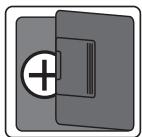
If present, pull the battery insulating strip off the battery compartment cover or remove the battery's protective film and insert the battery according to the polarity. If the scale fails to operate, remove the battery completely and insert it again. Your scale is equipped with a "replace battery" indicator. When the scale is operated with a battery which is too weak, "Lo" appears in the display field and the scale automatically switches off. The battery must be replaced in this case (3 V lithium battery CR2032). The used, completely drained standard and rechargeable batteries must be disposed of in specially marked collection containers, at toxic waste collection points or electrical product retailers. You are legally obligated to dispose of the batteries.
Note: Batteries containing pollutants are marked with the following symbols: Pb = Battery contains lead, Cd = Battery contains cadmium, Hg = Battery contains mercury.
Place the scale on a firm, flat surface; a firm floor covering is a basic requirement for correct weight measurement.
3.2 Measuring weight only
Quickly and firmly tap the standing surface of your scale with your foot. The entire display (Fig. 1) appears up to "0.0" (Fig. 2) as a self-test (tap-on technology).
Now the scale is ready to measure your weight. Stand on the scale without moving about and distribute your weight evenly on both legs. The scale immediately begins to measure your weight. Your measured weight is displayed shortly after this (Fig 3). The scale switches off a few seconds after you step down from it.
3.3 Measuring weight, body fat, body water and muscle percentage
- First your personal parameters must be stored;
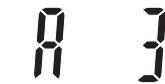
- Briefly step onto the scale first and wait until the display "0.0" (Fig. 2) appears. Then press "SET". Now the first memory preset flashes in the display (Fig. 4). Select the desired preset by pressing the buttons "up" or "down" and confirm the desired preset with the "SET" button.
- Now height in cm (inch) flashes in the display (Fig. 5). Set the desired value by briefly pressing or holding the buttons "up" or "down" and confirm it by pressing "SET".
- "Age" in years then flashes in the display (Fig. 6). Set the desired value by briefly pressing or holding the buttons "up" or "down" and confirm it by pressing "SET".
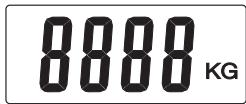
Fig. 1
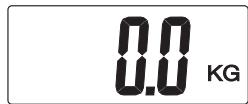
Fig. 2
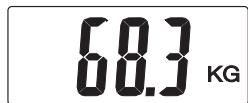
Fig. 3
Fig. 4
- The sex setting "Woman" or "Man" appears on the display (Fig. 7). Select your sex by pressing the buttons "up" or "down" and confirm by pressing "SET".
- Now the setting for your individual level of activity or fitness appears on the display (Fig. 8). Select the desired level of activity by pressing the buttons "up" "down" and confirm the desired level of activity with the "SET" button.
- The values you've just set are displayed again consecutively.
After which the scale switches off automatically.
Explanation of the 5 levels of activity:
Fitness 1: No physical activity while overweight
Fitness 2: Little physical activity while overweight
Fitness 3: No or little physical activity
(Less than 20 min of physical exercise twice a week, e.g. going for a walk, light gardening, gymnastic exercises)
This mode should also be selected before the start of a training or dietary program. After approx. 6-10 weeks you can switch to the next level of activity.
Fitness 4: Moderate physical activity
(20 minutes of physical exercise 2 to 5 times a week, e.g. jogging, cycling, tennis etc.)
This mode should be selected as soon as you notice a general improvement in your well-being/fitness in the course of a training/dietary program.
After 8-12 weeks of continuous training/diet, you can change to the next level of activity.
Fitness 5: Intensive physical activity
(Daily intensive training or physical work, e.g. intensive running, construction work etc.) For this mode you should have an overall high level of mobility, endurance and power and maintain this level over a longer period of time.
The scale has 10 memory presets for basic data with which the users, e.g. each member of the family, can store and call up their personal settings at any time.
- First briefly step onto the scale.
- Select the memory preset where your basic personal data are stored by pressing the or button repeatedly. The data are displayed consecutively until "0.0" (Fig. 2) appears.
- Step onto the scale barefoot and make sure you're standing on both electrodes. First your body weight is determined and displayed.
- Remain standing on the scale; now the body fat and body water analysis is performed. This can take a few seconds.
Important: Your feet, legs, calves and thighs must not touch each other, as otherwise the measurement cannot be performed correctly.
The following data are displayed:
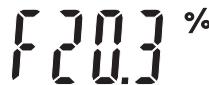
- Body fat percentage in % (Fig. 9)
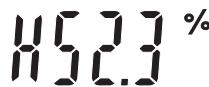
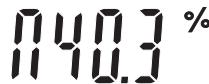
Water percentage in % (Fig. 10) - Muscle percentage in % (Fig. 11)
- Now all measured values are displayed consecutively and the scale switches off.
3.4 Tips for using the scale
Important when measuring body fat/body water/muscle percentage:
- The measurement may only be carried out while barefoot and it is helpful if the soles of your feet are slightly damp. Completely dry soles can result in unsatisfactory results, as they have insufficient conductivity.
- Stand still during the measurement.
Fig. 5
Fig. 6
Fig. 7
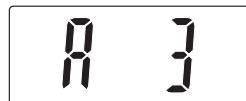
Fig. 8
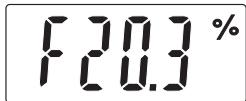
Fig. 9
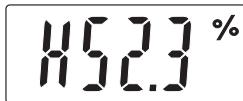
Fig. 10
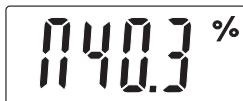
Fig. 11
- Wait several hours (6-8) after unusually strenuous activity.
- Wait approx. 15 minutes after getting out of bed so that the water in your body can be distributed.
The measurement is not reliable for:
- Children under approx. 10 years of age.
- Persons with fever, undergoing dialysis, with symptoms of edema or osteoporosis.
- Persons taking cardiovascular medication. Persons taking vasodialating or vasoconstricting medications.
- Persons with substantial anatomical deviations in the legs relative to their total height (leg length considerably shorter or longer than usual).
Body fat guide
The following body fat levels provide you with a guideline (for further information, please consult your doctor!).
A lower level is often found in athletes. Depending on the type of sports, the intensity of training and the person's physical constitution, levels can be achieved that are even lower than the specified guidelines.
Women
| Age | Very good | Good | Average | Poor |
| <19 | <17% | 17–22% | 22,1–27% | >27,1% |
| 20–29 | <18% | 18–23% | 23,1–28% | >28,1% |
| 30–39 | <19% | 19–24% | 24,1–29% | >29,1% |
| 40–49 | <20% | 20–25% | 25,1–30% | >30,1% |
| >50 | <21% | 21–26% | 26,1–31% | >31,1% |
Men
| Age | Very good | Good | Average | Poor |
| <19 | <12% | 12-17% | 17,1-22% | >22,1% |
| 20-29 | <13% | 13-18% | 18,1-23% | >23,1% |
| 30-39 | <14% | 14-19% | 19,1-24% | >24,1% |
| 40-49 | <15% | 15-20% | 20,1-25% | >25,1% |
| >50 | <16% | 16-21% | 21,1-26% | >26,1% |
based on: "Principles + Labs for Physical Fitness and Wellness. 1st edition, Copyright 1999"
According to the World Health Organization (WHO 2001), the percentage of body water should lie within the following ranges!
Women: 50 - 55%
Men: 60-65%
Children: 65-75%
In persons with a high percentage of body fat, the percentage of body water very frequently lies below the specified guidelines.
As the percentage of muscle differs from individual to individual, there are no generally valid guidelines.
4. Incorrect measurement
If the scale detects an error during weighing, "FFFF" or "Err" appears in the display.
If you step onto the scale before "0.0" appears in the display, the scale will not operate properly.
| Possible causes of errors: | Remedy: |
| - The maximum load-bearing capacity of 150 kg (330 lbs) was exceeded. | - Only weigh the maximum permissible weight. |
| - The electrical resistance between the electrodes and the soles of your feed is too high (e.g. with heavily callused skin). | - Repeat weighing barefoot. Slightly moisten the soles of your feet if necessary. Remove the calluses on the soles of your feet if necessary. |
| - Your body fat lies outside the measurable range (less than 3% or greater than 55%). | - Repeat weighing barefoot. - Slightly moisten the soles of your feet if necessary. |
| - Your percentage of water lies outside the measurable range (less than 36% or greater than 70%) | - Repeat weighing barefoot. - Slightly moisten the soles of your feet if necessary. |
FRANÇAIS
Chere cliente, cher client,
basado en: "Principles + Labs for Physical Fitness and Wellness. 1st edition by Copyright 1999"
Sulla base di: "Principles + Labs for Physical Fitness and Wellness. 1st edition by Copyright 1999"
"Principles + Labs for Physical Fitness and Wellness. 1st edition by Copyright 1999" adli yayindan alintidir.
Pe3yIbTaTbI n3MepeHn HeBepHbIe:
-yTeTeMmJaDme10net;
- liuC BbICOKO TEmpeatpyo, IeuauxxCra dJaIN3OM, CKJIOHHbIX K OTEkAM NII 60JIbHbIX OCTeONOpO3OM;
- liu, npHnHMaIOxN leKapCTBa npOTNB 3a6oJIeBaHn cepDeHNo-CocyDnCTO nCCTEmbl; liu, npHnHMaIOxN cocydopacIrpHIOxne nIi cocSyOCyJKBaIOxne cpeCTBa;
- IINU CO 3HaunTeIbHbIMn aHaTOMUeCKMn OTKIOHEHnMn HOr OTHOCInIbHOrO oBSeo poCTa (IINHa Hor 3HaunTeIbHO yMeHbSeHa IIN yBeJIuHeHa).
pnc.8
pnc.9
pnc.10
pnc. 11
OpneHTnpOBOuHbIe 3NaueHnA COCTaBIAIOUeJ XInpoBOI TkaH
ПивебеHHье HNKe 3NaueHnЯ COCTaBnIIOUe JxIpOBOr TkaHn PpeDcTaBnIOT cObOJ LIMMbOpNEHTIpOBOchIbe BelenuHb (3a DaJIbHeIse INHΦopMaIeM ObaTntEcB K BpaYu!).
Y cnpTcmeHOB qacto 6bIbaet 60lee H3Koe 3aueHHe. B 3aBNCIMOCtN OT Bua cnpTa, INTEHCNBHOCTn TpeHIOBOK N fN3UeCKO KoHCTNTuCm MOyT 6bITb DOCTNRHyTb 3aueHn, KOToPbIE 3HaHTeNbHO MeHbIe Yka3aHHbIX opNEHTPOBOOHbIX 3aueHn.
XeHnHbI
| Возраct | Оченьхорошо | Хорошо | Уdobлесь. | Плобо |
| <19 | <17% | 17-22% | 22,1-27% | >27,1% |
| 20-29 | <18% | 18-23% | 23,1-28% | >28,1% |
| 30-39 | <19% | 19-24% | 24,1-29% | >29,1% |
| 40-49 | <20% | 20-25% | 25,1-30% | >30,1% |
| >50 | <21% | 21-26% | 26,1-31% | >31,1% |
MxKHHbI
| Возраct<19 | Оченьхорош<12% | Хорош12-17% | Удовлесв.17,1-22% | Плобо>22,1% |
| 20-29 | <13% | 13-18% | 18,1-23% | >23,1% |
| 30-39 | <14% | 14-19% | 19,1-24% | >24,1% |
| 40-49 | <15% | 15-20% | 20,1-25% | >25,1% |
| >50 | <16% | 16-21% | 21,1-26% | >26,1% |
Пос MATерпалam: "Principles + Labs for Physical Fitness and Wellness. 1st edition by Copyright 1999"
Tak KaK COCTABJIIOUaMbIeHOn TKaH N OeHb INIINBnDyalbHa, TO ObIux OPneHTIpOBOuyhix 3NaHeHn He cyuectByeT.
4. HeBepHoe n3MepeHne
Ecnn BbctaHOBInTeCb Ha BeCb paHbSe, Yem Ha nncnnee noBnEeTcna,0.0", BeCb He fynKuOnHpyoT doJxHbIM o6pa3OM.