
MultiMaster Top - Sander Fein - Free user manual and instructions
Find the device manual for free MultiMaster Top Fein in PDF.

 FR
FR
 BG
BG
 CS
CS
 DA
DA
 DE
DE
 EL
EL
 EN
EN
 ES
ES
 ET
ET
 FI
FI
 HU
HU
 IT
IT
 JA
JA
 KO
KO
 LT
LT
 LV
LV
 NL
NL
 NO
NO
 PL
PL
 PT
PT
 RO
RO
 RU
RU
 SK
SK
 SL
SL
 SV
SV
 TH
TH
 TR
TR
 UK
UK
 ZH
ZH
| Product type | Multi-function oscillating tool (MultiMaster) |
| Brand | Fein |
| Model | MultiMaster Top |
| Category | Sander / Multi-tool |
| Dimensions (L x W x H) | 350 x 100 x 140 mm |
| Weight | 1.8 kg |
| Power supply | Mains, 230 V / 50-60 Hz |
| Power consumption | 350 W |
| Oscillation frequency | 10,000 – 19,000 min⁻¹ |
| Oscillation angle | 3.2° |
| Main functions | Sanding, plunge cutting, cut-off sawing, scraping, polishing |
| Included accessories | Sanding pad (80 mm), segmented saw blade, scraper, hex key, carrying bag |
| Variable speed | Yes, electronic with dial |
| Accessory holder | QuickIN system (tool-free quick change) |
| Noise level (LpA) | 86 dB(A) (sanding) |
| Vibration (sanding) | 9.5 m/s² (typical value) |
| Protection class | II (double insulation) |
| Power cable | 4 m, H05VV-F, with plug |
| Maintenance and cleaning | Clean ventilation slots with a brush; do not use solvents |
| Spare parts and repairability | Accessories and blades available; repair by Fein authorized center |
| Warranty | 3 years (according to conditions) |
| Production | Germany |
Frequently Asked Questions - MultiMaster Top Fein
User questions about MultiMaster Top Fein
0 question about this device. Answer the ones you know or ask your own.
Ask a new question about this device
Download the instructions for your Sander in PDF format for free! Find your manual MultiMaster Top - Fein and take your electronic device back in hand. On this page are published all the documents necessary for the use of your device. MultiMaster Top by Fein.
USER MANUAL MultiMaster Top Fein
ONJ DOKU-000006206-002.fm Page 1 Thursday, November 24, 2016 3:02 PM

▶ FMM350QSL [**] 7 229 ...


EN 60745-1:2009 + Cor.:2009 + A11:2010
EN 60745-2-4:2009 + A11:2011
EN 60745-2-11:2010
EN 55014-1:2006 + A1:2009 + A2:2011
EN 55014-2:1997 + Cor.:1997 + A1:2001 + A2:2008
EN 61000-3-2:2014
EN 61000-3-3:2013
EN 50581:2012
2011/65/EU, 2006/42/EG, 2014/30/EU


i. V. Schmidt
i. V. Dr. Schreiber
Quality Manager
Director of Advanced Technology
natural_image
3D rendering of a mechanical power tool with no visible text or symbols

other
OBJ BUCH-0000000237-002.book Page 2 Thursday, November 24, 2016 3:03 PM | Parameter | Value | | :--- | :--- | | P1 | W 350 | | P2 | W 190 | | nS | /min, min⁻¹, rpm, r/min 10 000 – 19 500 | | ° | 2 | | kg | 1,45 | | LpA | dB 72 | | KpA | dB 3 | | LwA | dB 83 | | KwA | dB 3 | | LpCpeak | dB 84 | | KpCpeak | dB 3 | | File | File Name | | :--- | :--- | | de | 10 pt 34 tr 58 sl 82 et 106 th 128 | | en | 14 el 38 hu 62 sr 86 lt 110 ja 132 | | fr | 18 da 42 cs 66 hr 90 lv 114 hi 136 | | it | 22 no 46 sk 70 ru 94 zh(CM) 118 ar 143 | | nl | 26 sv 50 pl 74 uk 98 zh(CK) 121 | | es | 30 fi 54 ro 78 bg 102 ko 124 |


OBJ BUCH-0000000237-002.book Page 4 Thursday, November 24, 2016 3:03 PM


4


OBJ BUCH-0000000237-002.book Page 5 Thursday, November 24, 2016 3:03 PM


5





OBJ BUCH-0000000237-002.book Page 7 Thursday, November 24, 2016 3:03 PM


7


natural_image
Illustration of a hand holding a pen tip with a device emitting a curved line, next to a small container (no text or symbols)





8



OBJ BUCH-0000000237-002.book Page 9 Thursday, November 24, 2016 3:03 PM


9




de
Original Instructions.
Symbols, abbreviations and terms used.
| Symbol, character Explanation | |
| Make sure to read the enclosed documents such as the Instruction Manual and the General Safety Instructions. | |
| Do not touch the saw blade. Danger of sharp application tools moving back and forth. | |
| Warning against sharp edges of application tools, such as the cutting edges of the cutter blades. | |
| Observe the instructions in the text or graphic opposite! | |
| General prohibition sign. This action is prohibited. | |
| Before commencing this work step, pull the mains plug out of the socket. Otherwise there will be danger of injury if the power tool should start unintentionally. | |
| Use eye protection during operation. | |
| Use ear protection during operation. | |
| Use a dust mask during operation. | |
| Use protective gloves during operation. | |
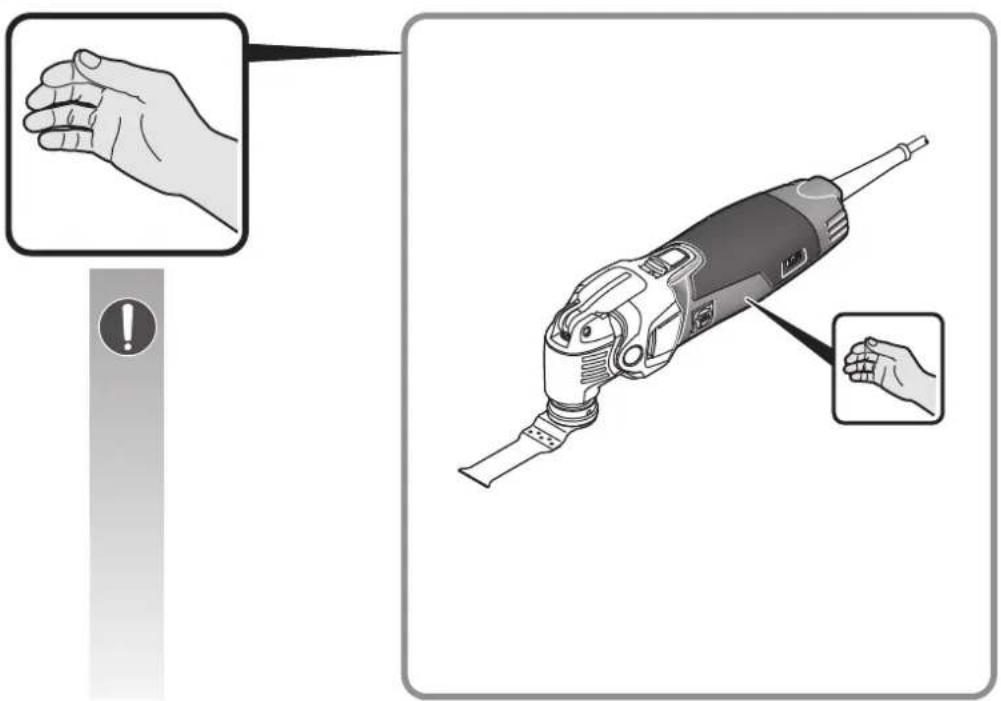
| Gripping surface | |
| Observe the information in the adjacent text! | |
| CE | Confirms the conformity of the power tool with the directives of the European Community. |
| WARNING | This sign indicates a possible dangerous situation that could cause severe or fatal injury. |
| Worn out power tools and other electrotechnical and electrical products should be sorted separately for environmental-friendly recycling. | |
| Product with double or reinforced Insulation | |
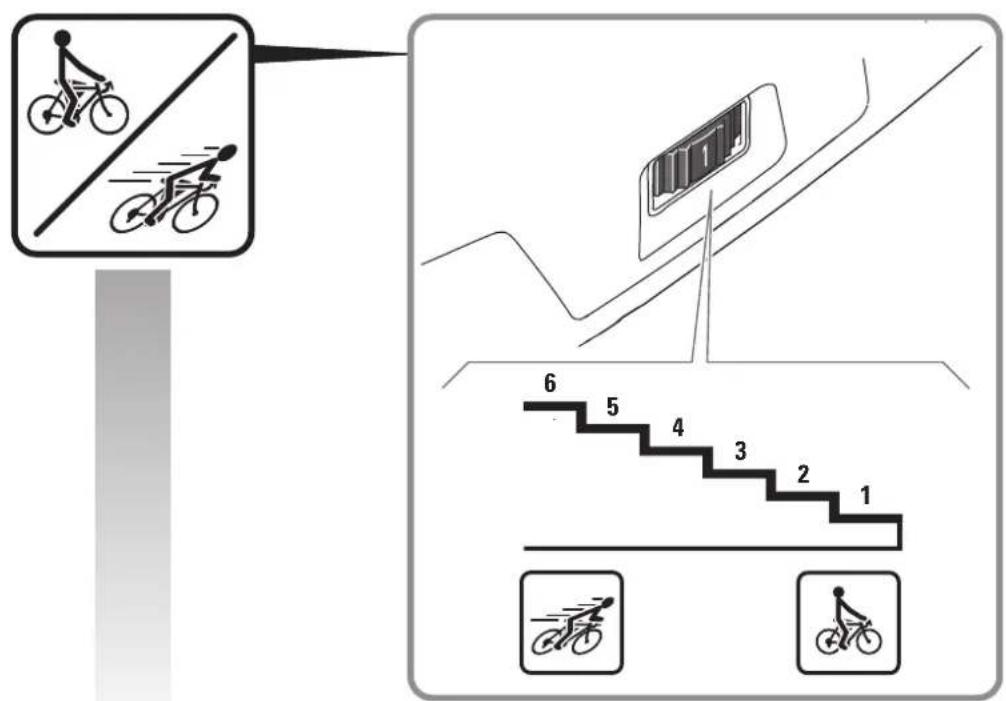
| Low oscillation rate | |
| High oscillation rate | |
| (**) may contain numbers and letters | |
| Character Unit of measurement, international | Unit of measurement, national | Explanation | |
| P_1 | W W Power input | ||
| P_2 | W W Output | ||
| UV | V | R | a t |
| /Hz Hz Frequency | |||
| n_S | /min, min ^-1 , rpm, r/min | /min Rated oscillation rate | |
| ° ° Oscillation angle | |||
e





en
15
| Character Unit of measurement, international | Unit of measurement, national | Explanation |
| kg kg Weight according to EPTA-Procedure 01 | ||
| L_pA | dB dB Sound pressure level | |
| L_wA | dB dB Sound power level | |
| L_pCpeak | dB dB Peak sound pressure level | |
| K... | Uncertainty | |
| a | m/s2 | m/s2Vibrational emission value according to EN 60745 (vector sum of three directions) |
| m, s, kg, A, mm, V, W, Hz, N, °C, dB, min, m/s2 | m, s, kg, A, mm, V, W, Hz, N, °C, dB, min, m/s2Basic and derived units of measurement from the International system of units SI. |
For your safety.
WARNING
Read all safety warnings and all instructions. Failure to follow the
warnings and instructions may result in electric shock, fire and/or serious injury.
Save all warnings and instructions for future reference.

Do not use this power tool before you have thoroughly read and completely understood this Instruction Manual and the enclosed "General
Safety Instructions" (document number
3 41 30 054 06 1). The documents mentioned should be kept for later use and enclosed with the power tool, should it be passed on or sold.
Please also observe the relevant national industrial safety regulations.
Intended use of the power tool:
Hand-guided oscillator for sanding small surfaces, corners and edges, for sawing thin parts of steel sheet, wood and plastic, for scraping, polishing, rasping, cutting and separating without water in weather-protected environments, using the application tools and accessories recommended by FEIN.
This power tool is also suitable for use with AC generators with sufficient power output that correspond to the Standard ISO 8528, design type G2. This Standard is particularly not complied with when the so-called distortion factor exceeds 10% . When in doubt, please refer to the generator instruction/specification guide.
Special safety instructions.
Hold power tool by the insulated gripping surfaces, when performing an operation where the cutting accessory may contact hidden wiring or its own cord. Cutting accessory contacting a "live" wire may make exposed metal parts of the power tool "live" and could give the operator an electric shock.
Use clamps or another practical way to secure and support the workpiece to a stable platform. Holding the work by hand or against your body leaves it unstable and may lead to loss of control.
Do not use accessories which are not specifically designed and recommended by the power tool manufacturer. Safe operation is not ensured merely because an accessory fits your power tool.
Grasp the power tool in such a safe manner that your body never comes into contact with the application tool, especially while working with application tools such as saw blades or other blades pointed toward the grasping range. Touching sharp tips or cutting edges can lead to injuries.
Wear personal protective equipment. Depending on application, use face shield, safety goggles or safety glasses. Where appropriate, wear dust mask, hearing protectors, gloves and workshop apron capable of stopping small abrasive or workpiece fragments. The eye protection must be capable of stopping flying debris generated by various operations. The dust mask or respirator must be capable of filtrating particles generated by your operation. Prolonged exposure to high intensity noise may cause hearing loss.
Do not direct the power tool against yourself, other persons or animals. Danger of injury from sharp or hot application tools.
Do not rivet or screw any name-plates or signs onto the power tool. If the insulation is damaged, protection against an electric shock will be ineffective. Adhesive labels are recommended.
Clean the ventilation openings on the power tool at regular intervals using non-metal tools. The blower of the motor draws dust into the housing. An excessive accumulation of metallic dust can cause an electrical hazard.
Before putting into operation, check the mains connection and the mains plug for damage.
Recommendation: The tool should always be supplied with power via a residual current device (RCD) with a rated current of 30 mA or less.
Handling hazardous dusts
For work procedures with this power tool where material is removed, dusts develop that can be hazardous to one's health.
Contact with or inhaling some dust types, e. g. asbestos and asbestos-containing materials, lead-containing coatings, metal, some wood types, minerals, silicate particles from materials containing stone, paint solvents, wood preservatives, antifouling paints for vessels, can trigger allergic reactions to the operator or bystanders and/or lead to respiratory infections, cancer, birth defects or other reproductive harm. The risk from inhaling dusts depends on the exposition. Use dust extraction matched
en
appropriately for the developing dust, as well as personal protective equipment and provide for good ventilation of the workplace. Leave the processing of asbestos-containing materials to specialists.
Wood and light-metal dust, hot mixtures of grinding dust and chemical materials can self-ignite under unfavourable conditions or cause an explosion. Avoid sparking in the direction of the dust collector as well as overheating of the power tool and the materials being sanded, empty the dust collector/container in time, observe the material manufacturer's working instructions, as well as the relevant regulations in your country for the materials being worked.
Hand/arm vibrations
The vibration emission level given in this information sheet has been measured in accordance with a standardised test given in EN 60745 and may be used to compare one tool with another. It may be used for a preliminary assessment of exposure.
The declared vibration emission level represents the main applications of the tool. However, if the tool is used for different applications, with different accessories or poorly maintained, the vibration emission may differ. This may significantly increase the exposure level over the total working period.
An estimation of the level of exposure to vibration should also take into account the times when the tool is switched off or when it is running but not actually doing the job. This may significantly reduce the exposure level over the total working period.
Identify additional safety measures to protect the operator from the effects of vibration such as: maintain the tool and the accessories, keep the hands warm, organisation of work patterns.
Emission values for vibration
| Vibration | a |
| Classification of FEIN application tools according to vibration class | Weighted acceleration* |
| VC0 | < 2.5 m/s^2 |
| VC1 | < 5 m/s^2 |
| VC2 | < 7 m/s^2 |
| VC3 | < 10 m/s^2 |
| VC4 | < 15 m/s^2 |
| VC5 | > 15 m/s^2 |
| Ka1.5 m/s | ^2 |
| * These values are based on a work cycle consisting of no-load and full-load operation of the same duration.For Information on the vibration class assigned to the application tool, please see the enclosed data sheet 3 41 30 443 06 0. | |
Operating Instructions.
Do not use accessories not specifically intended and recommended for this power tool by FEIN. The use of non-original FEIN accessories can lead to overheating of the power tool and destroy it.
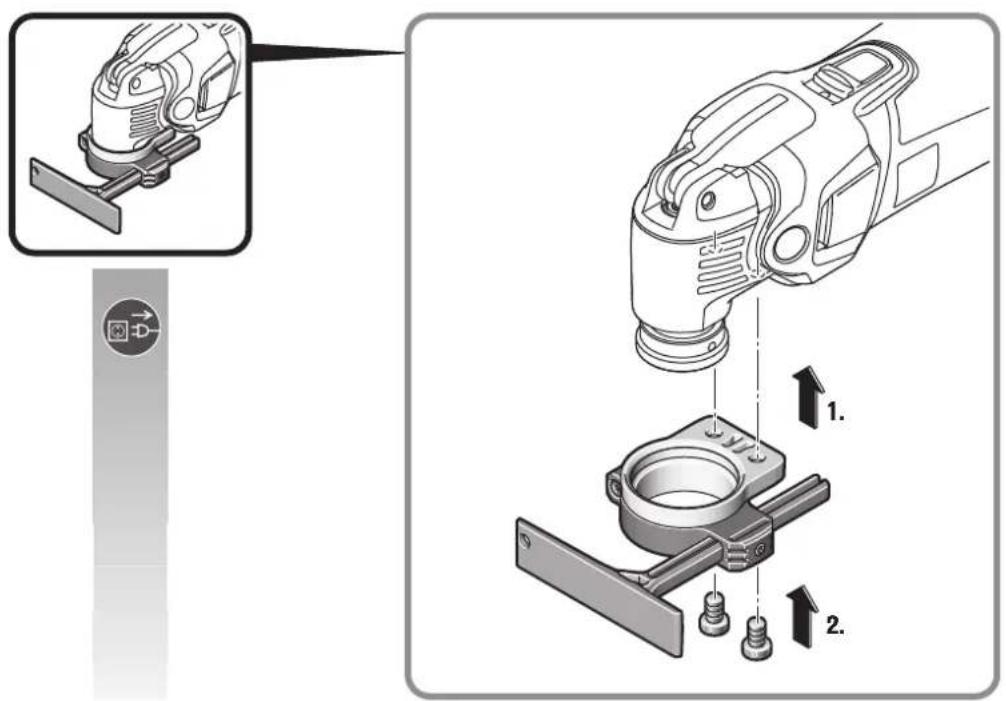
Changing the tool (see pages 4/5).
Do not switch the power tool on while the clamping lever is open. Otherwise there is danger of crushes or contusions to the hand and fingers.
Do not reach into the area of the clamping jaws. Otherwise there is danger of crushes or contusions to the fingers.
Additional operating instructions.
Do not actuate the clamping lever while the power tool is running. Otherwise there is danger of injury.
Do not operate the power tool with with open clamping jaws and without an application tool! This could damage the power tool.
When the clamping jaws are open before the application tool is inserted, pivot the clamping lever toward the front and then back again. The clamping jaws are closed now. The application tool can be inserted.
Guide the power tool toward the work piece only when switched on.
The application tool can be offset in 30° steps and fastened in the most favourable working position.
Notes on sanding.
Press the power tool with the sanding sheet briefly and firmly against a flat surface and briefly switch the power tool on. This provides for good adhesion and prevents premature wear.
When only one tip or corner of the sanding sheet is worn, it can be removed again and reattached turned by 120°.
Work with the entire surface of the sanding plate, not only with the tip.
When sanding with small triangle sanding plates, select a high oscillating frequency (electronics level 4 – 6); when sanding with the round sanding plate and the large triangle sanding plate, select a moderate oscillating frequency (max. electronics level 4).
Sand with continuous motion applying moderate pressure. Applying excessive pressure does not increase the rate of removal, it only wears off the sanding sheet faster.
Notes on profile sanding.
Select a medium oscillating frequency.
Notes on sawing.
Select a high oscillating frequency. Round saw blades can be released and clamped offset again, to allow for uniform wearing off.
Notes on scraping.
Select a moderate to high oscillating frequency.
Repair and customer service.


When working metal under extreme operating conditions, it is possible for conductive dust to settle in the interior of the power tool.
The total insulation of the power tool can be impaired. Blow out the interior of the power tool via the ventilation slots frequently with dry and oil-free compressed air, and connect a residual current device (RCD) on the line side.
If the supply cord of this power tool is damaged, it must be replaced by a specially prepared cord available through the FEIN customer service centre.
The current spare parts list for this power tool can be found in the Internet at www.fein.com.
If required, you can change the following parts yourself: Application tools
Warranty and liability.
The warranty for the product is valid in accordance with the legal regulations in the country where it is marketed. In addition, FEIN also provides a guarantee in accordance with the FEIN manufacturer's warranty declaration.
The delivery scope of your power tool may include only a part of the accessories described or shown in this Instruction Manual.
Declaration of conformity.
FEIN declares itself solely responsible for this product conforming with the relevant provisions given on the last page of this Instruction Manual.
Technical documents at: C. & E. Fein GmbH, C-DB_IA, D-73529 Schwäbisch Gmünd
Environmental protection, disposal.
Packaging, worn out power tools and accessories should be sorted for environmental-friendly recycling.

Miljøvern, deponering.
natural_image
Pure geometric diagram with crosshair and circular shapes, no text or symbols presentuk





- de
- For your safety.
- WARNING
- Intended use of the power tool:
- Special safety instructions.
- Handling hazardous dusts
- en
- Hand/arm vibrations
- Operating Instructions.
- Changing the tool (see pages 4/5).
- Additional operating instructions.
- Guide the power tool toward the work piece only when switched on.
- Notes on sanding.
- Notes on profile sanding.
- Notes on sawing.
- Notes on scraping.
- Repair and customer service.
- Warranty and liability.
- Declaration of conformity.
- Environmental protection, disposal.
- Miljøvern, deponering.
- uk
Brand : Fein
Model : MultiMaster Top
Category : Sander