
WEM1035 - Welding machine Ferm - Free user manual and instructions
Find the device manual for free WEM1035 Ferm in PDF.


| Product type | Arc welding machine |
| Brand | Ferm |
| Model | WEM1035 |
| Power supply | 230 V / 400 V ~ 50 Hz |
| Number of phases | 1 or 3 |
| Welding amperage range | 55 - 140 A (230 V) / 55 - 160 A (400 V) |
| No-load voltage | 48 V |
| Electrode diameter | 2 - 4 mm |
| Power factor | 0.62 |
| Weight | 22.1 kg |
| Dimensions (L x W x H) | 56 x 32.5 x 40 cm |
| Protection class | IP21S |
| Insulation class | H |
| Thermal protection | 105 °C (± 5 °C) with automatic shutdown |
| Package contents | Welding machine, welding mask, wire brush/chipping hammer, user manual, safety instructions, warranty card |
| Power cable | HO7RN-F 3x1.5 mm² |
| Welding cables | HO1N2-D 1x16 mm² |
| Recommended fuse | 16 A (delayed) |
| Standard | EN60974-6, IEC 60974-10 |
Frequently Asked Questions - WEM1035 Ferm
User questions about WEM1035 Ferm
0 question about this device. Answer the ones you know or ask your own.
Ask a new question about this device
Download the instructions for your Welding machine in PDF format for free! Find your manual WEM1035 - Ferm and take your electronic device back in hand. On this page are published all the documents necessary for the use of your device. WEM1035 by Ferm.
USER MANUAL WEM1035 Ferm
natural_image
Blue FERM industrial testing device with control panel and attached tubing (no visible text or symbols on main body)WEM1035
EN Original instructions 03
DE Übersetzung der Originalbetriebsanleitung 10
NL Vertaling van de oorspronkelijke gebruiksaanwijzing 17
FR Traduction de la notice originale 24
ES Traducción del manual original 31
PT Tradução do manual original 39
IT Traduzione delle istruzioni originali 46
SV Översättning av bruksanvisning i original 53
FI Alkuperäisten ohjeiden käännös 60
NO Oversatt fra orginal veiledning 66
DA Oversættelse af den originale brugsanvisning 72
The numbers in the following text refer to the picture on page 2 + 109

the operating instructions carefully before using this device. Familiarise yourself with its functions and basic operation. Service the device as per the instructions to ensure that it always functions properly. The operating instructions and the accompanying documentation must be kept in the vicinity of the device.
Introduction
The fusion welding process is used to melt the workpiece material under the influence of heat supplied. With electrical arc welding use is also made of welding material (electrodes). The weld originates after solidification.
The heat required is obtained by maintaining an electrical arc between the electrode and workpiece. The welding process requires a strong current (55-160 A) with a relatively low voltage (10-48 V). A transformer in the welding appliance ensures the lowering of the mains voltage (400 V).
The device is not suitable for commercial use!
Contents
- Machine information
- Safety instructions
- Mounting accessories
- Operation
- Service & maintenance
1. Machine information
Technical specifications
| Voltage 230 / 400 V ~ | |
| Frequency 50 Hz | |
| Welding power 55 / 140 A (230 V) / 160 A (400 V) | |
| No-load voltage 48 V / 230 V | |
| Power factor 0.62 | |
| Diameter of electrodes 2 - 4 mm | |
| Weight 22.1 kg | |
| Dimensions 56 x 32.5 x 40 cm | |
| Thermal protection 105 °C (±5 °C) | |
| Powercord H07RN-F 3×1.5mm | ^2 |
| Welding cable | H01N2-D 1×16mm ^2 |
Contents of packing
1 Welding appliance
1 Welding mask
1 Wire brush/scaling hammer
1 User Manual
1 Safety instructions
1 Guarantee card
Check the machines, loose parts and accessories for transport damage.
Product information
Fig. 1 & Fig. 2
- Indicator lamp temperature
- On/off switch
- Welding cable with electrode holder
- Earth cable with fixture
- Rubber cap
- Handle
- Ventilation slots
- Wire brush /scaling hammer
- Welding mask
-
Electrodes
-
Rotary knob for setting current intensity
Table: setting and use
| ∅ Electrode (mm) | Current intensity (A) | Suitable for, among others: |
| 2 | 50-75 Material thickness 2-3 mm Repairing of wall stand | |
| 2.5 | 70-100 | Material thickness 4-5 mm Garden fence, garden toys |
| 3.2 | 95-150 Carport, garage | Material thickness 6-7 mm |
| 4 | 130-160 | Material thickness 8-12 mm Construction (heavy) |
2. Safety instructions


Caution! Read instruction manual.
Explanation of the symbols

Denotes risk of personal injury, loss of life or damage to the tool in case of non-observance of the instructions in this manual.

Indicates electrical shock hazard.

Immediately unplug the plug from the mains electricity in the case that the cord gets damaged and during maintenance.
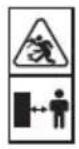
Keep bystanders away.

Do not expose in rain

Wear ear and eye protection.

Wear protective gloves.

Always use a welding mask during welding

Wear protecting clothes
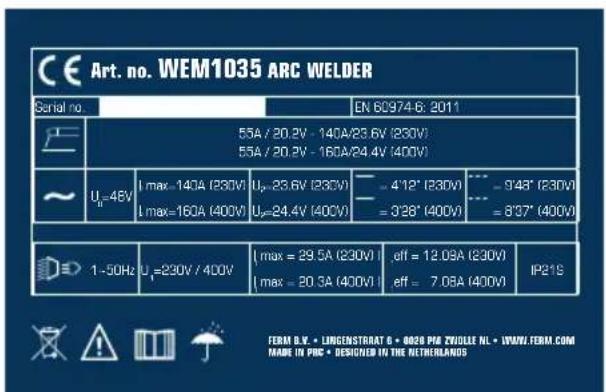
EN60974-6
Standard for welding appliances for manual metal arc welding with limited duty.
EMC classification in accordance with IEC 60974-10

Electrode holder

Earth terminal

Falling voltage

Single-phase transformer

Supply circuit, phases 1 or 3 \~50 Hz

Electrode diameter

Fusing 16A

Maximum I1 max primary current intensity in Ampere

Secondary current intensity in Ampere

Rated maximum welding time in intermittent

Rated maximum welding time in continuous mode
IP21S
Protection class. Sealed for objects up to 12 mm and against perpendicular falling drip water. Stoppage with water control.

Insulation class

Rated no-load voltage

Rated supply voltage

Values of the conventional load voltage

Maximum effective supply current
General safety instructions for welding appliances
• The user of the machine must have been instructed how to use and operate the machine.
- Ensure a well-illuminated and tidy working environment.
• Always remove the plug from the plug socket before carrying out maintenance on the machine.
- Remove the plug from the plug socket when you leave the machine.
- Do not use the machine before you have fully assembled and installed the machine as described in the manual.
Specific safety instructions for welding appliance
- Welding causes sparks and hot metal. Remember that this is a fire hazard, and remove all flammable objects from the working environment.
- Ensure good ventilation in the working environment. Gases are released when welding that are a danger to your health.
- Do not weld containers or pipes that contain or have contained flammable liquids or gases (danger of fire or explosion).
- Do not weld materials that have been cleaned with highly flammable liquids or that have painted surfaces (likelihood of the release of dangerous gases).
- Do not work in a humid or wet environment and do not weld in the rain.
• Always protect your eyes with the welding
mask supplied.
- Use gloves and protective clothing that are dry and not drenched in oil or dirt.
- The slag to be chipped off is sometimes glowing hot and can cause serious eye injuries during removal. Always wear protective goggles and gloves.
- Ultraviolet radiation can burn your skin during welding. So always wear suitable protective clothing.
- Your welding appliance is protected against overloading. The welding appliance therefore automatically switches off if it overloads. The welding appliance automatically switches on again after it has cooled sufficiently.
- During welding and cooling your workpiece can deform due to stresses. Always bear this in mind.
- Only the welding cables included in the delivery kit may be used ( 10 mm ^2 rubberized welding cable).
- Special regulations apply to areas at risk of fire or explosions.
- Welded connections that are exposed to high stress and which must fulfill certain safety requirements may only be carried out by specially trained and certified welders. Some examples are: Pressure vessels, slide rails, tow couplings, etc.
- Important: Always connect the ground terminal as close as possible to the weld spot in such a way that the welding current can take the shortest possible path from the electrode to the ground terminal. Never connect the ground terminal to the housing of the welding device! Never connect the ground terminal to grounded components that are located far away from the workpiece, e.g., to a water pipe in another corner of the room. Otherwise, the protective conductor system of the room in which you are welding could become damaged.
- The fusing of the supply lines to the power outlets must correspond to regulations (VDE 0100). Protective contact outlets may be fused with a max of 16A (types and technical data: RT14-20, ∅ 10 x 38, AC 400 V 16A. IEC 60269. slow blow. Manufacturer: Chint) (fuses or line-protection switches). Higher amperage fuses can lead to burnt cables or fire damage to the building.
Electrical safety

Switch off the machine at once if:
- There is a defect in the mains plug, power cable or there is damage to the cable.
• Defective switch.
• You see smoke or smell burnt insulation.

Warning! Depending on the supply mains conditions at the point of connection, the welding power source may cause interference to the supply to other electricity users. If there is any doubt about this question advice should be sought from the electricity supply authority.
- Make sure that the welding appliance and electric wiring connections are properly made. Any likelihood of electric shock can endanger life.
• Always ensure good connections, both of the electrode holder and the earth terminal. - Do not allow electrical cables to be damaged by pulling. Disconnect cables before you move the welding appliance.
- Avoid contact with the electrically conductive part of the welding appliance, the electrode holder and the earth terminal.
• Always check that your mains voltage corresponds to the value on the type plate of the machine. - With the replacement of cables or plugs: Throw away old cables or plugs as soon as they have been replaced by new ones. Inserting a loose cable plug in a plug socket is dangerous.
• For all welding appliances working on 230 Volts use at least 16 Ampere fusing - When use is made of extension leads: Use only an approved extension lead that is suitable for the machine power. The cores must have a diameter of at least 1.5 mm ^2 . Roll the cord fully out if the extension cord is on a reel.
- Only allow qualified electricians to work on the supply voltage end, e.g., on cables, plug-in connectors, outlets, etc.
3. Mounting accessories

Make sure that the plug has been removed from the plug socket during the assembly of accessories.
Installation of the machine
• Install the welding appliance in a dry and clean space (free of iron powder, dust and paint).
- Place the welding appliance on a firm and flat surface and at least 20 cm from the wall.
- Protect the welding appliance against rain and strong sunlight.
The welding mask
Fig. 2
- Assemble the welding mask by fixing the handle with the delivered screws.
- Place the light glass (protective glass) in front of the dark welding glass. Place the glasses inside the window and lock them.
- Make sure that the glasses are positioned so that no (harmful) light can now penetrate the opening.
- Replace the light protective glass when the view of the workpiece becomes insufficient during welding. Replacing the dark welding glass is considerably more expensive than replacing the light protective glass.
Fitting new electrodes
The electrode consists of a metal core enclosed by a coating. At one end of the electrode the core is not covered by the coating.
- Press the handle of the electrode holder against the spring.
- Place an electrode with uncoated end (± 2 cm) in the electrode holder. Make sure that the non-coated part makes good contact with the metal part of the electrode holder (electrode not pushed too far in the electrode holder).
- Release the handle of the grip. The electrode is now fixed.

N.B! Do not allow the electrode to burn to lengths shorter than ± 5 cm because of overheating and/or the deformation of the electrode holder. The burnt up electrode will then be difficult to remove.
Removing used electrodes
Press the grip of the electrode holder against the spring so that the burnt up electrode can fall from the holder.

N.B! Do not remove the electrode from the holder by hand. The electrode is very hot!

N.B! Watch where the waste electrode falls to prevent a fire hazard and possible injury.

Warning: Read instruction manuals before operating and servicing this equipment.
Installation
Fig. 4
The initial position of the switch (2) is set to "OFF". The machine has 2 plugs, it can be used at 230V or 400V voltage.
- With the VDE plug, it can only be used in 230V position. To operate the welder at 230V voltage, connect the VDE plug to 230V power supply, then turn the switch (2) from "OFF" to 230V position.
- With the 5 pin industrial plug it can only be used at 400V. Connect the industrial plug to 400V power supply, then turn the switch (2) from "OFF" to 400V positon.
Please note the following to avoid the risk of fire, electric shock or injury to persons:
1 Please make sure before operating the welder that the rated voltage of the unit matches that of the power source.
2 Please disconnect the device from the power supply before setting the nominal voltage.
3 Adjusting the nominal voltage during operation of the welder is prohibited.
4. Operating
Before use:
a. General information about electric arc welding
b. The electrode
c. Protective clothing
d. Face protection
e. Working environment
a. General information about electric arc welding
The temperature of the arc amounts to approx. 7000° Celsius, so the end of the electrode and the workpiece fuse. For as long as the arc is maintained, the electrode will melt and supply the necessary welding material to the parts to be joined. The distance between the electrode and the workpiece must be as short as possible (approx. 1.5 - 4 mm) depending on the diameter and type of electrode. The current needed for welding is supplied by the welding appliance. The power required by the welding appliance depends on the work to be done. Make sure that the electrodes are completely dry, as moist electrodes cause problems. If the electrode sticks to the workpiece during welding your current intensity is set too low.
b. The electrode
- The electrode consists of a metal core enclosed by a coating. The coating has the most important purpose of protecting the welding pool and the transferring droplets against oxygen and nitrogen in the surrounding air. The electrode melts during welding. A part of the coating vaporises so a protective gaseous shield originates. part of the coating floats on the welding pool (it is lighter than steel) and also protects the cooling weld. After cooling this coating becomes a solid but easily removable slag on the welded joint.
- Handle the electrodes with care so the coating is not broken. Make sure that the electrodes are thoroughly dry, so store them in a moisture-free place.
- It is of great importance to use the right electrode to make a good and strong welded joint. A universal electrode will in many cases be suitable for your work. The electrode packaging mentions in which positions welding can be done with the electrodes concerned (above the head, downwards, etc. bearing in mind the speed of melting of the electrode). Separate electrodes are commercially available for the welding of types of stainless steel and cast iron. Consult your dealer about purchasing the right electrode.
c. Protective clothing
Wear thoroughly covering clothing so that the likelihood of the skin being burnt by ultraviolet radiation or splashes of metal is minimised. Preferably wear cotton overalls, welding gloves and safety shoes. Make sure that welding spatter cannot end up in gloves or shoes. A (leather) welding apron stops burning and sparks damaging overalls.
d. Face protection
Fig. 2
Use a good welding mask with (dark) welding glass and protective glass. Check that both glasses are correctly fitted (well-fastened and not allowing any sunlight in).
The welding mask protects the welder against radiation, heat and weld spatter released during the welding process. This also reduces the inhalation of welding fumes. The invisible ultraviolet rays cause so-called “welder’s flash”. This already originates after a few seconds of looking into the electric arc.
Avoid the effects of this radiation and high temperatures on the face and other exposed body parts such as the neck and arms. Protect yourself against the dangerous effects of the electric arc and keep persons who are not participating in the work at least 15 m from the arc. Persons or assistants working in the vicinity of the electric arc must be advised of the hazards and they must be equipped with the required protective gear. If required, set up protective walls.
e. Working environment
- Ensure a well ventilated working environment. Gases are released when welding that are a danger to your health.
- Remove all flammable objects from the working environment. Welding causes sparks and hot metal.
• Make sure that cooling water is present in the vicinity of workplace. Do not leave just welded (hot) workpieces unattended in the workplace. Cool the workpiece before leaving the workplace.
Protection against radiation and burns
- At the work place, the hazard to the eyes must be indicated by a sign stating “Caution! Do not look at the flames!” The workstations must be shielded as much as possible in such a manner that personnel standing in the vicinity of the workstation are protected. Keep unauthorized personnel away from the welding work.
- In the immediate vicinity of the stationary workstations, the walls should not be brightly colored or glossy. Windows must be coated with suitable paint to at least eye-level to prevent radiation reflecting or passing
through.
Bringing into use
Fig. 3
Tip: Before you start welding difficult workpieces it is best to first try the welding out on a test piece.
- Ensure a clean workpiece: remove any rust, grease and paint residues.
-
Set the required current intensity using the knob on the front of the welding appliance.
The choice of current intensity depends on the workpiece and the type of electrode used. -
Place the part of the electrode without coating in the electrode holder and connect the earth terminal to the workpiece.
- Switch the welding appliance on with the main switch.
- Keep the welding mask in front of your face and move the point of the electrode over the workpiece as if you were striking a match. This is the best way to start the welding arc. Do not strike the workpiece with the electrode. This will damage the electrode and impede the creation of the welding arc.
- After creating the welding arc immediately try to keep the distance between point of the electrode and the workpiece equal. Keep this distance equal to the diameter of the electrode. Keep this distance as constant as possible during welding.
- Move the electrode in a gradual pulling movement over the workpiece.
- Keep the angle between electrode and workpiece between 60° and 70° in the direction of movement.
- When the welded joint has been made, break the welding arc by removing the electrode from the workpiece.
- Switch off the welding appliance.

N.B. If you leave the welding appliance on, the likelihood is great that the electrode will make contact (through the work bench) with the earth cable and spontaneously start to weld.
- Remove the slag from the welded joint with a scaling hammer.

Take care for hot flying metal particles. Always wear protective goggles.
an insulating and contaminated layer, and as a result weakens the weld (so-called slag inclusion).
• Brush the weld clean using a wire brush.

N.B. The workpiece is still at a very high temperature.
Do not leave the hot workpiece unattended.
Indicator lamp temperature
Fig.1
When the temperature of the welding appliance becomes too high, the built-in thermostat will switch off (indicator light comes on). The built-in ventilator cools the machine. After cooling the lamp goes off again.
Preferably allow the machine a sufficient time to cool down; with intensive welding the likelihood is great that the thermal cut-out will trigger again after a few minutes.
5. Service & maintenance

Make sure that the machine is disconnected before carrying out any maintenance.
This machine has been designed to operate over a long period of time with a minimum of maintenance. Continuous satisfactory operation depends upon proper machine care and regular cleaning.
Malfunction
Should the machine fail to function correctly, a number of possible causes and the appropriate solutions are given below:
The welding appliance is not working.
- Earth terminal does not have good contact with the workpiece.
- Electrode is not properly positioned in its holder.
• Thermal control switched off, or thermal protection broke.
• Fusing defective (in meter box).
• The cable is broken.
• The switch is defective/contact your dealer.
Electrode continues to 'stick' to the workpiece.
• Use the right type of electrode (universal)
• Current intensity too low/turn button 3
clockwise
Electrode is orange-red.
- Current intensity too high for this type of electrode/turn button 3 anti-clockwise
Electrode spatters excessively and makes a lot of noise during welding.
- Current intensity too high/turn button 3 anti-clockwise
The machine is too hot; indicator lamp is on.
- The ventilation slots are blocked/clean them with a dry cloth; wait a few minutes until the lamp goes off again.

Repairs and servicing should only be carried out by a qualified technician or service firm.
Cleaning
- Make sure that the ventilation slots are free of dust and dirt. Use a soft cloth moistened with soapy water for removing stubborn dirt. Do not use any solvents such as petrol, alcohol or ammonia, etc.
• Make sure that the electrode holder and earth terminal remain corrosion-free so they can continue making good electrical contact. - Regularly check that welding and workpiece cables are firmly connected in their connections
Lubrication
The machine requiers no additional lubrication.
Faults
Should a fault occur, e.g. after wear of a part, please contact the service address on the warranty card. In the back of this manual you find an exploded view showing the parts that can be ordered.
Environment
To prevent damage during transport, the appliance is delivered in a solid packaging which consists largely of reusable material. Therefore please make use of options for recycling the packaging.

Faulty and/or discarded electrical or electronic apparatus have to be collected at the appropriate recycling locations.
Only for EC countries
Do not dispose of power tools into domestic waste. According to the European Guideline 2012/19/EU for Waste Electrical and Electronic Equipment and its implementation into national right, power tools that are no longer usable must be collected separately and disposed of in an environmentally friendly way.
Warranty
The guarantee conditions can be found on the separately enclosed guarantee card.
EMC classification in accordance with IEC 60974-10

Držák elektrody

Koncovka uzemnení

Klesavé napetí

No. Description Position No.
| 100192 Switch-3 positions 13,17,18,19 | ||
| 100191 Thermic protection 26 | ||
| 100193 | Fan | 23 |
| 100194 Electrode holder 11 | ||
| 100195 Earth clamp 3 | ||
| 100196 | Handle | 50 |
| 100197 Wheel set 39,40,41,42 | ||
| 100178 Thermal control 25 | ||
| 100179 Industrial plug 21 | ||
| 100005 Chipping hammer / wire brush | ||
| 100006 Mask glass set (black & white) | ||
| 100007 Welding mask (excl.glass) | ||
| WEA1011 | Electrodes, 2,0mm, 1 kg | |
| WEA1012 | Electrodes, 2,6mm, 1 kg | |
| WEA1013 | Electrodes, 3,2mm, 1 kg | |
| WEA1014 | Electrodes, 2,6mm, 5 kg | |
| WEA1015 | Electrodes, 3,2mm, 5 kg | |
| WEA1016 | Electrodes, 2,0mm, 120 pcs | |
| WEA1017 | Electrodes, 2,6mm, 120 pcs | |
| WEA1018 | Electrodes, 3,2mm, 120 pcs | |

switch turn to 400V:1,3 on,2 off; use 400V model switch turn to 230V:2,3 on,1 off; use 230V model
Exploded view

CE
DECLARATION OF CONFORMITY
WEM1035 Arc welder
(EN) We declare under our sole responsibility that this product is in conformity with directive 2011/65/EU of the European parliament and of the council of 9 June on the restriction of the use of certain hazardous substances in electrical and electronic equipment is in conformity and accordance with the following standards and regulations:
(DE) Der Hersteller erklärt eigenverantwortlich, dass dieses Produkt der Direktive 2011/65/EU des Europäischen Parlaments und des Rats vom 8. Juni 2011 über die Einschränkung der Anwendung von bestimmten gefährlichen Stoffen in elektrischen und elektronischen Geräten entspricht. den folgenden Standards und Vorschriften entspricht:
(NL) Wij verklaren onder onze volledige verantwoordelijkheid dat dit product voldoet aan de conform Richtlijn 2011/65/EU van het Europees Parlement en de Raad van 8 juni 2011 betreffende beperking van het gebruik van bepaalde gevaarlijke stoffen in elektrische en elektronische apparatuur en in overeenstem ming is met de volgende standaarden en reguleringen:
(FR) Nous déclarons sous notre seule responsabilité que ce produit est conforme aux standards et directives suivants: est conforme à la Directive 2011/65/EU du Parlement Européen et du Conseil du 8 juin 2011 concernant la limitation d'usage de certaines substances dangereuses dans l'équipement électrique et électronique.
(ES) Declaramos bajo nuestra exclusiva responsabilidad que este producto cumple con las siguientes normas y estándares de funcionamiento: se encuentra conforme con la Directiva 2011/65/UE del Parlamento Europeo y del Consejo de 8 de junio de 2011 sobre la restricción del uso de determinadas sustancias pelligrosas en los equipos eléctricos y electrónicos.
(PT) Declaramos por nossa total responsabilida-de que este produto está em conformidade e cumpre as normas e regulamentações que se seguem: está em conformidade com a Directiva 2011/65/EU do Parlamento Europeu e com o Conselho de 8 de Junho de 2011 no que respeita à restrição de utilização de determinadas substâncias perigosas existentes em equipamento eléctrico e electrónico.
(IT) Dichiariamo, sotto la nostra responsabilità, che questo prodotto è conforme alle normative e ai regolamenti seguenti: è conforme alla Direttiva 2011/65/UE del Parlamento Europeo e del Consiglio dell'8 giugno 2011 sulla limitazione dell'uso di determinate sostanze pericolose nelle apparecchiature elettriche ed elettroniche.
(SV) Vi garanterar på eget ansvar att denna produkt uppfyller och följer följande standarder och bestämmelser: uppfyller direktiv 2011/65/EU från Europeiska parlamentet och EG-rådet från den 8 juni 2011 om begränsningen av användning av farliga substanser i elektrisk och elektronisk utrustning.
(FI) Vakuutamme yksinomaan omalla vastuullamme, että tämä tuote täyttää seuraavat standardit ja säädökset: täyttää Europan parlamentin ja neuvoston 8. kesäkuuta 2011 päivätyn direktiivin 2011/65/EU vaatimukset koskien vaarallisten aineiden käytön rajoitusta sähkö- ja elektronisissa laitteissa.
(NO) Vi erklærer under vårt eget ansvar at dette produktet er i samsvar med følgende standarder og regler: er i samsvar med EU-direktivet 2011/65/EU fra Europa-parlamentet og Europa-rådet, pr. 8 juni 2011, om begrensning i bruken av visse farlige stoffer i elektrisk og elektronisk utstyr.
(DA) Vi erklærer under eget ansvar, at dette produkt er i overensstemmelse med følgende standarder og bestemmelser: er i overensstemmelse med direktiv 2011/65/EU fra Europa-Parlamentet og Rådet af 8. juni 2011 om begrænsning af anvendelsen af visse farlige stoffer i elektrisk og elektronisk udstyr.
(HU) Felelősségünk teljes tudatában kijelentjük, hogy ez a termék teljes mértékben megfelel az alábbi szabványoknak és előírásoknak: je v souladu se směrnici 2011/65/EU Evropského parlamentu a Rady EU ze dne 8. června 2011, která se týká omezení použití určitých nebezpečných látek v elektrických a elektronických zařízeních.
(CS) Na naši vlastní zodpovědnost prohlašujeme, že je tento výrobek v souladu s následujícími standardy a normami: Je v súlade s normou 2011/65/EÚ Európskeho parlamentu a Rady z 8. júna 2011 týkajúcej sa obmedzenia používania určitých nebezpečných látok v elektrickom a elektronickom vybavení.
(SK) Vyhlasujeme na našu výhradnú zodpovednost, že tento výrobok je v zhode a súlade s nasledujúcimi normami a predpísmi: Je v súlade s normou 2011/65/EÚ Európskeho parlamentu a Rady z 8. júna 2011 týkajúcej sa obmedzenia používania určitých nebezpečných látok v elektrickom a elektronickom vybavení.
(SL) S polno odgovornostjo izjavljamo, da je ta izdelek v skladu in da odgovarja naslednjim standardom terpredpisom: je v skladu z direktivo 2011/65/EU Evropskega parlamenta in Sveta z dne 8. junij 2011 o omejevanju uporabe določenih nevarnih snovi v električni in elektronski opremi.
(PL) Deklarujemy na własną odpowiedzialność, że ten produkt spełnia wymogi zawarte w następujących normach i przepisach: jest zgodny z Dyrektywą 2001/65/UE Parlamentu Europejskiego i Rady z dnia 8 czerwca 2011 r. w sprawie ograniczenia stosowania niektórych niebezpiecznych substancji w sprzęcie elektrycznym i elektronicznym.
(LT) Prisiimdami visą atsakomybę deklaruojame, kad šis gaminys atitinka žemiau paminėtus standartus arba nuostatus: atitinka 2011 m. birželio 8 d. Europos Parlamento ir Tarybos direktyvą 2011/65/EB dėl tam tikrų pavojingų medžiagų naudojimo elektros ir elektroninėje įrangje apribojimo.
(LV) Ir atbilstoša Eiropas Parlamenta un Padomes 2011. gada 8. jūnija Direktīvai 2011/65/ES par dažu bīstamu vielu izmantošanas ierobežošanu elektriskās un elektroniskās iekārtās.
(ET) Apgalvojam ar visu atbildību, ka šis produkts ir saskaņā un atbilst sekojošiem stand artiem un nolikumiem: ir atbilstoša Elropas Parlamenta un Padomes 2011. gada 8. jūnija Direktīvai 2011/65/ES par dažu bīstamu vielu izmantošanas ierobežošanu elektriskās un elektroniskās iekārtās.
(RO) Declarăm prin aceasta cu răspunderea deplină că produsul acesta este în conformitate cu următoarele standarde sau directive: este în conformitate cu Directiva 2011/65/UE a Parlamentului European și a Consiliului din 8 iunie 2011 cu privire la interzicerea utilizării anumitor substanțe periculoase la echipamentele electrice și electronice.
(HR) Izjavljujemo pod vlastitom odgovomoLšu da je strojem ukladan sa slijedešim standardima ili standardiziranim dokumentima i u skladu sa odredbama: usklađeno s Direktivom 2011/65/EU europskog parlamenta i vijeća izdanom 8. lipnja 2011. o ograničenju korištenja određenih opasnih tvari u električnoj i elektroničkoj opremi.
(SR) Pod punom odgovornošću izjavljujemo da je usaglašen sa sledećim standardima ili normama: usaglašen sa direktivom 2011/65/EU Evropskog parlamenta i Saveta od 8.juna.2011. godine za restrikciju upotrebe određenih opasnih materija u električnoj i elektronskoj opremi.
(RU) Под свою ответственность заявляем, что данное изделие соответствует следующим стандартам и нормам: соответствует требованиям Директивы 2011/65/EU Европейского парламента и совета от 8 июня 2011 г. по ограничению использования определенных опасных веществ в электрическом и электронном оборудовании
(UK) На свою власну відповідальність заявляемо, що дане обладнання відповідає наступним стандартам і нормативам: задовольняє вимоги Директиви 2011/65/ЄС Європейського Парламенту та Ради від 8 червня 2011 року на обмеження використання деяких небезпечних речовин в електричному та електронному обладнанні.
(MK) Декларираме под нашата единствена одговорност дека овој производе во сообразност со Директиввата 2011/65/ЕУ на Европскиот парламент и на Советот од 9 Јуни за рестрикција на употреба на одредени опасни супстанци во електрична и електронска опрема е во сообразност и во склад со следните стандарди и регулативи
EN60974-1, EN60974-6, EN60974-10
2014/30/EU, 2014/35/EU, 2011/65/EU, 2012/19/EU
Zwolle, 01-05-2016 H.G.F. Rosberg
CEO Ferm B.V.
Ferm BV • Lingenstraat 6 • 8028 PM • Zwolle The Netherlands


- WEM1035
- The numbers in the following text refer to the picture on page 2 + 109
- Introduction
- Contents
- Machine information
- Technical specifications
- Contents of packing
- Product information
- Fig. 1 & Fig. 2
- Safety instructions
- Explanation of the symbols
- EN60974-6
- IP21S
- General safety instructions for welding appliances
- Specific safety instructions for welding appliance
- Electrical safety
- Mounting accessories
- Installation of the machine
- The welding mask
- Fig. 2
- Fitting new electrodes
- Removing used electrodes
- Installation
- Fig. 4
- Please note the following to avoid the risk of fire, electric shock or injury to persons:
- Operating
- Before use:
- a. General information about electric arc welding
- b. The electrode
- c. Protective clothing
- d. Face protection
- e. Working environment
- Protection against radiation and burns
- Bringing into use
- Fig. 3
- Indicator lamp temperature
- Fig.1
- Service & maintenance
- Malfunction
- The welding appliance is not working.
- Electrode continues to 'stick' to the workpiece.
- Electrode is orange-red.
- Electrode spatters excessively and makes a lot of noise during welding.
- The machine is too hot; indicator lamp is on.
- Cleaning
- Lubrication
- Faults
- Environment
- Only for EC countries
- Warranty
- CE
- DECLARATION OF CONFORMITY
- WEM1035 Arc welder
Brand : Ferm
Model : WEM1035
Category : Welding machine