
SWEP 500 A1 - Stick vacuum SILVERCREST - Free user manual and instructions
Find the device manual for free SWEP 500 A1 SILVERCREST in PDF.

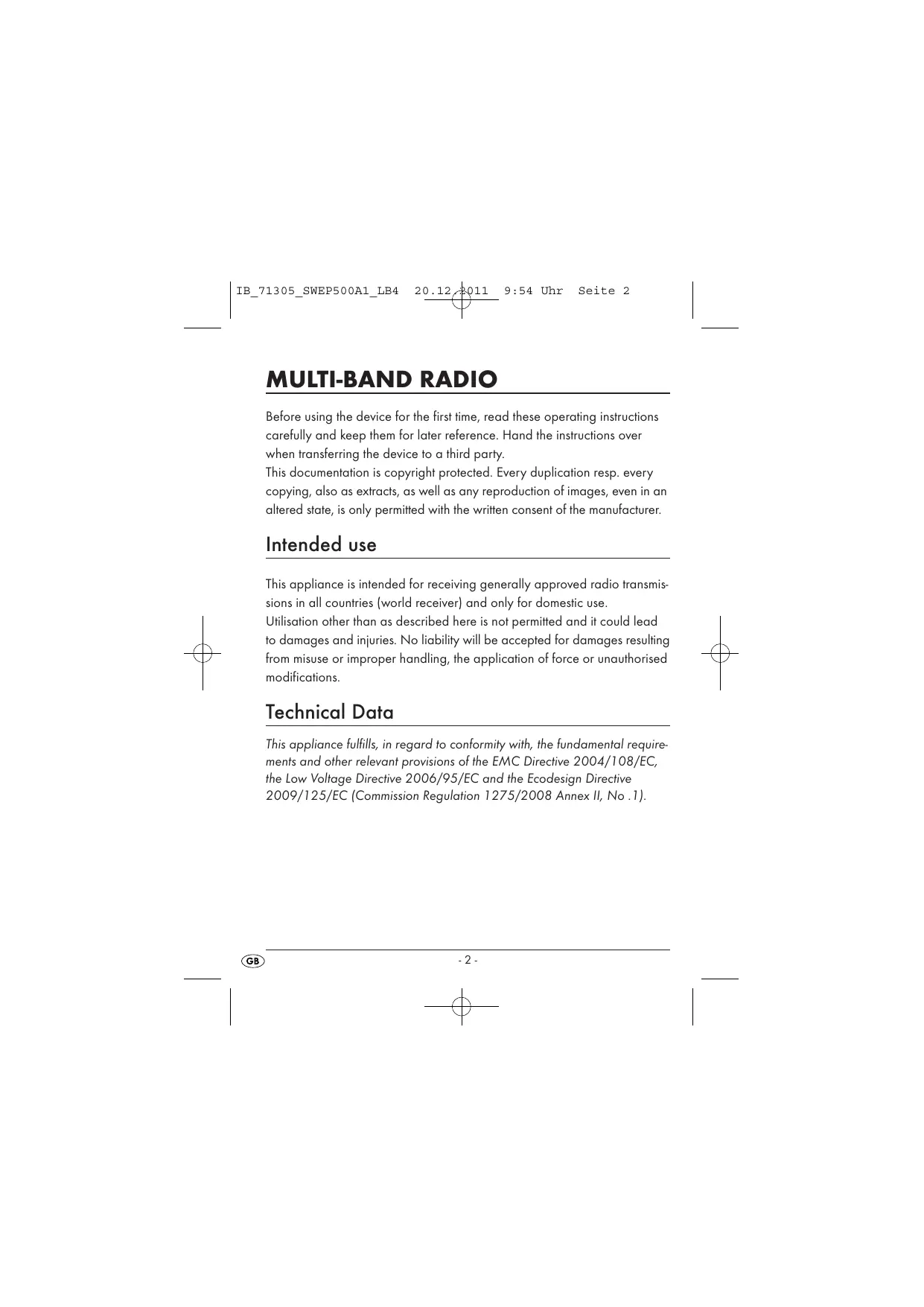


| Product type | Multiband radio (world receiver) |
| Brand | SILVERCREST |
| Model | SWEP 500 A1 |
| Dimensions (W × H × D) | 17.7 × 11 × 3.9 cm |
| Device weight | Approx. 425 g |
| Transformer weight | Approx. 185 g |
| Power supply | Mains 230 V via adapter (9 V, 400 mA) or 4 AA/LR6 batteries (not included) |
| Power consumption | 5 W in operation, approx. 1 W in standby |
| Frequency ranges | FM (87-109 MHz), SW (5.85-17.90 MHz), MW Europe (522-1656 kHz), MW USA (520-1710 kHz), LW (144-299 kHz) |
| Number of station presets | 400 |
| Clock functions | Clock, dual alarm, alarm date, timer, stopwatch, countdown, time zones, 12/24 h display |
| Radio functions | Auto scan, fine tuning, memory, memory scan, bass boost |
| Headphone output | 3.5 mm jack, impedance 32 Ω, max. output 35 mV |
| Operating temperature | +5 °C to +40 °C |
| Humidity | 5 to 90 % (non-condensing) |
| Included accessories | Power adapter, E105 headphones, storage pouch, instruction manual |
| Care and cleaning | Unplug before cleaning. Clean the casing with a slightly damp cloth. Do not immerse in water. |
| Safety | Do not open the casing, do not expose to humidity or naked flames. Use only the supplied headphones. |
| Warranty | 3 years from date of purchase (private use only) |
Frequently Asked Questions - SWEP 500 A1 SILVERCREST
User questions about SWEP 500 A1 SILVERCREST
0 question about this device. Answer the ones you know or ask your own.
Ask a new question about this device
Download the instructions for your Stick vacuum in PDF format for free! Find your manual SWEP 500 A1 - SILVERCREST and take your electronic device back in hand. On this page are published all the documents necessary for the use of your device. SWEP 500 A1 by SILVERCREST.
USER MANUAL SWEP 500 A1 SILVERCREST
Multi-Band Radio SWEP 500 A1
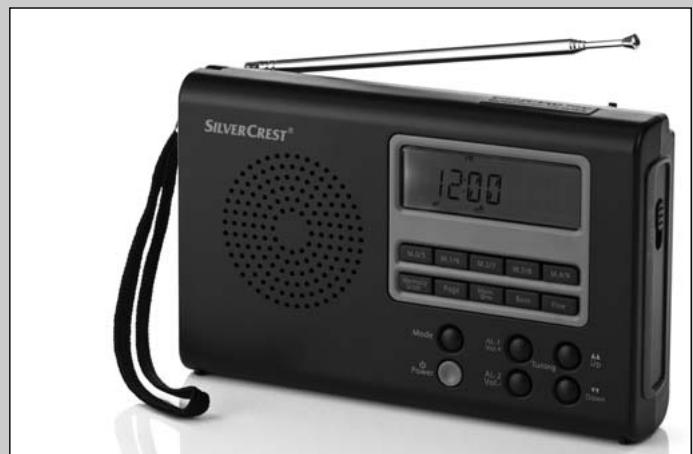
GB Multi-Band Radio Operating instructions
HU Vilagvevo rádio Használatiutasítás
Cz Radio Navod k obsluze
DE Weltempfänger AT Bedienungsanleitung CH
PL Odbiornik wielozakresowy Instrukcia obstugi
Svetovni sprejemnik Navodila za uporabo
SK Radioprijimac Navod na obsluhu
SK Radioprijimać Návod na obsluhu
CONTENTS
PAGE
Intended use 2
Technical Data 2
Symbols used 4
Safety information 5
Operating elements 9
Starting up 10
General functions 12
Time functions 12
Time, date, time zone and world time 13
Select display mode 19
Alarm function 19
Stopwatchfunction 22
Countdown function 22
Radio operation 24
Setting the station 25
Fine tuning 26
Aerial 26
Memory functions 27
Cleaning 29
Disposal 29
Importer 30
Warranty & Service 30
MULTI-BAND RADIO
Before using the device for the first time, read these operating instructions carefully and keep them for later reference. Hand the instructions over when transferring the device to a third party.
This documentation is copyright protected. Every duplication resp. every copying, also as extracts, as well as any reproduction of images, even in an altered state, is only permitted with the written consent of the manufacturer.
Intended use
This appliance is intended for receiving generally approved radio transmissions in all countries (world receiver) and only for domestic use.
Utilisation other than as described here is not permitted and it could lead to damages and injuries. No liability will be accepted for damages resulting from misuse or improper handling, the application of force or unauthorised modifications.
Technical Data
This appliance fulfills, in regard to conformity with, the fundamental requirements and other relevant provisions of the EMC Directive 2004/108/EC, the Low Voltage Directive 2006/95/EC and the Ecodesign Directive 2009/125/EC (Commission Regulation 1275/2008 Annex II, No .1).
Power consumption: 5 watts
Power consumption Standby: approx. 1 W
Operating temperature: +5 +40^ C
Humidity: 5 90% (no condensation)
Dimensions (W× H× D) .. 17.7× 11× 3.9cm
Appliance weight: approx. 425 g
Power transformer weight: approx. 185 g
Batteries
4x 1.5 V, Type AA/LR6/Mignon (not supplied)
Frequency range radio:
VHF (FM): 87 - 109 MHz
SW: 5.85 - 17.90 MHz
MW (AM) Europe 522 - 1656 kHz
MW (AM) USA 520 - 1710 kHz
LW 144-299kHz
The technical features of the device enable the frequency ranges stated above to be set. Various countries may have different national rules on the radio frequency ranges assigned. Please note that you may not sell, transfer to third parties or abuse information received outside the assigned radio frequency ranges.
Tuning ranges (NORMAL/FINE):
FM (VHF) 100kHz / 50kHz
SW 5kHz / 1kHz
MW (AM) Europe 9 kHz/1 kHz
MW (AM) USA 10kHz / 1kHz
LW 1 kHz
Sensitivity: SW can be set to 2 intervals
General
Memory positions: 400
Headphones
Model: E105
Impedance: 32Ω
Wideband characteristic
Voltage (WBCV): approx. 110mV
Headphone socket
max. Output voltage: approx. 35mV
Power transformer
Manufacturer: Everway Industries Ltd.
These symbols bring to your attention that here a warning notice follows in regard to one of the following matters:
- Risk of injury,
- Risk of electric shocks,
- Risk of fire,
- Risk of explosion,
plus bringing your attention to important matters such as: - Information regarding the handling of batteries,
- Information about voltage surges,
- Information about mains-power disconnection.

This symbol warns about submersing the appliance in water or other liquids.

This symbol warns you about hearing damage.
Note:
With this symbol you are given tips about interaction with the appliance.
Safety information
- This device has not been designed for use by people (including children) with restricted physical, sensory or intellectual abilities or lack of experience and/or knowledge, unless they are supervised by a responsible person (for their own safety) or have received instructions on how to use the device.
Children should be supervised to ensure that they do not play with the device.
In order to avoid the device being switched on unintentionally, remove the adapter from the mains socket after each use and before cleaning. - Check the device and all parts for visible damage. The device's safety concept can only work if the device is in perfect condition.
- A mains adapter connected to the device must always be easily accessible so that the device can be quickly disconnected from the mains power in an emergency.
Risk of electric shock!
- Connect the mains-power adapter only to correctly installed and earthed mains sockets. Ensure that the rating of the local power supply tallies completely with the details given on the rating plate of the appliance.
- Damaged adapters or mains cables should be exchanged immediately by an authorised technician or the Customer Service in order to avoid risks.
- Connection cables or devices that do not work perfectly or have been damaged should be repaired or exchanged immediately by Customer Services.

Never immerse the device in water! Simply wipe it with a slightly damp cloth.
- Do not expose the wall wart to rain or use it in a damp or wet environment.
- Ensure that the connection cable is never wet or damp when in use.
- You must not open or repair the device's housing. This can be dangerous and renders the warranty null and void.
- Protect the device from moisture and sprayed water. Therefore do not place any objects filled with water (e.g. vases) on or near the device.
Risk of fire!
- Do not use the device near hot surfaces.
- Do not set the device up where it is exposed to direct sunlight. This could cause it to overheat and damage it beyond repair.
- Never leave the device unattended during operation.
- Never cover the device's ventilation slots when it is switched on.
- Do not place open flames, such as candles, on or near the device.
Risk of injury
- Keep children away from the connection cable and device.
Children frequently underestimate the danger of electrical devices. - If the device has fallen down or is damaged it must no longer be used. Have the device checked by a qualified specialist and, if necessary, repaired.
- Batteries must not be handled by children.
Children can put batteries in their mouths and swallow them.
If a battery has been swallowed, obtain medical assistance immediately.
Thunder storms!
Devices connected to mains power can be damaged during a thunder storm. If there is a thunder storm, always remove the mains plug from the socket.
Information on voltage surges (EFT/electrical fast transient) and electrostatic discharges:
If the product does not work properly due to electrical fast transient processes (voltage surges) or electrostatic discharge, it must be reset to restore normal operation. If necessary, remove the plug from the power socket and insert it again. The batteries (if used) must be removed and reinserted.
Information on separating the device from mains power
The POWER button on this device does not completely separate it from the mains network. In addition, the device uses power when in standby mode. In order to completely separate the device from the mains supply the plug must be removed from the mains socket.
Notes on handling batteries
The device uses batteries. Please note the following on handling batteries:
Risk of explosion!
Do not throw batteries into a fire. Do not recharge batteries.
- Never open, solder or weld batteries. There is a risk of explosion and injury!
- Check batteries regularly. Leaking batteries can damage the device.
- If the appliance is not going to be used for long periods, remove the batteries.
If batteries leak, put on protective gloves. - Clean the battery compartment and contacts with a dry cloth.
Caution!
No liability/warranty applies to damage to the device caused by moisture due to water penetrating the device or overheating!
Operating elements
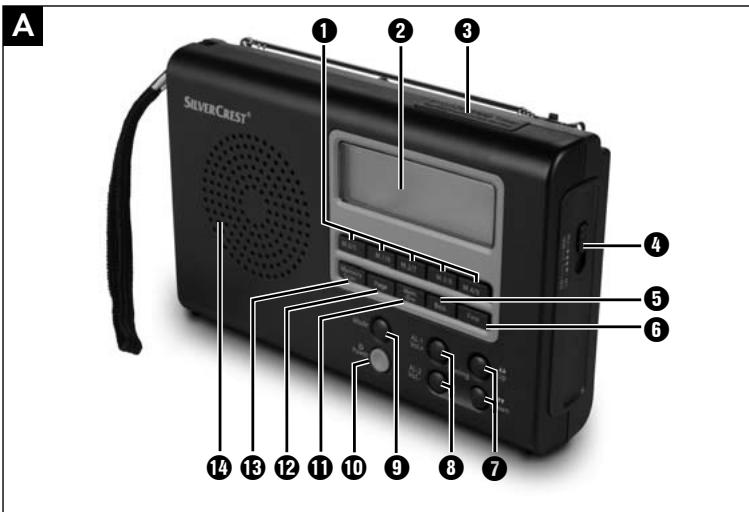
A Front panel
Save buttons M.0/5-M.4/9
2 Display
3 Button SNOOZE/SLEEP TIMER
Waveband selector switch (LW/SW/MW/FM)
BASS button
6 FINE button
UP/DOWN buttons
8 VOL+(AL-1)/VOL-(AL-2) buttons
9 MODE button
10 POWER button
1 MEM button
PAGE button
3 MEMORY SCAN button
14 Loudspeakers
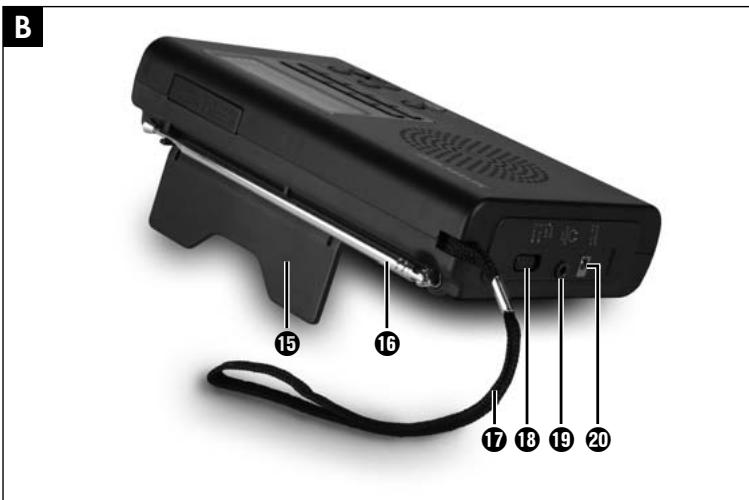
B Back
15 Stand
16 Aerial
17 Carrying strap
13 switch SW SEN. (DX/LX)
19 Headphone output
20 AC 9V400mA : Mains adapter connection
Unpack the device
Remove all packaging materials.

Caution!
Do not let children play with the plastic film. There is a risk of suffocation.
Check the items supplied
Whilst unpacking, check that all of the following items are available to you:
Shortwave Radio
Power transformer
- Headphones
Storage case
These operating instructions
Mains and battery operation
When you disconnect the radio from the mains supply, any settings you may have made (time, alarm, stations in memory) will be lost. If you wish to keep these settings, insert batteries (see below) before disconnecting.
Inserting batteries
The device can also be operated with batteries (not supplied) as well as from the mains. You will need four 1.5V mignon batteries, size AA/LR6.
- Open the battery compartment on the rear of the device by sliding the cover downwards.
-
Insert four batteries into the compartment, paying attention to the polarity.
-
Replace the cover on the battery compartment. If the batteries become too weak, this is indicated by the symbol blinking in the display. Subsequently, the appliance then switches itself off.
Mains connection
- Connect the plug of the mains adapter to the AC 9V400mA socket on the side of the device.
- Plug the mains adapter into an easily accessible socket. To avoid tripping hazards, please avoid using an extension cable.
Note:
When the power adapter is connected the device is supplied with electricity only through the power adapter, not from the batteries. The installed batteries are not charged. In the event of prolonged use of the power adapter the batteries should be removed from the battery compartment. Otherwise there is a risk that the batteries may leak.
Connecting headphones
On the left side of the radio, you will find the headphone socket.
Caution!
With this appliance, use only the supplied type E105 headphones.
- Insert the headphone jack plug into the headphone output. The speaker will be deactivated automatically.

Caution:
Listening to music with headphones for long periods and at high volume levels can lead to hearing damage!
General functions
Key lock
In order to prevent changing the settings unintentionally by touching the buttons, you can activate the key lock.
- With the radio switched on, press and hold the button MEM for about 3 seconds. On screen, the message flashes. All buttons, except the buttons SNOOZE and MEM, are now blocked.
Press and hold down the MEM button again for about 3 seconds to cancel the key lock. The message on the screen disappears.
Screen lighting
- Press any button to illuminate the screen. The screen will remain lit for about 15 seconds.
Stand
- Fold out the base on the rear of the device to make the device more stable.
Time functions
When the power provision is established (mains or battery operation) the time indicated by the world receiver begins at "0:00 00" Proceed with settings the date and time, as explained in the following sections.
The time functions can only be programmed when the radio is switched off. If the device is disconnected from mains power or the batteries are removed, the settings are lost.
Time, date, time zone and world time
You can set the time, date and time zone via the MODE button. You can continue to query and adjust the universal time, the date alarm, the medium-wave reception, alarm time interruption and the hours mode.
When you press the button MODE with the radio switched off, the function to be programmed blinks for about 15 seconds. During this time, adjust the setting with the UP/DOWN buttons.
Press MODE x 1: Setting clock time
Press MODE × 2 Setting the date
Press MODE x 3: Set time zone ("Local City")
Press MODE x 4: Show world time
Press MODE x 5: Date alarm
Press MODE x 6: Set reception range for medium wave.
Press MODE x 7: Set alarm pause.
Press MODE x 8: Set 12/24 hour mode.
To apply a setting, just wait until the screen stops flashing (the screen reverts to the time indication) or press MODE to move on to the next function.
Setting clock time
- Press MODE once. The most recently set time flashes on the screen.
- Press the UP or DOWN button to move the time forward or backward at minute intervals. Hold down one of the buttons for a few seconds to move the setting forward or backward quickly at 10 minute intervals.
Setting the date
- Press MODE again or twice.
The date set flashes on the screen ("Su 1.01.12" when first switched on).
- Press the UP or DOWN button to move the date forward or backward. Keep either of these buttons pressed for a few seconds to change the date in ten-day steps.
The weekday indication follows automatically. The indication uses the first two letters of the English name of the day.
The built-in calendar runs from 2000 to 2099.
Day of the week indication:
Su = Sunday
Mo = Monday
Tu = Tuesday
We = Wednesday
Th = Thursday
Fr = Friday
Sa = Saturday
Setting the time zone
- Press MODE again or three times. The selected time zone flashes on the screen as the abbreviation for the corresponding city (UTC when first switched on); the time disappears.
- Press the UP or DOWN button to move the time zone forward or backward.
The following table summarises the city abbreviations for the time zones and time differences.
| Short code | Difference from CET | Summer time | Town |
| HNL | -10:00 | no | Honolulu/USA |
| ANC | -9:00 | yes | Anchorage/USA |
| YVR | -8:00 | yes | Vancouver/Canada |
| LAX | -8:00 | yes | Los Angeles/USA |
| DEN | -7:00 | yes | Denver/USA |
| CHI | -6:00 | yes | Chicago/USA |
| MEX | -6:00 | yes | Mexico City/Mexico |
| NYC | -5:00 | yes | New York/USA |
| YYZ | -5:00 | yes | Toronto/Canada |
| YUL | -5:00 | yes | Montreal/Canada |
| CCS | -4:30 | no | Caracas/Venezuela |
| RIO | -3:00 | yes | Rio de Janeiro/Brazil |
| BUE | -3:00 | no | Buenos Aires/Argentina |
| UTC* | 0:00 | no | Universal Time Coordinated |
| LON | 0:00 | yes | London/GB |
| BER | 1:00 | yes | Berlin/Germany |
| PAR | 1:00 | yes | Paris/France |
| ROM | 1:00 | yes | Rome/Italy |
| CAI | 2:00 | yes | Cairo/Egypt |
| IST | 2:00 | yes | Istanbul/Turkey |
| MOW | 3:00 | yes | Moscow/Russia |
| KWI | 3:00 | no | Kuwait City/Kuwait |
| DXB | 4:00 | no | Dubai/United Arab Emirates |
| KHI | 5:00 | no | Karachi/Pakistan |
| DAC | 6:00 | yes | Dhaka/Bangladesh |
| BKK | 7:00 | no | Bangkok/Thailand |
| SIN | 8:00 | no | Singapore |
| HKG | 8:00 | no | Hong Kong |
| PEK | 8:00 | no | Beijing/China |
| SHA | 8:00 | no | Shanghai/China |
| TYO | 9:00 | no | Tokyo/Japan |
| SYD | 10:00 | yes | Sydney/Australia |
| NOU | 11:00 | no | Noumea/New Caledonia |
| AKL | 12:00 | yes | Auckland/New Zealand |
*UTC
Universal Time Coordinated (UTC). UTC is the reference for the times of the various time zones around the world.
Show world time
Press MODE again or four times to show the world time. The city
abbreviation appears with the corresponding time.
- Press the UP or DOWN button to move the time zone forward or backward.
Note:
To correctly present your set world time, you must set the summer time offset depending on the world time (see table).
Summer Time Offset
Not every time zone around the world differentiates between summer time and winter time. To correctly display your world time, you must set the summer time offset dependant on the time zone.
- When the display for the time zone is flashing, repeatedly press the SN00ZE button until the corresponding time offset is set (see table).
| Time offset | Display | Explanation |
| 1 | OFFSET 1 | In your time zone (Local City) it is winter time and in the set world time it is summer time. |
| 0 | OFFSET 0 | In your time zone (Local City) and in the set world time it is summer resp. winter time. |
| -1 | OFFSET -1 | In your time zone (Local City) it is summer time and in the set world time it is winter time resp. they do not have summer time. |
Special date alarm
- Press the MODE button a fifth time to set the special date alarm. The screen flashes SDA1 and the date in succession.
- Press the PAGE button to select one of the ten settable date alarms (SDA1 - SDA 10).
- Press the UP or DOWN button to set the date on which the alarm should sound.
- Press the SN00ZE button to ignore the year number setting so that the alarm sounds every year.
- When the current date tallies with the SDA alarm, on that day an alarm sounds for 10 minutes on every hour from 8:00 - 23:00. In addition, the SDA message will flash on the screen.
- Turn off the alarm by pressing any button.
Note:
In order to completely deactivate the date alarm set a date that is in the past!
Setting 12/24 hour mode
- Press MODE eight times. The screen shows the"24 HR" message for 24-hour mode.
- Press the UP button to set the 24 hour mode.
- Press the DOWN button to set the 12 hour mode.
"12 HR" is displayed on the screen. In the afternoon in addition PM is shown on the screen.
Select display mode
You can select which information is shown on the screen when the radio is switched off.
The selected mode is indicated by a corresponding symbol on the screen.
When the radio is switched off, select the display mode by repeatedly pressing the FINE button in accordance with the following table:
Symbol on the screen display mode
CLOCK only the time is displayed
CITY the time and world time are shown in succession
DATE the time and date are shown in succession
CITY DATE the time, date and world time are shown in succession
Alarm function
This multi-band radio provides you with two independently adjustable alarm times, AL1 and AL2. You can programme for both ...
...if the device should sound an alarm on every workday, at the weekend, the whole week or on a single specific weekday;
...if the alarm should sound with an alarm tone or with the radio.
Setting the alarm time
You can set two alarm times in your world receiver.
| Alarm function | Symbol on the screen |
| Radio | |
| Acoustic signals | |
| Switched off | No symbol |
- With the radio switched off, press the buttons VOL.+/AL-1 (or VOL.-/AL-2). The screen shows the most recently set alarm time and the symbol for the alarm type.
- Press the UP or DOWN button to move the alarm time forward or backward at minute intervals. Hold down one of the buttons for a few seconds to move the setting forward or backward quickly at 10 minute intervals.
- Press the VOL+/AL-1 (or VOL-/AL-2) button until the desired alarm function (see table above) is indicated on the screen.
- Press the SN00ZE button to set the weekday on which you want the alarm to sound:
You can select between workdays (Mo, Tu, We, Th, Fr), weekends (Su, Sa), the whole week (Su, Mo, Tu, We, Th, Fr, Sa) or a single weekday.
The selected setting is shown on the display.
- Press the SNOOZE button until the desired alarm days are set. Hold down the SNOOZE button until the screen shows an individual week day.
Press the SN00ZE button to set the desired week day.
To go back to selecting week days, weekend or every day, briefly hold down the SN00ZE button again.
- Press the MODE button to save the setting and return to the time mode. The setting is also saved if you wait around 15 seconds until the screen returns to displaying the time.
When the alarm sounds...
- and the "Radio" alarm function has been selected, the radio operates for one hour at a predefined alarm volume. To switch off press the VOL.+/AL-1 (or VOL.-/AL-2) button.
and the "signal sounds" alarm function has been selected, the signal sound is played for 10 minutes. To switch off press the VOL.+/AL-1 (or VOL.-/AL-2) button.
Note:
Please take note that the last tuned radio station together with the last used sound volume setting is used for the alarm call.
Interrupting the alarm
- Press the button SNOOZE to interrupt the alarm for 10 minutes (default setting) (see also the section "Set snooze time").
Set snooze time
- With the radio switched off, press the button MODE seven times.
The screen displays the snooze time set (default is "SNO 10").
Use the UP and DOWN buttons to set the snooze time to a time between
1 and 59 minutes.
Turning off the alarm function
- Press the VOL.+/AL-1 or VOL.-/AL-2 button until the relevant alarm symbols
disappear from the screen.
Stop watch function
The stop watch function is only available when the radio is switched off.
- Press and hold down the PAGE button for around 2 seconds, the screen shows 0.00 × 1 .
- Press SNOOZE to start the stop watch. The maximum time for the stop watch is 39 minutes and 59 seconds. If the stopwatch exceeds the maximum time, the indicator 39:59.0 appears and flashes in the display.
During time measurement, it can be stopped by pressing SNOOZE. - Pressing SNOOZE again restarts the stop watch.
Hold down SNOOZE to reset the stop watch. - Leave the stop watch by pressing PAGE.
Countdown function
The countdown function is only available when the radio is switched off.
Set and save countdown
-
Press and hold down the MEMORY SCAN button for around 2 seconds, the screen shows 0.00 D. The D blinks.
-
Press the UP or DOWN button to set the desired time.
5 countdown times are preset on the memory buttons and you can open these directly using the corresponding memory button:
Button M.0/5
5:00
Button M.1/6
10:00
Button M.2/7
15:00
Button M.3/8
20:00
Button M.4/9
25:00
- Press the MEM button to save the set time, the memory space indicator MEM flashes on the screen. Now use the M.0/5-M.4/9 buttons to select a memory space; when you press the relevant memory key the time is saved in this memory space and the time previously stored there overwritten.
- When the MEMORY SCAN button is pressed again you leave the countdown mode.
Call up and activate the countdown function
- Press and hold down the MEMORY SCAN button for around 2 seconds, the screen shows 0.00 D.
- Select the desired, saved countdown time with the aid of the M.0/5-M.4/9 memory buttons.
- Press SNOOZE to start the countdown. Pressing the SNOOZE button again pauses the countdown.
When the set time has been counted down, an alarm sound plays for one minute becoming gradually higher in tone and louder.
- Press the MEMORY SCAN button to pause the countdown and leave countdown mode.
Switching on/volume control
- Press the POWER button to switch the radio on. ON will appear briefly on the screen, followed by the current frequency and band selection.
- Press the VOL.+/AL-1 or VOL.-/AL-2 button to control the volume:
Button VOL.-/AL-2: quieter;
Button VOL.+/AL-1: louder.
The sound volume is shown as a bar graph in the left of the display.
Switch on bass amplifier
- When the radio is switched on, press the BASS button to switch on the bass amplifier. The screen will flash BASS.
- In order to switch the bass amplifier off again, press BASS one more time. The BASS message disappears.
Switch display message
- In radio operation press the MODE button to switch between displaying the time and frequency.
Turning off
- Switch the radio off by pressing the POWER button. OFF is shown briefly on the screen and the time is displayed again.
Sleep function
You can activate the sleep function via the SN00ZE button. You can set a time of up to 90 minutes in ten-minute steps, after which the radio will automatically turn itself off. To do so, first switch the radio off.
- Press the SNOOZE button. The symbol for the sleep function and 90 (for 90 minutes) will appear.
- Press the SN00ZE button repeatedly until 90 is displayed to count down the sleep time in 10 minute steps.
Either select a sleep time (the sleep symbol remains on the screen) or press SN00ZE again until 00 appears on the screen. The sleep time is now switched off.
Setting the station
- Select the required frequency band (FM, MW, LW or SW), using the frequency select button.
The corresponding abbreviation will appear on the screen.
The UP and DOWN buttons can now be used to set the desired frequency.
If you keep UP or DOWN pressed for about three seconds, the automatic station search will start.
- The search stops as soon as a station with sufficient signal strength is found.
Setting the MW band
Since the radio transmitter systems differ from one country to another, you should make the appropriate setting via the reception range setting:
- With the radio switched off, press the button MODE six times and then select, using the buttons UP resp. DOWN, the appropriate reception range as per the following table:
| Region | Channel spacing | Band range |
| Amerika | 10 kHz | 520-1710 kHz |
| Europa | 9 kHz | 522-1656 kHz |
Fine tuning
If a station can not be found precisely the fine tuning can be used to improve reception.
During the channel search press the FINE button, the screen shows FINE.
- Now, using the buttons UP resp. DOWN, adjust the required reception range with smaller frequency steps.
- By pressing the FINE again you leave the fine tuning function again. This function is not available for the LW frequency range.
Aerial
The rotatable telescopic aerial on the radio can be used for the FM and SW bands.
Pull the aerial out fully and arrange it for optimum reception.
The SW SEN. switch on the left side of the device can be used to improve the reception quality for the SW band. Select LX for strong stations and DX to improve reception for weak stations.
The telescopic aerial does not work in the MW and LW bands. In these ranges, reception is made by means of the built-in ferrite aerial.
- Align the radio for best reception.
Memory functions
Save station
The world receiver can save 400 radio stations.
To store a station, proceed as follows:
- Set the frequency range with the frequency selection switch and then the station that you want to save.
- Press the MEM button. The screen shows the PAGE memory page and MEM flashes.
- Within 10 seconds press the PAGE button (the PAGE message flashes), and then select a memory page (from 00 - 39) using the UP or DOWN button.
- Within 10 seconds use the M.0/5-M.4/9 buttons to select a memory space to store the station. For example, press the M.0/5 button once for memory space 0 and again for memory space 5. The occupancy is shown on the screen.
- Press MEM again to save the station. The PAGE and MEM messages are shown on a permanent basis.

Note:
If the world receiver is connected to the mains adapter and no batteries have been inserted, the station memories are lost when the adapter plug is pulled from the socket.
Selecting a saved station
- In order to select a saved station directly, first use the frequency selection switch to select the frequency range where the station is saved.
- Press the PAGE button and then use the UP or DOWN buttons to select a memory page (from 00 - 39).
- Within 10 seconds press the M.0/5-M.4/9 buttons to select a memory space to store the station.
The station is played immediately after entering the memory space.
Carry out automatic station search
Your world receiver can search the frequencies within a range and store the stations it finds. Do the following to activate the automatic search (automatic memory scan/AMS):
Press the MEM button once. The MEM message flashes.
Hold down the MEMORY SCAN button for about 1 second.
The world receiver now searches all frequencies in the currently selected frequency range and saves the stations it finds from the currently set memory page and memory space.
Displaying memory spaces
- Press the MEMORY SCAN button to call up the content of all station memories for the selected band.
All stored stations will be played in succession for about 15 seconds.
Press the button SNOOZE to finish the rendering of the memory positions.

Note:
Please take note that with this the snooze function will be activated. Repeatedly press the button SN00ZE until 00 appears in the display.
Risk of injury from electric shock:
- Disconnect the device from the mains power before cleaning it!
- Never immerse the device's parts into water or other liquids!
- Do not allow liquid to penetrate the housing.
Cleaning the housing:
Clean the housing surface with a slightly damp cloth.
Never use petrol, solvent or detergents that could attack the plastic!
Disposal
Device disposal

Never dispose of the device in the normal household rubbish.
Dispose of the device using an authorised disposal company or your local disposal facility. This device is subject to European Directive 2002/96/EC. Please follow the currently valid regulations.
In case of doubt, contact your disposal facilities.
Disposal of batteries
Batteries must not be disposed in the household rubbish. Each consumer is obliged by law to bring batteries/rechargeable batteries to a collection point provided by the local authority/council or to retailers.
This obligation is so that the batteries can be disposed of in an environmentally friendly manner. Only hand in batteries that have been discharged.
Disposal of packaging

Ensure all packaging materials are disposed in an environmentally friendly manner.
Importer
KOMPERNASS GMBH
BURGSTRASSE 21
44867 BOCHUM, GERMANY
www.kompernass.com
Warranty & Service
The warranty for this appliance is for 3 years from the date of purchase. The appliance has been manufactured with care and meticulously examined before delivery. Please retain your receipt as proof of purchase. In the event of a warranty claim, please make contact by telephone with our Service Department. Only in this way can a post-free despatch for your goods be assured. The warranty covers only claims for material and manufacturing defects, but not for transport damage, for wearing parts or for damage to fragile components, e.g. buttons or batteries. This product is for private use only and is not intended for commercial use. The warranty is void in the case of abusive and improper handling, use of force and internal tampering not carried out by our authorized service branch. Your statutory rights are not restricted in any way by this warranty.
The warranty period will not be extended by repairs made under warranty. This applies also to replaced and repaired parts. Any damage and defects extant on purchase must be reported immediately after unpacking the appliance, at the latest, two days after the purchase date. Repairs made after the expiration of the warranty period are subject to payment.
Service Great Britain
Tel.: 0871 5000 720 (£ 0.10/Min.)
E-Mail: kompernass@lidl.co.uk
IAN 71305
IE Service Ireland
Tel.: 1890 930 034
(0,08 EUR/Min., (peak))
(0,06 EUR/Min., (off peak))
E-Mail: kompernass@lidl.ie
IAN71305
SPIS TREŚCI
STRONA
UKF (FM): 87 - 109 MHz
KW (SW): 5,85 - 17,90 MHz
MW (AM) Europa 522 - 1656 kHz
MW (AM) USA 520 - 1710 kHz
LW 144-299kHz
MW (AM) Europa 9 kHz/1 kHz
MW (AM) USA 10kHz / 1kHz
LW 1 kHz
TARTALOMJEGYZÉK OLDAL
URH (FM): 87 - 109 MHz
KW (SW): 5,85 - 17,90 MHz
MW (AM) Europa 522 - 1656 kHz
MW (AM) USA 520 - 1710 kHz
LW 144-299kHz
URH (FM) 100 kHz /50 kHz
KW (SW) 5kHz / 1kHz
KW (AM) Europa 9 kHz /1 kHz
MW (AM) USA 10kHz / 1kHz
LW 1 kHz
A membranous membrane (BMB) is a membrane that forms a membrane of two membranes. It is composed of a membrane and its associated submembrane. The membrane has a membrane layer, which is organized by a membrane layer and a submembrane layer.
M.0/5 gomb: 5:00
M.1/6 gomb: 10:00
M.2/7 gomb: 15:00
M.3/8 gomb: 20:00
M.4/9 gomb: 25:00
UKV (FM) 100 kHz / 50 kHz
KV (SW) 5kHz / 1kHz
SV (AM) Evropa 9 kHz/1 kHz
SV (AM) ZDA 10kHz / 1kHz
DV 1 kHz
(WBCV) pribl. 110mV
Izhod za slusalke
UKW (FM) 100 kHz /50 kHz
KW (SW) 5kHz / 1kHz
SV (AM) Evropa 9 kHz/1 kHz
SV (AM) USA 10kHz / 1kHz
DV 1 kHz
Citlivost: SV nastavitelné ve 2 stupnich
Obecné informace
Mista v pameti: 400
Sluchatka
Model: E105
Vystupni uroven: 32Ω
Identifikacinapeti
sirokeho pasia (WBCV): cca. 110 mV
Vystup na sluchatka
Maximalni ystupni napeti: cca. 35mV
Sifovyadapter
Vyrobce: Everway Industries Ltd.
VKV (FM) 100 kHz/50 kHz
KV (SW) 5kHz / 1kHz
SV (AM) Europa 9 kHz/1 kHz
SV (AM) USA 10kHz / 1kHz
DV 1 kHz
Citlivosf: KV 2 stipne, prepinatel'né
Vseobecne
Miesta v pamati: 400
Sluchadla
Model: E105
Impedancia: 32Ω
Sirokopasmové napatie
(WBCV): asi 110mV
Vystup pre sluchladla
MW (AM) Europa 522 - 1656 kHz
MW (AM) USA 520 - 1710 kHz
LW 144-299kHz
UKW (FM) 100 kHz /50 kHz
KW (SW) 5kHz / 1kHz
MW (AM) Europa 9 kHz /1 kHz
MW (AM) USA 10kHz / 1kHz
LW 1kHz