 ManualGo.com
AF-S DX MICRO NIKKOR 85MM F-3.5G ED VR - Camera lens NIKON - Free user manual and instructions
Find the device manual for free AF-S DX MICRO NIKKOR 85MM F-3.5G ED VR NIKON in PDF.



Download the instructions for your Camera lens in PDF format for free! Find your manual AF-S DX MICRO NIKKOR 85MM F-3.5G ED VR - NIKON and take your electronic device back in hand. On this page are published all the documents necessary for the use of your device. AF-S DX MICRO NIKKOR 85MM F-3.5G ED VR by NIKON.
USER MANUAL AF-S DX MICRO NIKKOR 85MM F-3.5G ED VR NIKON
Nikon ERSBSONE HIER EEK 2 TH TE RCD EEE, 22H -ÉZRRIE TA LUMERRRE E SRE CEE LIEN) No reproduction in any form of this manual, in whole or in part (except for brief quotation in critical articles or reviews), may be made without written authorization from NIKON CORPORATION. NIKON CORPORATION Printed in China YPOCO3(E3) © 2010 Nikon Corporation ZMAA67E3-03 À GO1 UOIN VA Q3 95'€/} UUS8 HOMNNIN ONIN XQ S-1V Nikon
ÉRRRE Reno ep AH, CRU EDRÉEE EDIT HD X S OR
SI RROBENOS SET LLC E
BÉAOL © CPUESHA (P.10)
2A1YF (P.6) . ®FZLBEZL YF (P.8) © 74—R2U79 (P.6) (© ARE (P.7) © RES © RER (P.7)
D LUXE (P.5) (C):8RE
(HSM B MAITRE UE FMÈTS
AF-S DX?120=%2—JLLTX (227759
Notes on Safety Operations AN CAUTION Do not disassemble Touching the internal parts ofthe camera or lens could result in injury. Repairs should be performed only by qualiied technicians. Should the camera orlens break open as the result of a fall or other accident, take the product to a Nikon- authorized service representative for inspection after unplugging the product and/or removing the battery. Turn off immediately in the event of malfunction Should you notice smake ar an unusual smell coming from the camera or lens, remove the battery immediately, taking care to avoid burns. Continued operation could result in injury After removing or disconnecting the power source, take the product to à Nikon-authorized service representative for inspection. Do not use the camera or lens in the presence of flammable gas Operating electronic equipment in the presence of flammable gas could result in an explosion or fire. Do not look at the sun through the lens or viewfinder Viewing the sun or other strong light sources through the lens or viewfinder could cause permanent visual impairment. Keep out of reach of children Particular care should be taken to prevent infants from putting the batteries or other small parts into their mouths. Observe the following precautions when handling the camera and lens + Keep the camera and lens unit dry. Faïlure to do so could result in fire or electric shock Do not handle or touch the camera or lens unit with wet hands. Failure to do so could result in electric shock. + When shooting with back-lighting, do not point the lens at the sun or allow sunlight to pass directly down the lens as this may cause the camera to overheat and possibly cause a fire. When the lens will not be used for an extended period of time, attach both front and rear lens caps and store the lens away from direct sunlight. Failure to do so could result in a fre, as the lens may focus sunlight onto à flammable object.
Æ Nomenclature D@® @® © ®® © L Lens hood (P. 19) ®) Lens mount rubber gasket (À Lens hood attachment index (P.20) (P.19) @ CPU contacts (P. 20) (®) Lens hood setting index (P. 19) 40) Focus mode switch (P. 15) @) Lens hood mounting index 4 Vibration reduction ON/OFF (P.19) switch (P. 18) ) Focus ring (P. 15) 42 Reproduction ratio scale (P. 16) © Distance scale 13) Distance index line (P. 16) ® Mounting index (P. 15) (_ ):reference page
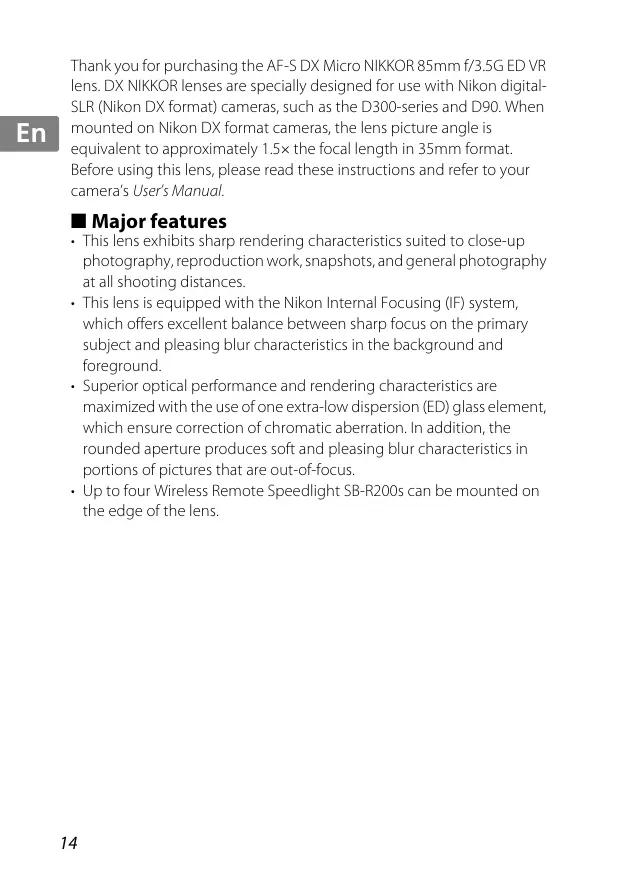
Thank you for purchasing the AF-S DX Micro NIKKOR 85mm f/3.5G ED VR lens. DX NIKKOR lenses are specially designed for use with Nikon digital- SLR (Nikon DX format) cameras, such as the D300-series and D90. When mounted on Nikon DX format cameres, the lens picture angle is equivalent to approximately 1.5x the focal length in 35mm format. Before using this lens, please read these instructions and refer to your camera's Users Manual. HE Major features + This lens exhibits sharp rendering characteristics suited to close-up photography, reproduction work, snapshots, and general photography at all shooting distances. + This lens is equipped with the Nikon Internal Focusing (IF) system, which offers excellent balance between sharp focus on the primary subject and pleasing blur characteristics in the background and foreground + Superior optical performance and rendering characteristics are maximized with the use of one extra-low dispersion (ED) glass element, which ensure correction of chromatic aberration. In addition, the rounded aperture produces soft and pleasing blur characteristics in portions of pictures that are out-of-focus. + Up to four Wireless Remote Speedlight SB-R2005 can be mounted on the edge ofthe lens.
MB Using the lens Mounting the lens on the camera [1] Tum the camera off. [2] Remove the rear lens cap. (Fig. B) EE [3] Align the mounting index (D) on the lens with the mounting index on the camera, and rotate the lens counterclockwise until it clicks into place. Be sure that the lens is in the correct position when the mounting index (is on the top of the lens. [4] Remove the front lens cap. (Fig. A) Removing the lens from the camera [1] Tum the camera off. [2] Press and hold the lens release button on the camera while turning the lens clockwise. H Focusing Set your cameras focus mode selector according to the chart below Camera focus Lens focus mode switch mode NA nr ego | Autofoeus vit manual | Manual focus (electronic overide rangefinder is available) MF Manual focus (electronic rangeñnder is available ) For more information on camera focus modes, refer to your camera's Users Manual. Autofocus with manual override (M/A mode) [1] Setthe lens focus mode switch 40 to M/A. [2] Autofocus is enabled, but autofocus operation can be overridden by rotating the separate focus ring (5) while pressing the shutter-release button halfway, or while pressing the AF-ON button on the camera body of cameras so equipped. [1 Press the shutter-release button halfway or the AF-ON button once again to cancel manual focus and resume autofocus.
EH Setting the aperture Use the camera to adjust the aperture setting. When exposure (or shooting) mode is set at “A” or M", the camera will control aperture to maintain the effective f-number (up to approx. 1.1 stops) even if shooting distance is changed HE Depth of field IF your camera supports depth-of-field preview the effects of the aperture setting can be previewed in the viewinder before shooting, This lens is equipped with the Internal Focusing (IF) system. As the shooting distance decreases, the focal length also decreases, H Focusing at a predetermined reproduction ratio (Reproduction ratio scale) The reproduction ratio is the relation between the size of the image recorded on the image sensor and the actual subject size. If for example, the image on the image sensor is one-fifth the actual subject size, the reproduction ratio is 1:5. To photograph at a predetermined reproduction ratio, use the following procedure: [M] Manuallyturn the focus ring until the desired reproduction ratio scale number is aligned with the distance index line €. Aim at the subject, then change your position, moving closer to or farther away from the subject, until the image in the viewfinder sharpens. EÆ Notes on close-up photography and reproduction work Camera shake This lens provides such exceptionally high image magnification that even the slightest movement during shooting can cause the image to blur. Therefore, the use of a tripod and a cable release or remote cord is highly recommended to prevent the effects of camera shake. Close working distance Atthe high reproduction ratios used in close-up shooting, the depth of field is very shallow. To ensure sufficient depth of field, stop down the lens, extend the exposure time, and carefully position the camera so that the most important portion ofthe subject is parallel to the surface ofthe image sensor to ensure sharp focus.
M Exposure factor The f-number of a lens indicates brightness of the image formed by the lens set at ‘infinity" shooting distance. The greaterthe reproduction ratio, the more image brightness decreases. The actual brightness ofthe image Eù is called the “effective Énumber and the exposure compensation value for the change ofthe effective Fnumber is called the ‘exposure factor” RH Effective f-number variation (P. 148) With this lens, the greater the reproduction ratio (the shorter the shooting distance), the more the brightness of the image projected onto the image sensor decreases and the more the effective number increases (the amount of light passing through the lens’ aperture decreases), This variation is automatically compensated for by the camera's exposure meter, so the user can determine exposure or operate TTL flash shooting without having to consider the exposure factor. The number displayed in the cameras LCD panel or viewfinder is the value automatically compensated
E Vibration reduction mode (VRII) Setting the vibration reduction ON/OFF switch ON: The effects of camera shake are reduced while the RE shutter- release button is pressed halfay and also atthe instant the shutter is released. Because vibration is reduced in the viewfinder, auto/ manual focusing and exact framing ofthe subject are easier. OFF: The effects of camera shake are not reduced Notes on using vibration reduction + By enabling vibration reduction (VA), slower shutter speeds (@pproximately four stops*) can be used when shooting distance is between o and 2.6 m (the reproduction ratio from ce to 1/30x). The higher the reproduction ratio from 1/30x is, the more the effects of vibration reduction will decrease graduall. (‘Based on results achieved under Nikon measurement conditions, The effects of vibration reduction may vary according to shooting conditions and use.) After pressing the shutter-release button halfway, wait until the image in the viewfinder stabilizes before pressing the shutter-release button the rest ofthe way down. Due to the characteristics of the vibration reduction mechanism, the image in the viewfinder may be blurred after the shutter is released This is not à malfunction. IFthe camera is panned in a wide arc, compensation for camera shake inthe panning direction is not performed. For example, only the effects of vertical camera shake is reduced with horizontal panning, Do not turn the camera off or remove the lens from the camera while vibration reduction is operating. Failure to observe this note could result in the lens sounding and feeling as if an internal component is loose or broken when it is shaken. This is not a malfunction. Turn the camera on again to correct this. With cameras featuring a built-in flash, vibration reduction does not function while the built-in flash is charging. With autofocus cameras featuring an AF-ON button, vibration reduction does not function even when the AF-ON button is pressed When the camera is mounted on a tripod, set the vibration reduction ON/OFF switch fD to OFF. However, set the switch to ON when using a tripod without securing the tripod head, or when using a monopod
Æ The built-in flash and vignetting + The built-in flash cannot be used over distances of less than 0.6 m (20 fc). + To prevent vignetting, do not use the lens hood EE
- Vignetting is the darkeningofthe comners around the image that occurs when light emitted by the camera's built-in flash is obstructed by the lens barrel MH Using the lens hood The lens hood blocks light rays that have harmful effects on pictures. lt also helps to protect the glass surface of the lens Attaching the hood + Be sure that the lens hood mounting index (€ ) is aligned with the lens hood setting index (—o) (@) + To facilitate attachment or removal ofthe hood, hold it by the lens hood attachment index (477) rather than its outer edge. + IFthe lens hood is not correctly attached, vignetting may occur. - The lens can be stored with the lens hood attached in the reverse position.
Lens care Be careful not to allow the CPU contacts © to become dirty or damaged Ithe lens mount rubber gasket (®) is damaged, be sure to visit the nearest Nikon-authorized service representative for repair. Clean lens surfaces with a blower brush, To remove dirt and smudges, use a soft, clean cotton cloth or lens tissue moistened with ethanol alcohol) or lens cleaner. Wipe in a circular motion from the center to the outer edge, taking care not to leave traces or touch other parts of the lens. Never use organic solvent such as thinner or benzene to clean the lens, 5 this could cause damage, result in a fire, or cause health problems NC fiers are available to protect the front lens element. The lens hood also helps to protect the front of the lens. When storing the lens in its flexible lens pouch, attach both the front and rear lens caps. When the lens is mounted on a camera, do not pick up or hold the camera and lens by the lens hood When the lens will not be used for an extended period of time, store it in a cool, dry place to prevent mold and rust. Be sure to store the lens away from direct sunlight or chemicals such as camphor or naphthalene. Do not get water on the lens or drop it in water as this will cause it to rust and malfunction: Reinforced plastic is used for certain parts ofthe lens. To avoid damage, never leave the lens in an excessively hot place. EH Standard accessories 52mm snap-on Front Lens Cap LC-52 Rear Lens Cap Bayonet Hood HB-37 Flexible Lens Pouch CL-1018 M Optional accessory
52mm screw-on filters
EH Speci Type oflens: Focal length: Maximum aperture: Lens construction: Picture angle: Reproduction ratio scale: Distance information: Focusing: Vibration reduction: Shooting distance scale: Closest focusing distance: No. of diaphragm blades: Diaphragm: Aperture range: Exposure measurement: Attachment size: Dimensions: Weight: cations G-type AF-S DX Micro NIKKOR lens with built-in CPU and Nikon bayonet mount (specially designed for use with Nikon digital-SLR—DX format—cameras) 85 mm
14 elements in 10 groups (1 ED lens element) 1850" ce to 1:1 (life-size) Output to camera Nikon Internal Focusing (IF) system, autofocus using à Silent Wave Motor, manually via separate focus ring Lens-shift method using voice coil motors (VCMS) Graduated in meters and feet from 0.286 m (1 ft) to infinity (oo )
0.286 m (0.9 ft (life-size)
9 pcs. (rounded) Fully automatic f/35 tof/32 Via full-aperture method 52 mm (P = 0.75 mm) Approximately 73 mm (dia) x 98.5 mm (extension from the cameras lens-mounting flange) Approximately 355 g (12.5 oz) Specifications and designs are subject to change without notice orobligation on the part ofthe manufacturer.
HANLIARRRERE. PATTES EUX -
(P.120) ORXEEHERERS (P.120) RENE (P.120) © H#ÆM (P.116) © FAAIE DIRXEZRIRS (P.115)
© #X+DRÉÈRE (P.121) © CPU#N (P.121) (0 HAE (P.116) 4D RAÆON/OFFFXE (P.119) @ RURELÆZXIE (P.117) @ FERRÉ (P.117) ( ):##7
REX ROBE © HR. 2 DOC EHESS
D@® @® © ®® © OSEXS (P.133) © SIRÉRISREM (p.134) O SEX EZRIEEC © CUS (P.134) (P.133) 6 HIAISNEMS (P. 129) © SREXSRERSC D SRON/OFFBAE (P.132) (P.133) @ ERILKR (P.130) © FREMXSRIRIESC PERRET (P. 130) (P.133) C)D:888 OMR (p.129) © FEAR D HERIES (P.129)
SR FRAC ERA TERRE RES CET e
+ INA CPU HE © FRA TERE
- MRSRAREURCME © HU + SE DARRTA TERRE
289] F0] AFS ABS] AOI 'E ANSE AMIS Sn EHEA ABSIEAS.
Fa StAIE AFS J8t2 gsuct ETES ZE! ÆAI Oil
@ £UE #4 ON/OFF ASIA
(P. 143) @ EX HSAI (P. 141) @ AE| HAJA (P. 141) OC): &Æ HIOIXI
= DX TDR AIT 7AUH ATORR (
He HRIPREITÉ CRETE BA FE (f/45) (, ÆHiB0): DAT TRICRDEROET, MIX, 27% 7R0/3RDÉÈE TI. — Display on camera's LCD panelAiewfinder (number at ‘infinity") = Display on camera's LCD paneWviewfinder [number at closest shooting distance)
Nikon ERSBSONE HIER EEK 2 TH TE RCD EEE, 22H -ÉZRRIE TA LUMERRRE E SRE CEE LIEN) No reproduction in any form of this manual, in whole or in part (except for brief quotation in critical articles or reviews), may be made without written authorization from NIKON CORPORATION. NIKON CORPORATION Printed in China YPOCO3(E3) © 2010 Nikon Corporation ZMAA67E3-03 À GO1 UOIN VA Q3 95'€/} UUS8 HOMNNIN ONIN XQ S-1V Nikon