 ManualGo.com
 FISHEYE-NIKKOR 6MM F/2.8 - Objectif photo NIKON - Free user manual and instructions
Find the device manual for free FISHEYE-NIKKOR 6MM F/2.8 NIKON in PDF.


Download the instructions for your Objectif photo in PDF format for free! Find your manual FISHEYE-NIKKOR 6MM F/2.8 - NIKON and take your electronic device back in hand. On this page are published all the documents necessary for the use of your device. FISHEYE-NIKKOR 6MM F/2.8 by NIKON.
USER MANUAL FISHEYE-NIKKOR 6MM F/2.8 NIKON
Depth-of-field table
Scharfentiefetabelle
C D E Gl G2 G3 G4 HI H2 H3 H4
A J R Gl G2 G3 G4 HI H2 H3 H4
• L1BCU Y48, Y52. 056, R60r*lia
Distance Index Aperture Index Aperture Scale Meter Coupling Shoe Aperture-Direct-Readout Scale
Meter Coupling Ridge
Aperture Indexing Post Aperture Ring Filter Selector Dial Focusing Ring Base
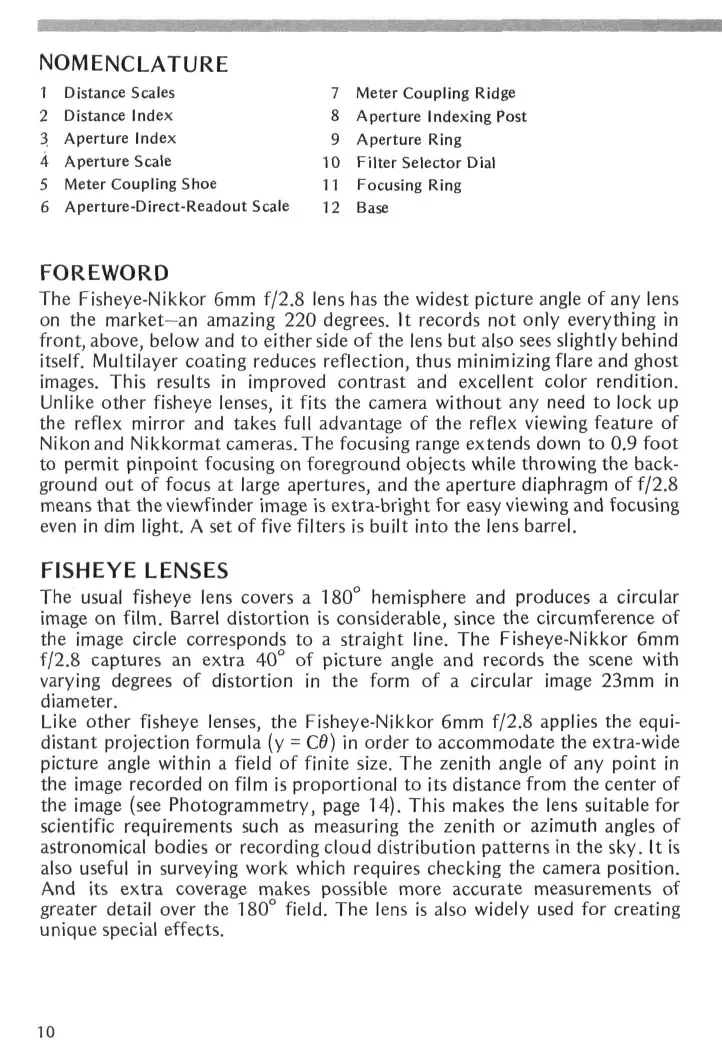
FOREWORD The Fisheye-Nikkor 6mm f/2.8 lens has the widest picture angle of any lens on the market-an amazing 220 degrees. It records not only everything in front, above, below and to either side of the lens but also sees slightly behind itself. Multilayer coating reduces reflection, thus minimizing flare and ghost images. This results in improved contrast and excellent color rendition.
Unlike other fisheye lenses, it fits the camera without any need to lock up the reflex mirror and takes full advantage of the reflex viewing feature of Nikon and Nikkormat cameras.The focusing range extends down to 0.9 foot to permit pinpoint focusing on foreground objects while throwing the background out of focus at large apertures, and the aperture diaphragm off/2.8 means that the viewf inder image is extra-bright for easy viewing and focusing even in dim light. A set of five filters is built into the lens barrel. F I S H E Y E LENSES The usual fisheye lens covers a 180° hemisphere and produces a circular image on film. Barrel distortion is considerable, since the circumference of the image circle corresponds to a straight line. The Fisheye-Nikkor 6mm f/2.8 captures an extra 40° of picture angle and records the scene with varying degrees of distortion in the form of a circular image 23mm in diameter. Like other fisheye lenses, the Fisheye-Nikkor 6mm f/2.8 applies the equidistant projection formula (y = Cd) in order to accommodate the extra-wide picture angle within a field of finite size. The zenith angle of any point in the image recorded on film is proportional to its distance from the center of the image (see Photogrammetry, page 14). This makes the lens suitable for scientific requirements such as measuring the zenith or azimuth angles of astronomical bodies or recording cloud distribution patterns in the sky. It is also useful in surveying work which requires checking the camera position. And its extra coverage makes possible more accurate measurements of greater detail over the 180° field. The lens is also widely used for creating unique special effects.
MOUNTING THE LENS A Position the lens in the camera's bayonet mount, lining up the aperture index on the lens with the lens mounting index on the camera. Twist the camera clockwise until it clicks into place.
To remove, depress the lens release button on the camera and twist the camera counterclockwise. Note: When mounting the lens on a camera with a meter coupling lever (Al type), make sure that the camera's meter coupling lever is correctly positioned; when mounting on a camera without this lever (non-AI type), "manual" maximum aperture indexing is required. In both cases, refer to the camera's instruction manual. Caution: Keep the accessory front leather lens cap in place when mounting or removing the lens and when loading or unloading film. Always replace this cap when the lens is not in use to prevent damage to the lens surface.
The Fisheye-Nikkor's automatic diaphragm couples directly to the thru-thelens meter of the Nikon F3, any Nikon F2 Photomic or other Nikon/
Nikkormat camera for full aperture exposure measurement via a meter coupring ridge for Al cameras or a meter coupling shoe for non-AI cameras. The aperture ring has click-stop settings for each full f-stop from f/2.8 to f/22 and can also be set to intermediate openings for more precise exposure. An "aperture-direct-readout" scale is also engraved on the lens to allow direct reading of the aperture setting in suitably equipped camera finders. The procedure for exposure measurement is similar to that used with other Nikkor lenses. For details, see the instruction manual supplied with your camera.
FOCUSING C The Fisheye-Nikkor 6mm f/2.8 lens focuses all the way from infinity down to 0.9 foot (0.25m). This means you can focus on foreground objects while throwing the background out of focus or move in close to the subject without stopping down the lens.
To focus, look through the camera viewfinder and turn the focusing ring until the image on the screen appears needle sharp. The automatic diaphragm feature and wide f/2.8 maximum aperture guarantee the brightest possible image for viewing and focusing, even in dim light. Depth of field can be observed by simply pressing the camera's depth-of-field preview button; or, refer to the table on page 34.
Recommended Focusing Screens
Various interchangeable focusing screens are available for F2 and F3 Nikon cameras to suit any type of lens or picture-taking situation. Those which are recommended for use with the Fisheye-Nikkor 6mm f/2.8 are listed below. ^ " - - - ^ ^ ^ Screen Camera ^ " " " " - - - - ^ ^
A/L B C D E G1 G2 G3 G4 HI
• When the Teleconverter TC-200 is attached to this lens, use the following table:
^ " ~ ~ ~ - \ ^ ^ Screen Camera -^^
E G1 G2 G3 G4 HI H2 H3 H4
O * Excellent focusing ®= Acceptable focusing The image is brilliant from edge to edge, but the central rangefinder, microprism or cross-hair area is dim. Focus on the surrounding matte area. 0 = Acceptable focusing Slight vignetting or moire phenomenon affects the screen image. But the image on film shows no traces of this. A= Acceptable focusing The in-focus image in the central spot may prove to be slightly out of focus on film. Focus on the surrounding matte area. Q= Exposure measurement not possible; lens/screen combination permits only focusing operation. Blank means inapplicable. The numbers (e.g., — y2) in the tables above mean that the film speed (ASA/ISO) should be set against the proper compensating mark as shown in the diagram below. When no exposure correction is indicated, the film speed (ASA/ISO) in use should be opposite the • index.
COMPOSITION Using a fisheye lens requires much more thought and planning about picture composition than does a conventional lens. The lens not only produces wideangle distortion but also exaggerates the relative size of objects to conform to its circular format. Objects near the center appear larger than those at the edges, and they show less optical distortion. The entire field is pushed into the distance and spatial relations are transformed. And a slight shift in camera position produces a whole new set of distortions.
Be careful not to include in the picture unwanted objects such as the legs of a tripod or the hands or feet of the photographer.
Besides the tripod socket on the bottom of the lens, the 6mm f/2.8 has three other tripod sockets on the back so that the camera may be mounted on a tripod facing upward. Try not to let too much direct sunlight strike the lens, as this may cause ghost images. One way to prevent this is to create an artificial "eclipse" by using a 3-inch diameter shield attached to a thin rod or wire. Hold the shield in front of the lens in such a way that it blocks out the direct rays of the sun. The further you hold the shield from the lens, the less conspicuous it will be in the resulting photograph.
BUILT-IN FILTERS D A set of five filters is built into the rear end of the lens mount: skylight
(L1BC), medium yellow (Y48), deep yellow (Y52), orange (056) and red (R60). These filters are mounted on a revolving turret so they can be moved into place quickly one after another. Turn the knurled filter selector dial on the side of the lens mount until the desired filter designation on the rim of the dial clicks into place. The selector dial should not be set at an intermediate position. The skylight (L1BC) filter is used in either black-and-white or color photography. The others are normally used to subdue the effect of certain colors or to increase image contrast in black-and-white photography. Contrast increases progressively from yellow to orange to red. The table below shows the filter factors for film rated ASA/ISO 100. No exposure compensation is necessary with the Nikon or Nikkormat cameras which have thru-the-lens meters, since their built-in meters read only the light passing through the lens and compensate automatically for loss of light. Type of film
Black-and-white and color
Black-and-white only
Tungsten light Daylight 1 1 1.7(2/3) 1.2(1/3) 1.4(1/2) 2 (1) 3.5 (1-5/6) 2 (1) 8 (3) 5 (2-1/3) ) = Exposure corrections in f/stops
PHOTOGRAMMETRY The circular photographic image produced by the Fisheye-Nikkor 6mm f/2.8 is an exact reproduction on a flat plane of all objects within the 220° field.
This feature enables the lens to be used in locating astral bodies or recording cloud distribution. The center of the image corresponds to the zenith in the angle of view, and the distance of any point in the image from this center is directly proportional to its angle from the zenith, expressed by the equation y = CO, where y is the distance of the point from the image center, 6 is the zenith angle, and C is a constant (see below). For example, a point j n the image 4mm from the center represents an object at an angle of 37.2 from the zenith in the angle of view. The table below gives zenith angles for points at given distances from the center of the film image. Relation of Zenith Angle to Distance of Point from Image Center 6 : Zenith angle y : Distance of point from image center
FEATURES/SPECIFICATIONS Focal length/Aperture: 6mm f/2.8
Picture angle: 220° Effective picture field: 23mm0 on film Lens construction: 12 elements in 9 groups Projection formula: Equidistant Aperture scale: f/2.8 ~ f/22 on both standard and aperture-direct-readout scales Diaphragm: Automatic Exposure measurement: Via full-aperture method; meter coupling ridge provided for Al cameras and meter coupling shoe for non-AI cameras Focusing range: Infinity (°°) to 0.9 foot (0.25m) Distance scale: Graduated in both feet and meters Mount: Nikon bayonet mount Filters: Built-in L1BC, Y48, Y52,056 and R60 Dimensions: 236mm0 x 171mm long (total); 160mm extension from flange Weight: Approx. 5200g Accessories Front lens cap Rear lens cap LF-1 Special metal case Teleconverter TC-200
Gl G2 G3 G4 HI H2 H3 H4
Gl G2 G3 G4 HI H2 H3 H4
E Gl G2 G3 G4 HI H2 H3 H4 J K/P M
E Gl G2 G3 G4 HI H2 H3 H4 J K/P M
Gl G2 G3 G4 H I H2 H3 H4
© © • © © © © © © ® © A © © F2 © © © © © © © • Cuando a esta objetivo se la adhiere el teleconvertidor TC-200 remitase a la siguiente tabla: F3