FC 8768 - Aspirateur PHILIPS - Free user manual and instructions

Find the device manual for free FC 8768 PHILIPS in PDF.

Page 6
Table of contents Click a title to go to the page
Manual assistant
Powered by ChatGPT
Waiting for your message
Product information

Brand : PHILIPS

Model : FC 8768

Category : Aspirateur

Download the instructions for your Aspirateur in PDF format for free! Find your manual FC 8768 - PHILIPS and take your electronic device back in hand. On this page are published all the documents necessary for the use of your device. FC 8768 by PHILIPS.

USER MANUAL FC 8768 PHILIPS

Register your product and get support at

Congratulations on your purchase and welcome to Philips! To fully benefit from the support that

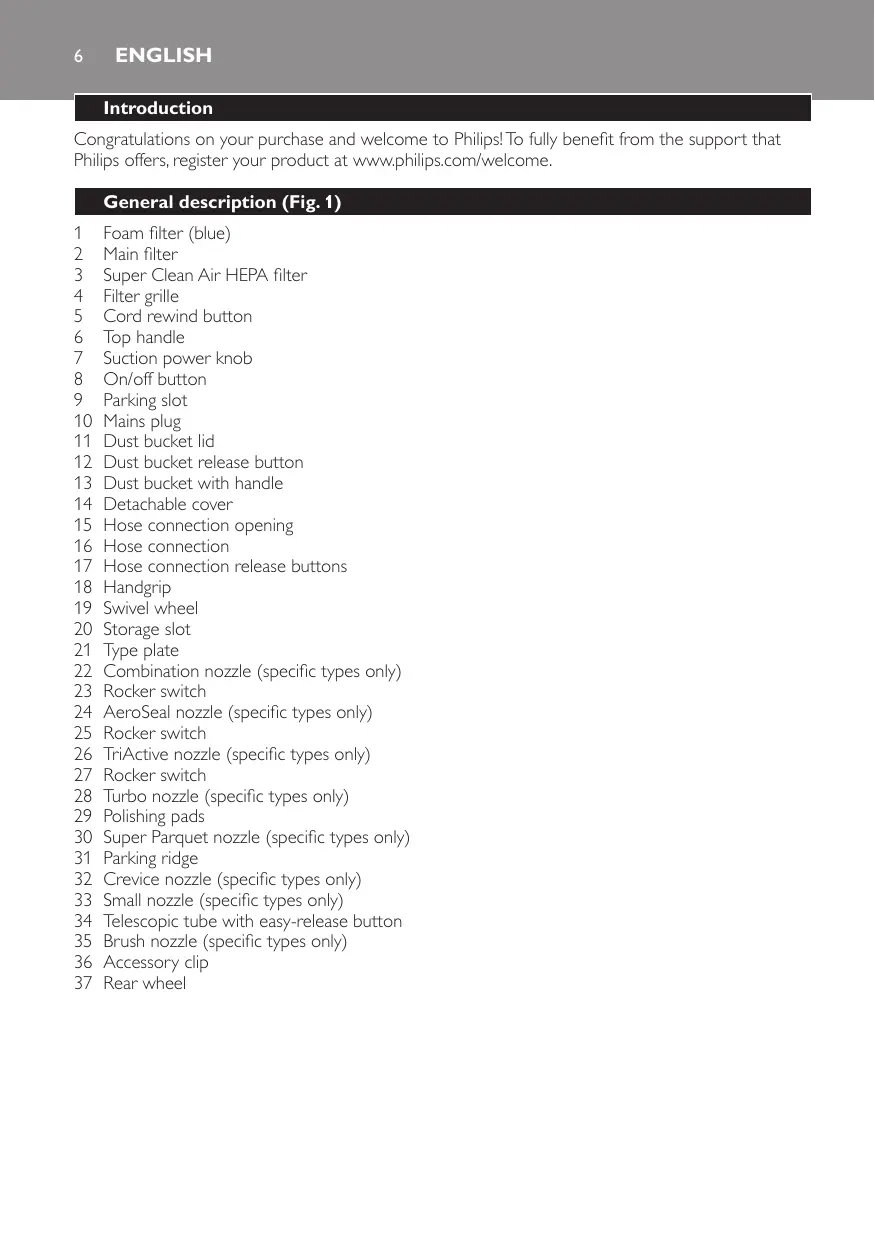
Philips offers, register your product at www.philips.com/welcome. General description (Fig. 1) 1 2 3 4 5 6 7 8 9 10 11 12 13 14 15 16 17 18 19 20 21 22 23 24 25 26 27 28 29 30 31 32 33 34 35 36 37

Main filter Super Clean Air HEPA filter Filter grille Cord rewind button Top handle Suction power knob On/off button Parking slot Mains plug Dust bucket lid Dust bucket release button Dust bucket with handle Detachable cover Hose connection opening Hose connection Hose connection release buttons Handgrip Swivel wheel Storage slot Type plate Combination nozzle (specific types only) Rocker switch AeroSeal nozzle (specific types only) Rocker switch TriActive nozzle (specific types only) Rocker switch Turbo nozzle (specific types only) Polishing pads Super Parquet nozzle (specific types only) Parking ridge Crevice nozzle (specific types only) Small nozzle (specific types only) Telescopic tube with easy-release button Brush nozzle (specific types only) Accessory clip Rear wheel

Read this user manual carefully before you use the appliance and save it for future reference. Danger -- Never vacuum up water or any other liquid. Never vacuum up flammable substances and do not vacuum up ashes until they are cold. Warning -- Check if the voltage indicated on the appliance corresponds to the local mains voltage before you connect the appliance. -- Do not use the appliance if the plug, the mains cord or the appliance itself is damaged. -- If the mains cord is damaged, you must have it replaced by Philips, a service centre authorised by Philips or similarly qualified persons in order to avoid a hazard. -- This appliance can be used by children aged 8 or above and by persons with reduced physical, sensory or mental capabilities, or lack of experience and knowledge, if they have been given instructions in safe use of the appliance and supervision to establish safe use and if they have been made aware of the hazards involved. -- Do not allow children to play with the appliance. -- Children are only allowed to empty and clean the dust bucket and clean or replace the filters under supervision. -- Do not point the hose, the tube or any other accessory at the eyes or ears nor put it in your mouth when it is connected to the vacuum cleaner and the vacuum cleaner is switched on. -- The plug must be removed from the socket-outlet before cleaning or maintaining the appliance. -- Do not clean any parts of the appliance in the dishwasher. -- Make sure the main filter and the foam filter are completely dry before you place them back into the appliance after cleaning. Caution -- When you use the appliance to vacuum ashes, fine sand, lime, cement dust and similar substances, the pores of the foam filter become clogged. If you notice a strong decrease in suction power, clean the foam filter. -- Only use the original Philips filters, do not attempt to make any of the filters yourself. -- Never use the appliance without any of the filters. This damages the motor and shortens the life of the appliance. -- Do not vacuum up large objects as this may cause the air passage in the tube or hose to become obstructed. -- The appliance does not work if the dust bucket or the dust bucket lid is not properly placed. -- For the best performance, clean both the main filter and foam filter at least 4 times per year. -- Do not remove any of the rubber sealings. -- Do not clean any of the rubber sealings with cleaning detergent. -- You should not rinse the dust bucket under the tap. If you accidentally did this anyway, make sure that you remove and dry the detachable cover before you put the dust bucket back into the appliance. -- During vacuum cleaning, especially in rooms with low air humidity, your vacuum cleaner builds up static electricity. As a result you can experience electric shocks when you touch the tube or other steel parts of your vacuum cleaner. These shocks are not harmful to you and do not damage the appliance. To reduce this inconvenience we advise you: 1 to discharge the appliance by frequently holding the tube against other metal objects in the room (for example legs of a table or chair, radiator etc.); (Fig. 2) 2 to raise the air humidity level in the room by placing water in the room. For example, you can hang containers filled with water from your radiators or place bowls filled with water on or near your radiators (Fig. 3).

Electromagnetic fields (EMF)

This Philips appliance complies with all standards regarding electromagnetic fields (EMF). If handled properly and according to the instructions in this user manual, the appliance is safe to use based on scientific evidence available today.

Preparing for use Hose 1 To connect the hose, insert it into the hose connection opening until it snaps into place (‘click’) (Fig. 4). 2 To disconnect the hose, press the release buttons (1) and pull the hose out of the hose connection opening (2) (Fig. 5). Handgrip 1 To connect the tube to the handgrip of the hose, insert the handgrip into the tube. Fit the spring-loaded lock button into the opening in the tube until it snaps into place (‘click’) (Fig. 6). -- To disconnect the tube, push the easy-release button and pull the handgrip out of the tube. Telescopic tube 1 Move the tube lock up or down to adjust the tube length so that the handgrip is at hip level (Fig. 7). Connecting the nozzles -- To connect the nozzle or an accessory to the tube, insert the tube into the nozzle or accessory. Fit the spring-loaded lock button into the opening in the nozzle or accessory until it snaps into place (‘click’). (Fig. 8) Note:You can also connect the nozzle or accessories directly to the handgrip. AeroSeal nozzle (specific types only) The AeroSeal nozzle is specially designed to reach deeper into floor crevices and carpets to capture more dust and fluff at each stroke. -- Use the hard floor setting to clean hard floors (for instance tiled, parqueted, laminated and linoleumed flooring): push the rocker switch on top of the nozzle with your foot to make the brush strip come out of the housing (Fig. 9). -- Use the carpet setting to clean carpets: push the rocker switch again to make the brush strip disappear into the nozzle housing (Fig. 10). TriActive nozzle (specific types only) The TriActive nozzle is a multi-purpose nozzle for carpets and hard floors. -- The side brushes catch more dust and dirt at the sides of the nozzle and allow you to clean better along furniture and other obstacles (Fig. 11). -- The opening at the front of the nozzle allows you to vacuum larger particles (Fig. 12). 1 To clean hard floors, push the rocker switch on top of the nozzle with your foot (Fig. 13). ,, The brush strip for cleaning hard floors comes out of the housing. At the same time, the wheel is lifted to prevent scratching and to increase manoeuvrability.

2 To clean carpets, push the rocker switch again. (Fig. 14)

,, The brush strip disappears into the nozzle housing and the wheel is lowered automatically. Combination nozzle (specific types only)

The combination nozzle can be used on either carpets or hard floors.

1 To clean hard floors, push the rocker switch on top of the nozzle with your foot (Fig. 15).

,, The brush strip for cleaning hard floors comes out of the nozzle housing. 2 To clean carpets, push the rocker switch again. (Fig. 16) ,, The brush strip disappears into the nozzle housing.

Crevice nozzle, small nozzle and brush nozzle (specific types only)

1 Connect the small nozzle, crevice nozzle or brush nozzle directly to the handgrip or to the tube (Fig. 17).

1 Use the crevice nozzle to clean narrow corners or hard-to-reach places. 2 Use the small nozzle to clean small areas, e.g. the seats of chairs and sofas. 3 Use the brush nozzle to clean computers, bookshelves etc. Accessory clip 1 Snap the accessory clip onto the tube (Fig. 18). 2 Snap the crevice tool, the small nozzle or the brush nozzle onto the clip. Using the appliance Vacuum cleaning 1 Pull the cord out of the appliance completely and insert the mains plug into the wall socket. 2 Press the on/off button on top of the appliance with your foot to switch on the appliance (Fig. 19). 3 If you want to pause for a moment, insert the parking ridge on the nozzle into the parking slot to park the tube in a convenient position (Fig. 20). Adjusting suction power -- During vacuuming, you can adjust the suction power with the suction power knob on top of the appliance (Fig. 21). -- Use maximum suction power to vacuum very dirty carpets and hard floors. -- Use moderate suction power to vacuum carpets. -- Use minimum suction power to vacuum furniture, table carpets, etc. Tip: By reducing suction power, you can move the nozzle across the floor more easily. Cleaning and maintenance The plug must be removed from the socket-outlet before cleaning or maintaining the appliance. Do not clean any part of the appliance in the dishwasher. Emptying the dust bucket Note: For optimal performance, empty the dust bucket after use. Always empty the dust bucket when the dust reaches the maximum indication (Fig. 22). Caution: Children are only allowed to empty and clean the dust bucket and clean or replace the filters under supervision.

1 Press the dust bucket release button, grab the dust bucket handle and lift the dust bucket out of the appliance. (Fig. 23)

2 Remove the lid of the dust bucket (Fig. 24). 3 Empty the dust bucket into a dustbin (Fig. 25). 4 Reattach the dust bucket lid (1) and close it (2) (Fig. 26). 5 Put the dust bucket back into the appliance and push down the top handle (‘click’) (Fig. 27). Caution:You should not rinse the dust bucket under the tap. If you accidentally did this anyway, make sure that you remove and dry the detachable cover before you put the dust bucket back into the appliance. (Fig. 28) Cleaning and replacing the filters Caution: Do not use any other filters. Use only original Philips HEPA filters. For more information on ordering HEPA filters, see chapter ‘Ordering accessories’.

Note: In case of normal use you do not have to replace the main filter.

Note: Only replace the foam filter when it is very dirty and cannot be cleaned properly or when it is damaged. Cleaning the foam filter and the main filter Caution: For the best performance, clean both the main filter and the foam filter at least 4 times a year. Caution: Do not attempt to make the filter yourself, but only use an original Philips filter. 1 Remove the dust bucket and pull the main filter towards you (Fig. 29). 2 Take the blue foam filter out of the main filter.  (Fig. 30) Tip:To prevent dirty hands, you can use the tag to remove the filter. 3 Clean the foam filter and the main filter under the tap (Fig. 31). Never use a brush or cleaning agent to clean the foam filter and the main filter. Do not clean them in the washing machine or dishwasher either. Note: Cleaning does not restore the original colour of the filter, but it does restore its filtration power. 4 Wring out the blue foam filter (Fig. 32). 5 Let the foam filter and the main filter dry for at least 24 hours, out of direct sunlight (Fig. 33). Make sure that the foam filter and the main filter are completely dry. Do not dry the foam filter and the main filter on the radiator or in the tumble dryer. 6 Press the foam filter back into the main filter.  (Fig. 34) 7 Reattach the main filter to the dust bucket (Fig. 35).

Cleaning the Super Clean Air HEPA filter Clean the Super Clean Air HEPA filter every 6 months. You can clean the Super Clean Air Hepa filter max. 4 times. Replace the filter after it has been cleaned 4 times. 1 To detach the filter grille, push the tab downwards (1) and pull the grille towards you (2). (Fig. 36) 2 Pull out the Super Clean Air HEPA filter by pulling the tab towards you.  (Fig. 37) 3 Rinse the filter under a warm slow-running tap (Fig. 38). Never clean the filter with a brush. 4 Carefully shake the water from the surface of the filter. Let the filter dry completely (at least 2 hours) before you put it back into the vacuum cleaner. Note: Cleaning does not restore the original colour of the filter, but does restore its filtration power. 5 Click the filter back into place (Fig. 39). Note: Make sure the tab of the filter is located at the top. 6 Reattach the filter grille to the vacuum cleaner.  (Fig. 40) Replacing the Super Clean Air HEPA Filter Caution: Use only original Philips filters. 1 To detach the filter grille, push the tab downwards (1) and pull the grille towards you (2). (Fig. 36) 2 Pull out the Super Clean Air HEPA filter pulling the tab towards you (Fig. 37). 3 Click the new Super Clean Air HEPA filter into place.  (Fig. 39) Note: Make sure the tab of the filter is located at the top. 4 Reattach the filter grille to the vacuum cleaner.  (Fig. 40) Storage 1 Switch off the appliance and remove the mains plug from the wall socket. 2 Press the cord rewind button to rewind the cord (Fig. 41). 3 Put the appliance in upright position. Insert the ridge on the nozzle into the storage slot to store the tube, adjust the tube to the shortest length and then put away the appliance. (Fig. 42) Ordering accessories To purchase accessories for this appliance, please visit our website www.philips.com/shop. If you have any difficulties obtaining accessories for your appliance, please contact the Philips Consumer Care Centre in your country. You will find its contact details in the worldwide guarantee leaflet. You can also visit www. philips.com/support. Ordering filters -- HEPA filters are available under type number FC8038. -- Foam filters are available under type number 4322 004.9369.0.

-- Do not throw away the appliance with the normal household waste at the end of its life, but hand it in at an official collection point for recycling. By doing this, you help to preserve the environment (Fig. 43).

-- To save energy, switch off the appliance when you stop vacuum cleaning, even if it is only for a short while. Guarantee and service If you need service or information or if you have a problem, please visit the Philips website at www.philips.com or contact the Philips Consumer Care Centre in your country. You find its phone number in the worldwide guarantee leaflet. If there is no Consumer Care Centre in your country, go to your local Philips dealer. Troubleshooting This chapter summarises the most common problems you could encounter with the appliance. If you are unable to solve the problem with the information below, contact the Consumer Care Centre in your country. 1 The suction power is insufficient -- Perhaps the dust bucket is full. If necessary, empty the dust bucket. -- Perhaps the suction power knob is not at right setting. -- Perhaps the dust bucket lid is not placed correctly. Place the lid correctly. -- Perhaps the filters need to be cleaned or replaced. If necessary, clean or replace the filters. -- Perhaps the nozzle, tube or hose is blocked up. -- To remove the obstruction, disconnect the blocked-up part (hose or tube) and connect it (as well as possible) the other way round. Switch on the vacuum cleaner to force the air through the blocked-up part in opposite direction (Fig. 44). 2 It is difficult to move the nozzle over the floor. -- By reducing suction power, you can move the nozzle across the floor more easily