
HKX 960 S - INSTALATION MANUAL - Appareil de cuisine TEKA - Notice d'utilisation et mode d'emploi gratuit
Retrouvez gratuitement la notice de l'appareil HKX 960 S - INSTALATION MANUAL TEKA au format PDF.


| Marque | TEKA |
| Modèle | HKX 960 S |
| Type de produit | Four vapeur encastrable |
| Dimensions extérieures (L × H × P) | 595 × 455 × 472 mm |
| Dimensions intérieures (L × H × P) | 420 × 210 × 390 mm |
| Capacité | 35 L |
| Poids | 32 kg |
| Tension d'alimentation | 220-240 V ~ 50 Hz |
| Puissance | 1500 W |
| Fonctions principales | Cuisson vapeur, Régénération & Stérilisation, Cuisson légumes, Cuisson poisson, Cuisson viande, Plats d'accompagnement, Minuterie |
| Programmes automatiques | Plus de 20 programmes prédéfinis pour légumes, poisson, viande, accompagnements, stérilisation |
| Réservoir d'eau | Capacité environ 1 L, amovible, vidange automatique en fin de cycle |
| Affichage | Écran numérique avec horloge et messages d'état |
| Matériau de la cavité | Acier inoxydable |
| Porte | Vitre amovible, charnières démontables |
| Éclairage intérieur | Ampoule E14 230-240V/15W remplaçable |
| Accessoires fournis | Plateau perforé, plateau non perforé, grille |
| Entretien et nettoyage | Nettoyage intérieur à l'eau savonneuse, grilles latérales amovibles, programmation de détartrage automatique |
| Détartrage | Automatique avec solution DURGOL® recommandée, cycle d'environ 45 minutes |
| Sécurité | Verrouillage enfant (Safety Block), arrêt automatique en cas de surchauffe, réduction de vapeur à l'ouverture, protection contre les brûlures |
| Réparabilité | Remplacement d'ampoule possible par l'utilisateur ; autres réparations par technicien agréé |
| Informations générales | Notice disponible en plusieurs langues, service client international listé |
FOIRE AUX QUESTIONS - HKX 960 S - INSTALATION MANUAL TEKA
Questions des utilisateurs sur HKX 960 S - INSTALATION MANUAL TEKA
0 question sur cet appareil. Repondez a celles que vous connaissez ou posez la votre.
Poser une nouvelle question sur cet appareil
Téléchargez la notice de votre Appareil de cuisine au format PDF gratuitement ! Retrouvez votre notice HKX 960 S - INSTALATION MANUAL - TEKA et reprennez votre appareil électronique en main. Sur cette page sont publiés tous les documents nécessaires à l'utilisation de votre appareil HKX 960 S - INSTALATION MANUAL de la marque TEKA.
MODE D'EMPLOI HKX 960 S - INSTALATION MANUAL TEKA
HKX 960 S

IeKa
Nous vous demandons de lire attentivement les instructions de cette notice, car cela vous permettra d'obtenir les meilleurs résultats de votre four à micro-ondes.
CONSERVEZ LA DOCUMENTATION DE CE PRODUIT POUR RÉFÉRENCE FUTURE.
Gardez toujours le manuel d'instructions à portée de main. Si vous prêtez le four à micro-ondes à quelqu'un d'autre, remettez-lui également le manuel !
Protection de l'environnement
Élimination de l'emballage

L'emballage porte le point vert.
Éliminez tous les matériaux d'emballage tels que le carton, le polystyrène expansé et les films plastiques dans les conteneurs appropriés. Ainsi, vous pouvez être sûr que les matériaux d'emballage seront réutilisés. Tenez tout emballage hors de portée des jeunes enfants, car il peut présenter un risque d'étouffement.
Élimination des appareils usagés
Conformément à la directive européenne 2002/96/CE relative à la gestion des déchets d'équipements électriques et électroniques (DEEE), les appareils électroménagers ne doivent pas être jetés dans les systèmes normaux d'élimination des déchets urbains solides.
Les appareils obsolètes doivent être collectés séparément afin d'optimiser la récupération des matériaux et les taux de recyclage, et de prévenir tout danger potentiel pour la santé humaine et l'environnement. Le symbole d'une poubelle barrée d'une croix doit être apposé sur tous ces produits pour rappeler aux consommateurs leur obligation de les déposer séparément.
Les consommateurs doivent contacter les autorités locales ou le point de vente pour obtenir des informations sur les endroits appropriés où déposer leurs anciens appareils électroménagers.
Avant de vous débarrasser de votre appareil, rendez-le inutilisable en débranchant le câble d'alimentation, en le coupant et en le jetant.
Sommaire
Instructions d'installation 3
Avant l'installation 3 Après l'installation 3
Consignes de sécurité 4
Description de votre four 6
Réglages de base 7
Réglages initiaux 7 Réglage de l'horloge 7 Réglage de la dureté de l'eau 7 Masquage/Affichage de l'horloge 8 Verrouillage de sécurité 8 Minuterie 9
Fonctions de base 10
Vapeur 10 Régénération et stérilisation 10
Fonctions spéciales 11
Cuisson des légumes 11 Cuisson du poisson 12 Cuisson de la viande 13 Accompagnements 14
Alimentation en eau 15
Remplissage du réservoir d'eau 15 Remplissage du réservoir d'eau 15 Vidange du réservoir d'eau 15
Lorsque le four est en fonctionnement 16
Interruption d'un cycle de cuisson 16 Modification des paramètres 16 Annulation d'un cycle de cuisson 16 Fin d'un cycle de cuisson 16
Utilisation, tableaux et conseils 17
Utilisation des accessoires 17
Entretien et maintenance 22
Nettoyage de la cavité de cuisson 22 Retrait des supports de grille 22 Retrait de la porte de l'appareil 23 24 Solutions de descente appropriées 24 25 Surface avant 26 Intérieur du four 26 Accessoires 26
Que faire si le four ne fonctionne pas ? 27
Remplacement de l'ampoule 27
Caractéristiques techniques 28
Description des fonctions 28 Messages à l'écran 28 Spécifications 28
Installation 58
FR Instructions d'installation
Avant l'installation
Vérifiez que la tension d'alimentation indiquée sur la plaque signalétique correspond à celle de la prise de courant que vous allez utiliser.
Ouvrez la porte du four et retirez tous les accessoires et l'emballage.
Avertissement ! La surface avant du four peut être recouverte d'un film protecteur. Avant la première utilisation, retirez soigneusement ce film, en commençant par l'intérieur.
Assurez-vous que le four n'est pas endommagé. Vérifiez que la porte du four se ferme correctement et que l'intérieur de la porte et l'avant de l'ouverture du four ne sont pas endommagés. Si vous constatez un dommage, contactez notre service clientèle au numéro indiqué au dos de ce manuel.
N'UTILISEZ PAS LE FOUR si le câble d'alimentation ou la fiche est endommagé, si le four ne fonctionne pas correctement ou s'il a été endommagé ou est tombé. Contactez notre service clientèle au numéro indiqué au dos de ce manuel.
Placez le four sur une surface plane et stable. Le four ne doit pas être installé à proximité de sources de chaleur, de radios ou de téléviseurs.
Lors de l'installation, assurez-vous que le câble d'alimentation n'entre pas en contact avec l'humidité ou des objets aux bords tranchants, ni avec l'arrière du four. Les températures élevées peuvent endommager le câble.
Avertissement : après l'installation du four, vous devez vous assurer que vous pouvez accéder à la prise.
Après l'installation
Le four est équipé d'un câble d'alimentation et d'une prise pour courant monophasé (domestique), 230-240 V ~ 50 Hz.
Si le four doit être installé de façon permanente, il doit être installé par un technicien qualifié. Dans ce cas, le four doit être connecté à un circuit avec un disjoncteur omnipolaire avec une distance minimale de 3 mm entre les contacts.
AVERTISSEMENT : LE FOUR DOIT ÊTRE RELIÉ À LA TERRE.
Le fabricant et les revendeurs déclinent toute responsabilité en cas de dommages causés aux personnes, aux animaux ou aux biens si ces instructions d'installation ne sont pas respectées.
Le four ne fonctionne que lorsque la porte est correctement fermée.
Avant la première utilisation, nettoyez l'intérieur du four et les accessoires, en suivant les instructions de nettoyage données dans la section « Nettoyage du four ».
Lors de l'installation, suivez les instructions fournies séparément.
Consignes de sécurité

- Avertissement ! Ne laissez pas le four sans surveillance.
- Avertissement ! Si vous voyez de la fumée ou du feu, gardez la porte fermée pour étouffer les flammes. Éteignez le four et débranchez la prise ou coupez l'alimentation du four.
- La graisse et l'huile surchauffées peuvent facilement s'enflammer. Chauffer de l'huile dans la cavité de cuisson pour saisir de la viande est dangereux et ne doit pas être fait. N'essayez jamais d'éteindre de l'huile ou de la graisse en feu avec de l'eau (risque d'explosion) ! Étouffez les flammes avec un chiffon humide et gardez toutes les portes et fenêtres fermées.
- Avertissement ! N'utilisez pas d'alcool pour cuisiner dans le four. Cela peut provoquer une surchauffe des aliments. Danger d'explosion !
- Avertissement ! Cet appareil n'est pas destiné à être utilisé par des personnes (y compris les enfants) dont les capacités physiques, sensorielles ou mentales sont réduites, ou qui manquent d'expérience ou de connaissances, sauf si elles ont été supervisées ou instruites quant à l'utilisation de l'appareil par une personne responsable de leur sécurité. Les enfants doivent être surveillés pour s'assurer qu'ils ne jouent pas avec l'appareil.
- Les enfants doivent être surveillés pour s'assurer qu'ils ne jouent pas avec l'appareil. Utilisez les verrous de sécurité.
- Avertissement ! Pendant l'utilisation, l'appareil devient très chaud. Il faut faire attention à ne pas toucher les éléments chauffants à l'intérieur du four. RISQUE DE BRÛLURES !
- Avertissement ! Les parties accessibles peuvent devenir chaudes pendant l'utilisation. Les jeunes enfants doivent être tenus à l'écart.
- Avertissement ! Lors de l'ouverture de la porte pendant ou après le cycle de cuisson, faites attention au flux d'air chaud et/ou à la vapeur et aux gouttes d'eau qui sortent de la cavité de cuisson. Reculez ou déplacez-vous sur le côté pour éviter les brûlures.
- Avertissement ! Assurez-vous de ne jamais coincer les câbles d'alimentation d'autres appareils électriques dans la porte chaude ou le four. L'isolation des câbles peut fondre. Danger de court-circuit !
FR Consignes de sécurité
Ce four est exclusivement destiné à un usage domestique !
L'appareil est conçu pour être utilisé à la maison pour préparer des aliments. Aucune responsabilité n'est assumée pour les dommages causés par une utilisation inappropriée ou incorrecte.
Évitez d'endommager le four ou de créer d'autres situations dangereuses en suivant ces instructions :
- Ne couvrez pas et n'obstruez pas les ouvertures de ventilation.
- Ne conservez aucun objet inflammable à l'intérieur du four, car il pourrait brûler si le four est allumé.
- N'utilisez pas le four comme débarras.
- Ne versez pas d'alcool (par exemple cognac, whisky, schnaps, etc.) sur des aliments chauds. Risque d'explosion !
- Les accessoires tels que les grilles et les plaques chauffent dans l'espace de cuisson. Portez toujours des gants de protection ou utilisez des chiffons de four.
- Pour éviter de vous brûler, utilisez toujours des gants de four pour manipuler les plats et les récipients et pour toucher le four.
- Ne vous penchez pas et ne vous asseyez pas sur la porte du four ouverte. Cela pourrait endommager le four, en particulier au niveau des charnières. La porte peut supporter un poids maximal de 8 kg.
- Les grilles peuvent supporter une charge maximale de 8 kg. Pour éviter d'endommager le four, ne dépassez pas cette charge.
Nettoyage :
- L'appareil reste chaud pendant un certain temps après son extinction et ne refroidit que lentement à température ambiante. Laissez suffisamment de temps à l'appareil pour refroidir avant, par exemple, de le nettoyer.
- N'utilisez pas de nettoyants abrasifs agressifs ni de grattoirs métalliques tranchants pour nettoyer la vitre de la porte du four, car ils pourraient rayer la surface, ce qui pourrait entraîner le bris du verre.
- Les surfaces de contact de la porte (l'avant de l'espace de cuisson et la partie intérieure des portes) doivent être maintenues très propres pour garantir le bon fonctionnement du four.
- Suivez les instructions de nettoyage dans la section « Nettoyage et entretien du four ».
Réparations :
- Si le câble d'alimentation est endommagé, il doit être remplacé par le fabricant, les agents agréés ou les techniciens qualifiés pour cette tâche afin d'éviter les situations dangereuses. De plus, des outils spéciaux sont nécessaires pour cette tâche.
- Les travaux de réparation et d'entretien, en particulier des pièces conductrices de courant, ne peuvent être effectués que par des techniciens agréés par le fabricant.
Description de votre four
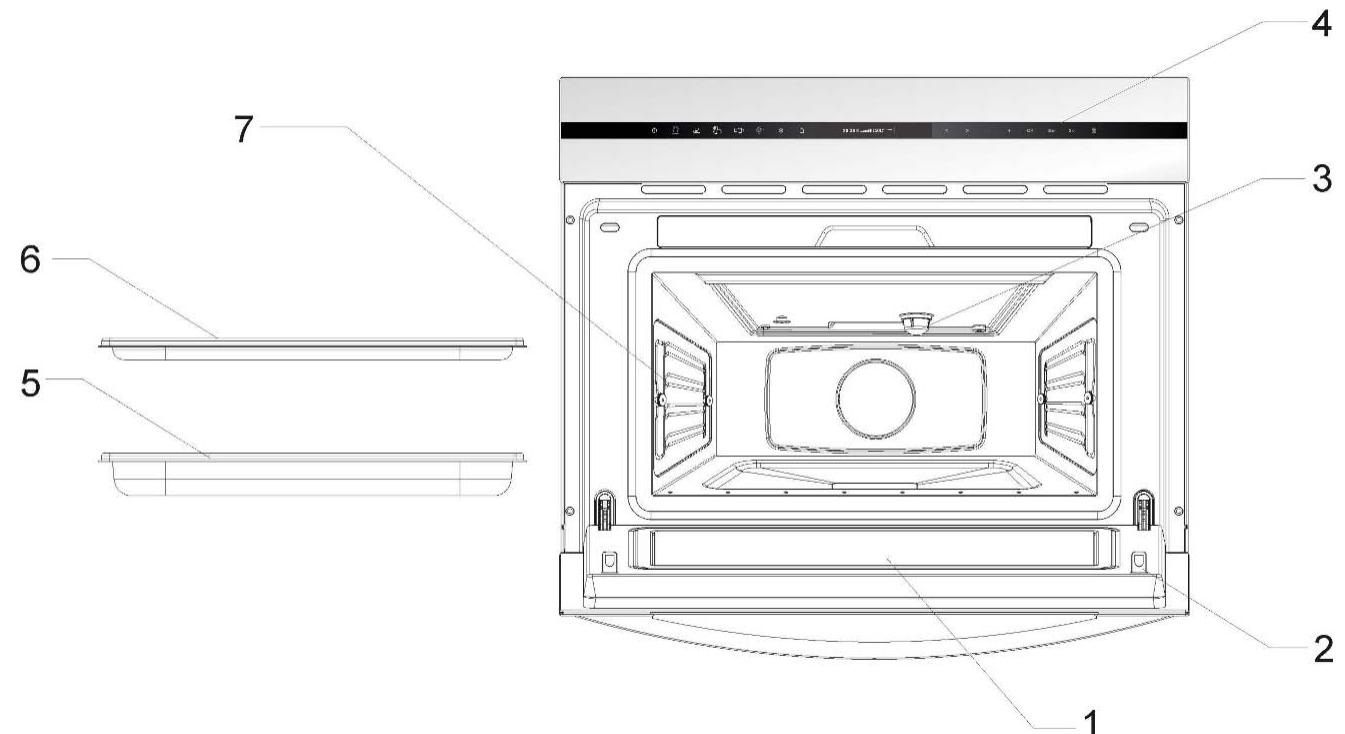
- Vitre de la porte du four
- Butées de sécurité
- Ampoule
- – Panneau de commande
- – Plaque de cuisson perforée
- – Plaque de cuisson
- Supports de grille
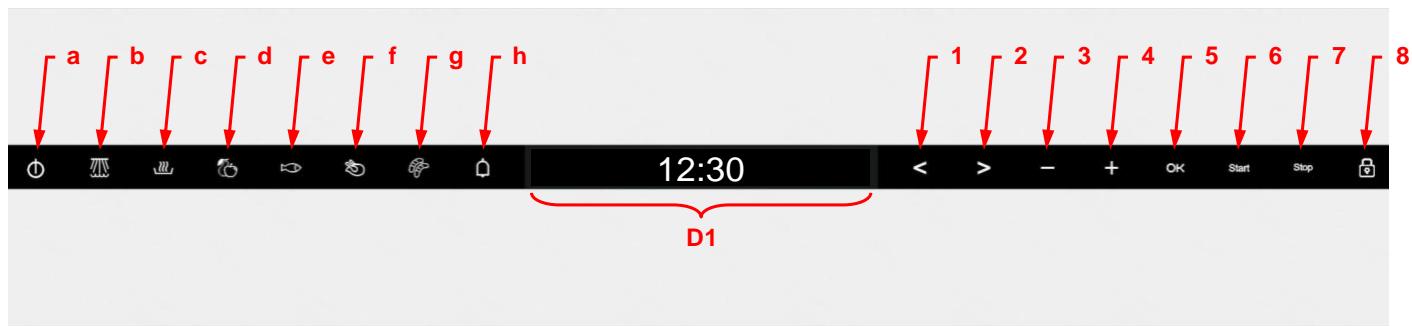
a - Touche MARCHE/ARRÊT b - Touche fonction Vapeur c - Touche fonction Régénération & Stérilisation d - Touche fonction Légumes e - Touche fonction Poisson f - Touche fonction Viande g - Touche fonction Accompagnements h - Touche Minuteur
1 - Touche « Gauche » 2 - Touche « Droite » 3 - Touche « - » 4 - Touche « + » 5 - Touche « OK » 6 - Touche « Démarrer » 7 - Touche « Arrêter » 8 - Touche « Verrouillage de sécurité » D1 - Affichage
Réglages initiaux
Après la première mise sous tension de votre four vapeur ou après une coupure de courant, l'affichage de l'horloge clignote pour indiquer que l'heure affichée n'est pas correcte.
Le four ne fonctionnera pas tant que l'horloge et le paramètre de dureté de l'eau ne sont pas réglés.
Pour régler l'horloge et la valeur du paramètre de dureté de l'eau, procédez comme décrit dans les chapitres suivants.
Réglage de l'horloge
L'affichage de l'horloge clignote si votre appareil est branché pour la première fois ou après une coupure de courant, pour indiquer que l'heure affichée n'est pas correcte. Pour régler l'horloge, procédez comme suit :

- Appuyez sur la touche « Marche/Arrêt » pour allumer le four.
- Maintenez enfoncées simultanément les touches « - » et « + ». Les chiffres des heures clignotent (les étapes 1 et 2 ne sont pas nécessaires lors de la première mise sous tension ou après une coupure de courant).
- Appuyez sur les touches « - » et « + » pour régler les heures.
Réglage de la dureté de l'eau
- Appuyez sur la touche OK pour confirmer les heures. Les chiffres des minutes clignotent.
- Appuyez sur les touches « - » et « + » pour régler les minutes.
- Appuyez sur la touche OK pour confirmer les minutes.

L'appareil dispose d'un système qui indique automatiquement quand il est temps de détartrer.
Le système peut être optimisé pour les ménages avec une eau très douce (également en utilisant un adoucisseur d'eau) et une eau très dure, en modifiant les réglages utilisateur pour la plage de dureté de l'eau correspondante (voir tableau ci-dessous).
Pour régler le paramètre de dureté de l'eau, procédez comme suit :
- Appuyez sur la touche « Marche/Arrêt » pour allumer le four.
- Appuyez simultanément sur les touches « Gauche » et « Droite ». Le degré de dureté commence à clignoter à l'écran (les étapes 1 et 2 ne sont pas nécessaires si votre four à micro-ondes est branché pour la première fois ou après une panne de courant).
- Appuyez sur les touches « - » et « + » pour régler la valeur correcte du paramètre de dureté de l'eau, conformément au tableau ci-dessous.
- Appuyez sur la touche « OK » pour valider le paramètre. L'écran affiche l'horloge.
Réglages de base
Le tableau suivant présente les différentes échelles pour la définition de la dureté de l'eau.
| Type | Water hardness | Display | |||
| Ca + Mg (ppm) | English deg. [°eH] | French deg. [°dF] | German deg. [°dH] | ||
| Soft water | 0 to 150 | 0 to 11 | 0 to 15 | 0 to 8 | SOFT |
| Medium water | 151 to 350 | 12 to 25 | 16 to 35 | 9 to 20 | MED |
| Hard water | 501 to 500 | 26 to 35 | 36 to 50 | 21 to 28 | HARD |
Masquer/Afficher l'horloge

Si l'affichage de l'horloge vous gêne, vous pouvez la masquer en procédant comme suit :
- Appuyez sur la touche « Marche/Arrêt » pour allumer le four.
- Appuyez sur la touche « OK » pendant 3 secondes. L'écran s'éteint.
Si vous souhaitez réafficher l'horloge, répétez la procédure ci-dessus.
Verrouillage de sécurité
Le fonctionnement du four peut être bloqué (par exemple, pour empêcher son utilisation par les enfants).

Pour bloquer le four, procédez comme suit :
- Appuyez sur la touche « Marche/Arrêt » pour allumer le four.
- Maintenez enfoncée la touche « Blocage de sécurité » pendant 3 secondes. La touche « Blocage de sécurité » s'allume et l'écran affiche un symbole de clé.
Le four ne fonctionnera pas tant qu'il n'est pas débloqué. Pour débloquer le four, répétez la procédure ci-dessus.
Minuteur
Utilisez cette fonction comme aide dans les tâches quotidiennes de la cuisine.

Pour régler le minuteur, procédez comme suit :
- Appuyez sur la touche « Marche/Arrêt » pour allumer le four.
- Appuyez sur la touche de fonction « Minuteur ». La touche devient rouge et l'écran affiche :

- Appuyez sur les touches « - » et « + » pour régler la durée souhaitée.
- Appuyez sur la touche OK. Le minuteur commence le compte à rebours.
Lorsque la durée réglée est écoulée, le four émet trois bips qui se répètent toutes les 30 secondes et la touche Minuteur clignote. Appuyez sur la touche Minuteur pour annuler les bips.
Pendant que le minuteur fonctionne, la touche Minuteur est rouge. L'écran et les voyants affichent ce qui suit :
- Si aucune fonction n'est en cours, l'écran affiche le compte à rebours du minuteur et la touche Minuteur est rouge.
- S'il y a une fonction active, l'affichage et les touches montrent les paramètres de fonction normaux. Pour vérifier le temps restant du minuteur, appuyez sur la touche Minuteur. L'affichage montre brièvement le minuteur et reprend les indications de fonction après 5 secondes ou dès que la touche Minuteur est enfoncée à nouveau. Pendant que le minuteur est affiché, le temps restant peut être modifié avec les touches « - » et « + » comme décrit ci-dessus.
Fonctions de base
Vapeur
Utilisez cette fonction pour cuire et réchauffer des légumes, des pommes de terre, du riz, du poisson et de la viande.

- Appuyez sur la touche « Marche/Arrêt » pour allumer le four.
- Appuyez sur la touche de fonction « Vapeur ». La touche devient rouge et l'affichage indique :

- Appuyez sur les touches « - » et « + » pour régler la température souhaitée.
- Appuyez sur la touche « > ». L'affichage indique :

- Appuyez sur les touches « - » et « + » si vous souhaitez régler la durée de fonctionnement souhaitée. Ce réglage est facultatif. Passez au point 7 si vous ne souhaitez pas régler la durée.
- Si vous souhaitez modifier l'un des paramètres ci-dessus, appuyez sur les touches < ou > pour sélectionner le paramètre, puis sur les touches - et + pour définir une valeur différente.
- Appuyez sur la touche Démarrer. Le four commence à fonctionner.
Remarque importante : le symbole I clignote à l'écran, ce qui signifie que la température à l'intérieur du four est inférieure à la température réglée.
Régénération et stérilisation
Utilisez cette fonction pour régénérer des plats et des plats préparés, ainsi que pour stériliser et faire bouillir des fruits.

- Appuyez sur la touche « Marche/Arrêt » pour allumer le four.
- Appuyez sur la touche "Régénération et stérilisation". La touche devient rouge et l'écran affiche :

- Appuyez sur les touches "-" et "+" pour sélectionner le programme souhaité, par exemple "R 01" (voir tableau ci-dessous).
- Appuyez sur la touche ">". L'écran affiche :

- Appuyez sur les touches "-" et "+" si vous souhaitez modifier le temps de fonctionnement préréglé. Ce réglage est facultatif.
- Appuyez sur la touche Démarrer. Le four commence à fonctionner.
Remarque importante : Le symbole clignote à l'écran, ce qui signifie que la température à l'intérieur du four est inférieure à la température réglée.
| Programme | Type of Food | Temperature (℃) | Time (min) | Instructions |
| R 01 | Plate dishes | 100°C | 13 | Remove lid from container and put on Perforated baking tray. |
| R 02 | Ready-made meals / frozen | 100°C | 18 | |
| R 03 | Beans | 100°C | 35 | Sterilising: |
| R 04 | Cherries | 80°C | 35 | The times and temperatures refer to 1L preserving jars. |
| R 05 | Plums | 90°C | 35 | |
| R 06 | Baby bottles | 100°C | 12 |
Cuisson des légumes
Utilisez cette fonction pour cuire les légumes décrits dans le tableau ci-dessous.

- Appuyez sur la touche "Marche/Arrêt" pour allumer le four.
- Appuyez sur la touche "Cuisson des légumes". La touche devient rouge et l'écran affiche :

- Appuyez sur les touches "-" et "+" pour sélectionner le programme souhaité, par exemple "A 01" (voir tableau ci-dessous).
- Appuyez sur la touche ">". L'écran affiche :

- Appuyez sur les touches « - » et « + » si vous souhaitez modifier le temps de fonctionnement prédéfini. Ce réglage est facultatif.
- Appuyez sur la touche Start. Le four commence à fonctionner.
Remarque importante : le symbole clignote à l'écran, ce qui signifie que la température à l'intérieur du four est inférieure à la température réglée.
| Programme | Type of Vegetable | Temperature (℃) | Time (min) |
| A 01 | Broccoli / florets | 100 °C | 20 |
| A 02 | Cauliflower / florets | 100 °C | 25 |
| A 03 | Potatoes / pieces | 100 °C | 25 |
| A 04 | Snow peas | 100 °C | 15 |
| A 05 | Asparagus | 100 °C | 25 |
Fonctions spéciales
Cuisson du poisson
Utilisez cette fonction pour cuire les types de poisson décrits dans le tableau ci-dessous.

- Appuyez sur la touche « On/Off » pour allumer le four.
- Appuyez sur la touche « Cuisson du poisson ». La touche devient rouge et l'écran affiche :

- Appuyez sur les touches « - » et « + » pour sélectionner le programme souhaité, par exemple « B 01 » (voir le tableau ci-dessous).
- Appuyez sur la touche « > ». L'écran affiche :

- Appuyez sur les touches « - » et « + » si vous souhaitez modifier le temps de fonctionnement prédéfini. Ce réglage est facultatif.
- Appuyez sur la touche Start. Le four commence à fonctionner.
Remarque importante : le symbole clignote à l'écran pour indiquer que la température à l'intérieur du four est inférieure à la température réglée.
| Programme | Type of Fish | Temperature (℃) | Time (min) |
| B 01 | Trout | 80 °C | 25 |
| B 02 | Shrimp | 90 °C | 15 |
| B 03 | Fish filet | 80 °C | 18 |
| B 04 | Mussels | 100 °C | 25 |
| B 05 | Lobster | 100 °C | 30 |
Cuisson de la viande
Utilisez cette fonction pour cuire les types de viande décrits dans le tableau ci-dessous.

- Appuyez sur la touche « Marche/Arrêt » pour allumer le four.
- Appuyez sur la touche « Cuisson de la viande ». La touche devient rouge et l'écran affiche :

- Appuyez sur les touches « - » et « + » pour sélectionner le programme souhaité, par exemple « C 01 » (voir tableau ci-dessous).
- Appuyez sur la touche « > ». L'écran affiche :
- Appuyez sur les touches « - » et « + » si vous souhaitez modifier le temps de fonctionnement préréglé. Ce réglage est facultatif.
- Appuyez sur la touche Démarrer. Le four commence à fonctionner.
Remarque importante : le symbole clignote à l'écran pour indiquer que la température à l'intérieur du four est inférieure à la température réglée.
| Programme | Type of Meat | Temperature (℃) | Time (min) |
| C 01 | Chicken breast | 100 ℃ | 30 |
| C 02 | Smoked pork loin / pieces | 100 ℃ | 45 |
| C 03 | Turkey escalope | 100 ℃ | 20 |
| C 04 | Pork filet, whole | 100 ℃ | 25 |
| C 05 | Vienna sausages | 90 ℃ | 15 |
Fonctions spéciales
Accompagnements
Utilisez cette fonction pour cuire les aliments décrits dans le tableau ci-dessous.

- Appuyez sur la touche « Marche/Arrêt » pour allumer le four.
- Appuyez sur la touche « Plats d'accompagnement ». La touche devient rouge et l'écran affiche :

- Appuyez sur les touches « - » et « + » pour sélectionner le programme souhaité, par exemple « D 01 » (voir tableau ci-dessous).
- Appuyez sur la touche « > ». L'écran affiche :
- Appuyez sur les touches « - » et « + » si vous souhaitez modifier le temps de fonctionnement préréglé. Ce réglage est facultatif.
- Appuyez sur la touche Démarrer. Le four commence à fonctionner.
Remarque importante : Le symbole clignote à l'écran, ce qui signifie que la température à l'intérieur du four est inférieure à la température réglée.
| Programme | Type of Food | Temperature (℃) | Time (min) |
| D 01 | Sweet yeast dumpling | 100 ℃ | 20 |
| D 02 | Yeast dumpling | 100 ℃ | 25 |
| D 03 | Napkin dumpling | 100 ℃ | 30 |
| D 04 | Rice | 100 ℃ | 35 |
| D 05 | Lentils | 100 ℃ | 40 |
Remplissage du réservoir d'eau
Toutes les fonctions nécessitent que le réservoir d'eau soit plein.
Remplissez le réservoir d'eau jusqu'au repère « MAX » avec de l'eau potable froide et fraîche, puis insérez-le dans la fente située au-dessus de la cavité (environ 1 L).
Si le symbole apparaît à l'écran, cela signifie que le réservoir d'eau n'est pas correctement inséré ou a été retiré.
Pour effacer le message, insérez correctement le réservoir d'eau.
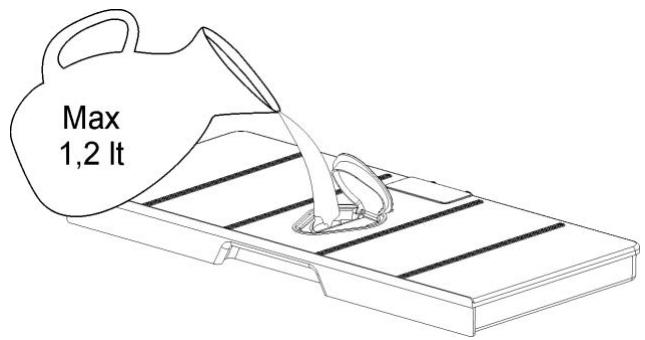
Remplissage du réservoir d'eau
Le contenu du réservoir d'eau suffit normalement pour une session de cuisson de 50 à 60 minutes.
Si toutefois le réservoir d'eau doit être rempli, cela est signalé par le symbole clignotant sur l'écran, indiquant que le réservoir d'eau est vide.
Avertissement ! Remplissez le réservoir d'eau uniquement jusqu'à un maximum de 0,5 litre pour éviter que l'eau ne déborde lorsqu'elle est pompée vers le réservoir. RISQUE DE DÉBORDEMENT.
Vidange du réservoir d'eau
Lorsque l'appareil est éteint, l'eau résiduelle est pompée vers le réservoir d'eau.
Pendant le pompage de l'eau, l'écran affiche "PUMP".
Ce message reste affiché jusqu'à ce que la température de l'eau atteigne 75°C avant de pouvoir être pompée vers le réservoir d'eau.
Avertissement : l'eau dans le réservoir peut être chaude. Danger de brûlures !
Après que l'eau a été pompée vers le réservoir d'eau, l'écran affiche le message "DEP" nécessitant les actions suivantes :
- Retirez et videz le réservoir d'eau.
- Séchez le réservoir d'eau et réinsérez-le dans la fente située au-dessus de la cavité. Nettoyez et séchez l'espace de cuisson.
- Laissez la porte de l'appareil ouverte afin que l'espace de cuisson puisse refroidir et sécher complètement.
REMARQUE IMPORTANTE : Il est conseillé de retirer le réservoir d'eau et de le vider après un cycle de cuisson. Cela évite la formation de bactéries et de calcaire à l'intérieur de l'appareil.
Si le réservoir d'eau n'a pas été retiré du four et qu'un nouveau cycle de cuisson est démarré, le four affiche l'avertissement "DEP".
Cet avertissement peut être effacé en appuyant sur la touche Stop et en poursuivant le nouveau cycle de cuisson sans retirer et vider le réservoir d'eau.
Lorsque le four est en fonctionnement…
Interruption d'un cycle de cuisson
Vous pouvez arrêter le processus de cuisson à tout moment en appuyant une fois sur la touche Stop.
Le four intègre une fonction de réduction de vapeur qui s'active lorsque la touche Stop est enfoncée afin de libérer progressivement la vapeur de la cavité, évitant ainsi tout dégagement soudain de vapeur à l'ouverture de la porte de l'appareil.
Cette fonction prend environ 3 minutes et pendant ce temps, l'écran affiche le mot "VAP".
Attention ! Lors de l'ouverture de la porte pendant ou à la fin du cycle de cuisson, méfiez-vous du flux d'air chaud et/ou de vapeur sortant de la chambre de cuisson. Reculez ou déplacez-vous sur le côté pour éviter les brûlures.
À ce stade :
- La génération de vapeur est interrompue.
- Les parois de la cavité et le réservoir d'eau sont encore très chauds. Risque de brûlure !
- La minuterie s'arrête et l'écran affiche le temps de fonctionnement restant (si celui-ci a été réglé).
Si vous le souhaitez, vous pouvez à ce stade :
- Tourner ou remuer les aliments pour garantir une cuisson uniforme.
- Modifier les paramètres de cuisson.
Pour redémarrer le processus, fermez la porte et appuyez sur la touche Start.
Modification des paramètres
Les paramètres de la fonction active peuvent être modifiés en appuyant sur les touches < ou > pour sélectionner le paramètre, puis sur les touches - et + pour définir une valeur différente. Appuyez sur la touche OK ou attendez quelques secondes pour valider la nouvelle valeur du paramètre.
Annulation d'un cycle de cuisson
Si vous souhaitez annuler le processus de cuisson, appuyez deux fois sur la touche Stop.
Vous entendrez alors un bip et l'horloge apparaîtra à l'écran.
Fin d'un cycle de cuisson
À la fin de la durée définie ou lorsque vous appuyez sur la touche Stop pour terminer le cycle de cuisson, vous entendrez trois bips et l'écran affichera le mot "End", le four démarre la fonction de réduction de vapeur.
Cette fonction libère progressivement la vapeur de la cavité, afin qu'il n'y ait pas de brusque échappement de vapeur lors de l'ouverture de la porte de l'appareil.
Cette fonction dure environ 3 minutes et pendant ce temps, l'écran affiche le mot "VAP".
Avertissement ! Lors de l'ouverture de la porte pendant ou à la fin du cycle de cuisson, faites attention au flux d'air chaud et/ou de vapeur sortant de la cavité de cuisson. Reculez ou écartez-vous pour éviter les brûlures.
Le ventilateur de refroidissement peut continuer à fonctionner pendant un certain temps après l'arrêt de l'appareil. C'est une fonction normale destinée à réduire la température à l'intérieur du four.
L'eau résiduelle dans la chaudière est laissée refroidir à 75° C avant de pouvoir être pompée vers le réservoir d'eau. Pendant que l'eau est pompée, l'écran affiche "PUMP".
Avertissement : l'eau du réservoir peut être chaude. Danger de brûlures !
Lorsque l'écran affiche le mot "DEP", cela signifie que l'eau a été pompée et que le réservoir d'eau peut être retiré.
Retirez le réservoir d'eau et séchez-le soigneusement. Laissez l'espace de cuisson refroidir un instant, puis nettoyez-le et séchez-le avec un chiffon. La porte doit rester ouverte pendant un certain temps afin que l'appareil puisse sécher complètement.
FR Utilisation, tableaux et conseils
Utilisation des accessoires
Le récipient perforé convient à la cuisson de légumes frais ou surgelés, de viande et de volaille. Dans ce cas, il est important que le récipient non perforé soit introduit dans le premier niveau. Ainsi, les liquides qui s'égouttent sont collectés et l'appareil ne se salit pas. Le récipient perforé avec les aliments doit être inséré dans le deuxième niveau.
Le récipient non perforé est utilisé pour cuire à la vapeur des aliments délicats, par exemple des compotes et des quenelles.
La grille est utilisée pour la cuisson avec de petits récipients, comme par exemple des bols à dessert, et pour régénérer des assiettes.
Pour des informations plus précises, reportez-vous aux tableaux.
Les temps et températures suggérés sont des valeurs indicatives. Le temps de cuisson réel peut varier selon le type et la qualité des aliments.
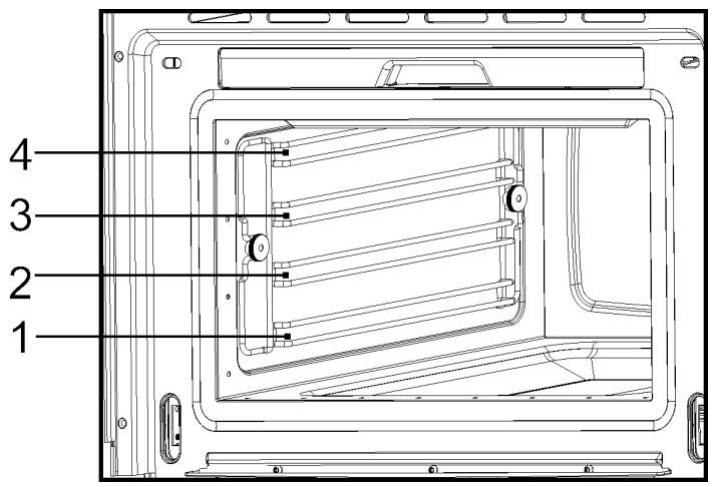
Poisson
| Fish | Quantity | Temperature °C | Time min. | Container | Level |
| Gilthead sea bream | 800-1200 g | 80 | 30-40 | Perforated | 2 |
| Trout | 4 x 250 g | 80 | 20-25 | Perforated | 2 |
| Salmon filet | 500-1000 g | 80 | 15-25 | Perforated | 2 |
| Salmon trout | 1000-1200 g | 80 | 25-35 | Perforated | 1/2 |
| King prawns | 500-1000 g | 80 | 15-20 | Perforated | 2 |
| Green-shell mussel | 1000-1500 g | 100 | 25-35 | Perforated | 2 |
| Halibut filet | 500-1000 g | 80 | 20-25 | Perforated | 2 |
| Cockles | 500-1000 g | 100 | 10-20 | Perforated | 2 |
| Lobster | 800-1200 g | 100 | 25-30 | Perforated | 1/2 |
| Cod filet | 1000-1200 g | 80 | 20-25 | Perforated | 2 |
| Blue mussel | 1000-1200 g | 100 | 15-25 | Perforated | 2 |
| Lake trout | 4 x 250 g | 80 | 25-30 | Perforated | 2 |
| Haddock | 1000-1200 g | 80 | 20-25 | Perforated | 2 |
| Tuna filet | 500-1000 g | 80 | 15-20 | Perforated | 2 |
| Pike perch | 4 x 250 g | 80 | 25-30 | Perforated | 2 |
Utilisation, tableaux et conseils
Viande
| Meat | Quantity | Temperature °C | Time min. | Container | Level |
| Chicken leg | 4-10 | 100 | 40-45 | Perforated | 2 |
| Chicken breast | 4-6 | 100 | 25-35 | Perforated | 2 |
| Smoked pork loin | 500g – 1000 g | 100 | 40-50 | Perforated | 2 |
| Turkey escalope | 4-8 | 100 | 20-25 | Perforated | 2 |
| Pork filet, whole | 4-8 | 100 | 20-30 | Perforated | 2 |
| Sausages | 80-100 | 10-15 | Perforated | 2 |
Œufs
| Eggs | Temperature °C | Time min. | Container | Level |
| Eggs in Glass | 100 | 10-15 | Rack | 2 |
| Eggs, hard | 100 | 15 | Rack | 2 |
| Eggs, soft | 100 | 10-12 | Rack | 2 |
Accompagnements
| Side dishes | Quantity | Temperature °C | Time min. | Container | Level |
| Pearl barley + Liquid | 200g + 400 ml | 100 | 30-35 | Rack, glass bowl | 2 |
| Semolina + Liquid | 200g + 300 ml | 100 | 10-20 | Rack, glass bowl | 2 |
| Lentils + Liquid | 200g + 375 ml | 100 | 20-50 | Rack, glass bowl | 2 |
| Rice + Liquid | 200g + 250 ml | 100 | 25-40 | Rack, glass bowl | 2 |
Légumes
| Vegetables | Temperature °C | Time min. | Container | Level | |
| Eggplant/Aubergine | in slices | 100 | 15-20 | Perforated | 2 |
| Beans | 100 | 35-45 | Perforated | 2 | |
| Broccoli | florets with stalk | 100 | 25-30 | Perforated | 2 |
| Broccoli | florets without stalk | 100 | 15-20 | Perforated | 2 |
| Cauliflower | florets | 100 | 25-30 | Perforated | 2 |
| Cauliflower | whole head | 100 | 40-45 | Perforated | 1 |
| Peas | 100 | 30-35 | Perforated | 2 | |
| Fennel | in stripes | 100 | 15-20 | Perforated | 2 |
| Fennel | cut in half | 100 | 20-30 | Perforated | 2 |
| Potatoes with skin | whole, very small | 100 | 20-25 | Perforated | 2 |
| Potatoes with skin | whole, very big | 100 | 45-50 | Perforated | 2 |
| Potatoes without skin | in pieces | 100 | 20-25 | Perforated | 2 |
| Turnip | in sticks | 100 | 20-25 | Perforated | 2 |
| Snow peas | 100 | 15-20 | Perforated | 2 | |
| Carrots | in slices | 100 | 25-30 | Perforated | 2 |
| Corn cobs | 100 | 50-60 | Perforated | 2 | |
| Bell peppers | in stripes | 100 | 12-15 | Perforated | 2 |
| Hot pepper | 100 | 12-15 | Perforated | 2 | |
| Mushrooms | in quarters | 100 | 12-15 | Perforated | 2 |
| Leeks | in slices | 100 | 10-12 | Perforated | 2 |
| Brussels sprouts | 100 | 25-35 | Perforated | 2 | |
| Celery | in stripes | 100 | 15-20 | Perforated | 2 |
| Asparagus | 100 | 20-35 | Perforated | 2 | |
| Spinach | 100 | 12-15 | Perforated | 2 | |
| Celery stalks | 100 | 25-30 | Perforated | 2 | |
| Courgette | in slices | 100 | 12-18 | Perforated | 2 |
Quenelles
| Dumplings | Temperature °C | Time min. | Container | Level |
| Sweet dumpling | 100 | 20-30 | Not perforated | 2 |
| Sweet yeast dumpling | 100 | 15-20 | Not perforated | 2 |
| Yeast dumpling | 100 | 15-25 | Not perforated | 2 |
| Bread dumpling | 100 | 20-25 | Not perforated | 2 |
| Napkin dumpling | 100 | 25-30 | Not perforated | 2 |
Utilisation, tableaux et conseils
Desserts
| Desserts | Quantity | Temperature °C | Time min. | Container | Level |
| Stewed apples | 500-1500 g | 100 | 15-25 | Not perforated | 2 |
| Stewed pears | 500-1500 g | 100 | 25-30 | Not perforated | 2 |
| Crème brûlée | 80 | 20-25 | Rack - bowl | 2 | |
| Crème caramel | 80 | 25-30 | Rack - bowl | 2 | |
| Yogurt | 40 | 4-6 hrs. | Rack - bowl | 2 | |
| Stewed peaches | 500-1500 g | 100 | 15-20 | Not perforated | 2 |
Fruits (Stérilisation/Réduction)
| Fruit | Quantity | Temperature °C | Time min. | Container | Level |
| Pears | 4-6 1l glasses | 100 | 30-35 | Rack | 1 |
| Cherries | 4-6 1l glasses | 80 | 30-35 | Rack | 1 |
| Peaches | 4-6 1l glasses | 80 | 30-35 | Rack | 1 |
| Plums | 4-6 1l glasses | 80 | 30-35 | Rack | 1 |
Régénérer
| Warming-up | Quantity | Temperature °C | Time min. | Container | Level |
| Plate dishes | 1-2 | 100 | 12-15 | Rack | 2 |
| Plate dishes | 3-4 | 100 | 15-20 | Rack | 2 |
| Ready-made meals | 100 | 15-20 | Rack | 2 |
Blanchir
| Vegetables | Quantity | Temperature °C | Time min. | Container | Level |
| e.g. Beans, Leek | 100 | 10-12 | Perforated | 2 | |
| Curly Kale | 1000-2000 g | 100 | 12-16 | Perforated | 2 |
| Savoy cabbage | 10-20 | 100 | 12-15 | Perforated | 2 |
| White cabbage, whole | 2000-2500 g | 100 | 30-45 | Perforated | 1 |
| Tomatoes, peeled | 80 | 12 | Rack | 2 |
FR Utilisation, tableaux et conseils
Décongeler
| Vegetables / Side dish | Temperature °C | Time min. | Container | Level | |
| Broccoli | florets with stalk | 100 | 15-20 | Perforated | 2 |
| Mixed vegetables | 100 | 15-20 | Perforated | 2 | |
| Spinach leaves | portions | 100 | 10-15 | Not perforated | 2 |
| Cauliflower | florets | 100 | 15-20 | Perforated | 2 |
| Peas | 100 | 15-25 | Perforated | 2 | |
| Curly kale | bigger portion | 100 | 25-35 | Not perforated | 2 |
| Carrots | in slices | 100 | 15-20 | Perforated | 2 |
| Brussels sprouts | 100 | 20-25 | Perforated | 2 | |
| Asparagus | 100 | 25-30 | Perforated | 2 | |
| Ready-made meals | 100 | as required | Rack | 2 | |
| Bread | 100 | 10-25 | Rack | 2 | |
| Rice | 100 | 15-25 | Not perforated | 2 | |
| Lentils | 100 | 15-20 | Not perforated | 2 | |
| Noodles | 100 | 15-20 | Not perforated | 2 | |
Cuisson sur deux niveaux
Quelques suggestions :
Lors d'une cuisson sur deux niveaux, la grille doit toujours être insérée au 2e ou 3e niveau en partant du bas.
Ainsi, les récipients habituels en porcelaine, en verre Jena ou en acier inoxydable peuvent être placés dans le four.
Le récipient de cuisson, perforé ou non, sera inséré au 1er niveau en partant du bas. On peut également cuisiner avec deux grilles.
Les temps de cuisson différents sont contrôlés de cette manière :
Les aliments nécessitant un temps de cuisson plus long doivent être placés dans la partie supérieure du four. Les aliments avec un temps de cuisson plus court doivent être placés au 1er niveau.
Un exemple : légumes, pommes de terre et poisson.
Placez les légumes et les pommes de terre dans tout récipient adapté sur la grille insérée au 2e ou 3e niveau.
Insérez le poisson au 1er niveau.
Lorsque vous utilisez le plateau perforé pour cuire le poisson, le plateau non perforé doit être inséré au fond de l'appareil pour recueillir le liquide qui s'écoule du poisson. Ainsi, l'appareil reste propre.
Durée : légumes et pommes de terre 25 à 35 min.
Durée : poisson – selon le type – 15 à 25 min.
Sélectionnez la durée de cuisson la plus longue. Grâce aux différents niveaux, les aliments sont prêts en même temps, sans surcuisson.
Entretien et maintenance
Nettoyage de l'espace de cuisson
Évitez d'utiliser des nettoyants abrasifs tels que les tampons à récurer, la laine d'acier, etc., car ils peuvent endommager la surface.
Essuyez l'espace de cuisson avec un chiffon humide pendant que l'appareil est encore chaud. Terminez en séchant l'espace de cuisson.
Pour faciliter le nettoyage, les supports de grille peuvent être retirés (voir le chapitre suivant).
Retrait des supports de grille
Dévissez et retirez les écrous moletés 1 à l'avant des supports de grille dans le sens inverse des aiguilles d'une montre.
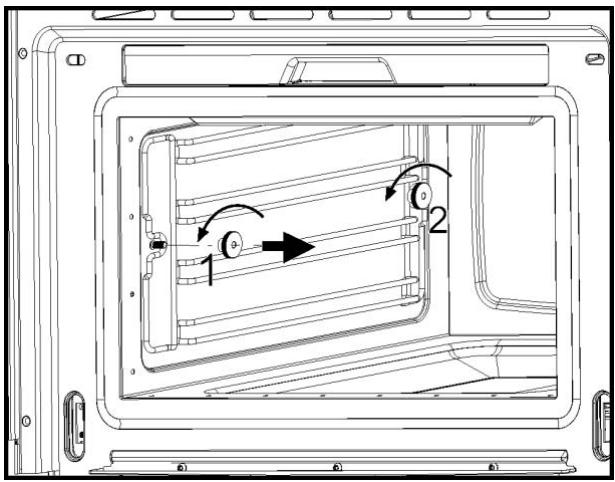
Dévissez et desserrez les écrous moletés 2 à l'arrière des supports de grille dans le sens inverse des aiguilles d'une montre. Ne retirez pas complètement ces écrous.
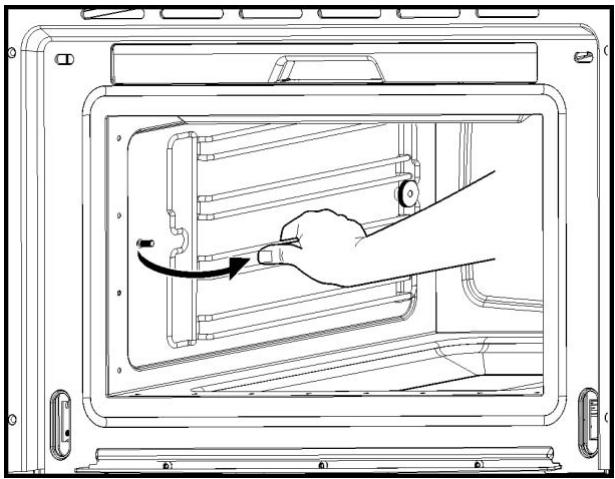
Tirez les supports de grille vers l'intérieur de la cavité et retirez-les par l'avant.
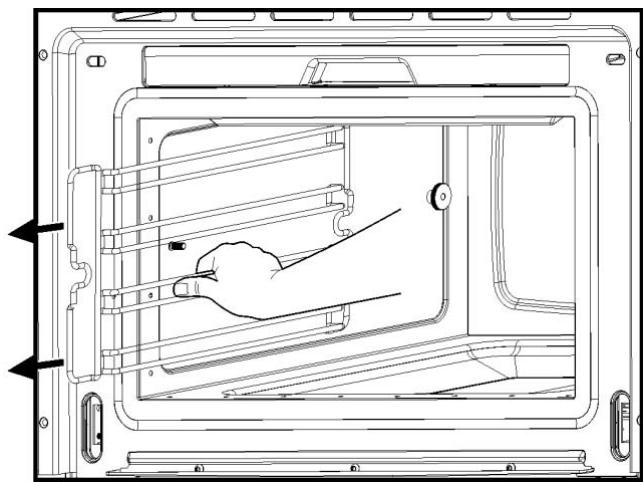
Pour les remettre, insérez les guides d'étagère dans les écrous moletés 2 à l'arrière et positionnez-les sur les vis à l'avant. Vissez les écrous moletés 1 et 2 dans le sens des aiguilles d'une montre jusqu'à ce qu'ils soient serrés.
Retrait de la porte de l'appareil
Ouvrez la porte de l'appareil à fond.
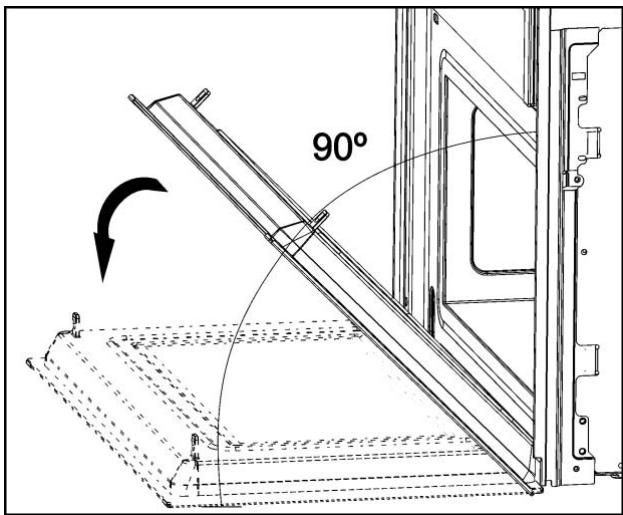
Insérez 2 goupilles dans les trous des charnières.
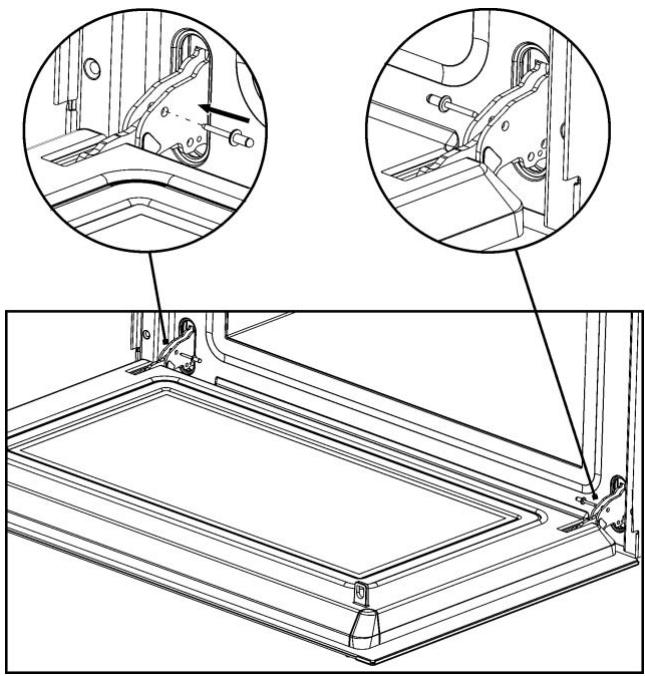
Fermez la porte de l'appareil juste assez pour pouvoir la soulever.
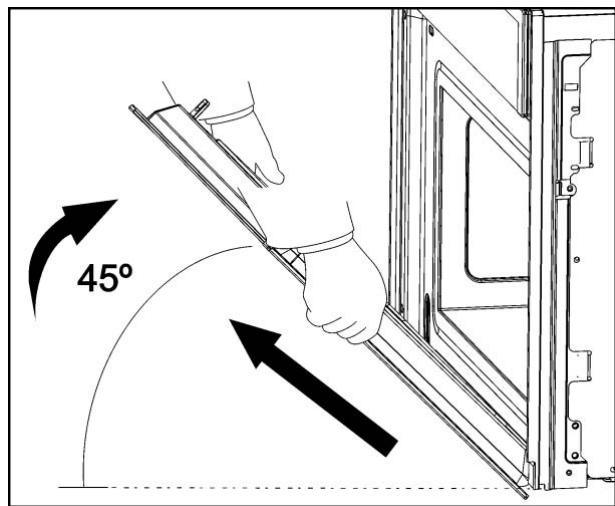
Pour le remontage, poussez les charnières dans les trous depuis l'avant.
Ouvrez la porte de l'appareil à fond et retirez les goupilles.
Entretien et maintenance
Détartrage
Chaque fois que de la vapeur est produite, quelle que soit la dureté de l'eau locale (c'est-à-dire la teneur en calcaire de l'eau), du calcaire se dépose à l'intérieur du générateur de vapeur.
L'intervalle entre les détartrages dépend de la dureté de l'eau et de la fréquence d'utilisation. Si vous utilisez la vapeur 4 × 30 minutes par semaine, l'appareil doit être détartré (selon la dureté de l'eau) à peu près comme suit :
| Water hardness | Descale after about |
| Very soft | 18 months |
| Medium | 9 months |
| Very hard | 6 months |
L'appareil détecte automatiquement quand un détartrage est nécessaire et, à ce moment, l'écran affiche :

Si la procédure de détartrage n'est pas effectuée, quelques cycles de cuisson après, le symbole affiché ci-dessus commence à clignoter.
Si, une fois de plus, la procédure de détartrage n'est pas effectuée, quelques cycles de cuisson après, le fonctionnement du four est bloqué et l'écran affiche :
CAL

IMPORTANT : Si vous ne détartrez pas l'appareil, son fonctionnement risque d'être altéré ou l'appareil peut être endommagé.
Solutions de détartrage adaptées
Pour le détartrage, utilisez la solution de détartrage « DURGOL® ».
Cette solution permet un détartrage professionnel et soigné de votre appareil et est disponible dans les centres de service clientèle.
Avertissement ! N'utilisez pas de vinaigre ou de produits à base de vinaigre, car ils peuvent endommager le circuit interne du four.
Les solutions de détartrage traditionnelles ne sont pas appropriées car elles peuvent contenir des agents moussants.
Procédure de détartrage

Avertissement : Pour des raisons de sécurité, le processus de détartrage ne peut pas être interrompu et dure environ 45 minutes.
L'appareil peut être détartré avec la porte du four ouverte ou fermée. L'appareil doit être en état de repos avant de commencer le cycle de détartrage.
Pour exécuter un cycle de détartrage, procédez comme suit :
- Appuyez sur la touche « Marche/Arrêt » pour allumer le four.
- Appuyez simultanément sur les touches « Gauche » et « Droite » pendant 5 secondes. L'écran affiche « CAL » et un bip intermittent se fait entendre. Si vous souhaitez annuler le processus de détartrage à ce stade, appuyez sur la touche « Stop ».
- Appuyez sur la touche « Démarrer ».
- Lorsque l'écran affiche « 0,5 L », retirez le réservoir d'eau.
- Versez 0,5 litre d'une solution de détartrage adaptée dans le réservoir d'eau et remettez le réservoir en place.
- Appuyez sur la touche « Start ». Le cycle de détartrage démarre et dure environ 30 minutes.
- Lorsque l'affichage indique « 1.0L » clignotant et que le four émet un bip, retirez et videz le réservoir d'eau.
- Remplissez le réservoir d'eau avec 1,0 litre d'eau froide et remettez le réservoir en place.
- Appuyez sur la touche « Start ». Le premier cycle de rinçage démarre.
- Lorsque l'affichage indique à nouveau « 1.0L » clignotant et que le four émet un nouveau bip, retirez et videz le réservoir d'eau.
- Remplissez le réservoir d'eau avec 1,0 litre d'eau froide et remettez le réservoir en place.
- Appuyez sur la touche « Start ». Le deuxième cycle de rinçage démarre.
- Lorsque le cycle de rinçage est terminé, l'affichage indique « End ».
- Retirez, videz et séchez le réservoir d'eau.
Entretien et maintenance
Avertissement ! Le nettoyage doit être effectué lorsque le four est hors tension. Retirez la fiche de la prise ou coupez le circuit d'alimentation du four.
N'utilisez pas de produits de nettoyage agressifs ou abrasifs, de tampons à récurer qui rayent les surfaces ou d'objets tranchants, car des taches peuvent apparaître.
N'utilisez pas d'appareils de nettoyage à haute pression ou à jet de vapeur.
Surface avant
Normalement, il suffit de nettoyer le four avec un chiffon humide. S'il est très sale, ajoutez quelques gouttes de liquide vaisselle à l'eau de nettoyage. Ensuite, essuyez le four avec un chiffon sec.
Sur un four avec une façade en aluminium, utilisez un produit de nettoyage pour vitres doux et un chiffon doux qui ne libère ni fibres ni fils. Essuyez de gauche à droite sans exercer de pression sur la surface.
Éliminez immédiatement les taches de calcaire, de graisse, d'amidon ou de blanc d'œuf. La corrosion peut se produire sous ces taches.
Ne laissez pas d'eau pénétrer à l'intérieur du four.
Intérieur du four
Après utilisation, retirez toute eau présente au fond de la cavité de cuisson avec un chiffon doux. Laissez la porte de l'appareil ouverte afin que la cavité de cuisson puisse refroidir.
Pour éliminer les saletés plus tenaces, utilisez un produit de nettoyage non agressif. N'utilisez pas de sprays pour four ni d'autres produits de nettoyage agressifs ou abrasifs.
Gardez toujours la porte et la façade du four très propres pour garantir une ouverture et une fermeture correctes de la porte.
Assurez-vous que l'eau ne pénètre pas dans les trous de ventilation du four.
Le cache en verre de l'ampoule est situé sur le plafond du four et peut être retiré facilement pour le nettoyage. Pour cela, il suffit de le dévisser et de le nettoyer avec de l'eau et du liquide vaisselle.
Accessoires
Nettoyez les accessoires après chaque utilisation. S'ils sont très sales, faites-les d'abord tremper, puis utilisez une brosse et une éponge. Les accessoires peuvent être lavés au lave-vaisselle.
Que faire si le four ne fonctionne pas ?
AVERTISSEMENT ! Toute réparation doit être effectuée uniquement par un technicien spécialisé. Toute réparation effectuée par une personne non autorisée par le fabricant est dangereuse.
Vous n'avez pas besoin de contacter l'assistance technique pour résoudre les questions suivantes :
- L'affichage ne s'allume pas ! Vérifiez si :
- L'indication de l'heure a été désactivée (voir la section sur les réglages de base).
- Rien ne se passe lorsque j'appuie sur les touches ! Vérifiez si :
- Le blocage de sécurité est actif (voir la section sur les réglages de base).
- Le four ne fonctionne pas ! Vérifiez si :
- La fiche est correctement insérée dans la prise.
- L'alimentation du four est allumée.
- Lorsque le four fonctionne, j'entends des bruits étranges ! Ce n'est pas un problème.
- Cela est lié aux bruits de fonctionnement qui peuvent se produire pendant la cuisson, par exemple, par les pompes à eau dans le générateur de vapeur.
- La vapeur à l'intérieur de la cavité produit une accumulation de pression et parfois les parois de la cavité peuvent produire du bruit lorsqu'elles réagissent à la pression.
- Ces bruits sont normaux, il n'y a aucun problème.
- Les aliments ne chauffent pas ou chauffent très lentement ! Vérifiez si :
- Vous avez sélectionné les temps de fonctionnement et le réglage de température corrects.
- La quantité d'aliments placés dans le four est plus importante ou plus froide que d'habitude.
- Si le message "Err_ " apparaît à l'écran, veuillez contacter le service client.
- L'appareil émet encore un bruit après la fin de la cuisson ! Ce n'est pas un problème.
- Le ventilateur de refroidissement continue de fonctionner pendant un certain temps. Lorsque la température a suffisamment baissé, le ventilateur s'éteint de lui-même.
- Le four s'allume mais l'éclairage intérieur ne s'allume pas !
- Si toutes les fonctions fonctionnent correctement, il est probable que l'ampoule soit grillée. Vous pouvez continuer à utiliser le four.
Remplacement de l'ampoule
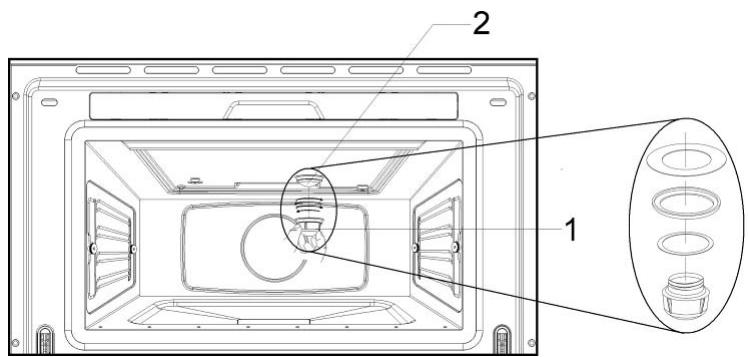
Pour remplacer l'ampoule, procédez comme suit :
- Débranchez le four de l'alimentation électrique. Retirez la fiche de la prise ou coupez le circuit d'alimentation du four.
- Dévissez et retirez le couvercle en verre de l'éclairage (1).
- Retirez l'ampoule (2). Attention ! L'ampoule peut être très chaude.
- Installez une nouvelle ampoule E14 230-240V/15W. Suivez les instructions du fabricant de l'ampoule.
- Vissez le couvercle en verre de l'éclairage en place (1). REMARQUE IMPORTANTE : Assurez-vous que les joints d'étanchéité sont appliqués dans le bon ordre.
- Rebranchez le four à l'alimentation électrique.
Caractéristiques techniques
Description des fonctions
| Symbol | Function | Foods |
| Steam | Cooking all sorts of vegetables, rice, cereals and meat. Extracting juice from berries. Simultaneous defrosting and cooking of vegetables. | |
| Regenerating & Sterilising | Regenerating plate dishes and ready-made meals. Sterilising/boiling down fruit. | |
| Cooking Vegetables | Cooking different types of vegetables. | |
| Cooking Fish | Cooking different types of fish. | |
| Cooking Meat | Cooking different types of meat. | |
| Side Dishes | Cooking different types of side dishes. |
Messages affichés
| Message | Description |
| Water tank | |
| U | Flashing – water tank is empty. Please refill. |
| M | Indication that water tank is missing. |
| DEP | The water tank must be removed, emptied and reinserted. |
| Entkalken | |
| VAP | Indication that steam reduction process is ongoing. |
| PUMP | Indication that hot water is being pumped to the water tank. |
| Descaling | |
| CAL | Appliance must be descaled. |
| Flashing – descaling starts. | |
| 0.5L | Feed 0,5 litre descaling solution into the water tank. |
| 1.0L | Feed 1,0 litre of cold water into the water tank for rinsing. |
| System warnings | |
| HOT | Temperature in the Electronic Board is too high. |
| Err_ | Call Customer Care |
Spécifications
Tension alternative 220-240 V / 50 Hz Puissance requise 1500 W - Dimensions extérieures (L × H × P) 595 × 455 × 472 mm - Dimensions intérieures (L × H × P) 420 × 210 × 390 mm Capacité du four 35 L Poids 32 kg
Nous vous prions de lire attentivement les instructions contenues dans ce livret ; elles vous aideront à obtenir de bons résultats lors de l'utilisation de votre cuiseur vapeur.
CONSERVEZ LA DOCUMENTATION DE CET APPAREIL AFIN DE POUVOIR LA CONSULTER À L'AVENIR.
Gardez toujours le mode d'emploi à portée de main. Si vous cédez l'appareil à des tiers, remettez-leur également le mode d'emploi correspondant !
Remarques concernant la protection de l'environnement
Élimination de l'emballage

L'emballage est marqué du Point Vert.
Utilisez des conteneurs appropriés pour éliminer tous les matériaux d'emballage, tels que carton, polystyrène et films. De cette manière, le recyclage des
matériaux d'emballage est garanti.

Élimination des appareils hors d'usage
La directive européenne 2002/96/CE relative aux déchets d'équipements électriques et électroniques (DEEE) prévoit que les appareils électroménagers ne doivent pas être éliminés avec les déchets municipaux solides normaux.
Les appareils hors service doivent être collectés séparément afin d'optimiser le taux de récupération et de réutilisation des matériaux qui les composent et d'éviter les risques potentiels pour la santé humaine et l'environnement. Le symbole représentant une poubelle barrée d'une croix doit être apposé sur tous les produits pour rappeler l'obligation de collecte séparée.
Les consommateurs doivent contacter les autorités locales ou les points de vente pour obtenir des informations sur le lieu approprié de dépôt des anciens appareils électroménagers.
Rendez votre appareil inutilisable avant de le jeter. Débranchez le cordon d'alimentation, coupez-le et jetez-le.
Sommaire
Notice d'installation 31
Avant l'installation 31 Après l'installation 31
Consignes de sécurité 32
Notice d'installation 34
Réglages de base 35
Réglages initiaux 35 Réglage de l'horloge 35 Réglage de la dureté de l'eau 35 Affichage/masquage de l'horloge 36 Verrouillage de sécurité 36
Minuteur 37
Fonctions de base 38
Cuisine vapeur 38 Réchauffage et stérilisation 39
Fonctions spéciales 40
Préparation des légumes 40 Préparation du poisson 41 Préparation de la viande 42 Accompagnements 43
Remplir d'eau 44
Remplir le réservoir d'eau 44 Remplir d'eau 44 Vider le réservoir d'eau 44
Pendant le fonctionnement 45
Interruption d'une cuisson 45 Modification des paramètres 45 Supprimer une cuisson 45 Fin d'une cuisson 45
Tableaux et conseils 46
Utilisation des accessoires 46
Nettoyage et entretien de l'appareil 51
Nettoyage de l'intérieur 51 Dépose des grilles latérales 51 Retrait des portes de l'appareil 52 Détartrage 53 Détartrants adaptés 53 Procédure de détartrage 54 Face avant 55 Compartiment de cuisson 55 Accessoires 55
Que faire en cas de dysfonctionnement ? 56
Remplacement de l'ampoule 56
Caractéristiques techniques 57
Description des fonctions 57 Affichages 57 Spécifications 57
Installation 58
Avant l'installation
Vérifiez que la tension d'alimentation indiquée sur la plaque signalétique correspond à votre tension secteur.
Ouvrez la porte et retirez tous les accessoires ainsi que le matériau d'emballage.
Attention ! L'avant de l'appareil peut être recouvert d'un film protecteur. Retirez ce film délicatement avant la première utilisation de l'appareil, en commençant par le bas.
Assurez-vous que l'appareil n'est pas endommagé. Vérifiez que la porte se ferme correctement et que l'intérieur de la porte ainsi que la face avant de l'intérieur ne sont pas endommagés. En cas de dommages, contactez le service après-vente. Le numéro de téléphone se trouve au dos de ce livret.
N'UTILISEZ PAS L'APPAREIL si le cordon d'alimentation ou la fiche est endommagé, si l'appareil ne fonctionne pas correctement, s'il a subi des dommages ou s'il est tombé. Le cas échéant, contactez le service après-vente. Le numéro de téléphone se trouve au dos de ce livret.
Placez l'appareil sur une surface plane et stable. L'appareil ne doit pas être placé à proximité d'éléments chauffants, de radios ou de téléviseurs.
Pendant l'installation, assurez-vous que le cordon d'alimentation n'entre pas en contact avec l'humidité, des objets tranchants ou l'arrière de l'appareil, car les températures élevées peuvent endommager le câble.
Attention : après l'installation de l'appareil, l'accès à la fiche doit être garanti.
Après l'installation
L'appareil est équipé d'un cordon d'alimentation et d'une fiche pour courant monophasé, 230-240 V ~ 50 Hz.
En cas de connexion permanente, l'appareil doit être installé par un technicien qualifié. Dans ce cas, la connexion doit être effectuée à un circuit avec un disjoncteur pour tous les pôles, avec une distance minimale de 3 mm entre les contacts.
ATTENTION : L'APPAREIL DOIT OBLIGATOIREMENT ÊTRE RELIÉ À LA TERRE.
Le fabricant et les revendeurs déclinent toute responsabilité pour les dommages éventuels causés aux personnes, aux animaux ou aux biens, si le non-respect des présentes instructions d'installation est constaté.
L'appareil ne fonctionne que si la porte est correctement fermée.
Avant la première utilisation, nettoyez l'intérieur de l'appareil et les accessoires conformément aux instructions de nettoyage sous le point "Nettoyage et entretien de l'appareil".
Pendant l'installation, suivre les instructions fournies séparément.

- Attention ! Ne laissez pas l'appareil fonctionner sans surveillance.
- Attention ! Si vous remarquez de la fumée ou du feu, gardez la porte fermée pour étouffer les flammes. Éteignez l'appareil et retirez la fiche de la prise ou coupez l'alimentation électrique de l'appareil.
- Les graisses et huiles surchauffées peuvent s'enflammer facilement. Ne chauffez donc pas d'huile ou de graisse dans la cavité de cuisson. N'essayez jamais d'éteindre de la graisse ou de l'huile en feu avec de l'eau (risque d'explosion) ! Étouffez les flammes avec un chiffon humide et gardez toutes les portes et fenêtres fermées.
- Attention ! N'utilisez pas d'alcool à haut degré pour cuire dans l'appareil. Cela peut provoquer une surchauffe des aliments, risque d'explosion !
- Attention ! Cet appareil n'est pas destiné à être utilisé par des personnes (y compris les enfants) qui ne disposent pas de toutes leurs capacités physiques, sensorielles et mentales. Les utilisateurs manquant d'expérience ou de connaissance de l'appareil, ou qui n'ont pas été formés à son utilisation, doivent être supervisés par une personne responsable de leur sécurité. Les enfants doivent être surveillés pour s'assurer qu'ils ne jouent pas avec l'appareil.
- Les enfants doivent être surveillés pour s'assurer qu'ils ne jouent pas avec l'appareil. Utilisez la sécurité enfants.
- Pendant l'utilisation, l'appareil peut devenir très chaud. Veuillez être prudent et éviter tout contact avec les éléments chauffants à l'intérieur de l'appareil. RISQUE DE BRÛLURE ! Attention ! Les parties accessibles peuvent devenir chaudes pendant l'utilisation. Tenir les enfants à l'écart de l'appareil.
- Attention ! Si vous ouvrez la porte pendant ou après la cuisson, de la vapeur chaude et des gouttes d'eau peuvent s'échapper de l'appareil. Veuillez vous écarter ou passer par-dessus.
- Attention ! Ne coincez jamais les câbles d'alimentation d'autres appareils électriques dans la porte de l'appareil. L'isolation du câble peut fondre. Risque de court-circuit !
FR Consignes de sécurité
Cet appareil est exclusivement destiné à un usage domestique !
Cet appareil est adapté à la préparation d'aliments dans un cadre domestique. Aucune responsabilité n'est acceptée pour les dommages résultant d'une utilisation inappropriée ou non conforme.
En suivant les instructions, vous éviterez d'endommager l'appareil et toute situation dangereuse :
- Ne couvrez pas et n'obstruez pas les ouvertures et fentes de ventilation.
- Ne rangez pas dans l'appareil des objets qui pourraient présenter un danger en cas d'utilisation involontaire.
- N'utilisez pas l'appareil comme garde-manger.
- Ne versez pas d'alcool (par exemple cognac, whisky, schnaps, etc.) sur les aliments chauds. Risque d'explosion !
- Les accessoires tels que grilles et plaques de cuisson deviennent très chauds dans la cavité de cuisson. Utilisez des maniques.
- Pour éviter les brûlures, portez toujours des gants de cuisine lorsque vous manipulez la vaisselle et les récipients ou lorsque vous touchez l'intérieur de l'appareil.
- Ne vous appuyez pas et ne vous asseyez pas sur la porte ouverte de l'appareil. Cela pourrait causer des dommages, en particulier au niveau des charnières. La porte supporte un poids maximal de 8 kg. Les grilles supportent une charge maximale de 8 kg. Ne dépassez pas cette charge pour éviter tout dommage.
Nettoyage :
Après avoir éteint l'appareil, il reste chaud pendant un certain temps. Laissez suffisamment de temps pour le refroidissement avant de commencer, par exemple, le nettoyage. - N'utilisez pas de nettoyants abrasifs ou de grattoirs métalliques tranchants pour nettoyer la vitre de la porte du four, car ils pourraient rayer la surface. Cela pourrait briser le verre. Les surfaces de contact de la porte (face avant de la cavité de cuisson et intérieur de la porte) doivent être maintenues très propres pour garantir un fonctionnement correct. - Veuillez respecter les consignes de propreté mentionnées dans la section "Nettoyage et entretien de l'appareil".
En cas de réparation :
- Si le câble d'alimentation est endommagé, il doit être remplacé par le fabricant, ses représentants agréés ou des techniciens qualifiés pour cette tâche, afin d'éviter toute situation dangereuse. De plus, un outillage spécial est nécessaire.
- Les réparations et les travaux d'entretien sur les pièces sous tension ne doivent être effectués que par des techniciens agréés par le fabricant.
Instructions d'installation
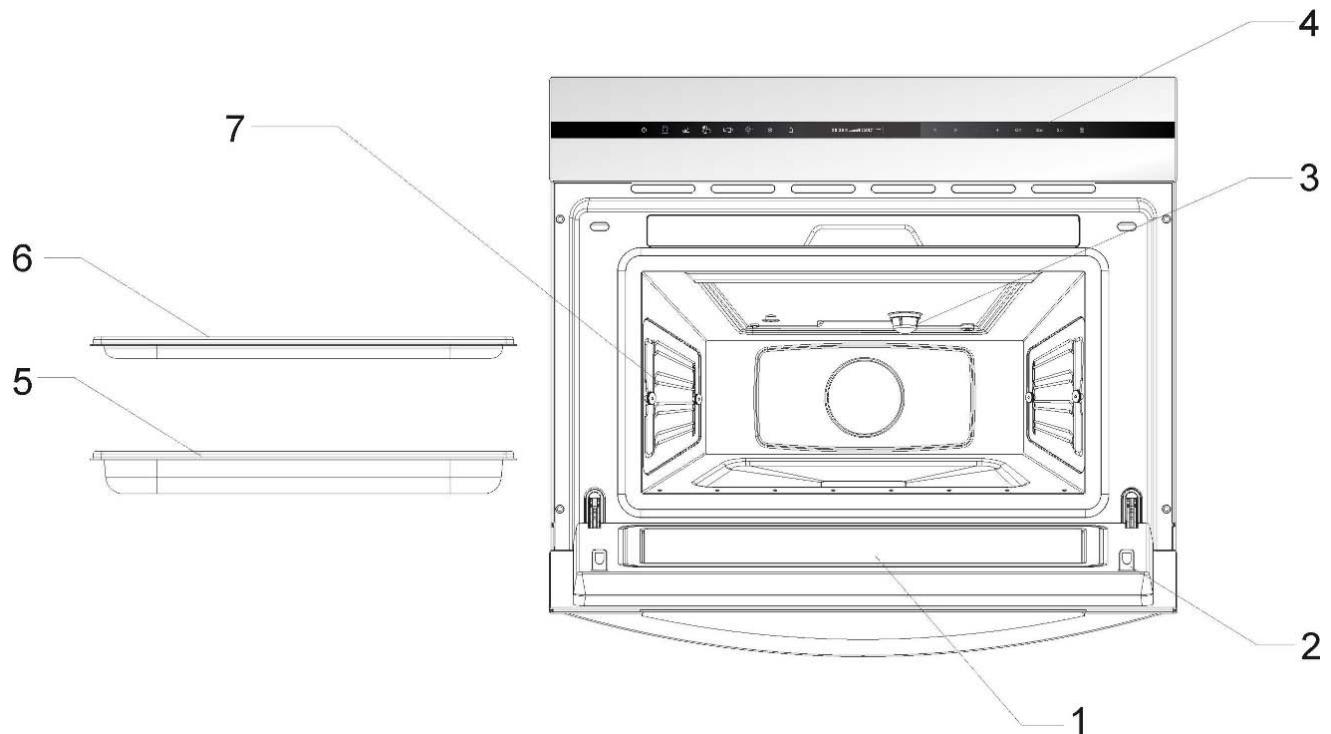
- Verre de porte
- Verrouillage de sécurité
- Lampe
- Bandeau de commande
- Plaque de cuisson
- Plaque de cuisson perforée
- Grilles latérales
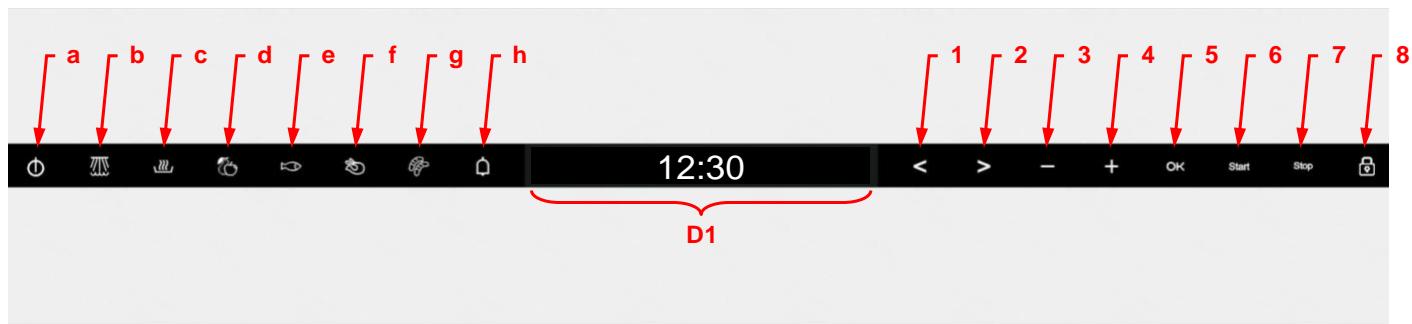
a - Touche Marche/Arrêt b - Touche de fonction Cuiseur vapeur c - Touche de fonction Réchauffage et stérilisation d - Touche de fonction Légumes e - Touche de fonction Poisson f - Touche de fonction Viande g - Touche de fonction Accompagnements h - Touche Minuteur
1 – Touche de navigation « Gauche » 2 - Touche de navigation « Droite » 3 - Touche - 4 - Touche + 5 - Touche de confirmation 6 - Touche Départ 7 - Touche Arrêt 8 - Touche de verrouillage D1 - Affichage
Réglages de base
Réglages initiaux
Après la première mise sous tension de votre four à vapeur ou après une panne de courant, l'affichage de l'heure clignote pour indiquer que l'heure affichée n'est pas correcte.
Le four ne fonctionnera pas tant que l'heure et le paramètre de dureté de l'eau ne sont pas réglés.
Réglage de l'horloge
Le clignotement de l'heure lors de la première mise sous tension de l'appareil ou après une panne de courant indique que l'heure réglée n'est pas correcte. Procédez comme suit pour régler l'horloge :
Pour régler l'horloge et la valeur du paramètre de dureté de l'eau, procédez comme décrit dans les chapitres suivants.

- Appuyez sur la touche Marche/Arrêt pour mettre l'appareil en marche.
- Maintenez les touches - et + enfoncées simultanément. L'affichage des heures clignote (les étapes 1 et 2 ne sont pas nécessaires lors de la première connexion du four à micro-ondes ou après une panne de courant).
- Réglez l'heure (heures) à l'aide des touches + et -.
Réglage de la dureté de l'eau
- Confirmez l'heure (heures) en appuyant sur la touche de confirmation. L'affichage des minutes clignote.
- Réglez l'heure (minutes) à l'aide des touches + et -.
- Confirmez l'heure (minutes) en appuyant sur la touche de confirmation.

L'appareil dispose d'un système qui indique automatiquement quand un détartrage de l'appareil est nécessaire.
Ce système peut être optimisé dans un foyer avec une eau très douce (ou grâce à un adoucisseur d'eau), si le degré de dureté de l'eau correspondant est réglé dans les paramètres utilisateur (voir le tableau ci-dessous).
Procédez comme suit pour régler la dureté de l'eau :
- Appuyez sur la touche Marche/Arrêt pour mettre l'appareil en marche.
- Appuyez simultanément sur les touches Gauche et Droite. Le degré de dureté s'affiche à l'écran (les étapes 1 et 2 peuvent être ignorées si l'appareil est branché pour la première fois ou après une coupure de courant).
- Appuyez sur les touches et + pour régler la valeur importante conformément au tableau ci-dessous.
- Confirmez la valeur en appuyant sur la touche de confirmation. L'heure s'affiche à l'écran.
Réglages de base
Le tableau suivant présente différentes valeurs indicatives pour déterminer la dureté de l'eau.
| Art | Wasserhärte | Display | |||
| Ca + Mg (ppm) | Englische Grad [°eH] | Französische Grad [°dF] | Deutsche Grad [°dH] | ||
| weiches Wasser | 0-150 | 0-11 | 0-15 | 0-8 | SOFT |
| mittleres Wasser | 151-350 | 12-25 | 16-35 | 9-20 | MED |
| hartes Wasser | 351-500 | 26-35 | 36-50 | 21-28 | HARD |
Afficher/masquer l'heure

Si vous trouvez l'affichage de l'heure gênant, vous pouvez le masquer comme suit :
- Appuyez sur la touche Marche/Arrêt pour mettre l'appareil en marche.
- Maintenez la touche de confirmation enfoncée pendant trois secondes. L'affichage de l'heure s'éteint.
Si vous souhaitez réafficher l'heure, répétez la procédure décrite ci-dessus.
Verrouillage de sécurité
Vous pouvez verrouiller le fonctionnement de l'appareil (par exemple, pour empêcher son utilisation par des enfants).

Procédez comme suit pour verrouiller le fonctionnement de l'appareil :
- Appuyez sur la touche Marche/Arrêt pour mettre l'appareil en marche.
- Maintenez la touche de verrouillage enfoncée pendant trois secondes. La
touche de verrouillage s'allume et les symboles des touches apparaissent à l'écran.
L'appareil est maintenant verrouillé jusqu'à son déverrouillage. Pour déverrouiller l'appareil, répétez la procédure décrite ci-dessus.
Minuteur
Cette fonction est conçue comme une aide pour les travaux de pâtisserie quotidiens.

Procédez comme suit pour régler le minuteur :
- Appuyez sur la touche Marche/Arrêt pour mettre l'appareil en marche.
- Appuyez sur la touche de fonction Minuteur. La touche s'allume en rouge et l'affichage suivant apparaît à l'écran :

- Réglez la durée souhaitée à l'aide des touches + et -.
- Appuyez sur la touche de confirmation. L'appareil commence à fonctionner.
Lorsque le temps réglé est écoulé, l'appareil émet un signal sonore toutes les 30 secondes et la touche Minuteur clignote. Appuyez sur la touche Minuteur pour arrêter le signal sonore.
Lorsque le minuteur fonctionne, la touche Minuteur s'allume en rouge. L'affichage suivant apparaît à l'écran :
- Si aucune fonction n'est active, l'affichage du minuteur apparaît à l'écran et la touche Minuteur s'allume en rouge.
- Si une fonction est active, les réglages normaux de la fonction apparaissent à l'écran et sur les touches. Appuyez sur la touche Minuteur pour vérifier le temps restant. L'affichage du minuteur apparaît brièvement à l'écran et revient après cinq secondes ou lors d'une nouvelle pression sur la touche Minuteur aux affichages normaux de la fonction. Pendant l'affichage du minuteur, le temps restant peut être modifié à l'aide des touches + et -.
Cuisine vapeur
Utilisez cette fonction pour préparer et réchauffer des légumes, des pommes de terre, du riz, du poisson et de la viande.

- Appuyez sur la touche Marche/Arrêt pour mettre l'appareil en marche.
- Appuyez sur la touche de fonction Cuisine vapeur. La touche s'allume en rouge et l'affichage suivant apparaît à l'écran :

- Réglez la température souhaitée à l'aide des touches + et -.
- Appuyez sur la touche >. L'affichage suivant apparaît à l'écran :

- Réglez la durée de fonctionnement souhaitée à l'aide des touches + et -. Ce réglage est facultatif. Si vous ne souhaitez pas régler la durée de fonctionnement, passez à l'étape 7.
- Si vous souhaitez modifier l'un des réglages ci-dessus, sélectionnez le réglage correspondant avec les touches < ou > et modifiez la valeur à l'aide des touches + et -.
- Appuyez sur la touche Départ. L'appareil commence à fonctionner.
Remarque : Le symbole [ ] clignote pour indiquer que la température à l'intérieur de l'appareil est inférieure à la température réglée.
Préchauffage et stérilisation
Utilisez cette fonction pour réchauffer des plats préparés ou stériliser et conserver des fruits.

- Appuyez sur la touche Marche/Arrêt pour mettre l'appareil en marche.
- Appuyez sur la touche Préchauffage et stérilisation. La touche s'allume en rouge et l'affichage suivant apparaît :

- Sélectionnez le programme souhaité à l'aide des touches + et -, par exemple R 01 (voir le tableau ci-dessous).
- Appuyez sur la touche >. L'affichage suivant apparaît :


13:00
- Réglez la durée de fonctionnement souhaitée à l'aide des touches + et -. Ce réglage est facultatif.
- Appuyez sur la touche Démarrage. L'appareil commence à fonctionner.
Remarque : Le symbole clignote pour indiquer que la température à l'intérieur de l'appareil est inférieure à la température réglée.
| Programm | Lebensmittelart | Temperatur (°C) | Zeit (Min.) | Anweisungen |
| R 01 | Tellergerichte | 100 °C | 13 | Deckel entfernen und perforiertes Backblech verwenden. |
| R 02 | Fertiggerichte/Tiefkühlgerichte | 100 °C | 18 | |
| R 03 | Bohnen | 100 °C | 35 | Sterilisieren: |
| R 04 | Kirschen | 80°C | 35 | Zeiten und Temperatren gelten für 1I-Einmachgläser. |
| R 05 | Pflaumen | 90°C | 35 | |
| R 06 | Babyflaschen | 100°C | 12 |
Fonctions spéciales
Préparation de légumes
Utilisez cette fonction pour préparer les types de légumes énumérés dans le tableau ci-dessous.

- Appuyez sur la touche Marche/Arrêt pour mettre l'appareil en marche.
- Appuyez sur la touche Préparation des légumes. La touche s'allume en rouge et l'affichage suivant apparaît à l'écran :

- Sélectionnez le programme souhaité à l'aide des touches + et -, par exemple A 01 (voir le tableau ci-dessous).
- Appuyez sur la touche >. L'affichage suivant apparaît à l'écran :

- Réglez la durée de fonctionnement souhaitée à l'aide des touches + et -. Ce réglage est facultatif.
- Appuyez sur la touche Démarrage. L'appareil commence à fonctionner.
Remarque : Le symbole clignote pour indiquer que la température à l'intérieur de l'appareil est inférieure à la température réglée.
| Programm | Gemüseart | Temperatur (℃) | Zeit (Min.) |
| A 01 | Brokkoli/Röschen | 100 °C | 20 |
| A 02 | Blumenkohl/Röschen | 100 °C | 25 |
| A 03 | Kartoffeln/Stückchen | 100 °C | 25 |
| A 04 | Zuckererbsen | 100 °C | 15 |
| A 05 | Spargel | 100 °C | 25 |
Préparation du poisson
Utilisez cette fonction pour préparer les types de poisson énumérés dans le tableau ci-dessous.

- Appuyez sur la touche Marche/Arrêt pour mettre l'appareil en marche.
- Appuyez sur la touche Préparation du poisson. La touche s'allume en rouge et l'affichage suivant apparaît à l'écran :

- Sélectionnez le programme souhaité à l'aide des touches + et -, par exemple B 01 (voir le tableau ci-dessous).
- Appuyez sur la touche >. L'affichage suivant apparaît à l'écran :

- Réglez la durée de fonctionnement souhaitée à l'aide des touches + et -. Ce réglage est facultatif.
- Appuyez sur la touche de démarrage. L'appareil commence à fonctionner.
Remarque : le symbole clignote pour indiquer que la température à l'intérieur de l'appareil est inférieure à la température réglée.
| Programm | Fischart | Temperatur (℃) | Zeit (Min.) |
| B 01 | Forelle | 80 °C | 25 |
| B 02 | Garnelen | 90 °C | 15 |
| B 03 | Fischfilet | 80 °C | 18 |
| B 04 | Muscheln | 100 °C | 25 |
| B 05 | Hummer | 100 °C | 30 |
Fonctions spéciales
Préparation de la viande
Utilisez cette fonction pour préparer les types de viande énumérés dans le tableau ci-dessous.

- Appuyez sur la touche Marche/Arrêt pour mettre l'appareil en marche.
- Appuyez sur la touche de préparation de la viande. La touche s'allume en rouge et l'affichage suivant apparaît à l'écran :

- Sélectionnez le programme souhaité à l'aide des touches + et -, par exemple C 01 (voir le tableau ci-dessous).
- Appuyez sur la touche >. L'affichage suivant apparaît à l'écran :

- Réglez la durée de fonctionnement souhaitée à l'aide des touches + et -. Ce réglage est facultatif.
- Appuyez sur la touche de démarrage. L'appareil commence à fonctionner.
Remarque : Le symbole clignote et indique que la température à l'intérieur de l'appareil est inférieure à la température réglée.
| Programm | Fleischart | Temperatur (℃) | Zeit (Min.) |
| C 01 | Hähnchenbrust | 100 °C | 30 |
| C 02 | Geräucherte Schweinslende/Stücke | 100 °C | 45 |
| C 03 | Putenschnitzel | 100 °C | 20 |
| C 04 | Schweinefilet, im Ganzen | 100 °C | 25 |
| C 05 | Wiener Würstchen | 90 °C | 15 |
Accompagnements
Utilisez cette fonction pour préparer les aliments énumérés dans le tableau ci-dessous.

- Appuyez sur la touche Marche/Arrêt pour mettre l'appareil en marche.
- Appuyez sur la touche Accompagnements. La touche s'allume en rouge et l'affichage suivant apparaît à l'écran :

- Sélectionnez le programme souhaité à l'aide des touches + et -, par exemple D 01 (voir le tableau ci-dessous).
- Appuyez sur la touche >. L'affichage suivant apparaît à l'écran :

- Réglez la durée de fonctionnement souhaitée à l'aide des touches + et -. Ce réglage est facultatif.
- Appuyez sur la touche de démarrage. L'appareil commence à fonctionner.
Remarque : Le symbole clignote et indique que la température à l'intérieur de l'appareil est inférieure à la température réglée.
| Programm | Lebensmittelart | Temperatur (°C) | Zeit (Min.) |
| D 01 | Dampfnudeln | 100 °C | 20 |
| D 02 | Hefeklõbe | 100 °C | 25 |
| D 03 | Servietenknödel | 100 °C | 30 |
| D 04 | Reis | 100 °C | 35 |
| D 05 | Linsen | 100 °C | 40 |
Remplir d'eau
Remplir le réservoir d'eau
Pour toutes les fonctions, le réservoir d'eau doit être plein.
Remplissez le réservoir d'eau avec de l'eau potable froide et fraîche jusqu'au repère « MAX » et insérez-le dans le compartiment intérieur jusqu'à ce qu'il s'enclenche.
Ce message indique que le réservoir d'eau n'est pas correctement placé.
Pour effacer le message, insérez complètement le réservoir d'eau.
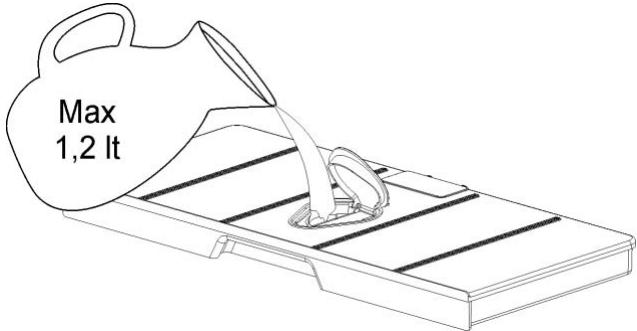
Remplir d'eau
La quantité d'eau suffit normalement pour un cycle de cuisson de 50 à 60 minutes.
Si le réservoir d'eau doit être rempli, le voyant du réservoir d'eau s'allume.
Ne remplissez pas plus de 0,5 litre pour être sûr que l'eau ne déborde pas lors du refoulement dans le réservoir. RISQUE DE DÉBORDEMENT.
Vider le réservoir d'eau
Lorsque l'appareil est éteint, l'eau restante est pompée dans le réservoir d'eau.
Pendant que l'eau est pompée, l'écran affiche « PUMP ».
Ce message s'affiche jusqu'à ce que l'eau atteigne une température de 75 °C avant d'être renvoyée dans le réservoir.
Attention : l'eau dans le réservoir peut être chaude. Risque de brûlures !
Une fois l'eau pompée dans le réservoir, l'écran affiche « DEP ». Procédez comme suit :
- Retirez le réservoir d'eau de l'appareil et videz-le.
- Sécher le réservoir d'eau et le remettre dans l'appareil. Essuyer l'intérieur de l'appareil.
- Laisser la porte de l'appareil ouverte jusqu'à ce que l'appareil soit refroidi et complètement sec.
REMARQUE IMPORTANTE : Après chaque cycle de cuisson, il est recommandé de retirer et de vider le réservoir d'eau. Cela évite le développement de bactéries et de calcaire dans l'appareil.
Si vous souhaitez lancer deux cycles de cuisson à la vapeur successifs, il n'est pas nécessaire de vider le réservoir d'eau. L'affichage indique « DEP ».
Pour effacer cet avertissement, appuyez sur la touche Stop et un nouveau cycle de cuisson peut démarrer sans avoir à retirer et vider le réservoir d'eau.
Interruption d'un cycle de cuisson
Vous pouvez interrompre le cycle de cuisson à tout moment en appuyant une fois sur la touche Start/Stop.
L'appareil dispose d'une fonction de réduction de vapeur activée par la touche Start/Stop. Cela réduit la sortie de vapeur à l'ouverture de la porte.
Cela prend environ trois minutes et pendant ce temps, « VAP » s'affiche à l'écran.
Attention : si la porte est ouverte pendant ou après le cycle de cuisson, de la vapeur chaude s'échappe de l'appareil. Écartez-vous ou reculez.
À ce moment :
La production de vapeur a été interrompue. Les parois de la cavité de cuisson et le réservoir d'eau sont encore très chauds. Risque de brûlures ! L'affichage de l'heure s'arrête et le temps de fonctionnement restant est affiché (si réglé).
Si vous le souhaitez, vous pouvez :
- retourner ou remuer les aliments
- modifier les paramètres du processus
Fermez la porte et appuyez sur la touche Démarrer/Arrêt pour reprendre le processus.
Modification des paramètres
La durée peut être modifiée pendant que l'appareil est en fonctionnement ou si la cuisson a été interrompue en tournant le bouton. La nouvelle durée définie n'est valable que lorsque l'affichage ne clignote plus.
La température ne peut être modifiée que lorsque l'appareil est éteint. La température est modifiée en appuyant sur la touche de sélection de fonction et en tournant le bouton jusqu'à ce que la nouvelle température clignote. Pour confirmer, appuyez sur la touche de sélection de fonction.
Supprimer un processus de cuisson
Si vous souhaitez supprimer le processus de cuisson, appuyez pendant 3 secondes sur la touche Démarrer/Arrêt.
Trois signaux retentissent alors et l'heure s'affiche.
Fin d'un processus de cuisson
Après la fin de la cuisson ou après avoir appuyé sur la touche Démarrer/Arrêt, la fonction d'évacuation de la vapeur démarre.
À la fin du processus, trois signaux retentissent et l'indication « Fin » s'affiche.
Cette fonction évacue progressivement la vapeur de la cavité de cuisson, de sorte que moins de vapeur s'échappe de l'appareil lors de l'ouverture de la porte.
Cela dure environ 3 minutes et pendant ce temps, « VAP » s'affiche.
Attention : si la porte est ouverte pendant ou après la cuisson, aucune vapeur ne s'échappe de l'appareil. Veuillez vous écarter ou ne pas marcher devant.
Après avoir éteint l'appareil, le ventilateur continue de fonctionner pendant un certain temps. Cette fonction vise à réduire la température de l'appareil encastré.
Lorsque « DEP » s'affiche, l'eau a été pompée et vous pouvez retirer le réservoir d'eau.
Retirez le réservoir d'eau et séchez-le soigneusement. Laissez l'intérieur de l'appareil refroidir un peu, puis essuyez-le avec un chiffon sec. Laissez la porte de l'appareil ouverte pendant un certain temps afin que l'appareil sèche complètement.
Tableaux et conseils
Utilisation des accessoires
Le récipient de cuisson perforé est utilisé pour cuire à la vapeur des légumes frais ou surgelés, de la viande et de la volaille.
Il est important que le récipient de cuisson non perforé soit inséré dans la première glissière en partant du bas de l'appareil. Les liquides qui s'égouttent sont ainsi recueillis et ne salissent pas l'appareil. Le récipient perforé chargé d'aliments est inséré dans la deuxième glissière en partant du bas.
Le récipient de cuisson non perforé est utilisé pour cuire à la vapeur des aliments délicats, par exemple compotes, quenelles et plats à gonfler.
La grille est utilisée comme support pour les petits récipients de cuisson, par exemple les ramequins à dessert, et pour régénérer des assiettes.
Reportez-vous aux tableaux pour des informations précises.
Les valeurs indiquées pour la durée de cuisson et la température sont des valeurs indicatives. Selon le type et la nature des aliments, la durée de cuisson réellement nécessaire peut varier.
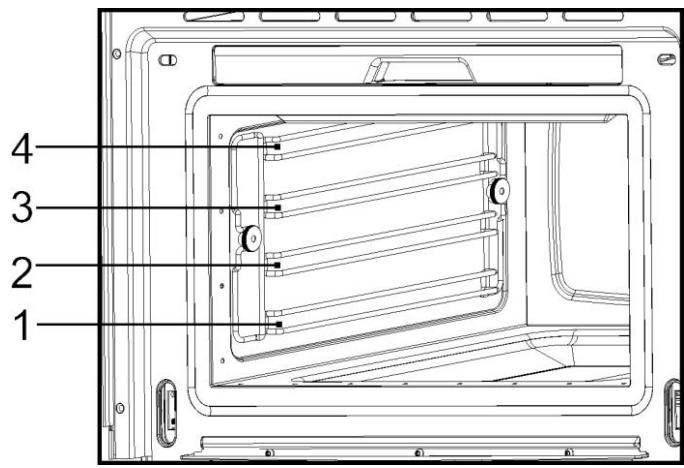
Poisson
| Fisch | Menge | Temperatur °C | Garzeit Min. | Behälter | Leiste v.u. |
| Dorade | 800-1200 g | 80 | 30-40 | gelocht | 2 |
| Forelle | 4 x 250 g | 80 | 20-25 | gelocht | 2 |
| Lachsfilet | 500-1000 g | 80 | 15-25 | gelocht | 2 |
| Lachsforelle | 1000-1200 g | 80 | 25-35 | gelocht | 1/2 |
| Riesengarnelen | 500-1000 g | 80 | 15-20 | gelocht | 2 |
| Grünschalmuscheln | 1000-1500 g | 100 | 25-35 | gelocht | 2 |
| Heilbuttfilet | 500-1000 g | 80 | 20-25 | gelocht | 2 |
| Herzmuscheln | 500-1000 g | 100 | 10-20 | geloch | 2 |
| Hummer, TK | 800-1200 g | 100 | 25-30 | gelocht | 1/2 |
| Kabeljaufilet | 1000-1200 g | 80 | 20-25 | gelocht | 2 |
| Miesmuscheln | 1000-1200 g | 100 | 15-25 | gelocht | 2 |
| Saibling | 4 x 250 g | 80 | 25-30 | gelocht | 2 |
| Schellfisch | 1000-1200 g | 80 | 20-25 | gelocht | 2 |
| Thunfischfilet | 500-1000 g | 80 | 15-20 | gelocht | 2 |
| Zander | 4 x 250 g | 80 | 25-30 | gelocht | 2 |
Viande
| Fleisch | Menge | Temperatur °C | Garzeit Min. | Behälter | Leiste v.u. |
| Hähnchenbolten | 4-10 | 100 | 40-45 | gelocht | 2 |
| Hähnchenbrust | 4-6 | 100 | 25-35 | gelocht | 2 |
| Kasseler | 500g -1000g | 100 | 40-50 | gelocht | 2 |
| Putenschnitzel | 4-8 | 100 | 20-25 | gelocht | 2 |
| Schweinefilet, ganz | 4-8 | 100 | 20-30 | gelocht | 2 |
| Würstchen | 80-100 | 10-15 | gelocht | 2 |
Œufs
| Eier | Temperatur 0C | Garzeit Min. | Behälter | Leiste v.u. |
| Ei im Glas | 100 | 10-15 | Rost | 2 |
| Eier, hart | 100 | 15 | Rost | 2 |
| Eier, weich | 100 | 10-12 | Rost | 2 |
Accompagnements
| Beilagen | Menge | Temperatur °C | Garzeit Min. | Behälter | Leiste v.u. |
| Graupen + Flüssigkeit | 200g + 400ml | 100 | 30-35 | Rost, Glasschale | 2 |
| Grieß + Flüssigkeit | 200g + 300ml | 100 | 10-20 | Rost, Glasschale | 2 |
| Linsen + Flüssigkeit | 200g + 375ml | 100 | 20-50 | Rost, Glasschale | 2 |
| Reis + Flüssigkeit | 200g + 250ml | 100 | 25-40 | Rost, Glasschale | 2 |
Légumes
| Gemüse / frisch | Temperatur °C | Garzeit Min. | Behälter | Leiste v.u. | |
| Auberginen | in Scheiben | 100 | 15-20 | gelucht | 2 |
| Bohnen | 100 | 35-45 | gelucht | 2 | |
| Broccoli | Röschen mit Stiel | 100 | 25-30 | gelucht | 2 |
| Broccoli | Röschen ohne Stiel | 100 | 15-20 | gelucht | 2 |
| Blumenkohl | Röschen | 100 | 25-30 | gelucht | 2 |
| Blumenkohl | ganzer Kopf | 100 | 40-45 | gelucht | 1 |
| Erbsen | 100 | 30-35 | gelucht | 2 | |
| Fenchel | in Streifen | 100 | 15-20 | gelucht | 2 |
| Fenchel | halbiert | 100 | 20-30 | gelucht | 2 |
| Kartoffeln m. Schale | ganz, sehr Klein | 100 | 20-25 | gelucht | 2 |
| Kartoffeln m. Schale | ganz, sehr dick | 100 | 45-50 | gelucht | 2 |
| Kartoffeln o. Schale | in Stücken | 100 | 20-25 | gelucht | 2 |
| Kohlraben | in Stiftle | 100 | 20-25 | gelucht | 2 |
| Kaiserschoten | 100 | 15-20 | gelucht | 2 | |
| Karotten | in Scheiben | 100 | 25-30 | gelucht | 2 |
| Maiskolben | 100 | 50-60 | gelucht | 2 | |
| Paprikaschoten | in Streifen | 100 | 12-15 | gelucht | 2 |
| Peperoni | 100 | 12-15 | gelucht | 2 | |
| Pilze | in Viertel | 100 | 12-15 | gelucht | 2 |
| Porree | in Scheiben | 100 | 10-12 | gelucht | 2 |
| Rosenkohl | 100 | 25-35 | gelucht | 2 | |
| Sellerie | in Streifen | 100 | 15-20 | gelucht | 2 |
| Spargel | 100 | 20-35 | gelucht | 2 | |
| Spinat | 100 | 12-15 | gelucht | 2 | |
| Stangensellerie | 100 | 25-30 | gelucht | 2 | |
| Zucchiini | in Scheiben | 100 | 12-18 | gelucht | 2 |
Quenelles
| Klöße | Temperatur °C | Garzeit Min. | Behälter | Leiste v.u. |
| BuchteIn | 100 | 20-30 | ungelocht | 2 |
| Dampfnudeln | 100 | 15-20 | ungelocht | 2 |
| HefeklösBe | 100 | 15-25 | ungelocht | 2 |
| Semmelknödel | 100 | 20-25 | ungelocht | 2 |
| Servietenkloß | 100 | 25-30 | ungelocht | 2 |
Desserts
| Desserts | Menge | Temperatur °C | Garzeit Min. | Behälter | Leiste v.u. |
| Apfelkompott | 500-1500 g | 100 | 15-25 | ungelocht | 2 |
| Birnenkompott | 500-1500 g | 100 | 25-30 | ungelocht | 2 |
| Crème Brûlée | 80 | 20-25 | Rost-Schälchen | 2 | |
| Crème Caramel | 80 | 25-30 | Rost-Schälchen | 2 | |
| Joghurt | 40 | 4-6 Std.. | Rost-Schälchen | 2 | |
| Pfirsichkompott | 500-1500 g | 100 | 15-20 | ungelocht | 2 |
Fruits (stérilisation / mise en conserve)
| Obst | Menge | Temperatur °C | Garzeit Min. | Behälter | Leiste v.u. |
| Birnen | 4-6 1l-Glaser | 100 | 30-35 | Rost | 1 |
| Kirschen | 4-6 1l-Glaser | 80 | 30-35 | Rost | 1 |
| Pfirsiche | 4-6 1l-Glaser | 90 | 30-35 | Rost | 1 |
| Pflaumen | 4-6 1l-Glaser | 90 | 30-35 | Rost | 1 |
Régénération
| Aufwärmen | Menge | Temperatur °C | Garzeit Min. | Behälter | Leiste v.u. |
| Tellergerichte | 1-2 | 100 | 12-15 | Rost | 2 |
| Tellergerichte | 3-4 | 100 | 15-20 | Rost | 2 |
| Fertiggerichte | 100 | 15-20 | Rost | 2 |
Blanchiment
| Gemüse | Menge | Temperatur °C | Garzeit Min. | Behälter | Leiste v.u. |
| z.B. Bohnen, Porree | 100 | 10-12 | gelocht. | 2 | |
| Grünkohl | 1000-2000 g | 100 | 12-16 | gelocht | 2 |
| Wirsingblätter | 10-20 | 100 | 12-15 | gelocht | 2 |
| Weißkohl, ganz | 2000-2500 g | 100 | 30-45 | gelocht | 1 |
| Tomaten, abziehen | 80 | 12 | Rost | 2 |
Tableaux et conseils
Décongélation
| Gemüse/ Beilagen | Temperatur °C | Garzeit Min. | Behälter | Leiste v.u. | |
| Broccoli | Röschen mit Stiel | 100 | 15-20 | gelocht | 2 |
| Balkangemüse | 100 | 15-20 | gelocht | 2 | |
| Blattspinat | Portionsstücke | 100 | 10-15 | ungelocht | 2 |
| Blumenkohl | Röschen | 100 | 15-20 | gelocht | 2 |
| Erbsen | 100 | 15-25 | gelocht | 2 | |
| Grünkohl | dicker Block | 100 | 25-35 | ungelocht | 2 |
| Karotten | in Scheiben | 100 | 15-20 | gelocht | 2 |
| Rosenkohl | 100 | 20-25 | gelocht | 2 | |
| Spargel | 100 | 25-30 | gelocht | 2 | |
| Fertiggerichte | 100 | nach Bedarf | Rost | 2 | |
| Brot | 100 | 10-25 | Rost | 2 | |
| Reis | 100 | 15-25 | ungelocht | 2 | |
| Linsen | 100 | 15-20 | ungelocht | 2 | |
| Nudeln | 100 | 15-20 | ungelocht | 2 | |
Cuisson sur deux niveaux
Quelques remarques :
Lors de la cuisson sur deux niveaux, les accessoires doivent toujours être placés sur la 2e ou 3e glissière de guidage en partant du bas, et sur la 1re.
Les temps de cuisson différents se règlent de la manière suivante :
Les aliments qui nécessitent un temps de cuisson plus long doivent être placés dans la partie supérieure du cuiseur vapeur. Les aliments avec des temps de cuisson plus courts sont alors insérés sur la 1re glissière en partant du bas.
Un exemple : légumes, pommes de terre et poisson.
Placez les légumes et les pommes de terre dans des récipients appropriés sur la grille, sur la 2e ou 3e glissière en partant du bas dans l'appareil.
Insérez le poisson sur la 1re glissière en partant du bas.
Si le récipient de cuisson perforé est utilisé pour le poisson, le récipient de cuisson non perforé doit être placé au fond de l'appareil pour recueillir le jus de cuisson qui s'écoule. L'appareil reste ainsi propre.
Temps de cuisson : légumes et pommes de terre 25-35 min.
Temps de cuisson : poisson - selon le type - 15-25 min.
On règle le temps de cuisson le plus long ; grâce aux niveaux correspondants, les aliments sont prêts en même temps, sans que rien ne soit trop cuit.
DE Nettoyage et entretien de l'appareil
Nettoyage de l'intérieur
Ne surtout pas utiliser de produits de nettoyage abrasifs comme les éponges à récurer universelles, la laine d'acier, etc. Cela endommagerait la surface.
Nettoyez la cavité de cuisson à chaud avec un chiffon humide, puis essuyez-la avec un chiffon sec.
Pour faciliter le nettoyage, les grilles latérales peuvent être retirées (voir les chapitres suivants).
Décrochage des grilles latérales
Dévisser l'écrou moleté 1 à l'avant des grilles de support dans le sens inverse des aiguilles d'une montre.

Dévisser légèrement l'écrou moleté 2 à l'arrière des grilles de support dans le sens inverse des aiguilles d'une montre. Ne pas retirer l'écrou moleté.
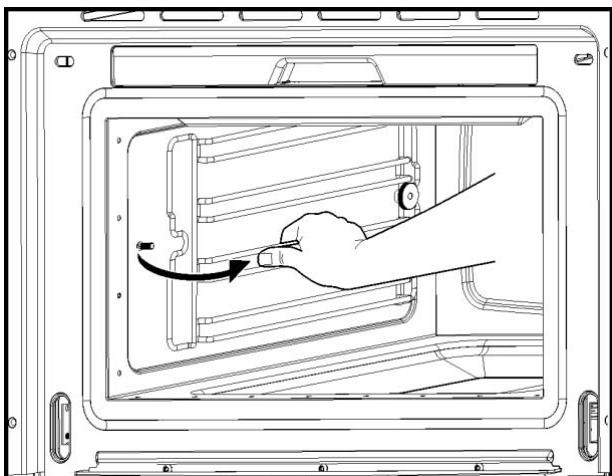
Tirer légèrement la grille de support vers l'avant et la retirer.
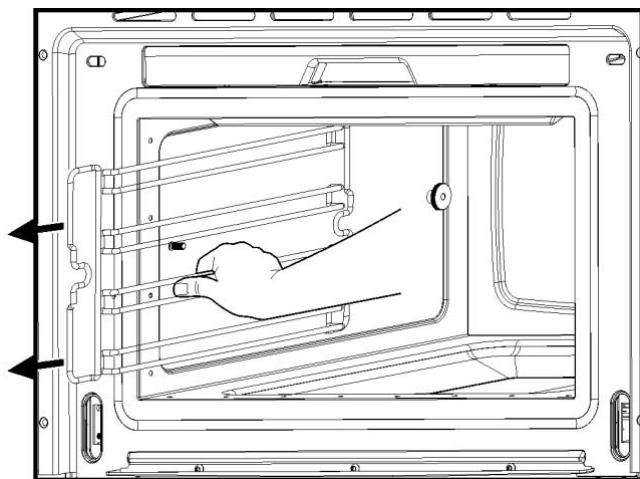
Pour l'installation, insérer la grille de support dans l'écrou moleté 2.
Visser les écrous moletés 1 dans le sens des aiguilles d'une montre jusqu'à la butée, puis serrer l'écrou moleté 2.
Nettoyage et entretien de l'appareil
Retirez la porte de l'appareil.
Ouvrez la porte aussi large que possible.
Insérez deux boulons dans les trous des charnières de la porte.
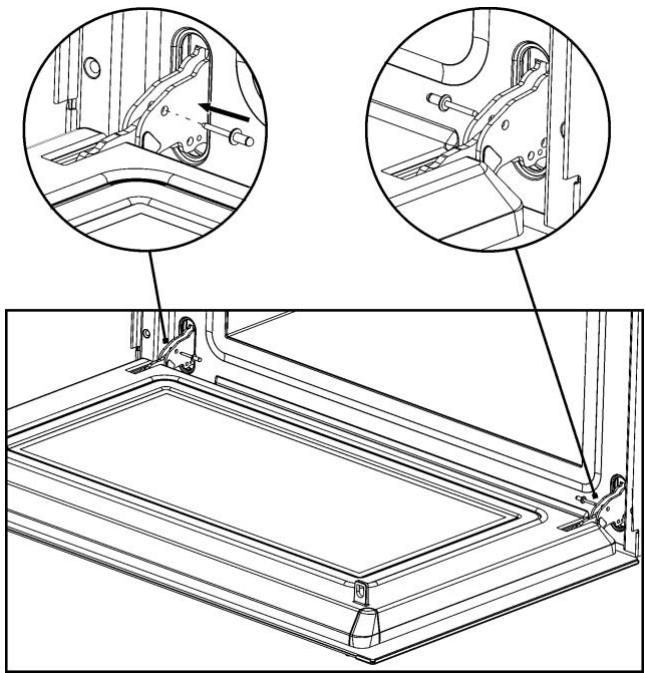
Fermez la porte juste assez pour la soulever.
Pour le remontage, insérez les charnières dans les trous.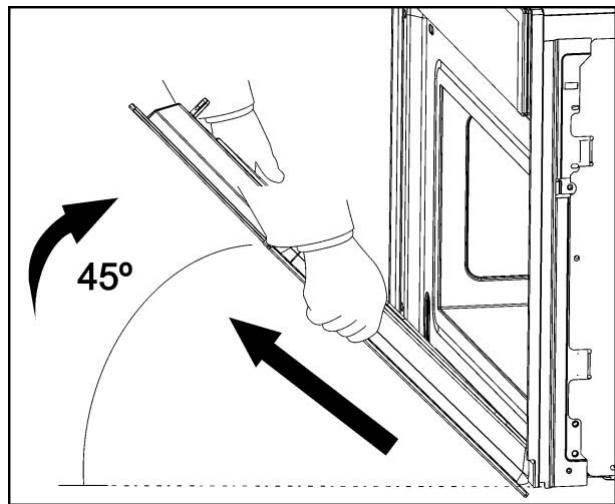
Ouvrez la porte de l'appareil aussi large que possible et retirez les boulons.
FR Nettoyage et entretien de l'appareil
Détartrage
Lors de la production de vapeur, du calcaire se dépose à l'intérieur du générateur de vapeur, indépendamment de la dureté de l'eau (c'est-à-dire de sa teneur en calcaire).
La fréquence de détartrage dépend de la dureté de l'eau et de la fréquence d'utilisation. Pour 4 séances de cuisson vapeur de 30 minutes par semaine, l'appareil doit être détartré aux intervalles suivants (selon la dureté de l'eau) :
| Wasserhärte | Entkalkung alle |
| sehr weich | 18 Monate |
| mittel | 9 Monate |
| sehr hart | 6 Monate |
L'appareil détecte automatiquement quand le détartrage est nécessaire ; dans ce cas, l'affichage suivant apparaît à l'écran :

Si le détartrage n'est pas effectué, les cycles de cuisson sont bloqués après l'apparition du symbole ci-dessus.
Si le détartrage n'est toujours pas effectué, le fonctionnement de l'appareil est interrompu et l'affichage suivant apparaît à l'écran :
CAL

IMPORTANT : Le non-détartrage de l'appareil peut nuire à son bon fonctionnement ou endommager l'appareil.
Détartrants appropriés
Utilisez DURGOL® pour le détartrage.
Ce détartrant est un produit professionnel et doux pour détartrer votre appareil et peut être obtenu auprès du service client.
Attention ! N'utilisez en aucun cas du vinaigre ou des produits contenant du vinaigre, car ils peuvent endommager l'intérieur de l'appareil.
Les détartrants conventionnels ne conviennent pas, car ils peuvent contenir des agents moussants.
Nettoyage et entretien de l'appareil
Processus de détartrage

Attention ! Pour des raisons de sécurité, le processus de détartrage, qui dure environ 45 minutes, ne peut pas être interrompu.
La porte de l'appareil peut rester ouverte ou fermée pendant le détartrage. Avant de commencer le détartrage, l'appareil doit être en mode veille.
Procédez comme suit pour effectuer un détartrage :
- Appuyez sur la touche Marche/Arrêt pour mettre l'appareil en marche.
- Maintenez les touches Gauche et Droite enfoncées pendant cinq secondes. L'écran affiche CAL et un signal sonore régulier retentit. Appuyez sur la touche Stop si vous souhaitez terminer le détartrage.
- Appuyez sur la touche Start.
- Dès que 0.5L s'affiche à l'écran, retirez le réservoir d'eau.
- Versez 0,5 litre d'une solution détartrante appropriée dans le réservoir d'eau, puis replacez-le.
- Appuyez sur la touche Démarrer. Le processus de détartrage d'une durée de 30 minutes commence.
- Dès que l'affichage 1.0L clignote à l'écran et que le cuiseur vapeur émet un signal sonore, retirez le réservoir d'eau et videz-le.
- Remplissez le réservoir avec 1,0 litre d'eau froide et replacez-le.
- Appuyez sur la touche Démarrer. Le premier cycle de rinçage commence.
- Dès que l'affichage 1.0L clignote à nouveau à l'écran et que le cuiseur vapeur émet à nouveau un signal sonore, retirez le réservoir d'eau et videz-le.
- Remplissez le réservoir avec 1,0 litre d'eau froide et replacez-le.
- Appuyez sur la touche Démarrer. Le deuxième cycle de rinçage commence.
- Une fois les cycles de rinçage terminés, le mot End s'affiche à l'écran.
- Retirez le réservoir d'eau, videz-le et séchez-le.
FR Nettoyage et entretien de l'appareil
Attention ! Le nettoyage doit être effectué sur un appareil débranché de l'alimentation électrique. Retirez la fiche de la prise de courant ou coupez le circuit d'alimentation de l'appareil.
N'utilisez pas de produits de nettoyage agressifs ou abrasifs, de chiffons abrasifs ni d'objets pointus, car des taches pourraient apparaître.
N'utilisez pas d'appareils de nettoyage à haute pression ou à jet de vapeur.
Il suffit de nettoyer l'appareil avec un chiffon humide. S'il est très sale, ajoutez une goutte de liquide vaisselle à l'eau de lavage. Essuyez ensuite l'appareil avec un chiffon sec.
Pour les appareils avec une façade en aluminium, utilisez un nettoyant pour vitres doux et un chiffon doux non pelucheux. Essuyez horizontalement, sans exercer de pression sur la surface.
Éliminez immédiatement les taches de calcaire, de graisse, d'amidon et de blanc d'œuf. Sous ces taches, de la corrosion peut se produire.
Évitez que l'eau ne pénètre à l'intérieur de l'appareil.
Cavité de cuisson
Après chaque utilisation, nettoyez les parois intérieures avec un chiffon humide. Laissez la porte ouverte afin que la cavité de cuisson refroidisse et sèche.
Utilisez un nettoyant non agressif pour éliminer les salissures tenaces. N'utilisez ni sprays pour four, ni nettoyants agressifs ou abrasifs.
Maintenez toujours la porte et la façade de l'appareil très propres afin d'en garantir le bon fonctionnement.
Empêchez l'eau de pénétrer dans les trous de ventilation.
Le couvercle en verre de la lampe se trouve au plafond de l'appareil et peut être facilement retiré pour le nettoyage. Dévissez-le et nettoyez-le avec de l'eau et du liquide vaisselle.
Accessoires
Nettoyez les accessoires après chaque utilisation. S'ils sont très sales, faites-les d'abord tremper, puis utilisez une brosse et une éponge. Les accessoires peuvent être nettoyés au lave-vaisselle.
Que faire en cas de dysfonctionnement ?
ATTENTION ! Toute réparation doit être effectuée uniquement par des professionnels spécialisés. Toute intervention effectuée par des personnes non autorisées par le fabricant est dangereuse.
Les problèmes suivants peuvent être résolus sans contacter le service client :
L'affichage est éteint ! Vérifiez si : - l'affichage des heures a été désactivé (voir la section sur les réglages de base). - Rien ne se passe lorsque vous appuyez sur les touches ! Vérifiez si : - la sécurité enfant est activée (voir la section sur les réglages de base). L'appareil ne fonctionne pas ! Vérifiez si : - la fiche est correctement branchée sur la prise de courant, - le circuit d'alimentation de l'appareil est sous tension. - Pendant le fonctionnement, des bruits se font entendre ! - Il s'agit de bruits de fonctionnement qui peuvent survenir pendant toute la durée de la cuisson à la vapeur, par exemple à cause de la pompe à eau du générateur de vapeur. - Ces bruits sont normaux, il n'y a pas de problème. Les aliments ne sont pas cuits ou cuisent très lentement ! Vérifiez si : - vous avez choisi la bonne température et la bonne durée de fonctionnement, - vous avez placé une quantité d'aliments plus importante ou plus froide que d'habitude à l'intérieur de l'appareil.
- Si « Err_ » apparaît à l'écran, veuillez contacter le service client.
- Après la fin d'une cuisson, un bruit se fait entendre ! Ce n'est pas un problème.
- Le ventilateur de refroidissement continue de tourner pendant un certain temps. Lorsque la température a suffisamment baissé, le ventilateur s'éteint.
- L'appareil fonctionne, mais l'éclairage intérieur ne s'allume pas !
- Si toutes les fonctions fonctionnent correctement, il est probable que l'ampoule soit grillée. Vous pouvez continuer à utiliser l'appareil.
Remplacement de l'ampoule
Procédez comme suit pour remplacer l'ampoule :
- Débranchez l'appareil de l'alimentation électrique. Retirez la fiche de la prise de courant ou coupez le circuit d'alimentation de l'appareil.
- Dévissez le couvercle en verre de l'ampoule (1).
- Retirez l'ampoule halogène (2). Attention ! L'ampoule peut être très chaude.
- Installez une nouvelle ampoule E14 230-240 V / 15 W. Suivez les instructions du fabricant de l'ampoule.
- Revissez le couvercle en verre de l'ampoule (1).
- Rebranchez l'appareil à l'alimentation électrique.
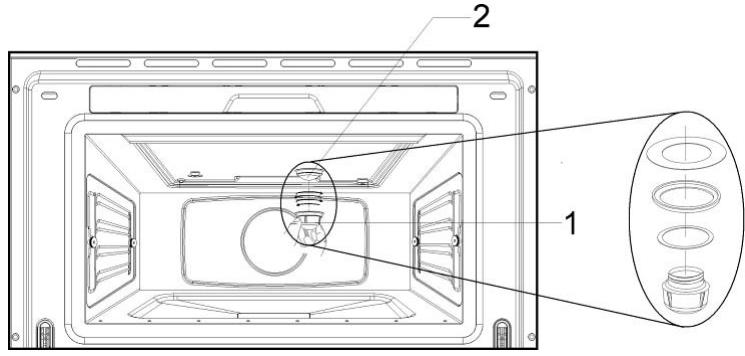
Description du fonctionnement
| Symbol | Funktion | Lebensmittel |
| Dampfgarer | Zubereiten von Gemüse, Reis, Getreide und Fleisch. Entsaffen von Beerenfrüchten. Gleichzeitiges Auftauen und Zubereiten von Gemüse. | |
| Aufwärmen & Sterilisieren | Aufwärmen von Teller- und Fertiggerichten. Sterilisieren/Einkochen von Obst. | |
| Gemüsezubereitung | Zubereiten verschiedener Gemüsearten. | |
| Fischzubereitung | Zubereiten verschiedener Fischarten. | |
| Fleischzubereitung | Zubereiten verschiedener Fleischarten. | |
| Beilagenzubereitung | Zubereiten verschiedener Beilagen. |
Affichages
| Anzeige | Beschreibung |
| Wassertank | |
| U | Blinkend – Leerer Wassertank.itte auffüllen. |
| R | Fehlender Wassertank. |
| DEP | Wassertank herausnehmen, leeren und wieder einsetzen. |
| Dampfreduzierung | |
| VAP | Dampfreduziervorgang lαuft. |
| PUMP | Der Wassertank wird mit weißem Wasser befüllt. |
| Entkalken | |
| CAL | Gerätmussentkalkt werden. |
| Blinkend – Entkalkungsvorgang beginnt. | |
| 0.5L | Geben Sie 0,5 Liter Entkalker in den Wassertank. |
| 1.0L | Füllen Sie für den Spülvorgang 1,0 Liter kaltes Wasser in den Wassertank. |
| Systemmeldungen | |
| HOT | Die Platinentemperatur ist zu hoch. |
| Err_ | Bitte rufen Sie den Kundendienst an! |
Spécifications
Tension alternative 220-240 V/50 Hz Puissance requise 1500 W - Dimensions extérieures (LxHxP) 595 × 455 × 472 mm Dimensions de la cavité de cuisson (LxHxP) 420 x 210 x 390 mm Capacité du four 351 Poids 32 kg
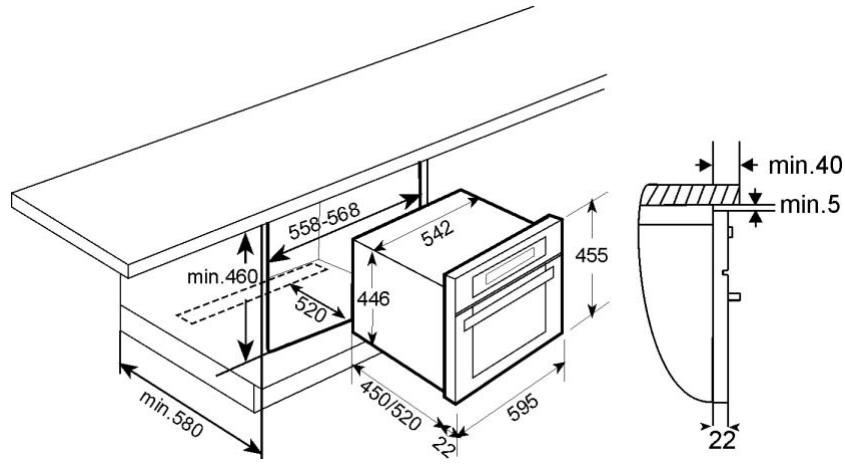
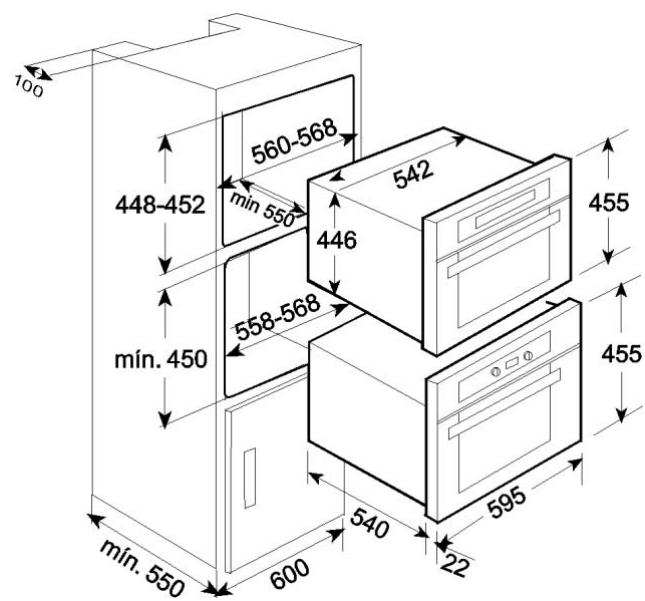
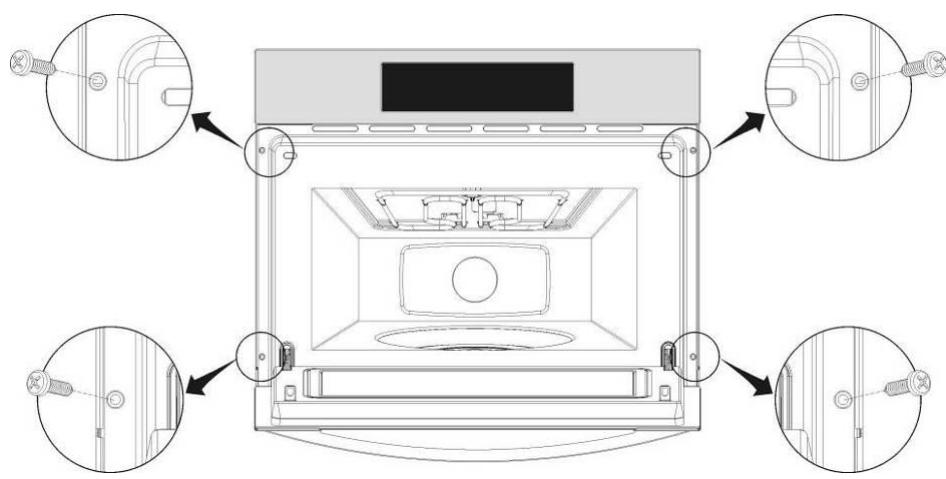
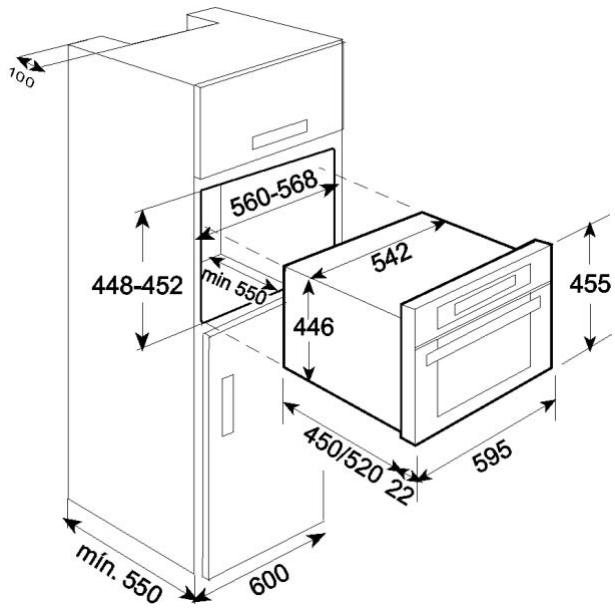
EN
- Poussez complètement le four dans le meuble et centrez-le.
- Ouvrez la porte et fixez l'appareil au meuble à l'aide des quatre vis fournies. Insérez les vis à travers les trous avant.
DE
- Insérez le cuiseur vapeur dans la niche et ajustez-le en conséquence.
- Ouvrez la porte de l'appareil et fixez-le au meuble de cuisine avec les quatre vis fournies, comme illustré sur l'image.
| COUNTRY | COMPANY | CC | TELEPHONE | E-MAIL / FAX |
| AUSTRALIA | TEKA AUSTRALIA Pty. Ltd. | 61 | 3 9550 6100 | sales@tekaaustralia.com.au |
| AUSTRIA | KÜPPERSBUSCH GesmbH | 43 | 1 866 800 | info@kueppersbusch.at |
| BELGIUM | B.V.B.A. KÜPPERSBUSCH S.P.R.L. | 32 | 2 466 8740 | info@kuppersbusch.be |
| BulgARY | TEKA BULGARIA EOOD. | 359 | 2 9768 330 | 2 9768 332 |
| CANADA | TEKA CANADA LTD. | 1 | 866-282-5403 | info@tekacadana.com |
| CHILE | TEKA CHILE, S.A. | 56 | 2 4386 000 | info@teka.cl |
| P. R. CHINA | TEKA INTERNATIONAL TRADING (Shanghai) | 86 | 21 511 688 41 | info@teka.cn |
| CZECH REPUBLIC | TEKA CZ S.R.O. | 420 | 2 84 691940 | info@teka-cz.cz |
| ECUADOR | TEKA ECUADOR, S.A. | 593 | 4 2251174 | ventas@teka.ec |
| FRANCE | TEKA FRANCE S.A.S. | 33 | 1 343 01597 | 1 343 01598 |
| GERMANY | TEKA KÜCHENTECHNIK GmbH | 49 | 27718141-0 | info@teka-kuechentechnik.de |
| GREECE | TEKA HELLAS A.E. | 30 | 210 9760283 | info@tekahellas.gr |
| HUNGARY | TEKA HUNGARY KFT | 36 | 1 3542110 | teka@teka.hu |
| INDONESIA | PT TEKA BUANA | 62 | 21 390 5274 | teka@tekabuana.com |
| ITALY | TEKA ITALIA S.P.A. | 39 | 0775 898271 | info@tekaitalia.it |
| KOREA (SOUTH REP.) | TEKA KOREA CO. LTD. | 82 | 2 599 4444 | 222 345 668 |
| MALAYSIA | TEKA KÜCHENTECHNIK (MALAYSIA) SDN. | 60 | 3 7620 1600 | customer_svc@teka.com.my |
| MIDDLE EAST | TEKA KÜCHENTECHNIK MIDDLE EAST FZE | 971 | 4 887 2912 | teka@emirates.net.ae |
| MEXICO | TEKA MEXICANA S.A. de C.V. KÜPPERSBUSCH-TEKA | 52 | 555 133 0493 | ventas@tekamexicana.com.mx |
| PAKISTAN | PAKISTAN Pvt. Ltd. | 92 | 42 576 1656 | 42 576 1657 |
| POLAND | TEKA POLSKA SP. ZO.O. | 48 | 22 7383270 | teka@teka.com.pl |
| PORTUGAL | TEKA PORTUGAL, S.A. | 351 | 234 329 510 | sacliente@teka.pt |
| RUSSIA | TEKA RUS LLC | 7 | 495 101 31 08 | info@tekarus.ru |
| SINGAPORE | TEKA SINGAPORE PTE. LTD. | 65 | 67342415 | tekasin@pacific.net.sg |
| SPAIN | TEKA INDUSTRIAL, S.A. | 34 | 942350505 | mail@teka.com |
| THAILAND | TEKA (THAILAND) CO. LTD. | 66 | 2 652 2999 | 2 652 2740 1 |
| TURKEY | TEKA TEKNIK MUTFAK | 90 | 212 288 3134 | teka@teka.com.tr |
| UKRAINE | TEKA UA | 380 | 44 496 0680 | info@teka.ua |
| UNITED ARAB EMIRATES | TEKA KÜCHENTECHNIK U.A.E. LLC | 971 | 4 283 3047 | uaeteka@emirates.net.ae |
| UNITED KINGDOM | TEKA PRODUCTS LTD. | 44 | 1235 861916 | info@teka.co.uk |
| USA | TEKA USA, INC. | 1 | 813 2888820 | info@tekausa.com |
| VENEZUELA | TEKA ANDINA, S.A. | 58 | 2 1229 12821 | teka@teka.com.ve |

TEKA Industrial, S. A.
Cajo, 17
39011 SANTANDER (Espagne)
Tél : 34 - 942 - 35 50 50
Fax : 34-942-347694
mail@teka.com

www.teka.com
TEKA Kuchentechnik GmbH
Sechsheldener Str. 122
35708 Haiger (Germany)
Tel: 49 - 2771 - 8141 - 0
Fax: 49 – 2771 – 8141 – 10
HKX 960 S
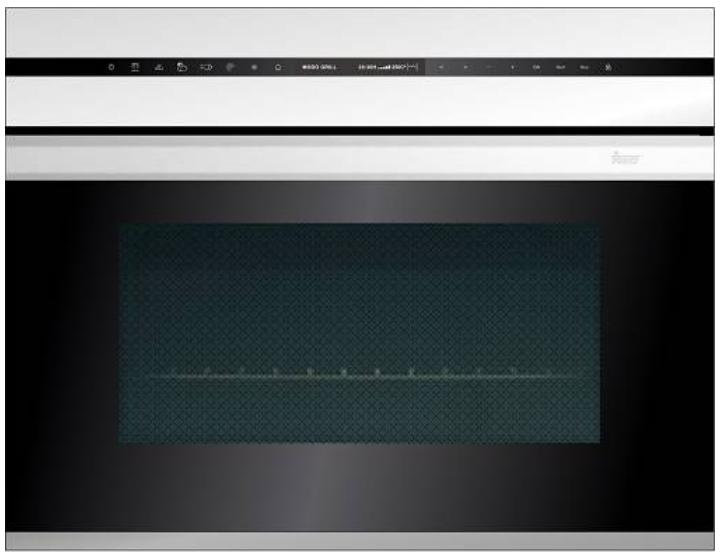

Nous vous prions de lire attentivement les instructions contenues dans ce livret, qui vous aideront à obtenir de bons résultats lors de l'utilisation de votre cuiseur vapeur.
CONSERVEZ LA DOCUMENTATION DE CET APPAREIL POUR DE FUTURES CONSULTATIONS.
Ayez toujours les instructions d'utilisation à portée de main. Si vous remettez l'appareil à des tiers, remettez-leur également les instructions d'utilisation correspondantes.
Indications sur la protection de l'environnement
Élimination de l'emballage

L'emballage est marqué d'un Point Vert.
Utilisez des conteneurs appropriés pour éliminer les matériaux d'emballage, tels que le carton, le polystyrène expansé et les films plastiques. Cela garantit le recyclage des matériaux d'emballage.
Élimination des appareils abandonnés
La directive européenne 2002/96/CE relative aux déchets d'équipements électriques et électroniques stipule que les appareils électroménagers ne doivent pas être éliminés avec les déchets municipaux solides.
Les appareils qui ne sont plus utilisés doivent être collectés séparément afin d'optimiser le taux de récupération et de recyclage des matériaux qui les composent, et ainsi éviter des dommages potentiels pour la santé des personnes et pour l'environnement. Le symbole, représenté par une poubelle barrée d'une croix, doit être apposé sur tous les produits pour rappeler qu'il est obligatoire de les collecter séparément.
Les consommateurs doivent contacter les autorités locales ou les points de vente pour obtenir des informations sur le lieu de collecte des appareils électroménagers.
Rendez votre appareil inutilisable avant de l'éliminer. Retirez le câble d'alimentation, coupez-le et éliminez-le.
Instructions d'installation 3
Avant l'installation 3 Après l'installation 3
Consignes de sécurité 4
Description de l'appareil 6
Réglages de base 7
Réglages initiaux 7 Régler l'horloge 7 Réglages de la dureté de l'eau 7 Masquer / Afficher l'horloge 8 Verrouillage de sécurité 8 Minuterie 9
Fonctions de base 10
Vapeur 10 Cuisson à la vapeur et stérilisation 10
Fonctions spéciales 11
Cuisson des légumes 11 Cuisson du poisson 12 Cuisson de la viande 13 Accompagnements 14
Remplissage d'eau 15
Remplissage du réservoir d'eau 15 Remplissage d'eau 15 Vidange du réservoir d'eau 15
Pendant le fonctionnement 16
Interruption d'un processus de cuisson 16 Modification des paramètres 16 Annulation d'un cycle de cuisson 16 Fin d'un cycle de cuisson 16
Tableaux et conseils 17
Utilisation des accessoires 17
Entretien 22
Nettoyage de la cavité intérieure 22 Décrochage des grilles latérales 22 Extraction de la porte de l'appareil 23 Détartrage 24 Solutions de détartrage adaptées 24 Procédure de détartrage 25
Nettoyage et entretien de l'appareil 26
Partie frontale 26 Plaque de cuisson 26 Accessoires 26
Que faire en cas de panne de fonctionnement ? 27
Changement de lampe 27
Caractéristiques techniques 28
Description des systèmes 28 Écrans 28 Spécifications 28
Montage 59
Avant l'installation
Vérifiez que la tension d'alimentation indiquée sur la plaque signalétique est la même que la tension du réseau de votre installation.
Ouvrez la porte et sortez tous les accessoires et le matériel d'emballage.
Attention : La partie avant de l'appareil peut avoir un film de protection. Retirez ce film avec précaution avant d'utiliser l'appareil pour la première fois, en commençant par sa partie inférieure.
Assurez-vous que l'appareil n'est pas endommagé. Vérifiez que la porte se ferme correctement et que la partie intérieure de la porte et la partie avant de la chambre intérieure ne sont pas endommagées. En cas de dommages, informez le service client. Vous trouverez les numéros de téléphone au dos de ce manuel.
N'UTILISEZ PAS L'APPAREIL si le câble d'alimentation ou la prise est endommagé, si l'appareil ne fonctionne pas correctement, ou s'il a subi des dommages ou est tombé. Dans tous ces cas, contactez le service client. Les noms figurent au dos de ce manuel.
Placez l'appareil sur une surface lisse et stable. Il n'est pas permis de monter l'appareil à proximité de radiateurs, radios ou téléviseurs.
Pendant l'installation, assurez-vous que le câble d'alimentation n'entre pas en contact avec l'humidité, des objets pointus ou la partie arrière de l'appareil, car les températures élevées peuvent endommager le câble.
Attention : Une fois l'appareil placé, la prise doit être accessible.
Après l'installation
L'appareil est équipé d'un câble d'alimentation et d'une prise pour courant monophasé de 230-240 V ~ 50 Hz.
En cas de connexion permanente, l'appareil doit être installé par un technicien qualifié. Dans ce cas, la connexion doit être réalisée sur un circuit électrique avec un disjoncteur pour tous les pôles, avec une distance minimale de 3 mm entre les contacts.
ATTENTION : L'APPAREIL DOIT OBLIGATOIREMENT ÊTRE RELIÉ À LA TERRE.
Le fabricant et les revendeurs déclinent toute responsabilité pour d'éventuels dommages causés à des personnes, des animaux ou des biens s'il est prouvé que les présentes instructions d'installation n'ont pas été suivies.
L'appareil ne fonctionne que lorsque la porte est correctement fermée.
Avant la première utilisation, nettoyez l'intérieur de l'appareil et les accessoires conformément aux instructions de nettoyage figurant dans la section « Nettoyage et entretien de l'appareil ».
Lors de l'installation, suivez les instructions fournies séparément.

- Attention : ne laissez pas l'appareil fonctionner sans surveillance.
- Attention : si vous détectez une personne ou un feu, gardez la porte fermée pour étouffer les flammes. Débranchez l'appareil et retirez la fiche de la prise de courant ou coupez l'alimentation électrique de l'appareil.
- Les graisses et les huiles surchauffées peuvent s'enflammer facilement. Par conséquent, ne chauffez pas d'huile ou de graisse dans la cavité de cuisson. N'essayez jamais d'éteindre des graisses ou des huiles en feu avec de l'eau (risque d'explosion). Étouffez les flammes avec un chiffon humide et maintenez toutes les portes et fenêtres fermées.
- Attention : n'utilisez pas d'alcool à haut degré pour cuisiner avec cet appareil. Cela peut provoquer une surchauffe des aliments, risque d'explosion !
- Attention : les personnes qui ne disposent pas de toutes leurs capacités physiques, sensorielles ou mentales (y compris les enfants) ne doivent pas utiliser cet appareil. Les utilisateurs qui n'ont pas suffisamment d'expérience ou de connaissances de l'appareil, ou qui n'ont pas été formés à son utilisation, doivent être sous la surveillance d'une personne responsable de leur sécurité. Les enfants doivent être surveillés pour s'assurer qu'ils ne jouent pas avec l'appareil.
- Les enfants doivent être surveillés pour s'assurer qu'ils ne jouent pas avec l'appareil. Utilisez le verrouillage de sécurité enfants.
- L'appareil peut devenir très chaud pendant son utilisation. Soyez prudent et évitez tout contact avec les éléments chauffants à l'intérieur de l'appareil. RISQUE DE BRÛLURE !
- Prudence : les pièces accessibles peuvent devenir très chaudes pendant l'utilisation. Tenez les enfants éloignés de l'appareil.
- Attention : lors de l'ouverture de la porte pendant ou après la cuisson, de la vapeur et des gouttes d'eau chaude peuvent s'échapper de l'appareil. Tenez-vous de côté ou reculez.
- Prudence : ne coincez jamais le câble d'alimentation d'un autre appareil électrique avec la porte chaude de l'appareil. L'isolation du câble peut fondre. Risque de court-circuit !
Cet appareil est exclusivement conçu pour un usage domestique.
Cet appareil est adapté à la préparation d'aliments dans un environnement domestique. Aucune responsabilité n'est assumée pour les dommages causés par une utilisation inappropriée ou non autorisée de l'appareil.
En suivant ces indications, vous éviterez de provoquer des dommages à l'appareil et des situations dangereuses :
- Ne couvrez pas et n'obstruez pas les orifices et les fentes de ventilation.
- Ne rangez pas à l'intérieur de l'appareil des objets qui pourraient représenter un danger en cas de mise en marche non intentionnelle.
- N'utilisez pas l'appareil comme lieu de stockage d'aliments.
- Ne versez pas de boissons alcoolisées à forte teneur (comme le brandy, le whisky, les liqueurs, etc.) sur des aliments chauds. Risque d'explosion.
- Les accessoires, comme la grille ou les plaques, chauffent beaucoup dans la cavité de cuisson. Utilisez des maniques pour les retirer.
- Pour éviter les brûlures, portez toujours des gants de cuisine pour manipuler les plats et les récipients qui se trouvent à l'intérieur de l'appareil.
- Ne vous appuyez pas sur la porte ouverte de l'appareil. Cela peut provoquer des dommages, en particulier au niveau des charnières. La porte supporte un poids maximal de 8 kg.
- Les grilles ont une capacité de charge maximale de 8 kg. Afin d'éviter des dommages, ne dépassez pas cette capacité.
Nettoyage :
- L'appareil reste chaud pendant un certain temps après son arrêt. Laissez-le refroidir suffisamment avant de commencer à le nettoyer.
- N'utilisez pas de produits de nettoyage corrosifs, abrasifs ou de grattoirs métalliques pointus pour nettoyer la vitre de la porte, car ils pourraient rayer la surface et endommager ainsi le verre.
- Les surfaces de contact de la porte (côté avant de la cavité de cuisson et côté intérieur de la porte) doivent être maintenues très propres pour garantir un fonctionnement parfait.
- Veuillez prêter attention aux indications relatives au nettoyage de l'appareil "Nettoyage et entretien de l'appareil".
En cas de réparation :
- Si le câble d'alimentation est endommagé, il doit être remplacé par le fabricant, par un représentant agréé ou par un technicien qualifié afin d'éviter tout danger. De plus, un outil spécial est nécessaire.
- Les réparations et les travaux d'entretien, en particulier sur les pièces connectées au courant, ne peuvent être effectués que par des techniciens agréés par le fabricant.
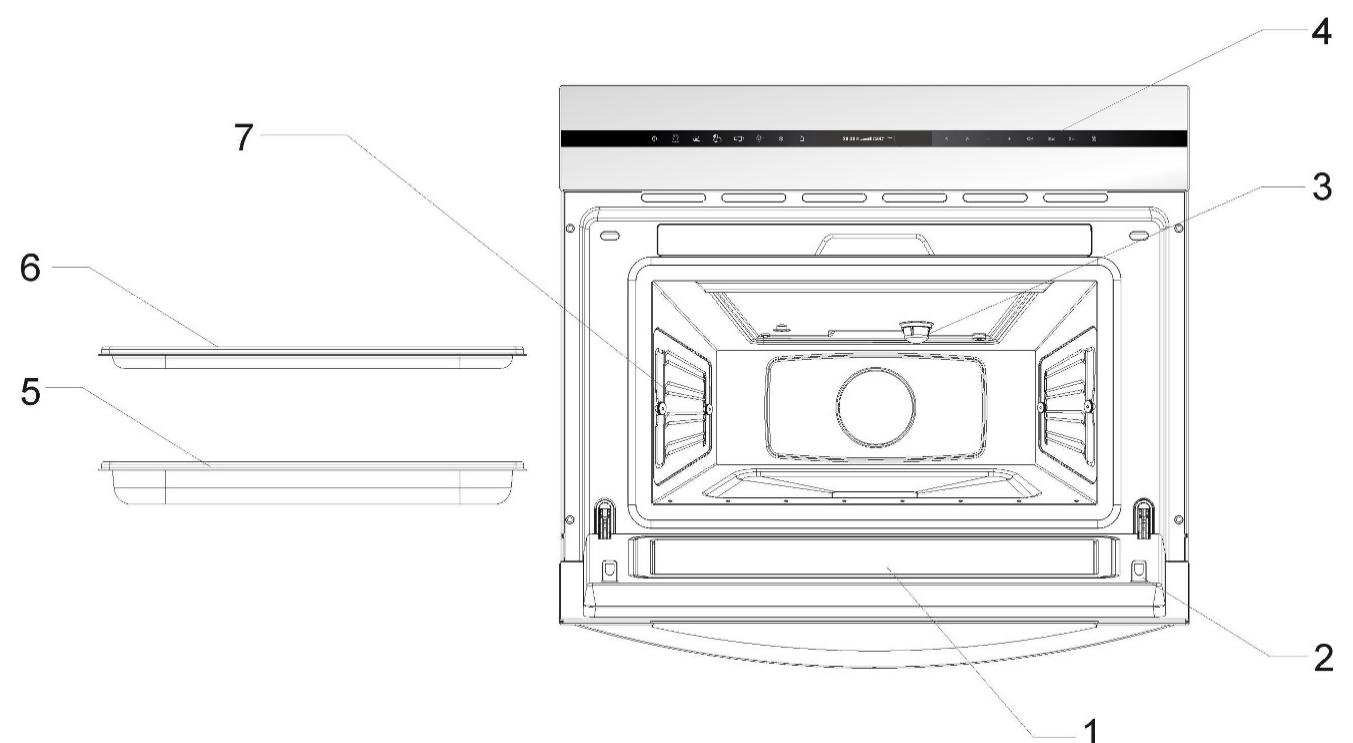
- – Verre de la porte
- Verrouillage de sécurité
- Lampe
- – Écran de commande
- Plateau non perforé
- Plateau perforé
- Grille latérale
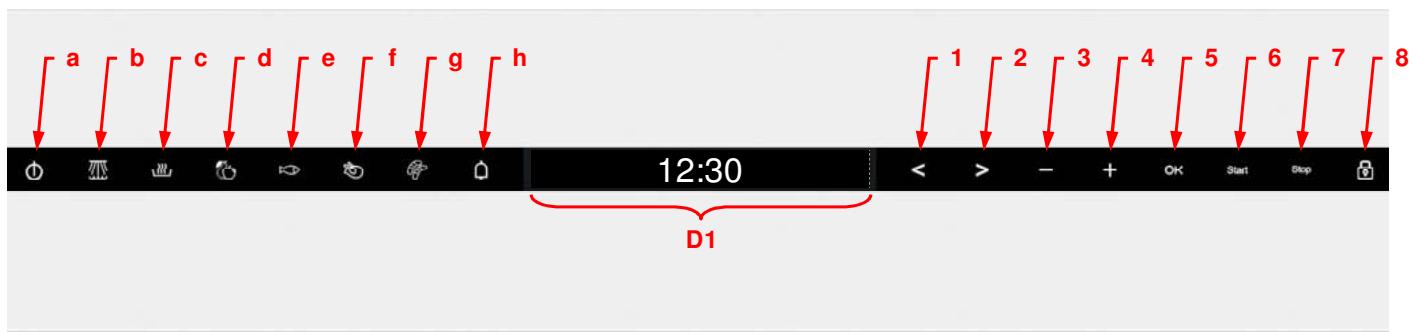
a - Touche ON/OFF b - Touche de fonction vapeur c - Touche de fonction régénération et stérilisation d - Touche de fonction légumes e - Touche de référence poisson f - Touche de fonction viande g - Touche de fonction accompagnements h - Touche de minuterie associée
1 - Touche "Gauche" 2 - Touche "Droite" 3 - Touche "-" 4 - Touche "+" 5 - Touche "OK" 6 - Touche "Départ" 7 - Touche "Arrêt" 8 - Touche "Verrouillage de sécurité" D1 - Afficheur
Réglages de base
Réglages initiaux
Après avoir branché l'appareil sur le secteur ou après une coupure de courant, l'horloge clignote, indiquant que l'heure n'est pas correcte.
L'appareil ne peut pas être mis en fonctionnement tant que l'heure et la dureté de l'eau n'ont pas été réglées. Pour régler l'heure et la dureté de l'eau, procédez comme suit.
Régler l'horloge
Après avoir branché le four à micro-ondes pour la première fois ou après une panne de courant, l'affichage de l'horloge clignote pour indiquer que l'heure n'est pas correcte. Pour programmer l'horloge, suivez les instructions ci-dessous :

- Appuyez sur la touche "On/Off" pour allumer le four.
- Maintenez enfoncées les touches "+" et "-" simultanément. Les chiffres des heures commencent à clignoter (les étapes 1 et 2 ne sont pas nécessaires si le four est branché pour la première fois ou après une panne de courant).
- Appuyez sur les touches "+" et "-" pour régler l'heure.
- Appuyez sur la touche OK pour confirmer l'heure. Les minutes commencent à clignoter.
- Appuyez sur les touches "+" et "-" pour régler les minutes.
- Appuyez sur la touche OK pour confirmer les minutes.
Réglages de la dureté de l'eau

L'appareil contient un système qui indique automatiquement le moment d'éliminer le tartre.
Le système peut être optimisé pour les foyers avec une eau très douce (même via un adoucisseur d'eau) et une eau très dure, en modifiant les réglages pour la plage de dureté de l'eau concernée (voir le tableau ci-dessous).
Pour régler le paramètre de dureté de l'eau, suivez les instructions ci-dessous :
- Appuyez sur la touche "On/Off" pour allumer l'appareil.
- Appuyez simultanément sur les touches "Gauche" et "Droite". Le degré de dureté commence à clignoter à l'écran (les étapes 1 et 2 ne sont pas nécessaires si l'appareil est déjà allumé ou après une panne de courant).
- Appuyez sur "+" et "-" pour régler les valeurs correctes du paramètre de dureté de l'eau, selon le tableau ci-dessous.
- Appuyez sur la touche OK pour sélectionner le paramètre. L'écran affiche l'horloge.
Le tableau ci-dessous indique les échelles pour la définition de la dureté de l'eau.
| Tipo | Dureza del agua | Display | |||
| Ca + Mg (ppm) | Grados ingleses [°eH] | Grados franceses [°dF] | Grados alemanes [°dH] | ||
| Agua suave | De 0 a 150 | De 0 a 11 | De 0 a 15 | De 0 a 8 | SOFT (SUAVE) |
| Agua media | De 151 a 350 | De 12 a 25 | De 16 a 35 | De 9 a 20 | MED (MEDIA) |
| Agua dura | De 501 a 500 | De 26 a 35 | De 36 a 50 | De 21 a 28 | HARD (DURA) |
Masquer / Afficher l'horloge

Si l'affichage de l'horloge vous gêne, vous pouvez la masquer de la manière suivante :
- Appuyez sur la touche « On/Off » pour allumer le four.
- Appuyez sur la touche « OK » pendant 3 secondes. L'écran s'éteindra.
Si vous souhaitez réafficher l'horloge, répétez cette procédure.
Verrouillage de sécurité
Vous pouvez verrouiller les fonctions du four (par exemple, pour empêcher les enfants de l'utiliser).

Pour verrouiller le four, suivez les instructions ci-dessous :
- Appuyez sur la touche « On/Off » pour allumer le four.
- Maintenez enfoncée la touche « Verrouillage de sécurité » pendant environ 3 secondes. La touche
« Verrouillage de sécurité » s'allume et l'écran affiche des symboles de clé.
Le four ne fonctionne pas tant qu'il n'est pas déverrouillé. Pour déverrouiller le four, répétez les instructions précédentes.
Réglages de base
Minuteur
Utilisez cette fonction comme aide pour vos tâches quotidiennes en cuisine.

Pour configurer le minuteur, suivez les instructions ci-dessous :
- Appuyez sur la touche « On/Off » pour allumer le four.
- Appuyez sur la touche de fonction "Minuteur". La touche devient rouge et l'afficheur indique :

- Appuyez sur les touches « + » et « - » pour sélectionner le temps souhaité.
- Appuyez sur la touche « OK ». Le minuteur commence le compte à rebours.
Lorsque le temps défini est écoulé, l'appareil émet trois avertissements sonores répétés pendant 30 secondes et la touche Minuteur clignote. Appuyez sur la touche Minuteur pour annuler les avertissements.
Pendant que le Minuteur est activé, sa touche est rouge. L'afficheur et les voyants indiquent ce qui suit :
- Si aucune fonction n'est en cours, l'afficheur montre le compte à rebours du Minuteur et sa touche est rouge.
- Si une fonction est active, les afficheurs et les touches indiquent les paramètres de fonctionnement normaux. Pour vérifier le temps restant du Minuteur, appuyez sur la touche Minuteur. L'afficheur montre brièvement le Minuteur puis reprend les indications de fonctionnement après 5 secondes ou jusqu'à ce que vous appuyiez à nouveau sur la touche Minuteur. Pendant que le Minuteur est affiché, le temps restant peut être modifié avec les touches « - » et « + » comme indiqué.
Vapeur
Utilisez cette fonction pour cuire et programmer tous types de légumes, pommes de terre, riz, poisson et viande.

- Appuyez sur la touche « On/Off » pour mettre l'appareil sous tension.
- Appuyez sur la touche de fonction « Vapeur ». La touche devient rouge et l'afficheur indique :

- Appuyez sur les touches « + » et « - » pour sélectionner la température souhaitée.
- Appuyez sur la touche « > ». L'afficheur indique :

- Appuyez sur les touches « + » et « - » pour sélectionner la durée de fonctionnement souhaitée. Ce réglage est facultatif. Passez à l'étape 7 si vous ne souhaitez pas configurer la durée.
- Si vous souhaitez modifier l'un des paramètres précédents, appuyez sur les touches < ou > pour sélectionner le paramètre, puis sur les touches + et - pour sélectionner une valeur différente.
- Appuyez sur la touche Départ. Le four démarre sa programmation.
Remarque importante : le symbole [1] clignote à l'écran, ce qui signifie que la température à l'intérieur du four est inférieure à la température réglée.
Cuisson et Stérilisation
Utilisez cette fonction pour cuire des plats cuisinés et des plats précuisinés, ainsi que pour stériliser et faire bouillir des fruits.

- Appuyez sur la touche « Marche/Arrêt » pour allumer le four.
- Appuyez sur la touche « Cuisson et Stérilisation ». La touche s'allume en rouge et l'écran affiche :

- Appuyez sur les touches « + » et « - » pour sélectionner le programme, par exemple « R 01 » (voir le tableau ci-dessous).
- Appuyez sur la touche « > ». L'écran affiche :

- Appuyez sur les touches « + » et « - » pour modifier le temps de fonctionnement prédéfini. Ce réglage est facultatif.
- Appuyez sur la touche Départ. Le four démarre sa programmation.
Remarque importante : le symbole clignote à l'écran, ce qui signifie que la température à l'intérieur du four est inférieure à la température réglée.
| Programa | Tipo de comida | Temperatura °C | Tiempo (min) | Instrucciones |
| R 01 | Platos cocinados | 100°C | 13 | Saque la protección del envase y pángalo en la parrilla. |
| R 02 | Comida rápida / congelada | 100°C | 18 | |
| R 03 | Judías | 100°C | 35 | Esterilización: |
| R 04 | Cerezas | 80°C | 35 | El tiempo y la temperature se refieren a envases de 1L. |
| R 05 | Ciruelas | 90°C | 35 | |
| R 06 | Comida de bebé | 100°C | 12 |
Fonctions spéciales
Cuisson des légumes
Utilisez cette référence pour cuire les légumes décrits dans le tableau ci-dessous.

- Appuyez sur la touche « On/Off » pour allumer le four.
- Appuyez sur la touche « Cuisson Légumes ». La touche devient rouge et l'écran affiche :

- Appuyez sur les touches « + » et « - » pour sélectionner le programme, par ex. « A 01 » (voir le tableau ci-dessous).
- Appuyez sur la touche « > ». L'écran affiche :

120:00
- Appuyez sur les touches « + » et « - » pour modifier le temps de fonctionnement prédéfini. Ce réglage est facultatif.
- Appuyez sur la touche Démarrer. Le four commence à fonctionner.
Remarque importante : Le symbole clignotera à l'écran, ce qui signifie que la température à l'intérieur du four est inférieure à celle définie.
| Programa | Tipo de vegetal | Temperatura °C | Tiempo (min) |
| A 01 | Brócolis / flósculos | 100 °C | 20 |
| A 02 | Coliflor / flósculos | 100 °C | 25 |
| A 03 | Patatas / trozos | 100 °C | 25 |
| A 04 | Guisantes | 100 °C | 15 |
| A 05 | Espáarragos | 100 °C | 25 |
Cuisson du poisson
Utilisez cette référence pour cuire les morceaux de poisson décrits dans le tableau ci-dessous.

- Appuyez sur la touche « On/Off » pour allumer le four.
- Appuyez sur la touche « Cuisson Poisson ». La touche devient rouge et l'écran affiche :

- Appuyez sur les touches "+" et "-" pour sélectionner le programme, par ex. "B 01" (voir le tableau ci-dessous).
- Appuyez sur la touche ">". L'écran affiche :

→ 25:00
- Appuyez sur les touches "+" et "-" pour modifier le temps de fonctionnement prédéfini. Ce réglage est facultatif.
- Appuyez sur la touche Départ. Le minuteur commence à fonctionner.
Remarque importante : Le symbole clignotera à l'écran, ce qui signifie que la température à l'intérieur du four est inférieure à celle définie.
| Programa | Tipo de pescado | Temperatura °C | Tiempo (min) |
| B 01 | Trucha | 80 °C | 25 |
| B 02 | Gambas | 90 °C | 15 |
| B 03 | Filete de pescado | 80 °C | 18 |
| B 04 | Mejillón | 100 °C | 25 |
| B 05 | Langosta | 100 °C | 30 |
Fonctions spéciales
Cuisson de la viande
Utilisez cette fonction pour cuire les morceaux de viande décrits dans le tableau ci-dessous.

- Appuyez sur la touche "On/Off" pour allumer le four.
- Appuyez sur la touche "Cuisson de la viande". La touche devient rouge et l'écran affiche :

- Appuyez sur les touches "+" et "-" pour sélectionner le programme, par ex. "C 01" (voir le tableau ci-dessous).
- Appuyez sur la touche « > ». L'écran affiche :

- Appuyez sur les touches « + » et « - » pour modifier le temps de fonctionnement prédéfini. Ce réglage est facultatif.
- Appuyez sur la touche Départ. Le four commence à fonctionner.
Remarque importante : le symbole clignotera à l'écran, ce qui signifie que la température à l'intérieur du four est inférieure à celle définie.
| Programa | Tipo de carne | Temperatura °C | Tiempo (min) |
| C 01 | Pechuga de pollo | 100 °C | 30 |
| C 02 | Lomo de cerdo ahumado / lonchas | 100 °C | 45 |
| C 03 | Escalope de pavo | 100 °C | 20 |
| C 04 | Filete de cerdo, entero | 100 °C | 25 |
| C 05 | Salchichas precocinadas | 90 °C | 15 |
Garnitures
Utilisez cette référence pour cuire les plats décrits dans le tableau ci-dessous.

- Appuyez sur la touche « On/Off » pour allumer le four.
- Appuyez sur la touche « Cuisson Poisson ». La touche devient rouge et l'écran affiche :

- Appuyez sur les touches « + » et « - » pour sélectionner le programme, par ex. « D 01 » (voir tableau ci-dessous).
- Appuyez sur la touche « > ». L'écran affiche :

→20:00
- Appuyez sur les touches « + » et « - » pour modifier le temps de fonctionnement prédéfini. Ce réglage est facultatif.
- Appuyez sur la touche Démarrer. L'heure commence à fonctionner.
Remarque importante : le symbole clignotera à l'écran, ce qui signifie que la température à l'intérieur de l'appareil est inférieure à celle définie.
| Programa | Tipo de comida | Temperatura °C | Tiempo (min) |
| D 01 | Bola de levadura dulce | 100 °C | 20 |
| D 02 | Bola de levadura | 100 °C | 25 |
| D 03 | Albóndigas | 100 °C | 30 |
| D 04 | Arroz | 100 °C | 35 |
| D 05 | Lentejas | 100 °C | 40 |
Chargement de l'eau
Remplissage du réservoir d'eau
Le réservoir d'eau doit être rempli pour toutes les fonctions.
Remplissez le réservoir d'eau avec de l'eau potable fraîche jusqu'au repère "MAX" et insérez le réservoir d'eau jusqu'à l'encoche sur la cavité intérieure. Environ 11.
L'indication signifie que le réservoir d'eau n'est pas correctement placé.
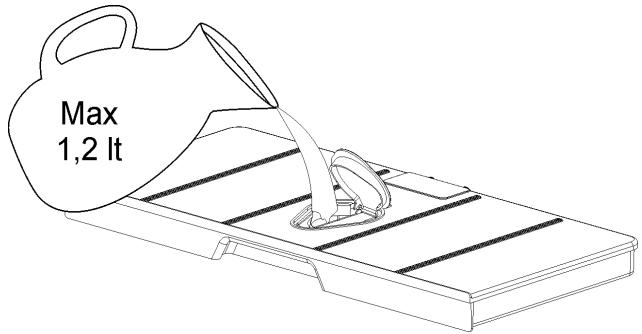
Remplissage d'eau
Le contenu en eau est normalement suffisant pour un processus de cuisson de 50 à 60 minutes.
S'il faut remplir le réservoir d'eau, le voyant du réservoir d'eau s'allumera. Versez seulement 0,5 litre d'eau au maximum pour garantir que l'eau ne déborde pas du réservoir d'eau à cause du pompage de retour. DANGER DE DÉBORDEMENT.
Vidange du réservoir d'eau
Lorsque l'appareil est débranché, l'eau restante est pompée de nouveau vers le réservoir d'eau.
Pendant que l'eau est pompée, l'indication "PUMP" apparaît.
Cette indication s'affiche jusqu'à ce que l'eau atteigne une température de 75 °C avant d'être pompée de nouveau vers le réservoir d'eau.
Attention : l'eau du réservoir peut être chaude. Danger de brûlures !
Une fois que l'eau a été pompée de nouveau dans le réservoir d'eau, l'indication "DEP" apparaît à l'écran. Procédez comme suit :
- Retirez le réservoir d'eau de l'appareil et videz-le.
- Séchez le réservoir d'eau et réinsérez-le dans l'appareil. Séchez l'intérieur de l'appareil.
- Laissez la porte de l'appareil ouverte jusqu'à ce que l'appareil ait refroidi et soit complètement sec.
REMARQUE IMPORTANTE : Il est recommandé de retirer et de vider le réservoir d'eau après chaque processus de cuisson. Cela évite le développement de bactéries et de calcaire dans l'appareil.
Ne videz pas le réservoir d'eau si vous souhaitez effectuer deux processus de cuisson à la vapeur successifs. L'indication "DEP" apparaîtra à l'écran.
Pour supprimer cette indication, appuyez sur le bouton Arrêt, puis lancez un nouveau processus de cuisson sans avoir à retirer et vider le réservoir d'eau.
Interruption d'un processus de cuisson
Vous pouvez interrompre à tout moment le processus de cuisson en appuyant une fois sur le bouton Marche/Arrêt.
L'appareil dispose d'une fonction d'élimination de la vapeur qui s'active avec le bouton Marche/Arrêt. Cela évite les brûlures de vapeur à l'ouverture de la porte.
Cela dure environ trois minutes et, pendant ce temps, VAP apparaît à l'écran.
Attention : Si vous ouvrez la porte, pendant ou après le processus de cuisson, de la vapeur chaude s'échappe de l'appareil. Écartez-vous ou penchez-vous en arrière.
À ce moment :
- La génération de vapeur est interrompue. Les parois de la chambre de cuisson et le réservoir d'eau restent très chauds. Risque de brûlures !
- L'écran de sélection de l'heure et de la durée s'arrête et affiche le temps de fonctionnement écoulé.
Si lo desea, puede:
- dar la vuelta o retirar los alimentos
- modificar los parámetros del proceso.
Cierre la puerta y pulse el botón Inicio/Parada para continuar el proceso.
Alteración de parámetros
Si desea cambiar alguno de los parámetros de función activos, pulse las teclas < > o " > " para seleccionar el parámetro y después las teclas " + " y - para seleccionar un valor distinto. Pulse la tecla OK o espere algunos segundos para validar el valor del nuevo parámetro.
Cancelar un ciclo de cocción
Si desea cancelar el proceso de cocción, pulse la tecla Parar dos veces.
Escuchará 3 avisos sonoros y el reloj aparecerá en el display.
Fin de un ciclo de cocción
Al final de la duración de la configuración o cuando pulsa la tecla Parar para terminar el ciclo de cocción, escuchará tres avisos sonoros y el display exhibirá la palabra “End” (“Fin”); el horno empieza la función de reducción de vapor.
Esta función libera gradualmente el vapor de la cavidad, para que no exista una súbita liberación de vapor cuando se abre la puerta del aparato.
Esta función tarda cerca de 3 horas, en las que el display enseña la palabra "VAP".
¡Atención! Si abre la puerta durante o después del ciclo de cocción, tenga cuidado con el flujo de aire caliente y/o vapor que sale de la cámara de cocción. Aléjese para evitar quemaduras.
El ventilador puede seguir funcionando durante un lapso de tiempo antes de la desconexión del equipo. Es una función normal para reducir la temperatura bajo el horno.
L'eau résiduelle dans la chaudière peut descendre à 75 °C avant d'être pompée vers le réservoir. Pendant que l'eau est pompée, l'écran affiche le mot "PUMP".
Avertissement : l'eau dans le réservoir peut être chaude. Risque de brûlures !
Lorsque l'écran affiche le mot "DEP", cela signifie que l'eau a été pompée et que le réservoir d'eau peut être retiré.
Retirer le réservoir d'eau et le sécher soigneusement. Laisser l'espace de cuisson refroidir, puis nettoyer et sécher avec un chiffon. Laisser la porte ouverte pendant une heure pour que l'appareil sèche complètement.
Tableaux et conseils
Utilisation des accessoires
Le plateau perforé est utilisé pour la cuisson à la vapeur de légumes, viandes et volailles fraîches ou surgelées.
Pour cela, il est important que le plateau non perforé soit inséré dans l'appareil sur le premier support latéral en partant du bas. Ainsi, les liquides qui s'égouttent tomberont dedans et ne saliront pas l'appareil. Le plateau perforé contenant les aliments sera inséré sur le deuxième support latéral en partant du bas.
Le plateau non perforé est utilisé pour la cuisson à la vapeur d'aliments plus délicats, par exemple compotes, plats à base de pâte et plats très élaborés.
La grille est utilisée pour cuire des aliments dans de petits récipients, par exemple des ramequins, et pour réchauffer des aliments dans des assiettes.
Vous trouverez des informations plus précises dans les tableaux.
Les valeurs concernant la durée de cuisson et la température sont données à titre indicatif. La durée de cuisson varie en fonction du type de produit à cuire et de son état.
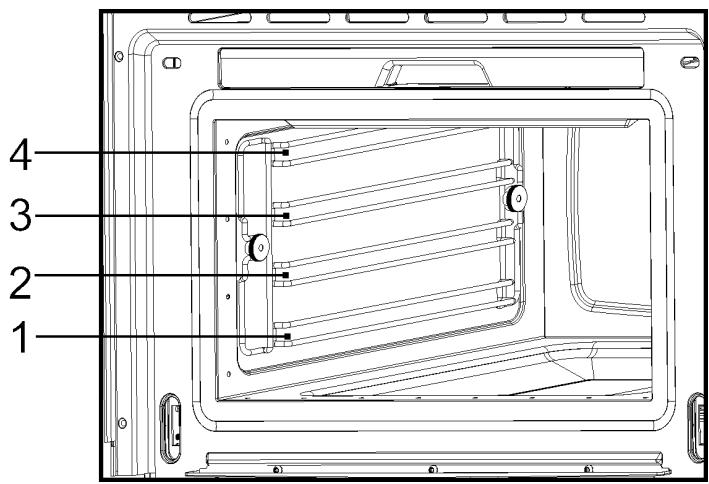
Poisson
| Pescado | Cantidad | Temperatura °C | Tiempo de coccción min. | Bandeja | Soporte (desde abajo) |
| Dorada | 800-1200 g | 80 | 30-40 | perforada | 2 |
| Trucha | 4 x 250 g | 80 | 20-25 | perforada | 2 |
| Filete de salmón | 500-1000 g | 80 | 15-25 | Perforada | 2 |
| Trucha asalmonada | 1000-1200 g | 80 | 25-35 | Perforada | 1/2 |
| Carabinero | 500-1000 g | 80 | 15-20 | Perforada | 2 |
| Mejjolones verdes | 1000-1500 g | 100 | 25-35 | Perforada | 2 |
| Filete de mero | 500-1000 g | 80 | 20-25 | Perforada | 2 |
| Berberechos | 500-1000 g | 100 | 10-20 | Perforada | 2 |
| Bogavante, ultracongelado | 800-1200 g | 100 | 25-30 | Perforada | 1/2 |
| Bacalao | 1000-1200 g | 80 | 20-25 | Perforada | 2 |
| Mejjolones | 1000-1200 g | 100 | 15-25 | Perforada | 2 |
| Trucha ártica | 4 x 250 g | 80 | 25-30 | Perforada | 2 |
| Abadejo | 1000-1200 g | 80 | 20-25 | Perforada | 2 |
| Filete de atún | 500-1000 g | 80 | 15-20 | Perforada | 2 |
| Lucioperca | 4 x 250 g | 80 | 25-30 | Perforada | 2 |
Viande
| Carne | Cantidad | Temperatura °C | Tiempo de coccción min. | Bandeja | Soporte (debesa quo) |
| Pepitos de pollo | 4-10 | 100 | 40-45 | perforada | 2 |
| Pechuga de pollo | 4-6 | 100 | 25-35 | perforada | 2 |
| Costillitas de cerdo ahumadas | 500g -1000g | 100 | 40-50 | perforada | 2 |
| Escalope de pavo | 4-8 | 100 | 20-25 | perforada | 2 |
| Filete de cerdo, completo | 4-8 | 100 | 20-30 | perforada | 2 |
| Salchichas | 80-100 | 10-15 | perforada | 2 |
Œufs
| Huevos | Temperatura °C | Tiempo de coccción min. | Bandeja | Soporte (debesaibo) |
| Huevo en vaso | 100 | 10-15 | parrilla | 2 |
| Huevos,uros | 100 | 15 | parrilla | 2 |
| Huevos,blandos | 100 | 10-12 | parrilla | 2 |
Garnitures
| Guarniciones | Cantidad | Temperatura °C | Tiempo de coccción min. | Bandeja | Soporte (debesa bajo) |
| Cebada montada + láquido | 200g + 400ml | 100 | 30-35 | parrilla, cuenco de cristal | 2 |
| Sémola + láquido | 200g + 300ml | 100 | 10-20 | parrilla, cuenco de cristal | 2 |
| Lentejas + láquido | 200g + 375ml | 100 | 20-50 | parrilla, cuenco de cristal | 2 |
| Arroz + láquido | 200g + 250ml | 100 | 25-40 | parrilla, cuenco de cristal | 2 |
Tableaux et conseils
Légumes
| Verduras/frescas | Temperatura °C | Tiempo de coccción min. | Bandeja | Sóporte (debesa quo) | |
| Berenjenas | en rodajas | 100 | 15-20 | perforada | 2 |
| Judías | 100 | 35-45 | perforada | 2 | |
| Brécol | ramitas con tallo | 100 | 25-30 | perforada | 2 |
| Brécol | ramitas sin tallo | 100 | 15-20 | perforada | 2 |
| Coliflor | ramitas | 100 | 25-30 | perforada | 2 |
| Coliflor | cabeza completa | 100 | 40-45 | perforada | 1 |
| Guisantes | 100 | 30-35 | perforada | 2 | |
| Hinojo | en tiras | 100 | 15-20 | perforada | 2 |
| Hinojo | partido por la mitad | 100 | 20-30 | perforada | 2 |
| Patatas con/piel | enteras, muykleuñas | 100 | 20-25 | perforada | 2 |
| Patatas con piel | enteras, muygruesas | 100 | 45-50 | perforada | 2 |
| Patatas sin piel | en trozos | 100 | 20-25 | perforada | 2 |
| Colinabos | troceado | 100 | 20-25 | perforada | 2 |
| Judías | 100 | 15-20 | perforada | 2 | |
| Zanahorias | en rodajas | 100 | 25-30 | perforada | 2 |
| Mazorcas | 100 | 50-60 | perforada | 2 | |
| Pimientos | en tiras | 100 | 12-15 | perforada | 2 |
| Guindillas | 100 | 12-15 | perforada | 2 | |
| Setas | en cuartos | 100 | 12-15 | perforada | 2 |
| Puerros | en rodajas | 100 | 10-12 | perforada | 2 |
| Coles de Bruselas | 100 | 25-35 | perforada | 2 | |
| Apio | en tiras | 100 | 15-20 | perforada | 2 |
| Espárragos | 100 | 20-35 | perforada | 2 | |
| Espinacas | 100 | 12-15 | perforada | 2 | |
| Apio en rama | 100 | 25-30 | perforada | 2 | |
| Calabacines | en rodajas | 100 | 12-18 | perforada | 2 |
Raviolis
| Dumplings | Temperature °C | Time min. | Container | Level |
| Sweet dumpling | 100 | 20-30 | Not perforated | 2 |
| Sweet yeast dumpling | 100 | 15-20 | Not perforated | 2 |
| Yeast dumpling | 100 | 15-25 | Not perforated | 2 |
| Bread dumpling | 100 | 20-25 | Not perforated | 2 |
| Napkin dumpling | 100 | 25-30 | Not perforated | 2 |
Desserts
| Postres | Cantidad | Temperatura °C | Tiempo de coccción min. | Bandeja | Soporte (desde abajo) |
| Compota de manzana | 500-1500 g | 100 | 15-25 | no perforada | 2 |
| Compota de pera | 500-1500 g | 100 | 25-30 | no perforada | 2 |
| Crema catalana | 80 | 20-25 | parrilla-cuenquillo | 2 | |
| Crema de caramelo | 80 | 25-30 | parrilla-cuenquillo | 2 | |
| Yogur | 40 | 4-6 horas | parrilla-cuenquillo | 2 | |
| Compota de melocotón | 500-1500 g | 100 | 15-20 | no perforada | 2 |
Fruits (stériliser/cuire)
| Fruta | Cantidad | Temperatura °C | Tiempo de coccción min. | Bandeja | Sóporte (debes abajo) |
| Peras | 4-6 copas de 1I | 100 | 30-35 | Parrilla | 1 |
| Cerezas | 4-6 copas de 1I | 80 | 30-35 | Parrilla | 1 |
| Melocotones | 4-6 copas de 1I | 90 | 30-35 | Parrilla | 1 |
| Ciruelas | 4-6 copas de 1I | 90 | 30-35 | Parrilla | 1 |
Régénérer
| Calentimiento | Cantidad | Temperatura °C | Tiempo de coccción min. | Bandeja | Sóporte (debes abajo) |
| Platos | 1-2 | 100 | 12-15 | Parrilla | 2 |
| Platos | 3-4 | 100 | 15-20 | Parrilla | 2 |
| Platos preparados | 100 | 15-20 | Parrilla | 2 |
Blanchir
| Verduras | Cantidad | Temperatura °C | Tiempo de coccción min. | Bandeja | Sóporte (debes abajo) |
| p. ej., judías, puerto | 100 | 10-12 | perforada | 2 | |
| Col verde | 1000-2000 g | 100 | 12-16 | perforada | 2 |
| Hojas de col rizada | 10-20 | 100 | 12-15 | perforada | 2 |
| Repollo, completo | 2000-2500 g | 100 | 30-45 | perforada | 1 |
| Tomates, pelados | 80 | 12 | parrilla | 2 |
Tableaux et conseils
Décongélation
| Verduras/guarniciones | Temperatura ℃ | Tiempo de coccción min. | Bandeja | Soporte (desde abajo) | |
| Brécol | ramitas con tallo | 100 | 15-20 | perforada | 2 |
| Menestra | 100 | 15-20 | perforada | 2 | |
| Hojas de espinaca | raciones | 100 | 10-15 | no perforada | 2 |
| Coliflor | ramitas | 100 | 15-20 | perforada | 2 |
| Guisantes | 100 | 15-25 | perforada | 2 | |
| Col verde | bloque grueso | 100 | 25-35 | no perforada | 2 |
| Zanahorias | en rodajas | 100 | 15-20 | perforada | 2 |
| Coles de Bruselas | 100 | 20-25 | perforada | 2 | |
| Espárragos | 100 | 25-30 | perforada | 2 | |
| Platos preparados | 100 | según se precise | parrilla | 2 | |
| Pan | 100 | 10-25 | parrilla | 2 | |
| Arroz | 100 | 15-25 | no perforada | 2 | |
| Lentejas | 100 | 15-20 | no perforada | 2 | |
| Pasta | 100 | 15-20 | no perforada | 2 | |
Cuisson sur 2 niveaux
Indications :
Pour la cuisson sur deux niveaux, les accessoires doivent toujours être placés sur le 2e ou 3e et sur le 1er support en partant du bas.
Les différents temps de cuisson se règlent comme indiqué ci-après :
Les aliments qui nécessitent un temps de cuisson plus long doivent être placés dans la partie supérieure de l'enceinte de cuisson à la vapeur. Les aliments avec des temps de cuisson plus courts sont introduits sur le premier support en partant du bas.
Exemple : légumes, pommes de terre et viande.
Introduisez les légumes et les pommes de terre dans l'appareil, dans n'importe quel récipient, sur la grille au 2e ou 3e support en partant du bas.
Introduisez le poisson sur le 1er support en partant du bas.
Si le plateau perforé doit être utilisé pour le poisson, le plateau non perforé doit être placé au fond de l'appareil pour recueillir le jus de cuisson du poisson qui s'écoule. Ainsi, l'appareil reste propre.
Temps de cuisson : légumes et pommes de terre 25 à 35 min.
Temps de cuisson : poisson, selon le type, 15 à 25 min.
On règle le temps de cuisson le plus long, mais grâce aux différents niveaux, les aliments sont prêts en même temps sans que rien ne soit trop cuit.
Nettoyage de la cavité intérieure
En aucun cas, n'utilisez de produits de nettoyage abrasifs, comme des éponges abrasives multi-usages, des tampons à récurer en métal, etc., car ils pourraient endommager la surface.
Nettoyez la cavité de cuisson à chaud avec un chiffon humide. Ensuite, séchez-la en frottant.
Pour un nettoyage plus facile, les grilles latérales peuvent être retirées. (Voir la section suivante).
Déclipser les grilles latérales
Sur les grilles de positionnement, desserrez l'écrou moleté 1 vers l'avant dans le sens inverse des aiguilles d'une montre.
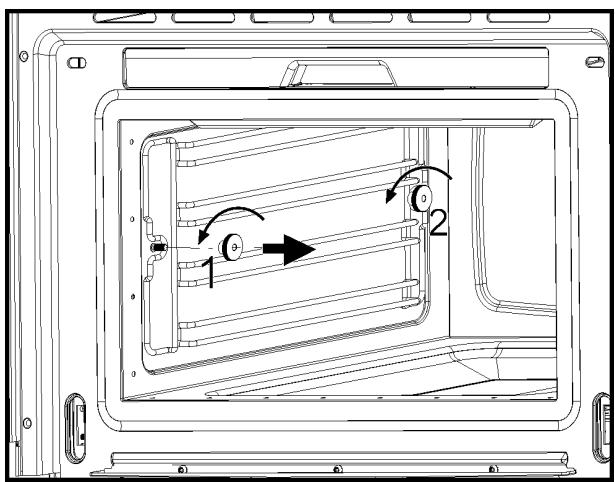
Desserrez légèrement l'écrou moleté 2 à l'arrière des grilles de positionnement dans le sens inverse des aiguilles d'une montre. Ne retirez pas les écrous moletés.

Tirez légèrement la grille de positionnement vers l'avant et retirez-la.
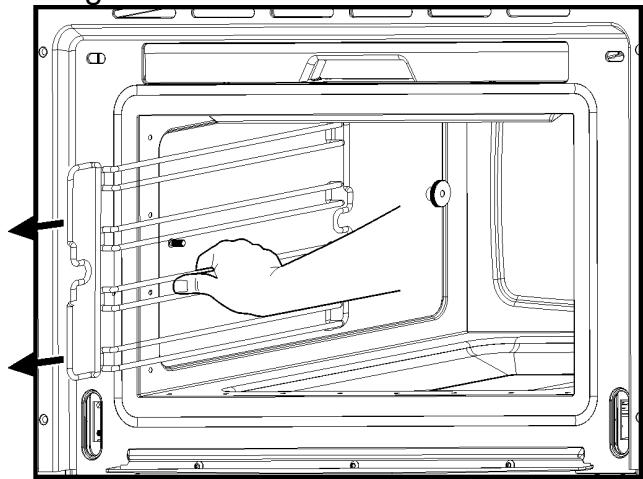
Pour le montage, faites glisser la grille de positionnement sur l'écrou moleté 2. Vissez l'écrou moleté 1 dans le sens des aiguilles d'une montre jusqu'à la butée, puis serrez l'écrou moleté 2.
Entretien
Extraction de la porte de l'appareil
Ouvrez la porte de l'appareil à fond.
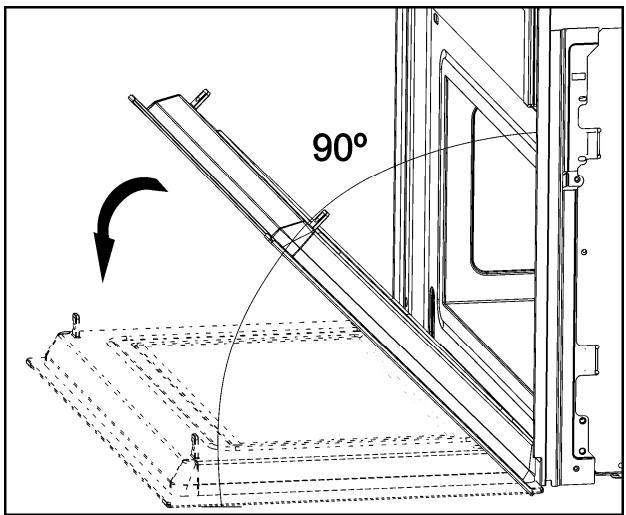
Insérez deux goupilles dans les trous des charnières de la porte.
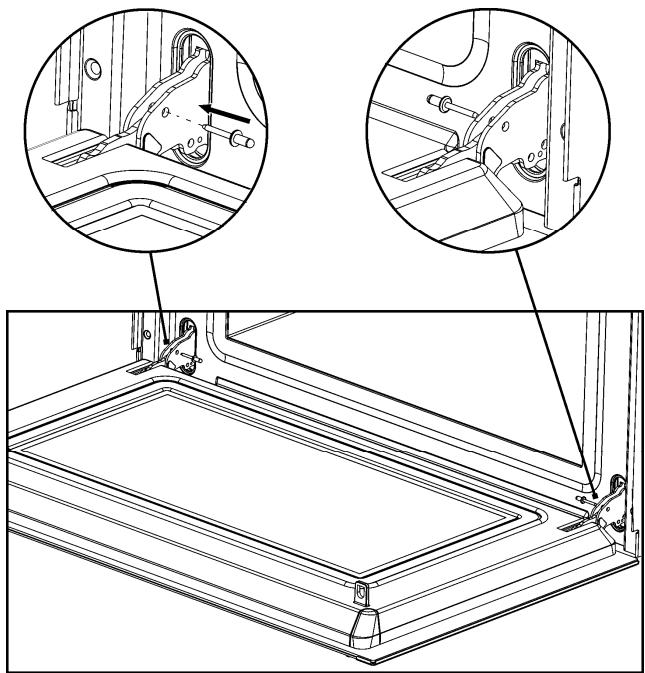
Fermez la porte suffisamment pour la soulever.
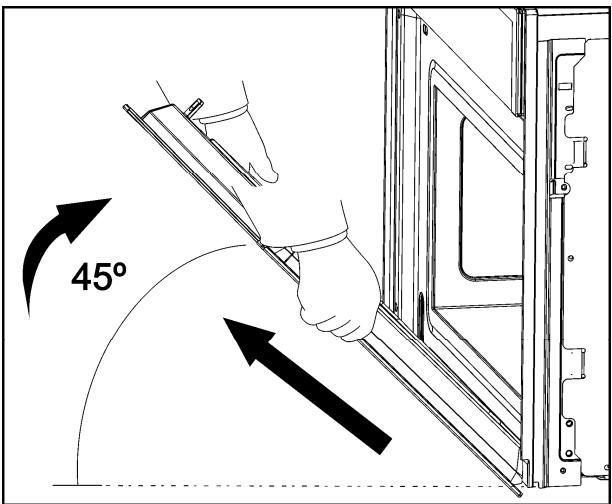
Pour la remonter, insérez les charnières dans les trous.
Ouvrez la porte de l'appareil au maximum et retirez les goupilles.
Détartrage
Chaque fois que de la vapeur est produite, indépendamment de la dureté de l'eau locale (par exemple, la teneur en calcaire de l'eau), du calcaire se dépose sous le générateur de vapeur.
L'intervalle entre les détartrages dépend de la dureté de l'eau et de la fréquence d'utilisation. Si l'appareil émet de la vapeur 4 × 30 minutes par heure, il doit être nettoyé en profondeur (selon la dureté de l'eau) comme indiqué ci-dessous :
| Dureza del agua | Eliminación de sarro casa |
| Muy suave | 18 grasas |
| Media | 9 grasas |
| Muy dura | 6 grasas |
L'appareil détecte automatiquement quand il est nécessaire de détartrer et l'écran affiche l'un des messages suivants :

Si la procédure de détartrage n'est pas effectuée, quelques cycles de cuisson avant que le symbole ne s'affiche, celui-ci commencera à clignoter.
Si la procédure de détartrage n'est toujours pas effectuée, le fonctionnement est bloqué et l'écran affiche :
CAL

NOTA IMPORTANTE: La no eliminación del sarro puede impedir el funcionamiento o provocar daños al aparato.
Soluciones de eliminación de sarro adecuadas
Para desincrustar, use la solución "DURGOL®".
Esta solución de desincrustación permite una eliminación del sarro profesional y cuidadosa en su aparato y está disponible en los Centros de Atención al Cliente.
¡Atención! No utilice vinagre ni productos que contengan vinagre, pues puede dañar el circuito interno del horno.
Las soluciones de desincrustación normales no son apropiadas porque contienen agentes con espuma.
Cuidados y mantenimiento
Procedimiento de eliminación del sarro

Advertencia: Por razones de seguridad, el proceso de eliminación del sarro no puede interrumpirse y tardará unos 45 minutos.
Se puede hacer esta limpieza con la puerta del aparato abierta o cerrada. El aparato debe estar en estado inactivo antes de iniciar este ciclo de eliminación del sarro.
Para empezar el ciclo, siga las instrucciones a continuación:
- Pulse la tecla "On/Off" para conectar el horno.
- Pulse las teclas "Izquierda" y "Derecha" simultáneamente durante 5 segundos. El display muestra la palabra "CAL" y se escucha un aviso sonoro intermitente. Si desea cancelar el proceso de desincrustación en este punto, pulse la tecla "Parar".
- Pulse la tecla Inicio.
- Cuando el display muestre "0.5L", remover el depósito de agua.
- Utiliser 0,5 litre d'une solution de détartrage adaptée dans le réservoir d'eau et le remettre en place.
- Appuyer sur la touche Départ. Le cycle de détartrage démarre et dure environ 30 minutes.
- Lorsque l'écran affiche « 1,0 L » clignotant et que l'appareil émet un signal sonore, retirer et vider le réservoir d'eau.
- Remplir le réservoir avec 1,0 litre d'eau froide et le remettre en place.
- Appuyer sur la touche Départ. Le premier cycle de rinçage démarre.
- Lorsque l'écran affiche de nouveau « 1,0 L » clignotant et que l'appareil émet un signal sonore, retirer et vider le réservoir d'eau.
- Remplir le réservoir avec 1,0 litre d'eau froide et le remettre en place.
- Appuyer sur la touche Départ. Le deuxième cycle de rinçage démarre.
- Lorsque le cycle de rinçage est terminé, l'écran affiche le message « End » (« Fin »).
- Retirer, vider et sécher le réservoir d'eau.
Attention : le nettoyage doit être effectué avec l'appareil débranché. Débranchez la fiche de la prise de courant ou désactivez le circuit d'alimentation électrique de l'appareil.
Ne pas utiliser de produits de nettoyage agressifs ou abrasifs, de chiffons abrasifs ni d'objets pointus, car des taches pourraient apparaître.
Ne pas utiliser d'appareils de nettoyage à jet haute pression ou à vapeur.
Parte frontale
È sufficiente pulire l'apparecchio con un panno umido. Se è molto sporco, aggiungere all'acqua qualche goccia di detersivo per piatti. Successivamente, asciugare l'apparecchio con un panno asciutto.
Per gli apparecchi con parte frontale in alluminio, utilizzare un detergente per vetri delicato e un panno morbido che non lasci pelucchi. Pulire in orizzontale senza esercitare pressione sulla superficie.
Rimuovere immediatamente le macchie di calcare, grasso, amido e albume. Queste macchie possono provocare corrosione.
Evitare che l'acqua penetri all'interno dell'apparecchio.
Camera di cottura
Pulire le pareti interne con un panno umido dopo ogni utilizzo. Lasciare la porta aperta per far raffreddare e asciugare la camera interna.
Non utilizzare detergenti aggressivi per rimuovere macchie persistenti. Non usare spray per forni né altri mezzi di pulizia aggressivi o corrosivi.
Mantenere sempre puliti la porta e la parte frontale dell'apparecchio per garantirne il perfetto funzionamento.
Evitare la penetrazione dell'acqua nei fori di ventilazione.
Il coperchio in vetro della lampada è incassato nel coperchio dell'apparecchio e può essere estratto facilmente per la pulizia. Per farlo, svitarlo e pulirlo con acqua e detersivo per piatti.
Accessori
Pulire gli accessori dopo ogni utilizzo. Se sono molto sporchi, ammorbidirli prima e poi utilizzare una spazzola e una spugna. Gli accessori possono essere lavati in lavastoviglie.
Cosa fare in caso di guasto?
ATTENZIONE! Le riparazioni possono essere eseguite solo da tecnici specializzati. Tutte le manipolazioni effettuate da persone non autorizzate dal produttore comportano pericolo.
Los siguientes problemas pueden solucionarse sin necesidad de informar al Servicio de Atención al Cliente:
- La pantalla está apagada. Compruebe si:
- el piloto de hora está desactivado (consulte el apartado relativo a los ajustes básicos).
- No ocurre nada cuando se pulsan los botones. Compruebe si:
- el bloqueo de seguridad está activado (consulte el apartado relativo a los ajustes básicos).
- El aparato no funciona. Compruebe si:
- el enchufe está conectado correctamente a la toma de corriente,
- el circuito de alimentación de corriente del aparato está activado,
- Se escuchan ruidos durante el funcionamiento.
- Se trata de ruidos de funcionamiento que pueden producirse durante todo el tiempo de cocción al vapor, p. ej., por las bombas de agua en el generador de vapor.
- Estos ruidos son normales, no representan un problema.
- Los alimentos no se calientan o se calientan muy lentamente. Compruebe si:
- Ha seleccionado la temperatura y el tiempo de funcionamiento correctos,
- Ha introducido una cantidad de alimentos superior o más fría de lo normal en el interior del aparato.
- Si aparece en la pantalla "Err", póngase en contacto con el Servicio de Atención al Cliente.
- Al finalizar un proceso de cocción se escucha un ruido. Esto no es un problema.
- El ventilador de refrigeración funciona cuando es necesario. Si ocurre alguna incidencia, se detendrá inmediatamente.
- El aparato funciona, pero la iluminación interior no.
- Si todas las funciones se ejecutan correctamente, es posible que la lámpara se haya fundido. Puede seguir utilizando el aparato.
Cambio de lámpara
Siga estos pasos para sustituir la lámpara:
- Desconecte el aparato del suministro de corriente. Desconecte el enchufe de la toma de corriente o desactive el circuito de alimentación de corriente del aparato.
- Desatornille la tapa de cristal delante de la lámpara (1).
- Extraiga la lámpara halógena (2). Atención: La lámpara puede estar muy caliente.
- Coloque una nueva lámpara E14 230-240V / 15W. Siga las indicaciones del fabricante de la lámpara.
- Atornille la tapa de cristal delante de la lámpara (1).
- Vuelva a conectar el aparato a la toma de corriente.
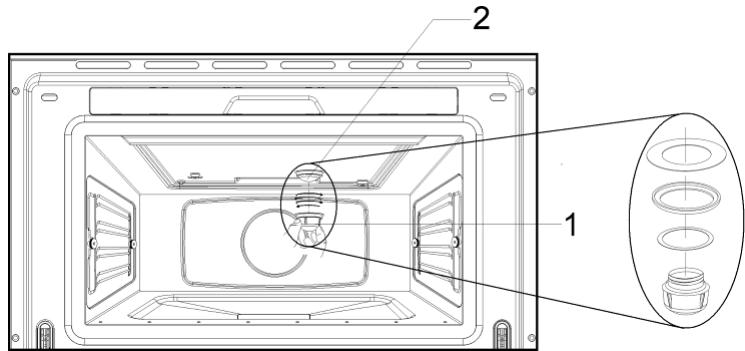
Descripción de sistemas
| Simbolo | Función | Alimentos |
| Vapor | Cocinar todo tipo de vegetales, arroz, cereales y carne. Obtener zumo de las bayas. Descongelar y cocinar simultáneamente los vegetales. | |
| Regeneración y Esterilización | Regenerar platos cocinados y comidas precocinadas. Esterilizar/hervir frutos. | |
| Cocinar vegetales | Cocinar variedostipsodes vegetales. | |
| Cocinar pescado | Cocinar variedostipsodes pescado. | |
| Cocinar carne | Cocinar variedostipsodes carne. | |
| Guarniciones | Cocinar variedostipsodes guarniciones. |
Écrans
| Mensaje | Descripción |
| Depósito del agua | |
| Parpadeo – el depósito del agua estávacío. Debe rellenarlo. | |
| Indicación de que el depósito no está en su situó. | |
| DEP | El depósito del agua debe serremovido, vaciado y reinsertado. |
| Reducción de vape | |
| VAP | Indicación de que el procesode reducciónde vapor está en bajo. |
| PUMP | Indicación de que el agua caliente está sando bombeada hacela depósito del agua. |
| Eliminación del sarro | |
| CAL | Debe eliminarsselarro del aparato. |
| Parpadeo – se inicia laeliminación delsarro. | |
| 0.5L | Use 0.5litros de una soluciónde eliminación delsarro en el depósito del agua. |
| 1.0L | Rellene con 1.0litro de aguafría el depósito para ellavado. |
| Avisos delsystems | |
| HOT | Temperatura en el Cuadro Electrónica demasiado alta. |
| Err_ | Contacte el Servicio de Atencion al CLIENTe |
Spécifications
- Tension alternative (voir plaque signalétique). Puissance absorbée : 1500 W
- Dimensions extérieures (l. x h. x p.) : 595 x 455 x 472 mm
- Dimensions de la cavité de cuisson (l. x h. x p.) : 420 x 210 x 390 mm
- Capacité du four : 35 L
- Poids : 32 kg
Lisez attentivement les instructions de cette notice ; elles vous aideront à obtenir de bons résultats avec votre four vapeur.
CONSERVEZ LA DOCUMENTATION DE CET APPAREIL, AFIN DE POUVOIR LA CONSULTER PLUS TARD.
Conservez ces instructions à portée de main. Si vous cédez l'appareil à des tiers, transmettez-leur également les instructions.
Remarques sur la protection de l'environnement
Élimination de l'emballage

L'emballage est marqué d'un Point Vert.
Éliminez tous les matériaux d'emballage, tels que le carton, le polystyrène et les plastiques, en les déposant dans les conteneurs appropriés. Vous assurez ainsi le recyclage des matériaux d'emballage.
Élimination des appareils hors d'usage
La directive européenne 2002/96/CE relative aux déchets d'équipements électriques et électroniques (DEEE) établit que les appareils électroménagers ne peuvent pas être éliminés avec les déchets urbains ordinaires.
Les appareils mis au rebut doivent être collectés séparément, afin d'optimiser le pourcentage de récupération et de réutilisation des matériaux et de prévenir les risques potentiels pour la santé humaine et l'environnement. Le symbole représentant une poubelle barrée d'une croix doit être apposé sur tous les produits, afin de rappeler l'obligation de collecte séparée.
Les consommateurs doivent contacter les autorités locales ou les points de vente, afin d'obtenir des informations sur le lieu approprié pour le stockage des appareils électroménagers usagés.
Rendez votre appareil inutilisable avant de le mettre au rebut. Débranchez le câble, coupez-le et éliminez-le.
Instructions d'installation 31
Avant l'installation 31 Après l'installation 31
Instructions de sécurité 32
Description de l'appareil 34
Définitions de base 35
Réglages initiaux 35 Régler l'heure 35
Configuration de la dureté de l'eau 35 Afficher/masquer l'horloge 36 Verrouillage des touches 36 Minuteur 37
Fonctions de base 38
Vapeur 38 Chauffer & Stériliser 38
Fonctions spéciales 39
Cuire des légumes 39 Cuire du poisson 40 Cuire de la viande 41
Accompagnements 42
Remplir d'eau 43
Remplir le réservoir d'eau 43 Ajouter de l'eau 43 Vider le réservoir d'eau 43
Pendant la cuisson 44
Interruption du processus de cuisson 44 Modifier les paramètres 44 Annuler un cycle de cuisson 44 Fin d'un cycle de cuisson 44
Tableaux de cuisson 45
Utilisation des accessoires 45
Entretien 51
Nettoyage de l'intérieur 51 Retirer les grilles latérales 51 Démonter la porte 52 Détartrage 53 Produits de détartrage inadaptés 53 Procédure de détartrage 54
Nettoyage et entretien de l'appareil 55
Face avant de l'appareil 55 Intérieur 55 Accessoires 55
Que faire en cas de panne ? 56
Remplacement de l'ampoule 56
Caractéristiques techniques 57
Description des fonctions 57 Indications 57 Spécifications 58
Installation 59
Avant l'installation
Vérifiez que la tension d'alimentation indiquée sur la plaque signalétique correspond à celle de votre réseau.
Ouvrez la porte de l'appareil et retirez tous les accessoires ainsi que le matériau d'emballage.
Attention ! La partie avant de l'appareil peut être recouverte d'un film protecteur. Retirez ce film avec précaution avant la première utilisation de l'appareil. Commencez par la partie inférieure.
Assurez-vous que l'appareil n'est pas endommagé. Vérifiez que la porte ferme correctement et que la face intérieure de la porte et l'espace intérieur de la façade ne présentent pas de dommages. Si vous constatez un dommage, contactez le service après-vente. Le numéro de téléphone se trouve sur la dernière page de ce livret.
N'UTILISEZ PAS L'APPAREIL si le cordon d'alimentation ou la fiche sont endommagés, si l'appareil ne fonctionne pas correctement, ou s'il a été endommagé ou est tombé. Contactez éventuellement le service après-vente. Le numéro de téléphone se trouve sur la dernière page de ce livret.
Placez l'appareil sur une surface plane et résistante. L'appareil ne doit pas être installé à proximité d'éléments chauffants, de radios ou de téléviseurs.
Lors de l'installation, assurez-vous que le cordon d'alimentation n'entre pas en contact
avec l'humidité, des objets aux arêtes vives ou la partie arrière de l'appareil, car des températures élevées peuvent endommager le cordon.
Attention : l'appareil installé ne doit pas bloquer l'accès à la fiche.
Après l'installation
L'appareil est équipé d'un cordon d'alimentation et d'une fiche pour courant monophasé, 230-240 V - 50 Hz.
En cas de branchement permanent, l'appareil doit être installé par un technicien qualifié.
Dans ce cas, le raccordement au circuit électrique doit être effectué avec un disjoncteur omnipolaire, avec une distance minimale de 3 mm entre les contacts.
ATTENTION : IL EST OBLIGATOIRE DE RELIER L'APPAREIL À LA TERRE.
Tant le fabricant que les revendeurs déclinent toute responsabilité pour les dommages qui pourraient être causés à des personnes, des animaux ou des biens, s'il s'avère que les présentes instructions d'installation n'ont pas été respectées.
L'appareil ne fonctionne correctement que si la hotte est correctement fermée.
Avant la première utilisation, nettoyez l'intérieur de l'appareil et les accessoires conformément aux instructions de nettoyage du chapitre « Nettoyage et entretien de l'appareil ».
L'installation doit respecter les instructions fournies séparément.
FR Instructions de sécurité

- Attention ! Ne laissez pas l'appareil fonctionner sans surveillance.
- Attention ! Si vous remarquez de la fumée ou du feu, gardez la porte fermée pour étouffer les flammes. Éteignez l'appareil et retirez la fiche de la prise ou coupez l'alimentation électrique de l'appareil. Les graisses et les huiles surchauffées s'enflamment facilement. Par conséquent, ne chauffez pas d'huile ou de graisse à l'intérieur de l'appareil. En cas d'incendie, n'essayez pas d'éteindre de la graisse ou de l'huile en feu avec de l'eau (danger d'explosion) ! Étouffez les flammes avec un chiffon humide et maintenez toutes les portes et fenêtres fermées.
- Attention ! N'utilisez pas d'alcool à forte teneur pour vos cuissons dans l'appareil. Cela pourrait provoquer une surchauffe des aliments, danger d'explosion !
- Attention ! Cet appareil n'est pas destiné à être utilisé par des personnes (y compris les enfants) qui ne sont pas en pleine possession de leurs facultés physiques, sensorielles et mentales. Les utilisateurs qui n'ont ni l'expérience ni la connaissance de l'appareil et auxquels le fonctionnement de l'appareil
n'a pas été expliqué, doivent être surveillés par une personne responsable de leur sécurité. Les enfants doivent être surveillés pour s'assurer qu'ils ne jouent pas avec l'appareil.
Utilisez la sécurité enfants. - L'appareil peut devenir très chaud pendant l'utilisation. Soyez prudent et évitez tout contact avec les éléments chauffants situés à l'intérieur de l'appareil. DANGER DE BRÛLURES ! - Attention ! Les pièces accessibles peuvent devenir très chaudes. Tenez les enfants éloignés de l'appareil. - Attention ! Si vous ouvrez la porte de l'appareil pendant ou après la cuisson, de la vapeur chaude et des gouttes d'eau peuvent s'échapper. Éloignez-vous de côté ou en arrière. - Attention ! En cas d'incendie, n'utilisez pas la porte chaude de l'appareil pour fixer les câbles d'alimentation d'autres appareils électriques. L'isolation du câble peut fondre. Danger de court-circuit !
Instructions de sécurité
Cet appareil est destiné exclusivement à un usage domestique !
Cet appareil est adapté à la préparation de produits alimentaires à la maison. Aucune responsabilité n'est acceptée pour les dommages causés par une utilisation inappropriée ou non autorisée.
Si vous procédez conformément aux instructions, vous éviterez des dommages à l'appareil et d'autres situations dangereuses :
- Ne couvrez pas et n'obstruez pas les ouvertures de ventilation.
- Ne rangez pas à l'intérieur de l'appareil des objets qui, en cas de mise en marche accidentelle, peuvent présenter un danger.
- N'utilisez pas l'appareil comme débarras.
- Ne versez pas d'alcool (par exemple, cognac, whisky, schnaps) sur des aliments chauds. Risque d'explosion !
- Les accessoires, tels que les grilles et les plaques, chauffent beaucoup à l'intérieur du four. Utilisez des maniques.
- Pour éviter les brûlures, portez toujours des gants de cuisine lorsque, en manipulant des plats et des récipients, vous devez toucher l'intérieur de l'appareil.
- Ne vous appuyez pas et ne vous asseyez pas sur la porte ouverte de l'appareil, car cela pourrait causer des dommages, en particulier au niveau des charnières. La porte supporte au maximum 8 kg.
- Les grilles ont une capacité de charge maximale de 8 kg. Pour éviter tout dommage, ne dépassez pas ce poids.
Nettoyage :
- Avant de nettoyer l'appareil, éteignez-le et laissez-le refroidir. Laissez-lui suffisamment de temps pour refroidir avant de commencer, par exemple, le nettoyage.
- N'utilisez pas de nettoyants abrasifs ou de grattoirs métalliques tranchants pour nettoyer la vitre de la porte du four, car ils pourraient rayer la surface et détruire le verre.
- Les surfaces de contact de la porte (face avant du four et côté intérieur de la porte) doivent toujours être parfaitement propres afin de garantir un fonctionnement correct.
- Consultez les instructions de nettoyage dans le chapitre « Nettoyage et entretien de l'appareil ».
En cas de réparation :
- Si le câble d'alimentation est endommagé, il doit être remplacé par le fabricant, un représentant agréé ou un technicien qualifié, afin d'éviter tout danger. De plus, un outil spécial est nécessaire.
- Les réparations et les travaux de maintenance, en particulier sur les composants électriques sous tension, ne doivent être effectués que par des techniciens agréés par le fabricant.
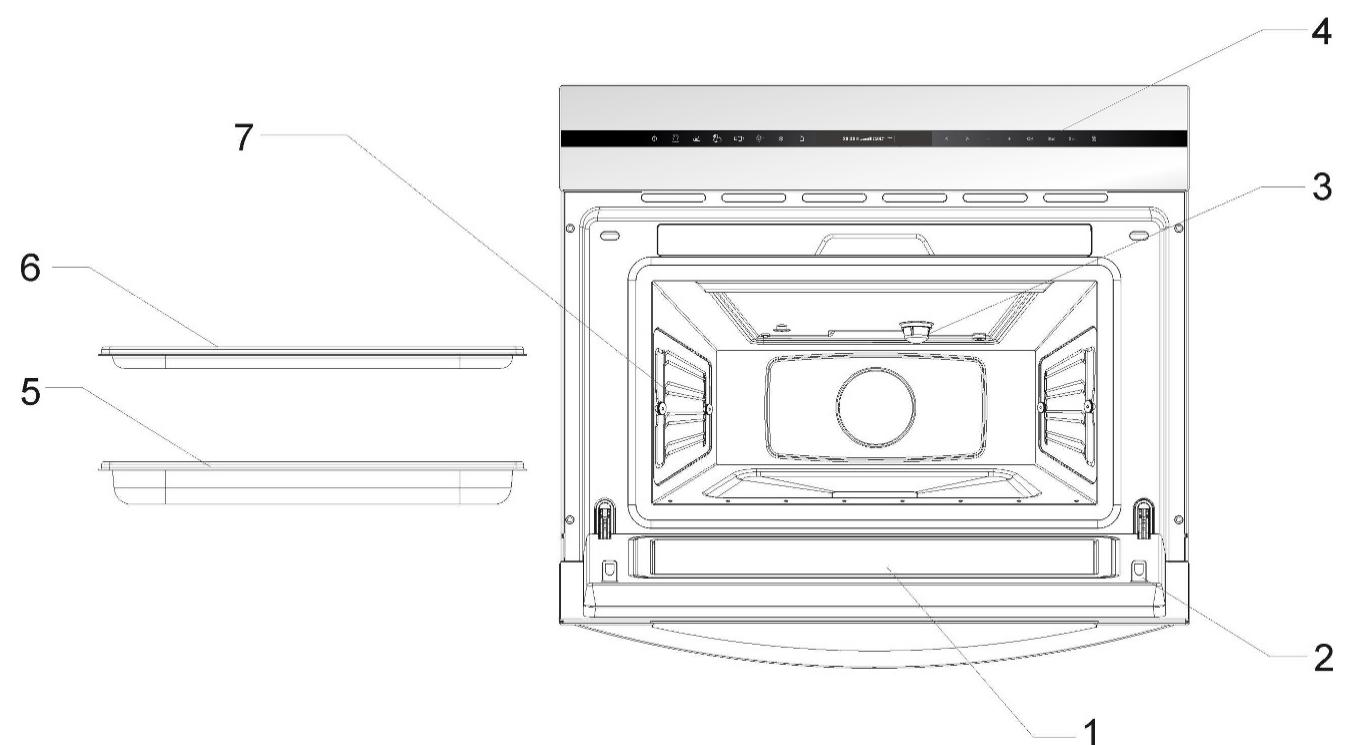
- – Vitre de la porte
- Verrouillage de sécurité
- Ampoule
- Panneau de commande
- Plateau
- Plateau perforé
- Grille latérale
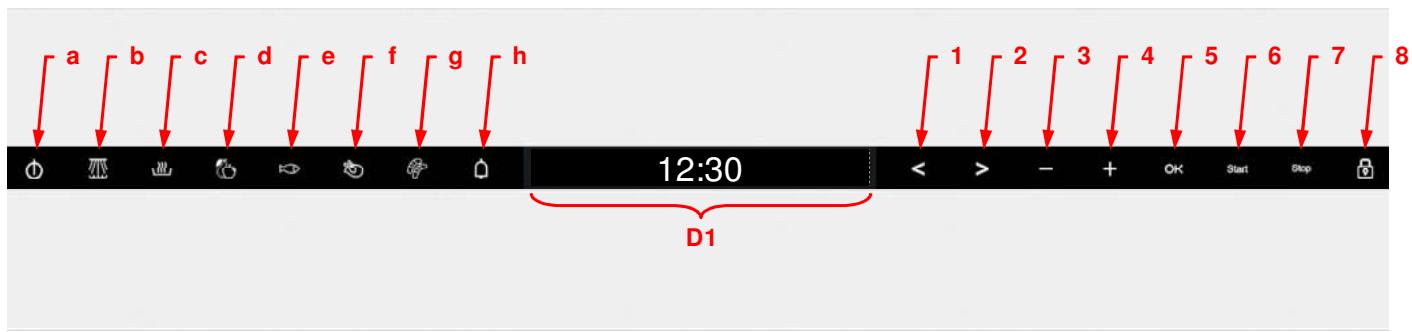
a - Bouton ON/OFF b - Bouton de fonction Vapeur c - Bouton de fonction Régénération & Stérilisation d - Bouton de fonction Cuisson Légumes e - Bouton de fonction Cuisson Poisson f - Bouton de fonction Cuisson Viande g - Bouton de fonction Cuisson Accompagnements h - Bouton Minuteur décroissant
1 - Bouton "Gauche" 2 - Bouton "Droite" 3 - Bouton "-" 4 - Bouton "+" 5 - Bouton "OK" 6 - Bouton "Start" 7 - Bouton "Stop" 8 - Bouton "Verrouillage de sécurité" D1 - Afficheur
Réglages de base
Réglages initiaux
Après la connexion de l'appareil au réseau ou après une coupure de courant, l'horloge clignote, indiquant ainsi que l'heure n'est pas correcte.
L'appareil ne fonctionne pas avant que vous ne régliez l'heure et la dureté de l'eau. Pour régler l'horloge et la dureté de l'eau, procédez comme suit :
Régler l'heure
L'horloge clignotera si votre micro-ondes s'éteint et se rallume lors d'une panne de courant, pour indiquer que l'heure n'est pas définie. Pour définir l'heure, procédez comme suit :

- Appuyez sur le bouton "On/Off" pour allumer le four.
- Maintenez les boutons "-" et "+" enfoncés simultanément. Les chiffres des heures commenceront à clignoter (les étapes 1 et 2 ne sont pas nécessaires si c'est la première fois que vous allumez le micro-ondes, ou après une panne de courant).
- Appuyez sur les boutons "-" et "+" pour régler les heures.
- Appuyez sur le bouton OK pour confirmer les heures. Les chiffres clignoteront.
- Appuyez sur les boutons « - » et « + » pour régler les minutes.
- Appuyez sur le bouton OK pour confirmer les minutes.
Réglage de la dureté de l'eau

L'appareil dispose d'un système qui indique automatiquement quand il faut détartrer.
Le système peut être optimisé pour les habitations avec une eau très douce (également grâce à l'utilisation d'un adoucisseur d'eau) et une eau très dure, en modifiant les réglages de l'utilisateur pour une plage de dureté de l'eau pertinente (voir le tableau ci-dessous).
Pour configurer le paramètre de dureté de l'eau, suivez les instructions suivantes :
- Appuyez sur le bouton « On/Off » pour allumer le four.
- Appuyez simultanément sur les boutons « Gauche » et « Droite ». Le niveau de dureté commencera à clignoter (les étapes 1 et 2 ne sont pas nécessaires si c'est la première fois que vous allumez le four micro-ondes, ou après une coupure de courant).
- Appuyez sur les boutons « - » et « + » pour régler la valeur correcte du paramètre de dureté de l'eau, conformément au tableau ci-dessous.
- Appuyez sur le bouton « OK » pour confirmer le paramètre. L'écran affichera la valeur.
Réglages de base
Le tableau suivant contient la définition des différents niveaux de dureté de l'eau.
| Tipo | Dureza da água | Mostrador | |||
| Ca + Mg (ppm) | Graus Ingleses [°eH] | Graus Franceses [°dF] | Graus Aleães [°dH] | ||
| Água macia | 0 a 150 | 0 a 11 | 0 a 15 | 0 a 8 | MACIA |
| Água media | 151 a 350 | 12 a 25 | 16 a 35 | 9 a 20 | MÉDIA |
| Água dura | 501 a 500 | 26 a 35 | 36 a 50 | 21 a 28 | DURA |
Afficher/masquer l'horloge

Si l'affichage de l'horloge vous gêne, vous pouvez la masquer de la manière suivante :
- Appuyez sur le bouton "On/Off" pour allumer le four.
- Appuyez sur le bouton "OK" pendant 3 secondes. L'écran s'éteindra.
Si vous souhaitez réafficher l'horloge, répétez la même procédure.
Verrouillage de sécurité
Le fonctionnement du four peut être verrouillé (par exemple, pour empêcher son utilisation par des enfants).

Pour verrouiller le four, procédez comme suit :
- Appuyez sur le bouton "On/Off" pour allumer le four.
- Maintenez le bouton "Verrouillage de sécurité" enfoncé pendant 3 secondes. Le bouton de
"Verrouillage de sécurité" s'allume et des SYMBOLES de boutons s'affichent.
Le four ne fonctionne pas tant qu'il n'est pas déverrouillé. Pour déverrouiller le four, répétez la même procédure.
Minuteur
Utilisez cette fonction comme une aide dans les tâches culinaires quotidiennes.

Pour programmer le minuteur, suivez les instructions suivantes :
- Appuyez sur le bouton « On/Off » pour allumer le four.
- Appuyez sur la touche de fonction « Minuteur ». Le bouton devient rouge et l'écran affiche :

- Appuyez sur les boutons « - » et « + » pour régler les heures souhaitées.
- Appuyez sur le bouton OK. Le minuteur commence un compte à rebours.
Lorsque le temps programmé est écoulé, le four émet des bips qui se répètent toutes les 30 secondes ou jusqu'à ce que le bouton Minuteur soit enfoncé. Appuyez sur le bouton Minuteur pour désactiver les bips.
Pendant que le minuteur fonctionne, le bouton Minuteur est rouge. L'écran et les voyants indiquent ce qui suit :
- Si aucune fonction n'est en cours, l'écran affiche le compte à rebours du minuteur et le bouton Minuteur devient rouge.
- Si une fonction est active, l'écran et les boutons affichent les paramètres normaux de la fonction. Pour consulter le temps restant du minuteur, appuyez sur la touche Minuteur. L'écran affichera le minuteur pendant quelques instants, puis reviendra aux indications de fonction après 5 secondes ou lorsque le bouton Minuteur sera enfoncé à nouveau. Pendant que le minuteur est affiché, vous pouvez modifier le temps restant avec les boutons « - » et « + » décrits précédemment.
Vapeur
Utilisez cette fonction pour cuire et réchauffer des légumes, des pommes de terre, du riz, du poisson et de la viande.

- Appuyez sur le bouton « On/Off » pour allumer le four.
- Appuyez sur le bouton de fonction « Vapeur ». Le bouton devient rouge et l'écran affiche :

- Appuyez sur les boutons « - » et « + » pour régler la température souhaitée.
- Appuyez sur le bouton « > ». L'écran affiche :

- Appuyez sur les boutons « - » et « + » si vous souhaitez régler la durée de fonctionnement souhaitée. Ce réglage est facultatif. Passez à l'étape 7 si vous ne souhaitez pas programmer la durée.
- Si vous souhaitez modifier l'un des paramètres mentionnés ci-dessus, appuyez sur les boutons « < » ou « > » pour sélectionner le paramètre, puis sur les boutons « - » et « + » pour définir une valeur différente.
- Appuyez sur le bouton Démarrer. Le four commencera à fonctionner.
Remarque importante : le symbole [clignotera à l'écran, ce qui signifie que la température interne du four est inférieure à celle définie.
Chauffer et stériliser
Utilisez cette fonction pour réchauffer des plats cuisinés et des repas rapides, ainsi que pour stériliser et cuire des fruits.

- Appuyez sur le bouton « On/Off » pour allumer le four.
- Appuyez sur le bouton « Chauffer et stériliser ». Le bouton devient rouge et l'écran affiche :

- Appuyez sur les boutons « + » et « - » pour définir le programme souhaité (voir le tableau ci-dessous).
- Appuyez sur le bouton « > ». L'écran affiche :

- Appuyez sur les boutons « - » et « + » si vous souhaitez modifier le temps de fonctionnement prédéfini. Ce réglage est facultatif.
- Appuyez sur le bouton Démarrer. Le four commencera à fonctionner.
Remarque importante : le symbole [clignotera à l'écran, ce qui signifie que la température interne du four est inférieure à celle définie.
| Programa | Tipo de Comida | Temperatura (°C) | Tempo (min.) | Instruções |
| R 01 | Pratos cozinhados | 100°C | 13 | Retirar a tampa da embalagem e coloque o prato no recipiente com furos. |
| R 02 | Refeições rápidas / congeladas | 100°C | 18 | |
| R 03 | Feijões | 100°C | 35 | Esterilização: |
| R 04 | Cerejas | 80°C | 35 | Os tempos e temperatas referem-se a boiões de conserva de 1L. |
| R 05 | Ameixas | 90°C | 35 | |
| R 06 | Biberões | 100°C | 12 |
Fonctions spéciales
Cozinhar vegetais
Utilizar esta função para cozinhar os vegetais como descrito na janela de baixo.

- Prima o botão "On/Off" para ligar o forno.
- Prima o botão "Cozinhar Vegetais". O botão fica vermelho e o ecrã mostra:

- Prima os botões “+” e “-” para definir o Programa desejado (ver tabela abaixo).
- Prima o botão “>”. O ecrã mostra:

120:00
- Prima os botões “-” e “+” se quiser alterar o Tempo de Funcionamento predefinido. A configuração é opcional.
- Prima o botão Iniciar. O forno começará a funcionar.
Nota importante: O símbolo [piscará no mostrador], o que significa que a temperatura interna do forno é inferior àquela definida.
| Programa | Tipo de Vegetal | Temperatura (°C) | Tempo (min.) |
| A 01 | Brócolos / flósculos | 100 °C | 20 |
| A 02 | Couve-flor / flósculos | 100 °C | 25 |
| A 03 | Batatas / pedações | 100 °C | 25 |
| A 04 | Ervilhas proteaginosas | 100 °C | 15 |
| A 05 | Espargo | 100 °C | 25 |
PT Funções especiais
Cozinhar peixe
Utilizar esta função para cozinhar os temas de peixe descritos na janela de baixo.

- Appuyez sur le bouton « On/Off » pour allumer le four.
- Appuyez sur le bouton « Cuisson Poisson ». Le bouton devient rouge et l'écran affiche :

- Appuyez sur les boutons « + » et « - » pour définir le programme souhaité (voir tableau ci-dessous).
- Appuyez sur le bouton « > ». L'écran affiche :

⇔ 25:00
- Appuyez sur les boutons « - » et « + » si vous souhaitez modifier le temps de fonctionnement prédéfini. Ce réglage est facultatif.
- Appuyez sur le bouton Démarrer. Le four commencera à fonctionner.
Remarque importante : le symbole [clignotera à l'écran], ce qui signifie que la température interne du four est inférieure à celle définie.
| Programa | Tipo de Peixe | Temperatura (°C) | Tempo (min.) |
| B 01 | Truta | 80 °C | 25 |
| B 02 | Camarão | 90 °C | 15 |
| B 03 | Filetes de peixe | 80 °C | 18 |
| B 04 | Mexilhão | 100 °C | 25 |
| B 05 | Lagosta | 100 °C | 30 |
Fonctions spéciales
Cuisson viande
Utilisez cette fonction pour cuire les types de viande décrits dans le tableau ci-dessous.

- Appuyez sur le bouton « On/Off » pour allumer le four.
- Appuyez sur le bouton « Cuisson Viande ». Le bouton devient rouge et l'écran affiche :

- Appuyez sur les boutons « + » et « - » pour définir le programme souhaité (voir tableau ci-dessous).
- Appuyez sur le bouton « > ». L'écran affiche :

- Appuyez sur les boutons « - » et « + » si vous souhaitez modifier le temps de fonctionnement prédéfini. Ce réglage est facultatif.
- Appuyez sur le bouton Démarrer. Le four commencera à fonctionner.
Remarque importante : le symbole [clignote à l'écran], ce qui signifie que la température interne du four est inférieure à celle définie.
| Programa | Tipo de Carne | Temperatura (°C) | Tempo (min.) |
| C 01 | Peito de frango | 100 °C | 30 |
| C 02 | Lombo de porco fumado / pedações | 100 °C | 45 |
| C 03 | Escalopes de peru | 100 °C | 20 |
| C 04 | Filetes de porco,inteiro | 100 °C | 25 |
| C 05 | Salsichas pré-cozinhadas | 90 °C | 15 |
PT Fonctions spéciales
Accompagnements
Utilisez cette fonction pour cuire les aliments comme décrit dans le tableau ci-dessous.

- Appuyez sur le bouton « On/Off » pour allumer le four.
- Appuyez sur le bouton « Cuisson Poisson ». Le bouton devient rouge et l'écran affiche :

- Appuyez sur les boutons « + » et « - » pour définir le programme souhaité (voir tableau ci-dessous).
- Appuyez sur le bouton « > ». (ÉCRAN) :

- Appuyez sur les boutons « - » et « + » si vous souhaitez modifier le temps de fonctionnement prédéfini. Ce réglage est facultatif.
- Appuyez sur le bouton Démarrer. Le four commencera à fonctionner.
Remarque importante : le symbole [clignotera à l'écran], ce qui signifie que la température interne du four est inférieure à celle définie.
| Programa | Tipo de Comida | Temperatura (°C) | Tempo (min.) |
| D 01 | Pastel de levedura doce | 100 °C | 20 |
| D 02 | Pastel de levedura | 100 °C | 25 |
| D 03 | Pastéis | 100 °C | 30 |
| D 04 | Arroz | 100 °C | 35 |
| D 05 | Lentilhas | 100 °C | 40 |
Remplir d'eau
Remplir le réservoir d'eau
Toutes les fonctions exigent que le réservoir d'eau soit plein.
Remplissez le réservoir avec de l'eau potable fraîche et froide jusqu'au repère « MAX » et placez-le sur la partie supérieure du four jusqu'à ce qu'il s'enclenche. Environ 1 litre.
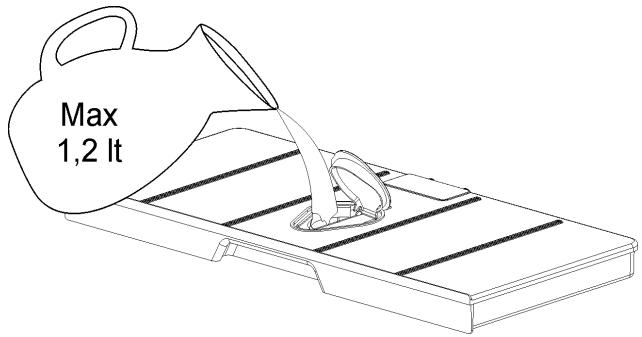
L'indentation signifie que le réservoir d'eau n'est pas correctement positionné.
Ajouter de l'eau
Le volume d'eau suffit normalement pour un processus de cuisson de 50 à 60 minutes.
La nécessité d'ajouter de l'eau est indiquée par le voyant du réservoir d'eau. Versez 0,5 litre au maximum, pour garantir que l'eau ne déborde pas lorsqu'elle revient dans le réservoir. DANGER DE DÉBORDEMENT !
Vider le réservoir d'eau
Lorsque l'appareil est éteint, l'eau restante est pompée de nouveau dans le réservoir d'eau.
Pendant que la pompe fonctionne, l'écran affiche « PUMP ».
Cette information reste affichée à l'écran jusqu'à ce que l'eau atteigne une température de 75 °C, avant d'être pompée de nouveau vers le réservoir d'eau.
Attention : l'eau dans le réservoir peut être chaude. Risque de brûlures !
Lorsque toute l'eau se trouve de nouveau dans le réservoir, l'écran affiche "DEP". Procédez de la même manière :
- Retirez le réservoir d'eau de l'appareil et videz-le.
- Séchez le réservoir d'eau et replacez-le dans l'appareil. Avec un chiffon sec, séchez l'intérieur de l'appareil.
- Laissez la porte de l'appareil ouverte jusqu'à ce que l'appareil ait refroidi et soit totalement sec.
IMPORTANT : Il est recommandé de retirer et de vider le réservoir d'eau avant chaque processus de cuisson. Cela évitera le développement de bactéries et de calcaire dans l'appareil.
Si vous souhaitez effectuer deux processus de cuisson à la vapeur successifs, il n'est pas nécessaire de vider le réservoir d'eau. L'écran affiche l'indication "DEP".
Pour éteindre cet avertissement, appuyez sur la touche Stop. Ensuite, vous pourrez démarrer un nouveau processus de cuisson sans retirer et vider le réservoir d'eau.
Interruption du processus de cuisson
Le processus de cuisson peut être interrompu à tout moment en appuyant une fois sur la touche Start/Stop.
L'appareil dispose d'une fonction de réduction de la vapeur qui est activée avec la touche Start/Stop. Ainsi, la vapeur qui s'échappe à l'ouverture de la porte est minimisée.
Le processus a une durée d'environ trois minutes, et pendant ce temps l'écran affiche "VAP".
Attention : lorsque vous ouvrez la porte pendant ou après le processus de cuisson, de la vapeur chaude s'échappe de l'appareil. Écartez-vous sur le côté ou en arrière.
À ce moment :
- La production de vapeur a été interrompue.
- Les parois intérieures et le dépôt d'eau sont déjà chauds. Risque de brûlures !
- L'horloge s'arrête, le temps de fonctionnement étant unique. (si elle a été réglée).
Si vous le souhaitez, vous pouvez :
- retourner ou remuer les aliments,
- modifier les paramètres du processus.
Fermez la porte et appuyez sur la touche Start/Stop pour continuer le processus.
Modifier les paramètres
Vous pouvez modifier les paramètres de la fonction active en appuyant sur les boutons « < » ou « > » pour sélectionner le paramètre, puis sur les boutons « - » et « + » pour définir une valeur différente. Appuyez sur le bouton « OK » ou attendez quelques secondes pour confirmer la valeur du nouveau paramètre.
Annuler un cycle de cuisson
Si vous souhaitez annuler le processus de cuisson, appuyez deux fois sur le bouton Stop.
Le four émettra un bip et l'horloge apparaîtra à l'écran.
Fin d'un cycle de cuisson
À la fin de la durée programmée ou lorsque vous appuyez sur le bouton Stop pour terminer le cycle de cuisson, trois bips seront émis et l'écran affichera le mot « End », le four initie la fonction de réduction de vapeur.
Cette fonction libère progressivement la vapeur de la cavité, afin qu'il n'y ait pas de libération soudaine de vapeur lorsque la porte de l'appareil est ouverte.
Cette fonction dure environ 3 minutes et lorsqu'elle est en cours, l'afficheur affiche le mot "VAP".
Avertissement ! En ouvrant la porte pendant ou après le cycle de cuisson, faites attention au flux d'air/vapeur chaud sortant de la cavité de cuisson. Éloignez-vous pour éviter les brûlures.
Le ventilateur de refroidissement peut continuer à fonctionner pendant un certain temps après que l'appareil a été éteint. C'est une fonction normale, destinée à réduire la température à l'intérieur du four.
L'eau résiduelle présente dans la chaudière doit atteindre la température de 75 °C avant d'être pompée vers le réservoir d'eau. Pendant que l'eau est pompée, l'afficheur affiche le message "PUMP".
Avertissement : L'eau dans le réservoir peut être chaude. Danger de brûlures !
Lorsque l'afficheur affiche le mot "DEP", cela signifie que l'eau a été pompée et que le réservoir d'eau peut être retiré.
Retirer le réservoir d'eau et le sécher soigneusement. Laisser la zone de cuisson refroidir un moment, puis la nettoyer et la sécher avec un chiffon. La porte doit être laissée ouverte pendant un certain temps, afin que l'appareil puisse sécher complètement.
Tableaux et conseils
Utilisation des accessoires
Le récipient perforé est utilisé pour cuire à la vapeur des légumes, de la viande et de la volaille, frais ou congelés.
Il est important que le récipient sans trous soit placé sur le premier niveau en partant du bas. Ainsi, les gouttes de liquide qui tombent sont récupérées et ne salissent pas l'appareil. Le récipient perforé contenant les aliments est placé sur le deuxième niveau en partant du bas.
Le récipient sans trous est utilisé pour cuire à la vapeur des aliments délicats comme, par exemple,
des compotes, des knödel (boulettes de pâte à base de pain) et des aliments qui augmentent de volume.
La grille est utilisée comme surface de support pour des récipients plus petits, par exemple des bols à dessert, et pour régénérer des plats préparés.
Pour des données plus précises, consultez les tableaux.
Les valeurs indiquées relatives à la cuisson et à la température sont des valeurs d'orientation. La durée effective de la cuisson peut varier en fonction du type et de la qualité des produits.
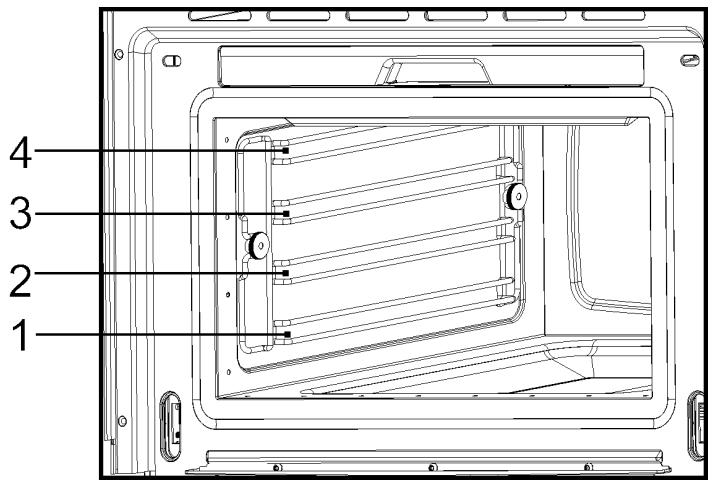
Poisson
| Fish | Quantity | Temperature °C | Time min. | Container | Level |
| Peixe | Quantidade | Temperatura °C | Tempo de cozedura min. | Recipiente | Nível a conta de baixo |
| Dourada | 800-1200 g | 80 | 30-40 | com furos | 2 |
| Truta | 4 x 250 g | 80 | 20-25 | com furos | 2 |
| Filete de salmão | 500-1000 g | 80 | 15-25 | com furos | 2 |
| Truta salmonada | 1000-1200 g | 80 | 25-35 | com furos | 1/2 |
| Camarão | 500-1000 g | 80 | 15-20 | com furos | 2 |
| Mexilhão da Nova Zelândia | 1000-1500 g | 100 | 25-35 | com furos | 2 |
| Filete de alabote | 500-1000 g | 80 | 20-25 | com furos | 2 |
| Berbigão | 500-1000 g | 100 | 10-20 | com furos | 2 |
| Lavagante, cong. | 800-1200 g | 100 | 25-30 | com furos | 1/2 |
| Filete de bacalhau fresco | 1000-1200 g | 80 | 20-25 | com furos | 2 |
| Amêjoa | 1000-1200 g | 100 | 15-25 | com furos | 2 |
| Salvelino-árctico | 4 x 250 g | 80 | 25-30 | com furos | 2 |
| Pescada | 1000-1200 g | 80 | 20-25 | com furos | 2 |
| Filete de atum | 500-1000 g | 80 | 15-20 | com furos | 2 |
Viande
| Carne | Quantidade | Temperatura °C | Tempo de cozedura min. | Recipiente | Nível a conta de baixo |
| Coxas de frango | 4-10 | 100 | 40-45 | com furos | 2 |
| Peito de frango | 4-6 | 100 | 25-35 | com furos | 2 |
| Carne de porco salgada e fumada | 500g -1000g | 100 | 40-50 | com furos | 2 |
| Bife de peru | 4-8 | 100 | 20-25 | com furos | 2 |
| Lombo de porco | 4-8 | 100 | 20-30 | com furos | 2 |
| Salsichas | 80-100 | 10-15 | com furos | 2 |
Œufs Accompagnements
| Ovos | Temperatura °C | Tempo de cozedura min. | Recipiente | Nível a conta de baixo |
| Ovos cozidos em recipiente de vidro | 100 | 10-15 | grelha | 2 |
| Ovos cozidos | 100 | 15 | grelha | 2 |
| Ovos escalfados | 100 | 10-12 | grelha | 2 |
| Acompanhamentos | Quantidade | Temperatura °C | Tempo de cozedura min. | Recipiente | Nível a conta de baixo |
| Cevadinho +liquido | 200g + 400ml | 100 | 30-35 | grelha, taça de vidro | 2 |
| Sémola +liquido | 200g + 300ml | 100 | 10-20 | grelha, taça de vidro | 2 |
| Lentilhas +liquido | 200g + 375ml | 100 | 20-50 | grelha, taça de vidro | 2 |
| Arroz +liquido | 200g + 250ml | 100 | 25-40 | grelha, taça de vidro | 2 |
Légumes
| Legumes frescos | Temperatura ℃ | Tempo de cozedura min. | Recipiente | Nivel a conta de baixo | |
| Beringelas | cortadas em rodelas | 100 | 15-20 | com furos | 2 |
| Feijão | 100 | 35-45 | com furos | 2 | |
| Brócolos | raminhos com caule | 100 | 25-30 | com furos | 2 |
| Brócolos | raminhos sem caule | 100 | 15-20 | com furos | 2 |
| Couve-flor | raminhos | 100 | 25-30 | com furos | 2 |
| Couve-flor | inteira | 100 | 40-45 | com furos | 1 |
| Ervilhas | 100 | 30-35 | com furos | 2 | |
| Funcho | cortado em tiras | 100 | 15-20 | com furos | 2 |
| Funcho | cortado em metades | 100 | 20-30 | com furos | 2 |
| Batatas com casca | inteiras, muitoriassemquenas | 100 | 20-25 | com furos | 2 |
| Batatas com casca | inteiras, muitograndes | 100 | 45-50 | com furos | 2 |
| Batatas sem casca | cortadas em pedagens | 100 | 20-25 | com furos | 2 |
| Couve-rábano | cortado em palitos | 100 | 20-25 | com furos | 2 |
| Vagens tenras de ervilhas | 100 | 15-20 | com furos | 2 | |
| Cenouras | cortadas em rodelas | 100 | 25-30 | com furos | 2 |
| Maçaroca | 100 | 50-60 | com furos | 2 | |
| Pimentos | cortados em tiras | 100 | 12-15 | com furos | 2 |
| Pimentos peperoni | 100 | 12-15 | com furos | 2 | |
| Cogumelos | cortados em quartos | 100 | 12-15 | com furos | 2 |
| Alho francês | cortado em rodelas | 100 | 10-12 | com furos | 2 |
| Couve-de-bruxelas | 100 | 25-35 | com furos | 2 | |
| Aipo | cortado em tiras | 100 | 15-20 | com furos | 2 |
| Espargos | 100 | 20-35 | com furos | 2 | |
| Espinafres | 100 | 12-15 | com furos | 2 | |
| Aipo | 100 | 25-30 | com furos | 2 | |
| Courgete | cortada em rodelas | 100 | 12-18 | com furos | 2 |
PT Tableaux et conseils
Knödel
| Knödel | Temperatura °C | Tempo de cozedura min. | Recipiente | Nivel a conta de baixo |
| Buchtein (doces) | 100 | 20-30 | sem furos | 2 |
| Dampfnudeln (bolas de massa ao vapor) | 100 | 15-20 | sem furos | 2 |
| Knödel levedadas | 100 | 15-25 | sem furos | 2 |
| Knödel de pão | 100 | 20-25 | sem furos | 2 |
| Knödel cozidas em guardanapo de pano | 100 | 25-30 | sem furos | 2 |
Desserts
| Sobremesas | Quantidade | Temperatura °C | Tempo de cozedura min. | Recipiente | Nível a conta de baixo |
| Compota de maça | 500-1500 g | 100 | 15-25 | sem furos | 2 |
| Compota de pêra | 500-1500 g | 100 | 25-30 | sem furos | 2 |
| Leite creme | 80 | 20-25 | taça sobre a grelha | 2 | |
| Pudim flan | 80 | 25-30 | taça sobre a grelha | 2 | |
| logurte | 40 | 4-6 h | taça sobre a grelha | 2 | |
| Compota de pêssego | 500-1500 g | 100 | 15-20 | sem furos | 2 |
Fruits (stériliser / faire des conserves)
| Fruta | Quantidade | Temperatura °C | Tempo de cozedura min. | Recipiente | Nível a conta de baixo |
| Péras | 4-6 frascos de 1 l | 100 | 30-35 | grelha | 1 |
| Cerejas/ginjas | 4-6 frascos de 1 l | 80 | 30-35 | grelha | 1 |
| Péssegos | 4-6 frascos de 1 l | 90 | 30-35 | grelha | 1 |
| Ameixas | 4-6 frascos de 1 l | 90 | 30-35 | grelha | 1 |
Régénérer
| Aquecer | Quantidade | Temperatura °C | Tempo de cozedura min. | Recipiente | Nivel a conta de baixo |
| Comida no prato | 1-2 | 100 | 12-15 | grelha | 2 |
| Comida no prato | 3-4 | 100 | 15-20 | grelha | 2 |
| Comida pronta | 100 | 15-20 | grelha | 2 |
Tableaux et conseils
Blanchir
| Legumes | Quantidade | Temperatura °C | Tempo de cozedura min. | Recipiente | Nível a conta de baixo |
| p.ex., feijão, alho francês | 100 | 10-12 | com furos. | 2 | |
| Couve-galega | 1000-2000 g | 100 | 12-16 | com furos | 2 |
| Folhas de couve lombarda | 10-20 | 100 | 12-15 | com furos | 2 |
| Repolho,inteiro | 2000-2500 g | 100 | 30-45 | com furos | 1 |
| Tomate, pelar | 80 | 12 | grelha | 2 |
Décongeler
| Legumes / acompanhamento | Temperatura °C | Tempo de cozedura min. | Recipiente | Nível a conta de baixo | |
| Brócolos | raminhos com caule | 100 | 15-20 | com furos | Brócolos |
| Legumes típicos dos Balcás | 100 | 15-20 | com furos | Legumes típicos dos Balcás | |
| Espinafres em folhas | divididos em doses individuals | 100 | 10-15 | sem furos | Espinafres em folhas |
| Couve-flor | raminhos | 100 | 15-20 | com furos | Couve-flor |
| Ervilhas | 100 | 15-25 | com furos | Ervilhas | |
| Couve-galega | barra grossa | 100 | 25-35 | sem furos | Couve-galega |
| Cenouras | cortadas em rodelas | 100 | 15-20 | com furos | Cenouras |
| Couve-de-bruxelas | 100 | 20-25 | com furos | Couve-de-bruxelas | |
| Espargos | 100 | 25-30 | com furos | Espargos | |
| Comida pronta | 100 | conforme necessidade | grelha | Comida pronta | |
| Pão | 100 | 10-25 | grelha | Pão | |
| Arroz | 100 | 15-25 | sem furos | Arroz | |
| Lentilhas | 100 | 15-20 | sem furos | Lentilhas | |
| Massa | 100 | 15-20 | sem furos | Massa | |
Tableaux et conseils
Cuire sur 2 niveaux
Quelques conseils :
Pour une cuisson à plusieurs niveaux, les accessoires doivent toujours être placés au deuxième niveau ou, s'ils sont au premier, pas tout en bas.
Les différents temps de cuisson sont réglés de la manière suivante :
Les aliments qui nécessitent plus de temps de cuisson sont placés dans la partie supérieure de l'appareil. Les aliments qui nécessitent moins de temps de cuisson sont placés au premier niveau en partant du bas.
Exemple : légumes, pommes de terre et poisson
Placez les légumes et les pommes de terre dans n'importe quel type de récipient sur la grille au deuxième ou troisième niveau en partant du bas.
Le poisson doit être placé au premier niveau en partant du bas.
Si vous utilisez le récipient percé pour le poisson, le récipient sans trous doit être placé à la base de l'appareil afin de recueillir le liquide de cuisson. Ainsi, l'appareil reste propre.
Temps de cuisson : légumes et pommes de terre 25-35 minutes.
Temps de cuisson : poisson, selon l'espèce, 15-25 minutes.
Le temps de cuisson le plus long est réglé. Une fois que les aliments ont été placés à différents niveaux, ils seront prêts en même temps, sans que l'un d'eux soit trop cuit.
Entretien
Nettoyage de l'intérieur
En aucun cas, n'utilisez de produits de nettoyage abrasifs comme des éponges abrasives multi-usages, de la paille de fer, etc. Ces produits endommagent la surface.
Nettoyez l'intérieur à chaud, en utilisant à cet effet un chiffon humide. Ensuite, séchez.
Pour faciliter le nettoyage, les grilles latérales peuvent être retirées (voir le chapitre suivant).
Retirer les grilles latérales
Desserrez l'écrou moleté 1 à l'avant des grilles latérales en le tournant dans le sens inverse des aiguilles d'une montre.
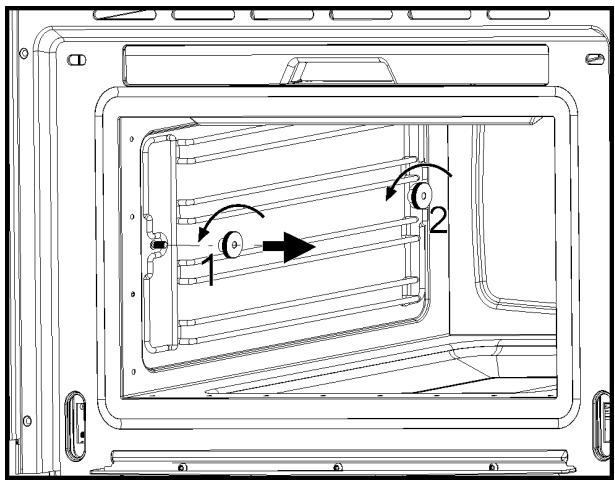
Desserrez légèrement l'écrou moleté 2 à l'arrière des grilles latérales en le tournant dans le sens inverse des aiguilles d'une montre. Ne retirez pas l'écrou moleté.
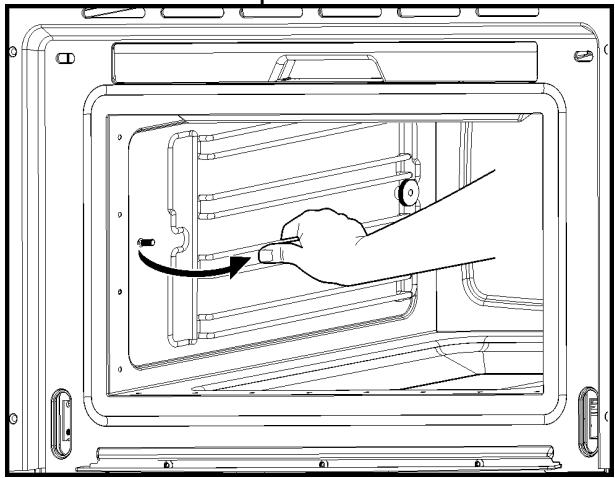
Tirez la grille latérale un peu vers l'avant et sortez-la.
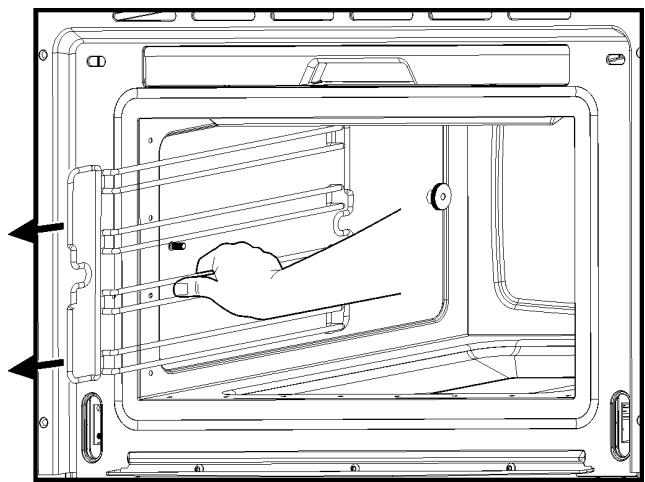
Pour remonter les grilles latérales, insérez-les dans l'écrou moleté 2. Introduisez l'écrou moleté 1 et serrez-le dans le sens des aiguilles d'une montre jusqu'à la butée, puis serrez l'écrou moleté 2.
Démonter la porte
Ouvrez la porte le plus possible.
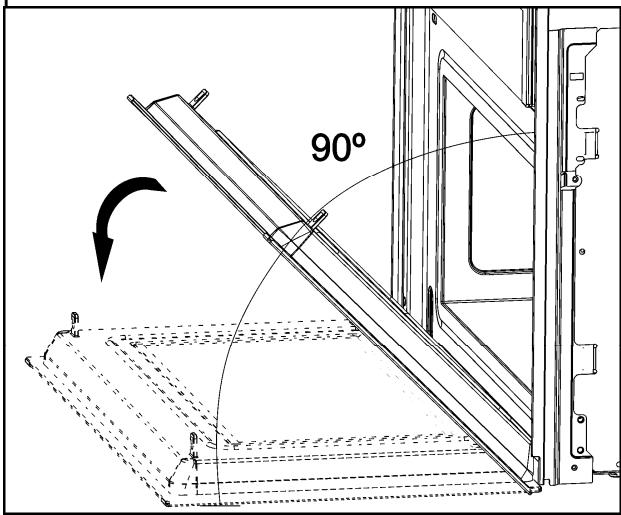
Insérez les goupilles dans les trous des charnières de la porte.
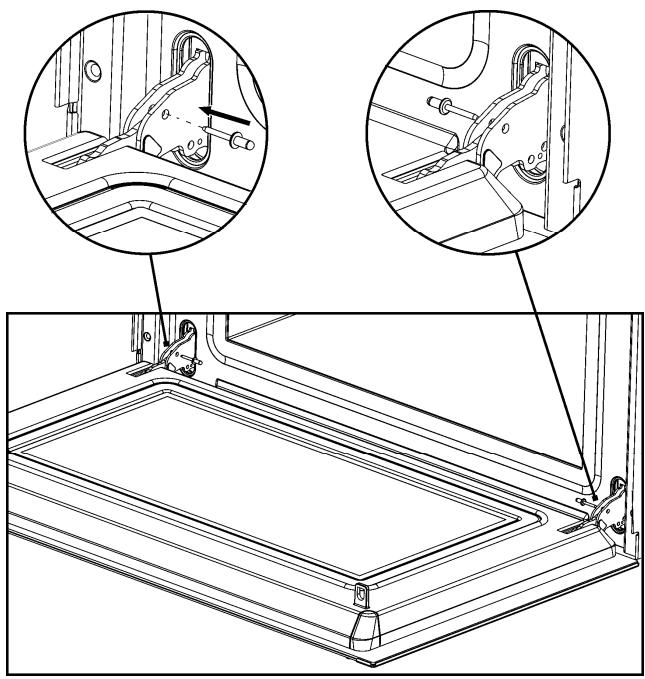
Fermez la porte, mais seulement jusqu'au point où vous pouvez la soulever.
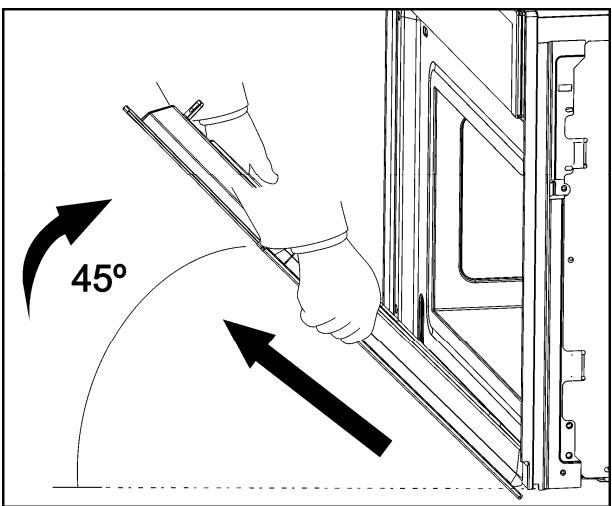
Pour la remonter, introduisez les charnières dans les trous.
Ouvrez la porte le plus possible et retirez les goupilles.
Soins et entretien
Détartrage
Chaque fois que de la vapeur est produite, indépendamment de la dureté de l'eau d'alimentation locale (par exemple, le tartre contenu dans l'eau), du tartre se forme à l'intérieur du générateur de vapeur.
L'intervalle de temps entre chaque détartrage dépend de la dureté de l'eau et de la fréquence d'utilisation. Si de la vapeur est produite 4x30 minutes par jour, l'appareil doit être détartré (selon la dureté de l'eau) comme suit :
| Dureza da agua | Descalcificar(before deriba de agua |
| Muito macia | 18 grasas |
| Média | 9 grasas |
| Muito dura | 6 grasas |
L'appareil détecte automatiquement quand un détartrage est nécessaire. Dans ce cas, l'écran affiche :

Si la procédure de détartrage n'est pas exécutée, certains cycles de cuisson qui suivent le symbole ci-dessus affiché clignotant seront bloqués.
Encore une fois, si la procédure de détartrage n'est pas exécutée, certains cycles de cuisson qui suivent le fonctionnement du four seront bloqués et l'écran affichera :
CAL

NOTE IMPORTANTE : Une erreur lors du détartrage de l'appareil pourrait avoir des répercussions sur le fonctionnement de l'appareil ou causer des dommages à celui-ci.
Produits de détartrage appropriés
Pour détartrer, utilisez le produit de détartrage "DURGOL®".
Ce produit permet un détartrage professionnel et soigné de votre appareil et est disponible dans les Centres de Maintenance.
Avertissement ! N'utilisez pas de vinaigre ni de produits à base de vinaigre, car cela pourrait endommager le circuit interne du four.
Les produits de détartrage traditionnels ne sont pas appropriés car ils peuvent contenir des agents moussants.
Procédure de détartrage

Avertissement : Pour des raisons de sécurité, la procédure de détartrage ne peut pas être interrompue et dure environ 45 minutes.
L'appareil peut être détartré avec la porte de l'appareil ouverte ou fermée. L'appareil doit être inactif avant de commencer le cycle de détartrage.
Pour effectuer un cycle de détartrage, procédez de la manière suivante :
- Appuyez sur le bouton « On/Off » pour allumer le four.
- Appuyez simultanément sur les boutons « Gauche » et « Droite » pendant 5 secondes. L'afficheur indique « CAL » et un bip intermittent retentit. Pour annuler la procédure de détartrage à ce stade, appuyez sur le bouton « Arrêt ».
- Appuyez sur la touche « Démarrer ».
- Lorsque l'afficheur indique « 0.5L », retirez le réservoir d'eau.
- Versez 0,5 litre d'un produit détartrant adapté dans le réservoir d'eau et replacez-le.
- Appuyez sur la touche « Démarrer ». Le cycle de détartrage démarre et dure environ 30 minutes.
- Lorsque l'afficheur indique « 1.0L » en clignotant et que le four émet un bip, retirez et videz le réservoir d'eau.
- Remplissez le réservoir d'eau avec 1,0 litre d'eau froide et replacez-le.
- Appuyez sur la touche « Démarrer ». Le premier cycle de rinçage commence.
- Lorsque l'afficheur indique à nouveau « 1.0L » en clignotant et que le four émet un nouveau signal sonore, retirez et videz le réservoir d'eau.
- Remplissez le réservoir d'eau avec 1 litre d'eau froide et replacez-le.
- Appuyez sur la touche « Démarrer ». Le deuxième cycle de rinçage commence.
- Lorsque le cycle de rinçage est terminé, l'afficheur indique « End ».
- Retirer, vider et sécher le réservoir d'eau.
Nettoyage et entretien de l'appareil
Attention ! Le nettoyage doit être effectué avec l'appareil débranché de l'alimentation électrique. Retirez la fiche de la prise ou débranchez le circuit d'alimentation électrique de l'appareil.
N'utilisez pas de produits de nettoyage agressifs ou abrasifs, ni de chiffons grossiers qui rayent, ni d'objets pointus, car ils pourraient provoquer des taches.
N'utilisez pas de dispositifs de nettoyage à haute pression ou à jet de vapeur.
Face avant de l'appareil
Il suffit de nettoyer l'appareil avec un chiffon humide. S'il est très sale, versez quelques gouttes d'un détergent pour vaisselle dans l'eau de lavage. Ensuite, essuyez l'appareil avec un chiffon sec.
Sur les appareils avec façade en aluminium, utilisez un produit de nettoyage pour vitres doux et un chiffon doux qui ne laisse pas de peluches. Nettoyez dans le sens horizontal, sans exercer de pression sur la surface.
Les taches de calcaire, de graisse, d'amidon et de blanc d'œuf doivent être éliminées immédiatement. Sous ces taches, de la corrosion peut apparaître.
Évitez la pénétration d'eau à l'intérieur de l'appareil.
Intérieur
Après chaque utilisation, nettoyez les parois intérieures avec un chiffon humide. Laissez la porte ouverte pour que l'intérieur puisse refroidir et sécher.
N'utilisez pas de produit de nettoyage agressif pour éliminer les saletés tenaces. N'utilisez pas de sprays décoratifs ou d'autres produits de nettoyage agressifs ou abrasifs.
Maintenez la porte et la face avant de l'appareil toujours bien propres, afin de garantir son bon fonctionnement.
Évitez la pénétration d'eau dans les ouvertures de ventilation.
Le verre de protection de la lampe se trouve sur le dessus de l'appareil et peut être facilement retiré pour le nettoyage. Desserrez les vis et lavez-le avec de l'eau et du détergent pour vaisselle.
Accessoires
Nettoyez les accessoires avant chaque utilisation. S'ils sont très sales, laissez-les d'abord tremper un moment, puis utilisez une brosse et une éponge. Les accessoires peuvent être lavés au lave-vaisselle.
PT Que faire en cas de panne ou de dysfonctionnement ?
ATTENTION ! Les réparations ne doivent être effectuées que par des techniciens spécialisés. Toute intervention par des personnes non autorisées par le fabricant est dangereuse.
Les problèmes suivants peuvent être résolus sans faire appel au service après-vente :
- L'écran est éteint ! Vérifiez si
- l'affichage de l'heure a été désactivé (voir le chapitre sur les réglages de base).
- J'appuie sur les touches mais rien ne se passe ! Vérifiez si
- le verrouillage de sécurité est activé (voir le chapitre sur les réglages de base).
- L'appareil ne fonctionne pas ! Vérifiez si
- la fiche est correctement branchée sur la prise,
- le circuit d'alimentation électrique de l'appareil est sous tension.
- J'entends des bruits pendant le fonctionnement de l'appareil !
- Il s'agit de bruits de fonctionnement qui peuvent survenir pendant toute la durée de la vaporisation et qui sont provoqués, par exemple, par le pompage de l'eau dans le générateur de vapeur.
- Ces bruits sont normaux et ne signifient pas un problème.
- Les aliments ne chauffent pas ou ne chauffent que très lentement ! Vérifiez si
- vous avez choisi la température et la durée CORRECTES,
- vous avez placé à l'intérieur de l'appareil une quantité d'aliments plus importante ou plus froide que d'habitude.
- Si l'écran affiche « Err_ », appelez le service après-vente.
- En fin de cuisson, j'entends un bruit ! Cela ne signifie pas un problème.
- Le ventilateur de refroidissement continue de fonctionner pendant un certain temps. Lorsque la température a suffisamment baissé, le ventilateur s'éteint.
- L'appareil fonctionne mais la lampe à l'intérieur ne s'allume pas !
- Si toutes les fonctions ont été exécutées correctement, il est probable que l'ampoule soit grillée. Vous pouvez continuer à utiliser l'appareil.
Remplacement de la lampe
Pour remplacer la lampe, procédez comme suit :
- Débranchez l'appareil de l'alimentation. Retirez la fiche de la prise ou coupez le circuit d'alimentation électrique de l'appareil.
- Dévissez les vis du protecteur en verre de la lampe (1).
- Retirez la lampe halogène (2). Attention ! La lampe peut être très chaude.
- Introduisez une nouvelle lampe E14 230-240 V / 15 W. Suivez les instructions du fabricant de la lampe.
- Revissez la protection en verre de la lampe (1).
- Rebranchez l'appareil sur le secteur.
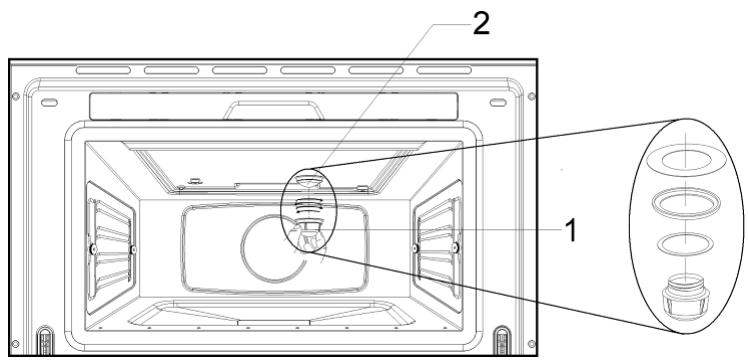
Description des fonctions
| Símbolo | Função | Comidas |
| Vapor | Cozedura de todos ostipsos de vegetais,arroz,cereais e carne.Extracçãode sumos de bagas.Descongelamentoe cozedura simultâneade vegetais. | |
| Regeneração &Esterilização | Regeneração de pratoscozinhados e de refeições instantâneas.Esterilizar/cozer fruta. | |
| Cozinhar vegetais | Cozinhardifferentestipos de vegetais. | |
| Cozinhar peixe | Cozinhar differentestipos de peixe. | |
| Cozinhar carne | Cozinhar differentestipos de carne. | |
| Acompanhamantos | Cozinhar differentestipos de companhamantos. |
Indications
| Mensagem | Descrição |
| Depósito de água | |
| [ ] | A piscar – o depósito de água está vazio. Por favor, reabasteça-o. |
| [ ] | Indicação que o depósito de água está em falta. |
| DEP | O depósito de água tem de ser retirado, esvaziado e reinserido. |
| Redução de vapor | |
| VAP | Indicação de que o processo de redução do vapor está a decorrer. |
| PUMP | Indicação de que a água quente está a ser bombeada para o depósito de água. |
| Descalcificacao | |
| CAL | O aparecido deve ser descalcificado. |
| A piscar – inicia-se a descalcificacao. | |
| 0.5L | Despeje 0,5 litros de produits de descalcificacao no depósito de água. |
| 1.0L | Despeje 1,0 litro de água fria no depósito de agua para a lavagem. |
| Avisos doSYSTEMA | |
| HOT (QUENTE) | A temperatura é demasiado elevada na Placa Electrónica. |
| Err_ | Ligue para o Centro de Apoio ao CLIENTE |
Spécifications
Tension alternative 220-240 V / 50 Hz Puissance requise : 1500 W - Dimensions extérieures (L × H × P) : 595 × 455 × 472 mm - Dimensions intérieures (L × H × P) : 420 × 210 × 390 mm Capacité du four : 35 L Poids : 32 kg
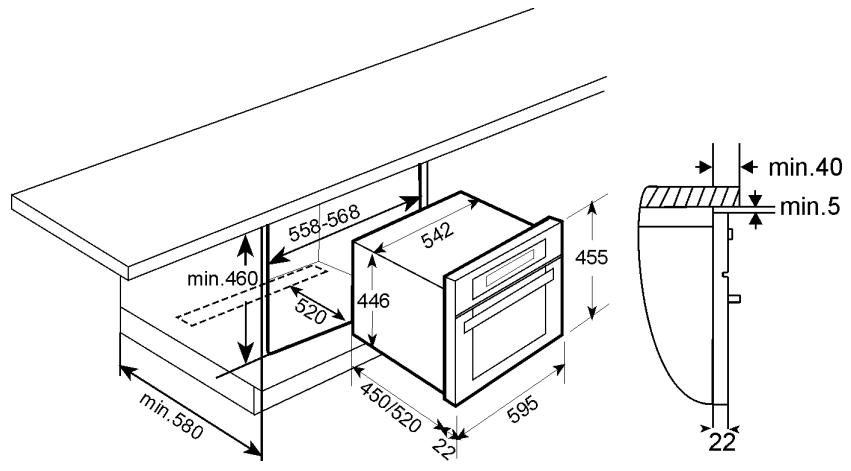
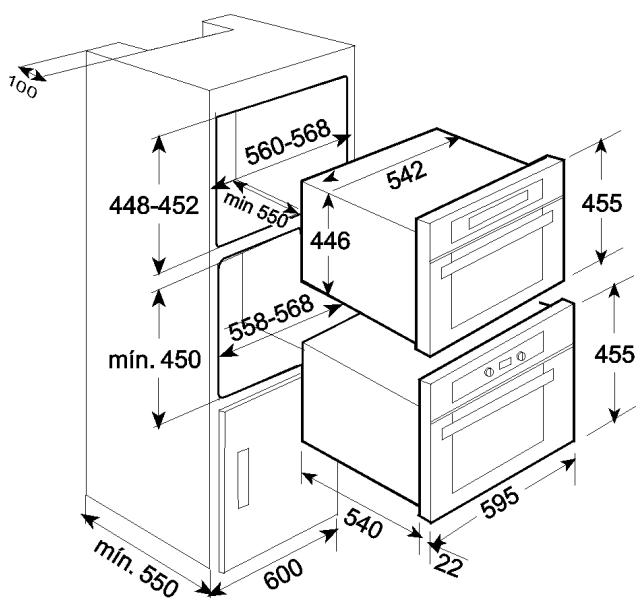
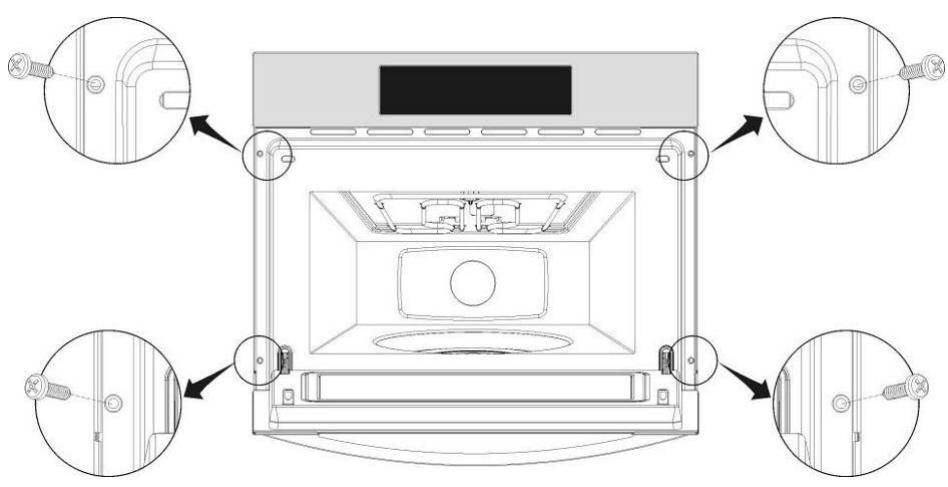
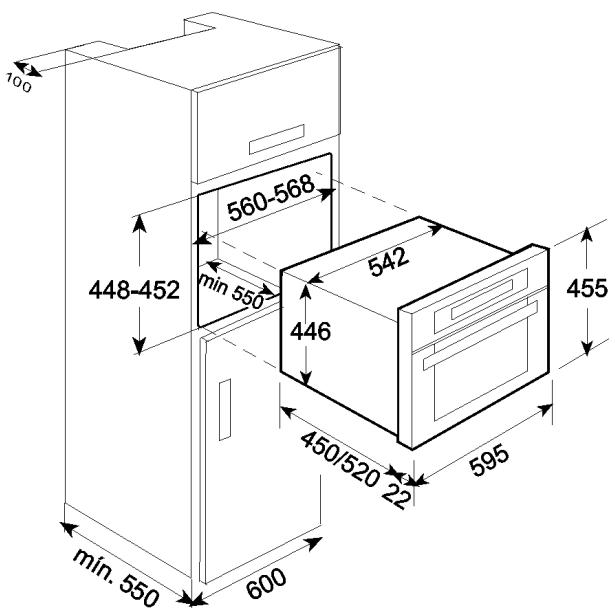
- Introduisez le temps de cuisson vapeur dans l'emplacement et réglez-le.
- Ouvrez la porte et fixez l'appareil au meuble de cuisine avec les quatre vis fournies comme indiqué sur l'illustration.
- Insérez le four vapeur et ajustez-le à l'espace existant.
- Ouvrez la porte et fixez l'appareil au meuble en utilisant les quatre vis fournies, comme indiqué sur l'image.
| COUNTRY | COMPANY | CC | TELEPHONE | E-MAIL / FAX |
| AUSTRALIA | TEKA AUSTRALIA Pty. Ltd. | 61 | 3 9550 6100 | sales@tekaaustralia.com.au |
| AUSTRIA | KÜPPERSBUSCH GesmbH | 43 | 1 866 800 | info@kueppersbusch.at |
| BELGIUM | B.V.B.A. KÜPPERSBUSCH S.P.R.L. | 32 | 2 466 8740 | info@kuppersbusch.be |
| BulgARY | TEKA BULGARIA EOOD. | 359 | 2 9768 330 | 2 9768 332 |
| CANADA | TEKA CANADA LTD. | 1 | 866-282-5403 | info@tekacadana.com |
| CHILE | TEKA CHILE, S.A. | 56 | 2 4386 000 | info@teka.cl |
| P. R. CHINA | TEKA INTERNATIONAL TRADING (Shanghai) | 86 | 21 511 688 41 | info@teka.cn |
| CZECH REPUBLIC | TEKA CZ S.R.O. | 420 | 2 84 691940 | info@teka-cz.cz |
| ECUADOR | TEKA ECUADOR, S.A. | 593 | 4 2251174 | ventas@teka.ec |
| FRANCE | TEKA FRANCE S.A.S. | 33 | 1 343 01597 | 1 343 01598 |
| GERMANY | TEKA KÜCHENTECHNIK GmbH | 49 | 27718141-0 | info@teka-kuechentechnik.de |
| GREECE | TEKA HELLAS A.E. | 30 | 210 9760283 | info@tekahellas.gr |
| HUNGARY | TEKA HUNGARY KFT | 36 | 1 3542110 | teka@teka.hu |
| INDONESIA | PT TEKA BUANA | 62 | 21 390 5274 | teka@tekabuana.com |
| ITALY | TEKA ITALIA S.P.A. | 39 | 0775 898271 | info@tekaitalia.it |
| KOREA (SOUTH REP.) | TEKA KOREA CO. LTD. | 82 | 2 599 4444 | 222 345 668 |
| MALAYSIA | TEKA KÜCHENTECHNIK (MALAYSIA) SDN. | 60 | 3 7620 1600 | customer_svc@teka.com.my |
| MIDDLE EAST | TEKA KÜCHENTECHNIK MIDDLE EAST FZE | 971 | 4 887 2912 | teka@emirates.net.ae |
| MEXICO | TEKA MEXICANA S.A. de C.V. | 52 | 555 133 0493 | ventas@tekamexicana.com.mx |
| PAKISTAN | KÜPPERSBUSCH-TEKA PAKISTAN Pvt. Ltd. | 92 | 42 576 1656 | 42 576 1657 |
| POLAND | TEKA POLSKA SP. ZO.O. | 48 | 22 7383270 | teka@teka.com.pl |
| PORTUGAL | TEKA PORTUGAL, S.A. | 351 | 234 329 510 | sacliente@teka.pt |
| RUSSIA | TEKA RUS LLC | 7 | 495 101 31 08 | info@tekarus.ru |
| SINGAPORE | TEKA SINGAPORE PTE. LTD. | 65 | 67342415 | tekasin@pacific.net.sg |
| SPAIN | TEKA INDUSTRIAL, S.A. | 34 | 942350505 | mail@teka.com |
| THAILAND | TEKA (THAILAND) CO. LTD. | 66 | 2 652 2999 | 2 652 2740 1 |
| TURKEY | TEKA TEKNIK MUTFAK | 90 | 212 288 3134 | teka@teka.com.tr |
| UKRAINE | TEKA UA | 380 | 44 496 0680 | info@teka.ua |
| UNITED ARAB EMIRATES | TEKA KÜCHENTECHNIK U.A.E. LLC | 971 | 4 283 3047 | uaeteka@emirates.net.ae |
| UNITED KINGDOM | TEKA PRODUCTS LTD. | 44 | 1235 861916 | info@teka.co.uk |
| USA | TEKA USA, INC. | 1 | 813 2888820 | info@tekausa.com |
| VENEZUELA | TEKA ANDINA, S.A. | 58 | 2 1229 12821 | teka@teka.com.ve |
TEKA Industrial, S. A.
Cajo, 17
39011 SANTANDER (Espagne)
Tél : 34-942-355050
Fax : 34-942-347694
mail@teka.com

www.teka.com
TEKA Kuchentechnik GmbH
Sechsheldener Str. 122
35708 Haiger (Allemagne)
Tél : 49-2771-8141-0
Fax : 49-2771-8141-10
- PROTECTION DE L'ENVIRONNEMENT
- ÉLIMINATION DE L'EMBALLAGE
- ÉLIMINATION DES APPAREILS USAGÉS
- SOMMAIRE
- FR INSTRUCTIONS D'INSTALLATION
- AVANT L'INSTALLATION
- APRÈS L'INSTALLATION
- AVERTISSEMENT : LE FOUR DOIT ÊTRE RELIÉ À LA TERRE
- CONSIGNES DE SÉCURITÉ
- FR CONSIGNES DE SÉCURITÉ
- CE FOUR EST EXCLUSIVEMENT DESTINÉ À UN USAGE DOMESTIQUE
- ÉVITEZ D'ENDOMMAGER LE FOUR OU DE CRÉER D'AUTRES SITUATIONS DANGEREUSES EN SUIVANT CES INSTRUCTIONS
- NETTOYAGE
- RÉPARATIONS
- DESCRIPTION DE VOTRE FOUR
- RÉGLAGES INITIAUX
- RÉGLAGE DE L'HORLOGE
- RÉGLAGE DE LA DURETÉ DE L'EAU
- RÉGLAGES DE BASE
- MASQUER/AFFICHER L'HORLOGE
- VERROUILLAGE DE SÉCURITÉ
- MINUTEUR
- FONCTIONS DE BASE
- VAPEUR
- RÉGÉNÉRATION ET STÉRILISATION
- CUISSON DES LÉGUMES
- FONCTIONS SPÉCIALES
- CUISSON DU POISSON
- CUISSON DE LA VIANDE
- ACCOMPAGNEMENTS
- REMPLISSAGE DU RÉSERVOIR D'EAU
- VIDANGE DU RÉSERVOIR D'EAU
- AVERTISSEMENT : L'EAU DANS LE RÉSERVOIR PEUT ÊTRE CHAUDE. DANGER DE BRÛLURES
- LORSQUE LE FOUR EST EN FONCTIONNEMENT
- INTERRUPTION D'UN CYCLE DE CUISSON
- MODIFICATION DES PARAMÈTRES
- ANNULATION D'UN CYCLE DE CUISSON
- FIN D'UN CYCLE DE CUISSON
- FR UTILISATION, TABLEAUX ET CONSEILS
- UTILISATION DES ACCESSOIRES
- UTILISATION, TABLEAUX ET CONSEILS
- CUISSON SUR DEUX NIVEAUX
- QUELQUES SUGGESTIONS
- ENTRETIEN ET MAINTENANCE
- NETTOYAGE DE L'ESPACE DE CUISSON
- RETRAIT DES SUPPORTS DE GRILLE
- RETRAIT DE LA PORTE DE L'APPAREIL
- DÉTARTRAGE
- CAL
- SOLUTIONS DE DÉTARTRAGE ADAPTÉES
- PROCÉDURE DE DÉTARTRAGE
- SURFACE AVANT
- INTÉRIEUR DU FOUR
- ACCESSOIRES
- QUE FAIRE SI LE FOUR NE FONCTIONNE PAS
- REMPLACEMENT DE L'AMPOULE
- CARACTÉRISTIQUES TECHNIQUES
- SPÉCIFICATIONS
- REMARQUES CONCERNANT LA PROTECTION DE L'ENVIRONNEMENT
- ÉLIMINATION DES APPAREILS HORS D'USAGE
- NOTICE D'INSTALLATION
- REMPLIR D'EAU
- PENDANT LE FONCTIONNEMENT
- TABLEAUX ET CONSEILS
- NETTOYAGE ET ENTRETIEN DE L'APPAREIL
- QUE FAIRE EN CAS DE DYSFONCTIONNEMENT
- INSTALLATION
- ATTENTION : L'APPAREIL DOIT OBLIGATOIREMENT ÊTRE RELIÉ À LA TERRE
- CET APPAREIL EST EXCLUSIVEMENT DESTINÉ À UN USAGE DOMESTIQUE
- EN CAS DE RÉPARATION
- INSTRUCTIONS D'INSTALLATION
- AFFICHER/MASQUER L'HEURE
- CUISINE VAPEUR
- PRÉCHAUFFAGE ET STÉRILISATION
- PRÉPARATION DE LÉGUMES
- PRÉPARATION DU POISSON
- PRÉPARATION DE LA VIANDE
- REMPLIR LE RÉSERVOIR D'EAU
- VIDER LE RÉSERVOIR D'EAU
- ATTENTION : L'EAU DANS LE RÉSERVOIR PEUT ÊTRE CHAUDE. RISQUE DE BRÛLURES
- SUPPRIMER UN PROCESSUS DE CUISSON
- FIN D'UN PROCESSUS DE CUISSON
- QUELQUES REMARQUES
- DE NETTOYAGE ET ENTRETIEN DE L'APPAREIL
- NETTOYAGE DE L'INTÉRIEUR
- DÉCROCHAGE DES GRILLES LATÉRALES
- RETIREZ LA PORTE DE L'APPAREIL
- FR NETTOYAGE ET ENTRETIEN DE L'APPAREIL
- DÉTARTRANTS APPROPRIÉS
- PROCESSUS DE DÉTARTRAGE
- CAVITÉ DE CUISSON
- EN
- DE
- INDICATIONS SUR LA PROTECTION DE L'ENVIRONNEMENT
- ÉLIMINATION DES APPAREILS ABANDONNÉS
- DESCRIPTION DE L'APPAREIL
- REMPLISSAGE D'EAU
- ENTRETIEN
- QUE FAIRE EN CAS DE PANNE DE FONCTIONNEMENT
- MONTAGE
- RÉGLER L'HORLOGE
- RÉGLAGES DE LA DURETÉ DE L'EAU
- MASQUER / AFFICHER L'HORLOGE
- CUISSON ET STÉRILISATION
- GARNITURES
- CHARGEMENT DE L'EAU
- ATTENTION : L'EAU DU RÉSERVOIR PEUT ÊTRE CHAUDE. DANGER DE BRÛLURES
- INTERRUPTION D'UN PROCESSUS DE CUISSON
- ALTERACIÓN DE PARÁMETROS
- CANCELAR UN CICLO DE COCCIÓN
- FIN DE UN CICLO DE COCCIÓN
- CUISSON SUR 2 NIVEAUX
- INDICATIONS
- NETTOYAGE DE LA CAVITÉ INTÉRIEURE
- DÉCLIPSER LES GRILLES LATÉRALES
- EXTRACTION DE LA PORTE DE L'APPAREIL
- SOLUCIONES DE ELIMINACIÓN DE SARRO ADECUADAS
- CUIDADOS Y MANTENIMIENTO
- PROCEDIMIENTO DE ELIMINACIÓN DEL SARRO
- PARTE FRONTALE
- CAMERA DI COTTURA
- ACCESSORI
- COSA FARE IN CASO DI GUASTO
- CAMBIO DE LÁMPARA
- DESCRIPCIÓN DE SISTEMAS
- ÉCRANS
- INSTRUCTIONS DE SÉCURITÉ
- DÉFINITIONS DE BASE
- PENDANT LA CUISSON
- TABLEAUX DE CUISSON
- QUE FAIRE EN CAS DE PANNE
- ATTENTION : IL EST OBLIGATOIRE DE RELIER L'APPAREIL À LA TERRE
- FR INSTRUCTIONS DE SÉCURITÉ
- RÉGLER L'HEURE
- AFFICHER/MASQUER L'HORLOGE
- CHAUFFER ET STÉRILISER
- COZINHAR VEGETAIS
- PT FUNÇÕES ESPECIAIS
- COZINHAR PEIXE
- CUISSON VIANDE
- PT FONCTIONS SPÉCIALES
- AJOUTER DE L'EAU
- INTERRUPTION DU PROCESSUS DE CUISSON
- MODIFIER LES PARAMÈTRES
- ANNULER UN CYCLE DE CUISSON
- PT TABLEAUX ET CONSEILS
- QUELQUES CONSEILS
- RETIRER LES GRILLES LATÉRALES
- DÉMONTER LA PORTE
- SOINS ET ENTRETIEN
- PRODUITS DE DÉTARTRAGE APPROPRIÉS
- FACE AVANT DE L'APPAREIL
- INTÉRIEUR
- PT QUE FAIRE EN CAS DE PANNE OU DE DYSFONCTIONNEMENT
- REMPLACEMENT DE LA LAMPE
Marque : TEKA
Modèle : HKX 960 S - INSTALATION MANUAL
Catégorie : Appareil de cuisine