
613 - Audio Amplifier NAD - Free user manual and instructions
Find the device manual for free 613 NAD in PDF.


| Product type | Stereo cassette deck |
| Brand | NAD |
| Model | 613 |
| Power supply | 230 V AC, 50 Hz (European models) / 120 V AC, 60 Hz (US/Canada models) |
| Power consumption | Approximately 15 W (estimated) |
| Frequency response | 20 Hz – 20 kHz (depending on tape type) |
| Signal-to-noise ratio | Up to 70 dB with Dolby C NR |
| Wow and flutter | ±0.08% (estimated) |
| Supported tape types | Normal (I), CrO2 (II), Metal (IV) with automatic detection |
| Noise reduction systems | Dolby B NR, Dolby C NR, HX Pro (recording) |
| Playback functions | Play, Pause, Rewind, Fast Forward, Repeat (full side or section) |
| Recording functions | Record, Record Pause, level and balance adjustment |
| Special controls | Play Trim (playback alignment), Bias (correction), MPX Filter |
| Outputs | Line output (RCA), headphone jack (6.5 mm) |
| Inputs | Line input (RCA), NAD link input (remote control) |
| Display | Tape counter, peak level indicators, function icons |
| Dimensions (W x H x D) | Approximately 420 x 120 x 280 mm (estimated) |
| Weight | Approximately 5 kg (estimated) |
| Maintenance | Clean heads and capstan with alcohol, clean pinch roller with distilled water; regular demagnetization |
| Safety | Avoid exposure to strong magnetic fields, do not place on an amplifier or speaker |
| Included accessories | Warranty card, RCA cables (likely) |
Frequently Asked Questions - 613 NAD
User questions about 613 NAD
0 question about this device. Answer the ones you know or ask your own.
Ask a new question about this device
Download the instructions for your Audio Amplifier in PDF format for free! Find your manual 613 - NAD and take your electronic device back in hand. On this page are published all the documents necessary for the use of your device. 613 by NAD.
USER MANUAL 613 NAD
WARNING: TO PREVENT FIRE OR ELECTRIC SHOCK, DO NOT EXPOSE THIS APPLIANCE TO RAIN OR MOISTURE
Note to CATV system installer: This reminder is provided to call the CATV installer's attention to Section 820-40 of the NEC, which provides guidelines for proper grounding and, in particular, specifies that the cable should be connected to the grounding system of the building, as close to the point of cable entry as practical.
THIS DIGITAL APPARATUS DOES NOT EXCEED THE CLASS B LIMITS FOR RADIO NOISE EMISSIONS FROM DIGITAL APPARATUS AS SET OUT IN THE RADIO INTERFERENCE REGULATIONS OF THE CANADIAN DEPARTMENT OF COMMUNICATIONS.
LE PRESENT APPAREIL NUMVERIQUE N'EMET PAS DE BRUITS RADIOELECTRIQUES DEPASSANT LES LIMITES APPLICABLES AUX APPAREILS NUMERIQUES DE LA CLASSE B PRESCRITES DANS LE REGLEMENT SUR LE BROUILLAGE RADIO ELECTRIQUE EDICTE PAR LE MINISTERE DES COMMUNICATIONS DU CANADA.
CAUTION: TO PREVENT ELECTRIC SHOCK DO NOT USE THIS POLARISED PLUG WITH AN EXTENSION CORD RECEPTACLE OR OTHER OUTLET UNLESS THE BLADES CAN BE FULLY INSERTED TO PREVENT BLADE EXPOSURE.
ATTENTION: POUR PREVENIR LES CHOCS ELECTRIQUES NE PAS UTILISER CETTE FICHE POLARISEE AVEC UN PROLONGATEUR, UNE PRISE DE COURANT OU UNE AUTRE SORTIE DE COURANT, SAUF SI LES LAMES PEUVENT ETRE INSEREES A FOND SANS EN LAISSER AUCUNE PARTIE A DECOUVERT.

CAUTION
RISK OF ELECTRIC SHOCK DO NOT OPEN

CAUTION: TO REDUCE THE RISK OF ELECTRIC SHOCK, DO NOT REMOVE COVER (OR BACK). NO USER SEVICEABLE PARTS INSIDE. REFER SERVICING TO QUALIFIED SERVICE PERSONNEL.
ATTENTION:
RISQUE DE CHOC ELECTRIQUE NE PAS OUVRIR
AFIN DEVITER UN CHOC ELECTRIQUE, ET LES CONSEQUENCES GRAVES QUI POURRAIENT EN RESULTER, TENTEZ PAS D'OUVRIR L'APPAREIL ET DE TOUCHER AUX COMPOSANTS INTERNES SANS LA PRESENCE D'UNE SERVICE PERSONNEL.
ATTENTION FOR EUROPEAN MODEL:
THIS APPARATUS COMPLIES WITH THE REQUIREMENTS OF EC DIRECTIVE 87/308/EEC.
WARNING : BEFORE PLUGGING IN THE UNIT FOR THE FIRST TIME, READ THE FOLLOWING SECTION CAREFULLY.
Some models are designed for use only with the power supply voltage of the region where they are sold.
European models: AC 230V, 50Hz
U.S.A. anmd Canadian models: AC 120V, 60Hz
CAUTION : TO REDUCE THE RISK OF ELECTRIC SHOCK, DO NOT REMOVE COVER (OR BACK). NO USER-SERVICEABLE PARTS INSIDE, REFER SERVICING TO QUALIFIED SERVICE PERSONNEL.
The lightning flash with arrowhead, within an equilateral triangle is intended to alert the user of the presence of uninsulated "dangerous voltage" within the product's enclosure; that may be of sufficient magnitude to constitute a risk of electric shock to persons.
The exclamation point within an equilateral triangle is intended to alert the user of the presence of important operating and maintenance (servicing) instructions in the literature accompanying the appliance
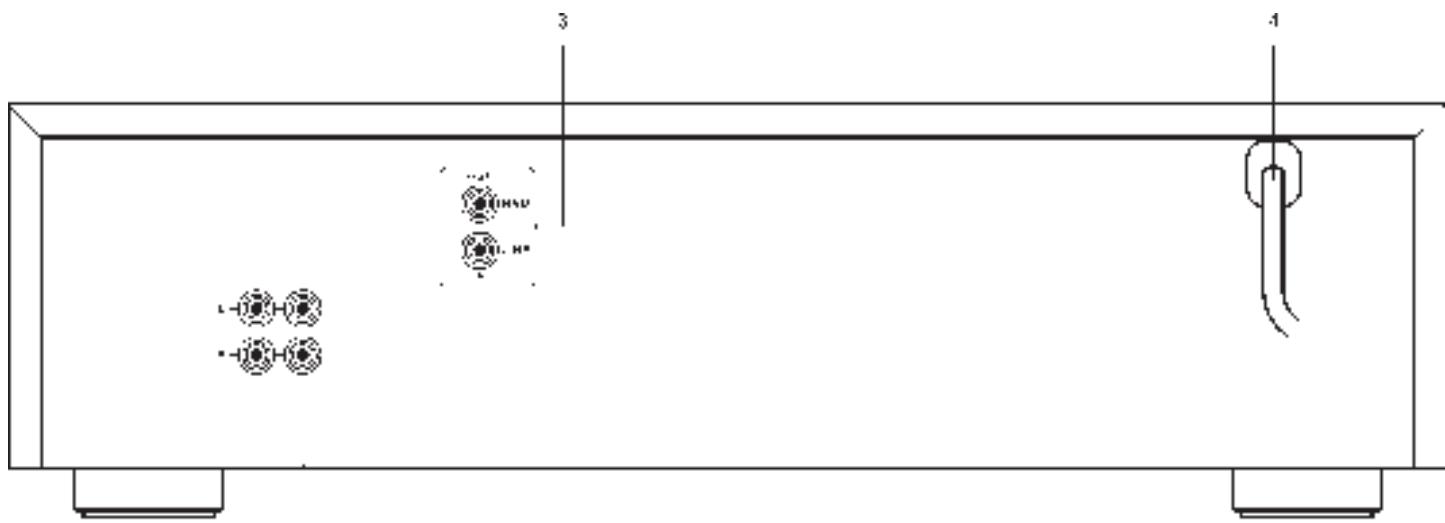
REAR PANEL CONNECTIONS
FRONT PANEL CONTROLS
© 1995. NAD ELECTRONICS LTD. 613.
Figure 1.
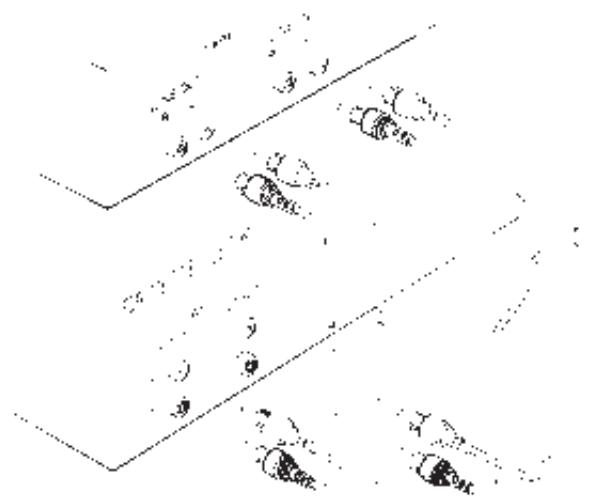
Figure 2.
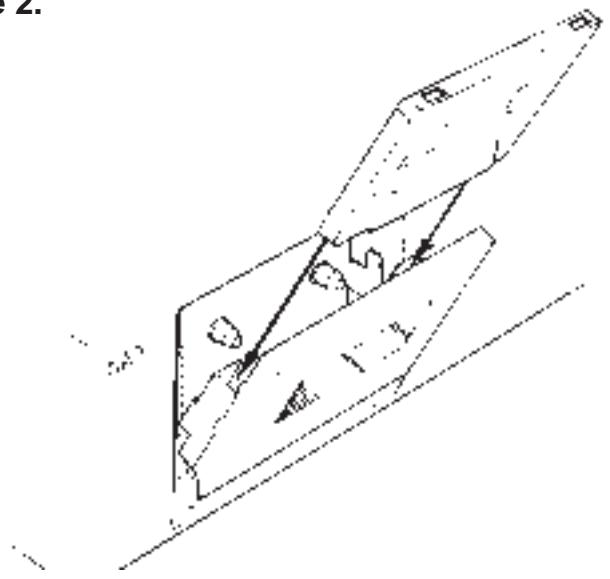
Figure 3.
natural_image
Pure technical diagram showing mechanical components without any text, numbers, or symbolsFigure 4.
natural_image
Technical line drawing of a mechanical assembly with levers and components (no text or symbols)INSTALLATION
The recorder may be installed on any stable surface that is not subjected to vibration or intense magnetic fields. It should not be placed directly on a loudspeaker, a television set, or a large power amplifier where it might pick up hum from the amplifier's power transformer. if you wish to install the recorder next to an amplifier on the same shelf, place the recorder on the left so that its cassette compartment will be located away from the amplifier.
WARNING TO UK USERS. If this appartus is not fitted with a UK three-pin plug, do not attempt to insert the attached plug into a UK mains socket. Instead, cut the plug from the mains lead and attach a fused UK three-pin plug using the following safety advice on wiring.
IMPORTANT. The wires in this mains lead are coloured BLUE and BROWN;
BLUE: NEUTRAL BROWN: LIVE
The colours of these mains lead wires may not correspond with the coloured markings identifying the terminals in your plug. In this case the BROWN wire must be connected to the terminal which is marked L(ive) or coloured RED. The BLUE wire must be connected to the terminal marked N(eutral) or coloured
BLACK. No connection should be made to the terminal marked E or coloured green or green and yellow
PRECAUTIONS
To ensure that maximum performance of the NAD 613 cassette deck is maintained over time, please bear the following precautions in mind:
THE DECK
A. Make sure the heads and transport are cleaned regularly. Please refer to page 8.
B. Demagnetise both heads and tape guidance from time to time. Please refer to page 8.
C. The bearings and other moving parts have been treated with special lubricants and are therefore maintenance-free. Additional lubrication can actually cause malfunctioning.
D. Do not position the deck near equipment with strong magnetic fields, such as loudspeakers or televisions, etc.
E. Place the deck on a solid, flat surface.
F. Avoid dirt, dust, sand, etc. from entering the deck.
G. Avoid placing near transmitters: they can generate high frequencies which may cause malfunctioning of the deck.
H. Ensure the cassette deck compartment lid is closed when the deck is not in use. Open it only for taking a cassette in or out, or for cleaning the heads and tape guides.
I. Do not place the deck directly on top of a (power) amplifier or receiver. The deck may pick up hum from the amplifier's power transformer. Some amplifiers can also generate a fair amount of heat, even when on stand-by.
WARNING : BEFORE PLUGGING IN THE UNIT FOR THE FIRST TIME, READ THE FOLLOWING SECTION CAREFULLY.
Some models are designed for use only with the power supply voltage of the region where they are sold.
European models: AC 230V, 50Hz
U.S.A. and Canadian models: AC 120V, 60Hz
THE CASSETTE TAPES
A. Store the cassette tapes in their jewel case, away from dust. Never store tapes in direct sunlight or very hot places.
B. Always use cassette tapes of a good quality. Besides mediocre results, poor quality tapes can cause excessive head wear.
C. Never touch the exposed tape itself or take it out of its cassette casing.
D. In most cases the cassette tape has a five to eight second leader tape at both the beginning and end of a cassette tape. As you cannot record on this leader tape, be sure to commence recording beyond this tape.
REAR PANEL CONNECTIONS & CONTROLS.
The numbers in the text refer to the connections in figure "REAR PANEL CONNECTIONS"
This cassette deck can be connected to almost all pre-amplifiers, integrated amplifiers or receivers. Ensure the plugs are fully inserted and the recording and playback cables are connected properly.
1. INPUT.
Connect a cable from the deck's "LINE IN" jacks at the rear panel to the TAPE OUT or REC jacks of your amplifier. Connect the left channel of the deck to the left channel of the amplifier and connect the right channel of the deck to the right channel of the amplifier. Normally, the red plug is used for the right channel, the black or white plug for the left channel. Please refer to figure 1.
2. OUTPUT.
Connect a cable from the deck's "LINE OUT" jacks at the rear panel to the TAPE IN, PLAY, or MONITOR jacks of your amplifier. Connect the left channel of the deck to the left channel of the amplifier and connect the right channel of the deck to the right channel of the amplifier. Normally, the red plug is used for the right channel, the black or white plug for the left channel. Please refer to figure 1.
3. NAD LINK.
The “NAD Link IN” connector allows the NAD 613 to be operated by external remote control signals passed from another NAD remote control component featuring NAD Link, e.g. AV 716 receiver. NAD Link works in a “daisy chain” fashion, connections going from one unit to the next one. Many NAD receivers and AV components come supplied as standard with an NAD system remote control which sports buttons for most used tape transport functions (Play, Record, Fast Forward, Rewind, Stop, etc.). It is recommended that the NAD 613 is the second unit in the daisy chain after the “master” unit, usually a receiver. Connect a cable from the master unit Link Out (e.g. the AV 716) to the NAD Link IN jack on the 613.
The “NAD Link OUT” connector allows remote control commands to be relayed from the 613 to other products equipped with a NAD Link (or compatible) input. For example, you can operate a CD player, a tuner and this cassette deck from a single system remote control. Connect a cable from the recorder's NAD Link OUT socket to the NAD Link IN jack on another product.
4. POWER.
Connect the AC mains cable to a convenient wall socket or to an AC convenience outlet at the rear of your amplifier or receiver.
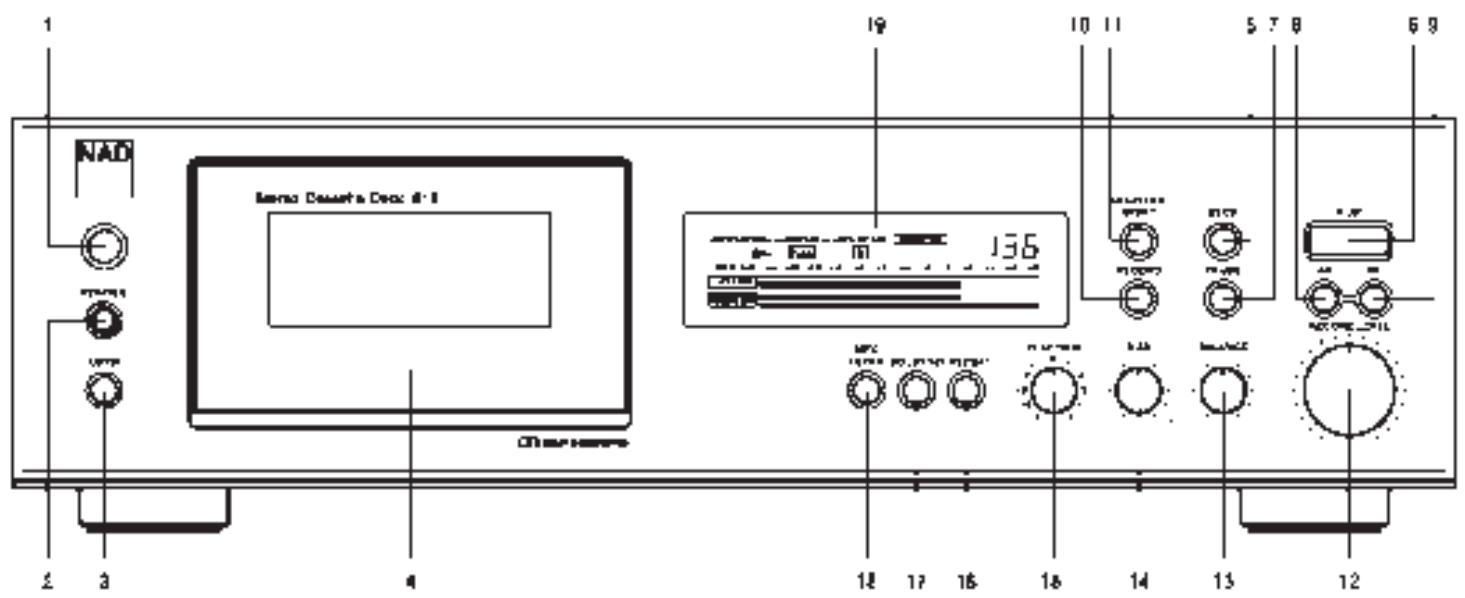
FRONT PANEL CONTROLS
The numbers in the text refer to the controls in figure "FRONT PANEL CONTROLS".
1. POWER.
Press this button to switch on the power to the cassette deck. The display will light up and the Pause icon "II" will flash for three seconds during which time the deck will not respond to any commands. To turn off the power, press again and release. Always press STOP before switching off the deck.
2.PHONES.
Insert a stereo headphone with a 6.5 mm jack here. When recording or playing back a tape the sound can be monitored through the headphones at a fixed level.
3. OPEN.
When this button is pressed, the door of the cassette compartment swings open to allow a tape to be inserted or to be removed. During play-back or recording the door cannot be opened.
4. CASSETTE COMPARTMENT.
The cassette tape must be inserted into this compartment. Use the “OPEN” button to open the compartment. With a gentle push, until a click is heard, the compartment can be closed.
5. STOP.
This button will stop all tape transport functions such as play, record, fast forward and rewind. It will also disengage the Record-pause and Play-pause mode.
6. PLAY.
To play-back a tape use this button. The Play icon will light up in the display.
- To load a cassette tape, remove it from its protective jewel case. Before inserting the cassette, ensure the tape is straight and taut where it is exposed at the thick edge of the cassette.
N.B. If necessary, insert a pencil into either hub
and manually wind the tape spool until any slack is taken up.
- Switch on the unit by pressing the POWER (1) switch. After use, the unit can be switched off by pressing the button again.
- Press the OPEN (3) button to release the cassette compartment door and insert the tape with the thick edge -where the tape is exposed- downwards. The cassette tape is held in a carrier within the door assembly.
Refer to figure 2.
- Press the cassette compartment door shut until a light "click" is heard. The tape is now in position.
- The tape can be removed by again using the OPEN (3) button.
Please note the button doesn't work during tape travel.
- Reset the tape counter (in the display) to "0000" by pressing the RESET (11) button.
- Select the appropriate DOLBY NR (17) position (Dolby NR Off, Dolby B NR or Dolby C NR) to suit the particular tape you wish to play back. Refer to the chapter “How to get the best performance from your NAD 613 cassette deck” section “Dolby NR noise reduction systems B & C” for more information.
- Press the PLAY (6) button to engage tape transport. The play icon ▶ in the display will light up to indicate the play status.
- If the recording sounds dull, turn the PLAY TRIM control (15) up (clock-wise) to restore accurate highs. If the recording sounds edgy or sibilant, turn the Play-Trim down to obtain smoother treble. Refer to chapter "How to get the best performance from your NAD 613 cassette deck", section "The Play Trim control" for further information.
- Press the STOP (5) button if you wish to end play-back.
7. PAUSE.
If you wish to interrupt play-back or recording for a moment, use this button. By pressing PLAY, you can resume play-back or recording. In the display the icon for Pause "I I" will light up to indicate the tape pause status. Press Play again to resume playing back or recording.
8. REWIND ◀◀.
With the ◀ function you can rewind the tape from right to left. Fast rewind is stopped automatically once the beginning of a tape is reached or if REPEAT Block had been engaged and the tape has reached the beginning of the block (see also section "REPEAT" (16) of this chapter). You can stop rewind manually by using the STOP button.
9. FAST FORWARD ▶▶.
With the ▶ function you can wind the tape forward from left to right. Fast forward is stopped automatically once the end of a tape is reached. You can stop fast forward manually by using the STOP button.
10. RECORD.
This button, when pressed together with either the PLAY or PAUSE button, will activate the recording circuits. The “Record” annunciator with either play or pause icon will light up in the display. By pressing PLAY in combination with RECORD, the recording will start immediately; by pressing PAUSE with RECORD only the recording circuits will be activated. By subsequently pressing PLAY recording will start. Now the “Record” annunciator together with the play icon in the display will light up to indicate the recording status.
- Insert a tape as described in the section “tape replay” above.
- Set the DOLBY NR (17) selector to the desired type of noise reduction (no noise reduction; OFF, B or C). Do not change the Dolby NR setting whilst the deck is recording. Refer to the chapter “How to get the best performance from your NAD 613 cassette deck”, section “The Dolby NR noise reduction systems B & C” for more detailed information.
- Press the RECORD (10) button together with the PAUSE (7) button; the red annunciator and pause icon in the display will light up.
- Adjust the recording level using the rotary RECORD LEVEL (12) control and BALANCE (13) control.
Refer to chapter "How to get the best performance from your NAD 613 cassette deck", section "Recording level" for more information.
- Start the recording by pressing the PLAY (6) button.
If you wish to interrupt a recording whilst keeping the recording circuits and display active, press the PAUSE (7) button. When you are ready to resume recording press PLAY (6). This technique is useful for omitting announcements or commercials when recording from radio or television.
- To stop recording, press the STOP (5) button.
(Note: Play Trim has no effect during recording.)
11. RESET.
Press this button to reset the tape counter to "0000". The counter can be re-set at any point while a tape is playing to mark a particular place on the tape. The counter is re-set to 0000 after power has been turned of as well.
12. RECORD LEVEL.
The recording level for both channels can be controlled with this control. The two horizontal bars in the display give you an exact indication of the record level during recording. The bars also work during play-back. These recording level meters are equipped with an automatic “Peak hold” facility which will display the highest peak for one second, even if the peak itself lasted only a fraction of a second to facilitate accurate read-out. Refer to chapter “How to get the best performance from your NAD 613 cassette deck”, section “Recording level” for more detailed information.
13. BALANCE.
The recording balance between left and right channel can be adjusted using this control. Normally this control is set at the 12 o'clock position.
Refer to chapter "How to get the best performance from your NAD 613 cassette deck", section "Recording level" for more information.
14. BIAS.
The Bias tuning control allows you to compensate for almost any brand-to-brand difference in tape sensitivity and frequency response. Turning the control clockwise will decrease treble (more Bias), turning it counter clockwise increases treble response (less Bias). Normally this control should be at the "0" position (centre detent). Refer to chapter "Getting the best performance from your NAD 613 cassette deck" section "Bias control" for more information.
15. PLAY TRIM.
Play Trim is a special play-back equalisation circuit to restore accurate play-back response from pre-recorded, old and worn tapes, tapes recorded in another deck, tapes which weren't recorded properly (too much or too little bias). This control will allow you to adjust the deck's circuitry to ensure proper Dolby NR tracking for a correct high frequency response.
Refer to chapter "Getting the best performance from your NAD 613", section "The Play Trim control" for more detailed information.
16. REPEAT.
The NAD 613 is equipped with two repeat modes; repeat the entire side of a cassette or repeat a pre-selected block 5 times. The REPEAT button scrolls through three different settings: OFF FULL BLOCK OFF FULL, etc. (indicated in the display). Select FULL (either from stop or during playback) to repeat the entire cassette.
To repeat a pre-selected block:
- Select BLOCK by pressing REPEAT twice. BLOCK lights up in the display.
- Press the PLAY button (6) to start play-back. BLOCK now flashes in the display.
- Press the PLAY button again to mark the beginning of the block. You can press PLAY again to change the beginning of the block. BLOCK continues to flash in the display.
- When you have reached the end of the block you wish to repeat, press the REWIND ◀ button (8). The block indicator stops flashing and remains lit until the pre-selected block has been repeated five times or STOP is pressed.
17. DOLBY NR.
The Dolby NR ^™ Noise Reduction systems have been devised to reduce tape hiss. The display indicates if Dolby NR has been selected and which type (B or C). The button allows you to scroll through the different settings: OFF B C OFF B, etc. (indicated in the display). Select the same type of
Dolby NR with which the tape was originally recorded for playback. Select the Dolby NR position with which you wish to make a recording before starting a recording. Refer to chapter "Getting the best performance from your NAD 613", section "Dolby NR Noise Reduction systems B & C" for more details. Dolby NR will default to OFF after the deck has been switched off.
18. MPX FILTER.
When recording off-air with some tuners an inaudible high frequency signal can cause mis-tracking of the Dolby NR noise reduction circuit which results in dull sound when the recording is played back. The MPX filter blocks these high frequencies (above 15kHz).
Press the MPX button if you are experiencing such problems; MPX FILTER will light up in the display. If you don't record from radio you do not need to select the MPX filter.
19. DISPLAY.
Various functions of the deck are displayed, Recording, Play, Pause, Dolby NR OFF/B/C/, Repeat OFF/FULL/BLOCK, Record level and Tape Counter.
GETTING THE BEST PERFORMANCE FROM YOUR NAD 613 CASSETTE DECK.
The numbers in the text refer to the controls in figure "FRONT PANEL CONTROLS" unless mentioned otherwise.
THE DOLBY NR NOISE REDUCTION SYSTEMS B & C.
The deck is equipped with two types of Dolby NR noise reduction. Dolby C NR provides the greatest quieting of tape hiss, important when taping “live” musical performances or recordings with a wide dynamic range (digital Compact Discs, for example).
Dolby B NR provides optimum compatibility with older tape recorders, portable and car stereo tape players. Dolby B NR should also be used when playing most pre-recorded music cassettes.
Each Dolby NR system is active both during recording and play-back. Thus if a tape is recorded with Dolby C NR, it must be played back with Dolby C NR in order for the benefits to be obtained. Similarly, if Dolby B NR has been used during recording, than it should be used in play-back as well.
To avoid confusion, it is recommended that you label each cassette B or C when it is recorded, to indicate the type of noise reduction used.
NOTE: After switching Power off, the Dolby NR circuits will be switched off. Make sure you select the appropriate Dolby NR setting again after switching the deck on.
Tape sensitivity is constantly changing as recordings are made due to the biasing effect of high frequency audio signals. dolby HX Pro is a system that compensates for these undesirable fluctuations during recording. It does not operate during playback, so cassettes recorded with Dolby HX Pro can be played back on decks not equipped with the system.
NOTE: Dolby HX Pro operates independently of Dolby B and C NR, and only during recording.
THE BIAS CONTROL.
Matching the recorder's bias to the tape is especially important when Dolby NR noise reduction is used, because any departure from flat high-frequency response will be magnified in the Dolby NR NR circuit during play-back, making the sound excessively bright or dull. The “Bias” control (14) allows you to compensate for brand-to-brand tape differences. The procedure for fine tuning the bias is as follows:
- Load an unrecorded tape and fast forward for a few seconds to get past the blank leader tape at the beginning.
- Set the "Play Trim" (15) control at "0" (the centre detent position) and press the "Multiplex Filter" button (18) to engage the filter (indicated in display).
- Press "Dolby NR" (17) to select "C".
- Set the "Bias" control (14) at "0" (the centre detent position).
- Press the "Reset" button (11) and record a brief sample of music at peak level of about -8dB.
- Rewind the tape to approximately to 0000.
- Play back the sample of music and evaluate its tonal balance in comparison to the original.
- If the recording sounds duller than the original, turn the Bias control DOWN (counter clockwise) to boost the highs (less bias). If the high frequencies are exaggerated in the recording, turn the control UP (clockwise) to reduce the treble response (increase bias).
- To test the new bias setting, make another brief trial recording and check the results. Fine tune again if necessary.
NOTES:
- The Bias control affects tapes only while a recording is being made. It cannot be used to improve the quality of tapes after they are recorded.
- We recommend you consistently use the same brand and type quality tapes to get the best and most consistent performance from the recorder. Set the Bias control to match that particular tape.
RECORDING LEVEL.
The two horizontal segmented bars display the peak level of the source's signal in each channel. Adjust the recording level by turning down (counter clock-wise) or turning up (clock-wise). There are various tape formulations - normal (I), CrO2 (II) and Metal (IV) - available, each with its own specific characteristics such as saturation level. The NAD 613 senses automatically which tape type is used and adapts its settings accordingly. Too low a recording
level will result in excessive tape hiss, whereas too high a recording level will result in distortion. The standard procedure is to set the recording level to accommodate the loudest part of the music, and then leave the controls alone. Set the control so that sustained sounds, e.g. a singing voice or full orchestral chord reaches the red segments (up to 4 dB). With music that spans a wide range of volume levels, this may mean that the quiet portions of the music will be recorded at a level of -20 dB or less (with no segments illuminated). This is normal.
The BALANCE (13) control will allow you to alter the left/right balance of a recording. When turned fully counter clock-wise, only the left channel will be recorded, whereas turned fully clock-wise only the right channel will be recorded. For normal use the control is set in the detent in the centre of its range, recording each channel with equal levels.
If you wish to erase a tape, without making a new recording, follow the procedure as described above, but turn the RECORD LEVEL (12) control fully counter clock-wise. No recording level segments will illuminate.
ACCIDENTAL ERASURE PREVENTION.
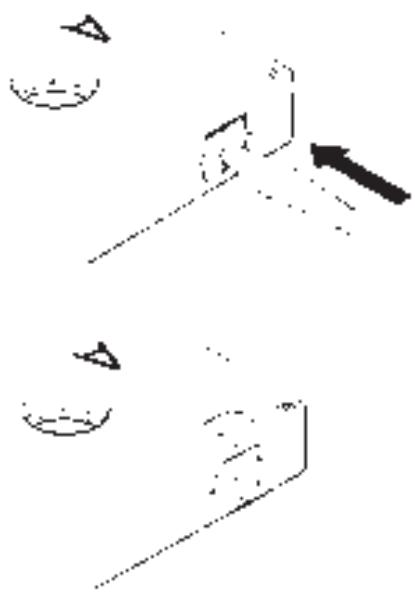
Whilst making a new recording any previous recordings already on the tape will automatically be erased. If you wish to protect a tape from being erased or re-recorded accidentally, you can remove the tape's protection tabs. This way the record function will not engage. Please note that most pre-recorded tapes commercially available already have the tabs removed. Using adhesive tape over the holes will enable the circuits to record again.
CrO2 (type II) and Metal (type IV) tapes have additional holes in the cassette housing, enabling the deck to “recognize” the various tape types. Make sure you do not cover these holes as well! Refer to figure 3.
THE PLAY TRIM CONTROL.
Position the PLAY TRIM control in the "0" (centre detent) position for normal play-back.
Errors in high frequency response often occur in cassette recordings, especially in tapes that were recorded on one machine and are being played on another. These errors arise from tape saturation - particularly those tapes recorded on decks without HX Pro headroom extension -, from biasing that didn't match the tape when the recording was made, and from differences in equalisation and head azimuth among recorders.
These errors cause mis-tracking of the Dolby NR circuits, which in turn cause the faults to be “magnified” by the circuits, often resulting in dull sound.
Play Trim is a special high-frequency play-back equalisation circuit, used to restore accurate play-back response before Dolby NR decoding takes place. Standard play-back equalisation, for correctly recorded tapes, is provided when the Play Trim control is set at the detent in the centre of its range.
When playing tapes, set the DOLBY NR selector to match the recorded tape. If the recording sounds dull, turn the Play-Trim up (clock-wise) to restore accurate highs. If the recording sounds edgy or sibilant, turn the Play-Trim down to obtain smoother treble.
NOTE: The Play Trim control only affects play-back and doesn't function whilst making a recording.
MAINTENANCE
The bearings and other moving parts have been factory treated with special lubricants and do not need any special attention.
Dirt, dust and tape-oxide can potentially damage the heads and tape guidance, besides degrading the sound quality both on play-back and recording. Parts in direct contact with the tape therefore need to be cleaned regularly.
NOTE: Make sure the receiver or amplifier is switched off before cleaning or demagnetising the heads.
CLEANING
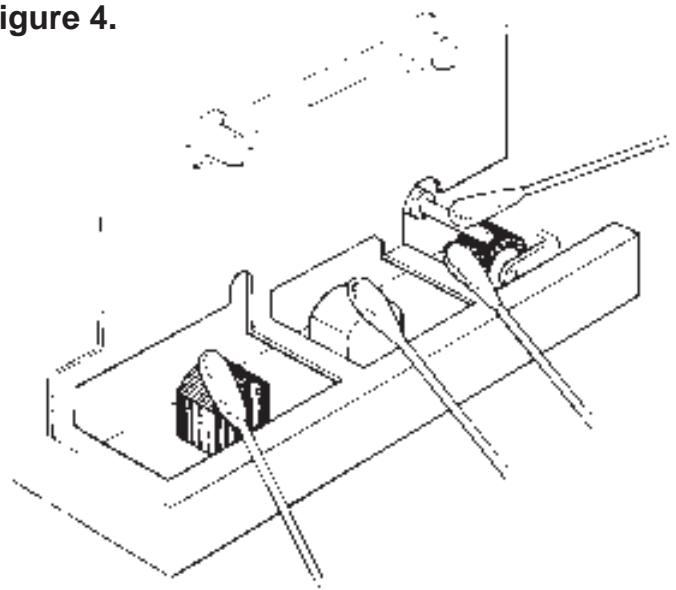
Open the cassette compartment door. At the bottom of the compartment you can see the heads and tape guidance (capstan and pinch-roller). Refer to figure 4.
Clean the heads (A & B) and the capstan (C) using cotton wool buds with pure alcohol or with a dedicated Tape Recorder Cleaner.
Clean the pinch-roller (D) using only distilled water. Never use alcohol on the roller, as the rubber will dry out. Alternatively, you can use a special cleaning cassette. Be sure to use a cassette that cleans all parts illustrated in figure 3.
DEMAGNETIZING
Parts in direct contact with the tape will become slightly magnetic over time. This magnetism will increase hiss, both during play-back and recording.
It is therefore advisable to demagnetise the heads, pinch roller and other metal tape guidance parts from time to time, using a demagnetiser or a demagnetising cassette. Follow the instructions of the demagnetiser or demagnetising cassette.
WARNING
Keep demagnetisers away from your tapes, they can accidentally erase the recordings.
Your dealer will be able to advise you and supply the proper accessories for both cleaning and demagnetising.
PLAY TRIM was developed by NAD and Dolby Laboratories Inc. HX Pro originated by Bang and Olufsen. Dolby Noise reduction and HX Pro headroom extension manufactured under license from Dolby Laboratories Licensing Corporation. "Dolby" "Dolby NR", the double-D symbol and "HX Pro" are registered trademarks of the Dolby Licensing Corporation. Dolby NR is a registered trademark of Dolby Laboratories Ltd.
INSTALLATION
1. LINE IN. (Insignal)
| Speed Accuracy | ±1% |
| Wow and Flutter | <0.07% JIS wtd. RMS |
| <0.09% DIN wtd. peak | |
| Frequency response(Dolby NR off, Record/Playback) | 30Hz - 18kHz ±3dB |
| MPX filter reponse | Flat within 1dB to 15kHz |
| Harmonic distortion | Varies with recording level;typically <0.3% at -10dB |
| THD @ 0dB (Normal tape) | <1.0% |
| THD @ 0dB (CrO2, Metal tape) | <1.5% |
| Signal-to-Noise ratio(Ref. 3% THD at 333Hz [biased tape] | 58dB (Dolby NR off) |
| CCIR/ARM weighting) | 68dB (Dolby B NR) |
| 78dB (Dolby C NR) | |
| Channel separation | 40dB @ 1kHz |
| 35dB broadband | |
| Erase | >70dB @ 1kHz |
| Input sensitivity / impedance | 80mV/50k |
| Maximum input level | 25V |
| Output level @ 0dB | 500mV |
| Output impedance | 600 |
| PHYSICAL SPECIFICATIONS | |
| Dimensions (W x H x D) | 435 x 125 x 311mm |
| Net weight | 5.0kg |
| Shipping weight | 6.6kg |
NAD reserves the right to change specifications without notice
PLAY TRIM was developed by NAD and Dolby Laboratories Inc.
HX Pro originated by Bang and Olufsen.
Dolby Noise reduction and HX Pro headroom extension manufactured under license from Dolby Laboratories Licensing Corporation.
“Dolby” “Dolby NR”, the double-D symbol and “HX Pro” are registered trademarks of the Dolby Licensing Corporation.
Dolby NR is a registered trademark of Dolby Laboratories Ltd.
- WARNING: TO PREVENT FIRE OR ELECTRIC SHOCK, DO NOT EXPOSE THIS APPLIANCE TO RAIN OR MOISTURE
- CAUTION
- ATTENTION:
- ATTENTION FOR EUROPEAN MODEL:
- FRONT PANEL CONTROLS
- INSTALLATION
- BLUE: NEUTRAL BROWN: LIVE
- PRECAUTIONS
- THE DECK
- WARNING : BEFORE PLUGGING IN THE UNIT FOR THE FIRST TIME, READ THE FOLLOWING SECTION CAREFULLY.
- THE CASSETTE TAPES
- REAR PANEL CONNECTIONS & CONTROLS.
- INPUT.
- OUTPUT.
- NAD LINK.
- POWER.
- POWER.
- 2.PHONES.
- OPEN.
- CASSETTE COMPARTMENT.
- STOP.
- PLAY.
- PAUSE.
- REWIND ◀◀.
- FAST FORWARD ▶▶.
- RECORD.
- RESET.
- RECORD LEVEL.
- BALANCE.
- BIAS.
- PLAY TRIM.
- REPEAT.
- DOLBY NR.
- MPX FILTER.
- DISPLAY.
- GETTING THE BEST PERFORMANCE FROM YOUR NAD 613 CASSETTE DECK.
- THE DOLBY NR NOISE REDUCTION SYSTEMS B & C.
- THE BIAS CONTROL.
- NOTES:
- RECORDING LEVEL.
- ACCIDENTAL ERASURE PREVENTION.
- THE PLAY TRIM CONTROL.
- MAINTENANCE
- CLEANING
- DEMAGNETIZING
- WARNING
- LINE IN. (Insignal)
Brand : NAD
Model : 613
Category : Audio Amplifier