HR 850-T - Saw Cocraft - Free user manual and instructions
Find the device manual for free HR 850-T Cocraft in PDF.


| Product Type | Circular Saw |
| Model | HR 850-T |
| Brand | Cocraft |
| Power Source | Corded Electric |
| Rated Power | 850 W |
| Blade Diameter | 190 mm (7.5 inches) |
| No-Load Speed | 5000 rpm |
| Cutting Depth at 90° | 65 mm |
| Cutting Depth at 45° | 45 mm |
| Bevel Adjustment | 0° to 45° |
| Dimensions (L x W x H) | 310 x 240 x 280 mm |
| Weight | 4.5 kg |
| Power Cord Length | 2.5 m |
| Key Features | Parallel guide, dust extraction port, safety switch |
| Maintenance | Clean ventilation slots, check carbon brushes every 50 hours |
| Safety Features | Blade guard, trigger lock-off, anti-kickback |
| Spare Parts Availability | Replaceable carbon brushes, blade, parallel guide |
| General Information | Designed for cutting wood, plastic, and soft metals |
Frequently Asked Questions - HR 850-T Cocraft
User questions about HR 850-T Cocraft
0 question about this device. Answer the ones you know or ask your own.
Ask a new question about this device
Download the instructions for your Saw in PDF format for free! Find your manual HR 850-T - Cocraft and take your electronic device back in hand. On this page are published all the documents necessary for the use of your device. HR 850-T by Cocraft.
USER MANUAL HR 850-T Cocraft
RECIPROCATING SAW 850 W
HR 850-T
ADJUSTABLE SHOE
TIGERSÅG
PUUKKOSAHA
BAJONETTSAG
SÄBELSÄGE

Important!
Read the entire instruction manual carefully and make sure that you fully understand it before you use the equipment. Keep the manual for future reference.
Viktig information:
Original instructions
Bruksanvisning i original
Originalbruksanvisning
Please read the entire instruction manual before using the product and save it for future reference. We reserve the right for any errors in text or images and any necessary changes made to technical data. If you have any questions regarding technical problems please contact Customer Services.
Safety
General Safety Instructions
Caution! Read all the instructions. Failure to adhere to the following instructions may lead to electric shocks, fires and/or serious injury. The term “power tools” in the warning text below refers to your handheld mains operated or battery operated tool.
SAVE THESE INSTRUCTIONS.
1) Work area safety
a) Keep work area clean and well lit. Cluttered or dark areas invite accidents.
b) Do not operate power tools in explosive atmospheres, such as in the presence of flammable liquids, gases or dust. Power tools create sparks which may ignite the dust or fumes.
c) Keep children and bystanders away while operating a power tool. Distractions can cause you to lose control.
2) Electrical safety
a) Power tool plugs must match the outlet. Never modify the plug in any way. Do not use any adapter plugs with earthed (grounded) power tools. Unmodified plugs and matching outlets will reduce risk of electric shock.
b) Avoid body contact with earthed or grounded surfaces, such as pipes, radiators, ranges and refrigerators. There is an increased risk of electric shock if your body is earthed or grounded.
c) Do not expose power tools to rain or wet conditions. Water entering a power tool will increase the risk of electric shock.
d) Do not abuse the cord. Never use the cord for carrying, pulling or unplugging the power tool. Keep cord away from heat, oil, sharp edges or moving parts. Damaged or entangled cords increase the risk of electric shock.
e) When operating a power tool outdoors, use an extension cord suitable for outdoor use. Use of a cord suitable for outdoor use reduces the risk of electric shock.
f) If operating a power tool in a damp location is unavoidable, use a residual current device (RCD) protected supply. Use of an RCD reduces the risk of electric shock.
3) Personal safety
a) Stay alert, watch what you are doing and use common sense when operating a power tool. Do not use a power tool while you are tired or under the influence of drugs, alcohol or medication. A moment of inattention while operating power tools may result in serious personal injury.
b) Use personal protective equipment. Always wear eye protection. Protective equipment such as dust mask, non-skid safety shoes, hard hat, or hearing protection used for appropriate conditions will reduce personal injuries.
c) Prevent unintentional starting. Ensure the switch is in the off-position before connecting to power source and/or battery pack, picking up or carrying the tool. Carrying power tools with your finger on the switch or energising power tools that have the switch on invites accidents.
d) Remove any adjusting key or wrench before turning the power tool on. A wrench or a key left attached to a rotating part of the power tool may result in personal injury.
e) Do not overreach. Keep proper footing and balance at all times. This enables better control of the power tool in unexpected situations.
f) Dress properly. Do not wear loose clothing or jewellery. Keep your hair, clothing and gloves away from moving parts. Loose clothes, jewellery or long hair can be caught in moving parts.
g) If devices are provided for the connection of dust extraction and collection facilities, ensure these are connected and properly used. Use of dust collection can reduce dust related hazards.
4) Power tool use and care
a) Do not force the power tool. Use the correct power tool for your application.
The correct power tool will do the job better and safer at the rate for which it was designed.
b) Do not use the power tool if the switch does not turn it on and off. Any power tool that cannot be controlled with the switch is dangerous and must be repaired.
c) Disconnect the plug from the power source and/or the battery pack from the power tool before making any adjustments, changing accessories, or storing power tools. Such preventive safety measures reduce the risk of starting the power tool accidentally.
d) Store idle power tools out of the reach of children and do not allow persons unfamiliar with the power tool or these instructions to operate the power tool. Power tools are dangerous in the hands of untrained users.
e) Maintain power tools. Check for misalignment or binding of moving parts, breakage of parts and any other condition that may affect the power tool's operation. If damaged, have the power tool repaired before use.
Many accidents are caused by poorly maintained power tools.
f) Keep cutting tools sharp and clean. Properly maintained cutting tools with sharp cutting edges are less likely to bind and are easier to control.
g) Use the power tool, accessories and tool bits, etc. in accordance with these instructions, taking into account the working conditions and the work to be performed. Use of the power tool for operations different from those intended could result in a hazardous situation.
5) Service
a) Repairs and service should only be performed by qualified tradesmen, and only with original spare parts. This guarantees that the safety of the power tool is maintained.
Specific safety instructions for reciprocating saws
Warning: Always disconnect the plug from the mains before adjusting, servicing or performing maintenance on the machine.
- If the mains lead is damaged it should only be replaced by the retailer.
- Keep your hands away from the blade and other moving parts. Do not reach under the workpiece being sawed. The blade or your hand could be out of your sight.
- Never put your hand or finger between the pendulum arm and gearbox. There is a risk of crushing.
- Do not drill into walls or other places where there might be hidden electric cables. If it is necessary to saw in any case: Remove all fuses and cut off all the power supply to any wiring circuits which may be hidden behind the wall. Grip only the plastic parts of the reciprocating saw. Never touch any metal parts of the saw when cutting in areas where there might be live electrical wires.
- Do not use blunt or damaged saw blades. Bent saw blades can easily break or cause kickback.
- Start the saw and let it get up to speed before starting to cut.
- Fasten smaller workpieces with a clamp, vice, etc. before beginning to saw. It is easy to lose control over the machine on pieces that bend or begin to vibrate.
- Make sure that the settings are correct and that the blade is securely fastened in the blade holder before beginning to saw.
Safety symbol guide

Read the entire instruction manual.

Always use ear defenders, safety goggles/visor and a face mask.
Product description
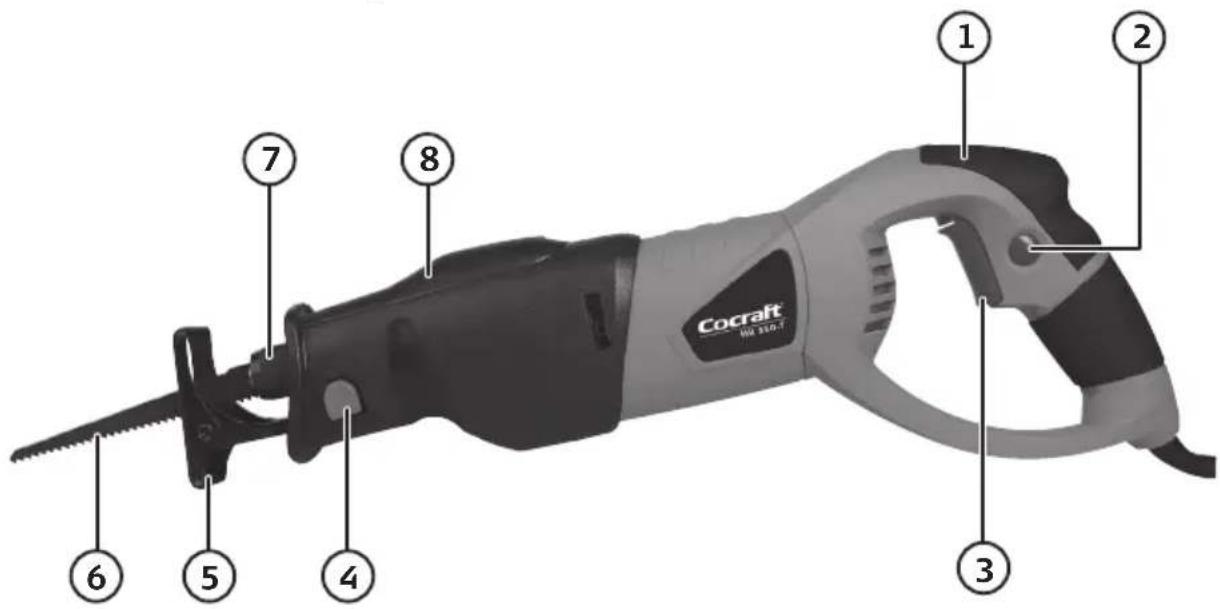
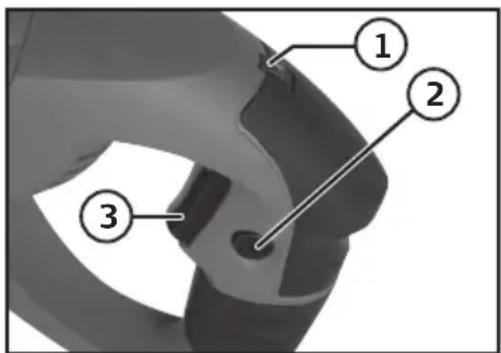
- Variable speed dial
- Trigger lock button
- Power trigger
-
Shoe lock
-
Shoe
- Saw blade
- Quick release blade clamp
- Soft-grip handle
Included accessories
- Saw blade (2×)
- Instruction manual
Assembly and setup
Important: Disconnect the plug from the power source before servicing or adjusting the saw.
Changing the saw blade
- Disconnect the mains lead from the power source before changing blades.
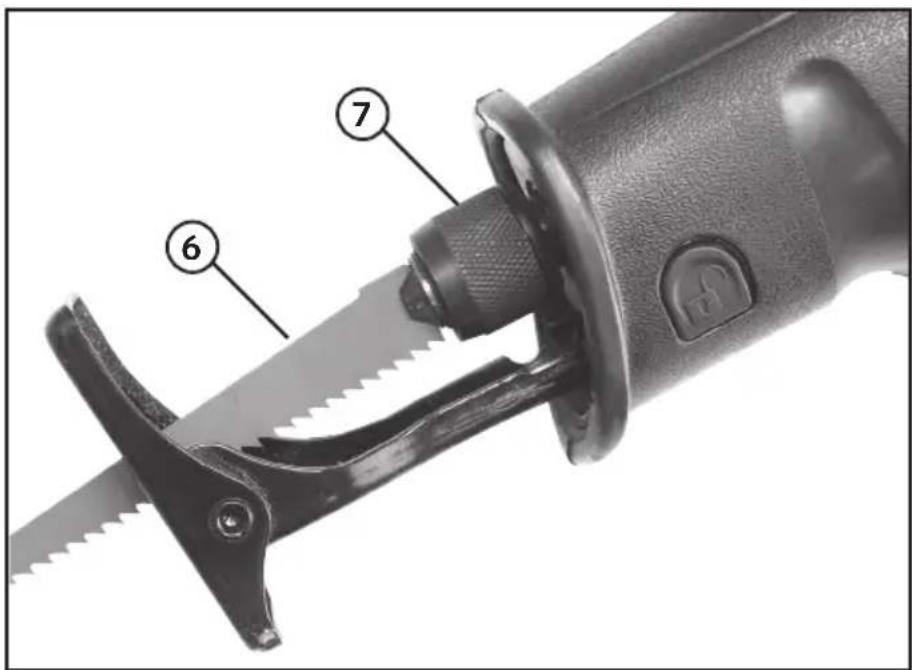
- Turn the outer part of the blade clamp (7) a half turn anticlockwise (viewed from the front), pull the old saw blade (6) straight out and replace it with a new one.
- Make sure that the blade is properly clamped before starting to saw.
Adjusting the shoe
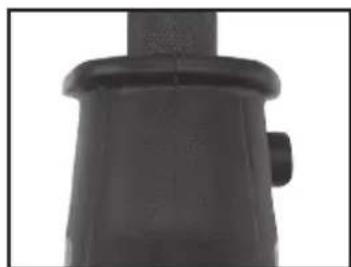
- By pushing in the shoe lock button (4) on the left-hand side 🔍 the shoe (5) can be adjusted to the desired position.
- Pushing in the shoe lock button (4) on the right-hand side locks the shoe (5).
natural_image
Close-up of a black plastic cylindrical object with a small protrusion (no visible text or symbols)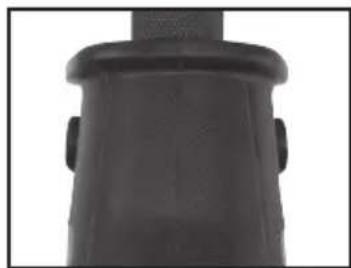
natural_image
Close-up of a black plastic cylindrical object with a flared top and side protrusions (no text or symbols visible)Use
- Make sure that the saw blade and the shoe are both locked before starting to saw.
- Make sure that the workpiece is securely anchored or clamped to prevent it slipping (especially small or light workpieces). It is the saw that you want to move, not the workpiece.
- Mark the cut line clearly before starting to cut.
- Adjust the shoe so that it rests against the surface or the workpiece.
- Hold the saw firmly with both hands. Make sure that the blade is not touching the workpiece when the saw is turned on and that the mains lead is safely out of the way.
- Start the saw by pressing in the power trigger (3).
- Rest the shoe against the workpiece and carefully feed the blade into the material following the cut line. Do not apply too much pressure to the saw blade. It is the saw blade that should do the work; do not force the blade into the workpiece.
Power trigger
- Start the saw by pulling the power trigger (3). Press in the trigger lock (2) to lock the trigger in the ON position. Release the trigger. Pull the power trigger (3) to disengage the trigger lock and switch the saw off.
- The blade speed can be set using the dial (1).
Note: After sawing for a long time at low speed the motor should be run at maximum speed for about 3 minutes to cool it down.
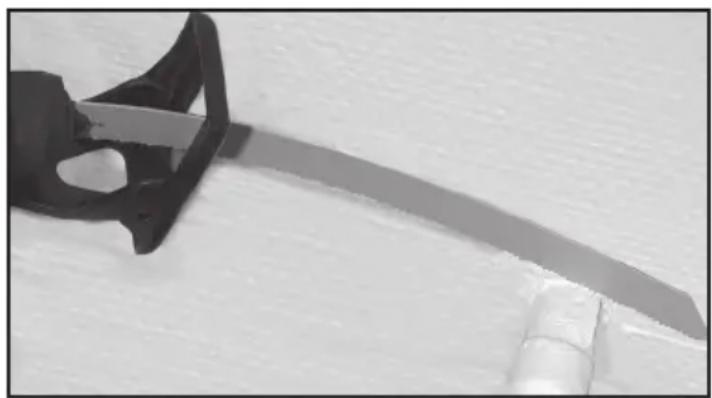
Sawing flush to a surface
Handy hint
By using a flexible bi-metallic blade, it is possible to saw with a bowed blade. This can be useful for e.g. cutting off protruding pipes flush to a wall.
- Lay the sawblade flat against the surface and tilt the saw so that the side of the shoe rests against the surface.
- Lay a thin piece of hard plastic between the blade and the surface to protect the surface.
natural_image
Close-up of a black plastic bag and a white cylindrical object on a textured surface (no text or symbols visible)Sawing corners
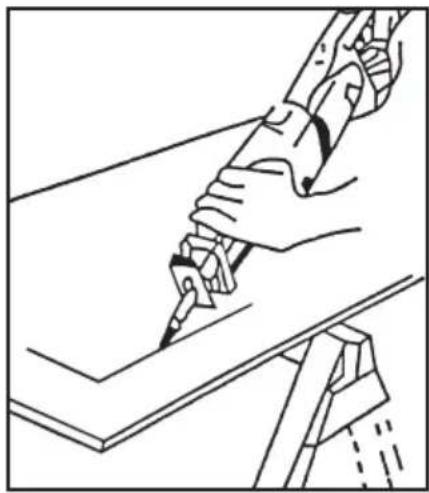
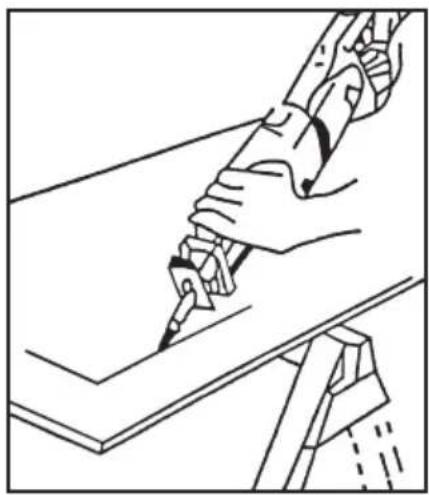
- Mark the cut line clearly before starting to cut.
- Place the tip of the blade along the cut line that crosses your previous cut.
- Tilt the saw so that the shoe rests on the workpiece but the blade is in the air.
- Start the motor and let the blade come up to speed.
- Slowly tilt the saw upwards so that the blade feeds into the marked cut line.
- Continue to swing the saw upwards until it is at right angles to the workpiece, cut until you reach the next corner.
natural_image
Line drawing of a hand using a tool to cut or mark a piece of paper (no text or symbols present)Caution!
Do not feed the saw blade into the material until it has fully come up to the set speed or serious injury may result.
Sawing metal
Use a sharp blade specially designed for cutting metal. Use cutting oil* for cooling and lubrication while cutting metal. Do not overexert the saw – let it work at its own pace.
* Different materials require different lubricants/coolants.
Maintenance
- Cleaning: Unplug the saw from the power outlet and wipe it with a soft cloth and maybe even a little mild detergent. Never use abrasive cleaning agents or solvents.
- Keep the motor's ventilation ports clear.
Responsible disposal
This symbol indicates that this product should not be disposed of with general household waste. This applies throughout the entire EU. In order to prevent any harm to the environment or health hazards caused by incorrect waste disposal, the product must be handed in for recycling so that the material can be disposed of in a responsible manner. When recycling your product, take it to your local collection facility or contact the place of purchase. They will ensure that the product is disposed of in an environmentally sound manner.
natural_image
Symbol of a trash bin crossed with no text or labels, representing waste sorting or disposal (no text present)Specifications
Voltage 230 V AC, 50 Hz
Power 850 W
No-load speed 1300–3000 rpm
Wood sawing capacity 115 mm
Metal sawing capacity 9 mm
Stroke length 24 mm
Sound pressure LpA = 88.3 dB(A), KpA = 3 dB(A)
Sound power LwA = 99.3 dB(A), KwA = 3 dB(A)
Vibration values Cutting boards a
Cutting wooden beams a
$$ _ {h, B} = 1 4. 0 0 \mathrm{m} / \mathrm{s} ^ {2}, K _ {B} = 1. 5 \mathrm{m} / \mathrm{s} ^ {2} $$
$$ _ {\mathrm{h,WB}} = 1 4. 1 5 \mathrm {m/ s ^ {2}}, K _ {\mathrm{WB}} = 1. 5 \mathrm {m/ s ^ {2}} $$
Tigersåg
Art.nr 18-3163 Modell M1W-TD2-210E 40-7944 M1W-TD2-210E
natural_image
Close-up of a black plastic cylindrical object with a small protrusion (no visible text or symbols)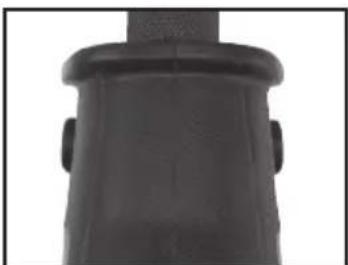
natural_image
Close-up of a black plastic cylindrical object with a flared top and side protrusions (no text or symbols visible)Användning
natural_image
Close-up of a black plastic clip and a white cylindrical object on a textured surface (no text or symbols visible)Sågning av hörn
natural_image
Line drawing of a hand using a tool to cut or mark a piece of paper (no text or symbols present)Varning!
natural_image
Symbol of a trash bin crossed with a diagonal line and a horizontal bar below (no text or labels)Specifikationer
Spänning 230 V AC, 50 Hz
Effekt 850 W
Varvtal obelastad 1300–3000/min
h, WB = 14, 15 m/s^2, K_WB = 1, 5 m/s^2
Bajonettsag
Art.nr. 18-3163 Modell M1W-TD2-210E 40-7944 M1W-TD2-210E
natural_image
Close-up of a black plastic mechanical component with a cylindrical top and a small protruding part (no visible text or symbols)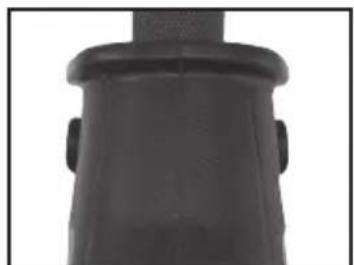
natural_image
Close-up of a black plastic cylindrical object with a flared top and side protrusions (no text or symbols visible)Bruk
natural_image
Close-up of a black mechanical part and a white cylindrical object on a textured surface (no text or symbols visible)Saging av hjørne
- Merk sagesnittet.
- Plasser sagbladets spiss mot linjen som krysser sagesnittet.
- Vinkle sagen til fotplaten berører arbeidsemnet og sagbladet går fritt.
- Start sagen og la den komme opp i turtall.
- Før sagen sakte opp slik at bladet møter den markerte sagelinjen.
- Fortsett å føre sagen opp til den er vinkelrett mot arbeidsemnet og sag til neste hjørne.
natural_image
Line drawing of a hand using a tool to cut or mark a piece of paper (no text or symbols present)Advarsel!
La ikke sagbladet komme i berøring av emnet før sagen har oppnådd maksimalt turtall.
Saging i metall
Bruk kun sagblad som er beregnet for saging i metall. Bruk skjæreolje* til avkjøling og smøring under sageprosessen. Maskinen må ikke overbelastes. La den jobbe i sin egen takt.
natural_image
Symbol of a trash bin crossed with no visible text or labelsSpesifikasjoner
Spenning 230 V AC, 50 Hz
Effekt 850 W
Turtall ubelastet 1300–3000 o/min
Sagdybde i tre Maks 115 mm
Sagdybde i metall Maks 9 mm
Slaglengde 24 mm
Jalustan säätö
natural_image
Close-up of a black cylindrical object with a protruding rod and small protrusion (no visible text or symbols)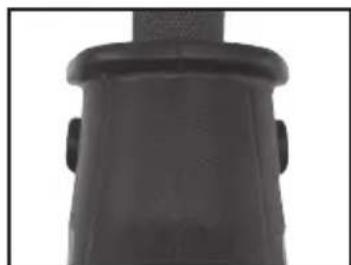
natural_image
Close-up of a black plastic container with side handles (no text or symbols visible)Käyttö
natural_image
Close-up of a black plastic tool and a white cylindrical object on a textured surface (no text or symbols visible)Kulmien sahaus
natural_image
Line drawing of a hand using a tool to cut or mark a piece of paper (no text or symbols present)Varoitus!
natural_image
Symbol of a trash bin crossed out by two diagonal lines, with no text or labels present.Tekniset tiedot
Jännite 230 V AC, 50 Hz
Teho 850 W
Kierrosluku
kuormittamattomana 1300–3000/min
natural_image
Close-up of a black cylindrical object with a protruding handle and a small protruding part (no visible text or symbols)natural_image
Close-up of a black cylindrical object with a flared top and side protrusions (no visible text or symbols)Bedienung
natural_image
Close-up of a black mechanical component with a diagonal blade and a white cylindrical object on a textured surface (no text or symbols visible)Sägen von Ecken
natural_image
Line drawing of a hand using a tool to cut or mark a piece of paper (no text or symbols present)Warnung:
natural_image
Symbol of a trash bin crossed with no visible text or labelsTechnische Daten
Declaration of Conformity
Declares that this product complies with the requirements of the following directives and standards
Machinery Directive 2006/42/EC
EN 60745-1:2009
+A11:2010
EN 60745-2-11:2010
EMC Directive 2004/108/EC
EN 55014-1:2006
EN 55014-2:1997
+A1:2001+A2:2008
EN 61000-3-2:2006
+A1:2009+A2:2009
EN 61000-3-3:2008
Henrik Alfredsson
Manager Technique & Quality
Insjön, Sweden, 2016-04-21
Sverige
Postal 10 - 13 Market Place
Kingston upon Thames
Surrey
KT1 1JZ
Deutschland
Kundenservice Hotline: 040 2999 78111
E-Mail: kundenservice@clasohlson.de
Homepage
www.clasohlson.de

- RECIPROCATING SAW 850 W
- HR 850-T
- ADJUSTABLE SHOE
- Important!
- Viktig information:
- Safety
- General Safety Instructions
- SAVE THESE INSTRUCTIONS.
- 1) Work area safety
- 2) Electrical safety
- 3) Personal safety
- 4) Power tool use and care
- 5) Service
- Specific safety instructions for reciprocating saws
- Safety symbol guide
- Product description
- Included accessories
- Assembly and setup
- Changing the saw blade
- Adjusting the shoe
- Use
- Power trigger
- Sawing flush to a surface
- Handy hint
- Sawing corners
- Caution!
- Sawing metal
- Maintenance
- Responsible disposal
- Specifications
- Tigersåg
- Användning
- Sågning av hörn
- Varning!
- Specifikationer
- Bajonettsag
- Bruk
- Saging av hjørne
- Advarsel!
- Saging i metall
- Spesifikasjoner
- Jalustan säätö
- Käyttö
- Kulmien sahaus
- Varoitus!
- Tekniset tiedot
- Bedienung
- Sägen von Ecken
- Warnung:
- Technische Daten
- Declaration of Conformity
- Sverige
- Deutschland
Brand : Cocraft
Model : HR 850-T
Category : Saw