
LXC CS18 - Saw Cocraft - Free user manual and instructions
Find the device manual for free LXC CS18 Cocraft in PDF.


| Product Type | Cordless Circular Saw |
| Brand | Cocraft |
| Model | LXC CS18 |
| Part Number | 40-8505 / DMY009C-180-150 |
| Battery Voltage | 18 V (Li-ion) |
| No-Load Speed | 3400 rpm |
| Blade Size | 150 mm diameter, 10 mm arbor, 1.5 mm kerf |
| Blade Teeth | 18 TCT |
| Cutting Depth at 90° | 45 mm |
| Cutting Depth at 45° | 32 mm |
| Bevel Adjustment | 0–45° |
| Weight (without battery) | 2.75 kg |
| Noise Level (LpA) | 76.1 dB(A) (K=3 dB(A)) |
| Noise Level (LwA) | 87.1 dB(A) (K=3 dB(A)) |
| Vibration Value (a_h,W) | 1.728 m/s² (K=1.5 m/s²) |
| Power Source | Battery (sold separately), compatible with Cocraft LXC 18V system |
| Charger | Sold separately, use only specified charger |
| Safety Features | Overload protection, overheating protection, low-voltage protection, blade guard, spindle lock |
| Maintenance | Clean dust port, check blade guard spring, replace blade as needed |
| Spare Parts | Saw blade, Allen key, blade flange washer, socket head blade bolt |
| Included Accessories | Parallel guide, Allen key |
| Certification | CE, EMC, Machinery Directive 2006/42/EC |
Frequently Asked Questions - LXC CS18 Cocraft
User questions about LXC CS18 Cocraft
0 question about this device. Answer the ones you know or ask your own.
Ask a new question about this device
Download the instructions for your Saw in PDF format for free! Find your manual LXC CS18 - Cocraft and take your electronic device back in hand. On this page are published all the documents necessary for the use of your device. LXC CS18 by Cocraft.
USER MANUAL LXC CS18 Cocraft
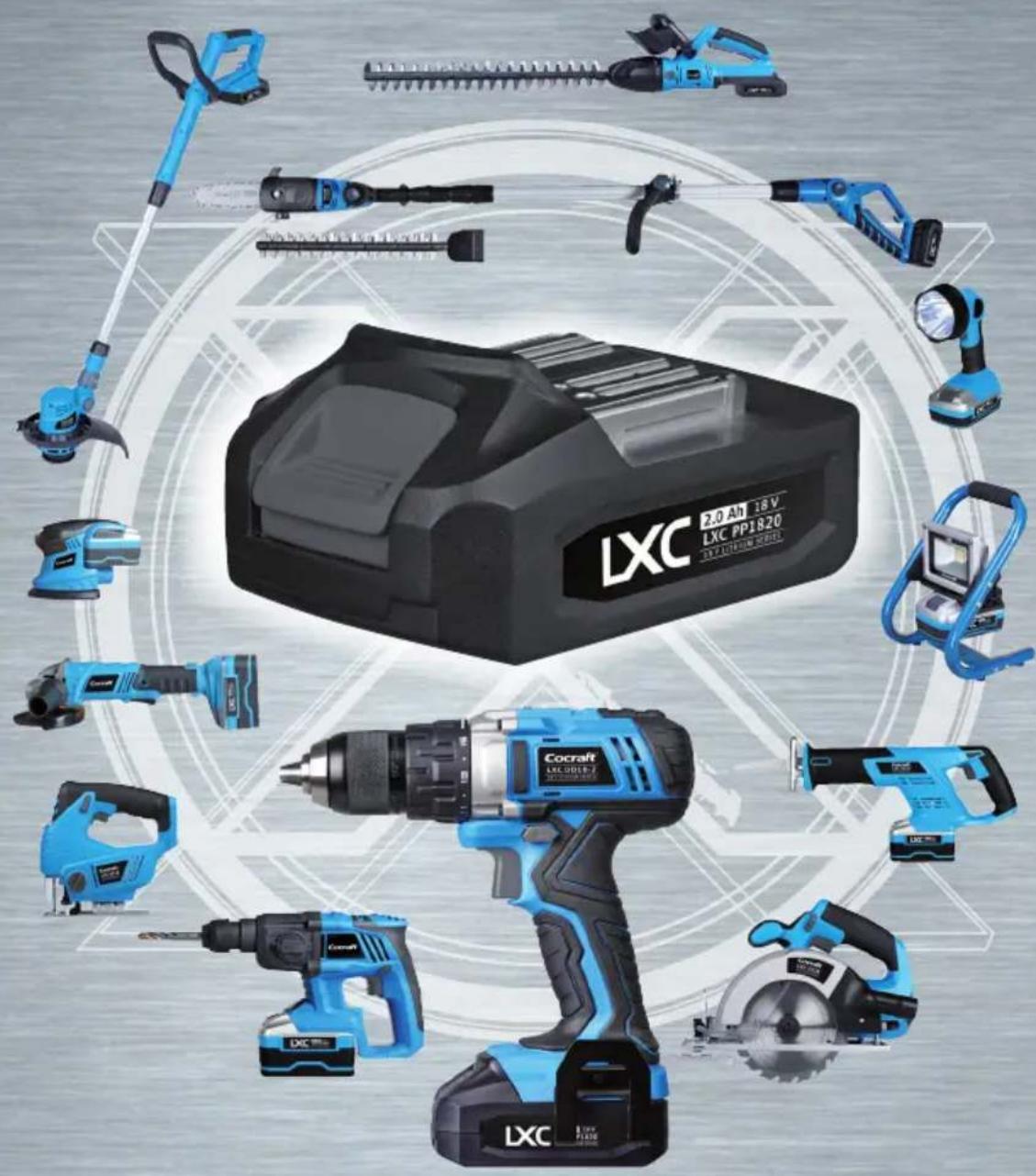
Cocraft LXC is a tool system incorporating lithium-ion technology for an entire series of Cocraft power tools. A single universal battery and charger is all that is needed to power the entire series.

LITHIUM XROSS CONNECT

Important!
Read the entire instruction manual carefully and make sure that you fully understand it before you use the equipment. Keep the manual for future reference.
Viktig information:
natural_image
Cocraft LXC CS18 excavator with blue and black blade (no visible text or symbols on the device itself)Art.no Model
40-8505
DMY009C-180-150
Ver. 20160204
Original instructions
Bruksanvisning i original
Originalbruksanvisning
POSTAL 10 - 13 Market Place
Kingston Upon Thames
Surrey
KT1 1JZ
DEUTSCHLAND
KUNDENSERVICE
Please read the entire instruction manual before use and save it for future reference. We reserve the right for any errors in text or images and for making any necessary technical changes to this document. If you should have any questions concerning technical problems please contact our Customer Services.
Safety
General Power Tool Safety Warnings – Personal Safety
WARNING! Read all safety warnings and all instructions. Failure to follow the warnings and instructions may result in electric shock, fire and/or serious injury.
SAVE ALL WARNINGS AND INSTRUCTIONS FOR FUTURE REFERENCE.
The term "power tool" in the warnings refers to your mains-operated (corded) power tool or battery-operated (cordless) power tool.
1) Work area safety
a) Keep work area clean and well lit. Cluttered or dark areas invite accidents.
b) Do not operate power tools in explosive atmospheres, such as in the presence of flammable liquids, gases or dust. Power tools create sparks which may ignite the dust or fumes.
c) Keep children and bystanders away while operating a power tool.
Distractions can cause you to lose control.
2) Electrical safety
a) Power tool plugs must match the outlet. Never modify the plug in any way. Do not use any adapter plugs with earthed (grounded) power tools. Unmodified plugs and matching outlets will reduce risk of electric shock.
b) Avoid body contact with earthed or grounded surfaces, such as pipes, radiators, ranges and refrigerators. There is an increased risk of electric shock if your body is earthed or grounded.
c) Do not expose power tools to rain or wet conditions. Water entering a power tool will increase the risk of electric shock.
d) Do not abuse the cord. Never use the cord for carrying, pulling or unplugging the power tool. Keep cord away from heat, oil, sharp edges or moving parts. Damaged or entangled cords increase the risk of electric shock.
e) When operating a power tool outdoors, use an extension cord suitable for outdoor use. Use of a cord suitable for outdoor use reduces the risk of electric shock.
f) If operating a power tool in a damp location is unavoidable, use a residual current device (RCD) protected supply. Use of an RCD reduces the risk of electric shock.
3) Personal safety
a) Stay alert, watch what you are doing and use common sense when operating a power tool. Do not use a power tool while you are tired or under the influence of drugs, alcohol or medication. A moment of inattention while operating power tools may result in serious personal injury.
b) Use personal protective equipment. Always wear eye protection. Protective equipment such as dust mask, non-skid safety shoes, hard hat, or hearing protection used for appropriate conditions will reduce personal injuries.
c) Prevent unintentional starting. Ensure the switch is in the off-position before connecting to power source and/or battery pack, picking up or carrying the tool. Carrying power tools with your finger on the switch or energising power tools that have the switch on invites accidents.
d) Remove any adjusting key or wrench before turning the power tool on.
A wrench or a key left attached to a rotating part of the power tool may result in personal injury.
e) Do not overreach. Keep proper footing and balance at all times. This enables better control of the power tool in unexpected situations.
f) Dress properly. Do not wear loose clothing or jewellery. Keep your hair, clothing and gloves away from moving parts. Loose clothes, jewellery or long hair can be caught in moving parts.
g) If devices are provided for the connection of dust extraction and collection facilities, ensure these are connected and properly used. Use of dust collection can reduce dust related hazards.
4) Power tool use and care
a) Do not force the power tool. Use the correct power tool for your application.
The correct power tool will do the job better and safer at the rate for which it was designed.
b) Do not use the power tool if the switch does not turn it on and off. Any power tool that cannot be controlled with the switch is dangerous and must be repaired.
c) Disconnect the plug from the power source and/or the battery pack from the power tool before making any adjustments, changing accessories, or storing power tools. Such preventive safety measures reduce the risk of starting the power tool accidentally.
d) Store idle power tools out of the reach of children and do not allow persons unfamiliar with the power tool or these instructions to operate the power tool. Power tools are dangerous in the hands of untrained users.
e) Maintain power tools. Check for misalignment or binding of moving parts, breakage of parts and any other condition that may affect the power tool's operation. If damaged, have the power tool repaired before use.
Many accidents are caused by poorly maintained power tools.
f) Keep cutting tools sharp and clean. Properly maintained cutting tools with sharp cutting edges are less likely to bind and are easier to control.
g) Use the power tool, accessories and tool bits, etc. in accordance with these instructions, taking into account the working conditions and the work to be performed. Use of the power tool for operations different from those intended could result in a hazardous situation.
5) Battery tool use and care
a) Recharge only with the charger specified by the manufacturer. A charger that is suitable for one type of battery pack may create a risk of fire when used with another battery pack.
b) Use power tools only with specifically designated battery packs. Use of any other battery packs may create a risk of injury and fire.
c) When battery pack is not in use, keep it away from other metal objects, like paper clips, coins, keys, nails, screws or other small metal objects, that can make a connection from one terminal to another. Shorting the battery terminals together may cause burns or a fire.
d) Under abusive conditions, liquid may be ejected from the battery; avoid contact. If contact accidentally occurs, flush with water. If liquid contacts eyes, additionally seek medical help. Liquid ejected from the battery may cause irritation or burns.
6) Service
a) Have your power tool serviced by a qualified repair person using only identical replacement parts. This will ensure that the safety of the power tool is maintained.
Safety Instructions Specific to Circular Saws
DANGER:
a) Keep your hands at a safe distance from the saw blade and out of the cutting line. Keep your free hand on the auxiliary handle. If both your hands are on the handles, you won't be able to cut yourself.
b) Do not reach under the workpiece. The blade guard will not protect you from the blade underneath the workpiece.
c) Adjust the cutting depth to suit the thickness of the workpiece. The blade should barely penetrate the workpiece for safety reasons.
d) Do not hold the workpiece in your hands or across you leg. Fasten the workpiece to a stable surface. It is important that the workpiece is correctly supported to minimise the risk of personal injury, to prevent the saw blade from binding and to prevent you from losing control of the saw.
e) Hold the electrical hand tool by its insulated handles whenever performing tasks where there is a risk of the saw cutting through hidden power cables. Contact with a live wire can lead to the metallic parts of the electrical hand tool becoming live and giving the user an electric shock.
f) When rip sawing, a parallel fence or straight edge guide should be used. This will improve the precision of the sawing and reduce the chances of the saw blade binding.
g) Only use a recommended saw blade. Saw blades that do not fit the saw properly will rotate eccentrically leading to loss of control over the saw.
h) Never use damaged or faulty washers or bolts. The washers and bolts for the saw blade are specially designed to achieve maximum performance and safety.
Additional Safety Instructions for all Saws
Reasons for kickback and preventing kickback
- Kickback is a sudden reaction to a pinched, jammed or incorrectly aligned saw blade which causes the saw to jump back violently out of the workpiece towards the user.
- When the saw blade binds because the kerf behind the blade is closed, the blade stops and the unit is ejected back towards the user.
- If the saw blade is twisted or distorted in the saw cut the teeth at the back of the saw blade can fasten in the workpiece and eject it towards the user.
Kickback is caused by the saw being used incorrectly, for the wrong purpose or under the wrong conditions and can be avoided by taking the following precautions.
a) Hold the saw firmly in both hands and in such a way that you can parry any kickbacks. Stand to the side of saw blade, not in line with it. A kickback can cause the saw to jump backwards but it can be controlled if certain precautions are taken.
b) When the saw blade jams, or if the sawing process is interrupted for some reason, switch the power off and hold the saw still until the blade has completely stopped. Never attempt to withdraw the saw from the workpiece when the blade is rotating, as this could cause a kickback. Examine and take the necessary measures to minimise the risk of blade jamming.
c) When restarting a saw in a workpiece, centre the saw blade in the saw cut and make sure that the teeth of the blade are not touching the material. If the saw blade has jammed it could wander upwards or be ejected from the workpiece when the saw is restarted.
d) Support large boards to reduce the risk of the saw blade binding or kicking back. Large boards tend to sag under their own weight. The boards need to be supported on both sides, near the saw cut and near the edge of the board.
e) Do not use blunt or damaged saw blades. Blunt or incorrectly set saw blades can produce saw cuts that are too narrow, producing too much friction and causing the saw blade to bind or the saw to kickback.
f) The cutting depth and angle adjusters must be locked in place before sawing begins. If any of the saw blade setting adjusters moves during cutting the blade could jam or the saw could kickback.
g) Be especially careful when plunge sawing in walls or objects where it is not possible to see what one is sawing. The protruding saw blade could cut into objects that could cause kickbacks.
Safety Instructions for Saws Fitted with Inner Blade Guard
a) Make sure that the lower blade guard is properly closed before each use. Do not use the saw if the lower blade guard does not move freely and close immediately. Never clamp or bind the lower blade guard in the open position. If the saw is accidentally dropped the lower blade guard can become damaged. Lift the lower blade guard using the handle and make sure that it can move freely without touching the saw blade or any other part of the saw in any of the saw's cutting angles and depths.
b) Make sure that the spring on the lower blade guard works. If the guard or spring do not work properly they must be repaired before the saw is used. The lower guard can stick due to damaged parts, sticky deposits or a build-up of sawdust.
c) The lower blade guard may only be moved to the side for special operations such as plunge sawing and compound sawing. Move the lower guard to the side using the handle and as soon as the saw blade makes contact with the material the lower guard must be released. For all other sawing the lower guard must work automatically.
d) Always make sure that the lower blade guard is covering the blade before laying the saw on a bench or the floor. An uncovered rotating saw blade can cause the saw to move backwards and saw through everything in its path. Bear in mind that it takes time for the saw blade to come to a stop after the power switch has been released.
- Tie the workpiece down if it is not held in place by its own weight.
- Use a dust extractor when using the circular saw.
Safety Warnings for battery pack
a) Do not dismantle, open or shred cells or battery pack.
b) Do not short-circuit a battery pack. Do not store battery packs haphazardly in a box or drawer where they may short-circuit each other or be short-circuited by conductive materials. When battery pack is not in use, keep it away from other metal objects, like paper clips, coins, keys, nails, screws or other small metal objects, that can make a connection from one terminal to another. Shorting the battery terminals together may cause burns or a fire.
c) Do not expose battery pack to heat or fire. Avoid storage in direct sunlight.
d) Do not subject battery pack to mechanical shock.
e) In the event of battery leaking, do not allow the liquid to come into contact with the skin or eyes. If contact has been made, wash the affected area with copious amounts of water and seek medical advice.
f) Seek medical advice immediately if a cell or battery pack has been swallowed.
g) Keep battery pack clean and dry.
h) Wipe the battery pack terminals with a clean dry cloth if they become dirty.
i) Battery pack needs to be charged before use. Always refer to this instruction and use the correct charging procedure.
j) Do not maintain battery pack on charge when not in use.
k) After extended periods of storage, it may be necessary to charge and discharge the battery pack several times to obtain maximum performance.
I) Battery pack gives its best performance when it is operated at normal room temperature (20 ± 5 °C).
m) When disposing of battery packs, keep battery packs of different electrochemical systems separate from each other.
n) Recharge only with the specified charger. Do not use any charger other than that specifically provided for use with the equipment.
A charger that is suitable for one type of battery pack may create a risk of fire when used with another battery pack.
o) Do not use any battery pack which is not designed for use with the equipment.
p) Keep battery pack out of the reach of children.
q) Retain the original product literature for future reference.
r) Remove the battery from the equipment when not in use.
s) Dispose of properly.
General safety instructions for batteries and chargers
- Never attempt to dismantle a battery.
- Never store a battery in direct sunlight or at temperatures above 40 °C.
- Only charge the battery when the ambient temperature is between +5 and 40 °C.
- Never expose the battery or charger to water.
Vibration
- The measurement of the vibration emission level declared in this instruction manual has been carried out in accordance with a standardised test method described in EN 60745 and can be used for comparing one power tool with another.
- The measurement method may also be used for a preliminary assessment of vibration exposure.
- The declared vibration emission level applies when the power tool is used in accordance with this instruction manual. If however, the power tool is used for other purposes and with other accessories or has not been properly maintained, the vibration emission level could increase significantly over the total working period.
- For an exact assessment of the vibration exposure, the times when the tool is switched off or running idle should also be taken into account. This significantly reduces the vibration exposure over the total working period. Decide upon safety measures to protect the operator from the effects of vibration during all types of use.
Product safety symbols

Read the entire instruction manual.

Always use ear protection.
Always use safety glasses.
Always use respiratory protection.
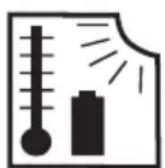
max 50 °C

Protect the battery against heat, e. g., against continuous intense sunlight, fire, water, and moisture. Danger of explosion.
Parts
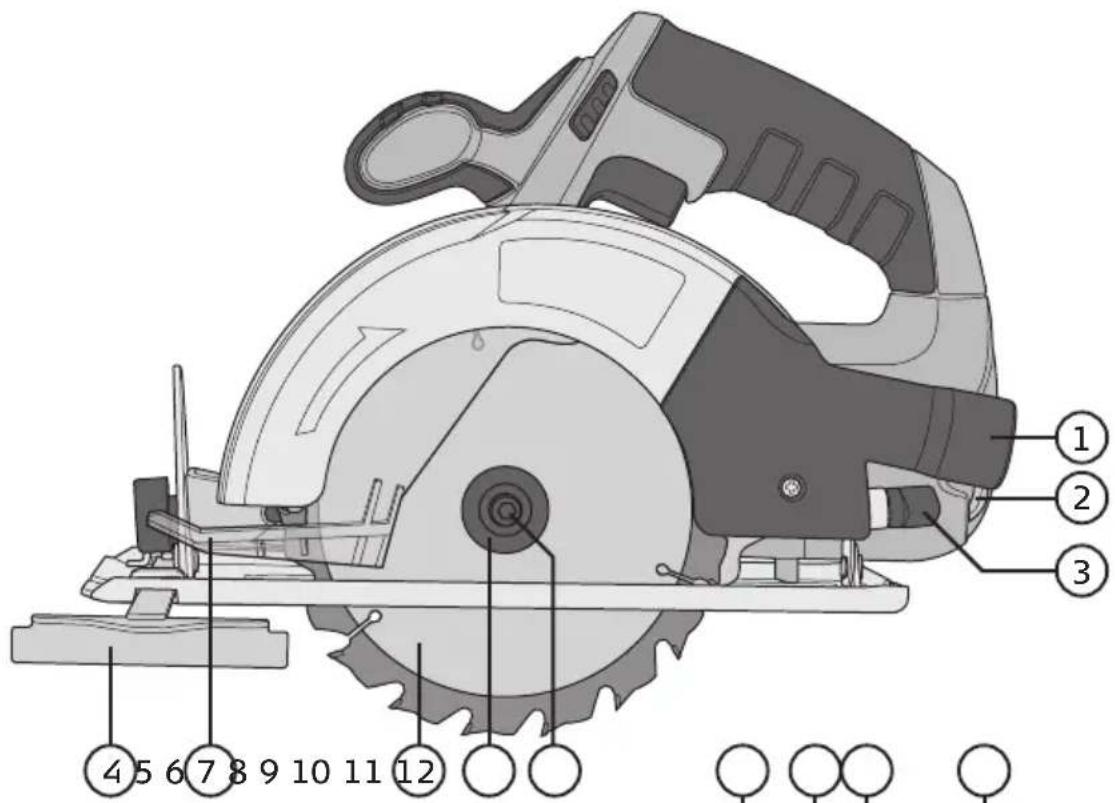
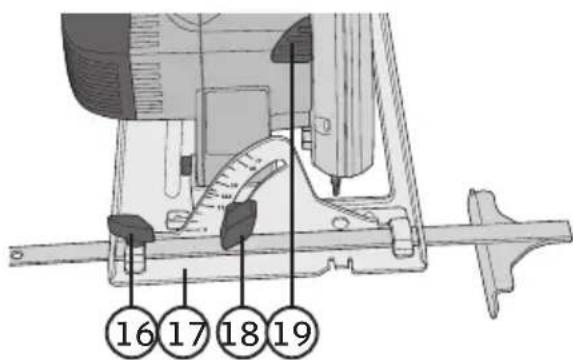
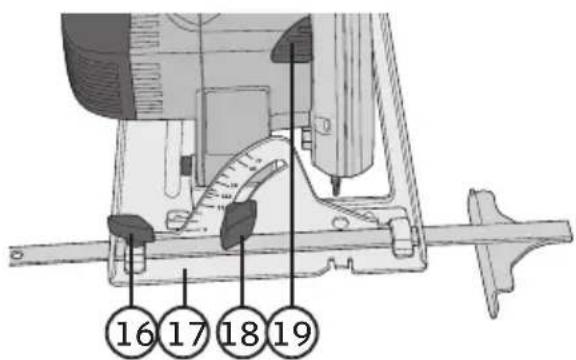
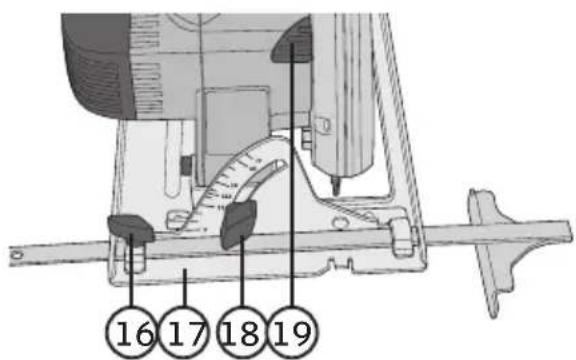
- Dust port
- Allen key
- Depth adjustment locking knob
- Parallel guide
- Blade guard retracting lever
- Saw blade
- Blade flange washer
- Socket head blade bolt
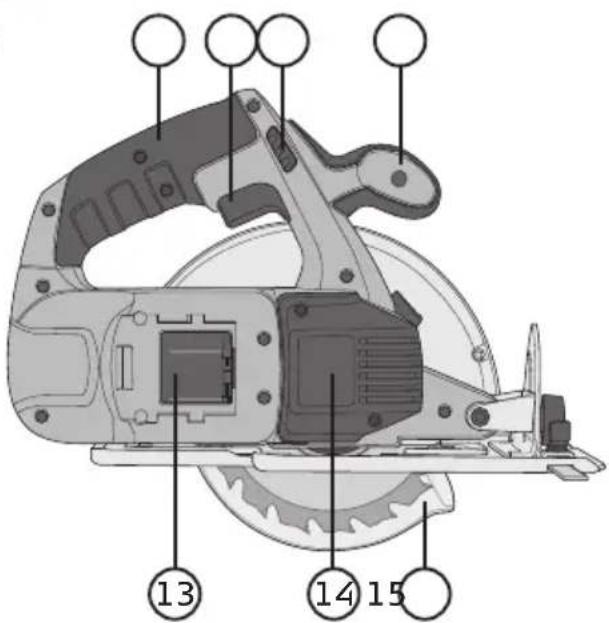
- Rear handle
- Power trigger
- Safety lock button
- Front handle
- Battery connection
- Rating plate
- Blade guard
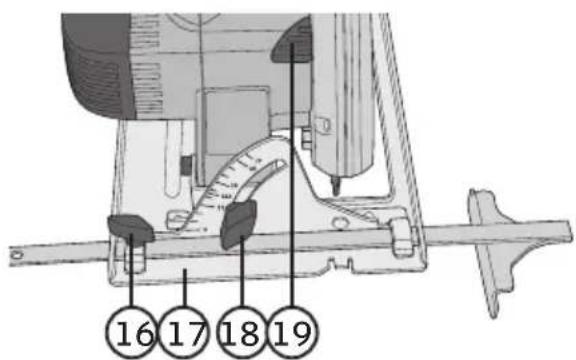
- Parallel guide locking knob
- Base plate
- Bevel adjustment locking knob
- Spindle lock button
Setup and maintenance Setting the blade angle
- Undo the locking knob.
- Set the desired bevel angle, 0–45°.
- Tighten the locking knob.
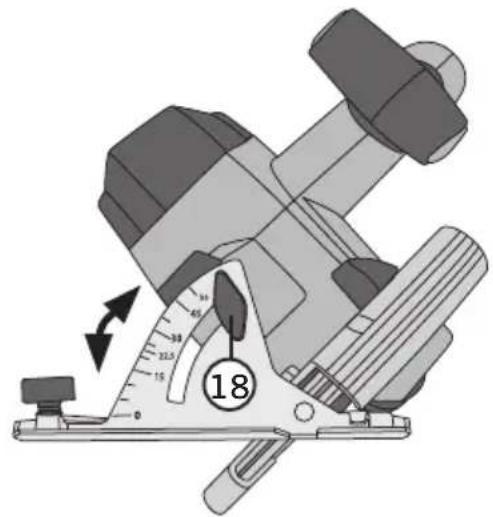
Setting the cutting depth
- Undo the locking knob.
- Lower the base plate to the desired cutting depth.
- Tighten the locking knob.
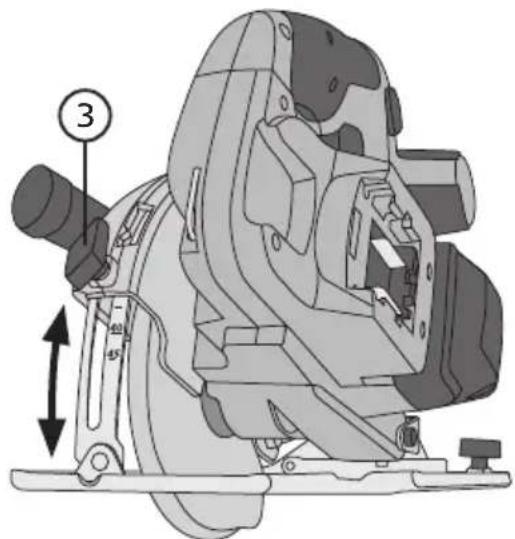
Setting the parallel guide
- Undo the locking knob.
- For sawing at 90^ , lock the scale next to slot A. For sawing at 45^ , lock the scale next to slot B. Don't forget to allow for the thickness of the blade! Tighten the locking knob.
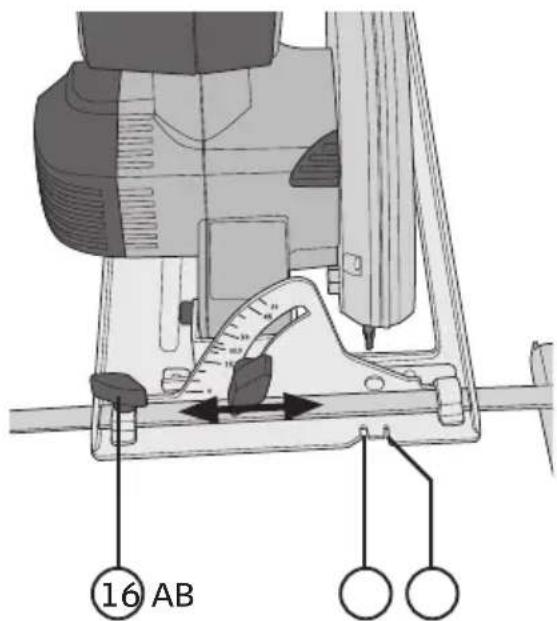
Changing the blade
- Remove the battery from the saw for safety.
- Take off the Allen key stored on the back of the saw.
- Press in the spindle lock button and rotate the blade carefully by hand until the spindle lock engages.
- Using the Allen key, turn the blade bolt clockwise to undo the blade.
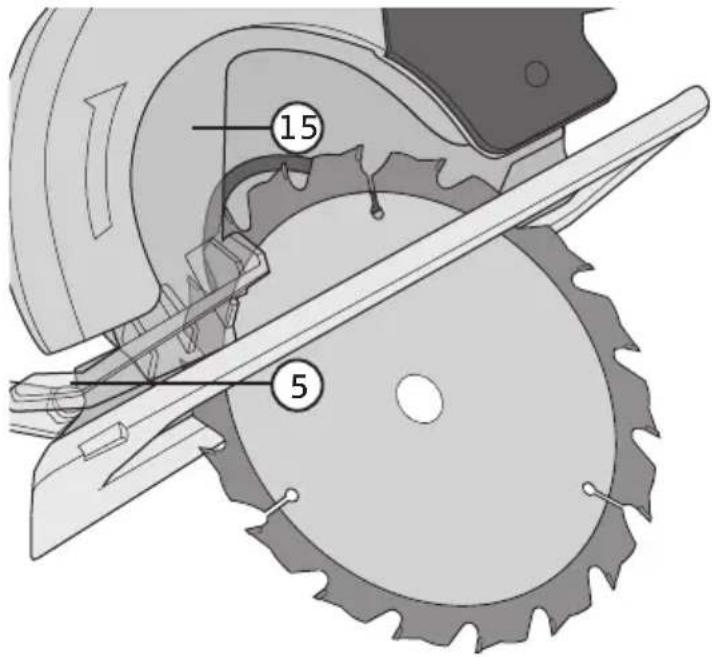
- Move the blade guard (15) back and hold it using the retracting lever (5).
- Remove the flange washer and then the saw blade.
- Fit a new saw blade by performing the above steps in reverse order.
Note: Before refitting the battery and starting the saw after a blade change, always double-check that the blade is fitted properly and that the blade bolt is tight.
Switching on and off
- Switching on: Hold in the safety lock button and then press the power trigger.
- Switching off: Release the power trigger.
Overload protection and other safety features
The machine/battery have a number of safety features that prevent damage to the machine and battery during use.
- During short high-load situations the overload protection may turn off the machine/battery. This protection resets automatically. Release the trigger, wait a few seconds, ensure that there is no load and restart the machine. The machine should now function normally again.
- During high-load situations for an extended period of time the overheating protection will turn off the machine/battery. This feature is self-resetting once the saw returns to normal operating temperature. Let the machine cool properly before trying to restart it. Adverse temperatures can occur in direct sunlight and should therefore be avoided.
- The battery has low-voltage protection which comes into effect when the battery becomes discharged. The low-voltage protection turns off the machine automatically and the battery should then be recharged.
Troubleshooting guide
| Problem Possible cause Solution | ||
| The machine does not start. | Battery is discharged. Recharge the battery. | |
| The battery is overheated. Let the battery cool down. | ||
| Worn brushes. Contact our Customer Services. | ||
| Faulty power trigger. | ||
| The machine is slow and/or shuts off. | Blunt or damaged blade. Replace the saw blade. | |
| Too much pressure applied. Decrease applied pressure. | ||
| The battery is discharged. Recharge the battery. | ||
| The battery is overheated. Let the battery cool down. | ||
| The motor is overheated. Let the motor cool down. | ||
| Unusual sounds and/or strong vibrations. | The saw blade is not fitted correctly. | Make sure that the blade is centred and that the bolt is tight. |
| Sparks in the motor. | Faulty brushes. Contact customer services. | |
| Winding short circuited. | ||
| Dirty commutator. | ||
Responsible disposal
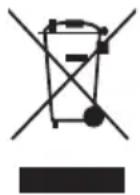
This symbol indicates that this product should not be disposed of with general household waste. This applies throughout the entire EU. In order to prevent any harm to the environment or health hazards caused by incorrect waste disposal, the product must be handed in for recycling so that the material can be disposed of in a responsible manner. When recycling your product, take it to your local collection facility or contact the place of purchase. They will ensure that the product is disposed of in an environmentally sound manner.
Specifications
No-load speed 3400 rpm
TCT saw blade 150 × 1.5 × 10 mm, 18 teeth
Cutting depth 45 mm (32 mm at 45°)
Blade bevel 0–45°
Noise level LpA: 76.1 dB(A), Uncertainty KpA: 3 dB(A)
LwA: 87.1 dB(A), Uncertainty KwA: 3 dB(A)
Vibration value a_h,W 1.728 m/s ^2 , Uncertainty K: 1.5 m/s ^2
Weight 2.75 kg (without battery)
(Battery and charger sold separately)
Cirkelsåg
Art.nr 40-8505 Modell DMY009C-180-150
Sagedybde 0–45 mm (45° 32 mm)
Vinkling 0–45°
Lyd LpA: 76,1 dB(A), Unøyaktighet KpA: 3 dB(A)
LwA: 87,1 dB(A), Unøyaktighet KwA: 3 dB(A)
natural_image
Mechanical device with measurement scale and numbered component (no readable text or symbols)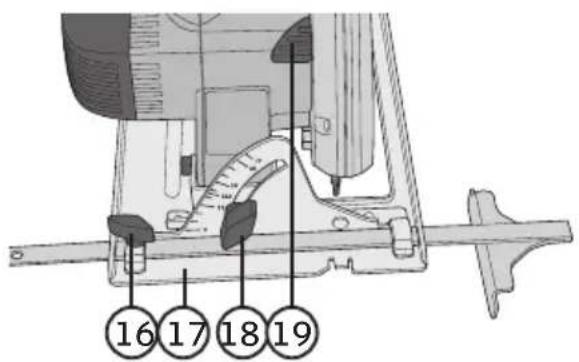
Declaration of Conformity
Declares that this product complies with the requirements of the following directives and standards
Machinery Directive 2006/42/EC
EMC Directive 2004/108/EC
EN 60745-1:2009
+A11:2010
EN 60745-2-5:2010
EN 55014-1:2006
+A1:2009+A2:2011
EN 55014-2:1997
+A1:2001+A2:2008
ISSUED BY THE FOLLOWING NOTIFIED BODY:
UTFÄRDATS AV FÖLJANDE ANMÄLDA ORGAN:
UTSTEDT AV F∅LGENDE TEKNISK KONTROLLORGAN:
MYÖNTÄNYT SEURAAVA ILMOITETTU LAITOS:
BV LCIE, Building 4, No.518, Xin Zhuan Road,
CaoHejing Songjiang High-Tech Park, Shanghai P.R.C
Henrik Alfredsson
Manager Technique & Quality
Insjön, Sweden, 2016-02-03
LXC
LITHIUM XROSS CONNECT
18V LITHIUM SERIES

- Important!
- Viktig information:
- DEUTSCHLAND
- Safety
- General Power Tool Safety Warnings – Personal Safety
- 1) Work area safety
- 2) Electrical safety
- 3) Personal safety
- 4) Power tool use and care
- 5) Battery tool use and care
- 6) Service
- Safety Instructions Specific to Circular Saws
- DANGER:
- Additional Safety Instructions for all Saws
- Reasons for kickback and preventing kickback
- Safety Instructions for Saws Fitted with Inner Blade Guard
- Safety Warnings for battery pack
- General safety instructions for batteries and chargers
- Vibration
- Product safety symbols
- Parts
- Setup and maintenance Setting the blade angle
- Setting the cutting depth
- Setting the parallel guide
- Changing the blade
- Switching on and off
- Overload protection and other safety features
- Responsible disposal
- Specifications
- Cirkelsåg
- Declaration of Conformity
- LXC
- LITHIUM XROSS CONNECT
- 18V LITHIUM SERIES
Brand : Cocraft
Model : LXC CS18
Category : Saw