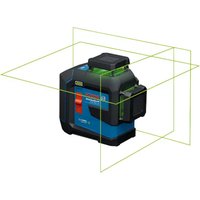
GLL 300-42 G Professional - Laser level BOSCH - Free user manual and instructions
Find the device manual for free GLL 300-42 G Professional BOSCH in PDF.


| Product type | Cross-line laser level |
| Brand | Bosch |
| Model | GLL 300-42 G Professional |
| Article number | 3601K65510 |
| Laser class | 2 |
| Laser type | < 10 mW, 500-540 nm |
| Working area (without receiver) | 100 ft (30 m) |
| Working area (with LR8 receiver) | 15-260 ft (5-80 m) |
| Leveling accuracy | ± 1/8 in at 30 ft (± 3 mm at 10 m) |
| Self-leveling range | ± 4° |
| Typical leveling time | < 4 s |
| Power supply | 3.7 V lithium-ion battery pack (GBA37V30) or 4 LR6 (AA) batteries |
| Approximate runtime | Not specified in the manual, estimated several hours depending on use |
| Operating temperature | 14°F to 104°F (-10°C to +40°C) |
| Storage temperature | -4°F to 158°F (-20°C to +70°C) |
| Protection type | IP65 |
| Weight (with battery pack) | Not specified in the manual, approx. 0.5 kg (estimate) |
| Tripod mount | 1/4 in and 5/8 in |
| Laser receiver compatibility | LR8 |
| Operating modes | Horizontal line, two vertical lines, tilt mode |
| Special functions | Self-leveling, energy-saving mode, automatic shut-off (120 min) |
| Maintenance | Clean with a soft, damp cloth, no solvents |
| Safety | Class 2 laser, do not look into the beam, avoid direct eye contact |
| Warranty | Limited warranty, see Bosch website |
Frequently Asked Questions - GLL 300-42 G Professional BOSCH
User questions about GLL 300-42 G Professional BOSCH
0 question about this device. Answer the ones you know or ask your own.
Ask a new question about this device
Download the instructions for your Laser level in PDF format for free! Find your manual GLL 300-42 G Professional - BOSCH and take your electronic device back in hand. On this page are published all the documents necessary for the use of your device. GLL 300-42 G Professional by BOSCH.
USER MANUAL GLL 300-42 G Professional BOSCH
| Safety Symbols The definitions below describe the level of severity for each signal word. Please read the manual and pay attention to these symbols. | |
| ! | This is the safety alert symbol. It is used to alert you to potential personal injury hazards. Obey all safety messages that follow this symbol to avoid possible injury or death. |
| ▲ DANGER | DANGER indicates a hazardous situation which, if not avoided, will result in death or serious injury. |
| ▲ WARNING | WARNING indicates a hazardous situation which, if not avoided, could result in death or serious injury. |
| ▲ CAUTION | CAUTION indicates a hazardous situation which, if not avoided, could result in minor or moderate injury. |
Table of Contents
General Safety Rules 3
FCCCaution 5
ISEDCanada. 6
Intended Use 6
Symbols. 7
Getting to Know Your GLL300-42G Line Laser. 8
Technical Data 10
Preparation 12
Laser Tool Power Supply 12
Energy Saving Mode 134 Battery Status Indicator 14
Operation 15
Initial Operation 15
Switching On and Off 15
Operating Modes 15
Automatic Leveling 15
Accuracy Check of the Laser Tool . . . 16
Use with Attachments. 18
Maintenance and Service 24
Environment Protection 24
General Safety Rules
WARNING
Read all instructions. Failure to follow all instructions listed below may result in electric shock, fire and/or serious injury.
SAVE ALL WARNING AND INSTRUCTIONS FOR FUTURE REFERENCE.
The term "laser tool" in the warnings listed below refers to your battery-operated (cordless) laser tool.
The following label is on your tool for your safety. ALWAYS BE AWARE of its location when using the laser.
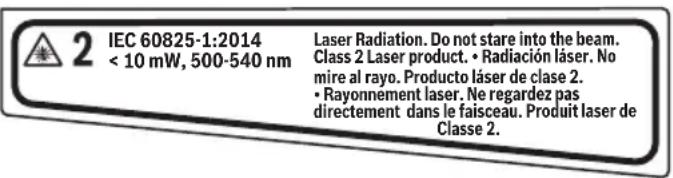

DO NOT direct the laser beam at persons or animals and do not stare into the laser beam yourself. This laser tool produces class 2 laser radiation
and complies with 21 CFR 1040.10 and 1040.11 except for conformance with IEC 60825-1 Ed.3., as described in Laser Notice No. 56, dated May 8, 2019. This can lead to persons being blinded.
DO NOT stare directly at the laser beam or project the laser beam directly into the eyes of others. Serious eye injury could result.
DO NOT place the laser tool in a position that may cause anyone to stare into the laser beam intentionally or unintentionally. Serious eye injury could result.
ALWAYS make sure that any bystanders in the vicinity of use are made aware of the dangers of looking directly into the laser tool.
Never aim the beam at a workpiece with a reflective surface. Bright shiny reflective sheet steel or similar reflective surfaces are not recommended for laser use. Reflective surfaces could direct the beam back towards the operator.
Use of controls or adjustments or performance of procedures other than those specified herein may result in hazardous radiation exposure.
DO NOT use any optical tools such as, but not limited to, telescopes or transits to view the laser beam. Serious eye injury could result.
DO NOT leave the laser tool "ON" unattended in any operation mode. ALWAYS turn the laser tool "OFF" when not in use. Leaving the laser tool "ON" increases the risk of someone inadvertently staring into the laser beam.
Do not use the laser viewing glasses as safety goggles. The laser viewing glasses are used for improved visualization of the laser beam, but they do not protect against laser radiation.
Do not use the laser viewing glasses as sun glasses or in traffic. The laser viewing glasses do not afford complete UV protection and reduce color perception.
ALWAYS position the laser tool securely. Damage to the laser tool and/or serious injury to the user could result if the laser tool falls.
DO NOT remove or deface any warning or caution labels. Removing labels increases the risk of exposure to laser radiation.
Battery tool use and care
Recharge only with the charger specified by the manufacturer. A charger that is suitable for one type of battery pack may create a risk of fire when used with another battery pack.
Use tool only with specifically designated battery packs. Use of any other battery packs may create a risk of injury and fire.
When battery pack is not in use, keep it away from other metal objects like paper clips, coins, keys, nails, screws, or other
General Safety Rules
small metal objects that can make a connection from one terminal to another. Shorting the battery terminals together may cause burns or a fire.
Under abusive conditions, liquid may be ejected from the battery; avoid contact. If contact accidentally occurs, flush with water. If liquid contacts eyes, additionally seek medical help. Liquid ejected from the battery may cause irritation or burns.
Do not use a battery pack or tool that is damaged or modified. Damaged or modified batteries may exhibit unpredictable behaviour resulting in fire, explosion or risk of injury.
Do not expose a battery pack or tool to fire or excessive temperature. Exposure to fire or temperature above 265^ (130^) may cause explosion.
Follow all charging instructions and do not charge the battery pack or tool outside the temperature range specified in the instructions. Charging improperly or at temperatures outside the specified range may damage the battery and increase the risk of fire.
Disconnect the battery pack from the tool before making any adjustments, changing accessories, or storing the tool. Such preventive safety measures reduce the risk of starting the tool accidentally.
Do not modify or attempt to repair the tool or the battery pack except as indicated in the instructions for use and care.
Work area safety
Keep work area clean and well lit. Cluttered or dark areas invite accidents.
DO NOT operate the laser tool around children or allow children to operate the laser tool. Serious eye injury could result.
DO NOT use laser tools, attachments and accessories outdoors when lightning conditions are present.
Do not operate the laser tool in explosive environments, such as in the presence of flammable liquids, gases or dusts. Sparks can be created in the laser tool which may ignite the dust or fumes.
Electrical safety
WARNING Batteries can explode or leak,cause injury or
fire. To reduce this risk, always follow all instructions and warnings on the battery label and package.
DO NOT short any battery terminals.
DO NOT charge alkaline batteries.
DO NOT mix old and new batteries. Replace all of them at the same time with new batteries of the same brand and type.
DO NOT mix battery chemistries.
Dispose of or recycle batteries per local code.
DO NOT dispose of batteries in fire.
Keep batteries out of reach of children.
Remove batteries if the device will not be used for several months.
WARNING Risk of fire and burns. Do not open, crush or heat above 158^ (70^) or incinerate.
Personal safety
If laser radiation strikes your eye, you must deliberately close your eyes and immediately turn your head away from the beam.
Do not make any modifications to the laser equipment.
Stay alert, watch what you are doing and use common sense when operating a tool. Do not use a tool while you are tired or under the influence of drugs, alcohol or medication. A moment of inattention while operating a tool may result in serious personal injury or incorrect measurement results.
Use safety equipment. Always wear eye protection. Safety equipment such as dust mask, non-skid safety shoes, hard hat, or hearing protection used for appropriate conditions will reduce personal injuries.
Use caution when using laser tools in the vicinity of electrical hazards.
General Safety Rules
Magnets

Keep the magnetic accessories away from implants or other medical devices such as pacemaker or insulin pumps. The
magnets generate a field that can impair the function of implants or medical devices, which may lead to serious personal injury.
Keep the tool, positioning device, and laser target plate away from magnetic data medium and magnetically-sensitive equipment. The effect of the magnets of the tool and laser target plate can lead to irreversible data loss.
Use and care
Use the correct tool for your application. The correct tool will do the job better and safer.
Do not use the tool if the switch does not turn it on and off. Any tool that cannot be controlled with the switch is dangerous and must be repaired.
Store idle tool out of the reach of children and do not allow persons unfamiliar with the tool or these instructions to operate the tool. Tools are dangerous in the hands of untrained users.
Maintain tools. Check for misalignment or binding of moving parts, breakage of parts and any other condition that may affect the operation. If damaged, have the tool repaired before use. Many accidents are caused by poorly maintained tools.
Use the tool, accessories, etc., in accordance with these instructions and in the manner intended for the particular type of tool, taking into account the working conditions and the work to be performed. Use of the tool for operations different from those intended could result in a hazardous situation.
Service
Have your tool serviced by a qualified repair person using only identical replacement parts. This will ensure that the safety of the tool is maintained.
Develop a periodic maintenance schedule for tool. When cleaning a tool be careful not to disassemble any portion of the tool since internal wires may be misplaced or pinched or may be improperly mounted.
Certain cleaning agents such as gasoline, carbon tetrachloride, ammonia, etc. may damage plastic parts.
FCC Caution

The manufacturer is not responsible for radio interference caused by unauthorized modifications to this equipment. Such
modifications could void the user's authority to operate the equipment.
This device complies with Part 15 of the FCC Rules. Operation is subject to the following two conditions:
- This device may not cause harmful interference, and
- This device must accept any interference received, including interference that may cause undesired operation.
NOTE! This equipment has been tested and found to comply with the limits for a Class B digital device, pursuant to Part 15 of the
FCC rules. These limits are designed to provide reasonable protection against harmful interference in a residential installation. This equipment generates uses and can radiate radio frequency energy and, if not installed and used in accordance with the instructions, may cause harmful interference to radio communications. However, there is no guarantee that interference will not occur in a particular installation. If this equipment does cause harmful interference to radio or television reception, which can be determined by turning the equipment off and on, the user is encouraged to try to correct the interference by one or more of the following measures:
- Reorient or relocate the receiving antenna.
FCC Caution
- Increase the separation between the equipment and receiver.
-
Connect the equipment into an outlet on a circuit different from that to which the receiver is connected.
-
Consult the dealer or an experienced radio/TV technician for help.
ISED Canada
This device contains licence-exempt transmitter(s)/receiver(s) that comply with Innovation, Science and Economic Development Canada's licence-exempt RSS(s). Operation is subject to the following two conditions:
- this device may not cause interference, and
- this device must accept any interference, including interference that may cause undesired operation of the device.
Intended Use
The tool is intended for determining and checking horizontal and vertical lines.
The laser tool is suitable for indoor use.
Symbols
Important: Some of the following symbols may be used on your tool. Please study them and learn their meaning. Proper interpretation of these symbols will allow you to operate the tool better and safer.
| Symbol Designation/Explanation | |
| V Volts | (voltage) |
| A Amperes (current) | |
| Hz Hertz (frequency, cycles per second) | |
| W Watt | (power) |
| ft Feet | (length) |
| in Inches (length) | |
| m Meters (length) | |
| mm Millimeters (length) | |
| lb Pounds (weight) | |
| kg Kilograms (weight) | |
| min Minutes (time) | |
| s Seconds (time) | |
| F Fahrenheit (temperature) | |
| C Celsius (temperature) | |
| = = | Direct current (type or a characteristic of current) |
| This symbol indicates magnetic field in place. | |
| Alerts user to laser radiation. | |
| Alerts user to read manual. | |
| Alerts user to wear eye protection. | |
Symbols
Important: Some of the following symbols may be used on your tool. Please study them and learn their meaning. Proper interpretation of these symbols will allow you to operate the tool better and safer.
| Symbol Designation/Explanation | |
| RECYCLE | Designates Li-ion battery recycling program. |
| C US | This symbol designates that this tool is listed by the Canadian Standards Association, to United States and Canadian Standards. |
| F C | This symbol designates that the tool complies with FCC Rules. |
Getting to Know Your GLL300-42G Line Laser
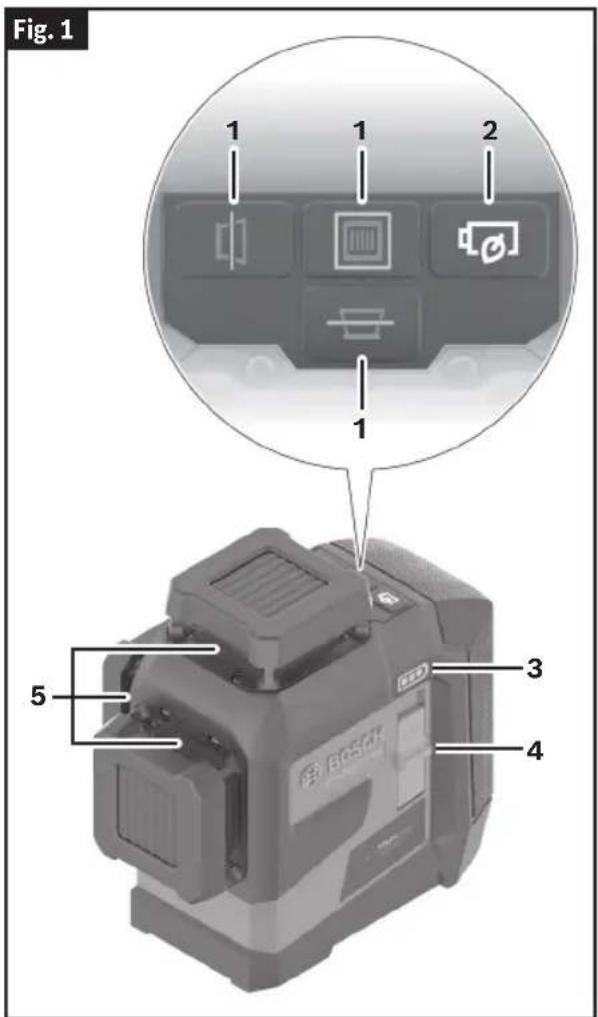
1 Buttons for Laser Operating Mode
2 Button for Energy Saving Mode
3 Battery Status Indicator
4 On/Off Switch
5 Exit Opening for Laser Beam
Getting to Know Your GLL300-42G Line Laser
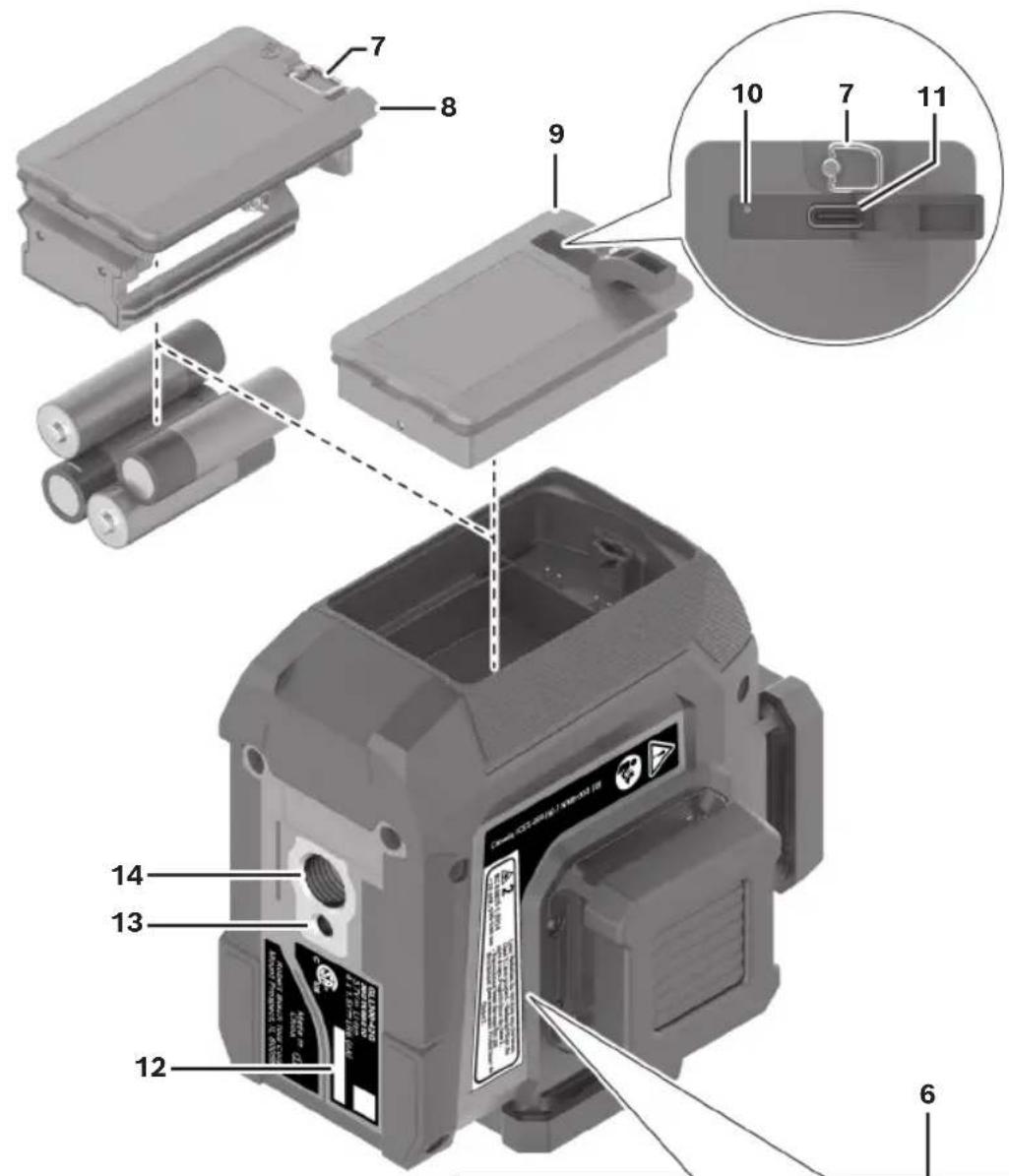
Fig.2
2
IEC 60825-1:2014
<10mW,500-540nm
Laser Radiation. Do not stare into the beam.
6 Laser Warning Label
7 Latch of the Lithium-Ion Battery Pack/ Battery Adapter
8 Battery Adapter
9 Lithium-Ion Battery Pack
10 Charge Indicator of the Lithium-Ion Battery Pack
11 USB Type-C Port
12 Serial Number
13 Tripod Mount 1/4"
14 Tripod Mount 5/8"
- The accessories illustrated or described are not included as standard delivery.
Technical Data
| Line Laser GLL300-42G | |
| Article number 3601K65510 | |
| Working range (typical)1 · Without laser receiver · With laser receiver2 | 100 ft (30 m) 15-260 ft (5-80 m) |
| Leveling accuracy (typical)345 | 1/8 in. at 30 ft (±3 mm at 10 m) |
| Self-leveling range (typical) ±4° | |
| Leveling duration (typical) < 4 s | |
| Operating temperature6 | 14°F to 104°F (-10°C to +40°C) |
| Storage temperature -4°F to 158°F (-20°C to +70°C) | +70°C |
| Max. altitude 6,562 ft (2000 m) | |
| Relative air humidity, max. 90% | |
| Laser class 2 | |
| Pollution degree according to IEC 61010-17 | 2 |
| Laser type < 10 mW, 500-540 nm | |
| C6 10 | |
| Divergence 50 × 10 mrad (full angle) | |
| Compatible laser receiver LR8 | |
| Tripod mount | 1/4", 5/8" |
| Laser tool power supply · Battery pack (lithium-ion) · Batteries (alkali-manganese) | 3.7 V 4 x 1.5 V LR6 (AA) |
| Degree of protection | IP65 |
- The working range can be decreased by unfavorable environmental conditions (e.g. direct sun irradiation).
- Maximum receiver range is possible at 135^ and 315^ only.
- Applies to the four horizontal intersection points.
- The values stated presuppose normal to favorable environmental conditions (e.g. no vibration, no fog, no smoke, no direct sunlight). Extreme fluctuations in temperature can cause deviations in accuracy.
- An additional deviation of ± 0.004in / m (± 0.1mm / m) must be taken into account when at maximum self-leveling range.
- Limited performance at temperatures < 32^ ( 0^ ).
- Only non-conductive deposits occur, whereby occasional temporary conductivity caused by condensation is expected.
Technical Data
| Lithium-ion Battery Pack (optional) | |
| Type GBA37V30 | |
| Article number 1600A031G4 | |
| USB port USB Type-C | |
| Rated voltage 3.7 V | --- |
| Capacity 3.0 Ah | |
| Input voltage 5.0 V | --- |
| Recommended ambient temperature during charging | 50°F ~ 95°F (+10° ~ +35°C) |
| Permitted ambient temperature during storage | 14°F ~ 113°F (-10°C ~ +45°C) |
| USB-C Cable | |
| Article number 1605A002XH | |
| Rated voltage 5.0 V | --- |
| Capacity 2.0 A max | |
| Power Adapter (optional) | |
| Recommended power adapter Output rated | 5V, 2A |
Technical data determined with battery from delivery scope.
The laser tool can be clearly identified with the Serial Number 12 on the nameplate.
Preparation
Laser Tool Power Supply
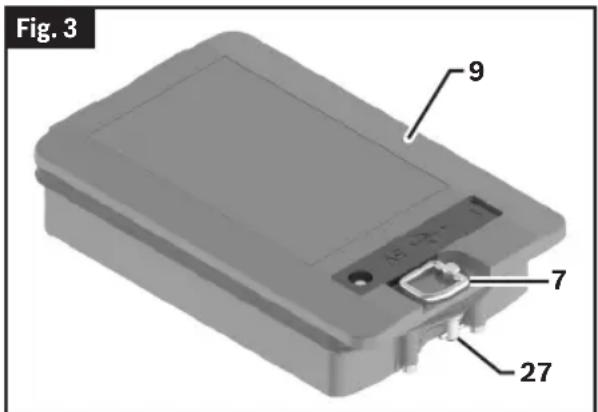
(Fig. 3)
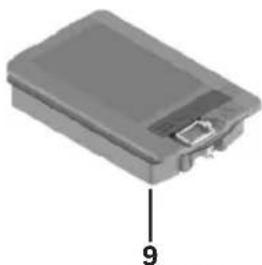
The tool can either be operated with the Bosch rechargeable Lithium-Ion Battery Pack 9 outlined in "Technical Data" on page 10 or commercially available LR6 (AA) batteries (optional).
Operation with Bosch Rechargeable Lithium-Ion Battery Packs
(Fig. 3)
WARNING Follow all warnings and all instructions in the
Bosch rechargeable lithium-ion battery pack manual before using the battery pack.
Improper usage and recharge of battery pack may increase the risk of fire, personal injury and property damage.
WARNING Use only Bosch rechargeable lithium-ion battery
packs listed in the technical data section of this manual. Use of other battery packs may increase the risk of fire, personal injury and property damage.
WARNING Remove the batteries from the tool when not
using it for extended periods. When storing for extended periods, the batteries can corrode and self-discharge.
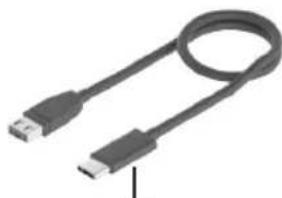
WARNING Use only Bosch USB-C cable listed in the tech
nical data section of this manual. Use of other USB-C cables may increase the risk of fire, personal injury and property damage.
Note: The Lithium-Ion Battery Pack 9 is supplied partially charged. To ensure full capacity of the battery pack, completely charge the battery pack with the USB power adapt
12
er (recommended) listed in "Technical Data" on page 10 before using for the first time. See Bosch rechargeable lithium-ion battery pack manual for details.
The Lithium-Ion Battery Pack 9 is protected against deep discharge by the Electronic Cell Protection (ECP). A protective circuit switches the laser level off when the battery is drained.
Following the automatic shut off of the tool, do not slide the On/Off Switch 4 to OFF and ON. The battery can be damaged.
To insert the lithium-ion battery, place the Lithium-Ion Battery Pack 9 in the laser tool. Turn the Latch of the Lithium-Ion Battery Pack 790^ clockwise to rotate the Lithium-Ion Battery Locking Mechanism 27. Push down on the Latch 7 so it lays flush against the battery pack and does not interfere with operation.
To remove the Lithium-ion Battery Pack 9, pull up the Latch of the Lithium-Ion Battery Pack 7 and turn it 90^ counterclockwise. Take the lithium-ion battery pack out of the laser tool.
Charging the Lithium-Ion Battery Pack
(Fig. 3)
- For charging, use a USB power supply unit whose output voltage and output current comply with the requirements in "Technical Data" on page 10.
- Pay attention to the mains voltage. The voltage of the power source must match the voltage specified on the type plate of the power supply.
- Only use the USB connection to charge the battery at an ambient temperature of between +50^ and +95^ ( +10^ and +35^ ). Charging outside of this temperature range can damage the battery and increase the risk of fire.
Note: Lithium-ion rechargeable batteries are supplied partially charged according to international transport regulations. To ensure full rechargeable battery capacity, fully charge the Lithium-Ion Battery Pack 9 before using your tool for the first time.

Preparation
Open the flap for the USB Type-C® Port 11. Connect the USB port to a USB power supply unit using the USB Type-C Cable 25. Connect the USB power supply unit to the mains supply.
Remove the USB Type-C Cable 25 after completing the charging process. Close the flap for the USB Type-C Port 11 to protect it from dust and splashes.
| LED Status Cause Corrective | Action | |
| Off Charging cable not con- | nected | Connect charging cable. |
| Green Full charge - | ||
| Yellow Charging - | ||
| Red Wrong charging voltage. | Use only power adapter | and USB C cable listed in "Technical Data" on page 10 to charge the Bosch battery pack. |
| Blinking Green/Yellow Charg | ng temperature too high | Charge battery pack in temperatures above +50°F (+10°C) and below +95°F (+35°C). |
| Other charging error Have ba | terry pack checked by Authorized Bosch Service Center or Service Station. |
Operation with LR6 (AA) Batteries (optional)
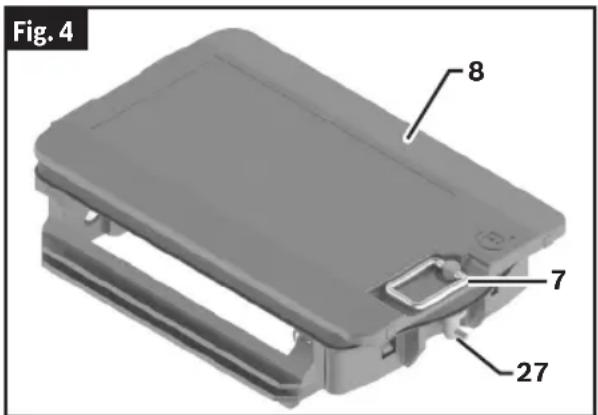
(Fig. 4)
It is recommended that you use alkaline manganese batteries to operate the laser tool.
Put the non-rechargeable batteries into the Battery Adapter 8. When inserting the non-rechargeable batteries, ensure that the polarity is correct according to the illustrations on the side and front interior of the battery adapter.
Always replace all the batteries at the same time. Only use batteries from the same manufacturer and which have the same capacity.
To insert the Battery Adapter 8, place the Battery Adapter 8 in the laser tool. Turn the Latch of the Battery Adapter 790^ clockwise to rotate the Lithium-Ion Battery Locking Mechanism 27. Push down on the Latch 7 so it lays flush against the Battery Adapter 8 and does not interfere with operation.
To remove the battery adapter, pull up the Latch of the Battery Adapter 7 and turn it 90^ counterclockwise. Take the Battery Adapter 8 out of the laser tool.
Remove the batteries from the laser tool when not using it for extended periods. When storing for extended periods, the batteries can corrode and discharge themselves.
Energy Saving Mode
To save energy, you can reduce the brightness of the laser lines. For this, press the Button for Energy Saving Mode 2. The energy saving mode is indicated by the Button
Preparation
for Energy Saving Mode 2 lighting up. To end energy saving mode, press the Button for Energy Saving Mode 2 again so that it goes out.
Battery Status Indicator
(Fig.1)
The Battery Status Indicator 3 shows the current state of charge of the lithium-ion battery pack/non-rechargeable batteries when the laser tool is switched on.
If the Lithium-Ion Battery Pack 9 or nonrechargeable batteries are running low, the laser lines will gradually become dimmer.
If the lithium-ion battery pack/non-rechargeable batteries are almost empty, the Battery Status Indicator 3 will flash continuously. The laser lines will flash for 5 seconds every 5 minutes.
If the lithium-ion battery pack/non-rechargeable batteries are empty, the laser lines and the Battery Status Indicator 3 will flash one last time before the laser tool switches off.
Operation
Initial Operation
- Protect the tool against moisture and direct sun light.
- Do not subject the tool to extreme temperatures or variations in temperature. As an example, do not leave it in vehicles for longer periods. In case of large variations in temperature, allow the tool to adjust to the ambient temperature before putting it into operation. In case of extreme temperatures or variations in temperature, the accuracy of the tool can be impaired.
- Avoid heavy impacts or dropping of the tool. After a heavy exterior impact on the tool, an accuracy check should always be carried out before continuing to work. (See "Accuracy Check of the Laser Tool" on page 16.)
- Switch the laser tool off when transporting it. The pendulum unit is locked when the tool is switched off, as it can otherwise be damaged by extreme movements.
Switching On and Off
To switch on the laser tool, slide the On/Off Switch 4 to the ON position. Immediately after switching on, the laser tool sends a laser line out of the Exit Opening for Laser Beam 5.
Do not direct the laser beam at persons or animals and do not stare into the laser beam yourself (even from a distance).
To switch off the laser tool, slide the On/Off Switch 4 to the OFF position. The pendulum unit is locked when the tool is switched off.
Never leave the laser tool unattended when switched on, and ensure the laser tool is switched off after use. Others may be blinded by the laser beam.
If the temperature of the laser tool is approaching the maximum permissible operating temperature, the laser lines will gradually become dimmer.
If the maximum permitted operating temperature is exceeded, the laser lines will flash rapidly before the laser tool switches off. Once it has cooled down, the laser tool is
operational again and can be switched back on.
Deactivating the Automatic Shut-Off Function
If no button on the laser tool is pressed for approx. 120min the laser tool will automatically switch itself off to preserve battery life.
To switch the laser tool back on after it has been automatically switched off, you can either slide the On/Off Switch 4 to the OFF position first and then switch the laser tool back on, or press one of the Buttons for Laser Operating Mode 1.
To deactivate the automatic shut-off function, hold down one of the Buttons for Laser Operating Mode 1 for at least 3 s (with the laser tool switched on). If the automatic shutoff function is deactivated, the laser beams will flash briefly as confirmation.
To activate the automatic shut-off function, switch the laser tool off and on again.
Operating Modes
The laser tool can generate one horizontal and two vertical laser lines.
Once the laser tool is switched on, the horizontal laser line is switched on.
You can switch each of the laser lines on and off independently of one another. To do this, press the Button for Laser Operating Mode 1 that corresponds to the relevant laser line.
All operating modes can be used with both automatic leveling and the incline function.
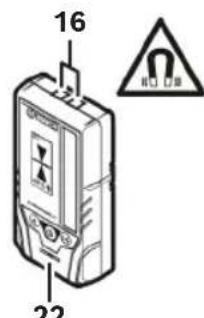
All operating modes are suitable for operation with the Laser Receiver 22.
Automatic Leveling
The laser tool monitors the position at all times during operation. It works with automatic leveling during set-up within the self-leveling range of ± 4^ . Outside of the self-leveling range, it will automatically switch to the incline function.
Working with Automatic Leveling
Position the laser tool on a level, firm surface or attach it to the Magnetic Mount 15 or the Tripod 23.
Operation
The automatic leveling function automatically compensates irregularities within the self-leveling range of ± 4^ . Once the laser beam is permanently lit, the laser tool has leveled in.
If automatic leveling is not possible, e.g. because the surface on which the laser tool stands deviates by more than 4^ from the horizontal plane, the laser lines will initially flash quickly for 2 seconds, then quickly flash every 5 seconds several times. The laser tool is in the incline function.
For additional work with automatic leveling, set up the laser tool so that it is horizontal and wait for the self-leveling procedure to complete. As soon as the laser tool is within the self-leveling range of ± 4^ , the laser beams will light up continuously.
In case of ground vibrations or position changes during operation, the laser tool is automatically leveled again. Upon leveling, check the position of the laser beams with regard to the reference points to avoid errors arising from a change in the laser tool's position.
Working with the Incline Function
Place the laser tool on an inclined surface. When working with the incline function, the laser lines will initially flash quickly for 2 seconds, then quickly flash every 5 seconds several times.
In the incline function, the laser lines are no longer leveled and no longer necessarily run perpendicular to one another.
Working Advice
Always use the center of the laser line for marking. The width of the laser line changes with the distance.
Accuracy Check of the Laser Tool
Influences on Accuracy
The ambient temperature has the greatest influence. Especially temperature differences occurring from the ground upward can refract the laser beam.
Since the largest difference in temperature layers is close to the ground, you should always mount the laser tool on a Tripod 23 for measuring distances of 65 ft (20 m) or more. In addition, position the laser tool in the center of the work surface, wherever this is possible.
In addition to external influences, device-specific influences (e.g. falls or heavy impacts) can also lead to deviations. For this reason, check the leveling accuracy each time before beginning work.
First check the leveling accuracy of the horizontal laser line, then the leveling accuracy of the vertical laser line.
Should the laser tool exceed the maximum deviation during one of the tests, please have it repaired by a Bosch aftersales service.
Checking the Horizontal Leveling Accuracy
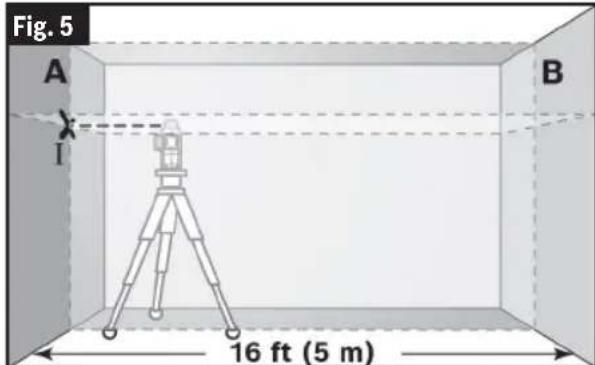
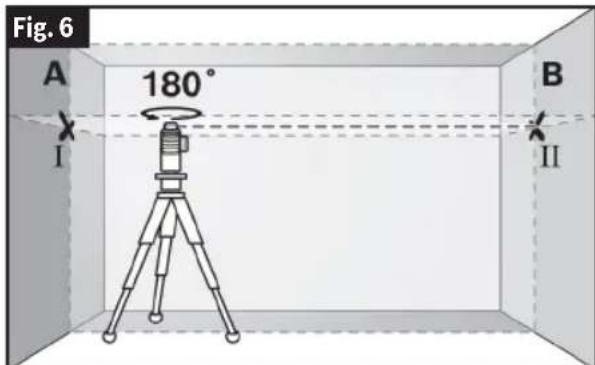
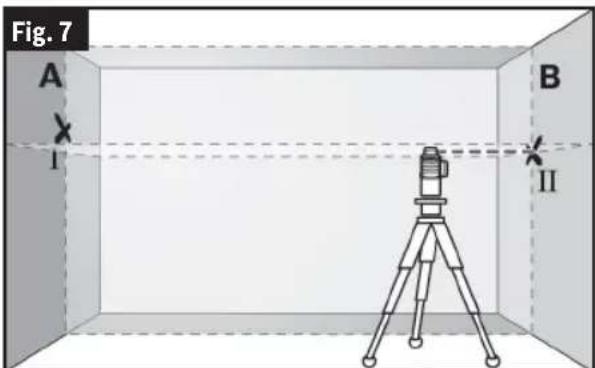
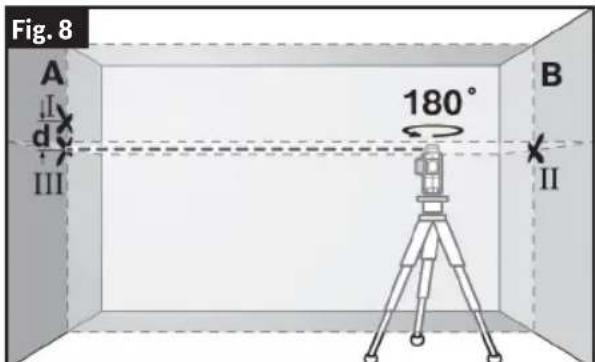
(Fig. 5, Fig. 6, Fig. 7, Fig. 8)
A free measuring distance of 16 ft (4.8m) on a firm surface in front of two walls A and B is required for the check.
- Mount the tool onto a tripod, or place it on a firm and level surface close to the wall A. Switch the tool on. Select crossline operation with automatic leveling. Select the operating mode in which a horizontal and vertical laser plane is generated in front of the tool.
- Direct the laser against the close wall A and allow the tool to level in. Mark the center of the point where the laser lines cross each other on the wall (point I).
- Turn the tool by 180^ , allow it to level in and mark the cross point of the laser lines on the opposite wall B (point II).
Operation
- Without turning the tool, position it close to wall B. Switch the tool on and allow it to level in.
- Align the height of the tool (using a tripod or by underlaying, if required) in such a manner that the cross point of the laser lines is projected against the previously marked point II on the wall B.
- Without changing the height, turn around the tool by 180^ . Direct it against the wall A in such a manner that the vertical laser line runs through the already marked point I.
- Allow the tool to level in and mark the cross point of the laser lines on the wall A (point III).
The difference of both marked points I and III on wall A results in the actual height deviation of the tool alongside the lateral axis.
On the measuring distance of 2 × 16 ft = 32 ft (2 x 5 m = 10 m), the maximum allowable deviation is:
32 ft x ±0.0036 in/ft = ±1/8 in (0.115 in) (10 m × ±0.3 mm/m = ±3 mm)
Thus, the difference d between points I and III must not exceed 0.115 in (3mm) (max.).
Checking the Vertical Leveling Accuracy
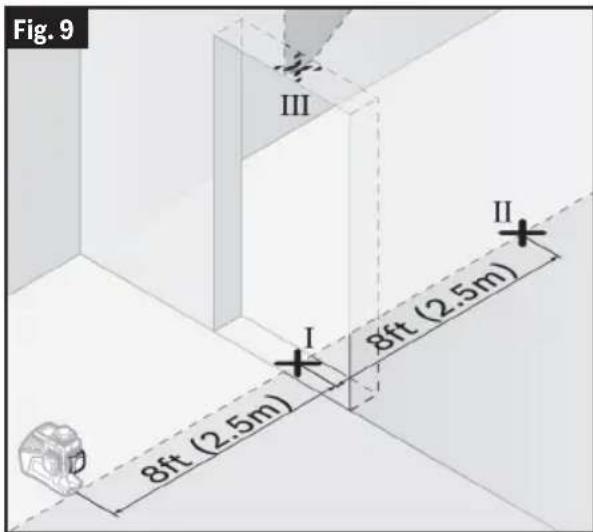
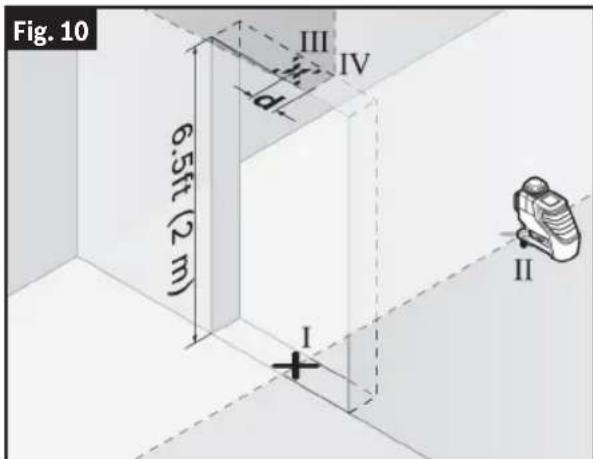
(Fig. 9, Fig. 10)
For this check, a door opening is required with at least 8 ft (2.5 m) of space (on a firm surface) to each side of the door.
- Position the tool on a firm, level surface (not on a tripod) 8 ft (2.5m) away from the door opening. Allow the tool to level in while in vertical operation with automatic leveling and direct the laser beam at the door opening.
- Mark the center of the vertical laser line at the floor of the door opening (point I) at a distance of 8 ft (2.5m) beyond the other side of the door opening (point II) and at the upper edge of the door opening (point III).
- Rotate the tool by 180^ and position it on the other side of the door opening directly behind point II. Allow the tool to level in and align the vertical laser line in such a manner that its center runs exactly through points I and II.
- Mark the center of the laser line at the upper edge of the door opening as point IV.
Operation
The differenced of both marked points III and IV results in the actual deviation of the tool to the plumb line.
- Measure the height of the door opening.
Repeat the measuring procedure for the second vertical laser plane. For this, select an operating mode in which a vertical laser plane is generated aside of the tool. Turn the tool 90^ before beginning with the measuring procedure.
The maximum admissible deviation is calculated as follows:
doubled height of the door opening x 0.0036 in/ft (0.3 mm/m).
Example: For a door-opening height of 6.5 ft (2 m), the maximum deviation may be 2 × 6.5 ft × ± 0.0036 in/ft = 0.047 in (2 × 2 m × ± 0.3 mm/m = ± 1.2 mm).
Consequently, points III and IV may be no more than 0.047 in (1.2 mm) (max.) apart from each other.
Use with Attachments
Working with the Laser Target Plate (Optional Accessory)
(Fig. 11)
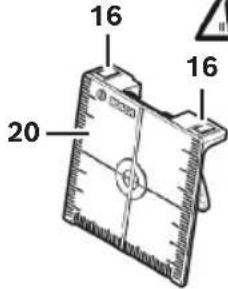
The Laser Target Plate 20 increases the visibility of the laser beam under unfavorable conditions and at large distances.
The reflective part of the Laser Target Plate 20 improves the visibility of the laser line. Thanks to the transparent part, the laser line is also visible from the back side of the laser target plate.
Working with the Tripod (Optional Accessory)
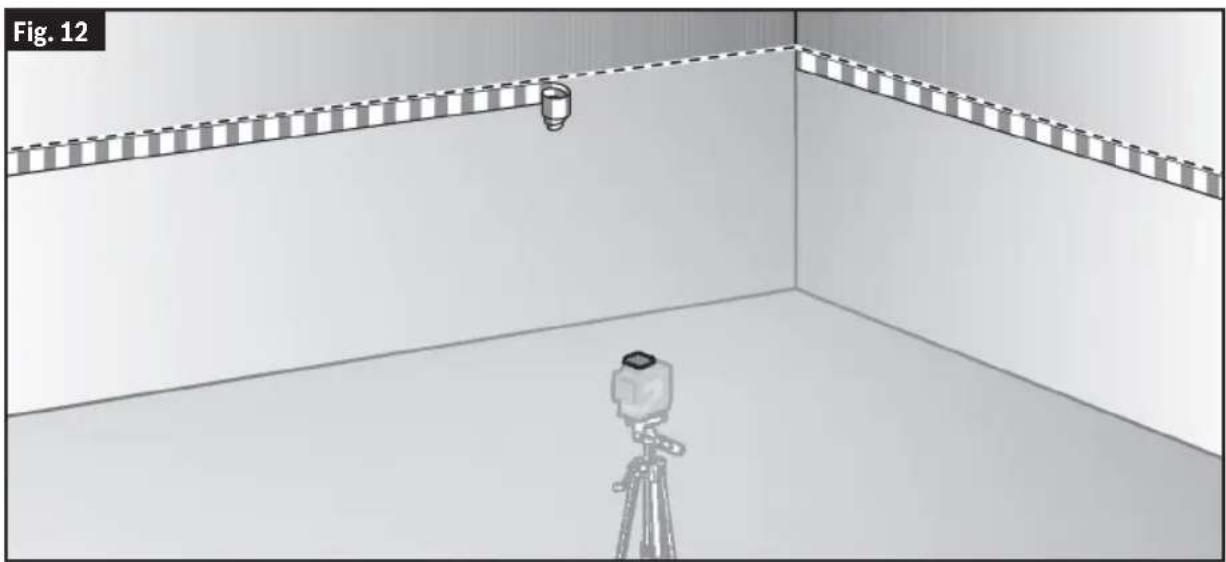
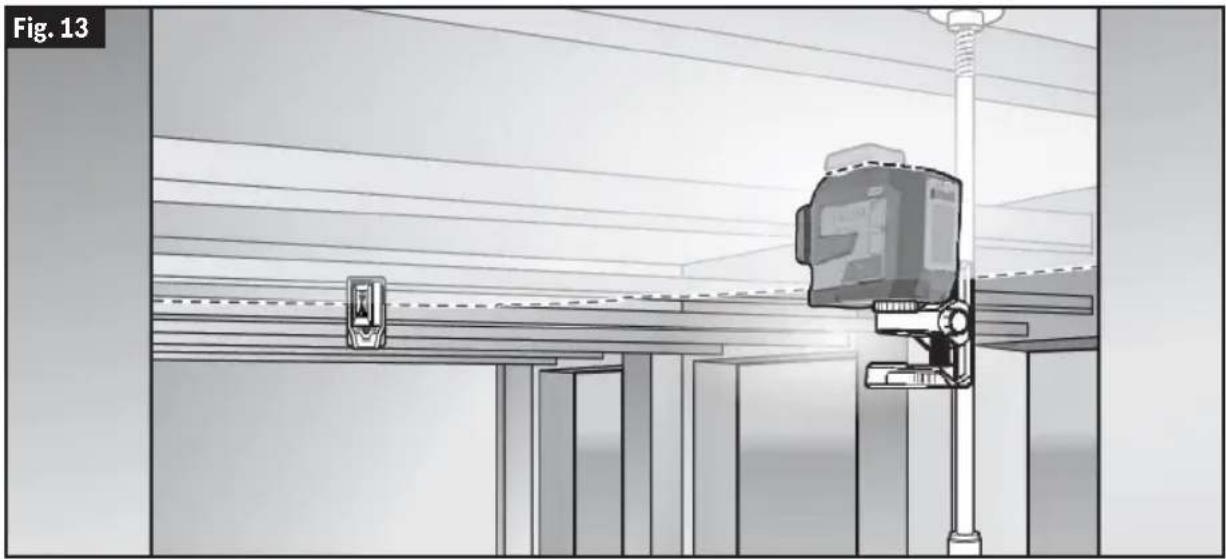
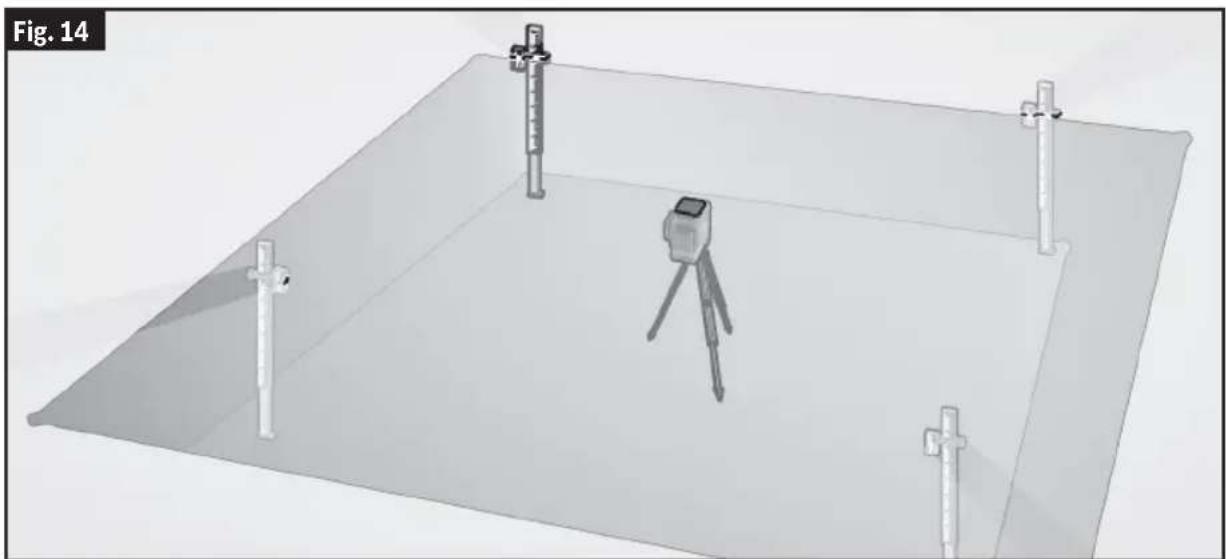
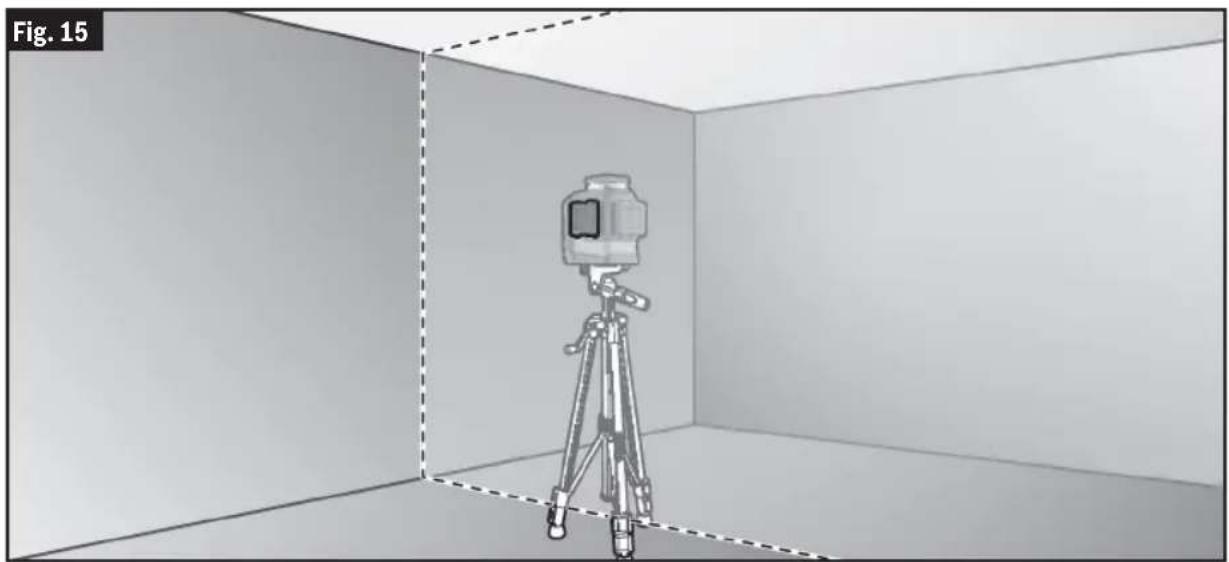
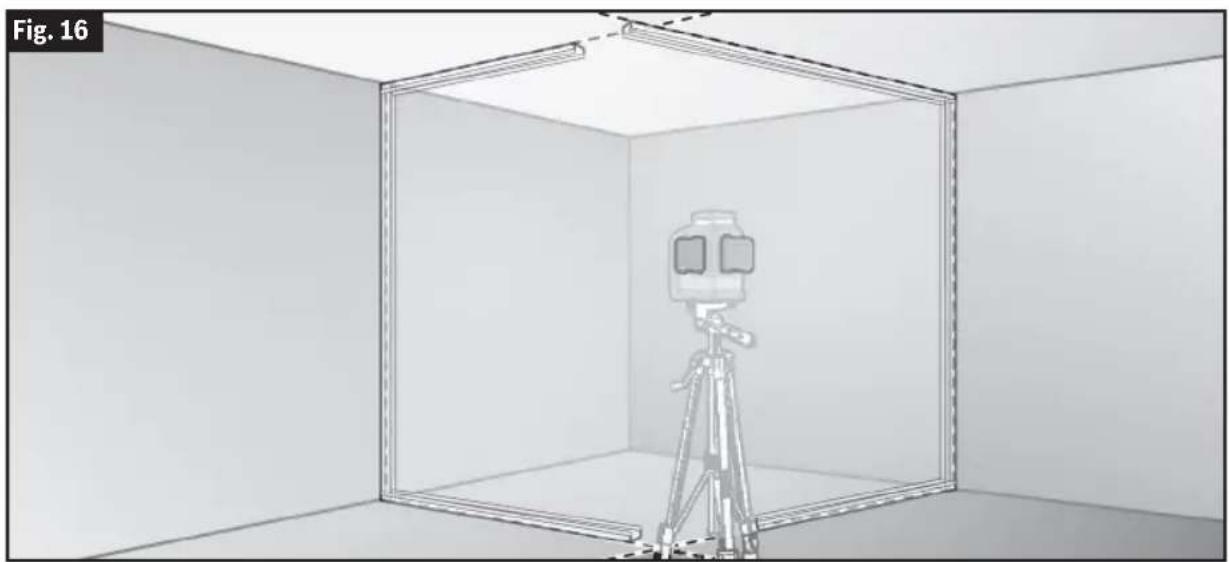
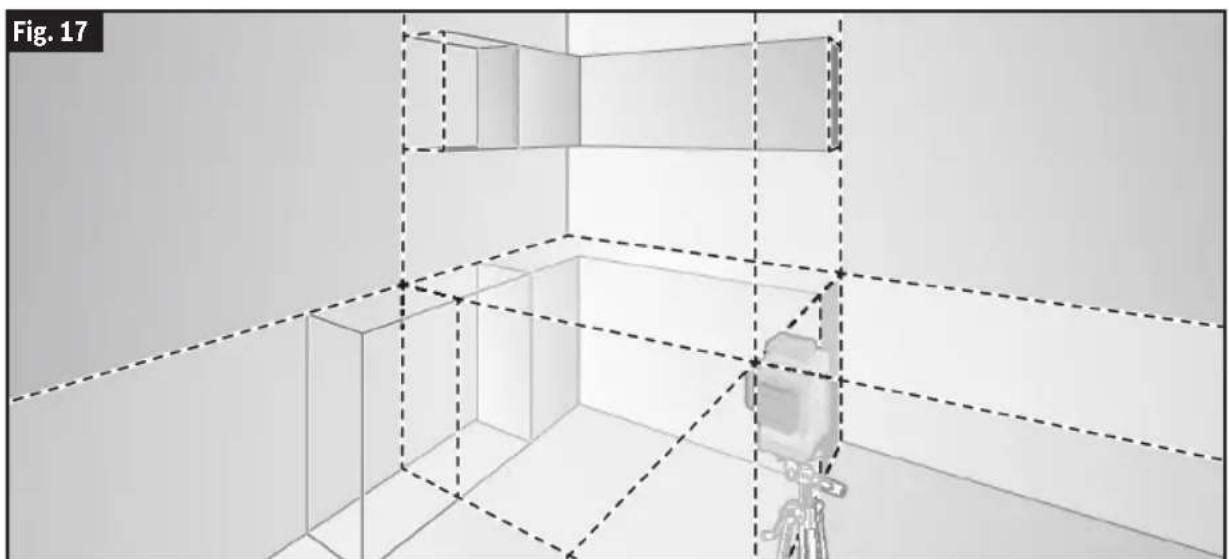
(Fig. 2, Fig. 11, Fig. 12, Fig. 13, Fig. 14, Fig. 15, Fig. 16, Fig. 17)
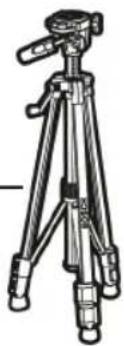
A Tripod 23 offers a stable, height-adjustable support. Position the tool with the Tripod Mount 1/4 " 13 onto the thread of the Tripod 23 or a commercially available camera tripod.
For fastening to a commercially available construction tripod, use the Tripod Mount 5/8" 14. Tighten the tool with the mounting stud on the Tripod 23.
Operation
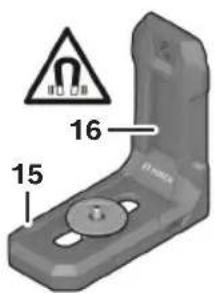
Fig. 11
LB10
19—
DK20

16

21—
LR8
BT 150
24
BT 350
Adapter
GBA37V30
25
Charging Cable
Operation
20
Operation
21
Operation
Working with the Magnetic Mount LB 10 (Optional Accessory)
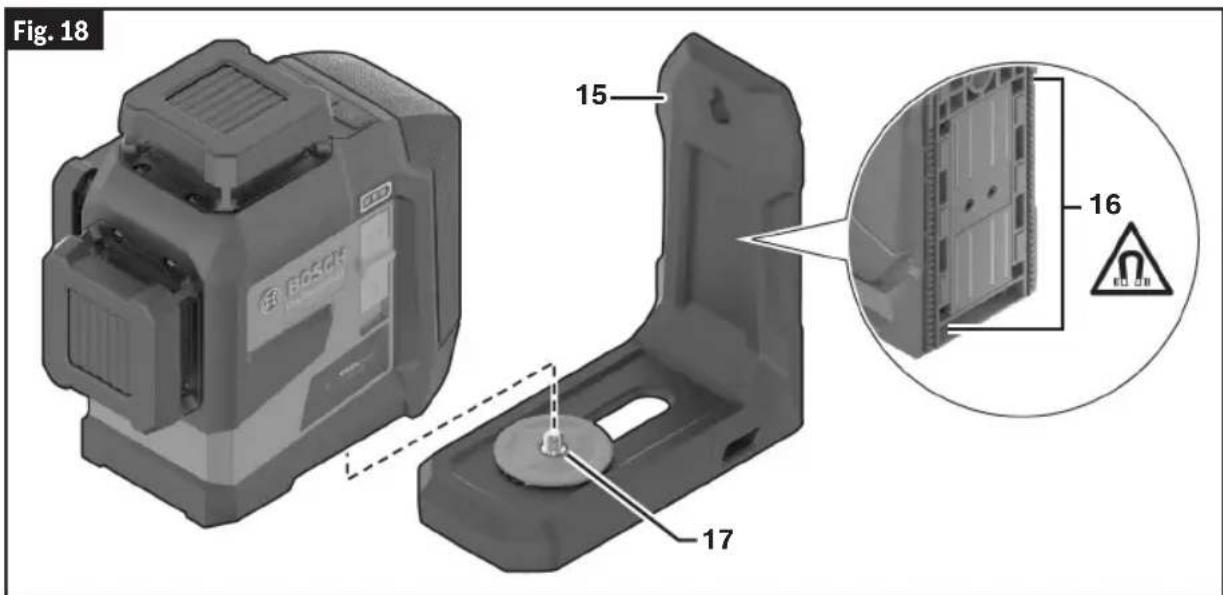
(Fig. 11, Fig. 18, Fig. 19, Fig. 20)
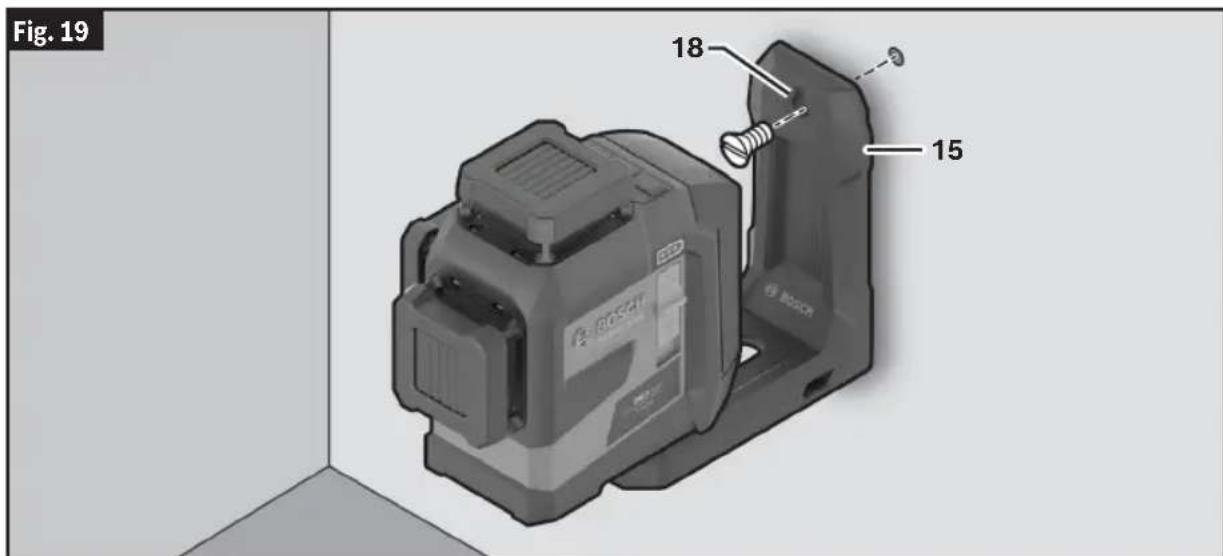
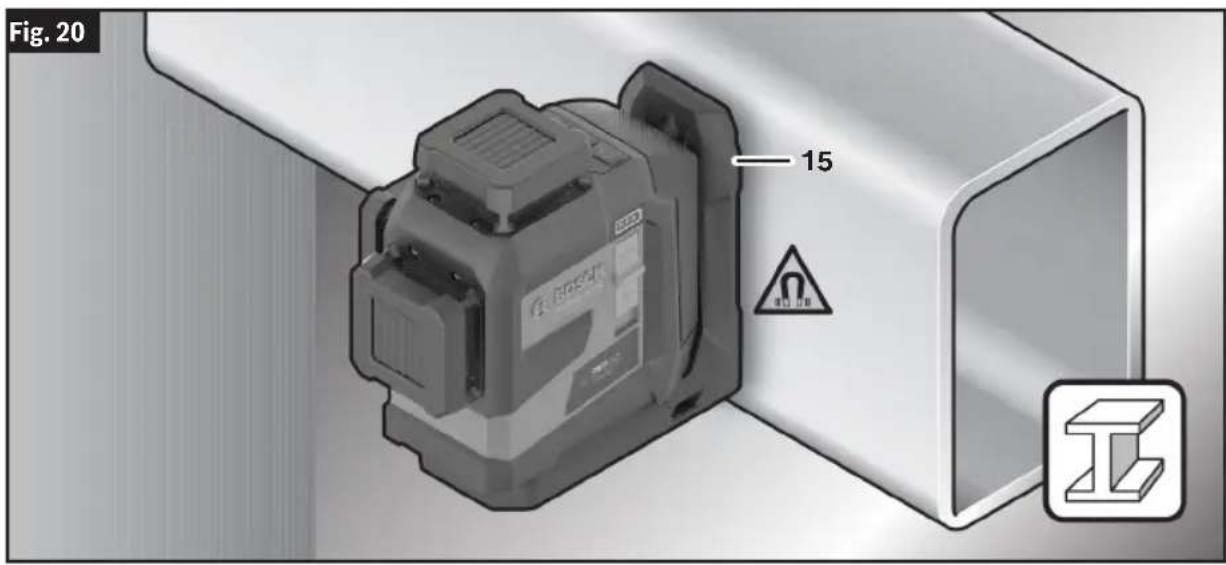
You can secure the laser tool on vertical surfaces or magnetizable materials using the Magnetic Mount 15. In conjunction with the Ceiling Clip 19, the laser tool can also be aligned vertically.
Place the laser tool with the Tripod Mount 1/4" 13 on the Magnetic Mount 1/4" Screw 17 and screw it tight.
Attachment options for the Magnetic Mount 15:
Using a commercially available fastening screw, it can be attached via the Magnetic Mount Screw Hole 18 to wood.
- Using the Magnets 16, it can be attached to magnetizable materials.
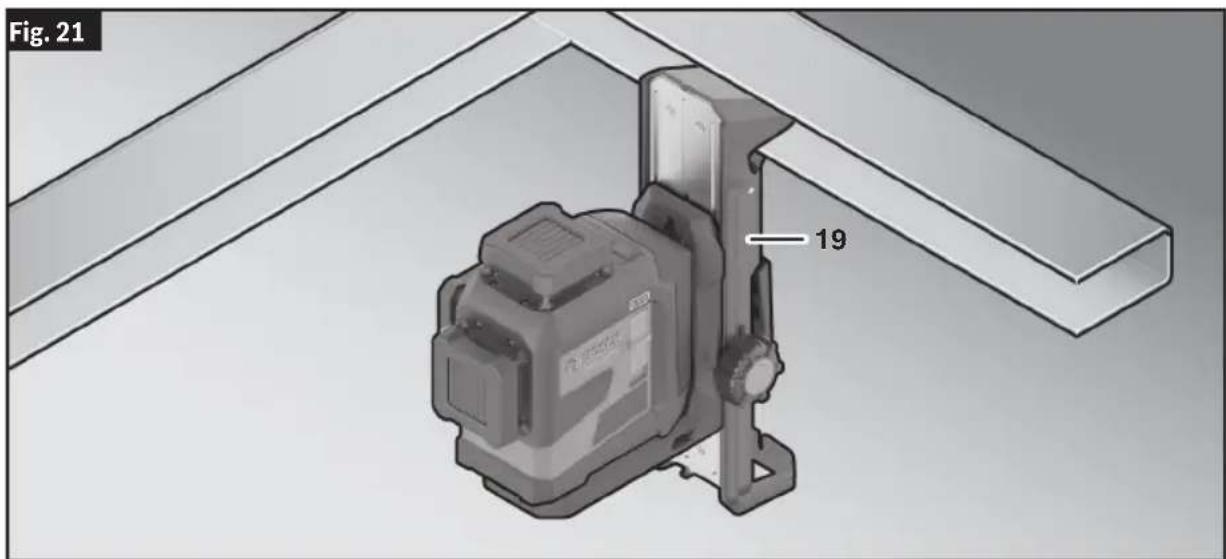
Using the Ceiling Clip 19, it can be attached to ceiling grids.
Note: Use only DK20. Use of DK10 will provide insufficient support and may cause the tool to fall.
Keep your fingers away from the rear side of the magnetic accessory while attaching the accessory to surfaces. The strong pulling force of the magnets may jam your fingers.
Roughly align the Magnetic Mount 15 before switching on the laser tool.
22
Operation
Working with the DK20 Ceiling Clip (Optional Accessory)
(Fig. 11, Fig. 21)
WARNING Make sure that this device and the tool are securely mounted before operation.
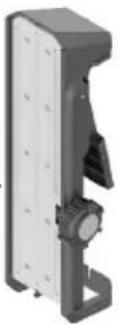
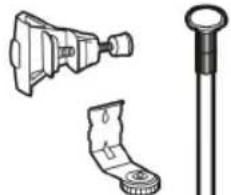
The DK20 Ceiling Clip 19 can be attached to ceiling grids for use with a magnetic mount:
- Slide the magnetic mount into position on the DK20 Ceiling Clip 19. The magnetic mount may require minor adjustments to sit in the track of the DK20 Ceiling Clip 19.
-
Squeeze the handle to open the clip of the DK20 19. Attach the DK20 Ceiling Clip 19 to the ceiling grid.
-
Roughly align the magnetic mount and DK20 Ceiling Clip 19 before switching on the laser tool.
- Turn on the laser tool.
- Use the adjustment knob of the DK20 Ceiling Clip 19 to align laser lines precisely with reference points.
Rotate the adjustment knob of the DK20 Ceiling Clip 19 clockwise to move the magnetic mount higher and counterclockwise to lower it.
Working with the Laser Receiver (Optional Accessory)
(Fig. 11, Fig. 13, Fig. 14)
Use the Laser Receiver 22 to improve detection of the laser lines in adverse lighting con
Operation
ditions (bright environment, direct sunlight) and over greater distances.
All operating modes are suitable for operation with the Laser Receiver 22.
Laser Viewing Glasses (Optional Accessory)
(Fig. 11)
The Laser Viewing Glasses 21 filter out the ambient light. This makes the light of the laser appear brighter for the eyes.
- Do not use the Laser Viewing Glasses 21 as safety goggles. The Laser Viewing Glasses 21 are used for improved visualization of the laser beam, but they do not protect against laser radiation.
- Do not use the Laser Viewing Glasses 21 as sunglasses or in traffic. The laser viewing glasses do not afford complete UV protection and reduce color perception.
Maintenance and Service
Store and transport the tool only in the supplied protective case.
Keep the tool clean at all times.
Do not immerse the tool into water or other fluids.
Wipe off debris using a moist and soft cloth. Do not use any cleaning agents or solvents.
Regularly clean the surfaces at the exit opening of the laser in particular, and pay attention to any fluff or fibers.
If the tool should fail despite the care taken in manufacturing and testing procedures, repair should be carried out by an authorized after-sales service center for Bosch power tools.
In all correspondence and spare parts orders, please always include the 10-digit article number given on the type plate of the tool.
Environment Protection

dance with the latest regulations.
Recycle raw materials & batteries instead of disposing of waste. The unit, accessories, packaging & used batteries should be sorted for environmentally friendly recycling in accor

Maintenance et service. 47
Laser Radiation. Do not stare into the beam.
This page was intentionally left blank
Copyright © 2009-2019 Arm Limited. All rights reserved.
Licensed under the Apache License, Version 2.0 (the "License"); you may not use this file except in compliance with the License.
You may obtain a copy of the License at http:// www.apache.org/licenses/License-2.0
Unless required by applicable law or agreed to in writing, software distributed under the License is distributed on an "AS IS" BASIS, WITHOUT WARRANTIES OR CONDITIONS OF ANY KIND, either express or implied. See the License for the specific language governing permissions and limitations under the License.
STM32CubeG0, v1.5.1
Apache-2.0
Copyright © 2018-2021 STMicroelectronics.
Licensed under the Apache License, Version 2.0 (the "License"); you may not use this file except in compliance with the License.
You may obtain a copy of the License at http:// www.apache.org/licenses/License-2.0
Unless required by applicable law or agreed to in writing, software distributed under the License is distributed on an "AS IS" BASIS, WITHOUT WARRANTY OR CONDITIONS OF ANY KIND, either express or implied.
See the License for the specific language governing permissions and limitations under the License.
SIMPLELINK-CC13XX-CC26XXSDK, 6.20.00.29
Copyright © 2015, Texas Instruments Incorporated
All rights reserved not granted herein. Limited License.
Texas Instruments Incorporated grants a worldwide, royalty-free, non-exclusive license under copyrights and patents it now or hereafter owns or controls to make, have made, use, import, offer to sell and sell ("Utilize") this software subject to the terms herein. With respect to the foregoing patent license, such license is granted solely to the extent that any such patent is necessary to Utilize the software alone. The patent license shall not apply to any combinations which include this software, other than combinations with devices manufactured by or for TI ("TI Devices"). No hardware patent is licensed hereunder.
Redistributions must preserve existing copyright notices and reproduce this license (including the above copyright notice and the disclaimer and (if applicable) source code license limitations below) in the documentation and/or other materials provided with the distribution.
Redistribution and use in binary form, without modification, are permitted provided that the following conditions are met:
- No reverse engineering, decompilation, or disassembly of this software is permitted with respect to any software provided in binary form.
- Any redistribution and use are licensed by TI for use only with TI Devices.
- Nothing shall obligate TI to provide you with source code for the software licensed and provided to you in object code.
If software source code is provided to you, modification and redistribution of the source code are permitted provided that the following conditions are met:
- Any redistribution and use of the source code, including any resulting derivative works, are licensed by TI for use only with TI Devices.
- Any redistribution and use of any object code compiled from the source code and any resulting derivative works, are licensed by TI for use only with TI Devices.
- Neither the name of Texas Instruments Incorporated nor the names of its suppliers may be used to endorse or promote products derived from this software without specific prior written permission.
DISCLAIMER.
THIS SOFTWARE IS PROVIDED BY TI AND TI'S LICENSORS "AS IS" AND ANY EXPRESS OR IMPLIED WARRANTY, INCLUDING, BUT NOT LIMITED TO, THE IMPLIED WARRANTY OF MERCHANTABILITY AND FITNESS FOR A PARTICULAR PURPOSE ARE DISCLAIMED. IN NO EVENT SHALL TI AND TI'S LICENSORS BE LIABLE FOR ANY DIRECT, INDIRECT, INCIDENTAL, SPECIAL, EXEMPLARY, OR CONSEQUENTIAL DAMAGES (INCLUDING, BUT NOT LIMITED TO, PROCUREMENT OF SUBSTITUTE GOODS OR SERVICES; LOSS OF USE, DATA, OR PROFITS; OR BUSINESS INTERRUsION) HOWEVER CAUSED AND ON ANY THEORY OF LIABILITY, WHETHER IN CONTRACT, STRICT LIABILITY, OR TORT (INCLUDING NEGLIGENCE OR OTHERWISE) ARISING IN ANY WAY OUT OF THE USE OF THIS SOFTWARE, EVEN IF ADVISED OF THE POSSIBILITY OF SUCH DAMAGE.
Licenses
Copyright 2010 - 2015 Texas Instruments Incorporated. All rights reserved.
Copyright © 2016 Texas Instruments Incorporated - http://www.ti.com/
All rights reserved not granted herein. Limited License.
Texas Instruments Incorporated grants a worldwide, royalty-free, non-exclusive license under copyrights and patents it now or hereafter owns or controls to make, have made, use, import, offer to sell and sell ("Utilize") this software subject to the terms herein. With respect to the foregoing patent license, such license is granted solely to the extent that any such patent is necessary to Utilize the software alone. The patent license shall not apply to any combinations which include this software, other than combinations with devices manufactured by or for TI ("TI Devices"). No hardware patent is licensed hereunder.
Redistributions must preserve existing copyright notices and reproduce this license (including the above copyright notice and the disclaimer and (if applicable) source code license limitations below) in the documentation and/or other materials provided with the distribution.
Redistribution and use in binary form, without modification, are permitted provided that the following conditions are met:
- No reverse engineering, decompilation, or disassembly of this software is permitted with respect to any software provided in binary form.
- Any redistribution and use are licensed by TI for use only with TI Devices.
- Nothing shall obligate TI to provide you with source code for the software licensed and provided to you in object code.
If software source code is provided to you, modification and redistribution of the source code are permitted provided that the following conditions are met:
- Any redistribution and use of the source code, including any resulting derivative works, are licensed by TI for use only with TI Devices.
- Any redistribution and use of any object code compiled from the source code and any resulting derivative works, are licensed by TI for use only with TI Devices.
- Neither the name of Texas Instruments Incorporated nor the names of its suppliers may be used to endorse or promote products derived from this software without specific prior written permission.
DISCLAIMER.
THIS SOFTWARE IS PROVIDED BY TI AND TI'S LICENSORS "AS IS" AND ANY EXPRESS OR IMPLIED WARRANTY, INCLUDING, BUT NOT LIMITED TO, THE IMPLIED WARRANTY OF MERCHANTABILITY AND FITNESS FOR A PARTICULAR PURPOSE ARE DISCLAIMED. IN NO EVENT SHALL TI AND TI'S LICENSORS BE LIABLE FOR ANY DIRECT, INDIRECT, INCIDENTAL, SPECIAL, EXEMPLARY, OR CONSEQUENTIAL DAMAGES (INCLUDING, BUT NOT LIMITED TO, PROCUREMENT OF SUBSTITUTE GOODS OR SERVICES; LOSS OF USE, DATA, OR PROFITS; OR BUSINESS INTERRUsION) HOWEVER CAUSED AND ON ANY THEORY OF LIABILITY, WHETHER IN CONTRACT, STRICT LIABILITY, OR TORT (INCLUDING NEGLIGENCE OR OTHERWISE) ARISING IN ANY WAY OUT OF THE USE OF THIS SOFTWARE, EVEN IF ADVISED OF THE POSSIBILITY OF SUCH DAMAGE.
Generic License Text
Apache License 2.0
Apache License Version 2.0, January 2004
http://www.apache.org/licenses/
TERMS AND CONDITIONS FOR USE, REPRODUCTION, AND DISTRIBUTION
Definitions.
"License" shall mean the terms and conditions for use, reproduction, and distribution as defined by Sections 1 through 9 of this document. "Licensor" shall mean the copyright owner or entity authorized by the copyright owner that is granting the License.
"Legal Entity" shall mean the union of the acting entity and all other entities that control, are controlled by, or are under common control with that entity. For the purposes of this definition, "control" means (i) the power, direct or indirect, to cause the direction or management of such entity, whether by contract or otherwise, or (ii) ownership of fifty percent (50%) or more of the outstanding shares, or (iii) beneficial ownership of such entity.
"You" (or "Your") shall mean an individual or Legal Entity exercising permissions granted by this License.
"Source" form shall mean the preferred form for making modifications, including but not limited to software source code, documentation source, and configuration files.
"Object" form shall mean any form resulting from mechanical transformation or translation of a Source form, including but not limited to
Licenses
compiled object code, generated documentation, and conversions to other media types.
"Work" shall mean the work of authorship, whether in Source or Object form, made available under the License, as indicated by a copyright notice that is included in or attached to the work (an example is provided in the Appendix below).
"Derivative Works" shall mean any work, whether in Source or Object form, that is based on (or derived from) the Work and for which the editorial revisions, annotations, elaborations, or other modifications represent, as a whole, an original work of authorship. For the purposes of this License, Derivative Works shall not include works that remain separable from, or merely link (or bind by name) to the interfaces of, the Work and Derivative Works thereof.
"Contribution" shall mean any work of authorship, including the original version of the Work and any modifications or additions to that Work or Derivative Works thereof, that is intentionally submitted to Licensor for inclusion in the Work by the copyright owner or by an individual or Legal Entity authorized to submit on behalf of the copyright owner. For the purposes of this definition, "submitted" means any form of electronic, verbal, or written communication sent to the Licensor or its representatives, including but not limited to communication on electronic mailing lists, source code control systems, and issue tracking systems that are managed by, or on behalf of, the Licensor for the purpose of discussing and improving the Work, but excluding communication that is conspicuously marked or otherwise designated in writing by the copyright owner as "Not a Contribution."
"Contributor" shall mean Licensor and any individual or Legal Entity on behalf of whom a Contribution has been received by Licensor and subsequently incorporated within the Work.
Grant of Copyright License. Subject to the terms and conditions of this License, each Contributor hereby grants to You a perpetual, worldwide, non-exclusive, no-charge, royalty-free, irrevocable copyright license to reproduce, prepare Derivative Works of, publicly display, publicly perform, sublicense, and distribute the Work and such Derivative Works in Source or Object form.
Grant of Patent License. Subject to the terms and conditions of this License, each Contributor hereby grants to You a perpetual, worldwide, non-exclusive, no-charge, royalty-free, irrevocable (except as stated in this section) patent license to make, have made, use, offer to sell, sell, import, and otherwise transfer the Work,
where such license applies only to those patent claims licensable by such Contributor that are necessarily infringed by their Contribution(s) alone or by combination of their Contribution(s) with the Work to which such Contribution(s) was submitted. If You institute patent litigation against any entity (including a cross-claim or counterclaim in a lawsuit) alleging that the Work or a Contribution incorporated within the Work constitutes direct or contributory patent infringement, then any patent licenses granted to You under this License for that Work shall terminate as of the date such litigation is filed.
Redistribution. You may reproduce and distribute copies of the Work or Derivative Works thereof in any medium, with or without modifications, and in Source or Object form, provided that You meet the following conditions:
a. You must give any other recipients of the Work or Derivative Works a copy of this License; and
b. You must cause any modified files to carry prominent notices stating that You changed the files; and
c. You must retain, in the Source form of any Derivative Works that You distribute, all copyright, patent, trademark, and attribution notices from the Source form of the Work, excluding those notices that do not pertain to any part of the Derivative Works; and
d. If the Work includes a "NOTICE" text file as part of its distribution, then any Derivative Works that You distribute must include a readable copy of the attribution notices contained within such NOTICE file, excluding those notices that do not pertain to any part of the Derivative Works, in at least one of the following places: within a NOTICE text file distributed as part of the Derivative Works; within the Source form or documentation, if provided along with the Derivative Works; or, within a display generated by the Derivative Works, if and wherever such third-party notices normally appear. The contents of the NOTICE file are for informational purposes only and do not modify the License. You may add Your own attribution notices within Derivative Works that You distribute, alongside or as an addendum to the NOTICE text from the Work, provided that such additional attribution notices cannot be construed as modifying the License.
You may add Your own copyright statement to Your modifications and may provide additional
Licenses
or different license terms and conditions for use, reproduction, or distribution of Your modifications, or for any such Derivative Works as a whole, provided Your use, reproduction, and distribution of the Work otherwise complies with the conditions stated in this License.
Submission of Contributions. Unless You explicitly state otherwise, any Contribution intentionally submitted for inclusion in the Work by You to the Licensor shall be under the terms and conditions of this License, without any additional terms or conditions. Notwithstanding the above, nothing herein shall supersede or modify the terms of any separate license agreement you may have executed with Licensor regarding such Contributions.
Trademarks. This License does not grant permission to use the trade names, trademarks, service marks, or product names of the Licensor, except as required for reasonable and customary use in describing the origin of the Work and reproducing the content of the NOTICE file.
Disclaimer of Warranty. Unless required by applicable law or agreed to in writing, Licensor provides the Work (and each Contributor provides its Contributions) on an "AS IS" BASIS, WITHOUT WARRANTY OR CONDITIONS OF ANY KIND, either express or implied, including, without limitation, any warranties or conditions of TITLE, NON-INFRINGEMENT, MERCHANTABILITY, or FITNESS FOR A PARTICULAR PURPOSE. You are solely responsible for determining the appropriateness of using or redistributing the Work and assume any risks associated with Your exercise of permissions under this License.
Limitation of Liability. In no event and under no legal theory, whether in tort (including negligence), contract, or otherwise, unless required by applicable law (such as deliberate and grossly negligent acts) or agreed to in writing, shall any Contributor be liable to You for damages, including any direct, indirect, special, incidental, or consequential damages of any character arising as a result of this License or out of the use or inability to use the Work (including but not limited to damages for loss of goodwill, work stoppage, computer failure or malfunction, or any and all other commercial damages or losses), even if such Contributor has been advised of the possibility of such damages.
Accepting Warranty or Additional Liability. While redistributing the Work or Derivative Works thereof, You may choose to offer, and charge a fee for, acceptance of support, warranty, indemnity, or other liability obligations and/or rights consistent with this License. However, in accepting such obligations, You may act only on Your own behalf and on Your sole responsibility,
not on behalf of any other Contributor, and only if You agree to indemnify, defend, and hold each Contributor harmless for any liability incurred by, or claims asserted against, such Contributor by reason of your accepting any such warranty or additional liability.
END OF TERMS AND CONDITIONS
Warranty Disclaimer
This product contains Open Source Software components which underly Open Source Software Licenses. Please note that Open Source Licenses contain disclaimer clauses. The text of the Open Source Licenses that apply are included in this manual under "Licenses".
LIMITED WARRANTY
For details on the terms of the limited warranty for this product, go to https://rb-pt.io/PowerToolWarranty or call 1-877-BOSCH99.
GARANTIE LIMITEE
© Robert Bosch Tool Corporation
1800 W. Central Road
Mt. Prospect, IL 60056-2230
1605A002SP 07/2024



- Table of Contents
- General Safety Rules
- WARNING
- SAVE ALL WARNING AND INSTRUCTIONS FOR FUTURE REFERENCE.
- Battery tool use and care
- Work area safety
- Electrical safety
- Personal safety
- Magnets
- Use and care
- Service
- FCC Caution
- ISED Canada
- Intended Use
- Symbols
- Getting to Know Your GLL300-42G Line Laser
- 2
- Technical Data
- Preparation
- Laser Tool Power Supply
- (Fig. 3)
- Operation with Bosch Rechargeable Lithium-Ion Battery Packs
- WARNING Follow all warnings and all instructions in the
- WARNING Use only Bosch rechargeable lithium-ion battery
- WARNING Remove the batteries from the tool when not
- WARNING Use only Bosch USB-C cable listed in the tech
- Charging the Lithium-Ion Battery Pack
- Operation with LR6 (AA) Batteries (optional)
- (Fig. 4)
- Energy Saving Mode
- Battery Status Indicator
- (Fig.1)
- Operation
- Initial Operation
- Switching On and Off
- Deactivating the Automatic Shut-Off Function
- Operating Modes
- Automatic Leveling
- Working with Automatic Leveling
- Working with the Incline Function
- Working Advice
- Accuracy Check of the Laser Tool
- Influences on Accuracy
- Checking the Horizontal Leveling Accuracy
- Checking the Vertical Leveling Accuracy
- Use with Attachments
- Working with the Laser Target Plate (Optional Accessory)
- Working with the Tripod (Optional Accessory)
- Working with the Magnetic Mount LB 10 (Optional Accessory)
- Working with the DK20 Ceiling Clip (Optional Accessory)
- WARNING Make sure that this device and the tool are securely mounted before operation.
- Working with the Laser Receiver (Optional Accessory)
- Laser Viewing Glasses (Optional Accessory)
- Maintenance and Service
- Environment Protection
- STM32CubeG0, v1.5.1
- SIMPLELINK-CC13XX-CC26XXSDK, 6.20.00.29
- Licenses
- Generic License Text
- Apache License 2.0
- Warranty Disclaimer
- LIMITED WARRANTY
- GARANTIE LIMITEE
Brand : BOSCH
Model : GLL 300-42 G Professional
Category : Laser level