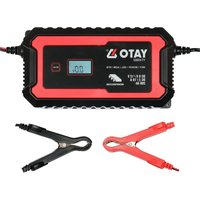
YT-83032 - Battery charger Yato - Free user manual and instructions
Find the device manual for free YT-83032 Yato in PDF.


| Product Type | Battery Charger (Rectifier) |
| Brand | Yato |
| Model | YT-83032 |
| Input Voltage | 220-240 V AC |
| Input Frequency | 50-60 Hz |
| Rated Power | 0.45 A |
| Rated Charging Voltage | 12 / 6 V DC |
| Charging Current | 4 A (max 8 A depending on mode) |
| Recommended Battery Capacity | 5-120 Ah |
| Compatible Battery Types | Lead-acid (vented, gel, AGM) |
| Protection | Short-circuits, overload, reverse polarity |
| Insulation Class | II |
| Protection Rating | IPX0 |
| Weight | 0.4 kg |
| Charging Modes | Motorcycle (2A), Car (8A), Low temperature (8A, 14.7V), Desulfation (17V) |
| Included Connectors | Crocodile clips, ring terminals, cigarette lighter plug |
| LED Indicators | Power, fault, charging, full charge |
| Use | Indoor only, well ventilated |
| Maintenance | Clean with soft cloth, compressed air max 0.3 MPa |
| Storage | Dry and cool place, out of reach of children |
| Repairability | Replace damaged cables only at an authorized service center |
| Standards | Compliant with European directives (WEEE) |
Frequently Asked Questions - YT-83032 Yato
User questions about YT-83032 Yato
0 question about this device. Answer the ones you know or ask your own.
Ask a new question about this device
Download the instructions for your Battery charger in PDF format for free! Find your manual YT-83032 - Yato and take your electronic device back in hand. On this page are published all the documents necessary for the use of your device. YT-83032 by Yato.
USER MANUAL YT-83032 Yato
CE
PL EN DE
Read the operating instruction
Nominal charging voltage
Accumulator's capacity
This symbol indicates that waste electrical and electronic equipment (including batteries and storage cells) cannot be disposed of with other types of waste. Waste equipment should be collected and handed over separately to a collection point for recycling and recovery, in order to reduce the amount of waste and the use of natural resources. Uncontrolled release of hazardous components contained in electrical and electronic equipment may pose a risk to human health and have adverse effects for the environment. The household plays an important role in contributing to reuse and recovery, including recycling of waste equipment. For more information about the appropriate recycling methods, contact your local authority or retailer.
PROPERTIES OF THE PRODUCT
The rectifier is a device that permits to charge any kind of batteries. The rectifier converts the current and voltage in the power network so as to guarantee a safe charging of batteries. Charging facilitates a proper functioning of a battery, which significantly extends its life. The rectifier is equipped with a short-circuit protection and an overcharge protection. A correct, reliable and safe functioning of the device depends on its proper use, so:
Before you proceed to operate the device, read the manual thoroughly and keep it.
The supplier will not be held responsible for any damage resulting from the safety regulations and the recommendations indicated hereby not being observed.
The indicators in the housing of the device are not meters, as the notion is construed in the „Measurement Act”
TECHNICAL DATA
| Parameter Measurement unit Value | ||
| Catalogue number YT-83032 | ||
| Power network voltage [V a.c.] 220 - 240 | ||
| Power network frequency [Hz] 50 - 60 | ||
| Rated current [A] 0,45 | ||
| Rated charging voltage [V d.c.] 12 / 6 | ||
| Charging current (voltage range) [A] 4 | ||
| Battery's capacity | [Ah] 5 - 120 | |
| Insulation class | II | |
| Protection grade | IPX0 | |
| Mass | [kg] | 0,4 |
GENERAL SAFETY CONDITIONS
The device has not been designed to be used by persons (including children) of impaired physical, sensory or mental capabilities, or those who lack the necessary experience and knowledge, unless they are supervised or they have been trained in operation of the device by the safety personnel.
Preclude children from playing with the device.
The rectifier has been designed to charge exclusively lead-acid accumulators. Charging any other type of accumulators may lead to an electric shock, which is dangerous for health and life.
It is prohibited to charge non-rechargeable batteries!
The charger must be under constant supervision during charging.
During charging the accumulator must be placed in a well ventilated area. It is recommended to charge the accumulator at a room temperature.
The rectifier has been designed to be operated in interiors, and it is prohibited to expose it to humidity, including atmospheric precipitation.
Electric Insulation Class I rectifiers must be connected to sockets equipped with a protection conductor.
While charging accumulators in the electric system of a car, first the terminal of the rectifier must be connected to the terminal of the accumulator, which is not connected to the chassis of the vehicle, and then connect the other terminal of the rectifier to the chassis away from the accumulator and the fuel system. Then connect the plug of the rectifier to the power supply socket.
EN
Once the accumulator has been charged, disconnect the plug of the rectifier from the power supply socket, and then disconnect the terminal of the rectifier.
Never leave the rectifier connected to the power supply network. Always remove the plug of the power cord from the power supply socket.
Observe the polarity indications of the rectifier and the accumulator.
Before you commence charging the accumulator, get acquainted with the charging instructions provided by the manufacturer of the accumulator and observe them.
The accumulator and the rectifier must be always placed on an even, flat and hard surface.
Do not incline the accumulator.
Before you connect the plug of the power cord of the rectifier, make sure the power supply network parameters of the power supply network correspond to the parameters indicated in the rating plate of the rectifier.
The rectifier must be placed as far from the accumulator as it is permitted by the cables with terminals. Do not overstretch the cables. Do not place the rectifier on the accumulator being charged or directly above it. The fumes generated while charging the accumulator may cause corrosion of the internal components of the rectifier, which may in turn cause its damage.
Do not smoke or approach accumulators with an open flame.
Do not ever touch the terminals of the rectifier, when it is connected to the power supply network.
Do not ever start the engine while charging the accumulator.
Before each use check the conditions of the rectifier, including the conditions of the power cord and the charging conductors. Should any damage be detected, stop using the rectifier.
Damaged cables and conductors must be replaced with new ones in a professional workshop.
Before any maintenance of the rectifier is executed, make sure the plug of the power cord has been disconnected from power supply socket.
The rectifier must be stored away from unauthorised persons, particularly children. Also during work make sure the rectifier is placed outside the reach of unauthorised persons, particularly children.
Before connecting the terminals of the rectifier, make sure the terminals of the accumulator are clean and free from corrosion. Provide the best possible electric contact between the terminal of the accumulator and the terminal of the rectifier.
Do not ever charge a frozen accumulator. Before you commence charging, move the accumulator to a place in which the electrolyte may totally defrost. Do not heat accumulators in order to accelerate defrosting.
Preclude any leakage from accumulators. Any leakage from the accumulator on the rectifier may cause a short-circuit and thus an electric shock, which may be dangerous for health and life.
Preparation of the battery for charging
Get acquainted with the charging instructions provided along with the battery and observe them. In the case of the so called „wet" acid-lead batteries" it is necessary to check the level of electrolyte and, if required, replenish it with distilled water to the level
EN
indicated in the documentation of the battery. While replenishing the level of electrolyte, observe strictly the recommendations indicated in the documentation of the battery.
The rectifier has been designed uniquely for charging the so called „wet“, gel or AGM acid-lead batteries.
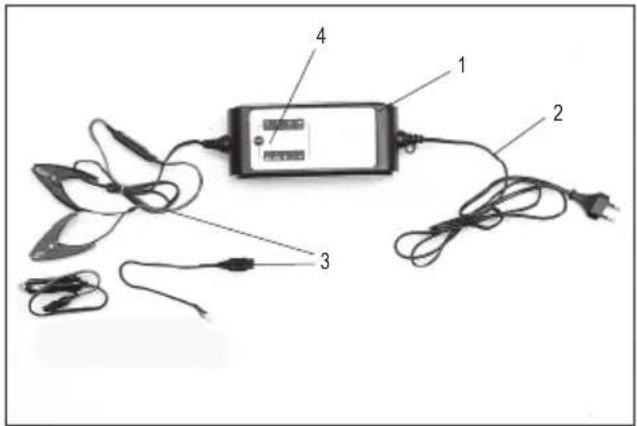
The rectifier is equipped with exchangeable connections:
- alligator clamps – to charge most batteries,
- eye clamps – to fix the terminals of the rectifier to the battery terminals,
- vehicle electrical installation socket – to feed devices equipped with an adequate plug,
- vehicle electrical installation plug – to charge batteries through vehicle electrical installation socket or to maintain the power supply in the vehicle electrical installation once the battery has been dismounted. Before operation in this mode commences, it is necessary to get acquainted with the documentation of the vehicle.
Connect the selected terminals to the socket of the rectifier. The plug of the terminals and the socket of the rectifier have a protrusion permitting a correct connection.
Connect the terminals of the rectifier to the terminals of the battery, make sure the terminal of the rectifier marked with a „+” is connected to the terminal of the battery marked with a „+”, and the terminal of the rectifier marked with a „-” is connected to the terminal of the battery marked with a „-”.
Connect the plug of the power cord to the power supply socket. For a moment all the diodes of the control panel will go on, and then only the diode below the power supply symbol should remain lit.
Using the „MODE” switch, select the required mode of operation, which is confirmed with a diode over the corresponding symbol.
Attention! Before the charging parameters are selected, get acquainted with the indications of the manufacturer of the battery.
Motorcycle symbol - to charge batteries whose capacity is lower than 40 Ah. Rated voltage 14.4 V; rated current 2.0 A.
Car symbol – to charge batteries whose capacity is lower than 160 Ah. Rated voltage 14.4 V; rated current 8.0 A.
Snowflake symbol – this mode is recommended for charging batteries in low temperatures. The mode of operation recommended to charge in temperatures below +5^ and to charge many AGM batteries. Rated voltage 14.7 V; rated current 8.0 A. It is not recommended to use this mode of operation to charge batteries in temperatures exceeding +5^ .
Key symbol – desulfurization of batteries. When the rectifier detects the rated voltage of the battery is lower than 10.5 V, it starts desulfurization of the battery. The voltage on the terminals of the battery will be automatically increased to 17 V. Desulfurization may last between 0.5 to 2 hours. If the process fails, it will be interrupted and the diode indicating failure will go on – the exclamation mark.
Vehicle electrical installation symbol - the mode of operation with the vehicle electrical installation plug connected. Rated voltage 13.5 V; rated current 5.0 A. Maximum output power 72 W.
Explanation of the indicator lights
Power supply symbol – if the diode is lit, the rectifier is connected to the power supply network.
Exclamation mark - if the diode is lit, the rectifier is functioning incorrectly (short circuit, incorrect polarization or damaged battery)
Symbol of the battery (half full) – indicates the process of charging of the battery
Symbol of the battery (full) – indicates the battery is completely charged
Once charging has concluded, take the power cord out of the socket and then disconnect the terminals of the charging cables.
MAINTENANCE OF THE DEVICE
The device does not require any special maintenance. A dirty housing should be cleaned with a soft cloth or with a compressed air jet, whose pressure must not exceed 0.3 MPa.
Check the conditions of the terminals of the conductors before and after each use. Remove any signs of corrosion, which might disturb the flow of the electric current. Avoid contamination of the terminals with the electrolyte from the accumulator, since it would accelerate the process of corrosion.
The device should be stored in a dry place, away from unauthorised persons, particularly children. Make sure the cables and conductors are not damaged during storage.