
One+ RY18PS15A - Saw RYOBI - Free user manual and instructions
Find the device manual for free One+ RY18PS15A RYOBI in PDF.


| Product type | Cordless pruning saw |
| Brand | RYOBI |
| Model | One+ RY18PS15A |
| Power source | 18 V lithium-ion battery (RYOBI One+ system) |
| Guide bar | Suitable for pruning, length not specified |
| Chain | Low kickback chain |
| Lubrication | Chain and guide bar oil (recommended before each use) |
| Chain tension | Tool-less manual adjustment |
| Operating temperature | 0 °C to 40 °C |
| Storage temperature | -10 °C to 50 °C |
| Guaranteed sound power level (LWA) | 96 dB(A) |
| Intended use | Cutting branches, trunks, logs; domestic pruning only |
| Required protective equipment | Helmet, hearing and eye protection, gloves, safety shoes |
| Built-in safety | Chain guard, chain catcher, overheating protection, lock-off button |
| Routine maintenance | Tension check, lubrication; cleaning after use |
| Chain sharpening | Recommended by a professional; replace if worn |
| Warranty | 24 months standard, extension possible via online registration |
| Included accessories | Battery, charger, guide bar scabbard, manual |
| Compatible battery type | All RYOBI One+ 18 V batteries |
Frequently Asked Questions - One+ RY18PS15A RYOBI
User questions about One+ RY18PS15A RYOBI
0 question about this device. Answer the ones you know or ask your own.
Ask a new question about this device
Download the instructions for your Saw in PDF format for free! Find your manual One+ RY18PS15A - RYOBI and take your electronic device back in hand. On this page are published all the documents necessary for the use of your device. One+ RY18PS15A by RYOBI.
USER MANUAL One+ RY18PS15A RYOBI
Safety, performance, and dependability have been given top priority in the design of your cordless pruning saw.
INTENDED USE
The cordless pruning saw is intended for outdoor use only. For safety reasons, the product must be adequately controlled by using a two-handed operation at all times.
The product is designed for cutting branches, trunks, logs, and beams of a diameter determined by the cutting length of the guide bar. It is designed to cut wood only.
The product is to be used in domestic applications only by adults who have received adequate training on the hazards and preventative measures to be taken while using the product. It should not be used for professional tree services.
Do not use the product for any other purpose.
GENERAL PRODUCT SAFETY WARNINGS
⚠ WARNING! Read all safety warnings, instructions, illustrations and specifications provided with this power tool. Failure to follow all instructions listed below may result in electric shock, fi re and/or serious injury.
Save all warnings and instructions for future reference.
The term "power tool" in the warnings refers to your mains-operated (corded) product or battery-operated (cordless) product.
WORK AREA SAFETY
- Keep work area clean and well lit. Cluttered or dark areas invite accidents.
- Do not operate power tools in explosive atmospheres, such as in the presence of flammable liquids, gases or dust. Power tools create sparks which may ignite the dust or fumes.
- Keep children and bystanders away while operating a power tool. Distractions can cause you to lose control.
ELECTRICAL SAFETY
■ Power tool plugs must match the outlet. Never modify the plug in any way. Do not use any adapter plugs with earthed (grounded) power tools. Unmodified plugs and matching outlets will reduce risk of electric shock.
- Avoid body contact with earthed or grounded surfaces, such as pipes, radiators, ranges and refrigerators. There is an increased risk of electric shock if your body is earthed or grounded.
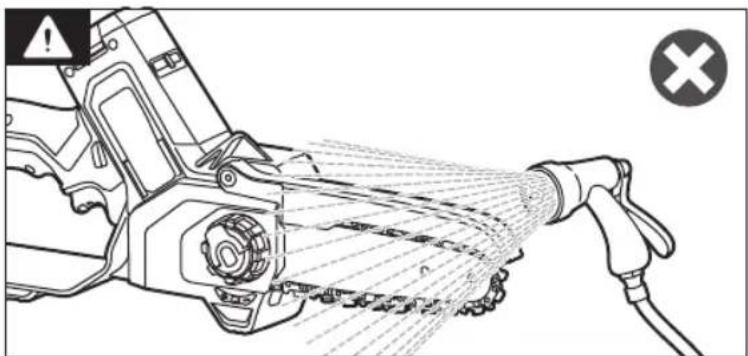
- Do not expose power tools to rain or wet conditions. Water entering a power tool will increase the risk of electric shock.
- Do not abuse the cord. Never use the cord for carrying, pulling or unplugging the power tool. Keep cord away from heat, oil, sharp edges or moving parts. Damaged or entangled cords increase the risk of electric shock.
- When operating a power tool outdoors, use an extension cord suitable for outdoor use. Use of a cord suitable for outdoor use reduces the risk of electric shock.
■ If operating a power tool in a damp location is unavoidable, use a residual current device (RCD) protected supply. Use of an RCD reduces the risk of electric shock.
PERSONAL SAFETY
■ Stay alert, watch what you are doing and use common sense when operating a power tool. Do not use a power tool while you are tired or under the influence of drugs, alcohol or medication. A moment of inattention while operating power tools may result in serious personal injury.
■ Use personal protective equipment. Always wear eye protection. Protective equipment such as a dust mask, non-skid safety shoes, hard hat or hearing protection used for appropriate conditions will reduce personal injuries.
■ Prevent unintentional starting. Ensure the switch is in the off-position before connecting to power source and/or battery pack, picking up or carrying the tool. Carrying power tools with your finger on the switch or energising power tools that have the switch on invites accidents.
■ Remove any adjusting key or wrench before turning the power tool on. A wrench or a key left attached to a rotating part of the power tool may result in personal injury.
- Do not overreach. Keep proper footing and balance at all times. This enables better control of the power tool in unexpected situations.
■ Dress properly. Do not wear loose clothing or jewellery. Keep your hair and clothing away from moving parts. Loose clothes, jewellery or long hair can be caught in moving parts.
If devices are provided for the connection of dust extraction and collection facilities, ensure these are connected and properly used. Use of dust collection can reduce dust-related hazards.
- Do not let familiarity gained from frequent use of tools allow you to become complacent and ignore tool safety principles. A careless action can cause severe injury within a fraction of a second.
POWER TOOL USE AND CARE
- Do not force the power tool. Use the correct power tool for your application. The correct power tool will do the job better and safer at the rate for which it was designed.
-
Do not use the power tool if the switch does not turn it on and off. Any power tool that cannot be controlled with the switch is dangerous and must be repaired.
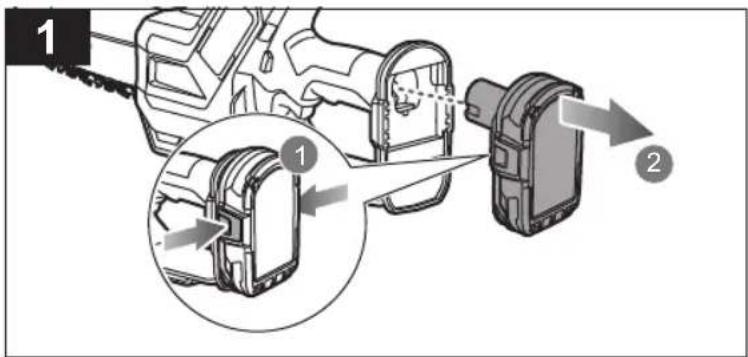
■ Disconnect the plug from the power source and/or remove the battery pack, if detachable, from the power tool before making any adjustments, changing accessories, or storing power tools. Such preventive safety measures reduce the risk of starting the power tool accidentally.
■ Store idle power tools out of the reach of children and do not allow persons unfamiliar with the power tool or these instructions to operate the power tool. Power tools are dangerous in the hands of untrained users. -
Maintain power tools and accessories. Check for misalignment or binding of moving parts, breakage of parts and any other condition that may affect the power tool's operation. If damaged, have the power tool repaired before use. Many accidents are caused by poorly maintained power tools.
- Keep cutting tools sharp and clean. Properly maintained cutting tools with sharp cutting edges are less likely to bind and are easier to control.
■ Use the power tool, accessories and tool bits etc. in accordance with these instructions, taking into account the working conditions and the work to be performed. Use of the power tool for operations different from those intended could result in a hazardous situation. - Keep handles and grasping surfaces dry, clean and free from oil and grease. Slippery handles and grasping surfaces do not allow for safe handling and control of the tool in unexpected situations.
BATTERY TOOL USE AND CARE
■ Recharge only with the charger specified by the manufacturer. A charger that is suitable for one type of battery pack may create a risk of fire when used with another battery pack.
■ Use power tools only with specifically designated battery packs. Use of any other battery packs may create a risk of injury and fire.
- When battery pack is not in use, keep it away from other metal objects, like paper clips, coins, keys, nails, screws or other small metal objects, that can make a connection from one terminal to another. Shorting the battery terminals together may cause burns or a fire.
■ Under abusive conditions, liquid may be ejected from the battery; avoid contact. If contact accidentally occurs, flush with water. If liquid contacts eyes, additionally seek medical help. Liquid ejected from the battery may cause irritation or burns.
- Do not use a battery pack or tool that is damaged or modified. Damaged or modified batteries may exhibit unpredictable behaviour resulting in fire, explosion or risk of injury.
- Do not expose a battery pack or tool to fire or excessive temperature. Exposure to fire or temperature above 130 °C may cause explosion.
■ Follow all charging instructions and do not charge the battery pack or tool outside the temperature range specified in the instructions. Charging improperly or at temperatures outside the specified range may damage the battery and increase the risk of fire.
SERVICE
■ Have your power tool serviced by a qualified repair person using only identical replacement parts. This will ensure that the safety of the power tool is maintained.
■ Never service damaged battery packs. Service of battery packs should only be performed by the manufacturer or authorized service providers.
GENERAL PRUNING SAW SAFETY WARNINGS
- Keep all parts of the body away from the saw chain when the pruning saw is operating. Before you start the pruning saw, make sure the saw chain is not contacting anything. A moment of inattention while operating pruning saws may cause entanglement of your clothing or body with the saw chain.
■ Always hold the pruning saw with one hand on the control handle and the other hand on the auxiliary handle. - Hold the pruning saw by insulated gripping surfaces only, because the saw chain may contact hidden wiring. Saw chains contacting a “live” wire may make exposed metal parts of the pruning saw “live” and could give the operator an electric shock.
■ Wear eye protection. Further protective equipment for hearing, head, hands, legs and feet is recommended. Adequate protective equipment will reduce personal injury by flying debris or accidental contact with the saw chain. - Do not operate a pruning saw in a tree, on a ladder, from a rooftop, or any unstable support. Operation of a pruning saw in this manner could result in serious personal injury.
■ Always keep proper footing and operate the pruning saw only when standing on fixed, secure and level surface. Slippery or unstable surfaces may cause a loss of balance or control of the pruning saw. - When cutting a branch that is under tension, be alert for spring back. When the tension in the wood fibres is released, the spring loaded branch may strike the operator and/or throw the pruning saw out of control.
■ Use extreme caution when cutting brush and saplings. The slender material may catch the saw chain and be whipped toward you or pull you off balance. - Carry the pruning saw with the pruning saw switched off and away from your body. When transporting or storing the pruning saw, always fit the guide bar cover. Proper handling of the pruning saw will reduce the likelihood of accidental contact with the moving saw chain.
■ Follow instructions for lubricating, chain tensioning and changing the bar and chain. Improperly tensioned or lubricated chain may either break or increase the chance for kickback.
Cut wood only. Do not use pruning saw for purposes not intended. For example: do not use pruning saw for cutting metal, plastic, masonry or non-wood building materials. Use of the pruning saw for operations different than intended could result in a hazardous situation.
This pruning saw is not intended for tree felling. Use of the pruning saw for operations different than intended could result in serious injury to the operator or bystanders.
■ Follow all instructions when clearing jammed material, storing or servicing the pruning saw. Make sure the switch is off and the battery pack is removed. Unexpected actuation of the pruning saw while clearing jammed material or servicing may result in serious personal injury.
CAUSES AND OPERATOR PREVENTION OF KICKBACK:
Kickback may occur when the nose or tip of the guide bar touches an object, or when the wood closes in and pinches the saw chain in the cut.
Tip contact in some cases may cause a sudden reverse reaction, kicking the guide bar up and back towards the operator.
Pinching the saw chain along the top of the guide bar may push the guide bar rapidly back towards the operator.
Either of these reactions may cause you to lose control of the saw which could result in serious personal injury. Do not rely exclusively upon the safety devices built into your saw. As a pruning saw user, you should take several steps to keep your cutting jobs free from accident or injury.
Kickback is the result of pruning saw misuse and/or incorrect operating procedures or conditions and can be avoided by taking proper precautions as given below:
- Maintain a firm grip, with thumbs and fingers encircling the pruning saw control handle, with both hands on the saw and position your body and arm to allow you to resist kickback forces. Kickback forces can be controlled by the operator, if proper precautions are taken. Do not let go of the pruning saw.
- Do not overreach and do not cut above shoulder height. This helps prevent unintended tip contact and enables better control of the pruning saw in unexpected situations.
■ Only use replacement guide bars and saw chains specified by the manufacturer. Incorrect replacement guide bars and saw chains may cause chain breakage and/or kickback. - Follow the manufacturer's sharpening and maintenance instructions for the saw chain. Decreasing the depth gauge height can lead to increased kickback.
ADDITIONAL SAFETY WARNINGS
■ Attend a professionally organised course on the use and maintenance of pruning saws, preventative actions, and first aid. Keep these instructions safe for later use.
■ Pruning saws are potentially dangerous tools. Accidents involving the use of pruning saws often result in loss of limbs or death. Falling branches, toppling trees, rolling logs can all kill. Diseased or rotting timber poses additional hazards. Assess your capability of completing the task safely. If there is any doubt, leave it to a professional tree surgeon.
- It is recommended to practise cutting logs on a saw-horse or cradle when operating the product for the first time.
■ The size of the work area depends on the job being performed and the size of the tree or workpiece involved. The operator needs to be aware and in control of everything happening in the work area.
- Do not cut with your body in line with the guide bar and chain. If you experience kickback, this position helps prevent the chain from coming into contact with your head or body.
- Do not use a back-and-forward sawing motion. Let the chain do the work. Keep the chain sharp, and do not try to push the chain through the cut.
- Do not put pressure on the saw at the end of the cut. Be ready to take on the weight of the saw as it cuts free from the wood. Failure to do so could result in possible serious personal injury.
- Do not stop the saw in the middle of a cutting operation. Keep the saw running until it is already removed from the cut.
■ To reduce the risk of injury associated with contacting moving parts, always turn off the product, remove the battery pack, and make sure that all moving parts have come to a complete stop:
• before cleaning or clearing a blockage
• before leaving the product unattended
• before installing or removing attachments
- before checking, conducting maintenance, or working on the product
Injuries may be caused, or aggravated, by prolonged use of the product. When using the product for prolonged periods, ensure to take regular breaks.
If the product is dropped, suffers heavy impact, or begins to vibrate abnormally, immediately stop the product and inspect for damage or identify the cause of the vibration. Any damage should be properly repaired or replaced by an authorised service centre.
■ Operate the product only in temperatures between 0 °C and 40 °C.
■ Store the product in a location where the ambient temperature is between -10 °C and 50 °C.
PERSONAL PROTECTIVE EQUIPMENT
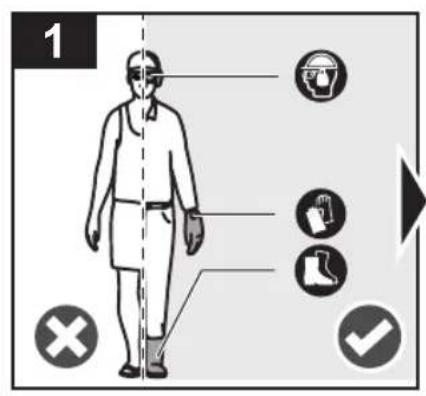
Good quality personal protective equipment, as used by professionals, helps reduce the risk of injury to the operator. The following items should be used when operating the product:
■ Safety helmet
- should comply with EN 397 and be CE marked
■ Hearing protection
- should comply with EN 352-1 and be CE marked
■ Eye and face protection
- should be CE marked and comply with EN 166 (for safety glasses) or EN 1731 (for mesh visors)
Gloves
- should comply with EN ISO 11393-4 and be CE marked
■ Leg protection (chaps)
- should comply with EN ISO 11393-2, and be CE marked and provide all-round protection
■ Pruning saw safety boots
- should comply with EN ISO 20345:2004 and be marked with a shield depicting a pruning saw to show compliance with EN ISO 11393-3. (Occasional users may use steel toe-cap safety boots with protective gaiters, which conform to EN ISO 11393-5 if the ground is even and there is little risk of tripping or catching on undergrowth.)
■ Pruning saw jackets for upper body protection
- should comply with EN ISO 11393-6 and be CE marked
ADDITIONAL BATTERY SAFETY WARNINGS
■ To reduce the risk of fire, personal injury, and product damage due to short circuit, never immerse the tool, battery pack, or charger in fluid or allow fluid to flow inside them. Corrosive or conductive fluids, such as seawater, certain industrial chemicals, and bleach or bleach-containing products, etc., can cause a short circuit.
- Charge the battery pack in a location where the ambient temperature is between 10 °C and 38 °C.
■ Store the battery pack in a location where the ambient temperature is between 0 °C and 20 °C.
INSTRUCTIONS CONCERNING THE PROPER TECHNIQUES FOR BASIC LIMBING AND CROSS-CUTTING
UNDERSTANDING THE FORCES WITHIN THE WOOD
When you understand the directional pressures and stresses inside the wood, you can reduce the pinches or at least expect them during your cutting. Tension in the wood means the fibres are being pulled apart, and if you cut in this area, the kerf or cut tends to open as the saw goes through. If a log is being supported on a saw-horse and the end is hanging unsupported over the end, tension is created on the upper surface due to the weight of the overhanging log stretching the fi bres. Likewise, the underside of the log is compressed and the fi bres are being pushed together. If a cut is made in this area, the kerf tends to close up during the cut. This cut would pinch the saw chain.
PUSH AND PULL
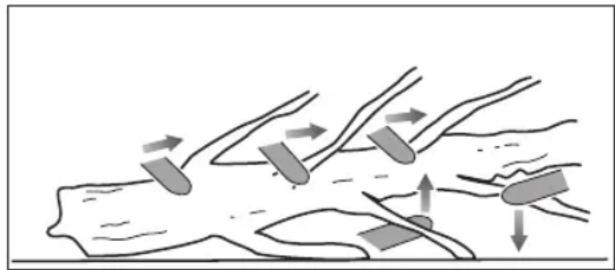
The reaction force is always opposite to the direction the chain is moving. The operator must be ready to control the tendency for the product to pull away and push backwards. The product pulls away (forward motion) when cutting on the bottom edge of the bar. The product pushes backwards (towards the operator) when cutting along the top edge.
SAW JAMMED IN THE CUT
Turn off the product, and remove the battery pack. Do not try to force the chain and bar out of the cut as this is likely to break the chain, which may swing back and strike the operator. This situation normally occurs because the wood is incorrectly supported, which forces the cut to close under compression, thereby pinching the saw chain. If adjusting the support does not release the bar and chain, use wooden wedges or a lever to open the cut and release the saw. Never try to start the pruning saw when the guide bar is already in a cut or kerf.
SKATING/BOUNCING
When the pruning saw fails to dig in during a cut, the guide bar can begin hopping or dangerously skidding along the surface of the log or branch, possibly resulting in the loss of control of the pruning saw. To prevent or reduce skating or bouncing, always use the saw with both hands. Make sure that the saw chain establishes a groove for cutting. Never cut small, fl exible branches or brushes with your pruning saw. Their size and fl exibility can easily cause the saw to bounce towards you or bind up with enough force to cause a kickback. The best tool for that kind of work is a hand saw, pruning shears, an axe, or other hand tools.
LIMBING A TREE
Limbing is removing the branches from a fallen tree. When limbing, leave larger lower limbs to support the log off the ground. Remove the small limbs in one cut. Branches under tension should be cut from the bottom up to avoid binding the pruning saw.
SPRINGPOLES
A springpole is any log, branch, rooted stump, or sapling that is bent under tension by other wood so that it springs back if the wood holding it is cut or removed.
On a fallen tree, a rooted stump has a high potential of springing back to the upright position during the bucking cut to separate the log from the stump. Watch out for springpoles—they are dangerous. Do not attempt to cut bent branches or stumps that are under tension unless you are professionally trained and competent to do so.
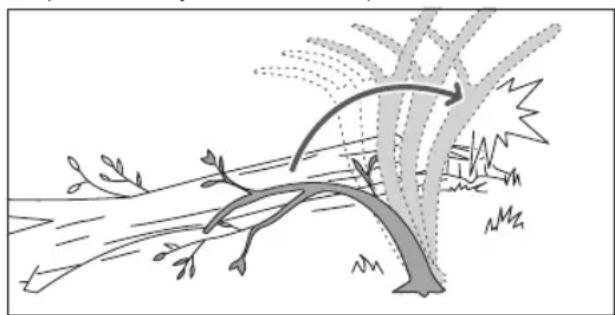
⚠ WARNING! Springpoles are dangerous and could strike the operator, causing the operator to lose control of the pruning saw. This could result in a severe or fatal injury to the operator. Cutting spring poles should be done by trained users.
TRANSPORTATION AND STORAGE
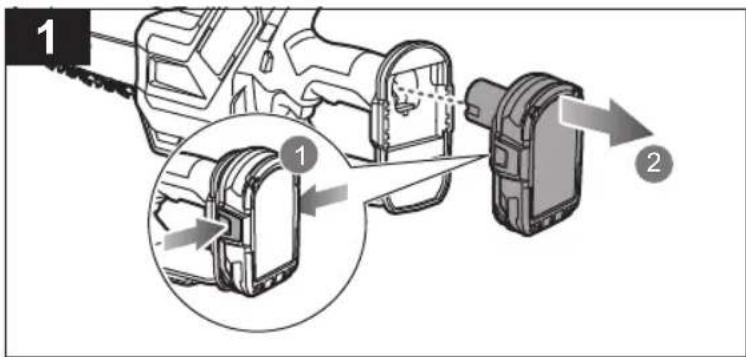
■ Turn off the product, remove the battery pack, and allow the product to cool down before storing or transporting.
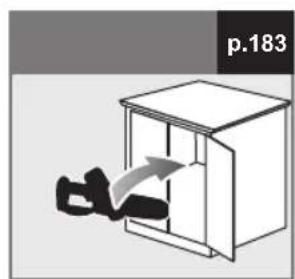
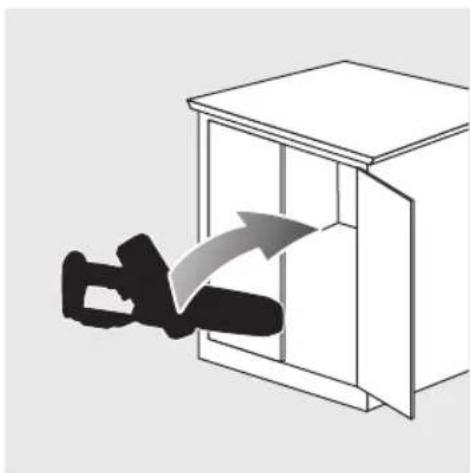
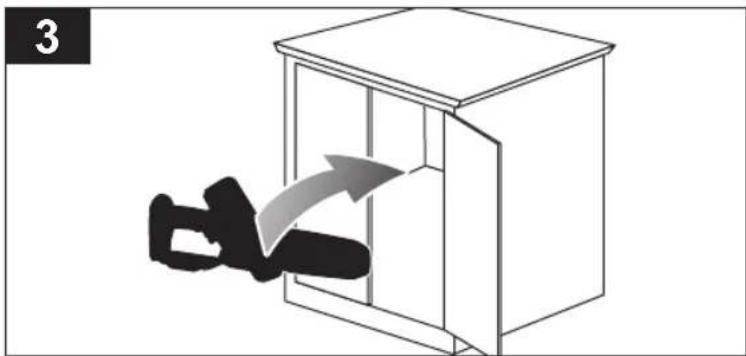
■ Remove all foreign materials from the product. Store the product in a cool, dry, and well-ventilated place that is inaccessible to children. Keep the product away from corrosive agents, such as garden chemicals and deicing salts. Do not store the product outdoors.
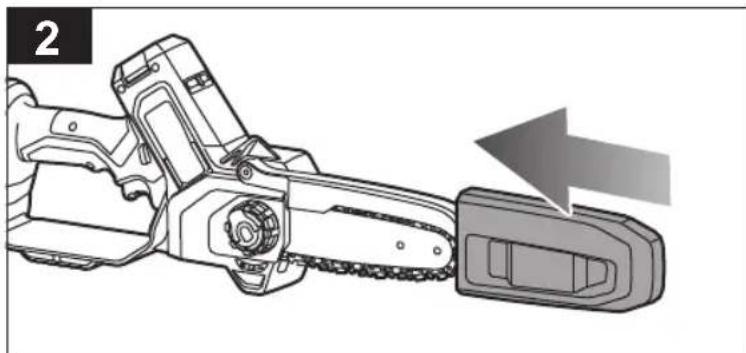
■ Fit the guide bar cover before storing the product or during transportation.
■ For transportation, secure the product against movement or falling to prevent injury to persons or damage to the product.
TRANSPORTING LITHIUM BATTERIES
Transport the battery in accordance with local and national provisions and regulations.
Follow all special requirements on packaging and labelling when transporting batteries by a third party. Ensure that no batteries can come in contact with other batteries or conductive materials while in transport by protecting exposed connectors with insulating, non-conductive caps or tape. Do not transport batteries that are cracked or leaking. Check with the forwarding company for further advice.
MAINTENANCE
■ Use only original manufacturer's replacement parts, accessories, and attachments. Failure to do so can cause possible injury, can contribute to poor performance, and may void your warranty.
■ Servicing requires extreme care and knowledge and should be performed only by a qualified service technician. Have the product serviced by an authorised service centre only.
- You may make adjustments or repairs described in this manual. For other repairs, have the product serviced by an authorised service centre only.
■ Consequences of improper maintenance, removal, or modification of safety devices may cause the product to not function correctly, increasing the potential for serious injury. Keep the product professionally maintained.
■ Sharpening the chain safely is a difficult precision task that should be performed only by experienced skilled professionals. The manufacturer strongly recommends that a worn or dull chain is replaced with a new one, available at your authorised service centre. The part number is available in the product specifications table in this manual.
■ Follow the instructions for lubricating and chain tension checking and adjustment.
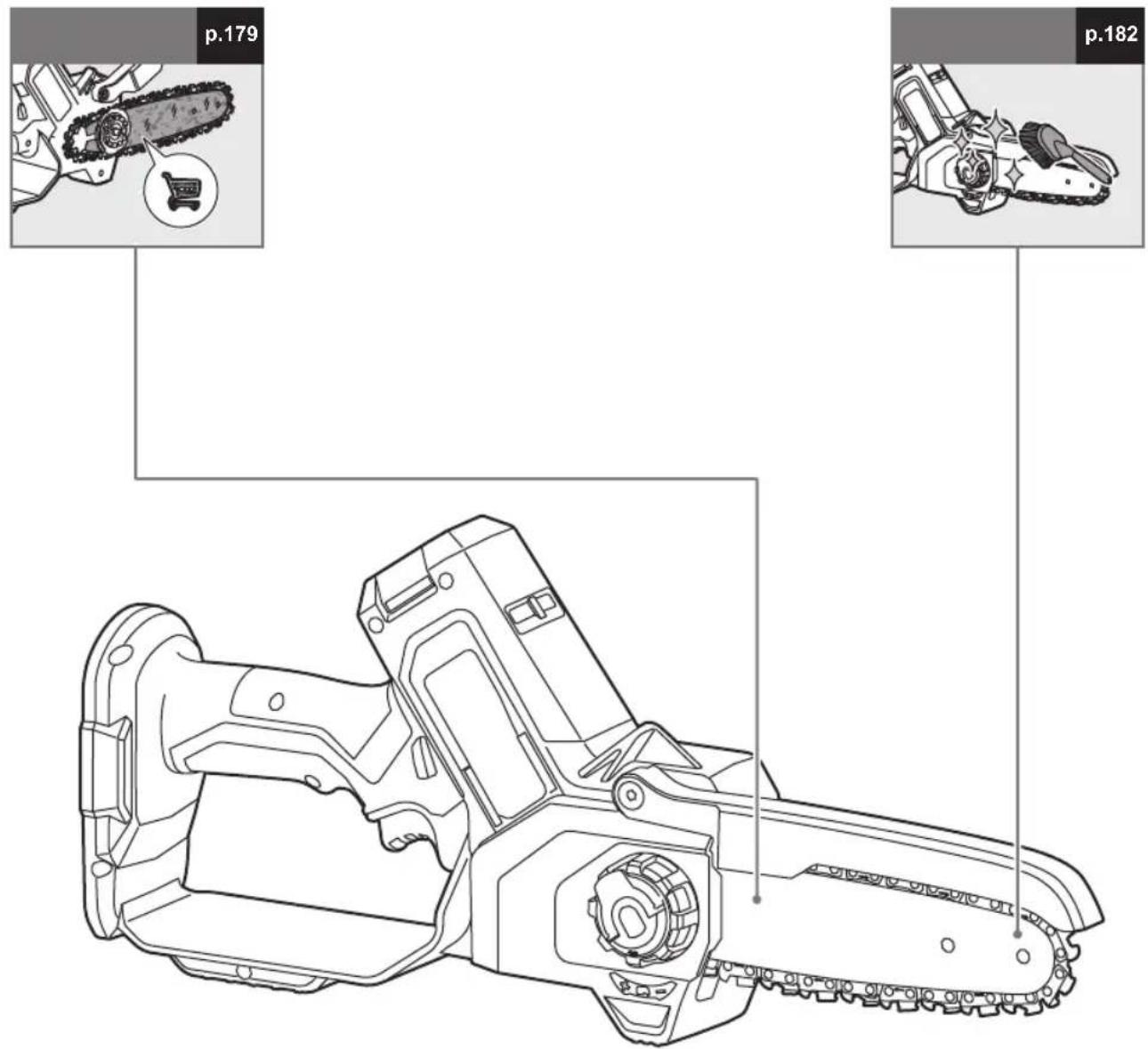
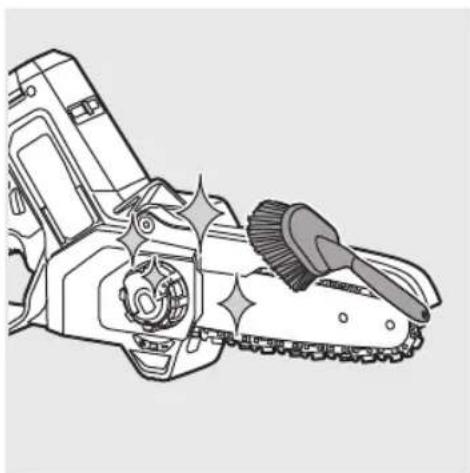
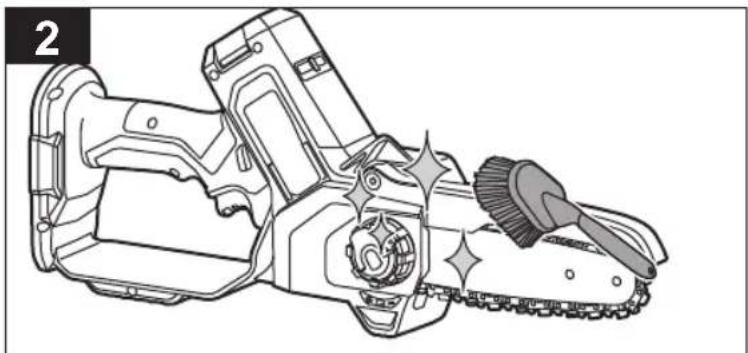
■ After each use, clean the plastic parts with a soft, dry cloth.
- Check all nuts, bolts, and screws at frequent intervals for security to ensure that the product is in safe working condition. Any part that is damaged should be properly repaired or replaced by an authorised service centre.
MAINTENANCE SCHEDULE
Daily check
Bar lubrication Before each use
Chain tension Before each use and frequently
Chain sharpness Before each use (visual check)
For damaged parts Before each use
For loose fasteners Before each use
Inspect and clean
Bar Before each use
Complete saw After each use
KNOW YOUR PRODUCT
See page 175.
- Control handle
- Trigger release
- Auxiliary handle
- Chain guard
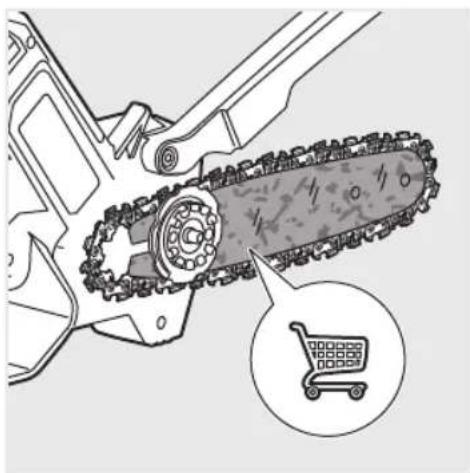
- Guide bar
- Saw chain
- Chain tensioner knob
- Guide bar locking knob
- Sprocket cover
- Switch trigger
- Chain and bar oiler
- Guide bar cover
- Operator's manual
- Battery pack
- Charger
SAFETY DEVICES
Chain guard
The chain guard prevents your hand from coming into contact with the saw chain.
Chain catcher
The chain catcher prevents the saw chain from being thrown back towards the operator if the saw chain comes loose or breaks.
Guide bars
Generally, guide bars with small radius tips have a somewhat lower potential for kickback. Use a guide bar and matching chain that is just long enough for the job. Longer bars increase the risk of loss of control during sawing. Regularly check the chain tension. When cutting smaller branches (less than the full length of the guide bar) the chain is more likely to be thrown off if the tension is not correct.
Low-kickback saw chain
The low-kickback saw chain helps to reduce the possibility of a kickback event.
The rakers (depth gauges) ahead of each cutter can minimise the force of a kickback reaction by preventing the cutters from digging in too deeply. Use only replacement guide bar and chain combinations that are recommended by the manufacturer.
As saw chains are sharpened, they lose some of the low-kickback qualities, and extra caution is required. For safety, replace saw chains when cutting performance decreases.
Over-temperature protection
The battery pack has over-temperature protection, which is designed to protect the battery cells from damage in the event of high temperatures. This feature may cause the
battery to stop powering the product until the battery cells cool down. If the battery pack is warm to touch, allow it to cool down before resuming operation. If the product still does not work, connect the battery pack to the charger, which can also indicate over-temperature protection. When the battery cells cool down, the charger begins to charge the battery.
NOTE: High ambient temperatures above 30 °C and high-power tools, such as pruning saws, can cause the battery cells to heat up faster. Monitor the battery pack regularly, and if it is warm to touch, change the battery or allow the battery to cool down.
NOTE: The battery pack LED indicator stops working if the battery protection feature has caused the battery pack to stop powering the product.
SYMBOLS

Safety alert

Read and understand all instructions before operating the product. Follow all warnings and safety instructions.

Wear eye, ear, and head protection.

Wear non-slip, heavy-duty gloves.

Wear non-slip safety footwear when using the product.

Do not expose the product to rain or damp conditions.

Hold and operate the saw properly with both hands.

Do not operate the saw using only one hand.

Beware of pruning saw kickback and avoid contact with bar tip.

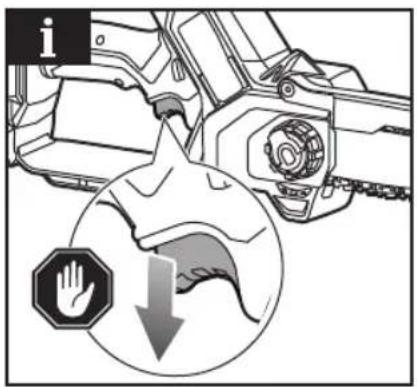
Do not touch below.
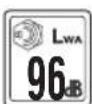
Guaranteed sound power level
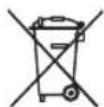
Do not dispose of waste batteries, waste electrical and electronic equipment as unsorted municipal waste. Waste batteries and waste electrical and electronic equipment must be collected separately. Waste batteries, waste accumulators, and light sources have to be removed from the equipment. Check with your local authority or retailer for recycling advice and collection point. According to local regulations, retailers may have an obligation to take back waste batteries and waste electrical and electronic equipment free of charge. Your contribution to the reuse and recycling of waste batteries and waste electrical and electronic equipment helps to reduce the demand of raw materials. Waste batteries, in particular containing lithium, and waste electrical and electronic equipment contain valuable and recyclable materials, which can adversely impact the environment and the human health if not disposed of in an environmentally compatible manner. Delete personal data from waste equipment, if any.
GETTING STARTED
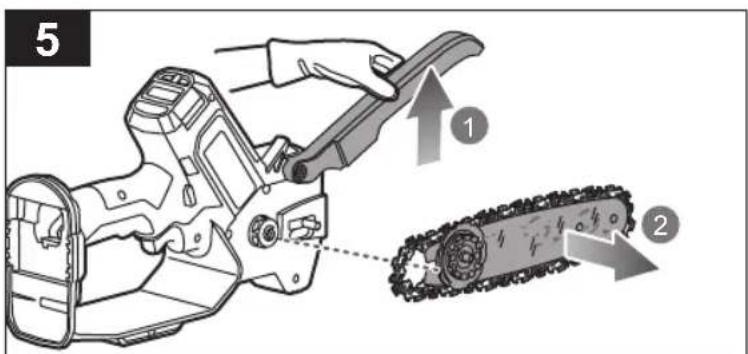
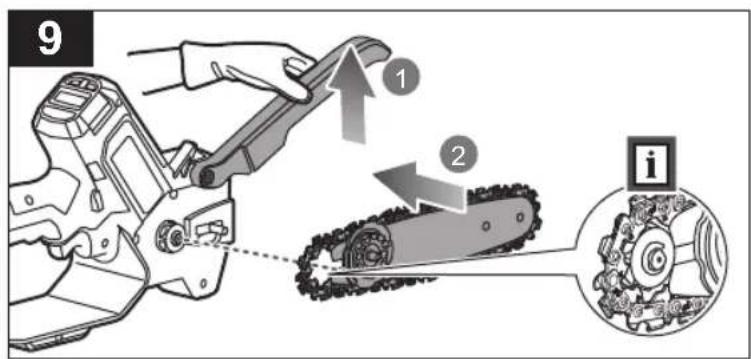
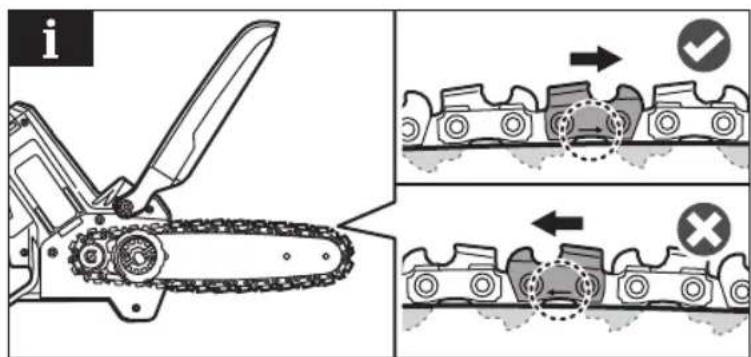
See pages 176-177.
- Wear full eye protection, ear protection, non-slip heavy-duty gloves, substantial footwear, and protective clothing at all times while operating the product. Do not operate the product when barefoot or wearing open sandals.
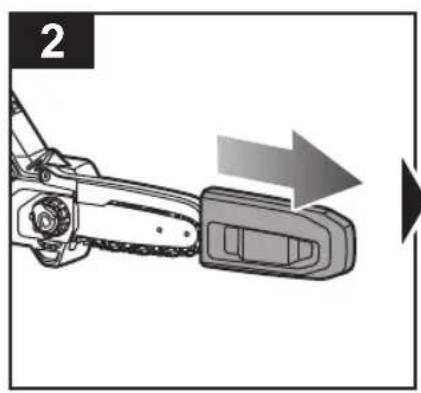
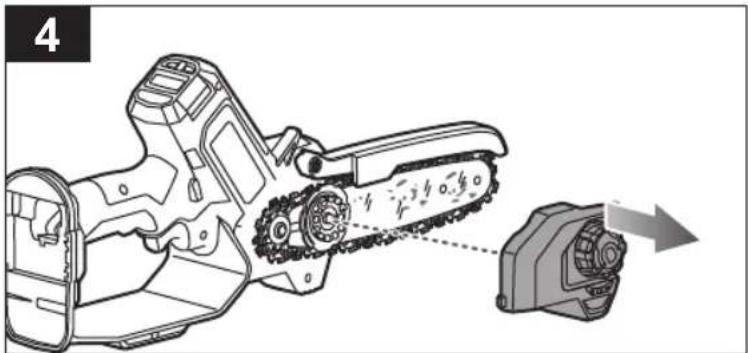
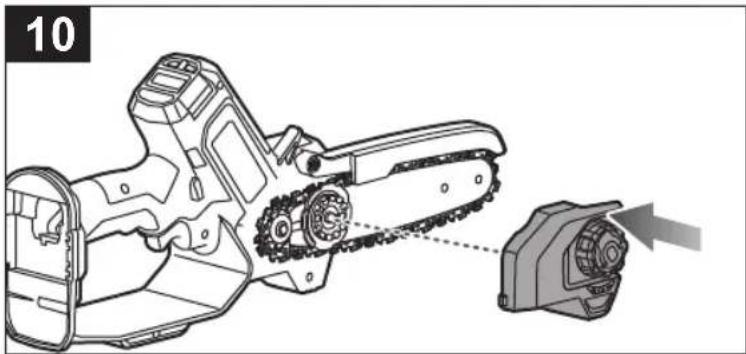
- Remove the guide bar cover.
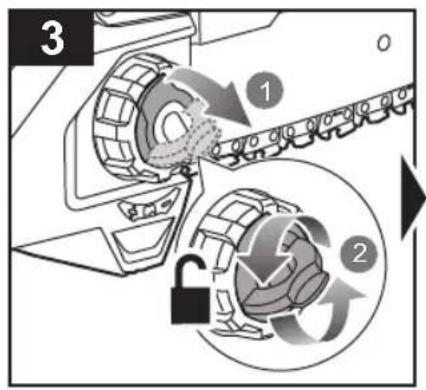
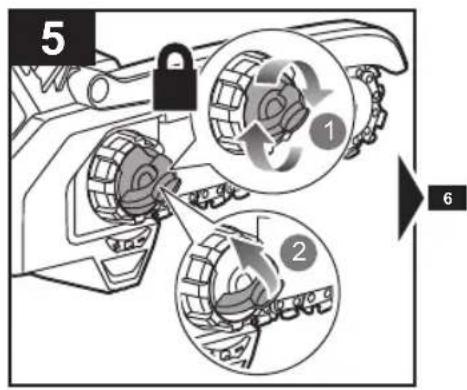
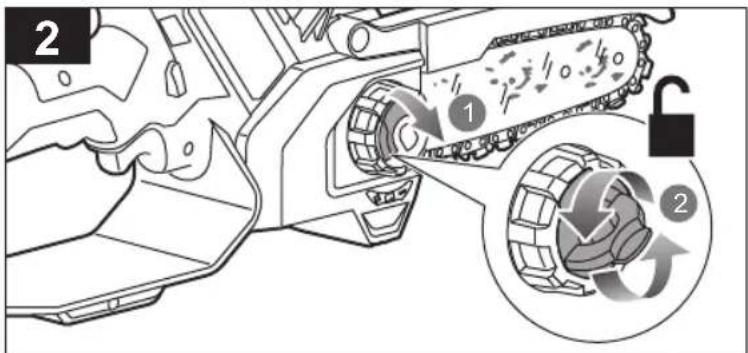
- Turn the guide bar locking knob counterclockwise to unlock.
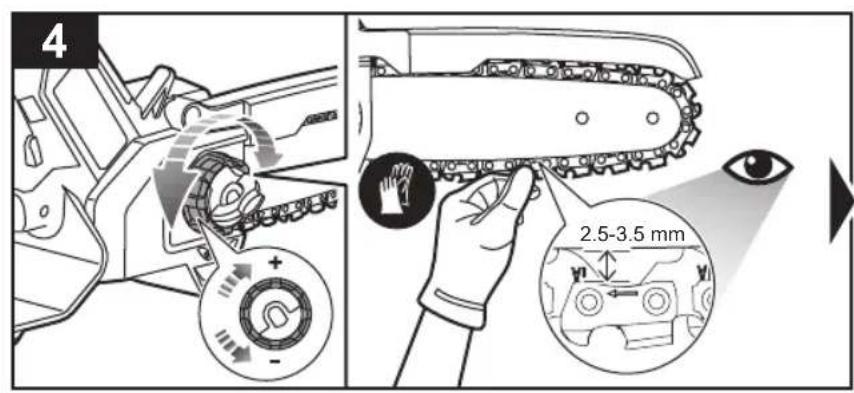
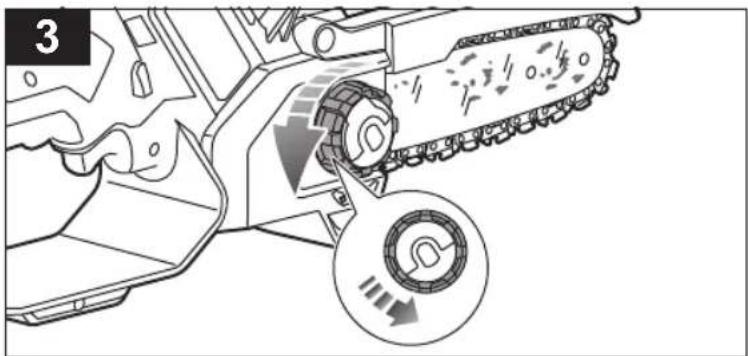
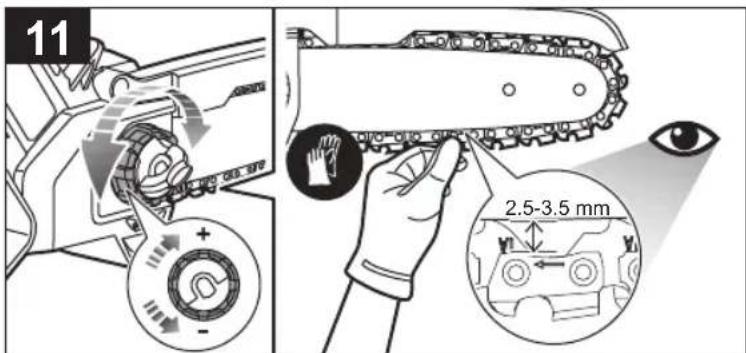
- Adjust the chain tension. To increase the chain tension, turn the chain tensioner knob clockwise. To reduce the chain tension, turn the chain tensioner knob counterclockwise.
NOTE: The chain tension is correct when the gap between the cutter in the chain and the bar is between 2.5 and 3.5 mm. Pull the chain in the middle of the lower side of the bar downwards (away from the bar), and measure the distance between the bar and the chain cutters.
NOTE: The temperature of the chain increases during normal operation, causing the chain to stretch. Check the chain tension frequently and adjust as required. A chain that is tensioned while warm may be too tight upon cooling. Make sure that the chain tension is correctly adjusted as specified in these instructions.
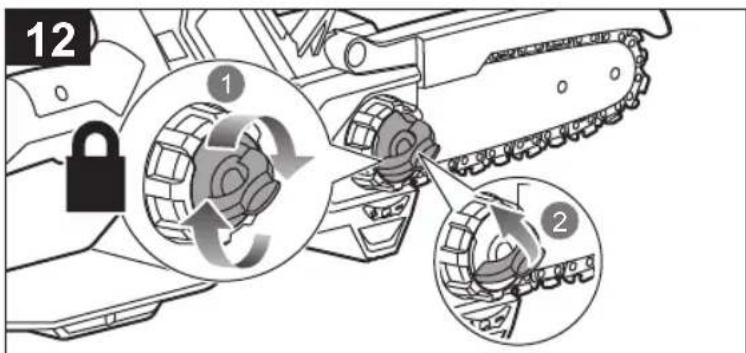
- Turn the guide bar locking knob clockwise until it locks into place.
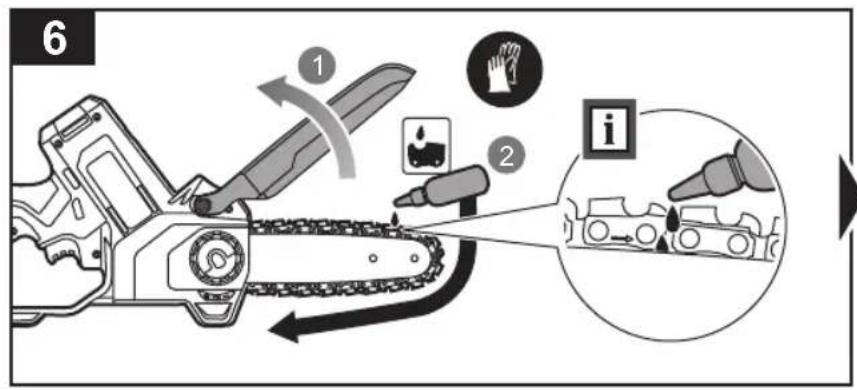
- Raise and hold the chain guard. Apply chain and bar oil. Never work without chain lubricant. If the saw chain is running without lubricant, the guide bar and the saw chain can be damaged.
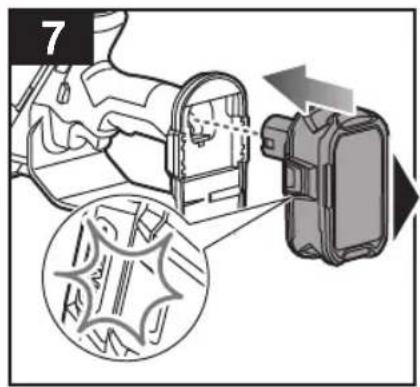
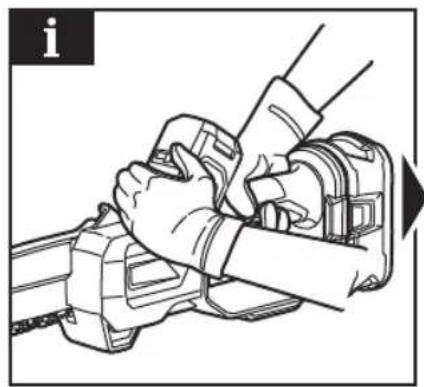
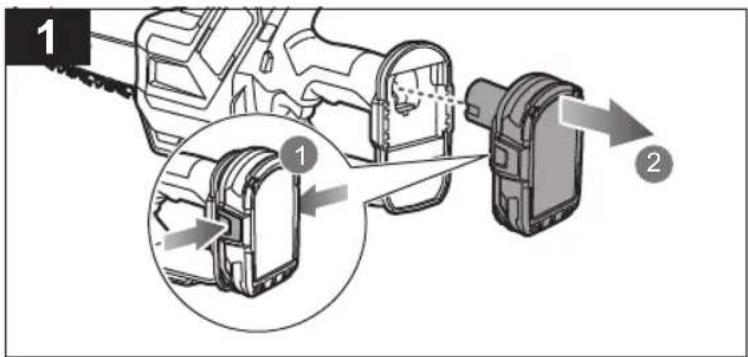
NOTE: Lubricate the chain and bar when needed. - Insert the battery pack into the product. Make sure that the latch of the battery pack clicks in place and that the battery pack is fully seated and securely attached before beginning operation.
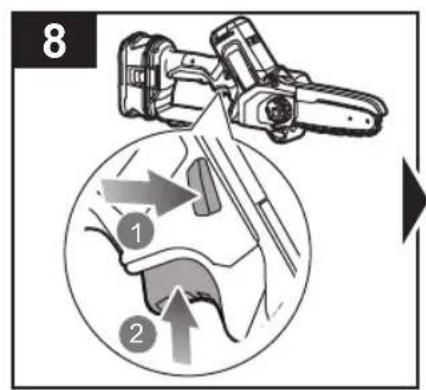
- Press the trigger release and squeeze the switch trigger to start the product.
NOTE: Always hold the pruning saw with one hand on the control handle and the other hand on the auxiliary handle.
NOTE: To stop the product, release the switch trigger.
FR TRADUCTION DE LA NOTICE ORIGINALE
TIGES RESSORTS
VERSTEHEN SIE DIE KRÄFTE IN DEM HOLZ
FEDERSTÖCKE
MACHEN SIE SICH MIT IHREM PRODUKT VERTRAUT
Siehe Seite 175.
BARRAS ELÁSTICAS
POLI A MOLLA
ALGEMENE PRODUCTVEILIGHEIDSWAARSCHUWINGEN
EXTRA VEILIGHEIDSWAARSCHUWINGEN ACCU
VEERSTOK
GALHOS
SAV HAR SAT SIG FAST I SAVERILLEN
FJEDERSTÄNGER
SÅGEN HAR FASTNAT I KAPET
FJÄDERSTÄNGER
TRANSPORT OCH FÖRVARING
KIREYDET
ARBEIDSOMRÅDETS SIKKERHET
BRUK OG VEDLIKEHOLD AV ELEKTROVERKT∅Y
SAG KJ∅RT FAST I KUTTET
FJÆRSTENGER
KJENN PRODUKTET DITT
Se side 175.
ПРУЖИНЯЩИЕ ДЕРЕВЬЯ
NAPREŻONE GAŁĘZIE
ODPRUŽENÉ VĚTVĚ
ÁGRÉSZEK
TIJE DE SUSPENSIE DE AMORTIZARE
ATSPERİGI KRÜMI
ITEMPIMO JÈGŲ VEIKIAMI PJOVINIAI
SEADME ÜLDISED OHUTUSJUHISED
TAGASILÖÖGIOKSAD
SIGURNOST RADNOG PROSTORA
Neka vaša radna površina bude čista i dobro osvijetljena. Zatrpani i neosvijetljeni radni prostori izazivaju nezgode.
- Električne alate nemojte upotrebljavati u eksplozivnoj okolini, primjerice u blizini zapaljivih tekućina, plina ili prašine. Iskre koje izlaze iz električnih alata mogu ih zapaliti ili izazvati eksploziju.
Djecu, posjetitelje i domaće životinje držite dalje od mjesta na kojem upotrebljavate električni alat. Mogli bi vas omesti te biste zbog toga mogli izgubiti nadzor nad alatom.
ELEKTRIČNA SIGURNOST
- Utikač električnog alata uvijek mora biti prilagođen utičnici. Nikada ne mijenjajte utikač. Nikada nemojte upotrebljavati prilagodnik s električnim alatom s uzemljenjem. Tako ćete izbjeći opasnost od strujnog udara.
Izbjegavajte svaki kontakt s uzemljenim površinama poput cijevi, radijatora, kuhala, hladnjaka itd. Opasnost od strujnog udara povećava se ako je dio vašeg tijela u dodiru s uzemljenim površinama. - Električni alat nemojte izlagati kiši ili vlazi. Opasnost od strujnog udara povećava se ako u električni alat uđe voda.
Pazite da kabel za napajanje bude u dobrom stanju. Alat nikad nemojte držati za kabel za napajanje, a kabel nemojte vući ni prilikom isključivanja iz struje.
NAPETE GRANE
Savijeno šiblje je grana, panj bez korjena ili grm koji je savijen zbog nekog drugog komada drveta, tako da se naglo otpušta kad odrežemo ili uklonimo komad tog drveta koji ga drži.
DODATNA VARNOSTNA OPOZORILA
VZMETNE PALICE
Odskočno deblo je vsako deblo, veja, ukoreninjen štor ali mlado drevesce, ki je upognjeno pod pritiskom zaradi drugega lesa, tako da odskoči nazaj, će odžagamo ali odstranimo les, ki ga zadržuje.
OSOBNÉ OCHRANNÉ POMÔCKY
NAPNUTÉ KONÁRE
OBOZNÁMTE SA S VAŠÍM PRODUKTOM
Pozrite stranu 175.
ПРУЖИННИ ПРЪТИ
ПРУЖНІ ШТАНГИ
YAYLI DIREKLER
TENTΩΜΕΝΑ ΣΤΕΛΕΧΗ
![graph TD A[" gears meshing"] --> B[" lock mechanism "] B --> C[" gear wheel "] C --> D[" lock mechanism "] D --> E[" gear wheel "] style A fill:#f9f,stroke:#333 style B fill:#ccf,stroke:#333 style C fill:#cfc,stroke:#333 style D fill:#fcc,stroke:#333 style E fill:#ffc,stroke:#333](/content/2026/04/727020/images/0353349fd79def326cfc4e27e1a4399c91c3c639f72335b658ff24e9caa48643.jpg)
![graph TD A["Tool"] --> B["Gear"] B --> C["Wheel"] C --> D["Lock"] D --> E["Gear"] style A fill:#f9f,stroke:#333 style B fill:#ccf,stroke:#333 style C fill:#cfc,stroke:#333 style D fill:#fcc,stroke:#333 style E fill:#cff,stroke:#333](/content/2026/04/727020/images/04bad62ce55f9496c8285327adf91ab7838afd3642c87d4ec47fee0d539e15f0.jpg)
![graph TD A["Robot 1"] --> B["Chain"] C["Robot 2"] --> B B --> D["Car"] style A fill:#f9f,stroke:#333 style C fill:#f9f,stroke:#333 style D fill:#ccf,stroke:#333](/content/2026/04/727020/images/0b45839f384d8e89261aebb2eabbd31050cc474369bef225efb85aa02b06dea4.jpg)
English Français Deutsch Español Italiano Nederlands Português
| Product specifications | Caracteristiques produit | Produkt-Spezifikationen | Caracteristicas del producto | Caratteristiche del prodotto | Productgegevens Caracteristicas do aparelho |
| Cordless pruning saw Sce d'élagage sans fil Akku-Astsäge Sierra de poda | |||||
| Model Modèle Modell | Modelo Modello | Model Modelo | Lama di potatura senza fili | Snoerloze snoeizaag Serra de podar sem fios | |
| Rated voltage | Tension nominale | Nennspannung | Tensión nominal | Voltaggio nominale | Toegekende spanning |
| No-load speed | Vitesse à vide | Leerlaufdrehzahl | Velocidad sin carga | Velocità senza carico | Snelheid zonder lading |
| Guide bar length | Longueur du guide-chaîne | Länge der Führungsschiene | Longitud de la barra guía | Lunghezza barra di guida | Zwaardlengte Comprimento da lâmina-guia |
| Usable cutting length Longueur de coupe utile | Anwendbare Schnittlänge | Largo de corte | Lunghezza di taglio disponibile | Bruikbare zaaglengte | Comprimento de corte útil |
| Chain stop | Arrêt de chaîne | Kettenstop | Parada de la cadena | Arresto catena | Kettingstop |
| Chain length | Longueur de la chaîne | Kettenlänge | Longitud de la cadena | Lunghezza catena | Kettinglengte |
| Chain pitch | Gouge de la chaîne | Kettenteilung | Paso de la cadena | Passo catena | Kettingsteck |
| Chain gauge | Pas de la chaîne | Kettenstärke | Calibre de la cadena | Sezione catena | Tanddiepte |
| Drive links quantity Nomore de maillons d'entraînement | Anzahl der Antriebsglieder | Cantidad de eslabones del accionamiento | Quantità maglie guida | Aantal aandrijfschakels | Quantidade de ligações do motor |
| Weight (without battery pack, guide bar, chain, and oil) | Poids (sans la batterie, la barre de guidage, la chaîne et l'huile) | Gewicht (ohne Akkupack, Führungsschiene, Kette und Öl) | Peso (sin batería, barra de guía, cadena ni aceite) | Peso (senza pacco battería, barra guida, catena e olio) | Gewicht (zonder accu, geleidestang, ketting en olie) |
| Weight (with guide bar and chain) | Poids (avec le guide-chaîne et la chaîne) | Gewicht (mit Führungsschiene und Ketto) | Peso (con barra de guía y cadena) | Peso (con barra guida e catena) | Gewicht (met kettinggeleider en ketting) |
| Vibration level (in accordance with IEC 62841-1 and IEC 62841-4-1) | Niveau de vibration (selon IEC 62841-1; IEC 62841-4-1) | Vibrationsgrad (gemäß IEC 62841-1; IEC 62841-4-1) | Nivel de vibración (de acuerdo con IEC 62841-1; IEC 62841-4-1) | Livello vibrazioni (in accordo con la direttiva IEC 62841-1; IEC 62841-4-1) | Trillingsniveau (in overeenstemming met IEC 62841-1; IEC 62841-4-1) |
| Auxiliary handle | Poignée auxiliaire | Hilfsgriff | Mango auxiliar | Manico ausiliario | Extra handgreep |
| Control handle | Poignée de commande | Bediengriff | Mando de control | Impugnatura di controllo | Bedieningshandgreep |
| Uncertainty of measurement | Incertitude de la mesure | Unsicherheit der Messung | Incertidumbre de medición | Incertezza delle misurazioni | Onzekerheid bij meting |
| Noise emission level (in accordance with IEC 62841-1 and IEC 62841-4-1) | Niveau d'émission sonore (selon IEC 62841-1; IEC 62841-4-1) | Schallenergiepegel (gemäß IEC 62841-1; IEC 62841-4-1) | Nivel de emisión de ruido (de acuerdo con IEC 62841-1; IEC 62841-4-1) | Livello di emissione rumore (in accordo con la direttiva IEC 62841-1; IEC 62841-4-1) | Geluidsemissieniveau (in overeenstemming met IEC 62841-1; IEC 62841-4-1) |
| A-weighted sound pressure level at the operator's position | Niveau de pression sonore pondéré A au niveau de l'opérateur | A-bewerteter Schalldruckpegel an der Position des Anwenders | Nivel de presión sonora ponderado A en la posición del operario | Livello di pressione sonora pesato A alla posizione dell'operatore | A-gewogen geluidsdrukniveau op de plaats van de bediener |
| Uncertainty of measurement | Incertitude de la mesure | Unsicherheit der Messung | Incertidumbre de medición | Incertezza delle misurazioni | Onzekerheid bij meting |
| A-weighted sound power level | Niveau de puissance sonore pondéré A | A-bewerteter Schallleistungspegel | Nivel de potencia acústica ponderada en A | Livello di potenza sonora pesato A | A-gewogen geluidsniveau |
| Uncertainty of measurement | Incertitude de la mesure | Unsicherheit der Messung | Incertidumbre de medición | Incertezza delle misurazioni | Onzekerheid bij meting |
| Compatible battery packs | Blocs des batterie compatibles | Kompatible Akkupacks | Paquetes de batería compatibles | Gruppo batterie compatibili | Compatibele accupacks |
| Compatible chargers | Chargeurs compatibles | Kompatible Ladegeräte | Cargador compatible | Caricatore compatibile | Compatibele oplader |
| Replacement parts | Pièces de rechange | Ersatzteile | Piezas de repuesto | Parti di ricambio | Vervangonderdelen | Peças de substituição |
| Manufacturer | Fabricant | Hersteller | Fabricante | Ditta produttrice | Fabrikant | Fabricante |
| Chain | Chaîne coupante | Kette | Cadena | Catena | Ketting | Corrente |
| Bar | Guide-chaîne | Führungsschiene | Barra | Barra | Zwaard | Barra |
| NOTE: The chain must be fitted with the bar from the same manufacturer according to above combinations. | REMARQUE : La chaîne doit être appairée avec un guide-chaîne de la même marque selon les combinaisons ci-dessus. | HINWEIS: Die Kette muss mit einer Schiene von demselben Hersteller, entsprechend den oben genannten Kombinationen, montiert sein. | NOTA: La cadena debe llevar una barra del mismo fabricante según las combinaciones anteriores. | NOTA: La catena deve essere montata con una barra prodotta dalla stessa ditta produttrice seguendo le indicazioni di cui sopra. | OPMERKING: De ketting moet met de geleider van dezelfde fabrikant volgens bovenstaande combinaties worden bevestigd. | NOTA: A correia deve levar uma barra do mesmo fabricante consoante as combinações anteriores. |
Dansk Svenska Suomi Norsk Русский Polski
| Produktspecifikationer | Produktspecifikationer | Tuotteen tekniset tiedot | Produktspesifikasjoner | Характеристики изделия | Parametry techniczne | |
| Ledningsfribeskæringssav | Sladdlös beskämingssåg | Akkuoksasaha Trådløs | trebeskjæringssag | Беспроводная пила для обрезки ветвей | Przycinarka akumulatorowa | |
| Model | Modell | Malli | Modell | Модель | Model | RY18PS15A |
| Mærkespænding | Spänning | Nimellisjännite | Nominell spenning | Номинальное напряжение | Napięcie znamionowe | 18 V d.c. |
| Tomgangshastighed | Hastighet utan belastning | Nopeus ilman kuormaa | Tomgangshastighet | Холостая скорость | Prędkość obrotowa bez obciążenia | 4,4 m/s |
| Sværdets længde | Klingans längd | Terälevyn pituus | Sagsverdlengde | Длина пильной шины | Długość prowadnicy | 152 mm (6 in.) |
| Anvendelig skærer længde | Användbar sågningslängd | Leikkuupituus | Brukbar kuttelengde | Используемая режущая длина | Użyteczna długość cięcia | 152 mm (6 in.) |
| Kædestop | Kedjestopp | Ketjun pysähtyminen | Kjedestopp | Останов цепи | Ogranicznik łańcucha | < 2 s |
| Kædelængde | Kedjelängd | Ketjun pituus | Kjedelengde | Длина цепи | Długość łańcucha | 152 mm (6 in.) |
| Kædestigning | Kedjedelning | Ketjun jako | Inndeling av kjede | Зубья пильной цепи | Przecinak kształtowy łańcucha | 0,375 in. |
| Max. tilladeligt kædeslør | Kedjetjocklek | Ketjun paksuus | Kjedestørrelse | Шаг пильной цепи | Skok łańcucha | 0,043 in. |
| Antal drivled | Mängden drivlänkar | Vetolenkkien määrä | Drivlinkmengde | Количество звеньев | Liczba ogniw napędu | 28 |
| Vægt (uden batteripakke, sværd, kæde og olie) | Vikt (utan batteripaket, sägsvärd, kedja och olja) | Paino (ilman akkupakkausta, terälaippaa, ketjua ja öliyä) | Vekt (uten batteripakke, føringsstang, kjede og olje) | Вес (без аккумуляторного блока, направляющей шины, цепи и масла) | Masa (bez akumulatora, prowadnicy, łańcucha i oleju) | 1,4 kg |
| Vægt (uden sværd og kæde) | Vikt (med sägsvärd och kedja) | Paino (terälaipan ja ketjun kanssa) | Vekt (med føringsstang og kjede) | Вес (с направляющей шиной и цепью) | Masa (z prowadnicą i łańcuchem) | 1,68 kg |
| Vibrationsniveau (iht. IEC 62841-1; IEC 62841-4-1) | Vibrationsnivå (enligt IEC 62841-1; IEC 62841-4-1) | Tärinätaso (standardin IEC 62841-1; IEC 62841-4-1 mukaisesti) | Vibrasjonsnivå (iht. IEC 62841-1; IEC 62841-4-1) | Уровень вибрации (в соответствии с IEC 62841-1; IEC 62841-4-1) | Poziom wibracji (zgodnie z normą IEC 62841-1; IEC 62841-4-1) | |
| Ekstra håndtag | Extra handtag | Lisäkahva | Hjelpehändtak | Вспомогательная рукоять | Rekojesc pomocnicza | 2,2 m/s2 |
| Styrehåndtag | Reglagehandtag | Hallintakahva | Kontrollhändtak | Рукоятка управления | Uchwyt sterujący | 2,1 m/s2 |
| Målingsusikkerhed | Osäkerhet för mätt | Mittausten epätarkkuus | Usikkerhet ved måling | Погрешность измерения | Niepewność pomiaru | 1,5 m/s2 |
| Stojemissionsniveau (iht. IEC 62841-1; IEC 62841-4-1) | Bullerutsläppsnivå (enligt IEC 62841-1; IEC 62841-4-1) | Melutaso (standardin IEC 62841-1; IEC 62841-4-1 mukaisesti) | Støyutslipsnivå (iht. IEC 62841-1; IEC 62841-4-1) | Уровень шума (в соответствии с IEC 62841-1; IEC 62841-4-1) | Poziom emisji hałasu (zgodnie z normą IEC 62841-1; IEC 62841-4-1) | |
| A-vægtet lydtryksniveau ved operatørens position | A-viktad ljudtrycksnivå vid operatörsplats | A-painotettu käyttäjään kohdistuva äänenpainetaso | A-vektet lydtrykk ved operatørposisjon | Амплитудно-взвешенный уровень звукового давления на рабочем месте оператора | Poziom ważonego ciśnienia akustycznego w pozycji operatora 86,4 dB(A) | |
| Målingsusikkerhed | Osäkerhet för mätt | Mittausten epätarkkuus | Usikkerhet ved måling | Погрешность измерения | Niepewność pomiaru | 3,0 dB |
| A-vægtet lydeffektniveau | A-vägd ljudeffektsnivå | A-painotettu äänenteho | A-vektet lydeffektnivå | Уровень А-взвешенной звуковой мощности | A-ważony poziom mocy akustycznej | 94,4 dB(A) |
| Målingsusikkerhed | Osäkerhet för mätt | Mittausten epätarkkuus | Usikkerhet ved måling | Погрешность измерения | Niepewność pomiaru | 3,0 dB |
| Kompatible batterier | Kompatibla batteripaket | Yhteensopivat akut | Kompatible batteripakker | Совместимая аккумуляторная батарея | Pasujace akumulatory | RB18... |
| Kompatibel oplader | Kompatibel laddare | Yhteensopiva laturi | Kompatibel lader | Совместимое зарядное устройство | Zgodna ładowarka | RC18... |
| Reservedele | Utbytesdelar | Varaosat | Erstatningsdeler | Запасные части | Części zamienne | |
| Producent | Tillverkare | Valmistaja | Produsent | Изготовитель | Producent | RYOBI |
| Kæde | Kedja | Ketju | Kjede | Пильная цепь | Łańcuch tnący | RAC282 |
| Sværd | Stöd | Terälevy | Skinne | Шина | Prowadnica | 5131048302 |
| BEMÆRK: Kæden skal sættes på et sværd fra samme producent ifølge ovenstående kombinationer. | OBS: Kedjan máste sitta på ett svård från samma tillverkare enligt ovan nämnda kombinationer. | HUOMAUTUS: Ketjun on oltava saman valmistajan toimittamaan terälevyyn sopiva, yllä mainittujen yhdistelmien mukaisesti. | MERK: Kjede má benyttes med styreskinne fra samme produsent i henhold til ovenstående kombinasjoner. | ПРИМЕЧАНИЕ. Цепь следует использовать с пильной шиной того же производителя в соответствии с приведенными выше сочетаниями. | UWAGA: Należy stosować kombinacje łańcucha i prowadnicy wymienione powyżej, obydwa elementy muszą pochodząć od tego samego producenta. | |
| Čeština | Magyar | Română | Latviski | Lietuviškai | Eesti | Hrvatski |
| Technické údaje produktu | Termék muszaki adatai | Specificatiile produsului | Produkta specifikacijas | Gaminio technines savybes | Toote tehnilised andmed | Specifikacije proizvoda |
| Akumulátorová vyvětvovací pila | Akkumulátoros kézifůrész | Fierăstrău de tăiat crengi fără fir | Akumulatoru zaru zăgis | Akumuliatorinis šakų genėtuvas | Juhtmeta oksasaag Akumulatorska pila za orezivanje | |
| Model Típus Model Model | elis Modelis Mulel Model | |||||
| Jmenovité napětí | Névleges feszültség | Tensiunea nominală | Nominálais spriegums | Nominali įtampa | Nimipinge | Nazivni napon |
| Rychlost naprázdno | Üresjáratí fordulatszám | Viteză fără sarcină | Tukšgaitas ātrums | Greitis be apkrovimo | Tūhikāigukilirus | Brzina bez opterećenja |
| Délka vodící lišty Láncvezető hossza Lungime a barei de ghidare | Sliedes garums | Kreipiamosios juostos ilgis | Juhtlati pikkus Duljina vodilice lanca | |||
| Vyuzitelná řezací délka | Hasznos vágáshossz | Lungime de tăiere utilizabilă | Izmantojamais griešanas garums | Naudojamas pjovimo ilgis | Kasutatav lõike pikkus Korisna duljina rezanja | |
| Zastavení řetēzu | Lándleállás | Oprire lanț | Kõdes apstăšanãs | Grandinés stabdiklis | Keti seiskumine | Hvatač lanca |
| Délka řetēzu | Lánc hossza | Lungimea lanțului | Kõdes garums | Grandinés ilgis | Ketta pikkus | Duljina lanca |
| Článek řetēzu | Fog osztás | Lamele lanțului | Kõdes asmeniši | Pjovimo grandinés dantukas | Keti samm Zubac lanca | |
| Rozteč řetēzu | Fogak közötti távolság | Pasul lanțului | Kõdes parameters | Pjovimo grandinés žingsnis | Keti rööbe | Korak lanca |
| Počet hnacích článků řetēzu | Vágófogak mennyisége | Număr zale de legătură | Piedziņas posmu skaits | Varomujų grandžių kiekis | Veolúlide hulk Količina pogonskih članaka | |
| Hmotnost (bez baterií, vodicí lišty, řetēzu a oleje) | Súly (akku, vezetörüd, lánc és olaj nélkül) | Greutate (fără acumulator, ghidaj, lanți și ulei) | Svars (bez akumulatoru bloka, kõdes sliedes, kõdes un eljas) | Svoris (be akumuliatoriaus, kreipiamosios juostos, grandinés ir alyvos) | Kaal (ilma aku, juhtplaadi, keti ja ôlita) | Težina (bez baterijskog sklopa, mača, lanca i ulja) |
| Hmotnost (s vodicí lištou a řetēzem) | Súly (láncvezetővel és lánccal) | Greutate (cu ghidaj și lanț) | Svars (ar kõdes sliedi un kõdi) | Svoris (su pjovimo juosta ir grandine) | Kaal (juhtplaadi ja ketiga) | Težina (s vodilicom i lancem) |
| Üroveň vibrací (v souladu s IEC 62841-1; IEC 62841-4-1) | Vibrációs szint (az IEC 62841-1; IEC 62841-4-1 szerint) | Nivel de vibratie (în conformitate cu IEC 62841-1; IEC 62841-4-1) | Vibrácijas līmenis (saskaņa ar IEC 62841-1; IEC 62841-4-1) | Vibracijos lygis (pagal IEC 62841-1; IEC 62841-4-1 standartą) | Vibratsioonitase (vastavalt standardile IEC 62841-1; IEC 62841-4-1) | Razina vibracija (u skladu s IEC 62841-1; IEC 62841-4-1) |
| Prídavná rukojet | Kiegészito fogantýu | Mâner auxiliar | Papildu rokturis | Pagalbine rankena | Abikäepide | Pomocna rucka |
| Ovládací rukojeť | Vezérlofogantýu | Mâner de control | Vadības rokturis | Valdymo rankena | Juhtkäepide | Kontrolna ručka |
| Nejistota měření | Mérés bizonytalansága | Nesiguranța măsurătorii | Mērijuma nenoteiktība | Matavimo paklaida | Mõõtmismääramatus | Neodređenost mjerenja |
| Hladina emise hluku (v souladu s IEC 62841-1; IEC 62841-4-1) | Hangkibocsátási szint (az IEC 62841-1; IEC 62841-4-1 szerint) | Nivel emisie zgomot (în conformitate cu IEC 62841-1; IEC 62841-4-1) | Trokšnu emisijas līmenis (saskaņa ar IEC 62841-1; IEC 62841-4-1) | Skleidžiamo triukšmo lygis (pagal IEC 62841-1; IEC 62841-4-1 standartą) | Helivõimsuse tase (vastavalt standardile IEC 62841-1; IEC 62841-4-1) | Razina emisija buke (u skladu s IEC 62841-1; IEC 62841-4-1) |
| Hladina akustlického tlaku vážená funkcí A v poloze obsluhy | A-súlyozott hangnyomásszint a kezelő helyén | Valoare A nivel presiune zgomot la poziṭja operatorului | A-novértējuma skaņas spiediena līmenis operatora darba vietā | A dažninės charakteristikos garso slėgio lygis operatoriaus vietoje | A-kaalutud helirōhu tase operaatori töökohal | A-ponderirana razina zvučnog tlaka u položaju operatera |
| Nejistota měření | Mérės bizonytalansága | Nesiguranța măsurătorii | Mērijuma nenoteiktība | Matavimo paklaida | Mõõtmismääramatus | Neodređenost mjerenja |
| Hladina akustlického výkonu vážená funkcí A | A-súlyozott hangteljesítményszint | Nivel de putere acustică ponderată A | A-līmeņa skaņas jaudas līmenis | A-svertinis akustinis lygis | A-kaalutud helivõimsuse tase | Ponderirana razina zvučne snage |
| Nejistota měření | Mérės bizonytalansága | Nesiguranța măsurătorii | Mērijuma nenoteiktība | Matavimo paklaida | Mõõtmismääramatus | Neodređenost mjerenja |
| Kompatibilní akumulátory | Kompatibilis akkumulátorok | Acumulatori compatibili | Savietojami akumulatoru komplekti | Suderinami baterijos paketai | Ühilduvad akupaketid | Kompatibilna pakiranja baterija |
| Kompatibilní nabiječka | Kompatibilis töltö | Încărcător compatibil | Saderīgs lădētājs | Suderinamas jkroviklis | Ühilduv laadija | Kompatibilni punjači |
| Náhradní díly | Cserealkatrészek | Piese de schimb | Rezerves daļas | Atsarginės detalės | Asendusosad | Zamjena dijelova |
| Výrobce | Gyártó | Producātor | Ražotājs | Gamintojas | Tootja | Proizvođač |
| Ostrá část řetėzu Lišta | FūrészláncLáncvezető | Lanțul ferăstrăuluiLamă | Zāgēšanas kēdeSliede | Pjovimo grandinėApsagas | KettJuhtlatt | LanacVodilica |
| POZNÁMKA:Retėz musí být upevněn na lištė od stejného výrobce dle výše uvedených kombinacích. | MEGJEGYZÉS: Aláncot ugyanazon gyártójú láncvezetőjével kell használni, a fenti párosítás szerinti. | NOTĂ: Lanțul trebuie sā fie montat cu lamă de la același producātor, conform combinațiilor de mai sus. | PIEZIME. Kēde ir jāsalāgo ar atbilstošā ražotāja sliedi minētajās kombinācijās. | PASTABA. Grandinę būtina pritvirtinti naudojant to paties gamintojo strypą pagal aukščiau nurodytus derinius. | MÄRKUS: Kett peab olema komplekteeritud juhtlatiga vastavalt sama tootja osade ülalesitatud kombinatsioonidele. | NAPOMENA: Lanac mora biti učvršćen s vodilicom od istog proizvođača prema gornjim kombinacijama. |

The declared vibration total values and the declared noise emission values given in this instruction manual have been measured in accordance with a standardised test and may be used to compare one tool with another. They may be used for a preliminary assessment of exposure.
The declared vibration and noise emission values represent the main applications of the tool. However, if the tool is used for different applications, used with different accessories, or poorly maintained, the vibration and noise emission may differ. These conditions may significantly increase the exposure levels over the total working period. An estimation of the level of exposure to vibration and noise should take into account the times when the tool is turned off or when it is running idle. These conditions may significantly reduce the exposure level over the total working period.
Identify additional safety measures to protect the operator from the effects of vibration and noise, such as maintaining the tool and the accessories, keeping the hands warm (in case of vibration), and organising work patterns.
FR
⚠ AVERTISSEMENT
EN RYOBI WARRANTY APPLICATION CONDITIONS
In addition to any statutory rights arising from the purchase of a product and without prejudice on the statutory rights which apply independently and free of charge, all new RYOBI branded power tools and/or garden tools listed on our website, excluding tool accessories, tool storage systems, and spare parts, as further outlined under ("Product"), are covered by a voluntary guarantee issued by Techtronic Industries GmbH ("TTI") subject to the terms and conditions as stated below ("Guarantee").
The Guarantee is only applicable to purchaser(s) who purchase the products as end users in their capacity as consumers ("Consumer"). Retailers' rental companies, as well as professional end users are expressly excluded from these general terms and conditions of the Guarantee. For professional end users, a different type of voluntary guarantee may be applicable to certain product(s), if explicitly provided on the www.nyobitools.eu website. The invocation of this voluntary Guarantee does not limit the statutory legal rights of the Consumer in case of a defect.
- The standard guarantee ("Standard Guarantee"), provided that the Product is purchased for private use only, has a term of 24 months ("Standard Guarantee Period") and commences on the date the product was purchased. This date must be documented by an invoice or other proof of purchase in order for the Standard Guarantee to be valid and enforceable. This Standard Guarantee also only applies to new Product(s).
- Consumers in certain countries may be able to extend the Standard Guarantee for eligible Products beyond the period of the Standard Guarantee by registering on the www.ryobitools.eu website. The eligibility of Products for the extended guarantee ("Extended Guarantee") is specified on the packaging of a Product, on the website at www.ryobitools.eu, and/or is contained within the relevant Product documentation under https://www.ryobitools.eu/. In order to benefit from the Extended Guarantee, Consumers are required to register their Product(s) online within 30 calendar days from the date of purchase to benefit from this Extended Guarantee. All personal information of a Consumer will be processed in accordance with the privacy statement, which can be found here https://uk.ryobitools.eu/footer-links/privacy-policy/. The registration confirmation receipt, which is sent out by e-mail, and the original invoice showing the date of purchase will serve as proof of the Extended Guarantee.
- The Standard Guarantee and the Extended Guarantee ("Guarantees") are limited to repair and/or replacement of the defective Product at the discretion of TTI provided that the defect in workmanship or material existed at the date of purchase. No further costs or losses can be claimed. In addition, the Guarantees do not apply to:
— any damage caused accidentally, wilfully, or negligently by the Consumer
— any damage to the Product that is the result of improper treatment or lack of maintenance
– any Product that has been altered or modified
– any Product where original identification (trade mark, serial number) markings have been defaced, altered or removed
– any damage caused by non-observance of the instruction manual
- Products, which are not subject to a CE/UKCA marking
- any Product that has been attempted to be repaired by a non-authorised service centre or without prior authorisation by TTI
– any Product connected to improper power supply (amps, voltage, frequency)
– any Product used with inappropriate fuel mixture (fuel, oil, ratio of oil)
- any damage caused by external influences (water, chemical, physical, shocks) or foreign substances
- normal wear and tear of spare parts
– inappropriate use, overloading of the Product(s)
- use of non-approved accessories or parts
- power tool accessories provided with the tool or purchased separately. Such exclusions including but not limited to screw driver bits, drill bits, abrasive discs, sand paper and blades, lateral guide
- components (parts and accessories) which are subject to normal wear and tear, including but not limited to service and maintenance kits, carbon brushes, bearings, chuck, SDS drill bit attachment or reception, power cord, auxiliary handle, transport carry case, sanding plate, dust bag, dust exhaust tube, felt washers, impact wrench pins and springs, bump knobs, drive belts, clutch, blades of hedge trimmers or lawnmowers, harness, cable throttle, tines, felt washers, hitch pins. blower fans, blower and vacuum tubes, vacuum bag and straps, guide bars, saw chains, hoses, connector fittings, spray nozzles, wheels, spray wands, inner reels, outer spools, cutting lines, spark plugs, air filters, gas filters, mulching blades, etc.
- For guarantee servicing, the Product(s) must be sent or presented without undue delay after occurrence or recognition of the defect in workmanship or material to an authorised RYOBI service partner listed on the following website https://www.nyobitools.eu/. Consumers can obtain the services under the Guarantees from a RYOBI service partner by
a. contacting the retailer where the purchase was made; or
b. registering via the service platform available on the RYOBI Commercial webpage https://www.ryobilools.eu/, the availability of the process might vary from country to country.
When sending a Product to an authorised RYOBI service partner, the Product shall be safely packaged without hazardous contents (for details, please see the safety instructions on the website at https://www.ryobitools.eu/), marked with sender's address and accompanied by a short description of the defect. Please note that in some countries delivery charges or postage will have to be paid by the sender according to local practice. Please consult your local authorised RYOBI service centre to confirm whether such charges apply.
- Upon receipt of the Product claimed to be defective by the Consumer, it will be inspected. When the defect has been confirmed, the services under the Guarantees will be provided by repairing the defective parts of the products or replacing them by non-defective parts at TTI's discretion. If TTI refuses to repair the defect or if, at TTI's discretion, the repair has failed, an equivalent replacement will be supplied. The replaced Product(s) or part(s) will become the property of TTI. Any repair/replacement(s) under the Guarantees above are free of charge. The repair/replacement(s) conducted by TTI do not constitute an extension or a new start of the Guarantees. The replaced spare parts are subject to the Guarantees originally given and the period for the Guarantees will end with period for the Guarantee that was originally given for the entire product.
- The RYOBI Guarantees are granted by Techtronic Industries GmbH, Max-Eyth-Str.10, 71364 Winnenden, Germany, only to the Consumer that originally purchased the Product and may not be transferred or assigned.
- The Guarantees are valid in the European Economical Areas (EEA), Switzerland, and the United Kingdom. Outside these areas, please contact the retailer where the purchase was made to find out if another voluntary guarantee applies.
AUTHORISED SERVICE CENTRE
Any request or issue with the product can be addressed to your local authorised service centres (visit www.ryobitools.eu) or directly to: Techtronic Industries GmbH, Max Eyth Straße 10, 71364 Winnenden, Germany. Please state the serial number and product type printed on the label.
FR CONDITIONS D'APPLICATION DE LA GARANTIE RYOBI
EN EC DECLARATION OF CONFORMITY
Cordless pruning saw
Brand: RYOBI | Manufacturer 1 | Model number 2 | Serial number range 3
We declare as the manufacturer under our sole responsibility that the product mentioned below fulfills all the relevant provisions of the following European Directives, European Regulations and harmonised standards 1
Measured sound power level.... 93.2 dB(A)
Guaranteed sound power level.... 96 dB(A)
Conformity assessment method to Annex V Directive 2000/14/EC amended by 2005/88/EC.
Notified body 5
Certificate number ©
Authorised to compile the technical file:7
FR DÉCLARATION CE DE CONFORMITÉ
Max-Eyth-Straße 10, 71364 Winnenden, Germany
7 RY18PS15A
3 50419601000001-50419601999999
4 2006/42/EC, 2014/30/EU, 2000/14/EC, 2005/88/EC, 2011/65/EU, EN 62841-1:2015+A11:2022, EN ISO 12100:2010, EN IEC 55014-1:2021 EN IEC 55014-2:2021, EN IEC 63000:2018
5 No. 0197 – TÜV Rheinland LGA Products GmbH Tillystraße 2 D - 90431 Nürnberg, Germany
6 BM 50621125 0001

Todd Chipner
Senior Vice President, Quality – Asia
Max-Eyth-Straße 10, 71364 Winnenden, Germany
GB-DECLARATION OF CONFORMITY
Manufacturer: Techtronic Industries GmbH
Max-Eyth-Straße 10, 71364 Winnenden, Germany
We declare as the manufacturer under our sole responsibility that the product mentioned below
Cordless pruning saw
Brand: RYOBI
Model number: RY18PS15A
Serial number range: 50419601000001-50419601999999
fulfills all the relevant provisions of the following Regulations: S.I. 2008/1597 (as amended), S.I. 2016/1091 (as amended), S.I. 2012/3032 (as amended), S.I. 2001/1701 (as amended) and that the following designated standards have been used:
EN 62841-1:2015+A11:2022, EN ISO 12100:2010,
BS EN IEC 55014-1:2021, BS EN IEC 55014-2:2021,
BS EN IEC 63000:2018
Measured sound power level: 93.2 dB(A)
Guaranteed sound power level: 96 dB(A)
Conformity assessment method to S.I. 2001/1701 Schedule 8 (as amended)
Notified body:
No. 0197 – TÜV Rheinland LGA Products GmbH
Tillystraße 2 D - 90431 Nürnberg, Germany
Certificate number:
BM 50621125 0001
Todd Chipner
Senior Vice President, Quality – Asia
Authorised to compile the technical file:
Techtronic Industries (UK) Ltd
Parkway
Marlow Bucks SL7 1YL
UK


EN RYOBI is a trade mark of Ryobi Limited, and is used under license.
Techtronic Industries GmbH
Max-Eyth-Straße 10,
71364 Winnenden, Germany
Techtronic Industries (UK) Ltd
Parkway
Marlow Bucks SL7 1YL
UK
961087630-01




- INTENDED USE
- GENERAL PRODUCT SAFETY WARNINGS
- WORK AREA SAFETY
- ELECTRICAL SAFETY
- PERSONAL SAFETY
- POWER TOOL USE AND CARE
- BATTERY TOOL USE AND CARE
- SERVICE
- GENERAL PRUNING SAW SAFETY WARNINGS
- CAUSES AND OPERATOR PREVENTION OF KICKBACK
- ADDITIONAL SAFETY WARNINGS
- PERSONAL PROTECTIVE EQUIPMENT
- ADDITIONAL BATTERY SAFETY WARNINGS
- INSTRUCTIONS CONCERNING THE PROPER TECHNIQUES FOR BASIC LIMBING AND CROSS-CUTTING
- UNDERSTANDING THE FORCES WITHIN THE WOOD
- PUSH AND PULL
- SAW JAMMED IN THE CUT
- SKATING/BOUNCING
- LIMBING A TREE
- SPRINGPOLES
- TRANSPORTATION AND STORAGE
- TRANSPORTING LITHIUM BATTERIES
- MAINTENANCE
- MAINTENANCE SCHEDULE
- DAILY CHECK
- INSPECT AND CLEAN
- KNOW YOUR PRODUCT
- SAFETY DEVICES
- CHAIN GUARD
- CHAIN CATCHER
- GUIDE BARS
- LOW-KICKBACK SAW CHAIN
- OVER-TEMPERATURE PROTECTION
- SYMBOLS
- GETTING STARTED
- SEE PAGES 176-177
- FR TRADUCTION DE LA NOTICE ORIGINALE
- TIGES RESSORTS
- VERSTEHEN SIE DIE KRÄFTE IN DEM HOLZ
- FEDERSTÖCKE
- MACHEN SIE SICH MIT IHREM PRODUKT VERTRAUT
- SIEHE SEITE 175
- BARRAS ELÁSTICAS
- POLI A MOLLA
- ALGEMENE PRODUCTVEILIGHEIDSWAARSCHUWINGEN
- EXTRA VEILIGHEIDSWAARSCHUWINGEN ACCU
- VEERSTOK
- GALHOS
- SAV HAR SAT SIG FAST I SAVERILLEN
- FJEDERSTÄNGER
- SÅGEN HAR FASTNAT I KAPET
- FJÄDERSTÄNGER
- TRANSPORT OCH FÖRVARING
- KIREYDET
- ARBEIDSOMRÅDETS SIKKERHET
- BRUK OG VEDLIKEHOLD AV ELEKTROVERKT∅Y
- SAG KJ∅RT FAST I KUTTET
- FJÆRSTENGER
- KJENN PRODUKTET DITT
- ПРУЖИНЯЩИЕ ДЕРЕВЬЯ
- NAPREŻONE GAŁĘZIE
- ODPRUŽENÉ VĚTVĚ
- ÁGRÉSZEK
- TIJE DE SUSPENSIE DE AMORTIZARE
- ATSPERİGI KRÜMI
- ITEMPIMO JÈGŲ VEIKIAMI PJOVINIAI
- SEADME ÜLDISED OHUTUSJUHISED
- TAGASILÖÖGIOKSAD
- SIGURNOST RADNOG PROSTORA
- ELEKTRIČNA SIGURNOST
- NAPETE GRANE
- DODATNA VARNOSTNA OPOZORILA
- VZMETNE PALICE
- OSOBNÉ OCHRANNÉ POMÔCKY
- NAPNUTÉ KONÁRE
- OBOZNÁMTE SA S VAŠÍM PRODUKTOM
- ПРУЖИННИ ПРЪТИ
- ПРУЖНІ ШТАНГИ
- YAYLI DIREKLER
- TENTΩΜΕΝΑ ΣΤΕΛΕΧΗ
- FR
- ⚠ AVERTISSEMENT
- EN RYOBI WARRANTY APPLICATION CONDITIONS
- AUTHORISED SERVICE CENTRE
- FR CONDITIONS D'APPLICATION DE LA GARANTIE RYOBI
- EN EC DECLARATION OF CONFORMITY
- CORDLESS PRUNING SAW
- FR DÉCLARATION CE DE CONFORMITÉ
- 7 RY18PS15A
- GB-DECLARATION OF CONFORMITY
- NOTIFIED BODY
Brand : RYOBI
Model : One+ RY18PS15A
Category : Saw