
SS-25130 - Saucepan Sogo - Free user manual and instructions
Find the device manual for free SS-25130 Sogo in PDF.
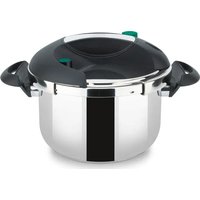


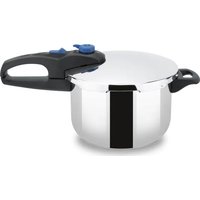
| Product type | Pressure cooker (pressure saucepan) |
| Brand | Sogo |
| Model | SS-25130 |
| Main material | 18/10 stainless steel |
| Base | Triple-layer sandwich for even heat distribution |
| Hob compatibility | Gas, electric, induction, ceramic glass |
| Seal material | Silicone, non-toxic and tasteless |
| Safety devices | Pressure indicator, lid lock, overpressure plug, decompression window, opening regulator |
| Maximum filling capacity | 3/4 of the pot for general use, 2/3 for rice, 1/2 for expanding foods |
| Cooking time reference | Table provided in the manual (rice 4 min, fish 4 min, beef 20 min, etc.) |
| Care and cleaning | Clean with detergent, do not use metal objects, clean the valve and seal after each use |
| Seal lifespan | Approximately 400 hours of use, replace if worn |
| Spare parts | Available from SOGO after-sales service (original parts) |
| Repairability | Do not repair yourself, contact an authorized SOGO service center |
| General information | Complies with directive 97/23/EC and 2015/863/EU. Made in PRC, designed by SOGO. |
Frequently Asked Questions - SS-25130 Sogo
User questions about SS-25130 Sogo
0 question about this device. Answer the ones you know or ask your own.
Ask a new question about this device
Download the instructions for your Saucepan in PDF format for free! Find your manual SS-25130 - Sogo and take your electronic device back in hand. On this page are published all the documents necessary for the use of your device. SS-25130 by Sogo.
USER MANUAL SS-25130 Sogo
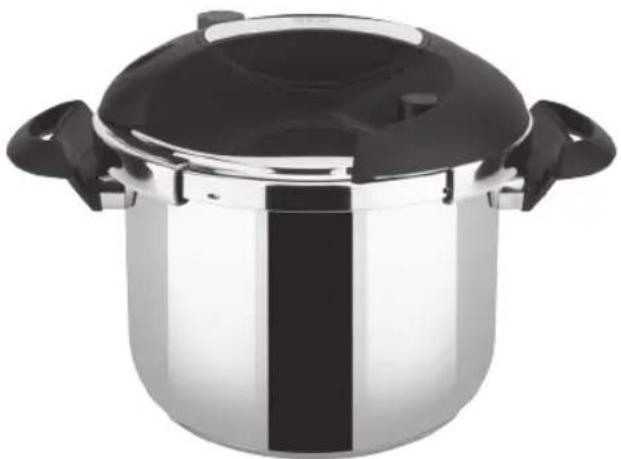

Stainless Steel Rapid Pressure Cooker
MAINTENANCE AND CLEANING:
PRODUCT PRODUCT TIME
Thank you very much for using our domestic pressure cookers.
Read all instructions in this user manual carefully before you use the appliance and save it for future reference. A copy of this manual can also be found on our website: www.sogo.es.
- Please read the instructions carefully.
- Please keep the instruction in a safe place for future reference.
- Do not use other brand or other manufacturers parts. All parts used must be our pressure cooker parts.
- Do not touch the hot surface straight away. Use the handle and the regulator.
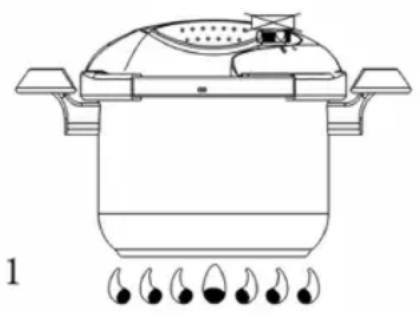
- Do not weigh down the pressure-control valve or use others to take place of it. (Picture1)
- When the pressure cooker is empty, do not burn it and do not use it for frying.
- Do not use pressure cooker for other than intended use.
- The pressure cooker should be heated on a stable fire.
- You must be very careful when you move the pressure cooker which is under pressure or full of hot liquid.
- Keep an eye on the pressure cooker when in use, especially when children are nearby.
- Children should not use the pressure cooker.
- Do not point the decompression window and the pressure control valve toward any person.
- If an abnormal phenomenon occurs or the safety device fails to work properly during use, stop using the cooker immediately and send it to our authorized service center for inspection and repair. Do not attempt to repair it yourself.
- Only open the pressure cooker when there is no pressure inside. Do not force it open.
- Before using, check that the exhaust pipe and the clog-proof filter are not blocked.
- This appliance cooks under pressure. Improper use may result in scalding injury. Make sure the unit is properly closed before operating. See "Operating Instructions."
- Do not fill the unit more than 2/3 full. When
cooking foods that expand during cooking, such as rice or dried vegetables, do not fill the unit more than 1/2 full. Overfilling may cause a risk of clogging the vent pipe and developing excess pressure. See "Food Preparation Instructions."
- Be aware that certain foods, such as applesauce, cranberries, pearl barley, oatmeal or other cereals, split peas, noodles, macaroni, rhubarb, or spaghetti, can foam, froth, and sputter, and clog the pressure release device (steam vent). These foods should not be cooked in a pressure cooker.
- Always check the pressure release devices for clogging before use.
- Do not open the pressure cooker until the unit has cooled and all internal pressure has been released. If the handles are difficult to push apart, this indicates that the cooker is still pressurized—do not force it open. Any pressure in the cooker can be hazardous.
- When the normal operating pressure is reached, turn the heat down so that all the liquid, which creates the steam, does not evaporate.
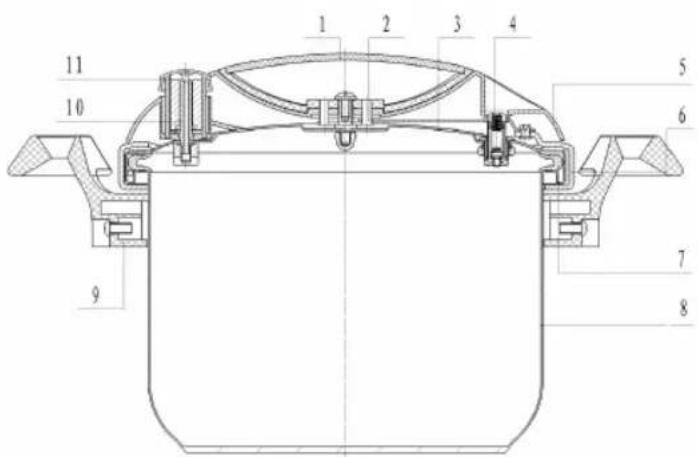
PRODUCT STRUCTURE
- Lid handle
- Screw
- Lid
- Lid lock & Overpressure plug
- Face plate
- Clamp
- Gasket
- Pot
- Pot side handle
- Air pipe
- Pressure control valve
PRODUCT'S TECHNICAL PARAMETERS
- The product is made of high-quality 18/10 stainless steel. The three-level sandwich base makes it more durable, with uniform heating and saves energy and time. It is suitable for induction hobs, electric surface and other gas stoves.
- The gasket is made out of silicon rubber, and has good airtightness. It is non-toxic and tasteless, safe and durable. It helps to easily open and close the lid of the pressure cooker.
SAFETY DEVICES
- Pressure indicate plug: The indicate shaft rising and dropping influenced by the change of pressure and the scale shows the pressure
- Lid lock & Over pressure plug: If the lid is not closed completely, the pressure cooker's internal pressure will not reach 5 kPa. If the pressure exceeds 5 kPa, the lid and pot will be locked together. If the pressure exceeds the over pressure plug's working pressure, it will open automatically to release the pressure.
- Decompression window: If the pressure exceeds the gasket's exhaust pressure, the gasket will be pushed and the pressure will drop quickly.
- Open-lid regulator: Moving with the lid lock and over pressure plug, it effectively avoids accidents. When the lid is not closed completely, the regulator and the inside slider prevent the over pressure plug from rising. Conversely, if there is pressure in the pot, the over pressure plug won't drop. This stops the regulator and outside slider from moving so that the lid cannot open.
MODE OF OPERATION
* For the first time use, please clean
the pressure cooker with detergent liquid, then wash and dry it. Make sure the exhaust pipe hole is clean. If it is jammed, dredge it with a 2mm diameter needle (Picture 2). If the lid lock cannot move freely, clean it and the area around it (Picture 3).
The pressure display system: this function shows the pressure during cooking, making it easy to know whether the pressure inside the pressure cooker is high or low.
You must place the silicon gasket into the six positive stops correctly (Pictures 4-5).

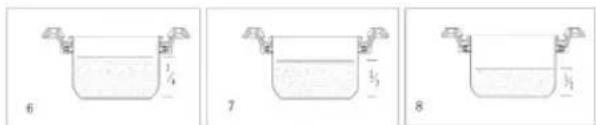
* No matter which pressure cooker you use, the total capacity of food should not exceed 3/4 of the pot (Picture 6). If cooking rice, it should not be filled over 2/3 (Picture 7), and expansive food such as porridge should not be more than 1/2 full (Picture 8).
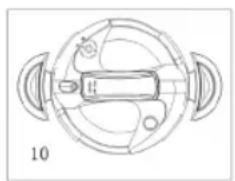
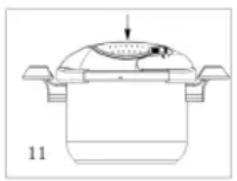
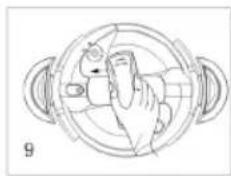
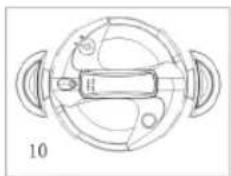
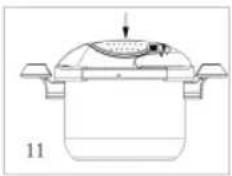
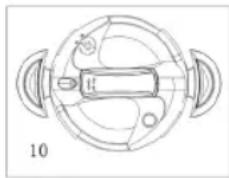
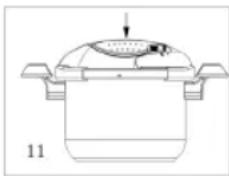
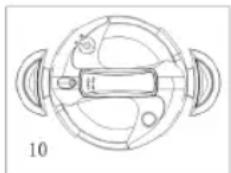
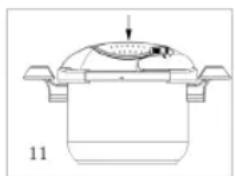
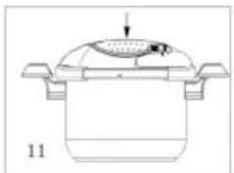
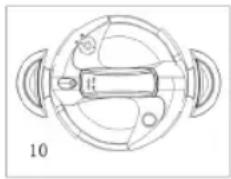
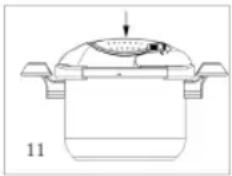
* When closing the lid, align the triangle mark on the lid with the pot handle mark. Hold the pot handle with your left hand and move the lid handle flatly with your right hand in a clockwise direction until the lid handle is directly above the pot handle, indicating that the lid is closed completely (Pictures 9 and 10). If you find it difficult to close the lid, apply more pressure on the lid; it will be easier to close (Picture 11).
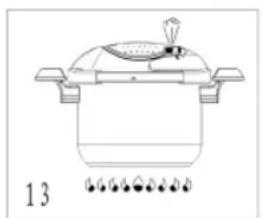
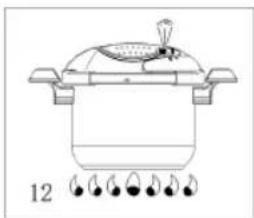
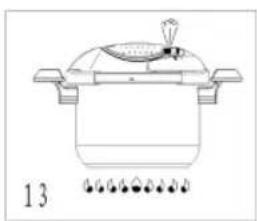
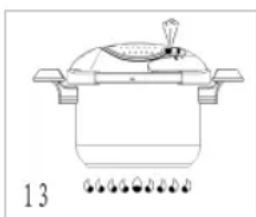
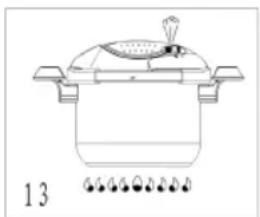
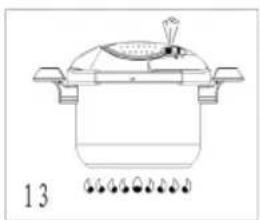
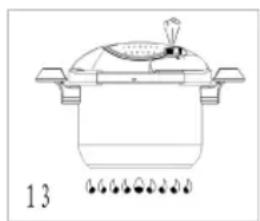
* Place the pressure cooker on the heating source. When there is steady steam exhausted from the exhaust pipe, buckle the pressure-control valve onto the exhaust pipe. Then the over pressure plug rises when steam escapes from the pressure-control valve (Picture 12). Turn down the heat (Picture 13) and keep a little steam exhausting, referring to the "Cooking Time", until the food is finished.
* Before opening the lid, turn off the fire or heat source, or move the pressure cooker away from the heat source, using one of the following ways to cool:
- Cool it naturally at normal temperature.
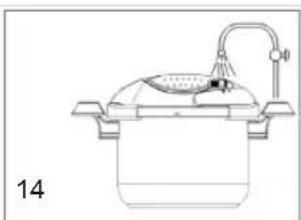
- Use cold water to force it to cool (Picture 14).
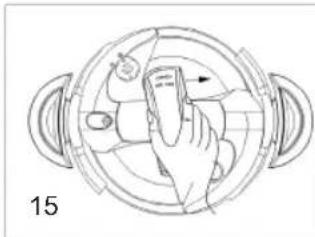
Before opening the lid, remove the pressure regulator and make sure the exhaust pipe is not releasing steam. Also, if the overpressure plug has dropped, move the lid handle to the front end and turn it counterclockwise until the two triangles align (Picture 15). Then the lid can be opened.
MAINTENANCE AND CLEANING:
- Clean the pressure cooker with detergent after cooking.
- Keep it dry when not in use.
- Do not scrape the pressure cooker with hard objects such as metal scouring pads or similar.
- Clean the gasket before and after each use. Remove dirt and oil, and keep it dry. Place it correctly in the lid.
- Clean the pressure control valve carefully after each use. If the exhaust pipe is clogged, clear it thoroughly. (Picture 2)
- Clean the overpressure plug frequently. Hold the inside slider to raise the head, turn the lid over, and check that the overpressure plug moves freely. Wash any residue when the plug hole is exposed. (Picture 3)
PROBLEMS AND SOLUTIONS:
- When heating, if the overpressure plug does not rise or seems stuck, clean the plug hole.
- If the gasket is not placed correctly or is worn, reposition it, clean it, or replace it.
- If the regulator does not return to the end, clean it or assist it with your hand.
- If the cooker is not hot enough during heating, increase the heat or remove any burnt food inside the pot.
- If burnt food at the bottom of the pot is hard, fill the pressure cooker with hot water to soften it, then clean. Do not use hard objects like metal scourers, as they may damage the pot.
- After prolonged usage, leakage of gasket will occur. In such a case you should change it promptly. Our suggested life of a gasket is 400 hours, and it must be of the same material and parts as supplied by SOGO.
COOKING TIME REFERENCE
Cooking time is decided by different people's appetite, cooking style and ingredients.
| FOOD FOODTIME (Min.) TIME | |
| Arroz | 4 |
| Repollo | 4 |
| Coliflor | 4 |
| Frijol rojo | 20 |
| Alubia | 20 |
| Pescado | 4 |
| Carne de res | 20 |
| Cerdo | 20 |
| Pollo | 18 |
| Carne de cordero | 15 |
| Carne de conejo | 15 |
| Congee | 20 |
| Haba de soja | 10-20 |
| Sopa de pescado | 6-8 |
| Sopa de cebolla | 3-4 |
| Dish soup | 6-8 |
| Sopa de rabo de buey | 20-30 |
| Sopa de carne | 15 |
| Sopa de verduras | 10 |
| Sopa de tomate | 3 |
| Macarrones | 5 |
| Pasta | 6 |
- The time is calculated from the beginning of pressure-control valve's normal releasing.
- Cooking time is effected by volume of food, weather, heat energy and so on. The time is only for reference.
- Cooking time is obtained according to cooking on gas stoves. It may vary if you use other type of heat sources.
MAINTENANCE FOR SAFE USE
- Each time, before using the pressure cooker, always check to make sure that the operating valve is clean of any built-up particles.
- For increased safety and best results, the rubber gasket should be replaced after using it approximately for 400 hours.
- Each time, before using the pressure cooker, always check the handles, the base handle, support grip, and the lid handle to make sure that they are securely screwed in place. If not, tighten the handle screws with a screwdriver.
REPLACEMENT PARTS
All parts of our pressure cooker are designed independently and specially for this product by SOGO. DO NOT change any part or assemble the parts in any other way. All parts used must be our SOGO pressure cooker parts. PIs contact your regular retail outlet to supply you parts for this pressure cooker or contact the SOGO Authorized Service Center.
USER SAFETY INSTRUCTIONS
PRODUCT STRUCTURE
MAINTENANCE AND CLEANING
PROBLEMS AND SOLUTIONS

DECLARATION OF CONFORMITY
This device complies with the pressure equipment directive 97/23/EC, Directive 2015/863/EU on the restriction of the use of certain hazardous substances in electrical and electronic equipment.
DECLARATION OF CONFORMITY
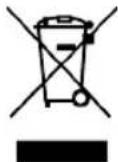
This symbol means that in case you wish to dispose of the product once its working life has ended, take it to an authorised waste agent for the selective collection of waste electrical and electronic equipment (WEEE)
Imported by:
Sanysan Appliances S.L, NIF: B98753056, C/ Barcas 2, 2
46002 Valencia, Spain
Product made in P.R.C. – Designed by
SOGO based on the European Quality Standards
Customer Service: www.sogosat.com / sogosat@sogosat.com / 0034 902 222 161
Brand : Sogo
Model : SS-25130
Category : Saucepan