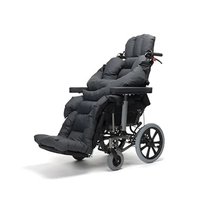
Inovys II + L70 - Wheelchair Vermeiren - Free user manual and instructions
Find the device manual for free Inovys II + L70 Vermeiren in PDF.


| Product type | Wheelchair |
| Brand | Vermeiren |
| Model | Inovys II + L70 |
| Maximum user weight | 135 kg |
| Overall length | 1280 mm |
| Overall width | 680 mm (730 mm depending on version) |
| Total height (without headrest) | 990 - 1060 mm |
| Total mass | 38 kg |
| Rear wheel diameter | 16 inches (T30) with drum brakes |
| Front wheel diameter | 200 mm |
| Seat tilt | 0° to 21° |
| Backrest tilt | 0° to 54° |
| Nominal slope | 10° |
| Use | Indoor and outdoor |
| Vehicle transport | Tested according to ISO 7176-19:2022 (forward facing seat) |
| Comfort adjustments | Tiltable seat, reclining backrest, adjustable armrests, adjustable leg rest, adjustable headrest |
| Maintenance | Clean with damp cloth; machine washable covers at 60°C |
| Repairability | By specialized dealer with genuine Vermeiren parts |
| Expected lifespan | 5 years |
| Warranty | According to applicable general terms and conditions |
| Operating temperature | +5°C to +41°C |
| Storage and operating humidity | 30% - 70% |
Frequently Asked Questions - Inovys II + L70 Vermeiren
User questions about Inovys II + L70 Vermeiren
0 question about this device. Answer the ones you know or ask your own.
Ask a new question about this device
Download the instructions for your Wheelchair in PDF format for free! Find your manual Inovys II + L70 - Vermeiren and take your electronic device back in hand. On this page are published all the documents necessary for the use of your device. Inovys II + L70 by Vermeiren.
USER MANUAL Inovys II + L70 Vermeiren
natural_image
Person in a black wheelchair with full puffer, standing on a wheeled wheel (no text or symbols visible)
Contents
Preface
4
1. Your product 6
1.1. Options 7
2. Before use 7
2.1. Intended use and indications 7
2.2. Safety instructions and applicable risks 8
2.3. Symbols on the wheelchair 9
2.4. First use and storage 10
2.5. Transport 10
3. Using your wheelchair 14
3.1. Operating the brakes 14
3.2. Moving to/from the wheelchair 17
3.3. Comfort adjustments 18
3.4. Riding the wheelchair 23
4. Installation and adjustment 28
4.1. Tools 28
4.2. Scope of delivery 28
4.3. Assembly 29
4.4. Adjustments 29
5. Maintenance 30
5.1. Points of maintenance 30
5.2. Maintenance instructions 32
5.3. Troubleshooting 33
5.4. Expected lifespan 33
5.5. Reuse 33
5.6. End of use 33
5.7. Warranty 34
6. Technical specifications 34
Preface
Congratulations! You are now owner of a Vermeiren wheelchair!
This wheelchair is made by qualified and committed personnel. It is designed and produced according to high quality standards, guarded by Vermeiren.
Thank you for your trust in the products of Vermeiren. To support you on the use of this wheelchair and its operating options, this manual is offered. Please read it carefully; it will help you to get familiar with the operation, capabilities and limitations of your wheelchair.
If you still have questions after reading this manual, do not hesitate to contact your specialist dealer. He/she will be glad to help you.
Important note
To ensure your safety, and to prolong the lifetime of your product, please take good care of it and have it checked and serviced on a regular basis.
This manual reflects the latest product developments. Vermeiren has the right to implement changes to this type of product without any obligation to adapt or replace similar products previously delivered.
Pictures are used to clarify the instructions in this manual. Details of the depicted product may deviate from your product.
Information available
On our website http://www.vermeiren.com/ you will always find the most recent version of the information in this manual. Please consult this website regularly for possible updates.
Visually impaired people can download the electronic version of this manual and have it read out by means of a text-to-speech software application.
 | User manual of L70 granule seat systemFor user and specialist dealer |
 | User manual of Inovys IIFor user and specialist dealer |
 | Installation instructionsFor specialist dealer |
 | Service manual for wheelchairsFor specialist dealer |
 | EC declaration of conformity |
1. Your product
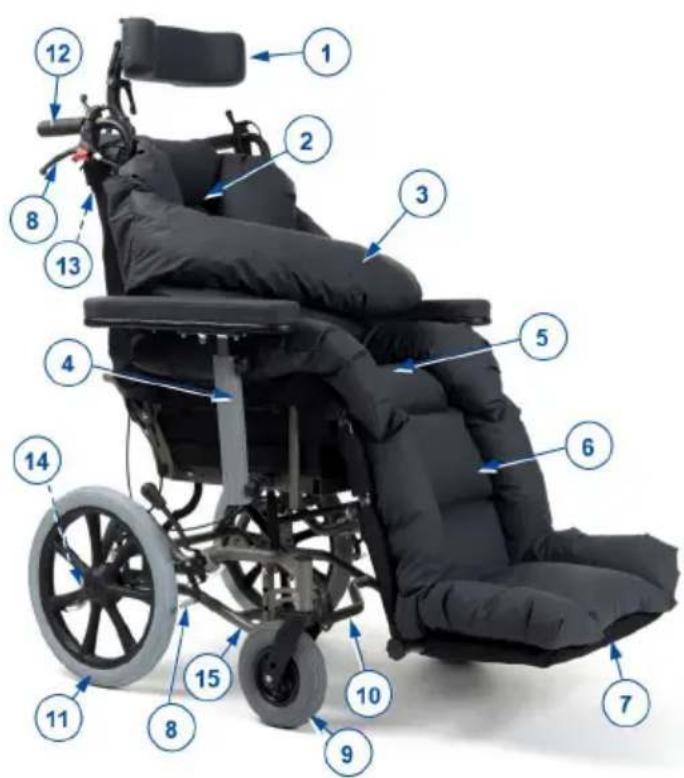
- Headrest
- Backrest
- Arm pads (optional)
- Armrests
- Seat
- Leg rest
- Footplates
- Brakes
- Front wheel
- Frame
- Rear wheels
- Handgrips
- Push bar
- Tipping aid
- Identification plate
1.1. Options
Contact your specialist dealer about options. He will gladly advise you.
2. Before use
2.1. Intended use and indications
• This product is a medical device.
- The L70 granule seat system is designed to be used in combination with the Inovys II wheelchair with T30 wheel system and frame alterations for the granule seat system.
- Indications and contraindications: The Inovys II wheelchair with L70 granule seat system is intended for passive wheelchair users, such as elderly people or people with walking difficulties or no walking abilities (e.g. paralysis, loss of limbs, limb defects or deformations, stiff or damaged joints, heart insufficiencies and poor blood circulation, balance disturbances, cachexia (decrease in muscle), ...). The user has the wheelchair pushed by an attendant.
- This wheelchair is designed and produced solely to transport/transfer one (1) person with a maximum weight of 135kg. It is not designed to transport goods or objects, nor for any other use than previously described.
- This wheelchair is suitable for indoor and outdoor use.
- Only use accessories and spare parts approved by Vermeiren.
- Please read all technical details and limits of your wheelchair in chapter 6..
- The warranty on this product is based on normal use and maintenance as described in this manual. Damage to your product caused by improper use or lack of maintenance will cause the warranty to lapse.
2.2. Safety instructions and applicable risks
CAUTION
Risk of injuries and/or damage
- Carefully read and follow the instructions in this manual. Otherwise you may get injured or your wheelchair may get damaged.
Keep the following general warnings in mind during use:
- As the attendant, do not operate the wheelchair if you are under influence of alcohol, medicines or other substances that may influence your riding abilities.
- Be aware that some parts of this wheelchair may get very hot or cold due to ambient temperature, solar radiation, heating devices. Be careful when touching. Use protective clothing if the weather is cold.
- Do not modify your product in any way.
• Take note of the instructions for care and service. The manufacturer is not liable for damage caused by improper servicing / care.
Be aware that your wheelchair may interfere with some types of anti-theft systems, depending on the settings used. This may cause the shop's alarm to go off.
Any serious incident [MDR (EU) 2017/745 §2 (65)] that has occurred in relation to the device should be reported to the manufacturer and the competent authority of the Member State in which the user and/or patient is established.
2.3. Symbols on the wheelchair
 | Maximum weight of the user in kg |
 | Type designation |
 | Catalogue number |
 | Serial number |
 | Medical device |
 | Manufacturer |
| [SADX] | Date of manufacture |
 | Declaration of conformity |
 | Attention: important information |
 | It is advised to read the manual |
 | Risk of entrapment |
 | Maximum safe slope in ° (degrees). |
 | Crash-tested product ; can be used as a seat in a motor vehicle |
 | Can be used as a seat in a motor vehicle; indicates attachment points |
2.4. First use and storage
CAUTION
Risk of damage
- Make sure that your wheelchair is stored in a dry environment to prevent mould from growing and the upholstery from being damaged, see also chapter 6..
If the packaging of your product has been damaged, (unintentionally) opened, or affected by environmental conditions (moisture, heat,...) upon delivery, check the device integrity of your product. When in doubt, contact your specialist dealer.
2.5. Transport
2.5.1. Moving out of the way
Move the wheelchair by using its wheels and rolling it to the destination.
If this is not possible, and disassembling is not desired, ask help to lift the wheelchair. Firmly grasp the frame with both hands and lift it from the floor. Do not use foot or arm rests, or wheels to grasp the wheelchair.
2.5.2. Transport by vehicle, as luggage
WARNING
Risk of injuries
- NEVER use the same seatbelt to secure the wheelchair and passenger.
-
Make sure that the wheelchair is attached properly to avoid injury from the passengers during collision or sudden braking.
-
Place the wheelchair in its most upright sitting position.
- Store the wheelchair and its parts in the luggage compartment. If luggage and passenger compartments are NOT separated or enclosed, fasten the wheelchair frame securely to the vehicle.
You can use a ramp to push the wheelchair inside the vehicle, see §3.4.3.. Apply the parking brakes after loading, see §3.1..
EN
2.5.3. Transport by vehicle, as seat for the user
WARNING
Risk of injuries
- The wheelchair has passed the crash test of ISO 7176-19: 2022 and, as such, has been designed and tested for use only as forward-facing seat in a motor vehicle.
- The wheelchair's pelvic belt alone is not suited as an occupant restraint belt.
- Use the wheelchair's pelvic belt and the applicable three-points belt in the vehicle to prevent head and chest impacts with the vehicle.
- Do not use postural supports to restrain the user in the vehicle unless they are labelled as being in accordance with the requirements specified in ISO 7176-19:2022.
- Following involvement in any type of vehicle collision, have your wheelchair inspected by the specialist dealer or manufacturer's representative before reuse.
The wheelchair is tested using the four-point strap-tie system and a 3-point occupant-restraint system.
Whenever feasible, use the seat of the vehicle and store the wheelchair in the cargo area.
2.5.3.1. Steps to secure the wheelchair in a motor vehicle:
- Check that the vehicle is equipped with a suitable wheelchair tie down and occupant-restraint system, conform ISO 10542.
- Check that the components of the wheelchair tie down and occupant restraint system are not frayed, contaminated, damaged or broken.
-
If equipped with an adjustable seat and/or back tilt, make sure that the wheelchair user is sitting as upright as possible. If the user's condition prevents this, a risk assessment should be done to evaluate the user's safety during transit.
-
Remove all mounted accessories such as trays and respiratory equipment, and secure them in a safe place.
- Position the wheelchair facing forward in the travelling direction, centrally between the tie-down rails mounted in the floor of the vehicle.
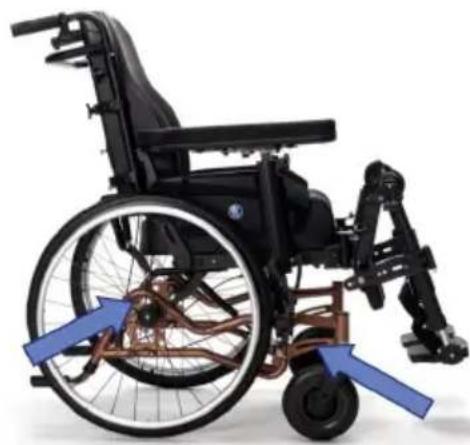
- Mount the front securement straps according to the instructions of the strap-system manufacturer at the indicated place (figure 1). This place is marked on the wheelchair with a symbol (figure 2).
- Roll back the wheelchair until the front straps are tight.
- Apply the wheelchair brake.
- Mount the back securement straps according to the instructions of the strap-system manufacturer at the indicated place (figure 1). This place is marked on the wheelchair with a symbol (figure 2).
Figure 1
natural_image
Side view of a black and brown wheelchair with blue arrows pointing to the wheel (no text or symbols visible)
Figure 2
2.5.3.2. Steps to secure the wheelchair user:
- Remove both armrests.
- If present, attach the wheelchair's pelvic belt.
- Attach the occupant restraint belts according to the instructions of the strap-system manufacturer.
i Wear the pelvic belt low across the front of the pelvis, so that the angle of the pelvic belt is within the preferred zone of 30^ to 75^ to the horizontal, similar to that shown on the image.
A steeper (greater) angle within the preferred zone is desirable.
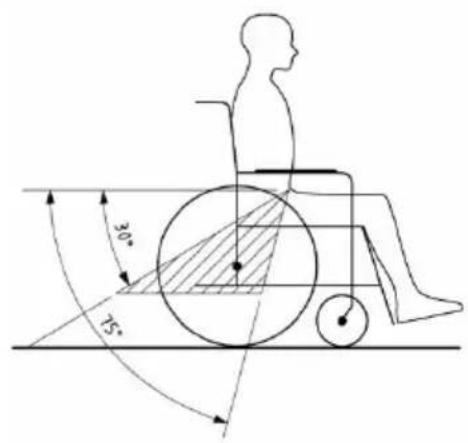
- Adjust the belt tightly according to the instructions of the strap-system manufacturer, consistent with the user's comfort.
- Ensure that the restraint belt connects in a straight line to the anchor point in the vehicle and that no bends in the belt are visible, for instance at the axle of the rear wheel.
- Install the armrests, if desired. Make sure that belts are not twisted or held away from the body by wheelchair components such as armrests or wheels.
- Position the seatbelt buckle so that the release button will not be contacted by wheelchair components during a crash.
- Make sure that the shoulder-belt restraints fit over the shoulders, see figure 4.
Belt restraints must not be held away from the body by wheelchair components such as armrests or wheels.
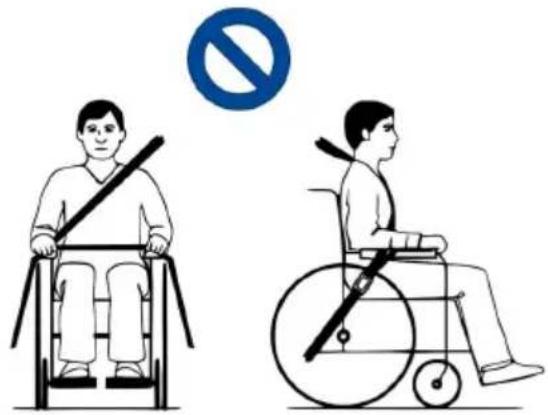
natural_image
Illustration showing a person in a wheelchair and another in a wheelchair, both without any text or symbols.Figure 3
Belt restraints make full contact with shoulder, chest and pelvis. Pelvic belt low on the pelvis near the thigh-abdominal junction
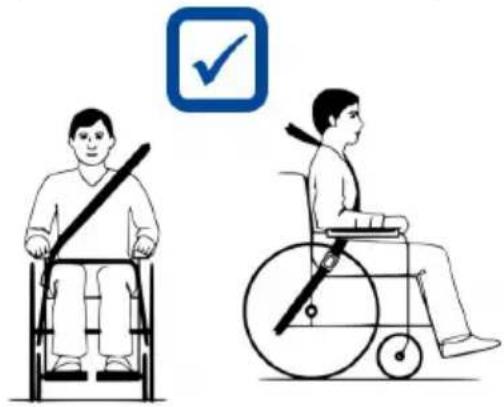
natural_image
Illustration showing a person in a wheelchair and another in a wheelchair, both with a checkmark icon (no text or symbols)Figure 4
3. Using your wheelchair
WARNING
Risk of injuries
- First read previous chapters and inform yourself about the intended use. Do NOT use your wheelchair unless you have read and fully understood all instructions.
- In case of doubts or questions, do not hesitate to contact your local specialist dealer, your care provider or technical adviser to help you with this.
3.1. Operating the brakes
3.1.1. Parking brakes
CAUTION
Risk of injuries
- The brakes are not used to slow down the wheelchair during movements. Use the brake only to prevent the wheelchair from unintended movements.
- Good operation of the brakes is influenced by wear and contamination of the tires (water, oil, mud, ...). Check the condition of the tires before each use.
- The brakes are adjustable and can wear. Check the operation of the brakes before each use.
- Make sure the wheelchair is on a flat horizontal surface before releasing the brakes. Never release both brakes simultaneously.
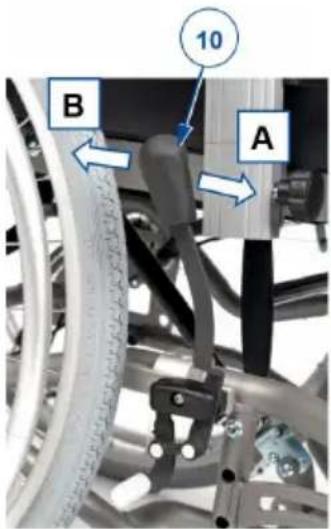
3.1.1.1. To apply the brakes:
- With one hand, hold one hand rim tight (or your attendant holds the push bar with one hand).
- Push the brake lever (10) of the OTHER wheel to the FRONT until you feel a distinctive lock [A].
- Repeat this for the second wheel and parking brake.
3.1.1.2. To release the brakes:
- With one hand, hold one hand rim tight (or your attendant holds the push bar with one hand).
- Pull the brake lever (10) of the OTHER wheel to the REAR [B].
- Repeat this for the second wheel and parking brake.
3.1.2. Attendant brakes
CAUTION
Risk of injuries
- Good operation of the brakes is influenced by wear and contamination of the tires (water, oil, mud, ...). Check the condition of the tires before each use.
- To park or stop on a slope, use the parking brakes after coming to a halt.
- The brakes are adjustable and can wear. Check the operation of the brakes before each use.
- Make sure the wheelchair is on a flat horizontal surface before releasing the brakes. Never release both brakes simultaneously.
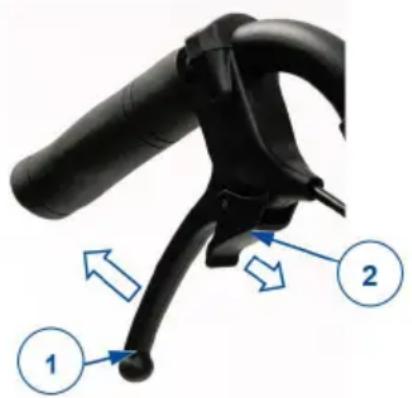
3.1.2.1. To apply the brakes:
- Pull the brake levers (1) in a squeezing motion.
- Each brake lever (1) can be blocked by pushing the lock lever (2) down with your finger.
- Release the brake lever (1).
3.1.2.2. To release the brakes:
-
Pull the brake lever (1). The lock lever (2) will be released by this motion.
-
Hold the handgrips firmly, while releasing the brake levers (1).
3.2. Moving to/from the wheelchair
EN
CAUTION
Risk of injuries or damage
- In case you cannot perform the transfer in a safe manner, ask someone to assist you.
- Do not stand on the footplates.
3.2.1. Transfer
- Position the wheelchair as close as possible to the chair, couch or bed to/from which you wish to transfer.
- Apply both parking brakes, see §3.1..
- Move the backrest and seat to sitting position, see §3.3.1..
- If needed, remove the footplate to prevent standing on it, see §3.3.6..
- Transfer to/from the wheelchair using the strength of your arms or with the help of attendant(s) or lifting equipment.
3.2.2. Sitting in the wheelchair
- Sit down on the seat with your lower back against the backrest.
- Make sure that your upper legs are horizontal and that your feet are in a comfortable position. Adjust if necessary, see §3.3..
3.3. Comfort adjustments
CAUTION
Risk of injuries or damage
• Always keep the swing range of the footplate in mind to prevent bystanders from being injured or objects from being damaged.
- Make sure that your fingers, clothes, buckles don't get trapped during adjustment.
3.3.1. Backrest and seat inclination
CAUTION
Risk of injuries or damage
- Be aware that the stability decreases when the wheelchair is adjusted from sitting-straight to inclined position.
- Apply the parking brakes before adjusting the backrest and seat inclination.
The seat inclination and backrest inclination can be adjusted simultaneously or separately by an attendant. Make sure that the patient sits in the chair when the attendant adjusts the backrest inclination and that the wheelchair does not tip over.
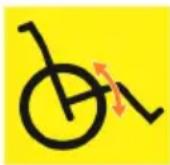
- Squeeze the lever (1) on the left handle (see label) towards the handle to adjust the seat inclination.
- Pull/Push the seat in the desired position ( 0^ to +21°), the gas pressure spring shall be pressed in/out.
- Loosen the lever (1) to block the gas pressure spring.

3.3.1.2. Backrest inclination
- Squeeze the lever (1) on the right handle (see label) towards the handle to adjust the angle of the backrest.
- Pull/Push the backrest in the desired position ( 0^ to +54°), the gas pressure spring shall be pressed in/out.
- Loosen the lever (1) to block the gas pressure spring.
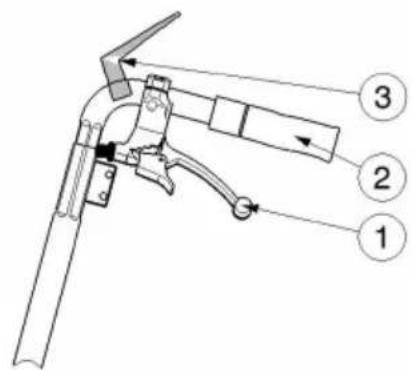
If your wheelchair features drum brakes, the levers (1) are used as brakes; additional levers (3) have been mounted to adjust the backrest and seat inclination.
3.3.2. Armrest height
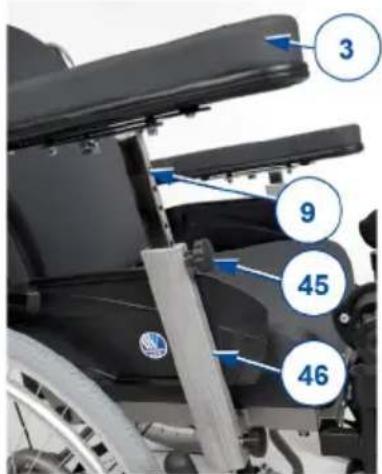
The arm pads (3) of the wheelchair can be adjusted in 6 different height positions:
- Turn the star knob (45) anticlockwise to unlock.
- Pull and hold the star knob to release the inner tube of the armrest (9).
- Slide the inner tube of the armrest (9) up/down in the support (46) until the desired height. Make sure that the holes on the inner/outer tube align.
- Retighten the star knob (45) by turning it clockwise.
- Repeat this for the second armrest. Make sure that the armrests are firmly secured.
3.3.3. Push handle height
CAUTION
Risk of injuries
- Always use the available adjustment holes on the push handle. Never exceed the maximum height adjustment.
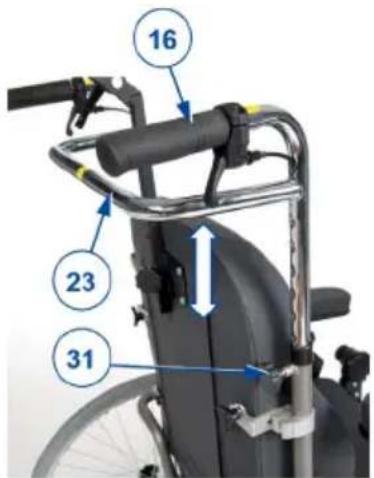
The push handles (16) and push bar (23) are connected and can be adjusted in 7 different height positions:
- Loosen both star knobs (31) on the handle supports and remove them.
- Adjust the height of both push handles simultaneously by sliding them up/down in the supports. Make sure that the holes on the inner/outer tube align.
- Insert the two star knobs (31) in the supports and the adjustment holes.
- Turn the star knobs clockwise until they are finger-tight.
- Make sure that the push handles are firmly secured.
3.3.4. Leg rest inclination
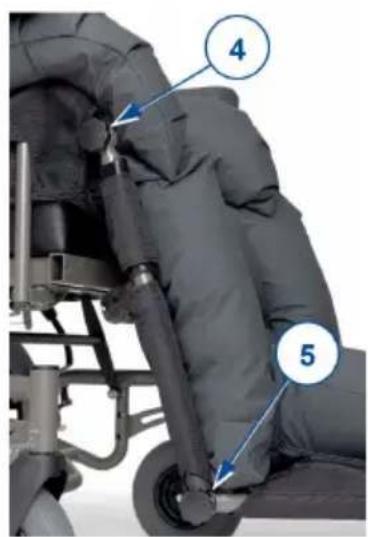
The leg rest is adjustable in 6 positions.
- Slightly loosen the lever (4) on both sides of the leg rest.
- Lift/Lower the leg rest until the desired angle is reached.
- Tighten the lever again firmly.
3.3.5. Footplate angle
The footplate is adjustable in 3 positions.
- Slightly loosen the lever (5) on both sides of the footplate.
- Turn the footplate up/down until the desired angle is reached.
- Tighten the lever again firmly.
3.3.6. Removable footplate
It is possible to remove the footplate to facilitate transfer in/out of the wheelchair.
3.3.6.1. To remove the footplate:
- Unzip the upholstery and cushions of the footplate from the upholstery and cushions of the leg rest.
- On the bottom of either side of the footplate, pull the protruding screws down to unlock the footplate from the frame.
- Gently pull the footplate forward off the leg rest tubes.
3.3.6.2. To attach the footplate:
- Gently place the footplate on the leg rest tubes.
- Push the protruding screws upward to lock the footplate to the frame.
- Close the zippers of the upholstery and cushions.
3.3.7. Headrest
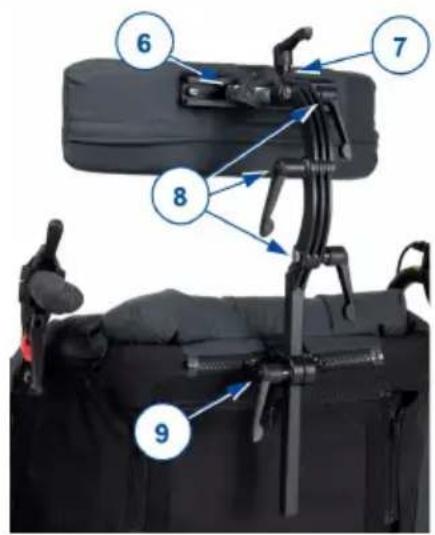
The headrest is fully adjustable in height and angle. To alter the position of the headrest: loosen any lever/star knob as specified below, adjust the headrest to the desired position, and retighten firmly.
• [6] To adjust the headrest sideways.
• [7] To rotate the headrest (360°).
• [8] To adjust the headrest forward/backward.
• [9] To adjust the height of the headrest.
To remove the headrest, loosen lever (9) and lift the headrest out of the support.
3.3.8. Tipping aid height
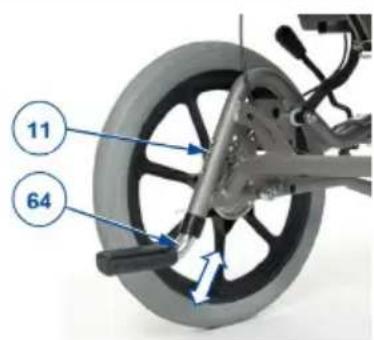
- Press and hold the spring button (11).
- Slide the tipping aid tube (64) in/out of the frame tube.
-
Release the spring button.
-
Repeat this for the second tipping aid. Make sure that both tipping aids are firmly secured.
CAUTION
Risk of entrapment
- When driving with an attendant, keep your arms away from the wheels and keep your feet on the footplates.
CAUTION
Risk of injuries or damage
- Do NOT drive on slopes, obstacles, steps or kerbs larger than specified in § 6..
- Do not proceed with your wheelchair in traffic. Always stay on the pavement.
- Pay attention if the road has holes or gaps that may cause entrapment of the wheels.
- Avoid stones and other objects that may block the wheels.
- Always keep the swing range of the footplate in mind to prevent bystanders from being injured or objects from being damaged.
- Before every usage, make sure that:
– all adjustments are firmly secured, see §3.3..
– the parking brakes are working properly.
– the tires are in good condition, see §5.2.1..
3.4.1. Riding with an attendant
- Release the brakes or have them released by the attendant, while he/she is holding the wheelchair to prevent movement, see §3.1..
- The attendant grasps the handgrips or push bar to push the wheelchair in the desired direction.
- After stopping, apply the brakes while holding the wheelchair in place, see §3.1..
3.4.2. Riding on slopes
CAUTION
Risk of injuries
- If the attendant has too little strength to control the wheelchair, stop riding and use the brakes immediately.
- When you stop on a (small) slope, use your brakes.
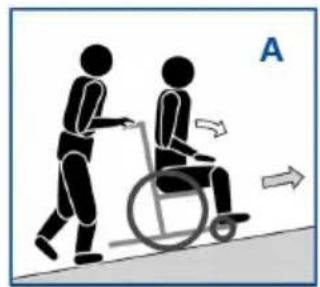
natural_image
Illustration of two people in a wheelchair, one pushing and the other leaning forward (no text or symbols)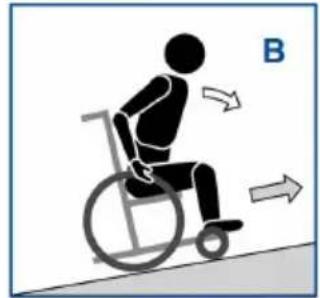
natural_image
Illustration of a person in a wheelchair using a horizontal barbell, with arrows indicating movement direction (no text or symbols)- Secure yourself in the wheelchair with a safety belt.
- Ask an attendant or a bystander to help you.
- Drive slowly and in a straight line. Lean slightly forward (A/B) when going up the slope. Lean backwards, against the backrest, when going down the slope.
- Never reverse on a slope.
3.4.3. Using ramps
CAUTION
Risk of tipping over
- Only use ramps approved by Vermeiren and do not exceed their maximum load.
• Make sure that the wheelchair does not touch the ground or ramp due to the inclination of the wheelchair. -
Only negotiate ramps with the help of one or two attendants.
-
Adjust the position of backrest, seat and footrest to decrease the volume taken by the wheelchair and to increase the stability during inclination.
-
Follow the instructions in §3.4.2..
CAUTION
Risk of tipping over
• Stairs should always be negotiated with the help of two attendants.
- Never try to use stairs that are not appropriate for wheelchairs.
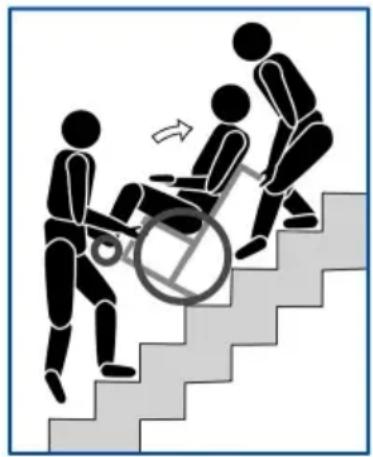
natural_image
Illustration of four human figures climbing stairs, one pushing a wheel with a crossed-out ring (no text or symbols)- One attendant tips the wheelchair slightly backwards by the handles.
- The second attendant grabs the wheelchair at the front of the frame, on both sides of the wheelchair.
- Stay calm, avoid sudden movements and keep your arms inside the wheelchair.
- Both attendants lift and pull the wheelchair from step to step while the rear wheels roll over the steps.
3.4.5. Coping with obstacles
CAUTION
Risk of tipping over
• Always ask assistance of one or two attendants.
- Make sure that the footplates do not touch ground while taking an obstacle.
- Do not use your wheelchair on an escalator.
- If available, wear your safety belt.
3.4.5.1. Small kerbs (up or down)
These can be taken forward (E / F) with one attendant:
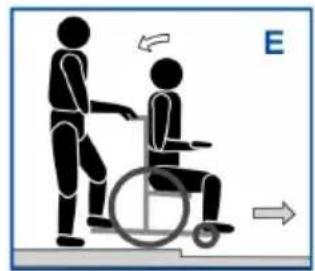
natural_image
Illustration of a person in a wheelchair being assisted by another person, with directional arrows indicating movement (no text or symbols)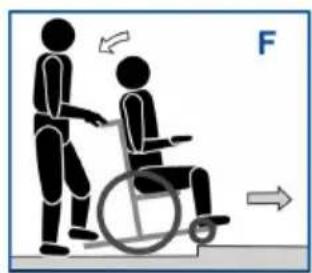
natural_image
Illustration of a person in a wheelchair being assisted by a seated figure, with directional arrows indicating movement (no text or symbols)- The attendant moves the wheelchair forward approaching the kerb. Make sure the footplates won't touch the kerbs.
- Lean backwards to reduce the pressure on the front wheels.
- The attendant holds the handles firmly while moving forward. If necessary he uses the tipping aid to keep the front wheels lifted until they have passed the kerb rim.
- The attendant releases the pressure on the handles and tipping aid to gently put the front wheels on the ground.
- Next, he holds the handles firmly while pushing the wheelchair with the rear wheels up/down the kerb.
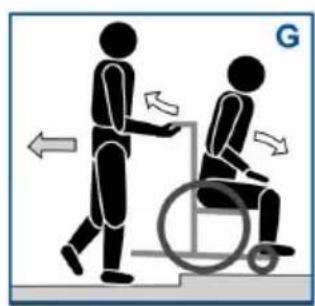
3.4.5.2. Medium kerbs (up or down)
These should be taken backwards with one attendant:
natural_image
Illustration of two human figures in a wheelchair, one moving right and the other sitting forward (no text or symbols)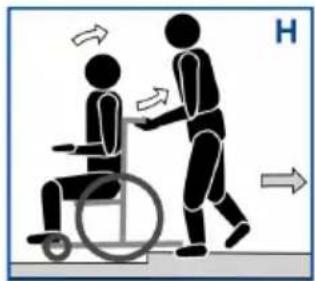
natural_image
Illustration of a person in a wheelchair being assisted by another person, with directional arrows indicating movement (no text or symbols)- The attendant reverses the wheelchair so that rear wheels approach the kerb first (G / H).
- Going down: Lean forward (G) to move your centre of gravity to the front. Going up: Lean backward (H) to move your centre of gravity to the back.
- The attendant pulls the wheelchair gently from/on the kerb.
3.4.5.3. Higher kerbs
EN
Higher kerbs, but below maximum size, see §6., should be taken with help of two attendants.
Going down:
- Remove the footrests.
- The attendant moves the wheelchair forward approaching the kerb.
- Lean backwards to reduce the pressure on the front wheels.
- The attendant holds the handles firmly and uses the tipping aid to keep the front wheels lifted until they have passed the kerb rim.
- The second attendant grabs the front of the frame and moves backwards while pulling the rear wheels down the kerb.
- The first attendant releases the pressure on the handles and tipping aid to put the front wheels on the ground.
Going up:
- Remove the footrests.
- The first attendant reverses the wheelchair so that rear wheels approach the kerb first.
- Lean backward to move your centre of gravity to the back.
- The second attendant grabs the front of the frame and moves forward while pulling/pushing the rear wheels on the kerb. The first attendant lifts and holds the handles firmly to prevent the wheelchair from tipping over.
4. Installation and adjustment
CAUTION
Risk of injuries or damage
- The wheelchair needs to be (dis)assembled and adjusted by a specialist dealer according to the instructions in this chapter.
- Only use parts and tools described in this manual.
- While (dis)assembling and operating the wheelchair, make sure no objects or body parts get caught between moving parts.
- Make sure all screws are firmly secured before driving.
i Read the user manual of this wheelchair. Be aware of the technical details and limits of intended use. For more information, contact Vermeiren.
4.1. Tools
To (dis)assemble and adjust the wheelchair, the following tools are needed:
- Allen key n° 4
4.2. Scope of delivery
The following items are part of the delivery.
- Framework with seat, backrest, wheels, armrests, leg rest, and L70 granule seat system
- Headrest
- User manual
Before use, check if everything is included and that no products are damaged.
Please note that the basic configuration may differ in different European countries. Contact your specialist dealer.
4.3. Assembly
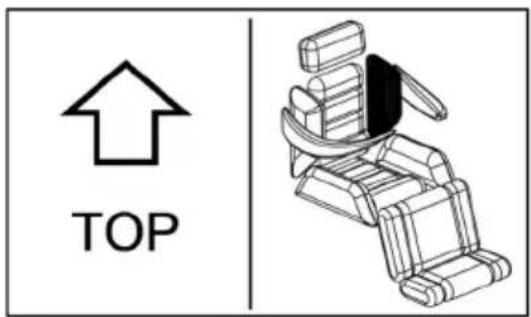
The wheelchair is delivered fully assembled except for the headrest, the side support pillows of the backrest and seat, and the optional arm pads.
- The headrest can be mounted and adjusted according to the instructions in §3.3.7..
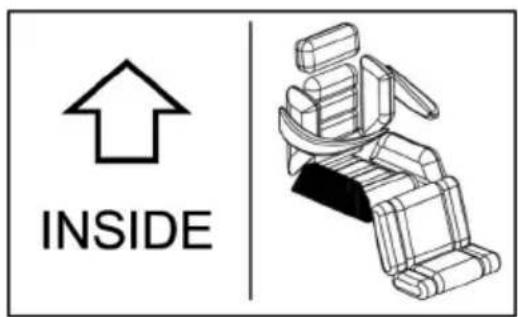
- The pillows are easy to attach by means of the zippers. The label on each pillow indicates the specific place and direction of the pillow (see examples below).
4.4. Adjustments
4.4.1. Leg rest length
The length of the leg rest can be adjusted in 4 positions.
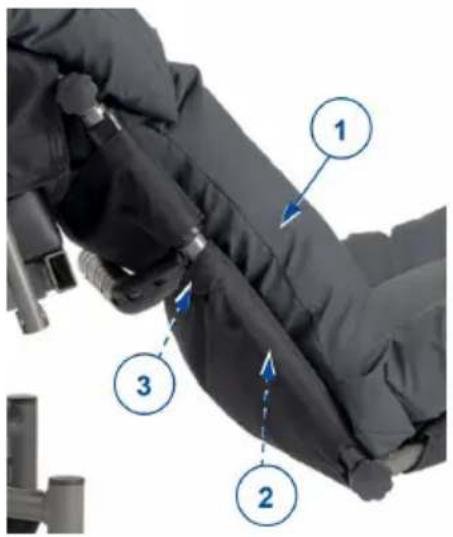
- Take off the L70 granule cushions (1) from the leg rest frame.
- Remove the lower foam protection (2) from the leg rest tubes.
- Loosen and remove the screw-nut connection (3) on both sides of the leg rest.
- Move the inner tubes with foot plate up/down in the outer frame tubes until the desired length is reached.
- Replace the screws (3) and tighten firmly by hand.
- Replace the foam protection (2).
- Reattach the granule cushions (1) to the leg rest frame.
5. Maintenance
i Regular care ensures that your wheelchair is preserved in a perfectly functional condition. For the maintenance manual, refer to the Vermeiren website: www.vermeiren.com.
5.1. Points of maintenance
CAUTION
Risk of injuries and damage
• Repairs and replacements may only be undertaken by trained persons and only genuine replacement parts of Vermeiren should be used.
The last page of this manual contains a registration form for the specialist dealer to record each service.
The service frequency depends on the frequency and intensity of use. Contact your dealer to agree to a common timetable for inspection/maintenance/repair.
5.1.1. Before each use
EN
Inspect the following points:
- All parts: Present and undamaged or unworn.
• All parts: Clean, see § 5.2.2.. - Wheels, seat, leg rests, arm rests, foot rests, footplates and headrest (if applicable): Well secured.
- All zippers: closed.
• Condition of wheels/tyres, see § 5.2.1..
• Condition of brakes, see 5.2.1.. - Condition of frame parts: No deformation, instability, weakness or loose connections.
- Seat, backrest, arm pads, calf pads and head rest (if applied): No excessive wear (like dented spots, damage or tears).
Contact your specialist dealer for possible repairs or part replacements.
5.1.2. Yearly or more often
Have your wheelchair inspected and serviced by your specialist dealer, at least once a year, or more often. The minimum maintenance frequency depends on use and should therefore be commonly agreed upon with your specialist dealer.
5.1.3. If stored
Make sure that your wheelchair is stored in a dry environment to prevent mould from growing and the upholstery from being damaged, see also chapter 6..
5.2. Maintenance instructions
5.2.1. Wheels and tyres
Proper working of the brakes depends on the state of the tyres, and can change due to wear and contamination (water, oil, mud, ...).
Keep your wheels free of wires, hair, sand and fibres.
Check the profile of the tyres. If the tread depth is less than 1 mm, the tyres need to be replaced. Contact your specialist dealer for this matter.
5.2.2. Cleaning

AUTION
Risk of damage by moisture
- Never use a hose or high-pressure cleaner to clean the wheelchair.
Wipe all rigid parts with a damp cloth (not drenched). If necessary, use a mild soap, suitable for varnishes and synthetics.
The granule seat cushions can be cleaned with a damp cloth (not drenched), and mild household soap if necessary. The teddy covers can be machine washed at 60^ C. Do not use abrasive cleaning agents.
5.2.3. Disinfection

AUTION
Risk of damage
- Disinfections may only be undertaken by trained persons. Consult your specialist dealer.
5.3. Troubleshooting
EN
Even if you use your wheelchair properly, a technical problem may occur. In this case, contact your local specialist dealer.
WARNING
Risk of injuries and damage
- NEVER attempt to repair your wheelchair yourself.
The following symptoms may indicate a serious problem. Therefore always contact your specialist dealer if you spot any of the following deviations:
- Strange sound;
- Uneven tread wear on one of the tyres;
- Jerky movements;
- Wheelchair deflects to one side;
- Damaged or broken wheel assemblies.
5.4. Expected lifespan
The wheelchair is designed to have an average lifespan of 5 years. Depending on the frequency of use, driving circumstances and maintenance, the lifespan of your wheelchair will increase or decrease.
5.5. Reuse
Before each reuse, have the wheelchair disinfected, inspected and serviced according to the instructions in § 5.1. and § 5.2..
5.6. End of use
At end of life, you need to dispose your wheelchair according to the local environmental legislation. The best way to do so, is to disassemble the wheelchair to facilitate the transport of recyclable parts.
5.7. Warranty
The warranty on this product is subject to the general terms and conditions of each country.
6. Technical specifications
The technical details below are only valid for this wheelchair, at standard settings and optimal ambient conditions. Take these details into account during use. The values are no longer applicable if your chair has been modified, damaged, or is severely worn.
| Brand Vermeiren | |
| Product group Manual wheelchair | |
| Type Inovys II with L70 granule seat system | |
| Description Dimensions | |
| Maximum user weight 135 kg | |
| Overall length 1280 mm | |
| Overall width 680 mm | 730 mm |
| Overall height (without headrest) | 990 - 1060 mm |
| Total mass 38 kg | |
| Mass of heaviest part 33 kg | |
| Mass of removable parts Armrests Headrest | 3,2 kg 1,85 kg |
| Rated slope 10° | |
| Seat plane angle | 0° - 30° |
| Effective seat depth | 460 - 520 mm |
| Effective seat width | 450 mm 500 mm |
| Seat surface height at front edge | 510 - 580 mm |
| Backrest angle | 0° - 45° |
| We reserve the right to introduce technical changes. Measurement tolerance +- 15 mm / 1,5 kg / 1,5° | |
| Description Dimensions | |
| Backrest height 550 - 600 mm | 700 - 750 mm |
| Footplate to seat distance 360 | -385 - 410 - 435 mm |
| Leg to seat surface angle 17° | 85° |
| Footplate angle 73° - 107° | |
| Distance between arm pad and seat | 220 - 320 mm |
| Front location of arm pad structure | 460 - 490 mm |
| Horizontal location of axle (deflection) | -8 mm - 41 mm |
| Minimum turning diameter 1500 mm | |
| Diameter of rear wheels 16" (T30) with drum brakes | |
| Diameter of front wheels 200 mm | |
| Use temperature +5°C - +41°C | |
| Storage and use humidity 30% | -70% |
| We reserve the right to introduce technical changes. Measurement tolerance +- 15 mm / 1,5 kg / 1,5° | |
EN
Table des matières
Préface
37
1. Votre produit 39
1.1. Options 40
natural_image
Side view of a black and brown wheelchair with blue arrows pointing to the wheels (no text or symbols visible)
Figure 2
natural_image
Illustration showing two individuals: one in a wheelchair and another in a wheelchair, with a blue prohibition symbol above (no text or labels)Figure 3
natural_image
Illustration of two individuals in wheelchairs, one using a diagonal brace and the other seated in a wheelchair, both with a checkmark icon above (no text or symbols on figures)Figure 4
natural_image
Illustration of two people in a wheelchair, one pushing and the other rolling down, with directional arrows indicating movement (no text or symbols)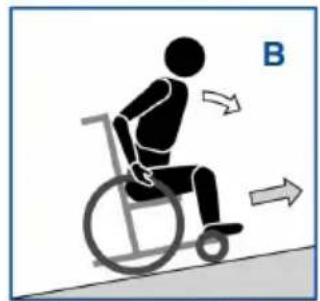
natural_image
Illustration of a person in a wheelchair using a horizontal barbell, with arrows indicating movement direction (no text or symbols)natural_image
Illustration of four human figures climbing stairs with a circular object, no text or symbols presentnatural_image
Illustration of a person in a wheelchair being assisted by another person, with directional arrows indicating movement (no text or symbols)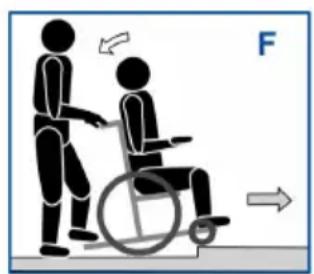
natural_image
Illustration of two people in a wheelchair, one pushing and the other standing, with directional arrows indicating movement (no text or symbols)natural_image
Illustration of two people in a wheelchair, one moving and the other pushing (no text or symbols)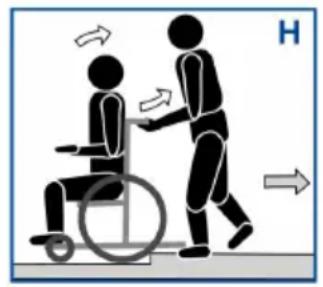
natural_image
Illustration of a person in a wheelchair being assisted by another person, with directional arrows indicating movement (no text or symbols)natural_image
Side view of a black wheelchair with blue arrows pointing to the wheel and lower body (no text or symbols visible)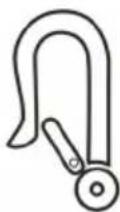
Figuur 2
natural_image
Illustration showing a person in a wheelchair and another in a wheelchair, both without any text or symbols.Figuur 3
natural_image
Illustration of two individuals in wheelchairs, one using a diagonal brace and the other seated in a wheelchair, both with a checkmark icon above (no text or symbols on figures)Figuur 4
3.1.2.1. Om de remmen in te schakelen:
natural_image
Illustration of two figures in a wheelchair, one pushing and the other seated, with directional arrows indicating movement (no text or symbols)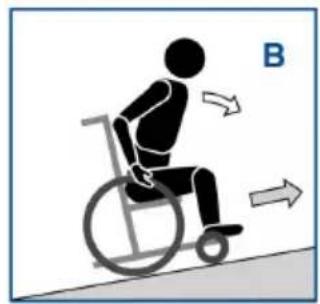
natural_image
Illustration of a person in a wheelchair using a horizontal barbell, with arrows indicating movement direction (no text or symbols)natural_image
Illustration of people climbing stairs with a wheelchair, no text or symbols presentnatural_image
Illustration of a person in a wheelchair being assisted by another person, with directional arrows indicating movement (no text or symbols)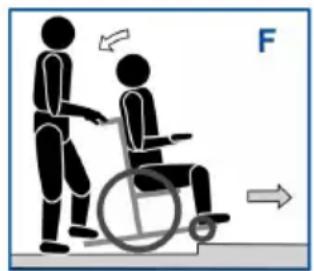
natural_image
Illustration of two people in a wheelchair, one pushing and the other standing, with directional arrows indicating movement (no text or symbols)natural_image
Illustration of two human figures in a wheelchair, one moving right and the other seated (no text or symbols)
natural_image
Illustration of a person in a wheelchair being assisted by another person, with directional arrows indicating movement (no text or symbols)5. Onderhoud
NL
natural_image
Side view of a black wheelchair with blue arrows pointing to the wheel and lower body (no text or symbols visible)
Abb. 2
natural_image
Illustration showing two individuals in wheelchairs, one using a horizontal barbell and the other in a wheelchair, with no visible text or symbols.Abb. 3
natural_image
Illustration of two individuals in wheelchairs, one using a bandage and the other seated in a wheelchair, both with a checkmark icon above (no text or symbols on figures)Abb. 4
natural_image
Illustration of two people in a wheelchair, one pushing and the other seated, with directional arrows indicating movement (no text or symbols)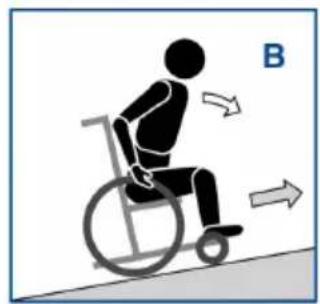
natural_image
Illustration of a person in a wheelchair using a horizontal barbell, with arrows indicating motion direction (no text or symbols)natural_image
Illustration of four human figures climbing stairs, one pushing a wheel with a crossed-out ring (no text or symbols)natural_image
Two-panel illustration showing a person in a wheelchair and another in a wheelchair, both with directional arrows indicating movement or force (no text or symbols)natural_image
Illustration of two human figures in a wheelchair, one moving right and the other seated (no text or symbols)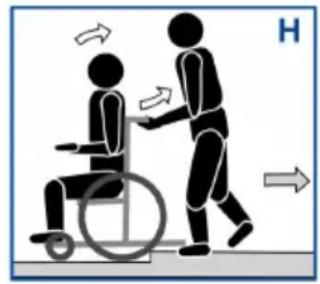
natural_image
Illustration of a person in a wheelchair being assisted by another person, with directional arrows indicating movement (no text or symbols)natural_image
Illustration showing two individuals in wheelchairs, one using a diagonal brace and the other in a wheelchair, with no visible text or symbols.Figura 3
natural_image
Illustration of two individuals in wheelchairs, one using a shoulder band and the other in a wheelchair, both with a checkmark icon above (no text or symbols on figures)Figura 4
natural_image
Illustration of two figures in a wheelchair, one pushing and the other leaning forward (no text or symbols)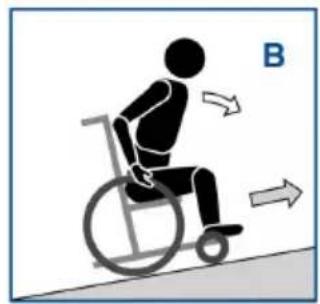
natural_image
Illustration of a person in a wheelchair using a horizontal barbell, with arrows indicating movement direction (no text or symbols)natural_image
Illustration of four human figures climbing stairs with a circular object, no text or symbols presentnatural_image
Illustration of a person in a wheelchair being assisted by another person, with directional arrows indicating movement (no text or symbols)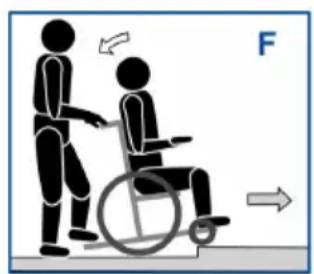
natural_image
Illustration of two people in a wheelchair, one pushing and the other standing, with directional arrows indicating movement (no text or symbols)natural_image
Illustration of two people in a wheelchair, one moving and the other pushing (no text or symbols)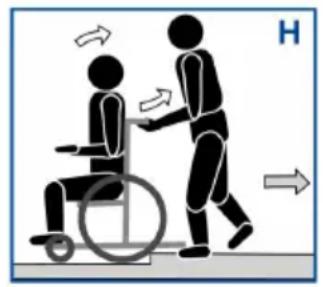
natural_image
Illustration of a person in a wheelchair being assisted by another person, with directional arrows indicating movement (no text or symbols)natural_image
Side view of a black wheelchair with blue arrows pointing to mechanical components (no text or symbols visible)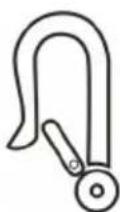
Figura 2
natural_image
Illustration showing two individuals: one in a wheelchair and another in a wheelchair, both without any text or symbols.Figura 3
natural_image
Illustration of two individuals in wheelchairs, one using a diagonal brace and the other seated in a wheelchair, both with a checkmark icon above (no text or symbols on figures)Figura 4
3. Utilizar la silla de ruedas
M VISO
Riesgo de lesiones
natural_image
Illustration of two people in a wheelchair, one pushing and the other rolling down, with directional arrows indicating movement (no text or symbols)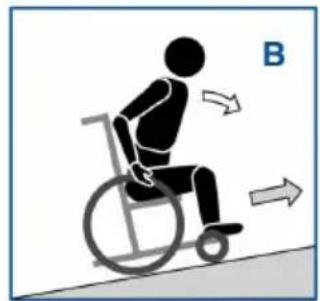
natural_image
Illustration of a person in a wheelchair using a horizontal barbell, with arrows indicating movement direction (no text or symbols)natural_image
Illustration of three figures climbing stairs with a wheelbelt, no text or symbols presentnatural_image
Illustration of a person in a wheelchair being assisted by another person, with directional arrows indicating movement (no text or symbols)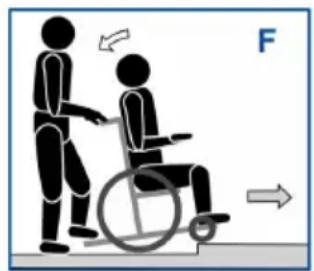
natural_image
Illustration of a person in a wheelchair being assisted by another person, with directional arrows indicating movement (no text or symbols)natural_image
Illustration of two people in a wheelchair, one moving and the other pushing (no text or symbols)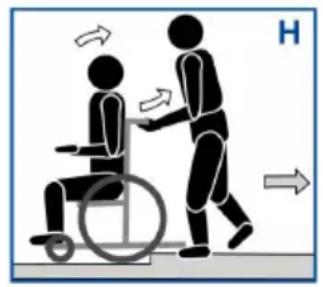
natural_image
Illustration of a person in a wheelchair being assisted by another person, with directional arrows indicating movement (no text or symbols)natural_image
Black wheelchair with articulated limbs and blue arrows pointing to mechanical components (no text or symbols visible)
Rysunek 2
natural_image
Illustration showing two individuals in wheelchairs, one using a diagonal brace and the other in a wheelchair, with no visible text or symbols.Rysunek 3
natural_image
Illustration of two individuals in wheelchairs, one using a diagonal brace and the other seated in a wheelchair, with a checkmark icon above (no text or symbols on figures)Rysunek 4
natural_image
Illustration of two figures in a wheelchair, one pushing and the other leaning forward (no text or symbols)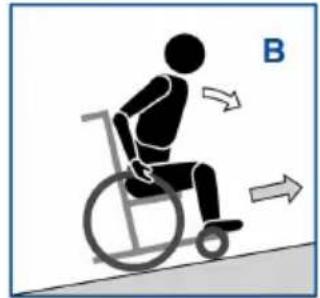
natural_image
Illustration of a person in a wheelchair using a mobility device (no text or symbols)natural_image
Illustration of four human figures climbing stairs, one pushing a wheel with a crossed-out ring (no text or symbols)natural_image
Illustration of a person in a wheelchair being assisted by another person, with directional arrows indicating movement (no text or symbols)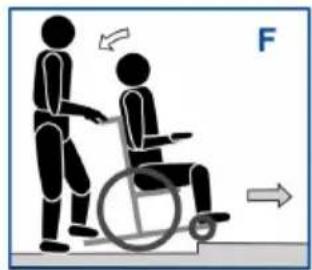
natural_image
Illustration of two figures in a wheelchair, one pushing and the other standing, with directional arrows indicating movement (no text or symbols)natural_image
Illustration of two human figures in a wheelchair, one walking and the other seated, with directional arrows indicating movement (no text or symbols)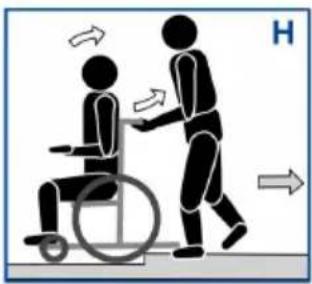
natural_image
Illustration of two figures in a wheelchair interacting, with directional arrows indicating movement (no text or symbols)natural_image
Side view of a black wheelchair with blue arrows pointing to the wheel and lower body (no text or symbols visible)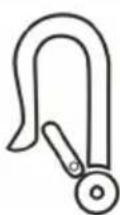
Obrázek 2
natural_image
Illustration showing two individuals in wheelchairs, one using a diagonal brace and the other seated in a wheelchair, with no visible text or symbols.Obrázek 3
natural_image
Illustration showing a person in a wheelchair and another in a wheelchair, both with a checkmark icon (no text or symbols)Obrázek 4
natural_image
Illustration of two figures in a wheelchair, one pushing and the other leaning forward (no text or symbols)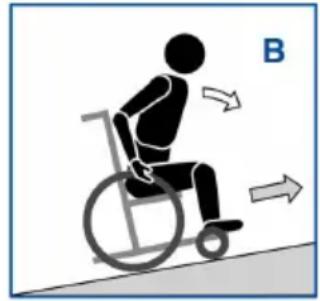
natural_image
Illustration of a person in a wheelchair using a horizontal barbell, with arrows indicating movement direction (no text or symbols)natural_image
Illustration of four figures climbing stairs, one pushing a wheel with a diagonal line (no text or symbols)natural_image
Illustration of a person in a wheelchair being assisted by another person, with directional arrows indicating movement (no text or symbols)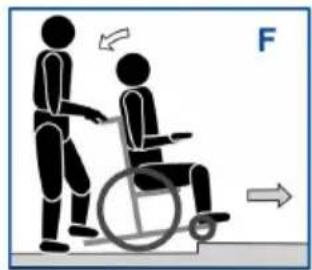
natural_image
Illustration of two figures in a wheelchair, one pushing and the other standing, with directional arrows indicating movement (no text or symbols)natural_image
Illustration of two human figures in a wheelchair, one moving right and the other sitting forward (no text or symbols)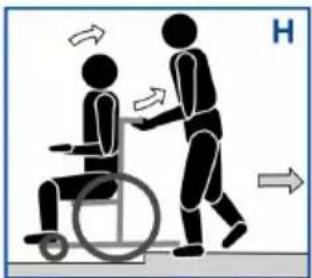
natural_image
Illustration of two figures in a wheelchair interacting, with directional arrows indicating movement (no text or symbols)Service registration form
This product (name): ....
was inspected (I), serviced (S), repaired (R) or disinfected (D):
| By (stamp):Kind of work: I / S / R / DDate: | By (stamp):Kind of work: I / S / R / DDate: | By (stamp):Kind of work: I / S / R / DDate: |
| By (stamp):Kind of work: I / S / R / DDate: | By (stamp):Kind of work: I / S / R / DDate: | By (stamp):Kind of work: I / S / R / DDate: |
| By (stamp):Kind of work: I / S / R / DDate: | By (stamp):Kind of work: I / S / R / DDate: | By (stamp):Kind of world: I / S / R / DDate: |
| By (stamp):Kind of work: I / S / R / DDate: | By (stamp):Kind of work: I / S / R / DDate: | By (stamp):Kind of work: I / S / R / DDate: |
| By (stamp):Kind of work: I / S / R / DDate: | By (stamp):Kind of work: I / S /R / DDate: | By (stamp):Kind of work: I / S / R / DDate: |
| By (stamp):Kind of work: I / S / R / DDate: | By (stamp):Kind of work: I / S / R / DDate: | By (stamp):Kind of work: I / S / R / DDate: |
VERMEIREN GROUP
Vermeirenplein 1/15
2920 Kalmthout
Belgium
www.vermeiren.com
Version: F, 2026-02
Basic UDI-DI: 5415174122103InovysIIN9
All rights reserved, including translation.

- Contents
- Preface
- Your product 6
- Before use 7
- Using your wheelchair 14
- Installation and adjustment 28
- Maintenance 30
- Technical specifications 34
- Important note
- Information available
- Your product
- Options
- Before use
- Intended use and indications
- Safety instructions and applicable risks
- CAUTION
- Risk of injuries and/or damage
- Symbols on the wheelchair
- First use and storage
- Risk of damage
- Transport
- Moving out of the way
- Transport by vehicle, as luggage
- WARNING
- Risk of injuries
- Transport by vehicle, as seat for the user
- Steps to secure the wheelchair in a motor vehicle:
- Steps to secure the wheelchair user:
- Using your wheelchair
- Operating the brakes
- Parking brakes
- To apply the brakes:
- To release the brakes:
- Attendant brakes
- To apply the brakes:
- To release the brakes:
- Moving to/from the wheelchair
- Risk of injuries or damage
- Transfer
- Sitting in the wheelchair
- Comfort adjustments
- Backrest and seat inclination
- Backrest inclination
- Armrest height
- Push handle height
- Leg rest inclination
- Footplate angle
- Removable footplate
- To remove the footplate:
- To attach the footplate:
- Headrest
- Tipping aid height
- Risk of entrapment
- Riding with an attendant
- Riding on slopes
- Using ramps
- Risk of tipping over
- Coping with obstacles
- Small kerbs (up or down)
- Medium kerbs (up or down)
- Higher kerbs
- Going down:
- Going up:
- Installation and adjustment
- Tools
- Scope of delivery
- Assembly
- Adjustments
- Leg rest length
- Maintenance
- Points of maintenance
- Risk of injuries and damage
- Before each use
- Yearly or more often
- If stored
- Maintenance instructions
- Wheels and tyres
- Cleaning
- AUTION
- Risk of damage by moisture
- Disinfection
- Troubleshooting
- Expected lifespan
- Reuse
- End of use
- Warranty
- Technical specifications
- Table des matières
- Préface
- Votre produit 39
- Om de remmen in te schakelen:
- Onderhoud
- Utilizar la silla de ruedas
- M VISO
- Riesgo de lesiones
- Service registration form
Brand : Vermeiren
Model : Inovys II + L70
Category : Wheelchair