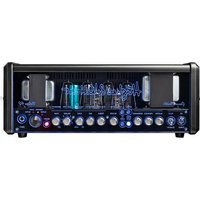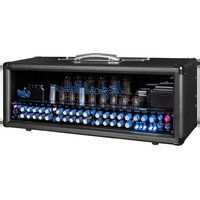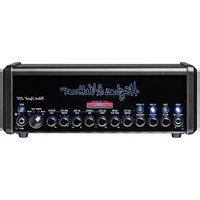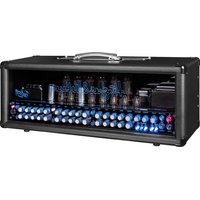
TriAmp Mark 3 - Guitar amp HUGHES & KETTNER - Free user manual and instructions
Find the device manual for free TriAmp Mark 3 HUGHES & KETTNER in PDF.


| Product Type | All-Tube Guitar Amplifier |
| Brand | Hughes & Kettner |
| Model | TriAmp Mark 3 |
| Output Power | Up to 150 watts (depending on tube configuration) |
| Number of Channels | 6 independent channels (Amp 1A/B, Amp 2A/B, Amp 3A/B) |
| Tube Preamplifier | 9 x ECC83 (including 1 x 7025) |
| Tube Power Stage | 3 tube pairs (2 x EL34 + 4 x 6L6 as delivered) |
| MIDI Presets | 128 programmable presets |
| Instrument Input | 6.35 mm unbalanced jack, impedance 1 MΩ |
| Speaker Outputs | 4 Ω, 8 Ω, 2 x 16 Ω (switchable) |
| DI Output | Balanced XLR Red Box AE with ambience emulation |
| MIDI | 7-pin input (5-pin compatible), 5-pin output/Thru |
| MIDI Phantom Power | 20 V DC, 150 mA for TSM-432 footswitch |
| Dimensions (W x H x D) | 740 x 393 x 254 mm |
| Weight | 22 kg |
| Mains Voltage | 100-240 V depending on version (selection switch) |
| Max Power Consumption | 460 W |
| Mains Fuse | T5A (100/120 V) or T2A (220-240 V), 5x20 mm |
| Main Features | Stomp Boost, IDB Noise Gate, SmartLoop FX Loop, TSC Tube Safety Control, Red Box AE, AES Energy Saving |
| Included Accessories | TSM-432 MIDI footswitch, 7-pin MIDI cable, power cable |
| Care and Cleaning | Clean with a dry cloth. Do not open the housing. |
| Safety | AES auto power-off after 90 min of inactivity (EU), TSC tube protection, protection class I |
Frequently Asked Questions - TriAmp Mark 3 HUGHES & KETTNER
User questions about TriAmp Mark 3 HUGHES & KETTNER
0 question about this device. Answer the ones you know or ask your own.
Ask a new question about this device
Download the instructions for your Guitar amp in PDF format for free! Find your manual TriAmp Mark 3 - HUGHES & KETTNER and take your electronic device back in hand. On this page are published all the documents necessary for the use of your device. TriAmp Mark 3 by HUGHES & KETTNER.
USER MANUAL TriAmp Mark 3 HUGHES & KETTNER
Hughes & Kettner® TECHNOLOGY OF TONE
TriAmp _3 /mark
Built for creative expression on an epic level
Manual 1.1
Important Safety Instructions! Read before connecting!
This product has been built by the manufacturer in accordance with IEC 60065 and left the factory in safe working order. To maintain this condition and ensure non-risk operation, the user must follow the advice and warning comments found in the operating instructions. The unit conforms to Protection Class 1 (protectively earthed). If this product shall be used in vehicles, ships or aircraft or at altitudes exceeding 2000 m above sea level, take care of the relevant safety regulations which may exceed the IEC 60065 requirements.
WARNING: To prevent the risk of fire and shock hazard, do not expose this appliance to moisture or rain. Do not open case – no user serviceable parts inside. Refer service to qualified service personnel.

This symbol, wherever it appears, alerts you to the presence of uninsulated dangerous voltage inside the enclosure – voltage that may be
sufficient to constitute a risk of shock.

This symbol, wherever it appears, alerts you to the presence of externally accessible hazardous voltage. External wiring connected to any
terminal marked with this symbol must be a "ready made cable" complying with the manufacturers recommendations, or must be a wiring installed by instructed persons only.

This symbol, wherever it appears, alerts you to important operating and maintenance instructions in the accompanying literature.
Read the manual.

This symbol, wherever it appears, tells you: Take care! Hot surface! To prevent burns you must
not touch.
- Read these instructions.
- Keep these instructions.
- Follow all warnings and instructions marked on the product and in this manual.
- Do not use this product near water. Do not place the product near water, baths, wash basins, kitchen sinks, wet areas, swimming pools or damp rooms.
- Do not place objects containing liquid on the product – vases, glasses, bottles etc.
- Clean only with dry cloth.
- Do not remove any covers or sections of the housing.
- The set operating voltage of the product must match the local mains supply voltage. If you are not sure of the type of power available consult your dealer or local power company.
- To reduce the risk of electrical shock, the grounding of this product must be maintained. Use only the power supply cord provided with this product, and maintain the function of the center (grounding) pin of the mains connection at any time. Do not defeat the safety purpose of the polarized or grounding-type plug.
- Do not defeat the safety purpose of the polarized or grounding-type plug. A polarized plug has two blades with one wider than the other. A grounding type plug has two blades and a third grounding prong. The wide blade or the third prong are provided for your safety. If the provided plug does not fit into your outlet, consult an electrician for replacement of the obsolete outlet.
- Protect the power cord from being walked on or pinched particularly at plugs, convenience receptacles, and the point where they exit from the device! Power supply cords should always be handled carefully. Periodically check cords for cuts or sign of stress, especially at the plug and the point where the cord exits the device.
- Never use a damaged power cord.
- Unplug this product during lightning storms or when unused for long periods of time.
- This product can be fully disconnected from mains only by pulling the mains plug at the unit or the wall socket. The product must be placed in such a way at any time, that disconnecting from mains is easily possible.
- Fuses: Replace with IEC127 (5x20mm) type and rated fuse only! It is prohibited to use "patched fuses" or to short the fuse-holder. Replacing any kind of fuses must only be carried out by qualified service personal.
- Refer all servicing to qualified service personnel. Servicing is required when the unit has been damaged in any way, such as:
- When the power cord or plug is damaged or frayed.
- If liquid has been spilled or objects have fallen into the product.
- If the product has been exposed to rain or moisture.
- If the product does not operate normally when the operating instructions are followed.
- If the product has been dropped or the cabinet has been damaged.
- Do not connect external speakers to this product with an impedance lower than the rated impedance given on the product or in this manual. Use only cables with sufficient cross section according to the local safety regulations.
- Keep away from direct sunlight.
- Do not install near heat sources such as radiators, heat registers, stoves or other devices that produce heat.
- Do not block any ventilation openings. Install in accordance with manufacturer's instructions. This product must not be placed in a built-in installation such as a rack unless proper ventilation is provided.
- Always allow a cold device to warm up to ambient temperature, when being moved into a room. Condensation can form inside it and damage the product, when being used without warming up.
- Do not place naked flame sources, such as lighted candles on the product.
- The device must be positioned at least 20 cm/8" away from walls with free air space in between, and there must be free air space of at least 50 cm / 20" immediately above the unit within which no object(s) may be placed or positioned.
- Use only with the cart, stand, tripod, bracket or table specified by the manufacturer or sold with the product. When a cart is used, use caution when moving the cart/product combination to avoid injury from tip-over.
- Use only accessories recommended by the manufacturer, this applies for all kind of accessories, for example protective covers, transport bags, stands, wall or ceiling mounting equipment. In case of attaching any kind of accessories to the product, always follow the instructions for use, provided by the manufacturer. Never use fixing points on the product other than specified by the manufacturer.
- This appliance is NOT suitable to be used by any person or persons (including children) with limited physical, sensorial or mental ability, or by persons with insufficient experience and/or knowledge to operate such an appliance. Children under 4 years of age must be kept away from this appliance at all times.
- Never push objects of any kind into this product through cabinet slots as they may touch dangerous voltage points or short out parts that could result in risk of fire or electric shock.
- This product is capable of delivering sound pressure levels in excess of 90 dB, which may cause permanent hearing damage! Exposure to extremely high noise levels may cause a permanent hearing loss. Wear hearing protection if continuously exposed to such high levels.
- The manufacturer only guarantees the safety, reliability and efficiency of this product if:
- Assembly, extension, re-adjustment, modifications or repairs are carried out by the manufacturer or by persons authorized to do so.
- The electrical installation of the relevant area complies with the requirements of IEC (ANSI) specifications.
- The unit is used in accordance with the operating instructions.
- The grounding of the center pin of the mains plug is maintained to reduce the risk of shock.
Things to do before operating the amp
- Please read these instructions carefully, particularly the notes on safety, before operating the amp.
- The manufacturer disclaims any liability on responsibility whatsoever for any damage or defect to this and other devices resulting from misuse.
- Before you plug this amp into a mains power outlet, make sure its Power and Standby switches are off and that the voltage rating indicated on its rear panel matches your local mains current.
- Do not use this amp without a speaker cabinet connected. Please make sure the impedance of the speaker cabinet matches the impedance of the speaker out it is connected to.
- A word of warning before you fire up your amp. It's loud, and high volume levels can cause hearing damage. To avoid very loud and unwelcome surprises, make a habit of backing the Master Volume knob all the way down before switching on the amp!
TriAmp _3 mark
1 Foreword 3
2 Quick Start....4
3 The fundamentals of handling TriAmp Mark 3 .... 4
4 Amps and Channels 5
5 Front Panel 5
6 Rear panel 7
7 MIDI Presets and MIDI Setup 8
8 TSC ^TM -Tube Safety Control 10
9 TSM-432 - The included MIDI board 11
10AES....12
11 Technical Data....13
1 Foreword
We always knew that taking the TriAmp MK II a major step forward would be a challenge. It would mean creating something radically new – so new, in fact, that it would have to redefine the status quo in tone, performance and design. But at the same time, a Mark 3 has to be a continuation on a theme, to look and feel familiar. So, we considered every single factor that had helped make the TriAmp MK II the amp of choice for many artists. Then, we reengineered every single feature in the most forwarding thinking way possible. The result is a genuine game changer, something no one in the world of guitar amps has ever seen before – the TriAmp Mark 3.
A whole new chapter in our epic tale of tube driven tone
TriAmp Mark 3 not only offers three completely independent preamps with two channels each, but also three truly independent power amps. Each of the three pairs of power amp tubes can be equipped with EL34s or 6L6s, and each of the pairs is freely assignable to each of the six channels – even via MIDI! But you're not just limited to one pair per channel – you can also assign different pairs to each, which allows you to mix the different types of power amp tubes.
Now combine this with 3 pairs of power amp tubes, this will result in 3x12=36 different sounds. If you kick in a second pair of tubes, you get another 36 combinations (Pair 1+2, Pair 1+3, Pair 2+3). With the third pair, it will add another 12 options! Each of the six channels has its own Gain, Volume and 3-band EQ, plus a Stomp Boost that is tailored specifically to each channel's character. This makes a total of 12 different base tones at the touch of a button. Now combine this with three pairs of power amp tubes – again, all accessible at a touch of a button – and you've got 36 different sounds available at 50 Watts. If you kick in a second pair of tubes (taking the power up to 100 Watts), you get another 36 combinations (Pair 1+2, Pair 1+3, Pair 2+3). With the third pair engaged too (that's now 150 Watts!), you've got another 12 options! That's a total of 84 different sounds.
The TriAmp Mark 3 doesn't just offer classic tones, though. The option to combine channels and power tube combinations like never before lets you create your own new sounds – the sounds of the future. Never before has tonal variety been accessible in such an inspiring way.
2 Quick Start
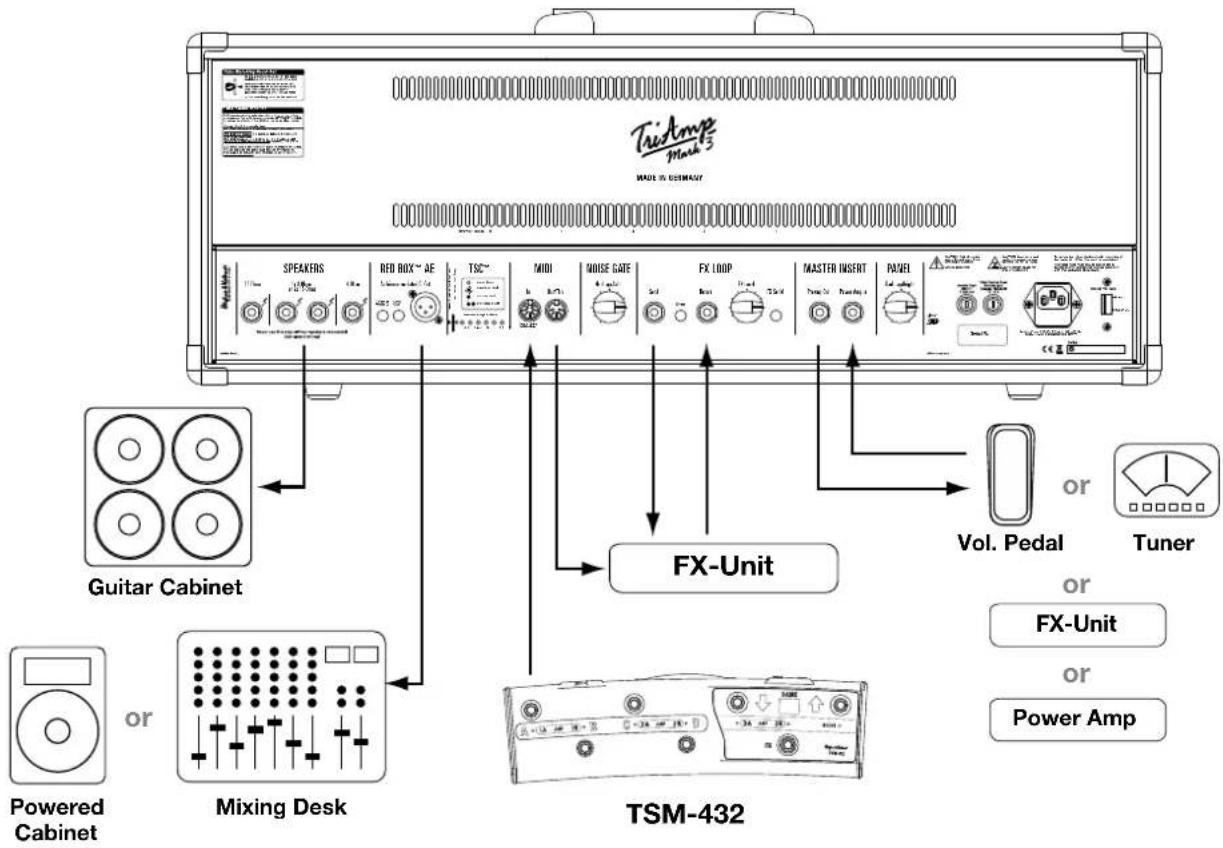
Mains In: Connect the factory-included power cord (Mains Lead) to this socket.
MIDI In: Connect the MIDI Out of the included TSM-432 or your favorite MIDI controller to the MIDI In. Though this is a 7-pin interface, you can connect a standard 5-pin MIDI cable and use any standard MIDI controller. The two additional terminals (1 and 7) serve to supply phantom power to the Hughes & Kettner TSM-432 MIDI board.
Speaker: Connect a speaker cabinet designed for guitar amps. We recommend the matching Hughes & Kettner TM and TC Series cabinets.
AES: The EU version of the TriAmp Mark 3 is equipped with an energy saving mechanism called AES (for more details, see Chapter 10 of this manual). If AES is activated (as it is by default in the factory settings), the TriAmp will automatically be switched off after a phase of silence or inactivity of about 90 minutes. The phase of silence is reset as soon as it receives an input signal.
3 The fundamentals of handling TriAmp Mark 3
Operating the TriAmp Mark 3 is as easy as it can get:
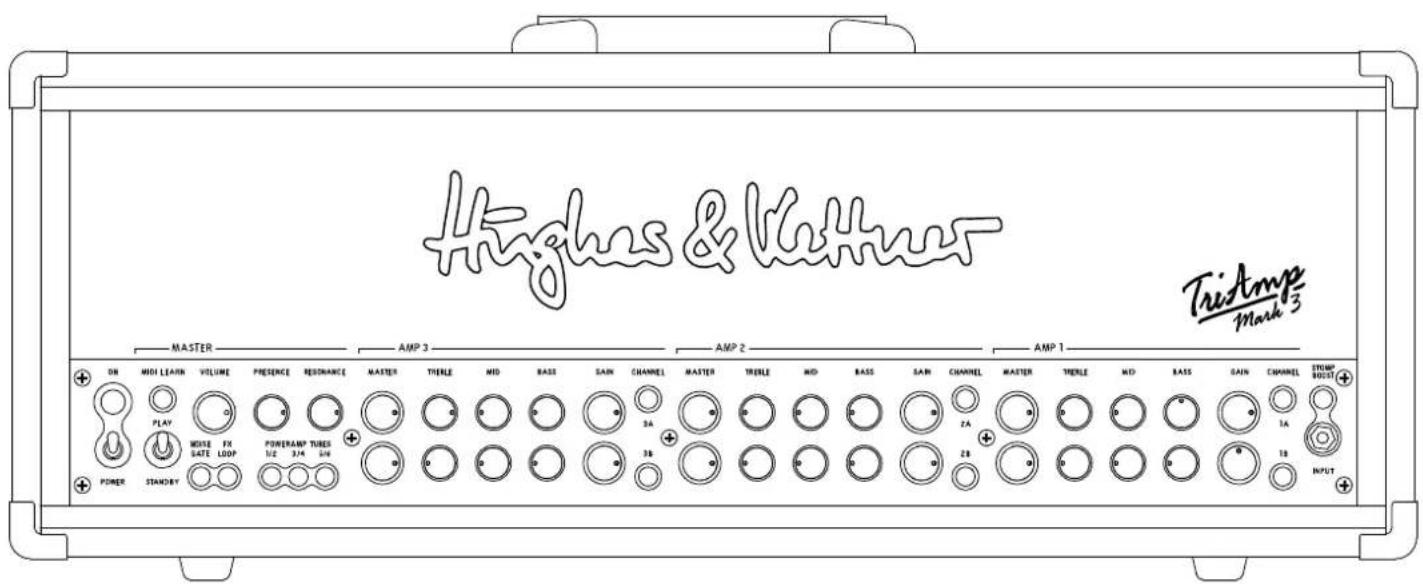
- There are six fully independent channels, and each channel features an identical set of controls.
- The position of each button is connected to the channel and is recalled with the selected channel.
- The Master controls on the left-hand side of the front panel affect all channels.
The Stomp Boost and Power Amp Tubes buttons look like global settings, but they can actually be set for each of the six channels separately. These settings are memorized automatically when you change channels. This means, for example, that if you are playing Channel 1A with one pair of 6L6 tubes, Boost on, these settings will be recalled every time you select channel 1A again – until you change the settings. (With the use of MIDI Presets, you have even more options – see Chapter 7, MIDI, for more information.)
The buttons all also serve as indicator LEDs, and they illuminate when selected to call attention to the active channel or function.

4 Amps and Channels
The channels of the TriAmp Mark 3 do not just represent different gain stages. Rather, each of them represents an era of tone. Highly advanced new switching technology reconfigures the multiple tube stages and the power amp tubes with each channel or MIDI Preset you select. This design pulls every drop of tone out of the all-tube circuitry, giving TriAmp Mark 3 an incredible tonal flexibility.
Channels can be selected on the amp itself or via the included TSM-432 MIDI board. In order to do this, switch the TSM-432 to Stomp Box Mode. On this mode, switches 1 to 6 represent the various channels, while switch 7 controls the Stomp Boost. (The other TSM-432 mode is Preset Mode, which offers you even more tonal options. See the MIDI Chapter for more information.)
4.1 Amp 1
Channel A: Sparkling 50s Californian Clean
Channel 1A sounds full and expansive in the great American tradition. It's forte is classy clean tone that stays distortion free - even at high gain settings - and it delivers the kind of twang that'll make you want to break out the cowboy boots and get your country stomp on! Make no mistake about it: Channel 1A's low end is big, tight and focused and will more than satisfy the needs of even the most ardent low-end connoiusseur.
Note: Channel 1A works exceptionally well with both pairs of 6L6s engaged.
Channel B: Chimey 60s British Clean
Channel 1B produces high class British-approved tones with that trademark shimmering top end and tremendously subtle harmonic distortion. Even at lower gain settings, 1B will still serenade you with rich, musical overtones in the high mids.
Note: Our recommended power amp setting for Channel 1B is the pair of EL34 tubes.
4.2 Amp 2
Channel A: Classic 70s British Lead
Channel 2A cranks out the scorching overdriven tones that have graced almost every genre-defining classic rock production. This channel has an open, British flavor that works fantastically for raw-edged riffing and aggressive chord work!
Note: If you want to get the sounds you'd expect from a channel of this nature, select the pair of EL34 tubes. That said, trying this channel will one (or even two!) pairs of 6L6s is also highly recommended!
Channel B: 'Brown' 80's British Lead
Channel 2B goes from gritty and fat to singing with days of sustain at the twist of a knob. So, what's the secret? Well, 2B features a special circuit that injects a highly desirable sonic additive into your sound – the kind of power amp distortion that players just couldn't get enough of from their old Plexis. Rich, loud and full of attitude, it's perfect for two-handed tapping and huge power chords!
Note: For channel 2B, one pair of EL34 is the right choice to start with.
4.3. Amp 3
Channel A: Classic 90s American High Gain
Channel 3A is honest and direct, its hair-trigger response reacting instantly to minute changes in your picking attack and the slightest twist of your guitar's volume knob. Pure and distinct, 3A will preserve your guitar's own unique sound, and the tone will remain crisp and defined – no matter how high you set the gain control!
Note: Channel 3A works great with one pair of EL34 combined with one pair of 6L6.
Channel B: Modern-day High Gain and beyond
Channel 3B pumps out the most merciless high gain sounds you've ever heard in your life. Drop-tuning devotees and seven and 8-string axe slingers will swoon at the sound of 3B's hot, huge and downright dirty distortion! Engage the Stomp Boost for the ultimate response to your touch, a feeling that the strings are an extension of your fingers and slaves to your will. Channel 3B greases up your strings, making riffs and licks fly off the fretboard with consummate ease.
Note: This is a must-try: play Channel 3B with both pairs of 6L6s, and then kick in the EL34s too!
5 Front Panel
5.1 Power and Standby
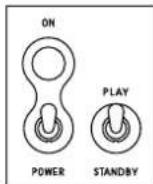
Power/On Switch: Flick this switch to On to get the mains power flowing. The amp lights up, and the tubes will begin to heat up for the challenges that lie ahead.
Play/Standby Switch: Give the tubes about 30 seconds to get toasty; then you can flip the Standby switch to Play. The amp is now ready to rock! When taking a longer break from playing, flick the switch back to Standby so the tubes remain at operating temperature. This will help prolong their lifespan.
5.2 Input and Stomp Boost
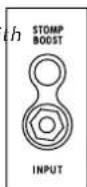
Input: Instrument input, 1 M-Ohms. Connect your guitar to this input using a shielded cord equipped with 6.3 mm (1/4") jack plugs.
Stomp Boost: The Stomp Boost targets specific frequency ranges in your tone and kicks them up a notch. on what channel and settings you've got dialed in, the Boost will yield an even more assertive, creamier, or punchier tone. The Stomp Boost is located right after the input jack and before the input stage of the
TriAmp Mark 3 - Manual 1.1
TriAmp Mark 3, and is tailored to each channel's character, meaning that it works like six different external solid state stomp boosters.
Clever fact: The Stomp Boost is actually a separate module located on an additional PCB (printed circuit board) and is switched on or off via true bypass circuitry.
5.3 Channel Controls
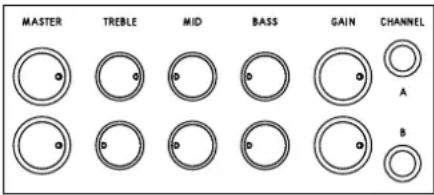
Channel Buttons: Push these to select the desired channel directly.
Gain, Master: Gain determines input sensitivity and therefore the saturation level of the preamp. Paired with the Stomp Boost, Gain is your most important sound sculpting tool. Use the separate Master controls to adjust and match channel levels to your satisfaction!
Bass, Mid, Treble: The three-band voicing section's sound-shaping action is fine-tuned for each channel. The individual EQ controls address the frequency ranges that define the tonal characteristics of their respective channel.
Heads-up: These are classic passive tone controls that influence one another. For example, if you crank the Mid knob, the Bass knob will be less sensitive than when you back the Mid knob down.
5.4 Master Controls
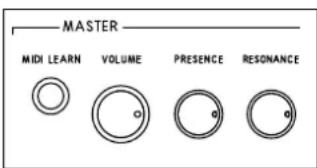
Volume: The master Volume control determines the overall output of your TriAmp Mark 3. This knob puts the power of 150 tube-driven watts between your thumb and forefinger. Use it wisely, because it can induce
everything from bliss to pain to near madness in your band mates. Though twisting this knob can be as much fun as the law allows, don't unleash all this power rashly.
Exercise restraint, turn it up gradually to a level that suits the venue and is not harmful to your – and your fellow musicians' – hearing!
Presence: This knob controls the amount generated by the power amp. The higher the setting, the more intense the effect. Use the Presence control to dial in razor-sharp tones when you need your musical statements cut through.
Resonance: Set the Resonance knob to 12 o'clock, and you will hear the natural resonance created by the combination of the TriAmp Mark 3 and your chosen cabinet(s). Twisting the Resonance control counterclockwise dampens the speakers' and the cabinets' resonance for a looser, softer sound. Turning the control clockwise intensifies resonance for a tighter, punchier low end. Turn it up fully to dig deep into the dark underbelly of the TriAmp and draw up bowel-shaking sub bass frequencies!
Tip: The Presence and Resonance controls work well as a master EQ, and allow you to adjust your overall sound to different cabinets or venues without having to fiddle with the EQs of your individual channels.
5.5 Power amp Tubes
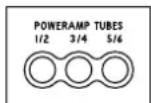
These three unimposing buttons are actually TriAmp Mark 3's secret weapon! They open up a whole new chapter in the epic tale of tube-driven tone. Each of the three pairs of power amp tubes is freely assignable to
each of the amp's six channels – all you need to do is select your desired channel, and then activate the pair (or pairs!) of tubes you want. Each of the three pairs of power amp tubes can be equipped with EL34 or 6L6GC tubes (see the TSC Chapter to learn more about TriAmp's autobiasing system). This allows you to mix and match the different kinds of tubes in any of TriAmp Mark 3's channels. And, with the use of MIDI Presets, you can even play the same channel with different power amp tubes at a tap of a button on the footswitch. (See the MIDI Chapter to learn more about MIDI Presets).
This lets you do some pretty exotic stuff with TriA example, over the course of one song you can play lead with one pair of 6L6s at 50 watts (for the intro), add a second pair of 6L6s (at 100 watts) for riffing, and, instead of using the Boost, kick in the EL34 tubes to add accordingly. Some creamy midrange punch (at up to 150 watts) for your solo! Trust us: you will be heard!
Or, imagine this: you can now switch from British EL34 tones to the distinctive American 6L6 sound within the same channel via Midi. Or, you could even go from Chinese EL34s to Slovakian EL34s without changing tubes, or amps, or channels. Among other things, TriAmp Mark 3 genuinely is the world's first six-channel Tube Comparison Machine!
Note: The TriAmp Mark 3 can be equipped with other types of poweramp tubes as well: The following types have been tested in the TriAmp Mark 3 by Hughes & Kettner: KT77, KT66, KT88, 5881 WXT, 6550 A, 6CA7, 7581
5.6 FX Loop
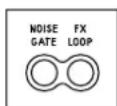
The SmartLoop™ effects routing circuit offers parallel and serial FX loop modes for patching in external effects devices. Its status – on or off and parallel or serial – is stored within each channel or MIDI Preset.
FX Loop: This button switches the effects loop on and off. Learn more about the Effects Loop in Rear Panel chapter.
harmonic overtones 5.7 Noise Gate
The ultra-precise IDBTM (Intelligent Dual Breakpoint) noise gate gauges levels simultaneously at two key points in the signal chain: the Input and the preamp's output. The IDBTM technology then uses these two values to calculate the optimum response, and automatically adapts the standard attack and threshold parameters for you. You'll never hear another extraneous noise from your amp!
The Noise Gate button switches the IDB ^™ noise gate on and off for each channel or MIDI preset. When activated, the noise gate kicks in to mute the preamp as the signal level drops below a certain threshold, removing

any unwanted noise. The gate remains shut until you hit the guitar strings. When you do so, it opens up again without any latency. Learn more about the noise gate in the Rear Panel chapter.
6 Rear Panel
6.1 Speakers
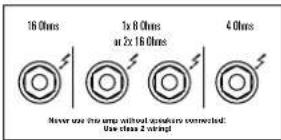
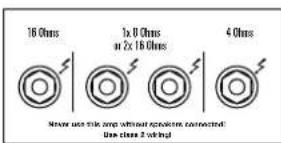
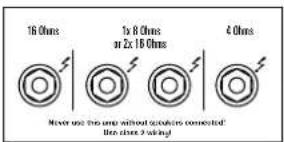
The TriAmp Mark 3 offers separate outputs for all standard impedances. You can connect either one 4 Ohm cabinet, one 8 Ohm cabinet or one or two 16 Ohm cabinets.
Never use this amp without speakers connected! For connection use a sufficient speaker cable only!
- If you want to run two 8 Ohm cabinets connected in parallel, use the 4 Ohm output. Never connect cabinets with different impedances at the same time!
- If you want to drive two cabinets with different impedances simultaneously, you must configure a parallel or serial circuit and connect it to the appropriate output. Use this formula to figure out the overall impedance (R) of two cabinets with different impedances (R1, R2):
$$ \text { In parallel: } R = (R 1 \times R 2) / (R 1 + R 2) $$
Here's an example with one 8 Ohm cab and one 16 Ohm cab:
$$ R = (8 \times 1 6) / (8 + 1 6) \text { Ohms } $$
$$ R = 1 2 8 / 2 4 \mathrm{Ohms} $$
$$ R = 5. 3 3 \text { Ohms } $$
Parallel connection is the standard, but if you find a cabinet with an output that is wired in series, or if you use custom-made wiring, the overall impedance is the sum of the impedances of each cab:
$$ \text { In series: } R = R 1 + R 2 $$
A combination of a 4 Ohm cabinet and an 8 Ohm cabinet connected in serial will result in 12 Ohms.
Tip: The golden rule is that the cabinets' impedance may never be lower than the amp's output impedance. That means that, in our examples, you would connect the combination of cabs that results in 5.33 Ohms to the 4 Ohm speaker out, and 12 Ohms combination to the 8 Ohm speaker out.
6.2 Red Box AE
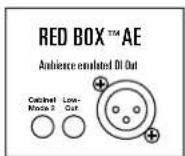
The TriAmp Mark 3 is the first Hughes & Kettner product to feature the all-new Red Box with Ambience Emulation. Since its late 80s release, the original Red Box has been the industry standard tool for capturing the sound of guitar amps without using microphones. Red Box delivers unvarying sound quality at every gig or recording session, putting an end to crosstalk with other instruments and the hassles of experimenting with microphone placement.
The Red Box AE is the latest version of the award-winning speaker simulator, and it features switchable Low-Cut filtering and a 2nd Cabinet Mode. The DSP-powered Ambience Emulation delivers a perfect mix of authentic 4x12 cabinet ambience effects and an ultra-direct attack of pure tube tone, capturing the signal just after the power amp stage, and right before the speaker output. The Red Box AE delivers a line signal. The level of the line signal depends on the level of the power amp, meaning that the Master Volume effectively determines the level of this DI Out.
Note: Use a microphone cord to patch the Red Box AF's signal to a mixing console. Make sure the mixing console's XLR input is set to line level. If the mixing console lacks XLR inputs, or if the inputs cannot be set to line level, you will need an XLR to 6.3 mm (1/4") jack adapter or cable. These are readily available in all good music stores.
6.3 TSC
Note: We have devoted an entire chapter of this manual to Tube Safet Control. See the TSC chapter to learn more about it.
6.4 MIDI In and Out/Thru
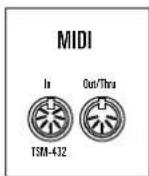
MIDI is a great opportunity to switch sounds using so-called program changes. At the touch of a button, you can change the channel of the amp and the effects program on your external effects device simultaneously. MIDI certainly puts an end to dancing around on your pedalboard. For this reason, we decided to use MIDI as the standard protocol for any switching function on TriAmp Mark 3, and to use it as the interface for the included MIDI board, the TSM-432. To learn more about the MIDI board, see the TSM-432 chapter.
MIDI In: TriAmp Mark 3's MIDI In is a 7-pin interface, but you can also connect a standard 5-pin MIDI cable, meaning that any MIDI controller or board will fit. The two additional pins serve to supply phantom power to the included Hughes & Kettner TSM-432 MIDI board.
Heads-up: The TSM-432 comes complete with a 7-pin MIDI cable. Should the cable get lost and you find yourself needing a quick replacement, a 5-pin MIDI cable will do the job. However, you will need a power supply
in this situation. To make things easier, the TSM-432 features an innovative mains port that accepts any AC or DC adapter rated for nine to 15 volts.
MIDI Out/Thru: MIDI Out/Thru forwards signals patched In to other devices. You can connect any external MIDI-enabled signal processor that you wish to switch simultaneously with your TriAmp Mark 3.
Note: We have devoted an entire chapter to TriAmp Mark 3's various MIDI functions. See the MIDI Presets and MIDI Setup chapter to learn more about it.
6.5 Noise Gate Hard/Soft
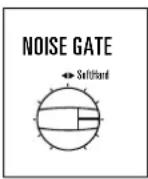
The Hard/Soft knob on the amp's rear panel controls the noise gate's response. The further you twist this knob to the right, the softer the noise gate's response. The further you twist the knob to the left, the harder the noise gate kicks in and cuts off signals and unwanted noise.
Tip: 12 O'clock is the universal noise gate setting. If you wish to use the noise gate as a stylistic device when playing fast staccato riffs at high gain levels, then dial in a setting towards the Hard end of the control range.
6.6 Effects Loop
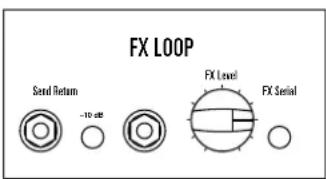
FX Send: Connect this jack to your effects processor's input.
FX Return: Connect this jack to your effects processor's output.
-10 dB: This damping switch allows you to adapt the signal level to lower-level effects devices. Activate it for instrument level processors that you would normally use as pre-effects in between the guitar and the instrument input of the amp (e.g. stomp boxes).
Level: Determines the level of the signal routed into the FX Return.
FX Serial: This button switches the effects loop from serial to mode. When it is on (the button will light up), the loop is in serial mode.
Tip: In parallel mode, use FX Level to set the desired wet/dry mix (i.e. the level of the effect versus the dry guitar signal). You can also route any line signal into the FX Return and use FX Level to mix that signal to the signal of the preamp.
In serial mode, you can adjust the overall volume of the preamp signal. This means that you can use it as a 2nd Master Volume – even without any FX device connected. You can patch the signal from the FX Send directly to the FX Return, adjust the volume with FX Level, and switch it by activating the FX Loop.
6.7 Master Insert
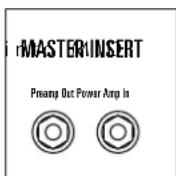
The TriAmp Mark 3 sports an ancillary serial loop that lets you control Master Volume via a volume pedal. The preamp signal is patched out via Preamp Out and in again via Power Amp In. You can also use the Preamp Out to send the preamp signal to other power amps, or connect a tuner to it. The Preamp
Out is always active, so connecting this jack does not affect the signal flow in any way.
Note: Power Amp In is a switching jack: if it is connected, the internal signal flow is interrupted and only signals that are patched to the Power Amp In will be routed to the power amp.
6.8 Panel
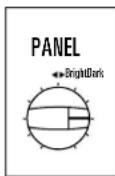
This knob adjusts the brightness of TriAmp Mark 3's from panel illumination. It can also be remote controlled by MIDI using continuous controller commands. (See the MIDI chapter for more information.)
7 MIDI Presets and MIDI Setup
Every one of TriAmp Mark 3's buttons can be remote controlled by MIDI and stored in one of 128 MIDI presets. Each preset can then be recalled at any time using a corresponding program change number. This can be done using any standard MIDI controller or sequencer/software. The included TSM-432 MIDI board also uses MIDI to switch channel boost directly (in Stomp Box Mode) or to recall any of the 128 presets, which are stored in 32 banks with 4 presets per bank (in Preset Mode). The MIDI factory setting of both the amp and the included TSM-432 MIDI board is channel 1, so it will work straight out of the box. You will learn how to change MIDI channels later in this chapter.
Note: We have devoted an entire chapter to the functions of the included TSM-432 MIDI board – see the TSM-432 Chapter for more information.
7.1 Creating and recalling a MIDI preset parallel
So, what is the difference between a channel setting and a MIDI preset?
Well, there are six channel settings that are automatically stored on TriAmp Mark 3 – these are selectable when you choose channels manually on the amp itself, or when you use the TSM-432 in Stomp Box Mode. However, you can also store any configuration of channels and power amp tubes, as well as toggling the noise gate, boost and FX loop on or off in up to 128 MIDI presets.
What are MIDI presets good for?
In many cases, when switching between sounds, you will want to switch a channel, the boost, noise gate and the effects program of our external MIDI effects processor simultaneously. This lets you switch, for example, from a clean sound with chorus and reverb to a lead tone with delay, boost and noise gate, etc.
What's really unique about TriAmp Mark 3, though, is this: you can also switch instantly between the three sets of power amp tubes using MIDI. Imagine being able to play a classic 60s British pop clean tone with a pair
of EL34s, and then adding some patented American sparkle to it just by switching to a pair of EL6L6s! Or, imagine you're playing using a modern American high gain sound using both pairs of the 6L6s, and then you instantly whack it up a notch with an extra aggressive mid-range punch – just by kicking in the pair of EL34s.
Feel free to explore your creative expression! Or, just enjoy the convenience of being able to fully remote control TriAmp Mark 3 via MIDI in the studio, or even onstage. Plus, if required, a click track can switch all your presets – and even the amp's front panel illumination in case the stage has to be completely dark. TriAmp Mark 3 truly is the very first tube amp that can be integrated into your light show!
How does it work?
Programming TriAmp Mark 3 really couldn't be any easier. If you want to save a configuration of channel, boost on/off, noise gate on/off, FX loop on/off and power amp tubes in a preset, simply activate the settings you want using the buttons on the amp, arm the amp by briefly pressing the MIDI Learn button (Learn will light up), and then press the appropriate switch on your MIDI board that you want to recall this configuration. The Learn light will switch off, which tells you that TriAmp Mark 3 has saved your settings to one of the 128 internal preset slots and assigned it to a program number on your MIDI board.
Now, when TriAmp Mark 3 receives a program change message via the selected MIDI channel (more on this below), Learn flashes briefly and TriAmp is configured accordingly.
By the way, if you want to quit the programming mode without saving your current settings, just press the Learn button again (instead of the MIDI board switch).
Note: If you use an external effects processor, you will have to program it separately, because the TriAmp Mark 3's LEARN function only programs the amp itself (and not external devices). In practice, this means that: if you want program change number 1 on your MIDI board (or TSM-432) to recall a clean tone on TriAmp Mark 3 and a chorus/reverb on your effects processor, the effects processor has to 'know' that it needs to recall that effect when it receives program change number 1. Please refer to the manual of your effects processor for information on how to do this.
Tip: Many effects processors offer MIDI mapping. This allows you to assign the same effects preset to different program change numbers. For example: program 1 mapped to effects preset 4, program 2 mapped to effects preset 16, or program 3 mapped to effects preset 4 again.
7.2 Setting the MIDI Channel / OMNI mode
MIDI offers 16 channels to control up to 16 different devices with MIDI controller. This is important in a studio environment or for keyboard players. However, in a guitar amp and FX setup, one channel is usually enough for most applications. That said, it is important that the 'MIDI slave' (the amp itself) is set to the same channel as the 'MIDI master' (the MIDI board), otherwise the amp will not react properly.
The factory setting for TriAmp Mark 3 and the TSM-432 is channel 1, and the OMNI mode is set to on. OMNI, by the way, means that the amp will react to commands that are sent on any MIDI channel.
If you are using TriAmp Mark 3 as part of an advanced MIDI setup with multiple devices, you may want to switch OMNI mode to off and set a dedicated MIDI channel.
How to enter the MIDI setup to change channels and OMNI mode
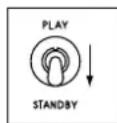
Set the standby switch from Play to Standby before you enter the MIDI setup.
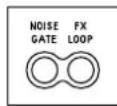
To enter the MIDI setup, press and hold Noise Gate and FX Loop buttons simultaneously for three seconds.
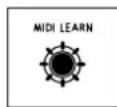
The Learn button will start flashing to indicate that special programming functions are now assigned to the following buttons (to leave the MIDI setup again at this point, press Learn again for three seconds – the button will stop
flashing, your changes are saved, and the amp will return to standard operating mode):
- The Noise Gate button now serves to indicate the status of the MIDI OMNI mode and switch OMNI on/off. If Noise Gate is lit up, this means OMNI is set to on (factory setting, receives on all MIDI channels). Press the Noise Gate button if you want to switch it off (receives on one dedicated MIDI channel).
- FX Loop now serves as a +1/up button to change the MIDI channel
- 5/6 now serves as a -1/down button to change the MIDI channel
- The four FX Loop and Power Amp Tube buttons serve to indicate the MIDI channel in binary code. See the chart below for more information:
| MIDI Channel | FX loop Tubes | 1/2 Tubes | 3/4 Tubes | 5/6 | |
| 1 | ○ | ○ | ○ | ||
| 2 | ○ | ○ | ○ | ||
| 3 | ○ | ○ | ● | ||
| 4 | ○ | ○ | ● | ||
| 5 | ○ | ● | ○ | ||
| 6 | ○ | ● | ○ | ||
| 7 | ○ | ● | ● | ||
| 8 | ○ | ● | ● | ||
| 9 | ● | ○ | ○ | ||
| 10 | ● | ○ | ○ | ||
| 11 | ● | ○ | ● | ||
| 12 | ● | ○ | ● | ||
| 13 | ● | ● | ○ | ||
| 14 | ● | ● | ○ | ||
| one | ● | ● | ● | ||
| 15 | ● | ● | ● | ||
| 16 | ● | ● | ● |
7.3 Factory Reset
A factory reset is a seldom-needed feature. Nevertheless, please read these instructions carefully to ensure you don't accidentally delete your MIDI presets!
A factory reset may be needed in the rare case that the MIDI communication is not working at all and you are unsure about the settings of the MIDI channel and the OMNI mode. A factory reset will set the MIDI channel to 1 and the OMNI mode to on.
You can perform a factory reset by doing the following: Press and hold the Learn and Boost buttons simultaneously while powering the amp up by using the Power/On switch.
Caution: Please note that this procedure is a last-resort option. It will reset all your settings, including the 128 MIDI presets!
8 TSC™ – Tube Safety Control
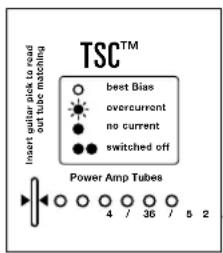
TSC™ adjusts the bias of TriAm power tubes to improve the amp's tonal and technical stability and to extend the tubes' lives. TSC operates automatically and continuously, so there is nothing for you to do but to enjoy the convenience of the system! What's more, you can swap tubes easily, quickly, and safely, because all the hard work of biasing gets done automatically for you. This can be a huge help if a tube runs into problems, or just if you fancy comparing different types or brands of tubes.
Warning: If tubes are replaced by a different type (e.g. EL34 by KT88), it is recommended to reset the TSC module:
- Switch Power off, switch Standby in Play position
- Switch Power on
- Wait for at least three minutes
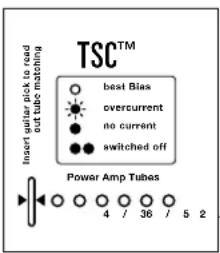
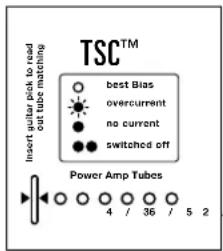
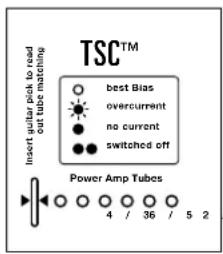
To make use of the full information TSC ^™ can provide you with, you will have to look at the six LEDs in the TSC section on the rear panel of your TriAmp Mark 3. Each LED is assigned to the power tube occupying that corresponding position. The LEDs will give you two different kinds of information: firstly, they indicate the operating status of the tube constantly performs an error diagnosis and will even shut down defective tubes if necessary in order to avoid a total failure of the amp. Secondly, you can easily get a manual read-out of the bias points of each individual tube. This can be done using any standard guitar pick (see 8.2 below for how to do this).
8.1 Automatic Status Indications
All LEDs light up and stay on
All the LEDs remain on for as long as the amp is in standby mode. When you flip the Standby switch to Play, the LEDs will go off after a few seconds. If all of the LEDs remain illuminated, the most likely cause is a blown anode fuse that needs to be replaced. The anode fuse can trip if a tube is already defective when the amp is switched on, and TSC does not have enough time to measure the idle current (after the tubes have heated up) and to then shut the faulty tube down.
None of the LEDs lights up
The power tubes are operating normally.
One LED lights up continuously
If only one LED lights up, then the tube assigned to this LED is not delivering enough current and has been shut down. If the LED does not go off after a few minutes, then the specific tube it represents needs to be replaced.
Two/four LEDs light up continuously
This tells you one of two things: either a corresponding pair of tubes are not delivering enough current and therefore will need replacing, or the pair of tubes is not active (meaning the relevant Power Amp Tube button on the front of the amp is switched off).
One LED flashes, the LED next to it lights up continuously
The tube assigned to this flashing LED is generating too much and therefore has been shut down. This tube will have to be replaced. With the type of power amp found in TriAmp Mark 3, it takes a pair of tubes working together to produce the best sounds. When one tube of a pair is defective, TSC also switches its counterpart off (indicated by the continuously lighting up LED), so it doesn't degrade the tone of the amp's other tube pairs. There is no need to replace this second tube in the pair (the one with the constantly lit LED), because there's nothing wrong with it.
And this is where TSC's intelligence saves your gig: if a tube failure like this occurs in a conventional amp, its fuse usually trips and you can't operate the amp again at all until you replace the tube and the fuse. Thanks to TSC, though, you can continue playing TriAmp Mark 3 for as long as the LED remains illuminated.
That said, please note that shutting down one pair of tubes will reduce the amp's output power. As well as this, channels and MIDI presets that use only this pair of tubes will need to be switched to another pair of tubes. And don't forget to replace the defective tube after your show!
8.2 Manual Read-Out
TSC is able to check the power amp tubes' bias points to let you determine if the three tube pairs are optimally matched. This can easily be done by inserting a guitar pick into the slot to the left of the LEDs while the amp is switched on (rather than in Standby mode). All the LEDs will flash several times. The number of flashes each LED makes will give you information about the tube rating of the assigned tube as well as about its bias.
Please make sure that the difference in flash counts between the single LEDs of one corresponding pair of tubes (1/2, 3/4, 5/6) is no greater than four flashes. Only in this situation can TSC ensure optimum sound. If the difference in flash counts is greater than four, we recommend installing a matched set of tubes to improve the amp's tone. This is strictly a matter of tone, of course – technically speaking, the amp will continue to operate safely, and there is no obligation for you to make any changes. However, optimally matched tubes will make you sound better!
Heads-up: TSC is also responsible for switching the respective pairs of tubes on and off. This means that when you opt to use only one pair of tubes, TSC will indicate that four of the tubes (i.e. the other two pairs that you're not using) are shut down. The LEDs only indicate the right status when the amp is in idle mode. While playing, the LEDs may flash very
occasionally, but this has no effect over the amp or the tubes in operation. If you do ever swap one tube from a pair, make sure that the replacement tube's rating matches that of its counterpart. You can buy replacement tubes from any good local music store, and please note that you do not necessarily have to use tubes from Hughes & Kettner!
Caution: Replacing or exchanging tubes is a job best left to qualified professionals!
9 TSM-432 - The included MIDI board
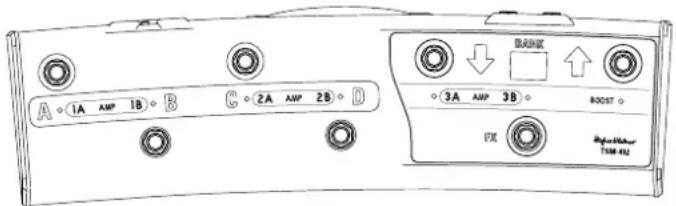
The TSM-432 MIDI board is based on the FSM-432, which you might already know from the Hughes & Kettner SwitchBlade, CoreBlade or GrandMeister models. Should you have an FSM-432, you can use it with TriAmp Mark 3 to select presets in case the TSM-432 is not available.
The TSM-432 is tailored specifically to TriAmp Mark 3, and offers two modes: Stomp Box Mode and Preset Mode. In Stomp Box mode, the TSM-432's buttons serve to access the amp's six channels and to switch the Stomp Boost directly. In Preset Mode, the TSM-432 gives you access to 128 MIDI presets. We recommend you start in Stomp Box mode first, and get to know TriAmp Mark 3 in basic terms before you move on to the vast opportunities the world of MIDI presets offers!
9.1 Connections
You do not need an external power source for the TSM-432, because phantom power is provided through TriAmp Mark 3's 7-pin MIDI In socket. If the TSM-432 is connected correctly, it will run through the following starting sequence once the TriAmp is switched on: the display will show the version number, and all the LEDs will light up from left to right. After this, the display will either change to '1', if the TSM-432 is in Preset Mode, or 'Sb', if the TSM-432 is in Stomp Box Mode. The LED below button A lights up continuously in both modes.
MIDI Out: Connect the TSM-432's MIDI Out to TriAmp Mark 3's MIDI In with the included 7-pin MIDI cable. If you are using a standard 5-pin cable, see the Power Supply section below.
MIDI In: To operate TriAmp Mark 3 with the TSM-432, the MIDI In is not necessarily needed. You can also use the MIDI In to connect other MIDI devices to the TSM-432. In this case, the TSM-432 serves as a true MIDI merger, forwarding the MIDI information from MIDI In to MIDI Out.
Power Supply: If you wish to use a standard 5-pin MIDI cable, you will need a power supply. To help connectivity wherever you are in the world, the TSM-432 provides an innovative mains port that accepts any AC or DC adapter rated for 9 to 15 volts and providing at least 250 mA.
Controller Inputs 1 and 2: You can connect single footswitches and/or expression pedals to these two 6.3 mm (1/4") jack inputs and assign additional control functions for TriAmp Mark 3. All of the amp's buttons can be remote controlled by a single footswitch, and the illumination of the front panel can be switched on or off. The brightness of the panel illumination can even be controlled using an expres might be more of a gimmick than a genuine feature, but we had loads of requests from TriAmp players, so we thought... well, why not?! Let's do it!
How to assign functions to the various control inputs is described below (in Section 9.4: Assigning Control 1 and 2). The factory setting for both inputs is set to switch the Noise Gate (Control 1) and the FX Loop On/Off (Control 2).
9.2 Stomp Box Mode
(1A, 1B, 2A, 2B, 3A, 3B, Boost)
The sliding switch above the MIDI connections on the rear side of the TSM-432 determines if the board is operating in Preset Mode or Stomp Box Mode. If you move the sliding switch to Stomp Box Mode, the display shows an 'Sb' symbol.
In Stomp Box Mode, the six buttons (1A, 1B, 2A, 2B, 3A and 3B) are now firmly assigned to TriAmp Mark 3's six channels. The lettering on the TSM-432 relates to the three preamps (numbered 1,2 and 3) with two channels each (A/B). In addition, the Stomp Boost can be independently activated and deactivated at the push of a button.
Note: The LEDs above/below their respective buttons do not always indicate the selected channel and status of the Stomp Boost. If you select channels or activate Boost manually on the amp, the TSM-432 does not recognize the changes!
Tip: You can also access the Stomp Box Mode on the fly when you are in Preset Mode. Press and hold the FX and B buttons to change over to Stomp Box Mode. To return to Preset Mode, press and hold FX and B again. This is a temporary function: TSM-4.32 automatically reverts to the mode that is selected by the sliding switch when powered off.
9.3 Preset Mode
(A, B, C, D, Bank up/down, FX)
In Preset Mode, you have access to TriAmp Mark 3's 128 MIDI presets and direct access to the FX-loop. The FX button enables you to activate or deactivate effects without programming a new preset. See the MIDI Presets and Setup Chapter to learn more about presets.
The A, B, C and D preset buttons: Presets within a bank activate directly. This means that you can switch straight from A to B within the same bank. The LEDs above/below the respective A, B, C, and D buttons indicate the selected preset.
Bank Up/Down: The TSM-432's display always shows the currently selected bank number. To access a preset in another bank, select the target bank using the Up and Down buttons. You can continue playing with the current preset while you're navigating. The TSM-432's display shows the bank's number; it flashes until you select a preset in the target bank by pressing A, B, C, or D. The TSM-432 will not switch over to the new preset until you do this, unless you activate Direct Mode.
Direct Mode: Direct Mode lets you trigger a direct program change via Bank Up/Down. In this mode, the TSM-432 will not wait for your input by way of the A, B, C, or D buttons, and will switch directly: for example, from preset B in bank 16 to preset B in bank 17 (Up) or bank 15 (Down). Here's how to activate Direct Mode:
- Press and hold FX, and then press Preset A.
- First release Preset A, and then FX. The decimal point in the display will light up.
Follow the same sequence to deactivate Direct Mode.
Note: Direct Mode is a temporary mode. The TSM-432 automatically reverts to the standard mode when powered off.
Note: The LEDs above/below their respective buttons do not always indicate the selected channel and status of the Stomp Boost. If you select channels or activate Boost manually on the amp, the TSM-432 does not recognize the changes!
9.4 Assigning Control 1 and 2
Assigning controller numbers to the two Control inputs works as follows:
Control 1: To access the edit mode, press and hold the FX and D buttons simultaneously until the display shows the controller number and the dot behind the second digit starts flashing. You can now change the controller numbers using the Up and Down buttons. Store the selected controller number by pressing D. The dot will stop flashing, and the TSM-432 will return to normal mode.
Control 2: Press and hold FX and C until the display shows the controller number and the dot behind the first digit starts flashing, then release them. Change the controller numbers using the Up and Down buttons. Store and exit by pressing the C button.
The following functions can be assigned:
| Name Control Number | Range Note | |
| Mute 90 – 63 = off, 64 – 127 = on This function is only | available via MIDI. | |
| FX Loop 550 – 63 = off, 64 – 127 = on | ||
| FX Serial 540 – 63 = parallel, 64 – 127 = serial | ||
| Stomp Boost 640 – 63 = off, 64 – 127 = on | ||
| Noise Gate 630 – 63 = off, 64 – 127 = on | ||
| Channels 310 – 12 = channel 1 (Amp 1A)13 – 37 = channel 2 (Amp 1B)38 – 63 = channel 3 (Amp 2A)64 – 87 = channel 4 (Amp 3A)88 – 112 = channel 5 (Amp 3A)113 – 127 = channel 6 (Amp 3B | To make selecting a channel via MIDI commands easy with third party controllers, we recommend using easy to remember values, such as:Channel 1 = 10Channel 2 = 30Channel 3 = 50Channel 4 = 80Channel 5 = 100Channel 6 = 120 | |
| Tube 1/2 | 580 – 63 = off, 64 – 127 = on If only one pair of | tubes is active, you cannot switch it off. |
| Tube 3/4 | 590 – 63 = off, 64 – 127 = on | |
| Tube 5/6 | 600 – 63 = off, 64 – 127 = on | |
| Panel Brightness | 880 – 127, 0 = min (off), 127 = max You can use a single footswitch to switch the illumination on (to maximum brightness)/off or an expression pedal to dim it from max to min. | |
Switch or Pedal?
A switch will always send the minimum value when switched off (0) and the maximum value when switched on (127), while an expression pedal can send any value between 0 and 127. However, expression pedals can be used for switching function as well – if you set your pedal below the middle position, it will switch the assigned function off; above the middle position will switch it on.
10 AES (EU version only)
Referred to Commission Regulation (EC) No. 1275/2008, electrical and electronic devices need to be equipped with an energy-saving mechanism which automatically switches the device off after not being used for a certain period of time. On your TriAmp Mark 3, this mechanism is called AES.
AES can be activated and deactivated with the mini switch right next to the speaker jack. The factory default is AES on; the mini switch is in the left position. In this mode, the amp will automatically be switched off after a phase of silence of about 90 minutes. The phase of silence is reset and starts again as soon as the amp receives an input signal (e.g. by you playing a note). A quite gentle signal is enough to trigger the restart of the 90-minute phase of silence until the amp will switch off automatically again. After automatically being shut down by AES, the amp can be switched back on by flipping the Power/On and Play/Standby switch off and then on again.
11 Technical Data
General Electrical Data
| Power output Up to 150 watts | |
| Max. power consumption 460 watts | |
| Inrush Current 100 V: 27 A, 120 V: 26 A, 220-240V: 23 A | |
| Mains voltage tolerance range +/-10% | |
| Ambient operating temperature range | 0° to +35°C |
| Mains fuse, 100 volts 250 V / T 5 A | |
| Mains fuse, 120 volts 250 V / T 5 A | |
| Mains fuse, 220-230 volts 250 V / T 2 A | |
| Mains fuse, 240 volts 250 V / T 2 A | |
| Anode fuse T 800 mA | |
| Tube heater fuse TT 15 A (Schurter 7040.3210) | |
Tubes
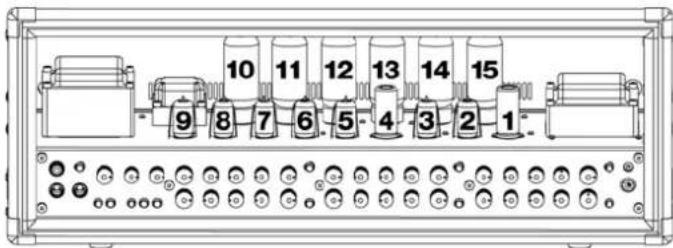
| No. Art. No. Type Origin Function | ||||
| 1 | 9440008 | 7025/E83CC (ECC83), High-Grade | Slovakia | Input Tube(active on all channels) |
| 2 | 9440001 | 12AX7A-C, select. | China | Channel 1B (Preamp) |
| 3 | 9440007 | ECC83, select. | Slovakia | Channel 1A-1B (Preamp Output) |
| 4 | 9440007 | ECC83, select. | Slovakia | Channel 2A-2B-3A-3B (Preamp) |
| 5 | 9440007 | ECC83, select. | Slovakia | Channel 2A-2B (Preamp Output) |
| 6 | 9440007 | ECC83, select. | Slovakia | Channel 3A (Preamp Output) |
| 7 | 9440007 | ECC83, select. | Slovakia | Channel 3B (Preamp) |
| 8 | 9440007 | ECC83, select. | Slovakia | FX Buffer(active on all channels) |
| 9 | 9440007 | ECC83, select. | Slovakia | Power Amp Driver(active on all channels) |
| 10 | 6000122 | EL34B-STR, select. | China | Power Tubes 1/2 |
| 11 | 6000122 | EL34B-STR, select. | China | Power Tubes 1/2 |
| 12 | 6000120 | 6L6GC-STR, select. | China | Power Tubes 3/4 |
| 13 | 6000120 | 6L6GC-STR, select. | China | Power Tubes 3/4 |
| 14 | 6000120 | 6L6GC-STR, select. | China | Power Tubes 5/6 |
| 15 | 6000120 | 6L6GC-STR, select. | China | Power Tubes 5/6 |
| Power Amp Tubes* / Power Output | 8 ohms / THD=10% | 8 ohms / THD=5% |
| 2x EL34 | 84 watts | 34 watts |
| 2x 6L6 | 72 watts | 30 watts |
| 4x 6L6 | 126 watts | 93 watts |
| 2x 6L6 + 2x EL34 | 132 watts | 95 watts |
| 4x 6L6 + 2x EL34 (recommended) | 145 watts | 116 watts |
Inputs
| Input jack | 6.3 mm (1/4"), unbalanced | |
| Impedance 1 M ohms | ||
| Max. input Level / 1 kHz (Amp 1A) | 0 dBV | |
| Input Sensitivity / 1 kHz (EQ centered, levels in max. position) | Boost off | Boost on |
| Amp 1A: -33 dBV | Amp 1A: -37 dBV | |
| Amp 1B: -49 dBV | Amp 1B: -49 dBV | |
| Amp 2A: -56 dBV | Amp 2A: -56 dBV | |
| Amp 2B: -74 dBV | Amp 2B: -74 dBV | |
| Amp 3A: -76 dBV | Amp 3A: -76 dBV | |
| Amp 3B: -78 dBV | Amp 3B: -89 dBV | |
| FX-Return jack | 6.3 mm (1/4"), unbalanced | |
| Impedance | 22 k ohms | |
| Max. Level / 1 kHz | +14 dBV | |
| Sensitivity / 1 kHz (Master centered, max. FX-Level) | -10 dB switch deactivated | -10 dB switch activated |
| 0 dBV | -10 dBV | |
| Power Amp In jack | 6.3 mm (1/4"), unbalanced |
| Impedance | 350 k ohms |
| Sensitivity / 1 kHz (depending on the channel) | +6 to +10 dBV |
Outputs
| Red Box DI Out | XLR, balanced | |
| Impedance 2 k ohms | ||
| Output Level | 0 dBV (balanced) | |
| Max. Output Level | +12 dBV | |
| FX Send jack | 6.3 mm (1/4"), unbalanced | |
| (Max. Volume, EQ centered) | -10 dB switch deactivated | -10 dB switch activated |
| Impedance | 2.2 k ohms | 680 ohms |
| Max. Level / 1 kHz | -2 dBV | +8 dBV |
| Power Amp Out jack | 6.3 mm (1/4"), unbalanced | |
| Max. Level / 1 kHz | +20 dBV | |
MIDI
| MIDI In | 7-pin (5-pin compatible)20 V DC phantom power (150 mA) |
| MIDI Out/Thru | 5-pin |
Mechanical Data
| Dimensions (WxHxD) | 740 x 393 x 254 mm |
| Weight | 22 kg / 48.5 lbs. |
*as shipped
$$ R = (8 \times 1 6) / (8 + 1 6) O h m $$
$$ R = 1 2 8 / 2 4 \mathrm{Ohm} $$
$$ R = 5. 3 3 \mathrm{Ohm} $$
8 TSC™ – Tube Safety Control
(1A, 1B, 2A, 2B, 3A, 3B, Boost)
(A, B, C, D, Bank up/down, FX)
(1A, 1B, 2A, 2B, 3A, 3B, Boost)
(A, B, C, D, Bank up/down, FX)
6 Pannello posteriore
6.1 Speakers
| Canale MIDI FX | Loop Valvole | 1/2 Valvole 3 | 4 Valvole 5/6 | |
| 1 | ○ | ○ | ○ | |
| 2 | ○ | ○ | ○ | |
| 3 | ○ | ○ | ● | |
| 4 | ○ | ○ | ● | |
| 5 | ○ | ● | ○ | |
| 6 | ○ | ● | ○ | |
| 7 | ○ | ● | ● | |
| 8 | ○ | ● | ● | |
| 9 | ● | ○ | ○ | |
| 10 | ● | ○ | ○ | |
| 11 | ● | ○ | ● | |
| 12 | ● | ○ | ● | |
| 13 | ● | ● | ○ | |
| 14 | ● | ● | ○ | |
| 15 | ● | ● | ● | |
| 16 | ● | ● | ● |
7.3 Factory Reset
8 TSC™ – Tube Safety Control
(1A, 1B, 2A, 2B, 3A, 3B, Boost)
A(Aj BdCc D, Bank up/down, FX)
8 TSC™ –Tube Safety Control
(1A, 1B, 2A, 2B, 3A, 3B, Boost)
(A, B, C, D, Bank up/down, FX)
6 リアパネル
6.1 スピーカー
$$ R = 5. 3 3 \Omega $$
Magdeburger Str.8, 66606 St. Wendel, Germany

1 前言 75
2 快速开始 76
3 基本操作 ..... 76
4 放大器和声道 77
5 正面 77
6 背面 79
International Inquiries:
Fax: +49 - 68 51 - 905 200
hkinternational@hughes-and-kettner.com
www.hughes-and-kettner.com

facebook.com/hughesandkettner
Copyrights 02/2015 by Music & Sales GmbH.
Subject to change without notice.