RCGK-BC30 - Freezer Royal Catering - Free user manual and instructions
Find the device manual for free RCGK-BC30 Royal Catering in PDF.
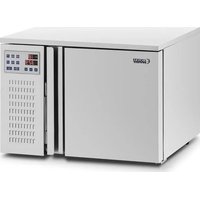


| Product type | Freezer (deep freezer) |
| Model | RCGK-BC30 |
| Brand | Royal Catering |
| Capacity | 29.5 liters |
| Dimensions (W x D x H) | 630 x 615 x 475 mm |
| Weight | 39 kg |
| Voltage / Frequency | 230 V ~ / 50 Hz |
| Nominal power | 1350 W |
| Input current | 3.2 A |
| Refrigerant type | R290 (propane) |
| Refrigerant quantity | 110 g |
| Foaming agent | Cyclopentane (C5H10) |
| Climate class | 5 |
| Protection class | I |
| Number of shelves | 3 |
| Maximum load per shelf | 5 kg |
| Temperature units | °C / °F |
| Display type | LCD |
| Functions | Cooling, rapid freezing, defrosting, temperature holding, food probe |
| Cleaning | Clean with a soft, damp cloth; do not immerse in water |
| Maintenance | Regularly check the seals, air filter, and drainage hole |
| Safety | Automatic shutdown in case of error, protection against accidental starts |
| Repairability | Spare parts available through the manufacturer; repair by qualified personnel |
| General information | User manual available in multiple languages; manufacturer's warranty |
Frequently Asked Questions - RCGK-BC30 Royal Catering
User questions about RCGK-BC30 Royal Catering
0 question about this device. Answer the ones you know or ask your own.
Ask a new question about this device
Download the instructions for your Freezer in PDF format for free! Find your manual RCGK-BC30 - Royal Catering and take your electronic device back in hand. On this page are published all the documents necessary for the use of your device. RCGK-BC30 by Royal Catering.
USER MANUAL RCGK-BC30 Royal Catering
RCGK-BC96 RCGK-BC30 RCGK-BC276
| DE | Produktname: | SCHOCKFROSTER |
| EN | Product name: | BLAST CHILLER |
| PL | Nazwa produktu: | ZAMRAŻARKA SZOKOWA |
| CZ | Název výrobku | ŠOKOVÝ MRAZÁK |
| FR | Nom du produit: | SURGELATEUR |
| IT | Nome del prodotto: | ABBATTITORE |
| ES | Nombre del producto: | ABATIDOR DE TEMPERATURA |
| HU | Termék neve | SOKKOLÓ FAGYASZTÓ |
| DK | Produktnavn | CHOKFRYSER |
| DE | Modell: | RCGK-BC96RCGK-BC30RCGK-BC276 |
| EN | Product model: | |
| PL | Model produktu: | |
| CZ | Model výrobku | |
| FR | Modèle: | |
| IT | Modello: | |
| ES | Modelo: | |
| HU | Modell | |
| DK | Model | |
| DE | Hersteller | expondo Polska sp. z o.o. sp. k. |
| EN | Manufacturer | |
| PL | Producent | |
| CZ | Výrobce | |
| FR | Fabricant | |
| IT | Produttore | |
| ES | Fabricante | |
| HU | Termelő | |
| DK | Producent | |
| DE | Anschrift des Herstellers | ul. Nowy Kisielin – Innowacyjna 7, 66-002 Zielona Góra | Poland, EU |
| EN | Manufacturer Address | |
| PL | Adres producenta | |
| CZ | Adresa výrobce | |
| FR | Adresse du fabricant | |
| IT | Indirizzo del produttore | |
| ES | Dirección del fabricante | |
| HU | A gyártó címe | |
| DK | Producentens adresse |
Technical Data
| Product Name | Blast Chiller |
| Model | RCGK-BC30 ● |
| Voltage/Frequency | 230V~/50Hz |
| Input Current | 3.2A ● |
| Input Power | 550W |
| Defrosting Current | 3.5A ● |
| Defrosting Power | 700W |
| Refrigerant / Amount | R290/110g ● |
| Foaming Agent | C5H10 (Cyclopentane) |
| Capacity | 29.5L ● |
| Climate Class | 5 |
| Protection Class | I ● |
| Production Year | |
| Serial No. | ● |
| Parameter description | Parameter value | ||
| Product name | Blast chiller | ||
| Model | RCGK-BC96 | RCGK-BC30 | RCGK-BC276 |
| Supply voltage [VAC] / Frequency [Hz] | 230/50 | ||
| Power rating [W] | 550 | 1350 | |
| Input current [A] | 3.6 | 3.2 | 6.7 |
| Defrosting current load [A] | 6 | 3.5 | 8.5 |
| Defrosting power input [A] | 1300 | 700 | 1650 |
| Refrigerant type | R290 | ||
| Refrigerant charge [g] | 148 | 110 | 2 x 148 |
| Foaming agent type | C5H10 (cyclopentane) | ||
| Power consumption in cooling [kWh/kg] | 0.11 0.16 0.10 | ||
| Power consumption in freezing [kWh/kg] | 0.40 0.75 0.54 | ||
| Food core heater power [W] | 30 | ||
| Capacity [L] | 96 | 29.5 | 276 |
| Protection class | I | ||
| Climate class | 5 | ||
| Dimensions (width x depth x height) [mm] | 751x747x842 | 630x615x475 | 790x750x1560 |
| Weight [kg] | 66 | 39 | 139 |
| Shelves | 5 | 3 | 10 |
| Maximum shelf load, ea. (kg) | 5 | ||
| Available temperature units | °C /°F | ||
| Display type | LCD | ||
1. General Overview
This manual is intended to assist you in safe and reliable use. The product is designed and manufactured strictly according to technical specifications using the latest technology and components, and maintaining the highest quality standards.
READ THE MANUAL CAREFULLY AND UNDERSTAND IT BEFORE USE.
To ensure long and reliable operation of the product, operate and maintain it correctly and strictly in compliance with this manual. The technical data and specifications in this manual are up-to-date. The manufacturer reserves the right to modifications for the purpose of quality improvement.
Explanation of Symbols
The product meets the requirements of relevant safety standards.
Read the manual before use.
Recyclable product.
CAUTION! or WARNING! or REMEMBER! indicates a specific instruction (general warning sign).
CAUTION! Risk of electric shock!
CAUTION! Risk of fire – flammable materials!
CAUTION! The figures in this manual are illustrative only and may vary in some details from the actual appearance of the product.
The original version of the manual is in German. Other language versions are translations from German.
2. Operating safety
CAUTION! Read all safety warnings and all instructions. Failure to follow the warnings and instructions may result in electric shock, fire and/or serious injury or death.
The term “appliance” or “product” in the warnings and instructions refers to the blast chiller.
2.1. Electrical safety
a) The appliance power cord plug must fit into the mains outlet. Do not modify the plug in any way. Original power cord plugs and matching mains outlets reduce the risk of electric shock. b) Avoid touching earthed objects, like piping, radiators, heaters, and refrigerators. There is an increased risk of electric shock if your body is earthed and touching the appliance exposed to direct rain, a wet floor or while operating in a humid environment. If water penetrates into the appliance, there is an increased risk of damage to the appliance and electric shock. c) Do not use the power cord in any unintended way. Never use it to carry the appliance or to unplug it from the mains outlet. Keep the power cord away from sources of heat, oil, sharp edges or moving parts. Damaged or tangled cords increase the risk of electric shock. d) If you cannot avoid using the appliance in a wet environment, use a residual current device (RCD) to connect the appliance to electrical mains. Using an RCD reduces the risk of electric shock. e) Do not use the appliance if the power cord is damaged or shows evidence of wear. Have a damaged power cord replaced by a qualified electrician or the manufacturer's technical service. f) To avoid electric shock, do not immerse the power cable, its plug or the appliance itself in water or other liquid. Do not use the appliance on wet surfaces.
2.2. Workplace safety
a) Keep the workplace tidy and well lit. b) If in doubt as to whether the appliance is working, contact the manufacturer's technical service. c) Repairs to the appliance may only be carried out by the manufacturer's service. Do not attempt to repair the product on your own! d) In the event of ignition or a fire, use dry powder or CO2 extinguishers only to suppress the fire of the appliance if live with electrical voltage. e) Use the appliance in a well-ventilated room.
f) Check the condition of the safety warning stickers regularly. Replace them if they are illegible. g) Keep this manual for future reference. If the product is to be handed over to a third party, hand it over with this user manual. h) Keep packaging components and small installation parts out of the reach of children. i) Keep the appliance away from children and animals.
2.3. Personal safety
a) Do not operate the product if you are tired, ill, or under the influence of alcohol, drugs, or medication that might significantly impair your ability to operate the product. b) The device may only be operated by persons who are physically fit, capable of handling the device, and who have been adequately trained, who have read these instructions, and have received training in health and safety. c) The device is not intended to be used by persons (including children) with reduced mental, sensory, or intellectual functions or lack of experience and/or knowledge, unless they are supervised by a person responsible for their safety or have been given instructions by them on how to operate the device. d) Be careful and use common sense when operating the product. e) The appliance is not a toy. Children must be supervised to ensure that they do not play with it.
2.4. Safe use of the product
a) Do not use the appliance if the power switch does not function properly (does not switch on or off). Appliances that cannot be controlled with their power switches are dangerous, shall not be operated, and must be repaired. b) Unplug the appliance from the mains before adjustment, cleaning, or maintenance. This safety precaution reduces the risk of accidental operation. c) Keep unused appliances out of the reach of children and anyone unfamiliar with the appliance or this manual. Appliances are dangerous in the hands of inexperienced users. d) Keep the product in good working order. e) Keep the product out of the reach of children. f) The product shall be repaired and maintained by qualified personnel using original spare parts only. This will ensure safe operation of the product. g) To ensure the designed operational integrity of the product, do not remove the factory-installed covers or loosen any bolts.
h) When transporting and handling the appliance from storage to the place of use, follow the health and safety regulations for manual handling that apply in the country of operation of the appliance. i) Clean the appliance regularly to prevent permanent deposits of dirt. j) The appliance is not a toy. Cleaning and maintenance shall not be performed by children without adult supervision. k) Never attempt to tamper with the appliance to change its parameters or structure. l) Risk of fire! The insulating gas (cyclopentane) and refrigerant are flammable. Keep the appliance away from sources of fire and heat! m) Do not overload the shelving of this appliance. n) Do not cover the vents of the appliance! o) Do not store flammable materials in the shock freezer or operate any electrical equipment inside of the appliance. p) Never use any heat sources or appliances to speed up the defrosting process, unless recommended otherwise by the appliance manufacturer. q) Do not break the refrigerant circuit. r) Do not apply mechanical pressure to the appliance or expose it to shock or fall. s) Do not place any objects on the freezer. t) Keep hands clear from areas beneath the enclosure when the appliance is running. Risk of hand injury! u) Do not put hot food, food in sealed containers or uncovered liquids into the appliance. v) Do not freeze food on cardboard/paper trays or wooden boards. w) Check that the door is closed shut once the food has been put in. Do not open the door frequently. x) Never attempt to tilt the freezer while in operation.

CAUTION!
Although the appliance has been designed to be safe and has been provided with adequate safeguards, and despite the use of additional safety measures, there is still a low, residual risk of accident or injury during its operation. Caution and common sense are advised when using the product.
3. Rules of use
The appliance is designed to rapidly reduce the temperature of food in a short time.
The user is responsible for any damage caused by non-intended use.
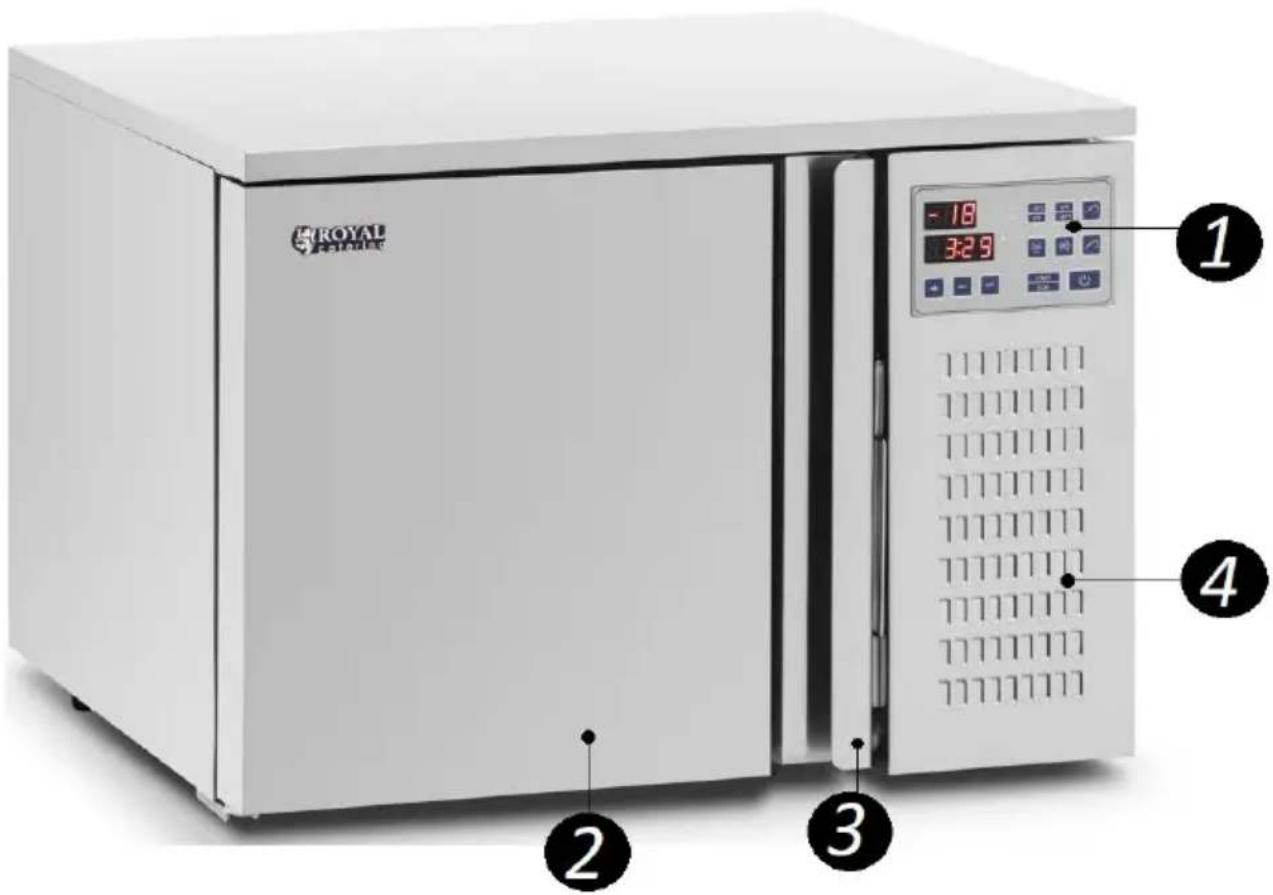
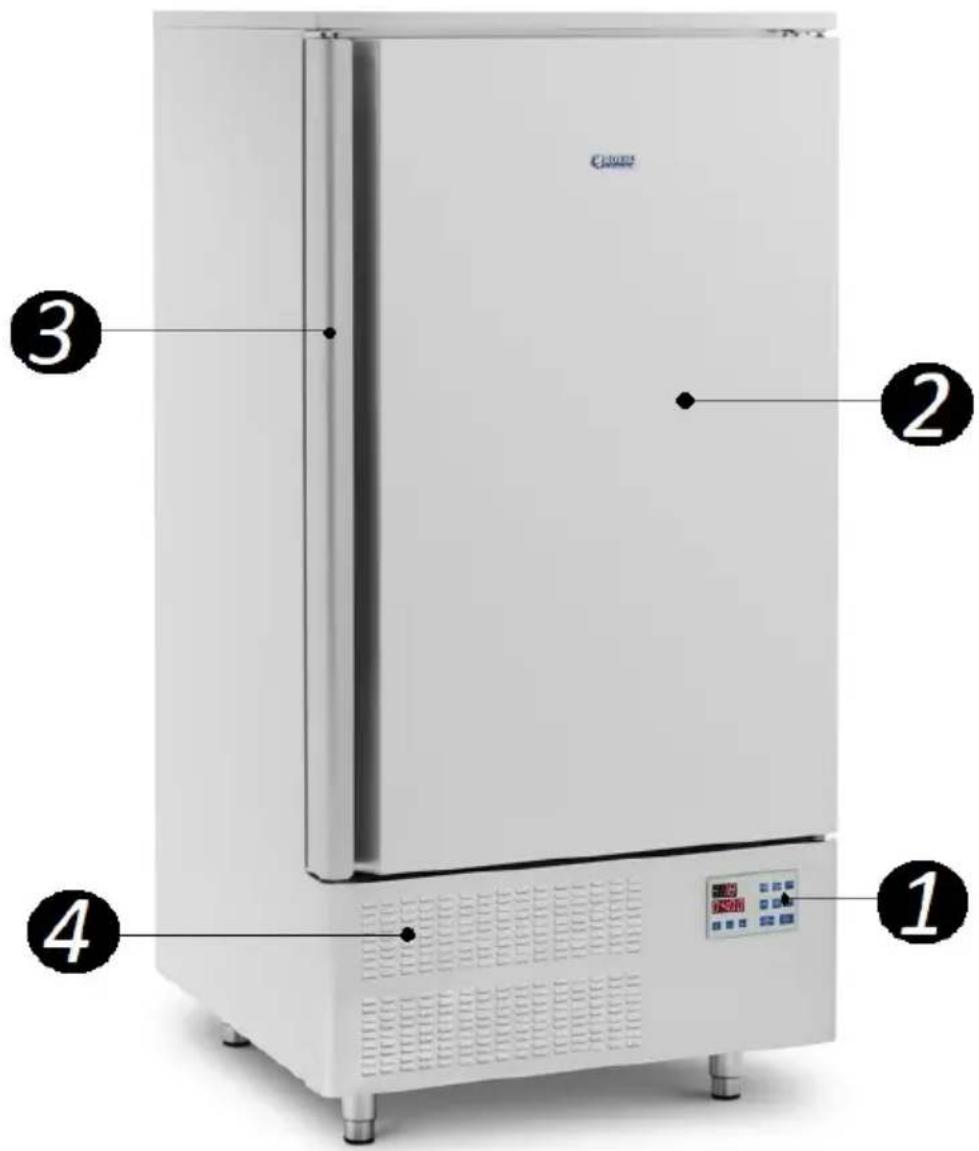
3.1. Appliance overview
RCGK-BC96
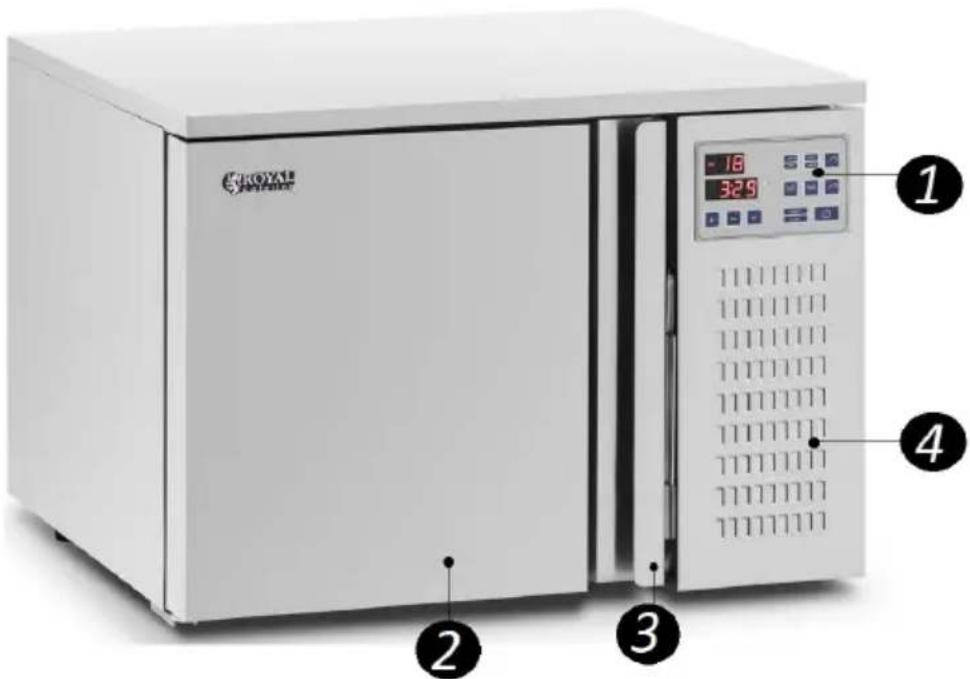
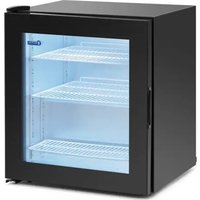
RCGK-BC30
RCGK-BC276
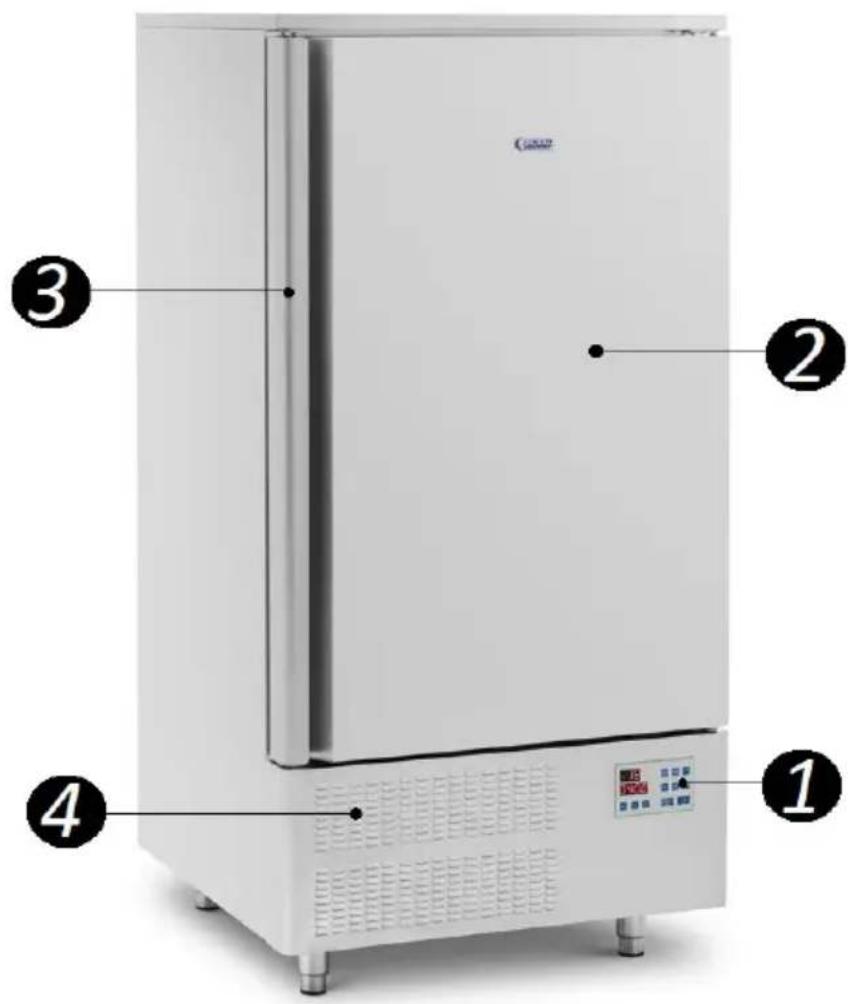
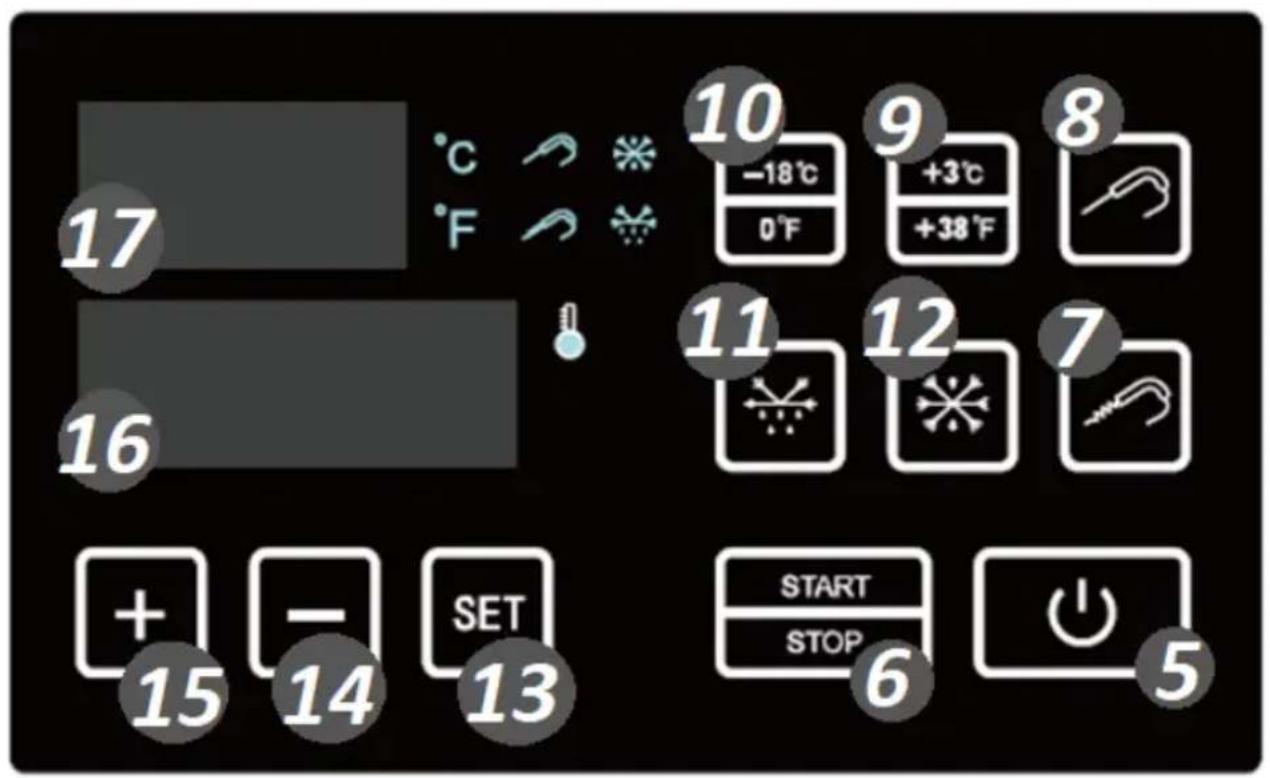
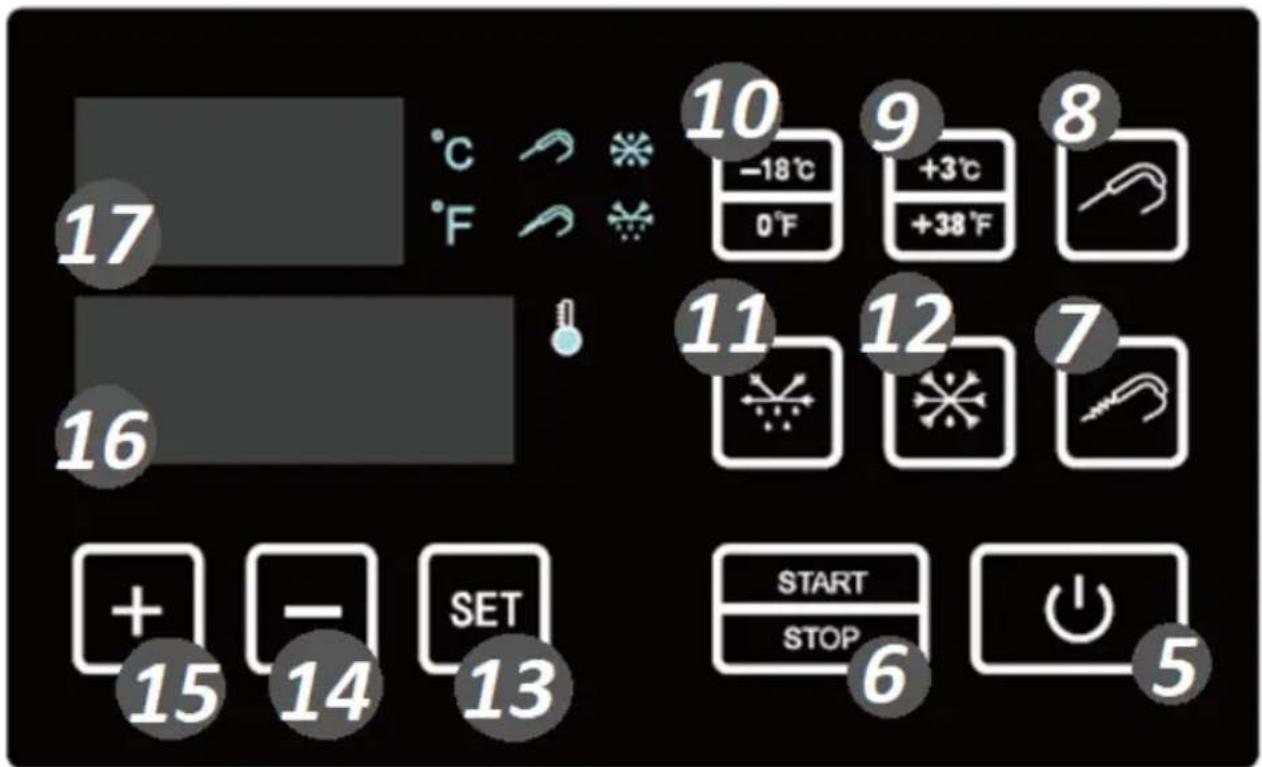
- Display control panel
- Cooling chamber
- Handle
- Ventilation grille
- START/STOP switch (cycles between operation and standby)
- Starting/stopping the appliance operation:
a) Press to start the selected cooling process. b) The cooling indicator will come on and the processing duration countdown will begin. c) If the START/STOP switch is pressed again during cooling, the appliance will stop operating and display the actual cooling chamber/food core probe temperature. d) To resume the cooling process, press the START/STOP switch again. The appliance will start operating only after 2 minutes (a delayed start feature) for protection of the refrigerant compressor (frequent cycling of the compressor over a short time will reduce its life). After 2 more minutes, the fan will start. e) If the cooling chamber temperature is below the temperature setting, the compressor will not run. It will only start when the cooling chamber temperature rises to or above the temperature setting.
f) If, after starting the deep freezing process [12] (pressing the “” button), the food core probe temperature is lower than the temperature setting, the compressor will not run. It will only start when the food core temperature rises to or above the temperature setting.
- Food core probe heating:
a) To remove the food core probe from the frozen product, press the "button." b) The probe heating indicator will come on and the display will indicate the probe temperature. c) When the heating indicator goes off, pull the core probe out of the product.
- Food core probe:
a) Drive the food core probe tip into the piece of food. b) Press the “” button. The probe indicator will come on and the display will indicate the probe temperature. c) Press the "√" button again to return to the cooling chamber temperature display mode.
9. Cooling:
a) The cooling process takes 1 minute and 30 seconds, during which the cooling chamber reaches 3° C ( 38° F). b) To start the process, press the “+3 °C/+38°F” button. The display will read the process setting values. c) Press the START/STOP switch to run the appliance.
10. Shock freezing:
a) The shock freezing process takes 4 minutes, during which the cooling chamber reaches -18°C (0°F). b) To start the process, press the “-18°C/0°F” button. The display will read the process setting values. c) Press the START/STOP switch to run the appliance.
* When the process (9)/(10) is complete, the appliance will automatically go to the food holding mode.
11. Defrosting:
a) Press to start the defrosting process. b) The indicator will come on. When the process is complete, the indicator will go off.
* The appliance automatically performs defrosting every 6 hours.
- Deep freezing (using the food core probe):
a) Drive the food core probe tip into the piece of food. b) Press the button [12]. c) Press the START/STOP switch.
13. Parameter settings
a) Press to set the target temperature and cooling duration. b) Operate the "+" and "-" buttons to set the parameter value flashing on the display. c) Duration (time) setting range: 00:10 – 99:59; temperature setting range: -30°C – 25°C (-22°F – 77°F). d) Once the parameters have been set, press the "SET" button to leave the manual parameter settings.
* The appliance will automatically leave the manual parameter settings after a few seconds without any user interaction and the display will read the cooling chamber or the food core probe temperature.
- Reduce the value
- Increase the value
- Temperature display
- Time display
- Food core probe:
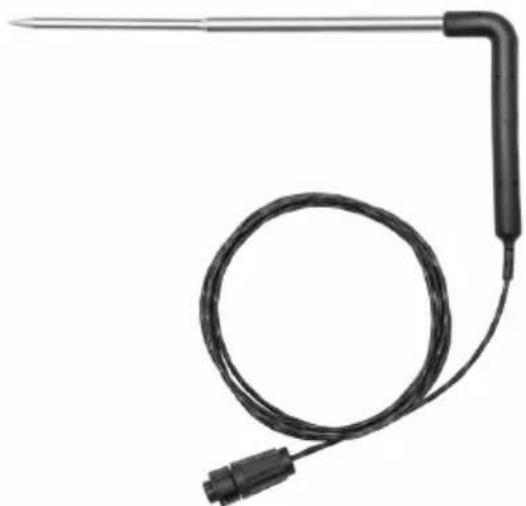
To install the probe in the device, insert its tip into the round socket located in the cooling chamber [A].
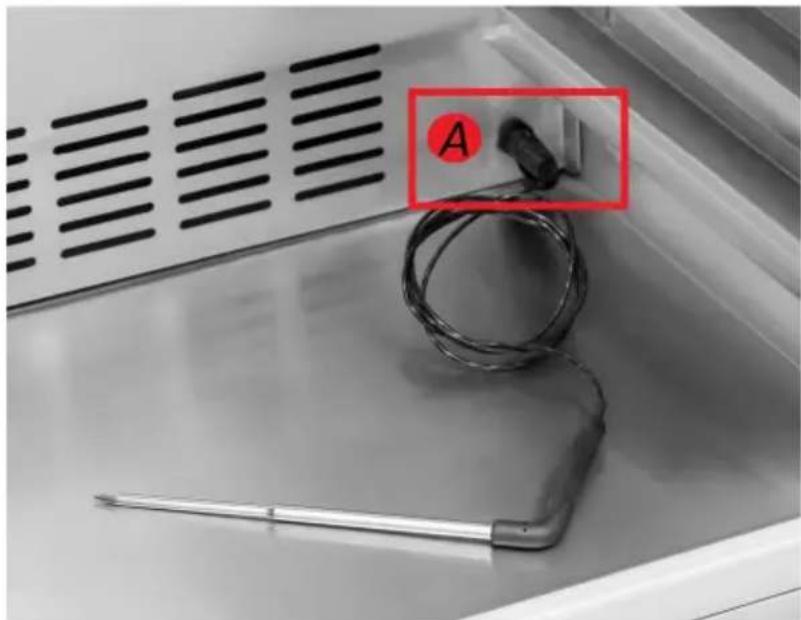
In the RCGK-BC276 model, the socket [A] is located in the lower right corner of the chamber, while in RCGK-BC96 and RCGK-BC30 - in the upper right corner of the chamber:
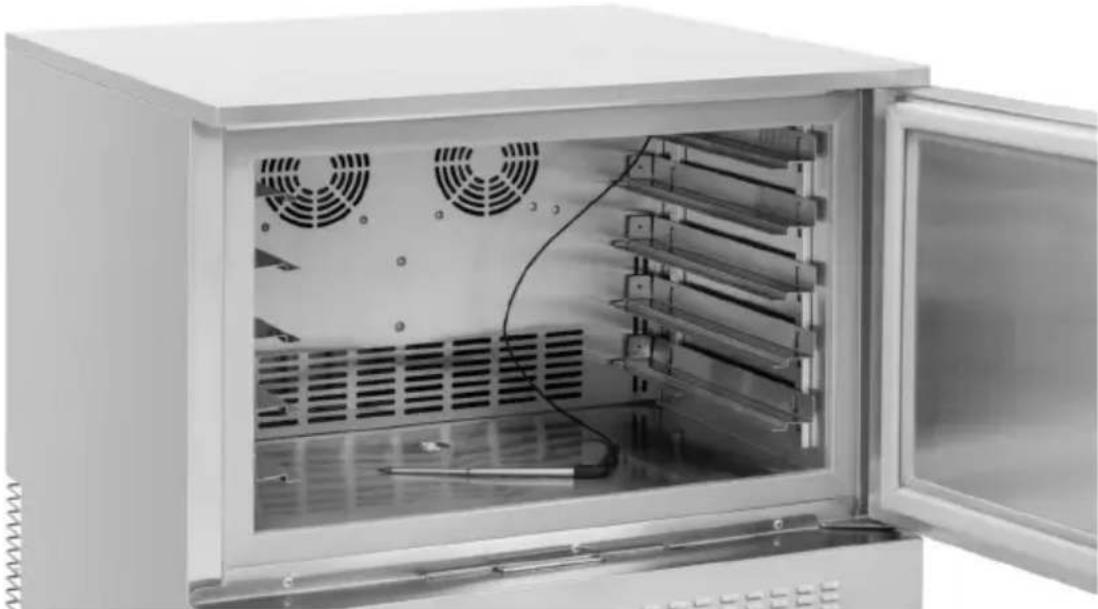
3.2. Preparations for operation
POSITIONING THE APPLIANCE
Once the appliance has been delivered, place it upright and leave for a few hours before connecting to the mains so that the insulating gas and refrigerant become still. The maximum ambient temperature and relative humidity limits not to be exceeded are +40°C and 85% RH, respectively. Position the appliance where good air circulation is ensured. Maintain a minimum clearance of 10 cm from all sides of the appliance. Keep the appliance away from any hot surfaces. Always operate the appliance on a level, firm, clean, fireproof, and dry surface and out of the reach of children and individuals with reduced mental, sensory and intellectual capacities. Position the appliance where the mains plug can be reached at any time. Make sure that the mains power ratings match the data on the rating plate!
Once the appliance has been delivered and before putting any food for the first time in the freezer's chamber, wash the chamber with warm water and a mild detergent approved for food contact; follow by wiping dry and precooling the interior.

CAUTION! Before connecting the appliance to the mains, install a suitable, 30 mA RCD on the power service line of the appliance.
3.3. Operating the appliance
- Plug the power cord into a mains outlet.
- Press the switch [5].
- The displays will read the actual temperature in the cooling chamber and the time setting entered the last time.
- Manually set the extremely low cooling temperature and a time of 20 minutes (for precooling).
- Select the desired running program or set the cooling temperature and time manually.
- Place the food products on the shelves spaced so that air flow is facilitated between the products. Keep the products spaced a little from one another. If the products are placed too close to one another or there is too much food in the chamber, the cooling/freezing performance can be reduced.
3.3.1. USING THE FOOD CORE PROBES:

- The tip of the food core probe houses a temperature sensor [A]. During the core temperature measurement, the entire temperature sensor must be in the product's core. Otherwise the measurement will not be accurate.
- Behind the temperature sensor is a heating element [B] operated to facilitate removal of the probe from the frozen food core.
- When the temperature reaches the set target value, the compressor stops running. It will resume running after 2 minutes when the actual temperature becomes equal to or higher than the setting.
3.3.2. SWITCHING THE TEMPERATURE UNITS:
Simultaneously press and hold the SET and – buttons for 3 seconds to switch from °C to °F or back.
3.3.3. DISPLAYING THE PARAMETER SETTINGS:
Press and hold the SET button for a few seconds.
3.3.4. FACTORY RESET:
- Simultaneously press and hold the + and - buttons for 3 seconds. The temperature display will read the message "rS" and the appliance will turn off.
- Turn on the appliance by pressing the switch [5].
- Factory settings:
a) Temperature: °C units; setting value -18
b) Time: 4:00
3.3.5. ERROR CODES:
- HI: cooling chamber temperature too high. This error code is displayed when the temperature reaches 45°C (113°F). Press the START/STOP switch to start cooling. Check the temperature reading after 2 hours. If the temperature has not fallen, unplug the appliance from the mains and contact the manufacturer's service.
- LO: cooling chamber temperature too low. This error code is displayed when the temperature reaches -45°C (-49°F). Press the START/STOP switch to start defrosting. Check the temperature reading after 2 hours. If the temperature has not risen, unplug the appliance from the mains and contact the manufacturer's service.
- E01: control panel-to-main PCB connection failure. To clear this failure, unplug the appliance from the mains, inspect the connection in question and the wiring; restart the appliance.
3.4. Cleaning and maintenance
a) Before cleaning, adjustment or replacement of accessories, and when the appliance is not in use, turn it off and unplug it from the mains. b) Use non-corrosive agents only for cleaning the surfaces. c) Only mild cleaning agents intended for surfaces in contact with food shall be used to clean the appliance. d) After each cleaning, dry all components well before the appliance is used again. e) Store the appliance in a dry and cool place, protected from moisture and direct sunlight. f) Do not spray the appliance with a stream of water and do not immerse it in water. g) Ensure that water will not enter through the ventilation ports in the housing. h) Regularly inspect the appliance for technical defects and damage. i) Use a soft, damp cloth for cleaning.
j) Do not clean with any sharp and/or metal implements (e.g. a wire brush or a metal scraper) as these may damage the surface of the appliance. k) Do not clean the unit with acidic substances, medical products, thinners, fuel, oil or other chemicals as they may damage it. l) Wear protective gloves during maintenance work. m) If the appliance will not be operated for a long time, empty the refrigerant circuit and leave the cooling chamber door slightly ajar to ensure ventilation of the interior. n) Regularly check that the air filter is not dirty or damaged. Clean or replace as required. o) Inspect the condensate drain. Keep it unclogged. p) Regularly service the device to clean the condenser, inspect the electrical circuit, etc. q) Clean/replace the food core probes regularly and check tightness of door seals. Failed seal will reduce the performance and service life of the appliance.
DISPOSAL OF WASTE APPLIANCES
At the end of its service life, this product must not be disposed of with mixed household waste; return it to a collector/recycler of waste electrical and electronic equipment. This is shown by the symbol placed on the product, the user manual or the packaging. The materials used in the appliance can be reused according to their classification identifications. By reuse, recycling or applying other forms of use of waste appliances, you make a significant contribution to the protection of our environment.
Local administration will provide you with the information about the nearest disposal locations for the appliance.
3.5. Troubleshooting
| Problem | Possible cause | Action |
| Compressor not running | Power supply lost | Check the power cord connections |
| Fan failure | Check and replace as required | |
| PCB failure | ||
| Fuse or relay failure | ||
| Incorrect coil resistance | Check and replace the compressor if necessary | |
| Shaft seized | ||
| Poor cooling capacity | Frozen evaporator | Defrost the appliance |
| Refrigerant leak | Inspect and replace the refrigerant cylinder if failed and recharge with | |
| refrigerant after the repairs have been completed | ||
| Condensate drain tube clogged | Unclog | |
| Too much food in the chamber | Remove a part of the food | |
| Continuous running time too long | Unplug the appliance from the mains for some time | |
| Condensate drain tube temperature high | Incorrect refrigerant type | |
| Poor location of the appliance (the freezer is in direct sunlight or near a heat source) | Move the appliance into a shaded location / away from heat sources | |
| Door seal failure | Replace the seal | |
| Temperature setting too high | Reduce the temperature setting | |
| Thermostat sensor position incorrect | Adjust | |
| Thermostat failure | Replace the thermostat |
4. Electrical wiring diagram
RCGK-BC96
![graph TD A["Input"] --> B["Switch"] B --> C["Control Block 6"] C --> D["Measurement Instrument 12"] C --> E["Measurement Instrument 13"] C --> F["Measurement Instrument 14"] C --> G["Measurement Instrument 15"] C --> H["Measurement Instrument 16"] C --> I["Measurement Instrument 17"] C --> J["Measur…](/content/2026/04/711412/images/73f1daf85276ba7ad1956b9bb02d68cb9acc9e76a882355b317e76bf95c502c2.jpg)
RCGK-BC30
![graph TD A["1"] --> B["2"] B --> C["3"] C --> D["4"] D --> E["5"] E --> F["6"] F --> G["7"] G --> H["8"] H --> I["9"] I --> J["10"] J --> K["11"] K --> L["12"] L --> M["13"] M --> N["14"] N --> O["15"] O --> P["16"] P --> Q["17"] Q --> R["18"] R --> S["19"] S --> T["Ground"] style A fill:#f9f,stroke…](/content/2026/04/711412/images/3fd1fc91fffd93e0f472e8f5f3c654922fa711eaee8a5b7d2acc937290e330da.jpg)
![graph TD A["Power Source"] --> B["Switch 6"] B --> C["Component 1"] B --> D["Component 2"] B --> E["Component 3"] B --> F["Component 4"] B --> G["Component 5"] B --> H["Component 7"] B --> I["Component 8"] B --> J["Component 9"] B --> K["Component 10"] B --> L["Component 11"] B --> M["Component 12"]…](/content/2026/04/711412/images/f33966cf6cf6b199e446feda6e4b4060d4455179fef65f1cade60e178fc3b200.jpg)
1/2/3. Thermal safety switch 4. Heating cable 5. Power cord plug 6. Main PCB 7. CPU PCB 8. Temperature display 9. Time display 10. Electromagnetic stop valve 11/12/18. Relay 13. Evaporator fan motor 14. Overload protection 15. Condenser fan motor 16. Starting capacitor 17/17.1/17.2. Refrigerant compressor 19. Line capacitor
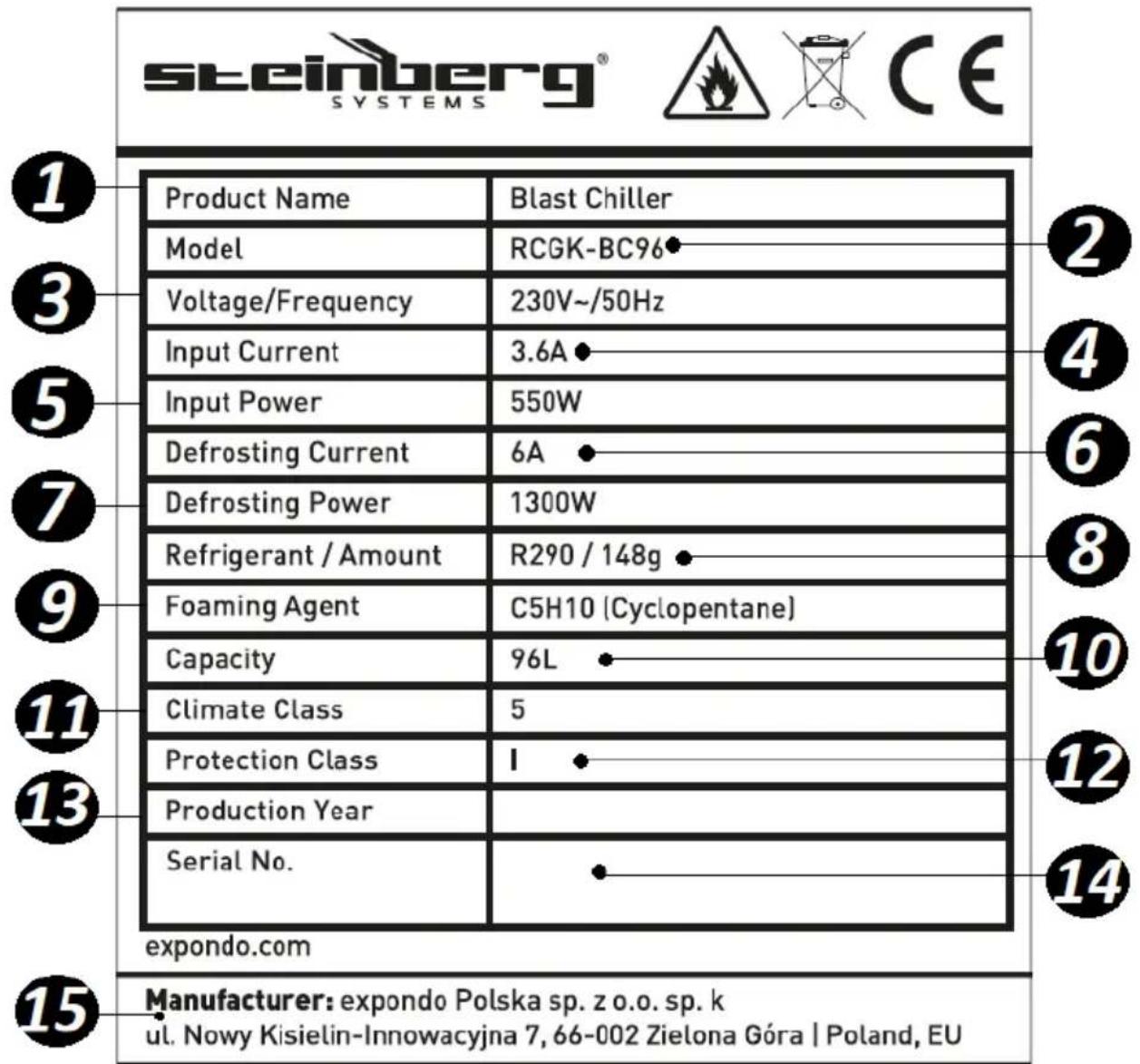
5. Nameplate overview:
steinberg® SYSTEMS


| Product Name | Blast Chiller |
| Model | RCGK-BC30 ● |
| Voltage/Frequency | 230V~/50Hz |
| Input Current | 3.2A ● |
| Input Power | 550W |
| Defrosting Current | 3.5A ● |
| Defrosting Power | 700W |
| Refrigerant / Amount | R290/110g ● |
| Foaming Agent | C5H10 (Cyclopentane) |
| Capacity | 29.5L ● |
| Climate Class | 5 |
| Protection Class | I ● |
| Production Year | |
| Serial No. | ● |
expondo.com
- Product name
- Model
- Supply voltage / frequency
- Input current
- Power rating
- Defrosting current load
- Defrosting power input
- Refrigerant charge
- Foaming agent type
- Capacity
- Climate class
- Protection class
- Year of production
- Serial number
- Manufacturer
Technical data
| Product Name | Blast Chiller |
| Model | RCGK-BC30 ● |
| Voltage/Frequency | 230V~/50Hz |
| Input Current | 3.2A ● |
| Input Power | 550W |
| Defrosting Current | 3.5A ● |
| Defrosting Power | 700W |
| Refrigerant / Amount | R290/110g ● |
| Foaming Agent | C5H10 (Cyclopentane) |
| Capacity | 29.5L ● |
| Climate Class | 5 |
| Protection Class | I ● |
| Production Year | |
| Serial No. | ● |
expondo.com
RCGK-BC30
![graph TD A["1"] --> B["2"] B --> C["3"] C --> D["4"] D --> E["5"] E --> F["6"] F --> G["7"] G --> H["8"] H --> I["9"] I --> J["10"] J --> K["11"] K --> L["12"] L --> M["13"] M --> N["14"] N --> O["15"] O --> P["16"] P --> Q["17"] Q --> R["18"] R --> S["19"] S --> T["Ground"] style A fill:#f9f,stroke…](/content/2026/04/711412/images/47b8c5e85dcf729853faddd8e1bd6cd90cd76ca38103bfafa1fcd45e5f9ffebb.jpg)
![graph TD A["Power Source"] --> B["Switch 6"] B --> C["Component 1"] B --> D["Component 2"] B --> E["Component 3"] B --> F["Component 4"] B --> G["Component 5"] B --> H["Component 7"] B --> I["Component 8"] B --> J["Component 9"] B --> K["Component 10"] B --> L["Component 11"] B --> M["Component 12"]…](/content/2026/04/711412/images/90104bfe39408516a98f09621f19d2f39d25f81d2e682db4995605e18bd3d897.jpg)
| Product Name | Blast Chiller |
| Model | RCGK-BC30 ● |
| Voltage/Frequency | 230V~/50Hz |
| Input Current | 3.2A ● |
| Input Power | 550W |
| Defrosting Current | 3.5A ● |
| Defrosting Power | 700W |
| Refrigerant / Amount | R290/110g ● |
| Foaming Agent | C5H10 (Cyclopentane) |
| Capacity | 29.5L ● |
| Climate Class | 5 |
| Protection Class | I ● |
| Production Year | |
| Serial No. | ● |
![graph TD A["1"] --> B["2"] B --> C["3"] C --> D["4"] D --> E["5"] E --> F["6"] F --> G["7"] G --> H["8"] H --> I["9"] I --> J["10"] J --> K["11"] K --> L["12"] L --> M["13"] M --> N["14"] N --> O["15"] O --> P["16"] P --> Q["17"] Q --> R["18"] R --> S["19"] S --> T["Ground"] style A fill:#f9f,stroke…](/content/2026/04/711412/images/6625ad2d6f41bdfe3f1786ad7a0133c391565fe6faff0f8d900227957304e476.jpg)
![graph TD A["Power Source"] --> B["Switch 6"] B --> C["Component 1"] B --> D["Component 2"] B --> E["Component 3"] B --> F["Component 4"] B --> G["Component 5"] B --> H["Component 7"] B --> I["Component 8"] B --> J["Component 9"] B --> K["Component 10"] B --> L["Component 11"] B --> M["Component 12"]…](/content/2026/04/711412/images/12749d80345c4decd84e28f02362536eb91413b5c99a2b12f912bcde382171fe.jpg)
| Product Name | Blast Chiller |
| Model | RCGK-BC30 ● |
| Voltage/Frequency | 230V~/50Hz |
| Input Current | 3.2A ● |
| Input Power | 550W |
| Defrosting Current | 3.5A ● |
| Defrosting Power | 700W |
| Refrigerant / Amount | R290/110g ● |
| Foaming Agent | C5H10 (Cyclopentane) |
| Capacity | 29.5L ● |
| Climate Class | 5 |
| Protection Class | I ● |
| Production Year | |
| Serial No. | ● |
| Product Name | Blast Chiller |
| Model | RCGK-BC30 ● |
| Voltage/Frequency | 230V~/50Hz |
| Input Current | 3.2A ● |
| Input Power | 550W |
| Defrosting Current | 3.5A ● |
| Defrosting Power | 700W |
| Refrigerant / Amount | R290/110g ● |
| Foaming Agent | C5H10 (Cyclopentane) |
| Capacity | 29.5L ● |
| Climate Class | 5 |
| Protection Class | I ● |
| Production Year | |
| Serial No. | ● |
| Product Name | Blast Chiller |
| Model | RCGK-BC30 ● |
| Voltage/Frequency | 230V~/50Hz |
| Input Current | 3.2A ● |
| Input Power | 550W |
| Defrosting Current | 3.5A ● |
| Defrosting Power | 700W |
| Refrigerant / Amount | R290/110g ● |
| Foaming Agent | C5H10 (Cyclopentane) |
| Capacity | 29.5L ● |
| Climate Class | 5 |
| Protection Class | I ● |
| Production Year | |
| Serial No. | ● |
![graph TD A["1"] --> B["2"] B --> C["3"] C --> D["4"] D --> E["5"] E --> F["6"] F --> G["7"] G --> H["8"] H --> I["9"] I --> J["88:88"] J --> K["10"] K --> L["11"] L --> M["12"] M --> N["13"] N --> O["14"] O --> P["15"] P --> Q["16"] Q --> R["17"] R --> S["18"] S --> T["19"] T --> U["Ground"] style A…](/content/2026/04/711412/images/fc2b58d76bc76cd07d4de3370b39d0fffc8f768baf27ff3af3147617f2e76b40.jpg)
| Product Name | Blast Chiller |
| Model | RCGK-BC30 ● |
| Voltage/Frequency | 230V~/50Hz |
| Input Current | 3.2A ● |
| Input Power | 550W |
| Defrosting Current | 3.5A ● |
| Defrosting Power | 700W |
| Refrigerant / Amount | R290/110g ● |
| Foaming Agent | C5H10 (Cyclopentane) |
| Capacity | 29.5L ● |
| Climate Class | 5 |
| Protection Class | I ● |
| Production Year | |
| Serial No. | ● |
For the disposal of the device, please consider and act according to the national and local rules and regulations.
CONTACT
expondo Polska sp. z o.o. sp. k.
- TECHNICAL DATA
- GENERAL OVERVIEW
- EXPLANATION OF SYMBOLS
- OPERATING SAFETY
- ELECTRICAL SAFETY
- WORKPLACE SAFETY
- PERSONAL SAFETY
- SAFE USE OF THE PRODUCT
- CAUTION
- RULES OF USE
- APPLIANCE OVERVIEW
- COOLING
- SHOCK FREEZING
- DEFROSTING
- PARAMETER SETTINGS
- PREPARATIONS FOR OPERATION
- POSITIONING THE APPLIANCE
- OPERATING THE APPLIANCE
- USING THE FOOD CORE PROBES
- SWITCHING THE TEMPERATURE UNITS
- DISPLAYING THE PARAMETER SETTINGS
- FACTORY RESET
- ERROR CODES
- CLEANING AND MAINTENANCE
- DISPOSAL OF WASTE APPLIANCES
- TROUBLESHOOTING
- ELECTRICAL WIRING DIAGRAM
- NAMEPLATE OVERVIEW
- STEINBERG® SYSTEMS
- CONTACT
Brand : Royal Catering
Model : RCGK-BC30
Category : Freezer