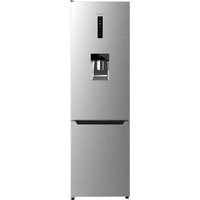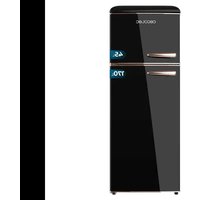
Bolero CoolMarket 2D Origin - Fridge CECOTEC - Free user manual and instructions
Find the device manual for free Bolero CoolMarket 2D Origin CECOTEC in PDF.


User questions about Bolero CoolMarket 2D Origin CECOTEC
0 question about this device. Answer the ones you know or ask your own.
Ask a new question about this device
Download the instructions for your Fridge in PDF format for free! Find your manual Bolero CoolMarket 2D Origin - CECOTEC and take your electronic device back in hand. On this page are published all the documents necessary for the use of your device. Bolero CoolMarket 2D Origin by CECOTEC.
USER MANUAL Bolero CoolMarket 2D Origin CECOTEC
natural_image
Exterior view of a modern black refrigerator with two side handles (no visible text or symbols)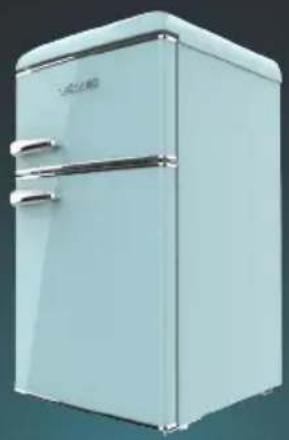
natural_image
Illustration of a light blue rectangular refrigerator with two side handles and a logo on the front (no text or symbols on the cabinet itself)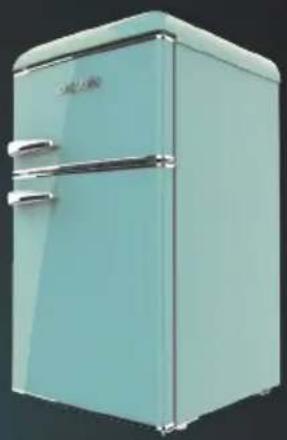
natural_image
Exterior view of a modern teal-colored refrigerator with silver trim and two side doors (no visible text or symbols)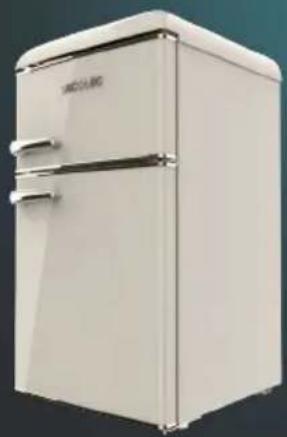
natural_image
Exterior view of a modern white refrigerator with two side doors and a front panel (no visible text or symbols)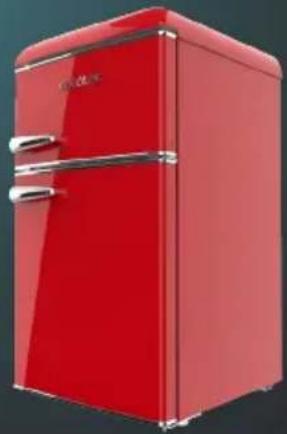
natural_image
Red vintage refrigerator with two doors and silver handles (no visible text or symbols)bolero
-
Parts and components
-
Before use 50
-
Installation
-
Operation
-
Instructions on food storage
-
Cleaning and maintenance
-
Troubleshooting 55
-
Technical specifications
-
Disposal of old electrical and
electronic appliances
-
Technical support and warranty
-
Copyright
SOMMAIRE
Read these instructions thoroughly before using the device. Keep this instruction manual for future reference or new users.
- This appliance can be used by children aged 8 years and above and people with reduced physical, sensory, or mental capabilities or lack of experience and knowledge if they have been given supervision or instruction concerning use of the appliance in a safe way and understand the hazards involved. Children must not play with the appliance. Cleaning and user maintenance should not be carried out by unsupervised children.
- Do not store explosive substances such as aerosol cans with flammable propellant in this appliance.
- This device is designed for domestic use only and is not intended for bars, restaurants, farmhouses, hotels, motels, and offices.
- To avoid food contamination, please follow the below instructions:
- The door openings for a long period of time may cause a significant increase in temperature in the appliance's compartments.
- Clean regularly the surfaces that might be in contact with food and accessible evacuation systems.
- Store raw meat and fish in appropriate containers so as to prevent them from touching or dripping on each other.
- The two-star compartments are suitable for storing pre-frozen food, storing, or making ice cream, and making ice cubes.
- Compartments with one, two, or three stars are not suitable for freezing fresh food.
- If the refrigerator appliance remains empty for a long period
of time, unplug it, defrost it, clean it, dry it, and leave the door open to prevent interior mould formation.
- WARNING: when positioning the appliance, make sure that the power cable does not get trapped or damaged.
- WARNING: do not place multiple mobile sockets or mobile power supplies on the rear of the appliance.
- WARNING: keep the appliance ventilation grilles or the cabinet for built-in installation free from any obstruction.
- WARNING: do not use mechanical devices or similar to accelerate the defrosting process other than those recommended by the manufacturer.
- WARNING: do not use electrical devices inside the food-preservation compartment unless they're of a type recommended by the manufacturer.
- WARNING: do not damage the refrigeration circuit.
- Check the power cable regularly for visible damage. If the cable is damaged, it must be replaced by the manufacturer, the supplier, or qualified personnel to avoid hazards.
- WARNING! It is dangerous for anyone other than authorised personnel to carry out maintenance or repairs involving the removal of covers. To prevent the electric shock risk do not attempt to repair the appliance yourself.
- Do not place carbonated beverages in the freezer compartment. Ice cream can cause "freezer burns". This can happen if they are ingested after removal from the freezer.
- Do not remove items from the refrigerator with wet hands to avoid skin abrasions caused by freeze burns. Do not place bottles or cans in the freezer compartment.
- See the storage times recommended by the manufacturer.
- Do not allow children to play with the controls or the refrigerator. The refrigerator is a heavy household appliance. Caution must be taken when moving the appliance. It is
dangerous to alter specifications or attempt to modify this appliance in any way.
- This refrigeration appliance is not suitable for built-in installation.
- WARNING: if doors or lids are fitted with locks and keys, they must be kept out of reach of children and not in the vicinity of the refrigerating appliance, to prevent children from being locked inside.
- WARNING: the refrigerant used in your appliance and the insulation materials must be disposed of correctly.
- Remove doors and covers before disposing of the appliance to avoid possible entrapment.
Temperature range
- The appliance temperature range information can be found on its marking. Indicates the optimum room temperature for proper operation of the appliance.
| Climate range | Optimum room temperature |
| SN From +10°C | to +32°C |
| N | From +16°C to +32°C |
| ST | From +16°C to +38°C |
| T | From +16°C to +43°C |
- WARNING: if the refrigerator operates outside its rated climate class (N/ST), it may not be able to maintain a satisfactory internal temperature.
Free of Freon
- This refrigerator uses freon-free refrigerant (R600a) and foaming insulation material (cyclopentane), which are environmentally friendly, do not cause damage to the ozone layer, and have a very low impact on global warming. R600a is flammable and does not leak during normal use when sealed in a refrigeration system. In the event of refrigerant leakage due to damage to the refrigerant circuit, be sure to keep the appliance away from open flames and open the windows to ventilate as soon as possible.
This symbol means: warning, fire hazard/flammable materials.

INSTRUCTIONS DE SÉCURITÉ
The graphics in this manual are schematic representations and may not exactly match the appliance.
2. BEFORE USE
- This appliance is packaged in a way as to protect it during transport. Take the appliance out of its box and remove all packaging materials. You can keep the original box and other packaging elements in a safe place. This will help you prevent damage to the appliance when transporting it in the future. In case the original packaging is disposed of, make sure all packaging materials are recycled accordingly.
- Make sure all parts and components are included and in good conditions. If there is any piece missing or in bad conditions, contact the official Cecotec Technical Support Service immediately.
3. INSTALLATION
Installation
Place the refrigerator on a completely flat surface. Leave 5-10 cm between each side of the appliance and the wall, and 30 cm between the top of the appliance and the ceiling. Choose a place that is not exposed to sunlight, high temperatures, or humidity, as moisture can cause stains.
Remove the bottom panel before installation.
The appliance can be adjusted via its two front support feet. You can raise the appliance by turning them clockwise.
Choose a solid and flat surface for installation. Improper levelling and installation can cause noise and vibrations:
Noise may increase if the floor is not solid.
You can place a sheet under the appliance to solve the heat-emission problem if you need to place it on a carpet.
Make sure the adjustable feet are securely on the floor and adjust the tilt of the appliance slightly backwards to keep the doors securely closed.
Installing the handle
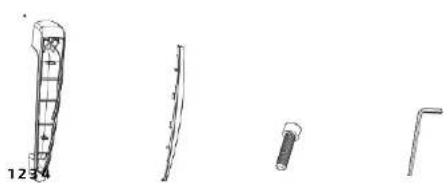
Fig. 2 key:
Handle
Handle trim
Screws
Socket spanner
Remove the accessories from the packing bags: the handle, the handle trim, and the three screws.
Take a socket spanner.
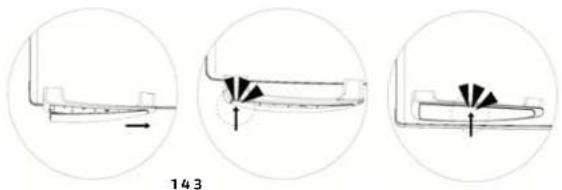
Make sure the three screw holes of the handle screws are aligned with those of the door, then screw them in respectively. It is preferable to screw on the right side (Fig. 3). Install the handle trim on the handle (Fig. 4):
1.- First, fit the handle on the right-hand side.
-
- Fit the handle on the left-hand side
-
Firmly fit the central part of the handle until you hear a "click". This means that the handle is installed correctly.
4. OPERATION
- The temperature of the refrigerator can be manually controlled via the knob. However, the number displayed on the knob isn't directly indicative of interior temperature.
- The higher the number, the lower the interior temperature.
- 0 means off.
- Turn the knob to 4 for normal use, turn it between 4-7 if you need a lower interior temperature, and between 4-1, if you need a higher interior temperature.
ENGLISHENGLISH
5. INSTRUCTIONS ON FOOD STORAGE
Use precautions
- The appliance may not operate consistently (there may be some defrosting of the contents, or the temperature may become too hot) if placed in locations with a temperature outside of the temperature range for which the refrigerator is designed for a long period of time.
- Information on the climatic class of the appliance can be found in the Technical Specifications section and on the appliance marking.
- The internal temperature may be affected by factors such as the location of the appliance, room temperature, door opening frequency, etc., and you should take these factors into account if you decide to use any temperature-control devices.
- It is not recommended to store liquids in glass containers or soft drink cans in the storage compartment.
Food location
- Due to the circulation of cold air in the refrigerator, the temperature in each zone is different, so food must be placed in different zones.
- The refrigerator compartment is suitable to store food that does not need to be frozen, cooked food, beer, eggs, some seasonings that need to be kept cold, milk, fruit juice, etc.
- The freezer compartment is suitable to store ice cream, frozen foods, and foods that need to be kept for a long time.
- Leave enough space around the food to allow air to circulate freely.
Shelves
To remove the shelf, first lift it up and then pull it out; to refit it, put it back in position before lowering it. Keep the rear edge of the shelf facing upwards to prevent food from coming into contact with the wall.
Tips for frozen food
- When buying frozen food, pay attention to the storage instructions on the package. You may store each frozen food for the period indicated in the star rating. This is usually the period indicated as "best before" on the front of the package.
- Make sure that the packaging of frozen food is in perfect condition.
- Do not buy frozen foods unless you can freeze them immediately. Special insulated bags are available in most supermarkets and department stores. In them, frozen food is kept cold for a longer period of time.
- Some foods do not require defrosting before cooking. Vegetables and pasta can be added directly to boiling water or steamed. Frozen sauces and soups can be placed in a pan and heated gently until thawed.
-
Use quality foods and alter them as little as possible. When food is frozen in small quantities, it takes less time to freeze and thaw.
-
Calculate the amount of food to be frozen. When freezing large quantities of fresh food, set the temperature knob to a lower freezing temperature. This way food can be frozen quickly maintaining its freshness.
- Before freezing, wrap and seal the food with aluminium foil, film, freezer bags, airtight containers, etc.
- It is recommended to put date labels on all frozen foods.
- Food must be fresh when frozen in order to retain its properties.
- Do not freeze bottles, cans with liquids or in particular beverages containing carbon dioxide, as they may explode when frozen.
- Never put hot food inside the freezer.
- Do not eat ice cubes, ice cream or ice lollies immediately after taking them out of the freezer. Risk of frostbite.
- Defrosted food cannot be refrozen. If a food has thawed, cook it, and refreeze it when it cools down.
Care for food storage
- Clean and dry food completely before storing it in the refrigerator. Before introducing food in the refrigerator, it is advisable to seal it to prevent water evaporation and thus keep fruit and vegetables fresh on the one hand, and to prevent colours on the other.
- Do not put too much or too heavy food in the refrigerator. Leave enough space between the food; if they are too close together, they will block the flow of cold air, which will affect the cooling effect. Do not store too much or too heavy food to prevent the shelves from bending. When storing food, leave a distance from the interior wall; do not place water-rich food too close to the inner wall of the refrigerator to prevent it from freezing on the interior wall.
Storing food by category
Place daily food items at the front of the shelf so as to reduce the door opening time and avoid food spoilage due to expiry.
Energy-saving tips
Let hot food cool down to room temperature before putting it in the refrigerator. Place frozen food in the refrigeration compartment to defrost them; you can use the low temperature of the frozen food to cool the fresh food to save energy.
Storing fruits, vegetables, and fresh food
- Please note that some types of fresh vegetables and fruits are sensitive to cold and therefore not suitable for storage in the refrigerator crisper drawer or in the freezer compartment.
- Only use the crisper drawer specifically designed for storing fruits and vegetables.
- It is not advisable to store exotic fruits like bananas, mangoes, papayas, etc., as well as
ENGLISHENGLISH
tomatoes, potatoes, onions, or garlic in the refrigerator.
- A good temperature setting that guarantees the preservation of fresh food is a temperature lower or equal to +4 °C.
- A higher temperature adjustment may reduce the freshness and life of the food.
- Cover or pack food to keep freshness.
- Always use airtight containers for liquids or cooked food to avoid smells.
- To avoid cross contamination between cooked and raw foods, cover or pack cooked foods and separate them from the raw ones.
- Wrap the meat in suitable packaging, place it on a shelf and consume it as soon as possible.
- The butter or cheese should be placed in an airtight container, wrapped in aluminium foil or inside a suitable polyethylene bag, to exclude as much air as possible.
- Bottles must be properly closed with a cap.
Defrost
Internal freezing influences the cooling of the appliance and increases energy consumption. Therefore, it is advisable to perform a defrosting process when a layer of ice or frost of about 5 mm is formed. The manual defrosting process to be followed is:
1.- Remove all the food from the compartment.
2. Remove all accessories, such as crisper drawers or shelves.
3.- Unplug the power cable.
4.- Open the doors and wait for natural air to defrost.
5.- After finishing, wipe off the remains of water with a dry cloth.
6. CLEANING AND MAINTENANCE
Before cleaning, disconnect the power plug, do not connect or disconnect the power plug with your hands wet, as there is a risk of electric shock and Injury. Do not spill water directly on the refrigerator to avoid rust, electrical leakage and accidents. Do not reach into the bottom of the refrigerator, as you may get scratched by the sharp metal corners.
Cleaning the interior and exterior
- Food residues in the refrigerator can cause undesired odours, so you should clean the refrigerator regularly. Clean the refrigerator compartment at least once a month.
- Remove all removable parts, etc., and clean them with a soft cloth or sponge dampened with lukewarm water or neutral detergent.
- Clean the dust that accumulates on the rear panel and side plates of the refrigerator regularly.
-
After using neutral detergent, make sure you rinse it with clean water, and then dry it with a cloth.
-
Do not use bristle brushes, steel wire brushes, detergent, soap powder, alkaline detergent, alcohol, benzine, acid, hot water, or other corrosive elements to clean the refrigerator surface, door gasket, plastic decorative parts, etc., to avoid damage.
- Carefully dry the door gasket and clean the slot with a wooden stick wrapped with cotton. After cleaning, fix the four corners of the door gasket and then gradually push it into the slot in the door.
- Try to avoid splashing water on the refrigerator, as this may cause rusting.
- Stains can damage the inner plastic component, so clean them as soon as possible.
Power failure or cooling system fault
- Try to open the refrigerator door as little as possible, so that you can keep food in good condition for hours, even in summer.
- If you receive an early power failure warning: Set the thermostat knob to the highest setting one hour in advance (do not store new food during this time!). Set the temperature back to the original setting when the power supply returns to normal. You can also make ice in an airtight container and place it on the top chamber of the refrigerator to extend the shelf life of fresh food.
Holiday
Please, remove food that can easily spoil before going on holidays. Close the door firmly. If the refrigerator will not be used for a long period of time, unplug it from the mains, empty all food, and clean the appliance, leaving the door ajar to avoid unpleasant odours.
Note:
Once you start using the refrigerator, it is best to use it continuously to lengthen its service life.
7. TROUBLESHOOTING
For the following minor malfunctions, please try to solve the problem yourself before contacting the official Cecotec Technical Support Service.
| Fault Possible causes | Possible solutions | |
| The appliance does not work | The appliance is not connected to the mains.The switches in the electrical installation or the fuses are damaged.There is no power or the fuse trips. | Plug the appliance into the main socket.Power outage or line disconnection. |
ENGLISHENGLISH
| Abnormal noise | The refrigerator is not stable.The refrigerator is too close to the wall. | Set the adjustable feet of the refrigerator.Separate the refrigerator from the wall. |
| Low cooling efficiency | The food inside is hot or there is too much food.You open the door too often.The door gasket has objects that do not allow to close it completely.The appliance receives direct sunlight or is close to a heat source.It is not well ventilated.The selected temperature is too high. | Store food in the refrigerator when at room temperature.Check and close the door.Remove the refrigerator from the heat source.Ventilate the room.Correct temperature settings. |
| Unpleasant smells in the refrigerator | There is spoiled food inside.The refrigerator should be cleaned.Food with a strong odour stored inside the refrigerator. | Dispose of food which is spoiled.Clean the refrigerator.Pack the strong-smelling foods. |
Note:
If none of these situations match your problem, do not attempt to disassemble, or repair the appliance by yourself. Repairs carried out by unqualified persons may result in injury or serious malfunctions. Contact the official Cecotec Technical Support Service. The repair must be carried out by an authorised technician, and you must use only original spare parts.
8. TECHNICAL SPECIFICATIONS
You can find more information on this model by scanning the QR code (and the energy label as well).
| Reference 018 | 95 01896 01897 | 01898 01899 | |||
| Model | Bolero CoolMarket 2D Origin 86 Red E | Bolero CoolMarket 2D Origin 86 Beige E | Bolero CoolMarket 2D Origin 86 Black E | Bolero CoolMarket 2D Origin 86 Blue E | Bolero CoolMarket 2D Origin 86 Green E |
| QR code |  |  |  |  |  |
| Voltage 220-240 V | |
| Rated frequency | 50 Hz |
| Rated current | 0.6 A |
| Climate class | SN/N/ST |
| Refrigerant R600a / 28 g | |
| Insulating foam | Cyclopentane |
(*) Refrigerating appliance intended for use at room temperatures between 10°C and 38°C. Technical specifications may change without prior notice to improve product quality. Made in China | Designed in Spain
9. DISPOSAL OF OLD ELECTRICAL AND ELECTRONIC APPLIANCES

This symbol indicates that, according to the applicable regulations, the product and/or batteries must be disposed of separately from household waste. When this product reaches the end of its shelf life, you should dispose of the cells/batteries/accumulators and take them to a collection point designated by the local authorities.
Consumers must contact their local authorities or retailer for information
concerning the correct disposal of old appliances and/or their batteries.
Compliance with the above guidelines will help protecting the environment.
10. TECHNICAL SUPPORT AND WARRANTY
Cecotec shall be liable to the end user or consumer for any lack of conformity that exists at the time of delivery of the product under the terms, conditions, and deadlines established by the applicable regulations.
It is recommended that repairs are carried out by qualified personnel.
If at any moment you detect any problem with your product or have any doubt, do not hesitate to contact the official Cecotec Technical Support Service at -34 95 321 07 28.
11. COPYRIGHT
The intellectual property rights over the texts in this manual belong to CECOTEC INNOVACIONES, S.L. All rights reserved. The contents of this publication may not, in whole or in part, be reproduced, stored in a retrieval system, transmitted, or distributed by any means (electronic, mechanical, photocopying, recording or similar) without the prior authorization of CECOTEC INNOVACIONES, S.L.
FRANÇAISENGLISH
1. PIÈCES ET COMPOSANTS
Img.1
7. PROBLEEMOPLOSSING
natural_image
Diagram showing a mechanical linkage or lever mechanism inside two circular frames, with no visible text or symbols.Fig./Img./Abb./Afb./Rys./Obr.3
natural_image
Technical line drawings of mechanical components or tools, no visible text or symbolsFig./Img./Abb./Afb./Rys./Obr.2
natural_image
Three circular diagrams showing mechanical or structural changes with arrows and numbers 143, no readable text or symbols present.Fig./Img./Abb./Afb./Rys./Obr.4
www.cecotec.es