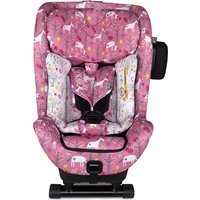
Axkid Minikid 4 - Car seat COSATTO - Free user manual and instructions
Find the device manual for free Axkid Minikid 4 COSATTO in PDF.


User questions about Axkid Minikid 4 COSATTO
0 question about this device. Answer the ones you know or ask your own.
Ask a new question about this device
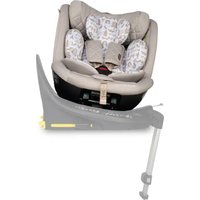
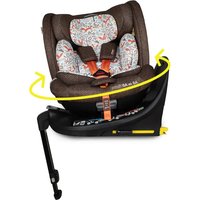
Download the instructions for your Car seat in PDF format for free! Find your manual Axkid Minikid 4 - COSATTO and take your electronic device back in hand. On this page are published all the documents necessary for the use of your device. Axkid Minikid 4 by COSATTO.
USER MANUAL Axkid Minikid 4 COSATTO

natural_image
Simple line drawing of a car seat inside a circle (no text or symbols)UN regulation no. 129
Instruction Manual
AXKID MINIKID 4 car seat, 61-125 cm
natural_image
Silhouette of a car with two side seats (no text or symbols)
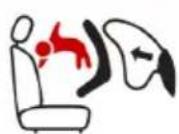
AIRBAG


natural_image
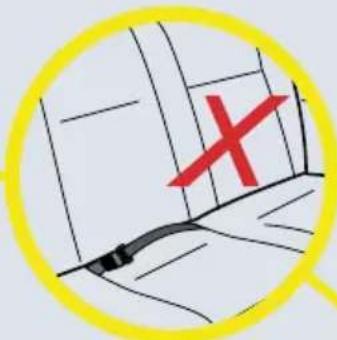
Simple line drawing of a window with a red X mark, enclosed in a yellow circle (no text or symbols)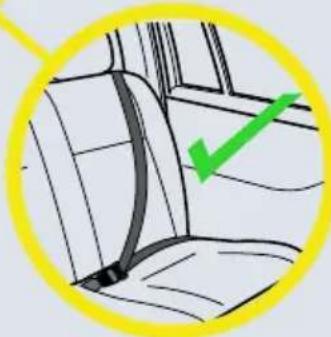
natural_image
Diagram of a car seatbelt with a green checkmark indicating a location (no text or symbols present)
natural_image
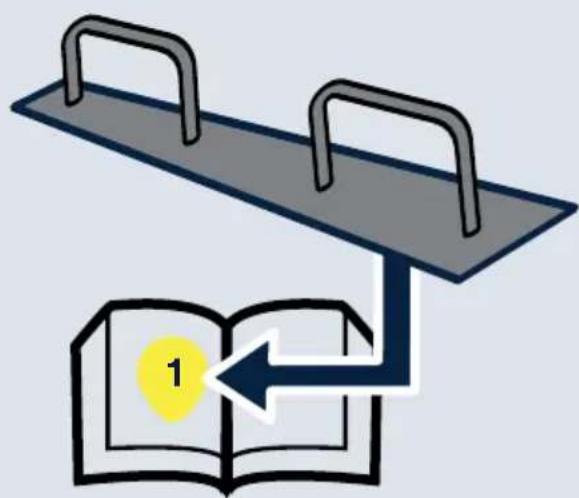
Illustration of an open book with a yellow circle labeled '1' and two metal handles above it, no text or symbols present.
natural_image
Illustration of a stylized globe with a key inserted into an open book, no text or symbols present.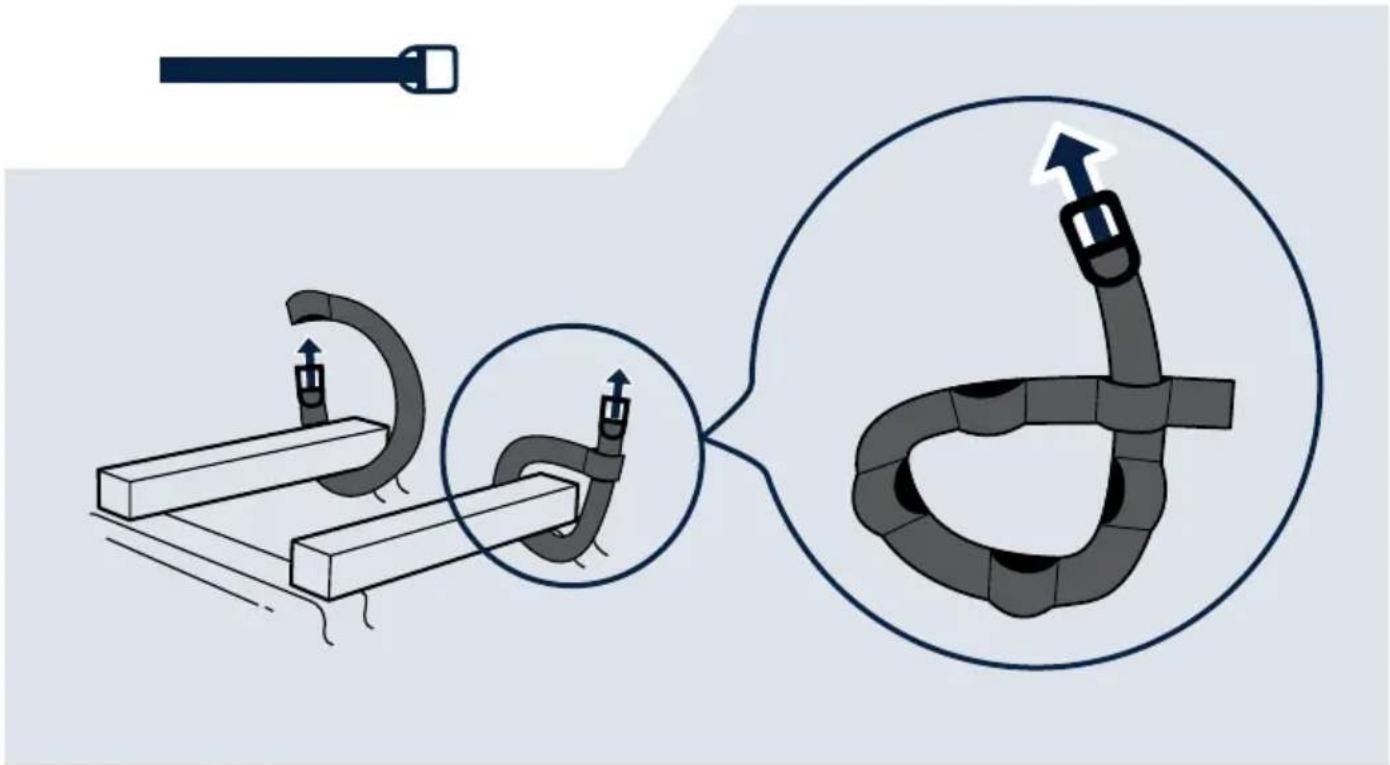
10
natural_image
Illustration of a baby in a car seatbelt seat, no text or symbols present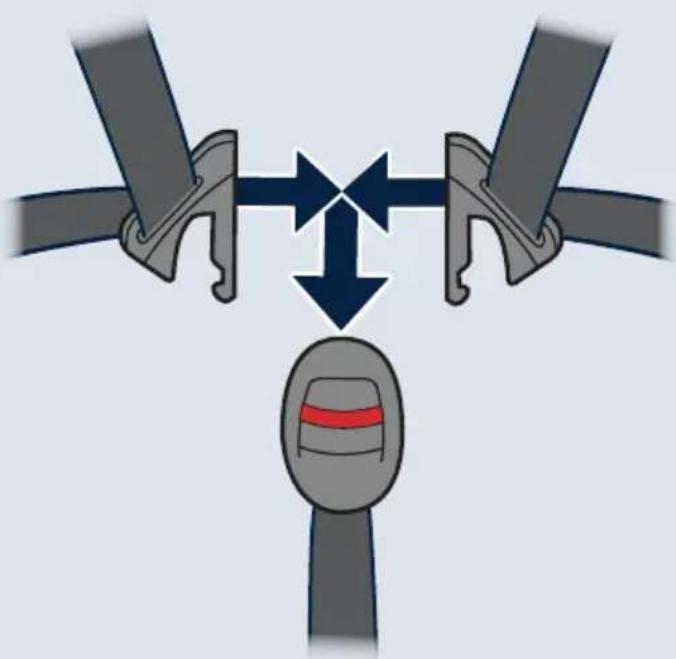
natural_image
Diagram showing two carabiners connected to a car seat, with arrows indicating direction of movement (no text or symbols)11
natural_image
Illustration of a person adjusting a seatbelt using a hand to press down a blue arrow (no text or symbols present)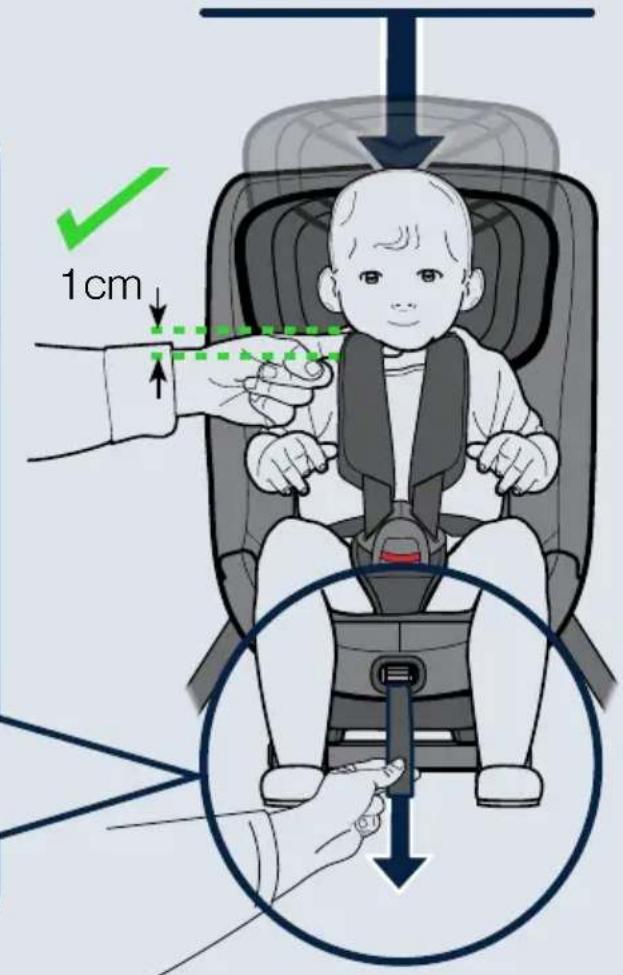
Sverige/Norge
Axkid AB
www.axkid.com
info@axkid.com
Tel: (+46) 511 760 620
UK/Ireland
Axkid Ltd
www.axkid.com
info@axkid.com
Tel: (+46) 511 760 620
France
Axkid AB
www.axkid.com
info@axkid.com
Tel (+33) 06 07 01 87 73
Deutschland
Axkid GmbH
www.axkid.com
kundenservice@axkid.com
Tel: +(49) 60-99 84 89 05
España/Portugal
Independent Marketing
www.infobebe.es
nina@infobebe.es
(+34) 902 111 881
Polsce
Junior Andrzej Kwapinski
Horbaczewskiego 4-6
54-130 Wroclaw Dh Astra Sklep
Poland Tel: +(48) 713 549 723
Czech Republic
Domecek pro deti
www.domecekprodeti.cz
info@domecekprodeti.cz
(+42) 0727 981 815
România
SC Baby Car seats
www.axkid.ro
maria@axkid.ro
(+40) 0747 35 47 47
New Zealand
Clicksafe
www.clicksafe.co.nz/axkid
axkid@clicksafe.co.nz
Tel: (+64) 212 504 215
Suomi
Lastentarvike
www.lastentarvike.fi
info@lastentarvike.fi
(+358) 09 852 05 100
Malaysia
SafenSound
www.safensound.com.my
may@safensound.com.my
(+60) 358 70 22 84
Greece Ελλάδα
Serbia Србија
LETO shop
www.letoshop.gr
christos@letoship.gr
(+30) 2111026730
Eesti
GreenHansa OÜ
www.beebipood.ee
riho@beebipood.ee
(+372) 5300 8000
Latvia
Muki
www.muki.lv
jurgis@muki.lv
(+371) 292 828 98
Lietuva
Kotryna Group
www.kotrynagroup.com
kotryna@kotryna.lt
(+370) 521 322 54
South Africa
Quality Imports SA & #Carseatfullstop
www.qualityimportssa.co.za
qualityimportssa@gmail.com
(+27) 11 789 7119
Ísland
Leiftur
www.leiftur.is
kristmann@leiftur.is
(+354) 8212537
Japan
Chameleon & Co. Inc
www.chameleonco.jp
+81(0)3-6265-6974
EN 12-21
DE 22-31
ES 32-41
FR 42-51
IT 52-61
NL 62-71
PL 72-81
CS 82-91
SV 92-101
NO 102-111
DA 112-121
FI 122-131
ET 132-141
EL 142-151
IS 152-161
PT 162-171
RO 172-181
AR 182-191
JP 192-201
Thank you for choosing AXKID MINIKID 4
Read this instruction manual before installing the car seat in your vehicle.
For more information and installation videos visit www.axkid.com.
AXKID MINIKID 4 is a rear-facing car seat approved for children with
a height between 61-125 cm, ≤36 kg
AXKID MINIKID 4 is suitable for use from approximately six months of age, or from when your child can sit up unsupported.
This is an integral Specific vehicle Belted Enhanced Child Restraint System. It is approved according to UN Regulation No. 129, for use in compatible vehicle seating positions as indicated by the vehicle list. If in doubt, consult either the Enhanced Child Restraint System manufacturer (www.axkid.com) or the retailer.
Important information
To maximize your child's safety, it is important that you keep the following in mind:
• Always follow the instructions in this manual. An incorrect installation may seriously affect the safety for your child. If in doubt, contact your retailer who can demonstrate a correct installation.
- Keep this instruction manual for future reference. If manual is lost, you can find it online at www.axkid.com
- Do not use the car seat in a seating position where an active frontal airbag is fitted. If you still wish to install the car seat in this location the airbag must be switched off according to the vehicle manufacturers instructions.
• Should you have an accident, no matter how small, your car seat should always be replaced. It may have damage that is not visible and could seriously affect the safety of your child. For this reason, Axkid does not recommend purchasing secondhand car seats.
• If the car seat has been exposed to direct sunlight, make sure the car seat is not too hot before installing your child.
- Never leave your child unattended in the vehicle.
- Ensure that any luggage or loose objects are secured in your vehicle as they may cause injuries to passengers in the event of an accident.
• Ensure that the car seat is installed in a way where no parts become trapped by movable seats, car doors, etc.
- If you are using lower tether anchorage straps, make sure they are installed in a way where they don't interfere with the movement of any vehicle seat.
- The car seat may only be installed rear-facing.
• Always make sure that the harness is adjusted to correctly fit your child's body. The harness is adjusted by moving the head support.
• Make sure that the child's back is pushed against the car seat when restraining your child with the harness.
• Always make sure that the harness is firmly tightened against your child and that the buckle is completely locked, you should not be able to pinch the straps.
- Make sure there is no twist in the harness.
• Always make sure the support leg is in its correct position and that is has contact with the vehicle floor. The support leg is a very important safety feature designed to maximise your child's safety in an accident.
- Do not attempt to disassemble or modify any part of the car seat. The warranty and the safety performance of the car seat could be affected if doing so.
- Never use the car seat without the textile cover. The seat textile cover is a safety feature and may only be replaced with an Axkid original seat textile cover.
• Read the vehicle handbook and the vehicle list at www.axkid.com to find which seating positions are suitable for this car seat.
• Axkid recommends to always use a seat protection to protect your vehicle seat from scratches and dirt.
• If you have any doubts, contact the retailer where the car seat was purchased or contact info@axkid.com
Table of content
Parts 14
Allowed and disallowed positioning of AXKID MINIKID 4 car seat 16
Lower Tether Anchorages 16
Installing lower tether anchorage straps 17
Installing AXKID MINIKID 4 car seat in the vehicle 18
Restraining your child in AXKID MINIKID 4 car seat 19
Headrest adjustments 20
Removing AXKID MINIKID 4 car seat from the vehicle 20
Care and maintenance 21
Warranty 21
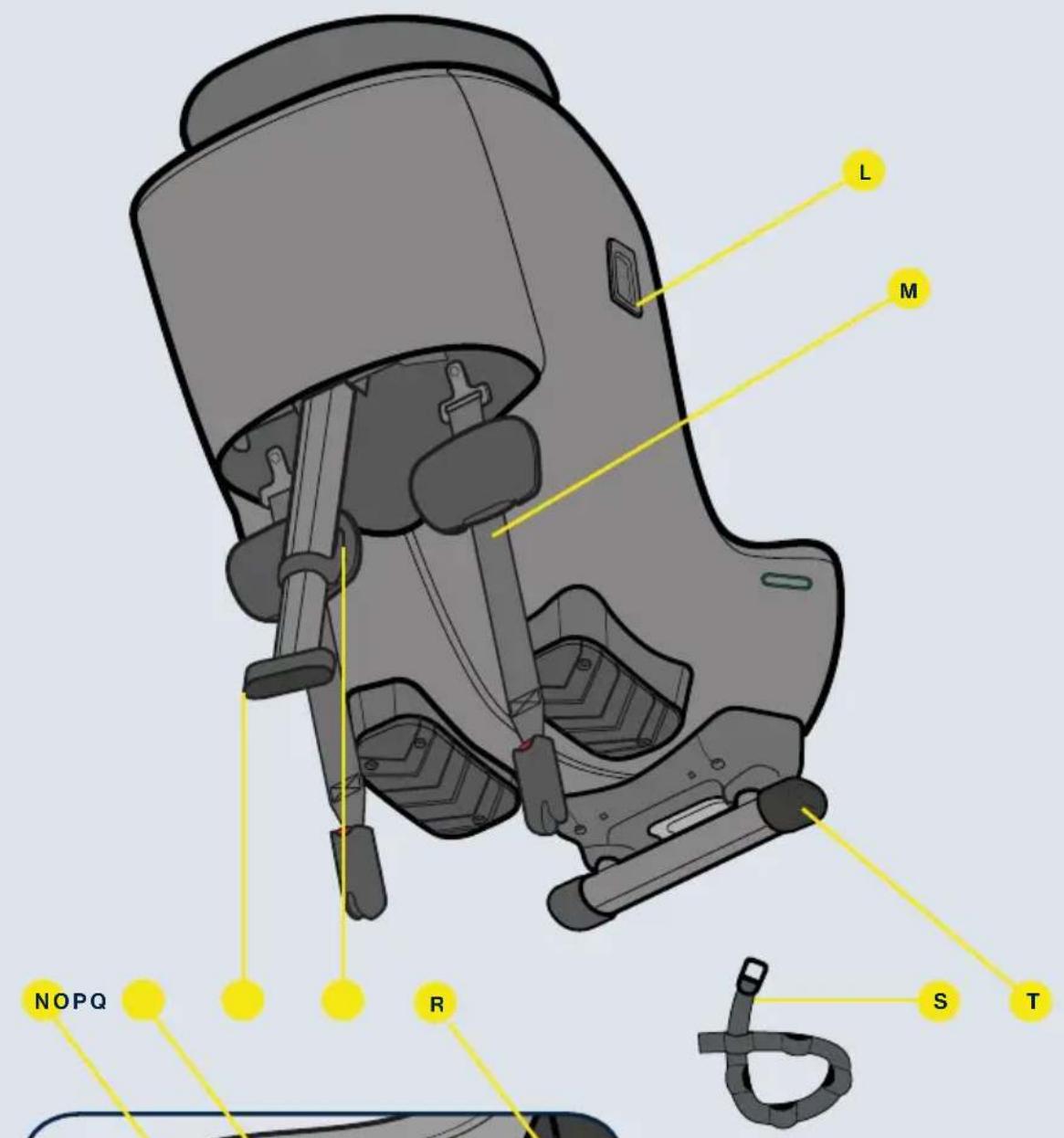
Parts
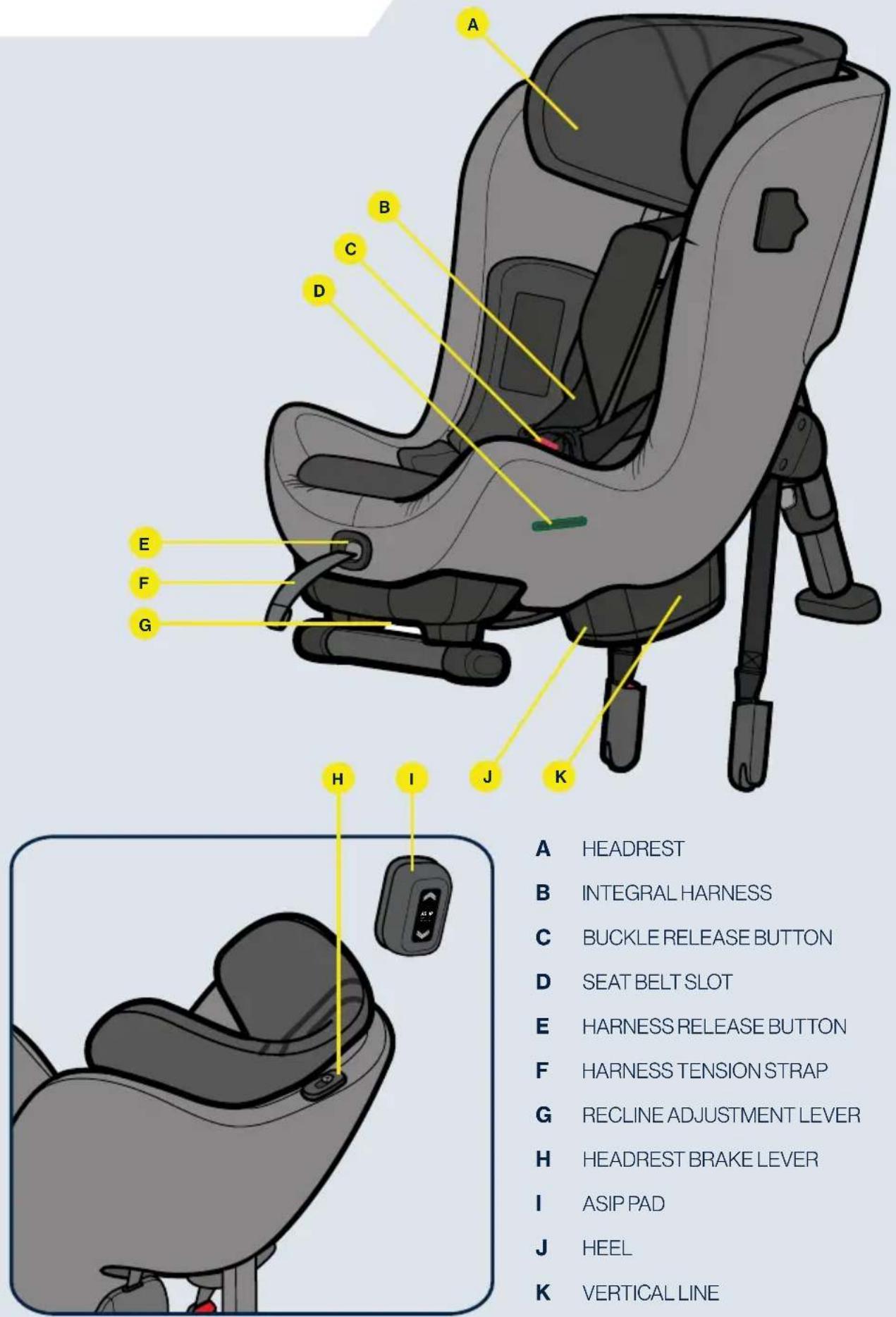
A HEADREST
B INTEGRAL HARNESS
C BUCKLE RELEASE BUTTON
D SEAT BELT SLOT
E HARNESS RELEASE BUTTON
F HARNESS TENSION STRAP
G RECLINE ADJUSTMENT LEVER
H HEADREST BRAKE LEVER
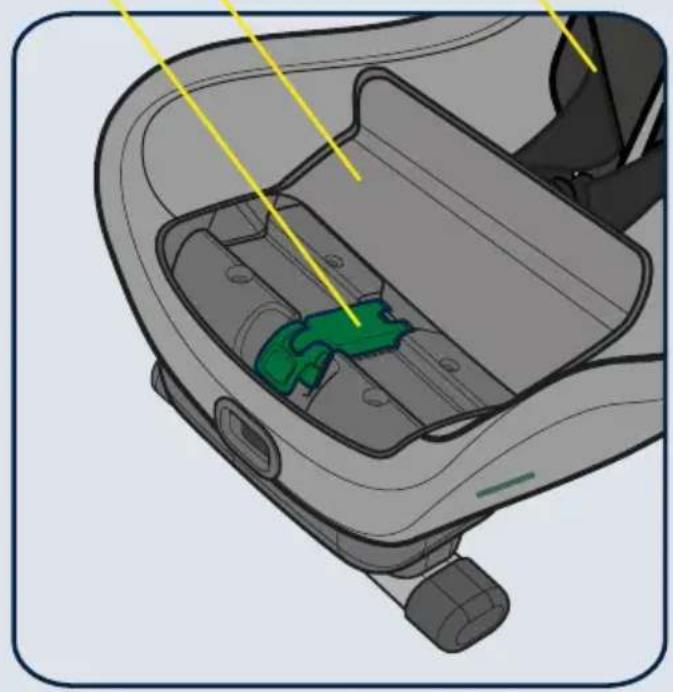
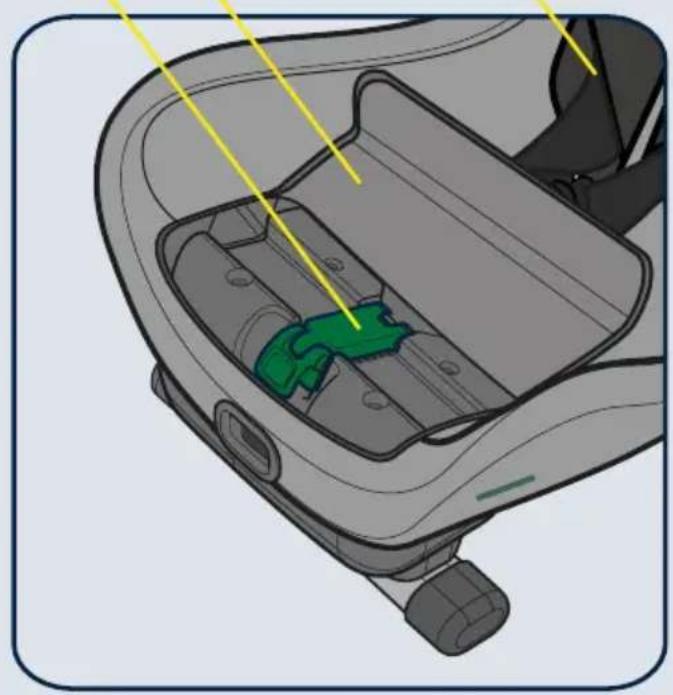
I ASIP PAD
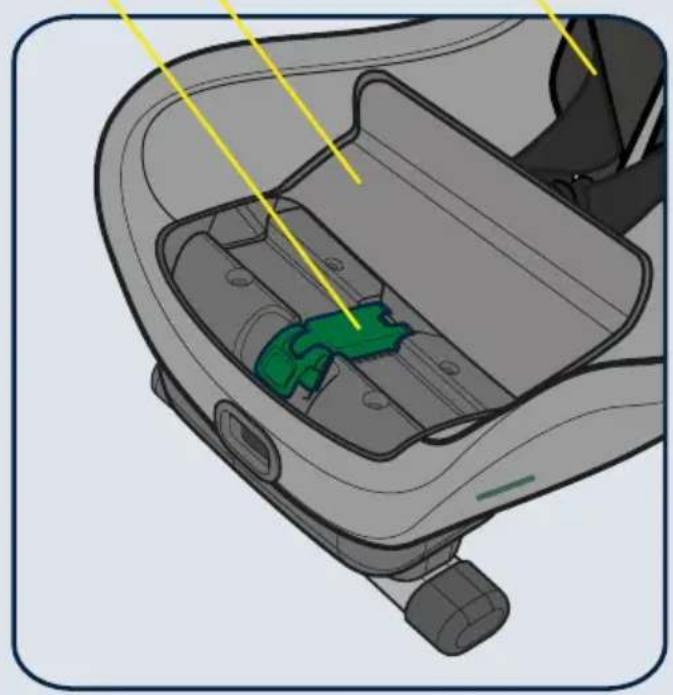
J HEEL
K VERTICAL LINE
natural_image
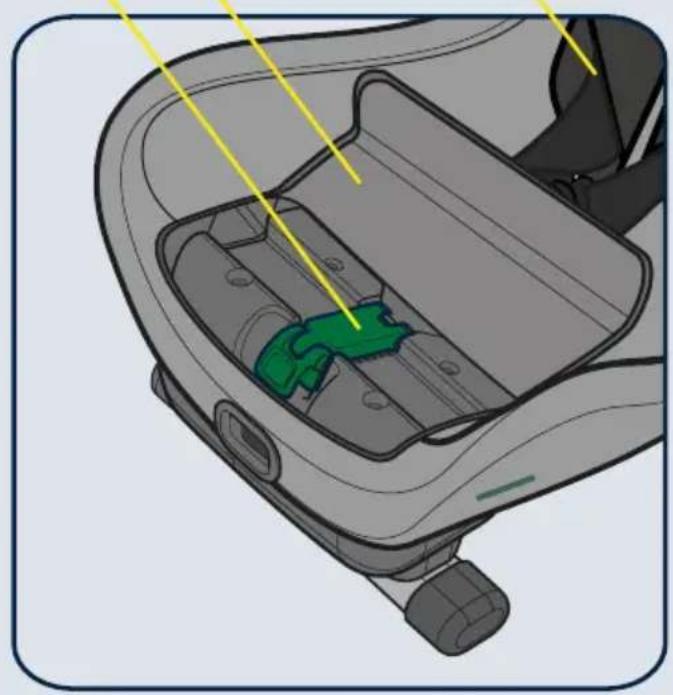
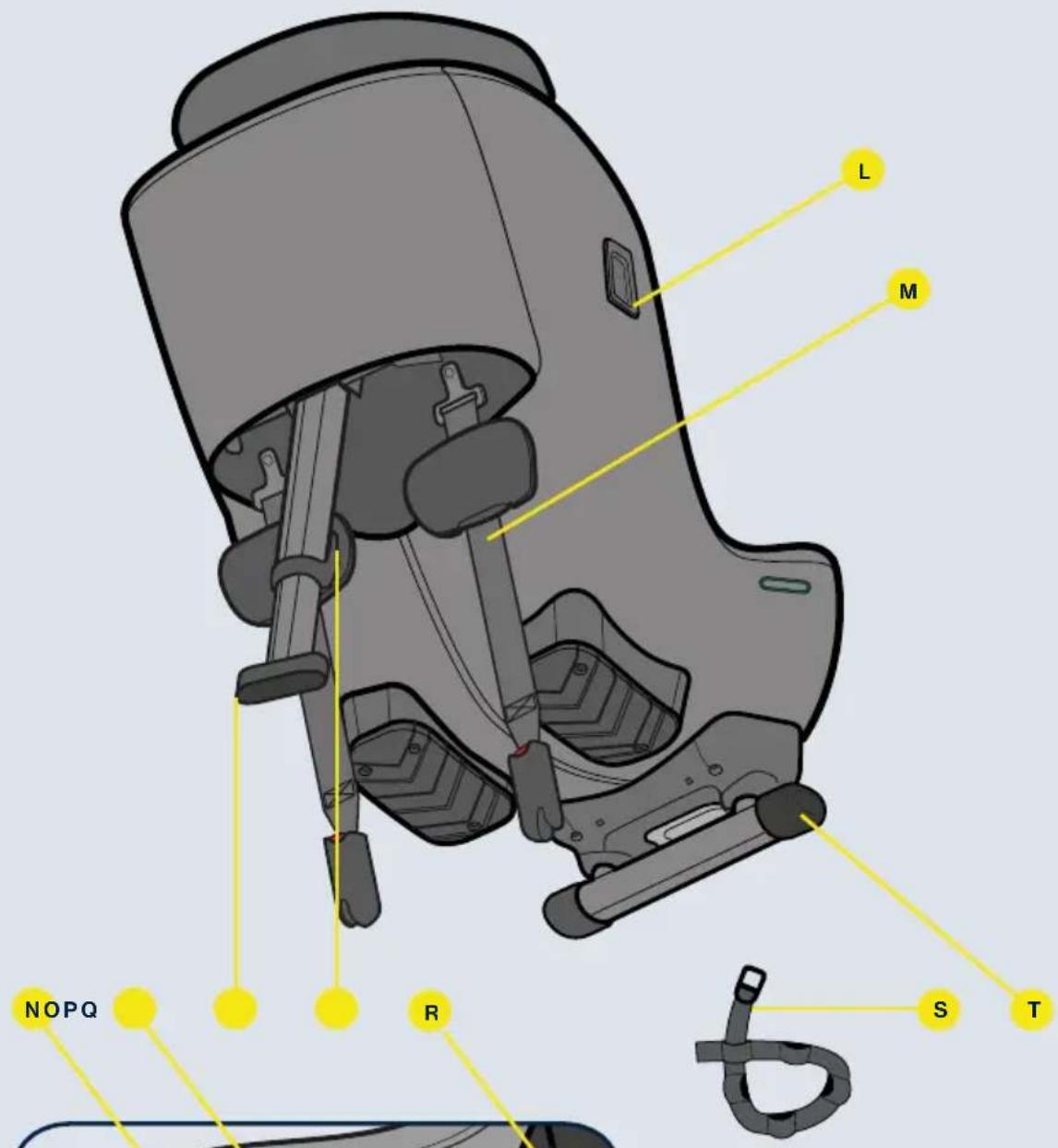
3D diagram of a car interior showing a green plastic component and yellow directional arrows (no text or symbols)L ASIP CONNECTOR
M LOWER TETHER
N BELT CLAMP
O BELTCLAMPLID
P SUPPORT LEG
Q SUPPORT LEG BUTTON
R SHOULDER STRAP
S LOWER TETHER ANCHORAGE STRAP X2
T RECLINE ANGLE ADJUSTER
Allowed and disallowed positioning of AXKID MINIKID 4 car seat
AXKID MINIKID 4 car seat can only be installed rear-facing. It will fit in most, but not all seating positions. Check your vehicle instruction manual to find suitable seating positions and check the vehicle list on www.axkid.com
| Front passenger seat (no active airbag) YES/NO* | |
| Front passenger seat (active airbag) NO | |
| Rear passenger seat with 3-point seat belt YES | |
| Seat with 2-point seat belt NO | |
| Side and rear facing seats NO |
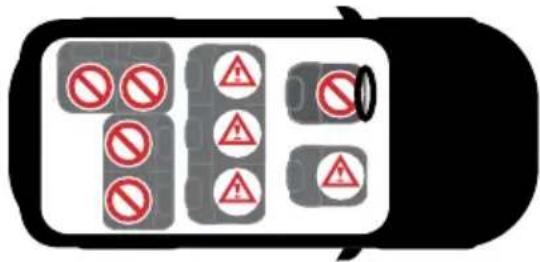
IMPORTANT: If you wish to install your AXKID MINIKID 4 car seat in a location where a frontal airbag is fitted, the airbag must be disconnected according to your vehicle manufacturer instruction. Note that some vehicles require an authorized service centre to disconnect the airbag.
* The General Regulation of Traffic in Spain, in its article 117, establishes the prohibition of driving with children of stature equal to or less than 135 centimetres located in the front seats of the vehicle, without exceptions.

Lower Tether Anchorages Important info
Lower tether anchorages (LTA) are used to enhance the protection of children in cars by providing a firm and stable installation for extended rear-facing belt attached car seats. This increases the safety for your child in all types of collisions, including roll-over accidents and rear-end impacts.
Lower tethers are a well-established method that has been extensively used in the Nordic countries for over 40 years. In 2020 a new international standard for LTA, ISO13216-4:2020, was released. This standard describes the requirements for lower tethers for car seats but also for vehicle manufactures and their anchor points. The purpose is to improve the compatibility and ensuring a safe and easy way of installation for the future.
AXKID MINIKID 4 lower tethers complies with ISO13216-4:2020, ensuring a perfect fit and easy installation in vehicles with pre-installed lower tether anchorages that also complies to this standard. If your vehicle has anchorage points that do not comply with the standard, AXKID MINIKID 4 lower tethers are still likely, but not guaranteed, to fit.
Pre-installed lower tether anchorages in vehicles are often found on the seat rails attached to the floor, but other positions are also used. Check your vehicle's instruction manual for more information on usable anchor points.
If your vehicle has no pre-installed lower tether anchorages, AXKID MINIKID 4 comes with additional lower tether anchorage straps (S) included that can be installed in your vehicle. See this manual for instructions of installation. These straps also comply to ISO13216-4:2020 and when installed correctly, offers the same safety as pre-installed anchorages.
Some vehicle manufactures also offers the possibility of retrofitting lower tether anchorages. Contact your vehicle manufacturer or dealer for more information. Axkid retrofit lower tether anchorages and extra lower tether anchorage straps can be purchased separately.
Note: Never use AXKID MINIKID 4 without the lower tethers. They are an important safety feature and must always be used when installing your car seat.
Installing lower tether anchorage straps
If your vehicle has no suitable pre-installed lower tether anchorages, AXKID MINIKID 4 comes with lower tether anchorage straps that can be installed in your vehicle. Depending on your vehicle and the seat position where you choose to install your car seat, there are various possible anchorage points to use for installing the anchorage straps. See below for alternatives.
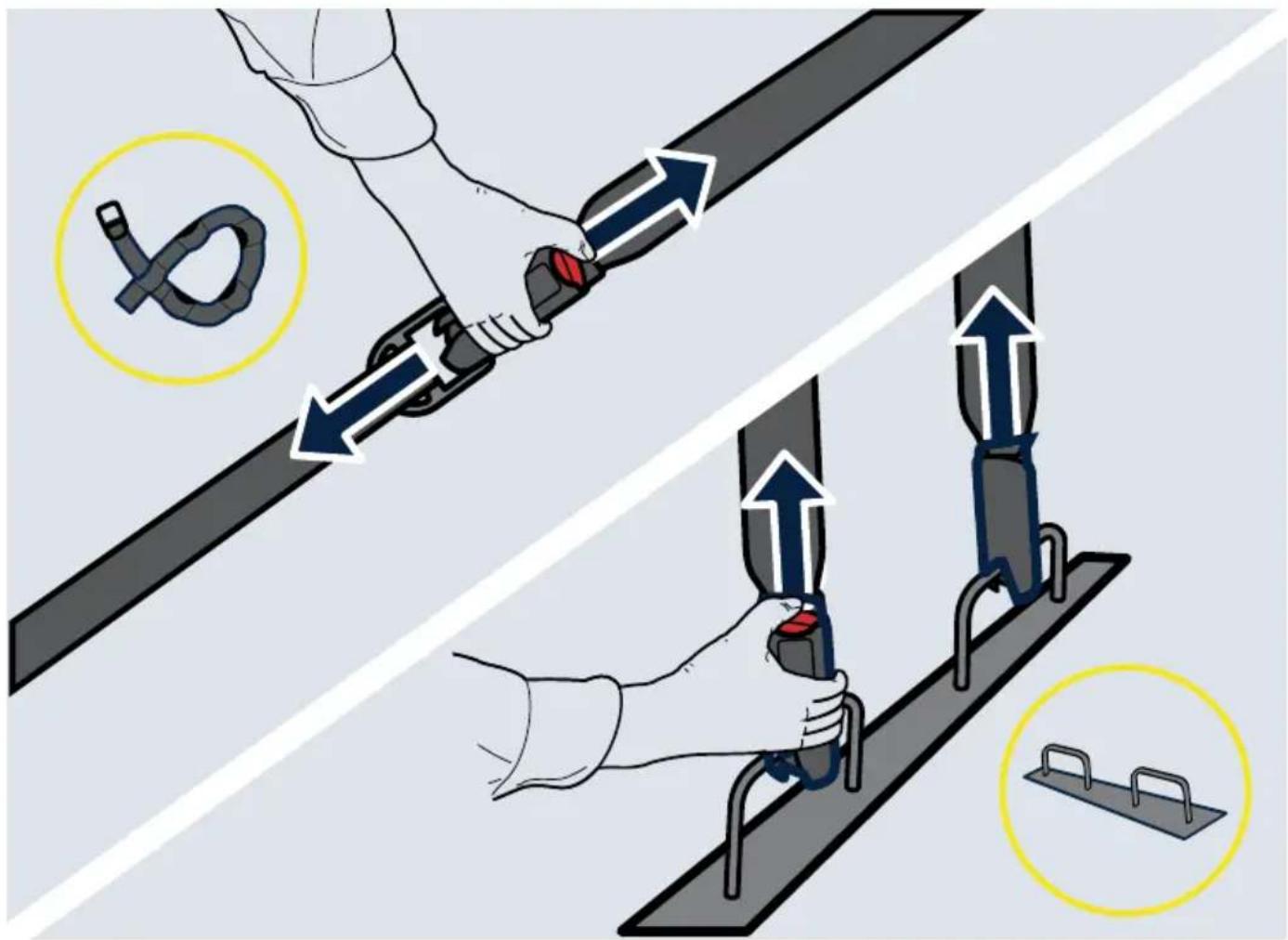
To install the lower tether anchorage straps (S), simply route the strap around the chosen anchorage point and thread the metal anchorage through one of the slots on the strap itself. The anchorage strap has several slots to use. Make sure to use the slot as close as possible to the metal anchorage, thus installing the metal anchorage as close to the vehicle floor as possible. Once this is done, pull on the metal anchorage to tighten the strap and repeat the process for the other strap. Always use two anchorage points when installing AXKID MINIKID 4 and choose anchorage points that are separated as this gives a more stable installation.
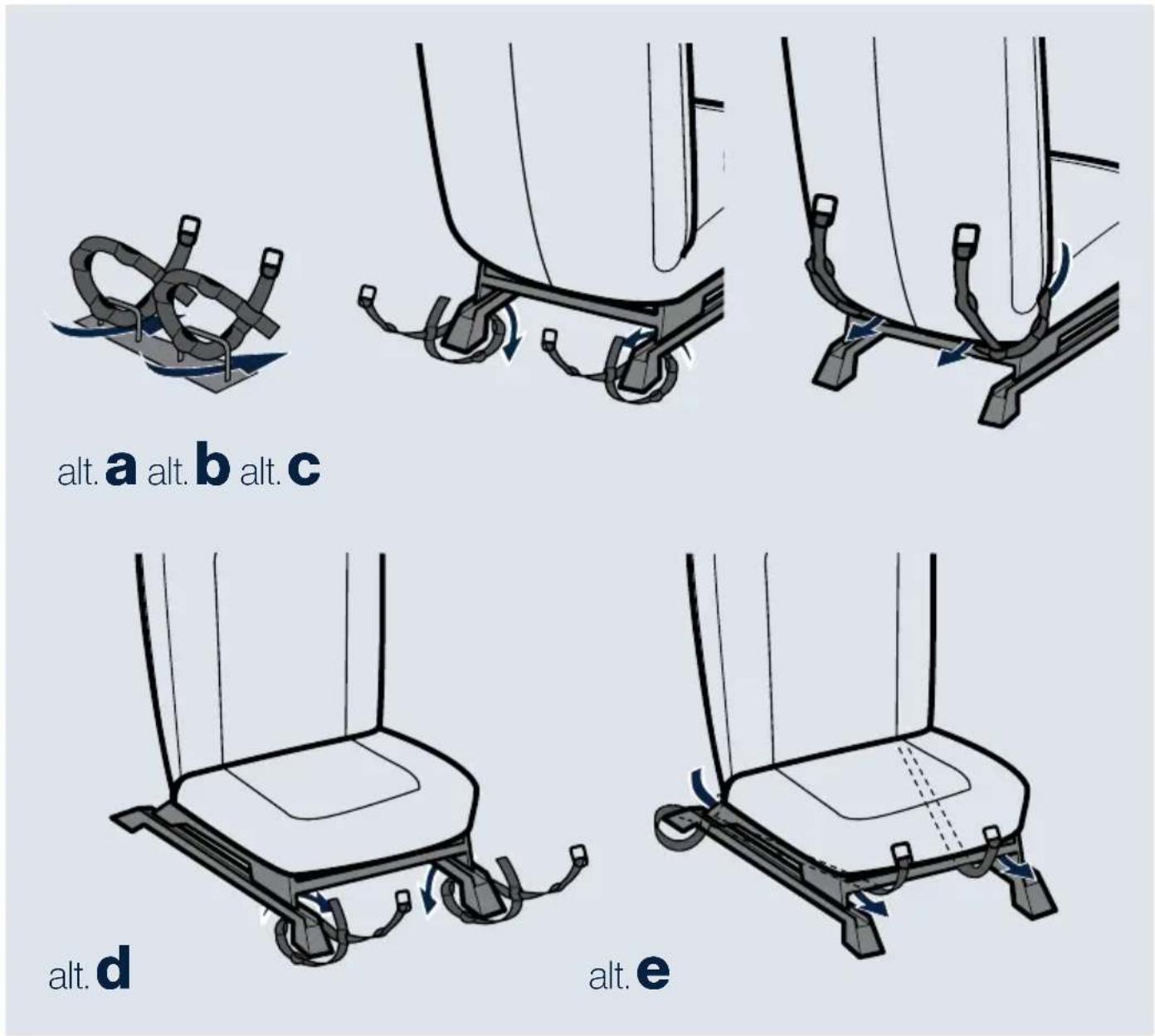
Anchorage strap routing options
alt. a
Route the strap around the edge of the pre-installed anchorage (use this method only if the pre-installed anchorages do not fit with the lower tethers directly).
alt. b
Install the strap around the seat rail in front of the car seat by threading the strap between the seat rail and vehicle floor or through appropriate hole of the seat rail.
alt. C
Install the strap around the hinge of the vehicle seat in front of the car seat by threading the strap in between the vehicle seat back and seat cushion.
alt. d
Install the strap around the seat rail below the car seat by threading the strap between the seat rail and vehicle floor or through appropriate hole of the seat rail.
alt. e
When installing the AXKID MINIKID 4 in a front passenger seat and none of above alternatives is available, it is possible to attach the lower tether anchorage straps to a suitable anchorage point in the back of the vehicle and rout the straps underneath the vehicle seat to the front of the vehicle. Make sure that the anchorage straps comes out from the front of the seat and not out from the sides.
Note: Always make sure that changing the position of any vehicle seat does not interfere or damage the installed lower tether anchorage straps.
Note: Never use sharp objects to assist in routing the straps as it might damage the strap.
Installing AXKID MINIKID 4 car seat in the vehicle
Before installing AXKID MINIKID 4, make sure you have lower tether anchorages in your vehicle. See section about lower tether anchorages in this manual for more information and installation instructions.
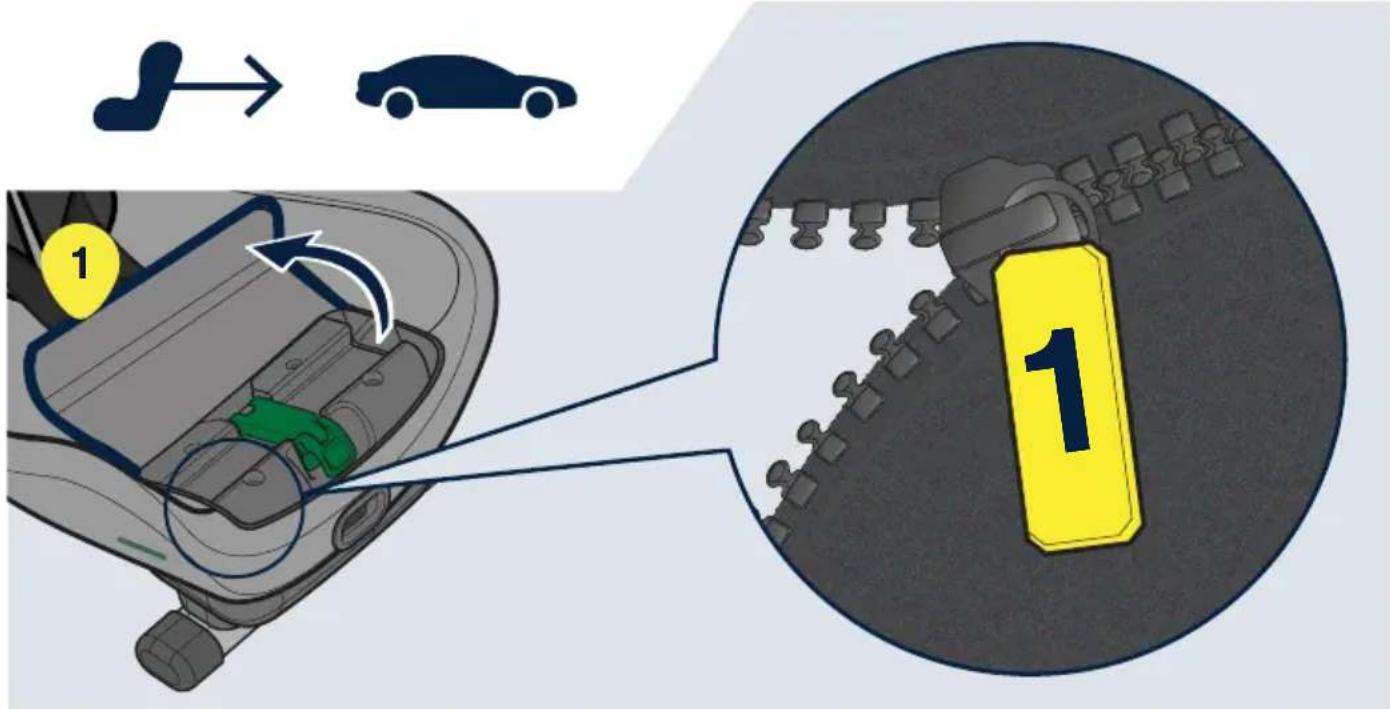
1
Unzip the zipper and open the belt clamp lid (O).
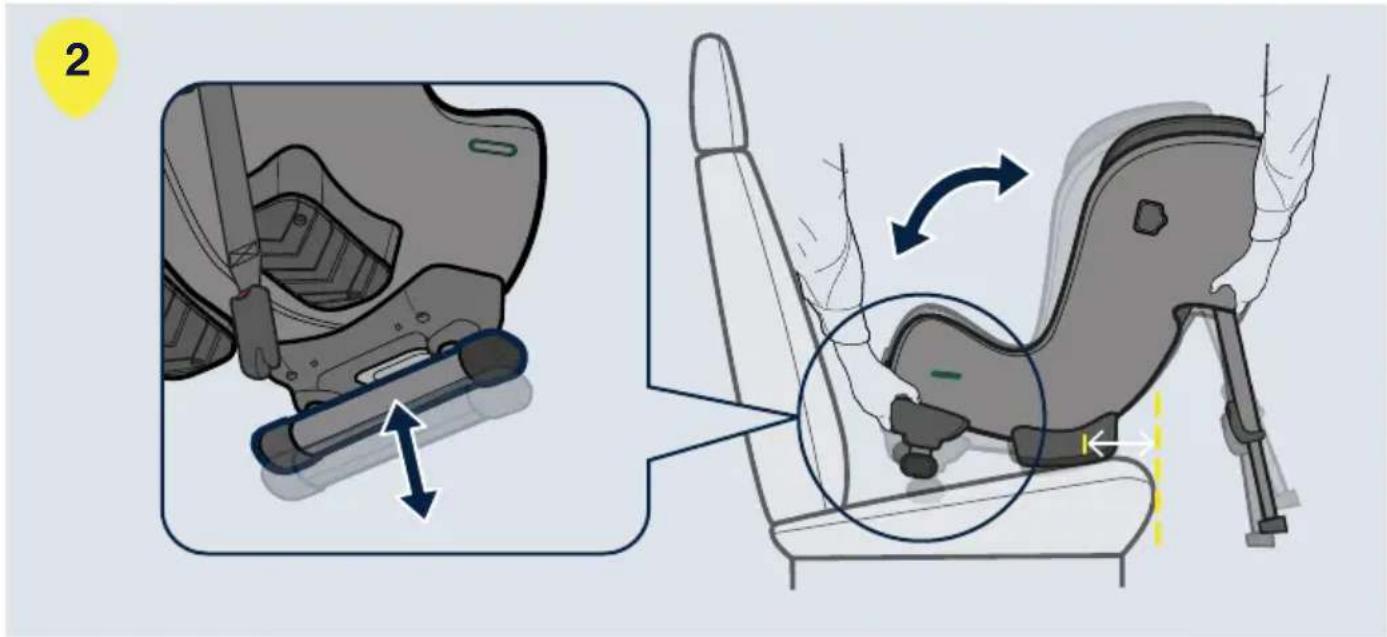
2
Place the AXKID MINIKID 4 on the vehicle seat with the back of the car seat facing the front of the vehicle. Adjust the legroom for your child by simply moving the car seat back and forth on the vehicle seat. AXKID MINIKID 4 can be installed tight against the vehicle seat back but may never be installed with the heel (J) hanging over the edge of the vehicle seat. Make sure that the vertical line (K) on the heel (J) never crosses the edge of the vehicle seat.
Adjust the angle of the car seat by pressing the recline adjustment lever (G) and select a suitable recline position. For maximum safety, choose a position as upright as possible while also ensuring that your child's head does not fall forward when sleeping. For both comfort and safety reasons, the recline angle should be adjusted to a more upright position as your child grows. Note that when tensioning the lower tethers (M), the car seat will be slightly more reclined as it sinks into the vehicle seat cushion. When installing AXKID MINIKID 4 in a front passenger seat it is possible, but not necessary, for the back of the car seat to have contact with the dashboard.
3
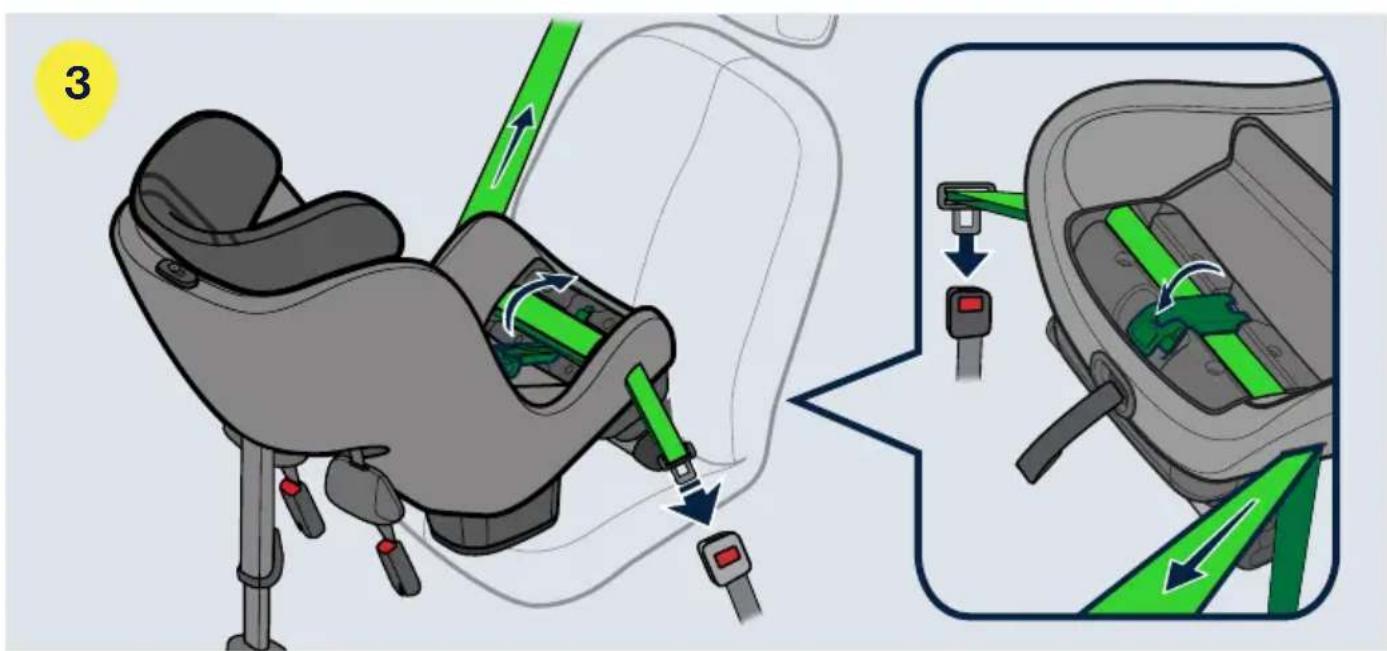
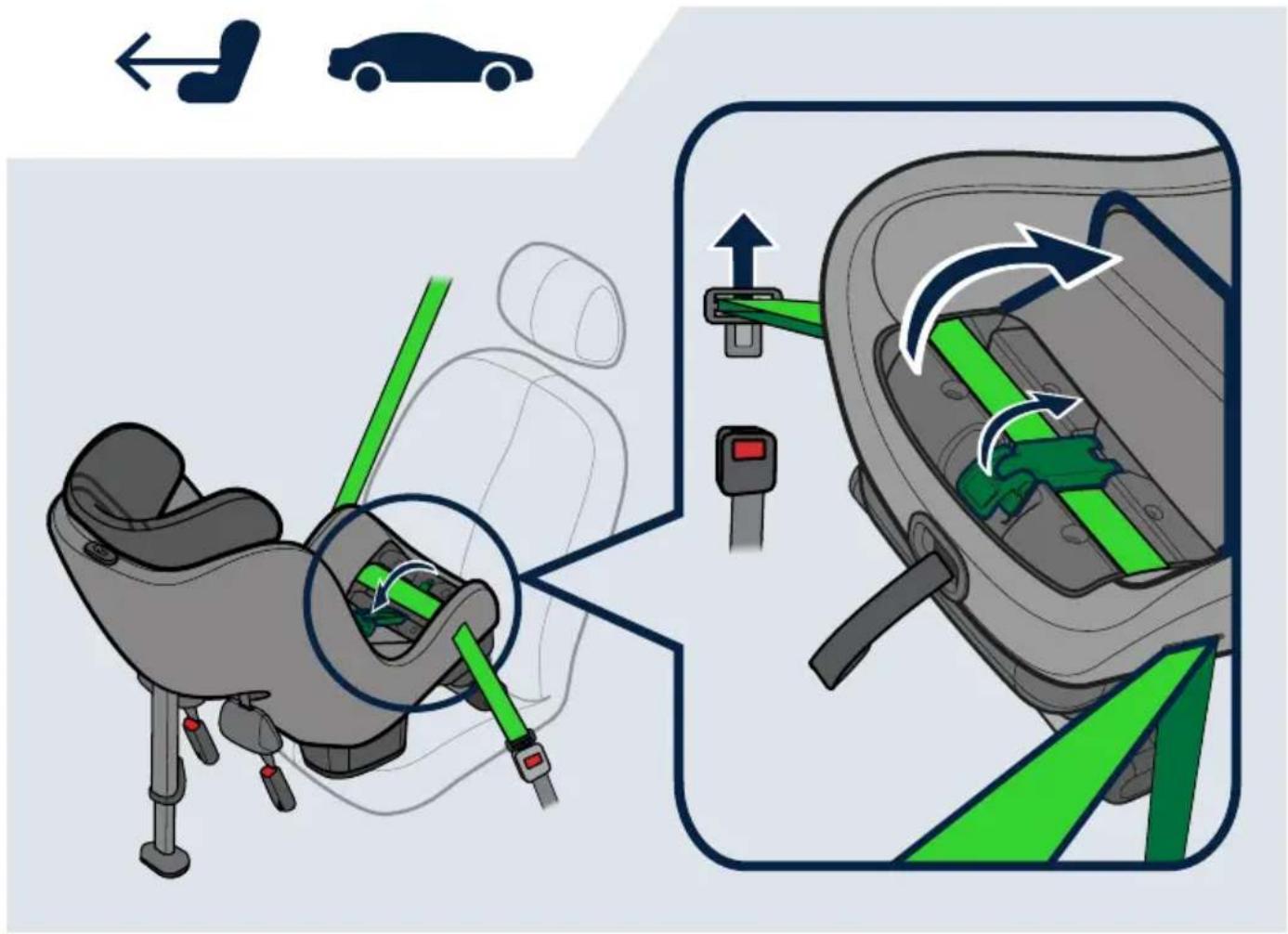
Open the belt clamp (N). Pull out an arm length of the vehicle seat belt and thread it through the seat belt slot (D) closest to you. Route the belt through the belt clamp (N) and thread it through the seat belt slot (D) on the opposite side. Connect the vehicle seat belt with the seat belt buckle and pull hard on the shoulder part of the vehicle seat belt to remove all slack and to fasten the car seat, the harder you pull the firmer the installation. When the car seat is firmly fastened, close the belt clamp (N) and lock the vehicle seat belt in position. Make sure that both the shoulder and lap belt is locked together in the belt clamp (N). Close the belt clamp lid (O) and close the zipper. To give an even more firm and stable installation, press down on the car seat while pulling the shoulder belt.
4
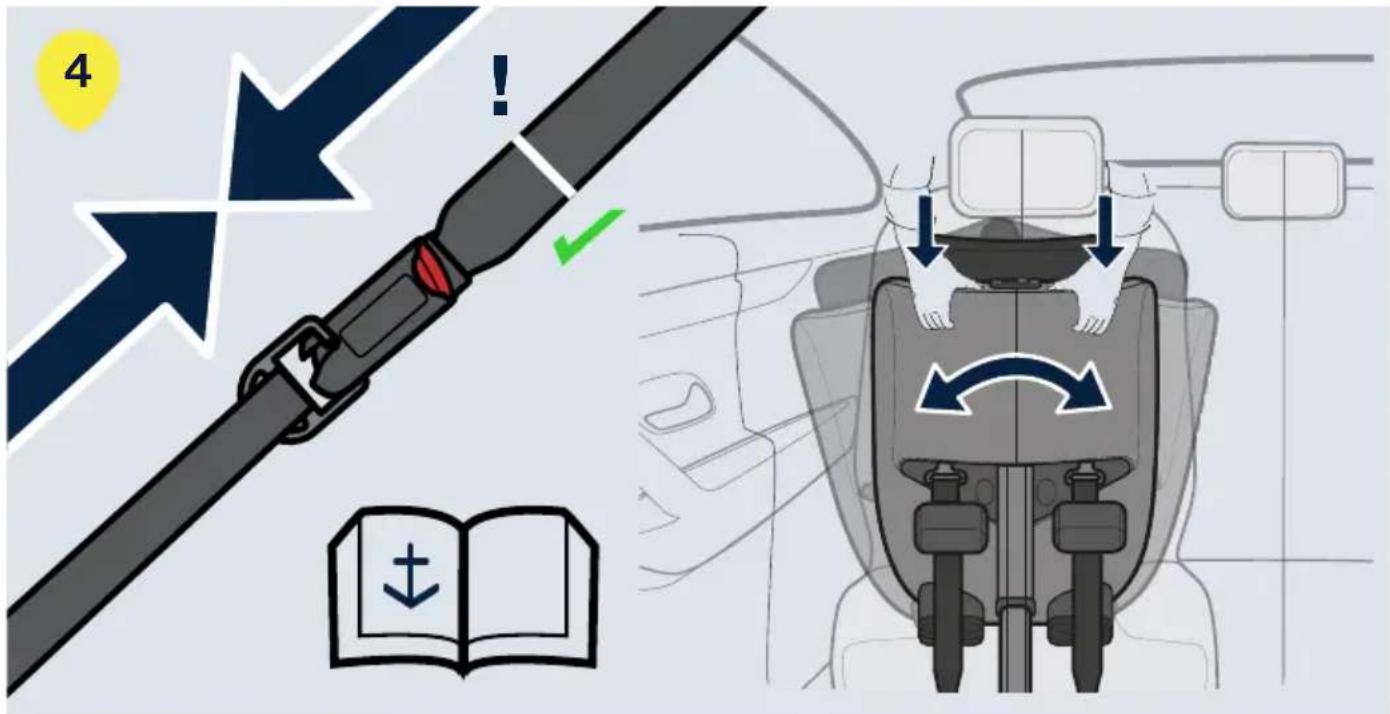
Pull out the lower tethers (M) from the car seat and connect them to the lower tether anchorages in your vehicle, see section about lower tether anchorages in this manual for more information. Press down on the top of the car seat and wiggle the car seat from side to side and the AXKID MINIKID 4 self-tensioning lower tethers (M) will automatically be tensioned. By tensioning the lower tethers (M) you also set the final recline angle of the car seat. Keep pushing on the car seat until it is firmly fastened, and you have achieved a suitable recline angle. Check that the white marking on the lower tether belt is visible. If not, the lower tether anchorages are too close to the car seat and needs to be adjusted. If this is not possible, you can also cross the lower tethers behind the seat to get a bit more distance.
5
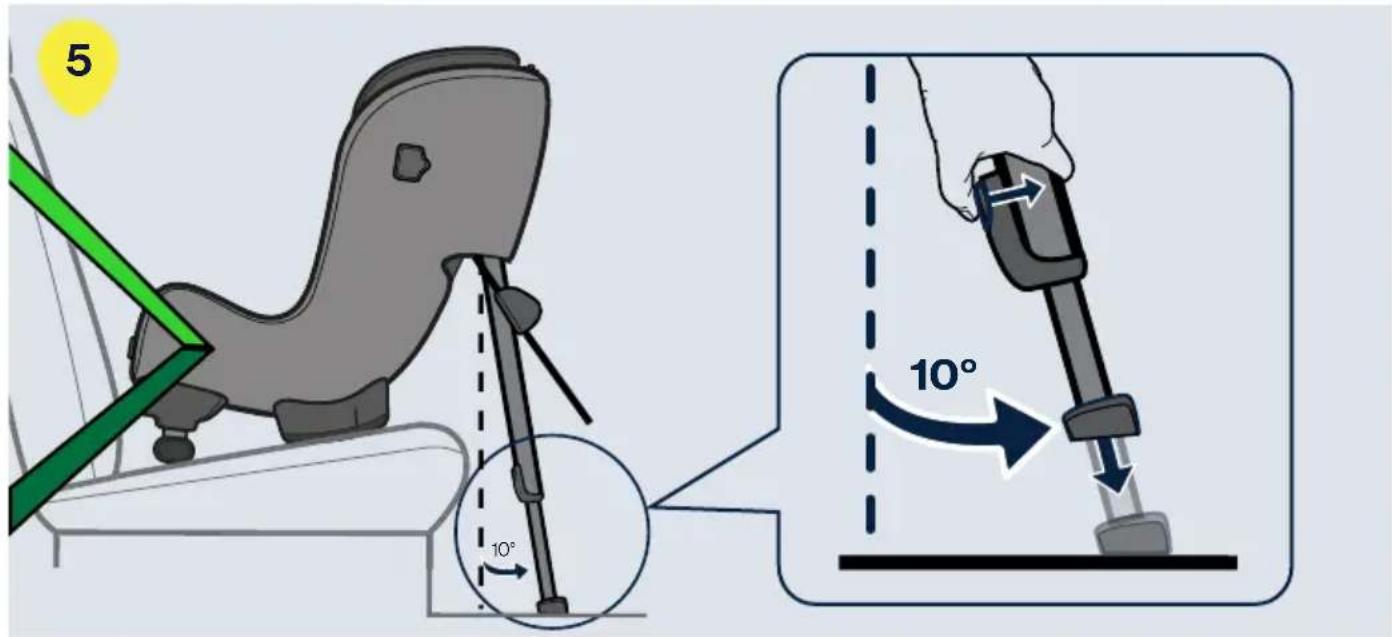
Pull out the support leg (P) from the car seat. Push the support leg button (Q) and pull the support leg (P) downwards until it is in contact with the vehicle floor. Let go of the support leg button (Q) and lift the car seat upwards to further extend the support leg (P) until you hear a click. The support leg (P) should now be locked and firmly pressed against the vehicle floor. Make sure that the support leg (P) is angled about 10° towards the front of the vehicle. Check the vehicle seat belt again to make sure that it is still firmly tensioned and that no slack has occurred in the hip belt while tensioning the lower tethers and support leg. If the vehicle belt has lost some tension, simply re-tension it by repeating step 2 of this guide without disconnecting the lower tethers.
6
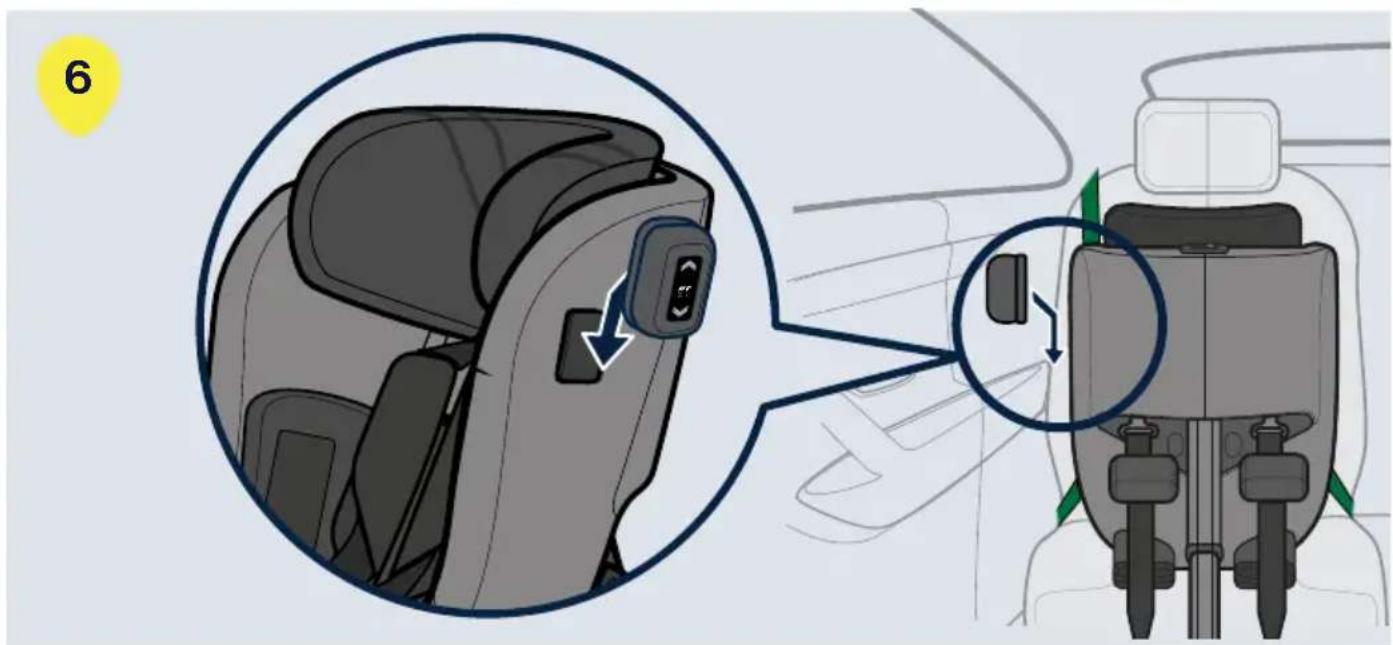
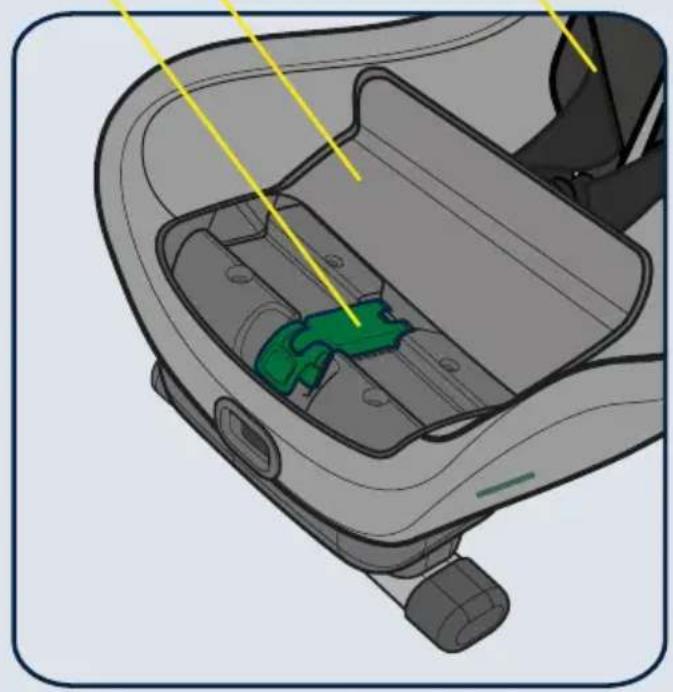
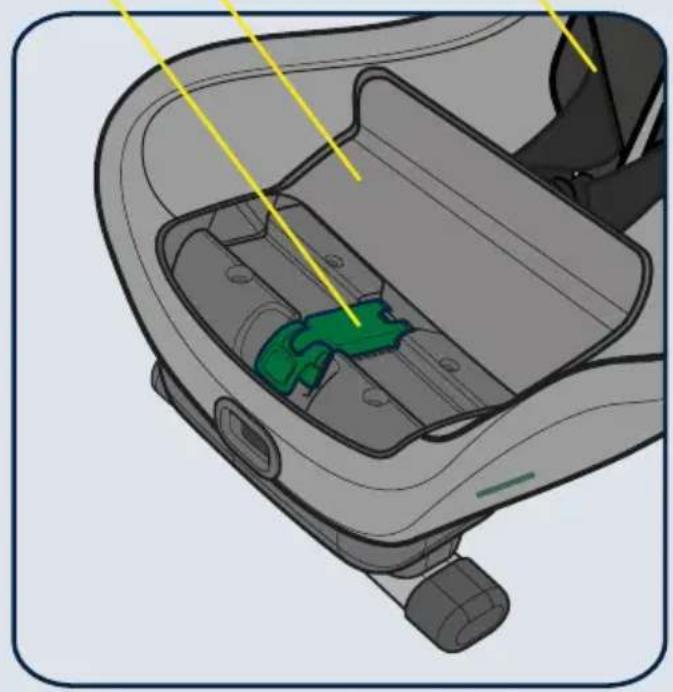
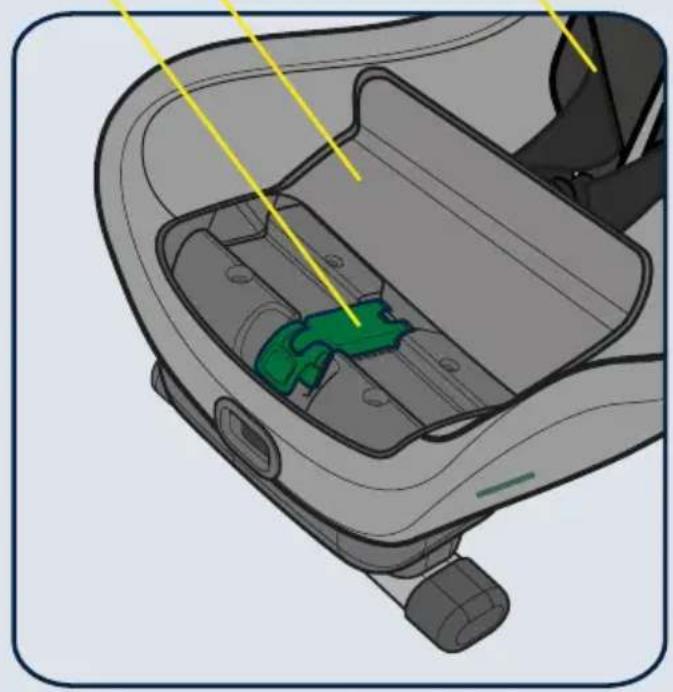
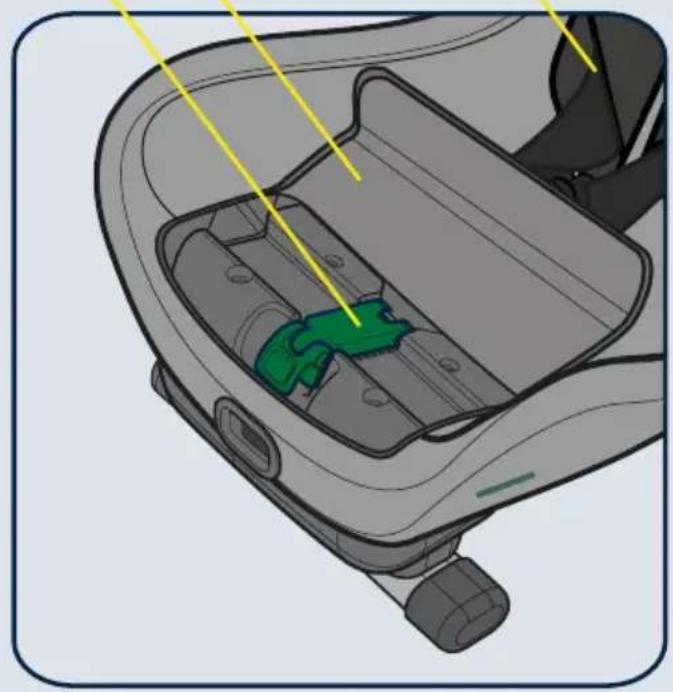
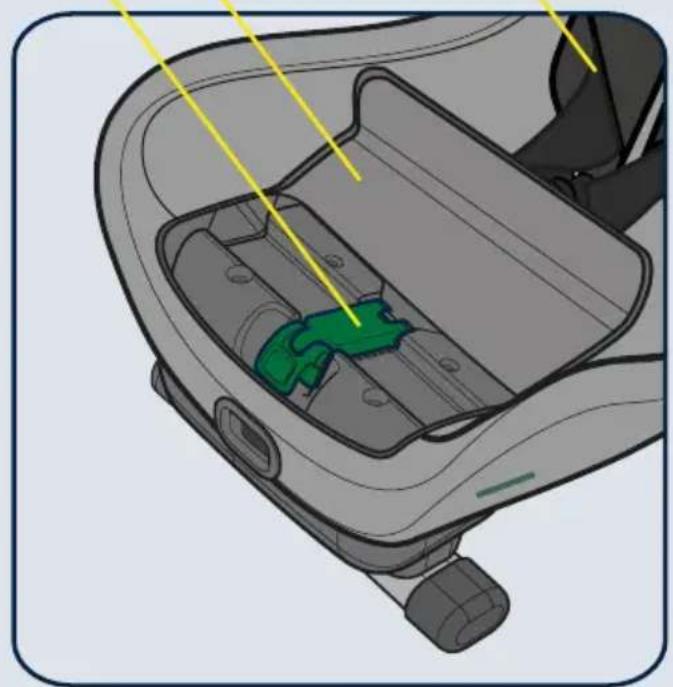
Push the ASIP pad (I) into the slots on the ASIP connector (L) and slide downwards, the ASIP pad (I) will click into place. If there is a plastic cover on the ASIP connector (L), remove it and place it on the ASIP connector (L) on the opposite side of the seat before fitting the ASIP pad (I). Make sure the ASIP pad (I) is attached on the side of the AXKID MINIKID 4 car seat that is closest to the vehicle door.
Restraining your child in AXKID MINIKID 4 car seat
Before restraining your child in the AXKID MINIKID 4 car seat, make sure you have the correct inlay installed in the seat. AXKID MINIKID 4 is designed to grow with your child and to ensure a comfortable and safe fit for the children. Axkid recommends using the inlay until it is too tight for your child, but to a minimum length according to table below (note that the age is just an indication):
| Age Height | ||
| Toddler0-3 years | 61–105 cm | 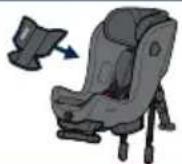 |
| Child3-7 years | 106 – 125 cm |  |
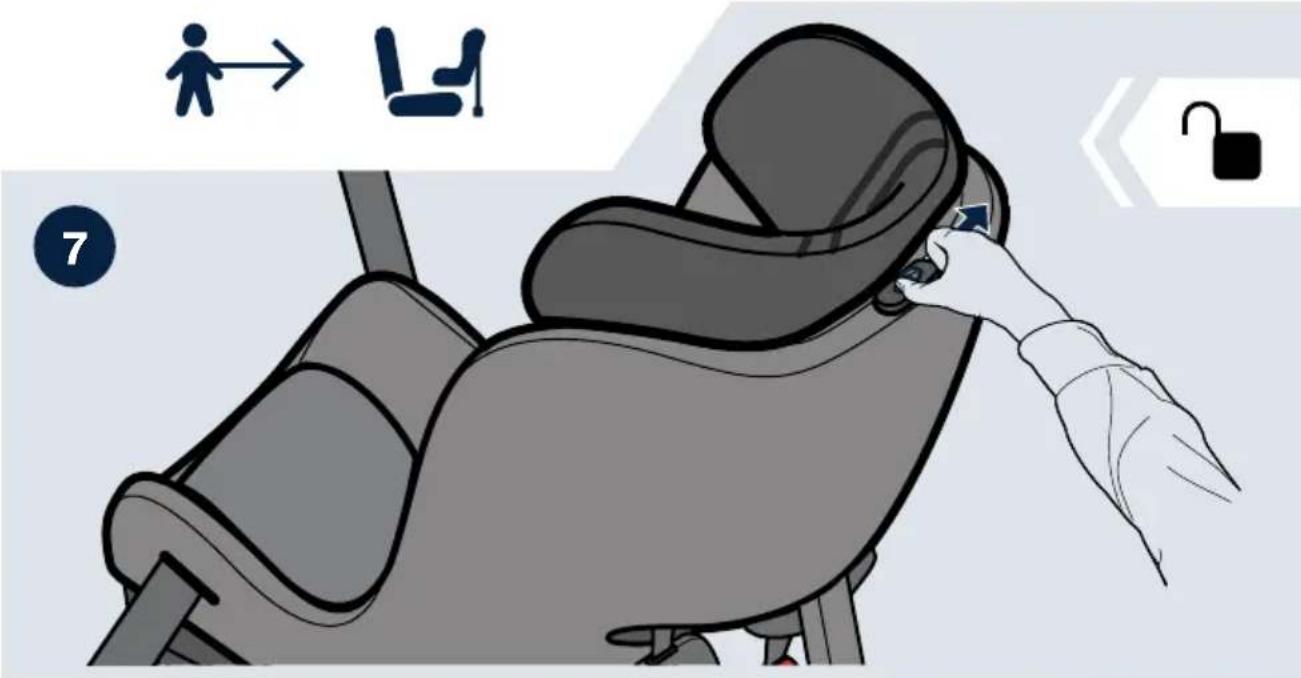
The AXKID MINIKID 4 is equipped with an automatic headrest (A) that will lower itself to the correct position when the harness is being tightened. To ensure the best fit, Axkid recommends using this feature every time you restrain your child. Before placing your child in the car seat, ensure that the automatic headrest (A) is in the unlocked position. See section headrest (A) adjustment for more information.
7
Make sure the Headrest brake lever (H) is set to unlocked. If locked, push the lever over to the unlocked position.
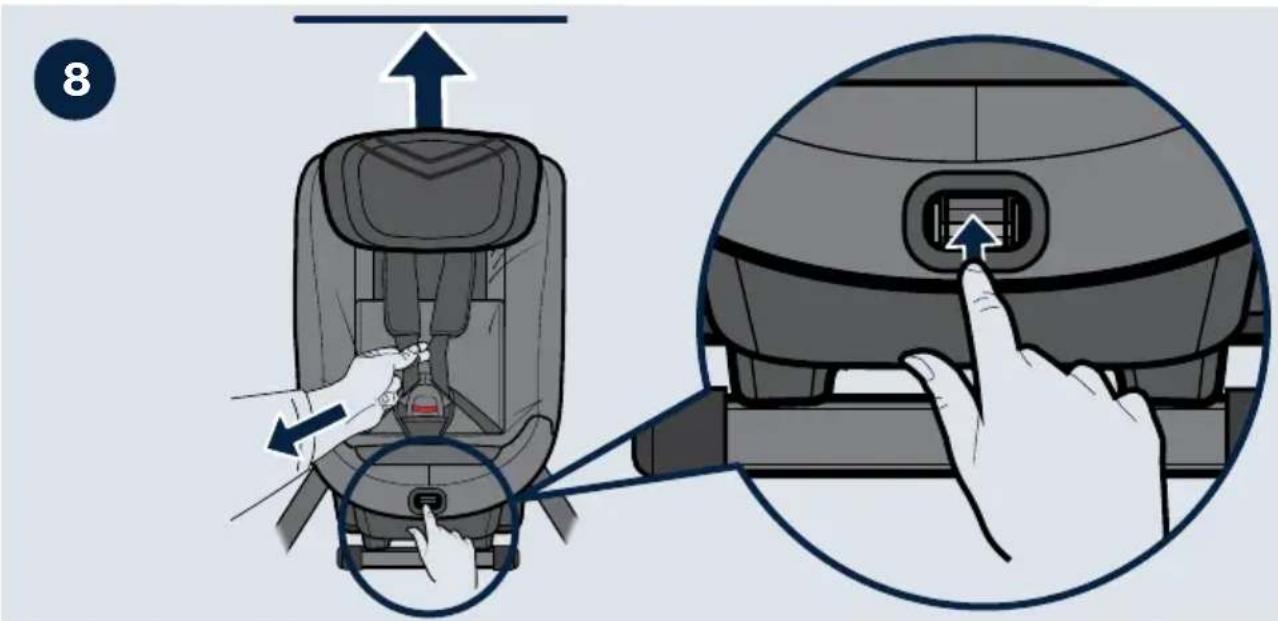
8
Loosen the harness by pressing the harness release button (E) and pull out both shoulder straps (R) at the same time. Avoid pulling only one strap at the time since it may cause the shoulder straps (R) to become uneven. Make sure the headrest (A) is pushed up to the top position.
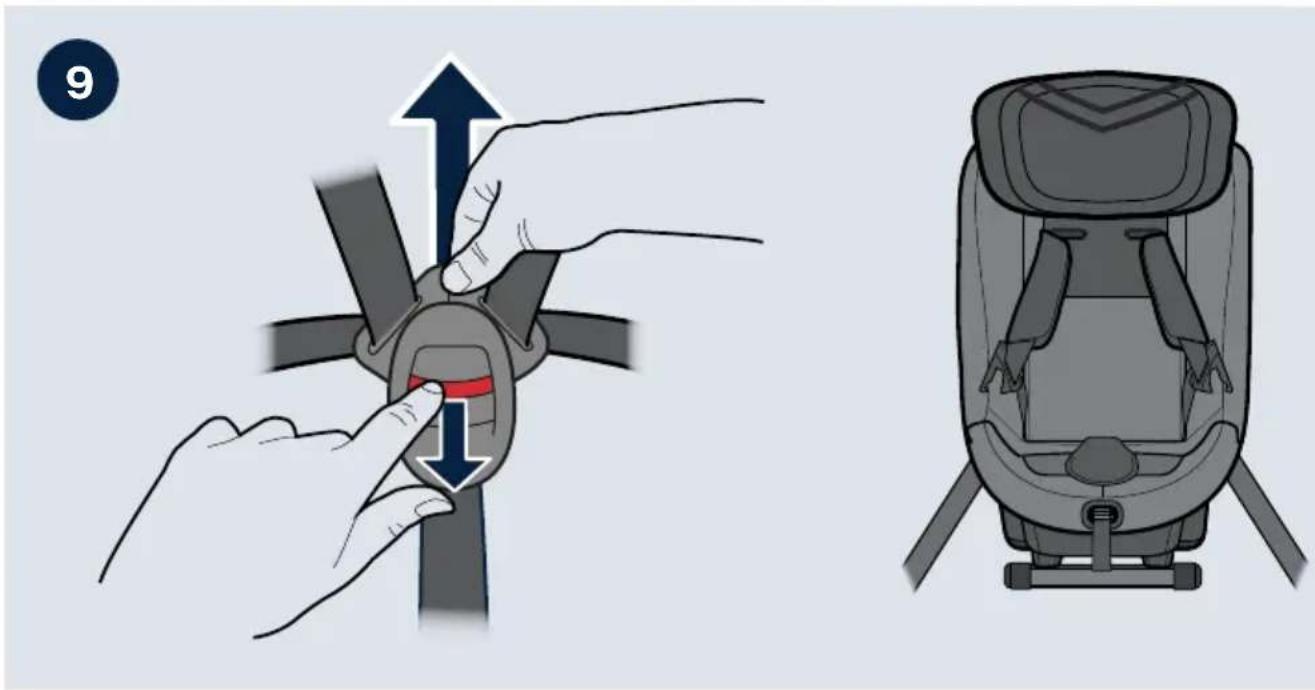
9
Unlock the harness buckle by pressing the buckle release button (C) and place the straps outside of the seat.
10
Place your child in the seat and place the shoulder straps (R) over your child's shoulder. Lock the harness by first positioning the parts of the buckle that is attached to the shoulder straps (R) together and then push them into the buckle until you hear a click.
11
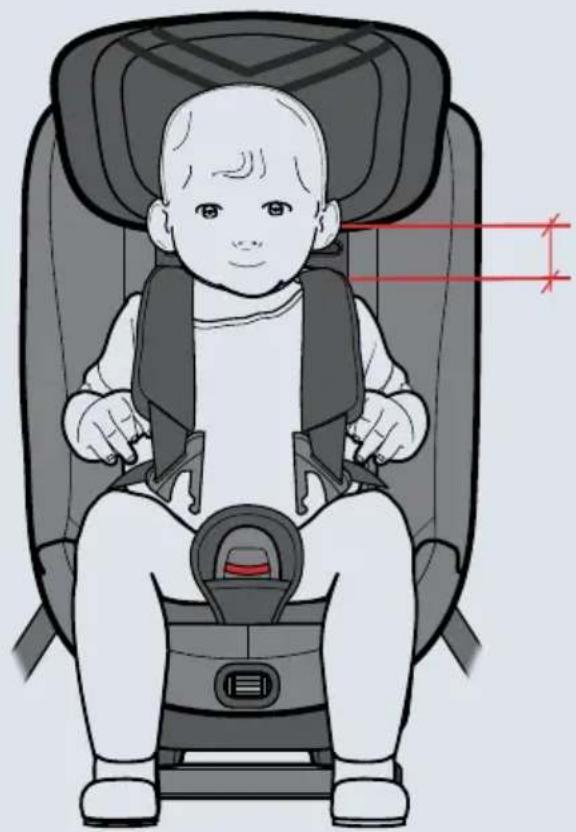
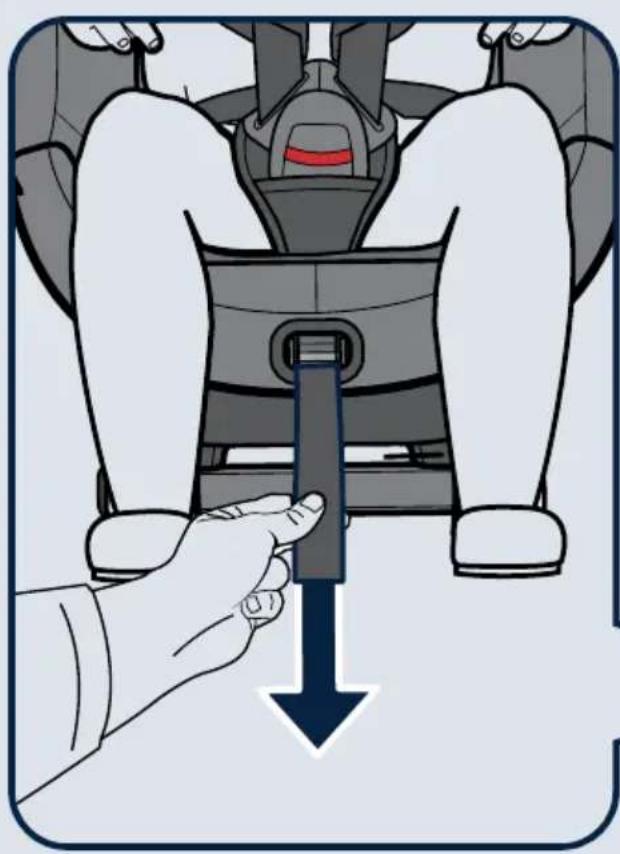
Pull on the shoulder straps (R) to tighten the harness over your child's hips. While keeping tension in the shoulder straps (R), pull the harness tension strap (F) straight from the car seat until the harness is tightened enough, you should not be able to fit more than one finger between the shoulder straps (R) and your child's shoulders. While tensioning the harness, the headrest (A) will automatically move downwards to the correct position for your child.
Headrest Adjustment
The AXKID MINIKID 4 is equipped with an automatic headrest (A) that will ensure the headrest (A) always is in the best position for your child. When the harness is being tightened, the headrest (A) will lower itself to the correct height and automatically lock in position. When loosening the harness, the headrest (A) will move back up to its top position again and unlock. To ensure the best fit, Axkid recommends using this feature every time you restrain your child.
The headrest (A) only unlocks in its top position. It is therefore important to ensure that the headrest (A) moves all the way to the top position when loosening the harness, otherwise the headrest (A) will stay locked and will not move down when tensioning the harness.
If you want to deactivate the automatic adjustment feature and keep the headrest (A) in a fixed position, place the headrest (A) in the desired position and switch the headrest brake lever (H) to the locked position. The headrest (A) is now locked in height and will not move until you switch back the headrest brake lever (H) to the unlocked position again.
When using your AXKID MINIKID 4 with the headrest (A) in a fixed position, ensure the headrest (A) is positioned in the correct height for your child. Check that the shoulder straps (R) are going through the seat straight from your child's shoulders or maximum 1 cm above. If not, adjust the headrest (A) by switching the headrest brake lever (H) to unlocked position and push the headrest (A) to the top position to unlock it and then repeat the procedure.
Removing AXKID MINIKID 4 car seat from the vehicle
- Unzip the zipper and open the belt clamp lid (O). Unlock the vehicle seat belt by pressing the red button on the seat belt buckle. Open the belt clamp (N) and pull the vehicle seat belt and guide it through the seat belt slots (D) to remove it from the car seat.
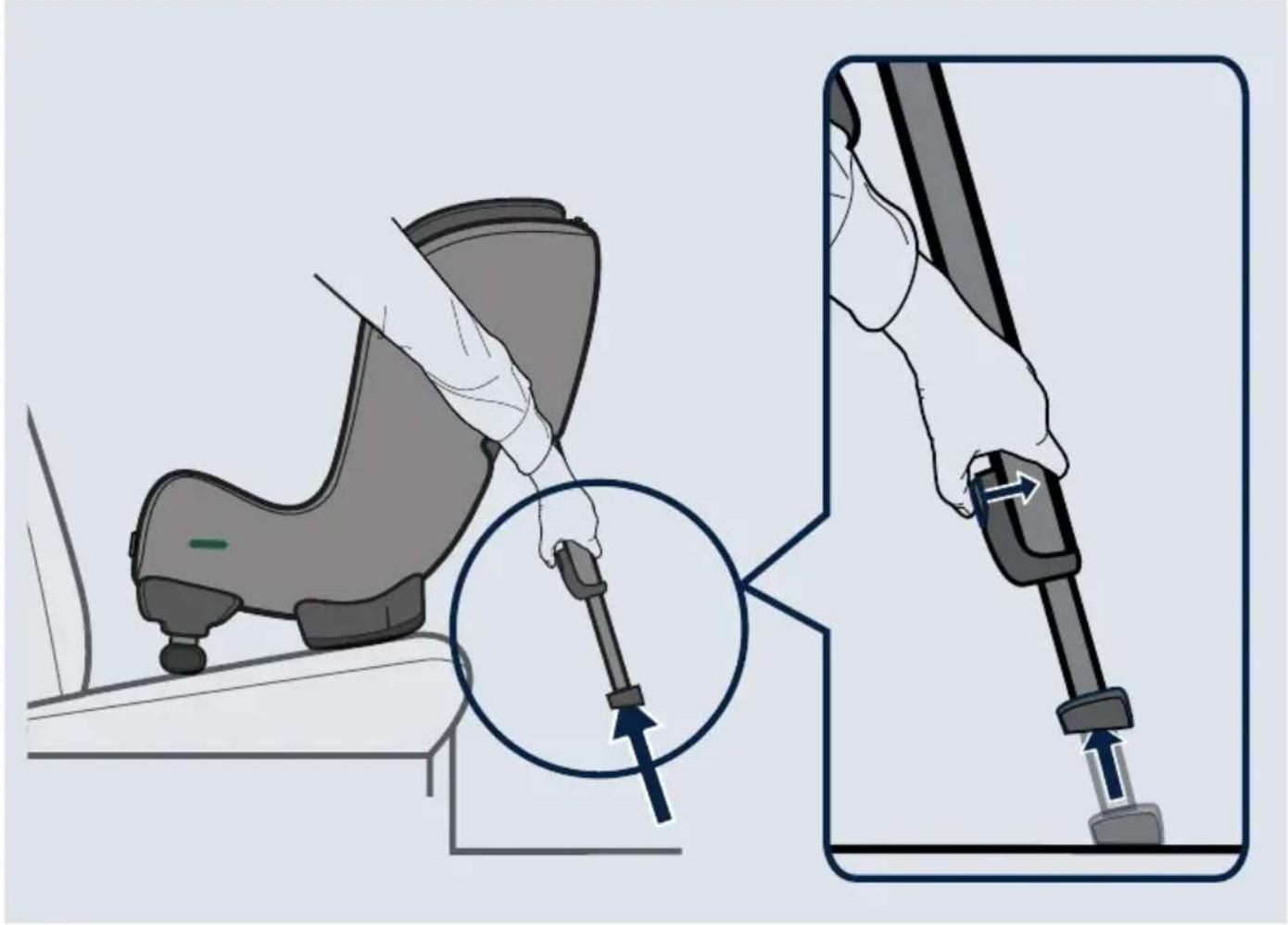
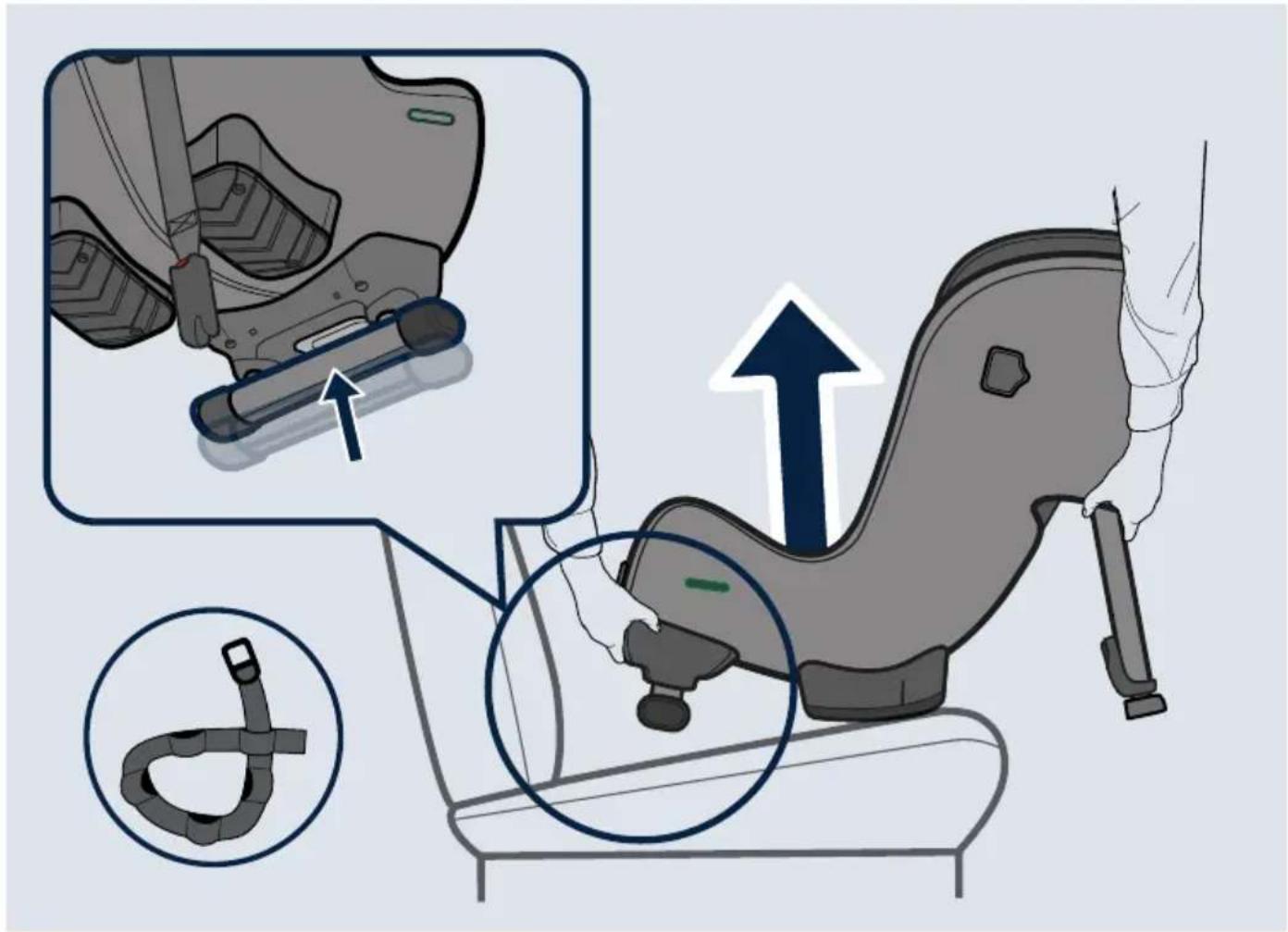
- Unlock the lower tethers (M) by holding on to the connectors with your hand and pressing on the red button with your thumb. While keeping the connector in your hand, slowly feed it back to the car seat. Be careful not to let go of the lower tether connector, as it will retract back automatically with high speed.
- Push the support leg button (Q) and collapse the support leg (P) to its shortest position.
- Press the recline adjustment lever (G) and push in the recline angle adjuster (T) to its shortest position. Lift the AXKID MINIKID 4 out of the vehicle.
Tip: Lock the harness buckle and tension the harness before removing the car seat from the vehicle. You can then use the shoulder straps (R) as a carrying handle, making it easier to lift out the car seat and transporting it outside of the vehicle.
Important: Never carry the car seat by holding in the headrest (A).
Recycling your car seat


Axkid strongly recommends recycling of old car seats. Before leaving the seat at your local recycling station cut off the harness straps from the seat, remove the textile cover, remove as many Styrofoam parts as possible, separate metal and plastic parts if possible. The main part of the seat should be marked unsafe or expired (use a marker) to deter anyone from using it again. Please check your local municipal guidelines for recycling instructions for the different materials.
Care and maintenance
The seat textile cover can be machine washed at 30^ C on a gentle cycle. Do not put the cover in a dryer as this can damage the cover and the padding may separate from the fabric. Visit www.axkid.com to find videos explaining how to remove and attach the cover.
If the textile seat cover needs replacing, ensure only original products from Axkid are used. If other products are used, the Axkid car seat's safety system may be compromised and could lead to severe injury in case of an accident.
Any plastic parts of the Axkid car seat can be cleaned with mild detergent and water. Do not use aggressive chemicals containing solvents or similar, as this can cause damage to the plastic and compromise the safety of the car seat.
Remove the textile cover:
- Remove the ASIP pad (I) if attached.
- Set the automatic headrest brake lever (H) to the unlocked position and loosen the harness by pressing the harness release button (E) and pull out both shoulder straps (R) at the same time.
• Unzip the two zippers on the underside of the headrest (A) and carefully pull the cover off from the headrest (A).
• Lower the headrest (A) to the lowest position and switch the automatic headrest brake lever (H) to the locked position. - Unlock the harness buckle by pressing the buckle release button (C) and remove the buckle cover.
• Unzip the zipper and open the belt clamp lid (O) and remove the plastic lid (O) from the textile cover. - Open the 4 buttons on the textile cover on the backside of the car seat.
- Unzip the two zippers at the backrest on the inside of the car seat and gently remove the textile cover from the car seat. Be careful around the ASIP pad and other plastic covers to avoid damaging the textile. Don't pull too hard.
- Open the shoulder pads and gently remove them from the Velcro.
Install the textile cover:
• Reverse the steps from the instruction above to install the textile cover on the car seat again.
Note: The shoulder pads can be installed at different positions. Install them in a position suitable for your child, the shoulder pads should be positioned on top of the shoulder and on the chest of your child. Also make sure that the rubber side of the shoulder pad is facing your child's chest.
Warranty
The Axkid car seat is covered by a 24-month warranty from date of purchase. Ensure you save your receipt and bring it to your place of purchase if you have any warranty issues.
The warranty does not cover:
- Normal wear and tear.
- Damage due to incorrect use, neglect, or accident.
- If repairs have been carried out by a third party.
- All materials used have a very high UV-resistance rating. However, UV-light is very aggressive and will ultimately lead to fading of the seat cover. This is not covered by our warranty as it is considered normal wear and tear.
- Handle the seat with care. Never carry the seat by holding in the headrest (A).
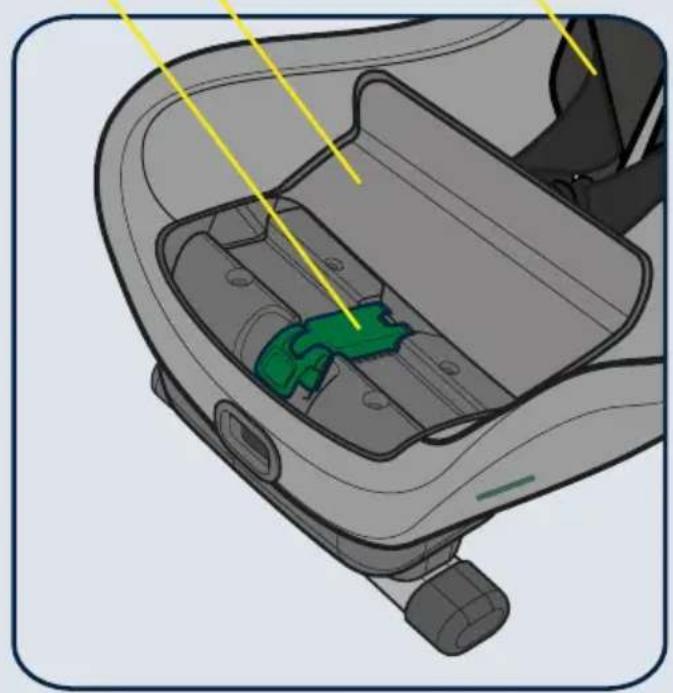
natural_image
3D diagram of a car interior showing a green plastic component and yellow directional arrows (no text or symbols)L ASIP-KONNEKTOR
M SPANNGURT
N GURTKLEMME
O ABDECKUNG DER GURTKLEMME
P STÜTZFUSS
Q STÜTZFUSSVERSTELLKNOPF
R SCHULTERGURT
S GURT FÜR DIE BEFESTIGUNG DER SPANNGURTE (S) X2
T NEIGUNGSWINKELEINSTELLUNG
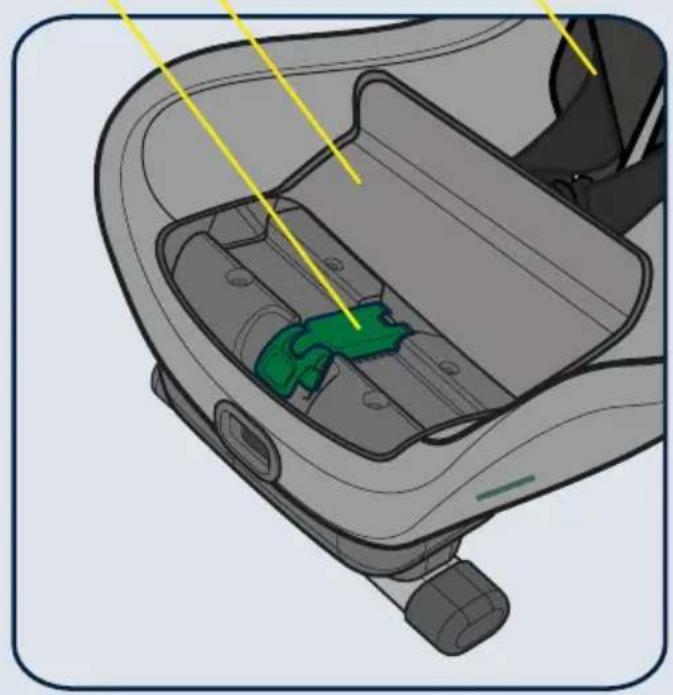
natural_image
3D diagram of a car interior showing a green plastic component and yellow directional arrows (no text or symbols)natural_image
Two icons: a left-turn arrow and a car silhouette (no text or symbols)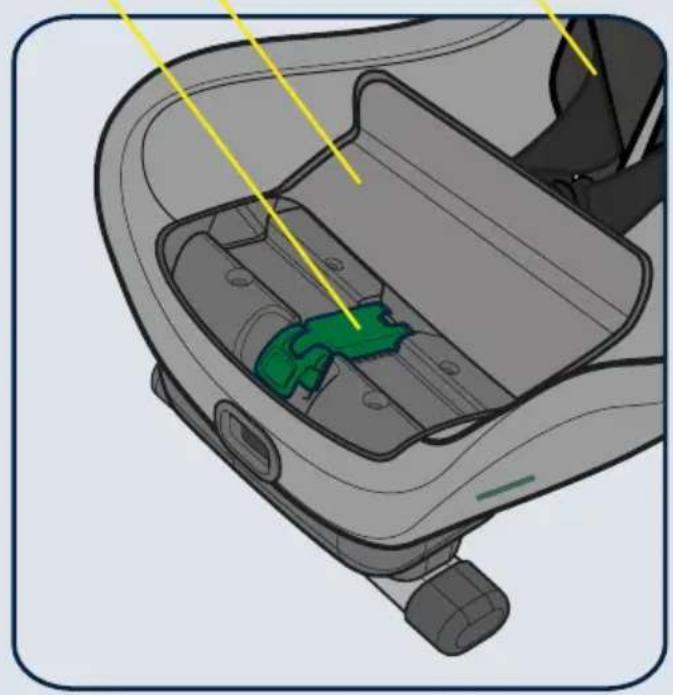
natural_image
3D diagram of a car interior showing a green plastic component and yellow directional arrows (no text or symbols)L CONNECTEUR ASIP
M ATTACHE INFÉRIEURE
N PINCE DE CEINTURE
COUVERCLE DE PINCE DE CEINTURE
P JAMBE DE FORCE
Q BOUTON DE JAMBE DE FORCE
R BANDOULIÈRE
S SANGLE D'ANCRAGE INFÉRIEURE X2
T RÉGLAGE DE L'ANGLE D'INCLINAISON
natural_image
Two icons: a left-turn arrow and a car silhouette (no text or symbols)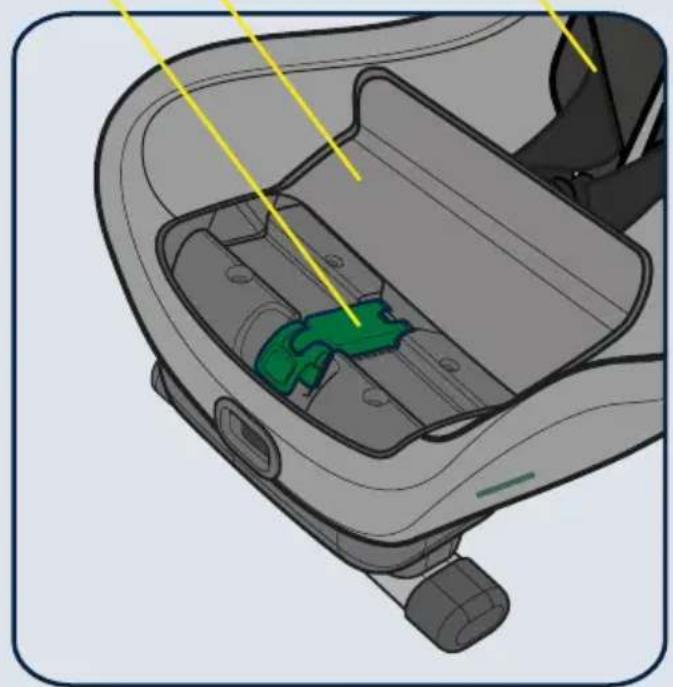
natural_image
3D diagram of a car interior showing a green plastic component and yellow alignment lines (no text or symbols)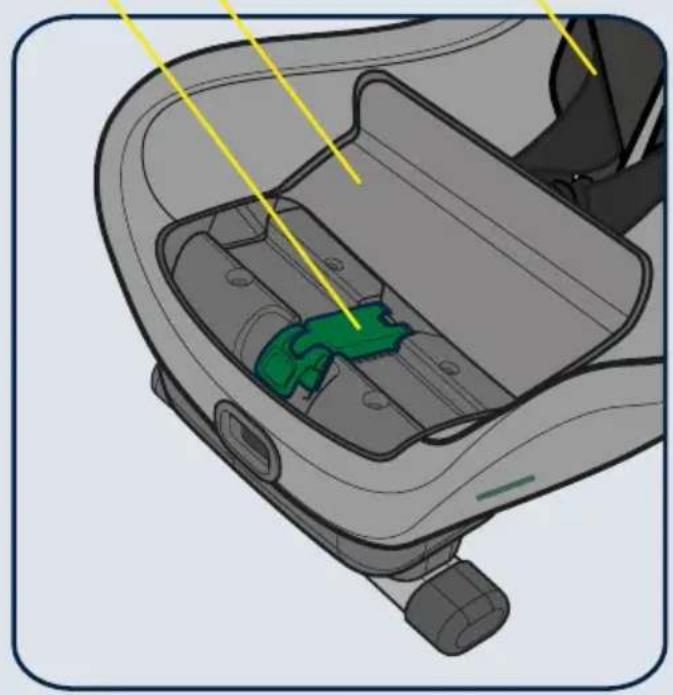
natural_image
3D diagram of a car interior showing a green plastic component and yellow directional arrows (no text or symbols)L ASIP-AANSLUITING
M ONDERSTE TETHER
N GORDELKLEM
O DEKSEL GORDELKLEM
P STEUNPOOT
Q STEUNPOOTKNOP
R SCHOUDERBAND
S ONDERSTE TETHERRIEM X2
T VERSTELBARE ZITHOEK
natural_image
3D diagram of a car gear shift lever with highlighted green component (no text or symbols)L ZŁĄCZE ASIP
M ZŁĄCZE PASAKOTWICZĄCEGO
N ZACISK PASA
O OSŁONA ZACISKUPASA
P NÓŻKA PODPIERAJĄCA
Q PRZYCISK NÓŻKI PODPIERAJĄCEJ
R PAS BARKOWY
S PAS KOTWICZĄCY × 2
T REGULATORKATAPOCHYLENIA
natural_image
3D diagram of a car interior showing a green plastic component and yellow directional arrows (no text or symbols)L KONEKTOR ASIP
M SPODNÍUPEVŇOVACÍ PRVEK
N SPONA PÁSU
- KRYT SPONY PÁSU
P OPĚRNÁ NOHA
Q TLAČÍTKO OPĚRNÉ NOHY
R RAMENNÍPÁS
S SPODNÍKOTVÍCÍ PÁSKY X2
T ZAŘÍZENÍ PRO NASTAVENÍ NÁKLONU
natural_image
3D diagram of a car gear shift lever with highlighted green component (no text or symbols)L ASIP-KOPPLING
M NEDRE FÖRANKRING
N BÄLTESKLÄMMA
- LOCK TILL BÄLTESKLÄMMA
P STÖDBEN
Q KNAPP FÖR STÖDBEN
R AXELREM
S NEDRE FÖRANKRINGSBAND X2
T SPÄRRSPAK, LUTNINGSVINKEL
natural_image
3D diagram of a car gear shift lever with highlighted green component (no text or symbols)L ASIP-KOBLING
M NEDRE FORANKRING
N BELTESPENNE
- LOKK OVER BELTESPENNE
P ST∅TTEBEIN
Q KNAPPPÅST∅TTEBEIN
R SKULDERSTROPP
S NEDREFORANKRINGSSTROPP X2
T JUSTERING AV SITTEVINKEL
natural_image
3D diagram of a car gear shift lever with highlighted green component (no text or symbols)L ASIP-BESLAG
M NEDRE FASTG∅RELSESREM
N SELEKLEMME
- LÅG TIL SELEKLEMME
P ST∅TTEBEN
Q KNAP TIL ST∅TTEBEN
R SKULDERSTROP
S NEDRE FORANKRINGSSTROP X2
T HÆLDNINGJUSTERING
natural_image
3D diagram of a car gear shift lever with highlighted green component (no text or symbols)L ASIP-KONNEKTOR
M ALUMINE KINNITUS
N TURVAVÖÖ KLAMBER
- TURVAVÖÖ KLAMBRI KATE
P TUGIJALG
Q TUGIJALA NUPP
R ÖLARIHM
S ALUMINE KINNITUSRIHM ×2
T KALDENURGA REGULAATOR
natural_image
3D diagram of a car interior showing a green plastic component and yellow directional arrows (no text or symbols)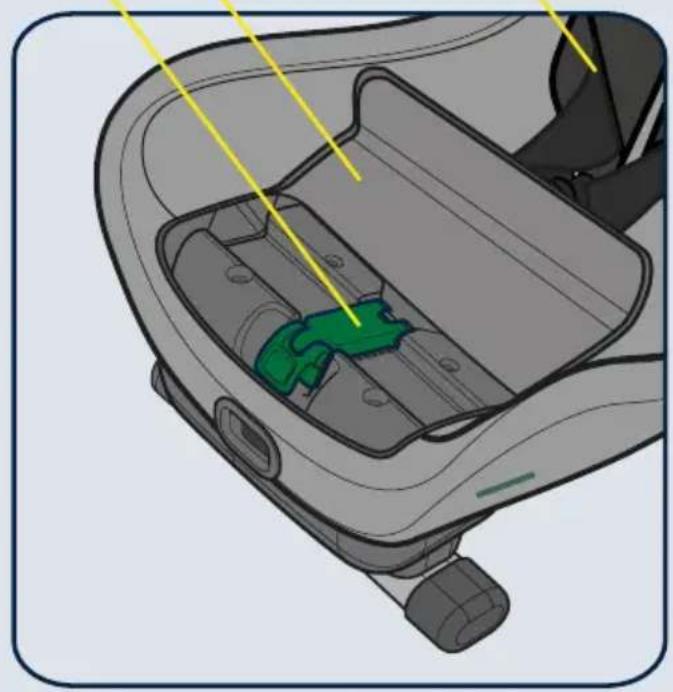
natural_image
3D diagram of a car gear shift lever with highlighted green component (no text or symbols)natural_image
Two icons: a left-turn arrow and a car silhouette (no text or symbols)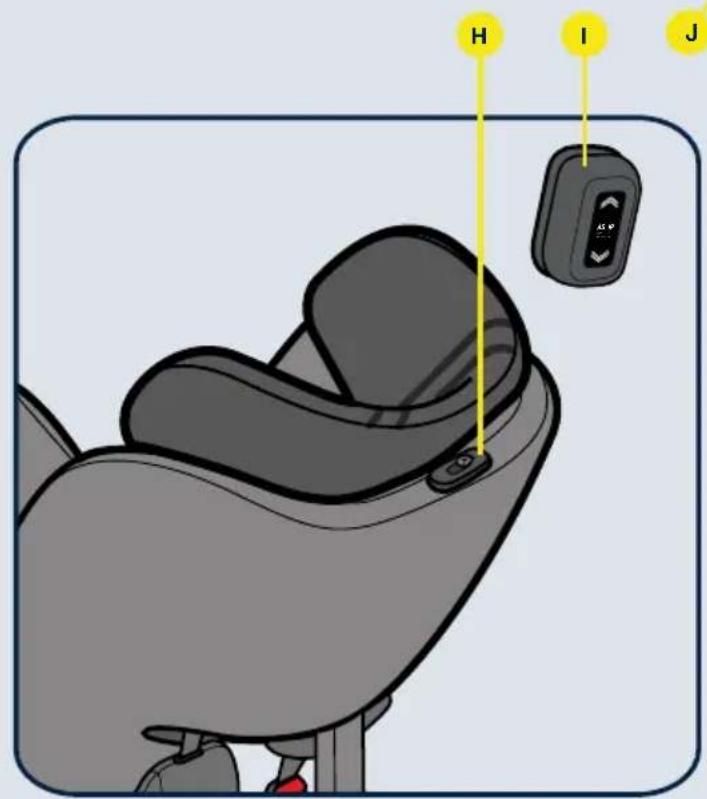
A TETIERĂ
B HAM INTEGRAT
C BUTON DE DESCHIDERE A CATARA-MEI
D FANTĂ PENTRU CENTURA DE SIGURANȚĂ
E BUTON DE DESCHIDERE A HAMULUI
F CHINGĂ DE TENSIONARE A HAMULUI
G PÂRGHIE DE REGLARE ÎNCLINARE
H PÂRGHIE DE BLOCARE A TETIEREI
PROTECTIE ASIP
J BAZĂ
K LINIE VERTICALĂ
natural_image
Diagram of a car interior showing a green plastic component and yellow directional arrows indicating flow or movement (no text or symbols)L CONECTOR ASIP
M FIXATOR INFERIOR
N CLEMĂ DE CENTURĂ
O CAPACUL CLEMEI DE CENTURĂ
P PICIOR DE SPRIJIN
Q BUTONUL PICIORULUI DE SPRIJIN
R CHINGĂ PENTRU UMĂR
S CHINGĂ DE FIXARE INFERIOARĂ 2 BUC.
T REGLAJUL UNGHIULUI DE ÎNCLINARE
natural_image
Two icons: a left-turn arrow and a car silhouette (no text or symbols)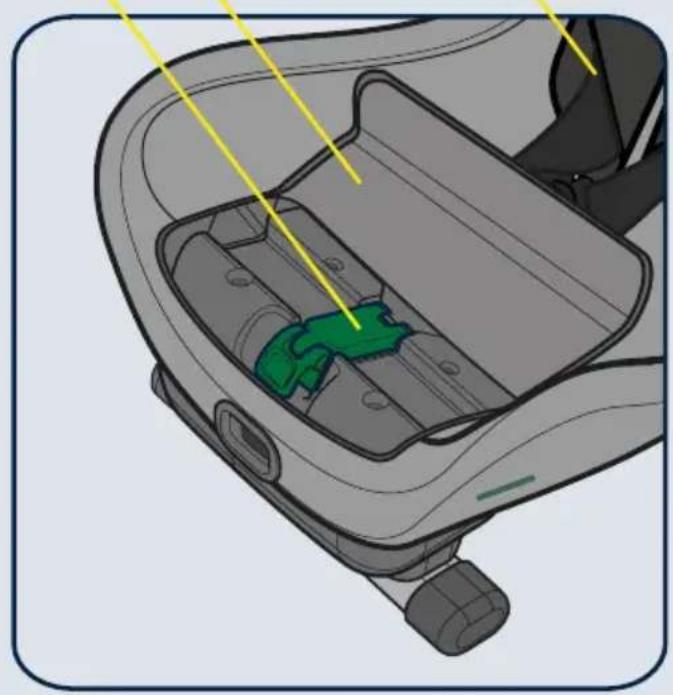
natural_image
3D diagram of a car interior showing a green plastic component and yellow alignment lines (no text or symbols)
natural_image
3D diagram of a car interior showing a green plastic component and yellow directional arrows (no text or symbols)L ASIPコネクター
M ロウワーテザー
N ベルト締め具
○ ベルト締め具の蓋
P サポートレッグ
Q サポートレッグボタン
R 肩ベルト
S ロウワーテザー固定用ストラップ×2
T リクライニング調整用アジャスター
natural_image
Technical line drawing of a mechanical device with internal components and mounting brackets (no text or symbols)EN DA
DE FI
ES ET
FR EL
IT IS
NL PT
PL RO
CS AR
SV JP
NO

- Sverige/Norge
- UK/Ireland
- France
- Deutschland
- España/Portugal
- Polsce
- Czech Republic
- România
- New Zealand
- Suomi
- Malaysia
- Greece Ελλάδα
- Serbia Србија
- Eesti
- Latvia
- Lietuva
- South Africa
- Ísland
- Japan
- Thank you for choosing AXKID MINIKID 4
- Important information
- Table of content
- Parts
- Allowed and disallowed positioning of AXKID MINIKID 4 car seat
- Lower Tether Anchorages Important info
- Installing lower tether anchorage straps
- Anchorage strap routing options
- Installing AXKID MINIKID 4 car seat in the vehicle
- Restraining your child in AXKID MINIKID 4 car seat
- Headrest Adjustment
- Removing AXKID MINIKID 4 car seat from the vehicle
- Recycling your car seat
- Care and maintenance
- Remove the textile cover:
- Install the textile cover:
- Warranty
- The warranty does not cover:
Brand : COSATTO
Model : Axkid Minikid 4
Category : Car seat