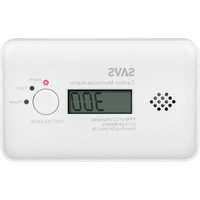
C10 - Smoke detector SAVS - Free user manual and instructions
Find the device manual for free C10 SAVS in PDF.


| Product Type | Carbon Monoxide (CO) Detector |
| Brand | SAVS |
| Model | C10 |
| Dimensions | 116.4 mm × 71.7 mm × 28.3 mm |
| Weight (estimated) | 150 g |
| Power Supply | 3 V DC (CR123A battery) |
| Battery Type | CR123A (replaceable) |
| Battery Life | 10 years (standby) |
| Sensor | Electrochemical (Figaro®) |
| Alarm Thresholds (CO) | 50 ppm: 60-90 min; 100 ppm: 10-40 min; 300 ppm: < 3 min |
| Alarm Volume | ≥ 85 dB (A) at 3 m |
| Display | LCD screen (concentration in ppm, peak value) |
| LED Indicators | Green (standby), Red (alarm), Yellow (fault) |
| Button | Test / Silence |
| Operating Temperature | -10 °C to +55 °C |
| Relative Humidity | ≤ 95 % RH (non-condensing) |
| Certification | EN 50291-1:2018/AC:2021 |
| Sensor Life | 10 years |
| Mounting Method | Wall mount (mounting plate included) |
| Package Contents | Detector, drilling template, screws/anchors, CR123A battery, manual |
| Warranty | 2 years (parts and labor) |
Frequently Asked Questions - C10 SAVS
User questions about C10 SAVS
0 question about this device. Answer the ones you know or ask your own.
Ask a new question about this device
Download the instructions for your Smoke detector in PDF format for free! Find your manual C10 - SAVS and take your electronic device back in hand. On this page are published all the documents necessary for the use of your device. C10 by SAVS.
USER MANUAL C10 SAVS
1 Information on carbon monoxide
EN
What is carbon monoxide (CO)
Carbon monoxide is an odourless, tasteless, highly toxic and flammable gas produced by the incomplete combustion of carbon-based fuels. Prolonged exposure to a carbon monoxide-rich environment leads to serious tissue damage or even death.
What are the symptoms of carbon monoxide poisoning?
- Mild exposure (about 100-200 ppm): mild headache, nausea, vomiting, fatigue (often described as "flu-like" symptoms).
• Medium exposure (about 400 ppm): violent throbbing headache, drowsiness, confusion, fast heartbeat. - Extreme exposure (about 800 ppm): unconsciousness, convulsions, cardiorespiratory failure, death.
| Parts per Million (PPM) | Effects on Adults |
| 100 | Mild headache, nausea, vomiting, fatigue (often described as "flu-like" symptoms). |
| 200 | Dizziness and headache within 2-3 hours. |
| 400 | Nausea, frontal headache, drowsiness, confusion and rapid heart rate.Risk to life after over 3 hours of exposure. |
| 800 | Severe headaches, convulsions, vital organ failures. Death possible within 2-3 hours. |
Where does carbon monoxide come from?
Carbon monoxide is caused by poor or incomplete combustion.
- A furnace, boiler, cooker, pellet stove, fireplace, wood stove, charcoal grill can be sources of carbon monoxide, especially if they are not working properly or if they are located in a poorly ventilated room.
- Vehicle exhaust gases in enclosed spaces (garage) can also become carbon monoxide hazards.
- With the use of paraffin heaters or charcoal grills/bbqs indoors or running a car in a garage, carbon monoxide levels can get so high that it can cause death.
How do I know if carbon monoxide is present?
Poisoning is measured in a range called parts per million (ppm). This CO Alarm monitors the level of carbon monoxide (CO) in the air. If the CO concentration is too high, the detector sounds a loud alarm. When the alarm sounds, warn all household members, go outside immediately and call 112.
EN
How do I protect myself and my family from carbon monoxide poisoning?
• Install one or more carbon monoxide detectors in your home.
- Have your home's heating system, boiler and other gas, oil or coal appliances checked every year by a competent person or company.
• Make sure that your combustion appliances and engines are well ventilated.
• Have your chimney checked and cleaned every year.
- Use gas appliances as recommended. Never use a gas cooker or oven to heat indoor areas.
What should I do if the carbon monoxide detector goes off?
When the carbon monoxide concentration reaches a dangerous level, the carbon monoxide detector emits a loud alarm signal (85dB) and the Alarm LED flashes rapidly.
• Inform all household members of the danger.
- Go outside immediately and call 112.
- Do not re-enter the premises until the alarm has been stopped and the source of the leak has been dealt with by an expert.

CAUTION
Unlike a smoke detector, a carbon monoxide detector does not easily give false alarms. If the CO Alarm goes off, take it seriously and assume that there is an excessive concentration of CO somewhere.
2 Important precautions and warnings
This manual will help you to use the detector correctly. Read this manual carefully before using the detector. Keep this manual for future reference.
Instructions for use

WARNING
- Never ignore an alarm. Failure to respond may result in serious injury or death.
- Do not attempt to open or disassemble the detector. There is a risk of electric shock or malfunction if the detector is tampered with.

CAUTION
- Transport, use and store the detector under the permitted humidity and temperature conditions.
- Prevent liquids from splashing or dripping on the detector. Prevent liquid from entering the detector by ensuring that no objects containing liquid are placed on top of it.
- This CO Alarm is designed to detect only the presence of CO; it cannot detect smoke, gas, heat or flames.
- This device is not intended for use by persons with reduced physical, sensory or mental capabilities, or lack of experience and knowledge, unless they have been given supervision or instruction concerning use of the detector by a person responsible for their safety.
- Vapours or gases, e.g. in cleaning liquids, polishes, paints, cooking processes, etc., can affect the detector's reliability in the short or long term.
Installation instructions

WARNING
If you do not install and operate this detector properly, it will not function properly and will not react adequately to carbon monoxide hazards. See Section 5 for proper installation.

CAUTION
- Before installation, read Section 5 on the correct installation location of the CO Alarm.
- Do not expose the detector to direct sunlight or heat sources.
- The detector must be installed by a competent person.
EN

3 Product
3.1 Product information
This Carbon Monoxide Alarm responds quickly with high sensitivity, stable performance and low false alarms when there is too much Carbon Monoxide in the air. This detector is able to measure carbon monoxide levels as low as 30 ppm using the high quality Figaro® sensor. As soon as the ambient carbon monoxide concentration reaches the alarm value, the detector sounds a loud 85dB alarm and the alarm LED flashes rapidly. The LCD display shows the amount of ppm. This detector is certified in accordance with the latest European standard EN 50291-1:2018/AC:2021 for carbon monoxide detectors.
3.2 Product profile
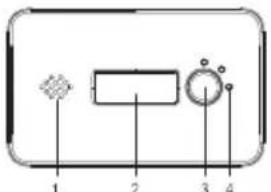
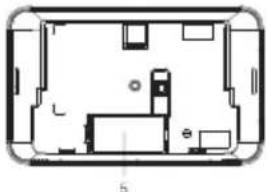
| No. | Section Description | |
| 1 | Buzzer | Alarm sound: 85dB (A) at 3 meters. |
| 2 | LCD display | Displays the current carbon monoxide concentration or peak reading. |
| 3 | Test/Silence button | Check normal operation: press the Test/Silence button; the detector now beeps 3 times. The LCD display will show 8888 for 3 seconds and all LED lights will flash 3 times.Stop the alarm sound: Press the Test/Silence button and the detector will temporarily stop the alarm sound (45 seconds). |
| 4 | Indicator | Standby: Power LED flashes once per minute.Alarm: Alarm LED flashes red.Fault: Fault LED is flashing yellow. |
| 5 | Battery compartment | Replaceable CR123A battery. |
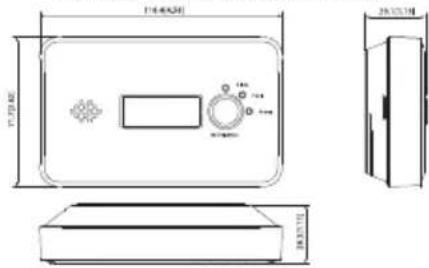
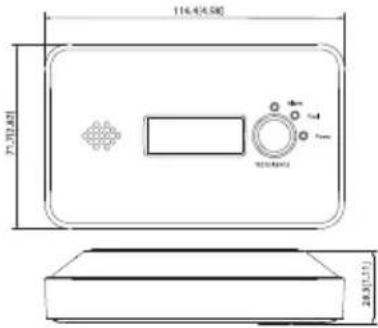
3.3 Dimensions
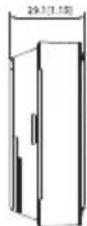
Figure 3-1 Dimensions (mm[inch])
4 Technical Information
| Parameter Introduction | |
| Detection gas | Carbon monoxide (CO) |
| Alarm triggered at the specific CO concentration within the time periods listed | 50 ppm: 60-90 min100 ppm: 10-40 min300 ppm: < 3 min |
| Operating voltage | 3 V direct current (DC) |
| Guard current | ≤ 20 uA |
| Alarm current | ≤ 10 mA |
| Operating temperature | -10 °C to +55 °C |
| Relative humidity | ≤ 95% RH (non-condensing) |
| Alarm method | Visual and audible alarm |
| Alarm volume | ≥ 85 dB (A) @ 3 m |
| Muting | Support |
| Dimensions | 116.4 mm × 71.7 mm × 28.3 mm |
| Installation | Mounting plate for woll |
| LED light | Red: AlarmYellow: FaultGreen: Standby (lx per minute) |
| Sensor lifetime | 10 years |
| Battery life | 10 years |
| Duration silence | 45 sec. |
| Certificates | EN 50291-1:2018/AC:2021 |
EN

5 Installing the detector
5.1 Package content
Check the contents of the package against the list below. If the detector is damaged or a part is missing, please contact the supplier. Table 5-1 Checklist
| Name | Number |
| Carbon monoxide detector | 1 |
| Drilling template | 1 |
| Set of screws/plugs | 1 |
| Battery | 1 |
| User Manual | 1 |
5.2 Installation position
In which room should the detector be installed?
Preferably install a carbon monoxide detector in every room with a combustion appliance. For added safety, also install detectors in living rooms and bedrooms. Make sure you can always hear the detector when it sounds the alarm.
Where in the room should the detector be installed?
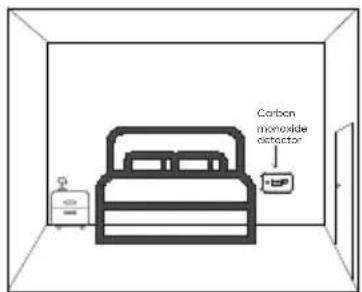
· Install in a bedroom without a combustion device.
◇ Install the alarm at the occupants' breathing height.
- Never install the alarm on or near the floor. Carbon monoxide mixes with air and will therefore rarely travel to the floor.
Image 5-1 Installation in a bedroom without a fuel appliance
-6--7-
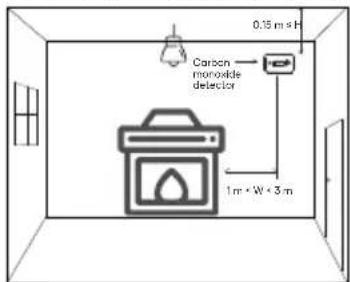
• Install in a living room with a combustion device (stove, boiler, fireplace, gas fire).
◇ Install the alarm above the combustion device. Carbon monoxide rises to the surface due to the hot gases from the combustion device.
◇ Install the alarm at least 15 cm from the ceiling.
Image 5-2 Installation in a room with a fuel appliance
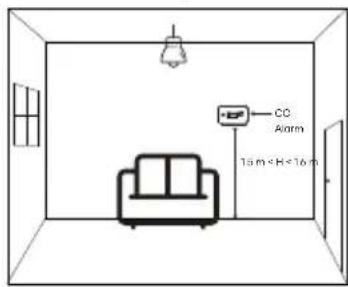
• Install in a living room without a combustion device.
◇ Install the alarm on a wall about 1.5 meters to 1.6 meters above the floor.
Never install the alarm on or near the floor. Carbon monoxide mixes with air and will rarely travel to the floor.
Image 5-3 Installation in a living room without a fuel appliance

EN Do not install a CO detector here
· Dusty, dirty, greasy or damp areas.
- In poorly ventilated kitchens, garages, boiler rooms, confined spaces (e.g. in a cupboard or behind a curtain) where smoke or fumes circulate under normal working conditions.
- Near stoves, cookers and other hot and easily contaminated places.
- Against or near the floor.
- Directly above the source of heat and steam.
• In direct sunlight
- Near obstructed areas (e.g. by furniture).
- Next to a door or window, exhaust fan, air vent or other similar ventilation openings.
- In rooms where the temperature may drop below -10 °C or rise above 55 °C.
5.3 First use
Carefully remove the plastic tab from the battery.
Step 1 Select a suitable location for placing the drilling template.
Step 2 Mount the detector with screws or a magnetic mounting kit (not included)
- Screw
1) Drill screw holes (6 mm) according to the drilling template on the mounting surface and then insert the dowels into the holes.
Figure 5-4 Installation (1)
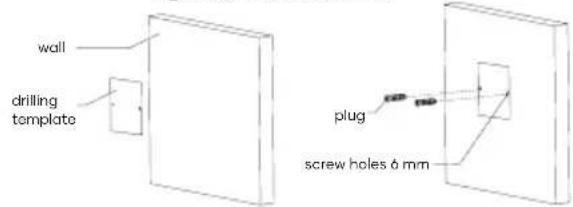
2) Attach the detector to the mounting surface.
EN
Figure 5-5 Installation (2)
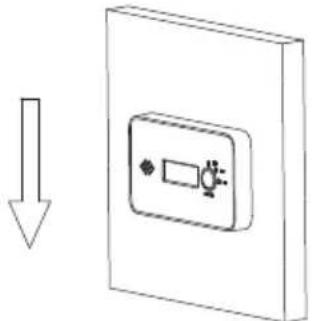
Step 3 After installation, test the detector by pressing the Test/Silence button.
Check that the LED lights, buzzer and LCD display are working properly as described in chapter 3.2.
EN
6 Operation LCD screen
| LCD Display | LED Status Alarm | Sound | Unit Status | Solutions |
| Lights up 3 seconds (8888) | All LED lights flash 3 times | The buzzer beeps 3 times | Self-test | No |
| - | The Power LED blinks green once per minute | No | The detector switches on and works normally | No |
| Carbon monoxide concentration in ppm | The Alarm LED flashes red once per second | The buzzer beeps 1 time per second | A carbon monoxide leak has been discovered | Inform all household members, go outside immediately and call 112. |
| No | No | Peak volume measured | Reset Peak Volume by removing the battery from the product. LCD screen with peak volume will turn off after pressing the Test/Silence button. | |
| Lb | The Fault LED flashes yellow once a minute | Buzzer beeps 1 time per minute | Battery low | Replace the battery immediately |
| Err | The Fault LED flashes yellow 2 times per minute | The buzzer beeps 2 times per minute | Failure | See chapter 9 Frequently asked questions |
| End | The Fault LED flashes yellow 3 times a minute | The buzzer beeps 3 times per minute | End of life | The maximum service life has been reached. Replace the detector immediately. |
PEAK VOLUME MEASUREMENT
EN
This detector displays on the LCD the amount of carbon monoxide measured in the past. This peak volume is displayed in ppm and remains on the LCD until the peak reading is reset.

CAUTION
If the LCD screen is on for a longer period of time, it will affect the battery life. Please check the LCD screen of your detector regularly.

CAUTION
A peak reading on the LCD screen indicates that carbon monoxide has been measured in the past. Ventilate where possible and call a professional or installer immediately to have your appliances checked.
7 Testing and maintenance
7.1 Testing
After installing or maintaining the detector, always perform a test to check that it is working properly. See section 3.2. If the detector fails the test, contact the supplier.
Self-test device
Press the Test/Silence button; the 3 LED lights will now flash rapidly and the buzzer will beep 3 times. The LCD display shows 8888 for 3 seconds.
Empty battery
When the battery voltage drops below a certain threshold, the Power indicator flashes and the buzzer beeps every minute until the battery is empty. Replace the battery immediately with an approved type. After replacing the battery, retest the detector.
button once to ensure that the buzzer and LED lights operate normally. If a malfunction occurs, please correct it in time.
EN7.2 Maintenance
- Clean the detector at least once a year by cleaning the housing. Use a soft cloth or the soft brush of a hoover for this purpose. Avoid applying cleaning agents to the detector to avoid possible contamination of the sensor.
- Test the detector every week (recommended). Under normal operating conditions, press the Test/Silence button once to ensure that the buzzer and LED lights operate normally. If a malfunction occurs, please correct it in time.
8 Battery Replacement
When the detector gives a low battery warning, replace the battery immediately. Test the detector every time you replace the battery. When replacing the battery, pay close attention to the positive and negative polarity markings (+ and -).

NOTE
Recommended battery: CR123A

WARNING
The sensor of this carbon monoxide detector has a service life of 10 years. After this, the detector is unreliable. So always replace the detector after 10 years.
Figure 8-1 Replacing the battery
![graph LR A["Open Box with internal components"] --> B["Closed Box with internal circuitry"] B --> C["Remote Control Unit"]](/content/2026/04/702387/images/acddd3063d0a28e2c9739bd91adeb00ddaf3af145b43d08341ab293f1efba03e.jpg)
9 Frequently asked questions
EN
| Problem Analysis | Solutions | |
| The green Power LED does not blink once per minute | The battery is not inserted | Insert battery or pull out plastic seal or tab |
| The LED bulb is broken | Contact the supplier for advice | |
| Press the Test/ Silence button; there is no alarm | Circuit breaker | Contact the supplier |
| No response to detected carbon monoxide | Circuit breaker | Contact the supplier |
| The detector continuously emits a sharp, high-pitched sound | There is a large amount of volatile substances such as alcohol, perfume, petrol or paint present | Move the detector to clean air (outside) and let it "operate" for 2 hours to allow the smoke to escape from the detector. |
| Circuit breaker | Contact the supplier | |
10 Disposal

Waste electrical products must not be disposed of with other household waste. Please dispose of the electrical appliance in an environmentally-friendly manner and in strict accordance with local regulations on the disposal or recycling of electrical appliances.

WARNING
Do not burn or throw into fire.

11 Warranty and Contact
If you need after-sales service, please contact your local dealer or retailer.
SAVS® is a brand of
IVendor B.V.
Docterskampstraat 5
5222 AM's-Hertogenbosch
The Netherlands
www.savs.me



-14--15-
-35--34-
Figure 3-1 Dimensions (mm[inch])
![116.4[4.58] 77.32.43 29.1[7.15] 28.3[1.71]](/content/2026/04/702387/images/ff0c1f78893c8505374a28692bcb7ebd3cd5639d1a2cea84a24d2b58e09b420c.jpg)
ES
-50--51-
Image 3-1 Dimensions (mm[inch])
4 Informations techniques
- 1 INFORMATION ON CARBON MONOXIDE
- WHAT IS CARBON MONOXIDE (CO)
- WHAT ARE THE SYMPTOMS OF CARBON MONOXIDE POISONING
- WHERE DOES CARBON MONOXIDE COME FROM
- HOW DO I KNOW IF CARBON MONOXIDE IS PRESENT
- EN
- HOW DO I PROTECT MYSELF AND MY FAMILY FROM CARBON MONOXIDE POISONING
- WHAT SHOULD I DO IF THE CARBON MONOXIDE DETECTOR GOES OFF
- CAUTION
- 2 IMPORTANT PRECAUTIONS AND WARNINGS
- INSTRUCTIONS FOR USE
- WARNING
- INSTALLATION INSTRUCTIONS
- 3 PRODUCT
- 3.1 PRODUCT INFORMATION
- 3.3 DIMENSIONS
- 5 INSTALLING THE DETECTOR
- 5.1 PACKAGE CONTENT
- 5.2 INSTALLATION POSITION
- IN WHICH ROOM SHOULD THE DETECTOR BE INSTALLED
- WHERE IN THE ROOM SHOULD THE DETECTOR BE INSTALLED
- EN DO NOT INSTALL A CO DETECTOR HERE
- 5.3 FIRST USE
- PEAK VOLUME MEASUREMENT
- 7 TESTING AND MAINTENANCE
- 7.1 TESTING
- SELF-TEST DEVICE
- EMPTY BATTERY
- EN7.2 MAINTENANCE
- 8 BATTERY REPLACEMENT
- NOTE
- 10 DISPOSAL
- 11 WARRANTY AND CONTACT
Brand : SAVS
Model : C10
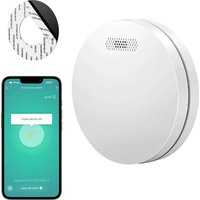
Category : Smoke detector