DW729 - Saw DEWALT - Free user manual and instructions
Find the device manual for free DW729 DEWALT in PDF.


User questions about DW729 DEWALT
0 question about this device. Answer the ones you know or ask your own.
Ask a new question about this device
Download the instructions for your Saw in PDF format for free! Find your manual DW729 - DEWALT and take your electronic device back in hand. On this page are published all the documents necessary for the use of your device. DW729 by DEWALT.
USER MANUAL DW729 DEWALT
text_image
Technical diagram of a mechanical device with numbered parts labeled for identification.A1
text_image
Technical diagram of a mechanical device with numbered components for identificationA2
text_image
G4 45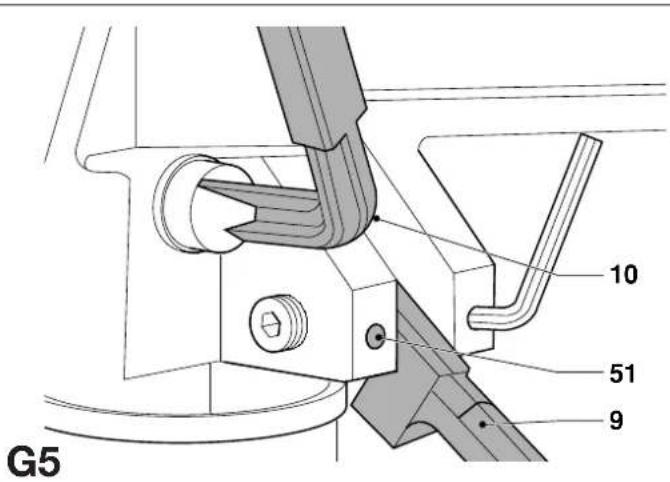
text_image
G5 10 51 9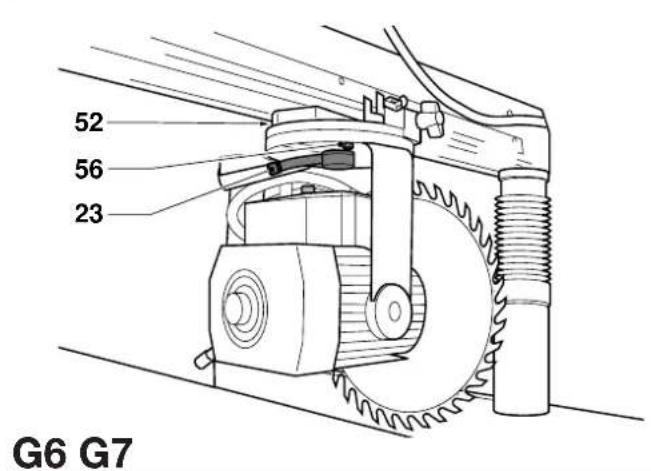
text_image
52 56 23 G6 G7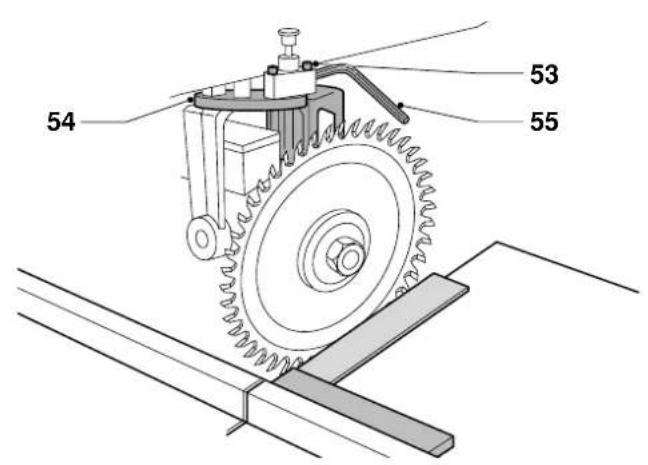
text_image
53 54 55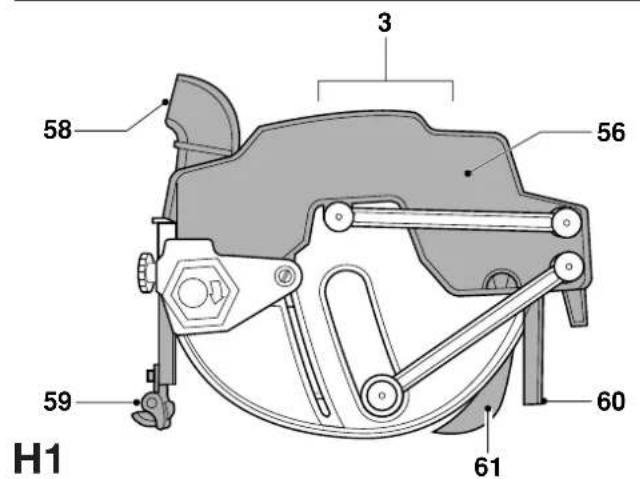
text_image
3 58 56 59 60 61 H1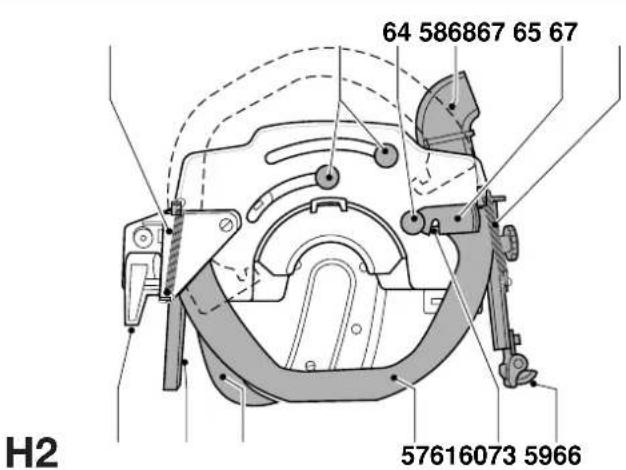
text_image
64 586867 65 67 57616073 5966 H2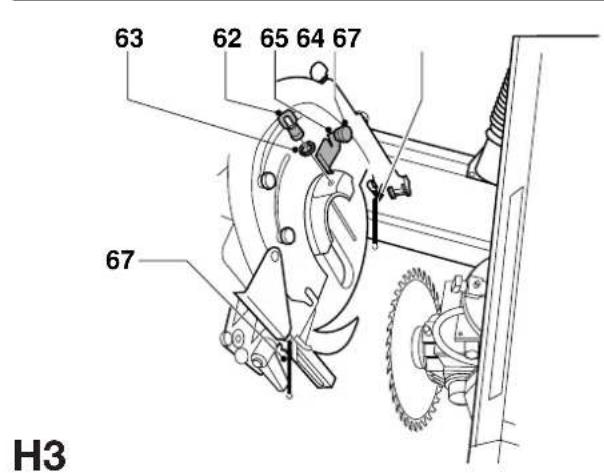
text_image
63 62 65 64 67 67 H3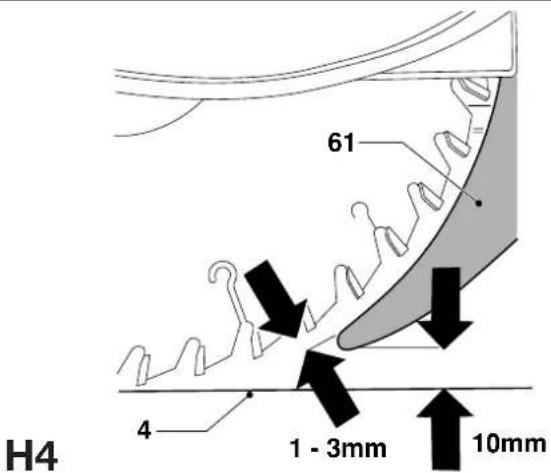
text_image
61 4 1 - 3mm 10mm H4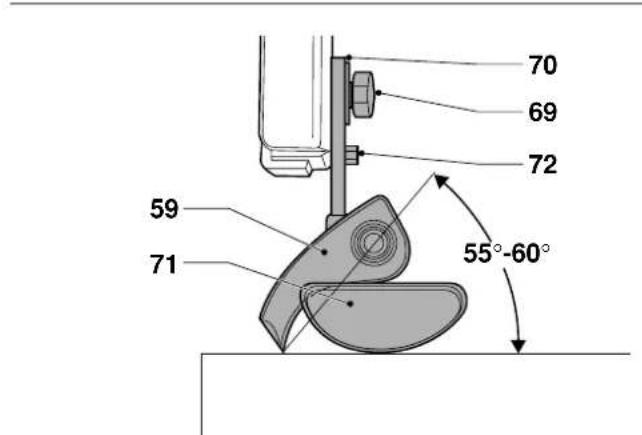
text_image
70 69 72 59 71 55°-60°H5
text_image
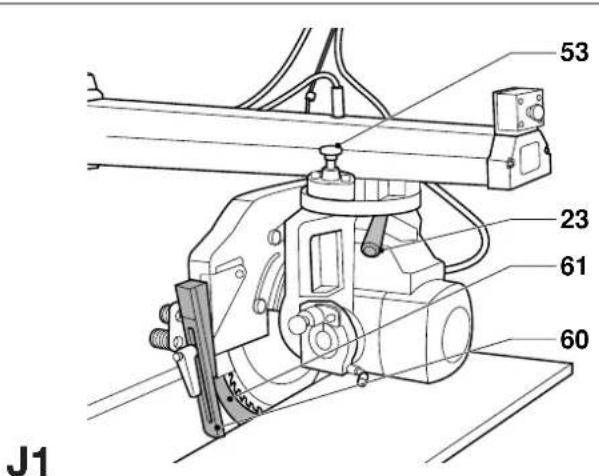
53 23 61 60 J1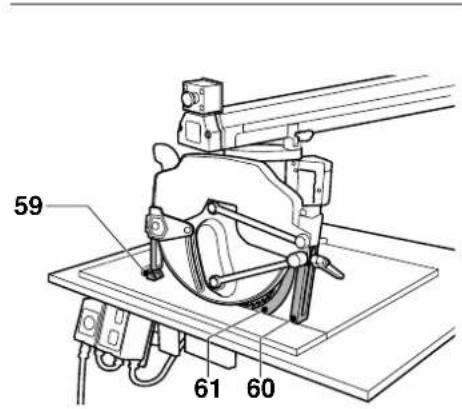
text_image
59 61 60J2
text_image
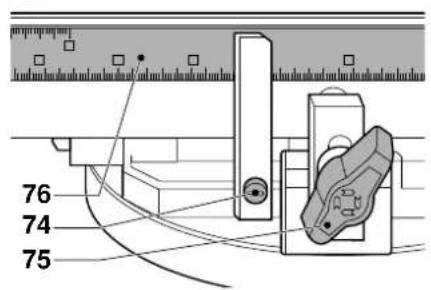
76 74 75J3
natural_image
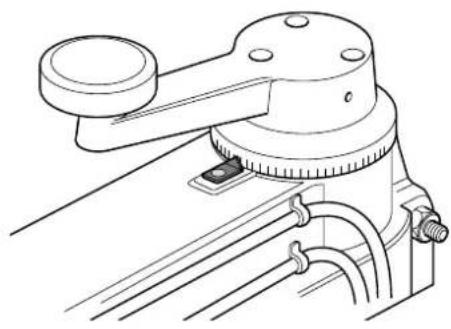
Technical line drawing of a mechanical lever assembly (no text or symbols)J4
text_image
80 81 82 83 84 K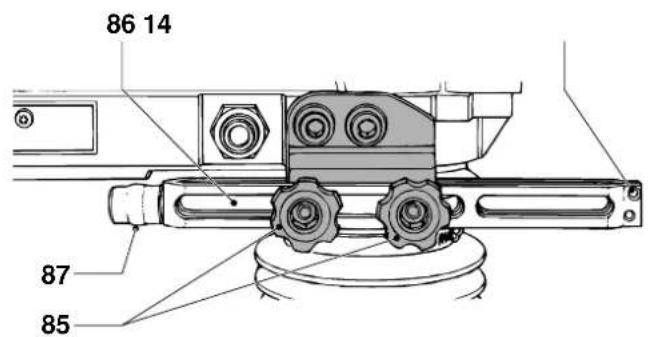
text_image
86 14 87 85L1
natural_image
Technical line drawing of a mechanical assembly with gears and adjustment knobs (no text or symbols)L2
text_image
92 91 90 89 14M
text_image
N1 4 6 7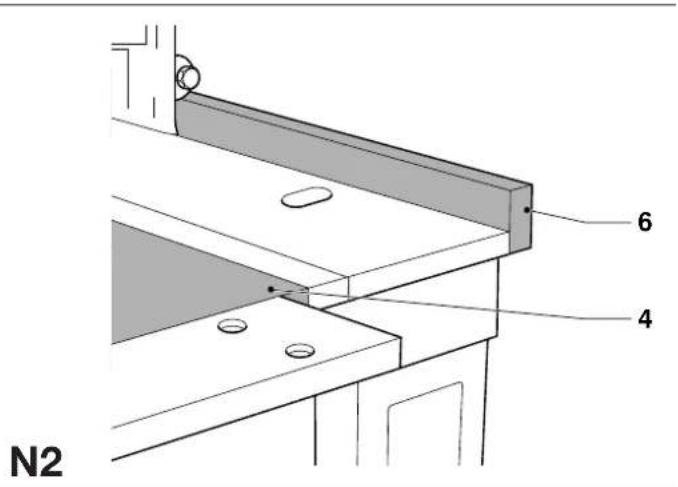
text_image
N2 4 6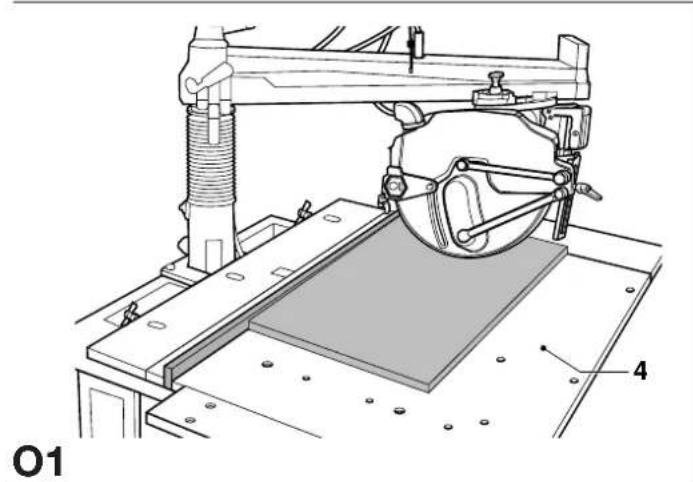
natural_image
Technical line drawing of a mechanical assembly with labeled components (no readable text or symbols)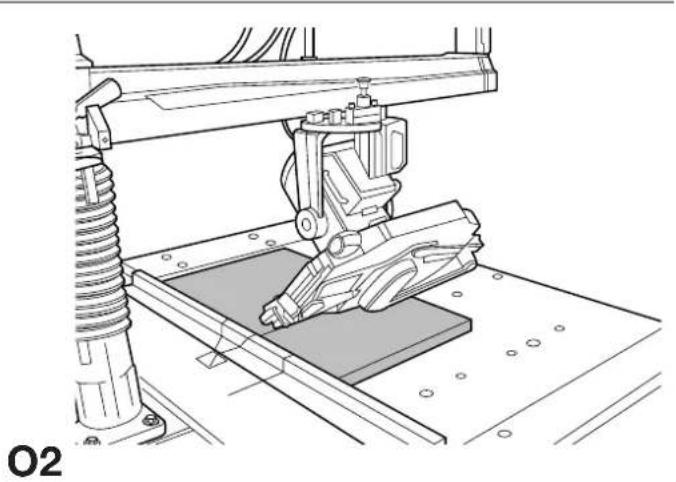
natural_image
Technical line drawing of a 3D printer or mechanical assembly with no visible text or symbols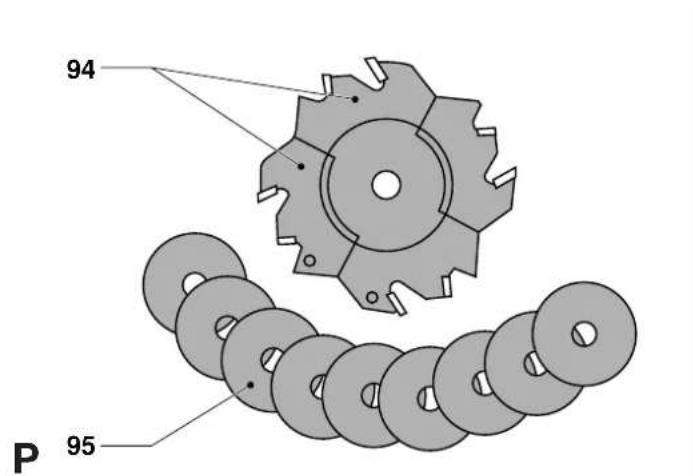
text_image
94 P 95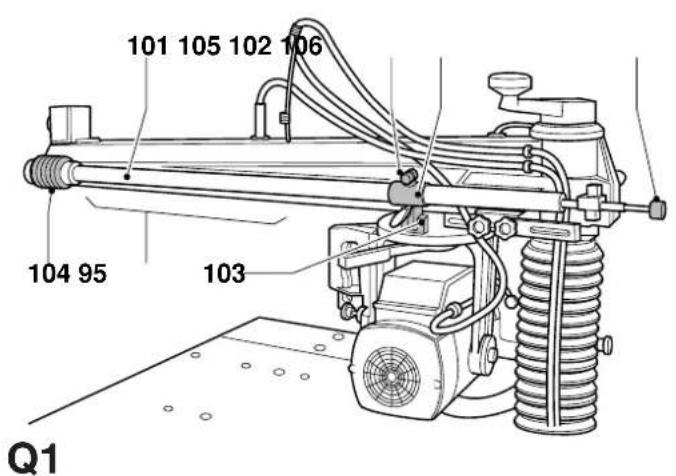
text_image
101 105 102 106 104 95 103 Q1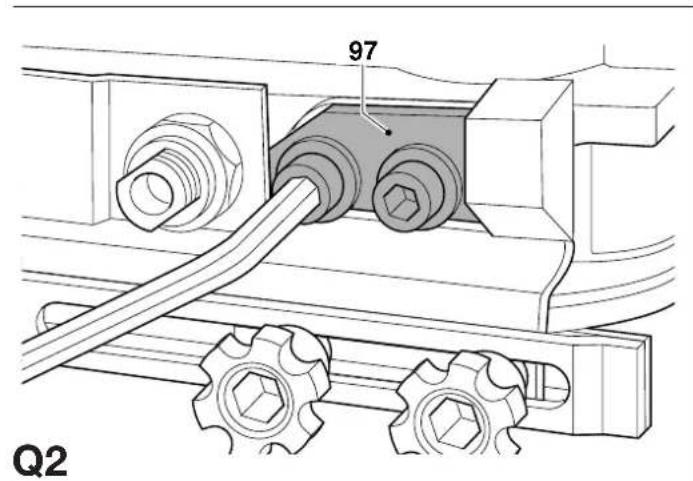
text_image
97 Q2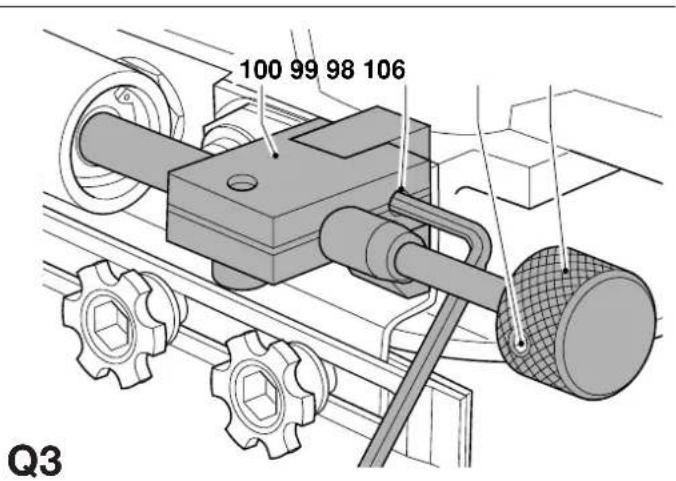
text_image
100 99 98 106 Q3RADIALARMSAV DW728/DW729
Tillykke!
RADIALARMSÄGE DW728/DW729
You have chosen a DeWALT product. Years of experience, thorough product development and innovation make DeWALT one of the most reliable partners for professional users.
Table of contents
| Technical data en - 1 |
| EC-Declaration of conformity en - 1 |
| Safety instructions en - 2 |
| Package contents en - 3 |
| Description en - 3 |
| Electrical safety en - 3 |
| Mains plug replacement (U.K. & Ireland only) en - 3 |
| Using an extension cable en - 3 |
| Assembly and adjustment en - 4 |
| Instructions for use en - 6 |
| Optional accessoires en - 7 |
| Maintenance en - 8 |
| Guarantee en - 8 |
| Quick reference chart en - 9 |
Technical data
| DW728 DW729 | |||
| Motor power (input) | W | 2200 | 4000 |
| Motor power (output) | W | 1840 | 3000 |
| Voltage | V | 230 | 415 |
| Blade diameter max | mm | 350 | 350 |
| Blade bore | mm | 30 | 30 |
| Spindle diameter | mm | 30 | 30 |
| No load speed, 50 Hz | min^-1 | 2800 | 2800 |
| No load speed, 60 Hz | min^-1 | 3400 | 3400 |
| Depth of cut at 90° | mm | 110 | 110 |
| Depth of cut at 45° | mm | 75 | 75 |
| Max. crosscut capacity at 0°in 25 mm stock | mm | 610 | 610 |
| Max. mitre cut capacity at 45°in 25 mm stock | mm | 445 | 445 |
| at max. cutting depth | mm | 380 | 380 |
| Max. crosscut width | mm | 610 | 610 |
| Max. rip cut width | mm | 920 | 920 |
| Overall dimensions (with legstand) | mm | 148 x 95 x 150 | 148 x 95 x 150 |
| Dust extraction adapter | mm | 100 | 100 |
| Weight | kg | 149 | 149 |
Standard equipment:
Legstand, TCT blade, blade guard and tools, no-volt release switch.
| Fuses: | ||
| Europe | 230 V tools | 16 Amperes, mains |
| 415 V tools | 16 Amperes, per phase | |
| UK & Ireland | 16 Amperes, in plug | |
The following symbols are used throughout this manual:

Denotes risk of personal injury, loss of life or damage to the tool in case of non-observance of the instructions in this manual.

Denotes risk of electric shock.

Sharp edges.
EC-Declaration of conformity

DW728
DeWALT declares that these power pools have been designed in compliance with: 98/37/EEC, 89/336/EEC, 73/23/EEC, EN 61029, EN 55014-2, EN 55014, EN 61000-3-2 & EN 61000-3-11.
DW729
DeWALT declares that these Power Tools have been designed in compliance with: 98/37/EEC, 89/336/EEC, 73/23/EEC, EN 61029, EN 55014-2, EN 55014, EN 61000-3-2 & EN 61000-3-3.
For more information, please contact DEWALT at the address below or refer to the back of the manual.
Level of sound pressure according to 86/188/EEC & 89/392/EEC, measured according to DIN 45635:
| DW728 | DW729 | |||
| L_pA | (sound pressure) | dB(A)* | 85.5 | 85.5 |
| L_wA | (acoustic power) | dB(A) | 93.5 | 93.5 |
* at the operator's ear

Take appropriate measures for the protection of hearing if the sound pressure of 85 dB(A) is exceeded.
Weighted root mean square acceleration value according to DIN 45675:
| DW728 | DW729 | |
| < 2.5 m/s^2 | < 2.5 m/s^2 |
TÜV Rheinland
Director Engineering and Product Development
Horst Großmann
X. fopsmann
D-65510, Idstein, Germany
Safety instructions
When using Power Tools, always observe the safety regulations applicable in your country to reduce the risk of fire, electric shock and personal injury. Read the following safety instructions before attempting to operate this product.
Keep these instructions in a safe place!
General
1 Keep work area clean
Cluttered areas and benches can cause accidents.
2 Consider work area environment
Do not expose Power Tools to humidity. Keep work area well lit. Do not use Power Tools in the presence of inflammable liquids or gases.
3 Guard against electric shock
Prevent body contact with earthed surfaces (e.g. pipes, radiators, cookers and refrigerators).
For use under extreme conditions (e.g. high humidity, when metal swarf is being produced, etc.) electric safety can be improved by inserting an isolating transformer or a (FI) earth-leakage circuit-breaker.
4 Keep children away
Do not let children come into contact with the tool or extension cord. Supervision is required for those under 16 years of age.
5 Extension cords for outdoor use
When the tool is used outdoors, always use extension cords intended for outdoor use and marked accordingly.
6 Store idle tools
When not in use, Power Tools must be stored in a dry place and locked up securely, out of reach of children.
7 Dress properly
Do not wear loose clothing or jewellery. They can be caught in moving parts. Preferably wear rubber gloves and non-slip footwear when working outdoors. Wear protective hair covering to keep long hair out of the way.
8 Wear safety goggles
Also use a face or dust mask in case the operations produce dust or flying particles.
9 Beware of maximum sound pressure
Take appropriate measures for the protection of hearing if the sound pressure of 85 dB(A) is exceeded.
10 Secure workpiece
Use clamps or a vice to hold the workpiece. It is safer and it frees both hands to operate the tool.
11 Do not overreach
Keep proper footing and balance at all times.
12 Avoid unintentional starting
Do not carry the plugged-in tool with a finger on the switch. Be sure that the switch is released when plugging in.
13 Stay alert
Watch what you are doing. Use common sense. Do not operate the tool when you are tired.
14 Disconnect tool
Shut off power and wait for the tool to come to a complete standstill before leaving it unattended. Unplug the tool when not in use, before servicing or changing accessories.
15 Remove adjusting keys and wrenches
Always check that adjusting keys and wrenches are removed from the tool before operating the tool.
16 Use appropriate tool
The intended use is laid down in this instruction manual. Do not force small tools or attachments to do the job of a heavy-duty tool. The tool will do the job better and safer at the rate for which it was intended.
Warning! The use of any accessory or attachment or performance of any operation with this tool, other than those recommended in this instruction manual may present a risk of personal injury.
17 Do not abuse cord
Never carry the tool by its cord or pull it to disconnect from the socket. Keep the cord away from heat, oil and sharp edges.
18 Maintain tools with care
Keep the tools in good condition and clean for better and safer performance. Follow the instructions for maintenance and changing accessories. Inspect the tool cords at regular intervals and, if damaged, have them repaired by an authorized DeWALT repair agent. Inspect the extension cords periodically and replace them if damaged. Keep all controls dry, clean and free from oil and grease.
19 Check for damaged parts
Before using the tool, carefully check it for damage to ensure that it will operate properly and perform its intended function. Check for misalignment and seizure of moving parts, breakage of parts and any other conditions that may affect its operation. Have damaged guards or other defective parts repaired or replaced as instructed.
Do not use the tool if the switch is defective. Have the switch replaced by an authorized DeWALT repair agent.
20 Have your tool repaired by an authorized DEWALT repair agent
This Power Tool is in accordance with the relevant safety regulations. To avoid danger, electric appliances must only be repaired by qualified technicians.
Additional Safety Rules for Radial Arm Saws
- Protect the electric power supply with a suitable fuse or circuit breaker.
- Keep the bearing tracks in the arm and the bearings on the roller head assembly clean and free from grease.
- Before switching ON, make sure that the fence is in the correct position. The blade should not contact the material until the saw is pulled by the handle.
- Always set the finger guard so that it passes through the pre-cut slot in the fence and/or 3 mm above the surface of the material being cut (except when ripping).
- When ripping, keep the riving knife adjusted to the correct distance from the blade (1 - 3 mm) and make sure the kickback fingers are properly adjusted.
- When ripping, always check the direction of feed.
- Regularly check the adjustments for accuracy and adjust as required.
- Make sure that the blade rotates in the correct direction and that the teeth are pointing towards the fence.
- Make sure all clamp handles are tight before starting operation.
- Never run the machine without all guards in place.
- When not in use, protect the saw blade completely using the blade guard.
- When not in use, when changing blades or carrying out maintenance, disconnect the machine from the power supply.
- Always use sharp blades of the correct type designed for the workpiece. The recommended blade diameter is stated in the technical data.
- Do not wedge anything against the motor fan to hold the motor shaft.
- Do not force the cutting action. (Stalling or partial stalling of the motor can cause major damage. Allow the motor to reach full speed before cutting.)
- Do not lift the machine by its worktable.
- Do not cut ferrous metals, non-ferrous metals or masonry.
- Do not apply lubricants to the blade when it is running.
- Do not place either hand in the blade area when the saw is connected to the power source.
- Do not reach around behind the saw blade when in use.
- Do not place hands closer than 150 mm from the saw blade while cutting.
- Do not use damaged or cracked saw blades.
Residual risks
The following risks are inherent to the use of radial arm saws: In spite of the application of the relevant safety regulations and the implementation of safety devices, certain residual risks cannot be avoided.
These are:
- Impairment of hearing.
- Risk of accidents caused by the uncovered parts of the rotating saw blade.
- Risk of injury when changing the blade.
- Risk of squeezing fingers when opening the guards.
- Health hazards caused by breathing dust developed when sawing wood, especially oak, beech and MDF.
Package contents
The package contains:
1 Partly assembled machine
5 Table top sections
1 Fence
4 Triangular supports
4 Straight supports
1 Motor, yoke and roller head assembly
1 No-volt release switch and brake control box
1 Isolating switch (DW729)
1 Dust extraction adapter
1 Box containing:
4 legs
1 height adjustment crank
1 cross head screw
1 saw blade
1 guard assembly
2 Skinpacks containing:
16 M8 x 16 socket head screws
8 M8 x 30 flat slotted head bolts
24 M8 nuts
32 D8 flat washers
1 Dust extraction adapter
1 41 mm spanner
2 box spanners (13 & 17 mm)
6 Allen keys (3, 4, 5, 6, 8 & 12 mm)
1 Plastic bag containing:
12 D10 flat washers
12 M10 nuts
12 socket head screws
1 Instruction manual
1 Exploded drawing
- Check for damage to the tool, parts or accessories which may have occurred during transport.
• Take the time to thoroughly read and understand this manual prior to operation. - Remove the saw from the packaging material carefully.
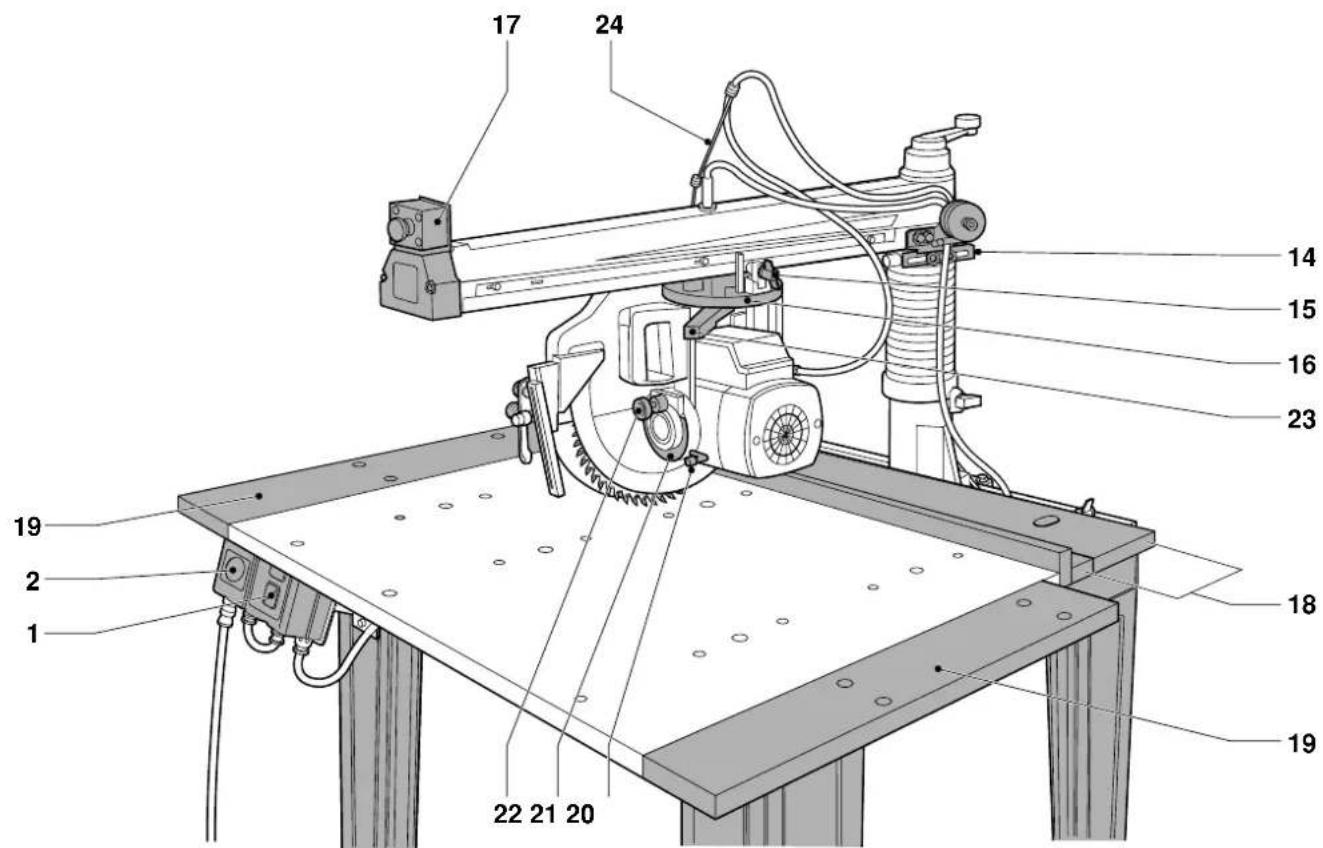
Description (fig. A1 & A2)
The DW728/DW729 Radial Arm Saw has been designed for the professional woodworking industry. This high precision machine can be easily and quickly set to crosscut, bevel, mitre, or rip. With the help of the wide variety of accessories, your Radial Arm Saw will perform virtually all workshop operations. For optimum safety, all major controls have both a latch and a locking device. Also refer to the quick reference chart in this manual.
A1
1 ON/OFF-switch
2 Isolating switch (DW729)
3 Leg
4 Fixed table top
5 Blade guard assembly
6 Fence
7 Table clamp
8 Column
9 Mitre latch lever
11 Height adjustment crank
12 Radial arm
13 End-cap
14 Yoke travel stop
15 Riplock
16 Roller head assembly
17 Emergency stop
18 Table strips
19 Table extension
20 Bevel clamp
21 Bevel scale
22 Bevel locating knob
23 Yoke clamp lever
24 Cable support
Electrical safety
The electric motor has been designed for one voltage only. Always check that the power supply corresponds to the voltage on the rating plate.
Mains plug replacement (U.K. & Ireland only)
- Should your mains plug need replacing and you are competent to do this, proceed as instructed below. If you are in doubt, contact an authorized DeWALT repair agent or a qualified electrician.
- Disconnect the plug from the supply.
- Cut off the plug and dispose of it safely; a plug with bared copper conductors is dangerous if engaged in a live socket outlet.
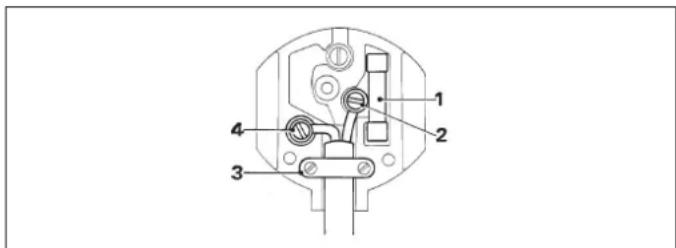
- Only fit 13 Amperes BS1363A approved plugs fitted with the correctly rated fuse (1).
- The cable wire colours, or a letter, will be marked at the connection points of most good quality plugs. Attach the wires to their respective points in the plug (see below). Brown is for Live (L) (2) and Blue is for Neutral (N) (4).
- Before replacing the top cover of the mains plug ensure that the cable restraint (3) is holding the outer sheath of the cable firmly and that the two leads are correctly fixed at the terminal screws.
text_image
1 2 3 4
Never use a light socket.
Never connect the live (L) or neutral (N) wires to the earth pin marked E or 12
For 115 V units with a power rating exceeding 1500 W, we recommend to fit a plug to BS4343 standard.
Using an extension cable
If an extension cable is required, use an approved extension cable suitable for the power input of this machine (see technical data). The minimum conductor size is 1.5 mm^2 . When using a cable reel, always unwind the cable completely.
Also refer to the table below.
Conductor size (mm²) Cable rating (Amperes)
| 0.75 6 |
| 1.00 10 |
| 1.50 15 |
| 2.50 20 |
| 4.00 25 |
Cable length (m)
7.5 15 25 30 45 60
Voltage Amperes Cable rating (Amperes)
| 230 0 - 2.0 6 6 6 6 6 | 6 | |
| 2.1 - 3.4 6 6 6 6 6 | 6 | |
| 3.5 - 5.0 6 6 6 6 10 15 | ||
| 5.1 - 7.0 | 10 10 10 10 15 15 | |
| 7.1 - 12.0 | 15 15 15 15 20 20 | |
| 12.1 - 20.0 | 20 20 20 20 25 | - |
Three-phase machines should be wired directly into the mains by a suitably qualified electrician.
Voltage drops
Inrush currents cause short-time voltage drops. Under unfavourable power supply conditions, other equipment may be affected.
If the system impedance of the power supply is lower than 0.25 , disturbances are unlikely to occur.
Assembly and adjustment

- Prior to assembly and adjustment always unplug the tool.
- For optimum performance of your saw, it is of vital importance to follow the procedures in the paragraphs below.
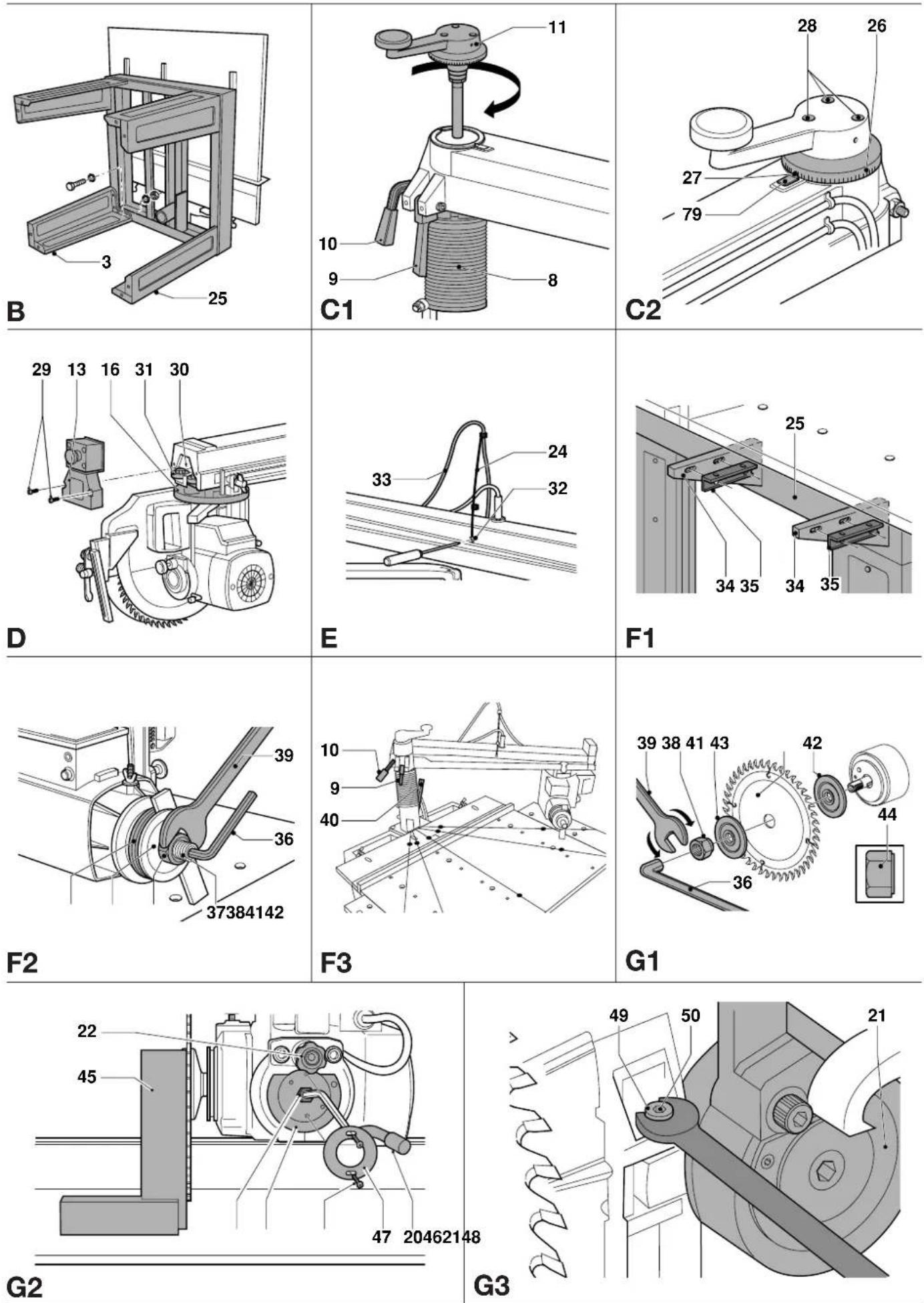
Assembling the legstand (fig. A1 & B)
The legstand components and fasteners are packed separately.
- Remove all parts from the package, except for the arm (12).
- Lock the arm using the mitre clamp lever (10).
- Tilt the machine backwards off the pallet and lie it with the rear of the column (8) on the floor.
- Using the M10 x 20 socket head screws, nuts and washers, fasten one leg (3) to each corner of the table base (25).
- Firmly tighten all fasteners.
- Tilt the assembly to upright position.

The machine must be level and stable at all times.
Fitting the switch boxes
DW728 - Fitting the ON/OFF-switch (fig. A1)
The ON/OFF-switch (1) is mounted on a bracket which must be fitted to the left-hand side leg using the fasteners on the bracket. The switch box also contains the brake control unit.
- Place the red button of the ON/OFF-switch at the bottom.
- Fit the bracket in the holes in the leg (two at the top and one at the bottom).
DW729 - Fitting the ON/OFF-switch and isolating switch (fig. A1 & A2)
The switch box of this model also contains an isolating switch (2) (fig. A2).
• Proceed as for the DW728.
Mounting the height adjustment crank (fig. C1 - C2)
- Rotate the arm to the central position.
- Press the mitre latch lever (9) down as shown (fig. C1).
-
Tighten the mitre clamp lever (10).
-
Introduce the height adjustment crank (11) into the column (8) as shown until the crank engages in the nut inside the column.
- Turn the height adjustment crank clockwise until it is fully seated (fig. C2).
- Align the mitre scale (26) with the pointer (27) and tighten the three screws (28) inside the height adjustment crank.
Mounting the roller head assembly (fig. A1 & D)
- Rotate the height adjustment crank (11) in the direction of the + to raise the arm (12) as far as it will go (fig. A1).
- Remove the two Allen screws (29) and remove the end-cap (13) (fig. D).
- Roughen the bearing tracks (30) using a steel wool pad and remove any dust with a dry cloth (fig. D).
- Make sure that the riplock (15) is released (fig. A1).
- Carefully insert the bearings (31) of the roller head assembly (16) into the bearing tracks.
- Move the roller head in the bearing tracks to check that it runs smoothly.
- Check that the riplock will lock and release the roller head as required.
- Replace the end-cap (13) immediately.
Mounting the cable support and cable clamp (fig. E)
- Remove the cross head screw (32).
- Mount the cable support (24) with the cable (33) and refit the cross head screw (32).
The saw table (fig. A2, F1 - F3)
Mounting the triangular supports (fig. A2 & F1)
Figure F1 shows the correct position of the triangular supports.
The supports are mounted using M8 x 16 bolts and corresponding nuts and with D8 flat washers at the front, but not at the rear.
- Mount the triangular supports (34) with the flat side to the front of the table base (25).
- Mount the straight supports (35) to the flat side of the triangular supports (34) as shown.
- Fit the two table extensions (19) to the supports by passing M8 x 30 slotted head screws with premounted washers through the four holes in the table extensions (fig. A2).
- Firmly tighten all fasteners.
Adjusting the table top parallel with the arm tracks using the arbor (fig. F2 & F3)
- Insert an Allen key (36) into the arbor (37) and loosen the arbor nut (38) using the 41 mm spanner (39) by turning clockwise (fig. F2).
- Clamp a piece of wood between the flanges (41) and (42) to be used as a height indicator and tighten the arbor nut (38).
- Loosen the mitre clamp lever (10) and the mitre clamp latch (9) (fig. F3).
- Loosen the height adjustment clamp (40).
- Rotate the arm until the piece of wood is right above one of the positions marked in figure F3.
- Carefully lower the arm until the arbor just touches the table top and skim the arm across to check all positions.
- If adjustment is required, proceed as follows:
- Place the 17 mm box spanner over the nut in the relevant hole in the table.
- table up : turn counterclockwise
- table down : turn clockwise
- Firmly tighten all fasteners.
- Slacken the bolts securing the straight supports to the triangular supports.
- Place a level over the two table extensions (19).
- The front of the extension tables must be flush with the front of the fixed table top.
- Adjust the position using the horizontal slotted holes in the triangular supports and the vertical slotted holes in the straight supports.
- Firmly tighten all fasteners.
- Bring the arm back to the central position and lock it.
The saw blade (fig. G1 - G6)
Mounting the saw blade (fig. G1)

- The teeth of a new blade are very sharp and can be dangerous.
-
The direction of rotation is indicated by the arrow on the motor.
-
Hold the arbor using the Allen key (36) supplied with the machine and remove the arbor nut (38) by turning clockwise with the open-ended spanner (39).
- Mount the blade (43) between the outer flange (41) and the inner flange (42) making sure that the lower teeth point to the rear of the machine.

Make sure that the ring (44) of the arbor nut (38) is against the outer flange (fig. G1).
- Tighten the arbor nut (38) by turning counterclockwise.
Checking that the blade is perpendicular to the table top (fig. A1 & G2 & G3)
- Bring the arm back to central position and tighten the riplock (15) (fig. A1).
- Place a steel square (45) against the blade body (fig. G2).
- If adjustment is required, proceed as follows:
- Remove the bevel pointer disk (46) by loosening the two screws (47).
- Slacken the Allen screw (48).
- Loosen the lock nuts (49) on either side of the bevel scale (21) (fig. G3).
- Adjust the unlocked screws (50) using an Allen key until the blade is flat against the square.
- Firmly tighten all fasteners.

It is particularly important to tighten the central Allen screw.
- Replace the bevel pointer disk (46) (fig. G2).
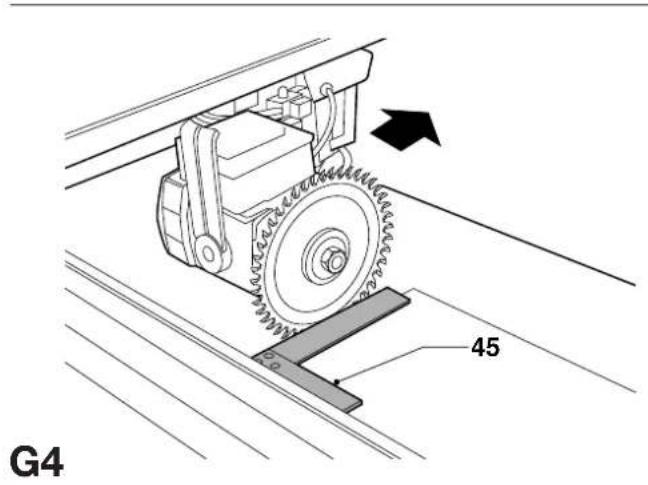
Checking that the crosscut travel is perpendicular to the fence (fig. G4 & G5)
- Lock the blade in front of the fence (fig. G4).
- Place a square (45) on a piece of board and against the fence and just touching the blade as shown.
- Unlock the riplock, pull the blade towards you to check that the blade traverses parallel to the square.
- If adjustment is required, proceed as follows:
- Loosen the mitre latch lever (9) and release the mitre clamp lever (10) (fig. G5).
- Loosen the two adjustment screws (51).
- To adjust the arm to the left, loosen the stud on the righthand side of the mitre latch lever and tighten the opposite stud.
- To adjust the arm to the right, loosen the stud on the lefthand side of the mitre latch lever and tighten the opposite stud.
- Proceed in small steps and check the adjustment after each step with the levers (9) and (10) engaged.

Do not overtighten the studs.
- Tighten the adjustment screws (51).
Checking that the blade is perpendicular to the fence (fig. G6 & G7)
- Loosen the yoke clamp lever (23) (fig. G6).
- Rotate the motor through 90^ as shown (fig. G6). The yoke latch (52) will automatically engage in this position (fig. G7).
- Place the blade against the fence and check that it is parallel to the fence.
- If adjustment is required, proceed as follows:
- Return the saw to 0^ crosscut position.
-
Loosen the two Allen screws (53) (fig. G7).
-
Manipulate the screws (54) using an Allen key (55) to adjust the blade position and check again.
• Tighten the Allen screws (53).
Mounting and adjusting the blade guard assembly (fig. H1 - H5)
The blade guard (5) is a multifunctional assembly which offers the following safety features (fig. H1):
- Upper guard (56) (fig. H1) and spring held rear guard (57) (fig. H2) for full blade protection.
- Dust extraction adapter (58) for cross and rip cutting.
- Anti-kickback fingers (59) for use in ripping mode.
- Adjustable finger guard (60) for use when cross-cutting.
-
Riving knife (61) to prevent the workpiece binding on the blade when ripping.
-
Release the bevel clamp (20) and pull out the bevel latch (22) (fig. A2) to tilt the motor as shown for optimum access (fig. H3).
- Remove the guard retaining wing nut (62) and washer (63).
- Loosen the locking screw (64) and turn the retaining bracket (65) anticlockwise until the spring held rear guard (57) can be lifted off its support lug (66).
- Unhook the two springs (67) at the top only.
- Rotate the unhooked rear blade guard (57) as shown in figure H2.
- Lower the guard assembly over the blade (fig. H3).
- Secure the guard assembly using the wing nut (62) and washer (63).
- Bring the spring held rear blade guard (57) and the retaining bracket (65) into their original position.
- To remove the guard assembly, proceed in reverse order.

The teeth of a new blade are very sharp and can be dangerous.
Adjusting the guard assembly controls (fig. H2 - H5)
Adjusting the riving knife for ripping
- Loosen the two knobs (68) and slide the riving knife (61) down until the tip is approximately 10 mm from the table top (fig. H2 & H4).

The riving knife should be correctly set; the distance between the toothed rim and the riving knife should be 1-3 mm (fig. H4).
Adjusting the anti-kickback fingers for (bevel) ripping (fig. H5)
- Loosen the knob (69) and lower the bracket (70) until the hold down spring (71) just touches the surface of the workpiece.
- The tips of the anti-kickback fingers (59) should now be 3 mm below the surface of the workpiece and the angle should now be as shown in figure H5.
- For bevel ripping, loosen the Allen screw (72) and set the anti-kickback fingers to the required angle.
Adjusting the riving knife, finger guard and anti-kickback fingers for cross-cutting (fig. H2)
- For cross-cutting, adjust the riving knife and anti-kickback fingers up and out of the way.
- Loosen the lever (73) to position the finger guard (60) just above the workpiece and lock the lever (73).
Scale adjustments (fig. G2, J1 - J4)
Rip scale
Ripping can be done with the motor in two positions. Each mode requires its own direction of feed:
Position Direction of feed
- In-rip from right to left (fig. J1)
- Out-rip from left to right (fig. J2)
The pointer (74) indicating the ripping width on the rip scale is adjustable (fig. J3):
- Place the fence in front position.
- Place a board of 24 mm against the fence.
- Position the motor in out-rip position (fig. J2).
- Move the yoke assembly along the radial arm until the blade just touches the edge of the material.
- Loosen the screw (75) and move the pointer (74) until the edge of the pointer lines up with the known width of the board on the lower scale (76) (fig. J3).
- Tighten the screw (75).
- Place the motor in in-rip position.
- Raise the guard to allow the blade to rest against the face of the fence.
- The in-rip pointer should now line up with the zero position in the upper scale (77). Adjust if necessary.
Bevel scale (fig. G2)
- Check that the bevel scale (21) reads 0^ when positioned for a vertical cut.
- If required, loosen the screws (47) and adjust the pointer (78) to 0^ .
- Check that the mitre scale (26) reads 0^ when positioned for a vertical cut.
- Adjust the pointer (27) to register 0^ using the screw (79).
The mitre scale has preset positions at 45^ left and right and at 0^ .
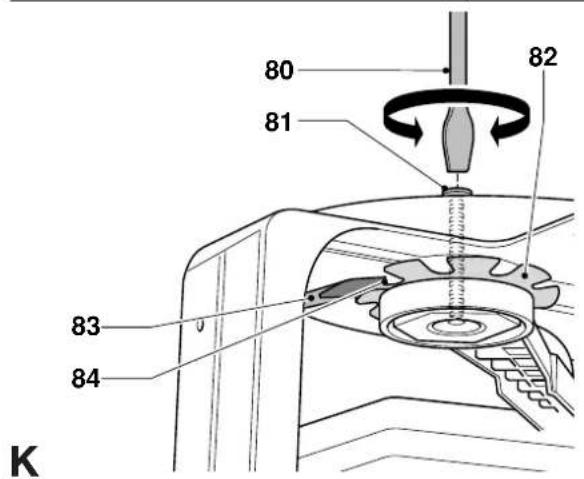
Adjusting the yoke clamp lever (fig. A1, A2 & K)
If the motor shows a certain play, the yoke clamp lever (23) needs to be tightened. The yoke clamp lever should be at approx. 90° or less to the main handle (fig. A2).
- If adjustment is required, proceed as follows:
- Remove the end-cap (13) and remove the complete roller head assembly (16) (fig. A1).
- Place a screwdriver (80) in the slotted head bolt (81) in the centre of the roller head assembly (fig. K).
- Lever the flange (82) down using a small screwdriver (83) so that it will pass over the lug (84), and turn the screwdriver in the slotted head bolt clockwise to tighten.
- Check again.

Move the flange one step at a time.
Yoke travel stop (fig. A2, L1 & L2)
The yoke travel stop (14) must be adjusted to avoid that the bearings on the yoke assembly hit the rear limit of the bearing tracks (fig. A2).
- Push the yoke assembly as far as it will go, pull it forwards approx. 5 mm and lock it using the riplock (15) (fig. A2).
- Adjust the yoke travel stop (14) by slackening the nuts (85) in the front slot (86) until the rubber stop (87) butts against the back of the riplock housing.
- Tighten the nuts (85) (fig. L1).

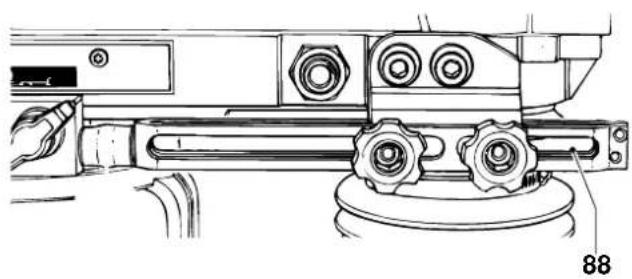
When cross-cutting, tighten one nut in the front slotted hole (86) and one in the rear slotted hole (88) (fig. L2).
Mounting the return spring (fig. M)
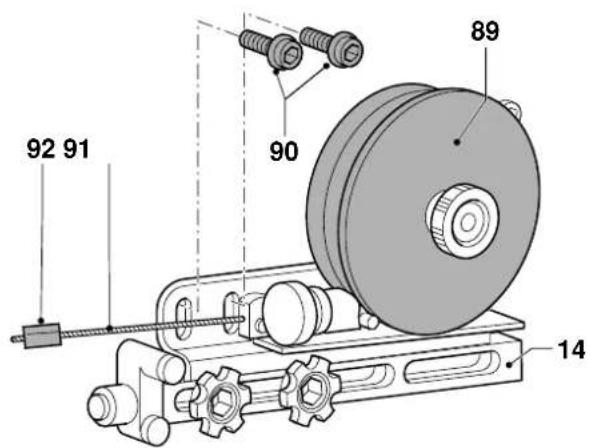
- Mount the return spring (89) behind the yoke travel stop (14) using the corresponding bolts (90) and attach the end of the cable (91) to the riplock (15) using the plastic clamp (92).
- To increase the spring tension, turn the knob (93) counterclockwise.
• To decrease the spring tension, turn the knob (93) clockwise.
Consult your dealer for further information on the appropriate accessories.
Instructions for use

• Always observe the safety instructions and applicable regulations.
- Ensure the material to be sawn is firmly secured in place.
- Apply only a gentle pressure to the tool and do not exert side pressure on the saw blade.
- Avoid overloading.
- Install the appropriate saw blade. Do not use excessively worn blades. The maximum rotation speed of the tool must not exceed that of the saw blade.
- Do not attempt to cut excessively small pieces.
- Allow the blade to cut freely. Do not force.
- Allow the motor to reach full speed before cutting.
- Make sure all locking knobs and clamp handles are tight.
- Never run the machine without the guards in place.
- Never lift the machine by the table top.
The attention of UK users is drawn to the “woodworking machines regulations 1974” and any subsequent amendments.
Switching ON and OFF (fig. A1)
The ON/OFF-switch (1) of your radial arm saw offers multiple advantages:
- no-volt release function: should the power be shut OFF for some reason, the switch has to be deliberately reactivated.
- motor overload protection device: in case of motor overload, the power supply to the motor will be cut OFF (In the DW728, the motor overload protection device is situated on top of the motor).
- Green button = ON The tool now works in continuous operation.
- Red button = OFF
- Isolating switch (2) (DW729) = manual rotary switch to cut OFF all power to the unit.
- Emergency stop (17) = cut OFF all power to the unit (fig. A2). To release the emergency stop, rotate it clockwise.
Making a trial cut (fig. A1, N1 & N2)
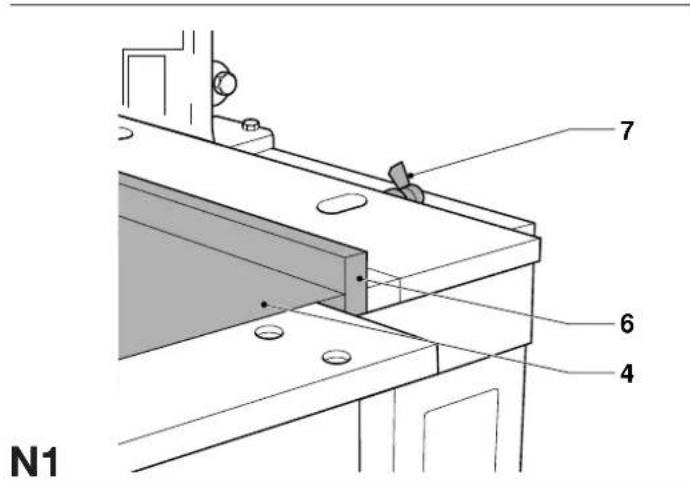
Figure N1 shows the standard position of the fence for cross-cutting and in-rip. Figure N2 shows the standard position of the fence for ripping wide panels. To release the fence, loosen the table clamps (7) (fig. N1).
- With the mitre latch lever (9) engaged, lock the mitre clamp lever (10) so that the blade is positioned for a straight 0^ cross-cut.
- Release the riplock (15) and push the yoke assembly back until the blade is behind the fence (fig. A1).
- Lower the arm until the blade almost touches the table top.
- Place the workpiece against the front of the fence.
- Switch ON and lower the arm to allow the blade to cut a shallow groove in the table surface.
- Pull the blade towards you so that it cuts a vertical slot in the wooden fence and through the workpiece.
- Return the blade back to rest position and switch OFF.
- Check that the cut is a true 90^ in all planes and adjust if required.
Basic Saw Cuts (fig. 01 - 02)

The teeth of a new blade are very sharp and can be dangerous.
Cross-cutting (fig. A1)
- Set the radial arm at right angles to the fence.
- Engage the mitre latch lever (9) in 0^ position and tighten the mitre clamp lever (10) (fig. A1).
- Lower the blade.
- Adjust the finger guard so that it just clears the workpiece.
- If there is no slot in the table top, cut one as described above.
-
Hold the workpiece against the fence, keeping your fingers well away from the path of the blade.
-
Switch ON and slowly pull the blade though the fence and the workpiece.
- Return the blade to rest position and switch OFF.
Mitre cuts (fig. A1 & O1)
- Release the mitre latch lever (9) and the mitre clamp lever (10) (fig. A1).
- Swing the arm to the required angle on the mitre scale.
- For 45^ left or right, engage the mitre latch lever (9) and lock with the mitre clamp lever (10).
- For intermediate angles, use the mitre clamp lever only.
• Proceed as for cross-cutting.

In the case of left-hand mitre, use the rear fence position.
Bevel cuts (fig. A1, G2 & O2)
- Set the arm as for a 0^ cross-cut.
- Raise the blade well above the table surface.
- Release the bevel clamp (20) and pull out the bevel latch (22) (fig. G2).
- Tilt the motor to the required angle on the bevel scale (21) (fig. A1).
- For 90^ or 45^ right, engage the bevel latch (22) and lock with the bevel clamp (20).
- For intermediate angles, use the bevel clamp only.
• Proceed as for a vertical cross-cut.
Ripping (fig. H2, J1 & J2)
The motor can be locked in in-rip or out-rip position as shown in figures J1 & J2 to adapt the machine to narrow and wide workpieces respectively.
- Lock the yoke in pulled out position using the riplock.
- Release the yoke clamp lever (23) and press the yoke latch (52) to rotate the motor to the appropriate position until it locks in place (fig. J1).
- Tighten the yoke clamp lever (23).
- Position the yoke along the arm for the desired width of cut, using the rip scale (76) and lock it in position using the riplock.
- Adjust the blade guard as described above and turn the dust extraction adaptor (58) away from your face (fig. H2). Remember that ripping requires the use of the riving knife (61) and the anti-kickback fingers (59) (fig. J2).
- Slowly feed the workpiece into the blade, keeping it firmly pressed onto the table and against the fence. Allow the teeth to cut and do not force the workpiece through the blade. The blade speed should be kept constant.

Always use a push stick.
Bevel ripping
- Set the machine in the bevel crosscut position.
- Rotate the yoke into rip position.
- Position the yoke for the correct ripping width.
- Angle the anti-kickback fingers so that they will be flat on the workpiece and lower the riving knife.
- Proceed as for ripping.
Compound mitre
This cut is a combination of a mitre and a bevel cut.
- Set the required bevel angle.
- Swing the arm to the required mitre position.
• Proceed as for mitre cuts.
Always switch OFF the tool when work is finished and before unplugging.

Dust extraction (fig. H1)
The machine is provided with a dust extraction adaptor (58).
- Whenever possible, connect a dust extraction device designed in accordance with the relevant regulations regarding dust emission.
- When cross-cutting, position a dust collection chute (option) behind the line of cut.
Optional Accessories

Prior to assembling any accessories always unplug the machine.
The Dado head (fig. F1, P1 & P2)
Figure P1 shows the parts composing the dado head. The dado head allows to cut wide, deep cuts in one pass.

Sharp edges.
Mounting the dado head
- Remove the blade guard assembly and the blade.
- Place one cutter blade (94) onto the shaft, making sure that the teeth point downwards.
- Mount the required number of intermediate blades (95) to achieve the required width of cut and finally the other cutter blade (94).
- Secure the dado head using the standard arbor nut (38) (fig. F2).
- Remove the riving knife and its support bracket from the blade guard assembly and mount the guard.
- Lower the dado head into position for the depth of cut required.
Using the dado head
- In crosscut or mitre position
- Adjust the anti-kickback fingers up and out of the way.
- Adjust the finger guard correctly.
- In ripping position
- Adjust the anti-kickback fingers correctly.
Traverse control (fig. A1, K, Q1 - Q3)
The traverse control (96) guarantees optimum results in applications where a consistent, even feed rate is important.
Mounting the traverse control
- Remove the return spring (89) in figure M.
- Remove the yoke travel stop (14) in figure A1.
- Mount the rear flat bracket (97) and the yoke travel stop as shown in figure Q2.
- Loosen the grub screw (98) in the knurled knob (106) using an Allen key and unscrew the knurled knob (fig. Q3).
- Loosen the grub screw (99) in the rear support (100) and pull the support off the rod.
• Pass the cylinder (101) through the cylinder clamp (102) (fig. Q1). - Position the cylinder clamp (102) over the riplock (15) and tighten the grub screws in each side of the mounting (103).
- Reassemble the rear support (100) and the knurled knob (106) and tighten all screws (fig. Q3).
- Position the rear support (100) as shown (fig. Q3) and tighten the grub screw (99).
- Push the roller head to the rear and position the cylinder in its clamp (102) as far to the rear as possible. The end of the rod should not touch the bleed bolt in the rubber bellows, when the bellows (104) are compressed. Check the position by pressing the bleed bolt.
- Tighten the screw (105) in the cylinder clamp.
- Set the traverse speed using the knurled knob (106).
Bleeding the traverse control
After refilling or replacing the oil in the traverse control, the air must be expelled from the system.
- Remove the unit from the machine and with the piston fully extended and turned downwards, clamp the unit in a vertical position.
- Remove the plug at the rear end of the bellows (104). Hold the bellows to avoid spilling the oil.
- Refill the bellows completely with hydraulic oil Castrol 210 NRL25 or equivalent using a funnel or an oil syringe.
- Replace the filler plug and tighten it one turn.
- Slightly press the bellows until some oil escapes from the filler plug.
- Tighten the filler plug with a wrench and reinstall the unit.
Maintenance
Your DeWALT Power Tool has been designed to operate over a long period of time with a minimum of maintenance. Continuous satisfactory operation depends upon proper tool care and regular cleaning.
- Replace the fixed table top and fence when worn.

Lubrication
Your Radial Arm Saw requires no additional lubrication.


Never grease the arm tracks or bearings.
Cleaning
- Regularly clean the armtracks. Remove the end-cap and the yoke to do so. Also remove dust from the bearings.
- Keep the table top clean at all times. Never use your hands to wipe off the dust.

Unwanted tools and the environment
Take your tool to an authorized DeWALT repair agent where it will be disposed of in an environmentally safe way.
GUARANTEE
• 30 DAY NO RISK SATISFACTION GUARANTEE •
If you are not completely satisfied with the performance of your DEWALT machine, simply return it within 30 days, complete as purchased, to a participating Dealer, or an authorized DEWALT repair agent, for a full refund or exchange. Proof of purchase must be produced.
• ONE YEAR FREE SERVICE CONTRACT •
If you need maintenance or service for your DEWALT machine, in the 12 months following purchase, it will be undertaken free of charge at an authorized DEWALT repair agent. Proof of purchase must be produced. Includes labour and spare parts for Power Tools. Excludes accessories.
• ONE YEAR WARRANTY •
If your DeWALT product becomes defective due to faulty materials or workmanship within 12 months from the date of purchase, we guarantee to replace all defective parts free of charge or, at our discretion, replace the unit free of charge provided that:
• The product has not been misused.
• Repairs have not been attempted by unauthorized persons.
• Proof of purchase date is produced.
This guarantee is offered as an extra benefit and is additional to consumers statutory rights.
For the location of your nearest authorized DEWALT repair agent, please use the appropriate telephone number on the back of this manual.
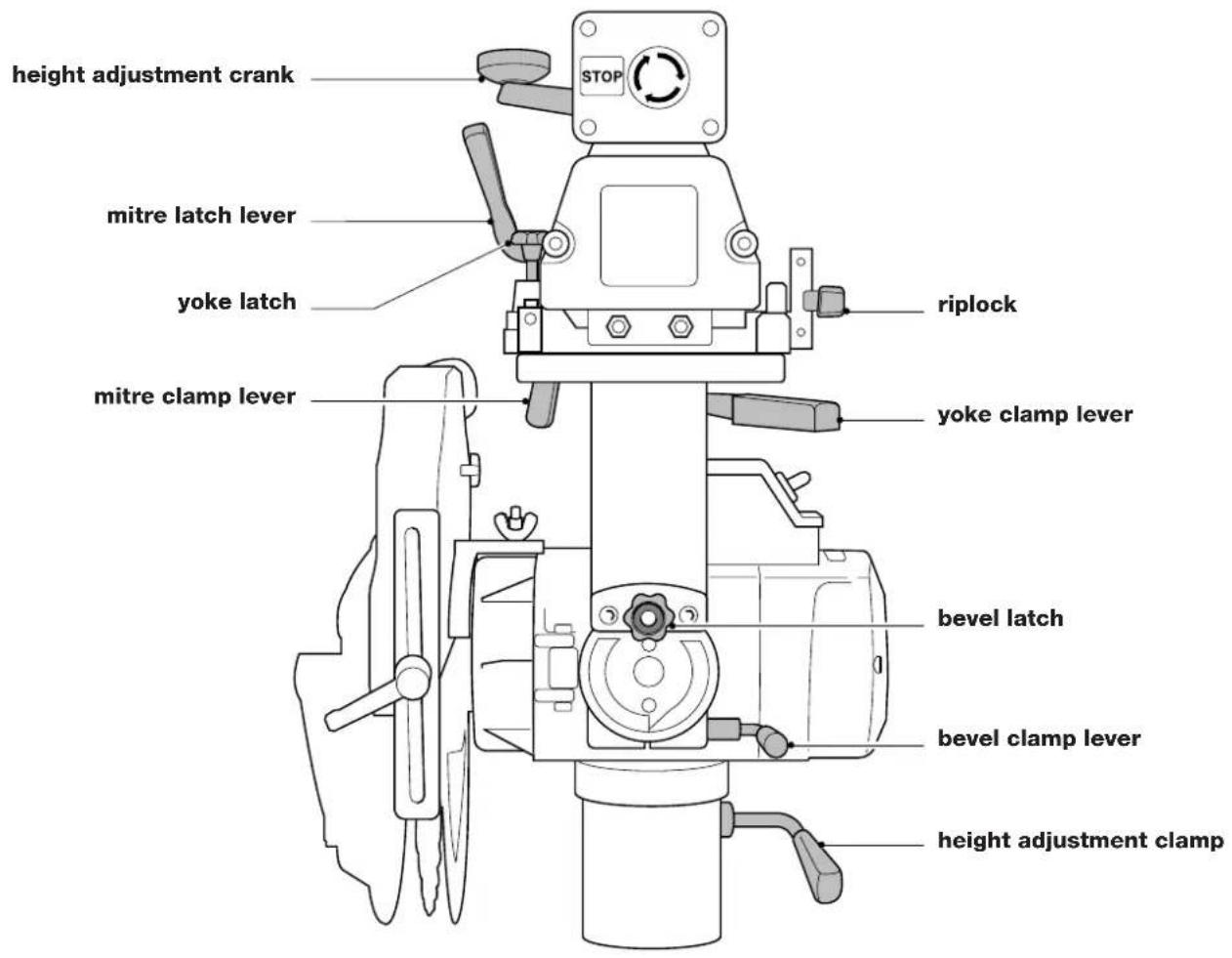
QUICK REFERENCE CHART
text_image
height adjustment crank mitre latch lever yoke latch mitre clamp lever riplock yoke clamp lever bevel latch bevel clamp lever height adjustment clampSIERRA CIRCULAR DE BRAZO DW728/DW729
¡Enhorabuena!
| Cert. No. | |
| BM 9511442.01 |
Director Engineering and Product Development Horst Großmann
X. fopsmann
SCIE RADIALE DW728/DW729
Félicitations!
L'emballage contient:
RADIAALARMZAAG DW728/DW729
Gefeliciteerd!
Director Engineering and Product Development Horst Großmann
text_image
X. fopsmannDeWALT, Richard-Klinger-Straße 40, D-65510, Idstein, Duitsland
RADIALARMSAG DW728/DW729
Gratulerer!
Director Engineering and Product Development Horst Großmann
X. fopsmann
1 Skillebryter (DW729)
1 Plastpose inneholder:
12 D10 flate skiver
12 M10 nøkler
12 skruer
1 Instruksjonsbok
1 Splitt-tegning
2 Skillebryter (DW729)
3 Ben
4 Fast borddel
5 Bladvern-enhet
6 Anlegg
7 Bordklemme
8 Søyle
22 Knott for avfasing
23 Åk-låsehändtak
24 Kabelholder
Elektrisk sikkerhet
Den elektriske motoren er kun konstruert for én spenning. Kontroller alltid at nettspenningen er i overensstemmelse med spenningen på typeskiltet.
Director Engineering and Product Development Horst Großmann
X. fopsmann
DeWALT, Richard-Klinger-Straße 40, D-65510, Idstein, Alemanha
15 Tire as chaves de aperto
DW728 - Colocar o interruptor ON/OFF (fig. A1)
Nunca lubrifique as guias do braço nem as chumaceiras.

Limpeza
Director Engineering and Product Development
Horst Großmann
X. fopsmann
RADIALARMSÅG DW728/DW729
Vi gratulerar!
Director Engineering and Product Development Horst Großmann
text_image
X. JopsmannDEWALT, Richard-Klinger-Straße 40, D-65510, Idstein, Tyskland