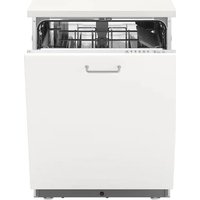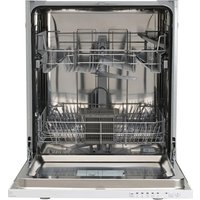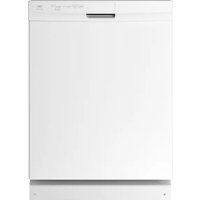
LAGAN 804.621.67 - Dishwasher IKEA - Free user manual and instructions
Find the device manual for free LAGAN 804.621.67 IKEA in PDF.


User questions about LAGAN 804.621.67 IKEA
0 question about this device. Answer the ones you know or ask your own.
Ask a new question about this device
Download the instructions for your Dishwasher in PDF format for free! Find your manual LAGAN 804.621.67 - IKEA and take your electronic device back in hand. On this page are published all the documents necessary for the use of your device. LAGAN 804.621.67 by IKEA.
USER MANUAL LAGAN 804.621.67 IKEA
Contents 2 Operating Instructions 9
Introduction 3 Care and Cleaning 14
Important Safety Information 4 Troubleshooting 16
Features 6 Warranty 21
Controls & Settings 7
Thank you for choosing IKEA.
This User Manual is part of our commitment to customer satisfaction and product quality throughout the service life of your new appliance.
We view your purchase as the beginning of a relationship. To ensure our ability to continue serving you, please use this page to record important product information.
Purchase Date
Model Number
Serial Number

NOTE
Very Important Information - Read Before Operating Your Dishwasher! Normal Operating Sounds
This dishwasher does not sound like most dishwashers - IT'S QUIETER.
Your Direct Feed Wash System dishwasher uses energy efficient motors for the wash and drain portions of the cycle you select. Each cycle has a series of water fills and drains for washing and rinsing dishes. As each cycle begins, you may-or may not-hear the drain motor. The next sound you will hear is the splashing water as it enters the tub.
PLEASE BE ADVISED: If you compare this dishwasher to previous models, you may be surprised at what you DON'T hear.

WARNING
For your safety, please follow the information in this manual to minimize the risk of fire, explosion, electric shock, and to help prevent property damage or personal injury.
Recognize Safety Symbols, Words and Labels
Safety items throughout this manual are labeled with a WARNING or CAUTION based on the risk type as described below:
Definitions
This is the safety alert symbol. It is used to alert you to potential personal injury hazards. Obey all safety messages that follow this symbol to avoid possible injury or death.

DANGER
DANGER indicates an imminently hazardous situation which, if not avoided, will result in death or serious injury.

WARNING
WARNING indicates a potentially hazardous situation which, if not avoided, could result in death or serious injury.

CAUTION
CAUTION indicates a potentially hazardous situation which, if not avoided, may result in minor or moderate injury.

IMPORTANT
IMPORTANT indicates installation, operation or maintenance information which is important but not hazard-related.
Child Safety
Destroy or recycle the carton, plastic bags, and any exterior wrapping material immediately after the laundry center is unpacked. Children should never use these items to play. Cartons covered with rugs, bedspreads, plastic sheets or stretch wrap may become airtight chambers, and can quickly cause suffocation.
Proper Disposal
Child entrapment and suffocation are not problems of the past. Junked or abandoned washers/dryers are still dangerous – even if they will sit for "just a few days". If you are getting rid of your old washer/dryer, please follow the Risk of Child Entrapment section of the safety instructions to help prevent accidents.
For Your Safety
- Use your dishwasher only as instructed in this User Manual.
- This Manual does not cover every possible condition and situation that may occur. Use common sense and caution when installing, operating and maintaining any appliance.
- NSF certified residential dishwashers are not intended for licensed food establishments.
- DISHWASHER MUST BE ELECTRICALLY GROUNDED. Read the Installation Instructions for details.
- This dishwasher is designed to operate on regular house current (120V, 60Hz). Use a circuit equipped with a 15 ampere fuse or circuit breaker. Use a 20 ampere fuse if dishwasher is connected with a food disposer.
-
Do not operate dishwasher unless all enclosure panels are in their proper place.
-
To avoid entrapment and/or suffocation, remove door or door latch mechanism from any dishwasher that is discarded or not in use.
- Keep young children and infants away from dishwasher when it is operating.
- Do not let children abuse, sit, stand or play on door or racks of a dishwasher.
- Use only detergents and rinse agents recommended for use in a dishwasher.
- Store dishwasher detergent and rinse agents out of the reach of children.
- Do not wash plastic items unless marked: "Dishwasher Safe" or equivalent. Check with manufacturer for recommendations, if not marked. Items that are not marked dishwasher safe may melt and create a potential fire hazard.
- Disconnect electrical power to dishwasher before servicing.
- If the dishwasher drains into a food disposer, make sure disposer is completely empty before running dishwasher.
• Repairs should be done by a qualified technician. - Do not tamper with controls.
- Do not touch the heating element during or immediately after wash has completed.
- Use care unloading the dishwasher when the SANITIZE option has been selected. Contents may be hot to the touch immediately after the end of cycle.
-
Water vapor from the vent may be hot to the touch when the SANITIZE option has been selected. Use care and do not let small children play around or touch the vent area of the dishwasher.
-
When loading items to be washed:
- Locate sharp items and knives so that they are not likely to damage the door seal or tub.
- Load sharp items and knives with the handles up to reduce the risk of cut-type injuries.
- Under certain conditions, hydrogen gas may be produced in a hot water, system that has not been used for 2 weeks or more. HYDROGEN GAS IS EXPLOSIVE. If hot water system has not been used for such a period, before using dishwasher, turn on for several minutes This will release any accumulated hydrogen gas. HYDROGEN GAS IS FLAMMABLE. Do not smoke or use an open flame during this time.
- Do not store or use combustible materials, gasoline or other flammable vapors and liquids in the vicinity of this or any other appliance.

WARNING
To reduce the risk of fire, electrical shock or injury when using your dishwasher, follow all basic precautions.
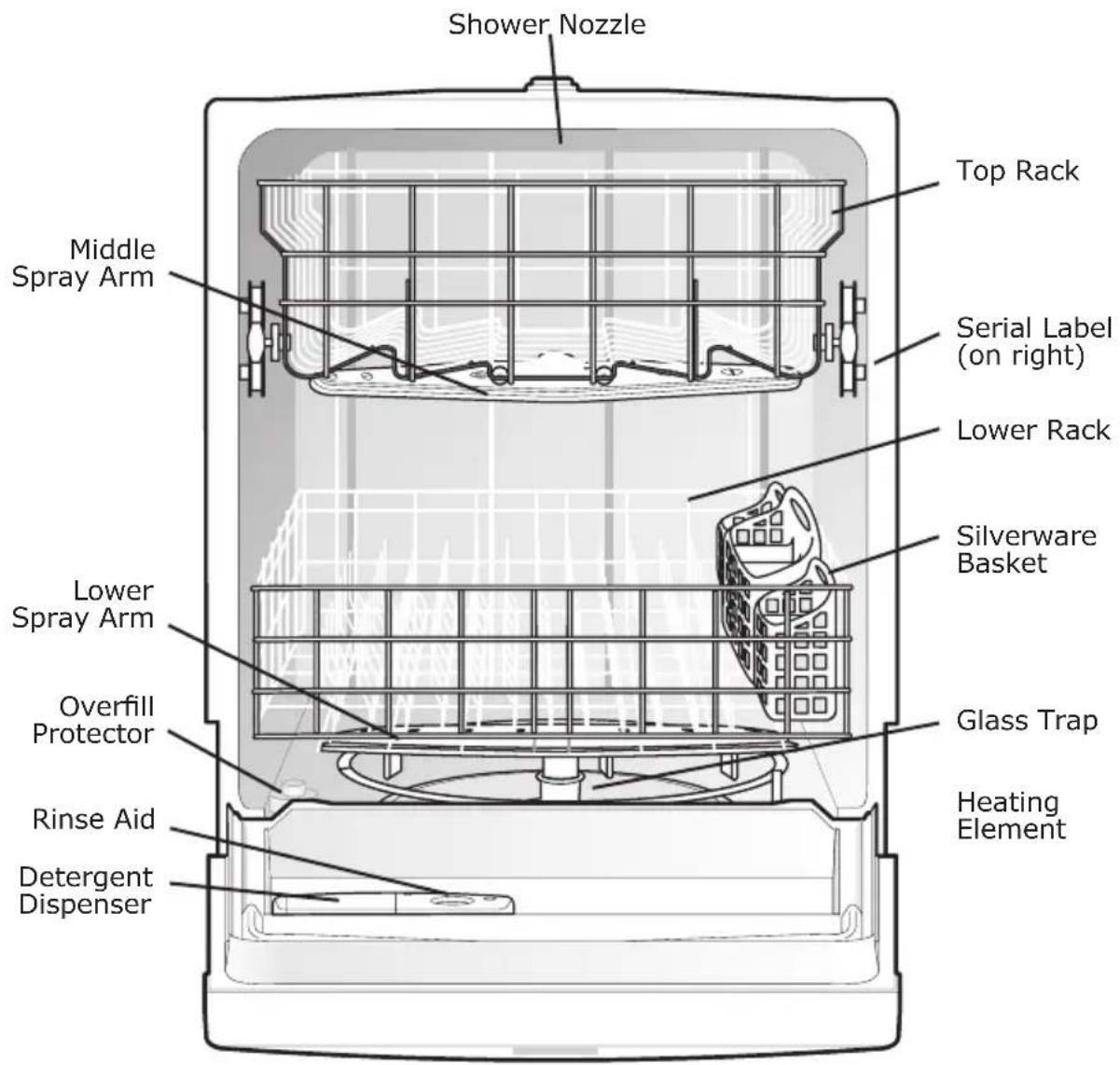
Your dishwasher cleans by spraying a mixture of hot water and detergent through the spray arms against soiled surfaces. First, the dishwasher fills with water covering the filter area. Water is then pumped through the spray arms. Soil particles go through and across the filter and down the drain as the water is pumped out. This series of steps are repeated as needed. The number of water fills vary with the cycle being used.
text_image
Shower Nozzle Top Rack Middle Spray Arm Serial Label (on right) Lower Rack Silverware Basket Lower Spray Arm Overfill Protector Glass Trap Rinse Aid Detergent Dispenser Heating ElementFeatures may vary according to model

text_image
Cycles Heavy Wash Normal Wash 1 Hr Wash Temp High Options Heat Dry Delay 4 Hr START Cancel Clean Hold 3s For Control Lock Hold 3s To CancelWash Cycles Wash Options Wash Temperature Wash Functions

NOTE
Not all cycles and options are available on all models.
Getting Started
- Load the dishwasher. (See Dish Preparation and Loading sections)
- Add detergent. (See Filling the detergent dispenser)
- Add rinse aid, if needed. (See Rinse Aid)
- Close door.
- Select desired CYCLE. (See Cycle Chart)
- Select desired OPTIONS. The indicator light will glow when selected. (See Control Panel)
- Run hot water faucet nearest dishwasher until water is hot, then turn water off.
- To start, press START/Cancel. (See Control Panel).

WARNING
To reduce the risk of fire, electrical shock or injury when using your dishwasher, follow all basic precautions.
Wash Cycle Selections
Cycle times are approximate and will vary with options selected. Hot water is necessary to activate dishwasher detergent and melt fatty food soils. An automatic sensor will check the incoming water temperature and, if it is not hot enough, the cycle will be lengthened for automatic water heating in the main wash and final rinse of all cycles. This happens even when High Temp option has not be selected. When High Temp is selected, an even higher temperature will be reached to handle heavier soil loads.
Wash Cycles
Heavy Wash
Recommended for pots, pans, casseroles and dinnerware having light to heavily soiled loads.
Normal Wash
Recommended for lightly to heavily soiled loads.
1 Hour Wash
Recommended for lightly soiled loads only.
Wash Temperature
High Temp
When High Temp option is selected, the dishwasher heats water in the main wash to approximately 140^ F ( 60^ C).
This increase in water temperature helps the dishwasher detergent remove food grease and soil from dishes more effectively and aids in improved drying performance. High Temp is automatically provided when the Heavy Wash cycle is selected.
When High Temp option is selected, the light above the pad will come on and remain on until end of cycle. To turn off the High Temp option, press the pad a second time. The light above the pad will turn off.
Wash Options
Heat Dry
The Heat Dry option in combination with rinse aid will enhance drying performance. The energy required to use the Heat Dry option costs pennies per cycle; however you will have items in your dish load that will not be completely dry at the end of the cycle.
Delay 4 hr
The Delay 4 hr option allows you to automatically delay starting your dishwasher for 4 hours.
To activate delay start option for 4 hour delay, press the Options pad once. A light will come on indicating the Delay 4 hr option has been activated and will remain on until cycle starts. Press the START/CANCEL pad to start the 4 hr. countdown. If the delay option is interrupted, the START/CANCEL pad will have to be pressed again to return to delay option.
To cancel the Delay 4 hr option and begin the cycle before the delay period is over, press and hold the START/CANCEL pad for 3 seconds.
Child Lock Controls
To prevent children from accidentally changing the dishwasher cycle or starting the dishwasher, lock the dishwasher controls by pressing the OPTIONS pad for 3 seconds while the door is latched. An indicator light on the lock graphic pad will illuminate when the controls are locked and no new selections can be made until the lock is released. To
unlock the controls, press the same pad, OPTIONS, again for 3 seconds until the indicator light goes out.
Status Indicator Lights
- The CLEAN light will come on at the end of cycle and remain on until the door is opened.

NOTE
If the dishwasher door is opened while the unit is running, the START/CANCEL pad must be pressed and the door shut immediately to return the unit to the selected cycle and option, this must happen within 10 minutes for the unit to continue the cycle.

NOTE
The dishwasher is programmed to remember your last cycle so you do not have to reset each time. To start the dishwasher using the same cycle and options selected on the previous wash, just press the START/CANCEL pad.
Cycle and Option Chart
| Cycle and Intended Use | Available Options Temperature; Drying | Water per cycle (approx) | Duration* (approx.) |
| Heavy WashRecommended for pots, pans, casseroles and dinnerware having light to heavily soiled loads. | High Temp | 9 gal.34 liters | 2-3 HoursHeat Dry |
| Air Dry | |||
| Normal WashRecommended for lightly to heavily soiled loads. | High Temp | 2.9–7.6 gal.11–29 liters | 114 - 234 Hours |
| Normal | |||
| Heat Dry | |||
| Air Dry | |||
| 1 Hour WashRecommended for lightly soiled loads only. | Normal | 4.3 gal.16 liters | 1 HourHeat Dry |
| Air Dry |
Dish Preparation
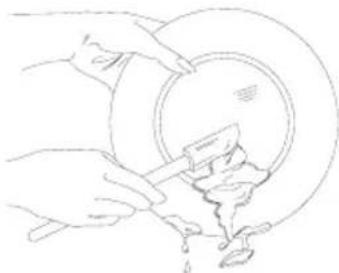
Scrape away large pieces of food, bones, pits, toothpicks, etc. The continuously filtered wash fluid will remove remaining food particles. Burned-on foods should be loosened before loading. Empty liquids from glasses and cups.
Foods such as mustard, mayonnaise, vinegar, lemon juice and tomato based products may cause discoloration of stainless steel and plastics if allowed to sit for a long period of time. Unless the dishwasher is to be operated at once, it is best to pre-rinse or use the rinse only cycle to rinse off these food soils.
- Load racks so that large items do not prevent the detergent dispenser from opening.
- Check manufacturer's recommendations before washing items in question.
- If the dishwasher drains into a Food Disposer, be sure disposer is completely empty before starting dishwasher.
natural_image
Line drawing of hands using a tool to clean or wash a circular object (no text or symbols)Loading the Top Rack
Features and appearance of racks and silverware basket may vary from your model.
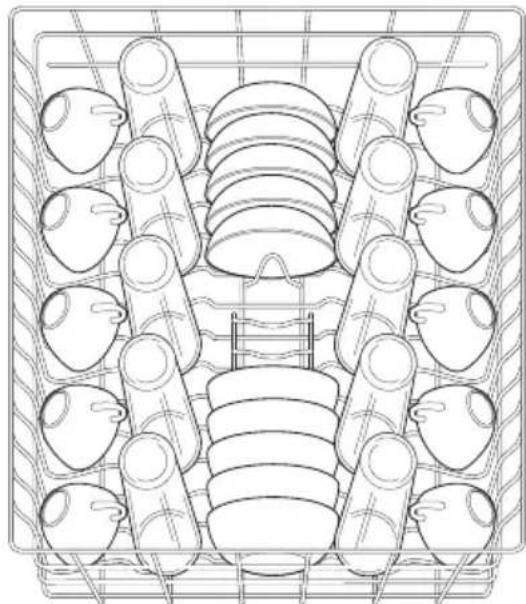
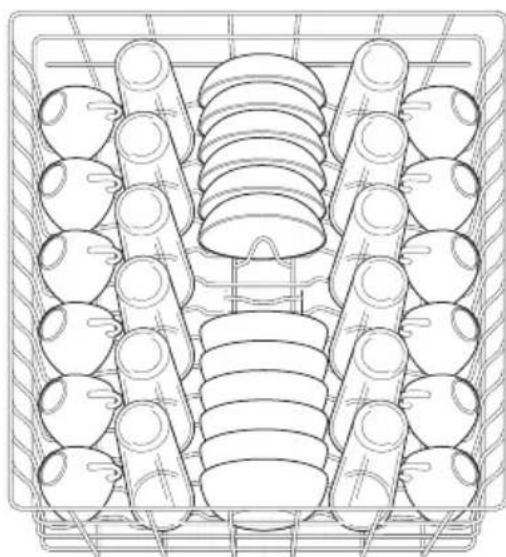
The upper rack is designed for flexibility in loading a wide variety of items including cups, glasses, stemware, small plates, bowls, etc.
Load glasses in top rack only. Damage may occur if placed in bottom rack.
Load plastic items in top rack only. Melting may occur if placed in bottom rack.
Load items with open ends facing down for better cleaning and draining.
Damage may occur if delicate items touch each other during dishwasher operation.
Long-handled knives and utensils can be placed in top rack.
Be sure nothing protrudes through the bottom of the rack to block rotation of middle spray arm.
natural_image
Line drawing of a basket containing multiple egg-shaped objects arranged in rows (no text or symbols)10 place settings standard loading pattern
natural_image
Technical line drawing of a mechanical assembly with multiple cylindrical components arranged in a grid (no text or symbols)12 place settings standard loading pattern
Some models have a fold-down cup shelf or a cup shelf/stemware holder. They can be used to load two levels of cups, juice glasses, and other short items. Stagger items on upper level so that water can reach all inside surfaces. Fold up to load tall glasses.
Loading the Bottom Rack
Features and appearance of racks and silverware basket may vary from your model.
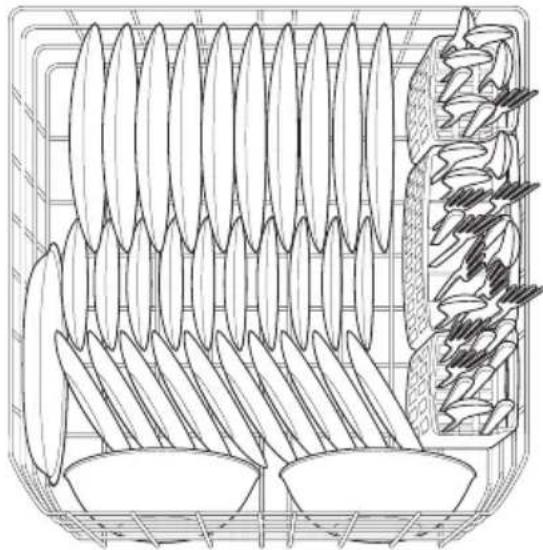
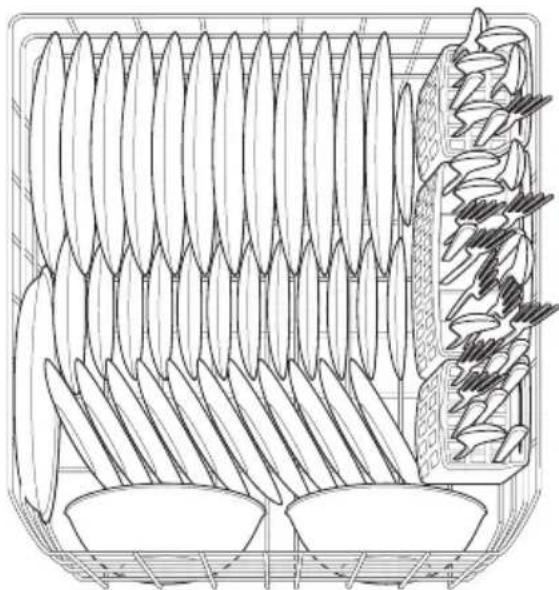
The lower rack is best for plates, saucers, bowls, and cookware. Large items should be placed along the edge so they do not block the spray arm rotation. For best results, place bowls, casseroles, and sauce pans with soiled surface facing down or toward the center. Tilt slightly for better drainage.
Make sure tall items do not block spray arm rotation.
Be sure pan handles do not protrude through the bottom of the rack and block the spray arm rotation.
natural_image
Illustration of a basket containing various leaf-shaped objects, with no visible text or symbols.10 place settings standard loading pattern
natural_image
Line drawing of a basket containing various leaf-shaped objects, with no visible text or symbols.12 place settings standard loading pattern
Loading the Silverware Basket

CAUTION
Load sharp items (knives, skewers, etc.) pointing down.
Failure to do so may result in injury.
Features and appearance of racks and silverware basket may vary from your model.
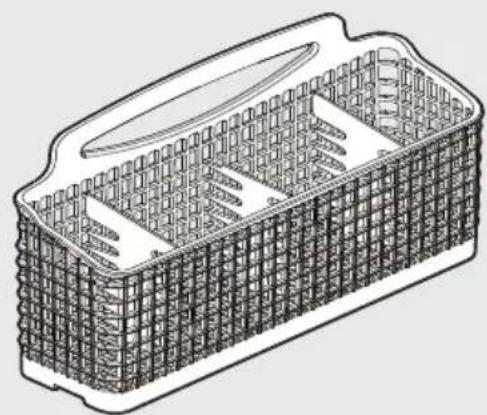
Load the silverware basket while it is in the bottom rack or take the basket out for loading on a counter or table.
natural_image
Line drawing of a rectangular plastic container with internal grid structure (no text or symbols)Use suggested loading patterns, as shown, to increase washability of the silverware.
Be sure nothing protrudes through bottom of basket or rack to block the spray arm.
Do not mix silver and stainless to avoid damaging the silver finish.
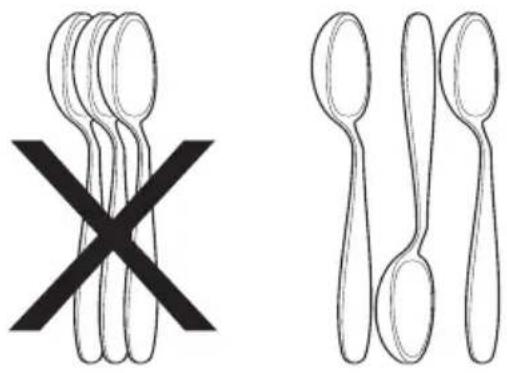
When covers are up, mix items in each section of the basket with some pointing up and some down to avoid nesting.
Water spray cannot reach nested items.
natural_image
Illustration of a crossed fork and a pair of spoons, no text or symbols presentAdding a Dish
To add or remove items after wash cycle starts:
- Unlatch door and wait a few seconds until wash action stops before opening.
- Add the item and wait a few seconds to allow cold air to slowly expand inside dishwasher.
- Close door firmly to latch and press the START/CANCEL pad to resume.
Filing the Detergent Dispenser
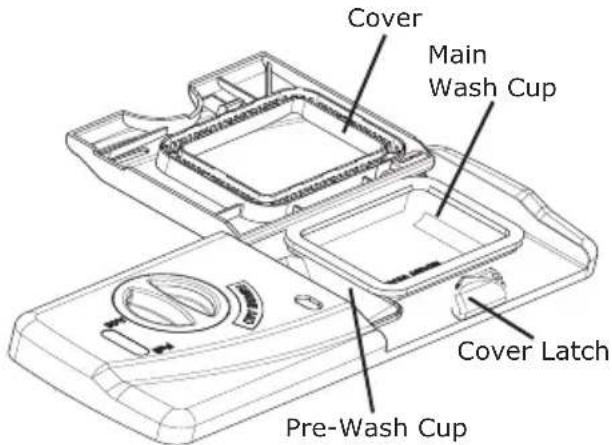
The detergent dispenser has one covered and one uncovered cup. Detergent in the uncovered cup falls into the dishwasher when the door is closed. The covered cup opens automatically to release detergent.
- Use only fresh automatic dishwashing detergent. Other detergents may cause oversuysing.
- When using automatic dishwashing detergent tabs, place one tab in main wash cup and close.
- Add detergent just before starting cycle.
- Store detergent in a cool, dry location. Moist or caked detergent may not dissolve properly.
text_image
Cover Main Wash Cup Cover Latch Pre-Wash CupIf the cover is closed on the Main Wash Cup open by pressing the Cover Latch.
How much Detergent to use
The amount of detergent to use depends on the water hardness. Water hardness is measured in grains per gallon. Using too little detergent can result in poor cleaning and hard water filming or spotting. Using too much detergent in soft water can cause etching to some glassware which is surface damage that appears like a film but cannot be wiped off. Your local water company, water softener company or county extension agent can tell you the water hardness in your area.

CAUTION
The use of industrial grade detergent can damage the heating coil and other parts of the dishwasher leading to damage to the unit and surrounding property. Use only household grade automatic dishwasher detergents.
| Detergent Usage Chart | ||||
| Cycle Soft Water (0-3 grains) | Medium Hard Water (4-8 grains) | Hard Water (9-12 grains) | Very Hard Water (Over 12 grains) | |
| Heavy Wash or Normal Wash | 2 teaspoons (each cup 1/4 full) | 5 teaspoons (each cup fill to line above "Regular) | 8 teaspoons (each cup completely full) | Each Cup Completely Full (water softener recommended) |
| 1 Hour Wash | 2 teaspoons (Main Wash cup 1/4 full) | 5 teaspoons (each cup fill to line above "Regular) | 8 teaspoons (Main Wash cup completely full) | Main Wash Cup Completely Full (water softener recommended) |
As a rule, use 1 teaspoon for each grain above 12. For very hard water, detergent alone may not be enough and then a water softener is recommended to improve water quality and dishwashing performance.
Rinse Aid
Rinse aid greatly improves drying, reduces water spots, filming, and lubricates wash arm bearing for proper rotation. With it water "sheets" off dishes rather than forming water droplets that cling and leave spots.
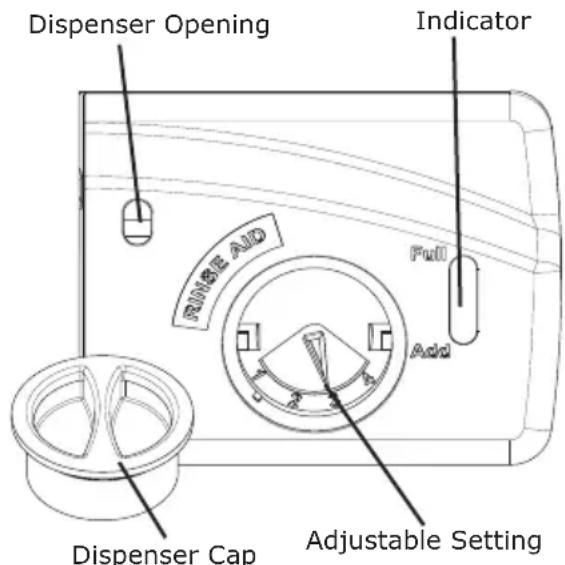
A dispenser, located next to the detergent cup, automatically releases a measured amount of rinse aid during the last rinse. If spotting and poor drying are problems, increase the amount of rinse aid dispensed by rotating the dial to a higher number. The dial is located under the dispenser cap. The indicator will be dark when full and will show clear when it is time to refill.
To add liquid rinse aid, turn dispense cap 1/4 turn counterclockwise and lift out. Pour in rinse aid until liquid touches the indicated fill level Replace cap.
Do not overfill since this can cause oversudsing. Wipe up any spills with a damp cloth.
The dispenser holds enough for 35 to 140 washes, depending on setting.
text_image
Dispenser Opening Indicator FUSEA AID Full Add Dispenser Cap Adjustable SettingThe HEAT DRY option in combination with rinse aid will enhance drying performance. The energy required to use the HEAT DRY option costs pennies per cycle. You may choose not to select the HEAT DRY option; however you will have items in your dish load that will not be completely dry at the end of the cycle.
Water Pressure
The hot water line to dishwasher must provide water pressure between 20 and 120 psi.
Low Water pressure may occur when laundry or showers are in operation. If you experience poor wash performance you may need to wait until water use is reduced before starting dishwasher.
Water Temperature
Hot water is needed for best dishwashing and drying results. Water entering dishwasher should be at least 120^ F ( 49^ C) to give satisfactory results.
To check water temperature entering dishwasher:
- Turn on hot water faucet nearest dishwasher for several minutes to clear cool water from pipes.
- Hold a candy or meat thermometer in the water stream to check the temperature.
- If temperature is below 120^ F ( 49^ C), have a qualified person raise the hot water heater thermostat setting.

IMPORTANT
Before starting a cycle, run hot water to clear cool water from pipe.
text_image
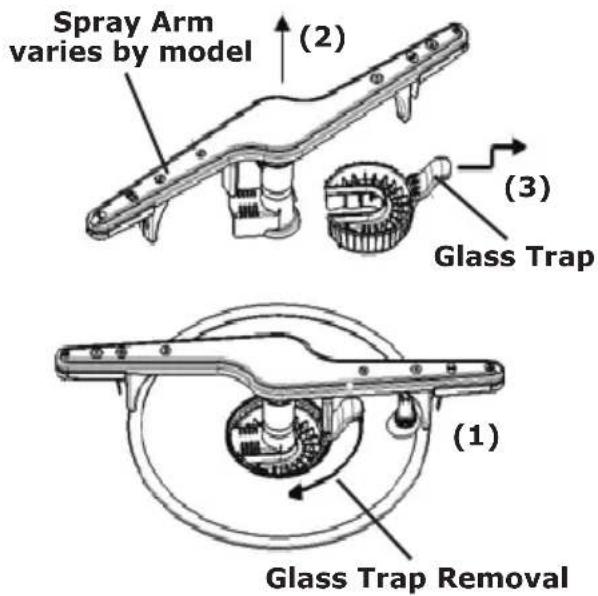
Spray Arm varies by model (2) (3) Glass Trap (1) Glass Trap RemovalTo empty the glass trap:
- Grasp the glass trap's handle and rotate it 90^ clockwise while pressing down on the center of the wash arm.
- Grab the spray arm in the center and lift the spray arm and glass trap assembly up and out form the dishwasher.
- Tip the assembly over an appropriate container and tap it to empty the glass trap, or separate the glass trap - pull the glass trap handle toward you, then up, then further toward you to slide it away from the rest of the assembly; empty it into an appropriate container; then slide the glass trap back into the assembly.
- Place the assembly back into position, press down on the arm at the center and rotate the glass trap handle 90^ counterclockwise being sure the glass trap ends in the orientation shown in the image above. To avoid damage to your unit make sure the spray arm and glass trap are fully snapped in place.

Hard water may cause lime deposit buildup on the interior of the dishwasher. For cleaning instructions see "Removing Spots and film" section.

Burn Hazard
Allow heating element to cool before cleaning the interior.
Failure to do so can result in burns.
Outer Door - Clean outer door with warm soapy water and a dishcloth or sponge. Rinse with clean water and a dry cloth. Do not use harsh cleaners.
Inside - The inside of the dishwasher and filter are self-cleaning with normal use. If needed, clean around the tub gasket area with a damp cloth. The filter is self-cleaning. A glass trap located in the center of the filter is designed to collect pieces of broken glass, straws, bones and pits.
Overfill Protector- keeps dishwasher from overfilling and is located in the left front corner of the tub.
- Clean occasionally with household cleaner containing vinegar or bleach to dissolve any buildup.
• Overfill Protector should move up and down freely about one inch. If it does not move, lift and clean underneath.
natural_image
3D technical drawing of a mechanical component with concentric rings and mounting holes (no text or symbols)Care of Drain Air Gap
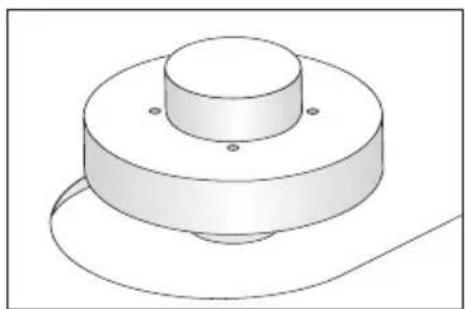
If a drain air gap was installed for your built-in dishwasher, check to make sure it is clean so the dishwasher will drain properly. A drain air gap is usually mounted on countertop and can be inspected by removing the cover. This is not part of your dishwasher and is not covered by warranty.
Winterizing
A dishwasher left in an unheated place should be protected from freezing. Have a qualified person do the following:
To Disconnect Service:
- Turn off electrical power to the dishwasher at the supply source by removing fuses or tripping circuit breaker.
- Shut off water supply
- Place a pan under the inlet valve. Disconnect water line from inlet valve and drain into pan.
- Disconnect drain line from pump and drain water into pan.
To Restore Service:
- Reconnect the water, drain, and electrical power supply.
- Turn on water and electrical power supply
- Fill both detergent cups and run dishwasher through a HEAVY WASH cycle.

NOTE
See Installation Instructions for more details on disconnecting and restoring service to your dishwasher.
Before calling for service, review this list. It may save you both time and expense. This list includes common experiences that are not the result of defective workmanship or material in your dishwasher.
| Concern Common Solution | |
| Food Soils Left on Dishes • | Choose another cycle for longer washing time.Check rack loading section for proper loading- avoid nesting items.Do not overload the dishwasher (See Preparing and Loading Dishes).Check to verify that the glass trap is maintained and installed properly (See Care and Cleaning)..Home water pressure may be too low-should be 20 to 120 pounds per square inch (psi).Check incoming water temperature. It should be about 120°F (49°C). (See Factors Affection Performance.)Check water hardness. For extremely hard water, it may be necessary to install a water softener. (See Detergent Chart).Use Fresh Detergent.Make sure items are not blocking the spray arms, preventing them from rotating. |
| Dishes not Dry • By selecting | Heat Dry, this will improve drying.Make sure the rinse aid dispenser is filled.Increase the discharge setting of rinse aid. (See Rinse Aid).Check the incoming water temperature. Be sure it is at least 120°F (49°C).Check for proper loading- avoid nesting items.Plastic items may need to be towel dried.Cups with a concave bottom will collect water. Load them at the far left of the upper rack so they will be held in a tilted position.Containers, bowls, pots/pans, and any dishware with concave surfaces that can collect water should be placed in the rack facing or angled down so that water is able to drain even from the lowest point. |
| Glassware/Flatware Spotted or Cloudy | Check water hardness. For extremely hard water, it may be necessary to install a water softener. (See Detergent Chart).Water temperature may be low. Avoid extremely low or high temperatures. (See Factors Affecting Performance.Avoid overloading and improper loading. (See Preparing and Loading Dishes).Use fresh detergent. Old detergent is ineffective.Make sure rinse aid dispenser is filled.Check to see that proper amount of detergent is being used for cycle selected. (See Detergent Dispenser).Home water pressure may be too low-it should be 20 to 120 pounds per square inch (psi). |
| Dishware Chipped • Load with care and do not overload. (See Preparing and Loading Dishes).Place delicate items in top rack.Place glasses securely against pins and not over pins.Load items so they are secure and don't jar loose when moving racks in and out. Move racks in and out slowly.Make sure tall glasses and stemware will clear top of tub when rack is pushed in.Fine antique china and crystal should be hand-washed. | |
| Dishware Stained or Discolored | Tea and coffee can stain cups. Remove the stains by hand washing in a solution of 1/2 cup (120 ml) bleach and one quart (1L) of warm water. Rinse thoroughly.Iron deposits in water can cause a yellow or brown film. A special filter installed in the water supply line will correct this problem. (See Removing Spots and Film).Aluminum utensils can leave gray/black marks when they rub against other items. Load Properly.Certain high acid foods can cause discoloration of stainless steel and plastics if allowed to sit for a long period. Use the Rinse Only cycle or rinse by hand if not operating dishwasher at once.Mixing stainless steel and silver utensils in silverware basket can cause pitting of the stainless steel blades. Avoid mixing stainless steel and silver. |
| Etching • Using too much detergent especially in soft or softened water causes damage that looks like a film but cannot be removed.Adjust the amount of detergent based on the water hardness. (Check Detergent Chart).Lower the water temperature by selecting the Normal Cycle. | |
| Dishwasher Won't Fill • Assure the water supply is turned on. Check that the overfill protector moves up and down freely. (See Overfill Protector section). | |
| Detergent Left in Cups • Detergent may be old. Discard and use fresh detergent. Be sure the dish load doesn't spray from entering the detergent cup. Check to see if cycle has been completed. Make sure items do not prevent the detergent dispenser from opening. | |
| Vapor at Vent • Water vapor escapes from the vent during the drying part of cycle. This is normal. Spilled rinse aid can cause foam and lead to overflowing. Wipe up any spills with a damp cloth. Check to see that dishwasher is level. (See Installation Instructions). | |
| Normal Sounds You Will Hear | Normal sounds include water fill, water circulation and motor sounds. There is a noticeable change in sound when the wash action switches between the lower and middle spray arm. This is normal since each spray arm has it's own sound. It is normal for the dishwasher to pause (no sound) when the wash action is switching between the lower and middle spray arms. |
| Water in Bottom of Tub • Water left in the tub bottom after the cycle is complete is not normal. If water remains in the bottom of the tub, the dishwasher may not be draining properly. (See Dishwasher Does not Drain Properly). | |
| Dishwasher Leaks • Check that the door gasket is pressed into its mounting channel, reaches to the bottom of the tub and does not extend beyond the end rib so as to interfere with door closure. Spilled rinse aide can cause foam and lead to overflowing. Wipe up any spills with a damp cloth. Check to see that the dishwasher is level. (See Installation Instructions). Avoid oversuding by using the correct amount of detergent designed for automatic dishwashers. Check to see that dishwasher is level. (See Installation Instructions). | |
| Dishwasher Won't Run • Check to see if circuit breaker is tripped or if a fuse is blown.Make sure water supply is turned on.Check to see if cycle is set correctly. (See Operating Instructions).Is dishwasher set for Delay Start Option?Make sure door is closed and latched.Make sure START/CANCEL pad is pressed after the cycle has been selected. | |
| Dishwasher Does Not Drain Properly | If unit is hooked up to a food waste disposer, make sure the disposer is empty.Assure the knockout plug has been removed from inside the food waste disposer inlet.Assure the drain hose isn't kinked.Make sure cycle is complete, not in a pause.Assure the glass trap is maintained and installed properly assuring no clogs (See Care and Cleaning). |
| Cycle Takes a Long Time • The cycle may have been automatically lengthened to reach key temperatures due to some factor such as a cool water supply or a large load of dishes.Delay Start option may have been selected.Choose lower temperature options to shorten the cycle.Cycles that are soil-sensing adjust automatically to assure a good wash - heavier soils will elicit a longer cycle response. | |
| Dishwasher has an Odor • Soiled dishes left in dishwasher too long can create an odor.There will be a "new" smell when first installed.This is normal.Check to see if unit is draining properly. (See Dishwasher Does Not Drain Properly). | |
| Stains on Tub Interior • Washing large amounts of dishware with tomato based soil can cause a pink/orange appearance.This will not affect performance and will gradually fade over time. Pre-rinsing or using the Rinse Only cycle will reduce the chance of staining. Using no heat dry option will lessen staining. | |
| Opening the door during cycle | If the dishwasher door is opened while the unit is running, the START/CANCEL pad must be pressed and the door shut immediately to return the unit to the selected cycle and option, this must happen within 10 minutes for the unit to continue the cycle. |
| Removing Spots and Film | Hard water can cause lime deposit buildup on the interior of the dishwasher. Dishes and glasses may also get spots and film for a number of reasons. (See Glassware/Flatware Spotted or Cloudy section). To remove buildup, and film, clean using the following instructions:1. Load clean dishes and glasses in normal manner.Do not load any metal utensils or silverware.2. Do not add detergent.3. Select the NORMAL WASH cycle. Close and latch door. Press START/CANCEL pad.4. Allow dishwasher to run until it starts the second water fill (approximately 10 minutes).5. Unlatch and open door and pour 2 cups of white vinegar into the bottom of dishwasher.6. Close and latch door and allow cycle to finish. |
How long is the IKEA guarantee valid?
This guarantee is valid for five (5) years from the original date of purchase of Your appliance at IKEA, unless the appliance is named LAGAN or TILLREDA in which case two (2) years of guarantee apply. The original sales receipt is required as proof of purchase. If service work is carried out under guarantee, this will not extend the guarantee period for the appliance.
Who will execute the service?
IKEA "Service Provider" will provide the service through its own service operations or authorized service partner network.
What does this guarantee cover?
The guarantee covers faults of the appliance which have been caused by faulty construction or material faults from the date of purchase from IKEA. This guarantee applies to domestic use only. Some exceptions not guaranteed are specified under the headline "What is not covered under this guarantee?" Within the guarantee period, the costs to remedy the fault (e.g., repairs, parts, labour and travel) will be covered, provided that the appliance is accessible for repair without special expenditure. On these conditions the local regulations are applicable. Replaced parts become the property of IKEA.
What will IKEA do to correct the problem?
IKEA appointed Service Provider will examine the product and decide, at its sole discretion, if it is covered under this guarantee. If considered covered, IKEA Service Provider or its authorized service partner through its own service operations, will then, at its sole discretion, either repair the defective product or replace it with the same or a comparable product.
What is not covered under this guarantee?
• Normal wear and tear.
- Deliberate or negligent damage, damage caused by failure to observe operating instructions, incorrect installation or by connection to the wrong voltage, damage caused by chemical or electrochemical reaction, rust, corrosion or water damage including but not limited to damage caused by excessive lime in the water supply, damage caused by abnormal environmental conditions.
- Consumable parts including batteries and lamps.
- Non-functional and decorative parts which do not affect normal use of the appliance, including any scratches and possible colour differences.
- Accidental damage caused by foreign objects or substances and cleaning or unblocking of filters, drainage systems or soap drawers.
- Damage to the following parts: ceramic glass, accessories, crockery and cutlery baskets, feed and drainage pipes, seals, lamps and lamp covers, screens, knobs, casings and parts of casings. Unless such damages can be proved to have been caused by production faults.
- Cases where no fault could be found during a technician's visit.
- Repairs not carried out by our appointed service providers and/or an authorized service contractual partner or where non-original parts have been used.
- Repairs caused by installation which is faulty or not according to specification.
- The use of the appliance in a non-domestic environment i.e. professional use.
- Transportation damages. If a customer transports the product to his home or another address, IKEA is not liable for any damage that may occur during transport. However, if IKEA delivers the product to the customer's delivery address, then damage to the product that occurs during this delivery will be covered by IKEA.
- Cost for carrying out the initial installation of the IKEA appliance. However, if an IKEA appointed Service Provider or its authorized service partner repairs or replaces the appliance under the terms of this guarantee, the appointed Service Provider or its authorized service partner will reinstall the repaired appliance or install the replacement, if necessary.
How country law applies
The IKEA guarantee gives you specific legal rights, and you may also have other rights which vary from state to state or jurisdiction to jurisdiction. However these conditions do not limit in any way consumer rights described in the local legislation.
Area of validity
For appliances which are purchased in United States or Canada, or moved to one of the mentioned countries, the services will be provided in the framework of the guarantee conditions normal in the specified country.
An obligation to carry out services in the framework of the guarantee exists only if the appliance complies and is installed in accordance with:
- the technical specifications of the country in which the guarantee claim is made;
- the Assembly Instructions and User Manual Safety Information.
The dedicated AFTER SALES for IKEA appliances
Please don't hesitate to contact IKEA appointed After Sales Service Provider to:
• make a service request under this guarantee;
- ask for clarifications on installation of the IKEA appliance in the dedicated IKEA kitchen furniture;
- ask for clarification on functions of IKEA appliances.
To ensure that we provide you with the best assistance, please read carefully the Assembly Instructions and/or the User Manual before contacting us.
How to reach us if you need our service
text_image
IKEAPhone number:
(833) 337-4006
Opening hours:
Monday - Friday
8:30 am - 8:00 pm EST
In order to provide you a quicker service, we recommend to use the specific phone numbers listed on this manual. Always refer to the numbers listed in the booklet of the specific appliance you need an assistance for.
Please also always refer to the IKEA article number (8 digit code) placed on the rating plate of your appliance.
SAVE THE SALES RECEIPT!
It is your proof of purchase and required for the guarantee to apply. The sales receipt also reports the IKEA name and article number (8 digit code) for each of the appliances you have purchased.
Do you need extra help?
For any additional questions not related to After Sales of your appliances please contact your nearest IKEA store call centre. We recommend you read the appliance documentation carefully before contacting us.
A18101701 C
LAGAN