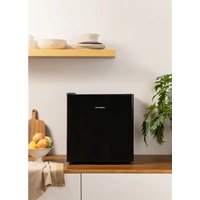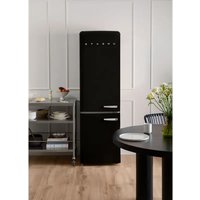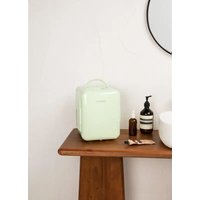
RETRO FRIDGE 48L - Fridge Create - Free user manual and instructions
Find the device manual for free RETRO FRIDGE 48L Create in PDF.


| Brand | Create |
| Model | RETRO FRIDGE 48L |
| Product type | Refrigerator |
| Capacity | 48 L |
| Power supply | 220-240 V, 50 Hz |
| Refrigerant gas | R600a (isobutane) |
| Temperature setting | Rotary thermostat (0 to 5) |
| Shelves | Height adjustable shelves |
| Included accessories | Metal bottle holder, door shelves |
| Handle | Metal handle to be installed |
| Adjustable feet | Yes, for leveling |
| Interior cleaning | Warm water and baking soda |
| Exterior cleaning | Warm water and mild soap |
| Safety | Flammable gas, do not damage the circuit |
| Repairability | No user-serviceable parts, contact customer service |
| Usage | Domestic use only |
| Installation | At least 100 mm at the rear, 50 mm on sides and top |
Frequently Asked Questions - RETRO FRIDGE 48L Create
User questions about RETRO FRIDGE 48L Create
0 question about this device. Answer the ones you know or ask your own.
Ask a new question about this device
Download the instructions for your Fridge in PDF format for free! Find your manual RETRO FRIDGE 48L - Create and take your electronic device back in hand. On this page are published all the documents necessary for the use of your device. RETRO FRIDGE 48L by Create.
USER MANUAL RETRO FRIDGE 48L Create
natural_image
Simple line drawing of a rectangular container with a handle and side connectors (no text or symbols)FRIDGE NEVERA
USER MANUAL
CREATE CREATE CREATE ATE CREATE CREATE CRE CREATE CREATE CREATE ATE CREATE CREATE CRE CREATE CREATE CREATE ATE CREATE CREATE CRE CREATE CREATE CREATE CREATE CREATE CREATE CREATE CREATE CREATE CREATE CREATE CREATE CREATE CREATE CREATE CREATE CREATE CREATE CREATE CREATE CREATE CREATE CREATE CREATE CREATE CREATE CREATE CREATE CREATE CREATE CREATE CREATE CREATE CREATE CREATE CREATE CREATE CREATE CREATE CREATE CREATE CREATE CREATE CREATE CREATE CREATE CREATE CREATE CREATE CREATE CREATE CREATE CREATE CREATE CREATE CREATE CREATE CREATE CREATE CREATE CREATE CREATE CRE
CREATE CREATE CREATE ATE CREATE CREATE CRE CREATE CREATE CREATE ATE CREATE CREATE CRE CREATE CREATE CREATE ATE CREATE CREATE CRE CREATE CREATE CREATE CREATE CREATE CREATE CREATE CREATE CREATE CREATE CREATE CREATE CREATE CREATE CREATE CREATE CREATE CREATE CREATE CREATE CREATE CREATE CREATE CREATE CREATE CREATE CREATE CREATE CREATE CREATE CREATE CREATE CREATE CREATE CREATE CREATE CREATE CREATE CREATE CREATE CREATE CREATE CREATE CREATE CREATE CREATE CREATE CREATE CREATE CREATE CREATE CREATE CREATE CRE
INDEX
ENGLISH
Security instructions 6
Daily use 7
Flammable - refrigerant gas warning 8
Parts list 9
Let's get started 9
Unpacking 9
Door handle installation 10
Fridge installation 10
Adjusting the thermostat 11
Food storage 12
Energy-saving tips 12
Going away? 12
Moving the fridge 13
Cleaning and maintenance 13
Internal cleaning 13
External cleaning 13
Warning 13
Disposal of old appliances and packaging 14
Troubleshooting 14
PORTUGUÊS
Thank you for choosing our fridge. Before using the appliance, and to ensure the best use, carefully read these instructions.
The safety precautions enclosed herein reduce the risk of death, injury and electrical shock when correctly adhered to. Keep the manual in a safe place for future reference, along with the completed warranty card, purchase receipt and package. If applicable, pass these instructions on to the next owner of the appliance. Always follow basic safety precautions and accident prevention measures when using an electrical appliance. We assume no liability for customer failing to comply with these requirements.
SECURITY INSTRUCTIONS
When using any electrical appliance, basic safety precautions should always be observed.
- Make sure your outlet voltage and circuit frequency correspond to the voltage stated on the appliance's rating label. If this is not the case, please contact the aftersales service and do not use the refrigerator.
- Use a dedicated circuit to avoid the main circuit getting overloaded as it may blow the fuse or circuit breaker.
- To protect against fire and electrical shock, do not immerse the cord, plug, power base or the body of the Retro Fridge itself in water or other liquids. Do not expose the electrical connections to water.
- The cord should be placed in such a way that there is no risk of anyone accidentally pulling it or tripping over it.
- Do not kink, bend, squash, strain or damage the power cord and protect it from sharp edges and heat sources.
- Do not pull out the mains plug by tugging the cable.
- Do not let the cord hang over the edge of a table or bench top. Do not let it come in contact with hot surfaces.
- Do not pick up or operate the appliance if the power supply cord or the plug are damaged, or if the refrigerator is malfunctioning or has been dropped or damaged in any way.
• In case of damage, contact the aftersales service. - A damaged cord or plug must be exclusively replaced by the manufacturer or a qualified person in order to avoid injuries.
- Make sure all of the electrical connections are clean and dry before switching anything on.
- Do not connect this appliance to an extension cord.
- Unplug the appliance from the power outlet when it's not in use and before cleaning, servicing, moving or maintenance of the refrigerator.
- Supervision or instruction concerning use of the appliance in a safe way and understand the hazards involved.
• To avoid the risk of children becoming trapped and suffocating, do not allow them to play or hide inside the appliance -
Do not use chemicals, steel wool or abrasive cleaners to clean the outside of the unit, as these will scratch the surface.
-
Ensure that all the parts are correctly assembled before operation.
- If the product is defective or if it has been damaged in any way, please contact the aftersales service.
- If there is smoke coming out of the appliance or it has an unusual smell, unplug it immediately and contact the aftersales service.
- Place the product on a level and stable surface, away from direct sunlight or excessive heat.
- Do not place the product near heat sources such as radiators, heat registers, stoves or other appliances that produce heat.
- Do not place the product near other items that may damage it, such as naked flame sources (lit candles) or objects containing water (such as a vase or a glass).
- Care should be taken so that objects do not fall and liquids are not spilled into any openings.
- The Manufacturer declines any liability for injury or damage to property if the above advice and precautions are not respected.
- Prevent overheating: Place the product in a well-ventilated room. Ensure that air can circulate freely around the back of the refrigerator.
- To ensure the best performance, leave a distance of approximately 100 mm on all sides of the fridge.
- This appliance features a short power cord to reduce the risk of the cable getting tangled and people tripping. Do not use single/multi adapters or extension cords.
- There are no user-serviceable parts inside. Do not attempt to repair this product. Please contact our aftersales service.
- Before its first use, it is advisable to wait at least eight hours before connecting the appliance to enable the oil ejected from the compressor to return to the crankcase.
- Make sure there is proper air circulation around the appliance to prevent overheating. To ensure there is enough space follow the installation instructions.
- The appliance must not be located near radiators or cookers.
- Make sure that the mains plug is accessible after installing the appliance.
DAILY USE
• Always allow hot foods and drinks to cool to room temperature before putting them in the compartment.
- Store pre-packaged food according to the instructions on the label.
WARNING! Do not use mechanical, electric or chemical means other than those recommended by the Manufacturer to speed up the defrosting process.
- Never use a sharp or metal instrument to remove frost or clean the appliance. Use a plastic scraper, if necessary.
- Strictly follow the refrigerator's storage guidelines. Refer to relevant instructions.
- If the refrigerator is unplugged, turned off or has lost power, you must wait 3 to 5 minutes before restarting the unit. If you attempt to restart it before this time delay, the refrigerator will not start.
FLAMMABLE - REFRIGERANT GAS WARNING
- Danger! Risk of fire or explosion. Flammable refrigerant used. Maintenance and repair work may only be carried out by authorised and appropriately trained personnel. Do not damage the appliance's refrigerant circuit pipes.
- Caution! Risk of fire or explosion. Dispose of the refrigerator in accordance with federal and local regulations. Refrigerants must be evacuated in accordance with established procedures.
Appliances with Isobutane (R600a): isobutane is a natural gas without environmental impact, but it is flammable. Therefore, make sure the refrigerant circuit pipes are not damaged. Keep special attention in case of damaged pipes emptying the refrigerant circuit.
WARNING: Do not damage the refrigerant circuit! Never use an appliance with a damaged refrigerant circuit! If the refrigerant circuit is damaged, avoid proximity to open fires and all types of heat and sources of ignition. Thoroughly ventilate the room in which the appliance is located.
- It is hazardous for anyone other than an authorised service person to service this appliance.
- The room in which the appliance is located must be at least 1m^3 per 8g of refrigerant. The amount and type of refrigerant in the appliance can be found in the Technical Specifications.
- Do not use or place electrical devices inside the appliance compartments if they are not of the type expressly authorised by the Manufacturer.
- Do not store explosive substances such as aerosol cans with a flammable propellant in this appliance.
- During transportation and installation of the appliance, ensure that none of the components of the refrigerant circuit becomes damaged.
- Avoid open flames and sources of ignition.
- Thoroughly ventilate the room in which the appliance is located.
- It is dangerous to alter the specifications or modify this product in any way.
- A damaged cord can cause a short circuit, fire and/or electrical shock.
- Excessive weight hazard. Take extra care when moving the fridge to avoid any injuries. This may require two people or mechanical aid when installing the fridge. Failure to do so can result in back injuries, amongst others.
- Avoid prolonged exposure of the appliance to direct sunlight.
• This appliance is intended to be used indoors only.
- All electrical components (plug, power cord, compressor, etc.) must be exclusively replaced by a certified service agent or qualified service personnel.
- DO NOT USE AN EXTENSION CORD. Plug the appliance into a grounded socket: the appliance must be correctly connected to an approved earthing system. Do not use single/multi adapters or extension cords.
- Make sure that the power plug is not squashed or damaged. This could lead to overheating and cause a fire.
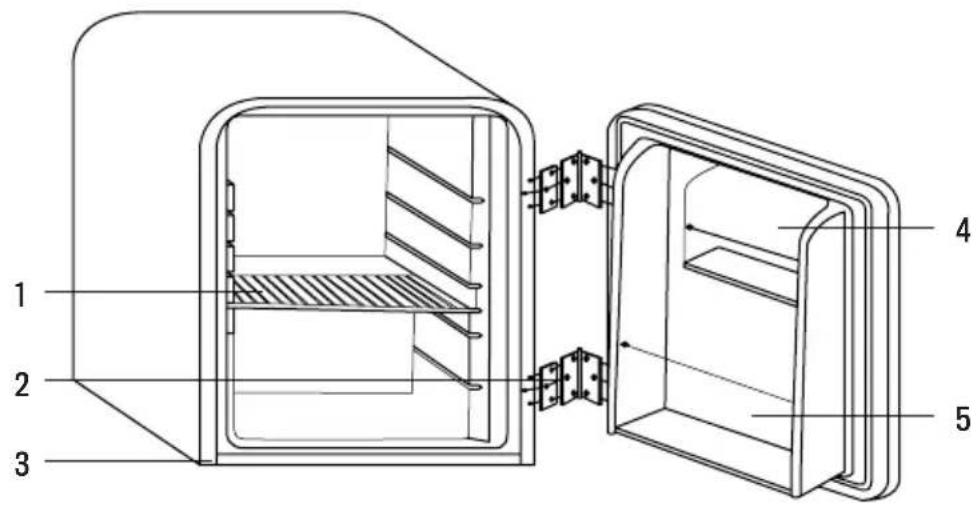

- Adjustable shelves
- Hinge
- Leveling foot
- Door shelves
- Anti-tip bottle racks
- Adjustable thermostat
LET'S GET STARTED
UNPACKING
- This product has been packaged to protect it against transportation damage. Remove all packaging materials from around and inside the appliance, but do not remove any foam insulation surrounding the pipes at the back. Keep the original packaging and materials in a safe place; this will help prevent any damage if the product needs to be transported in the future, and you can use it to store the appliance when it is not in use. In the event that the packaging is to be disposed of, please recycle all packaging materials where possible.
- Plastic wrapping can constitute a suffocation hazard for pets, babies and young children. Ensure all packaging materials are out of their reach and disposed of safely.
- Parts: Check to ensure you have all the parts shown at the beginning of this manual.
- Unwind the power cord completely and inspect it for damage. Do not use the appliance if the refrigerator or its cord have been damaged or if they are not working properly. In case of damage, contact our aftersales service.
• Make sure the refrigerator is disconnected from the power supply before cleaning the interior surfaces and all internal accessories with lukewarm water, a soft cloth and neutral cleaning agents. This will remove any dust from transit and storage and will help remove the typical smell of a brand new product. Dry thoroughly. Important: do not use harsh or abrasive detergents or powders, as these will damage the finish.
DOOR HANDLE INSTALLATION
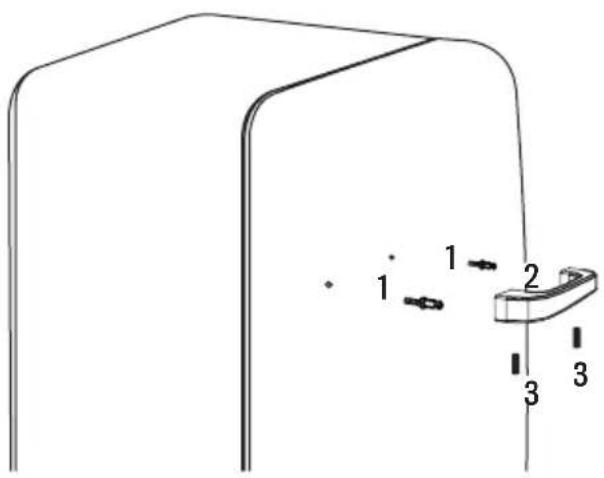
The door handle comes detached due to packaging restrictions. It can be easily attached following the instructions.
• Fix the two screws (1) to the door.
- Insert the two fixed screws into the two holes on the metal handle (2).
- Fasten the two screws (3) to the bottom of the handle.
FRIDGE INSTALLATION
Before installing your new fridge, read all of the safety guidelines in this manual and then follow the instructions below:
- Place the fridge on a sturdy, level floor for quieter operation. Ensure that the floor is strong enough to support the fridge when it is fully loaded.
- If the refrigerator is to be placed on a carpet, put a wooden board in between the fridge and the carpet. Be aware that, by placing the refrigerator on top of a carpet, the heat from the compressor may cause the carpet to fade.
- This appliance is designed to be freestanding and it should not be recessed or built-in.
- Do not tilt the fridge more than 45^ from its upright position when moving it.
- Avoid areas where the appliance would be exposed to direct sunlight, sources of heat (stove, heater, radiator, etc.), extremely cold ambient temperatures or excessive moisture and high humidity. Installing it in the coolest area of the room will save energy consumption and running costs.
Handle with care! Do not apply force to any area such as the condenser or the door. The metal rails on the bottom of the refrigerator may have sharp edges, so always unpack and handle with care. Do not drag the unit: place it carefully into position to avoid scratching the floor.
SPACE REQUIREMENTS
- Place the unit so there is enough space for the door to open.
- Leave a minimum clearance of 100mm at the back of the fridge to ensure air can circulate freely so the compressor and condenser can cool down. Also leave at least 50mm of space at the top of the fridge and 50mm on each side.
LEVELLING
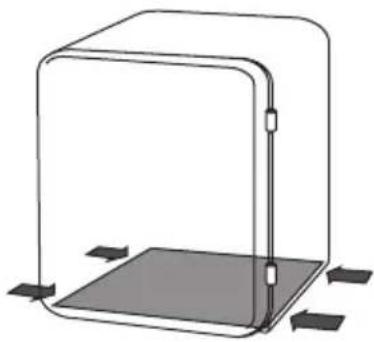
- The appliance must be level in order to work properly. If the unit is not level, the doors and magnetic seal alignments will not be covered properly.
- Your refrigerator has two adjustable front feet, one on the right and one on the left. In most cases, the refrigerator should be steady when both feet are touching the floor. If your refrigerator seems unsteady or if you want the doors to close more easily, adjust the refrigerator's tilt by levelling the feet.
natural_image
Simple line drawing of a rectangular box with a flat base and directional arrows, no text or symbols present.ADJUSTING THE THERMOSTAT
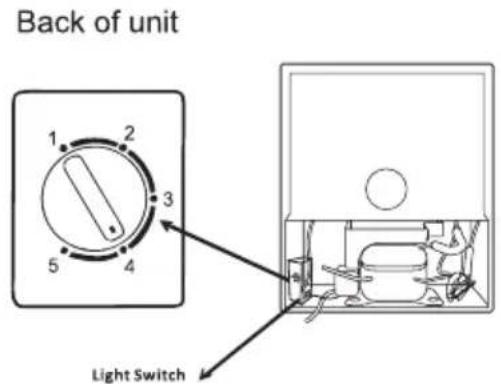
- To start the refrigerator, turn the thermostat knob to the position corresponding to the desired temperature. The temperature of the refrigerator is controlled by adjusting/setting the thermostat knob, located at the top of the cabinet.
- The settings 0(OFF) - 5(MAX) regulate the internal temperature of the refrigerator.
Setting 0 (OFF): not operating (Please press the knob and turn to get the "0" position).
Setting 1 (Min.): lowest setting (warmest internal temperature).
Setting 5 (Max.): highest setting (coldest internal temperature).
NOTE: The refrigerator temperature will vary depending on the quantity of cans/bottles stored and on the frequency with which the door is opened. The internal temperature varies in different parts of the refrigerator. The back of the refrigerator is coldest. Please keep the cans/bottles away from the rear wall to avoid them freezing and to allow cold air circulation.
NOTE: The thermostat 0 (OFF) position indicates that the refrigerator is turned off even though power is still being supplied to the appliance. By turning the thermostat knob to the left, the refrigerator will turn on automatically. When the refrigerator is not going to be used for a long period of time, disconnect the plug and leave the door partially open.
FOOD STORAGE
- The refrigerator compartment is suitable for short-term storage of fresh food. The internal temperature of the appliance may be affected by the ambient temperature, frequency of door opening, as well as the location of the appliance. When setting the temperature, these factors should be taken into consideration.
- In order to maintain good cooling efficiency and save energy, we recommend you do not open the door for too long or too often. Do not overload the fridge, and leave enough space around items to allow cold air to flow. Do not block ventilation openings.
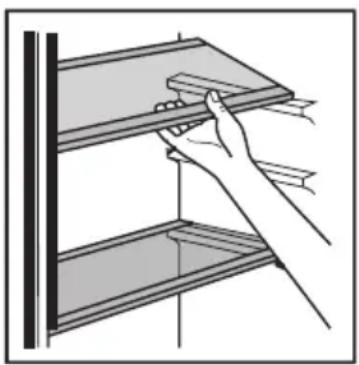
- The shelves can be positioned to suit individual storage requirements.
natural_image
Illustration of a hand using a tool to clean or store shelves (no text or symbols visible)ENERGY-SAVING TIPS
- Install the refrigerator in a cool, well ventilated place, protect it from direct sunlight and keep well away from heat sources.
- Do not put hot food in the fridge or freezer. Wait for foods and drinks to cool to room temperature before placing them in the fridge.
- Do not overload the fridge, as it forces the compressor to run for longer.
- Wrap foods properly and wipe containers dry before placing them in the fridge. This cuts down on frost build-up inside the fridge.
- Do not line any fridge container with aluminium foil, wax paper or paper towels. Liners interfere with cold air circulation, reducing cooling efficiency.
- Position food so that air can circulate freely around it (food should not touch each other and try to leave space between food and the rear wall).
- Do not leave the fridge door open for longer than required to prevent the unit from overheating.
- Make sure the food doesn't touch the back of the compartment.
- Don't set the thermostat to extremely cold temperatures.
GOING AWAY?
- Short vacation: Leave the fridge running during vacations shorter than a month long. Use up any perishables and freeze other items.
- Long vacation: Disconnect the appliance from the power supply, empty it, defrost it (if necessary) and clean it. To prevent odour and mould growth, keep the doors slightly ajar to let air circulate inside the compartments, blocking it open, if necessary. (While the fridge remains open, restrict children's access to the room to avoid child entrapment).
MOVING THE FRIDGE
- Unplug the fridge and remove all food from the inside. Clean, wipe and dry thoroughly.
- Securely tape the doors closed and tape the power cord to the back of the refrigerator. Take out all removable parts, wrap them well, and tape them together so they don't shift and rattle during the move.
- Depending on the model, raise the front of the refrigerator so it rolls more easily OR screw in the levelling feet so they don't scratch the floor.
CAUTION! Never pick the refrigerator up by the door.
- Protect the outside of the unit with a soft, clean surface, such as a towel, blanket or piece of cardboard and make sure the fridge stays secure in an upright position during its transportation.
CLEANING AND MAINTENANCE
Disconnect the appliance from the power supply before cleaning.
INTERNAL CLEANING
- Do not pour water over the appliance.
- The cavity should be cleaned periodically using a solution of baking soda and lukewarm water (5ml to 0.5 litre of water)
- Hand wash, rinse, and dry removable parts and interior surfaces thoroughly. Use a clean sponge or soft cloth and a mild detergent in warm water. Do not put them in the dishwasher.
- Do not use abrasive products, detergents or soaps.
• After washing, rinse with clean water and dry carefully. - Once you have finished cleaning, plug in the refrigerator or reconnect power with dry hands.
EXTERNAL CLEANING
- Wash stainless steel and painted metal parts with a clean sponge or soft cloth and a mild detergent in warm water.
• Take caution when cleaning as there are sharp edges on the bottom of the unit.
- Once or twice a year, dust the back of the appliance with a brush or vacuum cleaner, as an accumulation of dust will affect the performance of the appliance and cause an increase of energy consumption.
WARNING
- Do not use abrasive or harsh cleaners such as window sprays, scouring cleansers, flammable fluids, cleaning waxes, concentrated detergents, bleaches or cleansers containing petroleum products on plastic parts, interior and door liners or gaskets. Do not use paper towels, scouring pads, or other harsh cleaning tools. Never use flammable fluids or sprays for cleaning as the fumes from these substances can create a fire hazard or explosion.
- Never clean the appliance with a steam cleaner. Moisture could accumulate in the electrical components. Failure to follow this recommendation could result in electrical shock. Hot steam can lead to the damage of plastic parts.
- The appliance must be completely dry before it is turned back on.
- Essential oils and organic solvents (e.g. lemon juice or the juice from an orange peel) and cleansers that contain acetic acid can damage the plastic parts. Do not clean the appliance with substances such as these.
Be sure to make any locks unusable, remove any doors and discard separately.
Warning - chemical hazard: do not allow children to play with the old appliance.
Contact your local authority for disposal procedures.
- Before disposing of an old appliance, please make sure it is switched off and safe. Unplug the appliance and break any locks in order to avoid children becoming trapped.
- Please note: the refrigeration system contains gases and refrigerants which require specialist waste disposal. The valuable materials contained in a refrigerator can be recycled.
- You can contribute to environmental awareness by insisting on an appropriate non-polluting method of disposal.
- Do not allow pets or children to play with the packaging, and dispose of plastic bags safely.
- The cardboard can be broken or cut into smaller pieces and recycled. The wrapping covers are made of polyethylene. The polyethylene pads and padding don't contain fluorochloric hydrocarbons, and therefore they are recyclable.
WARNING!
Risk of child entrapment. Before you throw away your old appliance:
• Take off the doors.
- Leave the shelves in place so that children may not easily climb inside.
- Cut the power cord as close to the appliance as you can.
- If this appliance, featuring a magnetic door seal, is to replace an older appliance having a spring lock (latch) on the door or lid, please make the spring lock unusable before you discard the old appliance. This will reduce the risk of trapping children or animals inside.
TROUBLESHOOTING
| PROBLEM CAUSE/SOLUTION | |
| Refrigerator will not operate. | The appliance is not plugged in. Plug it in to an earthed socket. |
| No power to the electrical outlet. Check that the plug is not faulty. | |
| Household fuse has blown/circuit breaker has tripped. Replace the fuse or reset the circuit breaker. | |
| Check that the voltage is correct for the appliance. | |
| The temperature inside the appliance is not cold enough. | Large amount of warm food recently added. Allow several hours for the refrigerator to return to its normal temperature. |
| Controls are not set correctly for the surrounding conditions. | |
| Check that the appliance is not placed in direct sunlight, or too near to a heating source. | |
| Check that the ambient temperature is within the operation limits of the appliance. | |
| Are the doors of the appliance opened frequently? Once the door is opened, the humidity found in the air in the room enters the appliance, especially if the humidity levels in the room are very high. The more frequently the door is opened in humid conditions the more chance of moisture building up. | |
| The door is not completely closed. | |
| The door gasket is not properly sealed. | |
| Air vents are blocked. Remove any items that are immediately in front of the vents. | |
| The temperature within the appliance is too cold. | Increase the ambient temperature within the fridge by adjusting the thermostat to a lower setting. The highest setting should only be used as a rapid cool setting and should only be set 2 hours before storing a large load of food. If this is not done, the temperature in the fridge compartment could fall below 0°C , as the compressor will run continuously. |
| Moisture builds up on the inside or outside walls of the fridge. | A hot and humid environment will contribute to moisture being built-up. This is normal. |
| Smell/odour | Check that all the food and the drinks in the fridge are within their ‘best before’ date and is packaged correctly. If this weren’t the case, repackage or throw the expired food away immediately. |
| Check for spillage on each shelf, rack and drawer. You may need to remove the drawers to check that no food or liquids have settled underneath them. Wipe up any spills immediately to avoid smells and unwanted odours. | |
| The doors do not close properly. | Ensure there are no objects obstructing the door. |
| Make sure all bins and shelves are in their correct position. | |
| Check the door seal is not warped or torn. | |
| Confirm the appliance is level. | |
| Unusual noises. | Check that the appliance is on a flat, level surface and is stable. |
| Check the spacing around the appliance and ensure it is not touching other items. | |
| Bubbling and gurgling sound: This noise is the coolant fluid flowing through the pipes within the system. It’s normal. | |
| Water flowing sound: This is the normal sound of water flowing into the drain during the defrosting process. | |
| If the appliance is operating noisily (compressor noise): This is normal. This noise indicates that the compressor is operating normally. As the compressor is being energized, it might run a bit more noisily for a short period of time. | |
| Popping and cracking noises are heard when the inside walls contract/expand, especially during initial cooldown. | |
| The fridge door will not open. | If the door has just been opened, leave it for a few minutes to allow the air pressure to equalise before trying again. |
| The compressor runs continuously. | The temperature is set too cold: select a lower (warmer) setting. |
| The door is open or something is obstructing proper door closure. | |
| The door gaskets are worn, dirty or damaged. | |
| A large load of food has been added. | |
| The room temperature is higher than normal. | |
| The external fridge surface is warm. | The exterior walls can be warmer than room temp. It’s normal while the compressor is transferring heat from the inside of the fridge. |
natural_image
Simple line drawing of a 3D rectangular box with internal components and directional arrows, no text or symbols present.AJUSTES DEL TERMOSTATO
natural_image
Illustration of a hand cleaning or adjusting a shelf with a tool (no text or symbols visible)natural_image
Simple line drawing of a rectangular box with a flat base and directional arrows, no text or symbols present.AJUSTES DO TERMOSTATO
natural_image
Illustration of a hand using a tool to clean or store shelves (no text or symbols visible)CONSELHOS PARA A POUPANÇA DE ENERGIA
INSTALLATION DU RÉFRIGÉRATEUR
natural_image
Simple line drawing of a 3D rectangular box with internal components and directional arrows, no text or symbols present.RÉGLAGE DU THERMOSTAT
natural_image
Illustration of a hand using a tool to clean or store shelves (no text or symbols visible)CONSEILS D'ÉCONOMIE D'ÉNERGIE
INSTALLAZIONE DEL FRIGORIFERO
natural_image
Simple line drawing of a 3D rectangular box with internal components and directional arrows, no text or symbols present.VALORI DEL TERMOSTATO
natural_image
Illustration of a hand using a tool to clean or store shelves (no text or symbols visible)CONSIGLI PER IL RISPARMIO DI ENERGIA
INSTALLATION DES KÜHLSCHRANKS
natural_image
Simple line drawing of a rectangular container with internal components and directional arrows (no text or symbols)natural_image
Illustration of a hand using a tool to clean or store shelves (no text or symbols visible)WAARSCHUWING: BRANDBAAR KOELGAS
- In hoogte verstelbare plank
- Scharnier
- Verstelbare poten
- Deurplanken
- Metalen flessen- houder
- Instelbare thermo- staat
UITPAKKEN
KOELKAST INSTALLATIE
natural_image
Simple line drawing of a 3D rectangular box with internal components and directional arrows, no text or symbols present.THERMOSTAAT INSTELLINGEN
natural_image
Illustration of a hand cleaning or filtering a shelf with a tool (no text or symbols)TIPS OM ENERGIE TE BESPAREN
VERPLAATS DE KOELKAST
INSTALACJA LODÓWKI
natural_image
Simple line drawing of a rectangular container with a flat base and directional arrows indicating movement (no text or symbols)USTAWIENIA TERMOSTATU
natural_image
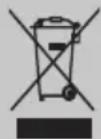
Illustration of a hand using a tool to clean or store shelves (no text or symbols visible)In compliance with Directives: 2012/19/EU and 2015/863/EU on the restriction of the use of dangerous substances in electric and electronic equipment as well as their waste disposal. The symbol with the crossed dustbin shown on the package indicates that the product at the end of its service life shall be collected as separate waste. Therefore, any products that have reached the end of their useful life must be given to waste disposal centres specialising in separate collection of waste electrical and electronic equipment, or given back to the retailer at the time of purchasing new similar equipment, on a one for one basis. The adequate separate collection for the subsequent start-up of the equipment sent to be recycled, treated and disposed of in an environmentally compatible way contributes to preventing possible negative effects on the environment and health and optimises the recycling and reuse of components making up the apparatus. Abusive disposal of the product by the user involves application of the administrative sanctions according to the laws.