FX-HWW2200 - Pump Fuxtec - Free user manual and instructions
Find the device manual for free FX-HWW2200 Fuxtec in PDF.



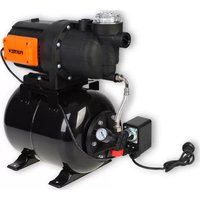
| Product type | Electric surface pump for clear water |
| Brand | Fuxtec |
| Model | FX-HWW2200 |
| Power supply | 230 V ~ 50 Hz |
| Power | 1200 W |
| Max. flow rate | 3800 L/h |
| Max. delivery head | 48 m (4.8 bar) |
| Max. suction depth | 9 m |
| Operating pressure | 1.5 bar (start) / 3 bar (stop) |
| Connection | 1" (thread) |
| Max. water temperature | 35 °C |
| Weight | 10.0 kg |
| Noise level | 77 dB(A) |
| Pressure tank | Yes, integrated |
| Thermal protection | Thermal circuit breaker with automatic reset |
| Intended use | Garden watering, service water supply, pumping rainwater or cistern water |
| Maintenance | Rinse with clear water after each use; check tank pressure every 3 months |
| Storage | Drain water and store frost-free |
| Warranty | CE conformity |
Frequently Asked Questions - FX-HWW2200 Fuxtec
User questions about FX-HWW2200 Fuxtec
0 question about this device. Answer the ones you know or ask your own.
Ask a new question about this device
Download the instructions for your Pump in PDF format for free! Find your manual FX-HWW2200 - Fuxtec and take your electronic device back in hand. On this page are published all the documents necessary for the use of your device. FX-HWW2200 by Fuxtec.
USER MANUAL FX-HWW2200 Fuxtec
natural_image
Line drawing of a FUXTEC air compressor with attached motors and wiring (no text or symbols)text_image
Technical diagram of an electric motor with numbered components and red directional arrows indicating assembly or flow.natural_image
Technical line drawing of a mechanical pump assembly (no text or symbols visible)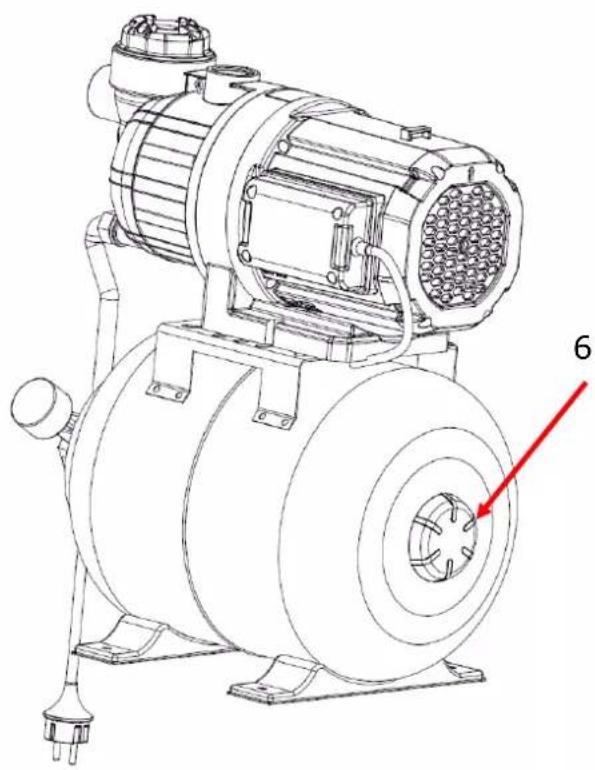
natural_image
Technical line drawing of a mechanical pump or motor assembly with no visible text or symbolsnatural_image
Technical line drawing of a mechanical device with a dial indicator (no text or symbols present)Your new device has been developed and designed to meet FUXTEC's high standards, such as ease of use and user safety. Treated properly, this device will serve you well for years to come.

WARNING: To reduce the risk of injury, the user must read and understand these instructions before operating the equipment.
FUXTEC GMBH
KAPPSTRASSE 69, 71083 HERRENBERG, GERMANY
TABLE OF CONTENTS
- TECHNICAL DATA....21
- PRODUCT DESCRIPTION....22
- INTENDED USE AND GENERAL SAFETY INSTRUCTIONS ......23
- SYMBOLS....25
- CARE AND MAINTENANCE OF THE DEVICE....26
- MOUNTING AND STARTING THE DEVICE....26
- HELP WITH PROBLEMS ....30
- STORAGE: 33
We are constantly striving to improve our products. Therefore, technical data and illustrations may change!
9. Technical data
 | FX-HWW2200 |
 | 230V/50HZ |
 | 1200 Watt |
 | X4 |
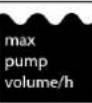 | 3.800l/h |
 | 48m / 4,8bar |
 | 77 dB(A) |
 | <35°C |
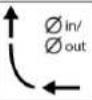 | 1" |
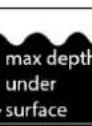 | 9m |
 | 10,0kg |
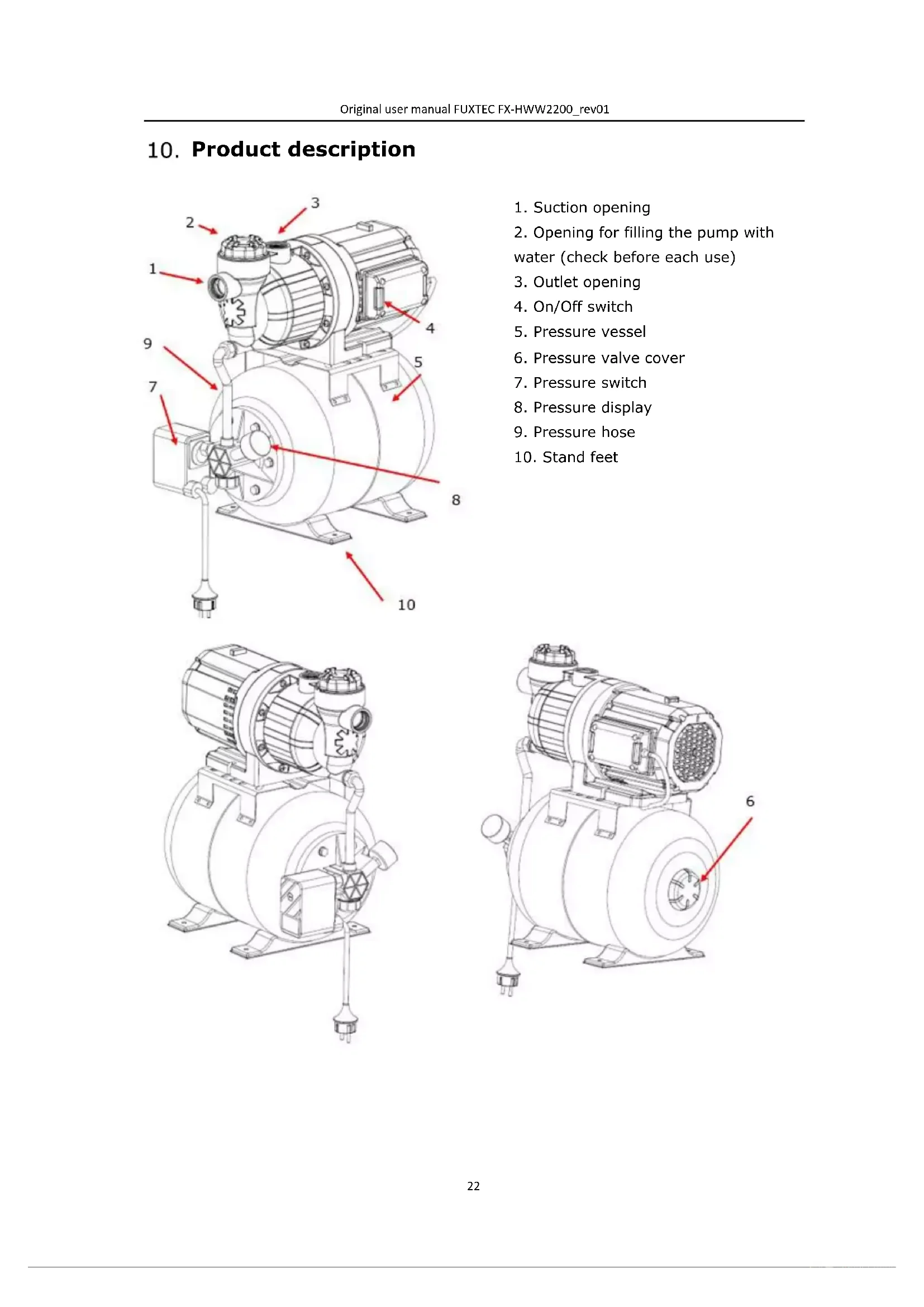
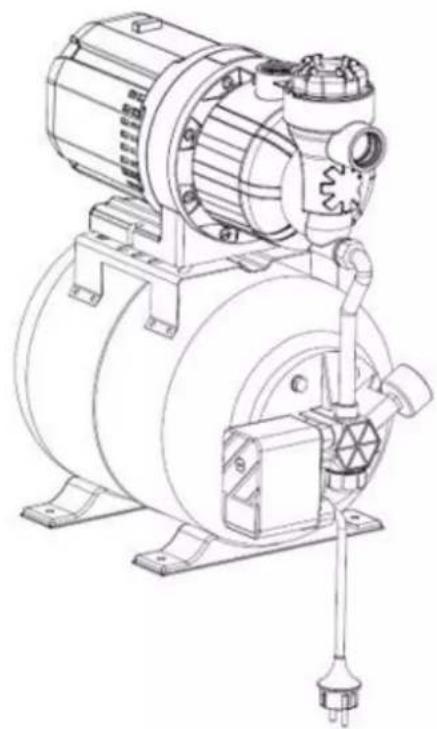
10. Product description
text_image
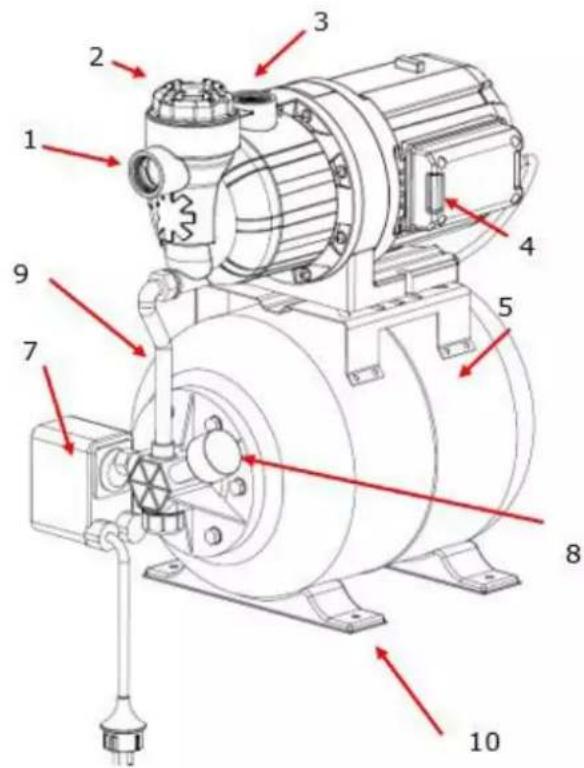
Technical diagram of an electric motor with numbered components and red directional arrows indicating assembly or control points.- Suction opening
- Opening for filling the pump with water (check before each use)
- Outlet opening
- On/Off switch
- Pressure vessel
- Pressure valve cover
- Pressure switch
- Pressure display
- Pressure hose
- Stand feet
natural_image
Technical line drawing of a mechanical pump assembly (no text or symbols)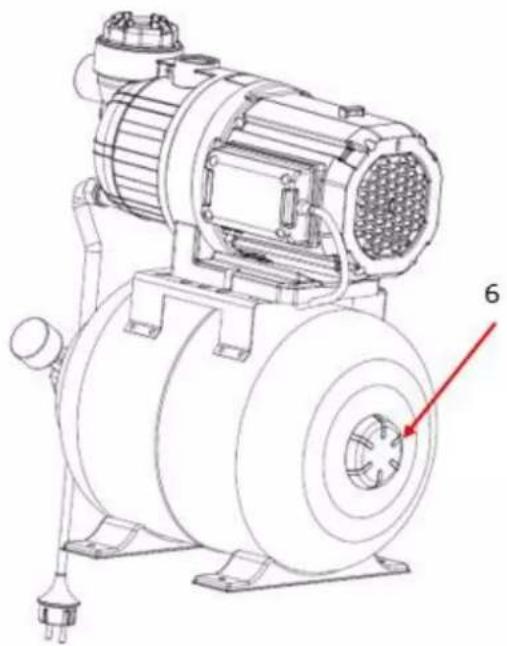
natural_image
Technical line drawing of an electric motor with labeled component (no text or symbols beyond label)11. Intended use and general safety instructions
Intended use
The device is designed for pumping clear water as service water in the house and garden.
The device can be used for the following pumped media:
• Rainwater from rain barrels or cisterns
• Water from ponds and streams (with appropriate pre-filter)
The device is suitable for the following applications:
• Watering gardens and vegetable beds
• Operation of lawn sprinklers
- Domestic water supply in the house and garden. The water temperature must not exceed 35^ C.
Attention - the device is NOT suitable for the following use!
- The device is not suitable for continuous operation (e.g., as a circulation pump for ponds).
• The device is not approved for use in swimming pools. - The device is not suitable for increasing the pressure on existing water mains.
- The device is not suitable for pumping drinking water.
-
The device must not be used for aggressive, abrasive, corrosive, flammable, or explosive pumping media, such as:
-
Saltwater
- Sand water - Food - Detergents - Fuels (such as gasoline, diesel) - Oils - Greases - Petroleum
- Nitro thinner
- Wastewater from toilets or urinals
- The device must not be operated in frosty conditions.
- Unauthorized structural modifications and additions or conversions to the device are prohibited.
Safety instructions:
- Children and persons who are not familiar with the operating instructions must not use the device.
- Never pick up, transport, or fasten the device by the connection cable.
- Unauthorized modifications or changes to the device are prohibited.
• Always disconnect the power plug before working on the device. -
Do not use the pump without a residual current device.
-
The pump must be supplied with 230V AC as indicated on the nameplate.
- Do not use the power cord to carry the pump or to disconnect it.
• Make sure that the electrical connections are protected from moisture. - Avoid dry running of the pump. Never use the pump if the suction hose is clogged.
- It is strictly forbidden to pump corrosive, highly flammable, aggressive, or explosive liquids (such as gasoline, petroleum, or nitro thinner), saltwater, and food.
- Do not use the pump if safety devices are damaged. Never deactivate the safety devices.
- Do not operate pumps in potentially explosive atmospheres, such as flammable liquids, gases, or dust.
- Keep children and unqualified persons away from the pump when it is in use.
- Risk of injury from hot water. If the pump runs for a long time when the outlet is closed, the pump's water may be heated, and hot water may leak from the outlet and cause injury.
- Stay alert, watch what you are doing, and use common sense when operating a pump.
- Maintain the pump. If the pump is damaged, have it repaired by a professional before use.
- This pump is not intended for use by persons (including children) with reduced physical, sensory or mental capabilities or lack of experience and knowledge unless they have been given supervision or instruction concerning the pump's use by a person responsible for their safety.
- It is necessary to keep children under supervision and ensure that they do not play with the pump or its power cord. Keep children away from the pump when working.
Electrical Safety:
- The house's mains voltage must correspond to the mains voltage specifications in the technical data and do not use any other supply voltage.
- The device may only be operated on an electrical installation according to DIN/VDE0100, parts 737, 738, and 702. A 10 A circuit breaker and a residual current circuit breaker with a rated residual current of 10/30 mA must be installed for fuse protection.
- Only use extension cords intended for outdoor use - minimum cross-section 1.5 mm ^2 . Always unroll cable drums completely.
- Damaged or brittle extension cords must not be used.
- Check the condition of your extension cord before each use.
- The pump cable plug must match the socket. Never modify the plug in any way. Do not use adapter plugs. Unmodified plugs and matching outlets reduce
the risk of electric shock.
- Avoid body contact with grounded surfaces.
- The pump is equipped with a socket compatible with it. Your country's power source must comply with international regulations.
- If the power cord is damaged, it must be replaced by the manufacturer, its customer service, or similarly qualified persons to avoid danger.
The pump sucks the pumped medium directly through the suction holes and delivers it to the pump outlet.
An on/off switch operates it.
Emergency Behavior:
- Switch off the device.
• In case of emergency, disconnect the device from the mains. - Do not reconnect a defective device to the mains.
Thermal circuit breaker:
The pump is equipped with a thermal protection switch, which switches off the motor in case of overheating. After a cooling phase of approx. 15 - 20 minutes, the pump switches on again automatically.
12. Symbols

The pump must not be disposed of with regular household waste but must be disposed of following local environmental regulations.

Compliance with the safety regulations in force on the EU market

Read the instructions for use before use.
13. Care and maintenance of the device
CAUTION: Disconnect the plug before carrying out any maintenance or servicing work!
- In case of temporary installation, the device should be rinsed with clean water after each use.
- In case of a permanent installation, check every 3 months if the starting mechanism is working correctly.
- Regularly remove any dirt that may accumulate in the water sampling tank.
- Do not expose the pumps to frost.
- Avoid dry running of the pump.
- Do not damage the cable. Never use the cable to carry, pull or extract the pump.
- Clean the pump regularly if aspirated liquid causes sediment.
- Avoid shocks, do not drop the pump.
- If the pump is clogged, first disconnect the pump from the mains and secure it against being switched on again.
- Then remove the suction line at the pump inlet.
- Then connect the pressure line to the waterline.
- Run sufficient water through the pump housing until the blockage dissolves.
- Check by briefly switching on whether the pump turns freely.
- Put the pump back into operation as described.
14. Mounting and starting the device
The device is used for pumping domestic water for households and gardens.
The device can draw clear water from wells, rainwater barrels, or cisterns from a depth of up to 7 m and pumping it up to a height of 48m.
In this case, the device has a pressure vessel, which provides a constant pressure in the line, even when the device is not working. The integrated automatic on/off switch monitors the pressure in the pressure vessel. It switches the device when the pressure drops below 1.5 bar or switches the device off again when the pressure of 3 bar is available again.
The water temperature must not exceed 35^ C.
For a permanent installation, the device has feet with drill holes, which allows screwing to the substrate.
Setting up the pump
- Select and prepare a level and firm location.
- Install the pump horizontally and in such a way that it is safe from flooding.
Important: The pump must be protected from rain and direct water jets.
Connecting the suction line
NOTE
We recommend installing flexible lines at the pump inlet. So can no mechanical pressure or pull is applied to the pump. This hose must be a vacuum-proof suction hose.
- Select the length of the suction line so that the pump cannot run dry. The suction line must always be at least 30 cm below the water surface. Deposits may have settled on the bottom of water bodies over time. To prevent damage to the device, do not lower the suction line to the bottom or use a suitable pre-filter with a backflow stop on the suction line
- To ensure proper operation, you must use a suction line with a check valve. For this purpose, a corresponding pre-filter with an integrated check valve can also be mounted on the suction line.
- Connect the suction line. Ensure tight connection without damaging the thread.
- Use a pressure line and suction line whose diameter is at least equal to the connections' size. A smaller diameter leads to a pressure loss and thus to a reduced flow rate.
- The lower the delivery heads of the pressure line and suction line, the higher the delivery rate.
- In the case of slightly sandy water, between the suction line and the pump inlet a pre-filter must be installed.
- Always lay the suction line uphill. An air bubble can form at elevated points in the suction line and cause the device to run dry.
Mount pressure line
IMPORTANT:
Be sure to install all pressure line parts properly. There is a risk of injury from the pressurized pumped medium in the event of improper installation or unsuitable parts.
Vent the pressure line:
Observe the following instructions before venting or switching on the device:
Make sure that the mains connection corresponds to the specifications in the technical data.
Check the proper condition of the mains socket and that it is adequately fused.
Make sure that moisture never gets to the power plug or the power socket. There is a risk of electric shock!
Check that the pressure and suction lines have been attached properly.
Check the set prepress pressure in the pressure vessel. To do this, follow the
instructions for Checking the pre-compression pressure in the pressure vessel in the Maintenance chapter.
-
Open all consumers connected to the pressure line to vent the pressure line.
-
Switch on the device as described in "Switching on the pump" and wait until the device has sucked in water or water comes out of the consumers.
Switch on the pump
Important:
The danger of device damage! Dry running destroys the pump!
The pump must be filled with water up to the overflow before each start-up to prime immediately.
- Open the filler plug (see illustration above, No. 2).
- Fill with water via the filler plug until the marking on the pump housing is reached.
-
Screw-in the filler plug again.
-
Open all closures present in the pressure line (valve, spray nozzle, water tap).
- Insert the power plug of the connection cable into the socket.
- Switch on the pump at the on/off switch.
- The device is ready for operation and switches on when the system's pressure drops below the switch-on pressure of 1.5 bar (usually by opening a consumer on the pressure line).
- The device switches off when the system's pressure rises again by closing the consumer, and the switch-off pressure of 3 bar is reached.
ATTENTION!
The danger of device damage!
A closed pressure line can cause damage to the pump!
■ Do not run the pump against a closed discharge line.
Switch off the pump
- Switch off the pump after use at the on/off switch.
- Open the lowest consumer to take pressure from the pressure line.
- Disconnect the pressure and suction lines.
- Clean the device according to the chapter Maintenance.
- Store the device according to the chapter Storage.
CAUTION!
Risk of injury from hot water
During the more extended operation against the closed pressure side (>10 min), the following may occur
the water in the pump will heat up strongly and escape uncontrollably!
- Disconnect the pump from the mains and allow the pump and the water it contains to cool down.
- Do not put the pump back into operation until all defects have been rectified!
- The risk of injury from hot water can be increased with:
- improper installation,
- closed pressure side,
- Lack of water in the suction line or
• defective pressure switch.
Procedure in case of overheating
- Disconnect the pump from the mains and allow the pump and the water to cool down.
- Check the pump, the installation, and the water level.
- Do not put the pump back into operation until all faults have been rectified!
15. Help with problems
Caution - Risk of electric shock!
When working on the pump, there is a risk of electric shock to get.
- Disconnect the power plug before carrying out any troubleshooting work.
- Have faults in the electrical system rectified by a qualified electrician.
Problem
Possible cause
Fixing the problem
| The motor does not run. | Impeller blocked. | Remove dirt in the suction area. Clean through the opening in the rear of the motor housing with a suitable tool. |
| Thermo switch has switched off | Wait until the thermal switch switches the pump on again. Pay attention to the maximum temperature of the pumped medium. Have the pump checked? | |
| No mains voltage present. | Check fuses, have power supply checked by electrician. | |
| The pump runs but does not deliver. | Water level too low. | Immerse the suction hose deeper. |
| Air in the pump housing. | Fill pump. | |
| The pump sucks air. | Check all connection joints and the filter cover for leaks. | |
| Suction side blockage. | Caution The danger of burns from hot water! Remove dirt in the suction area. | |
| The pressure line closed. | Caution The danger of burns from hot water! Open the pressure line. | |
| Pressure hose kinked. | Stretch the pressure hose. | |
| Delivery rate too low | Pressure hose kinked. | Stretch the pressure hose. |
| Hose diameter too small. | Use a larger pressure hose. | |
| Head too high. | Max. Observe delivery head, see technical data! | |
| Suction height too high. | Check suction height, observe max. suction height - see technical data. | |
| Hose line blocked | Clean from impurities | |
| The pump turns on and off too often | Check pre-compression pressure in a pressure vessel (should be 1.5 to 1.8 bar) | |
| Checking the check valve on the suction line | Remove the blockage or replace the check valve |
Maintenance
• The device requires only regular external cleaning.
• Always disconnect the power plug before cleaning the device.
- Do not clean the painted parts with emery or solvents and use only a moistened cloth.
- If the pump malfunctions, it must be repaired by qualified personnel or a service centre
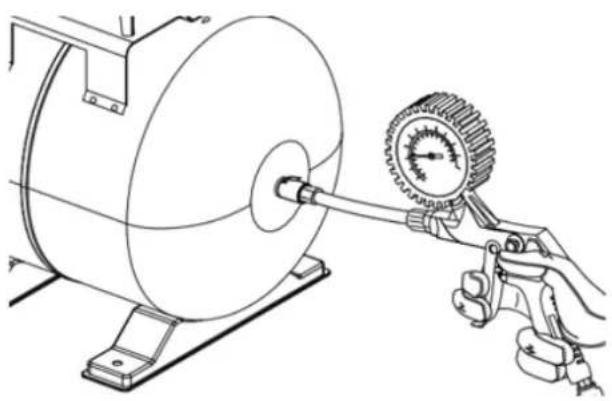
Check pressure vessel:
Check the pressure vessel's pre-pressure (air pressure) regularly (during initial start-up and every 3 months).
To do this, proceed as follows:
- Switch off the device,
- Unplug the power cord from the power outlet.
- Open the lowest consumer to take pressure from the pressure line.
- Loosen the pressure valve cover (No. 7)
- Check the pressure inside the boiler at the pressure valve with an air pressure gauge (should be between 1.5 bar and 1.8 bar)
natural_image
Technical line drawing of a mechanical device with a dial indicator and a hand holding the tool (no text or symbols present)Cleaning and care:
Proper and regular care not only ensures safe use but also prolongs the life of this equipment.
Warning Switch off the device and disconnect it from the power supply before cleaning and maintenance work to avoid electrical hazards.
a) Wipe off dust with a soft, dry cloth or brush.
b) To clean other dirt, you can use a slightly damp cloth and a neutral detergent.
Hint! Please do not use chemical, alkaline, abrasive, or other aggressive cleaning agents or disinfectants to clean this device, as they may damage the surface.
16. Storage:
- Drain all lines first.
- Open the drain plug and allow the water to drain from the pump.
- Afterwards, close the drain plug and store the pump and accessories in a frost-free place freeze.
EC DECLARATION OF CONFORMITY
Hereby, we
FUXTEC GMBH
KAPPSTRAße 69, 71083 HERRENBERG, GERMANY
declare that the device described below, under its design and construction and in the version placed on the market by us, complies with the relevant essential health and safety requirements of the EC Directives.
Designation of the device:
Garden Pump
Device type:
FX-HWW2200
Trademark:
FUXTEC
Relevant EC Directives:
2014/30/EU
Applied standards:
EN 60335-1:2012
Manufacturer signature/date:
C. Jille
L. Zirkler, 27th of June 2023
Name and address of the person
Leonhard Zirkler
authorized to compile the
FUXTEC GMBH - KAPPSTRAße 69, 71083 HERRENBERG,
technical file, established in the
GERMANY
Community
MODE D'EMPLOI ORIGINAL
text_image
Technical diagram of an electric motor with numbered components and red directional arrows indicating assembly or flow.natural_image
Technical line drawing of a mechanical pump assembly (no text or symbols visible)
natural_image
Technical line drawing of an electric motor with labeled component (no text or symbols beyond label)natural_image
Technical line drawing of a mechanical device with a dial indicator and a hand holding the tool (no text or symbols present)- DÉCLARATION DE CONFORMITÉ CE / DÉCLARATION DE CONFORMITÉ
text_image
Technical diagram of an electric motor with numbered components and red directional arrows indicating assembly or control points.natural_image
Technical line drawing of an electric motor with attached pump and mounting base (no text or symbols)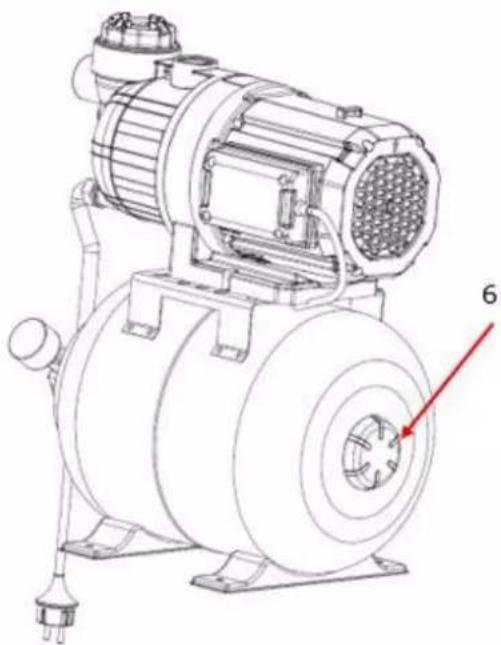
natural_image
Technical line drawing of an electric motor with labeled component (no text or symbols beyond label)natural_image
Technical line drawing of a mechanical device with a dial indicator (no text or symbols present)L. Zirkler, 27/06/2023