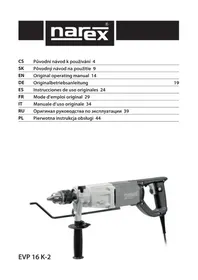
EVP 16 K-2 - Drill Narex - Free user manual and instructions
Find the device manual for free EVP 16 K-2 Narex in PDF.



| Product type | Hammer drill |
| Model | EVP 16 K-2 |
| Brand | Narex |
| Power input | 1,050 W |
| Voltage / Frequency | 230–240 V / 50–60 Hz |
| No-load speeds (1st / 2nd) | 0–970 / 0–1,750 min⁻¹ |
| Impact rate (1st / 2nd) | 0–19,400 / 0–35,000 min⁻¹ |
| Max. torque (1st / 2nd) | 35 / 19.5 Nm |
| Chuck clamping capacity | 3–16 mm |
| Max. drilling diameter (steel) | 16 mm |
| Max. drilling diameter (wood) | 55 mm |
| Max. drilling diameter (concrete, twist drill) | 30 mm |
| Max. drilling diameter (concrete, core bits) | 55 mm |
| Weight | 3.8 kg |
| Protection class | II (double insulation) |
| Neck thread | 5/8"-16UN-2A |
| Spindle collar diameter | 57 mm |
| Chuck type | Keyed chuck |
| Speed preselection | Yes, electronic |
| Friction safety clutch | Yes |
| Auxiliary handle | Yes, adjustable |
| Depth stop | Yes |
| Maintenance: brush replacement | Every 100 hours |
| Maintenance: lubrication | Every 200 hours |
| Sound level (metal drilling) | 90.1 dB(A) |
Frequently Asked Questions - EVP 16 K-2 Narex
User questions about EVP 16 K-2 Narex
0 question about this device. Answer the ones you know or ask your own.
Ask a new question about this device
Download the instructions for your Drill in PDF format for free! Find your manual EVP 16 K-2 - Narex and take your electronic device back in hand. On this page are published all the documents necessary for the use of your device. EVP 16 K-2 by Narex.
USER MANUAL EVP 16 K-2 Narex
natural_image
Exterior view of a narex EVF 15 K-2 electric drill press (no text or symbols on the device itself)Symbols used in the manual and on the machine
Nepresnost merania K = 1,0 m/s²
Impact drill EVP 16 K-2 Original operating manual
Table of contents
1 Safety warnings ......9
1.1 General Power Tool Safety Warnings....9
1.2 Special safety instructions for drills....10
1.3 Further safety instructions....10
1.4 Other risks....10
2 Information about noise level and vibrations....10
3 Technical Specification.... 11
4 Machine Description....11
5 Double insulation....11
6 Use....11
7 Safety clutch....11
8 Commissioning....11
8.1 Additional handle 12
8.2 Clamping of drill bits....12
8.3 Switching on and off....12
8.4 Permanent run....12
8.5 Speed control....12
8.6 Electronic speed pre-selection....12
8.7 Gear shifting 12
8.8 Change in rotation 12
8.9 Drilling and impact drilling 12
8.10 Removing the chuck with ring gear (Fig.)....12
8.11 Power Plug....12
9 Work instructions....12
10 Maintenance and service....13
11 Accessories....13
12 Storage.... 13
13 Environmental protection 13
14 Warranty....13
15 Certificate of Conformity 13
1 Safety warnings
1.1 General Power Tool Safety Warnings

WARNING! Read all safety warnings and all instructions. Failure to follow the warnings and instructions may result in electric shock, fire and/or serious injury.
Save all warnings and instructions for future reference!
The term "power tool" in the warnings refers to your mains-operated (corded) power tool or battery-operated (cordless) power tool.
1) Work area safety
a) Keep work area clean and well lit. Cluttered or dark areas invite accidents.
b) Do not operate power tools in explosive atmospheres, such as in the presence of flammable liquids, gases or dust. Power tools create sparks which may ignite the dust or fumes.
c) Keep children and bystanders away while operating a power tool. Distractions can cause you to lose control.
2) Electrical safety
a) Power tool plugs must match the outlet. Never modify the plug in any way. Do not use any adapter plugs with earthed (grounded) power tools. Unmodified plugs and matching outlets will reduce risk of electric shock.
b) Avoid body contact with earthed or grounded surfaces, such as pipes, radiators, ranges and refrigerators. There is an increased risk of electric shock if your body is earthed or grounded.
c) Do not expose power tools to rain or wet conditions. Water entering a power tool will increase the risk of electric shock.
d) Do not abuse the cord. Never use the cord for carrying, pulling or unplugging the power tool. Keep cord away from heat, oil, sharp edges or moving parts. Damaged or entangled cords increase the risk of electric shock.
e) When operating a power tool outdoors, use an extension cord suitable for outdoor use. Use of a cord suitable for outdoor use reduces the risk of electric shock.
f) If operating a power tool in a damp location is unavoidable, use a residual current device (RCD) protected supply. Use of an RCD reduces the risk of electric shock.
3) Personal safety
a) Stay alert, watch what you are doing and use common sense when operating a power tool. Do not use a power tool while you are tired or under the influence of drugs, alcohol or medication. A moment of inattention while operating power tools may result in serious personal injury.
b) Use personal protective equipment. Always wear eye protection. Protective equipment such as dust mask, non-skid safety shoes, hard hat, or hearing protection used for appropriate conditions will reduce personal injuries.
c) Prevent unintentional starting. Ensure the switch is in the off-position before connecting to power source and/or battery pack, picking up or carrying the tool. Carrying power tools with your finger on the switch or energising power tools that have the switch on invites accidents.
d) Remove any adjusting key or wrench before turning the power tool on. A wrench or a key left attached to a rotating part of the power tool may result in personal injury.
e) Do not overreach. Keep proper footing and balance at all times. This enables better control of the power tool in unexpected situations.
f) Dress properly. Do not wear loose clothing or jewellery. Keep your hair, clothing and gloves away from moving parts. Loose clothes, jewellery or long hair can be caught in moving parts.
g) If devices are provided for the connection of dust extraction and collection facilities, ensure these are connected and properly used. Use of dust collection can reduce dust-related hazards.
4) Power tool use and care
a) Do not force the power tool. Use the correct power tool for your application. The correct power tool will do the job better and safer at the rate for which it was designed.
b) Do not use the power tool if the switch does not turn it on and off. Any power tool that cannot be controlled with the switch is dangerous and must be repaired.
c) Disconnect the plug from the power source and/or the battery pack from the power tool before making any adjustments, changing accessories, or storing power tools. Such preventive safety measures reduce the risk of starting the power tool accidentally.
d) Store idle power tools out of the reach of children and do not allow persons unfamiliar with the power tool or these instructions to operate the power tool. Power tools are dangerous in the hands of untrained users.
e) Maintain power tools. Check for misalignment or binding of moving parts, breakage of parts and any other condition that may affect the power tool's operation. If damaged, have the power tool repaired before use. Many accidents are caused by poorly maintained power tools.
f) Keep cutting tools sharp and clean. Properly maintained cutting tools with sharp cutting edges are less likely to bind and are easier to control..
g) Use the power tool, accessories and tool bits etc. in accordance with these instructions, taking into account the working conditions and the work to be performed. Use of the power tool for operations different from those intended could result in a hazardous situation.
5) Service
a) Have your power tool serviced by a qualified repair person using only identical replacement parts. This will ensure that the safety of the power tool is maintained.
1.2 Special safety instructions for drills
- Use auxiliary handle(s), if supplied with the tool. Loss of control can cause personal injury.
- Hold power tool by insulated gripping surfaces, when performing an operation where the cutting accessory may contact hidden wiring. Cutting accessory contacting a "live" wire may make exposed metal parts of the power tool "live" and could give the operator an electric shock.
1.3 Further safety instructions
- Check the plug and cable on a regular basis and, if they are damaged, have them replaced by an authorised customer service workshop.
- The switch must be in the OFF position before you connect it to the mains.
- Always guide the power cable from the tool to the rear. Never pull hard on the power cable and never place it on or guide it over any sharp edges.
- Only work in a safe and stable position.
- Do not work in damp environments.
- If moisture has penetrated the power tool, unplug the mains plug and have the power tool checked by an authorised customer service workshop.
- Do not touch the connected power tool with wet hands.
- Wear suitable personal protective equipment: Ear protection, protective goggles, dust mask for work that generates dust and protective gloves when changing tools, sturdy shoes.


1.4 Other risks
Even in cases where the machine is used correctly and all relevant safety instructions have been adhered to, the design engineering of the machine and its operation mean that the following safety risks may also arise:
– Danger caused by the power cable.
- A concentration of dust which is harmful to health when working in an area that is not sufficiently ventilated.
-
Injuries caused by touching electrified parts when removing the machine or its parts if the plugs on the power cable have not been removed from the socket.
-
You must only use original spare parts.
2 Information about noise level and vibrations
The values have been measured in conformity with EN 62841.
Drilling
Acoustic pressure level L_pA = 90.1 dB (A).
Acoustic power level L_wA = 100.5 dB (A).
In accuracy of measurements K = 1.5 dB (A).
Percussion drilling
Acoustic pressure level L_pA = 93.6 dB (A).
Acoustic power level L_wA = 104.0 dB (A).
In accuracy of measurements K = 1.5 dB (A).

ATTENTION! Noise is generated during work! Use ear protection!
The weighted value of vibrations affecting hands and arms: Drilling a_b=3.6 m.s^-2
Percussion drilling a_h=8.8 m.s^2 .
In accuracy of measurements K = 1.0 m.s^-2 .
The emission values specified (vibration, noise) were measured in accordance with the test conditions stipulated in EN 62841 and are intended for machine comparisons. They are also used for making preliminary estimates regarding vibration and noise loads during operation.
The emission values specified refer to the main applications for which the power tool is used. If the electric power tool is used for other applications, with other tools or is not maintained sufficiently prior to operation, however, the vibration and noise load may be higher when the tool is used.
Take into account any machine idling times and downtimes to estimate these values more accurately for a specified time period. This may significantly reduce the load during the machine operating period.
3 Technical Specification
| Model EVP 16 K-2 | |
| Supply voltage (V) 230 | |
| Power frequency (Hz) 50–60 | |
| Power input (W) 1 050 | |
| Idle speed (rpm) | |
| 1st speed gear 0–970 | |
| 2nd speed gear 0–1 750 | |
| Number of impacts (ipm) | |
| 1st speed gear 0–19 400 | |
| 2nd speed gear 0–35 000 | |
| Maximum torque (Nm) | |
| 1st speed gear 35* | |
| 2nd speed gear 19.5* | |
| Speed pre-selection | √ |
| Safety clutch | √ |
| Extent of chuck dia. (mm) 3–16 | |
| Thread on spindle | 5/8"-16UN-2A |
| Drilling dia. max (mm) | |
| into steel | 16 |
| into wood | 55 |
| into concrete | full drill bit 30 |
| annular bit 55 | |
| Clamping neck dia. (mm) | 57 |
| Weight (kg) | 3.8 |
| Protection class | II /回 |
* Limited by safety clutch
4 Machine Description
[1a] ..Chuck with ring gear
[1b]..Quick-tightening chuck Auto-Lock
[2].....Spots on spindle
[3].....Clamping neck
[4].....Lever for impact shifting
[5].....Air vents
[6].....Latching pin
[7].....Switch / controller
[8].....Speed pre-selection wheel
[9].....Alteration switch lever
[10] ..Gear-shifting lever
[11] ..Additional handle
[12] ..Stop bar
[13] ..Chuck hook
[14] ..Spanner*
[15] ..Socket screw wrench*
*) Some accessories displayed or described here may not be included in the delivery.
5 Double insulation
To ensure maximum safety of the user, our tools are designed and built to satisfy applicable European standards (EN standards). Tools with double insulation are marked by the international symbol of a double square. These tools must not be grounded and a two-wire cable is sufficient to supply them with power. Tools are shielded in accordance with EN 55014.
6 Use
The machine is intended for impact drilling in brick, concrete and stone as well as for drilling in wood, metal, ceramics and plastics. Machines with electronic control and right/left rotation are also suitable for screwing and thread-cutting.
The user bears full responsibility for the consequences of using the tool for purposes other than the above.
7 Safety clutch
The safety clutch is activated if the drill becomes jammed or caught.
8 Commissioning
Any unauthorised use might cause damage to the tool. Therefore follow these instructions:
– Always use sharp drill bits.
- Load the tool to avoid any significant reduction of speed or stoppage.
- Always change the speed gear when the machine is idle or at the machine slow-down at low speed, in no case during the drilling or when the machine is otherwise loaded.
Check that the information on the production plate matches the real voltage of the power source.
Check that plug matches the type of socket.
Tools designed for 230 V can also be connected to 220/240 V.

ATTENTION! Noise is generated during work!
Use ear protection!
8.1 Additional handle
For safety reasons always use the enclosed auxiliary handle [9]. Fasten the auxiliary handle to the clamping collar [2] with the wing bolt [14].
By loosening the wing bolt [15] the drilling depth can be adjusted with the depth stop adjustment [10].
The auxiliary handle is used to guide the machine securely, especially with sudden occurring reaction torque (e.g. jamming of the drill bit).
By loosening the wing bolt [16] the position of the auxiliary
handle can be adjusted in length direction.
8.2 Clamping of drill bits
Open the chuck to allow mounting of the tool. Mount the tool on. Mount the tool on and, using the chuck hook [11] clamp in evenly.

Be careful as the chuck gets hot:
In case of longer work tasks, especially in impact drilling, the chick might get very hot. In this case you are recommended to wear protective gloves.
8.3 Switching on and off
By pressing the switch button [4a] the machine activates and releasing the button stops it.
8.4 Permanent run
By pressing the switch button [4a] to the stop and simultaneous pressing the latching pin [3] permanent run is achieved.
Repeated pressing the switch button [4a] and its release the permanent run is discontinued.
8.5 Speed control
By light and gradual pressing the controller button [4a] you will achieve low speed and controlled continuous run-up.
By further gradual pressing the button the speed increases to the pre-selected speed.
8.6 Electronic speed pre-selection
Using the pre-selection wheel [5] the required pre-selected speed is set—even if the machine runs. The necessary speed depends on the type of the material drilled, and a practical test is recommended to verify it.
If the machine is loaded considerably, adjust the pre-selection wheel [5] to the marginal position in the + direction (max speed - control disconnected).
After a longer work at low speed leave the machine run idle for 3 minutes at maximum speed to cool the engine down.
8.7 Gear shifting
Use the speed lever [7] to adjust the 2nd speed gear:
- Speed – lower speed gear – higher torque
- Speed – higher speed gear – lower torque
In any speed gear you can adjust the final speed by means of the electronic pre-selection. However, firstly select the mechanical speed gear.
Changing the gears can be done at slowing the machine down or in idle run but never when the machine is fully loaded. Once the gear is changed, leave the machine start up slowly.
8.8 Change in rotation
Adjust the rotation direction switch [4b] to the right (left run) or to the left (right run). The left run allows e.g. cutting the threads and unscrewing of bolts or nuts.
Changing is blocked if the controller button is pressed. The rotation direction has to be changed when the machine is idle.

WARNING! If the left run is used, the chuck has to be screwed on very firmly.
8.9 Drilling and impact drilling
Shift in or out the hammer by the hammer gear button [8]. The shifting can be done even when the machine runs.
Engaging hammer-action:
Press button [8]. Push the machine's spindle towards the body of the drill and rotate the spindle to the right until the button clicks in place.
Turning off hammer-action:
Push the machine's spindle towards the body of the drill and rotate the spindle to the left until the button releases from the hammer-action position.
8.10 Removing the chuck with ring gear (Fig.)
Hold the spindle on the surface [12] using an open wrench (22 mm). Insert the chuck hook [11] into a single opening on the chuck and by turning left screw the chuck out. Release the firmly clamped chuck by impacts of the hammer on the chuck hook [11].
8.11 Power Plug
WARNING! Risk of injury if the power tool is used with incorrect mains power supply.
The power tool may only be used with single-phase alternating current with rated voltage of 220–240 V / 50–60 Hz. The power tool has double insulation against injury by electric current in line with standard EN 62841 and features integrated interference elimination in line with standard EN 55014.
Before turning the tool on, check that the information on the production plate matches the real voltage in the socket.
The power cable can be extended if needed as follows:
- 20 m length, conductor cross section: 3 × 1.5 ~mm^2
- 50 m length, conductor cross section: 3 × 2.5 ~mm^2
Only use extension cables designed for outdoor use and bearing the appropriate markings.
Operation with an Electric Generator (EG) with a Combustion Engine
The manufacturer of the tool cannot guarantee faultless operation with all EGs.
The tool can be used with an EG if the following conditions are met:
» The output voltage of the EG must always be in 230 VAC ±10 % range. The EG should be fitted with automatic voltage regulation (AVR). Without AVR, the tool may not work correctly and may even get damaged!
» The power of the EG must be at least 2.5 times higher than the input power of the tool.
» Using the power tool with an EG with insufficient power may result in speed fluctuations and reduced output of the tool.
9 Work instructions
Drill bits
For steel use perfect and sharpened drill bits made of good-quality high-speed steel.
Drilling stands
For precise drilling on smaller parts, use of a drilling stand is recommended.
Clamping device
Clamp the worked pieces properly into the screw-type clamping unit. Thus turning of the piece is avoided, as well as a potential accident.
Drilling in tiles
Shift the impact gear lever to the drill-bit symbol. Once the upper layer is drilled through, shift the impact gear lever to the hammer symbol.
Thread cutting
Clamp the screw tap properly in the chuck using a considerable power, otherwise it will slide through.
10 Maintenance and service

Attention! Risk of el. shock. Prior to start any operation, pull the plug out of the socket!
The vents [6] on the motor housing must not be covered or clogged.
After about 100 hours of operation the following works need to be done:
- Check of the brushes length Brushes shorter than 5 mm must be replaced with new ones.
After about 200 hours of operation the following works need to be done:
- Exchange of lubricating grease in the gearbox and bearings. When the carbon brushes are worn down, the tool switches off automatically. The tool must be brought to a service centre for maintenance.
It is recommended to clean the tool regularly. Using cleaning agents that contain solvents may erode or damage painted surfaces and plastic parts. If you use such cleaning agents, it is recommended to try them out first on a small area that is not very visible. The vents on the motor housing must not be covered or clogged!
Leave the replacement of any parts, e.g., carbon brushes, power cable etc., to an authorised service centre. Should the tool fall or suffer a hard impact, have it checked by an authorised service centre to ensure the tool is mechanically and electrically safe to use.

Attention! With respect to protection from el. shock and preservation of the class of protection, all maintenance and service operations requesting jig saw case
removal must be performed by the authorized service centre only!
The current list of authorized service centres can be found at our website www.narex.cz.
11 Accessories
The accessories recommended for use with this device are available commercially in the shops with hand el. tools.
12 Storage
Packed appliance may be stored in dry, unheated storage place with temperature not lower than -5 °C.
Unpacked appliance should be stored only in dry storage place with temperature not lower than +5 °C with exclusion of all sudden temperature changes.
13 Environmental protection
Power tools, accessories and packaging should be sorted for environmental-friendly recy.
Only for EU countries:
Do not dispose of power tools into household waste!
According to the European Directive 2002/96/EC on waste electrical and electronic equipment and its incorporation into national law, power tools that are no longer suitable for must be separately collected and sent for recovery in an environmental-friendly manner.
14 Warranty
Our equipment is under warranty for at least 12 months with regard to material or production faults in accordance with national legislation. In the EU countries, the warranty period for exclusively private use is 24 months (an invoice or delivery note is required as proof of purchase).
Damage resulting from, in particular, normal wear and tear, overloading, improper handling, or caused by the user or other damage caused by not following the operating instructions, or any fault acknowledged at the time of purchase, is not covered by the warranty.
Complaints will only be acknowledged if the equipment has not been dismantled before being sent back to the suppliers or to an authorised NAREX customer support workshop. Store the operating instructions, safety notes, spare parts list and proof of purchase
in a safe place. In addition, the manufacturer's current warranty conditions apply.
Note
Due to continuous research and development work, we reserve the right to make changes to the technical content of this documentation.
15 Certificate of Conformity
EVP 16 K-2:
We declare that the device meets requirements of the following standards and directives.
Safety
EN 62841-1:2016
EN 62841-2-1:2018
EN ISO 3744:2011
EN ISO 5349-1:2002
EN ISO 12100:2011
Directive 2006/42/EC
Electromagnetic compatibility
EN 55014-1 ed. 4:2017
EN 55014-2 ed. 2:2017
Place of storage of the technical documentation:
470 01 Česká Lípa CEO of the company
Januar 5, 2022
[11] ..Spannfutterschlüssel
Directiva 2006/42/EC
Narex s.r.o.
Incertitude K = 1,0 m/s ^2
Directive 2006/42/EC
Narex s.r.o.
Narex s.r.o.
Narex s.r.o.
The current list of authorized service centres can be found at our website www.narex.cz, section "Service Centres".
- Symbols used in the manual and on the machine
- Impact drill EVP 16 K-2 Original operating manual
- Table of contents
- Safety warnings
- General Power Tool Safety Warnings
- Save all warnings and instructions for future reference!
- 5) Service
- Special safety instructions for drills
- Further safety instructions
- Other risks
- Information about noise level and vibrations
- Drilling
- Percussion drilling
- ATTENTION! Noise is generated during work! Use ear protection!
- Machine Description
- Double insulation
- Use
- Safety clutch
- Commissioning
- Additional handle
- Clamping of drill bits
- Switching on and off
- Permanent run
- Speed control
- Electronic speed pre-selection
- Gear shifting
- Change in rotation
- Drilling and impact drilling
- Engaging hammer-action:
- Turning off hammer-action:
- Removing the chuck with ring gear (Fig.)
- Power Plug
- Operation with an Electric Generator (EG) with a Combustion Engine
- Work instructions
- Drill bits
- Drilling stands
- Clamping device
- Drilling in tiles
- Thread cutting
- Maintenance and service
- After about 100 hours of operation the following works need to be done:
- After about 200 hours of operation the following works need to be done:
- Accessories
- Storage
- Environmental protection
- Only for EU countries:
- Warranty
- Note
- Certificate of Conformity
- EVP 16 K-2:
- Safety
- Electromagnetic compatibility
Brand : Narex
Model : EVP 16 K-2
Category : Drill