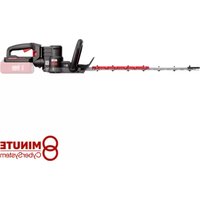
KC200.9 - Hedge Trimmers KRESS - Free user manual and instructions
Find the device manual for free KC200.9 KRESS in PDF.




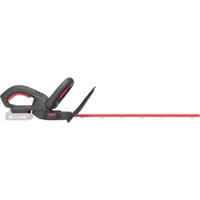
| Product Type | Cordless Hedge Trimmer |
| Brand | Kress |
| Model | KC200.9 |
| Rated voltage | 60 V max (54 V nominal) |
| Cutting speed | 2800 / 3200 strokes/min |
| Blade length | 63 cm (25 in) |
| Tooth spacing | 38 mm (1.5 in) |
| Weight | 4.0 kg (8.8 lb) |
| Protection rating | IPX4 |
| Sound pressure level | 80.4 dB(A) (K=3 dB(A)) |
| Sound power level | 91.4 dB(A) (K=3 dB(A)) |
| Vibration (measured value) | 3.06 m/s² (K=1.5 m/s²) |
| Recommended batteries | KAC804 (4 Ah), KAC840 (30 A), KAC810 (with harness), KA3000 (2.0 Ah) |
| Recommended charger | KAC840 (30 A) |
| Charging temperature range | -5 °C to 45 °C |
| Discharging temperature range | -20 °C to 45 °C |
| Main features | Rotatable rear handle (45°/90°/135°/180°), variable speed trigger, protective shield, compatible with back harness, LED indicator, quick stop |
| Maintenance and cleaning | Blade lubrication (WD-40), gearbox greasing every 50 h, cleanable air filter cleaning, professional blade sharpening |
| Safety | Two-hand operation (front and rear levers), battery lock, overload and overheat protection, automatic stop if any trigger is released |
| Battery storage | Recommended temperature: 5 °C to 25 °C |
Frequently Asked Questions - KC200.9 KRESS
User questions about KC200.9 KRESS
0 question about this device. Answer the ones you know or ask your own.
Ask a new question about this device
Download the instructions for your Hedge Trimmers in PDF format for free! Find your manual KC200.9 - KRESS and take your electronic device back in hand. On this page are published all the documents necessary for the use of your device. KC200.9 by KRESS.
USER MANUAL KC200.9 KRESS
natural_image
Black hair clip with serrated edge and handle, isolated on white background (no text or symbols)| Commercial hedge trimmer (Pruning) | EN | P02 |
| Gewerbliche Heckenschere (Baumschnitt) | D | P16 |
| Taille-haie commercial (taille) | F | P30 |
| Tagliasiepi professionale (potatura) | I | P44 |
| Cortasetos comercial (poda) | ES | P58 |
| Corta-sebes comercial (Poda) | PT | P72 |
| Commerciële heggenschaar (snoeien) | NL | P86 |
| Kereskedelmi sövénynyíró (metszéshez) | HU | P100 |
| Trimmer comercial pentru gard viu (toaletare) | RO | P115 |
| Komercyjne nożyce do żywopłotu (przycinanie) | PL | P129 |
| Nǚžky na živý plot pro komerční použití (prořezávaní) | CZ | P144 |
| Komerčné nožnice na živé ploty (strihanie) | SK | P158 |
| Komercialni obrezovalnik žive meje (obrezovanje) | SL | P172 |
| Profesionalne škare za živicu (obrezivanje) | HR | P186 |
| Kommerciel hækkeklipper (beskæring) | DK | P200 |
| Pensasleikkuri | FIN | P214 |
| Kommersiell hekketrimmer (skjæring) | NOR | P227 |
| Kommersiell häcktrimmer (beskärning) | SV | P240 |
KC200 KC200.X
TABLE OF CONTENTS
Introduction....2
Component List....3
Product Safety....4
Assembly & Operation....7
Transportation....10
Maintenance....10
Cleaning....11
Storage....11
Troubleshooting....12
Technical Data....13
EN
Environmental Protection....14
Declaration of Conformity....15
INTRODUCTION
Dear Customer,
Thank you for buying this Kress Commercial product. We are dedicated to developing high quality products to meet your commercial landscaping requirements.
The Kress brand is synonymous with premium quality service. Over the years of your product's life, if you have any questions or concerns about your product, please contact your dealer or our Customer Service Team for assistance.
We are confident you will enjoy working with your Kress product for years to come.
INTENDED USE
This machine is intended for cutting and trimming hedges and bushes in light and heavy commercial use.
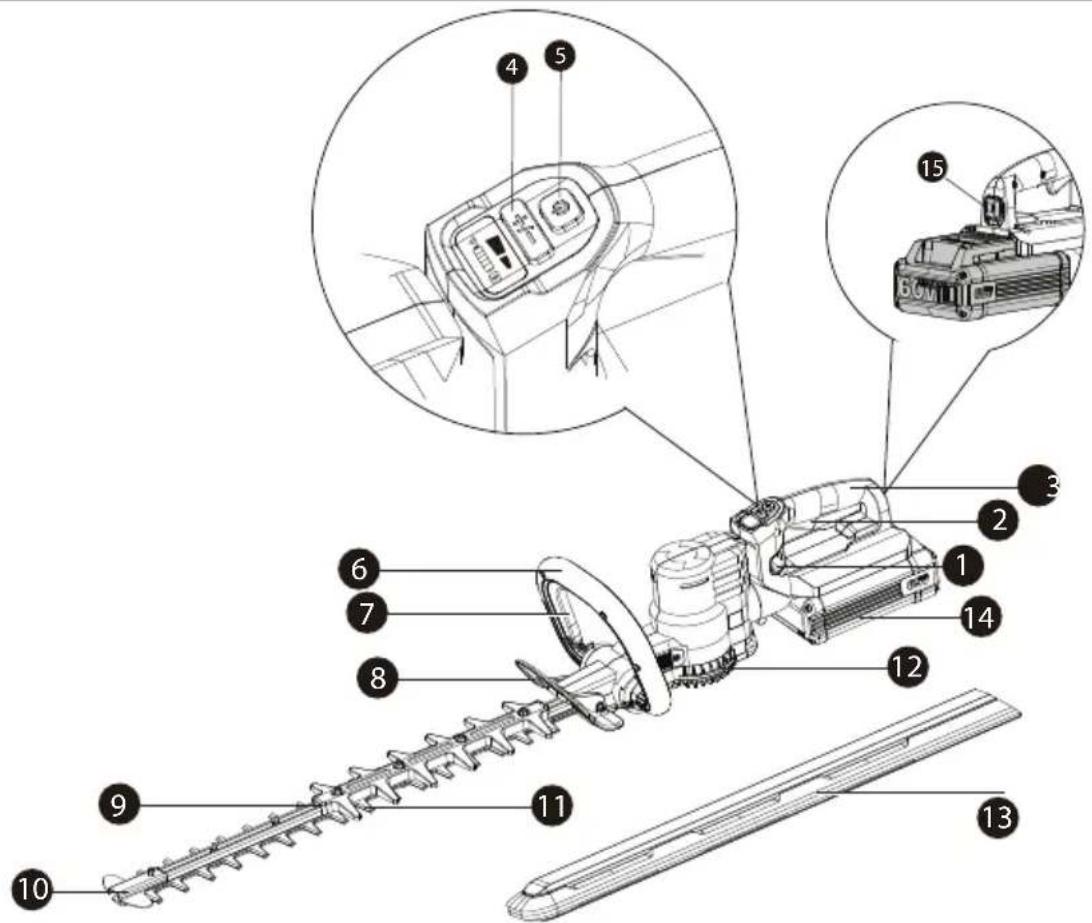
COMPONENT LIST
-
LOCKING SWITCH FOR ROTATING REAR HANDLE
-
THROTTLE TRIGGER
-
ROTATING REAR HANDLE
-
SPEED CONTROL BUTTON
-
ON/OFF SWITCH
-
FRONT HANDLE
-
OPERATOR PRESENCE SWITCH (ALL AROUND SWITCH FUNCTION)
-
SAFETY GUARD
-
BLADE
-
TIP PROTECTOR
-
REAR BLADE GUARD
-
METAL GEAR BOX
-
BLADE SHEATH
-
BATTERY PACK *
-
BATTERY-RELEASE BUTTON
* Not all the accessories illustrated or described are included in standard delivery.
PRODUCT SAFETY GENERAL POWER TOOL SAFETY WARNINGS

WARNING Read all safety warnings, instructions, illustrations and
specifications provided with this power tool.
Failure to follow all instructions listed below may result in electric shock, fire and/or serious injury.
Save all warnings and instructions for future reference.
The term “power tool” in the warnings refers to your mains-operated (corded) power tool or battery-operated (cordless) power tool.
1. Work area safety
a) Keep work area clean and well lit. Cluttered or dark areas invite accidents.
b) Do not operate power tools in explosive atmospheres, such as in the presence of flammable liquids, gases or dust. Power tools create sparks which may ignite the dust or fumes.
c) Keep children and bystanders away while operating a power tool. Distractions can cause you to lose control.
2. Electrical safety
a) Power tool plugs must match the outlet. Never modify the plug in any way. Do not use any adapter plugs with earthed (grounded) power tools. Unmodified plugs and matching outlets will reduce risk of electric shock.
b) Avoid body contact with earthed or grounded surfaces, such as pipes, radiators, ranges and refrigerators. There is an increased risk of electric shock if your body is earthed or grounded.
c) Do not operate the machine in rain or wet conditions. This may increase the risk of electric shock. Once got wet in the rain during operation, the machine and the battery should be dried before storing or charging. Remove the battery and reinsert it if the machine fails to turn on. Keep battery connection free of dirt and debris, and clean with a soft and dry brush or cloth.
d) Do not abuse the cord. Never use the cord for carrying, pulling or unplugging the power tool. Keep cord away from heat, oil, sharp edges or moving parts. Damaged or entangled cords increase the risk of electric shock.
e) When operating a power tool outdoors, use an extension cord suitable for outdoor use. Use of a cord suitable for outdoor use reduces the risk of electric shock.
f) If operating a power tool in a damp location is unavoidable, use a residual current device (RCD) protected supply. Use of an RCD reduces the risk of electric shock.
3. Personal safety
a) Stay alert, watch what you are doing and use common sense when operating a power
tool. Do not use a power tool while you are tired or under the influence of drugs, alcohol or medication. A moment of inattention while operating power tools may result in serious personal injury.
b) Use personal protective equipment. Always wear eye protection. Protective equipment such as dust mask, non-skid safety shoes, hard hat, or hearing protection used for appropriate conditions will reduce personal injuries.
c) Prevent unintentional starting. Ensure the switch is in the off-position before connecting to power source and/or battery pack, picking up or carrying the tool. Carrying power tools with your finger on the switch or energising power tools that have the switch on invites accidents.
d) Remove any adjusting key or wrench before turning the power tool on. A wrench or a key left attached to a rotating part of the power tool may result in personal injury.
e) Do not overreach. Keep proper footing and balance at all times. This enables better control of the power tool in unexpected situations.
f) Dress properly. Do not wear loose clothing or jewellery. Keep your hair and clothing away from moving parts. Loose clothes, jewellery or long hair can be caught in moving parts.
g) If devices are provided for the connection of dust extraction and collection facilities, ensure these are connected and properly used. Use of dust collection can reduce dust-related hazards.
h) Do not let familiarity gained from frequent use of tools allow you to become complacent and ignore tool safety principles. A careless action can cause severe injury within a fraction of a second.
4. Power tool use and care
a) Do not force the power tool. Use the correct power tool for your application. The correct power tool will do the job better and safer at the rate for which it was designed.
b) Do not use the power tool if the switch does not turn it on and off. Any power tool that cannot be controlled with the switch is dangerous and must be repaired.
c) Disconnect the plug from the power source and/or remove the battery pack, if detachable, from the power tool before making any adjustments, changing accessories, or storing power tools. Such preventive safety measures reduce the risk of starting the power tool accidentally.
d) Store idle power tools out of the reach of children and do not allow persons unfamiliar with the power tool or these instructions to operate the power tool. Power tools are dangerous in the hands of untrained users.
e) Maintain power tools and accessories. Check for misalignment or binding of moving parts, breakage of parts and any other condition that may affect the power tool's operation. If
damaged, have the power tool repaired before use. Many accidents are caused by poorly maintained power tools.
f) Keep cutting tools sharp and clean. Properly maintained cutting tools with sharp cutting edges are less likely to bind and are easier to control.
g) Use the power tool, accessories and tool bits etc. in accordance with these instructions, taking into account the working conditions and the work to be performed. Use of the power tool for operations different from those intended could result in a hazardous situation.
h) Keep handles and gra sping surfaces dry, clean and free from oil and grease. Slippery handles and grasping surfaces do not allow for safe handling and control of the tool in unexpected situations.
- Battery tool use and care
a) Recharge only with the charger specified by the manufacturer. A charger that is suitable for one type of battery pack may create a risk of fire when used with another battery pack.
b) Use power tools only with specifically designated battery packs. Use of any other battery packs may create a risk of injury and fire.
c) When battery pack is not in use, keep it away from other metal objects, like paper clips, coins, keys, nails, screws or other small metal objects, that can make a connection from one terminal to another. Shorting the battery terminals together may cause burns or a fire.
d) Under abusive conditions, liquid may be ejected from the battery; avoid contact. If contact accidentally occurs, flush with water. If liquid contacts eyes, additionally seek medical help. Liquid ejected from the battery may cause irritation or burns.
e) Do not use a battery pack or tool that is damaged or modified. Damaged or modified batteries may exhibit unpredictable behaviour resulting in fire, explosion or risk of injury.
f) Do not expose a battery pack or tool to fire or excessive temperature. Exposure to fire or temperature above 130 °C may cause explosion.
g) Follow all charging instructions and do not charge the battery pack or tool outside the temperature range specified in the instructions. Charging improperly or at temperatures outside the specified range may damage the battery and increase the risk of fire.
- Service
a) Have your power tool serviced by a qualified repair person using only identical replacement parts. This will ensure that the safety of the power tool is maintained.
b) Never service damaged battery packs. Service of battery packs should only be performed by the manufacturer or authorized service providers.
HEDGE TRIMMER SAFETY
WARNINGS:
a) Keep all parts of the body away from the blade. Do not remove cut material or hold material to be cut when blades are moving.
Blades continue to move after the switch is turned off. A moment of inattention while operating the hedge trimmer may result in serious personal injury.
b) Carry the hedge trimmer by the handle with the blade stopped and taking care not to operate any power switch. Proper carrying of the hedge trimmer will decrease the risk of inadvertent starting and resultant personal injury from the blades.
c) When transporting or storing the hedge trimmer, always fit the blade cover. Proper handling of the hedge trimmer will decrease the risk of personal injury from the blades.
d) When clearing jammed material or servicing the unit, make sure all power switches are off and the battery back is removed or disconnected. Unexpected actuation of the hedge trimmer while clearing jammed material or servicing may result in serious personal injury.
e) Hold the hedge trimmer by insulated gripping surfaces only, because the blade may contact hidden wiring. Blades contacting a "live" wire may make exposed metal parts of the hedge trimmer "live" and could give the operator an electric shock.
f) Keep all power cords and cables away from cutting area. Power cords or cables may be hidden in hedges or bushes and can be accidentally cut by the blade.
g) Do not use the hedge trimmer in bad weather conditions, especially when there is a risk of lightning. This decreases the risk of being struck by lightning.
h) Check the hedges and bushes for foreign objects, e.g. wire fences and hidden wiring.
i) Hold the hedge trimmer properly, e.g. with both hands if two handles are provided.
j) The hedge trimmer is intended to be used by the operator at ground level and not on ladders or any other unstable support.
k) Before operating the hedge trimmer, the user should make sure the locking device(s) of any moving elements (e.g. the extended shaft and pivoting element), if any, are in the locked position.
I) Have any adjustable stopping mechanism maintained at regular intervals.
SAFETY WARNINGS FOR BATTERY PACK
a) Do not dismantle, open or shred cells or battery pack.
b) Do not short-circuit a battery pack. Do not store battery packs haphazardly in a box or drawer where they may short-circuit each other or be short-circuited by conductive
materials. When battery pack is not in use, keep it away from other metal objects, like paper clips, coins, keys, nails, screws or other small metal objects, that can make a connection from one terminal to another. Shorting the battery terminals together may cause burns or a fire.
c) Do not expose battery pack to heat or fire. Avoid storage in direct sunlight.
d) Do not subject battery pack to mechanical shock.
e) In the event of battery leaking, do not allow the liquid to come into contact with the skin or eyes. If contact has been made, wash the affected area with copious amounts of water and seek medical advice.
f) Keep battery pack clean and dry.
g) Wipe the battery pack terminals with a clean dry cloth if they become dirty.
h) Battery pack needs to be charged before use. Always refer to this instruction and use the correct charging procedure.
i) Do not maintain battery pack on charge when not in use.
j) After extended periods of storage, it may be necessary to charge and discharge the battery pack several times to obtain maximum performance.
k) Recharge only with the charger specified by Kress. Do not use any charger other than that specifically provided for use with the equipment.
I) Do not use any battery pack which is not designed for use with the equipment.
m) Keep battery pack out of the reach of children.
n) Retain the original product literature for future reference.
o) Remove the battery from the equipment when not in use.
p) Dispose of properly.
q) Do not mix cells of different manufacture, capacity, size or type within a device.
r) Keep the battery away from microwaves and high pressure.
USER MANUAL REQUIREMENTS FOR WIRELESS PRODUCT
a) Operation of this device is subject to the following two conditions:
(1) This device may not cause harmful interference, and
(2) this device must accept any interference received, including interference that may cause undesired operation.
b) Caution: Changes or modifications to this unit not expressly approved by the party responsible for compliance could void the user's authority to operate the equipment.
c) NOTE: This equipment generates, uses and can radiate radio frequency energy and, if not installed and used in accordance with the
instructions, may cause harmful interference to radio communications. However, there is no guarantee that interference will not occur in a particular installation. If this equipment does cause harmful interference to radio or television reception, which can be determined by turning the equipment off and on, the user is encouraged to try to correct the interference by one or more of the following measures:
- Reorient or relocate the receiving antenna.
- Increase the separation between the equipment and receiver.
- Connect the equipment into an outlet on a circuit different from that to which the receiver is connected.
- Consult the dealer or an experienced radio/TV technician for help.
SYMBOLS
 | To reduce the risk of injury, user must read instruction manual |
 | Warning |
 | Wear eye protection |
 | Wear ear protection |
 | Wear dust mask |
 | Keep hands away from blade |
 | Wear protective gloves |
 | Do not burn |
 | Batteries may enter water cycle if disposed improperly, which can be hazardous for ecosystem. Do not dispose of waste batteries as unsorted municipal waste. |
 Li-Ion Li-Ion | Li-Ion battery This product has been marked with a symbol relating to 'separate collection' for all battery packs and battery pack. It will then be recycled or dismantled in order to reduce the impact on the environment. Battery packs can be hazardous for the environment and for human health since they contain hazardous substances. |
 | Waste electrical products must not be disposed of with household waste. Please recycle where facilities exist. Check with your local authorities or retailer for recycling advice. |
 | Remove battery from the socket before carrying out any adjustment, servicing or maintenance. |
NOTE: Before using the tool, read the instruction book carefully.

BEFORE OPERATION:
Assembling the safety guard (See Fig. A)
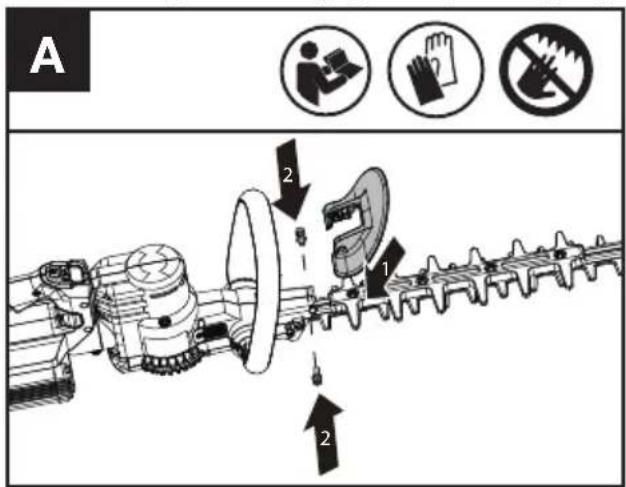
Secure the safety guard onto the hedge trimmer with the screw.
Installing & removing the battery pack (See Fig. B1,B2)
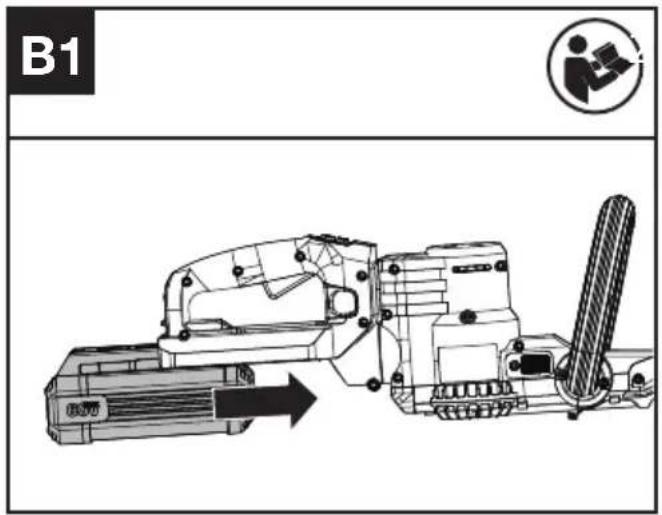
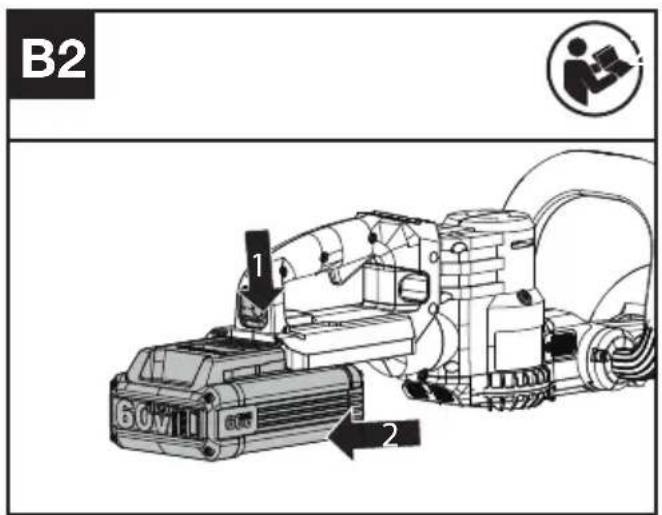
- Slide the battery pack into the battery compartment until you hear a click.
- Press the battery release button to release battery pack from your tool.
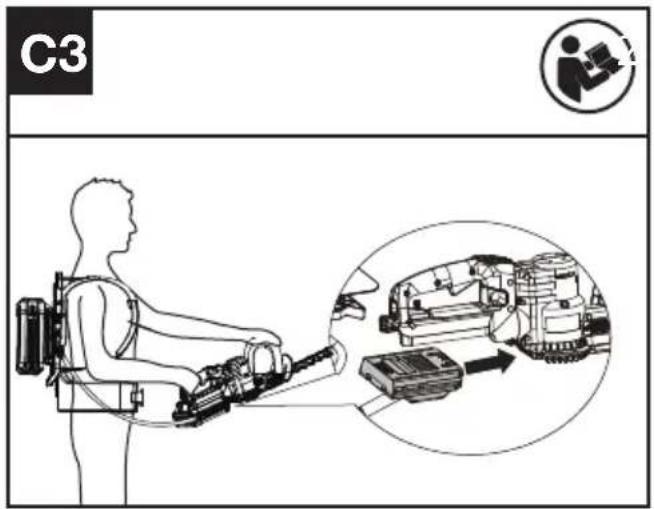
Connecting the hedge trimmer to the backpack harness(See Fig. C1,C2,C3)
Install the battery pack into the backpack harness, put on the backpack harness. Then connect the harness with your machine.
More details can be found in backpack harness's manual.
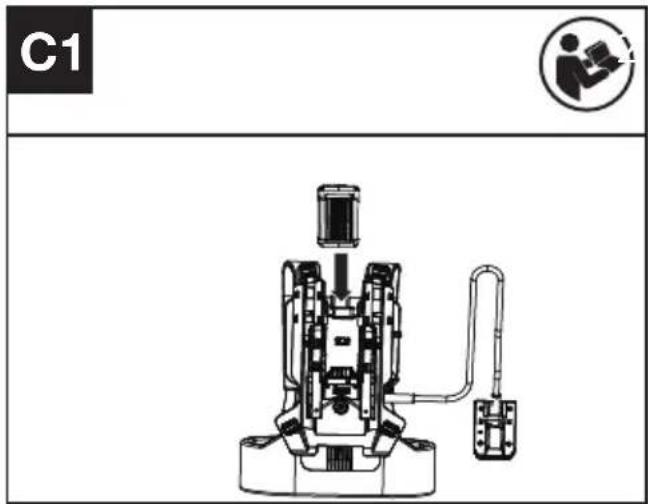
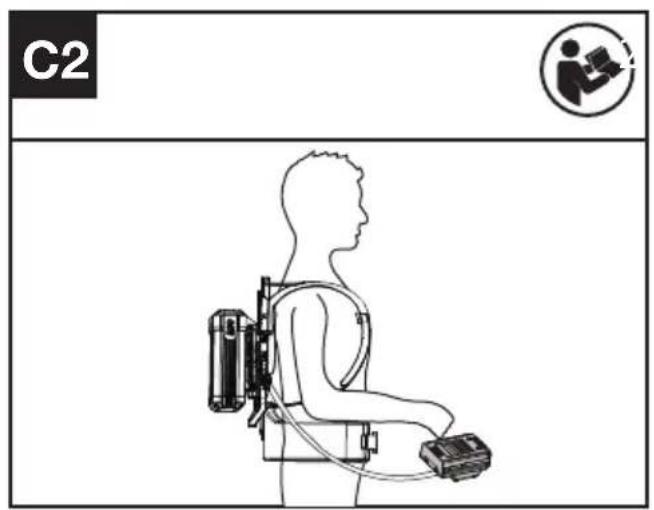
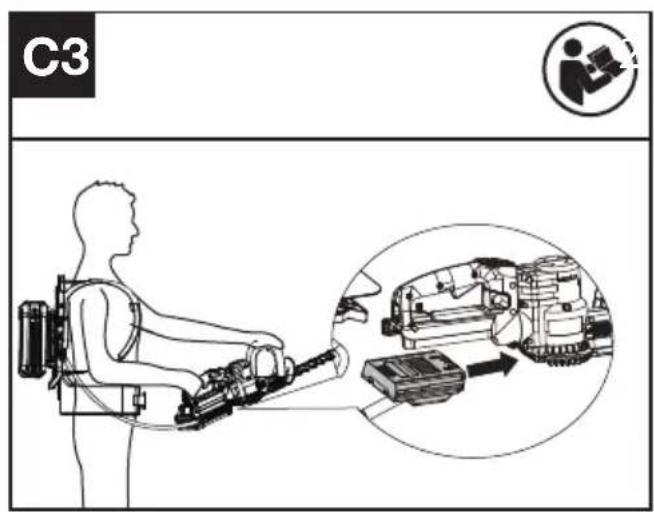
Testing the trimmer and battery (See Fig. D) Checking the controls Front Switch Lever and Rear Switch Lever
- Remove the battery.
- Press and release the Front Switch Lever and Rear Switch Lever. If the Rear Switch Lever or the Front Switch Lever is get stuck and cannot spring back to its original position. Stop using the trimmer and contact the service agent.
Checking the display
- Insert the battery.
- Hold and press the On / Off Switch.
The product is switched on when the LED (a) is lit.
The product is switched off when the LED (a) is off. - If the warning indicator (b) lights up or is flashing, refer to Troubleshooting for solutions.
- Press the Front Switch Lever, then press the Rear Switch Lever to start the machine.
- Release the Rear Switch Lever. The Trimmer stops. If the Trimmer cannot stop, remove the battery and contact the service agent.
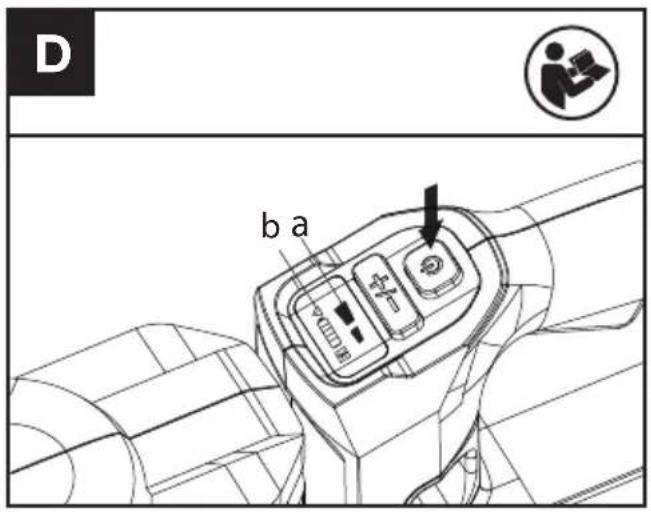
OPERATION:
Starting and Stopping
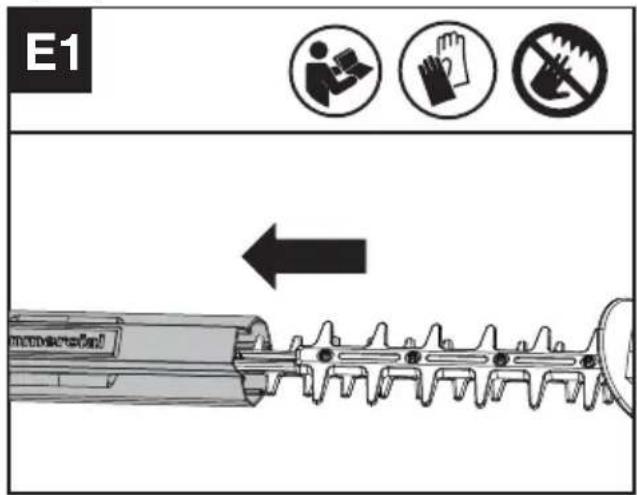
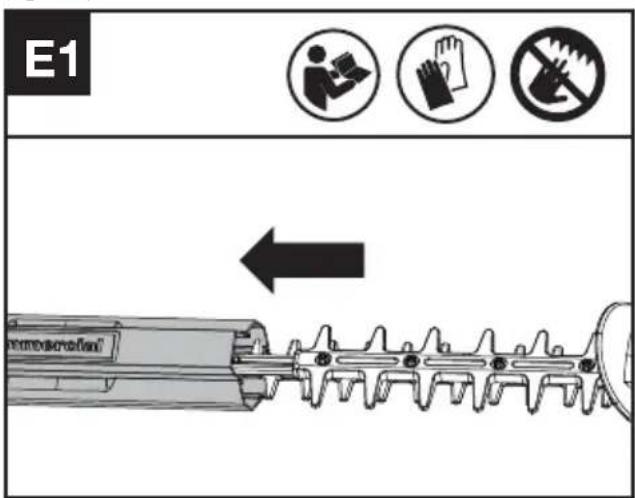
Before usage, remove the Blade Sheath first. (See Fig. E1)
Choosing speed
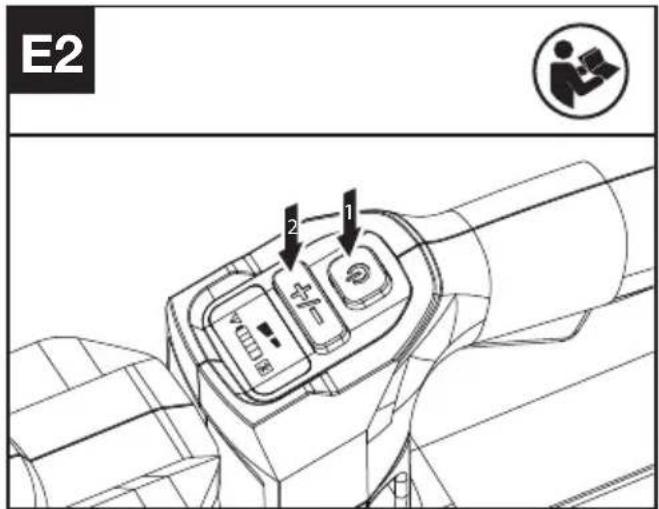
- Press the On/Off switch.
- Press the Speed Control Button to choose the speed you need.(See Fig. E2)
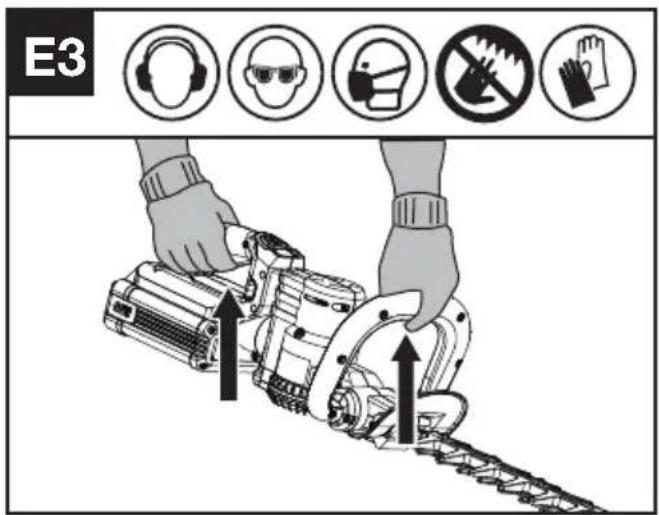
Press the Front Switch Lever and Rear Switch Lever to start. (See Fig. E3)
Release the Rear Switch Lever and Front Switch Lever to stop. (See Fig. E4)
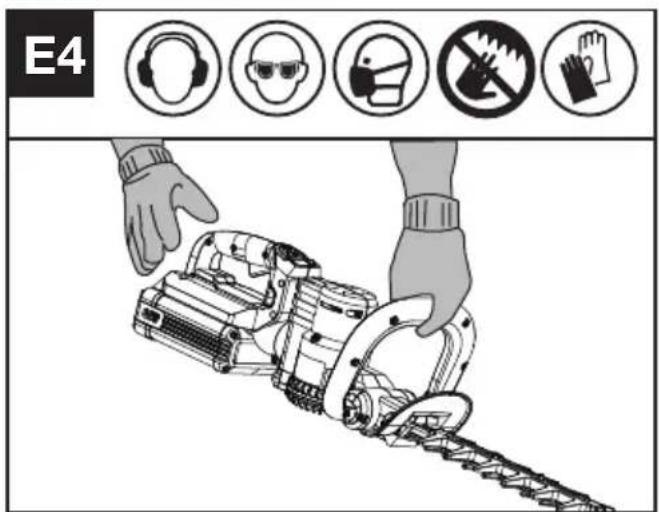
When the machine is not in use, turn the hedge trimmer off and remove the battery pack or disconnect it from the backpack harness.
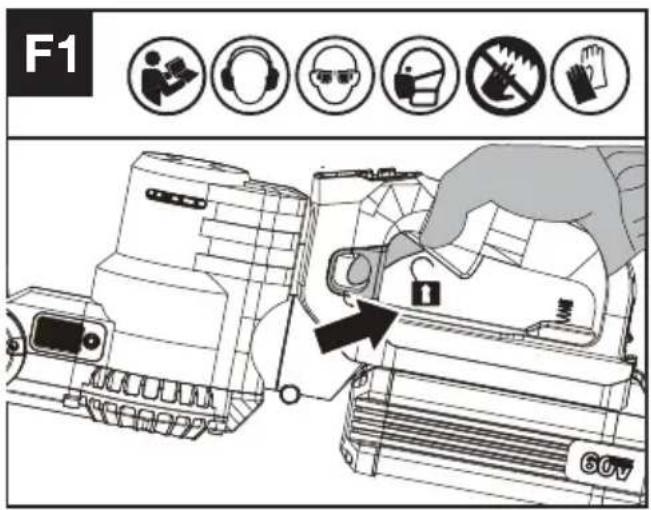
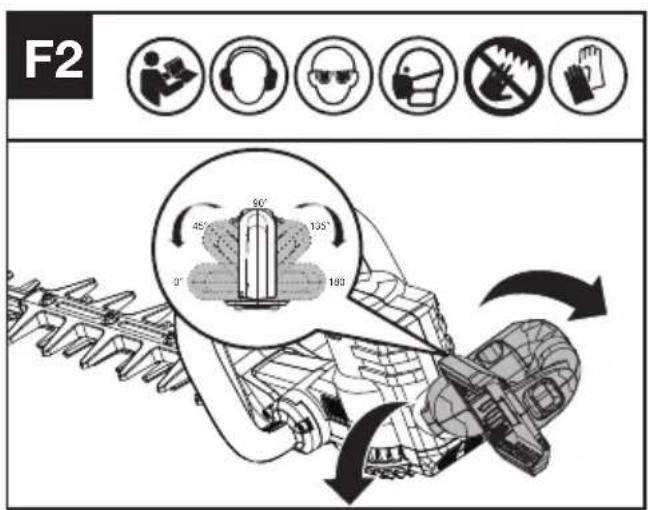
Rotating rear handle (See Fig. F1, F2)
NOTE: Unlock the Locking Switch before rotating. After rotating the handle to the desired position, adjust it a little until a click can be heard.

WARNING: Always make sure that the handle is locked in the desired position before operation. Always make sure the Locking Switch is locked before starting the hedge trimmer. Do not rotate the handle when the trimmer is being operated.
How to Use your Hedge trimmer
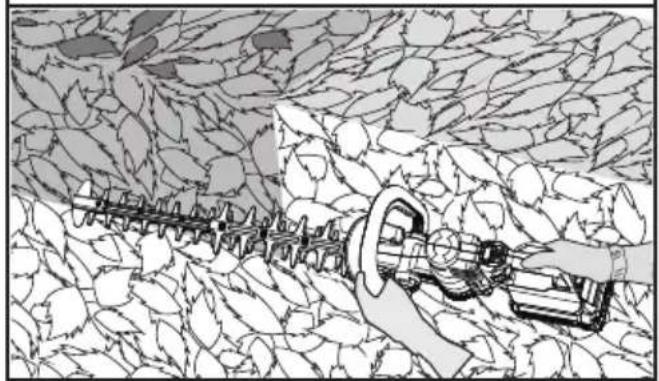
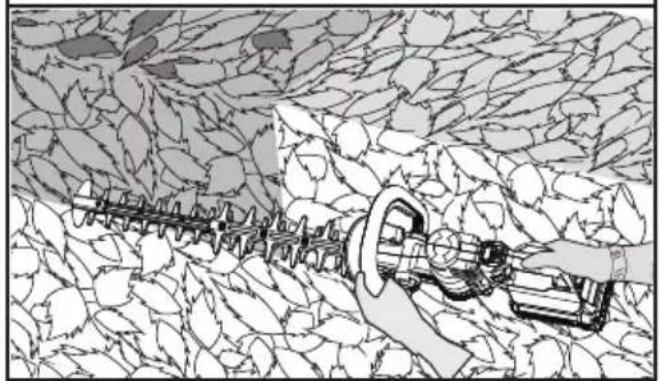
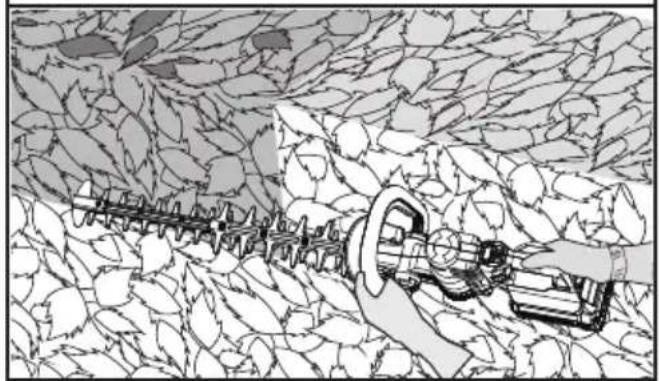
Before cutting an area, inspect it first and remove any foreign objects that could become thrown or entangled in the blades. Always hold the trimmer with both hands and with the blade away from you before turning it on.
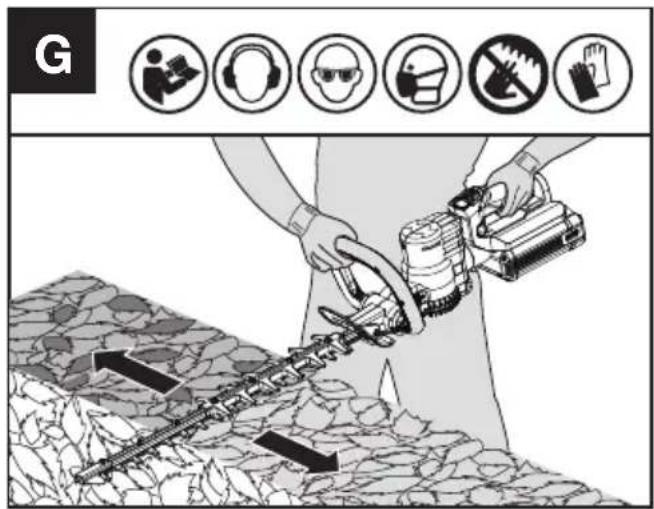
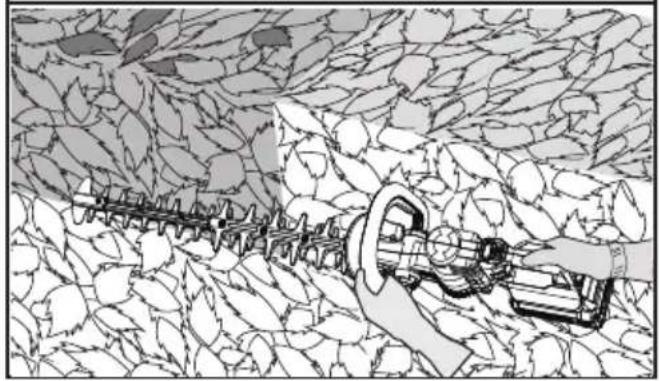
When trimming new growth, use a wide sweeping action so that the stems are fed directly into the blade.
Allow the cutting blades to reach full speed before cutting. When operating, keep the cutting blades away from people and objects such as walls, large stones, trees, vehicles, etc.
If the blade stalls, immediately stop the trimmer.
Release the two Switch Levers before attempting to clear jammed debris from the cutting blades.
Wear gloves when trimming thorny or prickly growth.
Do not attempt to cut stems that are too thick for the cutting blade.
Top cutting (See Fig. G)
Use a wide sweeping motion. A slight downward tilt of the cutting blades in the direction of motion gives the best cutting results.

WARNING: If any parts are missing, damaged or broken, do not operate your hedge trimmer until all damaged parts have been replaced or repaired. Failure to do so could result in
serious personal injury. DO NOT USE WITHOUT FRONT HANDLE AND SAFETY GUARD.
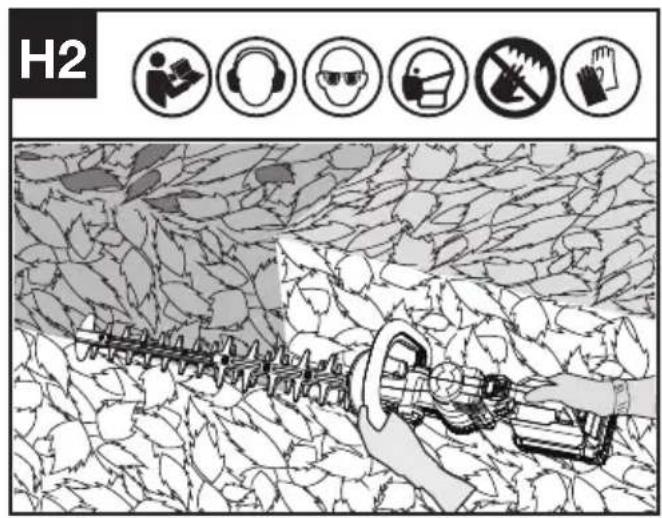
Side cutting (See Fig. H1, H2)
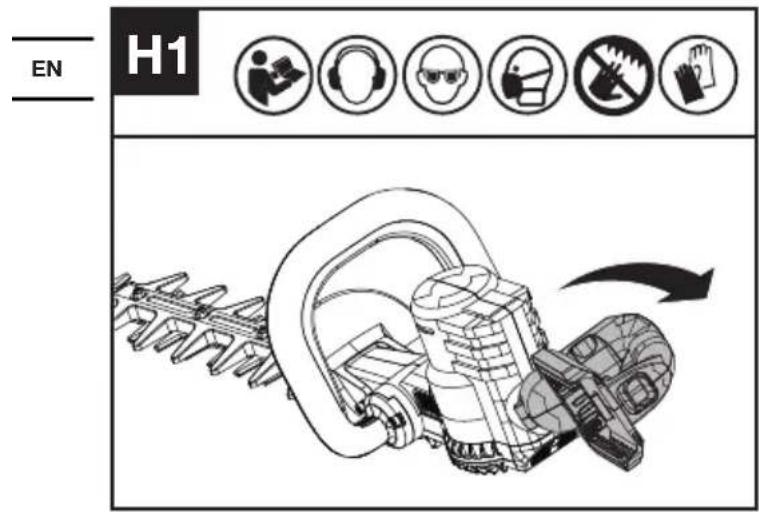
When trimming the sides of the hedge, begin at the bottom and cut upwards, tapering the hedge inward at the top. This shape will expose more of the hedge, resulting in a more uniformed growth.

WARNING: Stop operating the trimmer before rotating the handle.
TRANSPORTATION
Transporting the trimmer
- Switch off the trimmer and remove the battery.
- When transporting your trimmer by hand, hold the middle of front handle to make sure that your machine is parallel to the ground.
- When transporting your trimmer in a vehicle, secure and position it to prevent movement or damage.
Transporting the battery
- Ensure the battery is in a safe condition.
- Use non-conductive packaging when transporting the battery.
- The contained Li-Ion batteries are subject to the dangerous goods legislation requirements.
Transport batteries only when the battery housing is undamaged. Pack up the batteries in such a manner that cannot move around in the packaging.
MAINTENANCE

WARNING! Always remove battery before conducting any maintenance on the
trimmer.
Remove the battery from hedge trimmer before carrying out any adjustment, servicing or maintenance.
There are no user serviceable parts in your power tool. Never use water or chemical cleaners to clean your power tool. Wipe clean with a dry cloth. Always store your power tool in a dry place. Keep the motor ventilation slots clean. Keep all working controls free of dust.
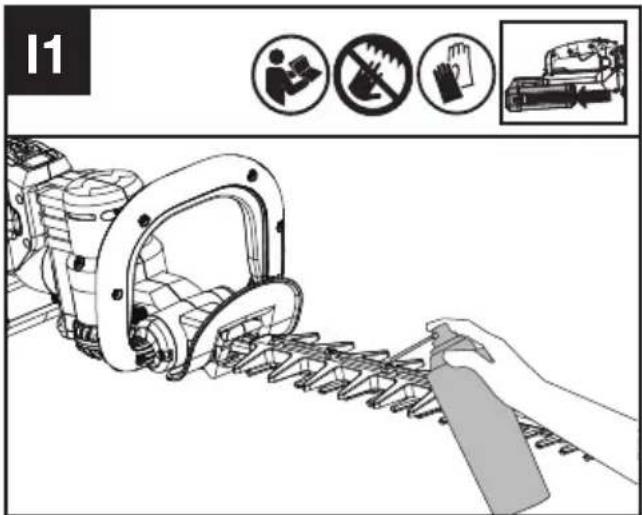
Lubricating the Cutting Blade (See Fig. I1)
NOTE: It is important to use only the recommended standard lubricating oil (e.g. WD-40) to avoid damage to the blade.
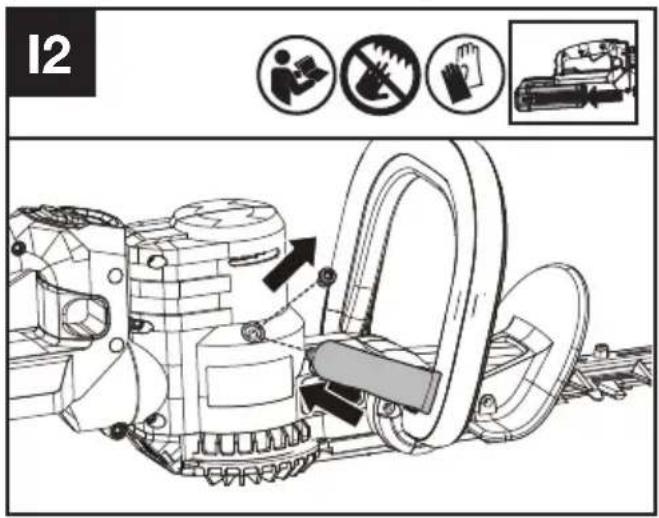
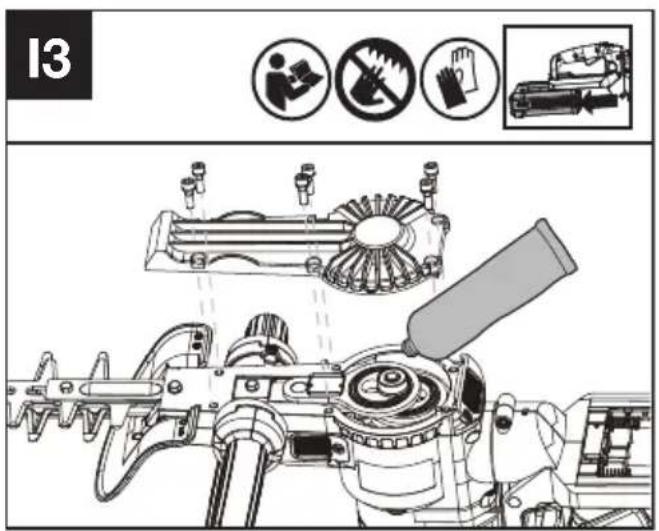
Lubricating the Gear Box (See Fig. 12, 13)
Remove the screw plug from the gear housing. Lubricating the gear case through the oil-hole after
every 50 hours operation.
Remove the screws from the gear box cover, and remove the cover. Lubricating after every 300 hours operation.
NOTE: For best operation and longer lifetime, lubricate the hedge trimmer gear case with the grease (SHELL Gadus S2 V220 1).
Sharpening

WARNING: Do not operate your machine with dull or damaged cutting blades, which
will cause overload and unsatisfactory performance. When cutting performance begins to deteriorate, please have the blade resharpened by a professional. Always wear protective gloves when handling the trimmer blade and only sharpen the cutting edge.
Only sharpen the cutting edge. Do not grind blunt projecting parts of the cutting blade or its guard. Use a whetstone to remove burr from cutting edge. After sharpening, clean away the dust from the blade in a safe manner.
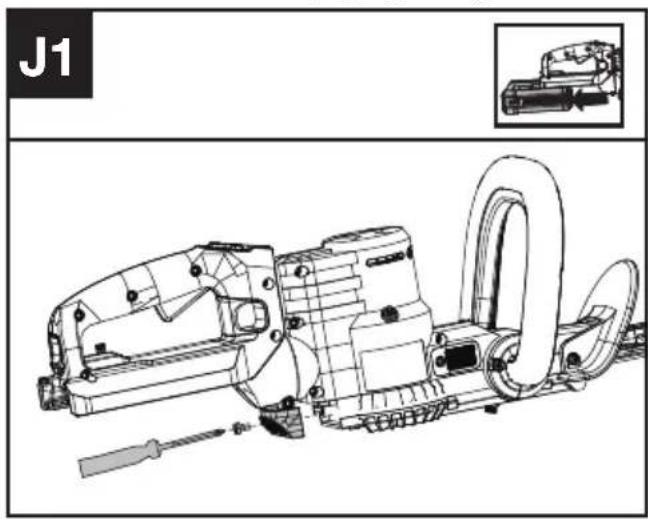
Cleaning the air filter (See Fig. J1,J2)
- Clean the area around the air filter. Use a damp cloth or a soft brush.
- Unscrew and remove the air filter.
- Wash the air filter with running water to remove
the dirt.
- Allow the air filter to dry in the air. And then re-install it in the housing by tightening the screw
natural_image
Technical line drawing of a mechanical device with screwdriver and housing (no text or symbols)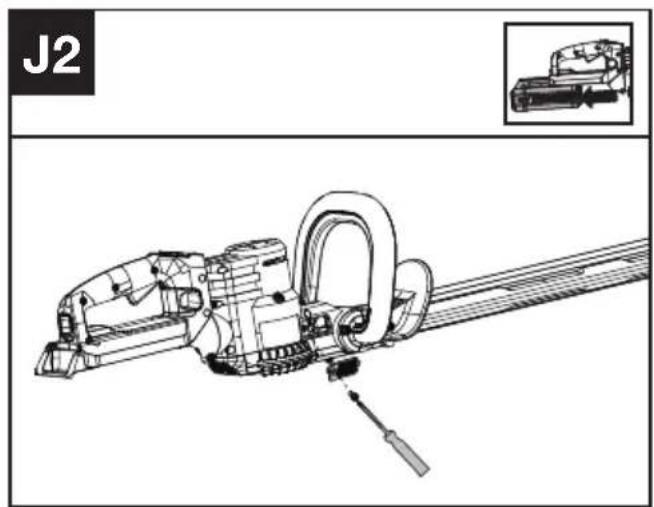
CLEANING
- Switch off the trimmer and remove the battery.
- Do not use aggressive detergents or solvents. Clean the machine after use with a damp cloth dipped in mild detergent.
- Keep battery connection free of dirt and debris, and clean with a soft and dry brush or cloth.
- Do not spray water onto the motor and electrical components.
- Do not use pressure washer to clean your machine.
STORAGE
- Remove the battery pack from the trimmer before storage.
- Store the trimmer and the battery in a dry and secure place that is inaccessible to children and other unauthorized people.
- Store the battery only within a temperature range between 41°F (5°C) and 77°F (25°C). As an example, do not leave the battery in the car in summer time.
- Once got wet in the rain during operation, the
machine and the battery should be dried before storing or charging. Remove the battery and reinsert it if the machine fails to turn on.
FOR BATTERY TOOLS
The recommended ambient temperature range for discharging is -20^ 45^ ( -4^ 113^ ).
The recommended ambient temperature range for the charging system during charging is -5^ 45^ ( 23^ 113^ ).
TROUBLESHOOTING
The following table gives problems and actions that you can perform if your machine does not operate correctly.

WARNING: Switch the machine off and remove the battery prior to any troubleshooting.
TRIMMER
| Problems Possible | Causes Corrective Action | |
| Battery indicator LED flashing | Low battery voltage. Charge the battery. | |
| Red error LED flashing Overload. The cutting attachment is jammed,deactivate the product and then lower machine for remove.Remove the battery.Clean the cutting attachment from unwanted materials. | ||
| The product does not start Deris in the battery connectors. | Clean the battery connectors with compressed air or a soft brush. | |
| Agent. | ||
| Trimmer runs intermittently The battery is not fully inserted to the machine. | Insert the battery fully. | |
| Contact Service Agent. | ||
| Excessive vibrations/ noise. Cutting attachment issue.Machine defective. | Replace cutting attachment.Contact Service Agent. | |
BATTERY
| Problems Possible | Causes Corrective Action | |
| Error LED lit | The battery is discharged | Charge the battery. If battery failed to charge, contact your Service Agent. |
| Temperature issue. Use the battery in surroundings where temperatures are between 23°F to 113°F (-5°C and 45°C) for charge; -4°F to 113°F (-20°C to 45°C) for discharge. | ||
| Others | Contact your Service Agent. | |
TECHNICAL DATA
Type Designation: KC200 KC200.X (200- designation of machinery, representative of cordless hedge trimmer)
| KC200 KC200.X** | |
| Voltage | 60 V --- MAX *** |
| Cutting speed | 2800/3200 SPM |
| Blade length 63 cm (25") | |
| Tooth spacing | 38 mm (1.5 inch) |
| Degree of protection | IPX4 |
| Machine Weight (Bare tool) | 4.0 kg (8.8 lbs) |
** X=1-999,A-Z,M1-M9 they are only used for different customers, there are no safety relevant changes between these models.
*** Voltage measured without workload. Initial battery voltage reaches maximum of 60 volts. Nominal voltage is 54 volts.
SUGGESTED BATTERIES AND CHARGERS
| Battery Capacity Charger Amperage | |||
| KAC804 4 Ah | KAC840 30 A | ||
| KAC810(With Backpack Harness) | 11 Ah | ||
| KA3000 2.0 Ah | |||
We recommend that you purchase your accessories from the same Dealer that sold you the tool. Refer to the accessory packaging for further details. Your Dealer can assist you and offer advice.
TECHNICAL DATA FOR BATTERY PACK (OPTIONAL)
| Frequency bands for Bluetooth | 2400-2483.5 MHz |
| Maximum Transmitted Power for Bluetooth | 8 dBm |
NOISE INFORMATION
| A weighted sound pressure L | _pA = 80.4dB(A) |
| K_pA | 3 dB(A) |
| A weighted sound power L | _wA =91.4 dB(A) |
| K_wA | 3 dB(A) |
| Wear ear protection |
VIBRATION INFORMATION
Vibration total values (triax vector sum) determined according to EN 62841:
| Typical weighted vibration | a | _h=3.06 m/s^2 |
| Uncertainty K =1.5 m/s2 |
The declared vibration total value and the declared noise emission value have been measured in accordance with a standard test method and may be used for comparing one tool with another.
The declared vibration total value and the declared noise emission value may also be used in a preliminary assessment of exposure.
WARNING: The vibration emission value during actual use of the power tool can differ from the declared value depending on the ways in which the tool is used dependant on the following examples and other variations on how the tool is used:
How the tool is used and the materials being cut or drilled.
The tool being in good condition and well maintained The use the correct accessory for the tool and ensuring it is sharp and in good condition.
The tightness of the grip on the handles and if any anti vibration accessories are used.
And the tool is being used as intended by its design and these instructions.
This tool may cause hand-arm vibration syndrome if its use is not adequately managed.
WARNING: To be accurate, an estimation of exposure level in the actual conditions of use should also take account of all parts of the operating cycle such as the times when the tool is switched off and when it is running idle but not actually doing the job. This may significantly reduce the exposure level over the total working period.
Helping to minimise your vibration and noise exposure risk.
Always use sharp chisels, drills and blades.
Maintain this tool in accordance with these instructions and keep well lubricated (where appropriate).
If the tool is to be used regularly then invest in anti vibration and noise accessories.
Plan your work schedule to spread any high vibration tool use across a number of days.
ENVIRONMENTAL PROTECTION
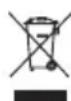
Waste electrical products must not be disposed of with household waste. Please recycle where facilities exist. Check with your
local authorities or retailer for recycling advice.
DECLARATION OF CONFORMITY
We,
Positec Germany GmbH
Postfach 32 02 16, 50796 Cologne, Germany
On behalf of Positec declare that the product Description Battery-powered Hedge Trimmer Type KC200 KC200.X (200-designation of machinery, representative of Hedge Trimmer) Function Trimming hedges and brushes
Complies with the following Directives:
2006/42/EC, 2014/30/EU, 2011/65/
EU&(EU)2015/863, 2000/14/EC amended by 2005/88/EC
2000/14/EC amended by 2005/88/EC:
- Conformity Assessment Procedure as per Annex V
- Measured Sound Power Level 91.4 dB (A)
- Declared Guaranteed Sound Power Level 96 dB (A)
Standards conform to,
EN 62841-1, EN 62841-4-2, EN ISO 3744, EN
55014-1, EN 55014-2, EN 300328,
EN 301489-1/-17, EN 50663
The person authorized to compile the technical file,
Name Marcel Filz
Address Positec Germany GmbH
Postfach 32 02 16, 50796 Cologne, Germany

2022/11/17
Allen Ding
Deputy Chief Engineer Testing & Certification
Positec Technology (China) Co., Ltd
18, Dongwang Road, Suzhou Industrial
Park, Jiangsu 215123, P. R. China
DECLARATION OF CONFORMITY
We,
Positec (UK & Ireland) Ltd
PO Box 6242, Newbury, RG14 9LT, UK
On behalf of Positec declare that the product
Description Battery-powered Hedge Trimmer
Type KC200 KC200.X (200-designation of machinery, representative of Hedge Trimmer)
Function Trimming hedges and brushes
Complies with the following regulations:
Supply of Machinery (Safety) Regulations 2008
Electromagnetic Compatibility Regulations 2016
The Restriction of the Use of Certain Hazardous
Substances in Electrical and Electronic
Equipment Regulations
Noise Emission in the Environment by Equipment for Use Outdoors Regulations
- Conformity Assessment Procedure as per SCHEDULE 8
- Measured Sound Power Level 91.4 dB (A)
- Declared Guaranteed Sound Power Level 96 dB (A)
Standards conform to,
BS EN 62841-1, BS EN 62841-4-2, BS EN ISO
3744, BS EN 55014-1, BS EN 55014-2,
BS EN 300328, BS EN 301489-1/-17,
BS EN 50663
The person authorized to compile the technical file,
Name Jim Kirkwood
Address Positec (UK & Ireland) Ltd,
PO Box 6242, Newbury, RG14 9LT, UK

2022/11/17
Allen Ding
Deputy Chief Engineer Testing & Certification
Positec Technology (China) Co., Ltd
18, Dongwang Road, Suzhou Industrial
Park, Jiangsu 215123, P. R. China
INHALTSVERZEICHNIS
Einführung....16
Komponenten....17
KOMPONENTEN
natural_image
Technical line drawing of a mechanical device with screwdriver and gear assembly (no text or symbols)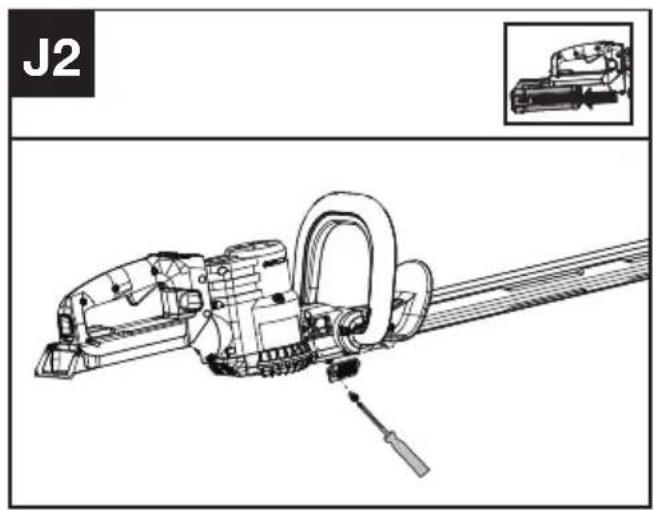
REINIGUNG
18, Dongwang Road, Suzhou Industrial
Park, Jiangsu 215123, P. R. China
SOMMAIRE
Introduction....31
LISTE DES COMPOSANTS
- BOUTON DE VERROUILLAGE POUR FAIRE TOURNER LA POIGNÉE ARRIÈRE
- GÂCHETTE D'ACCÉLÉRATION
- POIGNÉE ARRIÈRE ROTATIVE
- BOUTON DE CONTRÔLE DE LA VITESSE
- INTERRUPTEUR MARCHE/ARRÊT
- POIGNÉE AVANT
- BOUTON DE PRÉSENCE D'OPÉRATEUR (FONCTION D'ACTIVATION GÉNÉRALE)
- BOUCLIER DE SÉCURITÉ(PROTECTEUR)
- LAME
- PROTECTEUR DE POINTE
- BOUCLIER DE LAME ARRIÈRE
- BOÎTIER D'ENGRENAGES MÉTALLIQUE
- ETUI PROTECTEUR DE LAME
- PACK BATTERIE *
- BOUTON DE LIBÉRATION DE LA BATTERIE
NOTICE ORIGINALE AVERTISSEMENTS DE SÉCURITÉ SÉCURITÉ DU PRODUIT AVERTISSEMENTS GÉNÉRAUX DE SÉCURITÉ POUR L'OUTIL

INFORMATIONS RELATIVES
AU BRUIT
INFORMATIONS RELATIVES AUX VIBRATIONS
18, Dongwang Road, Suzhou Industrial
Park, Jiangsu 215123, P. R. China
INDICE
Introduzione....45
ELEMENTI DELL'APPARECCHIO
natural_image
Technical line drawing of a mechanical device with screwdriver and housing (no text or symbols)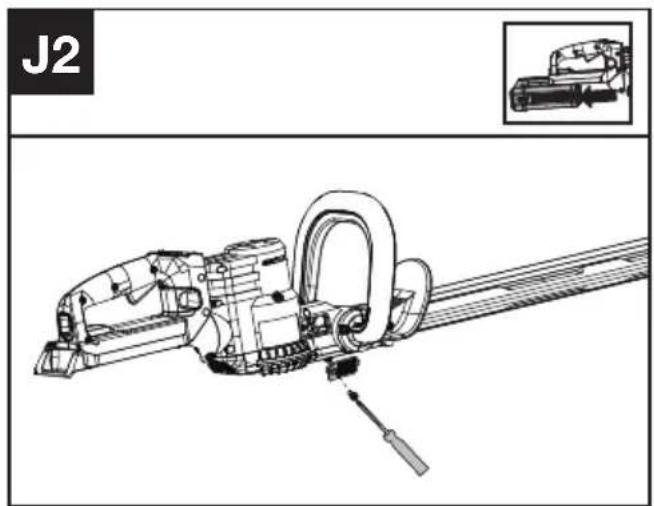
PULIZIA
Vice capo ingegnere, testing e certificazione Positec Technology (China) Co., Ltd 18, Dongwang Road, Suzhou Industrial Park, Jiangsu 215123, P. R. China
ÍNDICE
Introducción....59
Elegir la velocidad
natural_image
Illustration of a mechanical tool in a gear-filled environment (no text or symbols)TRANSPORTE
Transporte del cortasetos
natural_image
Technical line drawing of a mechanical device with a screwdriver and inset view (no text or symbols)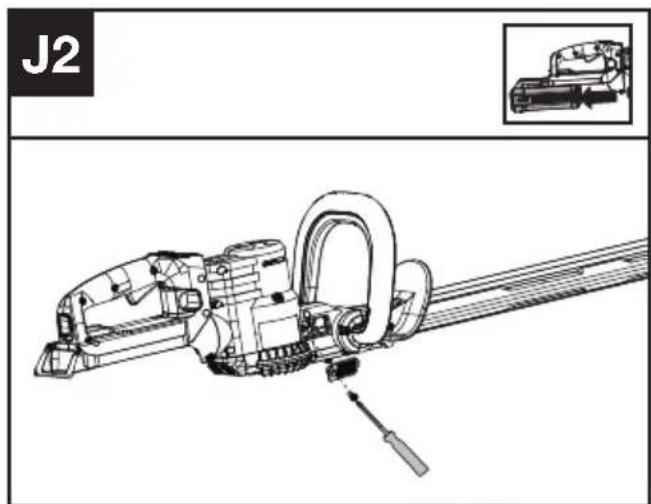
LIMPIEZA
natural_image
Illustration of a mechanical tool with a chain, set against a textured background (no text or symbols)TRANSPORTE
Transporte do aparador
natural_image
Technical line drawing of a mechanical device with a screwdriver and inset view (no text or symbols)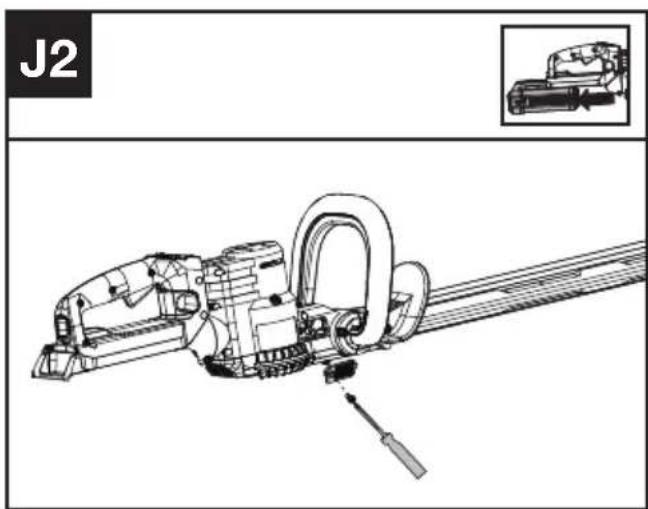
LIMPEZA
18, Dongwang Road, Suzhou Industrial
Park, Jiangsu 215123, P. R. China
PROTECÇÃO AMBIENTAL
DRIE SNELHEIDSINSTELLINGEN
-
VERGRENDELINGSSCHAKELAAR VOOR HET DRAAIEN VAN HET ACHTERSTE HANDVAT
-
GASHENDEL
-
DRAAIBARE ACHTERSTE HENDEL
-
SNELHEIDSREGELAAR
-
AAN/UITSCHAKELAAR
-
HANDVAT VOOR
-
GEBRUIKERS-ANWEZIGHEIDSSCHAKELAAR (RONDOM SCHAKELAARFUNCTIE)
-
BESCHERMKAP
-
SNIJBLAD
-
TIP PROTECTOR
-
ACHTERSTE MESBESCHERMER
-
PUNTBESCHERMER
-
BESCHERMKOKER
-
ACCUPACK *
-
ACCU-ONTGRENDELINGSKNOP
natural_image
Illustration of a hand holding a hatched tool against a textured background (no text or symbols)TRANSPORT
18, Dongwang Road, Suzhou Industrial
Park, Jiangsu 215123, P. R. China
TARTALOMJEGYZÉK
Bevezető....101
18, Dongwang Road, Suzhou Industrial
Park, Jiangsu 215123, P. R. China
KÖRNYEZETVÉDELEM

LISTA DE COMPONENTE
-
BUTON DE BLOCARE PENTRU ROTIREA MÂNERULUI DIN SPATE
-
BUTON DE ACCELERATIE
- MÂNER ROTATIV POSTERIOR
- BUTON DE CONTROL AL VITEZEI
- COMUTATOR DE PORNIRE/OPRIRE
- FMÂNER DE TRANSPORT FRONTAL
- BUTON DE PREZENTĂ A UTILIZATORULUI (BUTON MULT-FUNCTIONAL)
- SCUT DE PROTECTIE
- LAMĂ
- PROTECTIE VÂRF
- PROTECTIA LAMEI DIN SPATE
- CUTIE DE VITEZE METALICĂ
- TEACĂ PENTRU LAMĂ
- ACUMULATOR *
- BUTON PENTRU ELIBERAREA BATERIEI
INSTRUCTIUNI ORIGINALE SECURITATEA PRODUSULUI AVERTISMENTE GENERALE DE SIGURANTĂ PENTRU UNELTE ELECTRICE
natural_image
Technical line drawing of a mechanical device with a screwdriver and housing (no text or symbols)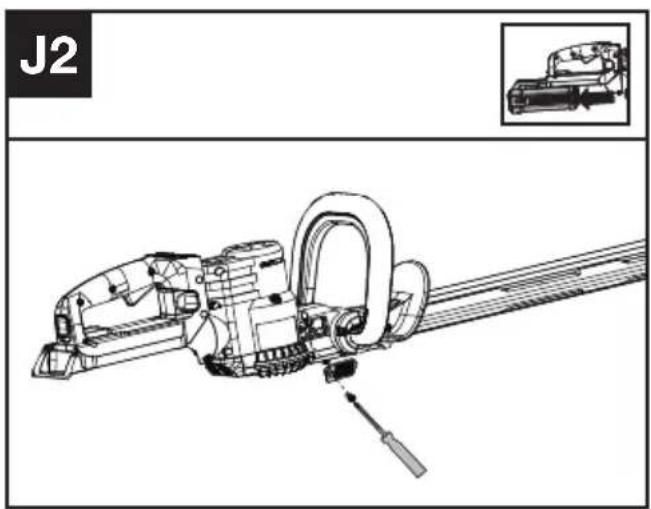
CURĂȚAREA
18, Dongwang Road, Suzhou Industrial
Park, Jiangsu 215123, P. R. China
SPIS TREŚCI
Wprowadzenie....130
LISTA KOMPONENTÓW
natural_image
Technical line drawing of a mechanical assembly with no visible text or symbolsOSTRZENIE
18, Dongwang Road, Suzhou Industrial
Park, Jiangsu 215123, P. R. China
OBSAH
Úvod....145
SEZNAM KOMPONENT
- ARETAČNÍ SPÍNAČ PRO OTÁČENÍ ZADNÍ RUKOJETI
- SPOUŠT
- OTOČNÁ ZADNÍ RUKOJEŤ
- TLAČÍTKO REGULACE RYCHLOSTI
- PŘEPÍNAČ ZAP. /VYP.
- PŘEDNÍ RUKOJEŤ
- SPÍNAČ PŘÍTOMNOSTI OBSLUHY (FUNKCE CELKOVÉHO SEPNUTÍ)
- BEZPEČNOSTNÍ KRYT
- NOŽE NŮŽEK
- CHRÁNIČ ŠPIČKY
- ZADNÍ KRYT NOŽŮ
- KOVOVÁ PŘEVODOVKA
- OCHRANNÉ POUZDRO
- AKUMULÁTOR *
- TLAČÍTKO UVOLNĚNÍ BATERIE
PŮVODNÍ NÁVOD K POUŽÍVÁNÍ BEZPEČNOST VÝROBKU OBECNÁ BEZPEČNOSTNÍ UPOZORNĚNÍ PRO ELEKTRICKÉ NÁSTROJE
natural_image
Six circular icons representing different occupational and safety symbols (no text or labels)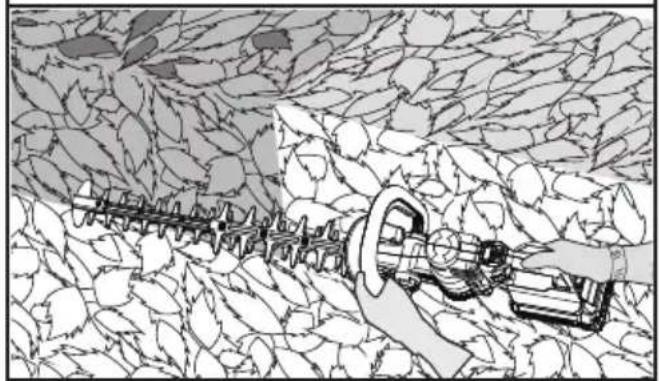
natural_image
Illustration of a mechanical tool with a chain, set against a textured background (no text or symbols)PŘEPRAVA
natural_image
Technical line drawing of a mechanical device with screwdriver and housing (no text or symbols)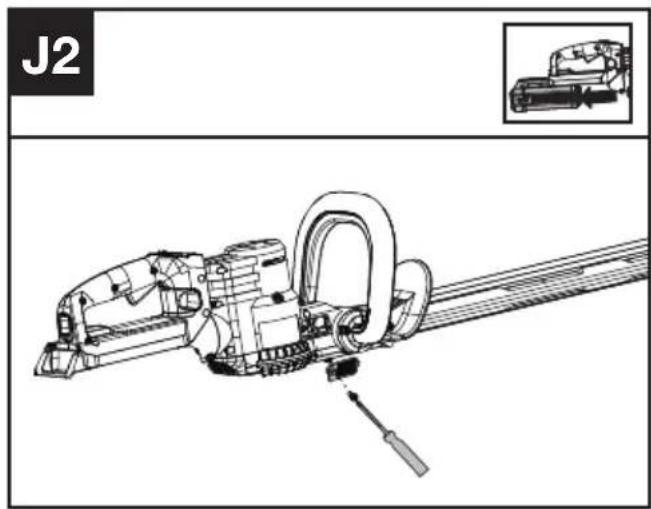
natural_image
Technical line drawing of a mechanical tool with a screwdriver inserted, showing assembly and component details (no text or symbols)ČIŠTĚNÍ
Typ: KC200 KC200.X (200- designation of machinery, representative of cordless hedge trimmer)
INFORMACE TÝKAJÍCÍ SE HLUČNOSTI
Positec Technology (China) Co., Ltd 18, Dongwang Road, Suzhou Industrial Park, Jiangsu 215123, P. R. China
OCHRANA ŽIVOTNÍHO PROSTŘEDÍ

ZOZNAM SÚČASTÍ
- UZAMYKACÍ SPÍNAČ OTOČNEJ ZADNEJ RUKOVÄTE
- PÁKA OVLÁDANIA
- OTOČNÁ ZADNÁ RUKOVÄT
- TLAČIDLO OVLÁDANIE OTÁČOK
- VYPÍNAČ ZAP/VYP
- PREDNÁ RUKOVÄT
- SPÍNAČ PRÍTOMNOSTI OPERÁTORA (VŠESTRANNÁ FUNKCIA PREPÍNAČA)
- BEZPEČNOSTNÝ KRYT
- NOŽE NOŽNÍC
- CHRÁNIČ HROTU
- KRYT ZADNEJ ČEPELE
- KOVOVÁ PREVODOVÁ SKRIŇA
- OCHRANNÉ PUZDRO
- BATÉRIOVÝ *
- TLAČIDLO UVOL'NENIA BATÉRIE
PÔVODNÝ NÁVOD NA POUŽITIE BEZPEČNOSTŠT VÝROBKU VŠEOBECNÉ BEZPEČNOSTNÉ UPOZORNENIA
natural_image
Six circular icons representing different occupational and safety symbols (no text or labels)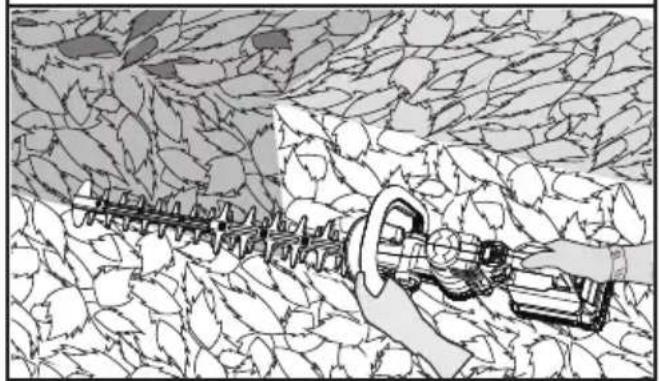
natural_image
Illustration of a hairpin with meshing pattern, no text or symbols presentPREPRAVA
Preprava vyžínača
- Vypnite vyžínač a vyberte batériu.
- Pri ručnej preprave vyžínača držte stred hriadel'a s reznou hlavou smerom dozadu a uistite sa, že je stroj rovnobežný so zemou.
- Pri preprave vyžinača vo vozidle ho zaistite a umiestnite tak, aby ste zabránili jeho pohybu alebo poškodeniu.
Preprava batérie
- Uistite sa, že je batéria v bezpečnom stave.
- Pri preprave batérie používajte nevodivé obaly.
- Obsiahnuté lítium-iónové batérie podliehajú požiadavkám legislatívy o nebezpečných tovaroch.
Batérie prepravujte iba vtedy, ked' nie je kryt batérie poškodený. Batérie zabal'te tak, aby sa v obale nemohli pohybovat'.
ÚDRŽBA

natural_image
Technical line drawing of a mechanical device with a screwdriver and inset view (no text or symbols)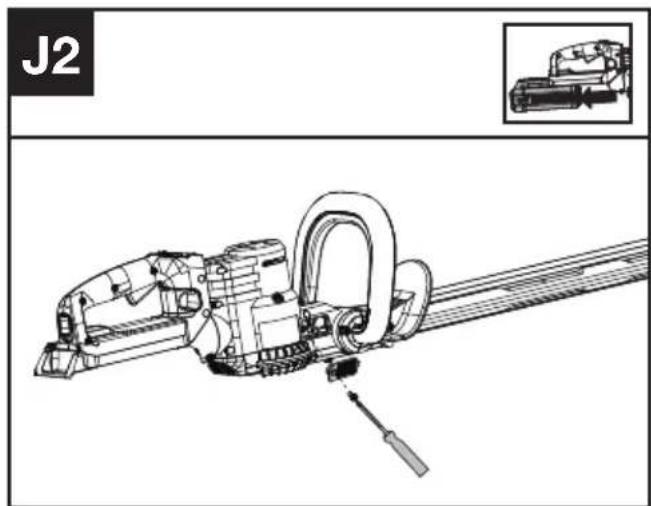
ČISTENIE
18, Dongwang Road, Suzhou Industrial
Park, Jiangsu 215123, P. R. China
KAZALO VSEBINE
Uvod....173
Sestavni deli....174
Varnost izdelka....175
Sestavljanje in delovanje....178
Transport....182
Vzdrževanje....182
Čiščenje....183
Shranjevanje....183
SESTAVNI DELI
- STIKALO ZA ZAKLEPANJE ZA VRTLJIV ZADNJI ROČAJ
- SPROŽILEC PLINA
- VRTEČI SE ZADNJI ROČAJ
- GUMB ZA NADZOR HITROSTI
- STIKALO ZA VKLOP/IZKLOP
- SPREDNJI ROČAJ
- STIKALO PRISOTNOSTI ZA UPRAVLJAVCA (FUNKCIJA VSESTRANSKEGA STIKALA)
- VAROVALO
- REZILO
- ŠČITNIK KONICE
- ZAŠČITA ZADNJEGA REZILA
- KOVINSKI MENJALNIK
- ZAŠČITA REZILA
- AKUMULATOR *
- GUMB ZA SPROSTITEV BATERIJE
IZVIRNA NAVODILA VARNOST IZDELKA SPLOŠNA VARNOSTNA OPOZORILA

natural_image
Illustration of a mechanical tool with a chain, set against a textured background (no text or symbols)PREVOZ
Prevoz obrezovalnika
- Izklopite obrezovalnik in odstranite baterijo.
- Če prenašate obrezovalnik ročno, držite sredino gredi z rezalno glava zadaj in se prepričajte, da je stroj vzporedno s tlemi.
- Ko prevažate obrezovalnik v vozilu, ga zavarujte in postavite tako, da se ne bo premikal ali poškodoval.
SL
Prevoz baterij
- Zagotovite, da je baterija v varnem stanju.
- Pri prevozu baterije uporabite neprevodno embalažo.
- Za vsebovane Li-ionske baterije veljajo zahteve zakonodaje o nevarnem blagu.
Baterije prevažajte samo, če ohišje baterije ni poškodovano. Baterije zapakirajte tako, da se v embalaži ne morejo premikati.
VZDRŽEVANJE

natural_image
Technical line drawing of a mechanical device with a screwdriver and inset view (no text or symbols)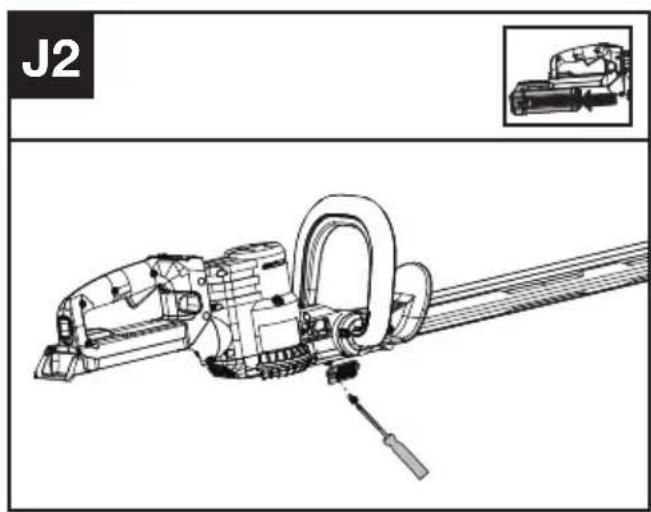
natural_image
Technical line drawing of a chain-link robotic device with a screwdriver inserted, shown in two views (J2 and an inset), no text or symbols present.ČIŠČENJE
18, Dongwang Road, Suzhou Industrial
Park, Jiangsu 215123, P. R. China
SADRŽAJ
Uvod....187
Popis komponenti....188
Sigurnost proizvoda.... 189
Sastavljanje i rad....192
Transport....196
Održavanje....196
Čišćenje....196
Skladištenje....197
Otklanjanje poteškoća....198
Tehnički podaci....198
Zaštita okoliša....200
Izjava o sukladnosti....200
UVOD
Poštovani,
POPIS KOMPONENTI
- PREKIDAČ ZA ZAKLJUČAVANJE ZA ROTIRAJUĆU STRAŽNJU RUČKU
- AKTIVATOR GASA
- ROTAIRAJUĆA STRAŽNJA RUČKA
- GUMB ZA KONTROLU BRZINE
- PREKIDAČ ON/OFF (UKLJUČENO/ISKLJUČENO)
- PREDNJA RUČKA
- PREKIDAČ PRISUTNOSTI RUKOVATELJA (FUNKCIJA PREKIDAČA ALL AROUND (SA SVIH STRANA))
- ZAŠTITNI ČUVAR
- OŠTRICA
- ŠTITNIK ZA VRHOVE
- STRAŽNJI ŠTITNIK ZA OŠTRICU
- METALNA KUTIJA ZA ZUPČANIK
- POKLOPAC ZA OŠTRICU
- BATERIJSKI KOMPLET *
- GUMB ZA OTPUŠTANJE BATERIJE
ORIGINALNE UPUTE ZA RAD SIGURNOST PROIZVODA UOBIČAJENA SIGURNOSNA UPOZORENJA ZA ELEKTRIČNE ALATE

UPOZORENJE Pročitajte sva sigurnosna upozorenja, upute, ilustracije i specifikacije koje se isporučuju s ovim električnim alatom. Nepoštivanje dolje navedenih uputa može uzrokovati električni udar, požar i/ili ozbiljne ozljede.
natural_image
Technical line drawing of a mechanical assembly with no visible text or symbolsOštrjenje
UPOZORENJE: Nemojte upotrebljavati stroj ako su rezne oštrice tupe ili oštećene, zato što mogu uzrokovati preopterećenje i slabe performanse. Kad učinkovitost rezanja počne slabiti, neka vam oštricu ponovo naoštri stručnjak. Uvijek nosite zaštitne rukavice kada rukujete oštricom škara za živicu i oštrite samo rezni rub. Oštrite samo rezni rub. Nemojte brusiti tupe stršeće djelove rezne oštrice ili njenog štitnika. Upotrijebite brusni kamen za uklanjanje neravnina s oštrice. Nakon oštrenja, na siguran način očistite prašinu sa oštrice.
Čišćenje filtra za zrak (vidi sl. J1, J2)
natural_image
Technical line drawing of a mechanical device with tool and component details, no readable text or symbols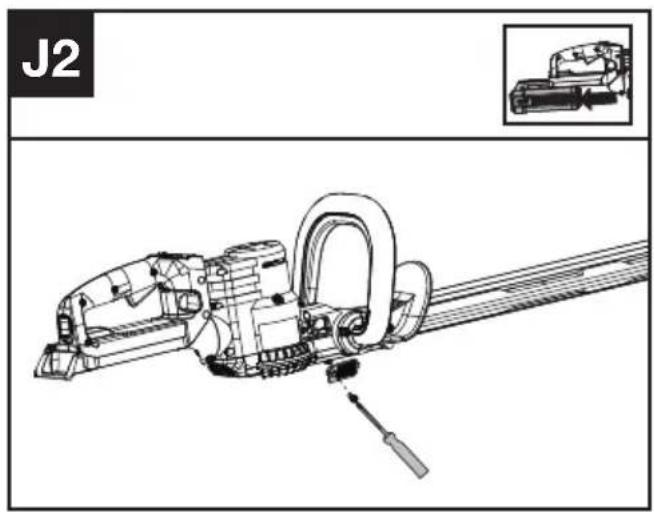
18, Dongwang Road, Suzhou Industrial
Park, Jiangsu 215123, P. R. China
INDHOLDSFORTEGNELSE
Introduktion....201
18, Dongwang Road, Suzhou Industrial
Park, Jiangsu 215123, P. R. China
SISÄLLYSLUETTELO
Johdanto....214
Komponenttiluettelo....215
KOMPONENTTILUETTELO
-
LUKITUSKYTKIN TAKAKAHVAN KÄÄNTÄMISTÄ VARTEN
-
KAASULIIPAISIN
-
KÄÄNTYVÄ TAKAKAHVA
-
NOPEUDENSÄÄTÖPAINIKE
-
ON/OFF-VIRTAKYTKIN
-
ETUKAHVA
-
KÄYTTÄJÄN LÄSNÄOLOKYTKIN
-
ETUKAHVA
-
TERÄ
-
KÄRJEN SUOJA
-
TAKATERÄN SUOJUS
-
METALLINEN VAIHDELAATIKKO
-
TERÄN TUPPI
-
AKKUYKSIKKÖ *
-
AKKUYKSIKÖN VAPAUTUSPAINIKE
Before usage, remove the Blade Sheath first. (See Fig. E1)
natural_image
Technical line drawing of a mechanical device with a screwdriver and a magnified inset showing a component (no text or symbols)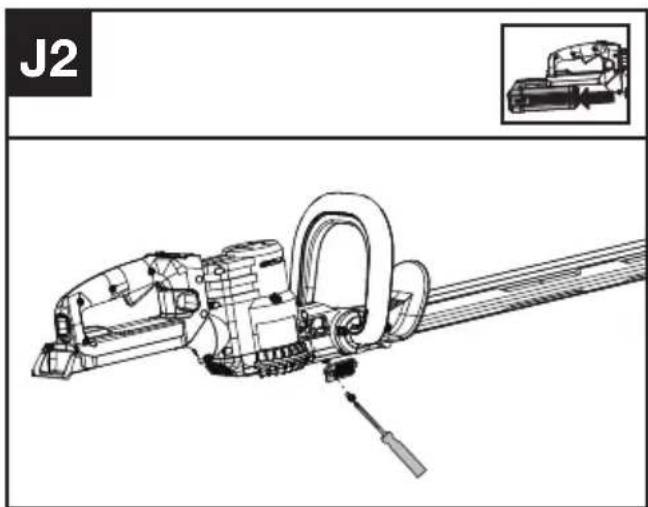
PUHDISTUS
18, Dongwang Road, Suzhou Industrial
Park, Jiangsu 215123, P. R. China
INNHOLDFORTEGNELSE
Introduksjon....227
Komponentliste....228
Transportation....235
Vedlikehold....235
Rengjøring....237
Lagring....237
Feilsøking....237
APPARATELEMENTER
- LÅSEBRYTER FOR ROTERENDE BAKRE HÅNDTAK
- GASSBRYTER
- ROTERENDE BAKHÅNDTAK
- FARTSKONTROLL
- AV/PÅ-BRYTER
- FRONTHÅNDTAK
- BRYTER FOR OPERAT∅RNAERVÆR (ALLROUND-BRYTERFUNKSJON)
- SIKKERHETSVAKT
- KNIV
- TUPPBESKYTTER
- BAKRE BLADVERN
- GIRKASSE AV METALL
- KNIVBESKYTTER
- BATTERIPAKKE *
- KNAPP FOR BATTERIFRIGJ∅RING
ORIGINAL DRIFTSINSTRUKS PRODUKTSIKKERHET GENERELLE ADVARSLER FOR ELEKTROVERKT∅Y

ADVARSEL Les alle
natural_image
Technical line drawing of a mechanical device with a screwdriver and inset view (no text or symbols)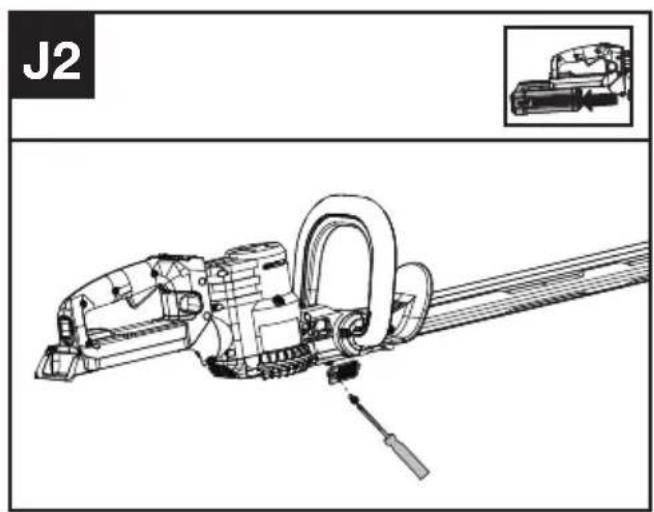
RENGJ∅RING
18, Dongwang Road, Suzhou Industrial
Park, Jiangsu 215123, P. R. China
INNEHÅLLSFÖRTECKNING
Introduktion....240
Komponenter....241
Produktsäkerhet 242
Transportation....248
Underhåll....248
Rengöring....249
Förvaring....249
Felsökning....250
Tekniska data....250
Miljöskydd....252
KOMPONENTER
-
LÅSOMKOPPLARE FÖR ROTATION AV BAKRE HANDTAG
-
GASREGLAGET
-
ROTERANDE BAKRE HANDTAG
-
KNAPP FÖR HASTIGHETSREGLERING
-
STRÖMBRYTARE PÅ/AV
-
FRÄMRE HANDTAG
-
OPERATÖRS SÄKERHETSKONTAKT (MÅNGSIDIG SÄKERHETSFUNKTION)
-
SÄKERHETSVAKT
-
BLAD
-
TIPSSKYDD
-
BAKRE BLADSKYDD
-
VÄXELLÅDA AV METALL
-
BLADSYLT
-
BATTERIPAKET *
-
BATTERIETS FRIGÖRINGSKNAPP
natural_image
Technical line drawing of a mechanical device with a screwdriver and gear assembly (no text or symbols)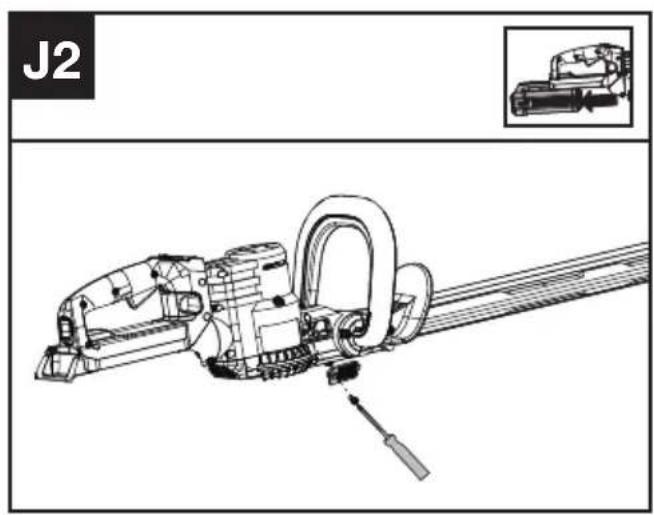
RENGÖRING
18, Dongwang Road, Suzhou Industrial
Park, Jiangsu 215123, P. R. China


- TABLE OF CONTENTS
- INTRODUCTION
- INTENDED USE
- COMPONENT LIST
- PRODUCT SAFETY GENERAL POWER TOOL SAFETY WARNINGS
- Save all warnings and instructions for future reference.
- Work area safety
- Electrical safety
- Personal safety
- Power tool use and care
- HEDGE TRIMMER SAFETY
- WARNINGS:
- SAFETY WARNINGS FOR BATTERY PACK
- USER MANUAL REQUIREMENTS FOR WIRELESS PRODUCT
- BEFORE OPERATION:
- Connecting the hedge trimmer to the backpack harness(See Fig. C1,C2,C3)
- Testing the trimmer and battery (See Fig. D) Checking the controls Front Switch Lever and Rear Switch Lever
- Checking the display
- OPERATION:
- Starting and Stopping
- Choosing speed
- Rotating rear handle (See Fig. F1, F2)
- How to Use your Hedge trimmer
- Top cutting (See Fig. G)
- Side cutting (See Fig. H1, H2)
- TRANSPORTATION
- Transporting the trimmer
- Transporting the battery
- MAINTENANCE
- Sharpening
- Cleaning the air filter (See Fig. J1,J2)
- CLEANING
- STORAGE
- FOR BATTERY TOOLS
- TROUBLESHOOTING
- TECHNICAL DATA
- SUGGESTED BATTERIES AND CHARGERS
- TECHNICAL DATA FOR BATTERY PACK (OPTIONAL)
- NOISE INFORMATION
- VIBRATION INFORMATION
- ENVIRONMENTAL PROTECTION
- DECLARATION OF CONFORMITY
- INHALTSVERZEICHNIS
- KOMPONENTEN
- REINIGUNG
- SOMMAIRE
- LISTE DES COMPOSANTS
- NOTICE ORIGINALE AVERTISSEMENTS DE SÉCURITÉ SÉCURITÉ DU PRODUIT AVERTISSEMENTS GÉNÉRAUX DE SÉCURITÉ POUR L'OUTIL
- INFORMATIONS RELATIVES
- INFORMATIONS RELATIVES AUX VIBRATIONS
- INDICE
- ELEMENTI DELL'APPARECCHIO
- PULIZIA
- ÍNDICE
- Elegir la velocidad
- TRANSPORTE
- Transporte del cortasetos
- LIMPIEZA
- Transporte do aparador
- LIMPEZA
- PROTECÇÃO AMBIENTAL
- DRIE SNELHEIDSINSTELLINGEN
- TRANSPORT
- TARTALOMJEGYZÉK
- KÖRNYEZETVÉDELEM
- LISTA DE COMPONENTE
- INSTRUCTIUNI ORIGINALE SECURITATEA PRODUSULUI AVERTISMENTE GENERALE DE SIGURANTĂ PENTRU UNELTE ELECTRICE
- CURĂȚAREA
- SPIS TREŚCI
- LISTA KOMPONENTÓW
- OSTRZENIE
- OBSAH
- SEZNAM KOMPONENT
- PŮVODNÍ NÁVOD K POUŽÍVÁNÍ BEZPEČNOST VÝROBKU OBECNÁ BEZPEČNOSTNÍ UPOZORNĚNÍ PRO ELEKTRICKÉ NÁSTROJE
- PŘEPRAVA
- ČIŠTĚNÍ
- INFORMACE TÝKAJÍCÍ SE HLUČNOSTI
- OCHRANA ŽIVOTNÍHO PROSTŘEDÍ
- ZOZNAM SÚČASTÍ
- PÔVODNÝ NÁVOD NA POUŽITIE BEZPEČNOSTŠT VÝROBKU VŠEOBECNÉ BEZPEČNOSTNÉ UPOZORNENIA
- PREPRAVA
- Preprava vyžínača
- Preprava batérie
- ÚDRŽBA
- ČISTENIE
- KAZALO VSEBINE
- SESTAVNI DELI
- IZVIRNA NAVODILA VARNOST IZDELKA SPLOŠNA VARNOSTNA OPOZORILA
- PREVOZ
- Prevoz obrezovalnika
- Prevoz baterij
- VZDRŽEVANJE
- ČIŠČENJE
- SADRŽAJ
- UVOD
- POPIS KOMPONENTI
- ORIGINALNE UPUTE ZA RAD SIGURNOST PROIZVODA UOBIČAJENA SIGURNOSNA UPOZORENJA ZA ELEKTRIČNE ALATE
- Oštrjenje
- Čišćenje filtra za zrak (vidi sl. J1, J2)
- INDHOLDSFORTEGNELSE
- SISÄLLYSLUETTELO
- KOMPONENTTILUETTELO
- PUHDISTUS
- INNHOLDFORTEGNELSE
- APPARATELEMENTER
- ORIGINAL DRIFTSINSTRUKS PRODUKTSIKKERHET GENERELLE ADVARSLER FOR ELEKTROVERKT∅Y
- RENGJ∅RING
- INNEHÅLLSFÖRTECKNING
- KOMPONENTER
- RENGÖRING
Brand : KRESS
Model : KC200.9
Category : Hedge Trimmers