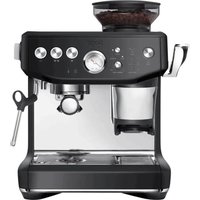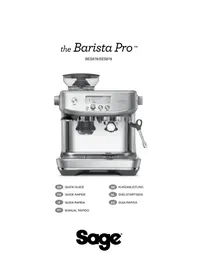
The Barista Pro BES878 - Coffee machine SAGE - Free user manual and instructions
Find the device manual for free The Barista Pro BES878 SAGE in PDF.




| Product Type | Bean-to-cup espresso machine |
| Brand | Sage |
| Model | The Barista Pro BES878 |
| Dimensions (W x H x D) | Approx. 33 x 40 x 40 cm |
| Weight | Approx. 10 kg |
| Power Supply | 220-240 V ~ 50/60 Hz |
| Rated Power | 1850 W |
| Water Tank Capacity | 2 L |
| Bean Hopper Capacity | 250 g |
| Grinder Type | Integrated stainless steel conical burr grinder |
| Grind Settings | 30 settings (from fine to coarse) |
| Heating System | ThermoJet™, ready in 3 seconds |
| Temperature Control | Electronic PID with adjustable brew temperature |
| Pre-infusion | Low pressure, manually adjustable |
| Portafilter | 54 mm stainless steel, with single and double wall baskets |
| Steam Wand | 360° swivel, with steam and hot water function |
| Display | LCD with animations |
| Additional Features | Instant hot water, automatic dosing, Razor™ dosing tool, auto-off after 30 min |
| Maintenance | Integrated cleaning and descaling cycles, grinder cleaning, replaceable water filter every 3 months |
| Safety | Auto shut-off, thermal protection, portafilter lock, detailed safety instructions |
| Spare Parts | Filter baskets, water filter, cleaning tool, cleaning disc, cleaning tablets, milk jug |
| Warranty | 2-year limited |
Frequently Asked Questions - The Barista Pro BES878 SAGE
User questions about The Barista Pro BES878 SAGE
0 question about this device. Answer the ones you know or ask your own.
Ask a new question about this device
Download the instructions for your Coffee machine in PDF format for free! Find your manual The Barista Pro BES878 - SAGE and take your electronic device back in hand. On this page are published all the documents necessary for the use of your device. The Barista Pro BES878 by SAGE.
USER MANUAL The Barista Pro BES878 SAGE
natural_image
Modern stainless steel coffee machine with digital display and control knobs (no visible text or symbols)EN QUICK GUIDE
DE KURZANLEITUNG
FR GUIDE RAPIDE
NL SNELSTARTGIDS
IT GUIDA RAPIDA
ES GUÍA RÁPIDA
PT MANUAL RÁPIDO
Sage®

Contents
2 Sage® Recommends Safety First
6 Components
8 Features
9 Assembly
11 Functions
18 Care & Cleaning
22 Troubleshooting
26 Guarantee
SAGE® RECOMMENDS SAFETY FIRST
At Sage® we are very safety conscious. We design and manufacture appliances with your safety foremost in mind. We also ask that you exercise a degree of care when using any electrical appliance and adhere to the following precautions.
READ ALL INSTRUCTIONS BEFORE USE AND SAVE FOR FUTURE REFERENCE
- A downloadable version of this document is also available at sageappliances.com
- Before using for the first time, please ensure that your electricity supply is the same as shown on the rating label on the underside of the appliance. If you have any concerns please contact your local electricity company.
- The installation of a residual current safety switch is recommended to provide additional safety when using all electrical appliances. Safety switches with a rated operating current not more than 30mA are recommended. Consult an electrician for professional advice.
- Remove and discard any packaging materials safely, before first use.
- To eliminate a choking hazard for young children, discard the protective cover fitted to the power plug safely.
- Ensure the product is properly assembled before first use.
- This appliance is for household use only. Do not use the appliance for anything other than its intended purpose. Do not use in moving vehicles or boats. Do not use outdoors. Misuse may cause injury.
- Position the appliance on a stable, heat resistant, level, dry surface away from the counter edge, and do not operate on or near a heat source such as a hot plate, oven or gas hob.
- Fully unwind the power cord before operating.
- Do not let the power cord hang over the edge of a counter or table. Do not let the power cord touch hot surfaces or become knotted.
- Do not leave the appliance unattended when in use.
- If the appliance is to be:
- left unattended
- cleaned
- moved
- assembled; or
- stored
Always switch off the espresso machine by pressing the POWER button to OFF.
Switch off and unplug from the power outlet.
- Regularly inspect the power cord, plug and actual appliance for any damage. If found to be damaged in any way, immediately cease use of the appliance and return the entire appliance to the nearest authorised Sage Service Centre for examination, replacement or repair.
- Keep the appliance and accessories clean. Follow the cleaning instructions provided in this book. Any procedure not listed in this instruction booklet should be performed at an authorised Sage Service Centre.
- The appliance can be used by children aged 8 or older and persons with reduced physical, sensory or mental capabilities or a lack of experience and knowledge, only if they have been given supervision or instruction concerning use of the appliance in a safe way and understand the hazards involved.
• Children should not play with the appliance.
- Cleaning of the appliance should not be carried out by children unless they are 8 years or older and under adult supervision.
• The appliance and its cord should be kept out of reach of children aged 8 years and younger.
- Do not use attachments other than those provided with the appliances.
- Do not attempt to operate the appliance by any method other than those described in this booklet.
- Do not move the appliance whilst in operation.
- Do not use any other liquid apart from cold mains/town water. We do not recommend the use of highly filtered, de-mineralised or distilled water as this may affect the taste of the coffee and how the espresso machine is designed to function.
- Never use the appliance without water in the water tank.
- Ensure the portafilter is firmly inserted and secured into the brewing head before using the machine.
- Never remove the portafilter during the brewing operation as the machine is under pressure.
- Do not place anything, other than cups for warming, on top of the appliance.
- Use caution when operating machine as metal surfaces are liable to get hot during use.
- Do not touch hot surfaces. Allow the product to cool down before moving or cleaning any parts.
• Heating element surface is subject to residual heat after use. - Always ensure the appliance is turned OFF, unplugged at the power outlet and has been allowed to cool before cleaning, attempting to move or storing.
- The appliance is not intended to be operated by means of an external timer or separate remote-control system.
-
The use of attachments not sold or recommended by Sage may cause fire, electric shock or injury.
• Always turn the appliance to the off position, switch off at the power outlet and unplug at the power outlet when the appliance is not in use. -
Any maintenance other than cleaning should be performed by an authorised Sage® service centre.
- Do not use the appliance on a sink drain board.
- Do not operate the appliance if it is in an enclosed space, or within a cupboard.
- Use caution when descaling as hot steam may be released. Before descaling, ensure drip tray is empty and inserted. Refer to ‘Care & Cleaning’ for further instructions.
- Do not operate the grinder without the hopper lid in position. Keep fingers, hands, hair, clothing and utensils away from the hopper during operation.
NOTICE TO CUSTOMERS REGARDING MEMORY STORAGE
Please note that in order to better serve our customers, internal memory storage has been imbedded into your appliance. This memory storage consists of a small chip to collect certain information about your appliance including the frequency of use of the appliance and the manner in which your appliance is being used. In the event your appliance is returned for service, the information collected from the chip enables us to quickly and efficiently service your appliance.
The information collected also serves as a valuable resource in developing future appliances to better serve the needs of our consumers. The chip does not collect any information regarding the individuals who use the product or the household where the product is used. If you have any questions regarding the memory storage chip please contact us at privacy@sageappliances.com
SPECIFIC INSTRUCTIONS FOR WATER FILTER
- Filter cartridge should be kept out of reach of children.
- Store filter cartridges in a dry place in the original packaging.
- Protect cartridges from heat and direct sunlight.
- Do not use damaged filter cartridges.
- Do not open filter cartridges.
- If you are absent for a prolonged period of time, empty the water tank and replace the cartridge.
The symbol shown indicates that this appliance should not be disposed of in normal household waste.
It should be taken to a local authority waste collection centre designated for this purpose or to a dealer providing this service. For more information, please contact your local council office.
To protect against electric shock, do not immerse the power cord, power plug or appliance in water or any other liquid.
FOR HOUSEHOLD USE ONLY SAVE THESE INSTRUCTIONS

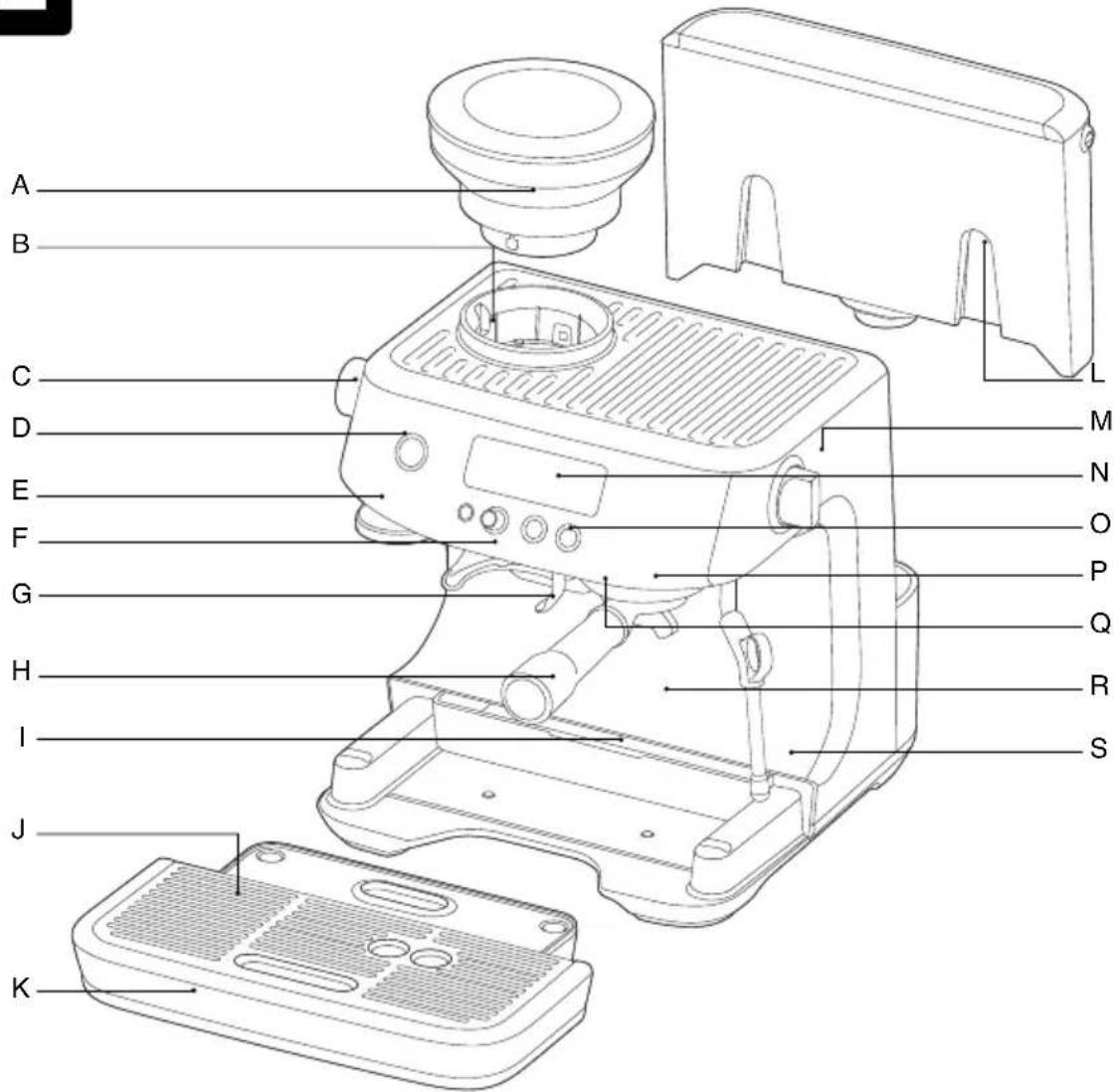
Components
text_image
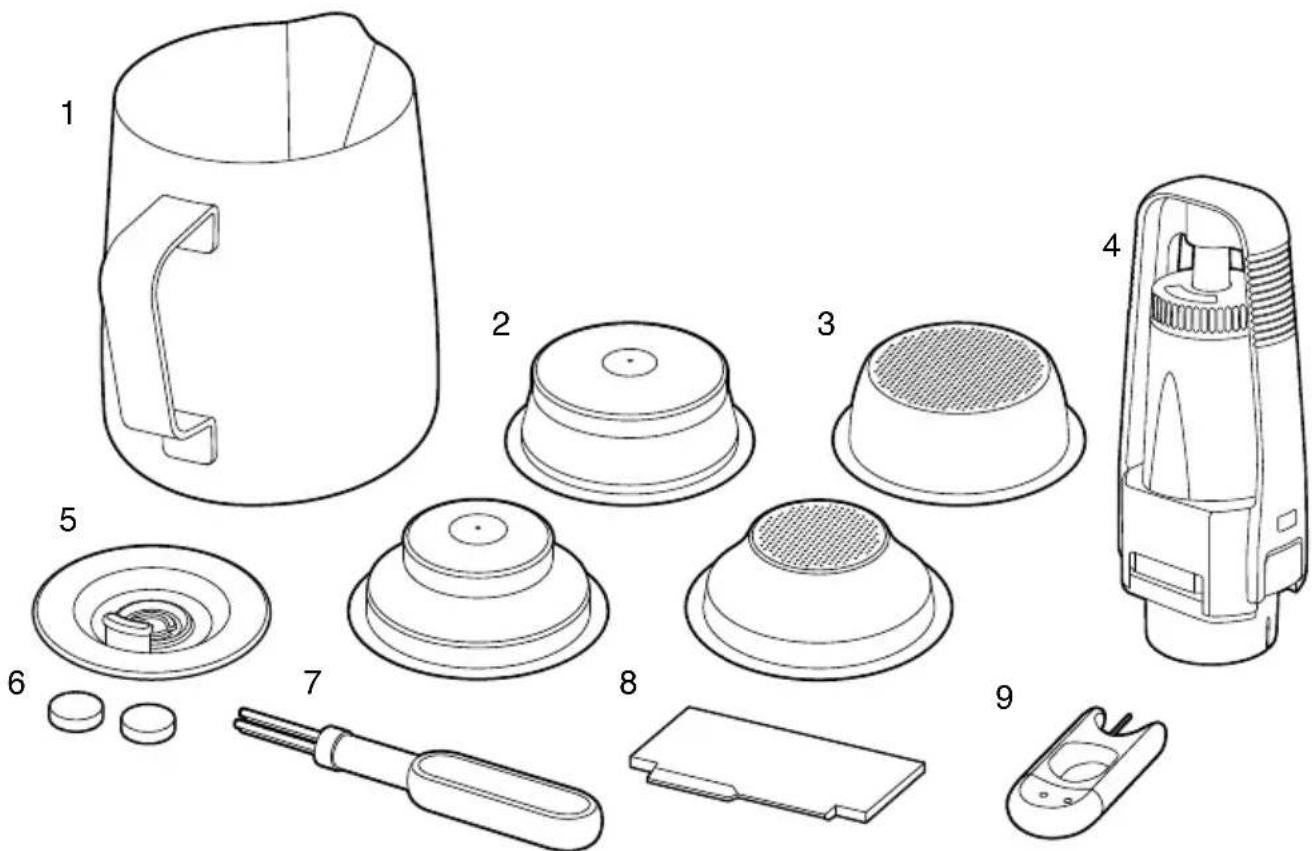
A B C D E F G H I J K M N O P Q R SA. 250g bean hopper
With locking system for easy removal,
storage and transfer of coffee beans.
B. Integrated conical burr grinder
C. Grind size selector 30 espresso grind settings from fine to coarse.
D. Power button
E. Integrated removable 54mm tamper
F. Grinder outlet
G. Grinding cradle
H. 54mm stainless steel portafilter With commercial style spouts.
I. Storage tray (located behind drip tray)
For storage of accessories.
J. Removable drip tray grid
K. Removable drip tray With tray full indicator.
L. 2L removable water tank With replaceable water filters to reduce scale and impurities.
M. Steam dial
Selector control for steam and hot water.
N. LCD display
With grinding and extracting progress animations.
O. Control panel
With menu, GRIND AMOUNT/ FILTER SIZE,
1 cup and 2 cup buttons.
P. Group head
Q. Dedicated hot water outlet For making long blacks and pre-heating cups.
R. Extra-tall cup clearance
S. 360° swivel steam wand
Easily adjusts to the perfect position for texturing milk.
All parts of the Barista Pro™ that come into contact with coffee, water and milk are BPA Free.
text_image
Technical diagram showing exploded view of a device with labeled parts including a kettle, dome-shaped enclosures, and a remote control unit.ACCESSORIES
- Stainless steel milk jug With MIN and MAX markings.
- Dual wall filter baskets (1 cup & 2 cup) Use with pre-ground coffee.
- Single wall filter baskets (1 cup & 2 cup) Use when grinding fresh whole coffee beans.
-
Water filter and filter holder
-
Cleaning disc
- Cleaning tablets
- Cleaning brush
- The Razor™ precision dose trimming tool
- Steam wand and filter basket cleaning tool BPA Free Materials*

Barista Pro™ Features
THERMOJET™ HEATING SYSTEM
Innovative heating system achieves ideal extraction temperature in 3 seconds.
INTEGRATED CONICAL BURR GRINDER
Stainless steel conical burrs maximise ground coffee surface area for a full espresso flavour. Upper and lower burrs are removable for cleaning.
ADJUSTABLE GRIND SIZE
30 espresso grind settings from fine to coarse for optimal extraction.
ADJUSTABLE GRIND AMOUNT
Adjust the amount of fresh ground coffee dosed into the filter basket to suit the fineness or coarseness of the grind.
AUTOMATIC DOSING
The grinder will dispense the required amount of ground coffee for a single or double cup dose.
HANDS FREE GRINDING
Auto stop for hands free grinding directly into the portafilter.
THE RAZOR™ DOSE TRIMMING TOOL
Patented twist blade trims down the puck to the right level for precision dosing and a consistent extraction.
Electronic PID temperature control for increased temperature stability.
INSTANT HOT WATER
Dedicated hot water outlet for making Long Blacks and pre-heating cups.
LOW PRESSURE PRE-INFUSION
Applies low water pressure at the start of the extraction to gently expand grinds for an even extraction.
VOLUMETRIC CONTROL
Pre-set 1 & 2 cup volumes, manual over-ride or programmable shot volumes.
DRY PUCK FEATURE
Removes excess water from the ground coffee in the filter basket after extraction for easy disposal of the coffee puck.
LARGE DRIP TRAY
With more usable workspace.

Assembly
BEFORE FIRST USE
Machine Preparation
Remove and discard all labels and packaging materials attached to your espresso machine. Ensure you have removed all parts and accessories before discarding the packaging. Remove the packaging and the plastics bags containing the water filter and water filter holder.
Clean the water tank, portafilter, filter baskets, milk jug and drip tray using warm water and a gentle dish washing liquid. Rinse well, then dry thoroughly before reassembling.
INSTALLING THE WATER FILTER
- Remove the water filter and water filter holder from the packaging.
- Set the reminder for the next month of replacement. We recommend to replace the filter after 3 months.
- Soak the filter in cold water for 5 minutes.
- Wash the filter holder with cold water.
- Insert the filter into the two parts of the filter holder. Ensure they are connected.
- Remove the water tank from the machine. Align the base of the filter holder with the adapter inside the water tank. Push down to lock into place.
- Fill the water tank with cold potable water and reattached the machine, ensuring it is properly attached and sitting flush to the back of the machine.
- Refer to ‘Care & Cleaning’ on page 18 for further instructions.

NOTE
DO NOT use highly filtered, demineralised or distilled water in this machine. This may affect the taste of the coffee.

NOTE
For replacement water filters, visit the Sage webpage or contact Sage Customer Service.
FILLING THE WATER TANK
- Ensure the water filter is securely fitted inside the water tank.
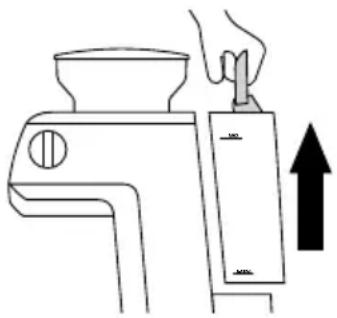
- Use the handle at the top of the water tank to assist in lifting it up and away from the machine.
natural_image
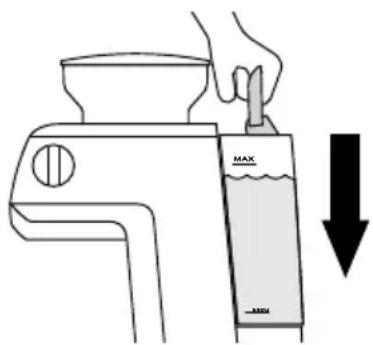
Line drawing of a hand using a blender to press a tray with an upward arrow (no text or symbols)- Fill the water tank with cold potable tap water to below the MAX marking indicated on the side of the water tank.
- Replace the water tank back on the machine, pressing down to ensure that it is properly positioned and attached to the machine.
text_image
Diagram showing a hand pouring liquid from a funnel into a washing machine labeled MAX and MIN, with a downward arrow indicating flow or process.
NOTE
Replace the water daily. The water tank should be filled with fresh, cold tap water before each use.
Assembly
ATTACHING THE HOPPER
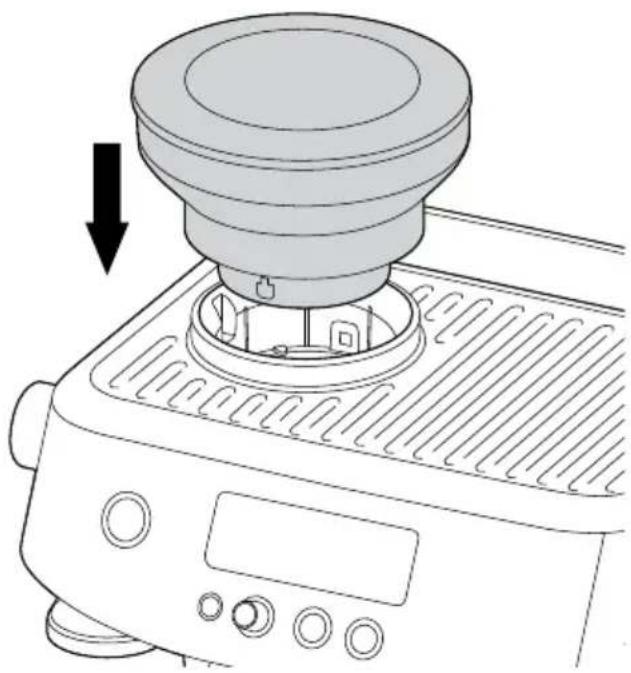
Insert the bean hopper into position on top of the machine.
natural_image
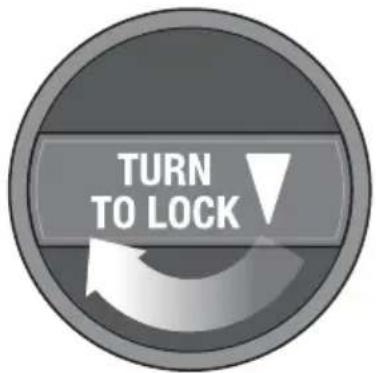
Line drawing of a mechanical device with a top component and a downward arrow indicating motion (no text or symbols)Turn the dial to lock the hopper into place. Fill with fresh coffee beans.
text_image
TURN TO LOCKFIRST USE CYCLE
A first use cycle must be completed before the initial use of the machine. The first use cycle rinses the machine and primes the heating system.
- Fill the water tank.
- Ensure machine is fully assembled with the bean hopper, drip tray and water tank securely attached to the machine.
- Press the POWER button. The machine will beep and go into FIRST CYCLE mode.
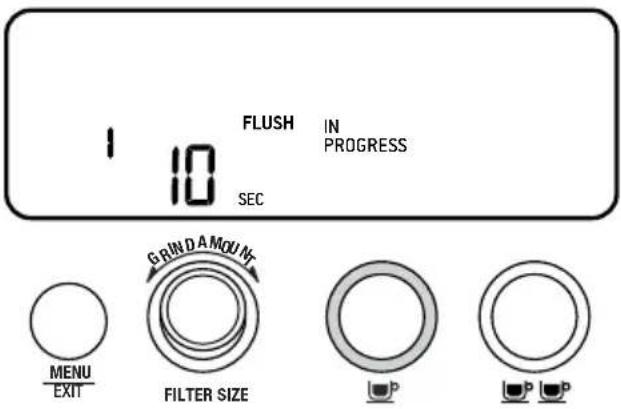
- The LCD will display FLUSH and the 1 CUP button will be illuminated.
text_image
10 FLUSH IN PROGRESS SEC GRIND AMOUNT MENU EXIT FILTER SIZE- Press the 1 CUP button. The LCD will show a count down for the remaining time of the first use cycle.
- Once complete, the machine will go into READY mode.

Functions
To turn the machine off, press the POWER button. Alternatively, the machine has auto-off, if it is not used for 30 minutes.
FILTER BASKETS
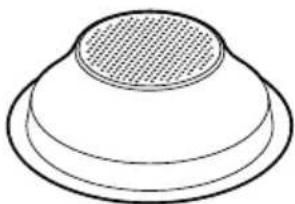
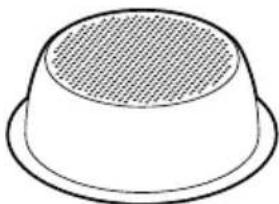
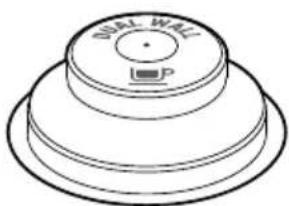
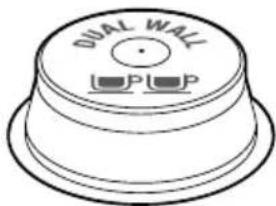
This machine includes 4 filter baskets; 2 x Single Wall and 2 x Dual Wall.
Single Wall filter baskets should be used when grinding fresh whole coffee beans. They allow you to experiment with grind, dose and tamp to create a more balanced espresso.
natural_image
Simple line drawing of a conical or dome-shaped object with a circular top and textured center (no text or symbols)1 CUP
natural_image
Simple line drawing of a circular object with a textured top and side rim (no text or symbols)2 CUP
Dual Wall filter baskets should be used when using pre-ground coffee. They regulate the pressure and help to optimise the extraction regardless of the grind, dose and tamp pressure or freshness.
natural_image
Line drawing of a dual-wall electrical connector (no text or symbols)1 CUP
text_image
DUAL WALL P P2 CUP
Regardless of whether you use Single Wall or Dual Wall filters baskets, use the 1 CUP basket when brewing a single cup and the 2 CUP basket when brewing two cups or a stronger single cup or mug.
You will need to adjust the grind amount and size if switching from a single to a double basket, or vice versa.
The provided filter baskets are designed for:
1 CUP basket = approx. 8 - 10g
2 CUP basket = approx. 19 - 22g

NOTE
You may need to experiment with how much coffee is dosed into the filter basket or how long the grinder needs to run to achieve the correct dose. For example; when using a finer espresso grind with the Single Wall filter baskets, you may need to increase the grind amount to ensure the filter basket is correctly dosed.
THE GRIND
When grinding coffee beans, the grind size should be fine, but not too fine. The grind size will affect the rate at which water flows through the ground coffee in the filter basket and the taste of the espresso.
If the grind is too fine (looks like powder and feels like flour when rubbed between the fingers), the water will not flow through the coffee, even when under pressure. The resulting espresso will be OVER EXTRACTED, dark in colour and bitter in flavour.
If the grind is too coarse, the water will flow through the ground coffee in the filter basket too quickly. The resulting espresso will be UNDER EXTRACTED and lacking in colour and flavour.
SETTING THE GRIND SIZE
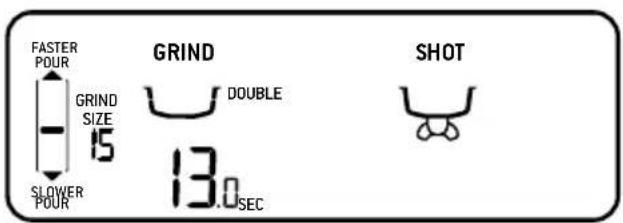
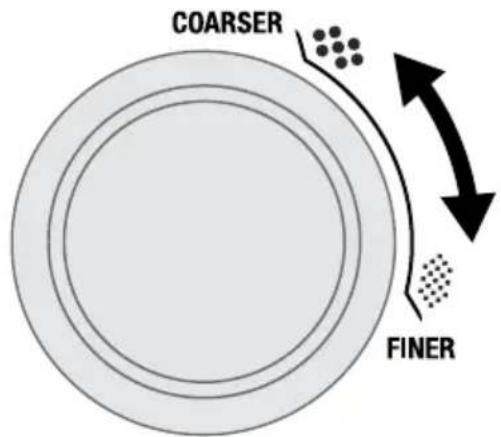
This machine has 30 grind settings to select from, with the size selected displayed on the LCD screen. The default grind size is 15.
When adjusting the grind size, a bar will display on the LCD indicating a faster or slower pour.
text_image
FASTER POUR GRIND DOUBLE 15 SLOWER POUR 13.0 SEC SHOTUse the GRIND SIZE selector on the left side of the machine to adjust the grind size.
text_image
COARSE FINERDOSING THE COFFEE
- Fill the hopper with fresh coffee beans.
- Insert the required filter basket into the portafilter.
- Place the portafilter into the grinding cradle.
- If required, press the FILTER SIZE button to select the filter basket size; Single or Double.
- If required, turn the GRIND AMOUNT dial to change the grind time; clockwise to increase the time and anti-clockwise to decrease.

NOTE
The default grind times are 9.5 seconds for a 1 cup filter and 13 seconds for a 2 cup filter.
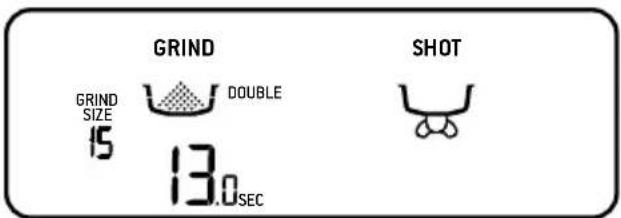
- Press and release the portafilter to activate the automatic dosing. The LCD will show the filter basket filling.
text_image
GRIND GRIND SIZE 15 DOUBLE 13.0sec SHOT- If you need to pause the grinding function, press and release the portafilter. The LCD will show PAUSED, it will remain paused for 10 seconds before returning to READY mode.
- Press and release the portafilter to resume grinding.

NOTE
It is normal for the portafilter to appear overfilled with ground coffee.
MANUAL DOSING
To manually dose the coffee, press and hold the portafilter in the grinding cradle until the desired amount of ground coffee has been dosed. To stop grinding, release the portafilter. The timer will count up, displaying the grind time.
- Remove the portafilter from the grinding cradle.
- Tap the portafilter several timers to collapse and distribute the coffee evenly in the filter basket.
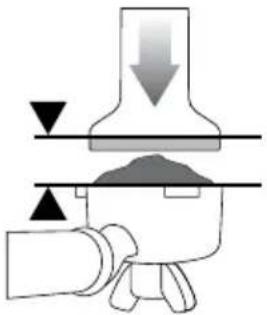
- Using the tamper, tamp down firmly (approx. 15–20kg of pressure). The amount of pressure is not as important as the consistent pressure every time.
natural_image
Diagram of a mechanical device with downward force arrow and load, no text or symbols present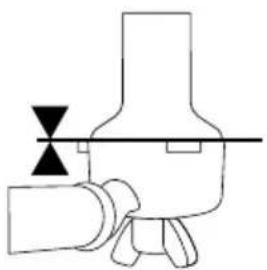
natural_image
Pure mechanical diagram of a pump or valve assembly without any text, labels, or symbols- As a guide, the top edge of the cap on the tamper should be level with the top of the filter basket AFTER the coffee has been tamped.

NOTE
We recommend quality 100% Arabica beans with a ‘Roasted On’ date stamped on the bags, not a ‘Best Before’ or ‘Use By’ date. Coffee beans are best consumed between 5 – 20 days after the ‘Roasted On’ date. Stale coffee may pour too quickly from the portafilter and taste bitter and watery.
TRIMMING THE DOSE
The Razor™ precision dose trimming tool allows you to trim the puck to the right level for a consistent extraction.
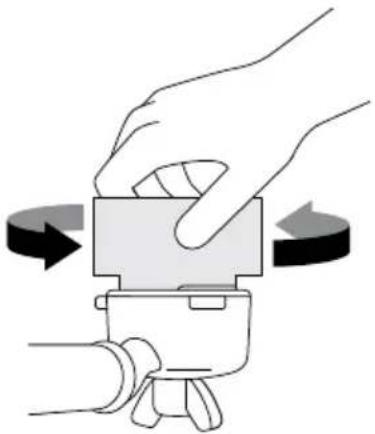
- Insert the Razor™ dose trimming tool into the filter basket until the shoulders of the tool rest on the rim of the basket. The blade of the dose trimming tool should penetrate the surface of the tamped coffee.
- Rotate the Razor™ dose trimming tool back and forth while holding the portafilter on an angle over a knock box to trim off excess coffee grinds. Your filter basket is now dosed with the correct amount of coffee.
natural_image
Illustration of a hand operating a mechanical device with rotating arrows indicating rotation (no text or symbols)- Wipe excess coffee from the rim of the filter basket to ensure a proper seal is achieved in the group head.
PURGING THE GROUP HEAD
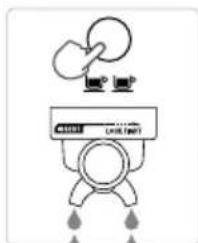
Before placing the portafilter into the group head, run a short flow of water through the group head by pressing the 1 CUP button. This will stabilise the temperature prior to extraction and preheat the portafilter for a consistent shot temperature.
INSERTING THE PORTAFILTER
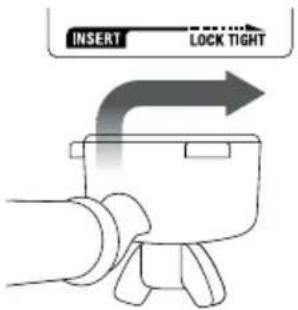
- Place the portafilter underneath the group head so that the handle is aligned with the INSERT position. Insert the portafilter into the group head and rotate the handle towards the centre until firm resistance is felt.
text_image
INSERT LOCK TIGHTEXTRACTING ESPRESSO
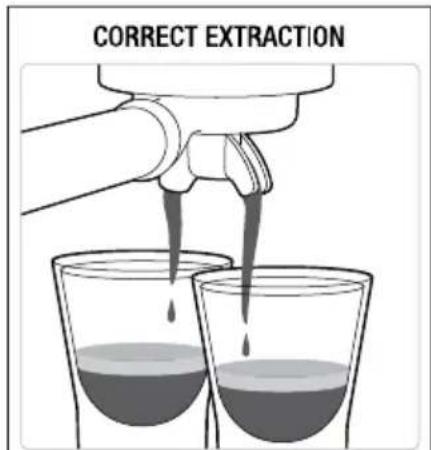
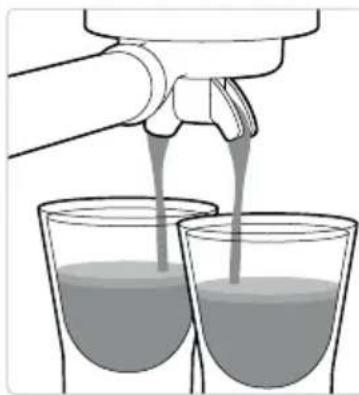
- As a guide the espresso will start to flow after 8–10 seconds (infusion time) and should be the consistency of dripping honey.
- If the espresso starts to flow after less than 6 seconds, you have either under dosed the filter basket and/or the grind is too coarse. This is an UNDER EXTRACTED shot.
- If the espresso starts to drip but doesn't flow after 15 seconds, the grind is too fine. This is an OVER EXTRACTED shot.
text_image
CORRECT EXTRACTION• Flow starts after 8-12 secs
- Flow slow like warm honey
- Crema is golden brown with a fine mousse texture
- Espresso is dark brown
AFTER EXTRACTION
natural_image
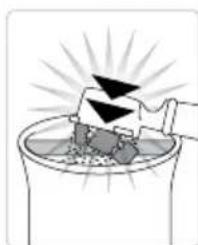
Illustration of a hand pressing down on a cylindrical container with a black arrow and granular material inside (no text or symbols)REMOVE USED GRINDS
Used grinds will form a coffee 'puck'. If the puck is wet, refer to the 'Under Extraction' section.
natural_image
Simple line drawing of a person standing at a desk with a fan and droplet, no text or symbols present.RINSE FILTER BASKET
Keep the filter basket clean to prevent blockages. Without ground coffee in the filter basket, lock the portafilter into the machine and run hot water through.
UNDER EXTRACTION
natural_image
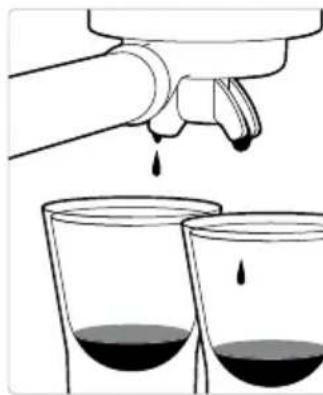
Illustration of a hand pouring liquid into two glasses (no text or symbols)• Flow starts after 1-7 secs
- Flow fast like water
- Crema is thin and pale
- Espresso is pale brown
• Tastes bitter/sharp, weak and watery
SOLUTIONS
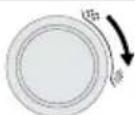
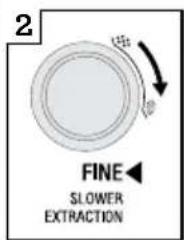
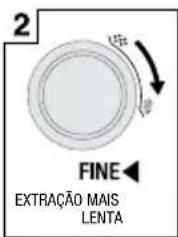
FINE
SLOWER EXTRACTION
Adjust & re-test
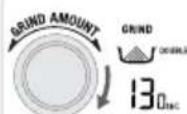
INCREASE
GRIND AMOUNT
Adjust & re-test
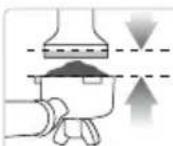
ALWAYS TAMP TO LINE
Adjust & re-test
Tamp using 15-20kgs of pressure. The top edge of metal cap on the tamper should be level with the top of the filter basket AFTER tamping. Trim the puck to the right level using the Razor™ precision dose trimming tool.
OVER EXTRACTION
natural_image
Illustration of a hand pouring liquid into two beakers with dark liquid, no text or symbols present• Flow starts after 13 secs
- Flow drips or not at all
- Crema is dark and spotty
- Espresso is very dark brown
• Tastes bitter and burnt
SOLUTIONS
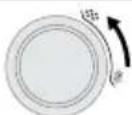
▶CO
FASTER EXTRACTION
Adjust & re-test
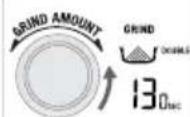
DECREASE
GRIND AMOUNT
Adjust & re-test
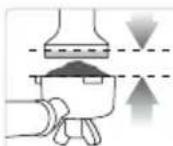
ALWAYS TAMP TO LINE
Adjust & re-test
Tamp using 15-20kgs of pressure. The top edge of metal cap on the tamper should be level with the top of the filter basket AFTER tamping. Trim the puck to the right level using the Razor™ precision dose trimming tool.
GRIND GRIND DOSE TAMP
| OVER EXTRATEDBITTER • ASTRINGENT | Too fine | Too muchUse razor to trim | Too heavy |
| BALANCED Optimum | 8–10g (1 cup)19–22g (2 cup) | 15–20kg | |
| UNDER EXTRACTEDUNDERDEVELOPED • SOUR | Too coarse | Too littleIncrease dose & use razor to trim | Too light |
PRE-PROGRAMMED SHOT VOLUME - 1 CUP
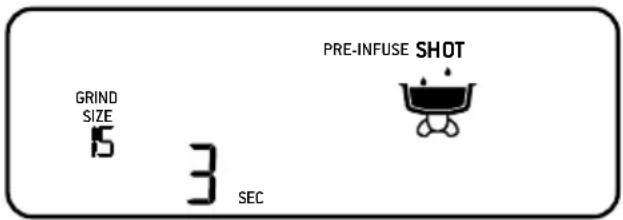
- Press the 1 CUP button once, the button will flash, indicating that it has been selected. The LCD will display PRE-INFUSE and the shot clock will start counting up. Once pre-infusion is complete, the shot will start extracting. A pre-set single espresso volume of approx. 30ml will be extracted. The machine will automatically stop once the pre-set volume has been extracted.
text_image
GRIND SIZE 15 3 SEC PRE-INFUSE SHOTPRE-PROGRAMMED SHOT VOLUME - 2 CUP
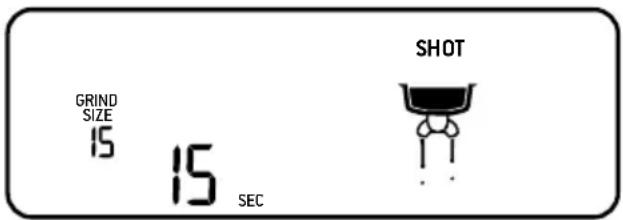
- Press the 2 CUP button once, the button will flash, indicating that it has been selected and the LCD will display PRE-INFUSE and the shot clock will start counting up. Once pre-infusion is complete, the shot will start extracting. A pre-set double espresso volume of approx. 60ml will be extracted. The machine will automatically stop once the pre-set volume has been extracted.
text_image
GRIND SIZE 15 15 SEC SHOTMANUAL PRE-INFUSION & EXTRACTION
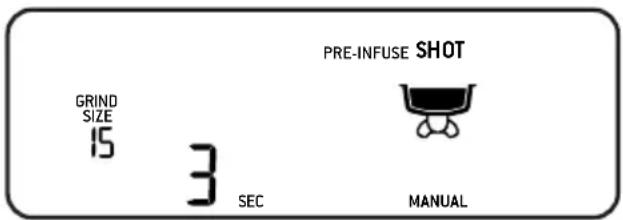
- Press and hold the 1 CUP or 2 CUP button for the desired pre-infusion time. Release the button to commence the extraction. Press the flashing button to stop the extraction.
text_image
GRIND SIZE 15 3 SEC PRE-INFUSE SHOT MANUALPROGRAMMING ESPRESSO SHOT
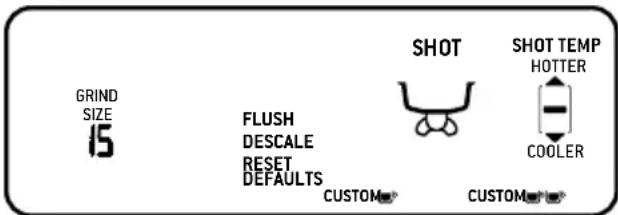
- Press the MENU button to enter the main menu.
text_image
GRIND SIZE 15 FLUSH DESCALE RESET DEFAULTS CUSTOM SHOT SHOT TEMP HOTTER COOLER CUSTOM- Use the GRIND AMOUNT dial to navigate through the menu to the custom or custom ▪▶ select, press the dial.
- Press the desired CUP button to start the default pre-infusion. To customise the pre-infusion, press and hold the same CUP button for the desired pre-infusion time. Release the button to commence the extraction.
- To stop the extraction at the desired level, press the CUP button. The LCD and CUP button will stop flashing and the machine will beep to indicate that the custom setting has been remembered. The machine will then return to READY mode. The custom setting can now be activated by pressing the desired CUP button selected.
- Press the MENU button to enter the main menu.
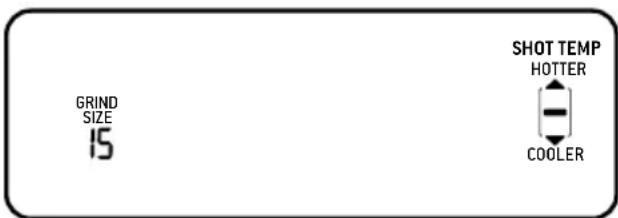
- Use the GRIND AMOUNT dial to navigate the menu and press to select SHOT TEMP.
text_image
GRIND SIZE 15 SHOT TEMP HOTTER COOLER- Use the GRIND AMOUNT dial to increase or decrease the shot temperature as displayed on the LCD.
- Press the dial to confirm the desired temperature. The machine will return to READY mode.
RESETTING TO DEFAULTS
- Press the MENU button to enter the main menu.
- Use the GRIND AMOUNT dial to navigate the menu and select RESET DEFAULTS.
- The GRIND AMOUNT, FILTER SIZE, SHOT TEMP, 1 CUP and 2 CUP SHOT settings will all return to the default settings. The machine will return to READY mode.
USING HOT WATER OUTLET
The hot water function can be used to pre-heat cups or to add hot water manually.
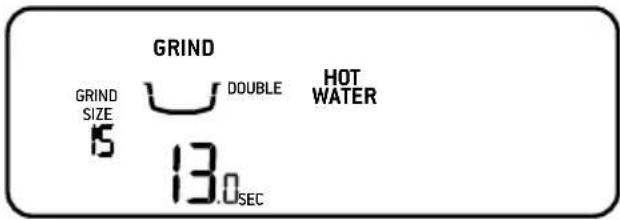
To activate the hot water, turn the STEAM dial to 🎨.
text_image
GRIND GRIND SIZE 15 DOUBLE 13.0sec HOT WATER- The LCD will show that HOT WATER has been activated.
- To stop the hot water, turn the dial back to the centre, vertical position.
- The hot water will stop after 60 seconds, but the dial must be turned back manually to the standby position.
TEXTURING MILK
It is recommended to momentarily purge the steam wand prior to texturing milk.
Position the steam wand over the drip tray and turn the STEAM dial to the 🎨. The LCD will display STEAM when activated. Turn the STEAM dial back to a vertical position to stop steaming.
Different brands and types of milk and milk alternatives will texture differently.
- Start with fresh cold milk.
- Fill the milk jug to between the MIN and MAX markings.
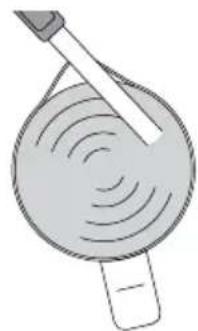
- Lift the steam wand and insert into the milk jug with the steam wand tip 1–2cm below the surface of the milk, close to the right-hand side of the jug at a 3 o'clock position.
- Turn the STEAM dial to the 🎨.
- Keep the steam wand tip just under the surface of the milk until the milk is spinning clockwise, producing a vortex (whirlpool effect).
- With the milk spinning, slowly lower the jug. This will bring the steam wand tip to the surface of the milk and start to introduce air into the milk.
• Gently break the surface of the milk with the tip to get the milk spinning fast enough.
- Keep the steam wand tip at or slightly below the surface, continuing to maintain the vortex. Texture the milk until sufficient volume is obtained.
- Lift the jug to lower the tip beneath the surface but keep the vortex spinning. The milk is at the correct temperature (60–65°C) when the jug is hot to touch.
natural_image
Simple line drawing of a pipette stirring a circular container with concentric rings (no text or symbols)- Once the desired temperature has been achieved, turn the STEAM dial back to the vertical position.
- Remove the steam wand from the milk jug.
- Wipe the steam wand with a clean, damp cloth. Then return to lowered position over the drip tray.

CAUTION: BURN HAZARD
Pressurised steam can still be released, even after machine has been switched off. Children must always be supervised.

NOTE
Ensure the STEAM dial is in the vertical position before removing the steam wand from the milk jug.

NOTE
When the machine creates steam, a pumping noise can be heard. This is normal operation.

NOTE
Use only the supplied stainless steel milk jug to froth milk using this machine. The use of other containers may lead to dangerous conditions.
STEAM WAND PURGING
After texturing milk, it is recommended to purge the steam wand. With the steam wand positioned over the drip tray and turn the STEAM dial to the 🔊, and allow the machine to purge. Turn the STEAM dial back to a vertical position to stop steaming.
ADJUSTING CONICAL BURRS
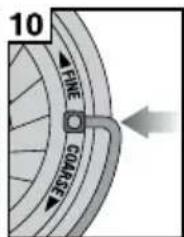
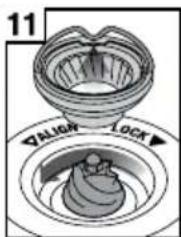
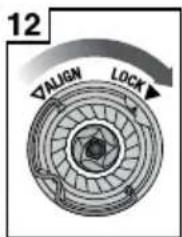
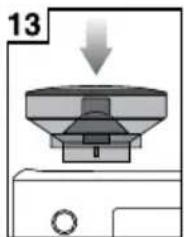
Some types of coffee may require a wider grind range to achieve an ideal extraction or brew. A feature of your Barista Pro™ is the ability to extend this range with an adjustable upper burr. We recommend making only one adjustment at a time.
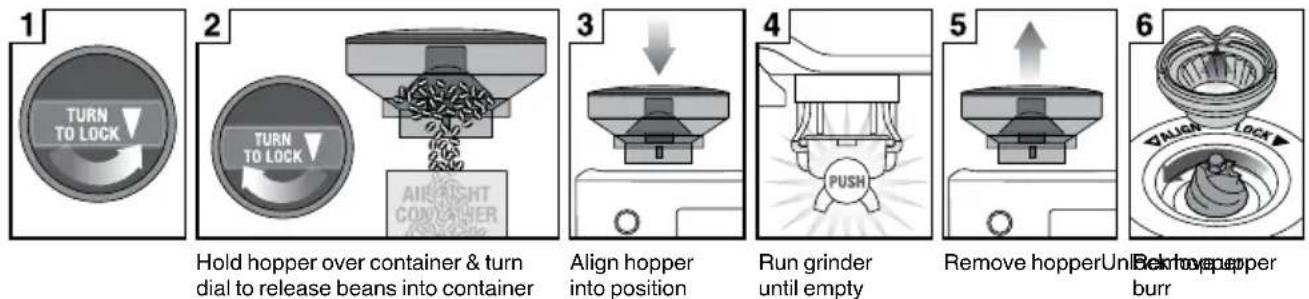
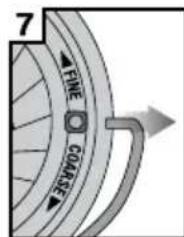
text_image
7 FINE COARSERemove wire handle from both sides of the burr
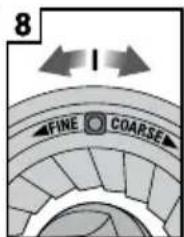
text_image
8 FINE COARSEMove adjustable Align the number top burr, 1 number, with the handle coarser or finer opening
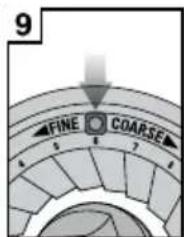
text_image
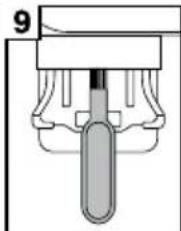
9 FINE COARSEAlign the number with the handle opening
text_image
10 FINE COARSEInsert wire handle from both sides of the burr
text_image
11 ALIGN LOCKPush upper burr firmly into position
text_image
12 ALIGN LOCKLock upper burr
natural_image
Diagram of a mechanical component with a downward arrow and circular base (no text or symbols)Align hopper into position
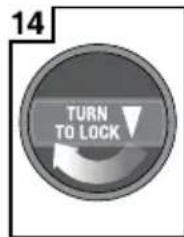
text_image
14 TURN TO LOCKLock hopper Check your extraction
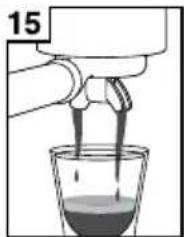
natural_image
Illustration of a hand pouring liquid into a glass with dark liquid, labeled '15' (no text or symbols on the diagram itself)INSTALLING THE WATER FILTER

- Remove the water filter and water filter holder from the packaging. Set the reminder for the next month of replacement. We recommend to replace the filter after 3 months.
- Soak the filter in cold water for 5 minutes.
- Wash the filter holder with cold water.
- Insert the filter into the two parts of the filter holder. Ensure they are connected.
- Remove the water tank from the machine. Align the base of the filter holder with the adapter inside the water tank. Push down to lock into place.
- Remove the water tank from the machine. Align the base of the filter holder with the adapter inside the water tank. Push down to lock into place.
- Fill the water tank with cold potable water and reattached the machine, ensuring it is properly attached and sitting flush to the back of the machine.

NOTE
Replacement water filters can be purchased from the Sage website or by contacting Sage Customer Service.
FLUSH CLEANING CYCLE
The LCD will display a FLUSH alert when a cleaning cycle is required. The cleaning cycle is separate from descaling.
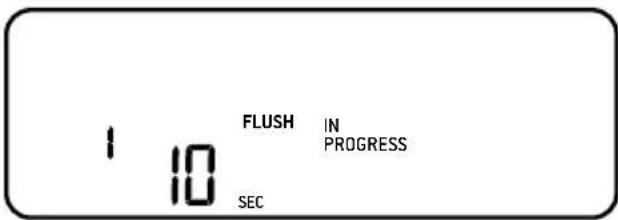
text_image
1 10 FLUSH IN PROGRESS SEC- Insert the cleaning disc into the filter basket in the portafilter.
- Place a cleaning tablet on top of the cleaning disc.
- Lock the portafilter into the group head.
- Empty the drip tray and replace onto the machine.
- Fill the water tank to the MAX line then reattach to the machine.
- Press the MENU button to enter the main menu.
- Use the GRIND AMOUNT dial to navigate the menu to FLUSH, then press to select. The 1 CUP button will illuminate.
- Press the 1 CUP button to start the cleaning cycle. The remaining time for the cleaning cycle will be displayed on the LCD.
- Once the cleaning cycle is complete, the machine will beep and return to READY mode. If any of the cleaning tablet remains in the cleaning disc, repeat the cycle.
- Empty and rinse the portafilter, cleaning disc and drip tray.
DESCALING
After regular use, hard water can cause mineral build up in and on many of the inner functioning components, reducing the brewing flow, brewing temperature, power of the machine, and the taste of the espresso. The LCD will display a DESCALE alert, when a descaling cycle is required.
- Empty the drip tray and reattach to the machine. Remove the water tank from the machine and remove the filter from the water tank.
- Fill the water tank to the DESCALE line indicated and add the descaling agent to the water. Reattach the water tank to the machine.
- Press the MENU button to enter the main menu. Use the GRIND AMOUNT dial to navigate the menu to DESCALE, then press to select. The 1 CUP button will illuminate.
- Press the 1 CUP button to start the descaling cycle. The descale cycle cleans in 3 stages; coffee, hot water and steam. After each stage is complete, the machine will beep. The STEAM DIAL must be manually turned to the HOT WATER and STEAM position when indicated on the LCD.

IN DESCALE PROGRESS
STEAM
-
Once the descale cycle is complete, the machine needs to complete a rinse cycle. The 1 CUP button will illuminate. As with the descale cycle, the STEAM DIAL must be manually turned to correct position when indicated on the LCD.
-
Remove and empty the drip tray then replace onto the machine. Empty any remaining descaling liquid from the water tank, then fill the water tank to the MAX line and reattached to the machine.
-
Press the 1 CUP button to commence the rinse cycle. The rinse cycle is also 3 stages. The LCD will show which stage it is up to. After each stage, the machine will beep.
- Once the rinse cycle is complete, the machine will beep and return to READY mode.
- Remove and rinse the drip tray and water tank. Dry thoroughly before replacing them on the machine.
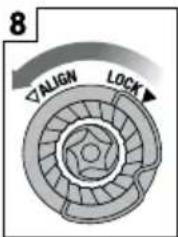
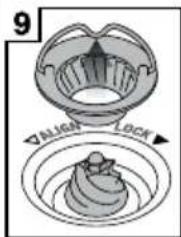
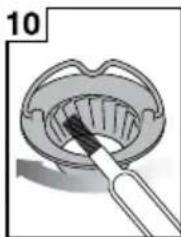
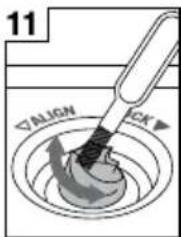
CLEANING THE CONICAL BURR GRINDER
This grinder cleaning cycle removes oil build-up on the burrs which can impede performance.
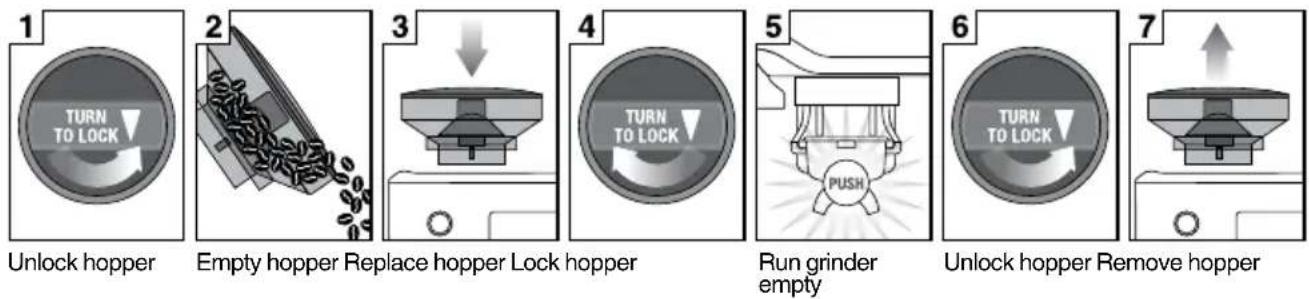
text_image
8 ▽ALIGN LOCKUnlock top burr
text_image
9 ALIGN LOCKRemove top burr
natural_image
Illustration of a toothbrush applying material to a circular cavity (no text or symbols)Clean top burr with brush
text_image
11 ALIGN OKClean lower burr with brush
natural_image
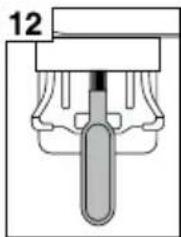
Mechanical component diagram showing a piston-like structure with no visible text or symbolsClean chute with brush
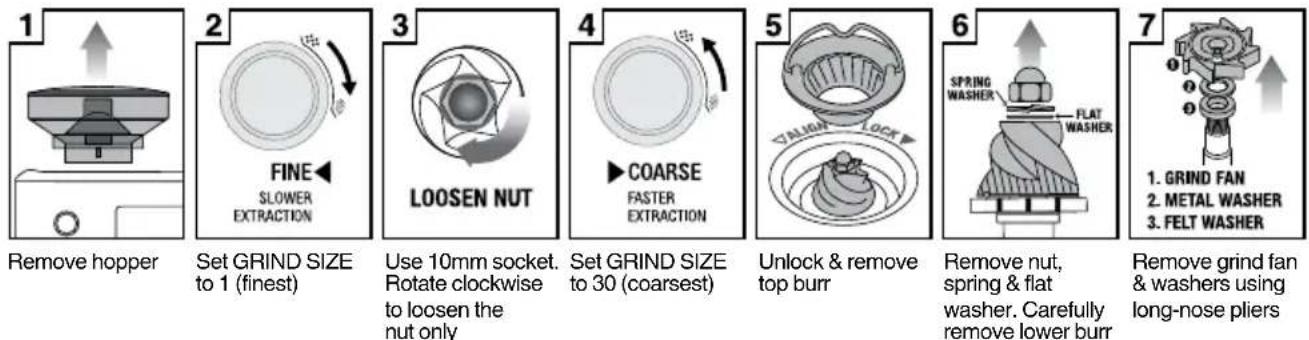
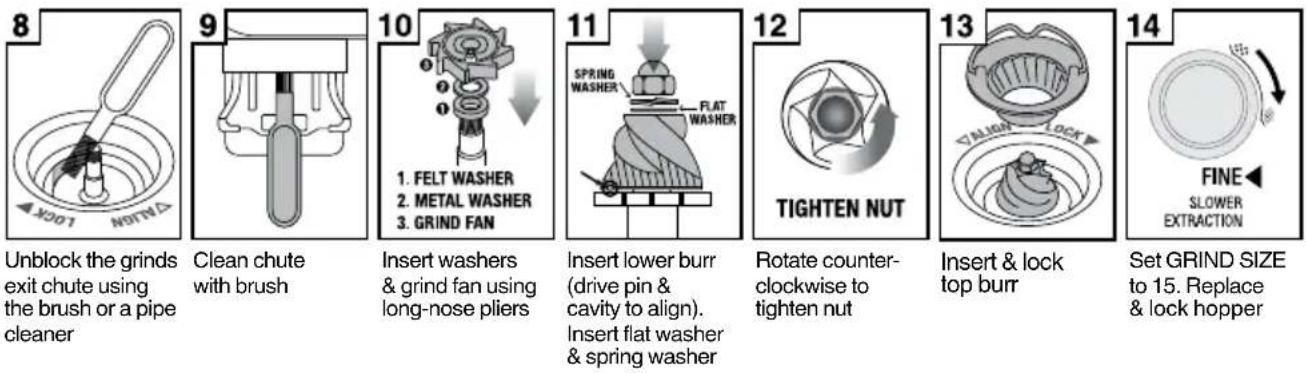
ADVANCED CLEANING FOR THE CONICAL BURR GRINDER
This step is only required if there is a blockage between the grinding burrs and the grinder outlet.

WARNING
Care should be taken as the grinder burrs are extremely sharp.
CLEANING THE STEAM WAND
- The steam wand should always be cleaned after texturing milk. Wipe the steam wand with a damp cloth.
- After use, it is recommended to purge the steam wand for a couple of seconds, to clear any remaining milk. With the steam wand positioned down over the drip tray, turn the STEAM dial to 🏠 for a couple of seconds allow the machine to create steam for a couple of seconds before turning it back to the vertical position.
- If the steam tip hole becomes blocked, it will reduce frothing performance. Use the provided steam wand cleaning tool to clear the opening.
- If the steam wand is still blocked, use the spanner in the middle of the steam wand cleaning tool to unscrew the tip. Soak the tip in hot water before using the cleaning tool to unblock again. Replace the tip back on the steam wand, using the tool.
CLEANING THE FILTER BASKETS AND PORTAFILTER
- The filter baskets and portafilter should be rinsed under hot water immediately after use to remove all residual coffee oils.
- If any of the holes in the filter basket become blocked, use the pin on the end of the provided cleaning tool to unblock the holes.
- If the holes remain blocked, dissolve a cleaning tablet in hot water and soak filter basket and portafilter in solution for approx. 20 minutes. Rinse thoroughly.
CLEANING THE GROUP HEAD
- The group head interior and shower screen should be wiped with a damp cloth after use to remove any ground coffee particles.
- Periodically purge the machine. Place an empty filter basket and portafilter into the group head. Press the 1 CUP button and run a short flow of water to rinse out any residual coffee. Press the 1 CUP button again to stop the hot water. Remove the portafilter and rinse thoroughly.
CLEANING THE DRIP TRAY
-
The drip tray should be removed, emptied and cleaned at regular intervals, particularly when the drip tray full indicator is showing EMPTY ME!
-
Remove the drip tray from the machine and separate the parts. The EMPTY ME! indicator can also be removed from the drip tray by pulling upwards to release the side latches. Wash all parts in warm soapy water with a soft cloth. Rinse and dry thoroughly before reassembling and attaching to the machine.
- The storage tray (located behind the drip tray) can be removed and cleaned with a soft, damp cloth.

NOTE
All parts should be cleaned by hand using warm water and a gentle dish washing liquid. Do not use abrasive cleansers, pads or cloths which can scratch the surface. Do not clean any of the parts or accessories in the dishwasher.

WARNING
Do not immerse the power cord, power plug or appliance in water or any other liquid.
CLEANING THE OUTER HOUSING
Wipe the outer housing with a soft, damp cloth and then polish with a soft, dry cloth.
STORING YOUR MACHINE
Before storing, press the POWER button to turn the machine off then turn off and remove the plug from the power outlet. Remove unused beans from the hopper, clean the grinder (see page 18), empty the water tank and the drip tray. Ensure the machine is cool, clean and dry. Place accessories in the storage tray.
Store the machine upright and do not store anything on top.
ERROR MODE
If your machine displays on the LCD, contact Sage Customer Service.
PROBLEM POSSIBLE CAUSES WHAT TO DO
| Water does not flow from the group head. No hot water. | ·Water tank is empty. ·Fill tank. | |
| ·Water tank is not fully inserted and locked into position. | ·Push water tank down completely to lock into place. | |
| ·Machine needs to be descaled. ·Perform descale cycle. | ||
| ·Coffee is ground too finely and/or too much coffee in filter basket and/or over tamping and/or filter basket is blocked. | ·See below, ‘Espresso only drips from the portafilter spouts or not at all’. | |
| Espresso only drips from the portafilter spouts or not at all. | ·Coffee is ground too finely. | ·Use slightly coarser grind. Refer to ‘Setting the Grind Size’, page 12 and ‘Over Extraction’, page 14. |
| ·Too much coffee in the filter basket. | ·Lower dose of coffee. Refer to ‘Dosing’, page 12 and ‘Over Extraction’, page 14. ·After tamping, trim the coffee doseusing the RazorTM dose trimming tool. | |
| ·Coffee tamped too firmly. | ·Tamp between or 15–20kg of pressure. | |
| ·Water tank is empty. ·Fill tank. | ||
| ·Water tank is not fully inserted and locked into position. | ·Push water tank down completely to lock into place. | |
| ·The filter basket may be blocked. | ·Use the pin on the end of the provided cleaning tool to unblock the hole(s). ·If the hole(s) remain blocked, dissolve a cleaning tablet in hot water and soak filter basket and portafilter in solution for approx. 20 minutes. Rinse thoroughly. | |
| ·Machine needs to be descaled. ·Perform descale cycle. | ||
| Water doesn't come through (the machine makes loud noise). | ·Water tank is empty or water level is below MIN. | ·Fill tank. |
PROBLEM POSSIBLE CAUSES WHAT TO DO
| Espresso runs out too quickly. | Coffee is ground too coarsely. | Use slightly finer grind.Refer to ‘Setting the Grind Size’, page 12 and ‘Under Extraction’, page 14. |
| Not enough coffee in the filter basket. | Increase dose of coffee.Refer to ‘Dosing’, page 12 and ‘Under Extraction’, page 14. Tamp then use the RazorTM dose trimming tool to trim off excess coffee. | |
| Coffee tamped too lightly. | Tamp between or 15–20kg of pressure. | |
| Espresso runs out around the edge of the portafilter. | Portafilter not inserted in the group head correctly. | Ensure portafilter is completely inserted and rotated until resistance is felt. |
| There are coffee grounds around the filter basket rim. | Clean excess coffee from the rim of the filter basket to ensure a proper seal in group head. | |
| Too much coffee in the filter basket. | Lower dose of coffee. Refer to ‘Dosing’, page 12.After tamping, trim the coffee dose using the RazorTM dose trimming tool. | |
| No steam. | Machine has not reached operating temperature. | Allow time for the machine to reach operating temperature. |
| Water tank is empty. Fill tank. | ||
| Water tank is not fully inserted and locked into position. | Push water tank down completely to lock into place. | |
| Machine needs to be descaled. Perform descale cycle. | ||
| Steam wand is blocked. Refer to ‘Cleaning the Steam Wand’, page 21. | ||
| Pulsing/pumping sound while extracting espresso or steaming milk. | The machine is carrying out the normal operation of the pump. | No action required as this is the normal operation of the machine. |
| Water tank is empty. Fill tank. | ||
| Water tank is not fully inserted and locked into position. | Push water tank down completely to lock into place. |
PROBLEM POSSIBLE CAUSES WHAT TO DO
| Coffee not hot enough. | Cups not pre-heated. Rinse cups under hot water outlet. | |
| Portafilter not pre-heated. Rinse portafilter under hot water outlet. Dry thoroughly. | ||
| Milk not hot enough (if making a cappuccino or latté etc). | Texture milk for a longer period of time. | |
| Water temperature needs to be adjusted. | Increase the brew temperature refer to 'Adjusting Shot Temperature' page 15. | |
| No crema. | Coffee tamped too lightly. | Tamp betweens or 15–20kg of pressure. |
| Coffee is ground too coarsely. | Use slightly finer grind. Refer to 'Setting the Grind Size', page 12 and 'Under Extraction', page 14. | |
| Coffee beans or pre-ground coffee are not fresh. | If grinding fresh whole coffee beans, use freshly roasted coffee beans with a 'Roasted On' date and consume between 5–20 days after that date.If using pre-ground coffee, use within a week of grinding. | |
| The filter basket may be blocked. | Use the pin on the end of the provided cleaning tool to unblock the hole(s).If the hole(s) remain blocked, dissolve a cleaning tablet in hot water and soak filter basket and portafilter in solution for approx. 20 minutes. Rinse thoroughly. | |
| Single Wall filter baskets are being used with pre-ground coffee. | Ensure you use Dual Wall filter baskets with pre-ground coffee. | |
| Water leaking. | Water tank is not fully inserted and locked into position. | Push water tank down completely to lock into place. |
| Machine is on but ceases to operate. | The safety thermal-cut out may have activated due to the pump or grinder overheating. | Press the POWER button to switch the machine off and unplug from the power outlet. Allow to cool for about 30–60 minutes.If problem persists, call Sage Support. |
PROBLEM POSSIBLE CAUSES WHAT TO DO
| No ground coffee coming from grinder. | · No coffee beans in hopper. · Filler hopper with fresh coffee beans. | |
| · Blocked grinder chamber or chute. | · Clean and clear grinder chamber and chute. Refer to ‘Advanced Cleaning for the Conical Burr Grinder’, page 20. | |
| · Water / moisture in grinder chamber and chute. | · Clean and clear grinder chamber and chute. Refer to ‘Advanced Cleaning for the Conical Burr Grinder’, page 20. Ensure burrs are thoroughly dry before re-assembling. It is possible to use a hair dryer to blow air into the grinder chamber. | |
| Too much/too little ground coffee is being delivered to the filter basket. | · Grind amount settings are incorrect for particular grind size. | · Use the grind duration button to increase or decrease the grind amount. Refer to ‘Dosing’, page 12 and ‘Extraction Guide’, page 14. |
| Too much/too little espresso is being delivered to the cup. | · Grind amount and/or grind size settings and/or shot volumes require adjustment. | · Adjust the grind amount and/or grind size settings. Refer to ‘Setting the Grind Size’, page 12, ‘Dosing’, page 12 and ‘Extraction Guide’, page 14. |
| Grinder is making a loud noise. | · Blockage or foreign object in grinder. | · Remove hopper, check for debris or blockage. If necessary, clean and clear grinder chamber and chute. Refer to ‘Cleaning the Conical Burr Grinder’, page 20. |

Guarantee
2 YEAR LIMITED GUARANTEE
Sage Appliances guarantees this product for domestic use in specified territories for 2 years from the date of purchase against defects caused by faulty workmanship and materials. During this guarantee period Sage Appliances will repair, replace, or refund any defective product (at the sole discretion of Sage Appliances).
All legal warranty rights under applicable national legislation will be respected and will not be impaired by our guarantee. For full terms and conditions on the guarantee, as well as instructions on how to make a claim, please visit www.sageappliances.com.

Notes

Inhalt
text_image
A B C D E F G H I J K M N O P Q R Stext_image
Exploded view diagram of a kitchen appliance with numbered parts for identificationZUBEHÖR
natural_image
Line drawing of a hand holding a small object next to a device with an upward arrow (no text or symbols)text_image
Diagram showing a hand pouring liquid into a machine labeled MAX, with a downward arrow indicating flow or process direction.
HINWEIS
natural_image
Line drawing of a mechanical device with a circular top component and a downward arrow indicating rotation (no text or symbols)natural_image
Simple line drawing of a conical container with a mesh top (no text or symbols)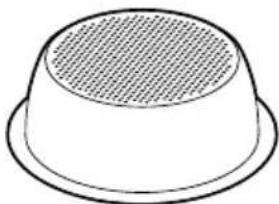
natural_image
Simple line drawing of a perforated container or lid (no text or symbols)1 TASSE 2 TASSEN
natural_image
Top-down diagram of a conical device with 'P' label and 'SAL WALK' text, no other symbols or text present.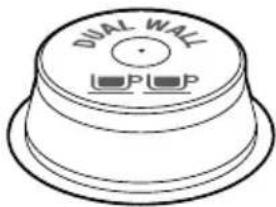
text_image
DUAL WALL P P1 TASSE 2 TASSEN
text_image
COARSE FINERnatural_image
Diagram showing two mechanical components with downward force arrows and triangular symbols, no text or labels presentnatural_image
Illustration of a hand operating a mechanical device with rotating arrows indicating rotation (no text or symbols)natural_image
Illustration of a hand pouring liquid from a funnel into two glasses filled with dark liquid (no text or symbols)natural_image
Simple line drawing of a container with a lid and spout, emitting light rays (no text or symbols)KAFFEESATZ ENTFERNEN
natural_image
Illustration of a hand pouring liquid into two glasses (no text or symbols)natural_image
Illustration of a hand pouring liquid into two glass cups containing dark liquid, with no text or symbols present.text_image
GRIND SIZE 15 3 SEC PRE-INFUSE SHOT MANUALPROGRAMMIEREN DER ESPRESSO-MENGE
text_image
GRIND GRIND SIZE 15 DOUBLE 13.0sec HOT WATERnatural_image
Simple line drawing of a pipette dispensing liquid into a circular container (no text or symbols)natural_image
Diagram of a mechanical component with a downward arrow, no visible text or symbolsnatural_image
Diagram of a mechanical device with an upward arrow and circular button (no text or symbols)natural_image
Diagram of a mechanical component with a downward arrow and circular base (no text or symbols)natural_image
Illustration of a hand pouring liquid into a glass with dark liquid, labeled '15' (no text or symbols on the diagram itself)flowchart
graph LR
    A["123:56:00"] --> B["5m mark"]
    B --> C["Water dispenser with drop, down arrow"]
    C --> D["Water dispenser with drop, down arrow"]
    D --> E["Water dispenser with drop, down arrow"]
text_image
1 10 FLUSH IN PROGRESS SECnatural_image
Illustration of a container with scattered seeds or pellets, no text or symbols presentnatural_image
Diagram of a mechanical device with a downward arrow indicating force or direction (no text or symbols present)natural_image
Diagram of a mechanical device with an upward arrow and circular button (no text or symbols)natural_image
Illustration of a toothbrush applying color to a circular cavity (no text or symbols)natural_image
Cross-sectional diagram of a mechanical component with no visible text or symbolsnatural_image
Diagram of a mechanical component with an upward arrow, no visible text or symbolsTrichter entfernen
text_image
2 FINE SLOWER EXTRACTIONtext_image
889910 ▲LOCK MILNnatural_image
Cross-sectional diagram of a mechanical component (no text or labels)natural_image
Modern Sapea coffee maker with digital display and control buttons (no visible text or symbols)FR GUIDE RAPIDE
Sage®

Table des matières
text_image
A B C D E F G H I J K M N O P Q R Stext_image
Exploded view diagram of a smart water heater with labeled parts including kettle, lid, and shaverACCESSOIRES
natural_image
Line drawing of a hand holding a blender with an upward arrow, no text or symbols presentnatural_image
Line drawing of a hand pouring liquid from a funnel into a washing machine with a downward arrow (no text or symbols)
REMARQUE
natural_image
Line drawing of a mechanical device with a circular top component and a downward arrow indicating motion (no text or symbols)natural_image
Simple line drawing of a conical or dome-shaped object with a circular top and textured center (no text or symbols)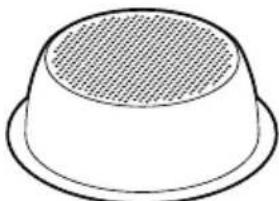
natural_image
Simple line drawing of a perforated metal bowl (no text or symbols)1 CUP 2 CUP
natural_image
Line drawing of a conical mechanical component with no text or symbols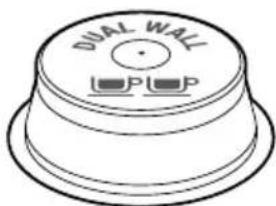
text_image
DUAL WALL P P1 CUP 2 CUP
natural_image
Two mechanical diagrams showing a presser pressing down on a component, with no text or symbols present.natural_image
Illustration of a hand operating a mechanical device with rotating arrows (no text or symbols)natural_image
Illustration of a hand pouring liquid into two glasses (no text or symbols)natural_image
Simple line drawing of a container with a lid and a hand holding a triangular object above it, emitting radiating lines (no text or symbols)RETIRER LA MOUTURE UTILISÉE
natural_image
Illustration of a hand pouring liquid from a funnel into two cups filled with dark liquid (no text or symbols)natural_image
Illustration of a hand pouring liquid into two glasses with dark liquid, no text or symbols presenttext_image
PRE-INFUSE SHOT GRIND SIZE 15 3 SEC MANUALPROGRAMMATION DE LA PRÉPARATION D'EXPRESSO
text_image
GRIND GRIND SIZE 15 DOUBLE 13.0sec HOT WATERnatural_image
Simple line drawing of a pipette dispensing liquid into a circular container (no text or symbols)natural_image
Diagram of a mechanical component with a downward arrow and circular base (no text or symbols)natural_image
Diagram of a mechanical component with an upward arrow, no visible text or symbolsRetirer la trémieDe
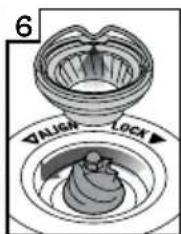
text_image
6 ALIGN LOCKtext_image
DAUGW LOCKnatural_image
Diagram of a mechanical component with a downward arrow, no visible text or symbolsnatural_image
Illustration of a hand pouring liquid into a glass with dark liquid (no text or symbols)flowchart
graph LR
    A["123.256.8"] --> B["5m mark"]
    B --> C["Water cleaning steps"]
    C --> D["Water cleaning device"]
    D --> E["Water cleaning device with drop"]
    E --> F["Water cleaning device with drop"]
    F --> G["Water cleaning device with drop"]
text_image
1 10 FLUSH IN PROGRESS SECnatural_image
Illustration of a conveyor belt filled with granular material, emitting particles (no text or symbols)natural_image
Diagram of a mechanical component with a downward arrow and circular base (no text or symbols)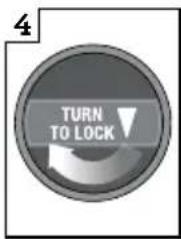
text_image
4 TURN TO LOCKnatural_image
Diagram of a mechanical device with an upward arrow and circular button (no text or symbols)Retirer la trémie
text_image
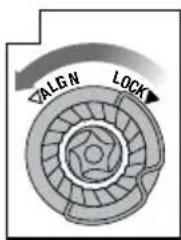
ALIGN LOCKnatural_image
Illustration of a toothbrush applying color to a mouth cavity (no text or symbols)natural_image
Cross-sectional diagram of a mechanical component with no visible text or symbolsnatural_image
Diagram of a mechanical component with an upward arrow, no visible text or symbolsRetirez la trémie
text_image
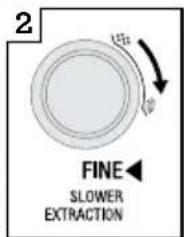
2 FINE SLOWER EXTRACTIONPROBLÈME CAUSES POSSIBLES SOLUTION
PROBLÈME CAUSES POSSIBLES SOLUTION
PROBLÈME CAUSES POSSIBLES SOLUTION
PROBLÈME CAUSES POSSIBLES SOLUTION
natural_image
Modern Sage brand coffee maker with digital display and control knobs (no visible text or symbols)NL SNELSTARTGIDS
Sage®

Inhoud
KENNISGEVING AAN KLANTEN OVER GEHEU- GENOPSLAG
text_image
A B C D E F G H I J K M N O P Q R Stext_image
Technical diagram showing exploded view of a device with labeled parts including a kettle, dome-shaped enclosures, and a remote control unit.ACCESSOIRES
natural_image
Line drawing of a hand using a blender to press a tray with an upward arrow (no text or symbols)natural_image
Line drawing of a mechanical device with a circular top component and a downward arrow indicating motion (no text or symbols)text_image
1 FLUSH IN PROGRESS 10 SEC GRIND AMOUNT MENU EXIT FILTER SIZE P P Pnatural_image
Two identical line drawings of a dome-shaped object with a mesh circular top, shown from different angles (no text or symbols)1 CUP 2 CUP
natural_image
Two identical 3D-rendered dome-shaped objects with 'Dual Wall' branding, shown from different angles (no text or symbols beyond branding)1 CUP 2 CUP
natural_image
Two schematic diagrams of mechanical components with downward arrows indicating force or movement (no text or symbols)natural_image
Illustration of a hand operating a device with rotating arrows indicating rotation (no text or symbols)natural_image
Illustration of a hand pouring liquid into two glasses with dark liquid, no text or symbols presentnatural_image
Illustration of a hand pouring liquid into a container with a black arrow indicating direction (no text or symbols)natural_image
Illustration of a hand pouring liquid from a bottle into two glasses (no text or symbols)natural_image
Illustration of a hand pouring liquid into two glasses with dark liquid, no text or symbols presenttext_image
GRIND SIZE 15 3 SEC PRE-INFUSE SHOT MANUALESPRESSOSHOT PROGRAMMEREN
text_image
GRIND GRIND SIZE 15 DOUBLE 13.0sec HOT WATERnatural_image
Simple line drawing of a pipette dispensing liquid into a circular container (no text or symbols)natural_image
Diagram of a mechanical component with a downward arrow, no visible text or symbolsnatural_image
Diagram of a mechanical device with an upward arrow and circular base (no text or symbols)natural_image
Diagram of a mechanical component with a downward arrow and circular base (no text or symbols)natural_image
Illustration of a hand pouring liquid into a glass with dark liquid, labeled '15' (no text or symbols on the diagram itself)flowchart
graph LR
    A["123/2 56"] --> B["5m mark"]
    B --> C["Water cleaning step"]
    C --> D[Water drop, brush, brush, brush, brush, brush, brush, brush, brush, brush, brush, brush, brush, brush, brush, brush, brush, brush, brush, brush, brush, brush, brush, brush, brush, brush, brush, brush, brush, brush, brush, brush, brush, brush, brush, brush, brush, brush, brush, brush, brush, brush, brush, brush, brush, brush, brush, brush, brush, brush, brush, brine.
text_image
1 10 FLUSH IN PROGRESS SECUW APPARAAT OPBERGEN
natural_image
Modern Sage brand coffee maker with digital display and control knobs (no visible text or symbols)IT GUIDA RAPIDA
Sage®

Sommario
text_image
A B C D E F G H I J K M N O P Q R Stext_image
Exploded view diagram of a portable electric heater with labeled parts including kettle, dome, and electrical plugACCESSORI
MACINATURA "HANDS-FREE"
natural_image
Line drawing of a hand using a blender to press a tray with an upward arrow (no text or symbols)text_image
Diagram showing a hand pouring liquid into a MAX device with a downward arrow indicating flow or reduction.
NOTA
natural_image
Line drawing of a mechanical device with a circular top component and a downward arrow indicating motion (no text or symbols)text_image
1 10 FLUSH IN PROGRESS SEC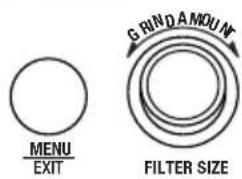
text_image
MENU EXIT G RIND A MOUNT FILTER SIZE
natural_image
Two identical 3D-rendered white objects with textured surfaces, no text or symbols present.1 TAZZA 2 TAZZE
natural_image
Two identical 3D-rendered dome-shaped objects with 'DUAL WALL' branding, shown from different angles (no text or symbols on the objects themselves)1 TAZZA 2 TAZZE
text_image
COARSE FINERDOSARE IL CAFFÈ
natural_image
Two mechanical assembly diagrams showing a presser pressing down on a component, with no visible text or symbols.natural_image
Illustration of a hand operating a device with rotating arrows indicating rotation (no text or symbols)natural_image
Illustration of a hand pouring liquid into two glasses (no text or symbols)natural_image
Simple line drawing of a container with a lid and a hand holding a tray, emitting a light beam (no text or symbols)RIMUOVERE IL CAFFÈ USATO
natural_image
Illustration of a hand pouring liquid into two glasses (no text or symbols)natural_image
Illustration of a hand pouring liquid into two glass cups filled with dark liquid, no text or symbols present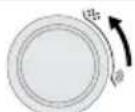
▶ COARSE
FASTER
EXTRACTION
text_image
GRIND SIZE 15 3 SEC PRE-INFUSE SHOT MANUALtext_image
GRIND GRIND SIZE 15 DOUBLE 13.0sec HOT WATERnatural_image
Simple line drawing of a pipette dispensing liquid into a circular container (no text or symbols)natural_image
Diagram of a mechanical component with a downward arrow indicating force or direction (no text or symbols)natural_image
Diagram of a mechanical component with an upward arrow and circular base (no text or symbols)text_image
8 FINE COARSE (in mm)text_image
10 FIN COURSE (in (8x50/6.9m)natural_image
Diagram of a mechanical component with a downward arrow and circular base (no text or symbols)natural_image
Illustration of a hand pouring liquid into a glass with dark liquid, labeled '15' (no text or symbols on the diagram itself)text_image
1 10 FLUSH IN PROGRESS SECnatural_image
Exterior view of a modern Bagna Baise mill console (no visible text or symbols)ES
GUÍA RÁPIDA
Sage®

Índice
text_image
A B C D E F G H I J K L M N O P Q R Stext_image
Technical diagram showing exploded view of a device with labeled parts including a kettle, dome-shaped enclosures, and a remote control unit.ACCESORIOS
natural_image
Line drawing of a hand holding a small container with an upward arrow, no text or symbols presenttext_image
Diagram showing a hand pouring liquid from a funnel into a washing machine labeled MAX and MIN, with a downward arrow indicating flow or process.
NOTA
natural_image
Line drawing of a laboratory instrument with a downward arrow indicating force or movement (no text or symbols present)natural_image
Simple line drawing of a dome-shaped object with a perforated top surface (no text or symbols)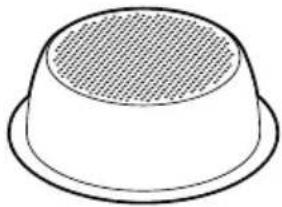
natural_image
Simple line drawing of a bowl-shaped object with a textured interior (no text or symbols)1 CUP 2 CUP
natural_image
Line drawing of a conical mechanical component with no text or symbols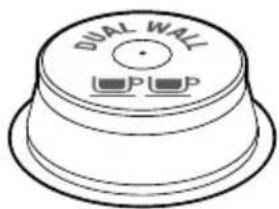
text_image
DUAL WALL1 CUP 2 CUP
text_image
COARSE FINERnatural_image
Two mechanical assembly diagrams showing a presser pressing down on a component, with no visible text or symbols.natural_image
Illustration of a hand operating a mechanical device with rotating arrows indicating rotation (no text or symbols)natural_image
Illustration of a hand pouring liquid into two glasses with dark liquid, no text or symbols presentnatural_image
Illustration of a hand pouring liquid into a container with a black arrow indicating direction (no text or symbols)ELIMINAR EL MARRO
text_image
Diagram of a robot with labeled control panel and sensor, showing a device with a fan and sensor components.ENJUAGA EL FILTRO
natural_image
Illustration of a hand pouring liquid from a bottle into two glasses (no text or symbols)natural_image
Illustration of a hand pouring liquid into two glasses with dark liquid, no text or symbols presenttext_image
15 SEC SHOTtext_image
PRE-INFUSE SHOT 3 SEC MANUALtext_image
GRIND GRIND DOUBLE HOT WATER 12.5secnatural_image
Simple line drawing of a pipette dispensing liquid into a circular container (no text or symbols)natural_image
Diagram of a mechanical component with an upward arrow, no visible text or symbolstext_image
7 FENO GRIESTOtext_image
8 RNO GRUES Onatural_image
Mechanical component diagram showing a downward arrow and a base with circular end (no text or symbols)natural_image
Illustration of a hand pouring liquid into a glass with dark liquid, labeled '15' (no text or symbols on the diagram itself)tu extracción

Cuidado y limpieza
flowchart
graph LR
    A["123/2 56/8"] --> B["5m mark"]
    B --> C[Water spray bottle with drop, water spray bottle with drop, water spray bottle with drop, water spray bottle with drop, water spray bottle with drop, water spray bottle with drop, water spray bottle with drop, water spray bottle with drop, water spray bottle with drop, water spray bottle with drop, water spray bottle with drop, water spray bottle with drop, water spray bottle with drop, water spray bottle with drop, water spray bottle with drop, water spray bottle with drop, water spray bottle with drop, water spray bottle with drops, water spray bottle with drops, water spray bottle with drops, water spray bottle with drops, water spray bottle with drops, water spray bottle with drops, water spray bottle with drops, water spray bottle with drops, water spray bottle with drops, water spray bottle with drops, water spray bottle with drops, water spray bottle with drops, water spray bottle with drops, water spray bottle with drops, water spray bottle with drops, water spray bottle with drops, water spray bottle with drops, water spray bottles (no text labels on diagram)
text_image
1 10 FLUSH IN PROGRESS SECnatural_image
Illustration of a dental tool applying material to a tooth (no text or symbols)natural_image
Cross-sectional diagram of a mechanical component with no visible text or symbolsPROBLEMA POSIBLES CAUSAS QUÉ HACER
PROBLEMA POSIBLES CAUSAS QUÉ HACER
PROBLEMA POSIBLES CAUSAS QUÉ HACER
PROBLEMA POSIBLES CAUSAS QUÉ HACER
natural_image
Modern Sapea coffee maker with digital display and control buttons (no visible text or symbols)PT
MANUAL RÁPIDO
Sage®

Índice
text_image
A B C D E F G H I J K L M N O P Q R Stext_image
Exploded view diagram of a portable electric heater with labeled parts including kettle, dome, and electrical plugACESSÓRIOS
- Jarra de leite de aço inoxidável Com marcas de MÁX. e MÍN.
- Cestos de filtro de parede dupla (1 chávena e 2 chávenas) Use com café pré-moído.
- Cestos de filtro de parede única (1 chávena e 2 chávenas) Use com grãos de café moídos no momento.
-
Filtro de água e suporte do filtro
-
Disco de limpeza
- Pastilhas de limpeza
- Pincel de limpeza
- Ferramenta de ajuste de dose de precisão Razor™
- Vaporizador e ferramenta de limpeza do cesto de filtro
Materiais sem BPA*

natural_image
Line drawing of a hand using a blender to press or install a tray, with an upward arrow indicating motion (no text or symbols)natural_image
Line drawing of a mechanical device with a downward arrow indicating force or adjustment (no text or symbols present)natural_image
Simple line drawing of a conical or dome-shaped object with a textured top surface (no text or symbols)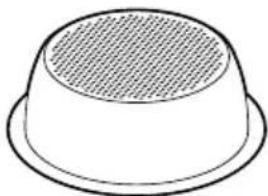
natural_image
Simple line drawing of a bowl with a textured lid (no text or symbols)natural_image
Line drawing of a conical lamp or cover with 'SUN WALK' and 'P' labels on the top (no additional text or symbols)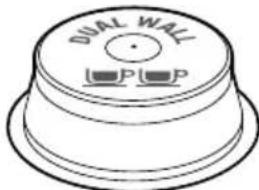
text_image
DUAL WALL P P2 CHÁVENAS1 CHÁVENA
A MOAGEM
natural_image
Two mechanical assembly diagrams showing a presser pressing a component with downward force arrows (no text or symbols)natural_image
Illustration of a hand pressing a button on a device with directional arrows indicating rotation (no text or symbols)natural_image
Illustration of a hand pouring liquid into two glasses with dark liquid, no text or symbols presentnatural_image
Simple line drawing of a container with a lid and a handle, emitting a beam of light (no text or symbols)REMOVA OS GRÃOS MOÍDOS
natural_image
Simple line drawing of a washing machine with a fan and sound waves (no text or symbols)ENXAGUE O CESTO DE FILTRO
natural_image
Illustration of a hand pouring liquid from a bottle into two glasses (no text or symbols)natural_image
Illustration of a hand pouring liquid into two glasses with dark liquid, no text or symbols presenttext_image
GRIND SIZE 15 3 SEC PRE-INFUSE SHOT MANUALPROGRAMAR UMA DOSE DE CAFÉ EXPRESSO
text_image
GRIND GRIND SIZE 15 DOUBLE 13.0sec HOT WATERnatural_image
Simple line drawing of a pipette stirring a circular object with concentric rings (no text or symbols)natural_image
Diagram of a mechanical component with a downward arrow indicating force or direction (no text or symbols)natural_image
Diagram of a mechanical component with an upward arrow, no text or symbols presenttext_image
7 FINE O COARSEtext_image
8 FINE COARSEtext_image
9 FINE COARSEtext_image
10 FINE COARSEnatural_image
Diagram of a mechanical component with a downward arrow and circular end (no text or symbols)natural_image
Illustration of a hand pouring liquid into a glass with dark liquid, labeled '15' (no text or symbols on the diagram itself)flowchart
graph TD
    A["1: Bottle with 5m mark"] --> B["2: Wash bottle with 5m mark"]
    B --> C["3: Down arrow, down arrow"]
    C --> D["4: Up arrow, up arrow"]
    D --> E["5: Down arrow, down arrow"]
    E --> F["6: Up arrow, down arrow"]
    F --> G["7: Down arrow, down arrow"]
text_image
1 10 FLUSH IN PROGRESS SECnatural_image
Diagram of a mechanical component with an upward arrow, no visible text or symbolsRemova o depósito
text_image
8 ▲ LOOK LOOK/INDesbloqueie a abertura de saída do café moído com o pin cel ou um limpador de tubos
natural_image
Diagram of a mechanical component with a central shaft and flange, no visible text or symbolswww.sageappliances.com
Registered in Germany No. HRB 81309 (AG Düsseldorf).
Registered in England & Wales No. 8223512.
- Due to continued product improvement, the products illustrated or photographed in this document may vary slightly from the actual product.
•Aufgrund kontinuierlicher Produktverbesserungen kann das auf dieser Verpackung dargestellte Produkt leicht vom tatsächlichen Produkt abweichen. - En raison de son amélioration continue, le produit représenté sur cet emballage peut différer légèrement du produit réel.
- Vanwege de voortdurende verbetering van de producten kunnen de producten die in dit document
worden geïllustreerd of gefotografeerd enigszins afwijken van het daadwerkelijke product. - A causa del continuo miglioramento dei prodotti, il prodotto illustrato su questa confezione può variare leggermente rispetto al prodotto reale.
- Perfeccionamos nuestros productos continuamente, por lo que el artículo podría diferir ligeramente de la ilustración o imagen en este documento.
- Devido à melhoria contínua dos produtos, os produtos ilustrados ou fotografados neste documento podem variar ligeiramente do produto real.
Copyright BRG Appliances 2019.