EasyManual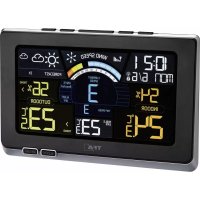
Spring Breeze 35.1140 - Weather Station TFA - Free user manual and instructions
Find the device manual for free Spring Breeze 35.1140 TFA in PDF.



User questions about Spring Breeze 35.1140 TFA
0 question about this device. Answer the ones you know or ask your own.
Ask a new question about this device
Download the instructions for your Weather Station in PDF format for free! Find your manual Spring Breeze 35.1140 - TFA and take your electronic device back in hand. On this page are published all the documents necessary for the use of your device. Spring Breeze 35.1140 by TFA.
USER MANUAL Spring Breeze 35.1140 TFA
SPRING BREEZE - Colour wireless weather station
- The base station and the power adapter must not come into contact with water or moisture. It should be operated in dry interiors.
- Do not use the device if the housing or the power adapter are damaged.
- Keep the device out of reach of persons (including children) who cannot fully appreciate the potential risks of handling electrical equipment.
- Unplug the device immediately if any fault occurs or if the device is not to be used for a long period of time.
- Please use only the supplied power adapter.
- Connect the lead to the base station first, then plug the power adapter into the mains socket.
- Do not pull the plug out of the mains socket by its lead.
- Route the power adapter lead so that it does not come into contact with sharp-edged or hot objects. Caution! Risk of injury:
- Keep these instruments and the batteries out of reach of children.
- Batteries must not be thrown into a fire, short-circuited, taken apart or recharged. Risk of explosion!
- Batteries contain harmful acids. Low batteries should be changed as soon as possible to prevent damage caused by leaking. Never use a combi- nation of old and new batteries together, nor batteries of different types. Wear chemical-resistant protective gloves and safety glasses when han- dling leaking batteries. Important information on product safety!
- Do not expose your device to extreme temperatures, vibrations or shocks.
- Protect it from moisture.
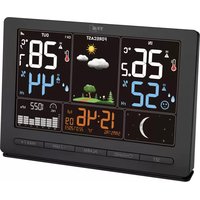
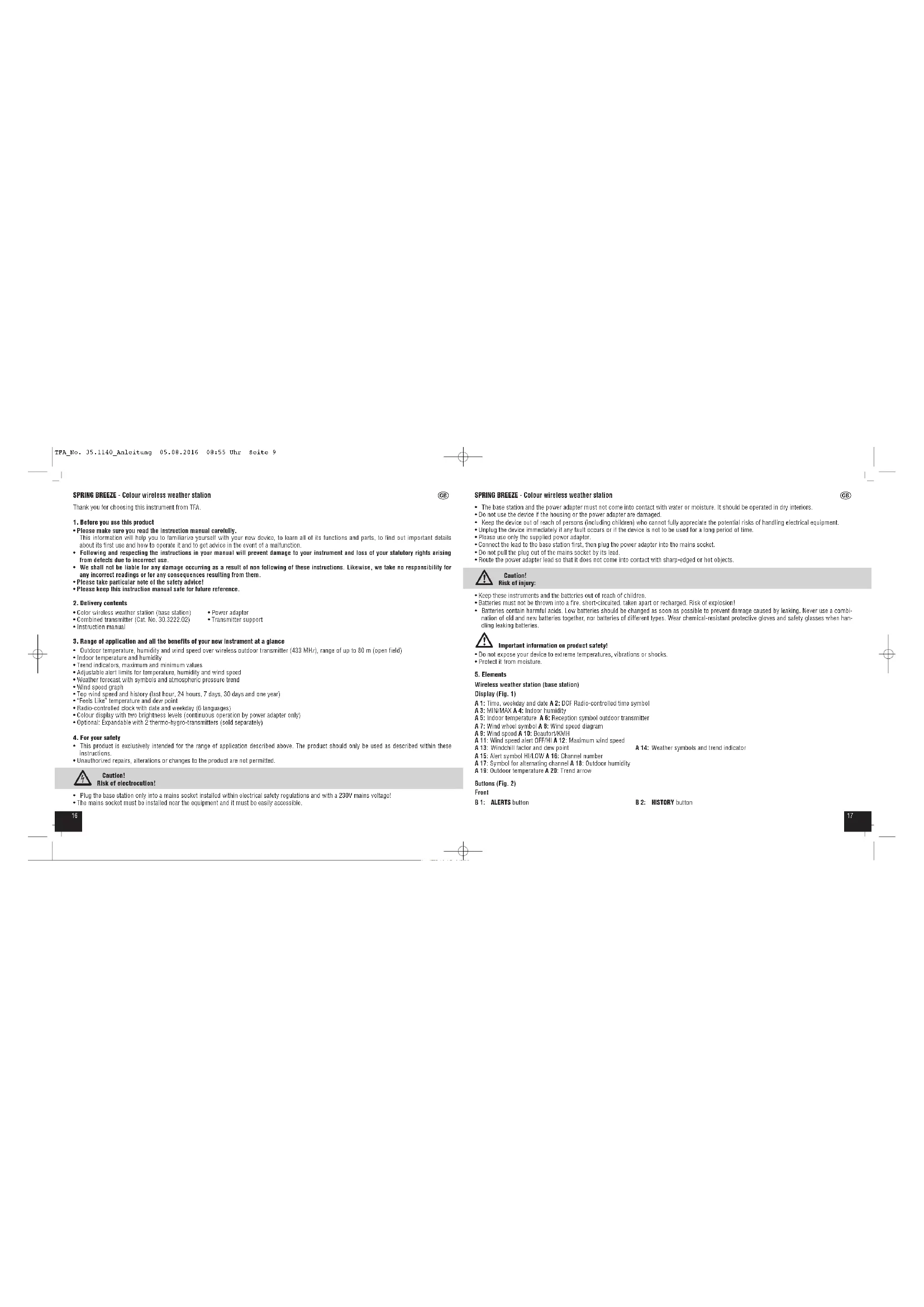
Wireless weather station (base station) Display (Fig. 1) A 1: Time, weekday and date A 2: DCF Radio-controlled time symbol A 3: MIN/MAX A 4: Indoor humidity A 5: Indoor temperature A 6: Reception symbol outdoor transmitter A 7: Wind wheel symbol A 8: Wind speed diagram A 9: Wind speed A 10: Beaufort/KMH A 11: Wind speed alert OFF/HI A 12: Maximum wind speed A 13: Windchill factor and dew point A 14: Weather symbols and trend indicator A 15: Alert symbol HI/LOW A 16: Channel number A 17: Symbol for alternating channel A 18: Outdoor humidity A 19: Outdoor temperature A 20: Trend arrow Buttons (Fig. 2) Front B 1: ALERTS button B 2: HISTORY button Thank you for choosing this instrument from TFA.
1. Before you use this product
- Please make sure you read the instruction manual carefully. This information will help you to familiarize yourself with your new device, to learn all of its functions and parts, to find out important details about its first use and how to operate it and to get advice in the event of a malfunction.
- Following and respecting the instructions in your manual will prevent damage to your instrument and loss of your statutory rights arising from defects due to incorrect use.
- We shall not be liable for any damage occurring as a result of non following of these instructions. Likewise, we take no responsibility for any incorrect readings or for any consequences resulting from them.
- Please take particular note of the safety advice!
- Please keep this instruction manual safe for future reference.
2. Delivery contents
- Color wireless weather station (base station) • Power adapter
- Combined transmitter (Cat. No. 30.3222.02) • Transmitter support
3. Range of application and all the benefits of your new instrument at a glance
- Outdoor temperature, humidity and wind speed over wireless outdoor transmitter (433 MHz), range of up to 80 m (open field)
- Indoor temperature and humidity
- Trend indicators, maximum and minimum values
- Adjustable alert limits for temperature, humidity and wind speed
- Weather forecast with symbols and atmospheric pressure trend
- Top wind speed and history (last hour, 24 hours, 7 days, 30 days and one year)
- “Feels Like” temperature and dew point
- Radio-controlled clock with date and weekday (6 languages)
- Colour display with two brightness levels (continuous operation by power adapter only)
- Optional: Expandable with 2 thermo-hygro-transmitters (sold separately)
- This product is exclusively intended for the range of application described above. The product should only be used as described within these instructions.
- Unauthorized repairs, alterations or changes to the product are not permitted. Caution! Risk of electrocution!
- Plug the base station only into a mains socket installed within electrical safety regulations and with a 230V mains voltage!
SPRING BREEZE - Colour wireless weather station
6.2 Reception of the DCF frequency signal
- After the reception of the outdoor values, the clock will now scan the DCF frequency signal and the DCF symbol will be flashing on the display.
- When the time code is successfully received after 3-10 minutes, the radio-controlled time and the DCF symbol will be shown steadily on the dis- play.
- The DCF reception always takes place at 2:00 and 3:00 o'clock in the morning. If the reception is not successfully received at 3:00 o'clock, further attempts will be held at 4:00 and 5:00 o'clock.
- You can also activate the DCF reception manually.
- Press the TIME SET button.
- The DCF reception symbol will be flashing.
- There are three different reception symbols: flashing - reception is active solid - reception is very good no symbol - No DCF reception
- By default, the DCF reception is activated and after successful reception of the DCF signal no manual adjustment is necessary.
- If the clock cannot detect the DCF-signal (e.g. due to interference, transmitting distance, etc.), the time can be set manually.
- The clock will then work as a normal quartz clock. (see: Manual settings).
6.2.1 Radio-controlled time reception
The time base for the radio-controlled time is a caesium atomic clock operated by the Physikalisch Technische Bundesanstalt based in Braun- schweig (Brunswick), Germany. It has a time deviation of less than one second in one million years. The time is coded and transmitted from Main- flingen near Frankfurt via the frequency signal DCF-77 (77.5 kHz) and has a transmitting range of approximately 1,500 km. The adjustment to Day- light Saving Time (summer/winter time) is automatic. In Daylight Saving Time "S” is shown on the display. The reception quality depends mainly on geographic location. Normally there should be no reception problems within a 1,500 km radius around Frankfurt. Therefore, please note the following steps:
- The recommended distance to any interfering sources like computer screens or TV sets is at least 1.5 - 2 meters.
- Within concrete walls (reinforced with steel) such as basements, the received signal is naturally weakened. In extreme cases, please place the unit close to a window to improve reception.
- During night-time, the atmospheric interference is usually less severe and reception is possible in most cases. A single daily reception is ade- quate to keep the accuracy deviation under 1 second.
6.3 Inserting the batteries in the base station
- The batteries will operate as a backup power source in case of power failure.
- For a permanent backlight and to conserve battery power, use the included supplied power adapter.
- Open the battery compartment at the back of the base station.
- Insert three new batteries AAA 1,5 V into the battery compartment. Make sure the polarity is correct.
- Close the battery compartment again.
- Attention: Backlight in continuous operation only works with power adapter.
- Default for the backlight is HI. Top B 3: ▼ button B 4: TIME SET button B 5: LIGHT (HI – LOW - OFF) button B 6: HEAT/DEW button B 7: ▲ button Housing (Fig. 2) C 1: Wall mount holes C 2: Battery compartment C 3: Stand (fold out) C 4: Power adapter jack C 5: Guide for the cable Combined transmitter (Fig. 3) D 1: LED signal lamp D 2: Battery compartment D 3: Hole for the attachment on a mast or on the delivered support D 4: 2 screws for fixing Support (Fig. 3) D 5: Fixing screw D 6: Supporting arm (90° rotatable) D 7: 4 screw holes for mounting
- Place the base station and the transmitter on a table at a distance of about 1.5 meters from each other. Avoid being close to possible sources of interference such as electronic devices and radio equipment.
- Remove the protective film from the base station display.
- Connect the attached power adapter to the base station. Insert the adapter into the base station jack and connect the power adapter into a mains socket. Important! Make sure that your household voltage is 230V! Otherwise your device may be damaged.
- The device will alert you with a beep and all segments will be displayed for a short moment.
- The indoor temperature and humidity appear on the left side of the base station display.
6.1 Inserting the batteries in the outdoor transmitter/Reception of outdoor values
- Unscrew the battery compartment cover of the transmitter if appropriate (supplied unassembled).
- Insert two new batteries 1,5 V C into the outdoor transmitter's battery compartment. Make sure the polarity is correct.
- Insert the batteries with the negative pole first in the holder and push the contact spring together. Attention: Do not bend the spring!
- Carefully screw the transmittter's battery compartment cover back in place.
- After the batteries are inserted, the outdoor values will be transmitted to the base station.
- As soon as the base station receives the outdoor values, the outdoor temperature, humidity and wind speed are permanently shown.
- If the reception of the outdoor values fails within three minutes, "- -" appears on the display. Check the batteries and try it again. Check if there is any source of interference.
- You can also activate the reception manually. Press and hold the ▼ button on the base station for two seconds. The reception symbol for the out- door transmitter will be flashing. The registered transmitter (channel) will be canceled. TFA_No. 35.1140_Anleitung 05.08.2016 08:55 Uhr Seite 102120 SPRING BREEZE - Colour wireless weather station
SPRING BREEZE - Colour wireless weather station
- In the setting mode you can change between °C (Celsius) or °F (Fahrenheit) as temperature unit.
- Press the ▲ or ▼button.
- Confirm the setting with the TIME SET button.
7.1.6 Setting of the day-of-week language
- In the setting mode choose the day-of-the-week language.
- Press the ▲ or ▼ button.
- In the display appears: German - GER, English - ENG, French - FRE, Italian - ITA, Spanish - ESP and Dutch - NET.
- Confirm the setting with the TIME SET button.
7.2 Temperature and humidity
- MAX appears on the display.
- You can now get the indoor and outdoor highest values for the temperature and humidity displayed since the last reset.
- Press the ▲ button again.
- MIN appears on the display.
- You can now get the indoor and outdoor lowest values for the temperature and humidity displayed since the last reset.
- Press the ▲ button once more, to go back to the current values display.
- The device will automatically quit the MAX/MIN mode if no button is pressed.
- Press and hold the ▲ button for 3 seconds while the maximum or minimum values are displayed to clear the recorded maximum readings.
- The maximum and minimum values are automatically reset at midnight.
- The trend arrows indicate whether the values for outdoor temperature and humidity are currently increasing, steady or decreasing.
- The wind wheel symbol is animated and moves according to the wind speed.
- The coloured diagram shows the current wind speed in different colour sections.
- The current wind speed (CURRENT SPEED) is indicated in the selected unit (Beaufort or KM/H). Hold and press the HEAT/DEW button for 3 seconds to change between Beaufort and KMH.
- The maximum wind speed covers the last hour. Press the HISTORY button to display sequentially the value of the last 24 hours, 7 days, 30 days and the last year with time and date of recording.
- Press LIGHT (HI – LOW - OFF) button once (LOW) to dim the backlight.
- Press LIGHT (HI – LOW - OFF) button once more (OFF) to turn off the backlight.
- The backlight is deactivated.
- To temporarily activate the backlight, press any button (in battery operation only).
- During the operation, all successful settings will be confirmed by a brief beep tone.
- The device will automatically quit the setting mode if no button is pressed for a few seconds.
- Press and hold the ▲ or ▼ button in the setting mode for fast mode.
- Press and hold the TIME SET button in normal mode for three seconds, to enter the setting mode.
- Beep (ON=default) flashes on the display.
- Press the ▲ or ▼ button to activate or deactivate the key tone.
- Press the TIME SET button again to do the settings in the following sequence: the radio signal reception (RCC ON - default), time zone (0H - default), the 12 or 24 hours system (24H - default), the hours, the minutes, the year, the month and the day, the wind speed unit (BFT - default), the temperature unit (°C - default) and the day-of-the-week language (GER - default). Press the ▲ or ▼ button to adjust it.
- Confirm the setting with the TIME SET button.
- Once the DCF time signal is successfully received, the manually set time is overwritten, if the DCF reception is activated.
- By default, the DCF reception is activated (RCC on) and after successful reception of the DCF signal no manual adjustment is necessary.
- In the setting mode, press the ▲ or ▼ button if you want to deactivate the DCF reception (OFF).
- Confirm the setting with the TIME SET button.
7.1.2 Time zone setting
- In the setting mode, press the ▲ or ▼ button to make the time zone correction (-12/+12).
- The time zone correction is needed for countries where the DCF signal can be received but the time zone is different from the DCF time (e.g. +1=one hour plus).
- Confirm the setting with the TIME SET button.
7.1.3 Setting of the 24- or 12 hour system
- In the setting mode you can choose between the 12 - or 24 hour system.
- Press the ▲ or ▼ button.
- In 12 HR system AM (before noon) or PM (after noon) appears on the display.
- Confirm the setting with the TIME SET button.
7.1.4 Setting of the wind speed unit
- In the setting mode you can choose between BFT (Beaufort) or km/h (Kilometer per hour) as wind speed unit.
SPRING BREEZE - Colour wireless weather station
7.6.1 Activate and deactivate alerts
- Press the ▲ button to activate the alert function.
- HI will be displayed next to the wind speed alert value.
- Press the ▲ button to deactivate the alert function.
- OFF will be displayed next to the wind speed alert value.
- Press the ALERTS button to navigate to further alert functions and activate or deactivate them with the ▲ or ▼ button.
- The alert symbol appears or disappears next to the upper and lower limits (HI/LOW) of the temperature and humidity values.
- Press the ALERTS button to return to normal mode.
7.6.2 In case of alert
- In case of an alert, the corresponding value will be flashing and an alert tone will sound.
- Stop the alert tone with any button.
8. Base station positioning
- With the foldable leg at the back, the base station can be placed onto any flat surface.
- With the wall mount holes at the back, the base station can be wall mounted at the respective location. Avoid the vicinity of any source of interfer- ence such as computer screens, TV sets or solid metal objects.
8.1 Combined transmitter installation
- We recommend testing the reception before permanently mounting the transmitter.
- Also make sure that the transmitter is easily accessible for cleaning and maintenance. The outdoor transmitter should be cleaned from time to time, since dirt and debris will affect the sensor's accuracy.
- Make sure that the wind can blow freely around the anemometer and is not blocked by nearby buildings, trees or any other objects.
- For best results, place the combined transmitter horizontally and at least 3 m above any other objects. The ground below the device creates fric- tion for the wind and will thus impair the measurements.
- Try to install the combined transmitter so that it will be exposed to the normal wind conditions in your area.
- Attach the combined sensor to a mast with the hole at the bottom of the device.
- Use the supplied support when installing the transmitter on a surface. The support arm may be rotated by 90°. Open the fixing screw and loosen the support arm. Turn it by 90°, put it back on the bracket and tighten the fixing screw again.
8.2 Additional outdoor transmitters (optional) Cat.-No. 30.3221.02
- When having more than one external transmitter, select a different channel for each one by the CH 1/2/3 switch inside the transmitter's battery compartment. Insert two new 1,5 V AAA batteries, polarity as illustrated. Start the base station operation or the manual search for the outdoor transmitter.
- Please note that the combined transmitter is always operated on channel 1.
- Press ▼ button to adjust the respective channel.
- Press and hold the ▼ button on the base station for two seconds. The registered transmitter (channel) will be canceled.
- Press the TX button in the corresponding transmitter's battery compartment. The transmission of the outdoor data takes place immediately and a successful reception will be confirmed by a beep tone of the base station.
- Press the HEAT/DEW button, to show the current dew point.
- On the display appears DEW and the dew point temperature.
- The display automatically switches back to the current display of “FEELS LIKE” temperature.
- This interdependency of temperature and relative humidity is expressed by means of the dew-point: If the air is cooled continuously at constant absolute humidity, then the relative humidity will steadily increase up to a maximum of 100%. If the air is cooled further, then the excess water vapour is separated out in the form of water droplets.
7.5 Weather forecast symbols
- The weather station has six different weather symbols (sunny, slightly cloudy, cloudy, rainy, stormy and snow).
- The weather forecast covers a range of 12 hours and indicates only a general weather trend. For example, if the current weather is cloudy and the rain symbol is displayed, it does not mean the product is faulty because it is not raining. It simply means that the air pressure has dropped and the weather is expected to get worse but not necessarily rain.
- The sun symbol also appears on a starry night. Note!
- Please note that the forecast symbol will become more defined in the course of operation. The forecast symbol is active right from the start, how- ever, the reliability of the forecasts increases with the amount of data collected. To begin with, the sensor must adapt initially to the reference level at the site.
7.6 Setting of the alerts for wind speed, temperature and humidity
- Make sure that the channel 1 is selected (change channel with the ▼ button).
- Confirm with the ALERTS button.
- HI is displayed and 99% (default) or the last adjusted upper outdoor humidity limit flashes on the display.
- Press the ▲ or ▼ button to set the desired upper limit.
- Confirm with the ALERTS button.
- LOW is displayed and 1% (default) or the last adjusted lower outdoor humidity limit flashes on the display.
- Press the ▲ or ▼ button to set the desired lower limit.
- Confirm with the ALERTS button.
- HI is displayed and 60°C (default) or the last adjusted upper outdoor temperature limit flashes on the display.
- Press the ▲ or ▼ button to set the desired upper limit.
- Confirm with the ALERTS button.
- LOW is displayed and -40°C (default) or the last adjusted lower outdoor temperature limit flashes on the display.
- Press the ▲ or ▼ button to set the desired lower limit.
- Confirm with the ALERTS button.
SPRING BREEZE - Colour wireless weather station
This product has been manufactured using high-grade materials and components which can be recycled and reused. Never dispose of empty batteries and rechargeable batteries with ordinary household waste. As a consumer, you are required by law to take them to your retail store or to an appropriate collection site depending on national or local regulations in order to protect the environment The symbols for the contained heavy metals are: Cd = cadmium, Hg = mercury, Pb = lead This product is labelled in accordance with the EU Waste Electrical and Electronic Equipment Directive (WEEE). Please do not dispose of this product in ordinary household waste. As a consumer, you are required to take end-of-life devices to a designated collection point for the disposal of electrical and electronic equipment, in order to ensure environmentally-compatible dis- posal.
- The outdoor values and the channel number will be shown on the base station display. If you have installed more than one outdoor transmitter, press the ▼ button on the base station to change between the channels 1 to 3.
- You can also choose an alternating channel display. Press the ▼button. After the last registered channel (1 to 3) a circle symbol will appear. To deactivate the function press the ▼ button again.
- After successful installation close the outdoor transmitter's battery compartment carefully.
9. Care and maintenance
- Clean the device with a soft damp cloth. Do not use solvents or scouring agents.
- Make sure that the wind cups can spin freely and are free from dirt, debris or spider webs.
- Remove the batteries and unplug the power adapter from the mains socket if the device will not be used for a long period of time.
9.1 Battery replacement
- Change the outdoor transmitter's batteries when the battery symbol appears on the outdoor values display.
- Change the base station batteries when the battery symbol appears on indoor values display.
- Please note: When the batteries are changed, the contact between the outdoor transmitter and the base station must be restored – so always insert new batteries into both devices or start a manual transmitter search.
Problem Solution No indication on the base station: Operation with power adapter ➜ Connect the base station to the power adapter ➜ Activate backlight permanently ➜ Control the power adapter Battery operation ➜ Ensure the batteries' polarity are correct ➜ Press any button to activate the backlight briefly ➜ Change the batteries No reception of the outdoor transmitter ➜ No outdoor transmitter is installed Display "---" ➜ Check the external transmitter's batteries (do not use rechargeable batteries!) ➜ Restart the transmitter and the base station according to the manual ➜ Start the outdoor transmitter manual search according to the manual ➜ Choose another place for the outdoor transmitter and/or the base station ➜ Reduce the distance between the outdoor transmitter and the base station ➜ Check if there is any source of interference No FEELS LIKE value ➜ Change to channel 1 Incorrect indication ➜ Change the batteries TFA_No. 35.1140_Anleitung 05.08.2016 08:55 Uhr Seite 132726 SPRING BREEZE - Colour wireless weather station
- Amarillo = 20-30 KMH