EasyManual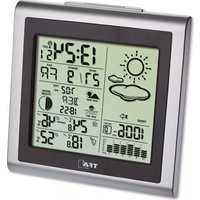
35.1145 - Weather Station TFA - Free user manual and instructions
Find the device manual for free 35.1145 TFA in PDF.



User questions about 35.1145 TFA
0 question about this device. Answer the ones you know or ask your own.
Ask a new question about this device
Download the instructions for your Weather Station in PDF format for free! Find your manual 35.1145 - TFA and take your electronic device back in hand. On this page are published all the documents necessary for the use of your device. 35.1145 by TFA.
USER MANUAL 35.1145 TFA
Thank you for choosing this instrument from TFA.
1. Before you use this product
- Please make sure you read the instruction manual carefully. This information will help you to familiarize yourself with your new device, to learn all of its functions and parts, to find out important details about its first use and how to operate it and to get advice in the event of a malfunction.
- Following and respecting the instructions in your manual will prevent damage to your instru- ment and loss of your statutory rights arising from defects due to incorrect use.
- We shall not be liable for any damage occurring as a result of non following of these instruc- tions.
- Likewise, we take no responsibility for any incorrect readings or for any consequences resulting from them.
- Please take particular note of the safety advice!
- Please keep this instruction manual safe for future reference.
2. Delivery contents
- Wireless weather station
3. Range of application and all the benefits of your new instrument at a glance
- Outdoor temperature and humidity wireless (433 MHz), distance range up to 100 m (open field)
- Expandable up to 3 outdoor transmitters, also for the climate control of remote rooms, e.g. chil- dren's room, wine-cellar etc.
- Indoor temperature and humidity
- Trend indicators and maximum/ minimum values
- Weather forecast with symbols and atmospheric pressure trend
- Absolute or relative atmospheric pressure
- Bar graph indication and history of the last 12 hours
- Radio-controlled clock with date and weekday
- Two different alarm times and snooze-function
- This product is exclusively intended for the range of application described above. It should only be used as described within these instructions.
- Unauthorized repairs, alterations or changes to the product are prohibited. Caution! Risk of injury:
- Keep these devices and the batteries out of reach of children.
- Batteries contain harmful acids and may be hazardous if swallowed. If a battery is swallowed, this can lead to serious internal burns and death within two hours. If you suspect a battery could have been swallowed or otherwise caught in the body, seek medical help immediately.
- Batteries must not be thrown into a fire, short-circuited, taken apart or recharged. Risk of explo- sion!
- Low batteries should be changed as soon as possible to prevent damage caused by leaking. Never use a combination of old and new batteries together, nor batteries of different types.
- Wear chemical-resistant protective gloves and safety glasses when handling leaking batteries. Important information on product safety!
- Do not expose the devices to extreme temperatures, vibrations or shocks.
- Protect it from moisture.
- The transmitter is splashproof, but not watertight. When placed outdoors, choose a shady and dry place for the transmitter. LARGO – Wireless weather station
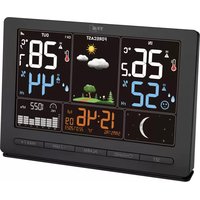
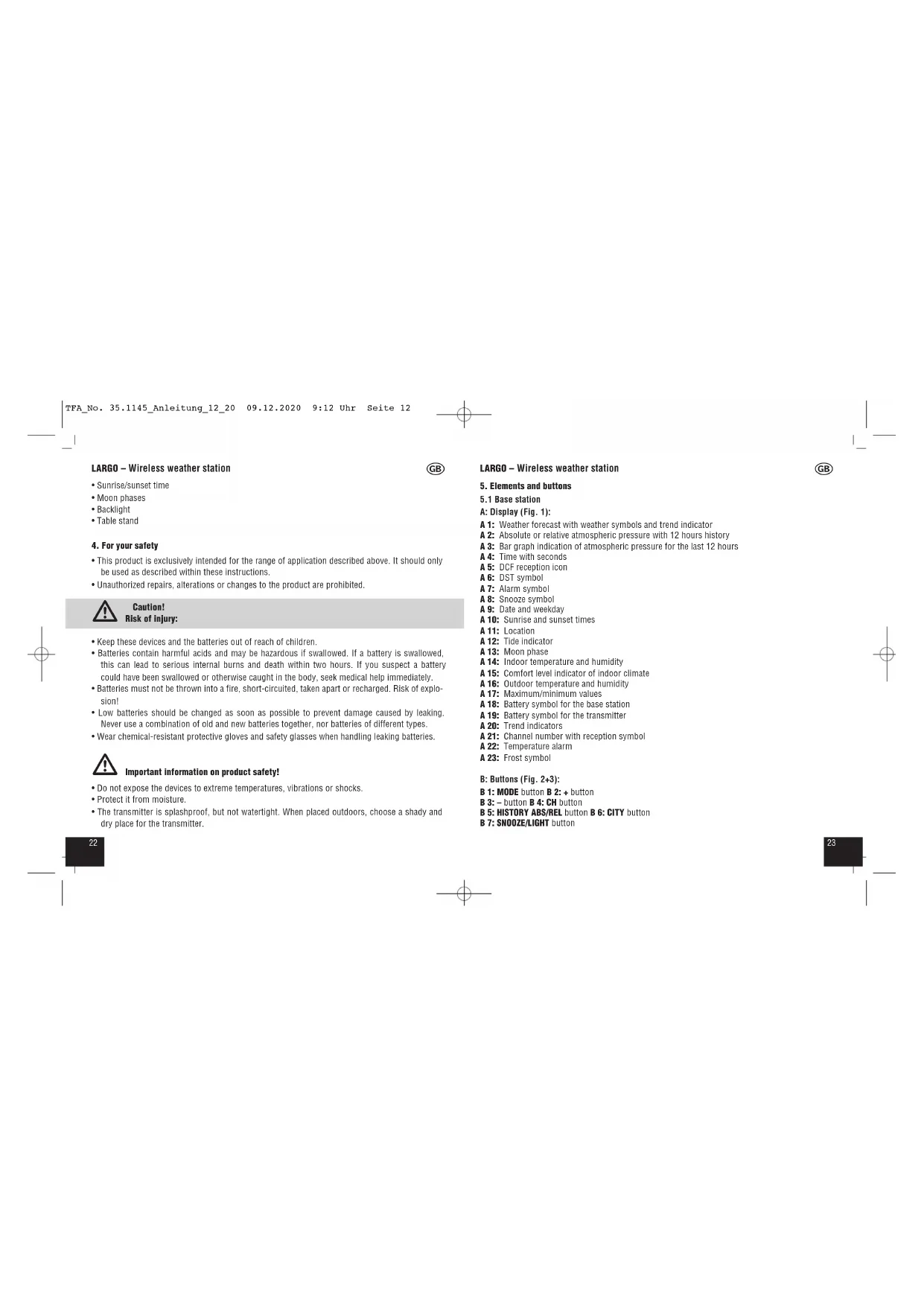
A: Display (Fig. 1): A 1: Weather forecast with weather symbols and trend indicator A 2: Absolute or relative atmospheric pressure with 12 hours history A 3: Bar graph indication of atmospheric pressure for the last 12 hours A 4: Time with seconds A 5: DCF reception icon A 6: DST symbol A 7: Alarm symbol A 8: Snooze symbol A 9: Date and weekday A 10: Sunrise and sunset times A 11: Location A 12: Tide indicator A 13: Moon phase A 14: Indoor temperature and humidity A 15: Comfort level indicator of indoor climate A 16: Outdoor temperature and humidity A 17: Maximum/minimum values A 18: Battery symbol for the base station A 19: Battery symbol for the transmitter A 20: Trend indicators A 21: Channel number with reception symbol A 22: Temperature alarm A 23: Frost symbol B: Buttons (Fig. 2+3): B 1: MODE button B 2: + button B 3: – button B 4: CH button B 5: HISTORY ABS/REL button B 6: CITY button B 7: SNOOZE/LIGHT button TFA_No. 35.1145_Anleitung_12_20 09.12.2020 9:12 Uhr Seite 122524 LARGO – Wireless weather station
C: Housing (Fig. 2): C 1: Battery compartment C 2: Stand
5.2 Transmitter (Fig. 3):
D 1: LED signal lamp D 2: Wall mounting hole D 3: Battery compartment D 4: Channel switch 1, 2, 3 D 5: TX button
- Place the base station and the transmitter on a table at a distance of about 1.5 meters from each other. Avoid being close to possible sources of interference such as electronic devices and radio equipment.
- Open the transmitter's battery compartment.
- Insert two new AA 1,5 V batteries, polarity as illustrated.
- Close the battery compartment carefully.
- Open the base station battery compartment and insert three new AA 1.5V batteries. Make sure the polarity is correct. The device will alert you with a beep and all segments will be displayed for a short moment. Close the battery compartment again.
- The indoor temperature and humidity appear on the base station display.
The base station will scan the outdoor values of the transmitter. The reception symbol flashes. If the reception is successful, the outdoor temperature and humidity appear on the base station display.
- If the reception of the outdoor values fails, “- -” appears on the base station display. Check the batteries and try it again. Check if there is any source of interference.
- As soon as the base station receives the radio-controlled time, you can start the manual initial- ization of the transmitter. Press and hold the CH button on the base station for two seconds. The registered transmitter (channel) will be canceled.
- Press the TX button in the transmitter's battery compartment. The transmission of the outdoor data takes place immediately and a successful reception will be confirmed by a beep tone of the base station. LARGO – Wireless weather station
6.3 Radio-controlled time reception
- Three minutes after the base station has completed the search for the transmitter, the device starts scanning the DCF signal (radio signal) and the DCF reception symbol flashes.
- When the time code is successfully received after 3-12 minutes, the radio-controlled time, the date and the DCF symbol will be shown steadily on the display.
- You can also start the initialization manually.
- Press and hold the + and – button at the same time.
- The DCF reception symbol will be flashing.
- The DCF reception always takes place hourly between 1:00 and 5:00 o'clock in the morning. If the reception is not successfully received until 5:00 o'clock, the next DCF reception attempt will happen at 1:00 o'clock in the following morning.
- If the clock cannot detect the DCF-signal (e.g. due to interference, transmitting distance, etc.), the time can be set manually. The DCF reception symbol disappears and the clock will then work as a normal quartz clock (see: Manual settings).
- There are 4 different reception symbols: Radio waves are flashing - reception is active Radio waves stop flashing - reception is successful Transmission tower - no DCF reception No symbol - time is set manually
6.4 Note on radio-controlled time
The time base for the radio-controlled time is a caesium atomic clock operated by the Physikalisch Technische Bundesanstalt based in Braunschweig (Brunswick), Germany. It has a time deviation of less than one second in one million years. The time is coded and transmitted from Mainflingen near Frankfurt via the frequency signal DCF-77 (77.5 kHz) and has a transmitting range of approximately 1,500 km. The adjustment to Daylight Saving Time (summer/winter time) is automatic. In Daylight Saving Time DST is shown on the display. The reception quality depends mainly on geographic loca- tion. Normally there should be no reception problems within a 1,500 km radius around Frankfurt. Therefore, please note the following steps:
- The recommended distance to any interfering sources like computer screens or TV sets is at least
- Within concrete walls (reinforced with steel) such as basements, the received signal is naturally weakened. In extreme cases, please place the unit close to a window to improve reception.
- During night-time, the atmospheric interference is usually less severe and reception is possible in most cases. A single daily reception is adequate to keep the accuracy deviation under 1 second.
- Press and hold the + or – button in setting mode for fast mode.
- The device will automatically quit the setting mode if no button is pressed for 15 seconds.
- Press and hold the MODE button for 3 seconds. 24 Hr (default) appears on the display. Press the + or – button in the setting mode to choose the 12 HR or 24 HR system. Press the MODE button to make the settings in the following sequence: the temperature unit (default: °C), the atmospheric pressure unit (default: hpa), the time zone (default: 00), the hours, the minutes, the year, the month, the day and the language of the day of the week (default: GE). Press + or – but- ton to adjust the settings.
- Confirm the setting with the MODE button.
- The manually set time is overwritten once the DCF time signal is successfully received.
7.1.1 12/24-hour display setting
- You can choose between the 12 - or 24 hour system in setting mode.
- In the 12-HR system AM (before noon) or PM (after noon) appears on the display.
7.1.2 Temperature unit setting
- You can change between °C (Celsius) or °F (Fahrenheit) as temperature unit in setting mode.
7.1.3 Atmospheric pressure unit setting
- You can change between hpa or inHg as atmospheric pressure unit in setting mode
7.1.4 Time zone setting for DCF time
- You can make the time zone correction (+2/-2) in setting mode. LARGO – Wireless weather station
- The time zone correction is needed for countries where the DCF signal can be received but the time zone is different from the DCF time (e.g. +1=one hour plus).
7.1.5 Day-of-the week language
- You can set the day-of-the week language in setting mode : German (GE), English (EN), Italian (IT), French (FR) and Spanish (SP)
- Press the SNOOZE/LIGHT button to activate the backlight for 5 seconds.
- Press the MODE button in normal mode, to enter the alarm mode 1.
- Press the + or – button to adjust the hours.
- Confirm the setting with the MODE button and set the minutes in the same way.
- Press the MODE button again.
- The display shows the current time.
- Press the MODE button twice in normal mode, to enter the alarm mode 2.
- Set the alarm time for the second alarm (A2) in the same way as the first alarm time.
- To activate/deactivate the respective alarm function, press the + button.
- The respective alarm symbol appears/disappears.
- When the adjusted alarm time is reached, the alarm rings.
- The alarm symbol flashes.
- If the alarm is not stopped manually, the alarm tone automatically turns off after two minutes and will be reactivated at the same set time in the following day.
- Press any button (except SNOOZE/LIGHT) and the alarm will stop.
- Press the SNOOZE/LIGHT button to activate the snooze function.
- Once the snooze function is activated, Zz will be flashing on the display.
10. Temperature and humidity
- MAX appears on the display.
- You can now get the indoor and outdoor highest values for the temperature and humidity dis- played since the last reset.
- Press the + button again.
- MIN appears on the display.
- You can now get the indoor and outdoor lowest values for the temperature and humidity dis- played since the last reset.
- Press the + button once more, to go back to the current values display.
- To clear the recorded maximum or minimum readings manually, press and hold the + button for two seconds while the maximum or minimum values are displayed.
- The trend arrows indicate whether the values for temperature and humidity are currently increasing, steady or decreasing.
- The indication of the indoor climate comfort levels are displayed as follows: Display Measuring range - temperature Measuring range - humidity DRY < 39% RH
COMFORT 20 °C… 28 °C 40% RH…70% RH
WET > 70% RH No indication <20°C, >28°C 40%RH…70%RH
11. Outdoor temperature alarm
11.1 Alarm limits setting
- Choose the respective transmitter by pressing the CH button.
- Press and hold the – button in normal mode. LARGO – Wireless weather station
- is displayed and 70°C (default) or the last adjusted upper outdoor temperature limit flashes on the display.
- Press the + or – button to set the desired upper limit.
- Confirm with the MODE button.
- is displayed and -50°C (default) or the last adjusted lower outdoor temperature limit flashes on the display.
- Press the + or – button to set the desired lower limit.
- Confirm with the MODE button.
- In case of an alert, the corresponding symbol will be flashing and an alert will sound every minute.
- Press the SNOOZE/LIGHT button to stop the alarm.
- The temperature display will continue flashing until the measured temperature is inside the alarm limits.
- On the display appears the symbol for frost , when the outdoor transmitter shows an out- door temperature between -1°C...3°C.
11.3 Activate and deactivate the temperature and frost alarm
- The weather forecast covers a range of 12 hours and indicates only a general weather trend. For example, if the current weather is cloudy and the rain symbol is displayed, it does not mean the product is faulty because it is not raining. It simply means that the air pressure has dropped and the weather is expected to get worse but not necessarily rain. The accuracy is about 70 %.
- The sun symbol also appears on a starry night. Note:
- Please note that the forecast symbol will become more defined in the course of operation. The forecast symbol is active right from the start, however, the reliability of the forecasts increases with the amount of data collected.
- Press the + or – button to select the absolute (“Abs”) or relative (“Rel”) pressure display.
- Confirm with the HISTORY ABS/REL button.
- If you have chosen the relative atmospheric pressure (recommended), the pressure value flashes. Now enter the value by pressing the + or – button.
- The relative atmospheric pressure is referred to the sea level’s pressure and has to be adjusted first to your local altitude. Ask for the present atmospheric pressure of your home area (Local weather service, Internet, optician, calibrated instruments in public buildings and airport).
- The trend arrows on the display will show whether the atmospheric pressure is increasing, steady or decreasing.
13.2 Developing of atmospheric pressure
- The bar graph indication of atmospheric pressure shows the last 12 hours. LARGO – Wireless weather station
- Press CITY button in normal mode to enter the setting mode.
- The city code will start flashing. Use the + or – button to select the city.
- It can be chosen from among 160 cities. See the city list at the end of this manual.
- Confirm the setting with the CITY button.
14.1.2 Manual location setting
- Press and hold the CITY button to insert an individual location.
- “-- -- --” appear and “--” flashes.
- Set the first letter of your location with the + or – button.
- Confirm with the CITY button. Set the second and third letter in the same way.
- Press the CITY button to set the time zone (default: 1:00), the longitude (E = East) and the lati- tude (N = North). Press the + or – button to adjust the settings.
- Confirm the setting with the CITY button.
14.1.3 Time zone setting for the sunrise/sunset time
- In setting mode, press the + or - button to make the time zone correction to the GMT (Green- wich Mean Time).
- In case of radio-controlled time reception DCF: 1:00 (default)
15. Additional outdoor transmitters
- When having more than one external transmitter, select a different channel for each one with the CH 1/2/3 switch inside the transmitter's battery compartment. Insert two new AA 1,5 V batteries, polarity as illustrated. Start the base station operation or the manual search for the outdoor transmitter.
- Choose the respective transmitter by pressing the CH button.
- Press and hold the CH button on the base station for two seconds. The last registered transmit- ter (channel) will be canceled.
- Press the TX button in the corresponding transmitter's battery compartment. The transmission of the outdoor data takes place immediately and a successful reception will be confirmed by a beep tone of the base station.
- The outdoor values and the channel number will be shown on the base station display. If you have installed more than one outdoor transmitter, press the CH button on the base station to change between the channels 1 to 3.
- You can also choose an alternating channel display. Press CH button. After the last registered channel (1 to 3) a circle symbol will appear. To deactivate the function press the CH button again.
- After a successful installation close the outdoor transmitter's battery compartment carefully.
16. Positioning and mounting of the base station and the transmitter
- Place the base station at your chosen location. Avoid the vicinity of any source of interference such as computer screens, TV sets or solid metal objects. LARGO – Wireless weather station
- The transmitter can be wall mounted (mounting hole at the back). When placed outdoors, choose a shady and dry place for the transmitter. Direct sunlight may trigger incorrect measure- ment and continuous humidity damages the electronic components needlessly.
- Once the desired location is chosen, check whether the data transfer from the transmitter to the base station is possible (transmission range of up to 100 m in open areas). Within solid walls, especially ones with metal parts, the transmission range can be reduced considerably.
- If necessary choose another position for the transmitter and/or base station.
17. Care and maintenance
- Clean the device with a soft damp cloth. Do not use solvents or scouring agents.
- Remove the batteries from all instruments if you do not use the products for a long period of time.
- Store the devices in a dry place.
17.1 Battery replacement
- When the battery symbol appears on a channel display, change the batteries of the respective transmitter.
- Change the batteries of the base station, when the battery symbol appears on the display of the indoor values.
- Please note: When the batteries are changed, the contact between the transmitters and the base station must be restored – so always insert new batteries into all devices or start a manual transmitter search.
➜ Restart the transmitter and the base station according to the manual ➜ Start manual search for the outdoor transmitter(s): Press the CH button on the base station for four seconds and then the TX button in the transmitter's battery compartment ➜ Choose another place for the transmitter and/or the base station ➜ Reduce the distance between the transmitters and the base station ➜ Check if there is any source of interference. No DCF reception ➜ Press + and – button at the same time to start the initialization manually ➜ Wait for an attempt reception during the night ➜ Choose another place for your product ➜ Check if there is any source of interference ➜ Restart the instrument according to the manual ➜ Set the clock manually Incorrect sunrise and sunset times ➜ Check the time zone correction (see 14.1.3). Incorrect indication ➜ Change the batteries ➜ Restart the instrument according to the manual
This product has been manufactured using high-grade materials and components which can be recycled and reused. Never dispose of empty batteries and rechargeable batteries in ordinary household waste. As a consumer, you are required by law to take them to your retail store or to an appropriate collection site depending on national or local regulations in order to pro- tect the environment. The symbols for the contained heavy metals are: Cd=cadmium, Hg=mercury, Pb=lead LARGO – Wireless weather station
This product is labelled in accordance with the EU Waste Electrical and Electronic Equipment Directive (WEEE). Please do not dispose of this product in ordinary household waste. As a consumer, you are required to take end-of-life devices to a designated collection point for the disposal of electrical and electronic equipment, in order to ensure environmentally- compatible disposal.
Maximum radio-frequency power < 10mW Power consumption Batteries 2 x AA 1,5 V (not included) Use alkaline batteries Housing dimension 40 x 21 x 130 mm Weight 47 g (device only) No part of this manual may be reproduced without written consent of TFA Dostmann. The technical data are correct at the time of going to print and may change without prior notice. The latest technical data and information about this product can be found in our homepage by simply entering the pro- duct number in the search box. EU Declaration of conformity Hereby, TFA Dostmann declares that the radio equipment type 35.1145 is in compliance with Directive 2014/53/EU. The full text of the EU declaration of conformity is available at the following Internet address: www.tfa-dostmann.de/service/downloads/ce www.tfa-dostmann.de E-Mail: info@tfa-dostmann.de TFA Dostmann GmbH & Co.KG, Zum Ottersberg 12, D-97877 Wertheim, Germany 12/20 LARGO – Station météo radio-pilotée