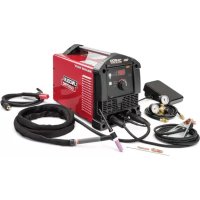
Square Wave TIG 200 - Welding machine LINCOLN ELECTRIC - Free user manual and instructions
Find the device manual for free Square Wave TIG 200 LINCOLN ELECTRIC in PDF.


User questions about Square Wave TIG 200 LINCOLN ELECTRIC
0 question about this device. Answer the ones you know or ask your own.
Ask a new question about this device
Download the instructions for your Welding machine in PDF format for free! Find your manual Square Wave TIG 200 - LINCOLN ELECTRIC and take your electronic device back in hand. On this page are published all the documents necessary for the use of your device. Square Wave TIG 200 by LINCOLN ELECTRIC.
USER MANUAL Square Wave TIG 200 LINCOLN ELECTRIC
For use with machines having Code Numbers:
12475, 12887, 12888, 12937
PRODUCT REGISTRATION
LINCOLN
ELECTRIC
Registering your product only takes a few minutes, ensures your qualification for available warranties and allows you to receive updates and information on your product.
Follow the QR code below to register.

https://lered.info/productregistration-8

Register your machine:
https://lered.info/locator
Authorized Service and Distributor Locator:
www.lincolnelectric.com/locator
Save for future reference
THANK YOU FOR SELECTING A QUALITY PRODUCT BY LINCOLNELECTRIC.
PLEASE EXAMINE CARTON AND EQUIPMENT FOR DAMAGE IMMEDIATELY
When this equipment is shipped, title passes to the purchaser upon receipt by the carrier. Consequently, claims for material damaged in shipment must be made by the purchaser against the transportation company at the time the shipment is received.
SAFETY DEPENDS ON YOU
Lincoln arc welding and cutting equipment is designed and built with safety in mind. However, your overall safety can be increased by proper installation ... and thoughtful operation on your part. DO NOT INSTALL, OPERATE OR REPAIR THIS EQUIPMENT WITHOUT READING THIS MANUAL AND THE SAFETY PRECAUTIONS CONTAINED THROUGHOUT. And, most importantly, think before you act and be careful.

WARNING
This statement appears where the information must be followed exactly to avoid serious personal injury or loss of life.

CAUTION
This statement appears where the information must be followed to avoid minor personal injury or damage to this equipment.
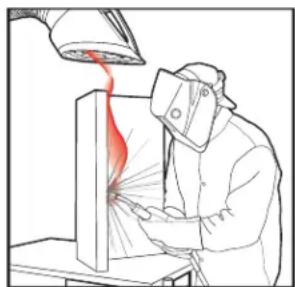
KEEP YOUR HEAD OUT OF THE FUMES.
DON'T get too close to the arc. Use corrective lenses if necessary to stay a reasonable distance away from the arc.
READ and obey the Safety Data Sheet (SDS) and the warning label that appears on all containers of welding materials.
USE ENOUGH VENTILATION or exhaust at the arc, or both, to keep the fumes and gases from
your breathing zone and the general area.
IN A LARGE ROOM OR OUTDOORS, natural ventilation may be adequate if you keep your head out of the fumes (See below).
USE NATURAL DRAFTS or fans to keep the fumes away from your face.
If you de velop unusual symptoms, see your supervisor. Perhaps the welding atmosphere and ventilation system should be checked.

WEAR CORRECT EYE, EAR & BODY PROTECTION
PROTECT your eyes and face with welding helmet properly fitted and with proper grade of filter plate (See ANSI Z49.1).
PROTECT your body from welding spatter and arc flash with protective clothing including woolen clothing, flame-proof apron and gloves, leather leggings, and high boots.
PROTECT others from splatter, flash, and glare with protective screens or barriers.
IN SOME AREAS, protection from noise may be appropriate.
BE SURE protective equipment is in good condition.
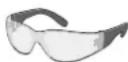
Also, wear safety glasses in work area AT ALL TIMES.
SPECIAL SITUATIONS
DO NOT WELD OR CUT containers or materials which previously had been in contact with hazardous substances unless they are properly cleaned. This is extremely dangerous.
DO NOT WELD OR CUT painted or plated parts unless special precautions with ventilation have been taken. They can release highly toxic fumes or gases.
Additional precautionary measures
PROTECT compressed gas cylinders from excessive heat, mechanical shocks, and arcs; fasten cylinders so they cannot fall.
BE SURE cylinders are never grounded or part of an electrical circuit.
REMOVE all potential fire hazards from welding area. ALWAYS HAVE FIRE FIGHTING EQUIPMENT READY IMMEDIATE USE AND KNOW HOW TO USE IT.

SECTION A:WARNINGS

CALIFORNIA PROPOSITION 65 WARNINGS

WARNING: Breathing diesel engine exhaust exposes you to chemicals known to the State of California to cause cancer and birth defects,
or other reproductive harm.
- Always start and operate the engine in a well-ventilated area.
- If in an exposed area, vent the exhaust to the outside.
- Do not modify or tamper with the exhaust system.
- Do not idle the engine except as necessary.
For more information go to www.P65 warnings.ca.gov/diesel
WARNING: This product, when used for welding or cutting, produces fumes or gases which contain chemicals known to the State of California to cause birth defects and, in some cases, cancer. (California Health & Safety Code § 25249.5 et seq.)

WARNING: Cancer and Reproductive Harm www.P65warnings.ca.gov
ARC WELDING CAN BE HAZARDOUS. PROTECT YOURSELF AND OTHERS FROM POSSIBLE SERIOUS INJURY OR DEATH. KEEP CHILDREN AWAY. PACEMAKER WEARERS SHOULD CONSULT WITH THEIR DOCTOR BEFORE OPERATING.
Read and understand the following safety highlights. For additional safety information, it is strongly recommended that you purchase a copy of "Safety in Welding & Cutting - ANSI Standard Z49.1" from the American Welding Society, P.O. Box 351040, Miami, Florida 33135 or CSA Standard W117.2. A Free copy of "Arc Welding Safety" booklet E205 is available from the Lincoln Electric Company, 22801 St. Clair Avenue, Cleveland, Ohio 44117-1199.
BE SURE THAT ALL INSTALLATION, OPERATION, MAINTENANCE AND REPAIR PROCEDURES ARE PERFORMED ONLY BY QUALIFIED INDIVIDUALS.

FOR ENGINE POWERED EQUIPMENT.

1.a. Turn the engine off before troubleshooting and maintenance work unless the maintenance work requires it to be running.
1.b. Operate engines in open, well-ventilated areas or vent the engine exhaust fumes outdoors.
1.c. Do not add the fuel near an open flame welding arc or when the engine is running. Stop the engine and allow it to cool before refueling to prevent spilled fuel from vaporizing on contact

with hot engine parts and igniting. Do not spill fuel when filling tank. If fuel is spilled, wipe it up and do not start engine until fumes have been eliminated.
1.d. Keep all equipment safety guards, covers and devices in position and in good repair. Keep hands, hair, clothing and tools away from V-belts, gears, fans and all other moving parts when starting, operating or repairing equipment.

1.e. In some cases it may be necessary to remove safety guards to perform required maintenance. Remove guards only when necessary and replace them when the maintenance requiring their removal is complete. Always use the greatest care when working near moving parts.
1.f. Do not put your hands near the engine fan. Do not attempt to override the governor or idler by pushing on the throttle control rods while the engine is running.
1.g. To prevent accidentally starting gasoline engines while turning the engine or welding generator during maintenance work, disconnect the spark plug wires, distributor cap or magneto wire as appropriate.
1.h. To avoid scalding, do not remove the radiator pressure cap when the engine is hot.
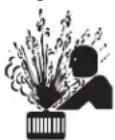
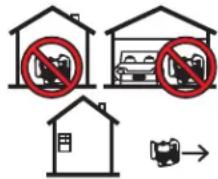
1.i. Using a generator indoors CAN KILL YOU IN MINUTES.
1.j. Generator exhaust contains carbon monoxide. This is a poison you cannot see or smell.
1.k. NEVER use inside a home or garage, EVEN IF doors and windows are open.
1.1. Only use OUTSIDE and far away from windows, doors and vents.
1.m. Avoid other generator hazards. READ MANUAL BEFORE USE.

ELECTRIC AND MAGNETIC FIELDS MAY BE DANGEROUS
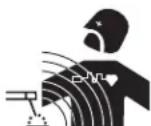
2.a. Electric current flowing through any conductor causes localized Electric and Magnetic Fields (EMF). Welding current creates EMF fields around welding cables and welding machines
2.b. EMF fields may interfere with some pacemakers, and welders having a pacemaker should consult their physician before welding.
2.c. Exposure to EMF fields in welding may have other health effects which are now not known.
2.d. All welders should use the following procedures in order to minimize exposure to EMF fields from the welding circuit:
2.d.1. Route the electrode and work cables together - Secure them with tape when possible.
2.d.2. Never coil the electrode lead around your body.
2.d.3. Do not place your body between the electrode and work cables. If the electrode cable is on your right side, the work cable should also be on your right side.
2.d.4. Connect the work cable to the workpiece as close as possible to the area being welded.
2.d.5. Do not work next to welding power source.

ELECTRIC SHOCK CAN KILL.

3.a. The electrode and work (or ground) circuits are electrically "hot" when the welder is on. Do not touch these "hot" parts with your bare skin or wet clothing. Wear dry, hole-free gloves to insulate hands.
3.b. Insulate yourself from work and ground using dry insulation. Make certain the insulation is large enough to cover your full area of physical contact with work and ground.
In addition to the normal safety precautions, if welding must be performed under electrically hazardous conditions (in damp locations or while wearing wet clothing; on metal structures such as floors, gratings or scaffolds; when in cramped positions such as sitting, kneeling or lying, if there is a high risk of unavoidable or accidental contact with the workpiece or ground) use the following equipment:
- Semiautomatic DC Constant Voltage (Wire) Welder.
- DC Manual (Stick) Welder.
- AC Welder with Reduced Voltage Control.
3.c. In semiautomatic or automatic wire welding, the electrode, electrode reel, welding head, nozzle or semiautomatic welding gun are also electrically "hot".
3.d. Always be sure the work cable makes a good electrical connection with the metal being welded. The connection should be as close as possible to the area being welded.
3.e. Ground the work or metal to be welded to a good electrical (earth) ground.
3.f. Maintain the electrode holder, work clamp, welding cable and welding machine in good, safe operating condition. Replace damaged insulation.
3.g. Never dip the electrode in water for cooling.
3.h. Never simultaneously touch electrically "hot" parts of electrode holders connected to two welders because voltage between the two can be the total of the open circuit voltage of both welders.
3.i. When working above floor level, use a safety belt to protect yourself from a fall should you get a shock.
3.j. Also see It ems 6.c. and 8.

ARC RAYS CAN BURN.
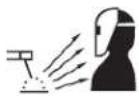
4.a. Use a shield with the proper filter and cover plates to protect your eyes from sparks and the rays of the arc when welding or observing open arc welding. Headshield and filter lens should conform to ANSI Z87. I standards.
4.b. Use suitable clothing made from durable flame-resistant material to protect your skin and that of your helpers from the arc rays.
4.c. Protect other nearby personnel with suitable, non-flammable screening and/or warn them not to watch the arc nor expose themselves to the arc rays or to hot spatter or metal.

5.a. Welding may produce fumes and gases hazardous to health. Avoid breathing these fumes and gases. When welding, keep your head out of the fume. Use enough ventilation and/or exhaust at the arc to keep fumes and gases away from the breathing zone. When welding hardfacing (see instructions on container or SDS) or on lead or cadmium plated steel and other metals or coatings which produce highly toxic fumes, keep exposure as low as possible and within applicable OSHA PEL and ACGIH TLV limits using local exhaust or mechanical ventilation unless exposure assessments indicate otherwise. In confined spaces or in some circumstances, outdoors, a respirator may also be required. Additional precautions are also required when welding on galvanized steel.
5. b. The operation of welding fume control equipment is affected by various factors including proper use and positioning of the equipment, maintenance of the equipment and the specific welding procedure and application involved. Worker exposure level should be checked upon installation and periodically thereafter to be certain it is within applicable OSHA PEL and ACGIH TLV limits.
5.c. Do not weld in locations near chlorinated hydrocarbon vapors coming from degreasing, cleaning or spraying operations. The heat and rays of the arc can react with solvent vapors to form phosgene, a highly toxic gas, and other irritating products.
5.d. Shielding gases used for arc welding can displace air and cause injury or death. Always use enough ventilation, especially in confined areas, to insure breathing air is safe.
5.e. Read and understand the manufacturer's instructions for this equipment and the consumables to be used, including the Safety Data Sheet (SDS) and follow your employer's safety practices. SDS forms are available from your welding distributor or from the manufacturer.
5.f. Also see item 1.b.

WELDING AND CUTTING SPARKS CAN CAUSE FIRE OR EXPLOSION.
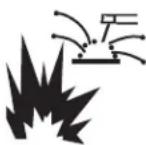
6.a. Remove fire hazards from the welding area. If this is not possible, cover them to prevent the welding sparks from starting a fire. Remember that welding sparks and hot materials from welding can easily go through small cracks and openings to adjacent areas. Avoid welding near hydraulic lines. Have a fire extinguisher readily available.
6.b. Where compressed gases are to be used at the job site, special precautions should be used to prevent hazardous situations. Refer to "Safety in Welding and Cutting" (ANSI Standard Z49.1) and the operating information for the equipment being used.
6.c. When not welding, make certain no part of the electrode circuit is touching the work or ground. Accidental contact can cause overheating and create a fire hazard.
6.d. Do not heat, cut or weld tanks, drums or containers until the proper steps have been taken to insure that such procedures will not cause flammable or toxic vapors from substances inside. They can cause an explosion even though they have been "cleaned". For information, purchase "Recommended Safe Practices for the Preparation for Welding and Cutting of Containers and Piping That Have Held Hazardous Substances", AWS F4.1 from the American Welding Society (see address above).
6.e. Vent hollow castings or containers before heating, cutting or welding. They may explode.
6.f. Sparks and spatter are thrown from the welding arc. Wear oil free protective garments such as leather gloves, heavy shirt, cuffless trousers, high shoes and a cap over your hair. Wear ear plugs when welding out of position or in confined places. Always wear safety glasses with side shields when in a welding area.
6.g. Connect the work cable to the work as close to the welding area as practical. Work cables connected to the building framework or other locations away from the welding area increase the possibility of the welding current passing through lifting chains, crane cables or other alternate circuits. This can create fire hazards or overheat lifting chains or cables until they fail.
6.h. Also see item 1.c.
6.I. Read and follow NFPA 51B "Standard for Fire Prevention During Welding, Cutting and Other Hot Work", available from NFPA, 1 Batterymarch Park, PO box 9101, Quincy, MA 022690-9101.
6.j. Do not use a welding power source for pipe thawing.

CYLINDER MAY EXPLODE IF DAMAGED.
7.a. Use only compressed gas cylinders containing the correct shielding gas for the process used and properly operating regulators designed for the gas and pressure used. All hoses, fittings, etc. should be suitable for the application and maintained in good condition.
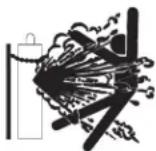
7.b. Always keep cylinders in an upright position securely chained to an undercarriage or fixed support.
7.c. Cylinders should be located:
- Away from areas where they may be struck or subjected to physical damage.
- A safe distance from arc welding or cutting operations and any other source of heat, sparks, or flame.
7.d. Never allow the electrode, electrode holder or any other electrically "hot" parts to touch a cylinder.
7.e. Keep your head and face away from the cylinder valve outlet when opening the cylinder valve.
7.f. Valve protection caps should always be in place and hand tight except when the cylinder is in use or connected for use.
7.g. Read and follow the instructions on compressed gas cylinders, associated equipment, and CGA publication P-I, "Precautions for Safe Handling of Compressed Gases in Cylinders," available from the Compressed Gas Association, 14501 George Carter Way Chantilly, VA 20151.

FOR ELECTRICALLY POWERED EQUIPMENT.

8.a. Turn off input power using the disconnect switch at the fuse box before working on the equipment.
8.b. Install equipment in accordance with the U.S. National Electrical Code, all local codes and the manufacturer's recommendations.
8.c. Ground the equipment in accordance with the U.S. National Electrical Code and the manufacturer's recommendations.
Refer to http://www.lincolnelectric.com/safety for additional safety information.
GENERAL DESCRIPTION 7
CHARACTERISTICS 7
PROCESSES 7
WELDING CAPABILITY. 7
INSTALLATION .A-1
TECHNICAL SPECIFICATIONS. A-1
TIG AMERAGE VALUES. A-2
STICKAMERAGEVALUES.. A-2
TUNGSTEIN A-2
SELECT SUITABLE LOCATION. A-3
STACKIN G. A-3
TILTING A-3
INPUT POWER CONNECTION A-3
INPUT VOLTAGE .A-3
ENGINE DRVEN GENERATOR. A-4
OUTPUT CONNECTIONs. A-4
STICK WELDING G. A-5
TIG WELDING (GTAW) A-6
STRIKING ARC OF TIG OPERATION. A-6
MACH INE GROUNDING AND HF INTERFERENCE PROTECTION. A-7
OPERATION. .B-1
ACCESSIONS C-1
MAINTENANCE D-1
TROUBLESHOOTING E-1
DIAGRAMS F-1
Parts Listparts.lincolnelectric.com
Content/details may be changed or updated without notice. For most current Instruction Manuals, go to parts.lincolnene ctic.com.
GENERAL DESCRIPTION
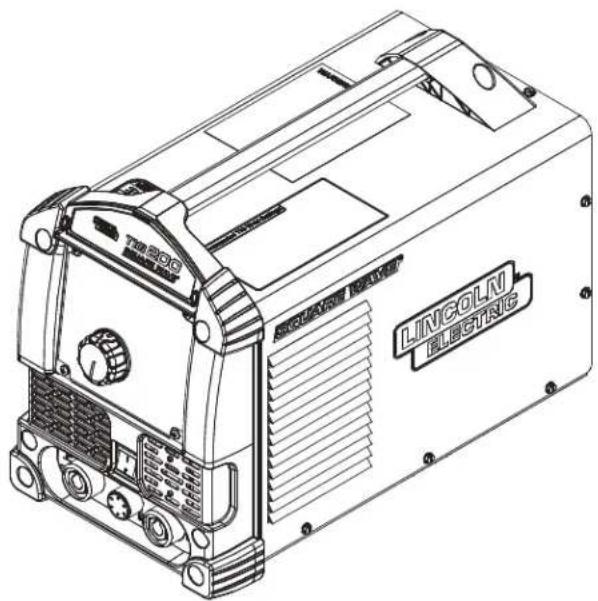
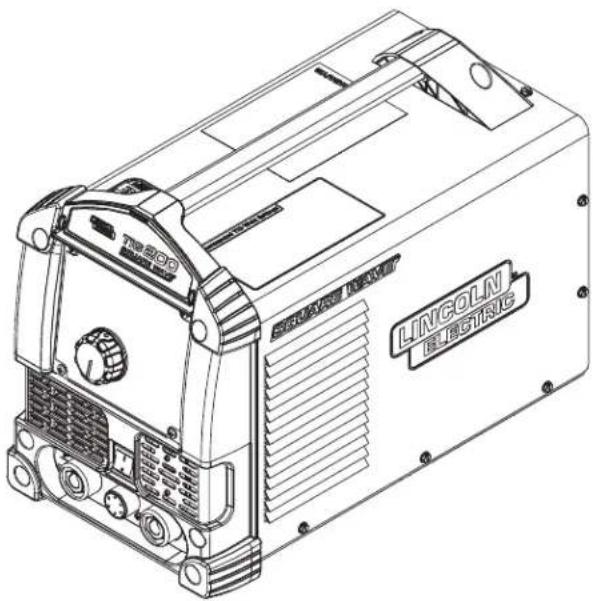
The Square Wave® TIG 200 is a portable TIG and Stick welding machine that lets hobbyists, small fabricators, and craftsmen explore their creativity. It is designed to help expand your welding expertise. As your skills and confidence grow, you can take advantage of the Square Wave TIG 200's additional functionality. No matter your skill level, you won't be disappointed using this machine. The Square Wave TIG 200 provides smooth and stable AC TIG welding on aluminum and DC TIG welding on steel, stainless steel and chrome-moly. A user-friendly interface enables the operators to set it, forget it and weld.
CHARACTERISTICS
- To ensure a high success rate of arc starting. The power source incorporates a high frequency arc start circuit.
- A smooth stable arc on AC or DC polarity
- Good stick welding capabilities for outdoor work or thicker materials.
PROCESSES
STICK DC
DC TIG
AC TIG
WELDING CAPABILITY
Please see Technical Specifications in the Installation Section for rated outputs for the Square Wave TIG 200 inverter machine. It is capable of higher duty cycles at lower output currents.
If the duty cycle is exceeded, a thermal protector will shut off the output until the machine cools.
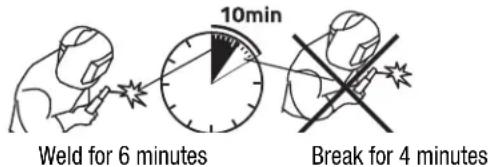
A Duty Cycle of 60% example is: 60% Duty Cycle
TECHNICAL SPECIFICATIONS
SQUARE WAVE® TIG 200 (K5126-1)
| OUTPUT RANGE | ||||
| INPUT POWER: | WELDING MODE | INPUT RANGE | OUTPUT RANGE | OPEN CIRCUIT VOLTAGE (OCV) |
| 120 V | TIG (AC/DC) | 120 V 10-1 | 25 A | AVERAGE OCV - 62 V PEAK OCV - 140 V VRD OCVPEAK - 13.5 V |
| 1 PHASE | 230 V 10-2 | 200 A | ||
| 60 Hz | 120 V 10-9 | 90 A | ||
| 220 / 230 V | STICK (DC) | 120 V 10-1 | 70 A | |
| 1 PHASE | 230 V 10-1 | 70 A | ||
| 50/60 Hz | ||||
| TIG RATED OUTPUT: CURRENT/DUTY CYCLE(1) | |
| INPUT VOLTAGE 120 V | 125 A / 25%* |
| 100 A / 40% | |
| 85 A / 60% | |
| 230 V | 200 A / 25% |
| 160 A / 40% | |
| 130 A / 60% | |
| STICK RATED OUTPUT: CURRENT/DUTY CYCLE(1) | |
| INPUT VOLTAGE 120 V | 75 A / 20 % |
| 65 A / 60 % | |
| 230 V | 170 A / 20 % |
| 100 A / 60 % | |
| RECOMMENDED BREAKER AND FUSE SIZES AND MAXIMUM EFFECTIVE CURRENT | |||
| INPUT VOLTAGE | FUSE (SUPER LAG) OR BREAKER SIZE(2)(3) | EFFECTIVE CURRENT DRAW | MAXIMUM CURRENT DRAW |
| 230 V 30 | A 14.7 A 25 A | ||
| 120 V 20 | A 15 A 21.5 A | ||
- 110 A for AC TIG
(1) Based upon 10 minute time period (i.e., for 60% duty cycle, it is 6 minutes on and 4 minutes off)
(2) Also called 'inverse time' or 'thermal/magnetic' circuit breakers; circuit breakers that have a delay in tripping action that decreases as the magnitude of current increases.
(3) To prevent nuisance breaker trips, refrain from operating at maximum output and exceeding rated duty cycle.
| PHYSICAL DIMENSIONS | |||
| LENGTH WIDTH | HEIGHT WEIGHT | ||
| 19.22 IN. (488 MM) | 0.75 IN. (282 MM). 14 IN. (358 MM) | 46 LBS (21KGS) | |
| OTHER PARAMETERS |
| PROTECTION CLASS |
| IP21S |
| TEMPERATURE RANGE | |
| OPERATING TEMPERATURE RANGE | 14°F~104°F (-10°C ~ +40°C) |
| STORAGE TEMPERATURE RANGE | 14°F~104°F (-10°C ~ +40°C) |
TIG Amperage Values
| Material Type | Material Thickness | ||||
| 24 Ga (0.024 in) (0.6 mm) | 16 Ga (0.060 in) (1.5 mm) | 12 Ga (0.105 in) (2.7 mm) | 10 Gauge (0.135 in) (3.4 mm) | 3/16" (4.8 mm) | |
| Steel (DC-) | 25-35 A | 70-85 A | 80-100 A | 90-120 A | 130-160 A |
| Stainless Steel (DC-) | 25-35 A | 70-85 A | 80-100 A | 90-120 A | 130-160 A |
| Aluminum (AC) | 24 Ga (0.024 in) (0.6 mm) | 1/16" (0.62 in) (1.6 mm) | 0.090" (2.3 mm) | 1/8" (0.125 in) (3.2 mm) | 3/16" (4.8 mm) |
| 25-35 A | 75-85 A | 85-110 A | 120-135 | 165-195 A | |
Material Thickness
| 24 Ga (0.024 in) (0.6 mm) | 16 Ga (0.060 in) (1.5 mm) or 1/16" (0.62 in) (1.6 mm) | 12 Ga (0.105 in) (2.7 mm) or 0.090" (2.3 mm) | 10 Ga (0.135 in) (3.4 mm) or 1/8" (0.125 in) (3.2 mm) | 3/16" (4.8 mm) | |
| Suggested Tungsten Diameter | 1/16" (1.6mm) | 3/32" (2.4 mm) | 3/32" (2.4 mm) | 3/32" (2.4 mm) | 3/32" (2.4 mm) |
| Suggested Filler Metal Diameter | 1/16" (1.6mm) | 1/16" (1.6 mm) | 3/32" (2.4 mm) | 3/32" (2.4 mm) | 1/8" (3.2mm) |
STICK Amperage Values
| Stick Electrode Diameter | 12 Gauge (0.105 in) (2.7 mm) | 10 Gauge (0.135 in) (3.4 mm) | 3/16" (4.7 mm) | |
| Steel E6011 / E6013 (DC+) | 3/32" (2.4 mm) | 50-70A | 60-80A | - |
| 1/8" (3.2 mm) | 65-85A | 75-95A | 90-110A | |
| 5/32" (4.0 mm) | 90-110A | 115-135A | 130-150A | |
| Steel E7018 (DC+) | 3/32" (2.4 mm) | 70-90A | 80-100A | 90-110A |
| 1/8" (3.2 mm) | 90-110A | 105-125A | 115-135A | |
| 5/32" (4.0 mm) | 105-125A | 115-135A | 140-160A |
Tungsten - Pure Tungsten is NOT Recommended
| Color | Tungsten Types | AC Polarity | DC Polarity X | Applications |
| Gold | 1.5% Lanthanated | Good choice for welding titanium, nickel, copper, mild steel and stainless steel. | ||
| Blue | 2% Lanthanted | X | X | |
| G | 2% Ceriated | X | X | Good all around choice for both AC and DC, in welding low alloyed & non-corroding steels, aluminum , magnesium, titanium, nickel, and copper. |
| Chartreuse or Purple (E3®) | 1.5% Lanthanum, 0.08% Zirconium, 0.08% Yttrium | X | X | |
| White | 0.8% Zirconiated | X | A very good choice for aluminum or magnesium alloys. |
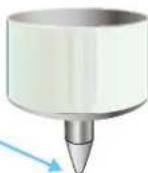
Tungsten Preparation
Tungsten should have a blunt tip.
INSTALLATION

WARNING
Do not attempt to use this equipment until you have thoroughly read the engine manufacturer's manual supplied with your welder. It includes important safety precautions, detailed engine starting, operating and maintenance instructions, and parts lists.
ELECTRIC SHOCK can kill.
- Do not touch electrically live parts or electrode with skin or wet clothing.
- Insulate yourself from work and ground
Always wear dry insulating gloves.
ENGINE EXHAUST can kill.
- If used with engine power generators, use in open, well ventilated areas or vent exhaust outside.

MOVING PARTS can injure.
- Do not operate with doors open or guards off.
- Keep away from moving parts.

See additional warning information at front of this operator's manual.
Only qualified personnel should install, use, or service this equipment.
SELECT SUITABLE LOCATION

CAUTION
This power source should not be subjected to rain or snow, nor should any parts of it be submerged in water. Doing so may cause improper operation as well as pose a safety hazard. The best practice is to keep the machine in a dry, sheltered area.
LOCATION AND VENTILATION
The welder should be located to provide an unrestricted flow of clean, cool air to the cooling air inlets and to avoid restricting the cooling air outlets. Also, locate the welder so that the engine exhaust fumes are properly vented to an outside area.
Locate the machine away from radio controlled machinery. Normal operation of the welder may adversely affect the operation of RF controlled equipment, which may result in bodily injury or damage to the equipment.
The EMC or RF classification of this equipment is Class A.
STACKING
The Square Wave TIG 200 inverter machine CANNOT be stacked.
TILTING

CAUTION
The bottom of machine must always be placed on a firm, secure, level surface. There is a danger of the machine toppling over if this precaution is not taken.
Do not place or operate the machines on a surface with an incline greater than 15^ from horizontal.
Place the welder where clean cooling air can freely circulate in through the rear louvers and out through the front side. Water, dirt, dust or any foreign material that can be drawn into the welder should be kept to a minimum. Failure to observe these precautions can result in excessive operating temperatures and nuisance shutdowns.
INPUT POWER CONNECTION
Check the input voltage supplied to this machine before turning it on. The allowable input voltage is indicated in the technical specification section of this manual and on the rating plate of the machine. Be sure that the machine is earthed (grounded) in accordance with the National Electrical Code & local codes.
INPUT VOLTAGE
The machine can be connected to either 120V± 10% or 230V± 10% input voltage.
An output amperage guide based on input voltage is provided in the technical specification section of this manual.
ENGINE DRIVEN GENERATOR
The machine is designed to operate on engine driven generators as long as the auxiliary can supply adequate voltage, frequency and power as indicated in the "Technical Specification" Installation Section of this manual. The auxiliary supply of the generator must also meet the following conditions:
Frequency: 60 Hz for 100-240V Input & 50 Hz for 230 / 240V input.
RMS voltage of the AC waveform: 100-240 V; Out of this range will trigger undervoltage and overvoltage protections.
Generator Minimum 8 kW
It is important to check these conditions because many engine driven generators produce high voltage spikes. Operation of this machine with engine driven generators not conforming to these conditions is not recommend and may damage the machine and is also NOT covered by warranty.

WARNING
ELECTRIC SHOCK can kill.
- Keep the electrode holder and cable insulation in good condition.
- Do not touch electrically live parts or electrode with skin or wet clothing.
- Insulate yourself from work and ground.
- Turn the input line Switch on the machines "Off" before connecting or disconnecting output cables or other equipment.

CAUTION
For secure electrical connection, the power source output sockets connecting cable plugs must be tightened. Damage may occur to the output socket or welding performance maybe compromised.
To avoid interference problems with other equipment and to achieve the best possible operation, route all cables directly to the work. Avoid excessive lengths and do not coil excess cable.
OUTPUT CONNECTIONS
A quick disconnect system using twist mate cable plugs is used for the welding cable connections. Refer to the following sections for more information on connecting the machine for operation of stick welding (SMAW) or TIG welding (GTAW).
STICK WELDING
First determine the proper electrode polarity for the electrode to be used. Consult the electrode data for this information. Then connect the output cables to the output terminals of the machine for the selected polarity. Shown here is the connection method for DC(+) welding. (See Figure A.1)
Connect the welding cable to the (+) terminal and the work clamp to the (-) terminal. Insert the connector with the key lining up with the keyway and rotate approximately 1/4 turn clockwise. Do not over tighten.
For DC(-) stick welding, switch the cable connections at the machine so that the welding cable is connected to (-) and and the work clamp is connected to (+). (See Figure A.2)
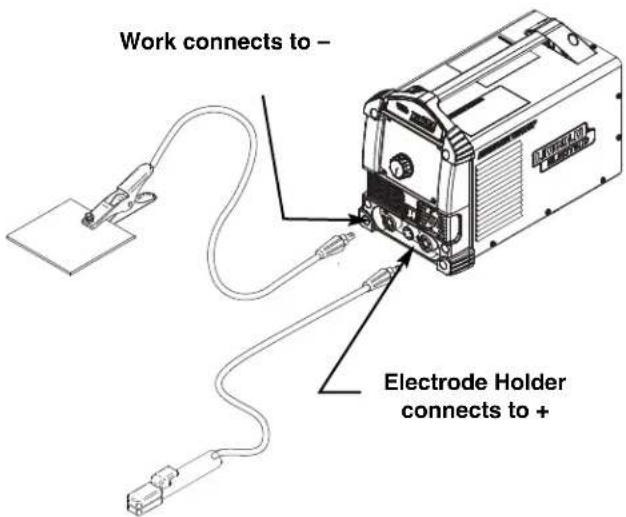
Figure A.1
For DC (+) STICK welding
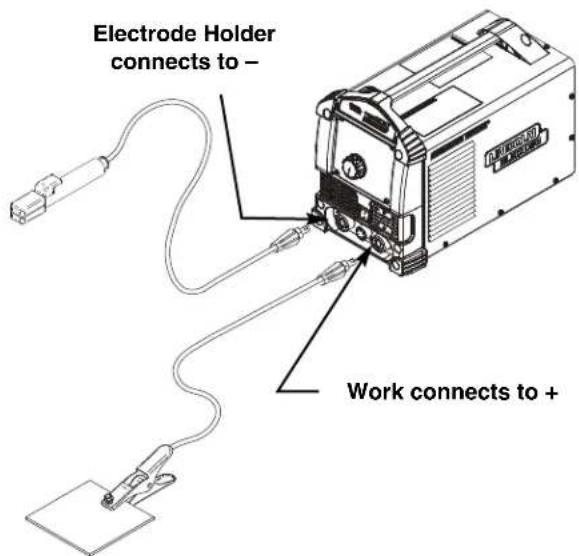
Figure A.2
For DC(-) STICK welding
TIG WELDING (GTAW)
The machine has a built in gas solenoid so a TIG Torch with a one-piece power/gas cable is provided as a ready to weld package including the torch adapter which is pre-installed.
Connect the torch cable to the (-) terminal of the machine and the work clamp to (+) terminal - refer to figure A.3 and A.4. Insert the connector with key lining up with the keyway and rotate approximately 1/4 turn clockwise. Do not over tighten. Also connect the trigger male connector to the female 6 pin connector on the case front.
Ensure the foot pedal connector is firmly tightened to the front of the machine. Press the foot pedal to start the arc & increase pressure to increase welding current. Current can be increased to the maximum value set on the front of the machine.
NOTE: High Frequency Arc Start is present for 1/2 second after foot pedal is pressed. To start the arc, position the tungsten 1/2 inch or less from the work piece and then press the pedal.
THERMAL PROTECTION
Thermostats protect the machine from excessive operating temperatures. Excessive temperatures may be caused by a lack of cooling air or operating the machine beyond the duty cycle and output rating. If excessive operating temperature should occur, the thermostats will prevent output voltage or current.
THERMAL BREAKER
If the current conducted through the breaker exceeds breaker rating for an extended period of time, the breaker will open and require manual reset. (See Figure A.4)
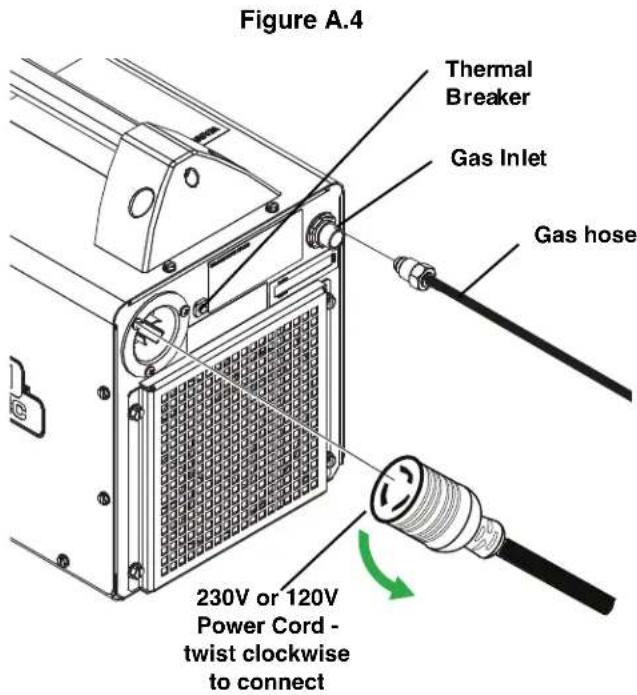
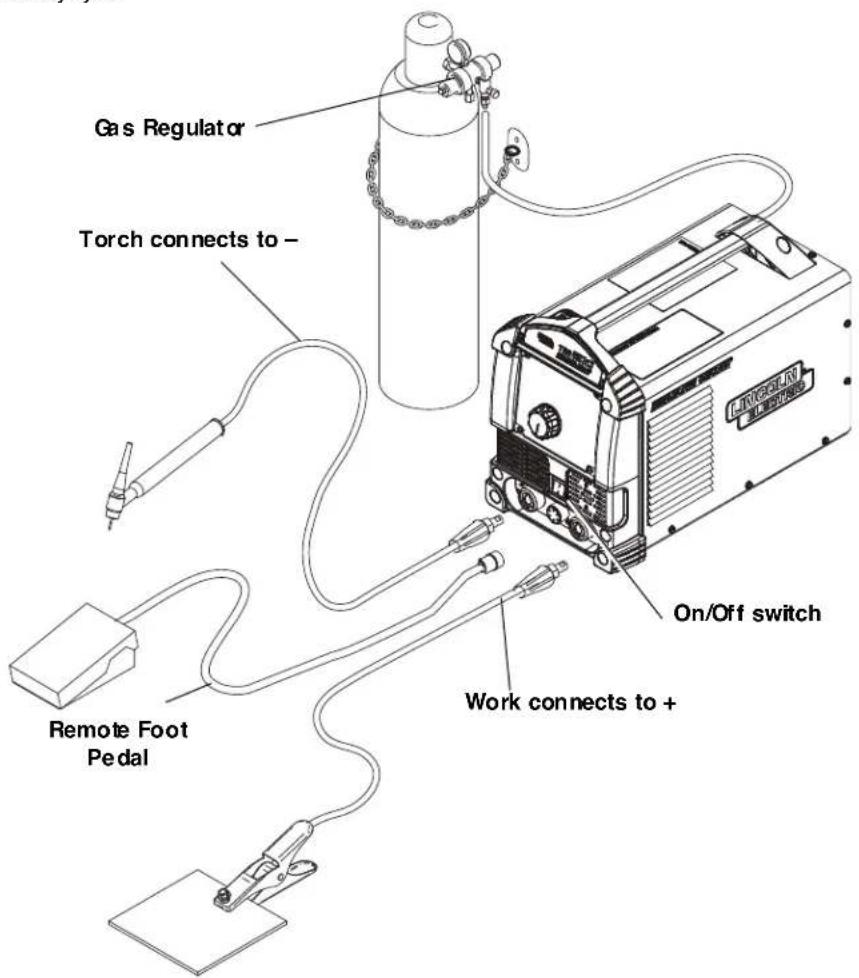
Figure A.3
MACHINE GROUNDING AND HIGH FREQUENCY INTERFERENCE PROTECTION
The welder must be grounded. See your local and national electrical codes for proper grounding methods.
The high frequency generator, being similar to a radio transmitter, can be blamed for radio, TV and electronic equipment interference problems. These problems may be the result of radiated interference. Proper grounding methods can reduce or eliminate radiated interference.
Radiated interference can develop in the following four ways:
- Direct interference radiated from the welder.
- Direct interference radiated from the welding leads.
- Direct interference radiated from feedback into the power lines.
- Interference from re-radiation of "pickup" by ungrounded metallic objects.
Keeping these contributing factors in mind, installing equipment per the following instructions should minimize problems.
- Keep the welder power supply lines as short as possible and enclose as much of them as possible in rigid metallic conduit or equivalent shielding for a distance of 50 feet (15.2m). There should be good electrical contact between this conduit and the welder case ground. Both ends of the conduit should be connected to a driven ground and the entire length should be continuous.
- Keep the work and electrode leads as short as possible and as close together as possible. Lengths should not exceed 25 ft (7.6m). Tape the leads together when practical.
- Be sure the torch and work cable coverings are free of cuts and cracks that allow high frequency leakage.
- Keep the torch in good repair and all connections tight to reduce high frequency leakage.
- It is recommended that the work piece should be connected to an earth ground close to the work clamp, using one of the following methods:
a) A metal underground water pipe in direct contact with the earth for ten feet or more.
b) A 3/4'' (19mm) galvanized pipe or a 5/8'' (16mm) solid galvanized iron, steel or copper rod driven at least eight feet into the ground.
The ground should be securely made and the grounding cable should be as short as possible using cable of the same size as the work cable, or larger. Grounding to the building frame electrical conduit or a long pipe system can result in re-radiation, effectively making these members radiating antennas.
- Keep cover and all screws securely in place.
- Electrical conductors within 50 ft (15.2m) of the welder should be enclosed in grounded rigid metallic conduit or equivalent shielding, wherever possible. Flexible metallic conduit is generally not suitable.
- When the welder is enclosed in a metal building, the metal building should be connected to several good earth driven electrical grounds (as in 5 (b) above) around the periphery of the building.
Failure to observe these recommended installation procedures can cause radio or TV and electronic equipment interference problems and result in unsatisfactory welding performance resulting from lost high frequency power.
OPERATION
GRAPHIC SYMBOL USED IN THE MANUAL OR BY THIS MACHINE

INPUT POWER
Ur
REDUCED OPEN CIRCUIT VOLTAG

ON
U0
OPEN CIRCUIT VOLTAGE

OFF
U1
INPUT VOLTAGE

HIGH TEMPERATURE
U2
OUTPUT VOLTAGE

CIRCUIT BREAKER
1
INPUT CURRENT

POSITIVE OUTPUT
12
OUTPUT CURRENT

NEGATIVE OUTPUT

PROTECTIVE GROUND

WARNING or CAUTION

E 3 PHASE INVERTER

Explosion

INPUT POWER

Dangerous Voltage

THREE PHASE

Shock Hazard

DIRECT CURRENT

TIG Torch

Stick Electrode Holder

Refer to Operator's Manual

Output Amperage
CASE FRONT CONTROLS
The front panel includes a "Process Mode Button," an "Settings" button and one encoder knob.
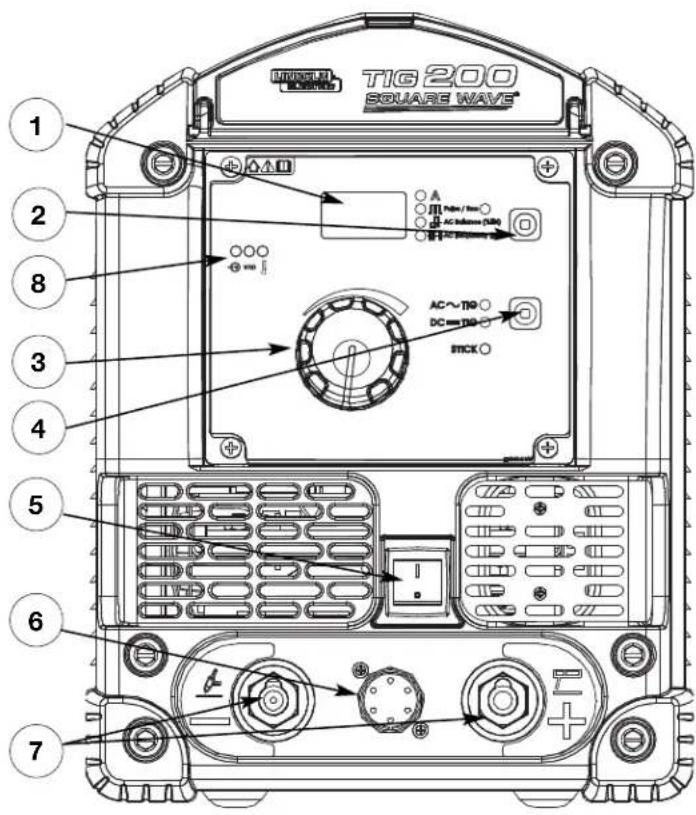
| Item | Description |
| 1 Digital Display | |
| 2 Settings Button | |
| 3 Encoder Knob | |
| 4 Process Mode Button* / Reset | |
| 5 Power Switch | |
| 6 Remote Connector | |
| 7 Twist-Mate™ Receptacle | |
| 8 Status Lights | |
- Pressing the Process Mode Button for 10 seconds will reset the settings to factory default.
Digital Display
Current (A)
Pulses per Second (PPS)
AC Frequency (Hz)
AC Balance (%EN: Electrode Negative)
Status Lights
Powered ON - illuminates when power is supplied and switch is set to on position.
VRD - illuminates when voltage reduction device is active. VRD is active in Stick and TIG modes when welding is not occurring. VRD can reduce the potential for hazardous electric shock
Thermal Trip - illuminates or flashes when a thermal trip is present.

Process Mode Button
Selecting the Mode button allows access to change the setting from DC-TIG, AC TIG, or Stick see A.1, A.2 for stick polarity setup.
Settings Button
(Pulse Frequency, AC Balance, AC Output Frequency)
The Settings button will allow the user to gain access to Pulse Frequency, AC Balance, and AC Output Frequency Controls.
DC-TIG:
- Pressing the Settings button to gain access to the Pulse setting. Use the main encoder knob to make a change to the pulse setting (Off - 20PPS), which is set to "Off" as a default setting. The pulse setting automatically regulates the output current between the peak amperage setting, and a background amperage setting that is equal to 50% of the peak amperage setting.
- Pressing this button a second time will return to the amperage control setting.
AC TIG:
- As in the case of DC - TIG, press the Settings button to gain access to the Pulse setting. Use the main encoder knob to make a change to the pulse setting (Off - 20PPS), which is set to "Off" as a default setting. The pulse setting automatically regulates the output current between the peak amperage setting defined in the display, and a background amperage setting that is equal to 50% of the peak amperage setting.
- Pressing the Settings button a second time, will allow access to the AC Balance Setting, at which point using the main encoder knob will allow change from the default 75% EN setting, to a value in between 60% EN and 90% EN (Electrode Negative).
- Pressing the Additional Settings button a third time will allow access to the AC Output Frequency Setting, at which point using the main encoder knob will allow change from the default 90Hz setting, to a value in between 60Hz and 150Hz.
- Pressing this button a fourth time will return to the amperage control setting.
In the event that no selection is made within any setting for six seconds, the setting will exit and return to the amperage control setting.
ACCESSIONS
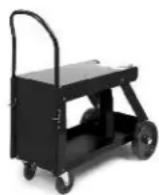
K520 - Utility Cart
Heavy duty cart stores and transports welder, 150 cubic foot shielding gas cylinder, welding cables and accessories. Includes stable platforms for welder and gas bottle, lower tray for added storage capacity and adjustable height handle.
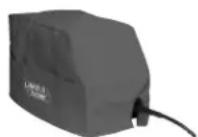
K2377-1 - Canvas Cover
Protect your machine when not in use. Made from attractive red canvas that is flame retardant, mildew resistant and water repellent. Includes a convenient side pocket to hold welding torch or gun.
TIG Torch Options
o K1782-1 - PTA-17 with 12.5' one piece cable assembly
o K1782-3 - PTA-17 with 25^ one piece cable assembly
o K1782-10 - PTA-17F Flexible Head with 25' one piece cable assembly
o K1783-1 - PTA-26 with 12.5' one piece cable assembly
o K1783-3 - PTA-26 with 25' one piece cable assembly
o K1783-10 - PTA-26F with 25' one piece cable assembly
o K1781-1 - PTA-9 with 12.5' one piece cable assembly
o K1781-9 - PTA-9F Flexible Head, with 12.5' flexible one piece cable assembly
o K1782-15 - PTA-17F Flexible Head with 12.5' Ultra-flex™ one piece cable assembly
o K1782-14 - PTA-17F Package with Flexible Head Torch, UltraflexTM cable assembly, one 1/16" E3® tungsten electrode, one 3/32" E3® tungsten electrode, one 1/16" collet and collet body, one 3/32" collet and collet body, #7 nozzle, cable cover and Twist-MateTM adapter.
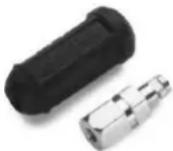
K1622-1 - Twist Mate™ Torch Adapter for PTA-9 and PTA-17 Series Torches
Use to connect 1-piece air-cooled TIG torches (PTA-9 125 Amp / PTA-17 150 Amp) to power sources with combined gas/power Twist-Mate™ connectors
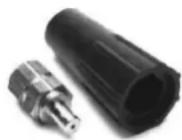
K1622-3 - Twist MateTM for PTA-26 Series Torches
Use to connect 1-piece air-cooled TIG torches (PTA-26 200 Amp) to power sources with combined gas/power Twist Mate™ connectors
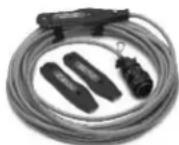
K963-3 - Hand AmptrolTM with 6-pin Universal Connector
Provides 25 ft. (7.6m) of remote current control for TIG welding.
Parts Kits
Parts Kits provide all the torch accessories you need to start welding. Parts Kits provide collets, collet bodies, a back cap, alumina nozzles and tungstens in a variety of sizes, all packaged in an easy to carry reclosable box. Five kits are available.
o KP508 - for PTA-17 Series Torches
o KP509 - for PTA-26 Series Torches
o KP507 - for PTA-9 Series Torches
K2374-1 200 Amp Electrode Holder
Includes Twist Mate™ connector. 12.5 ft. cable length.
K814 Arc Start Switch with 25 ft. (7.6m) cable assembly and 6-pin Universal Connector.
Needed if an Foot or Hand Amptrol is not used when TIG welding to initiate current. Current will rise to selected amperage setpoint upon depression of switch.
MAINTENANCE
WARNING

ELECTRIC SHOCK CAN KILL.
For safety while maintaining the machine, please shut off the supply power and wait for 5 minutes, until capacitor voltage drops to safe voltage.
All service work should be conducted by an authorised Lincoln Electric field service agent
WARNING
To avoid receiving a high frequency shock, keep the TIG torch and cables in good condition.
ROUTINE AND PERIODIC MAINTENANCE
In order to guarantee the arc welding machine works efficiently and safely, it must be maintained regularly. Refer to the maintenance items in the following table.
OVERLOAD PROTECTION
THERMOSTATIC PROTECTION
This welder has thermostatic protection from excessive duty cycles, overloads, loss of cooling, and excessive ambient temperatures. When the welder is subjected to an overload, or inadequate cooling, the thermostats will open. This condition will be indicated by the illumination or flashing while welding of the yellow Thermal Shutdown Light on the front panel. The fan will continue to run to cool the power source. Postflow occurs when TIG welding is shut down, but no welding is possible until the machine is allowed to cool and the yellow Thermal Shutdown Light goes out.
NO ARC PROTECTION
The machine outputs will be shutdown, if the trigger is closed without welding for 3 seconds.
MAINTENANCE ITEMS
| DAILY EXAMINATION | ·Check for correct operation of the control knob, switches and buttons on the front of the power source. ·If the switch is not operational, replace immediately. ·Check the function of the LED display. If it doesn't work, maintain or replace the display PCB. ·Check to see if fan is operating normally. If the fan is not rotating and obstruction is not present then replace the fan. ·Check the output terminals for overheating, if so change output terminals. Ensure welding lead plugs are connected tightly. ·Check welding leads and power cord for damage. If damaged replace parts. |
| MONTHLY EXAMINATION | Use a gentle dry compressed air to clean the inside of arc welding machine. Especially for removing dust from heat sinks, and PCB components. |
TROUBLESHOOTING

WARNING
Service and Repair should only be performed by Lincoln Electric Factory Trained Personnel. Unauthorized repairs performed on this equipment may result in danger to the technician and machine operator and will invalidate your factory warranty. For your safety and to avoid Electrical Shock, please observe all safety notes and precautions detailed throughout this manual.
This Troubleshooting Guide is provided to help you locate and repair possible machine malfunctions. Simply follow the three-step procedure listed below.
Step 1. LOCATE PROBLEM (SYMPTOM).
Look under the column labeled "PROBLEM (SYMPTOMS)." This column describes possible symptoms that the machine may exhibit. Find the listing that best describes the symptom that the machine is exhibiting.
Step 2. POSSIBLE CAUSE.
The second column labeled "POSSIBLE CAUSE" lists the obvious external possibilities that may contribute to the machine symptom.
Step 3. RECOMMENDED COURSE OF ACTION
This column provides a course of action for the Possible Cause, generally it states to contact your local Lincoln Authorized Field Service Facility.
If you do not understand or are unable to perform the Recommended Course of Action safely, contact your local Lincoln Authorized Field Service Facility.

CAUTION
If for any reason you do not understand the test procedures or are unable to perform the tests/repairs safely, contact your Local Lincoln Authorized Field Service Facility for technical troubleshooting assistance before you proceed.
Observe all Safety Guidelines detailed throughout this manual
| PROBLEM POSSIBLE CAUSE RECOMMENDED COURSE OF ACTION | ||
| Machine is Dead - No Output - No Fan | 1. Make certain that the input power switch is in the "ON" position and machine is plugged in. | Contact your Local Lincoln Authorized Field Service Facility for technical troubleshooting assistance. |
| 2. Check the input voltage at the machine. Input voltage must match the rating plate and voltage connection. Refer to the Installation section of this manual. | ||
| 3. Blown or missing fuses in input line. | ||
| Fan runs - No output from machine in either Stick or TIG modes. | 1. Check for proper input voltages per nameplate and voltage reconnection. | |
| 2. Check to make sure cables are firmly connected. | ||
| Fan runs - No output from machine in either Stick or TIG modes and the yellow light on the control panel is on or flashing while welding. | 1. Welding application may have exceeded the recommended duty cycle. Allow the unit to run until the fan cools the unit and the yellow light goes out. | |
| Machine does not respond (no gas flow, no high frequency and no open circuit voltage) when arc start switch or Amptrol is activated - fan is working. | 1. Machine MUST be in AC or DC TIG Mode. | |
| 2. The Amptrol may be defective. Check for continuity between pins "D" and "E" on cable connector when Amptrol is depressed. | ||
| Machine regularly over heats - thermostat opens, Yellow light on front panel illuminates or flashes. The fan runs but machine has no output. | 1. Welding application may exceed recommended duty cycle. Reduce the duty cycle. | |
| 2. Dirt and dust may have clogged the cooling channels inside the machine. Blow out unit with clean, dry low pressure air. | ||
| 3. Air intake, brickwork and exhaust louvers may be blocked due to inadequate clearance around machine. | ||
| Machine output is intermittently lost. | 1. Check Amptrol for proper operation and loose connections. | |
| 2. Check for proper input voltage and proper voltage reconnection. | ||

CAUTION
If for any reason you do not understand the test procedures or are unable to perform the tests/repairs safely, contact your Local Lincoln Authorized Field Service Facility for technical troubleshooting assistance before you proceed.
Observe all Safety Guidelines detailed throughout this manual
| PROBLEM POSSIBLE CAUSE RECOMMENDED | COURSE OF ACTION | |
| Arc "Flutters" when TIG welding. | 1. Tungsten electrode may be too large in diameter for the current setting. | Contact your Local Lincoln Authorized Field Service Facility for technical troubleshooting assistance. |
| 2. Tungsten not prepared properly - should have slight blunt. | ||
| 3. Gas shielding may be insufficient. Increase gas flow; reduce tungsten stickout beyond gas cup. | ||
| 4. Check for contaminated gas or leaks in the gas line, torch, or connections | ||
| 5. If a helium blend is used as a shielding gas, then reduce the percentage of helium. | ||
| Arc "Pulsates" when TIG welding | 1. Check to see if the Pulse feature is active. | |
| Black areas along weld bead. | 1. Clean any oily or organic contamination from the work piece. | |
| 2. Tungsten electrode may be contaminated. Replace or sharpen. | ||
| 3. Check for contaminated gas or leaks in the gas line, torch, or connections | ||
| 4. Gas shielding may be insufficient. Increase gas flow; reduce tungsten stickout beyond gas cup. | ||
| Weak high frequency - machine has normal welding output. | 1. Check for poor connections in the welding circuit. | |
| 2. Gas shielding may be insufficient. Increase gas flow; reduce tungsten stickout beyond gas cup. | ||
| 3. Check for work and torch cables in poor condition allowing high frequency to "Leak Off". | ||
| 4. Keep cables as short as possible. | ||
| High frequency "spark" is present at tungsten electrode, but operator is unable to establish a welding arc. Machine has normal open circuit voltage (refer to Technical Specifications in the Installation Chapter). | 1. The tungsten electrode may be contaminated. Replace or sharpen. | |
| 2. The current control may be set too low. | ||
| 3. The tungsten electrode may be too large for the process. | ||
| 4. If a helium blend is used as a shielding gas, then reduce the percentage of helium. | ||
| 5. Tungsten is too far from the workpiece when starting. | ||

CAUTION
If for any reason you do not understand the test procedures or are unable to perform the tests/repairs safely, contact your Local Lincoln Authorized Field Service Facility for technical troubleshooting assistance before you proceed.
Observe all Safety Guidelines detailed throughout this manual
| PROBLEM POSSIBLE CAUSE RECOMMENDED COURSE OF ACTION | ||
| No high frequency. 1. Ensure gas flow is present and cables are connected. | Contact your Local Lincoln Authorized Field Service Facility for technical troubleshooting assistance. | |
| No gas flow when Amptrol is activated in the TIG Mode. Machine has output - fan runs. A “Click” can be heard indicating that the gas solenoid valve is operating. | 1. Gas supply is empty or not turned on. | |
| 2. Flow regulator may be set too low. | ||
| 3. Gas hose may be pinched. | ||
| 4. Gas flow may be blocked with dirt. | ||
| 5. Consult your local welder/gas distributor. | ||
| When AC TIG welding, the arc is erratic and there is a loss of “cleaning” of the work piece. | 1. Tungsten electrode may be too small for process. Use a larger diameter tungsten or a pure tungsten. | |
| 2. If a helium blend is used as a shielding gas, then reduce the percentage of helium. | ||
| The end of the tungsten electrode melts away. | 1. The welding current is too high for the electrode type and/or size. | |
| 2. Check Polarity | ||
| Stick electrode “Blasts Off” when arc is struck. | 1. Weld current may be set too high for electrode size. Reduce current control setting, or use a larger diameter electrode. | |
| Stick electrode “sticks” in the weld puddle. | 1. The weld current may be set too low. Increase the current control setting or use a smaller diameter electrode. | |

CAUTION
If for any reason you do not understand the test procedures or are unable to perform the tests/repairs safely, contact your Local Lincoln Authorized Field Service Facility for technical troubleshooting assistance before you proceed.
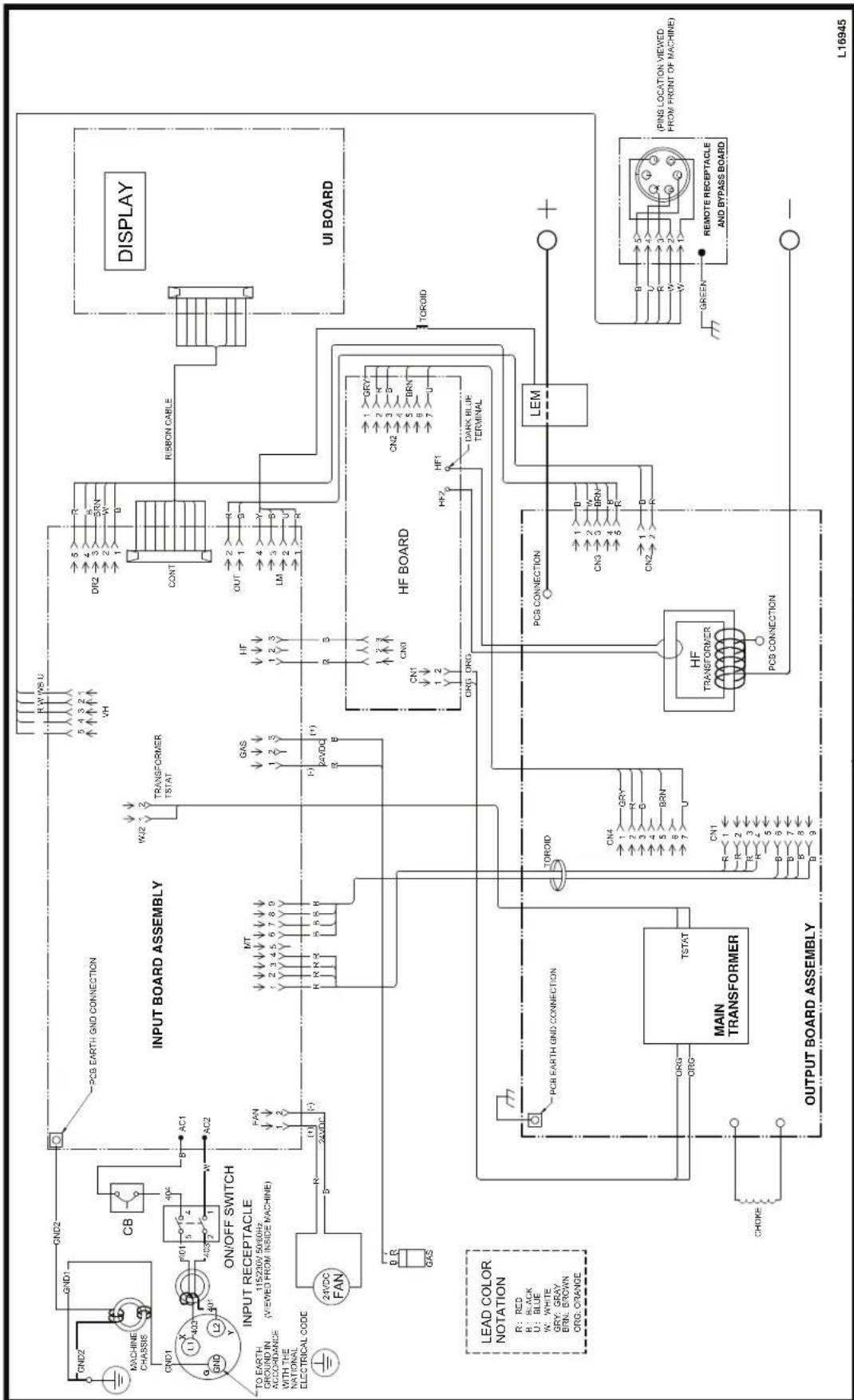
SQUARE WAVE TIG 200
NOTE: This diagram is for reference only. It may not be accurate for all machines covered by this manual. The specific diagram for a particular code is pasted inside the machine on one of the enclosure panels. If the diagram is illegible, write to the Service Department for a replacement. Give the equipment code number.
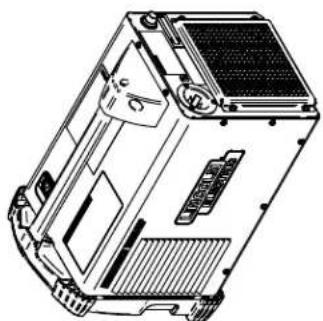
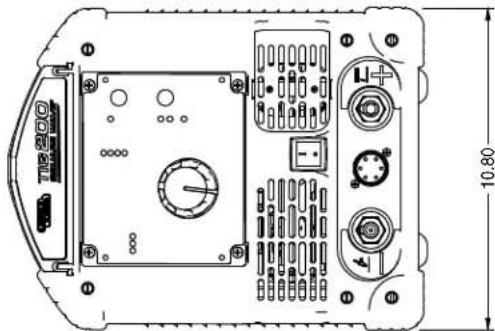
DIMENSIONAL PRINT
Manual del operador
Square Wave® TIG 200
CHOIX D'UN EMPLACEMENT APPROPRIÉ

ATTENTION
AMORCAGE D'ARC EN FONCTIONNEMENT TIG
ÉTAPE 2. CAUSE POSSIBLE.
This page Intentionally left blank.
This page Intentionally left blank.
This page Intentionally left blank.
|  |  |  |  |
| WARNING | - Do not touch electrically live parts o electrode with skin or wet clothing. - Insulate yourself from work and ground. | - Keep flammable materials away. | - Wear eye, ear and body protection. |
| Spanish AVISO DE PRECAUCION | - No toque las partes o los electrodos bajo energia con la piel o ropa moja- da. - Aislese del trabajo y de la tierra. | - Mantenga el material combustible fauna del area de trabajo. | - Protéjase los ojos,los oidos y el CFRPO. |
| French ATTENTION | - Ne laissez ni la peau ni des vete- ments mouillés entraer en contact avec des pièces sous tension. - Isolez-vous du travail et de la terre. | - Gardez à l'écart de tout matériel inflammable. | - Protégéz vos yeux, vos oreilles et votre corps. |
| German WARNING | - Berühren Sie keine stromfuhrenden Teile oder Elektroden mit ihrem Körper oder feuchter Kleidung! - Isolieren Sie sich von den Elektroden und dem Erdboden! | - Entfernen Sie brennbarres Material! | - Tragen Sie Augen-, Ohren- und Kör- perschutz! |
| Portuguese ATENÇAO | - Não toque partes electrolyticas e elec- trodos com a pele ou roupa molha- da. - Isole-se da peça e terra. | - Mantenha inflamáveis hem guarda- dos. | - Use proteção para a vista, ouvido e corporo. |
| Japanese 注意事項 | - 通電中的電気部品、又は溶材にご フやねけた布でCNTむさ。 - 施工物やアスから身体が経縄さ 裁いる様にして下載。 | - 燃元やすいの側の溶接作業は絶対にしおはなりせん。 | - 目、耳及び身体に保護具をて下 壹。 |
| Chinese 警告 | - 皮肤或濕衣物切勿接觸電部件及 鍾條。 - 使你自己與地面和工件絕緣。 | - 把一切易燃物品移離工作場所。 | - 佩戴眼、耳及身體勞動保護用具。 |
| Korean 發訟 | - 전ero체내 챩류고수 힍은 힍개无疑 所부로 쿸개 쿸개 힍개 힍개 힍개 힍개 힍개 힍개 힍개 힍개 힍개 힍개 힍개 힍개 힍개 힍개 힍개 힍개 힍개 힍개 힍개 힍개 힍개 힍개 힍개 힍개 힍개 힉개 힍개 힍개 힍개 힍개 힍개 힍개 힍개 힍개 힍개 힍개 힍개 힍개 힍개 힍개 힍개 힍개 힍개 힍개 힍개 힍개 힍개 힍개 힍개 힍개 ힿ개 힍개 힍개 힍개 힍개 힍개 힍개 힍개 힍개 힍개 힍개 힍개 힍개 힍개 힍개 힍개 힍개 힍개 힍개 힍개 힍개 힍개 힍개 힍개 힍개 개 힍개 힍개 개 힍개 힍개 개 힍개 힍개 개 힍개 개 힍개 개 개 개 개 개 개 개 개 개 개 개 개 개 개 개 개 개 T. | - 人呂職業員が職任・工・工・工・工・工・工・工・工・工・工・工・工・工・工・工・工・工・工・工・工・工・工・工・工・工・工・工・工・工・工・工・工・工・工・工・工・工・工・工・工・工・工・工・工・工・工・工・工・工・工・工人・工・工・工・工・工・工・工・工・工・工・工・工・工・工・工・工・工・工・工・工・工・工・工・工・工・工・工・工・工・工・工・工・工・工・工・工・工・工・工・工・工・工・工・工・工・工・工・工・工・工程・工・工・工・工・工・工・工・工・工・工・工・工・工・工・工・工・工・工・工・工・工・工・工・工・工・工・工・工・工・工・工・工・工・工・工・工・工・工・工・工・工・工・工・工・工・工・工・工・工・工具・工・工・工・工・工・工・工・工・工・工・工・工・工・工・工・工・工・工・工・工・工・工・工・工・工・工・工・工・工・工・工・工・工・工・工・工・工・工・工・工・工・工・工・工・工・工・工・工・工・工业・工・工・工・工・工・工・工・工・工・工・工・工・工・工・工・工・工・工・工・工・工・工・工・工・工・工・工・工・工・工・工・工・工・工・工・工・工・工・工・工・工・工・工・工・工・工・工・工・工・王・工・工・工・工・工・工・工・工・工・工・工・工・工・工・工・工・工・工・工・工・工・工・工・工・工・工・工・工・工・工・工・工・工・工・工・工・工・工・工・工・工・工・工・工・工・工・工・工・工・丁・丁・丁・丁・丁・丁・丁・丁・丁・丁・丁・丁・丁・丁・丁・丁・丁・丁・丁・丁・丁・丁・丁・丁・丁・丁・丁・丁・丁・丁・丁・丁・丁・丁・丁・丁・丁・丁・丁・丁・丁・丁・丁・丁・丁・丁・丁・丁・丁・丁・工・工・工・工・工・工・工・工・工・工・工・工・工・工・工・工・工・工・工・工・工・工・工・工・工・工・工・工・工・工・工・工・工・工・工・工・工・工・工・工・工・工・工・工・工・工・工・工・工・上・上・上・上・上・上・上・上・上・上・上・上・上・上・上・上・上・上・上・上・上・上・上・上・上・上・上・上・上・上・上・上・上・上・上・上・上・上・上・上・上・上・上・上・上・上・上・上・上・上・工・工・工・工・工・工・工・工・工・工・工・工・工・工・工・工・工・工・工・工・工・工・工・工・工・工・工・工・工・工・工・工・工・工・工・工・工・工・工・工・工・工・工・工・工・工・工・工・工・工资・工资・工资・工资・工资・工资・工资・工资・工资・工资・工资・工资・工资・工资・工资・工资・工资・工资・工资・工资・工资・工资・工资・工资・工资・工资・工资・工资・工资・工资・工资・工资・工资・工资・工资・工资・工资・工资・工资・工资・工资・工资・工资・工资・工资・工资・工资・工资・工资・工资・工・工・工・工・工・工・工・工・工・工・工・工・工・工・工・工・工・工・工・工・工・工・工・工・工・工・工・工・工・工・工・工・工・工・工・工・工・工・工・工・工・工・工・工・工・工・工・工・工・资・资・资・资・资・资・资・资・资・资・资・资・资・资・资・资・资・资・资・资・资・资・资・资・资・资・资・资・资・资・资・资・资・资・资・资・资・资・资・资・资・资・资・资・资・资・资・资・资・资・資・资・资・资・资・资・资・资・资・资・资・资・资・资・资・资・资・资・资・资・资・资・资・资・资・资・资・资・资・资・资・资・资・资・资・资・资・资・资・资・资・资・资・资・资・资・资・资・资・资・资源・资源・资源・资源・资源・资源・资源・资源・资源・资源・资源・资源・资源・资源・资源・资源・资源・资源・资源・资源・资源・资源・资源・资源・资源・资源・资源・资源・资源・资源・资源・资源・资源・资源・资源・资源・资源・资源・资源・资源・资源・资源・资源・资源・资源・资源・资源・资源・资源・资源・资・资・资・资・资・资・资・资・资・资・资・资・资・资・资・资・资・资・资・资・资・资・资・资・资・资・资・资・资・资・资・资・资・资・资・资・资・资・资・资・资・资・资・资・资・资・资・资・资・资金・资金・资金・资金・资金・资金・资金・资金・资金・资金・资金・资金・资金・资金・资金・资金・资金・资金・资金・资金・资金・资金・资金・资金・资金・资金・资金・资金・资金・资金・资金・资金・资金・资金・资金・资金・资金・资金・资金・资金・资金・资金・资金・资金・资金・资金・资金・资金・资金・资金・资・资・资・资・资・资・资・资・资・资・资・资・资・资・资・资・资・资・资・资・资・资・资・资・资・资・资・资・资・资・资・资・资・资・资・资・资・资・资・资・资・资・资・资・资・资・资・资・资・资料・资料・资料・资料・资料・资料・资料・资料・资料・资料・资料・资料・资料・资料・资料・资料・资料・资料・资料・资料・资料・资料・资料・资料・资料・资料・资料・资料・资料・资料・资料・资料・资料・资料・资料・资料・资料・资料・资料・资料・资料・资料・资料・资料・资料・资料・资料・资料・资料・资料・资・资・资・资・资・资・资・资・资・资・资・资・资・资・资・资・资・资・资・资・资・资・资・资・资・资・资・资・资・资・资・资・资・资・资・资・资・资・资・资・资・资・资・资・资・资・资・资・资・工资・工资・工资・工资・工资・工资・工资・工资・工资・工资・工资・工资・工资・工资・工资・工资・工资・工资・工资・工资・工资・工资・工资・工资・工资・工资・工资・工资・工资・工资・工资・工资・工资・工资・工资・工资・工资・工资・工资・工资・工资・工资・工资・工资・工资・工资・工资・工资・工资・资・资・资・资・资・资・资・资・资・资・资・资・资・资・资・资・资・资・资・资・资・资・资・资・资・资・资・资・资・资・资・资・资・资・资・资・资・资・资・资・资・资・资・资・资・资・资・资・资・投资・资・资・资・资・资・资・资・资・资・资・资・资・资・资・资・资・资・资・资・资・资・资・资・资・资・资・资・资・资・资・资・资・资・资・资・资・资・资・资・资・资・资・资・资・资・资・资・资・资・资助・资助・资助・资助・资助・资助・资助・资助・资助・资助・资助・资助・资助・资助・资助・资助・资助・资助・资助・资助・资助・资助・资助・资助・资助・资助・资助・资助・资助・资助・资助・资助・资助・资助・资助・资助・资助・资助・资助・资助・资助・资助・资助・资助・资助・资助・资助・资助・资助・资助・资 - 10000000000000000000000000000000000000000000000000000000000000000000000000000000000000000000000000000 | - Wearing eye, ear and body protection. |
READ AND UNDERSTAND THE MANUFACTURER'S INSTRUCTION FOR THIS EQUIPMENT AND THE CONSUMABLES TO BE USED AND FOLLOW YOUR EMPLOYER'S SAFETY PRACTICES.
CUSTOMER ASSISTANCE POLICY
The business of The Lincoln Electric Company is manufacturing and selling high quality welding equipment, consumables, and cutting equipment. Our challenge is to meet the needs of our customers and to exceed their expectations. On occasion, purchasers may ask Lincoln Electric for advice or information about their use of our products. We respond to our customers based on the best information in our possession at that time. Lincoln Electric is not in a position to warrant or guarantee such advice, and assumes no liability, with respect to such information or advice. We expressly disclaim any warranty of any kind, including any warranty of fitness for any customer's particular purpose, with respect to such information or advice. As a matter of practical consideration, we also cannot assume any responsibility for updating or correcting any such information or advice once it has been given, nor does the provision of information or advice create, expand or alter any warranty with respect to the sale of our products.
Lincoln Electric is a responsive manufacturer, but the selection and use of specific products sold by Lincoln Electric is solely within the control of, and remains the sole responsibility of the customer. Many variables beyond the control of Lincoln Electric affect the results obtained in applying these types of fabrication methods and service requirements.
Subject to Change - This information is accurate to the best of our knowledge at the time of printing. Please refer to www.lincolnelectric.com for any updated information.