180i MP Multiprocess Wire Feeder Welder - Welding machine LINCOLN ELECTRIC - Free user manual and instructions
Find the device manual for free 180i MP Multiprocess Wire Feeder Welder LINCOLN ELECTRIC in PDF.


| Product Type | Multiprocess welding machine (MIG, FCAW, TIG, Stick) |
| Brand | Lincoln Electric |
| Model | 180i MP Multiprocess Wire Feeder Welder |
| Dimensions (H x W x D) | 345 mm x 224 mm x 460 mm |
| Weight | 15.6 kg |
| Power Supply | 120 V or 230 V AC, single-phase, 60 Hz |
| Maximum Input Current | 20 A (120 V) / 22.5 A (230 V) |
| Output Current Range (MIG/FCAW) | 20 to 180 A |
| Output Current Range (TIG) | 10 to 165 A |
| Output Current Range (Stick) | 25 to 160 A |
| Duty Cycle (MIG at 120 V) | 60% at 95 A |
| Duty Cycle (MIG at 230 V) | 30% at 165 A |
| Supported Wire Diameters | 0.6 mm to 1.1 mm (steel, stainless, self-shielded, aluminum) |
| Spool Type | 10 cm (4 in) and 20 cm (8 in) spools |
| Wire Feed Speed | 40 to 450 in/min (MIG) / 40 to 500 in/min (spool gun) |
| Included Accessories | Magnum 100L gun, work cable, gas regulator, electrode holder, quick guide |
| Thermal Protection | Thermal LED indicator and automatic shutdown in case of overheating |
| Circuit Breaker | 25 A resettable at the back |
| Protection Rating | IP21S |
| Operating Temperature | -20 °C to 40 °C |
| Routine Maintenance | Blow off dust, inspect drive rolls, clean gun liner |
| Available Spare Parts | Drive rolls, contact tips, nozzles, liners, replacement guns, TIG foot pedal |
| Repairability | Repairs by a Lincoln Electric authorized service center |
| Safety | Follow safety instructions: wear gloves, mask, avoid electric shocks |
Frequently Asked Questions - 180i MP Multiprocess Wire Feeder Welder LINCOLN ELECTRIC
User questions about 180i MP Multiprocess Wire Feeder Welder LINCOLN ELECTRIC
0 question about this device. Answer the ones you know or ask your own.
Ask a new question about this device
Download the instructions for your Welding machine in PDF format for free! Find your manual 180i MP Multiprocess Wire Feeder Welder - LINCOLN ELECTRIC and take your electronic device back in hand. On this page are published all the documents necessary for the use of your device. 180i MP Multiprocess Wire Feeder Welder by LINCOLN ELECTRIC.
USER MANUAL 180i MP Multiprocess Wire Feeder Welder LINCOLN ELECTRIC
natural_image
Line drawing of a Lincoln Electric welding machine with control panel and wiring (no text or symbols on the device itself)For use with Code Numbers:
13213

Register your machine:
www.lincolnelectric.com/register
Authorized Service and Distributor Locator:
www.lincolnelectric.com/locator
Save for future reference
Date Purchased
Code: (ex: 10859)
Serial: (ex: U1060512345)
Need Help? Call 1.888.935.3877
to talk to a Service Representative
Hours of Operation:
8:00 AM to 6:00 PM (ET) Mon. thru Fri.
After hours?
Use "Ask the Experts" at lincolnelectric.com
A Lincoln Service Representative will contact you no later than the following business day.
For Service outside the USA:
Email: globalservice@lincolnelectric.com
THANK YOU FOR SELECTING A QUALITY PRODUCT BY LINCOLNELECTRIC.
PLEASE EXAMINE CARTON AND EQUIPMENT FOR DAMAGE IMMEDIATELY
When this equipment is shipped, title passes to the purchaser upon receipt by the carrier. Consequently, claims for material damaged in shipment must be made by the purchaser against the transportation company at the time the shipment is received.
SAFETY DEPENDS ON YOU
Lincoln arc welding and cutting equipment is designed and built with safety in mind. However, your overall safety can be increased by proper installation ... and thoughtful operation on your part. DO NOT INSTALL, OPERATE OR REPAIR THIS EQUIPMENT WITHOUT READING THIS MANUAL AND THE SAFETY PRECAUTIONS CONTAINED THROUGHOUT. And, most importantly, think before you act and be careful.

WARNING
This statement appears where the information must be followed exactly to avoid serious personal injury or loss of life.

CAUTION
This statement appears where the information must be followed to avoid minor personal injury or damage to this equipment.
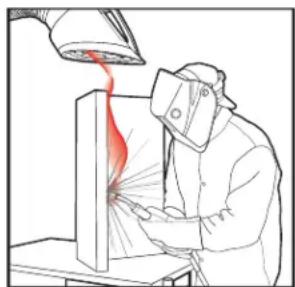
KEEP YOUR HEAD OUT OF THE FUMES.
DON'T get too close to the arc. Use corrective lenses if necessary to stay a reasonable distance away from the arc.
READ and obey the Safety Data Sheet (SDS) and the warning label that appears on all containers of welding materials.
USE ENOUGH VENTILATION or exhaust at the arc, or both, to keep the fumes and gases from your breathing zone and the general area.
natural_image
Illustration of a person in protective gear using a tool to spray or spray from a lamp (no text or symbols present)IN A LARGE ROOM OR OUTDOORS, natural ventilation may be adequate if you keep your head out of the fumes (See below).
USE NATURAL DRAFTS or fans to keep the fumes away from your face.
If you de velop unusual symptoms, see your supervisor. Perhaps the welding atmosphere and ventilation system should be checked.

natural_image
Silhouette of a person wearing a welding helmet and holding a tool, no text or symbols presentWEAR CORRECT EYE, EAR & BODY PROTECTION
PROTECT your eyes and face with welding helmet properly fitted and with proper grade of filter plate (See ANSI Z49.1).
PROTECT your body from welding spatter and arc flash with protective clothing including woolen clothing, flame-proof apron and gloves, leather leggings, and high boots.
PROTECT others from splatter, flash, and glare with protective screens or barriers.
IN SOME AREAS, protection from noise may be appropriate.
BE SURE protective equipment is in good condition.
Also, wear safety glasses in work area AT ALL TIMES.
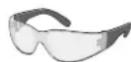
SPECIAL SITUATIONS
DO NOT WELD OR CUT containers or materials which previously had been in contact with hazardous substances unless they are properly cleaned. This is extremely dangerous.
DO NOT WELD OR CUT painted or plated parts unless special precautions with ventilation have been taken. They can release highly toxic fumes or gases.
Additional precautionary measures
PROTECT compressed gas cylinders from excessive heat, mechanical shocks, and arcs; fasten cylinders so they cannot fall.
BE SURE cylinders are never grounded or part of an electrical circuit.
REMOVE all potential fire hazards from welding area.
ALWAYS HAVE FIRE FIGHTING EQUIPMENT READY FOR IMMEDIATE USE AND KNOW HOW TO USE IT.

SECTION A: WARNINGS

CALIFORNIA PROPOSITION 65 WARNINGS

WARNING: Breathing diesel engine exhaust exposes you to chemicals known to the State of California to cause cancer and birth defects, or other reproductive harm.
- Always start and operate the engine in a well-ventilated area.
- If in an exposed area, vent the exhaust to the outside.
- Do not modify or tamper with the exhaust system.
- Do not idle the engine except as necessary.
For more information go to www.P65 warnings.ca.gov/diesel
WARNING: This product, when used for welding or cutting, produces fumes or gases which contain chemicals known to the State of California to cause birth defects and, in some cases, cancer. (California Health & Safety Code § 25249.5 et seq.)

WARNING: Cancer and Reproductive Harm www.P65warnings.ca.gov
ARC WELDING CAN BE HAZARDOUS. PROTECT YOURSELF AND OTHERS FROM POSSIBLE SERIOUS INJURY OR DEATH. KEEP CHILDREN AWAY. PACEMAKER WEARERS SHOULD CONSULT WITH THEIR DOCTOR BEFORE OPERATING.
Read and understand the following safety highlights. For additional safety information, it is strongly recommended that you purchase a copy of "Safety in Welding & Cutting - ANSI Standard Z49.1" from the American Welding Society, P.O. Box 351040, Miami, Florida 33135 or CSA Standard W117.2. A Free copy of "Arc Welding Safety" booklet E205 is available from the Lincoln Electric Company, 22801 St. Clair Avenue, Cleveland, Ohio 44117-1199.
BE SURE THAT ALL INSTALLATION, OPERATION, MAINTENANCE AND REPAIR PROCEDURES ARE PERFORMED ONLY BY QUALIFIED INDIVIDUALS.

FOR ENGINE POWERED EQUIPMENT.
1.a. Turn the engine off before troubleshooting and maintenance work unless the maintenance work requires it to be running.

1.b. Operate engines in open, well-ventilated areas or vent the engine exhaust fumes outdoors.
1.c. Do not add the fuel near an open flame welding arc or when the engine is running. Stop the engine and allow it to cool before refueling to prevent spilled fuel from vaporizing on contact

with hot engine parts and igniting. Do not spill fuel when filling tank. If fuel is spilled, wipe it up and do not start engine until fumes have been eliminated.
1.d. Keep all equipment safety guards, covers and devices in position and in good repair. Keep hands, hair, clothing and tools away from V-belts, gears, fans and all other moving parts when starting, operating or repairing equipment.

1.e. In some cases it may be necessary to remove safety guards to perform required maintenance. Remove guards only when necessary and replace them when the maintenance requiring their removal is complete. Always use the greatest care when working near moving parts.
1.f. Do not put your hands near the engine fan. Do not attempt to override the governor or idler by pushing on the throttle control rods while the engine is running.
1.g. To prevent accidentally starting gasoline engines while turning the engine or welding generator during maintenance work, disconnect the spark plug wires, distributor cap or magneto wire as appropriate.
1.h. To avoid scalding, do not remove the radiator pressure cap when the engine is hot.
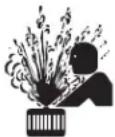
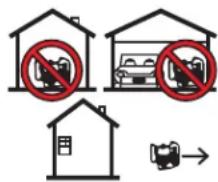
1.i. Using a generator indoors CAN KILL YOU IN MINUTES.
1.j. Generator exhaust contains carbon monoxide. This is a poison you cannot see or smell.
1.k. NEVER use inside a home or garage, EVEN IF doors and windows are open.
1.I. Only use OUTSIDE and far away from windows, doors and vents.
1.m. Avoid other generator hazards. READ MANUAL BEFORE USE.
text_image
Diagram showing three scenarios of a vehicle with no parking, including a house and a car, with an arrow indicating direction.
ELECTRIC AND MAGNETIC FIELDS MAY BE DANGEROUS
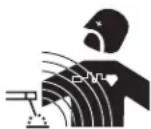
2.a. Electric current flowing through any conductor causes localized Electric and Magnetic Fields (EMF). Welding current creates EMF fields around welding cables and welding machines
2.b. EMF fields may interfere with some pacemakers, and welders having a pacemaker should consult their physician before welding.
2.c. Exposure to EMF fields in welding may have other health effects which are now not known.
2.d. All welders should use the following procedures in order to minimize exposure to EMF fields from the welding circuit:
2.d.1. Route the electrode and work cables together - Secure them with tape when possible.
2.d.2. Never coil the electrode lead around your body.
2.d.3. Do not place your body between the electrode and work cables. If the electrode cable is on your right side, the work cable should also be on your right side.
2.d.4. Connect the work cable to the workpiece as close as possible to the area being welded.
2.d.5. Do not work next to welding power source.
Safety 02 of 04 - 10/08/2021

ELECTRIC SHOCK CAN KILL.
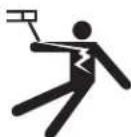
3.a. The electrode and work (or ground) circuits are electrically "hot" when the welder is on. Do
not touch these "hot" parts with your bare skin or wet clothing. Wear dry, hole-free gloves to insulate hands.
3.b. Insulate yourself from work and ground using dry insulation. Make certain the insulation is large enough to cover your full area of physical contact with work and ground.
In addition to the normal safety precautions, if welding must be performed under electrically hazardous conditions (in damp locations or while wearing wet clothing; on metal structures such as floors, gratings or scaffolds; when in cramped positions such as sitting, kneeling or lying, if there is a high risk of unavoidable or accidental contact with the workpiece or ground) use the following equipment:
- Semiautomatic DC Constant Voltage (Wire) Welder.
• DC Manual (Stick) Welder.
• AC Welder with Reduced Voltage Control.
3.c. In semiautomatic or automatic wire welding, the electrode, electrode reel, welding head, nozzle or semiautomatic welding gun are also electrically "hot".
3.d. Always be sure the work cable makes a good electrical connection with the metal being welded. The connection should be as close as possible to the area being welded.
3.e. Ground the work or metal to be welded to a good electrical (earth) ground.
3.f. Maintain the electrode holder, work clamp, welding cable and welding machine in good, safe operating condition. Replace damaged insulation.
3.g. Never dip the electrode in water for cooling.
3.h. Never simultaneously touch electrically "hot" parts of electrode holders connected to two welders because voltage between the two can be the total of the open circuit voltage of both welders.
3.i. When working above floor level, use a safety belt to protect yourself from a fall should you get a shock.
3.j. Also see It ems 6.c. and 8.

ARC RAYS CAN BURN.
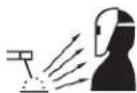
4.a. Use a shield with the proper filter and cover plates to protect your eyes from sparks and the rays of the arc when welding or observing open arc welding. Headshield and filter lens should conform to ANSI Z87. I standards.
4.b. Use suitable clothing made from durable flame-resistant material to protect your skin and that of your helpers from the arc rays.
4.c. Protect other nearby personnel with suitable, non-flammable screening and/or warn them not to watch the arc nor expose themselves to the arc rays or to hot spatter or metal.

5.a. Welding may produce fumes and gases hazardous to health. Avoid breathing these fumes and gases. When welding, keep your head out of the fume. Use enough ventilation and/or exhaust at the arc to keep fumes and gases away from the breathing zone. When welding hardfacing (see instructions on container or SDS) or on lead or cadmium plated steel and other metals or coatings which produce highly toxic fumes, keep exposure as low as possible and within applicable OSHA PEL and ACGIH TLV limits using local exhaust or mechanical ventilation unless exposure assessments indicate otherwise. In confined spaces or in some circumstances, outdoors, a respirator may also be required. Additional precautions are also required when welding on galvanized steel.
- b. The operation of welding fume control equipment is affected by various factors including proper use and positioning of the equipment, maintenance of the equipment and the specific welding procedure and application involved. Worker exposure level should be checked upon installation and periodically thereafter to be certain it is within applicable OSHA PEL and ACGIH TLV limits.
5.c. Do not weld in locations near chlorinated hydrocarbon vapors coming from degreasing, cleaning or spraying operations. The heat and rays of the arc can react with solvent vapors to form phosgene, a highly toxic gas, and other irritating products.
5.d. Shielding gases used for arc welding can displace air and cause injury or death. Always use enough ventilation, especially in confined areas, to insure breathing air is safe.
5.e. Read and understand the manufacturer's instructions for this equipment and the consumables to be used, including the Safety Data Sheet (SDS) and follow your employer's safety practices. SDS forms are available from your welding distributor or from the manufacturer.
5.f. Also see item 1.b.

WELDING AND CUTTING SPARKS CAN CAUSE FIRE OR EXPLOSION.
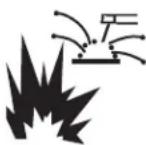
6.a. Remove fire hazards from the welding area. If this is not possible, cover them to prevent the welding sparks from starting a fire. Remember that welding sparks and hot materials from welding can easily go through small cracks and openings to adjacent areas. Avoid welding near hydraulic lines. Have a fire extinguisher readily available.
6.b. Where compressed gases are to be used at the job site, special precautions should be used to prevent hazardous situations. Refer to "Safety in Welding and Cutting" (ANSI Standard Z49.1) and the operating information for the equipment being used.
6.c. When not welding, make certain no part of the electrode circuit is touching the work or ground. Accidental contact can cause overheating and create a fire hazard.
6.d. Do not heat, cut or weld tanks, drums or containers until the proper steps have been taken to insure that such procedures will not cause flammable or toxic vapors from substances inside. They can cause an explosion even though they have been "cleaned". For information, purchase "Recommended Safe Practices for the Preparation for Welding and Cutting of Containers and Piping That Have Held Hazardous Substances", AWS F4.1 from the American Welding Society (see address above).
6.e. Vent hollow castings or containers before heating, cutting or welding. They may explode.
6.f. Sparks and spatter are thrown from the welding arc. Wear oil free protective garments such as leather gloves, heavy shirt, cuffless trousers, high shoes and a cap over your hair. Wear ear plugs when welding out of position or in confined places. Always wear safety glasses with side shields when in a welding area.
6.g. Connect the work cable to the work as close to the welding area as practical. Work cables connected to the building framework or other locations away from the welding area increase the possibility of the welding current passing through lifting chains, crane cables or other alternate circuits. This can create fire hazards or overheat lifting chains or cables until they fail.
6.h. Also see item 1.c.
6.I. Read and follow NFPA 51B "Standard for Fire Prevention During Welding, Cutting and Other Hot Work", available from NFPA, 1 Batterymarch Park, PO box 9101, Quincy, MA 022690-9101.
6.j. Do not use a welding power source for pipe thawing.

CYLINDER MAY EXPLODE IF DAMAGED.
7.a. Use only compressed gas cylinders containing the correct shielding gas for the process used and properly operating regulators designed for the gas and pressure used. All hoses, fittings, etc. should be suitable for the application and maintained in good condition.
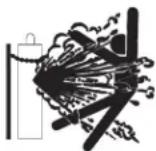
7.b. Always keep cylinders in an upright position securely chained to an undercarriage or fixed support.
7.c. Cylinders should be located:
- Away from areas where they may be struck or subjected to physical damage.
- A safe distance from arc welding or cutting operations and any other source of heat, sparks, or flame.
7.d. Never allow the electrode, electrode holder or any other electrically "hot" parts to touch a cylinder.
7.e. Keep your head and face away from the cylinder valve outlet when opening the cylinder valve.
7.f. Valve protection caps should always be in place and hand tight except when the cylinder is in use or connected for use.
7.g. Read and follow the instructions on compressed gas cylinders, associated equipment, and CGA publication P-I, "Precautions for Safe Handling of Compressed Gases in Cylinders," available from the Compressed Gas Association, 14501 George Carter Way Chantilly, VA 20151.

FOR ELECTRICALLY POWERED EQUIPMENT.
8.a. Turn off input power using the disconnect switch at the fuse box before working on the equipment.
8.b. Install equipment in accordance with the U.S. National Electrical Code, all local codes and the manufacturer's recommendations.
8.c. Ground the equipment in accordance with the U.S. National Electrical Code and the manufacturer's recommendations.
Refer to
http://www.lincolnelectric.com/safety for additional safety information.
TABLE OF CONTENTS
PAGE
INSTALLATION...... Section A
TECHNICAL SPECIFICATIONS - ......A-1
ENVIRONMENTAL RATING A-1
LOCATION AND MOUNTING....A-1
GENERATOR REQUIREMENTS....A-1
CASE FRONT CONTROLS....A-2
CASE BACK CONTROLS....A-2
INTERNAL CONTROLS....A-3
OPERATION .... Section B
HIGH FREQUENCY PROTECTION......B-1
GRAPHIC SYMBOLS USED IN THIS MANUAL OR BY THIS MACHINE....B-1
SETTING UP AND MAKING A MIG WELD......B-2
INPUT AND GROUND CONNECTIONS......B-2
GUN AND CABLE INSTALLATION......B-3
SHIELDING GAS (FOR MIG ARC WELDING PROCESSES)...... B-3
OUTPUT POLARITY CONNECTIONS......B-4
PROCEDURE FOR CHANGING DRIVE ROLL......B-5
POWER-UP SEQUENCE......B-5
CURRENT OR VOLTAGE BASED ON DIAL POSITION......B-6
.035 MIG WIRE, .035 OUTERSHIELD 71M, .035 NR-211MP PROCEDURES...... B-6
TIG SETUP AND USE......B-7
OPTIONS AND ACCESSORIES......Section C
MAINTENANCE .... Section D
ROUTINE MAINTENANCE....D-1
PERIODIC MAINTENANCE....D-2
TROUBLESHOOTING...... Section E
PARTS LIST ...... PARTS.LINCOLNELECTRIC.COM
CONTENT/DETAILS MAY BE CHANGED OR UPDATED WITHOUT NOTICE. FOR MOST CURRENT INSTRUCTION MANUALS, GO TO PARTS.LINCOLNELECTRIC.COM.
GENERAL DESCRIPTION
This multi-process welding machine is intended for light fabrication, maintenance, home and auto-body shops. The unit is housed in a portable and rugged case, and features an intuitive user interface with a push button for selecting processes and two knobs for adjusting welding parameters. The machine also features a cast aluminum wire drive system for reliable wire feeding and an integrated switch for activating a Magnum® 100SG spool gun. The multi-process machine is designed to be connected to 120 or 230VAC single phase 60 Hz power.
This machine is capable of MIG, FCAW, TIG, and STICK welding. The machine can support 4-inch and 8-inch spools of wire for MIG and FCAW welding. The machine is intended for the following wire diameters and composition; SuperArc® L-56® .025" through .035" solid steel, self-shielded NR®-211MP .030", .035", and .045" and Outershield® 71M .035" FCAW-GS. Welding aluminum ER4043 .035" requires use of the Magnum® 100SG Spool Gun. An integrated spool gun switch is pre-installed from the factory and located above the wire drive. The machine also permits TIG welding with .040, 1/16" and 3/32" tungsten and STICK welding with up to 1/8" electrode.
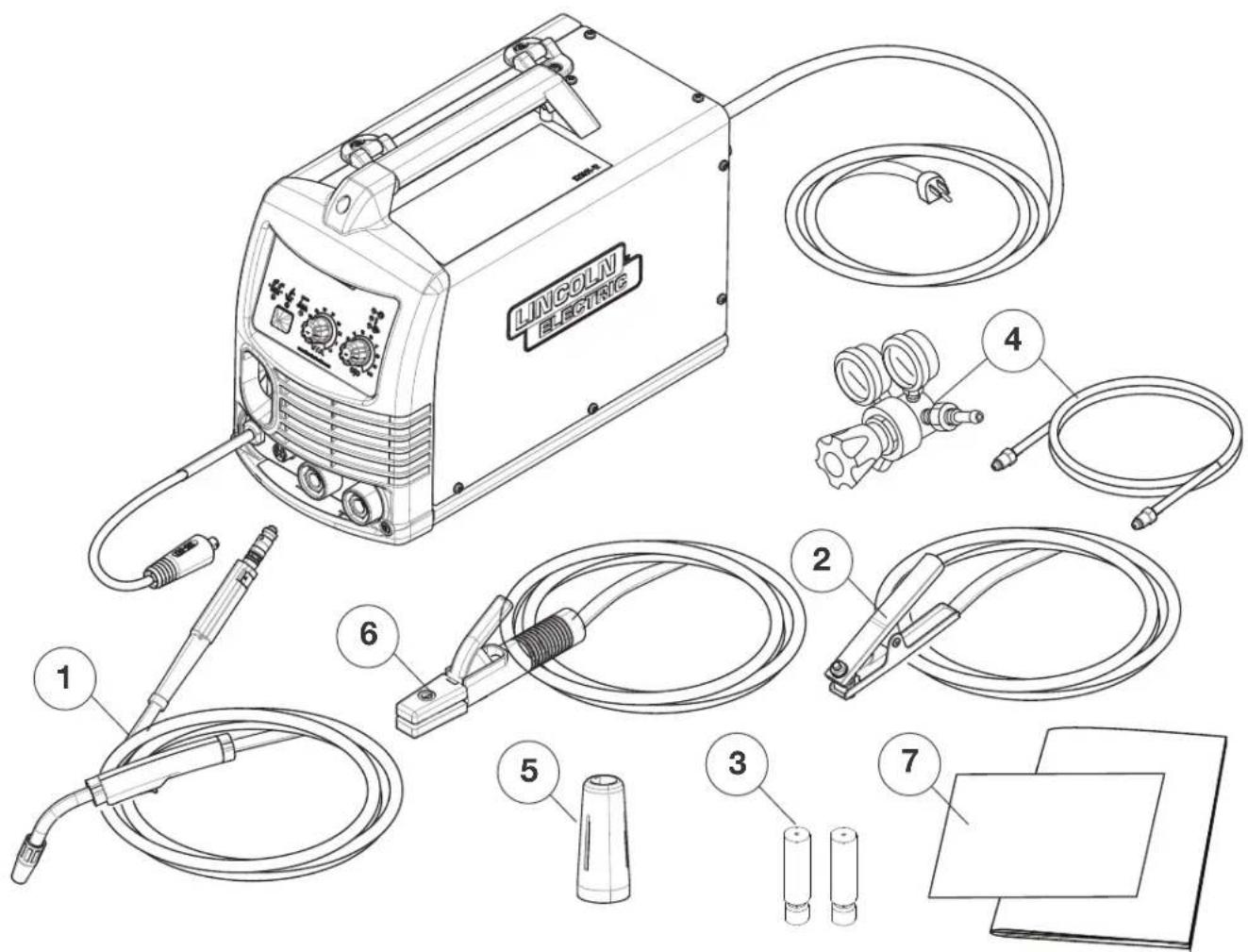
INCLUDED ACCESSORIES
1 Magnum ® 100L gun
2 Work cable with clamp
3 Spare contact tips
4 Gas regulator* and gas hose
5 Gas and gasless nozzle
6 Electrode holder and cable
7 Quick Start guide and literature
* The gas regulator knob is located in the wire drive compartment and must be assembled to the regulator.
text_image
LINCOLN ELECTRIC 1 2 3 4 5 6 7INSTALLATION
TECHNICAL SPECIFICATIONS -
INPUT VOLTAGE AND CURRENT
| Duty Cycle (Output) | Input Voltage | Input Amperes Max | Idle Amps |
| 60% FOR MIG | 20 20 .7 | ||
| 30% FOR MIG | 230 | 22.5 | .7 |
RECOMMENDED INPUT WIRE AND FUSE SIZES
| Voltage/Phase/Frequency | Input Amperes Effective | Fuse (Super Lag) or Breaker Size |
| 120/1/60 15 20230/1/60 | 15 | 20 |
PHYSICAL DIMENSIONS
| Height Width Depth Weight | |||
| 13.6”(345MM) | 8.9”(224MM) | 18.1”(460MM) | 34.5 LBS.(15.6 KG) |
WELDING PROCESSES
| Process | Electrode Diameter Range | Output Range (Amperes) | Wire Feed Speed Range |
| MIG | .025-.035" (0.6-0.9MM) | 20-180 | 40-450 IPM (MIG) 40-500 IPM (Spool) |
| FCAW | .030-.045" (0.8-1.143MM) | 20-180 40- | 450 IPM |
| TIG | .040, 1/16, 3/32" (1.0, 1.6MM, 2.4MM) | 10-180A | |
| STICK | UP TO 3/32" (2.4MM) | 25-180 |
TEMPERATURE RANGES
| Operating Temperature | -4°F TO 104°F (-20°C TO 40°C) |
| Storage Temperature | -40°F TO 185°F (-40°C TO 85°C) |
Thermal tests have been performed at ambient temperature. The duty cycle (duty factor) at 40^ C has been determined by simulation.
SELECT SUITABLE LOCATION
Place the machine on a secure, level surface or recommended undercarriage. The machine may topple over if this procedure is not followed. To minimize over heating, locate the welder in a dry location where there is free circulation of clean air. Do not place on combustible surfaces.
WELDING PROCESSES
| Process | Input | Duty Cycle | Amperage | Voltage |
| MIG & FCAW | 120V | 60% | 95 AMPS | 18.75 VOLTS |
| 230V | 30% | 165 AMPS | 22 VOLTS | |
| TIG | 120V | 60% | 115 AMPS | 14.6 VOLTS |
| 230V | 30% | 165 AMPS | 16.6 VOLTS | |
| STICK | 120V | 60% | 80 AMPS | 23.2 VOLTS |
| 230V | 25% | 160 AMPS | 26.4 VOLTS |
The machine is capable of higher duty cycles at lower output currents or higher amperages at lower duty cycles. An overview of the machine's input and output capabilities are available on the rating plate located on the back of the machine.
REGULATORY REQUIREMENTS
| Market | Conformity Mark | Standard |
| USA AND CANADA | _cCSA_US | IEC 60974-1IEC 60974-5 |
LOCATION AND MOUNTING
The welding machine will operate in harsh environments. Even so, it is important that preventative measures are followed in order to assure long life, reliability, and safe operation.
- The welding machine must be located in an area with circulation of clean air such that air moves in the back of the machine and out the front louvers.
- Dirt and dust that can be drawn into the welding machine should be kept to a minimum. Failure to observe these precautions can result in excessive operating temperatures, nuisance thermal trips and potential failures.
ENVIRONMENTAL RATING
The welding power source carries an IP21S rating. It may be used in normal industrial and commercial environments. Avoid using in areas where water / rain is present.
Read and follow the ‘Electric Shock Warnings’ in the safety section if welding must be performed under electrically hazardous conditions such as welding in wet areas or water on the work piece.
ENGINE DRIVEN GENERATOR
The machine is designed to operate on engine driven generators as long as the auxiliary can supply adequate voltage, frequency and power as indicated in the “Technical Specification” Installation Section of this manual. The auxiliary supply of the generator must also meet the following conditions:
Frequency: 60 Hz
RMS voltage of the AC waveform: 90-250 V; Out of this range will trigger undervoltage and overvoltage protections.
Generator Minimum 3 kW (120VAC) 6kW (230VAC)
It is important to check these conditions because many engine driven generators produce high voltage spikes. Operation of this machine with engine driven generators not conforming to these conditions is not recommend and may damage the machine and is also NOT covered by warranty.
text_image
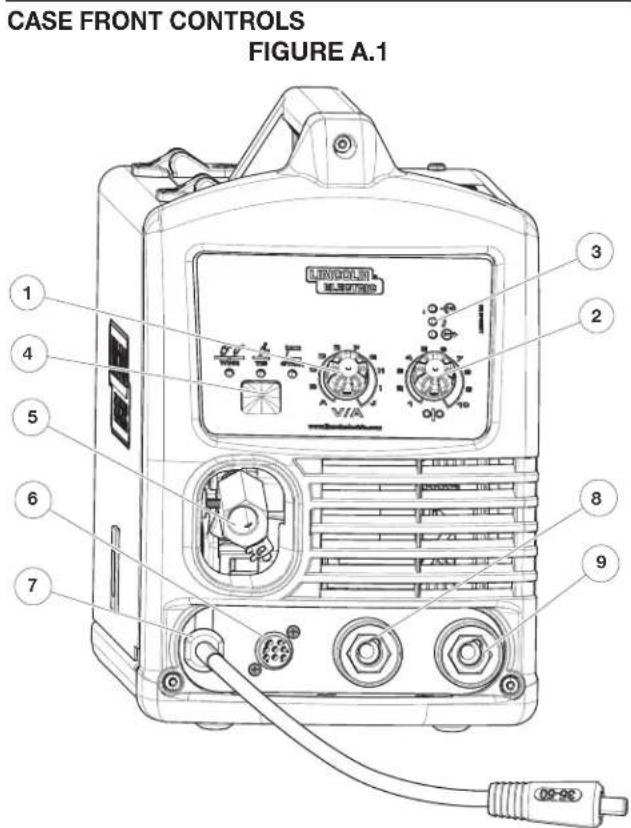
CASE FRONT CONTROLS FIGURE A.1 1 2 3 4 5 6 7 8 9-
Voltage/Amperage Adjustment Knob – While in WIRE mode, this knob adjusts the value of the voltage output. While in TIG or STICK mode, this knob adjusts the value of the amperage output.
-
Wire Feed Speed Adjustment Knob – While in WIRE mode, this knob adjusts the wire feed speed setting. While in TIG or STICK mode, this knob is inactive.
-
Input/Output Voltage and Temperature LEDs – The top LED will illuminate when Input power is present and the machine is turned on. The middle LED will illuminate when the machine has thermally tripped. Once the machine has cooled, the machine will reset and the thermal light will turn off. The middle LED will flash if the input voltage is above 250 VAC or below 90 VAC. The middle LED will also flash when power is removed from the machine. The bottom LED illuminates when the machine is welding or ready to weld. Safety precautions must be followed when the machine is welding or ready to weld. The bottom LED will flash when a short is present.
-
Process Selection Button – Allows the user to toggle between processes. The corresponding LED above the button will indicate the current process.
-
Brass Gun connection—Permits attachment of a MIG welding gun, TIG torch or spool gun. Ensure the gun or torch is fully seated into the brass receptacle and tighten the thumb screw.
-
Eight Pin Connector – Permits triggering the machine for MIG, FCAW, aluminum MIG or TIG welding when a foot pedal is attached. Also triggers gas flow for MIG, aluminum MIG, and TIG. Connect the 8-pin connector present on the welding gun or foot pedal to the receptacle.
-
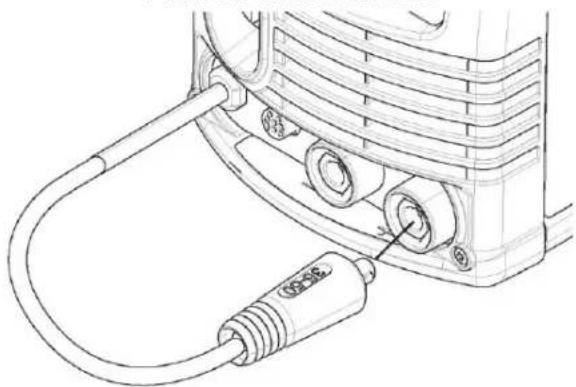
Wire Drive Polarity Lead – Permits configuring the wire drive to positive or negative polarity by inserting into the positive or negative receptacle. Ensure connector is tightly locked into place by rotating clockwise.
- Negative Output Receptacle – Permits attaching a work lead, electrode stinger, or the center wire drive polarity lead to DC negative polarity. Rotate connector clockwise to lock into place.
- Positive Output Receptacle – Permits attaching a work lead, electrode stinger, or the center wire drive polarity lead to DC positive polarity. Rotate clockwise to lock into place.
CASE BACK CONTROLS
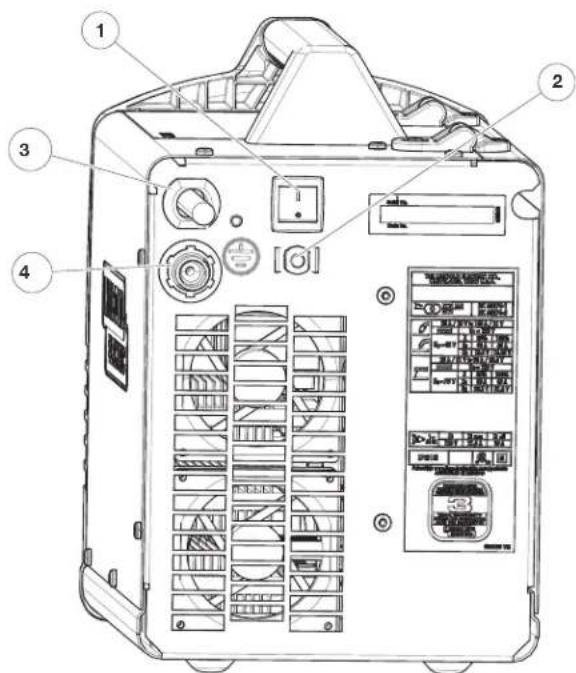
FIGURE A.2
text_image
Technical diagram of a device rear panel with labeled components including ports, switches, and control panels- Power Switch – Permits turning the machine on or off.
- Thermal Breaker – The welding machine features a resettable 25amp thermal breaker. If the current conducted through the breaker exceeds 25 amps for an extended period of time, the breaker will open and require manual reset.
- Input Power Cord – Permits the machine to be connected to 230VAC input. An adapter is provided for connecting to 120VAC input.
- Integrated gas solenoid – permits connecting the proper shielding gas
INTERNAL CONTROLS
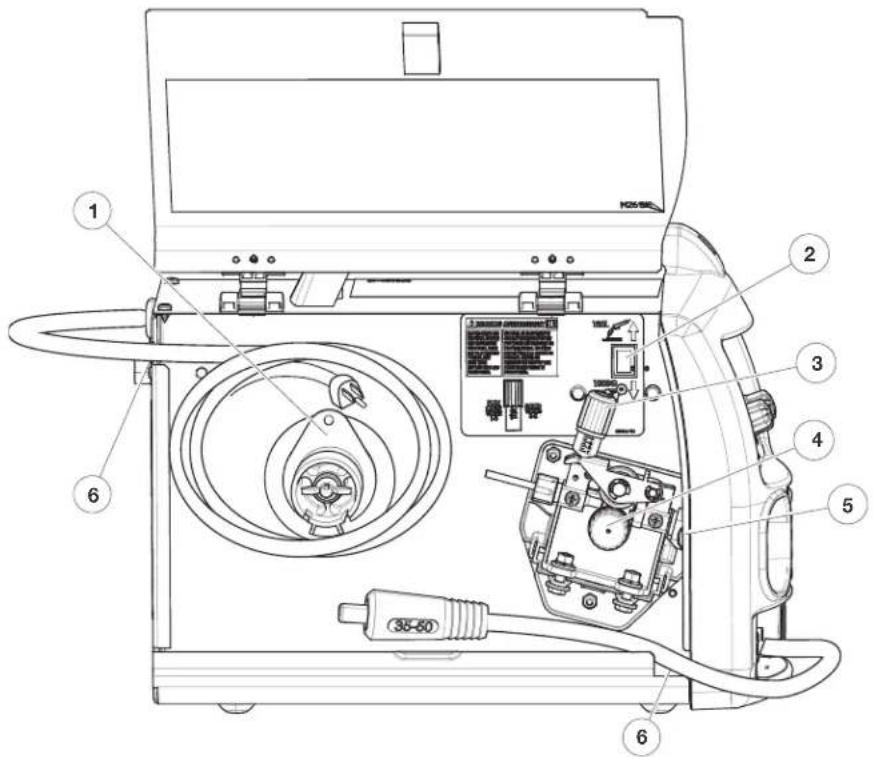
FIGURE A.3
text_image
Technical diagram of a device with numbered components, likely an industrial or electronic device assembly.- Wire Drive Spindle – Supports a 4-inch or 8-inch spool of wire. The center wing-nut can be adjusted to increase tension on the wire. For 4-inch spools, the hub adapter must be removed.
- Spool Gun Switch – Permits toggling between standard push gun welding with the Magnum® 100L or aluminum welding with the Magnum® 100SG Spool Gun.
- Wire Drive Tension Pressure Adjustment – Permits increasing or decreasing the pressure applied to the top drive roll.
- Replaceable drive roll - Select the correct drive roll groove for the wire diameter being fed.
- Gun Connector Block – Permits securing a welding gun to the wire drive by ensuring the gun connector is fully seated, then tightening the knob.
- Cutouts— A cut out in case back and side allows the input cord and wire drive polarity lead to be coiled and placed in the wire drive compartment for ease of transportation.
OPERATION
Read and understand this entire section before operating your machine
snoituacerP ytefaS
Do not attempt to use this equipment until you have thoroughly read all operating and maintenance manuals supplied with your equipment and any related welding machine it will be used with. They include important safety precautions, operating and maintenance instructions and parts lists.

WARNING
ELECTRIC SHOCK can kill.
- Do not touch electrically live parts such as output receptacles or internal wiring.
• Insulate yourself from the work and ground.
• Always wear dry insulating gloves.
• This welder must be grounded to earth

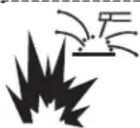
WELDING SPARKS can cause fire or explosion.
- Keep flammable material away.
- Do not weld upon containers which have held combustibles.
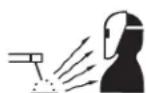
ARC RAYS can burn.
- Wear eye, ear and body protection.
FUMES AND GASES can be dangerous.
Although the removal of the particulate matter from welding smoke may reduce the ventilation requirement, concentrations of the clear exhausted fumes and gases may still be hazardous to health. Avoid breathing concentrations of these fumes and gases. Use adequate ventilation when welding. See ANSI Z49.1, "Safety in Welding and Cutting", published by the American Welding Society.

HIGH FREQUENCY PROTECTION

CAUTION
The high frequency generator being similar to a radio transmitter may cause interference to radio, TV and other electronic equipment.
- These problems may be the result of radiated interference. Proper grounding methods can reduce or eliminate this.
During operation, distance the welding machine from radio controlled machinery. The normal operation of the welding machine may adversely affect the operation of RF controlled equipment, which may result in bodily injury or damage to the equipment.
GRAPHIC SYMBOLS USED IN THIS MANUAL OR BY THIS MACHINE

INPUT POWER
U_0
OPEN CIRCUIT VOLTAGE
|
ON
U1
INPUT VOLTAGE

OFF
U2
OUTPUT VOLTAGE
1
INPUT CURRENT

HIGH TEMPERATURE
l2
OUTPUT CURRENT

CIRCUIT BREAKER

이오
WIRE FEEDER STATUS


POSITIVE OUTPUT

-
NEGATIVE OUTPUT

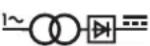
INVERTER


INPUT POWER

[EMPTY]
DIRECT CURRENT
PROTECTIVE GROUND
WARNING OR CAUTION
EXPLOSION
DANGEROUS VOLTAGE
SHOCK HAZARD
READ INSTRUCTION MANUAL
SETTING UP AND MAKING A MIG WELD WITH .025 MIG WIRE
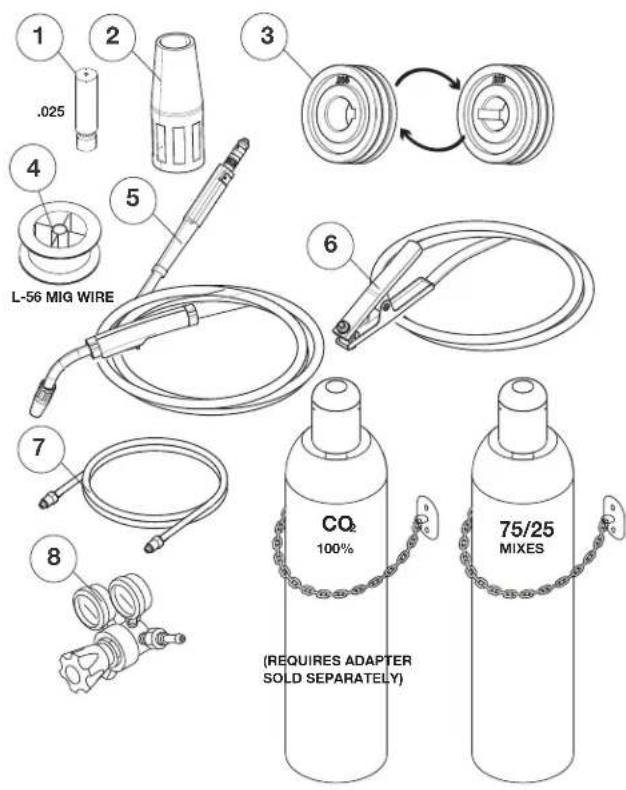
A. Items needed for MIG welding
- 025"(0.6mm) Contact Tip
- Metal gun nozzle
- Factory Installed Dual-groove Drive Roll
- .025"(0.6mm) SuperArc ^ L-56 ^ Solid MIG Wire
- Welding Gun
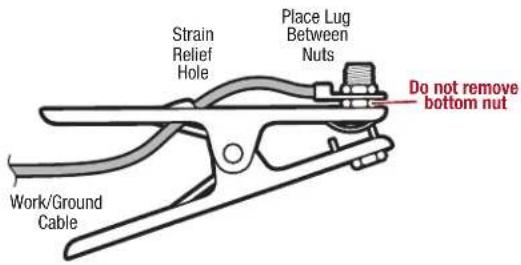
- Work Cable & Clamp (see assembly below)
- Gas Line
- Gas Regulator
Bottle of 75/25 Ar/CO 2 shielding gas or 100% CO 2 shielding gas (note this requires a CO _2 regulator adapter which is sold separately.
FIGURE B.1
text_image
1 .025 2 3 L-56 MIG WIRE 4 5 6 7 8 CO₂ 100% (REQUIRES ADAPTER SOLD SEPARATELY) 75/25 MIXESWORK CLAMP ASSEMBLY
text_image
Strain Relief Hole Place Lug Between Nuts Do not remove bottom nut Work/Ground CableINPUT AND GROUND CONNECTIONS
- Before starting the installation, check with the local power company if there are any questions about whether your power supply is adequate for the voltage, amperes, phase, and frequency specified on the welder rating plate. Also be sure the planned installation will meet the U.S. National Electrical Code and local code requirements.
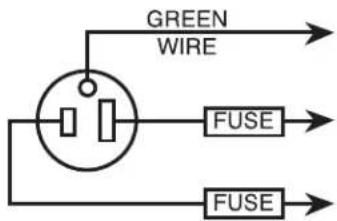
- Using the instructions in Figure B.2, have a qualified electrician connect a receptacle (Customer Supplied) or cable to the input power lines and the system ground per the U.S. National Electrical Code and any applicable local codes. For cords over 100 foot, larger copper conductors should be used. Fuse the two hot lines with super lag type fuses as shown in the following diagram. The center contact in the receptacle is for the grounding connection. A green wire in the input cable connects this contact to the frame of the welder. This ensures proper grounding of the welder frame when the welder plug is inserted into a grounded receptacle.
FIGURE B.2
text_image
GREEN WIRE FUSE FUSEConnect to a system grounding wire. See the United States National Electrical Code and/or local codes for other details and means for proper grounding. Connect to hot wires of a three-wire, single phase system.

WARNING
This welding machine must be connected to a power source in accordance with applicable electrical codes.

WARNING
Do not connect the machine to an input power supply with a rated voltage that is greater than 250 volts.
Do not remove the power cord ground prong.
EXTENSION CORD USAGE
If an extension cord is required, use one that is rated for the application and is 3 conductor #14 AWG (2.1 mm ^2 ) or larger. The recommended maximum lengths are 25 ft (7.5 m) if #14 AWG (2.1 mm ^2 ) is used and 50 ft (15 m) if #12 AWG (3.3 mm ^2 ) is used.
GUN AND CABLE INSTALLATION
The Magnum 100L gun and cable provided with the welding machine is factory installed with a liner for .025-.035" (0.6-0.9mm) wire and an .035" (0.9mm) contact tip. The user should ensure that the contact tip, liner, and drive rolls match the size of the wire being used. For .030 wire, use the .035 drive roll configuration.

WARNING
Turn the welder power switch "off" before installing gun and cable.
- Lay the cable straight.
- Unscrew the hand screw which is threading into the gun adapter.
- Insert the male end of the gun into the female end of the gun adapter through the opening in the front panel. Ensure the connector is fully inserted. Then tighten the hand screw.
- Connect the gun trigger connector from the gun and cable to the mating receptacle located on the machine case front. Make sure that the keyways are aligned, insert and tighten the retaining ring.
SHIELDING GAS (FOR MIG ARC WELDING PROCESSES)
Customer must provide cylinder of appropriate type shielding gas for the process being used.
A gas flow regulator, for Argon Blend gas, and an inlet gas hose are factory provided with the welding machine. When using 100% CO _2 an additional adapter will be required to connect the regulator to the gas bottle. Aluminum welding with a spool gun requires 100% Argon shielding gas.

WARNING
CYLINDER may explode if damaged. Keep cylinder upright and chained to support
- Keep cylinder away from areas where it may be damaged.
- Never lift welder with cylinder attached.
- Never allow welding electrode to touch cylinder.
- Keep cylinder away from welding or other live electrical circuits.
Install Shielding gas supply as follows:
- Set the gas cylinder on a flat surface and secure the cylinder to a sturdy structure to prevent the cylinder from falling over.
- Remove the cylinder cap. Inspect the cylinder valves and regulator for damaged threads, dirt, dust, oil, or grease. Remove dust and dirt with a clean cloth.
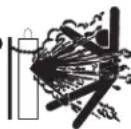
DO NOT ATTACH THE REGULATOR IF OIL, GREASE, OR DAMAGE IS PRESENT! Inform your gas supplier of this condition. Oil or grease in the presence of high pressure oxygen is explosive.

WARNING
BE SURE TO KEEP YOUR FACE AWAY FROM THE VALVE OUTLET WHEN "CRACKING" THE VALVE.
Never stand directly in front of or behind the flow regulator when opening the cylinder valve. Always stand to one side.
The user should distance his or her body from the valve outlet when “cracking” the valve.
-
Stand to one side away from the outlet and open the cylinder valve for an instant. This will eradicate any dust or dirt which may have accumulated in the valve outlet.
-
Attach the flow regulator to the cylinder valve and tighten the union nut(s) securely with a wrench.
NOTE: If connecting to 100% CO 2 cylinder, an additional regulator adapter must be installed between the regulator and cylinder valve. If adapter is equipped with a plastic washer, be sure it is seated for connection to the CO 2 cylinder.
-
Attach one end of the inlet gas hose to the outlet fitting of the flow regulator, the other end to the welding machine's rear fitting, and tighten the union nuts with a wrench.
-
Before opening the cylinder valve, turn the regulator adjusting knob counterclockwise until the adjusting spring pressure is released.
- While standing to one side, open the cylinder valve slowly a fraction of a turn. When the cylinder pressure gauge pointer stops moving, open the valve fully.

WARNING
BE SURE TO KEEP YOUR FACE AWAY FROM THE VALVE OUTLET WHEN "CRACKING" THE VALVE.
Never stand directly in front of or behind the flow regulator when opening the cylinder valve. Always stand to one side.
- The flow regulator is adjustable. Adjust the regulator to the flow rate recommended for the procedure and process.

WARNING
BUILDUP OF SHIELDING GAS may harm health or kill.
Shut off shielding gas supply when not in use.

OUTPUT POLARITY CONNECTIONS
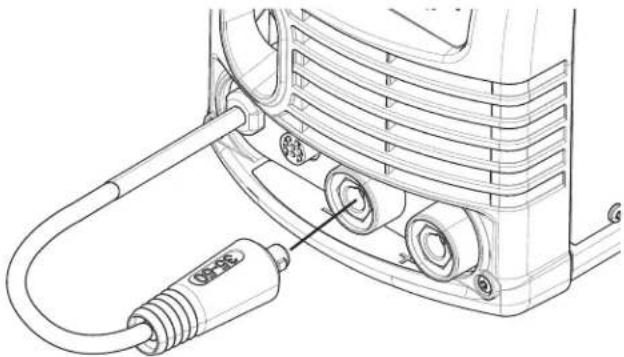
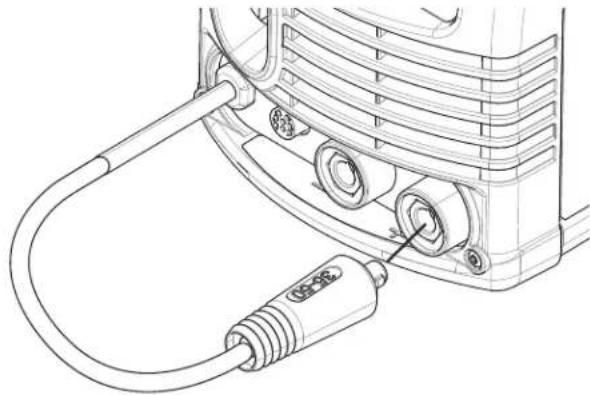
The welding machine features a short lead protruding from the front of the machine, the lead can be used to configure the wire drive polarity. For STICK welding the short lead does not need to be connected and this lead will not be electrically hot. For FCAW, MIG, and TIG welding this lead can be connected to either the positive output stud or negative output stud. Connecting the lead to the positive stud will electrically connect the wire drive to positive polarity; the work clamp would then connect to the negative stud. Ensure connector is tightly locked into place by rotating clockwise.
FIGURE B.3 WIRE DRIVE CONNECTED FOR NEGATIVE POLARITY
natural_image
Technical line drawing of a mechanical component with a coiled cable and attached housing (no text or symbols)FIGURE B.4 WIRE DRIVE CONNECTED FOR POSITIVE POLARITY
natural_image
Technical line drawing of a device with attached cable and connector (no text or symbols)PROCEDURE FOR CHANGING DRIVE ROLL
- Turn off the power source.
- Release the pressure on the idle roll by swinging the adjustable pressure arm down toward the back of the machine, allowing the tensioner to spring open.
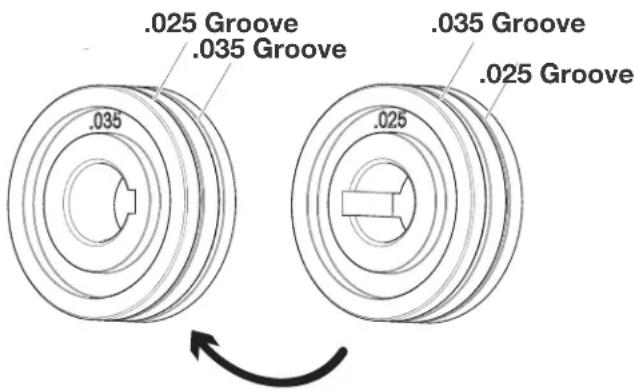
- Remove the drive roll retaining hand screw by turning counter clockwise and remove the drive roll.
- Remove and reinstall the drive roll based on wire to be used.
NOTE: be sure that the gun liner and contact tip are also sized to match the selected wire size. - Manually feed the wire from the wire reel, through the wire guide, over the drive roll groove, and into the back of the gun adapter and gun and cable assembly.
- Swing the tensioner back onto the wire and reposition the adjustable pressure arm to its original position to apply pressure. Adjust pressure as necessary.
| DRIVE ROLLS | ||
| Wire Diameter & Type | Smooth Drive Roll (Dual Grooves) | Drive Roll Part Number |
| .025"(0.6mm) MIG wire | Use .025"(0.6mm) Drive Roll Groove | KP2948-1 |
| .030"(0.8mm) MIG wire | Use .035"(0.9mm) Drive Roll Groove | |
| .035"(0.9mm) MIG wire | ||
| .030"(0.8mm) flux-cored | ||
| .035"(0.9mm) flux-cored | ||
| .045"(1.1mm) flux-cored | .045"(1.1mm) | KP3285-1 |
FIGURE B.5
text_image
.025 Groove .035 Groove .035 .025 .035 Groove .025 GroovePOWER-UP SEQUENCE
- Check that the electrode polarity is correct for the process being used. Refer to the quick start guide for polarity. Then turn the power switch ON. The fans will come on and stay on until power to the machine is removed.
- Configure the machine for the desired process and application. Use the Process Selection Button to select the desired welding process (WIRE, STICK, TIG). Use the adjustment knobs to set the parameters specified by the Procedure Decal for your desired welding condition.
- If you are running a WIRE process, remove the contact tip, then feed the wire through the liner to the gun tip. Replace the contact tip then cut the wire within approximately 3/8" (10 mm) from the end of the contact tip.
- If shielding gas is to be used, turn on the gas supply and set the gas to the required flow rate as specified by the Procedure Decal located on the door.
- When using an Innershield electrode, the gas nozzle may be removed and replaced with the gasless nozzle. This will provide increased visibility and eliminate the possibility of the gas nozzle overheating.
- Connect the work cable to the metal to be welded. The work clamp must make a good electrical contact with the piece being welded. The work must also be grounded as stated in "Arc Welding Safety Precautions."
For additional output ratings reference the rating plate present on the back of the machine.
The duty cycle is the “on” time (based on a 10 minute interval) the user can weld with the machine at a specific output without causing a thermal trip.
Example: 60% duty cycle means welding at a specified output for 6 constant minutes and needing 4 minutes of “off” time before welding again.
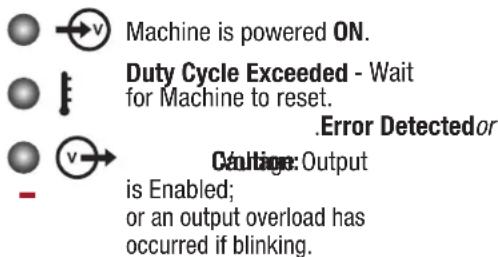
If the duty cycle of the machine is exceeded, then the machine will thermally trip and the Thermal LED will Illuminate. The machine must cool down before welding can be performed.
text_image
Machine is powered ON. Duty Cycle Exceeded - Wait for Machine to reset. .Error Detected or Cautige: Output is Enabled; or an output overload has occurred if blinking.Input Line Voltage Variations
High Line Voltage/Low Line Voltage – The welding machine will operate between 90 and 250 VAC 60 Hz. If the input voltage is too low or too high then the thermal LED will blink.
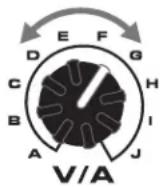
CURRENT OR VOLTAGE BASED ON DIAL POSITIONS
| Input Voltage | Knob Position A B C D E | F G H I J | |||||||||
| 230V | MIG Volts | 1314 | 115.2 | 216.31 | 7.418 | 619.8 | 212 | 2.223.7 | |||
| 120V | MIG Volts | 1314 | 115.2 | 216.31 | 7.418 | 619.8 | 2121 | 521.5 | |||
| 230V | STICK Output Current | 2540 | 5570 | 85100 | 11513 | 01451 | 62 | ||||
| 120V | STICK Output Current | 2527 | 3040 | 50607 | 080 | 85 | 90 | ||||
| 230V | TIG Output Current | 10 | 27 | 446 | 7895 | 1213 | 01501 | 67 | |||
| 120V | TIG Output Current | 1025 | 4055 | 70809 | 51051 | 15120 | |||||
Values listed in the table are approximate and should be used for reference only
If a foot pedal is used for TIG welding then the output current can be adjusted between 10 amps and maximum current determined by the position of the dial
TIG SETUP AND USE
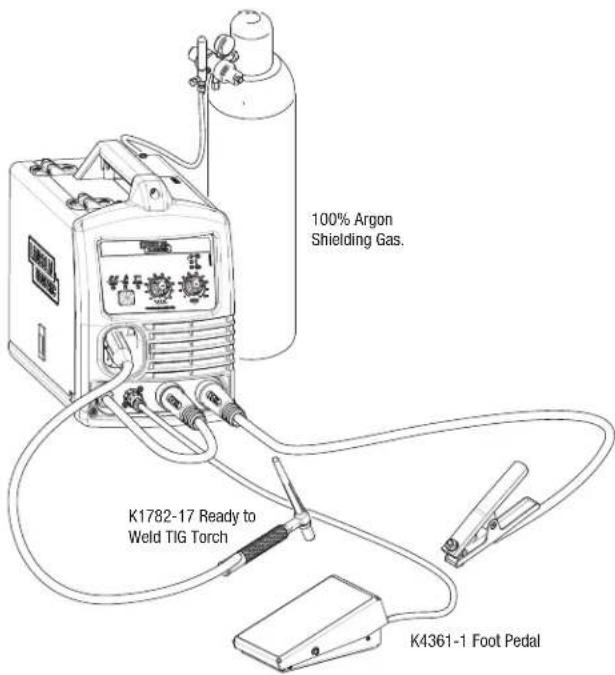
Procedure for TIG welding with a Foot Pedal
TIG welding with a foot pedal requires a Lincoln Electric K1782-16 or K1782-17 Ready to Weld TIG Torch, a K4361-1 Foot Pedal and a bottle of 100% Argon Shielding Gas. The foot pedal permits the output current to be adjusted while welding. The foot pedal can be used to initiate the welding output and the flow of argon shielding gas. The machine will automatically detect when the foot pedal is connected and set the machine to TIG mode.
Connect the Items to the machine as shown below
FIGURE B.6
text_image
100% Argon Shielding Gas. K1782-17 Ready to Weld TIG Torch K4361-1 Foot PedalThe welding arc current will be determined by the position of the foot pedal and the position of the V/A dial present on the front of the machine. In order to achieve maximum output, the V/A dial must be set to the letter "J" position and the foot pedal must be fully closed. Lower outputs can be achieved by reducing the V/A dial or by reducing the pressure on the foot pedal. To start the welding arc, lightly touch the tungsten to the piece that is to be welded and then press the foot pedal. Slowly pull or rock the tungsten off the work piece and the welding arc will initiate. After the foot pedal is released the shielding gas will continue to flow for 8 seconds. This post flow period is used to prevent contamination to the tungsten while the tungsten is still warm and to prevent contamination of the weld puddle.
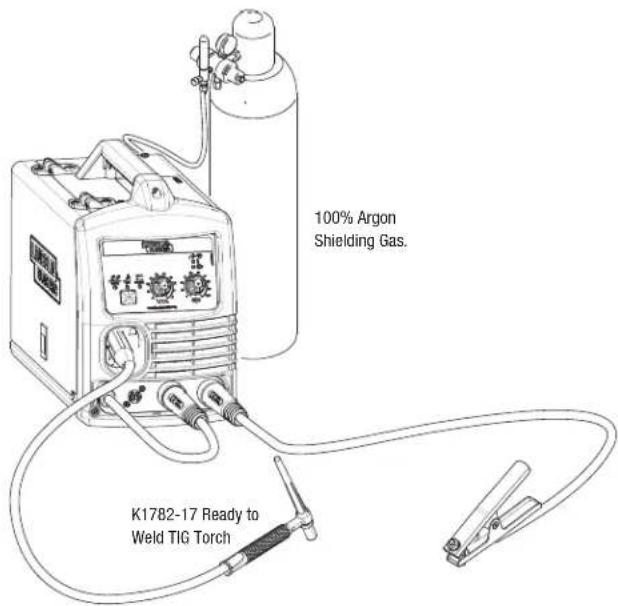
Procedure for TIG welding without a Foot Pedal
TIG welding without a foot pedal requires a Lincoln Electric K1782-17 Ready to Weld TIG Torch and a bottle of 100% Argon Shielding Gas.
Connect the Items to the Machine as shown below
FIGURE B.7
text_image
100% Argon Shielding Gas. K1782-17 Ready to Weld TIG TorchThe welding output current will be determined by the position of the V/A dial present on the front of the machine. To start the welding arc, lightly touch the tungsten to the piece that is to be welded and keep the tungsten on the work piece for about 1 second to initiate the Argon shielding gas. Slowly pull or rock the tungsten off the work piece and the welding arc will initiate. After welding is complete the shielding gas will continue to flow for 8 seconds. This post flow period is used to prevent contamination to the tungsten while the tungsten is still warm and to prevent contamination of the weld puddle.
OPTIONAL KITS AND ACCESSORIES
| Type Product Number Details | |||
| General | K520 |  | INDUSTRIAL WELDING CART - Heavy duty cart stores and transports welder, 150 cubic foot shielding gas cylinder, welding cables and accessories. Includes stable platforms for welder and gas bottle platform, lower tray for added storage capacity and adjustable height handle. |
| K2275-3 or K2275-1 | 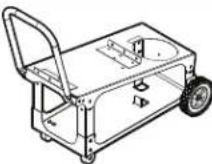 | WELDING CART (80 CUFT. BOTTLE CAPACITY) - Lightweight cart stores and transports welder, 80 cubic foot shielding gas cylinder, welding cables and accessories. Includes an angled top shelf for easy access to controls, lower tray for added storage capacity, a sturdy fixed handle and convenient cable wrap hanger. | |
| K2377-1 | 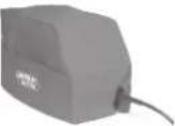 | CANVAS COVER - Protect your machine when not in use. Made from attractive red canvas that is flame retardant, mildew resistant and water repellent. Includes a convenient side pocket to hold welding gun. | |
| K5342-1 | 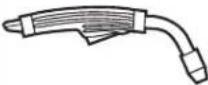 | REPLACEMENT MAGNUM® 100L GUN - with 8-pin connector | |
| Spool Gun | K5341-1 | 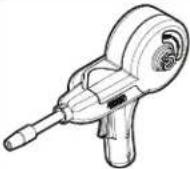 | MAGNUM® 100SG SPOOL GUN - Designed to easily feed small 4" diameter (1lb. spools of) .030 or .035 aluminum wire. Includes gun, adapter kit, three extra .035 contact tips, gas nozzle, and spool of Superglaze 4043 .035" diameter welding wire. Packaged in a convenient carry case. |
| TIG | K1782-16 | 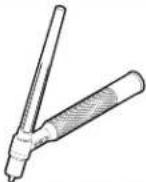 | READY TO WELD PTA-9 TIG TORCH ASSEMBLY: Features a 12.5 ft cable and a patent-pending brass connector that attaches to the machine's wire drive. Package also includes 1/16" and 3/32" tungsten, collets and collet bodies as well as a backcap and nozzle. |
| K1782-17 | 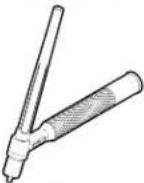 | READY TO WELD PTA-17 TIG TORCH ASSEMBLY: Features a 12.5 ft cable and a patent-pending brass connector that attaches to the machine's wire drive. Package also includes 1/16" and 3/32" tungsten, collets and collet bodies as well as a backcap and nozzle. | |
| K4361-1 | 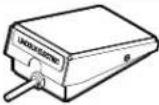 | FOOT AMPTROL - Features a durable steel enclosure and 13 foot cable with an 8-pin connector. The foot pedal can be used to initiate and stop TIG welding and for adjusting the output current while welding. | |
| FCAW | K3281-1 | 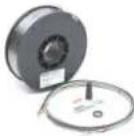 | .045 INNERSHIELD KIT - Includes everything needed to weld with .045 diameter Innershield wire. Includes an .035/.045 MagnumTM 100L gun liner, .045 Contact Tip, gasless nozzle, knurled drive roll, and a 10 lb. (4.5 kg) spool of .045"(0.9mm) Innershield® NR®-212 wire. |
ROUTINE MAINTENANCE

WARNING
Before carrying out service, maintenance and/or repair jobs, fully disconnect power to the machine.
Use Personal Protective Equipment (PPE), including safety glasses, dust mask and gloves to avoid injury. This also applies to persons who enter the work area.


MOVING PARTS can injure.
- Do not operate with doors open or guards off.
- Stop engine before servicing.
- Keep away from moving parts.
Have qualified personnel do all maintenance and troubleshooting work.


GENERAL MAINTENANCE
In extremely dusty locations, dirt may clog the air passages causing the welder to run hot. Blow dirt out of the welder with low-pressure air at regular intervals to eliminate excessive dirt and dust build-up on internal parts.
The fan motor has a sealed bearing, which requires no service
DRIVE ROLLS AND GUIDE PLATES
After every coil of wire, inspect the wire drive mechanism. Clean it as necessary by blowing with low pressure compressed air. Do not use solvents for cleaning the idle roll because it may wash the lubricant out of the bearing. All drive rolls are stamped with the wire sizes they will feed. If a wire size other than that stamped on the roll is used, the drive roll must be changed.
GUN TUBES AND NOZZLES
- Replace worn contact tips as required.
- Remove spatter from inside of gas nozzle and from tip after each 10 minutes of arc time or as required.
GUN CABLE CLEANING
To help prevent feeding problems, clean cable liner after using approximately 30 pounds (13.6 kg) of electrode. Remove the cable from the wire feeder and lay it out straight on the floor. Remove the contact tip from the gun. Using an air hose and only partial pressure, gently blow out the cable liner from the gas diffuser end.
Excessive pressure at the beginning of the cleaning procedure may cause the dirt to form a plug.
Flex the cable over its entire length and again blow out the cable. Repeat this procedure until no further dirt comes out. If this has been done and feed problems are experienced, replace the liner.
PERIODIC MAINTENANCE
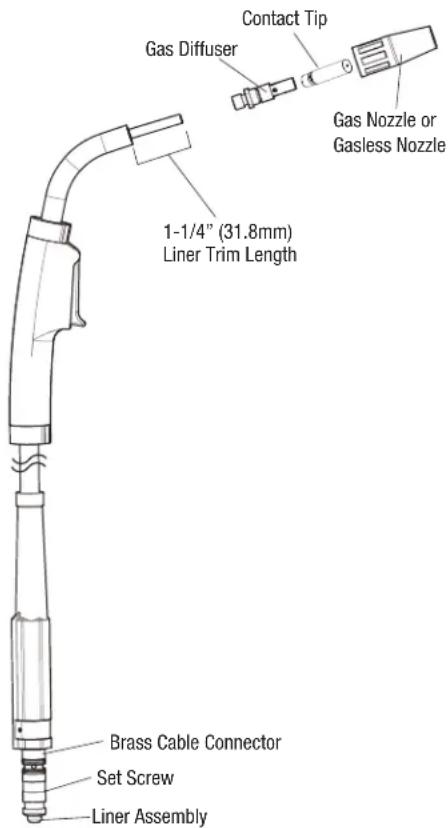
LINER REMOVAL, INSTALLATION AND TRIMMING INSTRUCTIONS FOR MAGNUM 100L

CAUTION
NOTE: The variation in cable lengths prevents interchanging of liners between guns. Once a liner has been cut for a particular gun, it should not be installed in another gun unless it can meet the liner cutoff length requirement.
- Remove the gas nozzle from the gun by unscrewing counterclockwise
- Remove the contact tip from the gun by unscrewing counterclockwise
- Remove the gas diffuser from the gun tube by unscrewing counter clockwise.
- Lay the gun and cable out straight on a flat surface. Loosen the set screw located in the brass connector that connects to the wire feeder. See bottom image. Pull the liner out of the cable.
-
Insert a new untrimmed liner into the connector end of the cable. Be sure the liner bushing is stenciled appropriately for the wire size being used.
-
Fully seat the liner bushing into the connector. Tighten the set screw on the brass cable connector. At this time, the gas diffuser should not be installed onto the end of the gun tube.
- With the gas nozzle and diffuser removed from the gun tube, be sure the cable is straight, and then trim the liner to the length shown. Remove any burrs from the end of the liner.
- Screw the gas diffuser onto the end of the gun tube and securely tighten.
- Replace the contact tip and nozzle.
FIGURE D.1
text_image
Contact Tip Gas Diffuser Gas Nozzle or Gasless Nozzle 1-1/4" (31.8mm) Liner Trim Length Brass Cable Connector Set Screw Liner Assembly
If for any reason you do not understand the procedures or are unable to perform the maintenance or repairs safely, contact your Lincoln Authorized Service Facility for technical troubleshooting assistance before you proceed.
WWW.LINCOLNELECTRIC.COM/LOCATOR
TROUBLESHOOTING
How to Use Troubleshooting Guide
WARNING
Service and Repair should only be performed by Lincoln Electric Factory Trained Personnel. Unauthorized repairs performed on this equipment may result in danger to the technician and machine operator and will invalidate your factory warranty. For your safety and to avoid Electrical Shock, please observe all safety notes and precautions detailed throughout this manual.
This Troubleshooting Guide is provided to help you locate and repair possible machine malfunctions. Simply follow the three-step procedure listed below.
Step 1. LOCATE PROBLEM (SYMPTOM).
Look under the column labeled “PROBLEM (SYMPTOMS).” This column describes possible symptoms that the machine may exhibit. Find the listing that best describes the symptom that the machine is exhibiting.
Step 2. POSSIBLE CAUSE.
The second column labeled "POSSIBLE CAUSE" lists the obvious external possibilities that may contribute to the machine symptom.
Step 3. RECOMMENDED COURSE OF ACTION
This column provides a course of action for the Possible Cause, generally it states to contact you local Lincoln Authorized Field Service Facility.
If you do not understand or are unable to perform the Recommended Course of Action safely, contact your local Lincoln Authorized Field Service Facility.
WARNING
ELECTRIC SHOCK can kill.
- Turn off machine at the disconnect switch on the rear of the machine and remove main power supply connections before doing any troubleshooting.
Observe all Safety Guidelines detailed throughout this manual
| PROBLEM (SYMPTOMS) | POSSIBLE AREAS OF MISADJUSTMENT(S) | RECOMMENDED COURSE OF ACTION |
| Major physical or electrical damage is evident. | "Do not Plug in machine or turn it on". Contact your local Authorized Field Service Facility. | If all recommended possible areas of misadjustment have been checked and the problem persists,Contact your local Lincoln Authorized Field Service Facility. |
| No wire feed, weld output or gas flow when gun trigger is pulled. Fan does NOT operate. | 1. Make sure correct voltage is applied to the machine. | |
| 2. Make certain that power switch is in the ON position. | ||
| 3. Make sure circuit breaker present on the back of the machine is reset. Ensure wall circuit breaker is reset. | ||
| No wire feed when gun trigger is pulled. Fan runs, gas flows and machine has correct open circuit voltage (42V) – weld output. | 1. If the wire drive motor is running make sure that the correct drive rolls are installed in the machine. | |
| 2. Check for clogged cable liner or contact tip. | ||
| 3. Check for proper size cable liner and contact tip. | ||
| 4. Ensure wire drive reconnect lead protruding from the front of the machine is connected to the proper polarity. | ||
| 5. Check Magnum 100SG/Magnum 100L switch is properly switched to activate proper gun. | ||
| 6. Ensure machine is set to wire mode. | ||
| Low or no gas flow when gun trigger is pulled. Wire feed, weld output and fan operate normally. | 1. Check gas supply, flow regulator and gas hoses. | |
| 2. Check gun connection to machine for obstruction or leaky seals. | ||
| 3. Ensure gun is fully seated in wire drive by loosening thumbscrew & fully inserting gun | ||
| Arc is unstable – Poor starting 1. Check for correct input voltage to machine. | ||

If for any reason you do not understand the test procedures or are unable to perform the tests/repairs safely, contact your
Lincoln Authorized Service Facility for technical troubleshooting assistance before you proceed.
WWW.LINCOLNELECTRIC.COM/LOCATOR
text_image
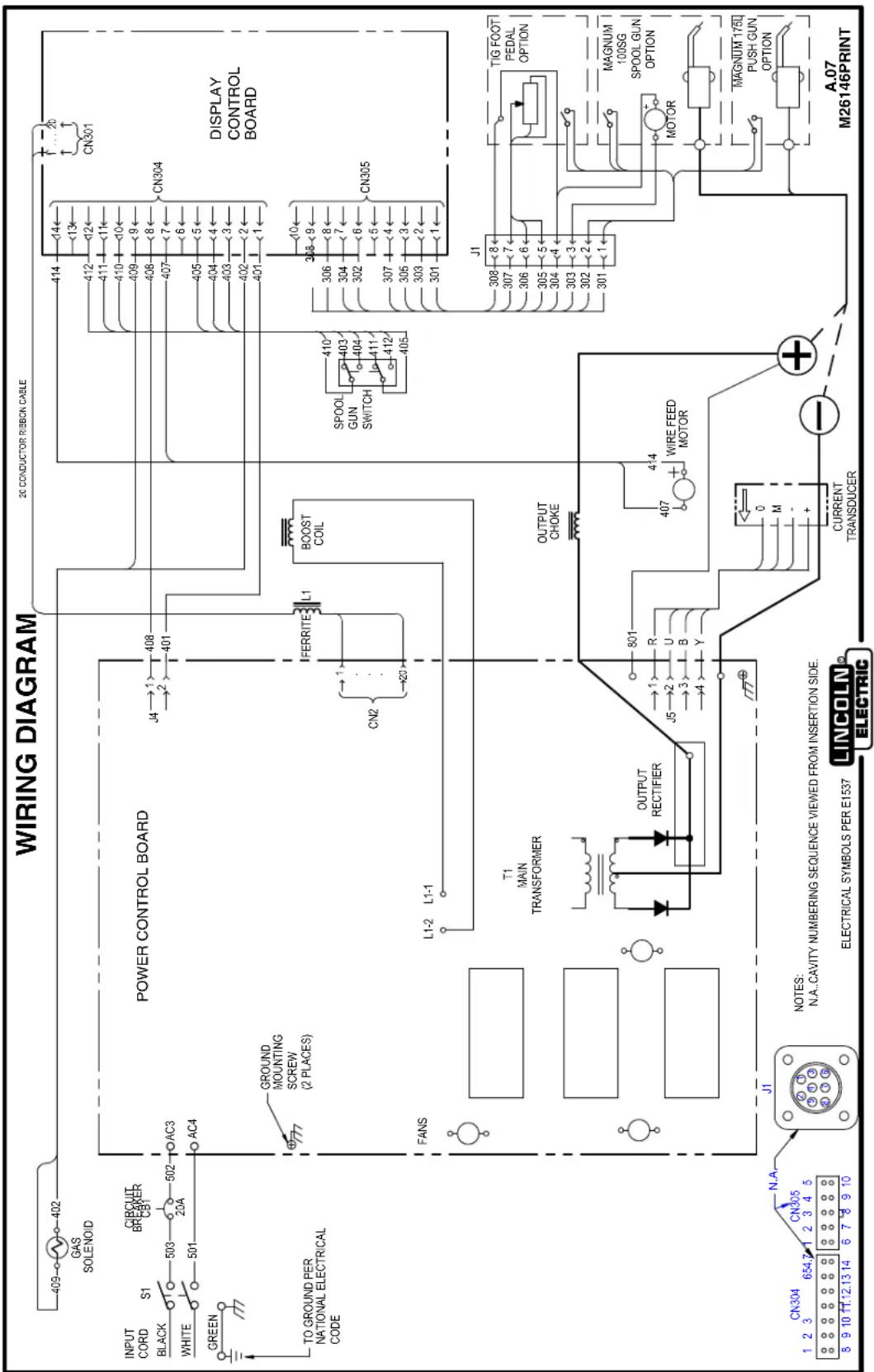
WIRING DIAGRAM 20 CONDUCTOR RIBBCN CABLE 414 14 13 412 12 11 410 10 9 408 8 7 6 405 5 4 403 3 2 402 2 1 CN301 INPUT CORD S1 CIRCUIT BREAKER AC3 BLACK CB1 WHITE 503 20A 502 GREEN 501 AC4 TO GROUND PER NATIONAL ELECTRICAL CODE GROUN D MOUNTING SCREW (2 PLACES) FANS L1-2 L1-1 T1 MAIN TRANSFORMER OUTPUT RECTIFIER 801 J5 2 U B Y OUTPUT CHOKE 407 414 WIRE FEED MOTOR CURRENT TRANSDUCER J1 308 8 TIG FOOT PEDAL OPTION 307 7 306 6 305 5 304 4 303 3 302 2 301 1 MAGNUM 100SG SPOOL GUN OPTION MOTOR MAGNUM 175L PUSH GUN OPTION A.07 M26146PRINT N.A. 8 9 10 11 12 13 14 6 7 8 9 10 J1 LINCOLN® ELECTRIC N.A.CAVITY NUMBERING SEQUENCE VIEWED FROM INSERTION SIDE. ELECTRICAL SYMBOLS PER E1537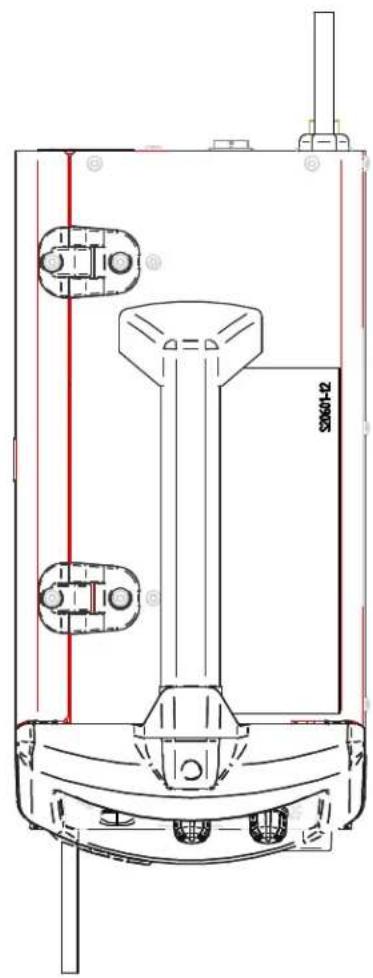
natural_image
Technical line drawing of a mechanical device with no visible text or symbols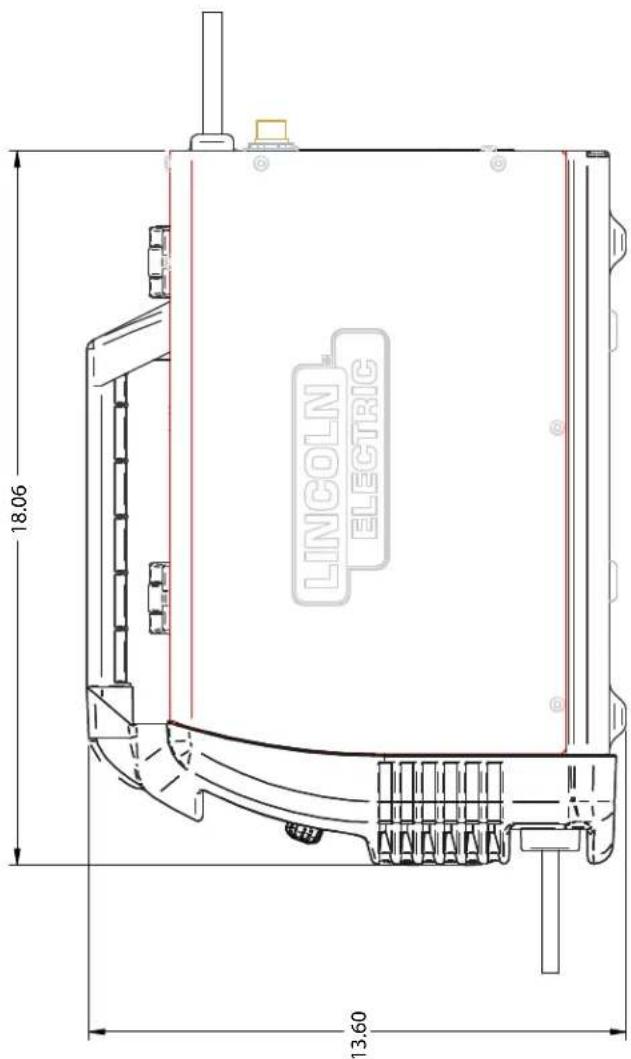
text_image
LINCOLN ELECTRIC 18.06 13.60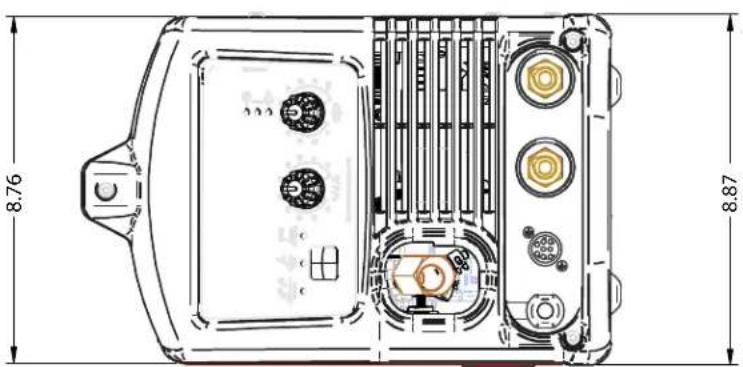
text_image
8.76 8.87This page intentionally left blank
This page intentionally left blank
 |  | 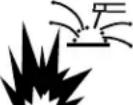 | 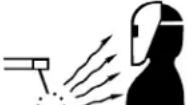 |
| WARNING | Do not touch electrically live parts of electrode with skin or wet clothing.Insulate yourself from work and ground. | Keep flammable materials away. | Wear eye, ear and body protection. |
| SpanishAVISO DE PRECAUCION | No toque las partes o los electrodos bajo carga con la piel o ropa moja-da.Aislese del trabajo y de la tierra. | Mantenga el material combustible fuera del área de trabajo. | Protéjase los ojos, los oídos y el cuerpo. |
| FrenchATTENTION | Ne laissez ni la peau ni des vêtements mouillés entrer en contact avec des pièces sous tension.Isolez-vous du travail et de la terre. | Gardez à l'écart de tout matériel inflammable. | Protégez vos yeux, vos oreilles et votre corps. |
| GermanWARNUNG | Berühren Sie keine stromführenden Teile oder Elektroden mit Ihrem Körper oder feuchter Kleidung!Isolieren Sie sich von den Elektroden und dem Erdboden! | Entfernen Sie brennbarres Material! | Tragen Sie Augen-, Ohren- und Körperschutz! |
| PortugueseATENÇÃO | Não toque partes elétricas e elec-trodos com a pele ou roupa molha-da.Isole-se da peça e terra. | Mantenha inflamáveis bem guarda-dos. | Use proteção para a vista, ouvido e corpo. |
| Japanese注意事項 | 通電中の電気部品、又は溶材にヒフやぬれた布で触れないこと。施工物やアースから身体が絶縁されている様にして下さい。 | 燃えやすいものの側での溶接作業は絶対にしてはなりません。 | 目、耳及び身体に保護具をして下さい。 |
| Chinese警告 | 皮肤或濕衣物切勿接觸帶電部件及錚條。使你自己與地面和工件絶縁。 | 把一切易燃物品移離工作場所。 | 佩戴眼、耳及身體勞動保護用具。 |
| Korean위험 | 전도체나 용접봉을 젖은 형갑 또는 피부로 절대 접촉치 마십시오.모재와 접지를 접촉치 마십시오. | 인화성 물질을 접근 시키지 마시요. | 눈, 귀와 몇에 보호장구를 착용하십시오. |
| Arabicتحذير | لا تلمس الاجزاء التي يسري فيها التيارال.ceربائي أو الالكترود بجلد الجسم أو بالملابس المبللة بالமاء.• ضع عازلا على جسمك خلال العمل. | ضع #: √ √ √ √ √ √ √ √ √ √ √ √ √ √ √ √ √ √ √ √ √ √ √ √ √ √ √ √ √ √ √ √ √ √ √ √ √ √ √ √ √ √ √ √ √ √ √ √ √ √ ∞ √ √ √ √ √ √ √ √ √ √ √ √ √ √ √ √ √ √ √ √ √ √ √ √ √ √ √ √ √ √ √ √ √ √ √ √ √ √ √ √ √ √ √ √ √ √ √ √ √ ∦ √ √ √ √ √ √ √ √ √ √ √ √ √ √ √ √ √ √ √ √ √ √ √ √ √ √ √ √ √ √ √ √ √ √ √ √ √ √ √ √ √ √ √ √ √ √ √ √ √ ∨ √ √ √ √ √ √ √ √ √ √ √ √ √ √ √ √ √ √ √ √ √ √ √ √ √ √ √ √ √ √ √ √ √ √ √ √ √ √ √ √ √ √ √ √ √ √ √ √ √ ∪ √ √ √ √ √ √ √ √ √ √ √ √ √ √ √ √ √ √ √ √ √ √ √ √ √ √ √ √ √ √ √ √ √ √ √ √ √ √ √ √ √ √ √ √ √ √ √ √ √ ∮ √ √ √ √ √ √ √ √ √ √ √ √ √ √ √ √ √ √ √ √ √ √ √ √ √ √ √ √ √ √ √ √ √ √ √ √ √ √ √ √ √ √ √ √ √ √ √ √ √ ∭ √ √ √ √ √ √ √ √ √ √ √ √ √ √ √ √ √ √ √ √ √ √ √ √ √ √ √ √ √ √ √ √ √ √ √ √ √ √ √ √ √ √ √ √ √ √ √ √ √ ∤ √ √ √ √ √ √ √ √ √ √ √ √ √ √ √ √ √ √ √ √ √ √ √ √ √ √ √ √ √ √ √ √ √ √ √ √ √ √ √ √ √ √ √ √ √ √ √ √ √ ∥ √ √ √ √ √ √ √ √ √ √ √ √ √ √ √ √ √ √ √ √ √ √ √ √ √ √ √ √ √ √ √ √ √ √ √ √ √ √ √ √ √ √ √ √ √ √ √ √ √ ∶ √ √ √ √ √ √ √ √ √ √ √ √ √ √ √ √ √ √ √ √ √ √ √ √ √ √ √ √ √ √ √ √ √ √ √ √ √ √ √ √ √ √ √ √ √ √ √ √ √ ∯ √ √ √ √ √ √ √ √ √ √ √ √ √ √ √ √ √ √ √ √ √ √ √ √ √ √ √ √ √ √ √ √ √ √ √ √ √ √ √ √ √ √ √ √ √ √ √ √ √ ∫ √ √ √ √ √ √ √ √ √ √ √ √ √ √ √ √ √ √ √ √ √ √ √ √ √ √ √ √ √ √ √ √ √ √ √ √ √ √ √ √ √ √ √ √ √ √ √ √ √ ∧ √ √ √ √ √ √ √ √ √ √ √ √ √ √ √ √ √ √ √ √ √ √ √ √ √ √ √ √ √ √ √ √ √ √ √ √ √ √ √ √ √ √ √ √ √ √ √ √ √ ∸ √ √ √ √ √ √ √ √ √ √ √ √ √ √ √ √ √ √ √ √ √ √ √ √ √ √ √ √ √ √ √ √ √ √ √ √ √ √ √ √ √ √ √ √ √ √ √ √ √ ∟ √ √ √ √ √ √ √ √ √ √ √ √ √ √ √ √ √ √ √ √ √ √ √ √ √ √ √ √ √ √ √ √ √ √ √ √ √ √ √ √ √ √ √ √ √ √ √ √ √ ∠ √ √ √ √ √ √ √ √ √ √ √ √ √ √ √ √ √ √ √ √ √ √ √ √ √ √ √ √ √ √ √ √ √ √ √ √ √ √ √ √ √ √ √ √ √ √ √ √ √ ∡ √ √ √ √ √ √ √ √ √ √ √ √ √ √ √ √ √ √ √ √ √ √ √ √ √ √ √ √ √ √ √ √ √ √ √ √ √ √ √ √ √ √ √ √ √ √ √ √ √ ∜ √ √ √ √ √ √ √ √ √ √ √ √ √ √ √ √ √ √ √ √ √ √ √ √ √ √ √ √ √ √ √ √ √ √ √ √ √ √ √ √ √ √ √ √ √ √ √ √ √ ∎ √ √ √ √ √ √ √ √ √ √ √ √ √ √ √ √ √ √ √ √ √ √ √ √ √ √ √ √ √ √ √ √ √ √ √ √ √ √ √ √ √ √ √ √ √ √ √ √ √ ∑ √ √ √ √ √ √ √ √ √ √ √ √ √ √ √ √ √ √ √ √ √ √ √ √ √ √ √ √ √ √ √ √ √ √ √ √ √ √ √ √ √ √ √ √ √ √ √ √ √ ∢ √ √ √ √ √ √ √ √ √ √ √ √ √ √ √ √ √ √ √ √ √ √ √ √ √ √ √ √ √ √ √ √ √ √ √ √ √ √ √ √ √ √ √ √ √ √ √ √ √ ∩ √ √ √ √ √ √ √ √ √ √ √ √ √ √ √ √ √ √ √ √ √ √ √ √ √ √ √ √ √ √ √ √ √ √ √ √ ∞ ∞ ∞ ∞ ∞ ∞ ∞ ∞ ∞ ∞ ∞ ∞ ∞ ∞ ∞ ∞ ∞ ∞ ∞ ∞ ∞ ∞ ∞ ∞ ∞ ∞ ∞ ∞ ∞ ∞ ∞ ∞ ∞ ∞ ∞ ∞ ∞ ∞ ∞ ∞ ∞ ∞ ∞ ∞ ∞ ∞ ∞ ∞ ∞ ∞ ∩ ∞ ∞ ∞ ∞ ∞ ∞ ∞ ∞ ∞ ∞ ∞ ∞ ∞ ∞ ∞ ∞ ∞ ∞ ∞ ∞ ∞ ∞ ∞ ∞ ∞ ∞ ∞ ∞ ∞ ∞ ∞ ∞ ∞ ∞ ∞ ∞ ∞ ∞ ∞ ∞ ∞ ∞ ∞ ∞ ∞ ∞ ∞ ∞ ∞ ∝ ∞ ∞ ∞ ∞ ∞ ∞ ∞ ∞ ∞ ∞ ∞ ∞ ∞ ∞ ∞ ∞ ∞ ∞ ∞ ∞ ∞ ∞ ∞ ∞ ∞ ∞ ∞ ∞ ∞ ∞ ∞ ∞ ∞ ∞ ∞ ∞ ∞ ∞ ∞ ∞ ∞ ∞ ∞ ∞ ∞ ∞ ∞ ∞ ∞ ∤ ∞ ∞ ∞ \text{ وجسمك.} |
READ AND UNDERSTAND THE MANUFACTURER'S INSTRUCTION FOR THIS EQUIPMENT AND THE CONSUMABLES TO BE USED AND FOLLOW YOUR EMPLOYER'S SAFETY PRACTICES.
CUSTOMER ASSISTANCE POLICY
The business of Lincoln Electric is manufacturing and selling high quality welding equipment, automated welding systems, consumables, and cutting equipment. Our challenge is to meet the needs of our customers, who are experts in their fields, and to exceed their expectations. On occasion, purchasers may ask Lincoln Electric for information or technical information about their use of our products. Our employees respond to inquiries to the best of their ability based on information and specifications provided to them by the customers and the knowledge they may have concerning the application. Our employees, however, are not in a position to verify the information provided or to evaluate the engineering requirements for the particular weldment, or to provide engineering advice in relation to a specific situation or application. Accordingly, Lincoln Electric does not warrant or guarantee or assume any liability with respect to such information or communications. Moreover, the provision of such information or technical information does not create, expand, or alter any warranty on our products. Any express or implied warranty that might arise from the information or technical information, including any implied warranty of merchantability or any warranty of fitness for any customers' particular purpose or any other equivalent or similar warranty is specifically disclaimed.
Lincoln Electric is a responsive manufacturer, but the definition of specifications, and the selection and use of specific products sold by Lincoln Electric is solely within the control of, and remains the sole responsibility of the customer. Many variables beyond the control of Lincoln Electric affect the results obtained in applying these types of fabrication methods and service requirements.
WELD FUME CONTROL EQUIPMENT
The operation of welding fume control equipment is affected by various factors including proper use and positioning of the equipment, maintenance of the equipment and the specific welding procedure and application involved. Worker exposure level should be checked upon installation and periodically thereafter to be certain it is within applicable OSHA PEL and ACGIH TLV limits.

THE LINCOLN ELECTRIC COMPANY
22801 St. Clair Avenue • Cleveland, OH • 44117-1199 • U.S.A.
Phone: +1.216.481.8100 • www.lincolnelectric.com
Manual del operador
natural_image
Line drawing of a Lincoln Electric welding machine with visible control panel and wiring (no text or symbols beyond branding)natural_image
Illustration of a person in protective gear using a tool to spray or spray onto a surface (no text or symbols present)
UTILICE PROTECTORES OCULARES, AUDITIVOS Y CORPORALES CORRECTOS
text_image
Diagram showing three house types with no parking and car symbols, next to a vehicle icon with an arrow indicating direction.
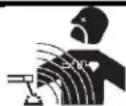
LOS CAMPOS ELECTROMAGNÉTICOS PUEDEN SER PELIGROSOS.
text_image
Technical diagram of a welding machine with labeled components including sensors, hoses, and welding toolsINSTALACIÓN
text_image
Technical diagram of a device front panel with numbered components and labeled portsnatural_image
Technical line drawing of a mechanical device with a coiled cable and connector (no text or symbols)natural_image
Technical line drawing of a mechanical component with a coiled cable and attached plug (no text or symbols)PROCEDIMIENTO PARA CAMBIAR EL RODILLO ALIMENTADOR
Paso 2. CAUSA POSIBLE.
natural_image
Silhouette of a person wearing a helmet and holding a tool, no text or symbols presentPORTER UNE PROTECTION CORRECTE DES YEUX, DES OREILLES ET DU CORPS
text_image
Diagram showing three house types with no parking and a parking sign, indicating parking restrictions or absence of parking.
OPTIONS ET ACCESSOIRES ....Section C
ENTRETIEN ....Section D
ENTRETIEN COURANT ....D-1
ENTRETIEN PÉRIODIQUE ....D-1
DÉPANNAGE......Section E
LISTE DES PIÈCES....PARTS.LINCOLNELECTRIC.COM
LE CONTENU/LES DÉTAILS PEUVENT ÊTRE MODIFIÉS OU MIS À JOUR SANS PRÉAVIS. POUR OBTENIR LES MANUELS D'INSTRUCTIONS EN COURS, ALLEZ À PARTS.LINCOLNELECTRIC.COM.
DESCRIPTION GÉNÉRALE
DIMENSIONS PHYSIQUES
text_image
Technical diagram of a device with numbered parts and labeled ports, including a control panel and wiring.text_image
Technical diagram of a device rear panel with labeled components including buttons, dials, and control panelstext_image
Technical diagram of a device with numbered components and labeled parts, including a 35-50 power connector and control panel.LIRE LE MANUEL D'INSTRUCTIONS

COURANT DIRECT
MISE EN PLACE ET RÉALISATION D'UNE SOUDURE MIG AVEC UN FIL MIG DE 0,025
natural_image
Technical line drawing of a mechanical component with a U-shaped connector (no text or symbols)Figure B.4 ENTRAÎNEMENT DES FILS CONNECTÉ
POUR POLARITÉ POSITIVE