
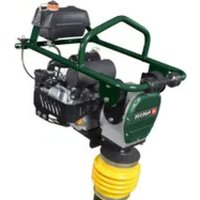
PRP 1100 A1 - Vibratory plate PARKSIDE - Free user manual and instructions
Find the device manual for free PRP 1100 A1 PARKSIDE in PDF.


| Brand | Parkside |
| Model | PRP 1100 A1 |
| Product type | Vibrating plate |
| Engine | 1 cylinder, 4-stroke, unleaded petrol |
| Engine power | 4.1 kW |
| Plate dimensions (L × W) | approx. 530 × 350 mm |
| Centrifugal force | 11 kN |
| Vibration frequency | 5500 Hz |
| Compaction depth | 25 cm |
| Fuel tank capacity | 3.6 L |
| Engine oil capacity | max. 0.61 L (600 ml) |
| Eccentric oil capacity | 0.08 L (80–100 ml) |
| Weight | approx. 57 kg |
| Sound pressure level (LpA) | 84.2 dB(A) |
| Sound power level (LWA) | 106 dB(A) |
| Vibrations (total value) | 10.8 m/s² |
| Fuel type | Super unleaded E5/E10 |
| Intended use | Compaction of loose soil, gravel, paving stones, etc. |
| Maintenance and cleaning | Engine oil change every 100 h, air filter every 50 h, V-belt to be checked regularly |
| Safety equipment | Belt guard, emergency stop, on/off switch |
| Spare parts and repairability | Wear parts: spark plug, oil, belt, rubber mat, air filter. After-sales service via dealer |
| Warranty | 3 years (excluding professional use) |
| General information | Operating instructions in multiple languages, available as PDF |
Frequently Asked Questions - PRP 1100 A1 PARKSIDE
User questions about PRP 1100 A1 PARKSIDE
0 question about this device. Answer the ones you know or ask your own.
Ask a new question about this device
Download the instructions for your Vibratory plate in PDF format for free! Find your manual PRP 1100 A1 - PARKSIDE and take your electronic device back in hand. On this page are published all the documents necessary for the use of your device. PRP 1100 A1 by PARKSIDE.
USER MANUAL PRP 1100 A1 PARKSIDE
VIBRATION PLATE PRP 1100 A1 RUTTELPATTE PRP 1100 A1 PLAQUE VIBRANTE PRP 1100 A1
GBE
PLATE COMPACTOR
Operating and Safety Instructions
Translation of Original Operating Manual
FR BE
PLAQUE VIBRANTE
Before reading, unfold the page containing the illustrations and familiarise yourself with all functions of the device.
DE AT CH
GB/IE Operating and Safety Instructions Page 01
Table of contents: Page:
- Explanation of the symbols on the device 2
- Introduction 5
- Device description.. 5
- Scope of delivery 5
- Proper use 5
- Safety information 6
- Technical data 8
- Unpacking 8
- Assembly 8
- Before commissioning 9
- Start up 9
- Transport (Fig. 20)
- Cleaning and maintenance 11
- Storage 14
- Disposal and recycling 14
- Troubleshooting 15
- Warranty certificate 16
- Exploded view 117
- Declaration of conformity 119
1. Explanation of the symbols on the device


Read the operating and safety instructions before start-up and follow them!


Wear eye protection!


Wear hearing protection!


Use work gloves.


Use safety shoes.


Removing or modifying protective or safety equipment is prohibited.


Do not touch rotating parts. Getting caught in the spinning belt will cause a hand injury.
Always put on the belt guard.


Naked flames or smoking near the device is strictly prohibited!


Hot surface! Touching can cause burns.
Only carry out servicing, maintenance and cleaning work when the engine has cooled down.


Keep third parties away from the work area.
| GBIE | Danger of poisoning! Only use the device outdoors and never in closed or poorly ventilated rooms. | |
| GBIE | Important: Always switch off the engine before refuelling. Do not refill during operation. | |
| GBIE | Before carrying out any cleaning or maintenance work, switch off the engine and remove the spark plug connector from the spark plug. | |
| LWA 106dB | GBIE | Guaranteed sound power level of the device |
| GBIE | - Choke closed - Open fuel valve | |
| GBIE | Speed lever | |
| GBIE | Checking the oil level | |
| CE | GBIE | The product complies with the applicable European directives. |
| GBIE | We have marked points in this operating manual that impact your safety with this symbol. | |
| DANGER! | GBIE | Signal word to indicate an imminently hazardous situation which, if not avoided, will result in death or serious injury. |
WARNING!

Signal word to indicate a potentially hazardous situation which, if not avoided, could result in death or serious injury.
CAUTION!

Signal word to indicate a potentially hazardous situation which, if not avoided, could result in minor or moderate injury.
NOTE

Signal word to indicate a potentially hazardous situation which, if not avoided, could result in product or property damage.
2. Introduction
MANUFACTURER:
Scheppach GmbH
GünzburgrsteraBe 69
D-89335 Ichenhausen
DEAR CUSTOMER,
We hope your new tool brings you much enjoyment and success.
NOTE:
In accordance with the applicable product liability laws, the manufacturer of this device assumes no liability for damage to the device or caused by the device arising from:
- Improper handling,
Non-compliance with the operating manual, - Repairs carried out by third parties, unauthorised specialists.
- Installing and replacing non-original spare parts,
Application other than specified.
Please consider:
Read through the complete text in the operating manual before installing and commissioning the device.
This operating manual should help you to familiarise yourself with your device and to use it for its intended purpose.
The operating manual includes important instructions for safe, proper and economic operation of the device, for avoiding danger, for minimising repair costs and downtimes, and for increasing the reliability and extending the service life of the device.
In addition to the safety instructions in this operating manual, you must also observe the regulations applicable to the operation of the device in your country.
Keep the operating manual package with the machine at all times and store it in a plastic cover to protect it from dirt and moisture. They must be read and carefully observed by all operating personnel before starting the work.
The device may only be used by personnel who have been trained to use it and who have been instructed with respect to the associated hazards. The required minimum age must be observed.
In addition to the safety instructions in this operating manual and the separate regulations of your country, the generally recognised technical rules relating to the operation of such machines must also be observed.
We accept no liability for accidents or damage that occur due to a failure to observe this manual and the safety instructions.
3. Device description
- Foldable guide bar with handle
1a. Guide bar screw - Throttle
2a. Throttle screw - Exhaust pipe
- Air filter cover
4a. Wing nut
4b. Wing nut (inner)
4c. Air filter insert - Petrol tank cap
5a. Fuel filter insert - Fuel tank
- Motor
- Starter cable
- Eccentric vibration unit
- Base plate
- Transport wheels
- Chassis
12a. Transport frame screws - Base plate screws
- Oil dipstick for engine oil
- Fuel valve
15a. Carburettor screw - Choke lever
- Bracket for transport frame
- Flex hose
- Belt cover
19a. Belt cover screws
19b.V-belt
19c. Set screws
19d. Lock nuts
19e. Engine mounting screws - Rubber pad
- Fastening strip
21a. Fastening strip screws - Oil drain screw for eccentric vibration unit oil
- On/off switch
- Spark plug
4. Scope of delivery
Vibrating plate with engine
- Handle
Chassis
Rubber pad with fastening bar
- Spark plug wrench
- Enclosed accessories bag
- Operating manual
5. Proper use
The plate vibrator transfers forces to loose soil or other materials. It can be used for general road works, landscaping and building construction. The plate vibrator increases the load-bearing capacity, reduces water permeability, prevents soil settling, reduces swelling or contraction of the soil. It is particularly suitable for compacting interlocking pavers and trenches, as well as for landscaping and conservation work.
Attention!
The plate vibrator is not designed for use on adherent substrates such as clay or hard surfaces such as concrete.
The machine may only be used in the intended manner. Any use beyond this is improper. The user/operator, not the manufacturer, is responsible for damages or injuries of any type resulting from this.
An element of the intended use is also the observance of the safety instructions, as well as the assembly instructions and operating information in the operating manual.
Persons who operate and maintain the machine must be familiar with it and must be informed about potential dangers.
In addition, the applicable accident prevention regulations must be strictly observed.
Other general occupational health and safety-related rules and regulations must be observed. The liability of the manufacturer and resulting damages are excluded in the event of modifications of the machine.
The machine may only be operated with original parts and original accessories from the manufacturer. The safety, operating and maintenance specifications of the manufacturer, as well as the dimensions specified in the technical data, must be observed.
Please observe that our equipment was not designed with the intention of use for commercial or industrial purposes. We assume no guarantee if the equipment is used in commercial or industrial applications, or for equivalent work.
6. Safety information
Familiarise yourself with your machine.
- Read the operating manual carefully and make sure you understand its contents, as well as all labels attached to the machine.
Familiarise yourself with the area of application, as well as limitations of the machine, and particular sources of danger.
- Make sure that you know all the controls and their function exactly.
Make sure you know how to stop the machine and quickly disable the controls.
- Do not attempt to use the machine without knowing the exact method of operation and the maintenance requirements of the engine and how to avoid accidents resulting in personal injury and/or property damage.
- Keep other people, particularly children, away from your work area.
Working range
- Never start or operate the machine in an enclosed area. The exhaust gases are dangerous because they contain the odourless and deadly gas carbon monoxide. Operate the machine only in a well-ventilated outdoor area.
- Never operate the machine without good visibility or lighting conditions.
Personal safety
-
Do not use the machine if you have taken drugs, alcohol or medication that affects your ability to operate the machine correctly.
-
Wear suitable clothing. Wear long trousers, boots and gloves.
- Do not wear loose clothing, shorts or jewellery of any kind. Tie back long hair so that it is at shoulder height at most. Keep hair, clothing and gloves away from moving parts. Loose-fitting clothing, jewellery or long hair may become caught in the moving parts. Check your machine before starting.
- Leave protective screens in place and in working order.
- Make sure that all nuts, bolts, etc. are securely tightened.
- Never use the machine if it is in need of repair or in poor mechanical condition. Replace damaged, missing or defective parts before use.
- Check the machine for fuel leaks.
- Keep it in good functional order. Do not use the machine if the engine cannot be switched on and off at the corresponding switch.
- A petrol-driven machine that cannot be controlled via the engine switch is dangerous and must be replaced.
- Before starting the machine, get into the habit of checking that screwdrivers and spanners are away from the area around the machine. A screwdriver or spanner that is still in a rotating device part may result in personal injury.
- Be attentive, watch your actions and use common sense when working with the machine. Do not overextend yourself.
- Do not operate the machine barefoot or with sandals or similar light footwear. Wear safety shoes that protect your feet and improve your grip on slippery surfaces.
- Ensure safe footing and balance at all times. This will allow you to better control the machine in unexpected situations.
- Prevent unintentional start-up. Make sure that the engine switch is switched off before transporting the machine or carrying out maintenance work on the machine. Transport or maintenance work on the machine can lead to accidents if the switch is on.
Safe handling of fuel
- Petrol is very flammable and its gases can explode if they ignite.
- Take safety precautions when handling petrol to reduce the risk of serious injury.
- Use a suitable petrol can when filling or draining the tank.
- Carry out this work in clean, well-ventilated outdoor areas.
- Do not smoke. Do not allow sparks, naked flames or other sources of fire to get near when filling up with petrol or working with the machine.
- Never fill the tank indoors. Keep earthed, electrically conductive objects, such as tools, away from exposed electrical parts and wires to avoid sparking or arcing. This could ignite petrol gases.
- Always switch off the engine and let it cool down before refilling the fuel tank. Never remove the fuel filler cap or fill fuel into the tank while the engine is running or while the engine is hot.
-
Do not use the machine if you know there is a leak in the fuel system. Slowly loosen the fuel filler cap to release any pressure in the tank. Never overfill the tank (petrol should never be above the marked maximum fill level). Close the fuel tank securely again with the fuel filler cap and wipe up any spilled petrol.
-
Do not use the machine if the fuel filler cap is not screwed tightly shut. Avoid ignition sources near spilled petrol. If petrol has been spilled, do not attempt to start the machine. Move the machine away from the area of the spillage and prevent the formation of ignition sources until the petrol gases have dissipated.
- Store fuel only in containers specially manufactured for this purpose.
- Store petrol in a cool, well-ventilated area away from sparks and naked flames or other sources of ignition. Never store petrol or the machine with a filled tank in a building where petrol gases could reach sparks, naked flames or other ignition sources such as water heaters, ovens, clothes dryers or similar.
- Allow the engine to cool before storing the machine in an enclosed area.
Use and care of the machine
- Never pick up or carry the machine while the engine is running.
- Do not handle the machine violently.
- Use the right machine for your area of application. The right machine will do the job it was designed for better and more safely.
- Do not change the speed governor setting of the engine or over-rev it. The speed governor controls the maximum speed of the engine with maximum safety.
- Do not run the engine at high speeds when not compacting.
- Do not hold your hands or feet near rotating parts.
- Avoid contact with hot fuel, oil, exhaust gases and hot surfaces. Do not touch the engine or exhaust silencer. These parts become particularly hot during use. They are still hot a short time after the machine is switched off.
- Allow the engine to cool down before carrying out maintenance or adjustment work.
- If the machine starts to make unusual noises or vibrations, switch the engine off immediately, disconnect the spark plug cable and determine the cause. Unusual noises or vibrations are usually a safety sign of faults.
- Only use assembly and accessory parts approved by the manufacturer. Failure to do so may result in injury.
- Service the machine. Check for misalignment or jamming of moving parts, damaged parts and other conditions that could impair function of the machine. Have the machine repaired before any further use if you find any damage. Many accidents are the result of poorly maintained equipment.
- Keep the engine and silencer free of grass, leaves, excess grease or soot encrustation to reduce the risk of fire.
- Never pour or splash water or any other liquid onto the machine.
- Keep the handles dry, clean and free of small parts.
- Clean the machine after every use.
- Follow the applicable waste disposal guidelines for petrol, oil etc. to protect the environment.
- Keep the switched-off machine out of the reach of children and do not allow persons who are not familiar with the machine or these instructions to use the machine. The machine is dangerous in the hands of untrained operators.
Service
- Before cleaning, repairing, inspecting or adjusting, switch off the engine and ensure that all moving parts have come to a standstill.
- Always ensure that the engine switch is in the "OFF" position. Disconnect the spark plug cable and keep it away from the spark plug to prevent accidental start-up.
- Have your machine serviced by qualified personnel. Only use original spare parts. This ensures that the machine remains safe.
Additional safety instructions
- Keep hands, fingers and feet away from the base plate in order to avoid injuries.
- Hold the handle of the plate vibrator firmly with both hands. If both hands hold the handle and your feet are away from the compacting plate, your hands, fingers and feet cannot be injured by the compacting plate.
- Always stay behind the machine when using it; never walk or stand in front of the machine when the engine is running.
- Never place tools or other objects under the plate vibrator. If the machine hits a foreign object, stop the engine, disconnect the spark plug and check the machine for damage; repair the damage before restarting and using the machine.
- Do not overload the machine by compacting too deep or too fast.
- Do not use the machine at high speeds on hard or slippery surfaces.
- Be especially careful when using the machine to work on or cross gravel beds, gravel paths or gravel roadways.
- Watch out for hidden dangers and traffic. Do not carry people.
- Never leave the workplace and never leave the plate vibrator unattended when the engine is running.
- Always stop the machine when work is interrupted or when relocating from one place to another.
- Stay away from trench edges and avoid actions that may cause the plate vibrator to tip over. Walk up slopes carefully backwards in a direct line, to avoid tipping the plate vibrator over onto the operator.
- Always place the device on a firm and level surface and switch the machine off.
- Limit working hours with the machine and take regular breaks to reduce vibration stress and let your hands rest. Reduce the speed and force with which you perform repetitive movements.
Residual risks
The machine has been built according to the state-of-the-art and the recognised technical safety requirements. However, individual residual risks can arise during operation.
- Furthermore, despite all precautions having been met, some non-obvious residual risks may still remain.
- Residual risks can be minimised if the "Safety information" and the "Proper use" together with the operating manual as a whole are observed.
- Avoid accidental start-ups of the machine.
-
Use the tool that is recommended in this operating manual. This is how to ensure that your machine provides optimum performance.
-
Keep your hands away from the work area, when the machine is in operation.
7. Technical data
Engine / drive. 1-cylinder, 4-stroke for unleaded petrol
Displacement 196 cm3
Motor power 4.1 kW
Fuel content. 3.61
Engine oil capacity. max. 0.61
Eccentric vibration unit oil capacity. 0.08
Plate size (L x W) ca. 530 x 350 mm
Centrifugal force 11 kN
Feed 25m/min
Vibration frequency. 5500 Hz
Compaction depth 25 cm
Max. permissible inclination for the engine. 20°
Weight ca. 57 kg
Technical changes reserved!
Noise and vibration
The noise levels have been determined in accordance with EN ISO 3744. Total vibration emission values (vector sum of three directions) determined per EN 500-1.
Noise can have serious effects on your health. If the machine noise exceeds 85 dB (A), please wear suitable hearing protection.
Noise data:
Sound pressure level L 84.2 dB(A)
Uncertainty K_PA 2.58 dB
Sound power level L_WA 106 dB(A)
Uncertainty K. 2.58 dB
Vibration parameters:
Vibration q. 10.8 m/s²
Uncertainty K. 1.5 m/s²
The specified sound levels have been measured in accordance with a standardised test procedure and can be used to compare different tools with one another.
In addition, these values are suitable for estimating the stresses for the user resulting from the noise in advance.
Warning! Depending on how you use the tool, the actual values may differ from the those given. Implement measures to protect against noise nuisance.
In doing so, take into account the complete working process, including the times when the tool is working without load or switched off.
Suitable measures include regular maintenance and care of the tool and the insertion tools, regular breaks as well as proper planning of the working process.
8. Unpacking
- Open the packaging and carefully remove the device.
- Remove the packaging material, as well as the packaging and transport safety devices (if present).
- Check whether the scope of delivery is complete.
- Check the device and accessory parts for transport damage. In the event of complaints the carrier must be informed immediately. Later claims will not be recognised.
- If possible, keep the packaging until the expiry of the warranty period.
Familiarise yourself with the product by means of the operat ing instructions before using for the first time. - With accessories as well as wearing parts and replacement parts use only original parts. Replacement parts can be obtained from your dealer.
- When ordering please provide our article number as well as type and year of manufacture for your equipment.
DANGER
The device and the packaging are not children's toys! Do not let children play with plastic bags, films or small parts! There is a danger of choking or suffocating!
9. Assembly
You will need the following to assemble the plate vibrator:
- 16 mm open-ended spanner (not included in the scope of delivery)
- Slotted screwdriver (not included in the scope of delivery)
- Enclosed accessories bag
9.1 Fitting the handle (Fig. 3 + 4)
- Unfold the guide bar with handle (1).
- Slide the guide bar with handle (1) between the fixing lugs and secure it with 2 hexagonal bolts M10 x 70 (1a), 2 10 mm washers and 2 stop nuts.
- Attach the throttle (2) to the upper handle (1) with a slo- teted screw M5× 25 2a and a washer. You can tension the cable using the Bowden cable screw on the throttle (2).
9.2 Fitting the transport frame (Fig. 5)
- Secure the pre-assembled transport frame (12) to the mounting lugs with 2 M10 x 30 hexagonal bolts, 2 10 mm washers and 2 stop nuts (12a). Tighten all the screws hand-tight.
- Now fold up the complete transport frame (12) in working position and attach it to the transport frame hooks (17).
Attention: Always fold up and hook in the transport frame (12) before compacting! Make sure that the joint of the transport frame is free to move so that it can be folded up.
9.3 Fitting the rubber pad (Fig. 6)
When using the plate vibrator on paving stones, fit the rubber pad (20) to prevent chipping and scratching of the stone surface.
Attention! Use the rubber pad only for bedding in concrete blocks, concrete slabs and similar.
Remove the rubber pad when compacting gravel, grit and the like.
- To mount the rubber pad (20), place the machine with the vibratory plate on the rubber pad. Align the rubber pad so that the holes match the screw points on the device.
- Fasten the rubber pad (20) with the fastening strip (21) on the front side with 3 hexagonal bolts M10 × 20 mm each and 3 A10 mm spring washers (21a).
- Tighten all the screws well.
10. Before commissioning
ATTENTION!
Always make sure the device is fully assembled before commissioning!
WARNING!
Risk to health!
Inhalation of petrol/lubricating oil vapours and exhaust gases can cause serious damage to health, unconsciousness and in extreme cases death.
- Do not breathe petrol/lubricating oil vapours and exhaust gases.
-Only use the product outdoors.
NOTE!
Product damage
Using the product without or with too little engine and gear oil can result in engine damage.
- Fill with petrol and oil before commissioning. The product is supplied without engine and gear oil.
NOTE!
Environmental damage!
Spilled oil can pollute the environment permanently. The liquid is highly toxic and can quickly lead to water pollution.
- Fill/empty oil only on level, paved surfaces.
- Use a filling nozzle or funnel.
- Collect drained oil in a suitable container.
- Immediately wipe up any spilled oil carefully and dispose it according to local regulations.
- Dispose of oil as per local regulations.
NOTE!
Risk of damage!
If incorrectly stored or undrained fuel is used, the carburettor may become clogged or engine operation may be affected.
- Put unused fuel in an airtight vessel and store it in a dark, cool room.
Check before operation
- Check all sides of the engine for oil or fuel leaks.
- Check the engine oil level.
- Check the fuel level -- the tank should be at least half-full.
- Check the condition of the air filter.
- Check the condition of the fuel lines.
- Look for signs of damage.
- Check that all protective covers are in place and all screws, nuts and bolts are tightened.
10.1 Filling up with engine oil (Fig. 13)
Attention!
The plate vibrator is delivered without engine oil. Therefore, ensure that you add oil before starting it up. Use multigrade oil (SAE 10W-30 or 10W-40 (depending on the operating temperature)) for this.
Check the oil level regularly before commissioning. An oil level that is too low can damage the engine.
- Place the plate vibrator on a level, even surface.
- Unscrew the oil dipstick (14).
- Fill the tank with engine oil using a funnel (not included in scope of delivery). Note the max. filling capacity of 600~ml . Carefully fill the oil up to the lower edge of the filler neck.
- Wipe the oil dipstick (14) with a clean, lint-free cloth.
- Re-insert the oil dipstick (14) and check the oil level without screwing the dipstick tight again.
- The oil level must be within the middle mark on the oil dipstick.
- If the oil level is too low, add the recommended amount of oil (max. 600 ml).
- Then screw the oil dipstick (14) in again.
10.2 Filling up with petrol (fig. 15)
Attention!
The plate vibrator is delivered without petrol. It is therefore essential to fill with petrol before commissioning. Use Super E5 / E10 petrol for this.
- Clean the area surrounding the filling area. Impurities in the tank lead to operational faults.
- Carefully open the tank cap (5) so that any possible overpressure can be relieved.
- Fill the tank with petrol (Super E5 / E10) using a funnel (not included in scope of delivery). Note the max. filling capacity of 3.6 litres. Carefully fill the petrol up to the lower edge of the filler neck.
- Close the tank filler cap (5) again. Ensure that the tank cap is tightly sealed.
- Clean the tank cap and the surroundings.
- Check the tank and fuel lines for leaks.
-
Move at least three meters away from the refuelling area before starting the engine.
-
Do not use petrol that has already been used or that is contaminated. Do not allow dirt or water to enter the fuel tank.
11. Start up
11.1 Starting the engine (Fig. 10 + 11)
ON/OFF switch (23)
The ON/OFF switch (23) activates and deactivates the ignition system. The ON/OFF switch (23) must be in the ON position for the engine to run.
The engine stops when the ON/OFF switch (23) is moved to the OFF position.
Throttle (2)
The throttle (2) controls the speed of the machine. If the lever is moved in the directions shown, the engine runs faster or slower.
Fast / working position

Slow/ Idle

Choke lever (16) (Fig. 10)
- Warm engine / choke closed:

Cold engine / choke open:

Note: The closed position of the choke lever enriches the fuel mixture for starting a cold engine.
The open position provides the correct fuel mixture for normal operation after starting and for restarting a warm engine.
Fuel valve (15) (Fig. 10)
- Open fuel valve:

- Fuel valve closed:

- Check the engine oil and petrol levels. See section 10.1.
- Always fold up the transport frame (12) before compacting and attach it to the transport frame hooks (17)! Make sure that the joint of the transport frame is free to move so that it can be folded up.
- Set the choke lever (16) to closed (open when the engine is warm). Note: As soon as the choke lever (16) is opened, the plate vibrator starts to vibrate at half throttle.
- Open the fuel valve (15).
- Set the throttle (2) to "half throttle" (= middle position between "fast" and "slow").
- Set the ON/OFF switch (23) to ON.
- Pull strongly on the starter rope (8) and let it wind back in slowly.
- Once the engine is running, slowly close the choke lever (16). And thus put it in the operating position.
- Set the throttle (2) to the working position.
- Plate vibrator starts to work.
11.2 Operation
When using the machine, use the guide bar with handle (1) to steer it.
Run the engine at full throttle, using the throttle (2). In doing so, the plate moves forward by itself at normal speed. When working on inclines, push the plate vibrator forward slightly. When working on sloping surfaces, reduce the speed by holding the plate vibrator back.
ATTENTION!
Do not use the plate vibrator on concrete or extremely hard, dry, compacted surfaces. The plate vibrator then tends to jump and does not vibrate. This can damage both the plate vibrator and the engine.
The number of repetitions necessary for a desired compaction result depends on the type and moisture of the substrate. Maximum compaction has been reached when you notice a very strong recoil.
A certain amount of moisture in the ground is necessary. However, excessive moisture can cause small parts to stick together and prevent good compaction. Let the ground dry a little if it is extremely wet.
A very dry floor raises a lot of dust when working with the plate vibrator. Adding moisture can improve compaction and reduce air filter maintenance.
Compaction with rubber pad
When using the plate vibrator on paving stones, fit the rubber pad (20) to prevent chipping and abrasion of the stone surface (see 9.3). You can prevent damage to slabs and natural stones when vibrating by fitting a rubber pad under the plate vibrator. Remove the rubber pad when compacting loose, granular soils and for blacktop repair work.
When bedding in with the black rubber pad, discolouration of the material surface may occur.
Compaction without rubber pad
If the plate vibrator is operated without a rubber pad, screw the screws (21a) into the fastening strip (21) and the base plate (20) to prevent damage to the holes.
Notes when compacting
The following notes must be followed when ground is compacted on slopes (mounds, embankments):
- Approach inclines only from the very bottom (an incline that can be easily overcome upwards can also be compacted downwards without risk).
- The operator must never stand facing the downward direction.
- ATTENTION: A maximum incline of 20^ shall not be exceeded. If this increase is exceeded, the engine lubrication system may fail (spray lubrication and therefore failure of important engine components).
11.3 Stopping the engine
Emergency stop
To stop the engine in an emergency situation, move the engine switch (23) to the OFF position.
Switching off under normal conditions:
- Return the throttle (2) to the idle position to stop the plate vibrator from moving.
- Let the engine cool down for a minute or two before stopping it.
- Move the ON/OFF switch (23) to the "OFF" position.
ATTENTION!
Do not move the choke lever (16) to the "closed" position to stop the engine. This can lead to a misfire or engine damage.
11.4 Idle speed
Reducing the engine speed when idling extends the engine's operating time, saves petrol and reduces the noise level of the plate vibrator.
- Move the throttle (2) to the "idle" position to reduce the load on the engine when not compacting.
12. Transport (Fig. 20)
WARNING!
Risk of injury!
Unintended and unexpected start-up of the product may lead to injuries.
-After loading, switch off the engine and, after the engine has cooled down, remove the spark plug connector from the spark plug.
- The product can cause severe crushing injuries due to its own weight.
Allow the engine to cool down before transporting or loading to avoid burns and to prevent fire hazards.
The machine can fall and cause damage or injury if it is not lifted properly.
When transporting over longer distances, drain the fuel tank completely.
Secure the machine on the transport vehicle against rolling, slipping or tipping over and also lash down the plate vibrator.
The transport frame facilitates handling. To do this, pull the transport frame out of the hooks (17).
Push the guide bar forward with both hands. This raises the machine slightly.
Now fold the transport frame under the plate vibrator.
Proceed in reverse order when setting the machine down.
ATTENTION: Only use the transport frame on a level and solid surface and for short distances.
13. Cleaning and maintenance
WARNING!
Danger of injury and burning!
The product can start unexpectedly and cause injuries. In addition, temperatures of 80^ and more can be reached.
- Switch off the motor before carrying out any cleaning or maintenance work.
-Allow the engine to cool down.
-Remove the spark plug cable from the spark plug.
WARNING!
Risk to health!
Inhaling petrol/lubricant vapours may lead to severe health damage, loss of consciousness and, in extreme cases, to death.
- Do not inhale petrol/lubricant vapours.
-Only use the product outdoors.
NOTE!
Risk of damage!
Water entering the housing can cause engine damages. In addition, the jet of a high-pressure cleaner can damage parts of the product.
Clean the product with a cloth, a hand brush, etc.
-Do not immerse the product in water or any other liquid and do not wash it with a high-pressure cleaner.
| Maintenance plan | |||||
| After 10 operat-ing hours | After 25 operat-ing hours | Every 50 op-erating hours | Every 100 op-erating hours | Every 300 op-erating hours | |
| Air filter | Clean Clean | Clean C | Clean Replace | ||
| Spark plug | Check | Clean Clean | Clean Replace | ||
| V-belt | Check Replace | ||||
| Exciter oil | Replace | ||||
| Engine oil level | Check | Replace | Replace | ||
13.1 Cleaning work:
WARNING!
Risk of injury!
Unintended and unexpected start-up of the product may lead to injuries.
- Switch off the engine before carrying out any cleaning or maintenance work and after the engine has cooled down, disconnect the spark plug connector from the spark plug.
Maintaining your plate vibrator ensures a long service life for the machine and its components.
- Check the general condition of the plate vibrator and check for loose screws, misalignment and jamming of moving parts, broken or worn parts and other issues that could impair function of the machine.
- Use a high quality light machine oil to lubricate the moving parts.
- Clean the underside of the plate vibrator as soon as particles of compacted soil get stuck. The machine will not work well if the underside is not smooth and clean.
- Re-attach the spark plug cable after cleaning and maintenance work.
13.2 Checking and replacing the V-belts
Remove the belt cover (19) to gain access to the V-belt (19b). Never use the plate vibrator without the belt cover (19). If the belt cover (19) is not in place, it is possible that your hand will be caught between the V-belt and the clutch, causing you serious injury.
13.2.1 Tensioning the V-belts (Fig. 7, 8, 9)
The V-belt (19b) must be in good condition to ensure optimum power transmission from the engine to the eccentric shaft. Check the condition of the V-belts (19b).
- Switch the engine off and let it cool down.
- Remove the belt cover (19) to gain access to the V-belt (19b). To do this, loosen the 2 screws on the belt cover (19a) with an open-ended 13mm spanner.
- Now check the belt tension (thumb pressure). If the V-belt (19b) gives more than 10-15 mm (thumb pressure), you must relighten it.
- To do this, slightly loosen the four engine mounting screws (19e) on the engine and push the engine forward towards the housing of the eccentric vibration unit (9).
-
Now loosen the two counternuts (19d).
-
Tighten the V-belt (19b) using the two belt tensioning screws (19c) if the V-belt (19b) gives more than 10-15 mm (thumb pressure). To do this, turn the belt tensioning screws (19c) clockwise. Make sure that the engine/pulley remains at a right angle.
- After tensioning, retighten the four engine mounting screws (19e) and the counternuts (19d).
- Replace the belt cover (19) and tighten the 2 screws on the belt cover (19a) with an open-ended 13mm spanner.
13.2.2 Replacing the V-belts (Fig. 7, 8, 9)
If the V-belt (19b) is torn, worn out or smooth, it must be replaced.
- Switch the engine off and let it cool down.
- Remove the belt cover (19) to gain access to the V-belt (19b). To do this, loosen the 2 screws on the belt cover (19a) with an open-ended 13mm spanner.
- Then slightly loosen the four engine mounting screws (19e) on the engine.
- To release the pre-tension of the belt, loosen the counternuts (19d) and turn the two belt tensioning screws (19c) anti-clockwise.
- Push the engine towards the housing of the eccentric vibration unit (9).
- Pull the worn V-belts (19b) off the pulleys and pull two new V-belts into place correctly.
- Tighten the V-belt (19b) using the two belt tensioning screws (19c) if the V-belt (19b) gives more than 10-15 mm (thumb pressure). To do this, turn the belt tensioning screws (19c) clockwise. Make sure that the engine/pulley remains at a right angle.
- After tensioning, retighten the four engine mounting screws (19e) and the counternuts (19d).
- Replace the belt cover (19) and tighten the 2 screws on the belt cover (19a) with an open-ended 13mm spanner.
ATTENTION!
When you remove or attach the V-belt (19b), make sure that your fingers do not get caught between the belt and the pulley.
NOTE!
Product damage
Using the product without or with too little engine and gear oil can result in engine damage.
- Fill with petrol and oil before commissioning. The product is supplied without engine and gear oil.
NOTE!
Environmental damage!
Spilled oil can pollute the environment permanently. The liquid is highly toxic and can quickly lead to water pollution.
- Fill/empty oil only on level, paved surfaces.
- Use a filling nozzle or funnel.
- Collect drained oil in a suitable container.
- Immediately wipe up any spilled oil carefully and dispose it according to local regulations.
- Dispose of oil as per local regulations.
13.3 Changing the engine oil (Fig. 12, 13)
The 1st oil change must be carried out after 25 operating hours. Thereafter, after 100 operating hours.
Recommended engine oil SAE 10W-30 or 10W-40 (depending on the operating temperature).
To drain the engine oil, please proceed as follows:
- Remove the flexible hose (18) with an open-ended 17mm spanner (not included in the scope of delivery) and drain the engine oil into a suitable tray. Make sure that the sealing ring installed in the flexible hose (18) does not get lost.
- When the engine oil is completely drained, secure the flexible hose (18) to the device again.
- Unscrew the engine oil dipstick (14). Fill the oil using a funnel (not included in scope of delivery).
- Check the oil level with the engine oil dipstick (14). Re-insert the oil dipstick (14) and check the oil level without screwing the dipstick tight again.
- Screw the engine oil dipstick (14) in again.
- Pull the starter cable (8) 5x slowly to distribute the oil (without ignition).
13.4 Drain petrol with a petrol extraction pump (Fig. 14, 15)
The petrol must be drained in the event of storage over a longer period of time or if the oil in the eccentric vibration unit is being replaced.
- Close the fuel valve (15).
- Hold a collection container under the hose of the petrol extraction pump (not included in the scope of delivery).
- Unscrew and remove the tank filler cap (5).
- Remove the fuel filter insert (5a).
- Push the hose of the petrol suction pump into the fuel tank and drain the petrol completely using the petrol suction pump.
- Reinsert the fuel filter insert (5a).
- Re-tighten the tank cap (5).
- To ensure that no petrol remains in the carburettor, the remaining petrol must be drained out of the carburettor. To do this, place a suitable container (not included in the scope of delivery) under the carburettor and open the carburettor screw (15a).
13.5 Changing the oil in the eccentric vibration unit (Fig. 16, 17)
Due to the weight, we advise you to carry out this work with two people! We recommend changing the eccentric vibration unit's oil after 300 operating hours.
Change the eccentric vibration unit's oil only when the eccentric vibration unit has cooled down.
Recommended low-viscosity gear oil SAE 10W-40.
- Drain the petrol as described in 13.4.
- Drain the engine oil as described in 13.3.
- Remove the oil drain screw (22) at the top of the eccentric vibration unit housing and tilt the plate vibrator forward.
- Allow the oil to drain into a tray.
- Return the plate vibrator to its original position.
- Fill the eccentric vibration unit housing (9) with low-viscosity gear oil (10W40) using a funnel (not included in the scope of delivery). Note the max. filling capacity of 80-100 ml.
- Screw the oil drain screw (22) back in.
ATTENTION!
Do not overfill the tank! Too much oil in the eccentric vibration unit can reduce performance and overheat the eccentric vibration unit.
Eccentric vibration unit
An eccentric weight on the eccentric shaft inside the eccentric vibration unit housing is driven, at high speeds, by a clutch and belt drive system.
These high rotational speeds of the shaft cause the rapid up and down movements of the machine as well as the forward movement.
13.6 Maintenance of the air filter (Fig. 18)
DANGER!
Risk of fire and explosion!
If not cleaned correctly, fuel may ignite and even explode. This leads to severe burns or death.
-Clean the air filter only by knocking it out.
- Never use petrol or flammable solvents to clean the air filter.
NOTE!
Risk of damage!
Operating the engine without the filter element in place can cause engine damage.
- Never run the engine without the air filter element in place.
A fouled air filter insert (4c) diminishes the engine output due to reduced air supply to the carburettor. Regular inspection is therefore essential.
The air filter should be checked every 50 operating hours and cleaned as required.
- Unscrew the wing nut (4a) and remove the air filter cover (4).
- Check the air filter cover (4) for holes or cracks. Replace any damaged insert.
- Unscrew the inner wing nut (4b) and remove the filter insert (4c).
- Wipe off dirt on the inside of the filter housing with a clean moist cloth. Make sure that no direct enters the opening. Set the air filter cover (4) on the filter housing for the duration of the filter cleaning process.
- Remove the filter insert (4c). Check it for damage and replace it if necessary.
- Knock the filter insert (4c) against a hard surface to remove the dirt. Never try to brush the dirt out as this will press it into the fibres.
- If necessary, clean the filter insert (4c) additionally in warm water and mild soap solution. Rinse it thoroughly with clean water and let it dry well.
- Replace the clean filter insert (4c) and tighten the inner wing nut (4b).
- Put on the air filter cover (4) and secure it with the wing nut (4a).
ATTENTION: Never run the engine without an air filter insert (4c) or with a damaged air filter insert (4c). This would allow dirt to enter the engine, which would damage the engine. The manufacturer warranty is then invalidated.
13.7 Cleaning/replacing the spark plug (Fig. 19)
ATENTION: Only replace the spark plug when the engine is cold!
Check the spark plug for dirt and grime after 10 operating hours and if necessary, clean it with a copper wire brush. Thereafter, replace the spark plug every 50 operating hours if necessary.
- Disconnect the spark plug cable and remove any dirt in the spark plug area.
- Unscrew the spark plug (24) with the supplied spark plug wrench.
- Check the insulation. Replace the spark plug if it is damaged, e.g. cracked or fragmented.
- Clean the spark plug electrodes with a wire brush.
- Check the electrode gap and adjust it using a feeler gauge. To make sure that the engine remains efficient, the spark plug must have the right electrode gap (0.7-0.8 mm).
- Screw the spark plug (24) back in by hand and tighten it about 1/4 turn with the spark plug wrench supplied.
- Fit the spark plug cable onto the spark plug (24).
ATTENTION!
A loose spark plug can overheat and cause damage to the engine. Tightening the spark plug too much can damage the thread in the cylinder head.
Please provide the following information in the event of any enquiries:
Data of machine type plate
Data of motor type plate
Important note in the case of repairs:
When returning the device for repair, please ensure for safety reasons that it is free of oil and fuel when it is sent to the service centre.
13.8 Ordering spare parts
Please provide the following information when ordering replacement parts:
Device type
Device article number
Spare parts / accessories
Rubber pad - Article no.: 3904601413
Fuel suction pump - Article no.: 7907600001
Service information
With this product, it is necessary to note that the following parts are subject to natural or usage-related wear, or that the following parts are required as consumables.
Wearing parts*: Spark plug, oil, belt, rubber pad, air filter
- may not be included in the scope of supply!
14. Storage
DANGER!
Risk of fire and explosion!
Storing the product near potential sources of ignition can result in a fire or an explosion. This leads to severe burns or death.
- Eliminate possible sources of ignition, such as furnaces, hot water boilers with gas, gas dryers, etc.
NOTE!
Risk of damage!
If the product is not stored properly, the engine can be damaged.
-Store the product protected against dirt, dust and moisture.
14.1 Storage during extended breaks in operation:
If the plate vibrator will not be used for a period of more than 30 days, follow the steps below to prepare it for storage.
- Empty the fuel tank completely (see section 13.4). Stored petrol containing ethanol or MTBE becomes stale within 30 days. Stale petrol has a high rubber content and can thus clog the carburettor and restrict the petrol supply.
- Drain the engine oil from the engine while it is still warm. Top up with new oil. (See section 13.3.)
- Use clean cloths to clean the plate vibrator.
Do not use aggressive or oil-based cleaning agents when cleaning the plastic parts. Chemicals can damage plastics.
- Store the plate vibrator in an upright position in a clean, dry building with good ventilation.
Store the device and its accessories in a dark, dry and frost-free place that is inaccessible to children. The optimum storage temperature lies between 5 and 30^ .
Store the device in its original packaging.
Cover the device to protect it from dust or moisture.
Store the operating manual with the device.
15. Disposal and recycling
The device is supplied in packaging to avoid transport damages. This packaging is raw material and can thus be used again or can be reintegrated into the raw material cycle.
The device and its accessories are made of different materials, such as metals and plastics. Take defective components to special waste disposal sites. Check with your specialist dealer or municipal administration!

The packaging is wholly composed of environmentally-friendly materials that can be disposed of at a local recycling centre.
Contact your local refuse disposal authority for more details of how to dispose of your worn-out electrical devices.
16. Troubleshooting
The following table shows fault symptoms and describes remedial measures in the event of your machine failing to work properly. If you cannot localise and rectify the problem with this, please contact your service workshop.
| Spark plug cable not connected Connect the spark plug cable securely to the spark plug. No petrol or stale petrol Fill with clean, new petrol. Throttle not in correct start position Set the throttle to the Start position. | ||
| Motor does not start | Blocked fuel line Clean the fuel lines. Oiled spark plug Clean the spark plug, set the gap or replace. Not enough oil Check the engine oil level and top it up if necessary. Overfilling the engine Wait a few minutes before re-starting. Spark plug cable loose Connect the spark plug cable and secure it. Device runs in CHOKE position Set the choke lever to the OFF position. | |
| Motor runs erratically | Blocked fuel line or stale petrol Water or contamination in the fuel system Contaminated air filter Contaminated air filter Restricted airflow | Clean the fuel lines. Fill the tank with clean, new petrol. Drain the petrol from the tank. Top up with new petrol. Clean or replace the air filter. Clean the air filter. Clean the engine of the plate vibrator. |
| Motor is overheated | ||
| Engine does not stop when throttle is in stop position or engine speed does not increase properly when throttle is moved. | Deposits in throttle connections. Pull cord damaged | Remove dirt and debris. Contact specialist dealer. |
| The plate vibrator is difficult to control during operation (machine bounces or moves forward abruptly). | Engine speed too high on hard ground. Shock absorber too loose or damaged | Set a lower speed with the throttle. Contact specialist dealer. |
| No compacting function or the plate vibrator does not reach the maximum speed | Damage on eccentric vibration unit or the plate vibrator Drive belt too loose and slipping | Contact specialist dealer. Adjust or replace the drive belt. |
| Oil loss from engine or eccentric vibration unit | Worn seals Leaks on housing | Contact specialist dealer. |
17. Warranty certificate
Dear Customer,
All of our products undergo strict quality checks to ensure that they reach you in perfect condition. In the unlikely event that your device develops a fault, please contact our service department at the address shown on this guarantee card. Of course, if you would prefer to call us then we are also happy to offer our assistance under the service number printed below. Please note the following terms under which guarantee claims can be made:
These guarantee terms cover additional guarantee rights and do not affect your statutory warranty rights. We do not charge you for this guarantee.
- Our guarantee only covers problems caused by material or manufacturing defects, and it is restricted to the rectification of these defects or replacement of the device. Please note that our devices have not been designed for use in commercial, trade or industrial applications. Consequently, the guarantee is invalidated if the equipment is used in commercial, trade or industrial applications or for other equivalent activities. The following are also excluded from our guarantee: compensation for transport damage, damage caused by failure to comply with the installation/assembly instructions or damage caused by unprofessional installation, failure to comply with the operating instructions (e.g. connection to the wrong mains voltage or current type), misuse or inappropriate use (such as overloading of the device or use of non-approved tools or accessories), failure to comply with the maintenance and safety regulations, ingress of foreign bodies into the device (e.g. sand, stones or dust), effects of force or external influences (e.g. damage caused by the device being dropped) and normal wear resulting from proper operation of the device.
The guarantee is rendered null and void if any attempt is made to tamper with the device.
- The guarantee is valid for a period of 3 years starting from the purchase date of the device. Guarantee claims should be submitted before the end of the guarantee period within two weeks of the defect being noticed. No guarantee claims will be accepted after the end of the guarantee period. The original guarantee period remains applicable to the device even if repairs are carried out or parts are replaced. In such cases, the work performed or parts fitted will not result in an extension of the guarantee period, and no new guarantee will become active for the work performed or parts fitted. This also applies when an on-site service is used.
In order to assert your guarantee claim, please contact the service partner shown below. If the complaint is within the guarantee period, we will provide you with a return slip, with which you can return your defective device free of charge to us. It would help us if you could describe the nature of the problem in as much detail as possible. If the defect is covered by our guarantee then your device will either be repaired immediately and returned to you, or we will send you a new device.
Of course, we are also happy offer a chargeable repair service for any defects which are not covered by the scope of this guarantee or for units which are no longer covered. To take advantage of this service, please send the device to our service address.
Service-Hotline (GB): Service-Hotline (IE):
0080040034003 0080040034003
{0,00 EUR/Min.} {0,00 EUR/Min.}
Service-Email (GB): Service-Email (IE):
service.GB@scheppach.com
service.IE@scheppach.com
Service Address (GB): Service Address (IE):
Forest Park & Garden LetMeRepair
Coed Court, Taffsmead Road 1 Langlands Court / Kelvin South Business Park
Treforest, Ind. Estate, Pontypridd CF375SW East Kilbride G75 0YB

At www.lidl-service.com you can download this and many more manuals, product videos plus installation software.
The QR code takes you directly to the Lidl service page (www.lidl-service.com) and you can open your operating manual by entering the article number (IAN) 402469_2110.
Inhalt:
Seite:
service.AT@scheppach.com
service.CH@scheppach.com
Service Adresse (DE): Service Adresse (AT):
Scheppach GmbH Gausch Hubert
Gunzburger Str. 69
Chere CLIENT, Cher Client
Service-hotline (BE):
0080040034003
(0,00 €/Min.)
Email du service (FR):
service.FR@scheppach.com
E-mailadres (BE):
service.BE@scheppach.com
Scheppach France Strassburg
2, Impasse Jean Millot
FR-6700 Strasbourg
Serviceadres (BE):
Service Center Bruyninckx
Guldendelle 30
BE-1930 Zventem (Nossegem)

9.3 Rubbermat monteren (afb. 6)
Troag / stationair =

Chokehendel (16) (afb. 10)
- Warme motor / choke dicht:

- Koude motor / choke open:

service.NL@scheppach.com
E-mailadres / Email du service (BE):
service.BE@scheppach.com
Serviceadres/Adresse du service (NL/BE):
13.2.2 Vymena klinovych remenov (obr. 7, 8, 9)
Ak je klinovy reme (19b) natrhnuty, opotrebovany alebo hladký, musi sa pri najblizsej prilezitosti vymenit.
- Vypnite motor a nechajte ho vychladnuf.
- Odstrante kryt remeña (19), aby ste sa dostali ku klinovému remenu (19b). Na tento učel uvo'nite 2 skrutky na kryte remeña (19a) pomocou vidlicoveho kl'úca s vel'. 13.
- Nasledne mierne uvolnite styri upevniovacie skrutky motora (19e) na motore.
-
Ak chcete uvolnif predpatie remena, otvorte poistne ma tice (19d) a otocte dve napinacie skrutky remena (19c) proti smeru hodinovych ruiciek.
-
Zatačte motor smerom k excentrickému telesu (9).
- Vytiahnite opotrebovany klinovy remen (19b) z remenic a spravne natiahnite dva nové klinove remene.
- Pomocou dvoch napinacich skrutiek remea (19c) dopni te klinovy reme (19b), ak sa klinovy reme (19b) zatlaci o viac ako 10 - 15 mm (tlak vytvarany prstom). Na to otocte napinacie skrutky remea (19c) v smere hodinovych ruciciek. Dbajte na to, aby motor/remenica dostali y spravnom uhle.
- Po utiahnuti znovu utiahnite styri upevnovacie skrutky motora (19e) a poistné matice (19d).
- Nasadte kryt remeña (19) naspa' a naskrutkujte 2 skrutky na kryt remeña (19a) pomocou vidlicoveho kl'ucavel. 13.
POZOR!
Pri odoberani alebo nasadzovani klinoveho remea (19b) dbaje na to, aby ste si prsty nezachytili medzi rema a valec.
UPOZORNENIE!
Poškodenie vyrobku
Ak sa produit prevadzkuje bez motorovo h a prevalo h o oleja, ale je ho prilis malo, moze to viest k poskodeniam motora.
- Pred uvedenim do prevadzky doplne benzin a olej. Produkt sa dodava bez motoroveho a prevodoveho oleja.
UPOZORNENIE!
EC Declaration of Conformity
Translation of the original EC declaration of conformity
Article name: PLATE COMPACTOR - PRP 1100 A1
Nom d'article: PLAQUE VIBRANTE - PRP 1100 A1
Art.-Nr./ Art. no./Numero d'article: 39046019915
Ident.-Nr./Ident.no./N°d'ident.:01001-02791

Standard references:
EN 55012:2007+A1:2009; EN ISO 12100:2010; EN 1679-1:1998+A1:2011
This declaration of conformity is issued under the sole responsibility of the manufacturer.
Subject to change without notice
Documents registrar: Thomas Schusler
Günzburger Str. 69, D-89335 Ichenhausen
CE
SCHEPPACH GMBH
Gunzburger Str. 69
D-89335 Ichenhausen


Last Information Update - Stand der Informationen - Version des informations - Stand van de informatie - Stav informaci - Stan informaci - Stav informaci- Update: 04/2022 - Ident.No.: 402469_2110_39046019915
- VIBRATION PLATE PRP 1100 A1 RUTTELPATTE PRP 1100 A1 PLAQUE VIBRANTE PRP 1100 A1
- PLATE COMPACTOR
- PLAQUE VIBRANTE
- DE AT CH
- Table of contents: Page:
- Explanation of the symbols on the device
- Introduction
- MANUFACTURER:
- Scheppach GmbH
- DEAR CUSTOMER,
- NOTE:
- Please consider:
- Device description
- Scope of delivery
- Proper use
- Attention!
- Safety information
- Working range
- Personal safety
- Safe handling of fuel
- Use and care of the machine
- Service
- Additional safety instructions
- Residual risks
- Technical data
- Noise and vibration
- Noise data:
- Vibration parameters:
- Unpacking
- DANGER
- Assembly
- Fitting the handle (Fig. 3 + 4)
- Fitting the transport frame (Fig. 5)
- Fitting the rubber pad (Fig. 6)
- Before commissioning
- Always make sure the device is fully assembled before commissioning!
- WARNING!
- Risk to health!
- NOTE!
- Product damage
- Environmental damage!
- Risk of damage!
- Check before operation
- Filling up with engine oil (Fig. 13)
- Filling up with petrol (fig. 15)
- The plate vibrator is delivered without petrol. It is therefore essential to fill with petrol before commissioning. Use Super E5 / E10 petrol for this.
- Start up
- Starting the engine (Fig. 10 + 11)
- ON/OFF switch (23)
- Throttle (2)
- Choke lever (16) (Fig. 10)
- Fuel valve (15) (Fig. 10)
- Operation
- Compaction with rubber pad
- Compaction without rubber pad
- Notes when compacting
- Stopping the engine
- Emergency stop
- Switching off under normal conditions:
- Idle speed
- Transport (Fig. 20)
- Risk of injury!
- Cleaning and maintenance
- Danger of injury and burning!
- Cleaning work:
- Checking and replacing the V-belts
- Tensioning the V-belts (Fig. 7, 8, 9)
- Replacing the V-belts (Fig. 7, 8, 9)
- Changing the engine oil (Fig. 12, 13)
- Drain petrol with a petrol extraction pump (Fig. 14, 15)
- Changing the oil in the eccentric vibration unit (Fig. 16, 17)
- Eccentric vibration unit
- Maintenance of the air filter (Fig. 18)
- DANGER!
- Risk of fire and explosion!
- Cleaning/replacing the spark plug (Fig. 19)
- Please provide the following information in the event of any enquiries:
- Important note in the case of repairs:
- Ordering spare parts
- Spare parts / accessories
- Service information
- Storage
- DANGER!
- Storage during extended breaks in operation:
- Do not use aggressive or oil-based cleaning agents when cleaning the plastic parts. Chemicals can damage plastics.
- Disposal and recycling
- Troubleshooting
- Warranty certificate
- Inhalt:
- Seite:
- Chere CLIENT, Cher Client
- Rubbermat monteren (afb. 6)
- Chokehendel (16) (afb. 10)
- Vymena klinovych remenov (obr. 7, 8, 9)
- POZOR!
- UPOZORNENIE!
- Poškodenie vyrobku
- EC Declaration of Conformity
- Standard references:
- EN 55012:2007+A1:2009; EN ISO 12100:2010; EN 1679-1:1998+A1:2011
Brand : PARKSIDE
Model : PRP 1100 A1
Category : Vibratory plate