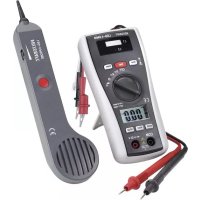
LSG4 - Detector VOLTCRAFT - Free user manual and instructions
Find the device manual for free LSG4 VOLTCRAFT in PDF.



| Product type | Cable detector and digital multimeter |
| Brand and model | Voltcraft LSG4 |
| Dimensions (multimeter) | 162 x 74 x 44 mm |
| Dimensions (receiver) | 233 x 56 x 27 mm |
| Weight (multimeter) | Approximately 308 g |
| Weight (receiver) | Approximately 125 g |
| Power supply | Multimeter: 2 AAA batteries; Signal generator: 1 9V battery; Receiver: 1 9V battery |
| Display | LCD, 2000 counts |
| Overvoltage category | CAT III 600 V (multimeter) |
| DC voltage measurement ranges | 200 mV / 2 V / 20 V / 200 V / 600 V |
| AC voltage measurement ranges | 2 V / 20 V / 200 V / 600 V |
| Resistance measurement ranges | 200 Ω / 2 kΩ / 20 kΩ / 200 kΩ / 2 MΩ / 20 MΩ |
| Diode test | Test voltage 1.5 V, current 1 mA |
| Acoustic continuity tester | Threshold lower than 35 Ω |
| Cable detector | Continuous beep (800-860 Hz) or warble (800-1050 Hz) |
| Telephone status test | Maximum voltage 50 V, polarity indication and ringing |
| Auto power off | After approximately 15 minutes of inactivity (multimeter) |
| Operating temperature | 0 to 40 °C, RH < 75 % |
| Storage temperature | -10 to 50 °C, RH < 80 % |
| Included accessories | Test leads, alligator clips, modular connector, batteries, receiver, instruction manual |
| Safety | Do not exceed 600 V in CAT III, do not use with open case, avoid humidity |
| Maintenance | Cleaning with damp cloth, annual calibration recommended |
Frequently Asked Questions - LSG4 VOLTCRAFT
User questions about LSG4 VOLTCRAFT
0 question about this device. Answer the ones you know or ask your own.
Ask a new question about this device
Download the instructions for your Detector in PDF format for free! Find your manual LSG4 - VOLTCRAFT and take your electronic device back in hand. On this page are published all the documents necessary for the use of your device. LSG4 by VOLTCRAFT.
USER MANUAL LSG4 VOLTCRAFT
GB Operating Instructions
DMM CABLE DETECTOR LSG-4
Item No. 2181313 Page 23 - 41
F Mode d'emploi
DÉTECTEUR DE CÂBLES AVEC DMM LSG-4
mV Millivolt (Exp. -3)
d) Signalverfolgung
- Introduction....24
- Explanation of symbols....24
- Intended use....25
- Delivery content....26
- Safety instructions ....26
a) General information....26
b) Connected devices....27
c) (Rechargeable) batteries....28
- Operating elements ......29
- Product description....30
- Display indications and symbols....31
- Inserting/charging the batteries ....31
- Measuring with the multimeter (DMM)....32
a) Turning the measuring device on 32
b) Voltage measuring "V" 33
c) Resistance measurement “Ω” 33
d) Diode test 34
e) Continuity check....34
f) HOLD function....35
g) MAX function....35
h) Auto power OFF function....35
- Measuring operation cable detector 35
a) Turning the cable detector on (signal transmitter + receiver) 36
b) Continuity test....36
c) Status test on telephone lines 36
d) Signal tracking....37
-
Troubleshooting....38
-
Care and cleaning....38
a) General....38
b) Cleaning 38
- Disposal 39
a) Product....39
b) (Rechargeable) batteries....39
- Technical data....39
1. Introduction
Dear customer,
Thank you for purchasing this product.
This product complies with the statutory national and European requirements.
To maintain this status and to ensure safe operation, you as the user must observe these operating instructions!

These operating instructions are part of this product. They contain important notes on commissioning and handling. Also consider this if you pass on the product to any third party. Therefore, retain these operating instructions for reference!
If there are any technical questions, please contact: www.conrad.com/contact
2. Explanation of symbols

The symbol with the lightning in the triangle is used if there is a risk to your health, e.g. due to an electric shock.

The symbol with the exclamation mark in the triangle is used to indicate important information in these operating instructions. Always read this information carefully.

The arrow symbol indicates special information and advice on operation.

Protection class 2 (double or reinforced insulation, protective insulation).
CAT II Overvoltage category II for measurements on electric and electronic devices connected to the mains supply with a power plug. This category also covers all smaller categories (e.g. CAT I for measuring signal and control voltages).
CAT III Overvoltage category III for measuring in building installation (e.g. outlets or sub-distribution). This category also covers all smaller categories (e.g. CAT II for measuring electronic devices).

Ground potential
3. Intended use
- Measuring and displaying electric parameters in the range of excess voltage category III (up to max. 600V against ground potential, pursuant to EN 61010-1) and all lower categories (only multimeter part "B")
- Measuring of direct and alternating voltages up to a maximum of 600V DC/AC rms (effective)
• Measuring resistance values of up to 40 MOhm. - Continuity check (< 35 ohms acoustic) and diode test.
- Touchless cable search with permanent or wobble sound on cables not carrying voltage
- Polarity and status test of telephone lines via banana clamps or modular connector RJ11
• Optical continuity tester (< 10 kOhm, in cable detection mode)
The measuring functions are selected via a rotary switch. Automatic measuring range selection is active in all measuring ranges.
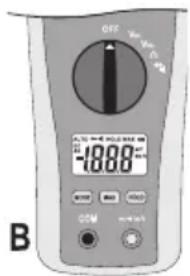
The housing of the LSG-4 DMM contains two function components that work independently of each other. The cable detector (signal generator) "A" has a fuse disconnector for shielding from the multi-meter component (DMM) "B". Both components work independently of each other.


The measuring instrument must not be operated when it is open, i.e. with an open battery compartment or when the battery compartment cover is missing. Measurements must not be carried out under unfavourable ambient conditions. Unfavourable ambient conditions are:
• presence of dust or combustible gases, vapours or solvents
- Thunderstorms or similar conditions such as strong electrostatic fields etc.
For safety reasons, when measuring only use measuring cables or accessories which are adjusted to the specifications of the multimeter.
Contact with moisture, e.g. in bathrooms, must be avoided under all circumstances.
For safety and approval purposes, you must not rebuild and/or modify this product. If you use the product for purposes other than those described above, the product may be damaged. In addition, improper use can result in short circuits, fires, electric shocks or other hazards. Read the instructions carefully and store them in a safe place. Make this product available to third parties only together with its operating instructions.
All company names and product names are trademarks of their respective owners. All rights reserved.
4. Delivery content
• Digital multimeter with rubber holster (LSG-4 DMM)
• Signal receiver (LSG-4 PROBE)
• 2 compound batteries (9V)
- 2 micro batteries (AAA)
• Safety measuring cables red and black
- Operating instructions
Up-to-date Operating Instructions
Download the latest operating instructions at www.conrad.com/downloads or scan the QR code shown. Follow the instructions on the website.
5. Safety instructions

Read the operating instructions carefully and especially observe the safety information. If you do not follow the safety instructions and information on proper handling in this manual, we assume no liability for any resulting personal injury or damage to property. Such cases will invalidate the warranty/guarantee.
a) General information
- The device is not a toy. Keep it out of the reach of children and pets.
- Do not leave packaging material lying around carelessly. This may become dangerous playing material for children.
- Protect the appliance from extreme temperatures, direct sunlight, strong jolts, high humidity, moisture, flammable gases, steam and solvents.
- Do not place the product under any mechanical stress.
-
If it is no longer possible to operate the product safely, take it out of operation and protect it from any accidental use. Safe operation can no longer be guaranteed if the product:
-
is visibly damaged,
- is no longer working properly,
- has been stored for extended periods in poor ambient conditions or
- has been subjected to any serious transport-related stresses.
- Please handle the product carefully. Jolts, impacts or a fall even from a low height can damage the product.
- On industrial sites the accident prevention regulations of the association of the industrial workers' society for electrical equipment and utilities must be followed.
- In schools, training centres, computer and self-help workshops, handling of measuring instruments must be supervised by trained personnel in a responsible manner.
- The voltage between the measuring sockets of the multimeter part and the ground potential must never exceed 600 V DC/AC in CAT III.
- Only voltages of <75 V/DC or <50 V/AC may be connected to the banana clips (14) and modular plugs. These contacts are only designed for standard telephone signal and control voltages or for cables which do not carry any voltage.
- The test prods have to be removed from the measured object every time the measuring range is changed.
- Be especially careful when dealing with voltages higher than 25V AC or 35 V DC. Even at such voltages you can receive a life-threatening electric shock when you come into contact with electric wires.
- Check the measuring device and its measuring lines for damage before each measurement. Never carry out any measurements if the protecting insulation is defective (torn, ripped off etc.)
- To avoid an electric shock, make sure not to touch the connections/measuring points to be measured neither directly nor indirectly during measurement. During measuring, do not grip beyond the tangible grip range markings present on the test prods and banana clamps.
- Do not use the multimeter just before, during or just after an electrical storm (electrical shock / highenergy overvoltage!). Please make sure that your hands, your shoes, your clothing, the floor, switches and switching components are dry.
- Avoid operation near strong magnetic or electromagnetic fields, transmitter aerials or HF generators. These could lead to incorrect measuring values.
- Do not switch the measuring instrument on immediately after it has been taken from a cold to a warm environment. The condensation that forms might destroy your device. Leave the device switched off and wait until it has reached room temperature.
- For safety reasons, when measuring only use the enclosed measuring cables or accessories which are adjusted to the specifications of the multimeter.
- You should also heed the safety instructions in each chapter of these instructions.
- Consult an expert when in doubt about the operation, safety or connection of the appliance.
- Maintenance, modifications and repairs must only be completed by a technician or an authorised repair centre.
- If you have questions which remain unanswered by these operating instructions, contact our technical support service or other technical personnel.
b) Connected devices
- Also observe the safety and operating instructions of any other devices which are connected to the product.

c) (Rechargeable) batteries
- Correct polarity must be observed while inserting the (rechargeable) battery.
- The (rechargeable) batteries should be removed from the device if it is not used for a long period of time to avoid damage through leaking. Leaking or damaged (rechargeable) batteries might cause acid burns when in contact with skin, therefore use suitable protective gloves to handle corrupted (rechargeable) batteries.
- (Rechargeable) batteries must be kept out of reach of children. Do not leave (rechargeable) batteries lying around, as there is risk, that children or pets swallow them.
- All (rechargeable) batteries should be replaced at the same time. Mixing old and new (rechargeable) batteries in the device can lead to (rechargeable) battery leakage and device damage.
- Rechargeable batteries must not be dismantled, short-circuited or thrown into fire. Never recharge non-rechargeable batteries. There is a risk of explosion!
6. Operating elements

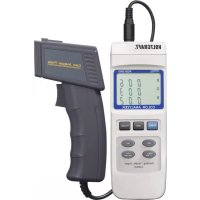
1 LED indicator for cable detector (L1: cable status, continuity tester; L2: Battery replacement display)
2 "Sel" toggle key for cable detector (signal tracing with permanent or wobble sound)
3 "Tone" duty switch for cable detector
4 Rotary switch
5 Display (LCD) for multimeter
6 MODE button for switching the measuring functions diode test and continuity tester
7 COM measuring socket (reference mass, minus potential)
8 V measuring sockets for all measuring functions of the multimeter (plus potential)
9 HOLD button for "freezing" the display value
10 MAX button; records the maximum value in the voltage measuring range.
11 Battery compartment on the rear
12 Removable protective rubber frame with setup brackets on the rear
13 "Cont" duty switch for continuity testing with cable detector
14 Banana clip measuring leads for cable detector and status test (red = Lb, black = La)
15 Modular connector for cable detector and status test
16 Headphone socket for 3.5 mm jack plug
17 Integrated loudspeaker
18 Battery compartment on the rear
19 Button for loudspeaker playback during cable tracking (depressed = loudspeaker on)
20 Rotary duty switch with volume control for tracking signal (0 = off, 1 = low, 9 = high)
21 Insulated test prod for cable tracking
7. Product description
The multimeter (referred to as DMM in the following) indicates measured values on the digital display together with the units and symbols. The measuring value display of the DMM comprises 2000 counts (count = smallest display value).
If the DMM is not operated for approx. 15 minutes, it turns itself off automatically. This saves the batteries and ensures longer operating time.
Cables are detected via a coupled acoustic signal that can be traced touchless with the receiver. A set of headphones can be connected to the receiver and the volume is adjustable.
The line status (right/wrong polarity and ring tone) of the telephone lines are displayed on a separate LED display and works independent of the DMM.
The measuring device can be used for do-it-yourself or for professional applications.
For better readability, the DMM can also be mounted with the clip on the rear.
Rotary switch (4) on the multimeter
The individual measuring functions are selected via a rotary switch.
The automatic range selection “auto range” is active in all measuring ranges. The appropriate range of measurement is set for each application individually.
The measuring function diode test and continuity test have dual assignments. These functions are switched with the button "MODE" (6).
If the rotary switch is set to "OFF", the measuring device is switched off. Always turn the measuring device off when it is not in use.

8. Display indications and symbols
This is a list of all possible symbols and statements on the DMM.
AUTO Automatic range selection is active
HOLD Data hold function is activated
OL Overload, the measuring range was exceeded
OFF Off position. The DMM is switched off.
+ Symbol for battery change
Symbol for the diode test
-1) Symbol for the acoustic continuity tester
OFF Symbol for "button not pressed" (function off)
ON Symbol for "button pressed" (function on)
AC Alternating size for voltage and current
DC Direct magnitude for voltage and current
mV Millivolt (exp.-3)
V Volt (unit of electric potential)
Ω Ohm (unit of electric resistance)
kΩ Kiloohm (exp.3)
MΩ Megaohm (exp.6)
MAX Maximum value display
9. Inserting/charging the batteries
The multimeter requires two AAA batteries for operation. You need to insert new, charged batteries prior to initial operation or when the battery change symbol appears on the display.
The signal transmitter requires a )V compound battery just like the receiver. You need to change the battery when the display "L2" is lit or if there is no audible sound on the receiver.
To insert/replace the batteries in the DMM, proceed as follows:
- Disconnect the measuring device from all measuring circuits and turn it off.
- Remove the protective rubber frame (12) from the device.
- Undo the screws on the battery compartment cover (11) and remove the cover.
- Place new batteries into the battery compartment observing the correct polarity.
- Now close the housing carefully again.
To insert/replace the batteries in the receiver, proceed as follows:
- Turn the device off with the rotary switch (20).
- Undo the screw of the battery compartment cover (18) and remove the cover.
- Place a new battery into the battery compartment, observing the correct polarity.
- Now close the housing carefully again.

Never operate the devices when they are open. !RISK OF FATAL INJURY!
Do not leave flat batteries in the device. Even batteries protected against leaking can corrode and thus release chemicals which may be detrimental to your health or destroy the battery compartment.
Do not leave batteries lying around carelessly. They might be swallowed by children or pets. If swallowed, consult a doctor immediately.
If the device is not used for longer periods of time, remove the batteries in order to prevent leaking.
Leaking or damaged batteries might cause acid burns when getting into contact with skin. Therefore, use suitable protective gloves.
Make sure that the batteries are not short-circuited. Do not throw batteries into fire!
Batteries may not be recharged or dismantled. Danger of explosion.

You can order suitable alkaline batteries stating the following order no.:
9 V block battery: Order no.: 65 25 10 (please order 2 x).
1.5 V micro battery: Order no.: 65 23 03 (please order 2 x).
Only use alkaline batteries, since these are powerful and have a long life.
10. Measuring with the multimeter (DMM)

Do not exceed the maximum permitted input values. Do not contact circuits or parts of circuits if there could be voltages higher than 25 V ACrms or 35 V DC present within them. Mortal danger!
Before measuring, check the connected measuring lines for damage such as, for example, cuts, cracks or squeezing. Defective measuring cables must no longer be used. Mortal danger!
During measuring, do not grip beyond the tangible grip range markings present on the test prods.
Measuring is only permitted with closed housing and battery compartment.

As soon as "OL" (overload) appears on the display, you have exceeded the measuring range.
a) Turning the measuring device on
The measuring instrument is turned on again via the rotary switch (4). Turn the rotary switch to the desired measuring function. Turn the rotary switch to "OFF" to turn the device off. Always turn the measuring device off when it is not in use (position "OFF").

Prior to working with the measuring device, you first have to insert the enclosed batteries. Inserting and changing the battery is described in the chapter "Maintenance and cleaning".
b) Voltage measuring "V"
Proceed as follows to measure DC voltages "V DC":
- Turn the DMM on and select measuring range "V DC".
- Plug the red measuring lead into the V measuring socket (8) and the black measuring lead into the COM measuring socket (7).
- Now connect the two measuring prods to the object to be measured (battery, switch etc.). The red measuring tip indicates the positive pole, the black measuring tip the negative pole.
- The polarity of the respective measuring value is indicated on the display together with the current measuring value.

As soon as a minus “-” appears for the direct voltage in front of the measuring value, the measured voltage is negative (or the measuring tips have been mixed up).

• After measuring, remove the measuring leads from the measuring object and turn the DMM off.
Proceed as follows to measure AC voltages "V AC":
- Turn the DMM on and select measuring range "V AC". "AC" appears on the display.
- Plug the red measuring lead into the V measuring socket (8) and the black measuring lead into the
• COM measuring socket (7). - Now connect the two measuring prods to the object to be measured (generator, switch etc.).
- The measuring value is indicated on the display
• After measuring, remove the measuring leads from the measuring object and turn the DMM off.
c) Resistance measurement “Ω”

Make sure that all the circuit parts, switches and components and other objects of measurement are disconnected from the voltage and discharged.
Proceed as follows to measure the resistance:
- Turn the DMM on and select measuring range "Ω".
- Plug the red measuring lead into the Ω measuring socket (8) and the black measuring lead into the COM measuring socket (7).
- Check the measuring leads for continuity by connecting both measuring prods with one another. After that the resistance value must be approximately 0 to 0.5 Ohm (inherent resistance of the measuring leads).

- Connect the two measuring prods to the object to be measured. As long as the object to be measured is not high-resistive or interrupted, the measured value will be indicated on the display. Wait until the display has stabilised. With resistances of >1 MOhm, this may take a few seconds.
- As soon as "OL" (overload) appears on the display, you have exceeded the measuring range or the measuring circuit has been broken.
• After measuring, remove the measuring leads from the measuring object and turn the DMM off.

If you carry out a resistance measurement, make sure that the measuring points which you contact with the test prods are free from dirt, oil, solderable lacquer or the like. An incorrect measurement may result under such circumstances.
d) Diode test

Make sure that all the circuit parts, switches and components and other objects of measurement are disconnected from the voltage and discharged.

- Turn the DMM on and select measuring range
• The diode symbol appears on the display. - Plug the red measuring lead into the Ω measuring socket (8) and the black measuring lead into the COM measuring socket (7).
- Check the measuring leads for continuity by connecting both measuring prods with one another. After that the value must be approx. 0 V.
- Now connect the two measuring prods with the object to be measured (diode).
- The display shows the continuity voltage "UF" in volt (V). If "OL" is indicated, the diode is measured in reverse direction (UR) or the diode is defect (interruption). Perform a counter-pole measuring for control reasons.
• After measuring, remove the measuring leads from the measuring object and turn the DMM off.

Silicone diodes have an on-state voltage (UF) of approx. 0.4 - 0.9 V.

e) Continuity check

Make sure that all the circuit parts, switches and components and other objects to be measured are disconnected from the voltage and currentless at all times.
- Turn the DMM on and select measuring range
- Press the button "MODE" (6) to switch the measuring function. The symbol for continuity check now appears in the display. Pressing this button again takes you to the first measuring function etc.
- Plug the red measuring lead into the Ω measuring socket (8) and the black measuring lead into the COM measuring socket (7).
• A measuring value of less than 35 Ohm is detected and a beep sounds. - As soon as "OL" (overload) appears on the display, you have exceeded the measuring range or the measuring circuit has been interrupted. Perform a counter-pole measuring for control reasons.
• After measuring, remove the measuring leads from the measuring object and turn the DMM off.

f) HOLD function
The HOLD function freezes the currently indicated measuring value to allow you to read it or to take the record without rush.

If you test live wires make sure that this function is deactivated before the measurement starts. Otherwise, a false measuring result is simulated!
- To switch on the HOLD function press the "HOLD" button (9); an acoustic signal confirms this action and "HOLD" appears on the display.
- To turn the HOLD function off, press the button "HOLD" again or change the measuring function.
g) MAX function
This function keeps the maximum value on the display during continuous measuring. This function is only available in the voltage measuring ranges "V/AC" and "V/DC".
- Press the button "MAX" (10) once in V measuring mode. The display shows "MAX" and indicates and saves the highest value.
- If you press the button "MAX" again, you return to normal measuring mode.
h) Auto power OFF function
- The DMM turns off automatically after 15 minutes if no button or switch is operated. This function saves battery power and extends the service life.
• To reactivate the DMM after automatic shutdown, use the rotary switch or press any function key (MODE, MAX, HOLD).
11. Measuring operation cable detector

Never exceed the admissible input values of <75 V/DC or <50 V/AC. Do not contact circuits or parts of circuits if there could be voltages higher than 25 V ACrms or 35 V DC present within them. Mortal danger!
Before measuring, check the permanently connected measuring lines for damage such as, for example, cuts, cracks or squeezing. Defective measuring cables must no longer be used.
Measuring is only permitted with closed housing and battery compartment.
Always turn both devices for cable detection off after operation. The devices do not turn off automatically like the DMM.
You may only perform cable detections and continuity tests on cables that do not carry any voltage.
The cable detector consists of two parts. The signal generator (in the DMM) is required for operation. It modulates the corresponding acoustic signal on the test lines. The receiver (PROBE) decodes this signal and emits it either via headphones (16) or the integrated loudspeaker. The volume can be adjusted on the receiver.
A continuity tester for cables that do not carry any voltage is also integrated.
The line status of telephone lines carrying voltage can also be determined via polarity and ring tone.
a) Turning the cable detector on (signal transmitter + receiver)
- The functions of the signal transmitter in the DMM are activated/deactivated via buttons (3 and 13).
- When the button is pressed, the corresponding function is on. To turn off press the switch again.
- The receiver is activated with the rotary switch (20). The receiver is switched off when the switch (with snap function) is in the "0" position. Position 1 - 9 corresponds to the volume (1 = low, 9 = high).

Prior to working with the cable detector, you first have to insert the enclosed batteries. Inserting and changing the battery is described in the chapter "Maintenance and cleaning".
b) Continuity test
Continuity tests can be performed with the banana clips (14) on the signal transmitter. Resistance values of <10 kOhm are signalled optically.
Proceed as follows to perform the continuity test:
- Release all push buttons (2, 3 and 13) to return them to the OFF position.
- Activate the function "continuity test" by pressing the button "Cont" (13). The button snaps into place.
- Connect the two banana clips (14) with each other for testing. The display "L1" turns green. It goes off after separation of the clips.

- Connect the two banana clips with the lines to be tested. With a forward resistance of < 10kOhm , the display "L1" starts to light up. The smaller the resistance, the brighter the light.
- Terminate the continuity test and press the button "Cont". The continuity test is switched off.
c) Status test on telephone lines
In passive state, the signal transmitter functions as a status tester of telephone lines carrying voltage. The polarity (right/wrong) as well as an incoming ring tone can be displayed. The max. input voltage is 50 V.
Line status with banana clip
- Release all push buttons (2, 3 and 13) to return them to the OFF position.
- Connect the red banana clip with the connection "Lb" and the black clip with the connection "La".
- In case of correct polarity, the display "L1" (1) lights up green. If the polarity of the connections is mixed up, the display lights up red. In case of an incoming ring tone, the display blinks in the interval of the ring tone. Attention! Danger of an electric shock when touching this signal voltage!
- When the test is completed, remove the banana clips from the telephone connections.
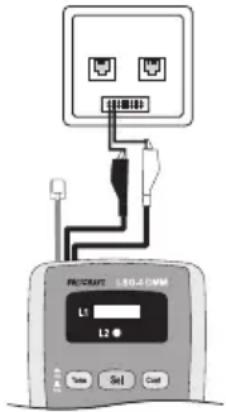
Line status with modular plug
- Release all push buttons (2, 3 and 13) to return them to the OFF position.
- Connect the modular plug with a modular telephone socket until the plug snaps into place.
- In case of correct polarity, the display "L1" (1) lights up green. If the polarity of the connections is mixed up, the display lights up red. In case of an incoming ring tone, the display blinks in the interval of the ring tone. Attention! Danger of an electric shock when touching this signal voltage!
- When the test is completed, remove the banana clips from the telephone connections.

d) Signal tracking
With signal tracking, you can determine the path of all cables, conductors or metal pipes not carrying voltage. An acoustic signal is applied to the line to be tested. This signal can then be located with the receiver and the line path checked. It also serves to identify lines in installations etc. The signal is emitted simultaneously on the banana clips and the modular plug.
To track the signal, proceed as follows.
- Release all push buttons (2, 3 and 13) to return them to the OFF position.
- Activate signal tracking by pressing the button "Tone" (3). The button snaps into place.
- Turn the receiver on at the rotary switch (20) and select a volume of approx. 6-7.
- To perform the function test, put the tip of the receiver (21) on the banana clip or the modular plug and keep the button (19) depressed. A wobble sound is emitted.

- Select the desired test signal with the switch "Sel" (2). When the switch is depressed, a permanent sound is emitted, when it is not pressed, a wobble sound is emitted.
- Use an optional set of headphones, select a lower volume. The headphones can be attached to the jack socket "Phone" (16). For signal tracking with headphones, it is not necessary to press the button (19). The headphone socket is always on in activated state.
- Put the banana clip or the modular plug on the lines to be tested.
- With cables that are connected at one end, please use the shielding or ground potential for the black clamp. Attach the red clamp to the internal conductor.
- In case of open lines, connect the red and the black clamp with two internal conductors.
- With modular sockets, please use the modular plug.
- For signal tracing, apply the tip of the receiver (21) as close as possible to the contacted line. Press the button for loudspeaker playback (19) or plug an optional set of headphones into the jack socket on the side (16).
- You can adjust the volume at the rotary switch (20). The closer the test prod is to the signal, the louder and clearer it is played back.
- Once the test is finished, put all switches (2, 3 and 13) to the OFF position by releasing them and put the rotary switch on the receiver to the position "0" until it snaps into place. The devices are turned off.
12. Troubleshooting
In purchasing this DMM cable detector, you have acquired a product which has been designed with state-of-the-art technology and is operationally reliable.
Nevertheless, problems or faults may occur.
For this reason, the following is a description of how you can eliminate possible malfunctions yourself.

Please always observe the safety instructions!
| Error Possible cause Remedy | ||
| The device does not work. | Is the battery dead? | Check the status.Battery replacement |
| None Change of the measuring value. | Is a wrong measuring function activated (AC/DC)? | Check the display (AC/DC) and switch the function if applicable. |
| Is the HOLD function activated?(display “HOLD”). | Press the button “HOLD” to deactivate this function. | |
13. Care and cleaning
a) General
To ensure the accuracy of the multimeter over an extended period of time, it should be calibrated once a year.
Apart from occasional cleaning and battery replacements, the multimeter requires no servicing.
The battery change is described below.

Regularly check the technical safety of the instrument and measuring lines, e.g. check for damage to the housing or squeezing etc.
b) Cleaning
Always observe the following safety instructions before cleaning the device:

Live components may be exposed if covers are opened or parts are removed (unless this can be done without tools).
The connected lines must be disconnected from the measuring device and all measuring objects prior to cleaning or repairing the device. Switch the DMM off.
- Do not use any carbon-containing cleaning agents or petrol, alcohol or the like to clean the product. These could corrode the surface of the measuring instrument. Furthermore, the fumes are hazardous to your health and explosive. Moreover, you should not use sharp-edged tools, screwdrivers or metal brushes or similar for cleaning.
- For cleaning the device or the display and the measuring lines, use a clean, fuzz-free, antistatic slightly damp cloth. Leave the device to dry completely prior to using it for the next measuring operation.
14. Disposal
a) Product

Electronic devices are recyclable waste and must not be disposed of in the household waste. At the end of its service life, dispose of the product in accordance with applicable regulatory guidelines.
Remove any inserted (rechargeable) batteries and dispose of them separately from the product.
b) (Rechargeable) batteries

You as the end user are required by law (Battery Ordinance) to return all used (rechargeable) batteries. Disposing of them in the household waste is prohibited.
Contaminated (rechargeable) batteries are labeled with this symbol to indicate that disposal in the domestic waste is forbidden. The designations for the heavy metals involved are: Cd = Cadmium, Hg = Mercury, Pb = Lead (name on (rechargeable) batteries, e.g. below the trash icon on the left).
Used (rechargeable) batteries can be returned to collection points in your municipality, our stores or wherever (rechargeable) batteries are sold.
You thus fulfill your statutory obligations and contribute to the protection of the environment.
15. Technical data
Display......LCD; 2000 counts
Measuring cable length ....about 80 cm each
Measuring impedance ....>7.5 MΩ (V range)
Automatic switch-off ....approx. 15 minutes
Operating voltage 2 x AAA micro batteries (DMM)
9V block battery (Signaller)
9V block battery (Receiver)
Operating altitude ....max. 2,000 m
Over-voltage category ....CAT III 600 V, contamination degree 2
(only DMM via safety sockets)
| Operating conditions....0 to 40°C (<75%rh) |
| Storage conditions....-10 to +50°C (<80% RH) |
| Dimensions (L x W x H)....162 x 74 x 44 mm (DMM)233 x 56 x 27 mm (Receiver) |
| Weight....ca. 308 g (DMM)ca. 125 g (Receiver) |
Cable detector
| Signal | permanent sound ca. 800 – 860 Hzwobble sound ca. 800 – 1050 Hz |
| Status indicator | max. 50 V |
| Continuity tester | <10 kΩ (optical) |
| Measuring cable length | banana clips approx. 50 cm each modular plug ca. 25 cm |
| Overload protection | <75 V/DC, <50 V/AC |
Measuring tolerances
Statement of accuracy in ± (% of reading + display error in counts (= number of smallest points)). The accuracy is valid for one year at a temperature of +23°C ± 5°C , and at a relative humidity of less than 75%, non-condensing.
V/DC
| Range Resolution Accuracy | ||
| 200 mV 0.1 mV ±(0.8 % + 4) | ||
| 2 V 0.001 V | ±(1.3 % + 4) | |
| 20 V 0.01 V | ||
| 200 V 0.1 V | ||
| 600 V 1 V | ||
| Overload protection: 600 V; impedance >7.5 MΩ | ||
Alternating voltage V/AC
| Range Resolution Accuracy | ||
| 2 V 0.001 V | ±(1.3 % + 6) | |
| 20 V 0.01 V | ||
| 200 V 0.1 V | ±(1.8 + 10) | |
| 600 V 1 V | ||
| Frequency range 50 – 60 Hz; average value with sinus voltage; overload protection 600 V; impedance >7.5 MΩ | ||
Resistance Ω
| Range Resolution Accuracy | ||
| 200 Ω 0.1 Ω ±(1.0 % + 6) | ||
| 2 kΩ 0.001 kΩ | ±(1.5 % + 4)20 kΩ 0.01 kΩ | |
| 200 kΩ 0.1 kΩ | ||
| 2 MΩ 0.001 MΩ ±(2.0 % + 5) | ||
| 20 MΩ 0.01 MΩ ±(5.0 % + 8) | ||
| Overload protection 600 V | ||
Diode test
| Test voltage Resolution Test current | |
| 1.5 V 0.001 V 1 mA (typical) | |
| Overload protection 600 V | |
Acoustic continuity tester
< 35 Ω permanent sound, overload protection 600 V

Do not exceed the maximum permitted input values. Never touch circuits or parts of circuits with voltages of more than 25 V/ACrms or 35 V/DC! Mortal danger!
Table des matières
Page
France (email): technique@conrad-france.fr

d) Suivi du signal
Tension alternative V/CA

Copyright 2019 by Conrad Electronic SE.
GB This is a publication by Conrad Electronic SE, Klaus-Conrad-Str. 1, D-92240 Hirschau (www.conrad.com).
All rights including translation reserved. Reproduction by any method, e.g. photocopy, microfilming, or the capture in electronic data processing systems require the prior written approval by the editor. Reprinting, also in part, is prohibited. This publication represents the technical status at the time of printing.
Copyright 2019 by Conrad Electronic SE.
Copyright 2019 by Conrad Electronic SE.
Copyright 2019 by Conrad Electronic SE.
- SIGNALVERFOLGUNG
- INTRODUCTION
- EXPLANATION OF SYMBOLS
- INTENDED USE
- DELIVERY CONTENT
- UP-TO-DATE OPERATING INSTRUCTIONS
- SAFETY INSTRUCTIONS
- GENERAL INFORMATION
- CONNECTED DEVICES
- (RECHARGEABLE) BATTERIES
- OPERATING ELEMENTS
- PRODUCT DESCRIPTION
- ROTARY SWITCH (4) ON THE MULTIMETER
- DISPLAY INDICATIONS AND SYMBOLS
- INSERTING/CHARGING THE BATTERIES
- TO INSERT/REPLACE THE BATTERIES IN THE DMM, PROCEED AS FOLLOWS
- TO INSERT/REPLACE THE BATTERIES IN THE RECEIVER, PROCEED AS FOLLOWS
- MEASURING WITH THE MULTIMETER (DMM)
- TURNING THE MEASURING DEVICE ON
- VOLTAGE MEASURING "V
- PROCEED AS FOLLOWS TO MEASURE DC VOLTAGES "V DC
- PROCEED AS FOLLOWS TO MEASURE AC VOLTAGES "V AC
- RESISTANCE MEASUREMENT “Ω
- PROCEED AS FOLLOWS TO MEASURE THE RESISTANCE
- DIODE TEST
- CONTINUITY CHECK
- HOLD FUNCTION
- MAX FUNCTION
- AUTO POWER OFF FUNCTION
- MEASURING OPERATION CABLE DETECTOR
- TURNING THE CABLE DETECTOR ON (SIGNAL TRANSMITTER + RECEIVER)
- CONTINUITY TEST
- PROCEED AS FOLLOWS TO PERFORM THE CONTINUITY TEST
- STATUS TEST ON TELEPHONE LINES
- LINE STATUS WITH BANANA CLIP
- LINE STATUS WITH MODULAR PLUG
- SIGNAL TRACKING
- TO TRACK THE SIGNAL, PROCEED AS FOLLOWS
- TROUBLESHOOTING
- CARE AND CLEANING
- GENERAL
- CLEANING
- DISPOSAL
- PRODUCT
- TECHNICAL DATA
- MEASURING TOLERANCES
- ACOUSTIC CONTINUITY TESTER
- TABLE DES MATIÈRES
- PAGE
- SUIVI DU SIGNAL
Brand : VOLTCRAFT
Model : LSG4
Category : Detector