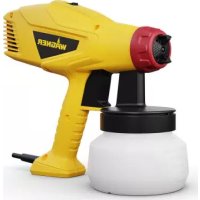
W 125 - Paint spray WAGNER - Free user manual and instructions
Find the device manual for free W 125 WAGNER in PDF.



| Brand | Wagner |
| Model | W 125 |
| Product type | Low-pressure electric spray gun |
| Power supply | 230 V ~, 50 Hz |
| Power consumption | 350 W |
| Weight | 1.2 kg |
| Tank capacity | 600 ml |
| Max product flow rate | 150 ml/min |
| Max viscosity | 100 DIN-s |
| Protection class | I |
| Sound pressure level | 75 dB(A) |
| Operating noise level | 86 dB(A) |
| Vibration level | < 2.5 m/s² |
| Spray patterns | Round jet, flat vertical jet, flat horizontal jet |
| Applicable products | Stains, solvent-based or water-based paints, varnishes (diluted 5-10% if necessary) |
| Non-applicable products | Wall paints, abrasive products, facade paint, acidic/alkaline products, combustible products |
| Recommended spraying distance | 5 to 15 cm |
| Warranty | 3 years + 1 additional year after online registration |
| Maintenance | Clean after each use; do not immerse the rear part; replace air filter regularly |
| Spare parts available | Complete front part, nozzle/nut assembly, tank, air filter |
| Compliance standards | CE (2006/42/EC, 2014/30/EU, 2011/65/EU, 2012/19/EU) |
Frequently Asked Questions - W 125 WAGNER
User questions about W 125 WAGNER
0 question about this device. Answer the ones you know or ask your own.
Ask a new question about this device
Download the instructions for your Paint spray in PDF format for free! Find your manual W 125 - WAGNER and take your electronic device back in hand. On this page are published all the documents necessary for the use of your device. W 125 by WAGNER.
USER MANUAL W 125 WAGNER
natural_image
Line drawing of a spray gun with a base and handle (no text or symbols)WOOD & METAL SPRAYER
W 125
ORIGINAL-
BETRIEBSANLEITUNG

natural_image
Technical line drawing of a handheld electric shaver with labeled part (4), no text or symbols presentInhalt
Translation of the original operating instructions
Contents
- Explanation of symbols used.... 11
- General Safety Instructions .... 12
- Safety Instructions for Spray Guns 14
- Description/ Scope of delivery 15
- Coating Materials Suitable for Use....15
- Start-up 15
- Adjusting the desired Spray Setting 16
- Adjusting the Material Volume (Fig. 5)....16
- Spray Technique....16
- Taking Out of Operation and Cleaning.... 16
- Maintenance 17
- Spare Parts List .... 17
- Correction of Malfunctions.... 17
- Technical Data.... 18
- Environmental protection.... 19
- Important Note regarding Product Liability! 19
1. Explanation of symbols used
 | This symbol indicates a potential danger for you or for the device. Under this symbol you can find important information on how to avoid injuries and damage to the device. |
 | Danger of electrical shock |
 | Indicates tips for use and other particularly useful information. |
2. General Safety Instructions
Caution!

Read all safety warnings and all instructions. Failure to follow the warnings and instructions may result in electric shock, fire and/or serious injury. Save all warnings and instructions for future reference.
The term "power tool" in the warnings refer to your mains-operated (corded) power tool or battery-operated (cordless) power tool.
1. Safety at the workplace
a) Keep your workplace clean and well lit. Disorder or unlit workplaces may result in accidents.
b) Never use the tool in hazardous areas that contain flammable liquids, gases or dusts. Power tools generate sparks that can ignite the dust or vapors.
c) Keep children and other persons away when using the power tool. You can lose control of the tool if you are distracted.
2. Electrical Safety
a) The tool plug must fit into the socket. The plug may not be modified in any form. Do not use adaptor plugs together with protective-earthed tools. Unmodified plugs and suitable sockets reduce the risk of an electric shock.
b) Avoid physical contact with earthed surfaces such as pipes, heating elements, stoves and refrigerators. The risk through electric shock increases if your body is earthed.
c) Keep the equipment away from rain and moisture. The risk of an electric shock increases if water penetrates electrical equipment.
d) Do not misuse the mains lead by carrying the tool by the lead, hanging it from the lead or by pulling on the lead to remove the plug. Keep the lead away from heat, oil, sharp edges or moving tool parts. Damaged or twisted leads increase the risk of an electric shock.
e) If you work outdoors with a power tool, only use extension cables suitable for outdoor use. The use of an extension lead that is suitable for outdoors reduces the risk of an electric shock.
f) If you cannot avoid using the tool in a damp environment, use a residual current operated circuit-breaker. Using a residual current operated circuit-breaker avoids the risk of electric shock.
3. Safety of Persons
a) Be attentive. Pay attention to what you are doing and work sensibly with a
power tool. Do not use the tool if you are tired or under the influence of drugs, alcohol or medication. Just a moment of inattentiveness while using the tool can lead to serious injuries.
b) Wear personal safety equipment and always wear safety goggles Wearing personal protective equipment, such as dust mask, non-slip safety shoes, safety helm or ear protection, depending on the type of power tools, reduces the risk of injury.
c) Avoid accidental starting-up. Make sure that the electric tool is switched off before you connect it to the power supply, pick it up or carry it. Accidents can occur if you carry the power tool while your finger is on the switch or if you connect the power tool to the power supply which it is on.
d) Remove setting tools or wrenches before switching on the power tool. A tool or wrench that is in a rotating tool part can lead to injuries.
e) Avoid an unnatural posture. Ensure that you are standing securely and have your balance at all times. This ensures that you can control the tool better in unexpected situations.
f) Wear suitable clothing. Do not wear wide clothing or jewellery. Keep your hair, clothes and gloves away from moving parts. Loose clothing, jewellery or long hair can be caught in moving parts.
g) Do not lull yourself into a false sense of security and do not think yourself above the safety rules for electric tools, even if you are familiar with the electric tool following extensive practical experience. Careless use can lead to serious injuries in fractions of a second.
4. Usage and treatment of the electric tool
a) Do not overload the tool. Use the power tool designed for the work that you are doing. You work better and safer in the specified performance range if you use the suitable power tool.
b) Do not use power tools whose switch is defective. A power tool that cannot be switched on or off is dangerous and has to be repaired.
c) Remove the plug from the socket before carrying out tool settings, changing accessories or putting the tool away. This precautionary measure prevents unintentional starting of the tool.
d) Store unused power tools so that they are inaccessible to children. Do not let persons use the tool who are not familiar with it or who have not read these instructions. Power tools are dangerous when they are used by inexperienced persons.
e) Take proper care of your tools. Check whether the moving parts function
trouble-free and do not jam, whether parts are broken or damaged so that the tool function is impaired. Have damaged parts repaired before using the tool. Many accidents have their origin in power tools that have been maintained badly.
f) Use the power tool, accessories, insert tools, etc. in accordance with these instructions and in a fashion specified for this special tool type. Take the working conditions and the activity to be carried out into consideration. The use of power tools for purposes other than the intended ones can lead to dangerous situations.
g) Keep the handles and grip surfaces dry, clean and free of oil and grease. Slippery handles and grip surfaces hamper safe operation and control of the electric tool in unforeseen situations.
5. Service
a) Have your tool repaired only by qualified specialist personnel and only with original spare parts. This ensures that the tool safety is maintained.
b) If the supply cord is damaged, it must be replaced by the manufacturer or it's service agent or a similarly qualified person in order to avoid a safety hazard.
3. Safety Instructions for Spray Guns
- The device may not be used in workplaces covered by the explosion-protection regulations.
- There must be no sources of ignition such as, for example, open fires, smoke of lit cigarettes, cigars and tobacco pipes, sparks, glowing wires, hot surfaces, etc. in the vicinity during spraying.
- Do not spray any substances whose hazard potential is not known.
- Before working on the spray gun remove the power plug from the socket.
- Do not use the spray guns to spray flammable substances.
- The spray guns are not to be cleaned with flammable solvents.
- Caution against dangers that can arise from the sprayed substance and observe the text and information on the containers or the specifications given by the substance manufacturer.
- Caution! Wear breathing equipment: Paint mist and solvent vapors are damaging to health. Always wear breathing equipment and only work in well ventilated rooms or using supplementary ventilating equipment. It is advisable to wear working clothing, safety glasses, ear protection and gloves.

CAUTION: DANGER OF INJURY!
Never point the spray stream towards human beings or animals.

Sockets and plugs must be masked. Risk of an electric shock as a consequence of sprayed material entering the socket!
- When working with the W 125 indoors as well as outdoors ensure that no solvent vapors are sucked in by the spray gun.
- When working outdoors, be aware of the wind direction. Wind can carry the coating substance across greater distances - thus causing damage. When working indoors, provide for adequate ventilation.
- Do not let children handle the device.
- Never open the device yourself in order to carry out repairs in the electrical system!
With original Homeright accessories and spare parts, you have the guarantee that all safety regulations are fulfilled.
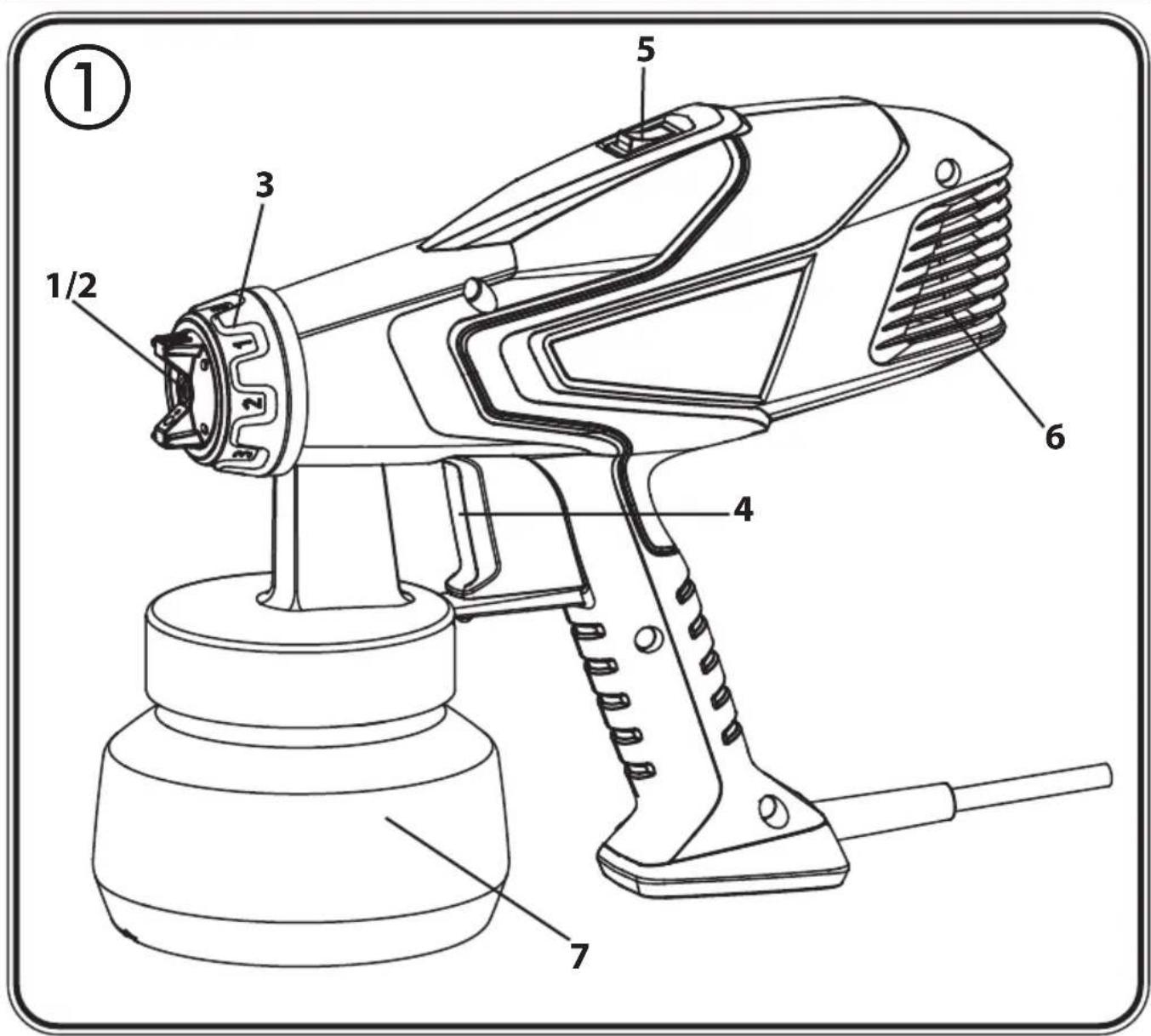
4. Description/ Scope of delivery
| Description/ Scope of delivery (Fig. 1) | |
| 1) Air Cap 2) Nozzle | |
| 3) Union nut with material volume regulation | 4) Trigger |
| 5) ON/OFF switch 6) Air filter | |
| 7) Container | |
5. Coating Materials
| Coating Materials Suitable for Use | |
| Glazes, Wood preservatives undiluted | |
| Paints containing solvents and water-soluble paints, primers dilute by 5 - 10% | |
| Coating Materials Not Suitable for Use |
| Wall paints, materials that contain highly abrasive components, facade paint, caustic solutions and acidic coating substances. Flammable materials. |
Paints, varnishes and glazes can be sprayed undiluted or slightly diluted.
- Stir the material up and put the required amount into the paint container.
- If the convey capacity is too low, add 5 - 10% dilution step-by-step until the convey capacity fulfils your requirements.
6. Start-up
Before connecting to the mains supply, be sure that the supply voltage is identical with the value given on the rating plate.
- Unscrew the container from the spray gun.
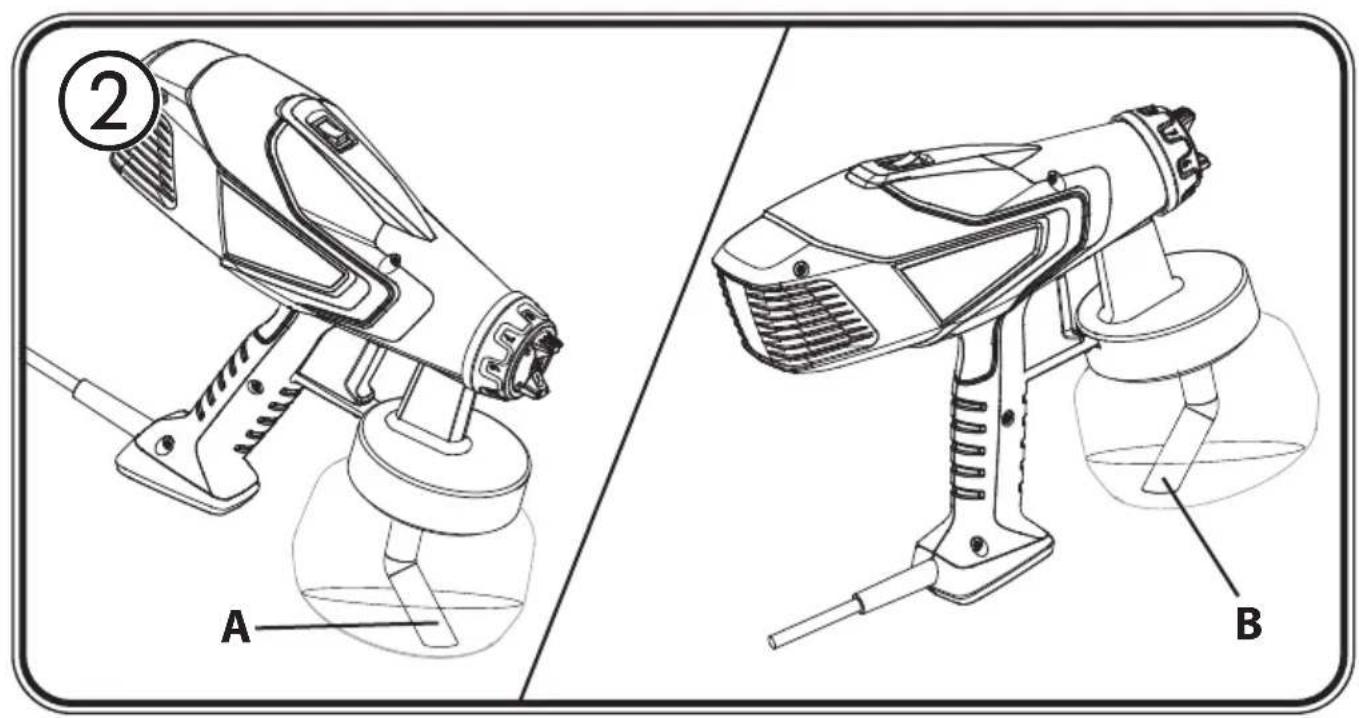
• Aligning suction tube. (Fig. 2)
If the suction tube is positioned correctly, the container contents can be sprayed without almost any residue.
When working on lying objects: Turn the suction tube forwards. (Fig. 2 A)
Spraying work when working on overhead objects: Turn the suction tube rearwards. (Fig. 2 B)
- Set the container on a sheet of paper, pour in the prepared coating material and screw the container tightly onto the spray gun.
7. Adjusting the desired Spray Setting

WARNING! Danger of injury! Never pull the trigger guard while adjusting the air cap.
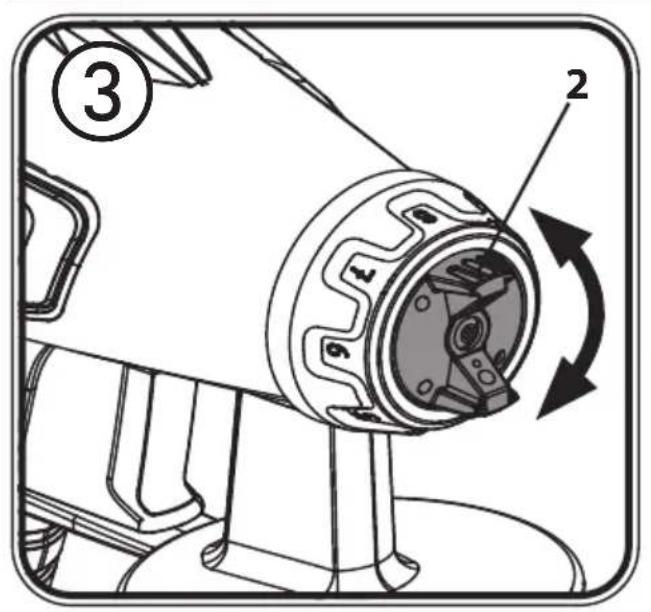
Turn the air cap (fig. 3, 2) to the desired spray setting position (arrow).
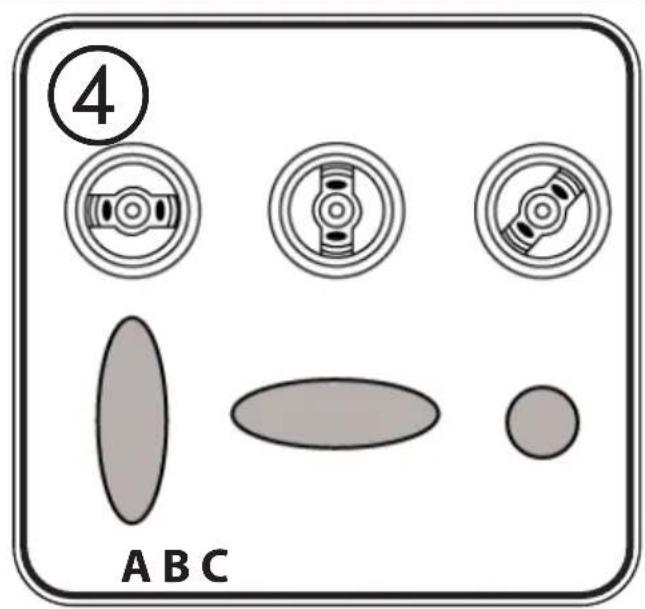
Fig. 4 A = vertical flat jet → for horizontal surfaces
Fig. 4 B = horizontal flat jet → for vertical surfaces
Fig. 4 C = circular jet → for corners, edges and hard-to-reach surfaces
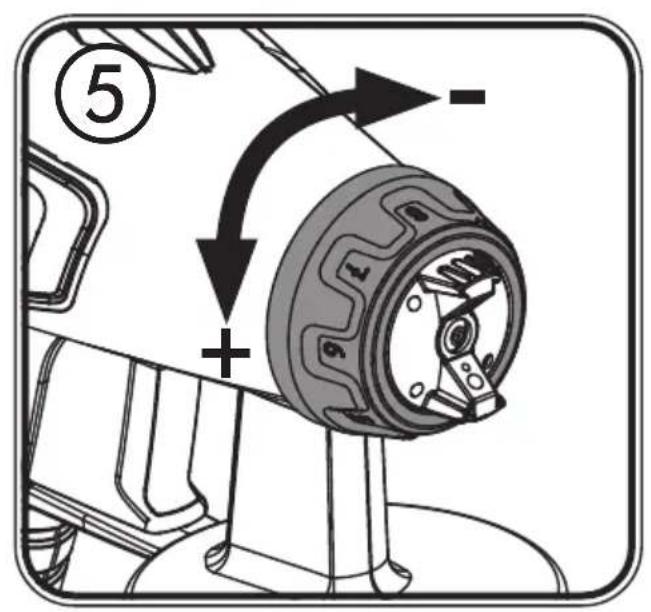
8. Adjusting the Material Volume (Fig. 5)
Adjust the volume of material by turning the union nut from 1 - 8.
9. Spray Technique
- The spray result depends heavily on the smoothness and cleanliness of the surface to be sprayed. Therefore the surface should be carefully prepared and kept free of dust.
- Cover all surfaces not to be sprayed.
- It is advisable to test the spray gun on cardboard or a similar surface to find the correct setting.
Important: Begin spraying outside of the target area and avoid interruptions inside the target area.
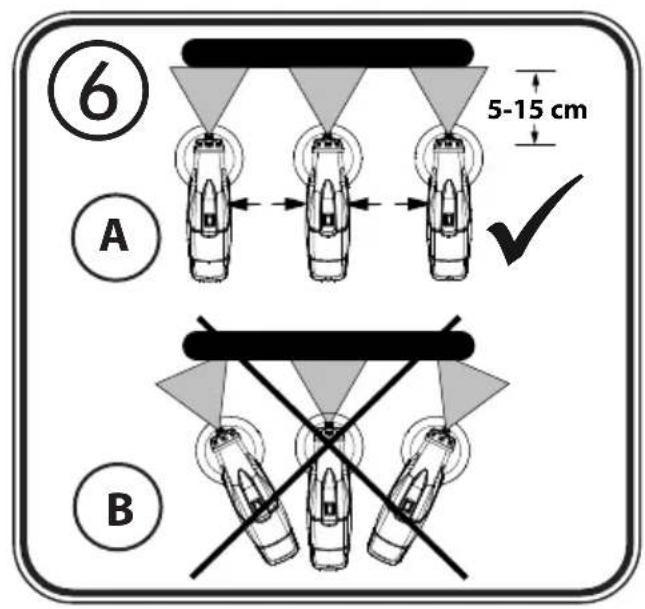
- Correct (Fig. 6a) Be sure to hold the spray gun at an even distance of approx. 5 - 15 cm to the target object.
- Incorrect (Fig. 6b) Heavy spray fog build-up, uneven surface quality.
10. Taking Out of Operation and Cleaning
Proper cleaning is the prerequisite for problem-free operation of the paint application device. No warranty claims are accepted in case of improper or no cleaning. When processing 2-component varnishes, clean the device immediately.

WARNING! Never hold the spray gun rear part under water or immerse it into liquids. Clean the housing only with a moistened cloth.
1) Turn off the machine and remove the plug.
2) Unscrew the container. Empty any remaining coating material back into the material tin.
3) Pull out the suction tube with container seal.
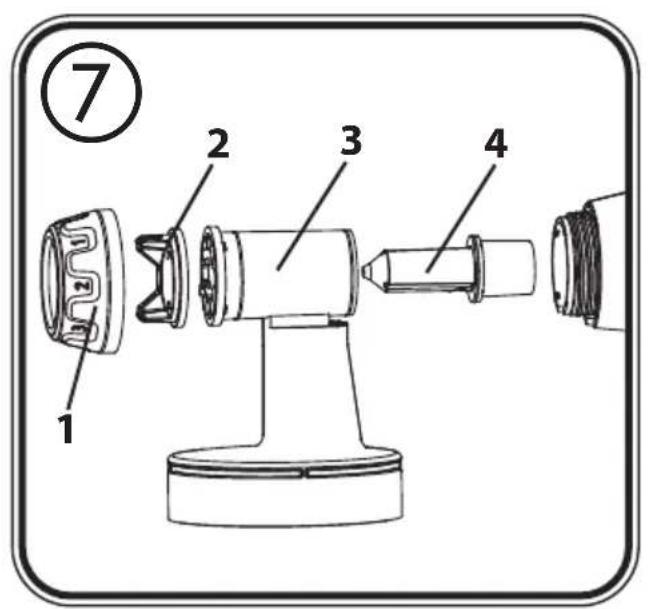
4) Turn the union nut (Fig. 7, 1) beyond the lock at level 1 to remove it. Remove the air cap (2) and pull out the front section of the gun (3). Pull the nozzle (4) out of the front part of the spray gun.
CAUTION! Never clean the spray gun with metal objects.
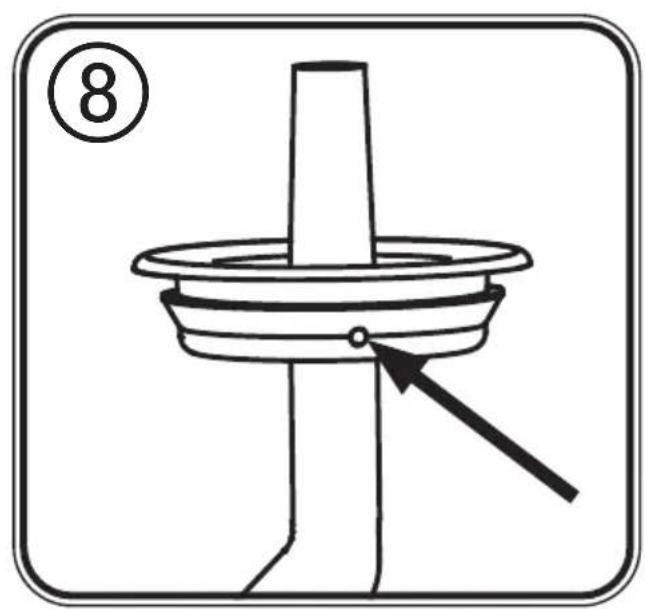
5) Clean all parts carefully using a brush and water or solvent (depending on the material being processed). Take particular care to ensure that the ventilation hole (Fig. 8) is clear.
Assembly
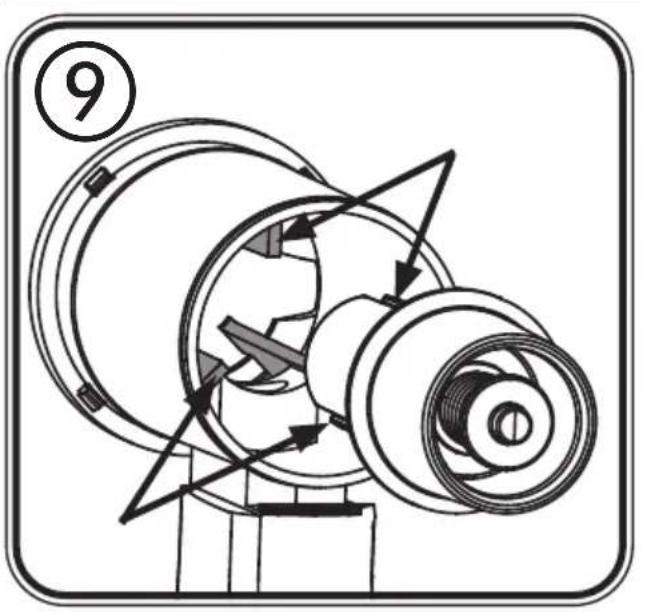
1) Insert the nozzle (Fig. 9) into the gun body so that the slots in the nozzle engage in the gun body's 3 guide rails.
2) Put the air cap onto the nozzle and tighten it using the union nut.
3) Place the container seal from below on the suction tube and slide it over the collar, while turning the container seal slightly.
4) Insert the suction tube with container seal in the gun body.
11. Maintenance

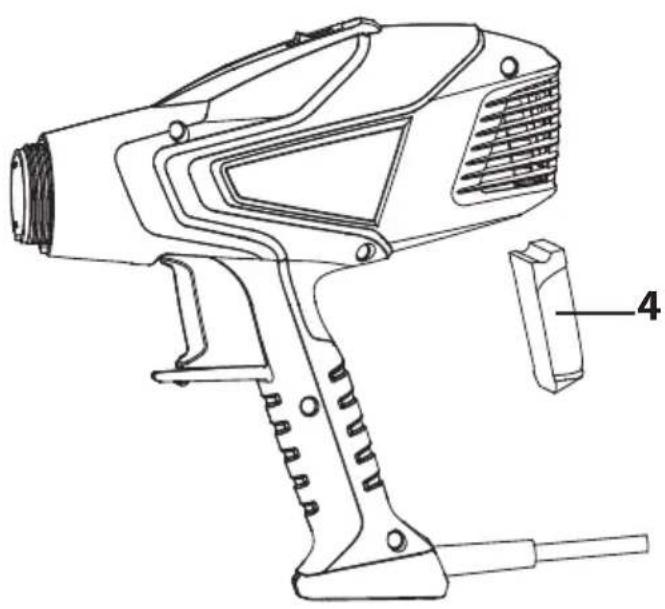
WARNING! Never operate the machine without the air filter; dirt could be sucked in and interfere with the function of the machine. Disconnect plug before changing parts.
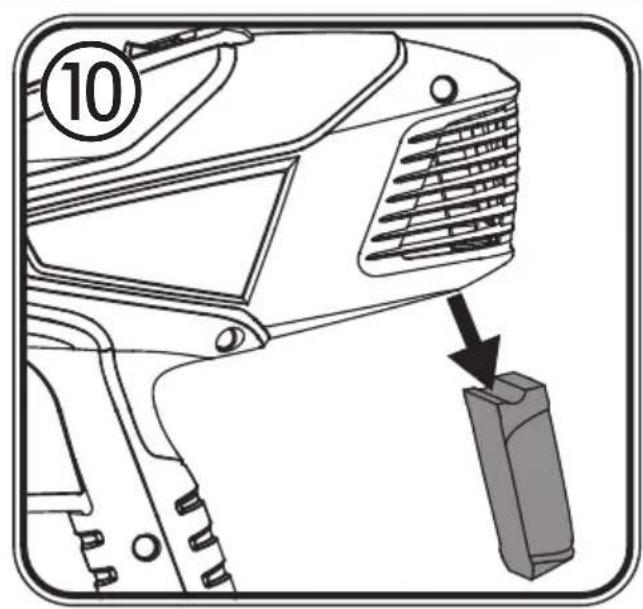
- Pull the air filter out of the gun and re-insert cleaned or new air filters (Fig. 10).
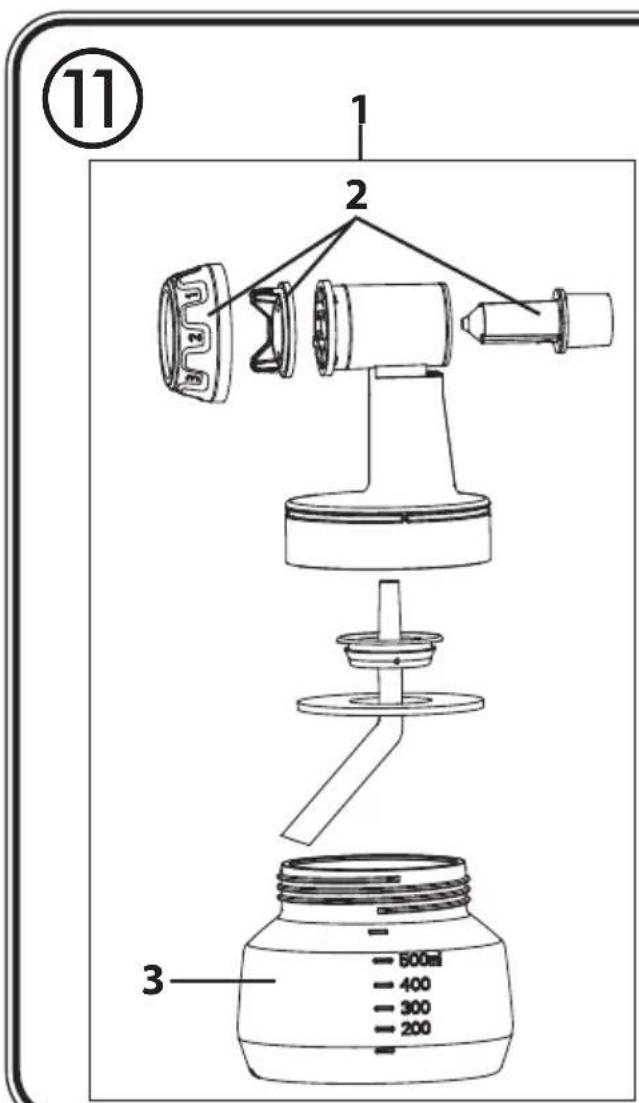
12. Spare Parts List
| Spare Parts List (Fig. 11) | ||
| Pos. Designation Order No. | ||
| 1 Spray gun front part complete incl. 600 ml container 2414440 | ||
| 2 Set comprising union nut, air cap, nozzle 2414442 | ||
| 3 Container with cover 2370528 | ||
| 4 Air filter 2414439 | ||
13. Correction of Malfunctions
| Problem | Cause | Remedy |
| No coating material emerges from the nozzle | Nozzle cloggedFeed tube cloggedMaterial volume too smallNo pressure build-up in container | CleanCleanIncrease the material volumeTighten container |
| Coating material drips from the nozzle | Nozzle worn | Change |
| Atomisation too coarse / Spray jet pulsates | Viscosity of coating material too highMaterial volume too largeNozzle contaminatedAir filter heavily soiledToo little pressure build-up in container | ThinReduce the material volumeCleanChangeTighten container |
| Too much fog of coating material (Overspray) | Distance to the object too largeMaterial volume too large | Reduce distanceReduce the material volume |
14. Technical Data
| Technical Data | |
| Max. viscosity 100 DIN-s | |
| Power source 230 V | ~, 50 Hz |
| Power consumption 350 W | |
| Protection Class I | |
| Max. flow rate 150 ml/min | |
| Sound pressure level* | 75 dB (A); Uncertainty K = 4 dB |
| Sound pressure output* | 86 dB (A); Uncertainty K = 4 dB |
| Oscillation level* | < 2.5 m/s ^2 ; Uncertainty K = 1.5 m/s ^2 |
| Weight | 1.2 kg |
* Measured in accordance with EN 50580:2014
Information about the oscillation level
The specified oscillation level has been measured according to a standard test procedure and can be used to compare against electric tools.
The oscillation level is also for determining an initial assessment of the vibrational strain.
Attention! The vibration emission value can differ from the specified value when the electric tool is actually in use, depending on how the electric tool is being used. It is necessary to specify safety measures to protect the operating personnel. These measures are based on an estimated shutdown during the actual conditions of use (all parts of the operating cycle are taken into consideration here, for example periods when the electric tool is switched off, and, when it is switched on but running without any load).
15. Environmental protection
The device and all accessories and packaging have to be recycled in an environmentally friendly manner. Do not dispose of the appliance with household waste. Support environmental protection by taking the appliance to a local collection point or obtain information from a specialist retailer. Leftover paint and solvents may not be emptied into drains, the sewage system or disposed of as household rubbish. It has to be disposed of separately as special waste. Please pay special attention to the instructions on the product packaging.
16. Important Note regarding Product Liability!
According to an EU directive, the manufacturer is only liable without limitation for faults in the product if all parts come from the manufacturer or have been approved by the manufacturer and have been mounted to the device and are operated properly. If third-party accessories or spare parts are used, the manufacturer is exonerated wholly or partly from his/her liability if use of the third-party accessories or spare parts have caused a defect in the product.
3+1 years guarantee
The guarantee runs for three years, counting from the date of sale (sales slip). The guarantee is extended by a further 12 months if the device is registered online within 4 weeks of the purchase at www.wagner-group.com/3plus1. Registration is only possible if the buyer is in agreement with the data being stored that is entered during registration. The guarantee covers and is restricted to free-of-charge rectification of faults which are demonstrably attributable to the use of faulty materials in manufacture, or assembly errors; or free-of-charge replacement of the defective parts. The guarantee does not cover incorrect use or commissioning or fitting or repair work which is not stated in our operating instructions. Wearing parts are also excluded from the guarantee. The guarantee excludes commercial use. We expressly reserve the right to fulfil the guarantee. The guarantee expires if the tool is opened up by persons other than WAGNER service personnel. Transport damage, maintenance work and loss and damage due to faulty maintenance work are not covered by the guarantee. Under any guarantee claim, there must be proof of purchase of the tool through submission of the original receipt. Wherever legally possible, we exclude all liability for injury, damage or consequential loss, especially if the tool has been used for a purpose other than that stated in the operating instructions, commissioned or repaired other than in accordance with our operating instructions or if repairs are performed by someone who is unqualified. We reserve the right to perform any repairs in excess of those stated in our operating instructions. In case of guarantee or repair, please refer to your point of sale.
EU Declaration of conformity
We declare under sole responsibility that this product conforms to the following relevant stipulations:
2006/42/EC, 2014/30/EU, 2011/65/EU, 2012/19/EU
Applied harmonised norms:
EN 60745-1, EN 50580, EN 62233, EN 55014-1, EN 55014-2, EN 61000-3-2, EN 61000-3-3
The EU declaration of conformity is enclosed with the product.
If required, it can be re-ordered using order number 2419203.
Warning
If the supply cord of this appliance is damaged, it must only be replaced by a repair shop appointed by the manufacturer, because special purpose tools are required.
The wires in this mains lead are coloured in accordance with the following code:
$$ \begin{array}{c} \text {green / yellow = earth} \ \text {blue = neutral brown = live} \end{array} $$
As the colours of the wires in the mains lead of this appliance may not correspond with the coloured markings identifying the terminals in your plug, proceed as follows:
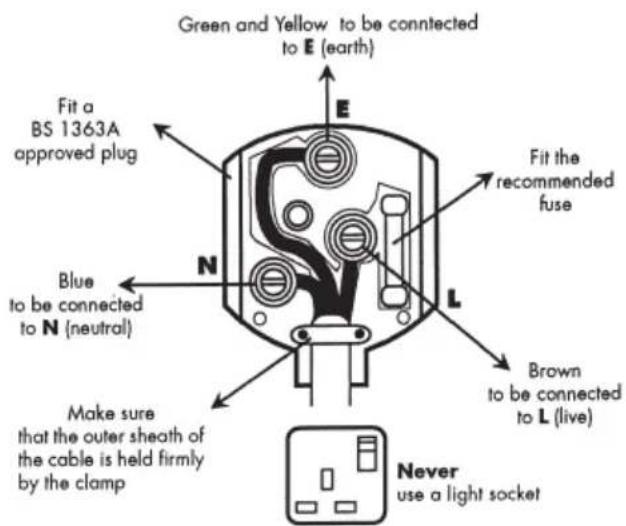
- The wire which is coloured green and yellow must be connected to the terminal in the plug which is marked with the letter E or by the earth symbol or coloured green or green and yellow.
- The wire which is coloured blue must be connected to the terminal which is marked with the letter N or coloured black.
- The wire which is coloured brown must be connected to the terminal which is marked with the letter L or coloured brown.
- Should the moulded plug have to be replaced, never re-use the defective plug or attempt to plug it into a different 13 A socket. This could result in an electric shock.
- Should it be necessary to exchange the fuse in the plug only use fuses approved by ASTA in accordance with BS 1362. Only 13 Amp fuses may be used.
- To ensure that the fuse and fuse carrier are correctly mounted please observe the provided markings or colour coding in the plug.
- After changing the fuse, always make sure that the fuse carrier is correctly inserted. Without the fuse carrier, it is not permissible to use the plug.
- The correct fuses and fuse carriers are available from your local electrical supplies stockist.
41-605 Swietochlowice
T+48/32/346 37 00
F +48/32/346 37 13
SCH
ORKLA HOUSE CARE AB
Box 133
564 23 Bankeryd
Sweden
T +46(0)36 37 63 00
ROM
ROMIB S.R.L.


- WOOD & METAL SPRAYER
- W 125
- Inhalt
- Translation of the original operating instructions
- Contents
- Explanation of symbols used
- General Safety Instructions
- Caution!
- Safety at the workplace
- Electrical Safety
- Safety of Persons
- Usage and treatment of the electric tool
- Service
- Safety Instructions for Spray Guns
- CAUTION: DANGER OF INJURY!
- Description/ Scope of delivery
- Coating Materials
- Start-up
- Adjusting the desired Spray Setting
- Adjusting the Material Volume (Fig. 5)
- Spray Technique
- Taking Out of Operation and Cleaning
- Assembly
- Maintenance
- Spare Parts List
- Correction of Malfunctions
- Technical Data
- Information about the oscillation level
- Environmental protection
- Important Note regarding Product Liability!
- 3+1 years guarantee
- EU Declaration of conformity
- Warning
- ORKLA HOUSE CARE AB
- ROMIB S.R.L.
Brand : WAGNER
Model : W 125
Category : Paint spray