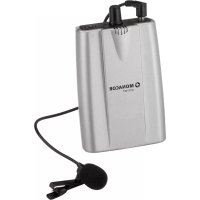
ATS16T - Receiver Monacor - Free user manual and instructions
Find the device manual for free ATS16T Monacor in PDF.



| Product Type | Wireless Audio Receiver |
| Brand | Monacor |
| Model | ATS-16R (Receiver) |
| Use | Portable wireless transmission system for speech and music (guided tours, conferences) |
| Radio Frequency | 863–865 MHz |
| Number of Channels | 16 (selectable) |
| Range | Approx. 110 m |
| Power Supply | 2 NiMH rechargeable batteries 1.2 V (included) or 2 R6 1.5 V batteries, or 5 V DC power adapter |
| Battery Life | Approx. 6 to 8 hours (depending on use) |
| Dimensions (W × H × D) | 66 × 111 × 35 mm |
| Weight (without batteries) | 97 g |
| Housing Material | Plastic |
| Connections | EAR 3.5 mm jack socket (earphone), AUX OUT 3.5 mm stereo jack socket (line out), DC IN 5 V socket |
| LED Indicators | LED RX (green/red): signal received / low battery; LED PL (red): battery discharged |
| Settings | Channel selection dial (0-F), On/Off switch and volume |
| Included Accessories | Earphone ES-16 (mono, 32 Ω, 1.2 m cable), belt clip, 2 NiMH rechargeable batteries |
| Optional Accessories | Acoustic tube ET-16, charging station ATS-16PS, charging case ATS-36C, carrying bag ATS-16BAG, cable ATS-16CORD |
| Operating Temperature | 0 – 40 °C |
| Maintenance | Clean with a dry, soft cloth, without chemicals or water |
| Safety | Indoor use only. Protect from moisture and heat. Remove batteries if not used for extended periods. |
| Approval | Complies with Directive 2014/53/EU (CE). Authorized in the EU and EFTA. |
Frequently Asked Questions - ATS16T Monacor
User questions about ATS16T Monacor
0 question about this device. Answer the ones you know or ask your own.
Ask a new question about this device
Download the instructions for your Receiver in PDF format for free! Find your manual ATS16T - Monacor and take your electronic device back in hand. On this page are published all the documents necessary for the use of your device. ATS16T by Monacor.
USER MANUAL ATS16T Monacor
English ...... Page 8
Français....Page 12
Italiano ...... Pagina 16
natural_image
Mechanical assembly diagram showing a suspended component with rope and clamp (no text or symbols)Audio Transmission System
These instructions are intended for users without any specific technical knowledge. Please read the instructions carefully prior to operation and keep them for later reference. All operating elements and connections described can be found on the fold-out page 3.
1 Operating Elements and Connections
(fig. 1: transmitter, fig. 2: receiver)
1 Bicolour power LED:
shows green during operation on the transmitter: to indicate transmission of a radio signal; on the receiver: to indicate reception of a radio signal from the transmitter; when it changes to red, the batteries are almost discharged
2 Red battery status LED
lights up when the batteries are completely discharged
3 Adjusting wheel to select the transmission channel
4 Power switch and volume control
5 On the transmitter:
internal microphone; will be switched off when the jack MIC. (6) or the jack AUX IN (10) is connected
On the receiver:
opening to insert the earphone ET-16*
(acoustic tube with earpiece, will transmit the sound of the internal speaker directly to your ear)
6 On the transmitter:
3.5 mm jack MIC. to connect the supplied tie clip microphone or the neck microphone ECM-16N ^* ; this microphone input will be switched off when the jack AUX IN (10) is connected
*available as an accessory
On the receiver:
3.5 mm jack EAR. to connect the supplied ear-phone; the internal speaker will be switched off when the jack is connected
7 Belt clip
8 Battery compartment cover
9 Contacts to charge the inserted rechargeable batteries via the charging station ATS-16PS* or the charging case ATS-36C*
10 On the transmitter:
line level input jack AUX IN (3.5 mm jack, mono) to connect an audio unit (e. g. CD player)
On the receiver:
line level output jack AUX OUT (3.5 mm jack, stereo) to connect an amplifier
11 Power supply jack to connect a power supply unit with an output voltage of 5V , as an alternative to operation via batteries dimensions of the connector plug:
3.5/1.3mm(∅ outside / inside), inside contact = positive pole
Attention: When connecting a power supply unit, make sure that the battery compartment is empty.
2 Important Notes
The unit corresponds to all relevant directives of the EU and is therefore marked with C.E.
- The unit is suitable for indoor use only. Protect it against humidity and heat (admissible ambient temperature range 0–40 °C).
- For cleaning only use a dry, soft cloth; never use chemicals or water.
- Always insert two batteries of the same type.
- If the unit is not used for a longer period of time, remove the batteries as a precaution to prevent damage to the unit in case of battery leakage.
- No guarantee claims for the unit and no liability for any resulting personal damage or material damage will be accepted if the unit is used for other purposes than originally intended, if it is not correctly operated or not repaired in an expert way.
If the unit is to be put out of operation definitively, dispose of the unit in accordance with local regulations.
3 Applications
In combination with a receiver or several receivers of the type ATS-16R, the transmitter ATS-16T creates a mobile wireless transmission system for speech and music. This system is ideally suited for any application where the signal of a single audio source is transmitted to several people, e. g. for guided tours or multilingual lectures. For wireless transmission, 16 channels in the frequency range of 863–865 MHz are available.
3.1 Conformity and approval
Herewith, MONACOR INTERNATIONAL declare that the receiver ATS-16R and the transmitter ATS-16T comply with the directive 2014 / 53 / EU. The EU declarations of conformity are available on the Internet: www.monacor.com
The units are generally approved for operation in EU and EFTA countries. The operation of the units is licence-free and requires no registration.
4 Power Supply
The transmitter and the receiver can be supplied with power via (rechargeable) batteries or a 5 V power supply unit.
4.1 (Rechargeable) Batteries
Each unit is supplied with two rechargeable 1.2 V NiMH batteries. For fast and convenient charging of these batteries, the following items are available as accessories:
- charging station ATS-16PS (for charging the batteries of up to 2 transmitters / receivers at the same time)
- transport and charging case ATS-36C (for charging the batteries of up to 36 transmitters / receivers at the same time)
Instead of the rechargeable batteries, two non-rechargeable 1.5 V batteries of size AA may be used.
To insert the batteries:
1) Slightly press the marked area on the battery compartment cover (8) while simultaneously pulling the cover downwards.
2) Insert the batteries with their positive and negative connections as indicated in the compartment.
3) Replace the cover and make sure it engages.
Never put batteries in the household waste. Always dispose of the batteries in accordance with local regulations.
4.2 Power supply unit
Connect a power supply unit with an output voltage of = 5 V and a permanent rating of 150 mA to the jack DC IN 5V (11). For connection, a low-voltage plug of the dimensions 3.5/1.3mm (outside/inside diameter) is required. The positive pole must be at the inside contact of the plug.
Attention: To prevent damage to the batteries or to the transmitter / receiver, always remove the (rechargeable) batteries from the battery compartment before connecting a power supply unit.
5 Selecting the Signal Source
The transmitter can be operated with a microphone, however, a unit with line output level may also be connected.
a) Microphone operation:
– Either use the internal microphone (5)
- or connect an external microphone, the supplied electret tie clip microphone or the neck microphone ECM-16N (available as an accessory) to the jack MIC. (6). When the jack is connected, the internal microphone will be switched off. Place the windshield on the microphone and attach the microphone to your body: attach the tie clip microphone to your clothes (e. g. lapel) via its clip or put the neck microphone around your neck.
b) Operation with an audio unit:
Connect the output of the audio unit (e. g. cassette recorder, CD player) via a 3.5 mm plug to the jack AUX IN (10). When connecting the jack, both the internal microphone and any external microphone connected to the jack MIC. (6) will be switched off.
6 Selecting the Sound Reproduction
The receiver offers different ways to reproduce the sound.
a) Via the internal speaker:
The sound of the speaker can either be radiated freely or be directly transmitted to your ear via the acoustic tube earphone ET-16 available as an accessory. Place the acoustic tube into the opening (5) provided on the receiver and insert the yellow earpiece into your ear in such a way that a tight fit is ensured.
b) Via the supplied earphone:
Connect the earphone to the jack EAR. (6) and attach it to your ear. When connecting the jack EAR., the internal speaker will be switched off.
c) Via an amplifier system:
Connect the amplifier via a 3.5 mm plug to the stereo jack AUX OUT (10).
Note: When connecting the jack AUX OUT, the internal speaker is still switched on. To switch it off, connect a 3.5 mm plug to the jack EAR. (6).
7 Operation
1) With the adjusting wheel (3) on the transmitter, select the channel for transmission from the 16 channels (0 to F): Turn the wheel in such a way that the arrow below it will point to the desired channel (in fig. 1, channel 0 is adjusted as an example).
Set the adjusting wheel (3) on the receiver to the same channel.
2) Attach the units to your clothes, e. g. your belt, via their clips (7).
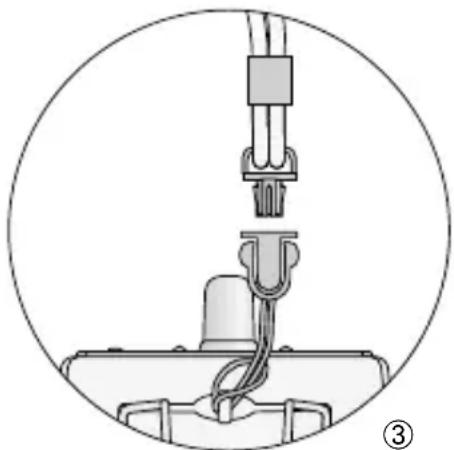
For attaching the units to your body, the following items are available as additional accessories: - ATS-16BAG, protective bag, to be attached to your belt via a loop - ATS-16CORD, neck cord (for attaching it to the unit see fig. 3)
natural_image
Mechanical assembly diagram showing a suspended component with wires and a base, enclosed in a circle (no text or symbols)3) To switch on the units, turn the control (4) clockwise from the position OFF:
On the transmitter, the LED TX (1) shows green to indicate transmission of a radio signal.
On the receiver, the red LED PL (2) briefly lights up first. Then the LED RX (1) shows green to indicate reception of a radio signal from the transmitter. (If it fails to light up, check if the transmitter and receiver have been adjusted to the same channel.)
When the LED TX or RX (1) changes to red, the batteries are almost discharged. When the LED TX or RX is extinguished and the red LED PL (2) lights up instead, the batteries are completely discharged.
4) With the control (4), adjust the volume for the audio signal transmitted on the transmitter and the reproduction volume on the receiver.
5) In case of poor reception or interference please check
a) if the reception can be improved by using a different transmission channel.
b) if the transmitter and the receiver are too far apart.
c) if the reception is disturbed by objects in the transmission path.
6) To switch off the units, set the control (4) to the left stop (OFF):
On the transmitter, the LED PL lights up for a few seconds before it is completely extinguished.
On the receiver, the LED PL flashes briefly.
Note concerning multichannel operation:
The number of channels to be used in parallel depends on the conditions at the place of application (e. g. on interference due to other wireless systems or high-frequency sources such as fluorescent lamps). In ideal conditions, up to eight channels can be operated at the same time without mutual interference. Two examples of a suitable channel selection for four wireless transmission paths:
Example 1:
channel 0 – channel 2 – channel 5 – channel B
Example 2:
channel 5 – channel 8 – channel E – channel F
8 Specifications
Type of system: ....PLL wireless system for audio transmission
Radio frequency range: . . . 863–865 MHz, divided into 16 channels
Range:.... approx. 110 m
Noise suppression: ..... pilot tone and noise squelch
Ambient temperature: . . . 0–40 °C
Power supply for
each unit: ....... via two rechargeable 1.2 V NiMH batteries (supplied) or via two 1.5 V AA batteries or via +5 V at the jack DC IN 5V
Transmitter ATS-16T
Transmitting power: ..... ≤ 10 mW (EIRP)
Audio connections
Microphone:....3.5 mm jack, mono
Line input: 3.5 mm jack, mono
Dimensions (W × H × D): . 66 × 111 × 35 mm
Weight: 81 g (without batteries)
Receiver ATS-16R
Earphone ES-16 (supplied): mono earphone, dynamic 32 Ω system with 1.2 m cable and 3.5 mm plug
Line output:....3.5 mm jack, stereo
Dimensions (W × H × D): . 66 × 111 × 35 mm
Weight: 97 g
(without batteries)
Subject to technical modification.
All rights reserved by MONACOR® INTERNATIONAL GmbH & Co. KG. No part of this instruction manual may be reproduced in any form or by any means for any commercial use.
natural_image
Mechanical assembly diagram showing a suspended component with wires and a base, enclosed in a circle (no text or symbols)natural_image
Mechanical assembly diagram showing a suspended component with wires and a base, enclosed in a circle (no text or symbols)radiofrequenze:....863–865 MHz, suddivisi in 16 canali
Portata: ca. 110 m
natural_image
Diagram of a mechanical assembly with a suspended component and rope, no visible text or symbolsnatural_image
Mechanical assembly diagram showing a suspended component with rope and clamp (no text or symbols)Alcance: ....a prox. 110 m
natural_image
Mechanical assembly diagram showing a suspended component with rope and clamped parts, enclosed in a circle (no text or symbols)Wymiary:....66 × 111 × 35 mm
Waga: ..... 81 g (bez baterii akumulatorowych)
Odbiornik ATS-16R
Słuchawki ES-16
Wymiary:....66 × 111 × 35 mm